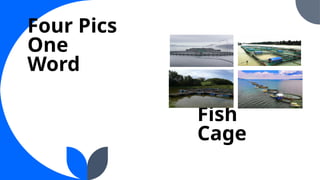
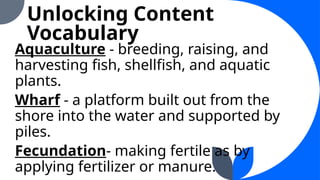
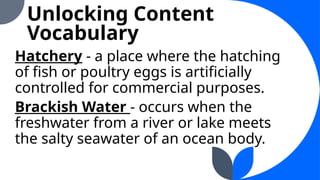
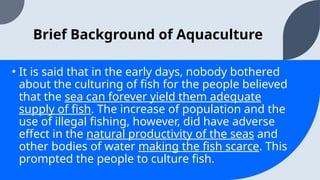
Learning Competency
• Discussthe background of aquaculture and its
relation to fisheries
• Discuss career and business opportunities related
to fisheries
Learning Objectives
At the end of the lesson, the students are expected to:
• 1. Explain the background of aquaculture and its relation to
fisheries
• 2. Describe the types of aquaculture systems
• 3. Identify career and business opportunities related to fisheries
Unlocking Content
Vocabulary
Aquaculture -breeding, raising, and
harvesting fish, shellfish, and aquatic
plants.
Wharf - a platform built out from the
shore into the water and supported by
piles.
Fecundation- making fertile as by
applying fertilizer or manure.
9.
Unlocking Content
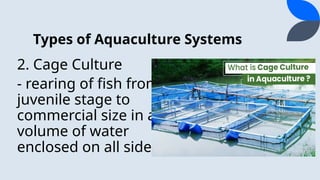
Vocabulary
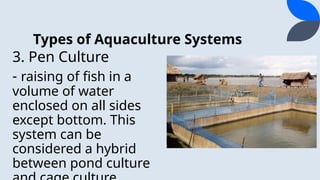
Hatchery -a place where the hatching
of fish or poultry eggs is artificially
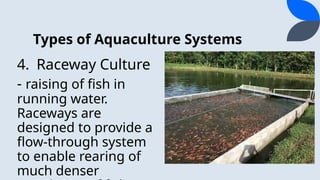
controlled for commercial purposes.
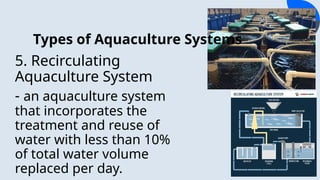
Brackish Water - occurs when the
freshwater from a river or lake meets
the salty seawater of an ocean body.
10.
Brief Background ofAquaculture
• It is said that in the early days, nobody bothered
about the culturing of fish for the people believed
that the sea can forever yield them adequate
supply of fish. The increase of population and the
use of illegal fishing, however, did have adverse
effect in the natural productivity of the seas and
other bodies of water making the fish scarce. This
prompted the people to culture fish.
11.
Brief Background ofAquaculture
•Fish culture was believed to have
started in China. Historical records
reveal that net making and methods
were developed in 2953 B. C. under
the regime of Fu Hi.
12.
Brief Background ofAquaculture
• The Roman considered fish as among the most
highly priced delicacies during the first century
A.D. Fish farming was well attended during this
period but it did not contribute much to the
scientific progress of aquaculture because the
people were more interested in food rather
than in the progress of the industry.
13.
Brief Background ofAquaculture
• The first real inventor of practical fecundation
by artificial means was Jacob of Westphalia. In
England, Leonard Mascall who published "Book
of Fishing" in 1590 is said to be the pioneer of
fish culture. In the United States, early interest
in fishponds was recorded in the diary of Squire
Caroll on August 27, 1792. The gold fish is the
first species of fish reared in the United States.
14.
Brief Background ofAquaculture
•In Indonesia, the origin of fishponds
is not known. Some authors say it
might be of Chinese origin, while
others say it is of Malay origin.
Records of fishponds in government
archives date back from 1821.
15.
Brief Background ofAquaculture
•The most original form of fish
farming practices in Japan is in
seaweeds and pearl culture.
Mikimota is the pioneer in the culture
of pearl oysters, thus he is known as
the king of pearl oyster culture.
16.
Brief Background ofAquaculture
Fish Culture in the Philippines
• In the Philippines, there is no record as to when the
cultivation of fish in pond started. The first
fishponds must have been introduced by the Malay
emigrants long before the Chinese traders came to
the Philippines. Navotas and Malabon are the two
principal towns which may be considered as
pioneers in the fishpond industry in the Philippines.
17.
Brief Background ofAquaculture
Fish Culture in the Philippines
•Dr. Pio Valencia is the pioneer of fish
culture in the Visayas, while Talava,
pioneered oyster culture in our
country.
18.
Brief Background ofAquaculture
Fish Culture in the Philippines
• Scientific fish farming in our country may be
said to have started with the experiments on
milkfish culture in 1940. In the sixties, improved
milkfish culture was applied. To further support
the industry, national and international
research institutions were established in the
early seventies.
19.
Brief Background ofAquaculture
Fish Culture in the Philippines
• Among the leading aquaculture research centers today
are the Southeast Asian Fisheries Development
Center's Aquaculture Department in Tigbuan, Iloilo;
the International Center for Living Aquatic Resources
Management in Makati; the Central Luzon State
University's Freshwater Aquaculture Center in Nueva
Ecija; and the Brackishwater Aquaculture Center of the
University of the Philippines.
20.
Brief Background ofAquaculture
Fish Culture in the Philippines
•Our government has established model fish
farms throughout the country to extend
technical assistance to fish culturists.
•Some operate as fish hatcheries and
nurseries and distribute fingerlings to fish
farmers.
21.
Brief Background ofAquaculture
Fish Culture in the Philippines
• Fishes cultured in freshwaters are tilapia, carp,
catfish, mudfish, and gourami. Milkfish and
prawns are the most important species cultured
in brackishwater ponds. The culture of marine
species is still in the experimental stage. Only a
few species have far been reared in ponds and
pens.
22.
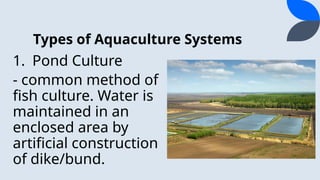
Types of AquacultureSystems
1. Pond Culture
- common method of
fish culture. Water is
maintained in an
enclosed area by
artificial construction
of dike/bund.
23.
Types of AquacultureSystems
2. Cage Culture
- rearing of fish from
juvenile stage to
commercial size in a
volume of water
enclosed on all sides.
24.
Types of AquacultureSystems
3. Pen Culture
- raising of fish in a
volume of water
enclosed on all sides
except bottom. This
system can be
considered a hybrid
between pond culture
25.
Types of AquacultureSystems
4. Raceway Culture
- raising of fish in
running water.
Raceways are
designed to provide a
flow-through system
to enable rearing of
much denser
26.
Types of AquacultureSystems
5. Recirculating
Aquaculture System
- an aquaculture system
that incorporates the
treatment and reuse of
water with less than 10%
of total water volume
replaced per day.
27.
The Ultimate Quiz
Challenge!
Theclass will be divided into three.
You will answer questions regarding “Fish Culture in the
Philippines”
Each group who answered correctly will be given points.
The group with the highest points will be declared as
the winner.
Item No.
2
What arethe two principal
towns which may be
considered as pioneers in
the fishpond industry in the
Philippines?
Answer: Malabon and
Navotas
30.
Item No.
3
Who isthe pioneer of
fish culture in the
Visayas?
Answer: Dr. Pio Valencia
31.
Item No.
4
Who isthe pioneer of
oyster culture in our
country?
Answer: Talava
Learning Competency
• Discussthe background of aquaculture and its
relation to fisheries
• Discuss career and business opportunities related
to fisheries
Learning Objectives
At the end of the lesson, the students are expected to:
• 1. Explain the background of aquaculture and its relation to
fisheries
• 2. Describe the types of aquaculture systems
• 3. Identify career and business opportunities related to fisheries
Aqua Culturist
An individualspecializes in
the practice of aquaculture,
which involves the
breeding, rearing, and
harvesting of aquatic
organisms such as fish,
shellfish, and aquatic
plants.
42.
Fishery Technician
A professionalwho works in
the field of fisheries
management and
conservation. Their
responsibilities include data
collection, fisheries
monitoring and habitat
restoration.
Fish Farm Aide/Worker
Theirresponsibilities may
include a variety of tasks
related to the maintenance
and operation of the fish
farm like feeding, water
quality monitoring, cleaning
and maintenance and
harvesting
45.
Fishery Facilities Repairand
Maintenance Worker
Ensure that fishery
operations run smoothly
and efficiently. Their
responsibilities are
repairing equipment,
maintaining infrastructure,
electrical work, plumbing
and pipework etc.
Fish Wharf Operator
Theirrole revolves around
managing and overseeing
the operations of a fish
wharf, which is a facility
where fishing vessels
unload their catch, and
where fish are sorted,
processed, and distributed.
Fish Farm Owner(hatchery,
nursery, and grow-out)
A fish farm owner is an
individual or entity
that owns and
operates a fish farm or
aquaculture facility.
51.
Fish Distributor
Facilitate thedistribution
of fish and seafood
products from suppliers
to various customers,
including retailers,
restaurants, wholesalers,
and consumers.
52.
Fish Handler
Primary responsibilityis
to handle fish and
seafood products
efficiently and safely
throughout various
stages of processing,
packaging, and
53.
Fish Trader
Primary responsibilityis to buy
and sell fish and seafood
products for commercial
purposes. They will be involved
in sourcing fish from suppliers,
negotiating prices, managing
inventory, and selling to
customers, such as
wholesalers, retailers,
restaurants, and consumers.
54.
• The classwill be divided into 4.
• Members in each team will take
turns in answering.
• Each Participant will write their
answer in a sheet of paper.
• Participant to answer correctly
will be given points.
BLIND ITEM!
SINETCH
ITEY???
55.
Responsible for theday-to-day
care and maintenance of fish
stocks in aquaculture facilities.
Fish
Farm
Caretak
er
NO.1
56.
Responsible for theday-to-day
care and maintenance of fish
stocks in aquaculture facilities.
Fish Farm
Caretaker
NO.1
57.
An individual orentity that owns
and operates a fish farm or
aquaculture facility.
Fish
Farm
Owner
NO.2
58.
An individual orentity that owns
and operates a fish farm or
aquaculture facility.
Fish Farm
Owner
NO.2
59.
An individual specializesin the practice of
aquaculture, which involves the breeding,
rearing, and harvesting of aquatic
organisms such as fish, shellfish, and
aquatic plants.
Aqua
Culturi
st
NO.3
60.
An individual specializesin the practice of
aquaculture, which involves the breeding,
rearing, and harvesting of aquatic
organisms such as fish, shellfish, and
aquatic plants.
NO.3
Aqua
Culturist
61.
Primary responsibility isto handle fish and
seafood products efficiently and safely
throughout various stages of processing,
packaging, and distribution.
Fish
Handle
r
NO.4
62.
Primary responsibility isto handle fish and
seafood products efficiently and safely
throughout various stages of processing,
packaging, and distribution.
NO.4
Fish
Handler
63.
Their responsibilities mayinclude a variety of
tasks related to the maintenance and operation
of the fish farm like feeding, water quality
monitoring, cleaning and maintenance and
harvesting.
Fish
Farm
Aide/
Worker
NO.5
64.
Their responsibilities mayinclude a variety of
tasks related to the maintenance and operation
of the fish farm like feeding, water quality
monitoring, cleaning and maintenance and
harvesting.
NO.5
Fish Farm
Aide/ Worker
65.
Facilitate the distributionof fish and
seafood products from suppliers to various
customers, including retailers, restaurants,
wholesalers, and consumers.
Fish
Distrib
utor
NO.6
66.
Facilitate the distributionof fish and
seafood products from suppliers to various
customers, including retailers, restaurants,
wholesalers, and consumers.
NO.6
Fish
Distribut
or
67.
Conduct research aimedat advancing
knowledge and improving practices
within the aquaculture industry.
Resear
ch
Officer
NO.7
68.
Conduct research aimedat advancing
knowledge and improving practices
within the aquaculture industry.
NO.7
Research
Officer
69.
Primary responsibility isto buy and sell fish and seafood
products for commercial purposes. They will be involved
in sourcing fish from suppliers, negotiating prices,
managing inventory, and selling to customers, such as
wholesalers, retailers, restaurants, and consumers.
Fish
Trader
NO.8
70.
Primary responsibility isto buy and sell fish and seafood
products for commercial purposes. They will be involved
in sourcing fish from suppliers, negotiating prices,
managing inventory, and selling to customers, such as
wholesalers, retailers, restaurants, and consumers.
NO.8
Fish Trader
71.
A professional whoworks in the field of
fisheries management and conservation.
Their responsibilities include data
collection, fisheries monitoring and habitat
restoration.
Fishery
Technic
ian
NO.9
72.
A professional whoworks in the field of
fisheries management and conservation.
Their responsibilities include data
collection, fisheries monitoring and habitat
restoration.
NO.9
Fishery
Technician
73.
Their role revolvesaround managing and
overseeing the operations of a fish wharf, which
is a facility where fishing vessels unload their
catch, and where fish are sorted, processed, and
distributed.
Fish
Wharf
Operat
or
ITEM NO.10
74.
Their role revolvesaround managing and
overseeing the operations of a fish wharf, which
is a facility where fishing vessels unload their
catch, and where fish are sorted, processed, and
distributed.
ITEM NO.10
Fish Wharf
Operator