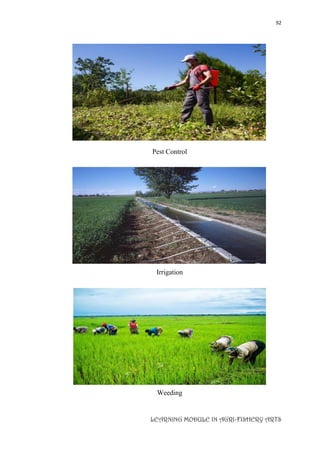
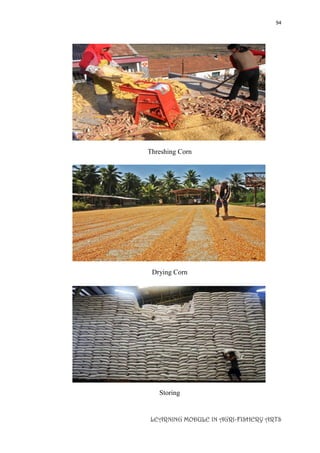
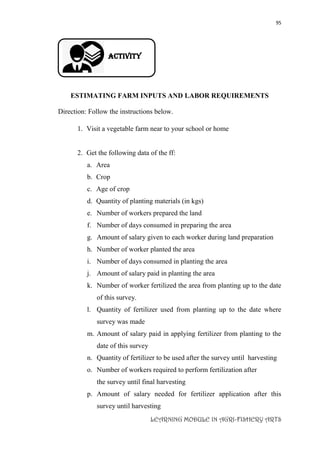
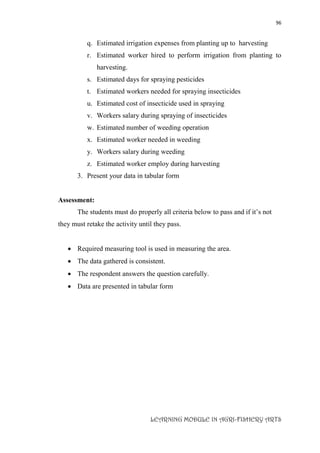
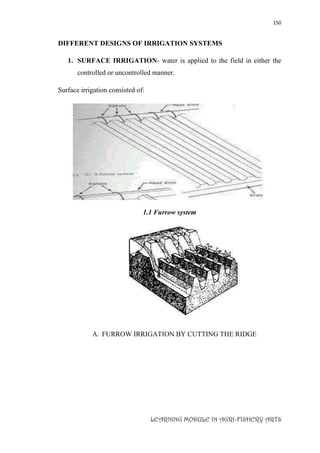
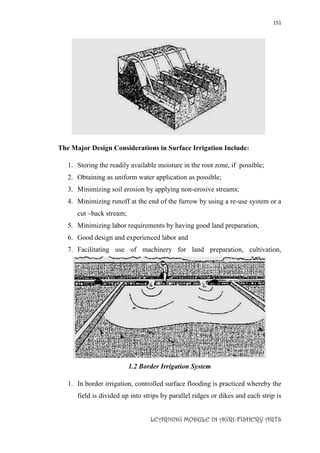
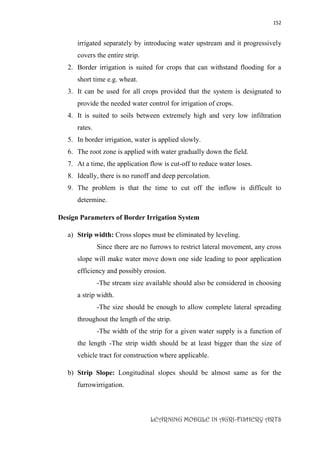
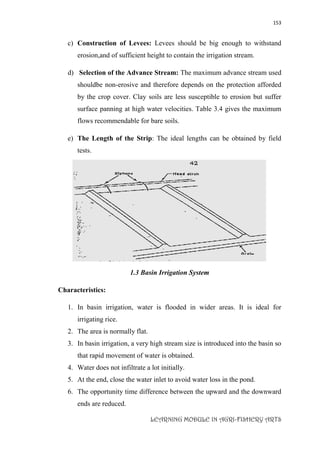
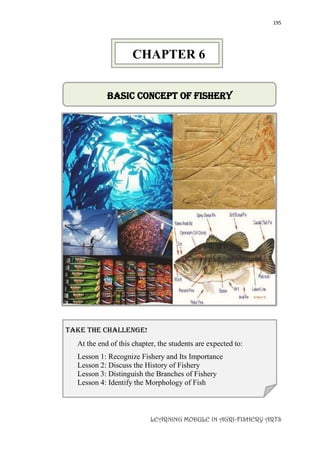
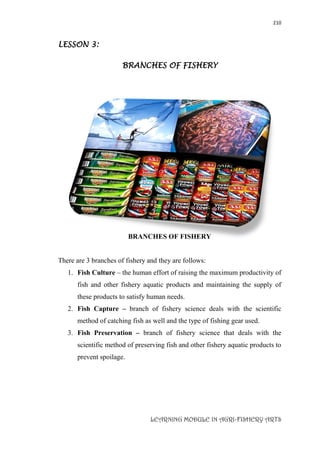
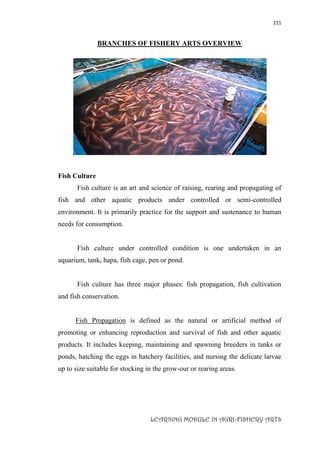
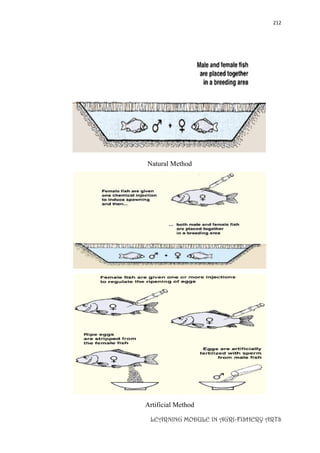
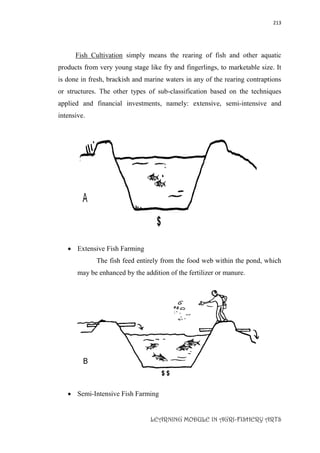
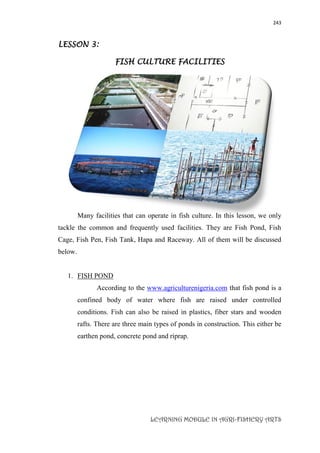
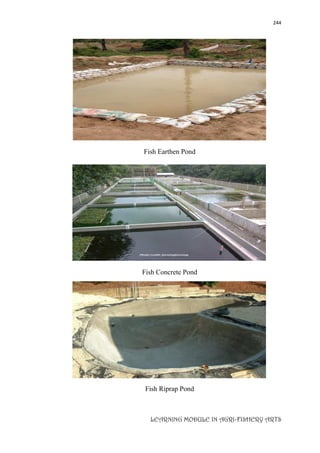
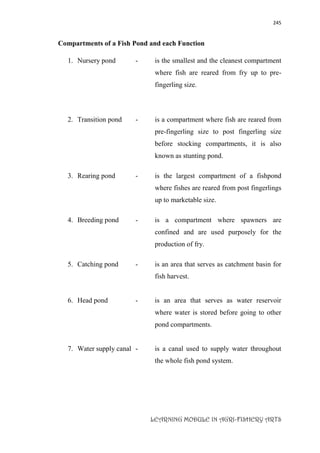
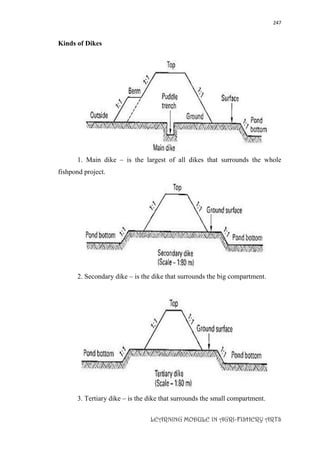
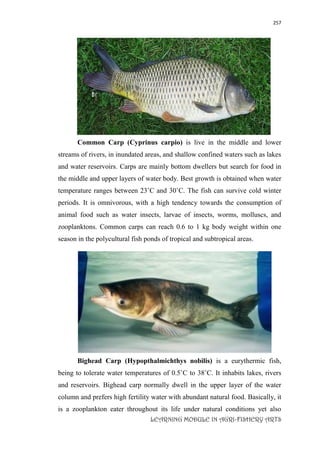
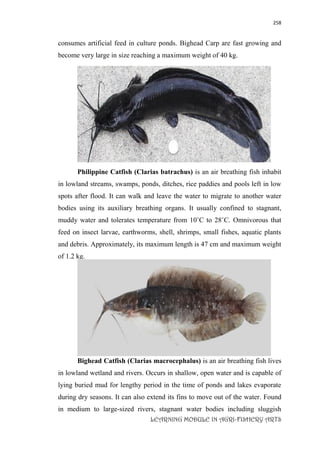
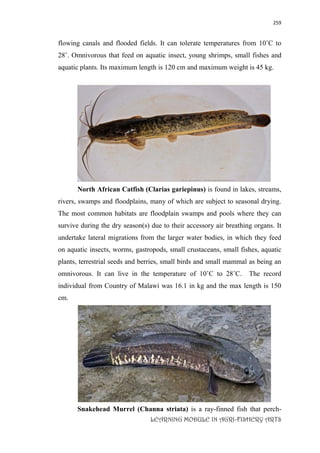
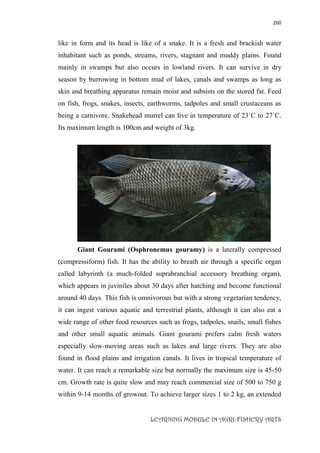
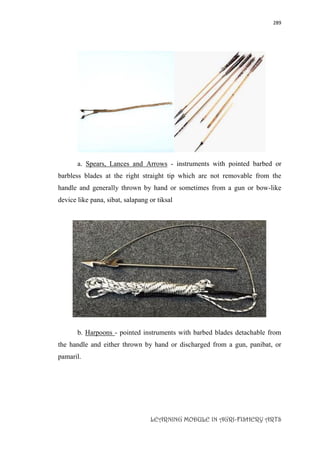
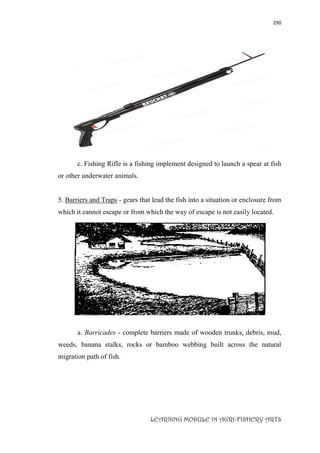
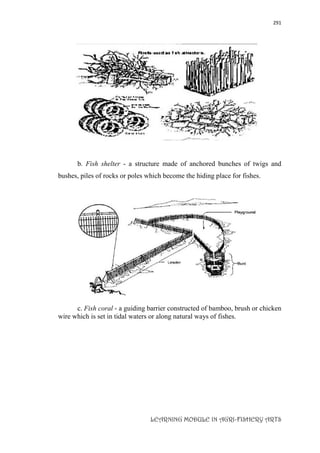
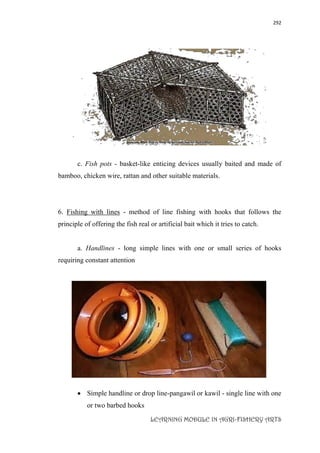
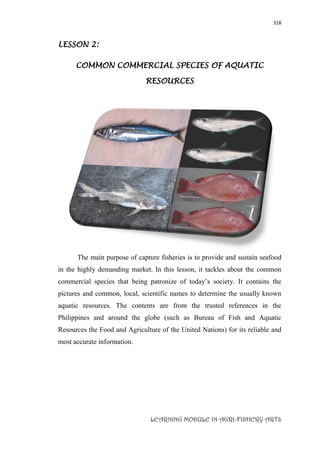
LEARNING MODULE IN AGRI-FISHERY ARTS
Republic of the Philippines
Batangas State University Balayan Campus
Caloocan, Balayan, Batangas
AGRI-FISHERY ARTS
LEARNING MODULE
ii
LEARNING MODULE IN AGRI-FISHERY ARTS
ACKNOWLEDGEMENT
This Learning Module was developed for all students of Bachelor of Science in
Industrial Education Major in Industrial Arts, Bachelor of Technical-
Vocational Teacher Education, and for those people who were hungry and
thirsty in knowledge about Agriculture and Fishery Arts.
This Learning Module in Agri-Fishery Arts was perseveringly developed by
the following researchers:
MODULE WRITERS
Aljohn S. Bituin
Rosalie R. Calisura
Lady Len A. Fabricante
Aljer V. Lagus
ADVISER/CO-AUTHOR
Mr. Melecio Joseph B. Bo
Fishery Technologist/Instructor III
iii
LEARNING MODULE IN AGRI-FISHERY ARTS
What Is This
Module About?
Welcome to the Agri-Fishery Arts!
In order to make the learning easier, we developed this learning module
in Agri-Fishery Arts that will guide the students to know better in a faster yet
competitive way. This learning module will may serves as reference to the
teacher and student in the exciting journey of knowing and acquiring factual
knowledge in the field of Agriculture and Fishery sector.
The purpose of this module is to give knowledge for all students about
Agri-Fishery Arts subject as part of the curriculum of Bachelor of Science in
Industrial Education students and also in the new curriculum of Bachelor in
Technical-Vocational Teacher Education which is the Introduction to Agri-
Fishery Arts.
This module covers nine (9) chapters that were composed of twenty-
eight (28) lessons. They are including in the following:
Chapter One: Basic Concept of Agricultural Crop – Lesson 1: Define
and Appreciate Agriculture, Lesson 2: Brief History of Agriculture, Lesson 3:
Branches of Agriculture, Lesson 4: Types of Agricultural Crops, Lesson 5:
Types of Commercial Food Crops in the Philippines, Lesson 6: Parts of the
Plant and Its Function.
Chapter Two: Farm Tools, Equipments, Inputs and Labor – Lesson 1:
Recognize and Select Farm Tools, Lesson 2: Identify and Select Farm
Equipments, Lesson 3: Perform Maintenance, Lesson 4: Farm Inputs and
Labor.
iv
LEARNING MODULE IN AGRI-FISHERY ARTS
Chapter Three: Basic Calculation – Lesson 1: Perform Basic Workplace
Calculation.
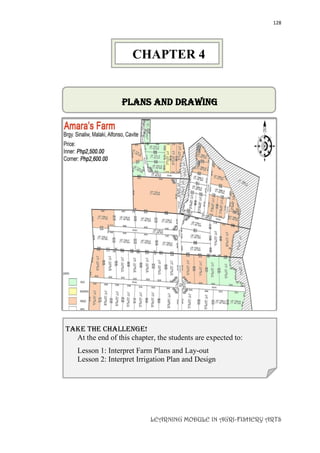
Chapter Four: Plans and Drawings – Lesson 1: Farm Plans and Lay-
Out, Lesson 2: Irrigation Plan and Design.
Chapter Five: Apply Safety Measures in Farm Operations – Lesson 1:
Safety Measures in Farm Operations, Lesson 2: Safe Keep/Dispose Materials
and Outfit.
Chapter Six: Basic Concept of Fishery – Lesson 1: Definition of Fishery
and Its Importance, Lesson 2: History of Fishery, Lesson 3 Branches of
Fishery, Lesson 4: Morphology of Fish.
Chapter Seven: Fish Culture – Lesson 1: Aspects, Classification and
Methods of Fish Culture, Lesson 2: Terminologies in Fish Culture, Lesson 3:
Facilities, Parts of Fish Pond and their Functions, Lesson 4: Cultivable Fish and
Crustacean Species
Chapter Eight: Fish Capture – Lesson 1: Fishing Methods, Gears,
Construction, Operation, Proper Handling and Safety Measures, Lesson 2:
Common Commercial Species of Aquatic Species
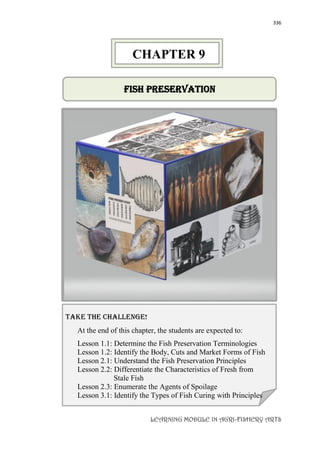
Chapter Nine: Fish Preservation – Lesson 1: Fish Preservation
Terminologies, Fish Body, Cuts and Market Forms, Lesson 2: Fish
Preservation Principles, Characteristics of Fresh from Stale Fish, Agents of
Spoilage, Lesson 3: Types of Fish Curing with their Principles, Methods of
Cutting Fish and Tools and Equipments.
This learning module aims to give students accurate and reliable
information in Agriculture and Fishery Arts to apply the ability and skills
v
LEARNING MODULE IN AGRI-FISHERY ARTS
required for the cultivation and development of natural resources of the
Philippines. It will surely help the students to understand more the purpose and
importance of Agri-Fishery Arts in the everyday lives.
vi
LEARNING MODULE IN AGRI-FISHERY ARTS
How Do You Use
This Module?
This Module has nine Chapters and each has the following parts:
 Title
 Learning Outcomes
 Pre-Test
 Definition of Terms
 Lesson Proper
 Activity
 Post-Test
 Answer Key (at the later part of the module)
To get the most learning from this module, you need to comply the following:
1. Begin by analysing the chapter picture, then reading and understanding
the Learning Outcomes. These will show what you should know and be
able to do at the end of this module.
2. Find out what you already know by taking the Pre-Test then check it
with the use of answer key. If you get perfect score in each item, now
you may proceed to the next chapter. This means that you don’t have to
go through the entire chapter because you already acquired the
knowledge supposed to teach you. On the other hand, if you failed to get
a perfect score in each items correctly, you must proceed and study well
vii
LEARNING MODULE IN AGRI-FISHERY ARTS
the information in the lesson especially to the points where you don’t
know.
3. Understand unfamiliar words using the definition of terms.
4. Study well the lesson proper as much as you can. It provides essential
information that you needed to know.
5. Do the required learning activities. This part of the module where the
demonstration and application occurs. Every lesson has an activity
which provides the first-hand experiences if possible and mind-
provoking questions for the newly acquired knowledge to be
strengthened.
6. Take the Post-Test. Check if you can get a perfect score in the
assessment test. After you take, refer to the answer key for correction.
The result of the test will determine how much you learn in the topic.
When you get a perfect score in the Post-Test, you may now proceed to
the next chapter, but if not you must repeat to study the entire lesson
proper and review especially those items which you get incorrectly.
When you are confident to perfect the test and then retake the Post-Test.
Don’t cheat yourself because no one will benefit!
viii
LEARNING MODULE IN AGRI-FISHERY ARTS
TABLE OF CONTENTS
Acknowledgement ii
What Is This Module About? iii
How Do You Use This Module? vi
AGRICULTURE ARTS
CHAPTER 1 – Basic Concepts of Agricultural Crop Production 2
Lesson 1 Definition and Importance of Agriculture 7
Lesson 2 Brief History of Agriculture 10
Lesson 3 Branches of Agriculture 15
Lesson 4 Types of Agricultural Crops
and Its Classifications 23
Lesson 5 Types Of Commercial Food Crops
in the Philippines 35
Lesson 6 Plant Parts and Its Function 40
CHAPTER 2 – Farm Tools, Equipments, Inputs and Labor 60
Lesson 1 Farm Tools 65
Lesson 2 Farm Equipment 76
Lesson 3 Maintenance 81
Lesson 4 Farm Inputs and Labor 88
CHAPTER 3 – Basic Calculation 101
Lesson 1 Basic Workplace Calculation 104
ix
LEARNING MODULE IN AGRI-FISHERY ARTS
CHAPTER 4- Farm Plans and Drawing 128
Lesson 1 Farm Plans and Layout 135
Lesson 2 Irrigation Plans and Design 147
CHAPTER 5- Safety Measures in Farm Operations 166
Lesson 1 Safety Measures in Farm Operation 171
Lesson 2 Safe Keep/Dispose Tools, Materials and Outfit 182
FISHERY ARTS
CHAPTER 6 – Basic Concept of Fishery 195
Lesson 1 Definition of Fishery and Its Importance 202
Lesson 2 Brief History of Fishery 206
Lesson 3 Branches of Fishery 210
Lesson 4 Morphology of Fish 217
CHAPTER 7 – Fish Culture 225
Lesson 1 Aspects, Classifications and Methods
of Fish Culture 231
Lesson 2 Terminologies in Fish Culture 238
Lesson 3 Facilities, Parts of Fish Pond and
Their Functions 243
Lesson 4 Cultivable Fish and Crustacean Species 255
x
LEARNING MODULE IN AGRI-FISHERY ARTS
CHAPTER 8 – Fish Capture 281
Lesson 1.1 Fishing Methods and Gears 287
Lesson 1.2 Fishing Gear Construction and Operation 316
Lesson 1.3 Fishing Gear Proper Handling and Safety Measures 317
Lesson 2 Common Commercial Species of Aquatic Resources 318
CHAPTER 9 – Fish Preservation 336
Lesson 1.1 Fish Preservation Terminologies 342
Lesson 1.2 Body, Cuts and Market Forms of Fish 345
Lesson 2.1 Fish Preservation Principles 354
Lesson 2.2 Characteristics of Fresh from
Stale Fish 355
Lesson 2.3 Agents of Spoilage 357
Lesson 3.1 Types of Fish Curing with Their Principles 361
Lesson 3.2 Tools and Equipment 368
Answer Key 380
Bibliography 387
LEARNING MODULE IN AGRI-FISHERY ARTS
Agriculture
art
2
LEARNING MODULE IN AGRI-FISHERY ARTS
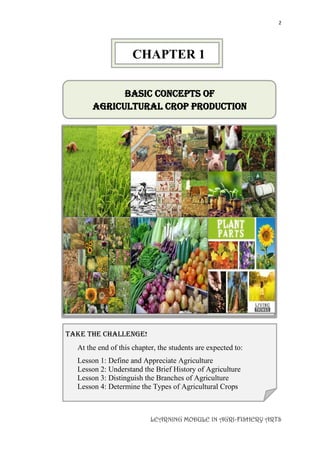
Basic Concepts of
Agricultural Crop Production
take the challenge!
At the end of this chapter, the students are expected to:
Lesson 1: Define and Appreciate Agriculture
Lesson 2: Understand the Brief History of Agriculture
Lesson 3: Distinguish the Branches of Agriculture
Lesson 4: Determine the Types of Agricultural Crops
CHAPTER 1
3
LEARNING MODULE IN AGRI-FISHERY ARTS
take the challenge!
At the end of this chapter, the students are expected to:
Lesson 5: Define the Different Types of Commercial Food Crops
in the Philippines, Its Common, Local and Scientific
Names
Lesson 6: Identify and Explain the Parts of the Plants and Its
Function
PRE-TEST
Test I. Multiple choice
Direction: Encircle the letter of the correct answer.
1. What is the science, art and practice of farming which includes the
cultivation of the soil for the growing of crops, fruit-bearing trees and
livestock production?
a. agronomy
b. horticulture
c. agriculture
d. olericulture
2. It is the science dealing with the cultivation of vegetable crops.
a. horticulture
b. agronomy
c. olericulture
d. agriculture
3. It is a plant that lives more than two years.
a. annual crops
b. biennial crops
c. perennial crops
d. millennial crops
4
LEARNING MODULE IN AGRI-FISHERY ARTS
4. It refers to the raising of birds either domestically or commercially,
primarily for meat and eggs including feathers.
a. swine raising
b. bird culture
c. poultry farming
d. zoology
5. _________ is the study of the allocation, distribution and utilization of
the resources used along with the commodities produced, by farming.
a. agricultural management
b. agricultural economics
c. agricultural administration
d. agricultural organization
6. _________ is the area of engineering concerned with the design,
construction and improvement of farming equipment and machinery.
a. agricultural construction
b. agricultural design
c. agricultural system
d. agricultural engineering
7. _________ is the cultivation of fruit crops.
a. floriculture
b. fruiticulture
c. pomology
d. horticulture
8. _________ is the science and art of growing and caring for plants,
especially flowers, fruits, and vegetables.
a. floriculture
b. olericulture
c. pomology
d. horticulture
5
LEARNING MODULE IN AGRI-FISHERY ARTS
9. _________ is the husbandry of grazing animals viewed as an ideal way
of making a living and the regular movement of all or part of the society
considered a normal and natural part of life.
a. nomadic pastoralism
b. greek pastoralism
c. roman pastoralism
d. pastoralism
10. ________ is the vital part of every economy.
a. Farming
b. Agro-industrial
c. Agriculture
d. Agribusiness
Test II: True or False
Directions: Write True if the statement is correct and False if it is wrong.
___________1. Agriculture is only the cultivation of soil to prepare for
planting.
__________ 2. Agriculture is one of the best examples of farming.
__________ 3. Animal Husbandry is a branch of agriculture.
__________ 4. The major source of raw materials is from the product of
agriculture.
__________ 5. Agriculture obstructs the economic growth because of the
industrial and commercial buildings are unable to expand their land
possessions.
6
LEARNING MODULE IN AGRI-FISHERY ARTS
DEFINITION OF TERMS
Agriculture – it is the science, art and practice of cultivating the soil,
producing crops and raising livestock and in varying degrees the preparation
and marketing and resulting of products
Farm Equipment - These are machineries used in crop production. They are
used in land preparation and in transporting farm inputs and products. These
equipment need a highly skilled operator to use
Farm Implements - accessories pulled by animals or mounted to
machineries to make the work easier
Farm Tools - objects that are usually light and are used without the help of
animals and machines
Fertile Crescent – semicircle of fertile land stretching from southeast coast of
Mediterranean around Syrian Desert, North of Arabia to Persian Gulf
Neolithic – of or relating to the latest period of the Stone Age characterized
by polished stone implements
Parthenocarpy – the production of fruits without fertilization
7
LEARNING MODULE IN AGRI-FISHERY ARTS
LESSON 1:
DEFINITION AND IMPORTANCE OF
AGRICULTURE
What is Agriculture?
Nominal Definition (explains what a name is)
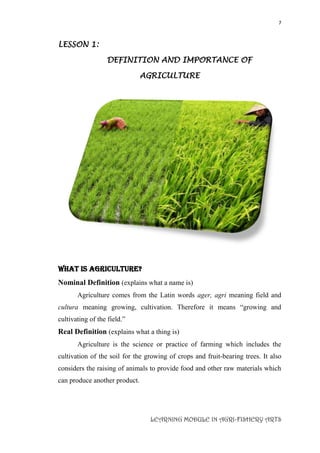
Agriculture comes from the Latin words ager, agri meaning field and
cultura meaning growing, cultivation. Therefore it means “growing and
cultivating of the field.”
Real Definition (explains what a thing is)
Agriculture is the science or practice of farming which includes the
cultivation of the soil for the growing of crops and fruit-bearing trees. It also
considers the raising of animals to provide food and other raw materials which
can produce another product.
8
LEARNING MODULE IN AGRI-FISHERY ARTS
Elements in the Definition of Agriculture
 It is a science, because of systematically organized body of knowledge
which not only based on opinions, hypothesis and theories but on factual
and absolute knowledge. Also, it is a practice because of the actual
applications of the ideas.
 Of farming, because is the act or process of working the ground,
planting seeds, and growing edible plants. It can also include raising
animals for milk, meat and wool.
VALUE OF AGRICULTURE
Agriculture has a vital role in the life and progress of an economy. It
does provide food which is the basic needs of mankind, not only to sustain food
and raw material but also employment opportunities to a vast number of the
population of a country. It can be a source of livelihood which can contribute to
micro and macro community, supplying and sustaining food and fodder that are
the basic necessities of human to live, promoting the diplomatic friendship
facilitated by trading system in local, national and international arena,
marketable surplus products, source of saving of the entire national budget and
basis of the economic development of a country.
Without agriculture, the economy will be at high risk to food security
that may result into serious national problems. The effect may be adverse or
even worse.
9
LEARNING MODULE IN AGRI-FISHERY ARTS
Activity
Direction: Answer the following questions.
1. What is the definition of agriculture? Justify.
2. Cite a value of agriculture that without it can create serious national
problem.
10
LEARNING MODULE IN AGRI-FISHERY ARTS
LESSON 2:
BRIEF HISTORY OF AGRICULTURE
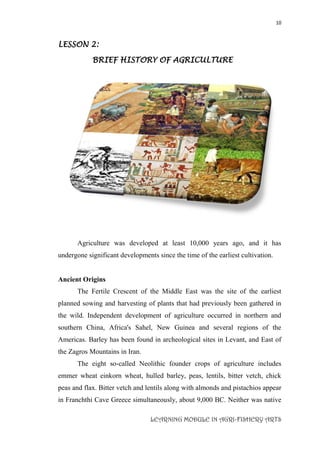
Agriculture was developed at least 10,000 years ago, and it has
undergone significant developments since the time of the earliest cultivation.
Ancient Origins
The Fertile Crescent of the Middle East was the site of the earliest
planned sowing and harvesting of plants that had previously been gathered in
the wild. Independent development of agriculture occurred in northern and
southern China, Africa's Sahel, New Guinea and several regions of the
Americas. Barley has been found in archeological sites in Levant, and East of
the Zagros Mountains in Iran.
The eight so-called Neolithic founder crops of agriculture includes
emmer wheat einkorn wheat, hulled barley, peas, lentils, bitter vetch, chick
peas and flax. Bitter vetch and lentils along with almonds and pistachios appear
in Franchthi Cave Greece simultaneously, about 9,000 BC. Neither was native
11
LEARNING MODULE IN AGRI-FISHERY ARTS
to Greece, and they appear 2,000 years prior to domesticated wheat in the same
location. This suggests that the cultivation of legumes and nuts preceded that of
grain in some Neolithic cultures.
By 7,000 BC, small-scale agriculture reached Egypt. From at least 7,000
BC the Indian subcontinent saw farming of wheat and barley, as attested by
archaeological excavation at Mehrgarh in Balochistan.
By 6,000 BC, mid-scale farming was entrenched on the banks of the
Nile. About this time, agriculture was developed independently in the Far East,
with rice, rather than wheat, as the primary crop. Chinese and Indonesian
farmers went on to domesticate taro and beans including mung, soy and azuki.
To complement these new sources of carbohydrates, highly organized net
fishing of rivers, lakes and ocean shores in these areas brought in great volumes
of essential protein. Collectively, these new methods of farming and fishing
inaugurated human population boom dwarfing all previous expansions, and it
continues today.
By 5,000 BC, the Sumerians had developed core agricultural techniques
including large scale intensive cultivation of land, mono-cropping, organized
irrigation, and use of a specialized labour force, particularly along the
waterway now known as the Shatt al-Arab, from its Persian Gulf delta to the
confluence of the Tigris and Euphrates. Domestication of wild aurochs and
mouflon into cattle and sheep, respectively, ushered in the large-scale use of
animals for food/fiber and as beasts of burden. The shepherd joined the farmer
as an essential provider for sedentary and semi-nomadic societies. Maize,
manioc, and arrowroot were first domesticated in the Americas as far back as
5,200 BC.
The potato, tomato, pepper, squash, several varieties of bean, tobacco,
and several other plants were also developed in the New World, as was
extensive terracing of steep hillsides in much of Andean South America. The
Greeks and Romans built on techniques pioneered by the Sumerians but made
few fundamentally new advances. Southern Greeks struggled with very poor
12
LEARNING MODULE IN AGRI-FISHERY ARTS
soils, yet managed to become a dominant society for years. The Romans were
noted for an emphasis on the cultivation of crops for trade.
Middle Ages
During the Middle Ages, Muslim farmers in North Africa and the Near
East developed and disseminated agricultural technologies including irrigation
systems based on hydraulic and hydrostatic principles, the use of machines and
the use of water raising machines, dams, and reservoirs. They also wrote
location-specific farming manuals, and were instrumental in the wider adoption
of crops including sugar cane, rice, citrus fruit, apricots, cotton, artichokes,
aubergines, and saffron. Muslims also brought lemons, oranges, cotton,
almonds, figs and sub-tropical crops such as bananas to Spain. The invention of
a three field system of crop rotation during the Middle Ages, and the
importation of the Chinese-invented moldboard plow, vastly improved
agricultural efficiency. Another important development towards the end of this
period was the discovery and subsequent cultivation of fodder crops which
allowed over-wintering of livestock.
Modern Era
After 1492, a global exchange of previously local crops and livestock
breeds occurred. Key crops involved in this exchange included the tomato,
maize, potato, cocoa and tobacco going from the New World to the Old, and
several varieties of wheat, spices, coffee, and sugar cane going from the Old
World to the New. The most important animal exportations from the Old
World to the New were those of the horse and dog (dogs were already present
in the pre-Columbian Americas but not in the numbers and breeds suited to
farm work). Although not usually food animals, the horse (including donkeys
and ponies) and dog quickly filled essential production roles on western
hemisphere farms.
By the early 1800s, agricultural techniques, implements, seed stocks and
cultivated plants selected and given a unique name because of its decorative or
13
LEARNING MODULE IN AGRI-FISHERY ARTS
useful characteristics had so improved that yield per land unit was many times
seen in the Middle Ages. With the rapid rise of mechanization in the late 19th
and 20th centuries, particularly in the form of the tractor, farming tasks could
be done with a speed and on a scale previously impossible. These advances
have led to efficiencies enabling certain modern farms in the United States,
Argentina, Israel, Germany, and a few other nations to output volumes of high
quality produce per land unit at what may be the practical limit.
The Haber-Bosch method for synthesizing ammonium nitrate
represented a major breakthrough and allowed crop yields to overcome
previous constraints. In the past century agriculture has been characterized by
enhanced productivity, the substitution of labor for synthetic fertilizers and
pesticides, selective breeding, mechanization, water pollution, and farm
subsidies. In recent years there has been a backlash against the external
environmental effects of conventional agriculture, resulting in the organic
movement.
Agricultural exploration expeditions, since the late nineteenth century,
have been mounted to find new species and new agricultural practices in
different areas of the world.
14
LEARNING MODULE IN AGRI-FISHERY ARTS
Activity
Direction: Answer the following questions. Write your answer on one whole
piece of yellow pad paper.
1. Collect pictures of agricultural technologies from the ancient origins
until the contemporary times. What are the similarities and
differences of agricultural technologies comparing to each era?
2. Why is it important to know and understand the history of
agriculture?
15
LEARNING MODULE IN AGRI-FISHERY ARTS
LESSON 3:
BRANCHES OF AGRICULTURE
There are four main branches of agriculture, namely;
1. Livestock Production or Animal Husbandry
2. Crop Production or Agronomy
3. Agricultural Economics
4. Agricultural Engineering
I. Livestock Production or Animal Husbandry
Animal Husbandry is the branch of agriculture concerned with animals
that are raised for meat, fiber, milk, eggs, or other products. The term
"livestock" encompasses many species and numerous breeds within animal
species which can produce food and other raw materials.
Livestock production or Animal Husbandry has 4 common classifications such
as:
16
LEARNING MODULE IN AGRI-FISHERY ARTS
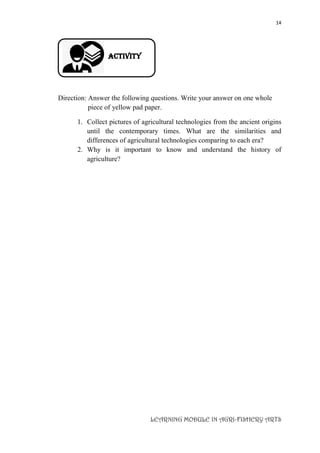
a.) Nomadic Pastoralism is the husbandry of grazing animals is viewed as an
ideal way of making a living and the regular movement of all or part of the
society is considered a normal and natural part of life. Pastoral nomadism is
commonly practice where climatic conditions produce seasonal pastures but
cannot support sustained stationary agriculture because of the animals’ food
limitations.
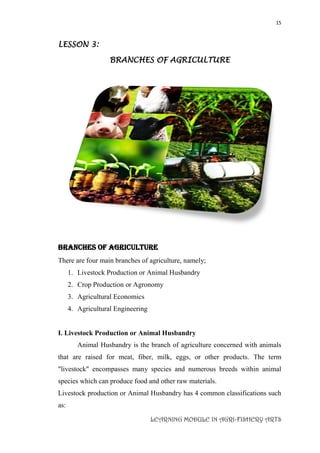
b.) Poultry Farming is the raising of birds domestically or commercially,
primarily for meat and eggs as well as for feathers. Chickens, turkeys, ducks,
and geese are of primary importance, while guinea fowl and squabs (young
pigeons) are chiefly of local interest.
17
LEARNING MODULE IN AGRI-FISHERY ARTS
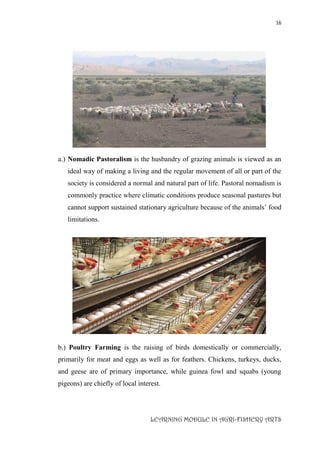
c.) Swine Farming is the raising and breeding of domestic pigs as livestock,
and is a branch of animal husbandry. Pigs are farmed principally for food (e.g.
pork, bacon, gammon) or sometimes skinned.
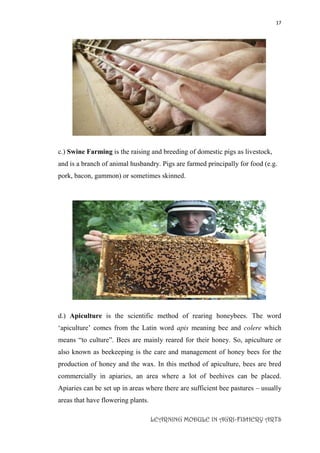
d.) Apiculture is the scientific method of rearing honeybees. The word
‘apiculture’ comes from the Latin word apis meaning bee and colere which
means “to culture”. Bees are mainly reared for their honey. So, apiculture or
also known as beekeeping is the care and management of honey bees for the
production of honey and the wax. In this method of apiculture, bees are bred
commercially in apiaries, an area where a lot of beehives can be placed.
Apiaries can be set up in areas where there are sufficient bee pastures – usually
areas that have flowering plants.
18
LEARNING MODULE IN AGRI-FISHERY ARTS
II. Crop Production or Agronomy
It is the science dealing with the cultivation of crops and vegetables on a
field scales either under rain fed or irrigation conditions. These crops are
mainly annuals cultivated food. The requirements of each crop are studied in
terms of soil and climate, as well as planting time and techniques, different
cultivars, fertilization, weed, disease, and insect control, as well as the effect of
stress factors. Crop Production or Agronomy includes:
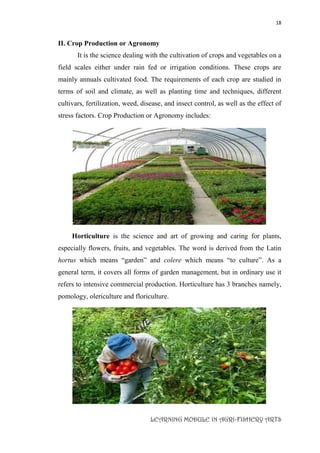
Horticulture is the science and art of growing and caring for plants,
especially flowers, fruits, and vegetables. The word is derived from the Latin
hortus which means “garden” and colere which means “to culture”. As a
general term, it covers all forms of garden management, but in ordinary use it
refers to intensive commercial production. Horticulture has 3 branches namely,
pomology, olericulture and floriculture.
19
LEARNING MODULE IN AGRI-FISHERY ARTS
a) Pomology- is the branch of botany that studies all fruits, specifically the
science of growing fruits and nuts. The word is derived from the Latin
pomum which means “fruit” and logia which means “field of study”. As a
branch of horticulture, it focuses to the cultivation of fruits, nuts, fruit-
bearing and nut-bearing trees/plants for human use and consumption.
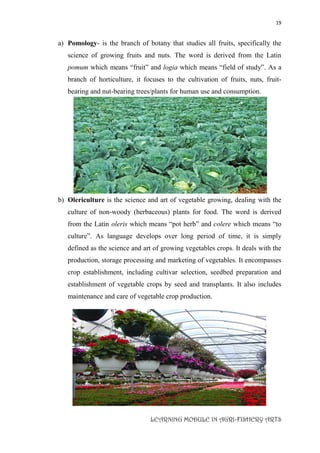
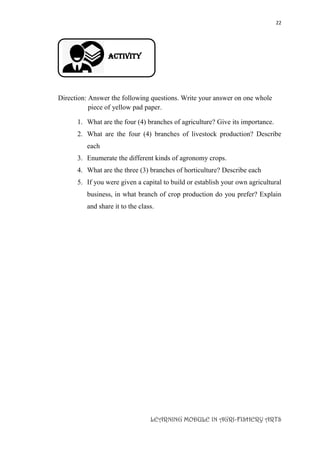
b) Olericulture is the science and art of vegetable growing, dealing with the
culture of non-woody (herbaceous) plants for food. The word is derived
from the Latin oleris which means “pot herb” and colere which means “to
culture”. As language develops over long period of time, it is simply
defined as the science and art of growing vegetables crops. It deals with the
production, storage processing and marketing of vegetables. It encompasses
crop establishment, including cultivar selection, seedbed preparation and
establishment of vegetable crops by seed and transplants. It also includes
maintenance and care of vegetable crop production.
20
LEARNING MODULE IN AGRI-FISHERY ARTS
c) Floriculture refers to farming, plant care, propagation, and cultivation with
one goal in mind, the maximum production of flowering and ornamental
plants for gardens and floristry, comprising the floral industry. The word is
derived from the Latin floris which means “flower” and colere which
means “to culture”. Therefore, it is the cultivation of flower. To elaborate,
floriculture is an entire gardening spectrum that is geared towards
understanding and improving all aspects of bud and flower creation,
including indoor lighting, growroom requirements, greenhouse needs, plant
nutrition, irrigation, pest management, and breeding new cultivars/strains.
III. Agricultural Economics is study of the allocation, distribution and
utilization of the resources used, along with the commodities produced, by
farming. It concerns itself with the study of the production and consumption of
food in both developed and developing countries along with analysis of the
policies that shape the world’s largest country.
21
LEARNING MODULE IN AGRI-FISHERY ARTS
IV. Agricultural Engineering is the area of engineering concerned with the
design, construction and improvement of farming equipment and machinery.
Agricultural engineers integrate technology with farming. For example, they
design new and improved farming equipment that may work more efficiently,
or perform new tasks. They design and build agricultural infrastructure such as
dams, water reservoirs, warehouses, and other structures. They may also help
engineer solutions for pollution control at large farms. Some agricultural
engineers are developing new forms of biofuels from non-food resources like
algae and agricultural waste. Such fuels could economically and sustainably
replace gasoline without jeopardizing the food supply.
22
LEARNING MODULE IN AGRI-FISHERY ARTS
Activity
Direction: Answer the following questions. Write your answer on one whole
piece of yellow pad paper.
1. What are the four (4) branches of agriculture? Give its importance.
2. What are the four (4) branches of livestock production? Describe
each
3. Enumerate the different kinds of agronomy crops.
4. What are the three (3) branches of horticulture? Describe each
5. If you were given a capital to build or establish your own agricultural
business, in what branch of crop production do you prefer? Explain
and share it to the class.
23
LEARNING MODULE IN AGRI-FISHERY ARTS
LESSON 4:
TYPES OF AGRICULTURAL CROPS
AND ITS CLASSIFICATIONS
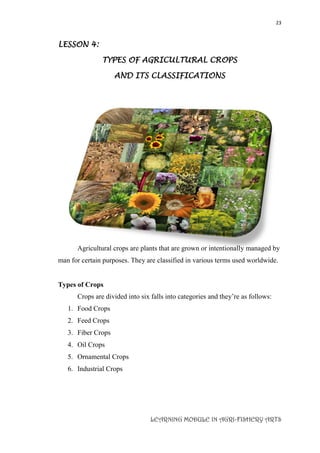
Agricultural crops are plants that are grown or intentionally managed by
man for certain purposes. They are classified in various terms used worldwide.
Types of Crops
Crops are divided into six falls into categories and they’re as follows:
1. Food Crops
2. Feed Crops
3. Fiber Crops
4. Oil Crops
5. Ornamental Crops
6. Industrial Crops
24
LEARNING MODULE IN AGRI-FISHERY ARTS
Descriptions of Crops According to their Categories
I. Food Crops – A plant that is primarily raise, culture and harvest for the
human consumption. It has two sub categories, the field crops and root
crops.
a) Field crop is a crop (other than fruits or vegetables) that is grown on a
large scale for agricultural purposes. Examples are wheat, rice, corn,
sugarcane and other forage crops. These crops typically consist of a
large majority of agricultural acreage and crop revenues.
b) Root Crops – are underground plant parts edible for human
consumption.
25
LEARNING MODULE IN AGRI-FISHERY ARTS
II. Feed Crops – A plant that is primarily raise, culture and harvest for the
livestock consumption.
III. Fiber Crops – A plant that is primarily raise, culture and harvest for its
fibers which are used as raw material.
IV. Oil Crops – A plant that is primarily raise, culture and harvest as base
for biodiesel production.
26
LEARNING MODULE IN AGRI-FISHERY ARTS
V. Ornamental Crops – A plant that is primarily raise and culture for
decorative purposes especially in gardens and landscape design projects.
VI. Industrial Crops – A plant that is cultured for their biological materials
which are used in industrial processes into nonedible products.
(Example: Tobacco)
27
LEARNING MODULE IN AGRI-FISHERY ARTS
Classification of Crops According to their Reproduction
1. Sexual - plants that develop from a seed or a spore after undergoing
union of male and female gametes.
2. Asexual – plants which reproduce by any vegetative means without the
union of the sexual gametes.
28
LEARNING MODULE IN AGRI-FISHERY ARTS
Classification of Crops According to Mode of Pollination
I. Naturally Self Pollinated Crops – predominant mode of pollination in
this plant is self-pollination.
II. Naturally Cross Pollinated Crops – pollen transfer in these plants is
from another of one flower in a separate plant.
29
LEARNING MODULE IN AGRI-FISHERY ARTS
III. Both Self and Cross Pollination Crops – these plants are largely self-
pollinated but in varying amounts.
Classifications of Crops According to Growth Habits
I. Herb – succulent plants with self-supporting stems.
II. Vines – herbaceous climbing or twining plants without self-supporting
stem.
30
LEARNING MODULE IN AGRI-FISHERY ARTS
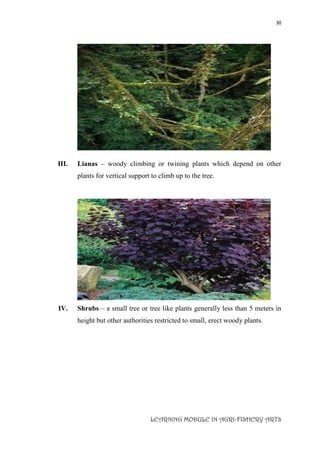
III. Lianas – woody climbing or twining plants which depend on other
plants for vertical support to climb up to the tree.
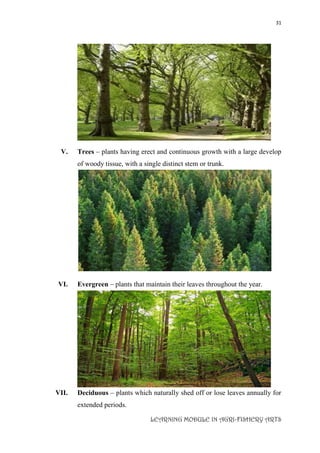
IV. Shrubs – a small tree or tree like plants generally less than 5 meters in
height but other authorities restricted to small, erect woody plants.
31
LEARNING MODULE IN AGRI-FISHERY ARTS
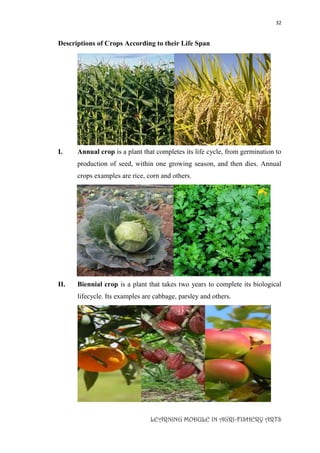
V. Trees – plants having erect and continuous growth with a large develop
of woody tissue, with a single distinct stem or trunk.
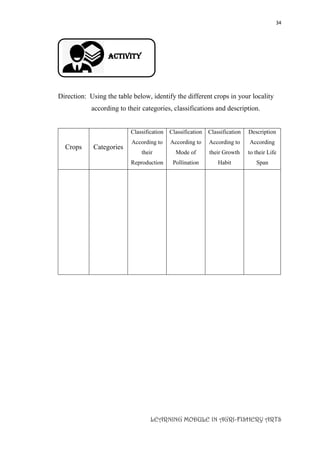
VI. Evergreen – plants that maintain their leaves throughout the year.
VII. Deciduous – plants which naturally shed off or lose leaves annually for
extended periods.
32
LEARNING MODULE IN AGRI-FISHERY ARTS
Descriptions of Crops According to their Life Span
I. Annual crop is a plant that completes its life cycle, from germination to
production of seed, within one growing season, and then dies. Annual
crops examples are rice, corn and others.
II. Biennial crop is a plant that takes two years to complete its biological
lifecycle. Its examples are cabbage, parsley and others.
33
LEARNING MODULE IN AGRI-FISHERY ARTS
III. Perennial crop is a plant that lives more than two years. The term is
often used to differentiate a plant from shorter-lived annuals and
biennials. The term is also widely used to distinguish plants with little or
no woody growth from trees and shrubs, which are also technically
perennials.
34
LEARNING MODULE IN AGRI-FISHERY ARTS
Activity
Direction: Using the table below, identify the different crops in your locality
according to their categories, classifications and description.
Crops Categories
Classification
According to
their
Reproduction
Classification
According to
Mode of
Pollination
Classification
According to
their Growth
Habit
Description
According
to their Life
Span
35
LEARNING MODULE IN AGRI-FISHERY ARTS
LESSON 5:
TYPES OF COMMERCIAL FOOD CROPS
IN THE PHILIPPINES
Food Crop
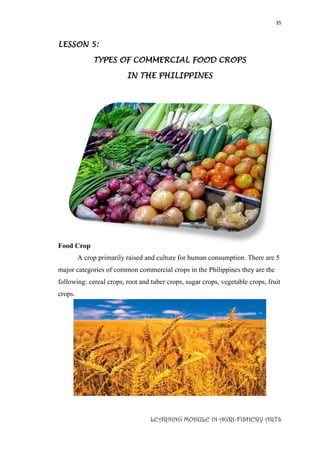
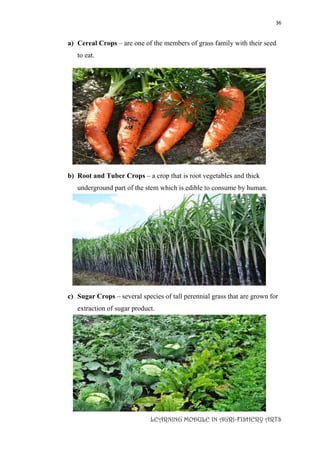
A crop primarily raised and culture for human consumption. There are 5
major categories of common commercial crops in the Philippines they are the
following: cereal crops, root and tuber crops, sugar crops, vegetable crops, fruit
crops.
36
LEARNING MODULE IN AGRI-FISHERY ARTS
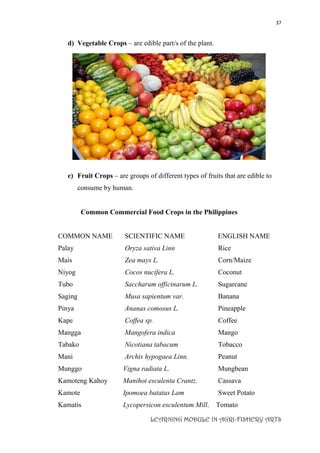
a) Cereal Crops – are one of the members of grass family with their seed
to eat.
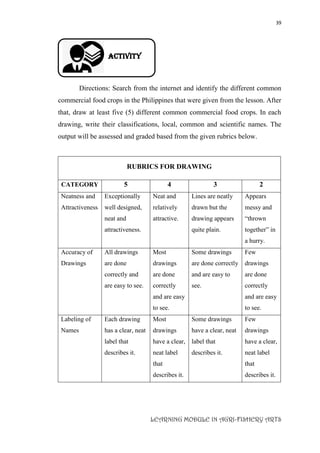
b) Root and Tuber Crops – a crop that is root vegetables and thick
underground part of the stem which is edible to consume by human.
c) Sugar Crops – several species of tall perennial grass that are grown for
extraction of sugar product.
37
LEARNING MODULE IN AGRI-FISHERY ARTS
d) Vegetable Crops – are edible part/s of the plant.
e) Fruit Crops – are groups of different types of fruits that are edible to
consume by human.
Common Commercial Food Crops in the Philippines
COMMON NAME SCIENTIFIC NAME ENGLISH NAME
Palay Oryza sativa Linn Rice
Mais Zea mays L. Corn/Maize
Niyog Cocos nucifera L. Coconut
Tubo Saccharum officinarum L. Sugarcane
Saging Musa sapientum var. Banana
Pinya Ananas comosus L. Pineapple
Kape Coffea sp. Coffee
Mangga Mangofera indica Mango
Tabako Nicotiana tabacum Tobacco
Mani Archis hypogaea Linn. Peanut
Munggo Vigna radiata L. Mungbean
Kamoteng Kahoy Manihot esculenta Crantz. Cassava
Kamote Ipomoea batatas Lam Sweet Potato
Kamatis Lycopersicon esculentum Mill. Tomato
38
LEARNING MODULE IN AGRI-FISHERY ARTS
Bawang Allium sativum Linn. Garlic
Sibuyas Allium cepa Linn. Onion bulb
Repolyo Brassica oleracea L. Cabbage
Talong Solanum melongena Linn. Eggplant
Kalamansi Citrus madurensis Lour. Calamansi
39
LEARNING MODULE IN AGRI-FISHERY ARTS
Activity
Directions: Search from the internet and identify the different common
commercial food crops in the Philippines that were given from the lesson. After
that, draw at least five (5) different common commercial food crops. In each
drawing, write their classifications, local, common and scientific names. The
output will be assessed and graded based from the given rubrics below.
RUBRICS FOR DRAWING
CATEGORY 5 4 3 2
Neatness and
Attractiveness
Exceptionally
well designed,
neat and
attractiveness.
Neat and
relatively
attractive.
Lines are neatly
drawn but the
drawing appears
quite plain.
Appears
messy and
“thrown
together” in
a hurry.
Accuracy of
Drawings
All drawings
are done
correctly and
are easy to see.
Most
drawings
are done
correctly
and are easy
to see.
Some drawings
are done correctly
and are easy to
see.
Few
drawings
are done
correctly
and are easy
to see.
Labeling of
Names
Each drawing
has a clear, neat
label that
describes it.
Most
drawings
have a clear,
neat label
that
describes it.
Some drawings
have a clear, neat
label that
describes it.
Few
drawings
have a clear,
neat label
that
describes it.
40
LEARNING MODULE IN AGRI-FISHERY ARTS
LESSON 6:
PLANT PARTS AND ITS FUNCTION
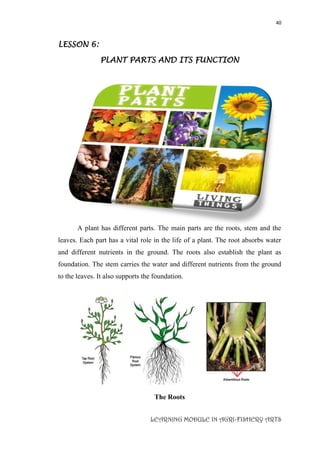
A plant has different parts. The main parts are the roots, stem and the
leaves. Each part has a vital role in the life of a plant. The root absorbs water
and different nutrients in the ground. The roots also establish the plant as
foundation. The stem carries the water and different nutrients from the ground
to the leaves. It also supports the foundation.
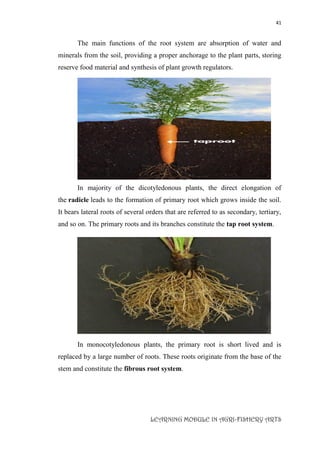
The Roots
41
LEARNING MODULE IN AGRI-FISHERY ARTS
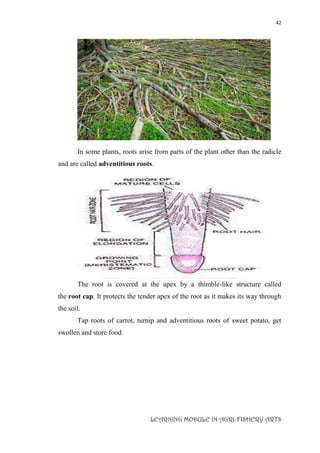
The main functions of the root system are absorption of water and
minerals from the soil, providing a proper anchorage to the plant parts, storing
reserve food material and synthesis of plant growth regulators.
In majority of the dicotyledonous plants, the direct elongation of
the radicle leads to the formation of primary root which grows inside the soil.
It bears lateral roots of several orders that are referred to as secondary, tertiary,
and so on. The primary roots and its branches constitute the tap root system.
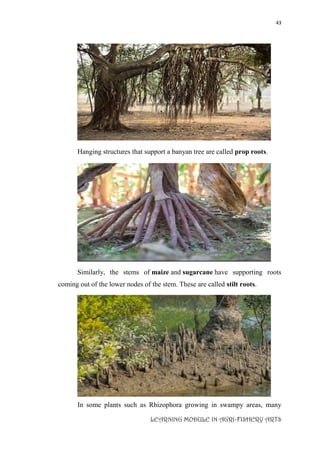
In monocotyledonous plants, the primary root is short lived and is
replaced by a large number of roots. These roots originate from the base of the
stem and constitute the fibrous root system.
42
LEARNING MODULE IN AGRI-FISHERY ARTS
In some plants, roots arise from parts of the plant other than the radicle
and are called adventitious roots.
The root is covered at the apex by a thimble-like structure called
the root cap. It protects the tender apex of the root as it makes its way through
the soil.
Tap roots of carrot, turnip and adventitious roots of sweet potato, get
swollen and store food.
43
LEARNING MODULE IN AGRI-FISHERY ARTS
Hanging structures that support a banyan tree are called prop roots.
Similarly, the stems of maize and sugarcane have supporting roots
coming out of the lower nodes of the stem. These are called stilt roots.
In some plants such as Rhizophora growing in swampy areas, many
44
LEARNING MODULE IN AGRI-FISHERY ARTS
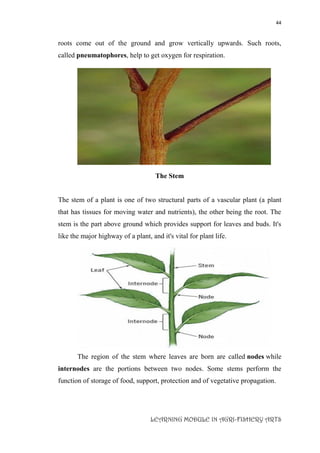
roots come out of the ground and grow vertically upwards. Such roots,
called pneumatophores, help to get oxygen for respiration.
The Stem
The stem of a plant is one of two structural parts of a vascular plant (a plant
that has tissues for moving water and nutrients), the other being the root. The
stem is the part above ground which provides support for leaves and buds. It's
like the major highway of a plant, and it's vital for plant life.
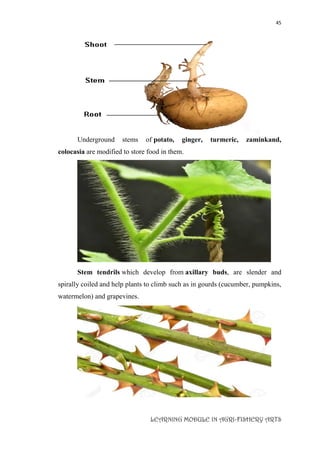
The region of the stem where leaves are born are called nodes while
internodes are the portions between two nodes. Some stems perform the
function of storage of food, support, protection and of vegetative propagation.
45
LEARNING MODULE IN AGRI-FISHERY ARTS
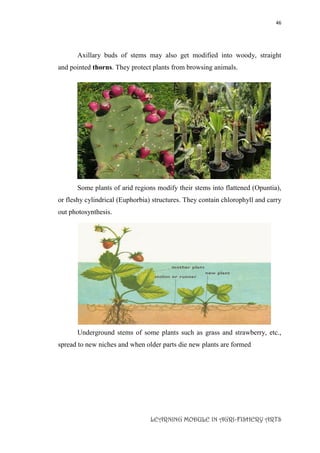
Underground stems of potato, ginger, turmeric, zaminkand,
colocasia are modified to store food in them.
Stem tendrils which develop from axillary buds, are slender and
spirally coiled and help plants to climb such as in gourds (cucumber, pumpkins,
watermelon) and grapevines.
46
LEARNING MODULE IN AGRI-FISHERY ARTS
Axillary buds of stems may also get modified into woody, straight
and pointed thorns. They protect plants from browsing animals.
Some plants of arid regions modify their stems into flattened (Opuntia),
or fleshy cylindrical (Euphorbia) structures. They contain chlorophyll and carry
out photosynthesis.
Underground stems of some plants such as grass and strawberry, etc.,
spread to new niches and when older parts die new plants are formed
47
LEARNING MODULE IN AGRI-FISHERY ARTS
The Leaf
Leaf is a flattened structure of a higher plant, typically green and blade-
like, that is attached to a stem directly or via a stalk. Leaves are the main
organs of photosynthesis and transpiration.
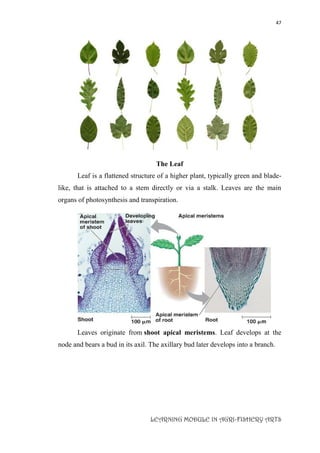
Leaves originate from shoot apical meristems. Leaf develops at the
node and bears a bud in its axil. The axillary bud later develops into a branch.
48
LEARNING MODULE IN AGRI-FISHERY ARTS
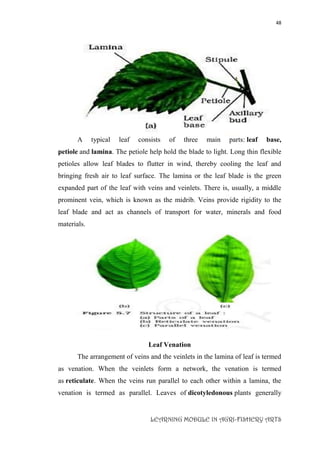
A typical leaf consists of three main parts: leaf base,
petiole and lamina. The petiole help hold the blade to light. Long thin flexible
petioles allow leaf blades to flutter in wind, thereby cooling the leaf and
bringing fresh air to leaf surface. The lamina or the leaf blade is the green
expanded part of the leaf with veins and veinlets. There is, usually, a middle
prominent vein, which is known as the midrib. Veins provide rigidity to the
leaf blade and act as channels of transport for water, minerals and food
materials.
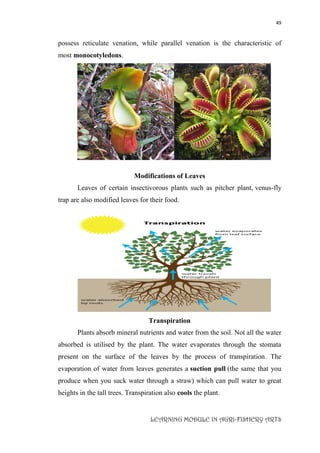
Leaf Venation
The arrangement of veins and the veinlets in the lamina of leaf is termed
as venation. When the veinlets form a network, the venation is termed
as reticulate. When the veins run parallel to each other within a lamina, the
venation is termed as parallel. Leaves of dicotyledonous plants generally
49
LEARNING MODULE IN AGRI-FISHERY ARTS
possess reticulate venation, while parallel venation is the characteristic of
most monocotyledons.
Modifications of Leaves
Leaves of certain insectivorous plants such as pitcher plant, venus-fly
trap are also modified leaves for their food.
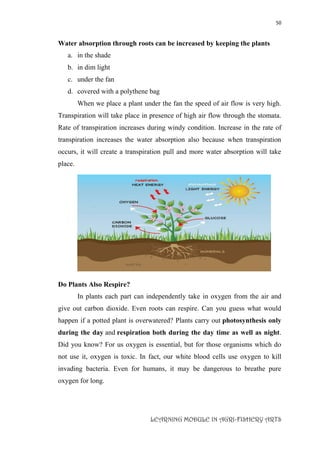
Transpiration
Plants absorb mineral nutrients and water from the soil. Not all the water
absorbed is utilised by the plant. The water evaporates through the stomata
present on the surface of the leaves by the process of transpiration. The
evaporation of water from leaves generates a suction pull (the same that you
produce when you suck water through a straw) which can pull water to great
heights in the tall trees. Transpiration also cools the plant.
50
LEARNING MODULE IN AGRI-FISHERY ARTS
Water absorption through roots can be increased by keeping the plants
a. in the shade
b. in dim light
c. under the fan
d. covered with a polythene bag
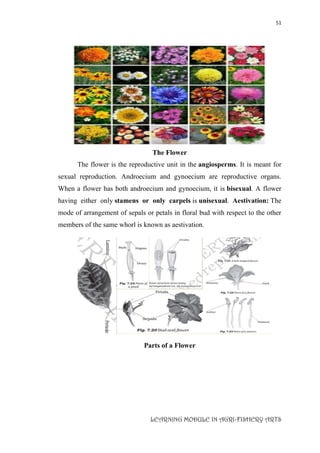
When we place a plant under the fan the speed of air flow is very high.
Transpiration will take place in presence of high air flow through the stomata.
Rate of transpiration increases during windy condition. Increase in the rate of
transpiration increases the water absorption also because when transpiration
occurs, it will create a transpiration pull and more water absorption will take
place.
Do Plants Also Respire?
In plants each part can independently take in oxygen from the air and
give out carbon dioxide. Even roots can respire. Can you guess what would
happen if a potted plant is overwatered? Plants carry out photosynthesis only
during the day and respiration both during the day time as well as night.
Did you know? For us oxygen is essential, but for those organisms which do
not use it, oxygen is toxic. In fact, our white blood cells use oxygen to kill
invading bacteria. Even for humans, it may be dangerous to breathe pure
oxygen for long.
51
LEARNING MODULE IN AGRI-FISHERY ARTS
The Flower
The flower is the reproductive unit in the angiosperms. It is meant for
sexual reproduction. Androecium and gynoecium are reproductive organs.
When a flower has both androecium and gynoecium, it is bisexual. A flower
having either only stamens or only carpels is unisexual. Aestivation: The
mode of arrangement of sepals or petals in floral bud with respect to the other
members of the same whorl is known as aestivation.
Parts of a Flower
52
LEARNING MODULE IN AGRI-FISHERY ARTS
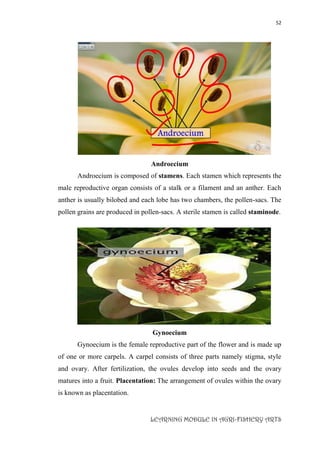
Androecium
Androecium is composed of stamens. Each stamen which represents the
male reproductive organ consists of a stalk or a filament and an anther. Each
anther is usually bilobed and each lobe has two chambers, the pollen-sacs. The
pollen grains are produced in pollen-sacs. A sterile stamen is called staminode.
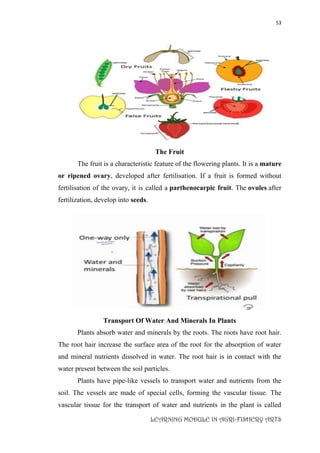
Gynoecium
Gynoecium is the female reproductive part of the flower and is made up
of one or more carpels. A carpel consists of three parts namely stigma, style
and ovary. After fertilization, the ovules develop into seeds and the ovary
matures into a fruit. Placentation: The arrangement of ovules within the ovary
is known as placentation.
53
LEARNING MODULE IN AGRI-FISHERY ARTS
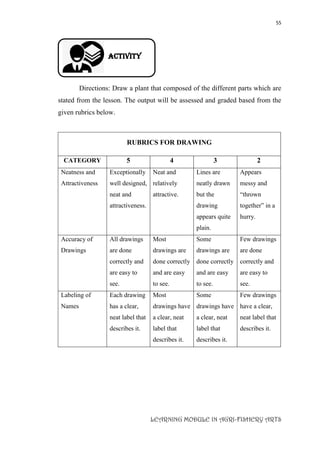
The Fruit
The fruit is a characteristic feature of the flowering plants. It is a mature
or ripened ovary, developed after fertilisation. If a fruit is formed without
fertilisation of the ovary, it is called a parthenocarpic fruit. The ovules after
fertilization, develop into seeds.
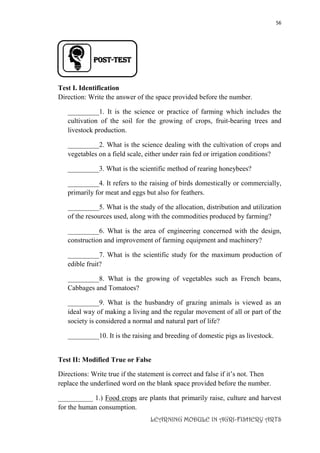
Transport Of Water And Minerals In Plants
Plants absorb water and minerals by the roots. The roots have root hair.
The root hair increase the surface area of the root for the absorption of water
and mineral nutrients dissolved in water. The root hair is in contact with the
water present between the soil particles.
Plants have pipe-like vessels to transport water and nutrients from the
soil. The vessels are made of special cells, forming the vascular tissue. The
vascular tissue for the transport of water and nutrients in the plant is called
54
LEARNING MODULE IN AGRI-FISHERY ARTS
the xylem. The xylem forms a continuous network of channels that connects
roots to the leaves through the stem and branches and thus transport water to
the entire plant leaves synthesise food. The food has to be transported to all
parts of the plant. This is done by the vascular tissue called the phloem. Thus,
xylem and phloem transport substances in plants.
55
LEARNING MODULE IN AGRI-FISHERY ARTS
Activity
Directions: Draw a plant that composed of the different parts which are
stated from the lesson. The output will be assessed and graded based from the
given rubrics below.
RUBRICS FOR DRAWING
CATEGORY 5 4 3 2
Neatness and
Attractiveness
Exceptionally
well designed,
neat and
attractiveness.
Neat and
relatively
attractive.
Lines are
neatly drawn
but the
drawing
appears quite
plain.
Appears
messy and
“thrown
together” in a
hurry.
Accuracy of
Drawings
All drawings
are done
correctly and
are easy to
see.
Most
drawings are
done correctly
and are easy
to see.
Some
drawings are
done correctly
and are easy
to see.
Few drawings
are done
correctly and
are easy to
see.
Labeling of
Names
Each drawing
has a clear,
neat label that
describes it.
Most
drawings have
a clear, neat
label that
describes it.
Some
drawings have
a clear, neat
label that
describes it.
Few drawings
have a clear,
neat label that
describes it.
56
LEARNING MODULE IN AGRI-FISHERY ARTS
Post-TEST
Test I. Identification
Direction: Write the answer of the space provided before the number.
_________1. It is the science or practice of farming which includes the
cultivation of the soil for the growing of crops, fruit-bearing trees and
livestock production.
_________2. What is the science dealing with the cultivation of crops and
vegetables on a field scale, either under rain fed or irrigation conditions?
_________3. What is the scientific method of rearing honeybees?
_________4. It refers to the raising of birds domestically or commercially,
primarily for meat and eggs but also for feathers.
_________5. What is the study of the allocation, distribution and utilization
of the resources used, along with the commodities produced by farming?
_________6. What is the area of engineering concerned with the design,
construction and improvement of farming equipment and machinery?
_________7. What is the scientific study for the maximum production of
edible fruit?
_________8. What is the growing of vegetables such as French beans,
Cabbages and Tomatoes?
_________9. What is the husbandry of grazing animals is viewed as an
ideal way of making a living and the regular movement of all or part of the
society is considered a normal and natural part of life?
_________10. It is the raising and breeding of domestic pigs as livestock.
Test II: Modified True or False
Directions: Write true if the statement is correct and false if it’s not. Then
replace the underlined word on the blank space provided before the number.
__________ 1.) Food crops are plants that primarily raise, culture and harvest
for the human consumption.
57
LEARNING MODULE IN AGRI-FISHERY ARTS
__________ 2.) Cereal Crops are plants that cultured for their biological
materials which are used in industrial processes into inedible products.
__________ 3.) Hybrid Pollinated Crops are pollen transfer in these plants is
from another of one flower in a separate plant.
__________ 4.) Silk Crops are plants that primarily raise, culture and harvest
for its fibers which are used to be a raw material.
__________ 5.) Sexual Crops is a classification of plants which reproduce by
any vegetative means without the union of the sexual gametes.
___________6.) Diesel Crops are plants that primarily raise, culture and
harvest for the base of biodiesel production.
___________7.) Feed Crops are plants that primarily raise, culture and harvest
for the livestock consumption.
___________8.) Deciduous are plants which naturally shed off or lose leaves
annually for extended periods.
___________9.) Aerial plants are small woody climbing or twining plants
which depend on other plants for vertical support to climb up to the tree.
___________10.) Bienial is a plant which requires two growing seasons to
complete its life cycle first for vegetative growth and accumulation.
III. Fill in the blank
Direction: Write the correct answer on the space provided.
COMMON NAME SCIENTIFIC NAME ENGLISH NAME
Palay 1._______________ Rice
Mais 2._______________ Corn/Maize
3.______________ Cocos nucifera L. Coconut
Tubo 4._______________ Sugarcane
5.______________ Musa sapientum var. Banana
6.______________ Ananas comosus L. Pineapple
Kape 7._______________ Coffee
8.______________ Mangifera indica L. Mango
Tabako 9._______________ Tobacco
Mani 10._______________ Peanut
58
LEARNING MODULE IN AGRI-FISHERY ARTS
11._____________ Vigna radiata L. Mungbean
12._____________ Manihot esculenta Crantz. Cassava
Kamoteng Baging Ipomoea batatas Lam 13._______________
Kamatis 14.________________ Tomato
15._____________ Allium sativum Linn. Garlic
IV. Identification
Direction: Using the keyword below, identify the following statements. Write
the answer on the space provided.
Lamina Leaf Phloem Flower
Root Cap Androecium Fly Eater Plant Transpiration
Xylem Venus-Fly Trap Gynoecium Fruit
___________1) It is a lateral outgrowth of stem developed exogeneously at the
node. These are green in colour to perform the function of photosynthesis.
___________2) It is the green expanded part of the leaf with veins and veinlets.
___________3) It is the vascular tissue for the transport of water and nutrients
in the plant.
___________4) Food has to be transported to all parts of the plant. This is done
by the vascular tissue called _______.
___________5 Water comes out of leaves in the form of vapour by a process
called __________.
___________6) It is a part of the flower that composed of stamens.
___________7) What is the female reproductive part of the flower and is made
up of one or more carpels?
___________8) It is the part of the root which is covered at the apex by a
thimble-like structure.
___________9) It is a characteristic feature of the flowering plants.
59
LEARNING MODULE IN AGRI-FISHERY ARTS
___________10) A carnivorous plant.
V. Essay
Direction: Write an essay of what you have learned in the ff:
 Definition and Importance of Agriculture (10 pts)
 History of Agriculture (10pts)
60
LEARNING MODULE IN AGRI-FISHERY ARTS
Farm Tools,
Equipments, Inputs AND LABOR
take the challenge!
At the end of this chapter, the students are expected to:
Lesson 1: Recognize and Select Farm tools
Lesson 2: Identify and Select Farm Equipments
Lesson 3: Perform Maintenance
Lesson 4: Remember and Understand the Farm Inputs and Labor
CHAPTER 2
61
LEARNING MODULE IN AGRI-FISHERY ARTS
PRE-TEST
Test I. Multiple choice
Direction: Write the letter of the correct answer before the number.
1) A proper tool for digging.
a. Bolo
b. Crowbar
c. Grub hoe
d. Pruning shear
2) A proper tool for cutting grasses.
a. Shovel
b. Bolo
c. Crowbar
d. Mattock
3) Which tool does not belong to the group according to its use as?
a. Crowbar
b. Pruning shear
c. Mattock
d. Shovel
4) Farm tools are very important in agricultural crop production because
they __________.
a. Make work faster
b. Male work easier
c. Save time and effort
d. All of the above
5) A farm tool used for cleaning the ground and levelling the topsoil.
a. Shovel
b. Pick-Mattock
c. Rake
d. Spade
6) A farm tool that looks like a spoon primarily used for transferring the
soil.
a. Spade
b. Shovel
c. Rake
d. Wheel barrow
62
LEARNING MODULE IN AGRI-FISHERY ARTS
7) An open container with a single pair of wheel at the front and two
handle at the rear used for transport materials to another place.
a. Trailer
b. Hand tractor
c. Wheel barrow
d. Improvised Basket
8) It is an implement which is pulled by working animal to till the soil.
a. Disc harrow
b. Disc plow
c. Native plow
d. Native harrow
9) It is an implement mounted to a tractor that is used to pulverize the
newly plowed soil.
a. Disc harrow
b. Disc plow
c. Native plow
d. Native harrow
10) A farm tool primarily used to operate horticultural works.
a. Pruning shear
b. Knife
c. Cutter
d. Harvester
11) Which of the following farming is used for digging canals, breaking
hard topsoil and for digging up stones and tree stumps?
a. Shovel
b. Spade
c. Hoe
d. Pick-mattock
12) It is a tool used without the help of animals or machines. Being used in
performing farm activities which involve small areas like school garden
and home garden.
a. Shovel
b. Hand tools
c. Grass cutter
d. Grab hoe
13) It is a tool used for cleaning the ground and leveling the topsoil.
a. Sickle
b. Spade
c. Prunning shears
d. Rake
14) Which of the following is the accessories which is being pulled by
working animals or mounted to machineries usually used in the
preparation of land. Usually made of a special kind of metal.
63
LEARNING MODULE IN AGRI-FISHERY ARTS
a. Farm tools
b. Farm equipments
c. Farm implements
d. None of the Above
15) Which of the following is equipment used in land preparation and in
transporting farm inputs and products? This equipment needs a highly
skilled operator to use.
a. Farm tools
b. Farm implements
c. Farm equipments
d. All of the above
II. True or False.
Direction: Read and analyze each statement below. Write T if the
statement is correct; F if the statement is incorrect on the space provided.
______1) Hand tractor is used to draw irrigation water from a source.
______2) Tools that are worn out should be separated and be fixed
immediately to avoid accident.
______3) When sharpening with a file, do not use oil; metal filings will
accumulate and clog the file's serrations.
______4) Water will help tools to work as intended and will prevent
the formation of rust.
______5) For pruners, use a whetstone because it produces a very
sharp cutting edge.
64
LEARNING MODULE IN AGRI-FISHERY ARTS
DEFINITION OF TERMS
Farm Equipments - These are machineries used in crop production. They are
used in land preparation and in transporting farm inputs and products. These
equipments need a highly skilled operator to use
Farm Implements - accessories pulled by animals or mounted to machineries
to make the work easier.
Farm Tools - objects that are usually light and are used without the help of
animals and machines
Preventive Maintenance - an activity or operation done to prevent
malfunction of tools and equipment and it is done to prolong the useful life of
tools and equipment
Repair - to restore to good condition something broken or damaged.
65
LEARNING MODULE IN AGRI-FISHERY ARTS
LESSON 1:
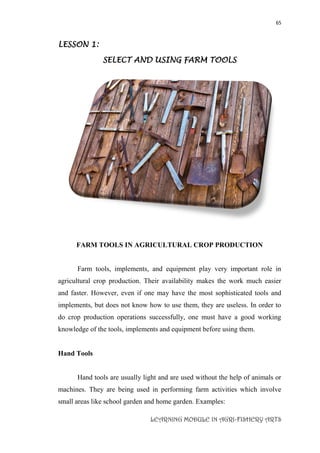
SELECT AND USING FARM TOOLS
FARM TOOLS IN AGRICULTURAL CROP PRODUCTION
Farm tools, implements, and equipment play very important role in
agricultural crop production. Their availability makes the work much easier
and faster. However, even if one may have the most sophisticated tools and
implements, but does not know how to use them, they are useless. In order to
do crop production operations successfully, one must have a good working
knowledge of the tools, implements and equipment before using them.
Hand Tools
Hand tools are usually light and are used without the help of animals or
machines. They are being used in performing farm activities which involve
small areas like school garden and home garden. Examples:
66
LEARNING MODULE IN AGRI-FISHERY ARTS
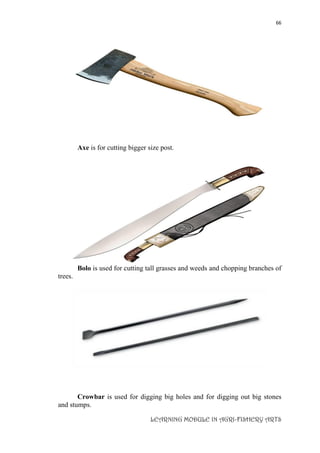
Axe is for cutting bigger size post.
Bolo is used for cutting tall grasses and weeds and chopping branches of
trees.
Crowbar is used for digging big holes and for digging out big stones
and stumps.
67
LEARNING MODULE IN AGRI-FISHERY ARTS
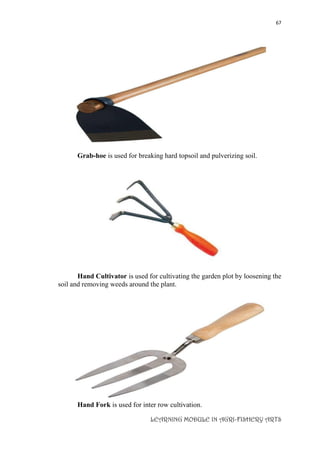
Grab-hoe is used for breaking hard topsoil and pulverizing soil.
Hand Cultivator is used for cultivating the garden plot by loosening the
soil and removing weeds around the plant.
Hand Fork is used for inter row cultivation.
68
LEARNING MODULE IN AGRI-FISHERY ARTS
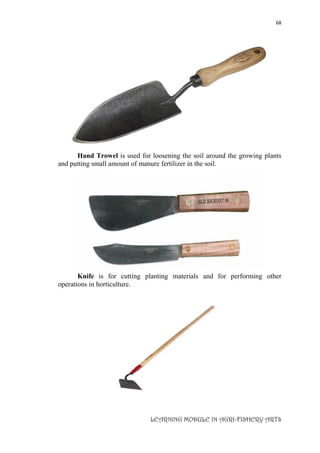
Hand Trowel is used for loosening the soil around the growing plants
and putting small amount of manure fertilizer in the soil.
Knife is for cutting planting materials and for performing other
operations in horticulture.
69
LEARNING MODULE IN AGRI-FISHERY ARTS
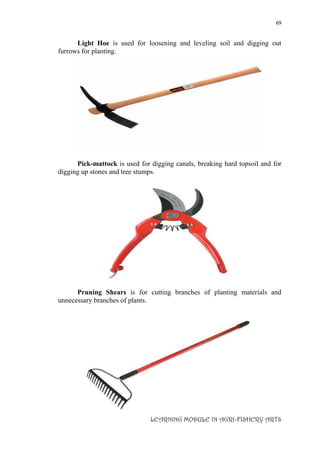
Light Hoe is used for loosening and leveling soil and digging out
furrows for planting.
Pick-mattock is used for digging canals, breaking hard topsoil and for
digging up stones and tree stumps.
Pruning Shears is for cutting branches of planting materials and
unnecessary branches of plants.
70
LEARNING MODULE IN AGRI-FISHERY ARTS
Rake is used for cleaning the ground and leveling the topsoil.
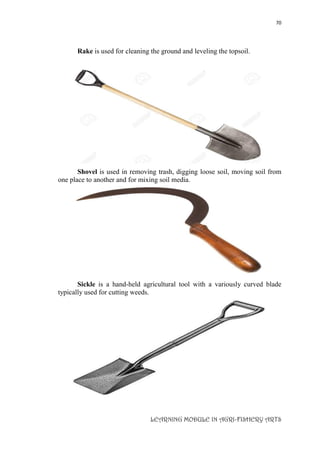
Shovel is used in removing trash, digging loose soil, moving soil from
one place to another and for mixing soil media.
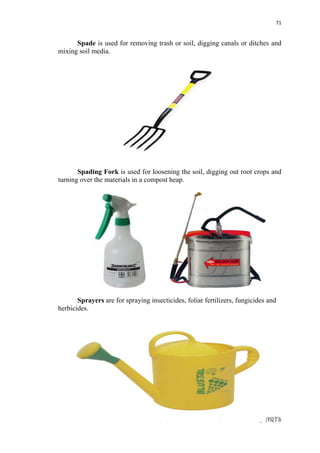
Sickle is a hand-held agricultural tool with a variously curved blade
typically used for cutting weeds.
71
LEARNING MODULE IN AGRI-FISHERY ARTS
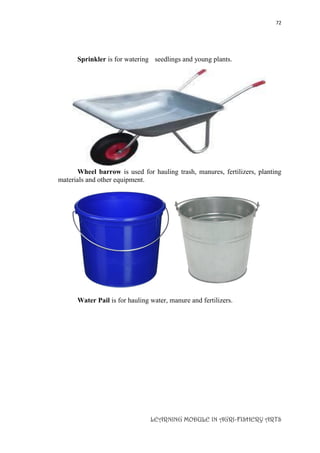
Spade is used for removing trash or soil, digging canals or ditches and
mixing soil media.
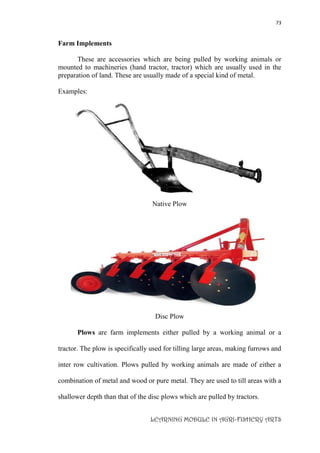
Spading Fork is used for loosening the soil, digging out root crops and
turning over the materials in a compost heap.
Sprayers are for spraying insecticides, foliar fertilizers, fungicides and
herbicides.
72
LEARNING MODULE IN AGRI-FISHERY ARTS
Sprinkler is for watering seedlings and young plants.
Wheel barrow is used for hauling trash, manures, fertilizers, planting
materials and other equipment.
Water Pail is for hauling water, manure and fertilizers.
73
LEARNING MODULE IN AGRI-FISHERY ARTS
Farm Implements
These are accessories which are being pulled by working animals or
mounted to machineries (hand tractor, tractor) which are usually used in the
preparation of land. These are usually made of a special kind of metal.
Examples:
Native Plow
Disc Plow
Plows are farm implements either pulled by a working animal or a
tractor. The plow is specifically used for tilling large areas, making furrows and
inter row cultivation. Plows pulled by working animals are made of either a
combination of metal and wood or pure metal. They are used to till areas with a
shallower depth than that of the disc plows which are pulled by tractors.
74
LEARNING MODULE IN AGRI-FISHERY ARTS
Native Wooden Harrow
Disc Harrow
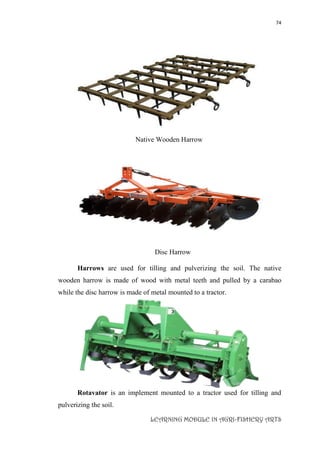
Harrows are used for tilling and pulverizing the soil. The native
wooden harrow is made of wood with metal teeth and pulled by a carabao
while the disc harrow is made of metal mounted to a tractor.
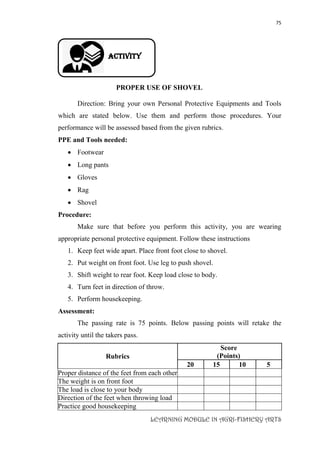
Rotavator is an implement mounted to a tractor used for tilling and
pulverizing the soil.
75
LEARNING MODULE IN AGRI-FISHERY ARTS
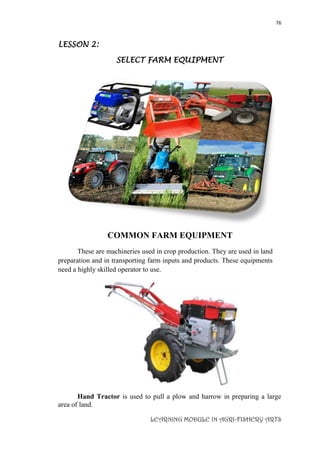
Activity
PROPER USE OF SHOVEL
Direction: Bring your own Personal Protective Equipments and Tools
which are stated below. Use them and perform those procedures. Your
performance will be assessed based from the given rubrics.
PPE and Tools needed:
 Footwear
 Long pants
 Gloves
 Rag
 Shovel
Procedure:
Make sure that before you perform this activity, you are wearing
appropriate personal protective equipment. Follow these instructions
1. Keep feet wide apart. Place front foot close to shovel.
2. Put weight on front foot. Use leg to push shovel.
3. Shift weight to rear foot. Keep load close to body.
4. Turn feet in direction of throw.
5. Perform housekeeping.
Assessment:
The passing rate is 75 points. Below passing points will retake the
activity until the takers pass.
Rubrics
Score
(Points)
20 15 10 5
Proper distance of the feet from each other
The weight is on front foot
The load is close to your body
Direction of the feet when throwing load
Practice good housekeeping
76
LEARNING MODULE IN AGRI-FISHERY ARTS
LESSON 2:
SELECT FARM EQUIPMENT
COMMON FARM EQUIPMENT
These are machineries used in crop production. They are used in land
preparation and in transporting farm inputs and products. These equipments
need a highly skilled operator to use.
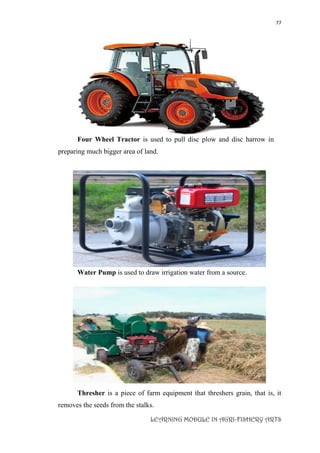
Hand Tractor is used to pull a plow and harrow in preparing a large
area of land.
77
LEARNING MODULE IN AGRI-FISHERY ARTS
Four Wheel Tractor is used to pull disc plow and disc harrow in
preparing much bigger area of land.

Water Pump is used to draw irrigation water from a source.
Thresher is a piece of farm equipment that threshers grain, that is, it
removes the seeds from the stalks.
78
LEARNING MODULE IN AGRI-FISHERY ARTS
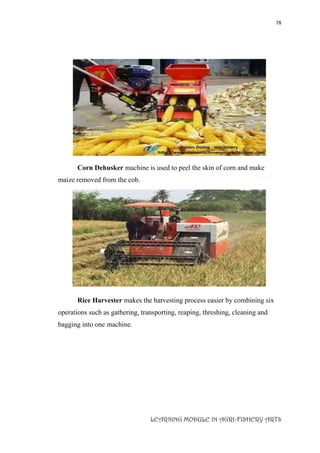
Corn Dehusker machine is used to peel the skin of corn and make
maize removed from the cob.
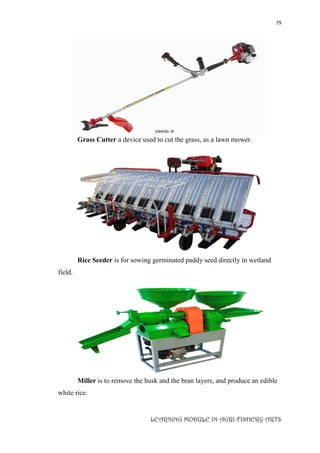
Rice Harvester makes the harvesting process easier by combining six
operations such as gathering, transporting, reaping, threshing, cleaning and
bagging into one machine.
79
LEARNING MODULE IN AGRI-FISHERY ARTS
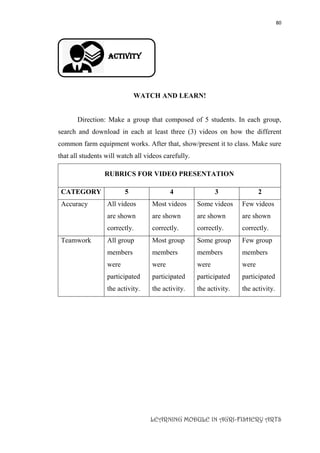
Grass Cutter a device used to cut the grass, as a lawn mower.
Rice Seeder is for sowing germinated paddy seed directly in wetland
field.
Miller is to remove the husk and the bran layers, and produce an edible
white rice.
80
LEARNING MODULE IN AGRI-FISHERY ARTS
Activity
WATCH AND LEARN!
Direction: Make a group that composed of 5 students. In each group,
search and download in each at least three (3) videos on how the different
common farm equipment works. After that, show/present it to class. Make sure
that all students will watch all videos carefully.
RUBRICS FOR VIDEO PRESENTATION
CATEGORY 5 4 3 2
Accuracy All videos
are shown
correctly.
Most videos
are shown
correctly.
Some videos
are shown
correctly.
Few videos
are shown
correctly.
Teamwork All group
members
were
participated
the activity.
Most group
members
were
participated
the activity.
Some group
members
were
participated
the activity.
Few group
members
were
participated
the activity.
81
LEARNING MODULE IN AGRI-FISHERY ARTS
LESSON 3:
PERFORM MAINTENANCE
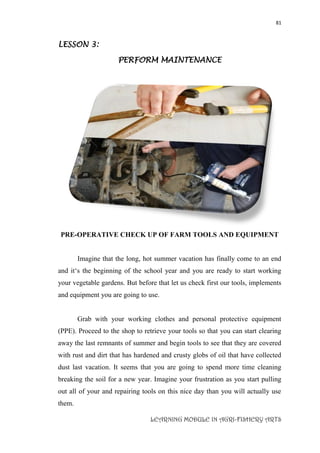
PRE-OPERATIVE CHECK UP OF FARM TOOLS AND EQUIPMENT
Imagine that the long, hot summer vacation has finally come to an end
and it‘s the beginning of the school year and you are ready to start working
your vegetable gardens. But before that let us check first our tools, implements
and equipment you are going to use.
Grab with your working clothes and personal protective equipment
(PPE). Proceed to the shop to retrieve your tools so that you can start clearing
away the last remnants of summer and begin tools to see that they are covered
with rust and dirt that has hardened and crusty globs of oil that have collected
dust last vacation. It seems that you are going to spend more time cleaning
breaking the soil for a new year. Imagine your frustration as you start pulling
out all of your and repairing tools on this nice day than you will actually use
them.
82
LEARNING MODULE IN AGRI-FISHERY ARTS
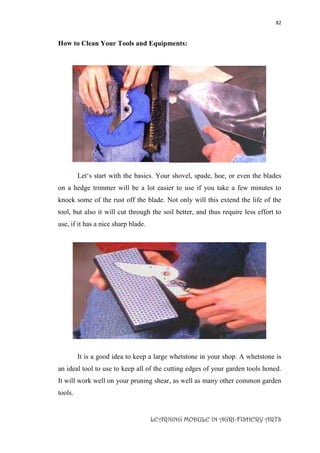
How to Clean Your Tools and Equipments:
Let‘s start with the basics. Your shovel, spade, hoe, or even the blades
on a hedge trimmer will be a lot easier to use if you take a few minutes to
knock some of the rust off the blade. Not only will this extend the life of the
tool, but also it will cut through the soil better, and thus require less effort to
use, if it has a nice sharp blade.
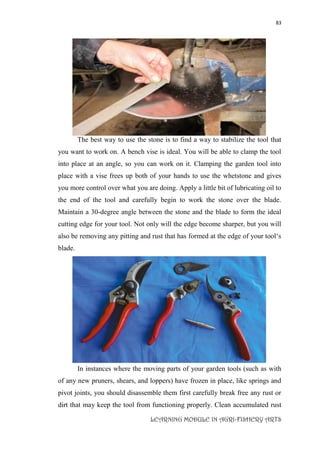
It is a good idea to keep a large whetstone in your shop. A whetstone is
an ideal tool to use to keep all of the cutting edges of your garden tools honed.
It will work well on your pruning shear, as well as many other common garden
tools.
83
LEARNING MODULE IN AGRI-FISHERY ARTS
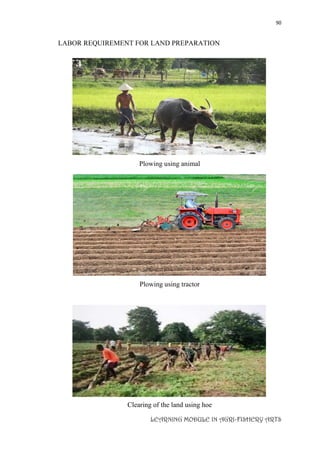
The best way to use the stone is to find a way to stabilize the tool that
you want to work on. A bench vise is ideal. You will be able to clamp the tool
into place at an angle, so you can work on it. Clamping the garden tool into
place with a vise frees up both of your hands to use the whetstone and gives
you more control over what you are doing. Apply a little bit of lubricating oil to
the end of the tool and carefully begin to work the stone over the blade.
Maintain a 30-degree angle between the stone and the blade to form the ideal
cutting edge for your tool. Not only will the edge become sharper, but you will
also be removing any pitting and rust that has formed at the edge of your tool‘s
blade.
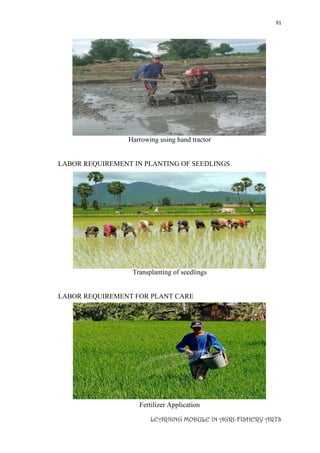
In instances where the moving parts of your garden tools (such as with
of any new pruners, shears, and loppers) have frozen in place, like springs and
pivot joints, you should disassemble them first carefully break free any rust or
dirt that may keep the tool from functioning properly. Clean accumulated rust
84
LEARNING MODULE IN AGRI-FISHERY ARTS
and dirt off all metal surfaces with a wire brush. Remove stubborn rust from
small tools with fine steel wool. Using an old toothbrush with some lightweight
lubricating oil is a great way to work fresh oil into the joints of most garden
tools. Not only will this fresh oil helps your tool to work as it was intended, but
it will also prevent the formation of rust. Use medium-grit sandpaper to remove
rust on larger tools such as shovels, spades, and hoes.
Once your tools are cleaned, they're ready to be sharpened. When
sharpening, try to maintain the original factory bevel or angle. For pruners, use
a whetstone because it produces a very sharp cutting edge. Depending on the
type of whetstone, apply a few drops of oil or water to the stone. With the
beveled side of the blade against the stone, rub the sharp edge of the blade
toward the stone in a curved motion, as if you were trying to shave off a thin
slice from the stone.
When working with a file, stabilize the blades in a vise or against a solid
surface such as a work bench to avoid injury and ensure an even stroke.
85
LEARNING MODULE IN AGRI-FISHERY ARTS
Always push the file across the blade in a motion away from your body. Move
the file diagonally, so that its cutting teeth are biting into the metal on the tool.
When sharpening with a file, do not use oil; metal filings will accumulate and
clog the file's serrations.
Farm implements like ordinary plow and wooden harrow should be
checked thoroughly before use. Loosened bolts and nuts should be tightened
firmly. Disc plow and harrow should also be lubricated on their moving parts
like bearings. Tractors should be tuned-up very well by skilled operator. Check
on their oil, lubricant, fuel and cooling system.
86
LEARNING MODULE IN AGRI-FISHERY ARTS
Activity
WELL-MAINTAINED, WELL EFFECTIVE
Direction: Bring the following materials and tools needed. Perform the
procedures properly.
Materials:
 1 Bottle/Container of Any Industrial Oil
 A piece of Rag
 Pieces of Sand Paper 300
 PPE such as gloves, eye protector goggles or glasses and dust mask
Tools:
 A set of Hedge Shear
 A set of Metal Clamp
 A Pile
 A Wrench (the size is based from the pivot nut of the hedge shear)
 A Bench Vise (look for School Facilities if available)
Procedure:
Step 1: Safety First. Wear all your Personal Protective Equipments. Prevention
to an accident is better than cure.
Step 2: Tighten the pivot nut. Before sharpening, check the pivot nut. It could
be loose, making the blades drift apart while cutting and tearing the twig
instead of cutting it clean. The nut should be snug with no play in the pivot.
With the nut tightened, check the tool; if it cuts cleanly, it doesn't need
sharpening. If it still cuts poorly, look down each blade to make sure it's not
bent. If a blade is slightly bent, loosen the pivot nut and separate the blades. To
87
LEARNING MODULE IN AGRI-FISHERY ARTS
straighten the blade, put it in a vise, slip on some thick leather gloves and
tweak it until it's straight.
Step 3: Hold the metal clamp using a vise. Examine the factory edge. Hold the
pile with both hands and mimic the direction of the bevel. Move the pile in one
direction, away from you. Don't use small, jerky strokes or you'll lose the
factory edge. As you work, you can see the clean metal path left by the pile.
Adjust your angle as needed to pile the entire edge evenly. Repeat this motion
several times until you expose clean metal over the whole edge. Usually it'll
take only about 10 strokes. Do the same with the other blade.
Step 4: Sand the back side of the blade. Place a sheet of 300-grit wet/dry
sandpaper on a smooth, flat piece of plywood. You'll be able to feel the burrs
(be careful— they're sharp) on the back side of each blade caused by the filing
action. To remove them, lightly sand the back side of the blade. Keep the blade
flat and move it in a circular motion. After making several circles, pick up the
blade and gently feel the edge. When the burrs left by the file disappear,
assemble the blades and lightly oil the moving parts.
Step 5: Perform house keeping
Assessment:
The students must do properly all criteria below to pass and if it’s not
they must retake the activity until they pass.
 The blade is properly sharpened.
 The nut is properly removed and returned.
 The step by step procedures are correctly followed.
 The safety precautions are properly observed.
88
LEARNING MODULE IN AGRI-FISHERY ARTS
LESSON 4:
FARM INPUTS AND LABOR
FARM INPUTS
They are defined as products permitted for use in organic farming.
These include feedstuffs, fertilizers and permitted plant protection products.
The resources that are used in farm production. The following are examples:
Seed is a material which is used for planting or regeneration purpose.
However scientifically, it is a fertilized matured ovule together covered with
89
LEARNING MODULE IN AGRI-FISHERY ARTS
seed coat and it is a propagating material. Thus, seed is the most vital and
crucial input for crop production.
Fertilizer is a chemical or natural substance added to soil or land to
increase its fertility. There are two types of fertilizer; organic and inorganic.
Pesticide is a substance used for destroying insects or other organisms
harmful to cultivated plants or animals.
FARM LABOR
Farm labor is the manpower to perform agricultural works such as land
preparation, planting, sowing, plant caring, maintenance, harvesting, and
storing. It is the comprehensive efforts by an individual or group of men to
successfully fulfill the needs of the demand of farm operations.
90
LEARNING MODULE IN AGRI-FISHERY ARTS
LABOR REQUIREMENT FOR LAND PREPARATION
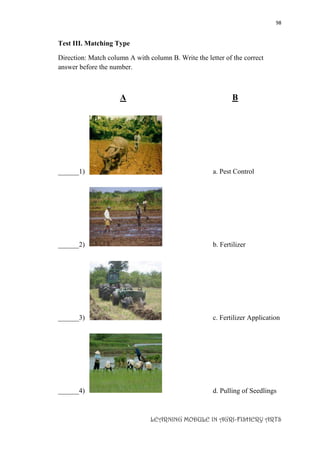
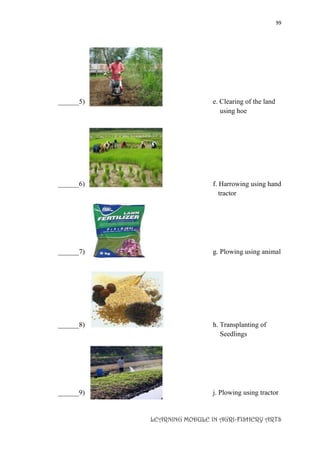
Plowing using animal
Plowing using tractor
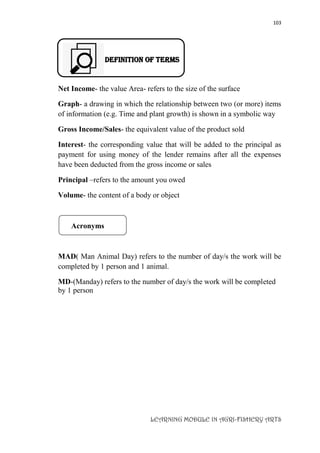
Clearing of the land using hoe
91
LEARNING MODULE IN AGRI-FISHERY ARTS
Harrowing using hand tractor
LABOR REQUIREMENT IN PLANTING OF SEEDLINGS
Transplanting of seedlings
LABOR REQUIREMENT FOR PLANT CARE
Fertilizer Application
92
LEARNING MODULE IN AGRI-FISHERY ARTS
Pest Control
Irrigation
Weeding
93
LEARNING MODULE IN AGRI-FISHERY ARTS
Harvesting
Threshing Rice
Drying Rice
94
LEARNING MODULE IN AGRI-FISHERY ARTS
Threshing Corn
Drying Corn
Storing
95
LEARNING MODULE IN AGRI-FISHERY ARTS
Activity
ESTIMATING FARM INPUTS AND LABOR REQUIREMENTS
Direction: Follow the instructions below.
1. Visit a vegetable farm near to your school or home
2. Get the following data of the ff:
a. Area
b. Crop
c. Age of crop
d. Quantity of planting materials (in kgs)
e. Number of workers prepared the land
f. Number of days consumed in preparing the area
g. Amount of salary given to each worker during land preparation
h. Number of worker planted the area
i. Number of days consumed in planting the area
j. Amount of salary paid in planting the area
k. Number of worker fertilized the area from planting up to the date
of this survey.
l. Quantity of fertilizer used from planting up to the date where
survey was made
m. Amount of salary paid in applying fertilizer from planting to the
date of this survey
n. Quantity of fertilizer to be used after the survey until harvesting
o. Number of workers required to perform fertilization after
the survey until final harvesting
p. Amount of salary needed for fertilizer application after this
survey until harvesting
96
LEARNING MODULE IN AGRI-FISHERY ARTS
q. Estimated irrigation expenses from planting up to harvesting
r. Estimated worker hired to perform irrigation from planting to
harvesting.
s. Estimated days for spraying pesticides
t. Estimated workers needed for spraying insecticides
u. Estimated cost of insecticide used in spraying
v. Workers salary during spraying of insecticides
w. Estimated number of weeding operation
x. Estimated worker needed in weeding
y. Workers salary during weeding
z. Estimated worker employ during harvesting
3. Present your data in tabular form
Assessment:
The students must do properly all criteria below to pass and if it’s not
they must retake the activity until they pass.
 Required measuring tool is used in measuring the area.
 The data gathered is consistent.
 The respondent answers the question carefully.
 Data are presented in tabular form
97
LEARNING MODULE IN AGRI-FISHERY ARTS
Post-TEST
Test I.Identification
Direction: Identify each farm tool, equipment and implements. Write
your answer in the space provided.
_________1. It is a farm tool used for cutting tall grasses and weeds and
chopping branches of trees.
_________2. It is a farm tool used for breaking hard topsoil and pulverizing
soil.
_________3. It is handy tool used for cutting planting materials and for
performing other operations in horticulture.
_________4. A farm tool used for spraying insecticides, foliar fertilizers,
fungicides and herbicides.
_________5. It is a farm tool used for hauling trash, manures, fertilizers,
planting materials and other equipment.
_________6. It is a hand-held agricultural tool with a variously curved blade
typically used for cutting weeds.
_________7. It is an implement mounted to a tractor used for tilling and
pulverizing the soil.
_________8. It is used for cutting bigger size post.
_________9.It is used for cutting branches of planting materials and
unnecessary branches of plants.
_________10. It is a farm tool use for inter row cultivation.
Test II. Enumeration
Direction: Enumerate the following:
1. Give at least ten (10) different hand tools used in farming.
2. Give at least five (5) different farm equipment.
3. Give three (3) different farm implement.
98
LEARNING MODULE IN AGRI-FISHERY ARTS
Test III. Matching Type
Direction: Match column A with column B. Write the letter of the correct
answer before the number.
A B
______1) a. Pest Control
______2) b. Fertilizer
______3) c. Fertilizer Application
______4) d. Pulling of Seedlings
99
LEARNING MODULE IN AGRI-FISHERY ARTS
______5) e. Clearing of the land
using hoe
______6) f. Harrowing using hand
tractor
______7) g. Plowing using animal
______8) h. Transplanting of
Seedlings
______9) j. Plowing using tractor
100
LEARNING MODULE IN AGRI-FISHERY ARTS
______10) k. Seeds
Test IV. Essay
Direction: Answer the following questions.
1. How to clean your tools and equipment?
2. What is the importance of preventive maintenance? Justify.
101
LEARNING MODULE IN AGRI-FISHERY ARTS
Basic Calculation

take the challenge!
At the end of this chapter, the students are expected to:
Lesson 1: Perform Farm Basic Workplace Calculation
CHAPTER 3
102
LEARNING MODULE IN AGRI-FISHERY ARTS
PRE-TEST
Test I. Calculation
Direction: Solve a mathematical computation each number has 2 points.
A. Convert the following:
1. 1m=____cm
2. 500cm=_____m
3. 8km=______m
4. 1km=_____cm
5. 3000 m=___km
B. Find the area (hectare) of the following.
1. 500m x 500m
2. 200mx2000m
3. 500mx600m
4. 800mx700m
5. 800mx900m
C. Compute the following:
1. 10% of 90 trees were replaced
2. 20% of 30 hectares are harvested
3. 80% of 100 farmers are present
4. 50% of P250 increase in farmers salary
5. 30% of 150 kg seeds are dormant
103
LEARNING MODULE IN AGRI-FISHERY ARTS
DEFINITION OF TERMS
Net Income- the value Area- refers to the size of the surface
Graph- a drawing in which the relationship between two (or more) items
of information (e.g. Time and plant growth) is shown in a symbolic way
Gross Income/Sales- the equivalent value of the product sold
Interest- the corresponding value that will be added to the principal as
payment for using money of the lender remains after all the expenses
have been deducted from the gross income or sales
Principal –refers to the amount you owed
Volume- the content of a body or object
Acronyms
MAD( Man Animal Day) refers to the number of day/s the work will be
completed by 1 person and 1 animal.
MD-(Manday) refers to the number of day/s the work will be completed
by 1 person
104
LEARNING MODULE IN AGRI-FISHERY ARTS
LESSON 1:
BASIC WORKPLACE CALCULATIONS
PERFORM CALCULATION
It is important to be able to measure and calculate surface areas. It might be
necessary to calculate, for example, the surface area of the cross-section of a
canal or the surface area of a farm.
This section will discuss the calculation of some of the most common surface
areas: triangle, square, rectangle, rhombus, parallelogram, trapezium and circle.
105
LEARNING MODULE IN AGRI-FISHERY ARTS
The height (h) of a triangle, a rhombus, a parallelogram or a trapezium,
is the distance from a top corner to the opposite side called base (b). The height
is always perpendicular to the base; in other words, the height makes a "right
angle" with the base. An example of a right angle is the corner of this page.
In the case of a square or a rectangle, the expression length (1) is
commonly used instead of base and width (w) instead of height. In the case of a
circle the expression diameter (d) is used.
The height (h), base (b), width (w), length (1) and diameter (d) of the
most common surface areas
TRIANGLES
The surface area or surface (A) of a triangle is calculated by the formula:
A (triangle) = 0.5 x base x height = 0.5 x b x h
106
LEARNING MODULE IN AGRI-FISHERY ARTS
Triangles can have many shapes but the same formula is used for all of them.
SQUARES AND RECTANGLES
The surface area or surface (A) of a square or a rectangle is calculated
by the formula: Area=Length x Width
In a square the lengths of all four sides are equal and all four angles are
right angles. In a rectangle, the lengths of the opposite sides are equal and all
four angles are right angles. All lengths and widths in a square are equal. All
lengths and widths in a rectangle are not equal.
RHOMBUSES AND PARALLELOGRAMS
The surface area or surface (A) of a rhombus or a parallelogram is calculated
by the formula: Area= Base x Height
107
LEARNING MODULE IN AGRI-FISHERY ARTS
In a rhombus the lengths of all four sides are equal; none of the angles are right
angles; opposite sides run parallel. In a parallelogram the lengths of the
opposite sides are equal; none of the angles are right angles; opposite sides run
parallel.
TRAPEZIUMS
The surface area or surface (A) of a trapezium is calculated by the formula:
Area=0.5 (Base+Top) x Height
The top (a) is the side opposite and parallel to the base (b). In a
trapezium only the base and the top run parallel.
Another method to calculate the surface area of a trapezium is to divide
the trapezium into a rectangle and two triangles, to measure their sides and to
determine separately the surface areas of the rectangle and the two triangles.
Splitting a trapezium into one rectangle and two triangles.
Note that A = A1+ A2 + A3 = 1 + 6 + 2 =9 cm2
108
LEARNING MODULE IN AGRI-FISHERY ARTS
CIRCLES
The surface area or surface (A) of a circle is calculated by the formula:
Area=1/4(3.14x d2
)
Whereby d is the diameter of the circle and ¶ (a Greek letter,
pronounced Pi) a constant (¶ = 3.14). A diameter (d) is a straight line which
divides the circle in two equal parts.
METRIC CONVERSIONS
The basic unit of length in the metric system is the meter (m). One meter can
be divided into 10 decimeters (dm), 100 centimeters (cm) or 1000 millimeters
(mm); 100 m equals to 1 hectometer (hm); while 1000 m is 1 kilometer (km).
1 m = 10 dm = 100 cm = 1000 mm
0.1 m = 1 dm = 10 cm = 100 mm
0.01 m = 0.1 dm = 1 cm = 10 mm
0.001 m = 0.01 dm = 0.1 cm = 1 mm
1 km = 10 hm = 1000 m
0.1 km = 1 hm = 100 m
0.01 km = 0.1 hm = 10 m
0.01 = 0.01 hm = 1 m
109
LEARNING MODULE IN AGRI-FISHERY ARTS
Units of surface
The basic unit of area in the metric system is the square meter (m),
which is obtained by multiplying a length of 1 meter by a width of 1 meter.
1 Surface Area in Hectare (ha)=100m x 100m= 10 000m2
A square meter
1 m2
= 100 dm2
= 10 000 cm2
= 1 000 000 mm2
0.01 m2
= 1 dm2
= 100 cm2
= 10 000 mm2
0.0001 m2
= 0.01 dm2
= 1 cm2
= 100 mm2
0.000001 m2
= 0.0001 dm2
= 0.01 cm2
= 1 mm2
1 km2
= 100 ha2
= 1 000 000 m2
0.01 km2
= 1 ha2
= 10 000 m2
0.000001 km2
= 0.0001 ha2
= 1 m2
SURFACE AREAS OF CANAL CROSS-SECTIONS AND FARMS
This Section explains how to apply the surface area formulas to two
common practical problems that will often be met in the field.
110
LEARNING MODULE IN AGRI-FISHERY ARTS
DETERMINATION OF THE SURFACE AREAS OF CANAL CROSS-
SECTIONS
The most common shape of a canal cross-section is a trapezium or, more truly,
an "up-side-down" trapezium.
Canal Cross Section
The area (A B C D), hatched on the above drawing, is called the canal
cross-section and has a trapezium shape. Thus, the formula to calculate its
surface is similar to the formula used to calculate the surface area of a
trapezium:
Surface area of the canal cross-section= 0.5 (base + top line) x canal depth
=0.5 (b +a) x h
Whereby:
base (b) = bottom width of the canal
top line (a) = top width of the canal
canal depth (h) = height of the canal (from the bottom of the canal to the top of
the embankment)
111
LEARNING MODULE IN AGRI-FISHERY ARTS
Wettted Cross-Section of a Canal
The area (A B C D), hatched on the above drawing, is called the wetted
canal cross-section or wetted cross-section. It also has a trapezium shape and
the formula to calculate its surface area is:
Surface area of the wetted canal cross-section = 0.5 (base + top line) x water
depth = 0.5 (b + a1) x h1
Whereby:
base (b) = bottom width of the canal
top line (a1) = top width of the water level
water depth (h1) = the height or depth of the water in the canal (from the
bottom of the canal to the water level).
DETERMINATION OF THE SURFACE AREA OF A FARM
It may be necessary to determine the surface area of a farmer's field. For
example, when calculating how much irrigation water should be given to a
certain field, the size of the field must be known.
When the shape of the field is regular and has, for example, a
rectangular shape, it should not be too difficult to calculate the surface area
once the length of the field (that is the base of its regular shape) and the width
of the field have been measured.
112
LEARNING MODULE IN AGRI-FISHERY ARTS
Field of regular shape
Field of irregular shape
In this case, the field should be divided in several regular areas (square,
rectangle, triangle, etc.).
113
LEARNING MODULE IN AGRI-FISHERY ARTS
Division of irregular field into regular areas
Surface area of the square: As = length x width = 30 m x 30 m = 900 m2
Surface area of the rectangle: Ar = length x width = 50 m x 15 m = 750 m2
Surface area of the triangle: At = 0.5 x base x height = 0.5 x 20 m x 30 m = 300
m2
Total surface area of the field: A = As + Ar + At = 900 m2
+ 750 m2
+ 300 m2
=
1950 m2
INTRODUCTION TO VOLUME
A volume (V) is the content of a body or object. Take for example a
block. A block has a certain length (l), width (w) and height (h). With these
three data, the volume of the block can be calculated using the formula:
V (block) = length x width x height = l x w x h
114
LEARNING MODULE IN AGRI-FISHERY ARTS
UNITS OF VOLUME
The basic unit of volume in the metric system is the cubic meter (m3
)
which is obtained by multiplying a length of 1 meter, by a width of 1 meter and
a height of 1 meter.
One cubic meter
1m3
= 1.000 dm3
= 1 000 000 cm3
= 1 000 000 000 mm3
0.001 m3
= 1 dm3
= 1 000 cm3
= 1 000 000 mm3
0.000001 m3
= 0.001 dm3
= 1 cm3
= 1 000 mm3
0.000000001 m3
= 0.000001 dm3
= 0.001 cm3
= 1 mm3
VOLUME OF WATER ON A FIELD
Suppose a one-liter bottle is filled with water. The volume of the water
is 1 liter or 1 dm3
. When the bottle of water is emptied on a table, the water will
spread out over the table and form a thin water layer. The amount of water on
the table is the same as the amount of water that was in the bottle.
The volume of water remains the same; only the shape of the "water
body" changes.
115
LEARNING MODULE IN AGRI-FISHERY ARTS
One Liter of water spread over a table
A similar process happens if you spread irrigation water from a storage
reservoir over a farmer's field.
A volume of 100 m3
of water spreas over an area of one hectare
The formula to use is:
As the first step, the volume of water must be calculated. It is the
volume of the filled reservoir, calculated with formula:
Volume (V) = length x width x height = 5 m x 10 m x 2 m = 100 m3
As the second step, the thickness of the water layer is calculated using
formula:
116
LEARNING MODULE IN AGRI-FISHERY ARTS
Given
Surface of the field = 10 000 m2
Volume of water = 100 m3
Formula: d= Volume of Water (m3
)
Surface of the Field (m2
)
Answer: d= 100 (m3
)
10 000 (m2
)
d = 0.01 m or d = 10 mm
A water layer 1 mm thick is spread over a field of 1 ha. Calculate the
volume of the water (in m3
).
One millimeter water depth on a field of one hectare
The formula to use is:
Volume of water (V) = Surface of the field (A) x Water depth (d)
Given:
Surface of the field = 10 000 m2
Water depth = 1 mm =1/1 000 = 0.001m
Answer:
Formula: Surface of the field (m²) x water depth (m)
Volume (m3)
V = 10 000 m2
x 0.001 m
V = 10 m3
or 10 000 liters
117
LEARNING MODULE IN AGRI-FISHERY ARTS
INTRODUCTION TO FLOW-RATE
The flow-rate of a river, or of a canal, is the volume of water discharged
through this river, or this canal, during a given period of time. Related to
irrigation, the volume of water is usually expressed in liters (l) or cubic meters
(m3
) and the time in seconds (s) or hours (h). The flow-rate is also called
discharge-rate.
CALCULATION AND UNITS
The water running out of a tap fills a one liter bottle in one second. Thus the
flow rate (Q) is one liter per second (1 l/s).
A flow-rate of one liter per second
PROBLEM
The water supplied by a pump fills a drum of 200 liters in 20 seconds.
What is the flow rate of this pump?
The formula used is: Q= Flow-Rate (l/s)= Volume of Water (liters)
Time (seconds)
Given: Volume of water: 200 L
Time: 20s
Answer: Q= Volume of Water_ =200l= 10 l/s
Time 20s
118
LEARNING MODULE IN AGRI-FISHERY ARTS
The unit "liter per second" is commonly used for small flows, e.g. a tap
or a small ditch. For larger flows, e.g. a river or a main canal, the unit "cubic
metre per second" (m3
/s) is more conveniently used.
PROBLEM
A river discharges 100 m3
of water to the sea every 2 seconds. What is
the flow-rate of this river expressed in m3
/s?
The formula used is: Q= Flow-Rate (m3
/s)= Volume of Water (m3
)
Time (seconds)
Given: Volume of water: 100 m3
Time: 2s
Answer: Q= Volume of Water_ =200m3
= 50 m3
/s
Time 2s
The discharge rate of a pump is often expressed in m3
per hour (m3
/h) or
in liters per minute (l/min).
Formula: Q = Flow-Rate (l/min) = Volume of Water (litres)
Time (minutes)
or
Q = Flow-Rate (m3
/h) = Volume of Water (m3
)
Time (hours)
119
LEARNING MODULE IN AGRI-FISHERY ARTS
INTRODUCTION TO PERCENTAGE
In relation to agriculture, the words percentage will be met regularly.
For instance "60 percent of the total area is irrigated during the dry season". In
this Section the meaning of the word "percentage" will be discussed.
PERCENTAGE
The word "percentage" means literally "per hundred"; in other words
one percent is the one hundredth part of the total. You can either write percent,
or %, or 1/100, or 0.01.
Some examples are:
5 percent = 5% =5/100 = 0.05
20 percent = 20% = 20/100= 0.20
25 percent = 25% = 25/100 = 0.25
50 percent = 50% = 50/100 =0.50
100 percent = 100% = 100/100 = 1
150 percent = 150% = 150/100 = 1.5
QUESTION
How many oranges are in 1% of a total of 300 oranges?
Three oranges are in 1% of 300 oranges
120
LEARNING MODULE IN AGRI-FISHERY ARTS
ANSWER
1% of 300 oranges = 1/100 x 300 = 3 oranges
INTRODUCTION TO GRAPHS
A graph is a drawing in which the relationship between two (or more)
items of information (e.g. time and plant growth) is shown in a symbolic way.
To this end, two lines are drawn at a right angle. The horizontal one is
called the x axis and the vertical one is called the y axis.
Where the x axis and the y axis intersect is the "0" (zero) point.
The plotting of the information on the graph is discussed in the following
examples.
A graph
EXAMPLE 1
Suppose it is necessary to make a graph of the growth rate of a corn
plant. Each week the height of the plant is measured. One week after planting
the seed, the plant measures 2 cm in height, two weeks after planting it
measures 5 cm and 3 weeks after planting the height is 10 cm.
121
LEARNING MODULE IN AGRI-FISHERY ARTS
Measuring the growth rate of a corn plant
These results can be plotted on a graph. The time (in weeks) will be
indicated on the x axis; 2 cm on the axis represents 1 week. The plant height (in
centimeters) will be indicated on the y axis; 1 cm on the axis represents 1 cm of
plant height.
After 1 week the height is 2 cm; this is indicated on the graph with A;
after 2 weeks the height is 5 cm, see B, and after 3 weeks the height is 10 cm,
see C.
At planting (Time = 0) the height was zero, see D.
Now connect the crosses with a straight line. The line indicates the
growth rate of the plant; this is the height increase over time.
It can be seen from the graph that the plant is growing faster and faster
(during the first week 2 cm and during the third week 5 cm); the line from B to
C is steeper than the line from D to A.
122
LEARNING MODULE IN AGRI-FISHERY ARTS
Graph of the growth rate of a corn plant
From the graph can be read what the height of the plant was after, say 2
1/2 weeks; see the dotted line. Locate on the horizontal axis 2 1/2 weeks and
follow the dotted line upwards until the dotted line crosses the graph. From this
crossing follow the dotted line to the left until the vertical axis is reached. Now
take the reading: 7.5 cm, which means that the plant had a height of 7.5 cm
after 2 1/2 weeks. This height has not been measured in reality, but with the
graph the height can be determined anyway.
QUESTION
What was the height of the plant after 1 1/2 weeks?
ANSWER
The height of the plant after 1 1/2 weeks was 3.5 cm.
EXAMPLE 2
Another example to illustrate how a graph should be made is the
variation of the temperature over one full day (24 hours). Suppose the outside
temperature (always in the shade) is measured, with a thermometer, every two
hours, starting at midnight and ending the following midnight.
Suppose the following results are found:
123
LEARNING MODULE IN AGRI-FISHERY ARTS
Time(hr) Temperature(°C)
0 16
2 13
4 6
6 8
8 13
10 19
12 24
14 28
16 2
18 27
20 22
22 19
24 16
Graph showing temperature over 24 hours; mistake 16 hour reading
On the x axis indicate the time in hours, whereby 1 cm on the graph is 2
hours. On the y axis indicate the temperature in degrees Celsius (°C), whereby
1 cm on the graph is 5°C.
Now indicate (with crosses) the values from the table (above) on the
graph paper and connect the crosses with straight dotted lines.
124
LEARNING MODULE IN AGRI-FISHERY ARTS
Graph showing temperature over 24 hours; estimated correction of mistake
At this stage, if you look attentively at the graph, you will note that there
is a very abrupt change in its shape around the sixteenth hour. The outside
temperature seems to have fallen from 28°C to 2°C in two hours‘ time! That
does not make sense, and the reading of the thermometer at the sixteenth hour
must have been wrong. This cross cannot be taken in consideration for the
graph and should be rejected. The only dotted line we can accept is the straight
one in between the reading at the fourteenth hour and the reading at the
eighteenth hour.
Graph showing temperature over 24 hours; smooth curve
In reality the temperature will change more gradually than indicated by
the dotted line; that is why a smooth curve is made (continuous line). The
125
LEARNING MODULE IN AGRI-FISHERY ARTS
smooth curve represents the most realistic approximation of the temperature
over 24 hours.
From the graph it can be seen that the minimum or lowest temperature
was reached around 4 o'clock in the morning and was about 6°C. The highest
temperature was reached at 4 o'clock in the afternoon and was approximately
29°C.
QUESTION
What was the temperature at 7, 15 and 23 hours? (Always use the smooth curve
to take the readings).
ANSWER
Temperature at 7 hours: 10°C
Temperature at 15 hours: 29°C
Temperature at 23 hours: 17°C
126
LEARNING MODULE IN AGRI-FISHERY ARTS
Activity
PROJECT PROPOSAL
Direction: Do the instructions properly.
SPECIFIC INSTRUCTIONS:
1. Get a copy of a simple project proposal from any sources (it is
suggested that your choice is related to crop production).
2. Study the different parts and make your own version.
3. Submit your proposal with estimated cost before the end of the quarter
or grading period.
Assessment:
The students must do properly all criteria below to pass and if it’s not
they must retake the activity until they pass.
 Project proposal is simple and easy to understand
 Project proposal is related to your course
 Data are reliable and applicable (prices)
 Sample of project plan is taken from a reliable source
127
LEARNING MODULE IN AGRI-FISHERY ARTS
Post-TEST
Test I. Calculation
Direction: Solve a mathematical computation each number has 2 points.
D. Convert the following:
6. 1m=____cm
7. 500cm=_____m
8. 8km=______m
9. 1km=_____cm
10.3000 m=___km
E. Find the area (hectare) of the following.
6. 500m x 500m
7. 200mx2000m
8. 500mx600m
9. 800mx700m
10.800mx900m
F. Compute the following:
6. 10% of 90 trees were replaced
7. 20% of 30 hectares are harvested
8. 80% of 100 farmers are present
9. 50% of P250 increase in farmers salary
10.30% of 150 kg seeds are dormant
128
LEARNING MODULE IN AGRI-FISHERY ARTS
Plans and Drawing
take the challenge!
At the end of this chapter, the students are expected to:
Lesson 1: Interpret Farm Plans and Lay-out
Lesson 2: Interpret Irrigation Plan and Design
CHAPTER 4
129
LEARNING MODULE IN AGRI-FISHERY ARTS
PRE-TEST
Test I: Multiple choice
Direction: Write the letter of the correct answer before the number.
1) Which of the following is a type of planting arrangement applied in
conventional horizontal farming or gardening is a system of growing crops
in linear pattern in at least one direction rather than planting without any
distinct arrangement.
a. Tree planting
b. Vegetable planting
c. Row planting
d. None of the above
2) ________ is a system of growing crops in blocks or strips of 2 or more
rows.
a. Single row planting
b. Double row planting
c. Multiple row planting
d. Half row planting
3) _________ is a method of planting in which seeds are directly planted on
the ground in the farm or any growing surface while transplanting makes
use of pre-grown plants, seedlings or vegetative propagated clones.
a. Row planting
b. Indirect seeding
c. Drill method
d. Direct seeding
4) ________is the systematic apportioning of the farm area or any growing
surface for crop production.
a. Spatial Arrangement
130
LEARNING MODULE IN AGRI-FISHERY ARTS
b. Kinesthetic Arrangement
c. Strategic Arrangement
d. Proficient Arrangement
5) Which of the following it pertains to the field shape must be accurately
drawn showing pertinent obstructions, features and elevation details?
a. Internet data
b. Site assessment
c. Geographical data
d. Topographic data
6) Which of the following pertains to the water supply must be clearly
indicated showing location and available capacity.
a. Topographic data
b. Water irrigation
c. food consumption
d. Water capacity
7) _________refers to the soil and crop limitations must be accounted for to
reduce runoff and deep percolation by mismanagement of the irrigation
system.
a. Soil capacity
b. Water capacity
c. Soil erosion
d. Soil and crop characteristics
8) It is a type of irrigation design where water is applied to the field in either
the controlled or uncontrolled manner.
a. Sprinkler Irrigation
b. Drip Irrigation
c. Trickle Irrigation
d. Surface Irrigation
9) It is a type of irrigation design that has a controlled surface flooding is
practiced whereby the field is divided up into strips by parallel ridges or
131
LEARNING MODULE IN AGRI-FISHERY ARTS
dikes and each strip is irrigated separately by introducing water upstream
and it progressively covers the entire strip.
a. Border irrigation
b. Furrow irrigation system
c. Highland irrigation system
d. Lowland irrigation system
10) It is a parameter design of borders in irrigation system where the Cross
slopes must be eliminated by levelling.
a. Strip length
b. Strip diameter
c. Slope height
d. Strip width
11) It is a parameter design of borders where the longitudinal slopes should be
almost same as for the furrow irrigation.
a. Strip length
b. Strip slope
c. Strip width
d. Strip height
12) It is a parameter design of border in irrigation where the maximum
advance stream used should be non-erosive and therefore depends on the
protection afforded by the crop cover.
a. Strip length
b. Strip slope
c. Construction of levees
d. Selection of the advance stream
13) It is a parameter design of border in irrigation where Levees should be big
enough to withstand erosion and of sufficient height to contain the
irrigation stream.
a. Strip length
b. Strip slope
c. Construction of levees
132
LEARNING MODULE IN AGRI-FISHERY ARTS
d. Selection of the advance stream
14) It is a parameter design of border in irrigation where The ideal lengths can
be obtained by field tests.
a. Strip length
b. Strip slope
c. Construction of levees
d. Selection of the advance stream
15)It is a type of irrigation design where the ideal areas where water is scarce.
a. Border irrigation
b. Furrow irrigation
c. Lower land irrigation
d. Sprinkler irrigation
II. True or False. Write true if the statement is correct and false if it is
otherwise.
__________ 1) The specific advantages of row planting over broadcasting or
scatter planting include the light absorption is maximized and, conversely, the
excessive shading effect of other plants is minimized thus favoring more
efficient photosynthesis and improved crop yield. Also, the wind passage along
the interrows is enhanced which increases gas exchanges and prevents
excessive humidity.
__________ 2) Single row planting of the intercrop can also be done between
the rows of the maincrop.
__________ 3) There are three planting crop method: direct seeding, indirect
seeding and transplanting.
__________ 4) Water required by crops is supplied by nature in the form of
precipitation, thus when it becomes scarce or its distribution does not coincide
with demand peaks, it is then necessary to supply it artificially, by irrigation.
133
LEARNING MODULE IN AGRI-FISHERY ARTS
__________ 5) Proper design of an irrigation system requires that the pumping
system precisely match to the irrigation distribution system so that the pressure
and flow rate required can be efficiently provided by the pumping system.
__________ 6) Irrigation water management involves determining when to
irrigate, the amount of water to apply at each irrigation event and during each
stage of plant, and operating and maintaining the irrigation system.
__________ 7) The primary functions of farm irrigation system include crop
and soil cooling, protecting crops from frost damage, delaying fruit and bud
development, and controlling wind erosion, providing water for seed
germination, application of chemicals, and land application of wastes.
__________ 8) The secondary function of farm irrigation systems is to supply
crops with irrigation water in the quantities and at the time it is needed.
__________ 9) A project plan enables the designer to lay out the irrigation
system in the most cost effective way. The plan is used to generate a material
list and to evaluate the anticipated project costs.
__________ 10) The plan provides a record for future reference. It can be used
for overall farm planning and identifies limits of expansion potential.
134
LEARNING MODULE IN AGRI-FISHERY ARTS
DEFINITION OF TERMS
Lay-outing-locating the position of plant in the field
Intercropping-the planting of other crop within the row of the main crop
Monocropping- the growing of single crop
Irrigation- the application of water to the soil by any other means than rainfall
135
LEARNING MODULE IN AGRI-FISHERY ARTS
LESSON 1:
FARM PLANS AND LAYOUT
The Farming for the Future (FFTF) program can help you to plan the
best farm layout. It is an initiative of NSW Government agencies focusing on
whole farm planning. A whole farm plan considers the farm‘s physical,
financial and human/personal resources for both now and the future.
Site assessment
An on-site assessment of a farm is necessary so that a map can be drawn
of the property‘s topography, boundaries, soils, water resources and so on, and
a farm business plan can be formulated.
Government plans
Acquaint yourself with relevant Regional Environmental Plans (REPs),
Local Environmental Plans (LEPs), and Development Control Plans (DCPs)
136
LEARNING MODULE IN AGRI-FISHERY ARTS
and their short and long-term effects on your proposed or existing farm
enterprise. This will help reduce unforeseen risks and enhance your farm
business. Council‘s building approval or development consent (DAs) may be
needed for siting greenhouses, siting and constructing dams or erecting hail and
windbreak netting. Council approval to clear land or a no burning of crop
debris or waste materials on farm‘ may apply. Consent will be required if odor
or noise is a nuisance likely to be generated from the development.
137
LEARNING MODULE IN AGRI-FISHERY ARTS
138
LEARNING MODULE IN AGRI-FISHERY ARTS
How Crops are Arranged in Row Planting
Row planting as applied in conventional horizontal farming or
gardening is asystem of growing crops in linear pattern in at least one direction
rather than planting without any distinct arrangement. It is practiced in most
crops whether direct seeded, transplanted or grown from vegetative planting
materials, both in monocropping and multiple cropping.
Crops are planted in rows or straight lines, either singly or in multiple
rows, mainly to enhance maximum yields as well as for convenience. An east-
west row orientation is preferred to maximize light absorption, but this is not
always possible. In many cases the topography that includes the shape, terrain
and slope of the land, as well as the location of existing vegetation, roads,
irrigation lines, buildings and physical barriers, dictate the row orientation.
The specific advantages of row planting over broadcasting or scatter
planting include the following: (1) light absorption is maximized and,
conversely, the excessive shading effect of other plants is minimized thus
favoring more efficient photosynthesis and improved crop yield; (2) wind
passage along the interrows is enhanced which increases gas exchanges and
prevents excessive humidity; (3) access through the interrows facilitates
cultivation, weeding, and other farm operations including hauling; (4)
movement within the crop area is convenient and allows close inspection of
individual plants; and (5) visibility is enhanced.
Row Planting Arrangement
139
LEARNING MODULE IN AGRI-FISHERY ARTS
Row-planted crops are either arranged in equidistant single rows or in
multiple rows. Planting insingle rowsis most common in monocropping or
sole cropping, the growing of a single crop.
Different systems of planting arrangement within the row are practiced
in both single and multiple row planting, depending on the characteristics and
requirement of the crop, particularly its extent of canopy expansion. In the hill
method of plantingcrops by direct seeding, the crops are arranged, singly or in
group, in uniform distances. But in the drill method, the only consideration is a
uniform number ofplants per linear meter.
In row-planted fruit trees and other perennial crops like coconut, oil
palm and rubber, the common types of planting or spatial arrangement are the
square, rectangular, quincunx, and triangular or hexagonal.
Multiple Row Planting Arrangement
140
LEARNING MODULE IN AGRI-FISHERY ARTS
Multiple row planting is a system of growing crops in blocks or strips of
2 or more rows. The adjacent blocks are separated by a space which may
remain vacant or planted to other crops. This planting arrangement is common
in multiplecropping in which two or more crops are grown in the same piece
of land. It is alsoemployed in monocropping where an alley wide enough to
facilitate passage is needed.
Coconut and other perennial crops are often intercropped with multiple
rows of annual crops like corn and pineapple. This is a common practice of
maximizing the use of vacant interrow spaces when the maincrop has not fully
developed thus allowing sufficient light exposure. In some farms, the intercrop
consists of multiple rows of such crops as coffee, cacao and banana. In this
system, both single row planting (for the maincrop) and multiple row planting
(for the intercrop) are combined.
In vegetable production that employs close spacing and where crops
should be within easy reach, the common practice is to plant in plots having
multiple rows. A space between plots is provided to allow passage.
Spatial Arrangement in Intercropping
Spatial arrangement is the systematic apportioning of the farm area or
anygrowing surface for crop production. In multiple cropping by intercropping,
the intercrop can be planted in any of the following ways: (1) within the rows
of the maincrop, (2) between the rows of the maincrop, and (3) in replacement
series Planting of the intercrop between two adjacent hills within the same row
of the main crop allows interrow cultivation but the intercrop has limited
exposure to sunlight. This is exemplified by the planting of peanut or
mungbean between corn plants within the same row or two coffee plants that
are 3 m apart between coconut plants.
Single row planting of the intercrop can also be done between the rows
of the maincrop. For example, peanut or mungbean can be dibbled between two
adjacent rows of corn. This system of planting arrangement is likewise
141
LEARNING MODULE IN AGRI-FISHERY ARTS
common in coconut farms where fruit trees like durian, lanzones and
mangosteen are grown in single rows between coconut.
In replacement series, one or more rows that are intended for the
maincrop are replaced with the intercrop. For example, a 3:2 corn+mungbean
intercrop means that for every 4 rows that are intended for sole corn, only 3
rows are planted to corn and one row may be substituted with 2 rows of
mungbean. Another practice is in strip intercropping, for example the
simultaneous growing of 6 rows corn and 12rows soybean in alternating strips.
These particular examples result to multiple row planting arrangement.
Methods of Planting Crops in the Farm
In general, there are two methods of planting crops: direct seeding and
transplanting. Direct seeding is either by broadcast, hill or dibble, or by drill
method. The hill and the drill methods are alternative options in row planting.
Direct Seeding
Direct seeding or direct sowing is a method of planting in which seeds
are directly planted on the ground in the farm or any growing surface. It
generally applies to large-seeded vegetables as well as in cereals and grain
legumes.The term direct seeding is also commonly used to refer to the planting
of seedpieces or underground vegetative planting materials directly into the
soil.
142
LEARNING MODULE IN AGRI-FISHERY ARTS
Planting crops by broadcasting or sabog tanim, or scatter planting,
commonly applies to small seeds, like rice and mungbean, that are capable of
germination and sustained growth without soil cover. There is no control of
plant-to-plant spacing. The seeds are simply distributed on a well prepared
ground by hand or with a mechanical broadcaster.
With hand broadcasting, a volume of seeds is held by the hand and
thrown with a wide swath. Skill is important to ensure even distribution of
seeds per unit ground area based on the desired seeding rate per hectare. For
example, a seeding rate of 100 kg per hectare means that the seeds have to be
distributed at an average of 0.01 kg or 10 g per sq meter. Assuming that the
crop is rice with a weight of 1000 grains of 29 grams, this is equivalent to a
seeding rate of about 345 seeds per sq meter.
Excessive seeding per unit area will mean that the prepared seeds will
have been completely sown but a portion of the farm is still unplanted, and so
additional seeds need to be procured. Conversely, seeding below the average
will complete the planting of the entire farm with some seeds still left.
In lowland rice, the seeds are broadcasted on puddled soil or over water
and allowed to germinate without covering. The broadcast method of planting
crops is also common with mungbean and cowpea grown as green manure. But
in upland farming, it is best to pass a tooth harrow or rake after broadcasting to
cover the seeds. The soil covering will hide the seeds from seed-harvesting
organisms like chicken and birds. It will also ensure that the seeds have full
contact with the soil which will maximize germination and improve the chance
of the seedlings to fully develop. In pasture establishment, a large herd of
livestock can be released after broadcasting to press the seeds into the ground
by their hooves. Dibbling is an old method of planting crops practiced by
subsistence farmers in hilly lands.
In both the hill and drill methods of planting crops by direct seeding,
there is a desired row-to-row spacing. Hills with a single or multiple number of
plants are spaced uniformly within each row so that in the hill method there is
always a reference to hill distance and number of plants per hill. A hill is that
143
LEARNING MODULE IN AGRI-FISHERY ARTS
specific spot on the ground on which a plant or a group of plants is grown. In
contrast, there is no uniform spacing between plants in the row in the drill
method, but uniformity in number of plants per linear meter is intended.
The hill method of direct seeding is done by dropping seeds in holes
made by a dibbler or in furrows that are more or less equidistant. But with
mechanized farming, a combine furrower-planter is commonly used.
In planting corn under rainfed conditions at a population density of, for
instance, 60,000 plants per hectare at 1 plant per hill in rows 70 cm apart, the
farmer walks forward along a furrow and drops a seed every 23.8 cm to the
bottom of the furrow. He does not carry a measuring tool, he just estimates
distances on the ground with impressive accuracy borne of long experience. To
cover the seeds, he merely sweeps the ridge at either side of the furrow by one
foot to push some soil toward the seed and steps thereon to press the soil on top
of the seed.
The drill method of planting crops is done, either manually or
mechanically, by releasing seeds continuously, as if pouring water from a
bottle with a small opening. Manual drilling applies to small seeds like rice,
millet, and mungbean and is usually done by hand. It can also be accomplished
by placing small, roundish seeds in a bottle with a hole on the cover. The seeds
are simply released by tilting and slightly shaking the bottle so that the seeds
drop one after the other or in a cascade through the hole and toward the ground.
The seeds are drilled with or without furrows. In rice, drilling in puddled
soil in linear direction is a modification of seed broadcasting in which plants
are dispersed without plant-to-plant spacing. But in rainfed sorghum,
mungbean, and other grain legumes, the seeds are always drilled at the bottom
of the furrow, covered with soil by raking or by foot, and stepped on to press
the soil.
Just like in the hill method of planting crops, an even distribution of
drilled seeds is intended but varies with the seeding rate per hectare and row
distance. With a seeding rate of 100 kg per hectare in rows 20 cm apart, the
calculated average seeding rate per linear meter in the row is 2 grams. With
144
LEARNING MODULE IN AGRI-FISHERY ARTS
1000 grain weight of 29 grams for rice, this is equivalent to a seeding rate of
about 70 seeds per linear meter. But if the row distance is widened to 25 cm,
the average seeding rate will increase to 2.5 grams or 86-87 seeds per linear
meter.
Transplanting
The term transplanting is also used to refer to the practice of replanting
an already established plant in one location and moving it elsewhere. It is a
method of planting in which makes use of pre-grown plants, seedlings or
vegetatively propagated clones. Transplanting is most common with small-
seeded vegetables, vegetatively propagated crops, ornamental crops, fruit trees
and many perennial crops.
Transplanting is also convenient with a few plants that can be
transferred with a ball of soil around the roots. In some vegetables, it is
common to prick seedlings from the seedbed and transplant them bareroot to
the garden plot. In perennial species like coffee at a time when rainfall has
become frequent and light is not intense, uprooted wildlings or bareroot
transplants have been directly planted.
145
LEARNING MODULE IN AGRI-FISHERY ARTS
Activity
FARM LAYOUT
Direction: Bring the following materials needed. Do the instructions
properly.
MATERIALS NEEDED:
Quantity Description
2 sheets Bond paper short
1 pc Pencil
1 pc Ruler
INSTRUCTIONS:
1. Put 1 inch border lines on your bond paper
2. Use the following data in making your layout. Imagine that 1 cm on
your drawing is equivalent to 1m
a. Width= 16 m
b. Length=19 m
c. Planting distance
Between row=1m
Between hill=0.5 m
3. Sketch inside the border lines your plot layout
4. Submit your output to your teacher
146
LEARNING MODULE IN AGRI-FISHERY ARTS
Assessment:
The work of the students will be evaluated by your teacher using the
given criteria. The students must have at least attained 75 percent to pass the
lesson.
1. Accuracy 70%
2. Presentation 20%
3. Neatness 10 %
147
LEARNING MODULE IN AGRI-FISHERY ARTS
LESSON 2:
PLAN AND DESIGN
IRRIGATION SYSTEM PLAN AND DESIGN
Water required by crops is supplied by nature in the form of
precipitation, but when it becomes scarce or its distribution does not coincide
with demand peaks, it is then necessary to supply it artificially, by irrigation.
Several irrigation methods are available, and the selection of one depends on
factors such as water availability, crop, soil characteristics, land topography,
and associated cost.
Proper design of an irrigation system requires that the pumping system
precisely match to the irrigation distribution system so that the pressure and
flow rate required can be efficiently provided by the pumping system. The
energy required to pump water is determined by the total dynamic head (water
lift, pipe friction, system pressure, etc.), the water flow rate desired and the
pumping system's efficiency.
148
LEARNING MODULE IN AGRI-FISHERY ARTS
Irrigation water management involves determining when to irrigate, the
amount of water to apply at each irrigation event and during each stage of
plant, and operating and maintaining the irrigation system. The main
management objective is to manage the production system for profit without
compromising environment and in agreement with water availability. A major
management activity involves irrigation scheduling or determining when and
how much water to apply, considering the irrigation method and other field
characteristics.
FUNCTIONS OF FARM IRRIGATION SYSTEMS
The primary function of farm irrigation systems is to supply crops with
irrigation water in the quantities and at the time it is needed. Specific function
includes:
1. Diverting water from the water source.
2. Conveying it to individual fields within the farm.
3. Distributing it within each field.
4. Providing a means for measuring and regulating flows.
Other functions of farm irrigation system include crop and soil cooling,
protecting crops from frost damage, delaying fruit and bud development, and
controlling wind erosion,
providing water for seed germination, application of chemicals, and land
application of wastes.
REASONS FOR AN IRRIGATION PLAN
 A project plan enables the designer to lay out the irrigation system in the
most cost effective way. The plan is used to generate a material list and
to evaluate the anticipated project costs.
 The plan provides step by step information on system installation.
Information on crop spacing, sprinklers, pumping requirements, pipeline
sizes and lengths should be included on the plan. Pertinent obstructions
149
LEARNING MODULE IN AGRI-FISHERY ARTS
such as roads, trees, gas, oil, water, telephone or transmission lines must
also be indicated.
 Specification, design standards and work schedules as set out on a plan
form the basis of any contractual agreements between the installation
contractor and the farmer.
 The plan provides a record for future reference. It can be used for
overall farm planning and identifies limits of expansion potential.
ESSENTIAL FEATURES OF A PLAN
 Topographic Data - the field shape must be accurately drawn showing
pertinentobstructions, features and elevation details.
 Water Source Capacity - the water supply must be clearly
indicatedshowing location and available capacity.
 Depending on the water source, a well log or water license must
accompany the irrigation plan. Irrigation reservoirs also require Water
Management Branchlicensing.
 Soil and Crop Characteristics - soil and crop limitations must be
accounted for toreduce runoff and deep percolation by mismanagement
of the irrigation system.
 Design Parameters - soil water holding capacity, maximum application
rate andclimatic data must be used to select the correct irrigation system
design.
 Design Data - the nozzle selected, operating pressure, discharge rate
and sprinklerspacing must all be shown on the plan. The irrigation
interval, set time, application rate and net amount applied must also be
calculated.
150
LEARNING MODULE IN AGRI-FISHERY ARTS
DIFFERENT DESIGNS OF IRRIGATION SYSTEMS
1. SURFACE IRRIGATION- water is applied to the field in either the
controlled or uncontrolled manner.
Surface irrigation consisted of:
1.1 Furrow system
A. FURROW IRRIGATION BY CUTTING THE RIDGE
151
LEARNING MODULE IN AGRI-FISHERY ARTS
B .FURROW IRRIGATION WITH SIPHONS
The Major Design Considerations in Surface Irrigation Include:
1. Storing the readily available moisture in the root zone, if possible;
2. Obtaining as uniform water application as possible;
3. Minimizing soil erosion by applying non-erosive streams;
4. Minimizing runoff at the end of the furrow by using a re-use system or a
cut –back stream;
5. Minimizing labor requirements by having good land preparation,
6. Good design and experienced labor and
7. Facilitating use of machinery for land preparation, cultivation,
furrowing, harvesting etc.
1.2 Border Irrigation System
1. In border irrigation, controlled surface flooding is practiced whereby the
field is divided up into strips by parallel ridges or dikes and each strip is
152
LEARNING MODULE IN AGRI-FISHERY ARTS
irrigated separately by introducing water upstream and it progressively
covers the entire strip.
2. Border irrigation is suited for crops that can withstand flooding for a
short time e.g. wheat.
3. It can be used for all crops provided that the system is designated to
provide the needed water control for irrigation of crops.
4. It is suited to soils between extremely high and very low infiltration
rates.
5. In border irrigation, water is applied slowly.
6. The root zone is applied with water gradually down the field.
7. At a time, the application flow is cut-off to reduce water loses.
8. Ideally, there is no runoff and deep percolation.
9. The problem is that the time to cut off the inflow is difficult to
determine.
Design Parameters of Border Irrigation System
a) Strip width: Cross slopes must be eliminated by leveling.
Since there are no furrows to restrict lateral movement, any cross
slope will make water move down one side leading to poor application
efficiency and possibly erosion.
-The stream size available should also be considered in choosing
a strip width.
-The size should be enough to allow complete lateral spreading
throughout the length of the strip.
-The width of the strip for a given water supply is a function of
the length -The strip width should be at least bigger than the size of
vehicle tract for construction where applicable.
b) Strip Slope: Longitudinal slopes should be almost same as for the
furrowirrigation.
153
LEARNING MODULE IN AGRI-FISHERY ARTS
c) Construction of Levees: Levees should be big enough to withstand
erosion,and of sufficient height to contain the irrigation stream.
d) Selection of the Advance Stream: The maximum advance stream used
shouldbe non-erosive and therefore depends on the protection afforded
by the crop cover. Clay soils are less susceptible to erosion but suffer
surface panning at high water velocities. Table 3.4 gives the maximum
flows recommendable for bare soils.
e) The Length of the Strip: The ideal lengths can be obtained by field
tests.
1.3 Basin Irrigation System
Characteristics:
1. In basin irrigation, water is flooded in wider areas. It is ideal for
irrigating rice.
2. The area is normally flat.
3. In basin irrigation, a very high stream size is introduced into the basin so
that rapid movement of water is obtained.
4. Water does not infiltrate a lot initially.
5. At the end, close the water inlet to avoid water loss in the pond.
6. The opportunity time difference between the upward and the downward
ends are reduced.
154
LEARNING MODULE IN AGRI-FISHERY ARTS
7. The size of basin is related to stream size and soil type.
Suggested basin areas for different soil types and rates of water flow
Flow rate Soil Type
Sand Sandy loam Clay loam Clay
l/s m3
/hr Hectares
30 108 0.02 0.06 0.12 0.20
60 216 0.04 0.12 0.24 0.40
90 324 0.06 0.18 0.36 0.60
120 432 0.08 0.24 0.48 0.80
150 540 0.10 0.30 0.60 1.00
180 648 0.12 0.36 0.72 1.20
210 756 0.14 0.42 0.84 1.40
240 864 0.16 0.48 0.96 1.60
300 1080 0.20 0.60 1.20 2.00
Note: The size of basin for clays is 10 times that of sand as the
infiltration rate forclay is low leading to higher irrigation time. The size of
basin also increases as the flow rate increases. The table is only a guide and
practical values from an area should be relied upon. There is the need for field
evaluation.
155
LEARNING MODULE IN AGRI-FISHERY ARTS
2. SPRINKLER IRRIGATION
The sprinkler system is ideal in areas where water is scarce.
A Sprinkler system conveys water through pipes and applies it with a
minimum amount of losses.
 Water is applied in form of sprays sometimes simulating natural rainfall.
 The difference is that this rainfall can be controlled in duration and
intensity.
 If well planned, designed and operated, it can be used in sloping land to
reduce erosion where other systems are not possible.
Components of a Sprinkler Irrigation System
Types of Conventional Sprinkler Systems
a) Fully portable system: The laterals, mains, sub-mains and the pumping
plantare all portable.
The system is designed to be moved from one field to another or other
pumping sites that are in the same field.
156
LEARNING MODULE IN AGRI-FISHERY ARTS
b) Semi-portable system: Water source and pumping plant are fixed in
locations.Other components can be moved.
The system cannot be moved from field to field or from farm to farm
except when more than one fixed pumping plant is used.
c) Fully permanent system: Permanent laterals, mains, sub-mains as well
as fixedpumping plant. Sometimes laterals and mainlines may be buried.
The sprinkler may be permanently located or moved along the lateral. It
can be used on permanent irrigation fields and for relatively high value
crops e.g. Orchards and vineyards. Labor savings throughout the life of
the system may later offset high installation cost.
3. DRIP OR TRICKLE IRRIGATION
Advantages:
a) Water is applied directly to the crop ie entire field is not wetted.
b) Water is conserved
c) Weeds are controlled because only the places getting water can grow
weeds.
d) There is a low pressure system.
e) There is a slow rate of water application somewhat matching the
consumptive use. Application rate can be as low as 1 – 12 l/hr.
f) There is reduced evaporation, only potential transpiration is considered.
g) There is no need for a drainage system.
157
LEARNING MODULE IN AGRI-FISHERY ARTS
Components of a Drip Irrigation System
158
LEARNING MODULE IN AGRI-FISHERY ARTS
Activity
SKETCH IRRIGATION PLAN
Direction: Bring the following materials needed. Do the instructions
properly.
MATERIALS NEEDED:
Quantity Description
2 sheets Bond paper short
1 pc Pencil
1 pc Ruler
INSTRUCTIONS:
1. After knowing different irrigation designs, select 1 design applicable in
your area.
2. Using the materials above sketch the irrigation design applicable in your
locality.
3. Explain, why did you considered this design on another sheet of bond
paper.
4. Submit your output to your teacher after 1 day.
5. Your teacher will ask you to present your work in front of your
classmates.
6. Save your work for the next activity.
159
LEARNING MODULE IN AGRI-FISHERY ARTS
Assessment:
The work of the students will be evaluated by your teacher using the
given criteria. The students must have at least attained 75 percent to pass the
lesson.
1. Content 50%
2. Applicability 20%
3. Presentation 20%
4. Neatness 10 %
CREATE A MINITURE IRRIGATION CANAL
Direction: Bring the following materials needed. Do the instructions
properly.
MATERIALS NEEDED:
Quantity Description
1 pc Illustration board
10 bar Activity clay
INSTRUCTIONS:
1. Your teacher will form you into groups (5 members in a group)
2. From your assignment sheet select the best work among your group.
3. Decide which work will serve as your pattern in creating your
miniature irrigation canal.
160
LEARNING MODULE IN AGRI-FISHERY ARTS
4. You will be given 1 hour to finish your group activity
5. Submit your completed output to your teacher for evaluation.
Assessment:
The work of the students will be evaluated by your teacher using the
given criteria. The students must have at least attained 75 percent to pass the
lesson.
1. Accuracy 50%
2. Design 20%
3. Presentation 20%
4. Neatness 10 %
161
LEARNING MODULE IN AGRI-FISHERY ARTS
POST-TEST
Test I: Multiple choice
Direction: Write the letter of the correct answer before the number.
1) Which of the following is a type of planting arrangement applied in
conventional horizontal farming or gardening is a system of growing crops
in linear pattern in at least one direction rather than planting without any
distinct arrangement.
e. Tree planting
f. Vegetable planting
g. Row planting
h. None of the above
2) ________ is a system of growing crops in blocks or strips of 2 or more
rows.
e. Single row planting
f. Double row planting
g. Multiple row planting
h. Half row planting
3) _________ is a method of planting in which seeds are directly planted on
the ground in the farm or any growing surface while transplanting makes
use of pre-grown plants, seedlings or vegetative propagated clones.
e. Row planting
f. Indirect seeding
g. Drill method
h. Direct seeding
4) ________is the systematic apportioning of the farm area or any growing
surface for crop production.
e. Spatial Arrangement
162
LEARNING MODULE IN AGRI-FISHERY ARTS
f. Kinesthetic Arrangement
g. Strategic Arrangement
h. Proficient Arrangement
5) Which of the following it pertains to the field shape must be accurately
drawn showing pertinent obstructions, features and elevation details?
e. Internet data
f. Site assessment
g. Geographical data
h. Topographic data
6) Which of the following pertains to the water supply must be clearly
indicated showing location and available capacity.
e. Topographic data
f. Water irrigation
g. food consumption
h. Water capacity
7) _________refers to the soil and crop limitations must be accounted for to
reduce runoff and deep percolation by mismanagement of the irrigation
system.
e. Soil capacity
f. Water capacity
g. Soil erosion
h. Soil and crop characteristics
8) It is a type of irrigation design where water is applied to the field in either
the controlled or uncontrolled manner.
e. Sprinkler Irrigation
f. Drip Irrigation
g. Trickle Irrigation
h. Surface Irrigation
9) It is a type of irrigation design that has a controlled surface flooding is
practiced whereby the field is divided up into strips by parallel ridges or
163
LEARNING MODULE IN AGRI-FISHERY ARTS
dikes and each strip is irrigated separately by introducing water upstream
and it progressively covers the entire strip.
e. Border irrigation
f. Furrow irrigation system
g. Highland irrigation system
h. Lowland irrigation system
10) It is a parameter design of borders in irrigation system where the Cross
slopes must be eliminated by levelling.
e. Strip length
f. Strip diameter
g. Slope height
h. Strip width
11) It is a parameter design of borders where the longitudinal slopes should be
almost same as for the furrow irrigation.
e. Strip length
f. Strip slope
g. Strip width
h. Strip height
12) It is a parameter design of border in irrigation where the maximum
advance stream used should be non-erosive and therefore depends on the
protection afforded by the crop cover.
e. Strip length
f. Strip slope
g. Construction of levees
h. Selection of the advance stream
13) It is a parameter design of border in irrigation where Levees should be big
enough to withstand erosion and of sufficient height to contain the
irrigation stream.
e. Strip length
f. Strip slope
g. Construction of levees
164
LEARNING MODULE IN AGRI-FISHERY ARTS
h. Selection of the advance stream
14) It is a parameter design of border in irrigation where The ideal lengths can
be obtained by field tests.
e. Strip length
f. Strip slope
g. Construction of levees
h. Selection of the advance stream
15)It is a type of irrigation design where the ideal areas where water is scarce.
e. Border irrigation
f. Furrow irrigation
g. Lower land irrigation
h. Sprinkler irrigation
II. True or False. Write true if the statement is correct and false if it is
otherwise.
__________ 1) The specific advantages of row planting over broadcasting or
scatter planting include the light absorption is maximized and, conversely, the
excessive shading effect of other plants is minimized thus favoring more
efficient photosynthesis and improved crop yield. Also, the wind passage along
the interrows is enhanced which increases gas exchanges and prevents
excessive humidity.
__________ 2) Single row planting of the intercrop can also be done between
the rows of the maincrop.
__________ 3) There are three planting crop method: direct seeding, indirect
seeding and transplanting.
__________ 4) Water required by crops is supplied by nature in the form of
precipitation, thus when it becomes scarce or its distribution does not coincide
with demand peaks, it is then necessary to supply it artificially, by irrigation.
165
LEARNING MODULE IN AGRI-FISHERY ARTS
__________ 5) Proper design of an irrigation system requires that the pumping
system precisely match to the irrigation distribution system so that the pressure
and flow rate required can be efficiently provided by the pumping system.
__________ 6) Irrigation water management involves determining when to
irrigate, the amount of water to apply at each irrigation event and during each
stage of plant, and operating and maintaining the irrigation system.
__________ 7) The primary functions of farm irrigation system include crop
and soil cooling, protecting crops from frost damage, delaying fruit and bud
development, and controlling wind erosion, providing water for seed
germination, application of chemicals, and land application of wastes.
__________ 8) The secondary function of farm irrigation systems is to supply
crops with irrigation water in the quantities and at the time it is needed.
__________ 9) A project plan enables the designer to lay out the irrigation
system in the most cost effective way. The plan is used to generate a material
list and to evaluate the anticipated project costs.
__________ 10) The plan provides a record for future reference. It can be used
for overall farm planning and identifies limits of expansion potential.
166
LEARNING MODULE IN AGRI-FISHERY ARTS
SAFETY MEASURES
IN FARM OPERATIONS
take the challenge!
At the end of this chapter, the students are expected to:
Lesson 1: Apply Appropriate Safety Measure in Farm Operations
Lesson 2: Safe Keep/ Dispose Materials and Outfit
CHAPTER 5
167
LEARNING MODULE IN AGRI-FISHERY ARTS
PRE-TEST
Test I. Multiple choice
Direction: Write the letter of the best answer before the number.
1) It is the potential for harm, or adverse effect on an employee‘s health.
Anything which may cause injury or ill health to anyone at or near a
workplace
a. Chemicals
b. Exposure
c. Risk
d. Hazard
2) It is the likelihood that a hazard will cause injury or ill health to anyone at
or near workplace.
a. Risk
b. Exposure
c. Hazard
d. Chemicals
3) This occurs when a person comes into contact with a hazard.
a. Risk
b. Exposure
c. Hazard
d. Chemicals
4) This includes floors, stairs, work platforms, steps, ladders, fire, falling
objects, slippery surfaces, manual handling (lifting, pushing, pulling),
excessively loud and prolonged noise, vibration, heat and cold, radiation,
poor lighting, ventilation, air quality.
a. Chemicals
b. Mechanical and/or electrical
c. Psychosocial environment
168
LEARNING MODULE IN AGRI-FISHERY ARTS
d. Physical
5) It includes electricity, machinery, equipment, pressure vessels, dangerous
goods, fork lifts, cranes, hoists.
a. Mechanical and/or electrical
b. Chemicals
c. Biological
d. Psychosocial environment
6) It includes chemical substances such as acids or poisons and those that
could lead to fire or explosion, like pesticides, herbicides, cleaning agents,
dusts and fumes from various processes such as welding
a. Chemicals
b. Psychosocial environment
c. Mechanical and/or electrical
d. Biological
7) It includes bacteria, viruses, molds, mildew, insects, vermin, animals
a. Biological
b. Chemicals
c. Mechanical and/or electrical
d. Psychosocial environment
8) It includes workplace stressors arising from a variety of sources.
a. Psychosocial environment
b. Biological
c. Chemicals
d. Mechanical and/or electrical
9) It is the physical or environmental conditions of work which comply with
the prescribed Occupational Health Safety (OHS) standards and which
allow the workers to perform his or her job without or within acceptable
exposure to hazards.
a. Safety
b. Biological
c. Psychosocial environment
169
LEARNING MODULE IN AGRI-FISHERY ARTS
d. Chemicals
10) It is the practices related to production and work process
a. Occupational safety
b. Safety
c. Psychosocial environment
d. Biological
170
LEARNING MODULE IN AGRI-FISHERY ARTS
DEFINITION OF TERMS
Cleaning - the act or process of removing dirt from tools, containers and farm
facilities.
Disinfection Chemicals - refers to the chemical used in cleaning which has
the ability to killmicroorganisms especially pathogens.
Health - a sound state of the body and mind of the workers that enable him
or her to performthe job normally
Occupational Safety - the practices related to production and work process
Safety - the physical or environmental conditions of work which comply
with the prescribed Occupational Health Safety (OHS) standards and which
allow the workers to perform his or her job without or within acceptable
exposure to hazards
Sharpening - the process of thinning the edge of the tools like knife,
pruning shears, hedgeshears, etc.
171
LEARNING MODULE IN AGRI-FISHERY ARTS
LESSON 1:
SAFETY MEASURE IN FARM OPERATIONS
APPLY APPROPRIATE SAFETY MEASURES WHILE WORKING IN
FARM
Many hazards are present in the farm. If the farmers are not aware of
these hazards these may cause injury to their body or may cause diseases and
even death. Farmer should always apply appropriate safety measures while
working in the farm. In this lesson the students with the guidance and
supervision of their teacher should identify farm works that involve the use of
chemicals and hazardous tools and equipment; determine the uses of Personal
Protective Equipment (PPE) and determine farm emergency procedures
regarding safety working environment.
HAZARD, RISK AND EXPOSURE IN THE FARM
Agricultural crop production deals with a lot of activities to be done in
the different workplace. While performing these activities we expose ourselves
to a lot of risk. Workplace hazard is a major cause of accident, injury, or harm
172
LEARNING MODULE IN AGRI-FISHERY ARTS
to a worker who performs such task. These hazards should be the major
concern of all who are involved in a certain job or work.
It is important to distinguish hazard, risk and exposure when
undertaking risk management.
 Hazard is the potential for harm, or adverse effect on an employee‘s
health. anything which may cause injury or ill health to anyone at or
near a workplace is a hazard.
 Risk is the likelihood that a hazard will cause injury or ill health to
anyone at or near aworkplace. The level of risk increases with the
severity of the hazard and the duration and frequency of exposure.
 Exposure occurs when a person comes into contact with a hazard.
Types of Hazard
Hazards are classified into five different types. They are:
1. Physical - includes floors, stairs, work platforms, steps, ladders, fire,
falling objects,slippery surfaces, manual handling (lifting, pushing,
pulling), excessively loud and prolonged noise, vibration, heat and cold,
radiation, poor lighting, ventilation, air quality
2. Mechanical and/or electrical - includes electricity, machinery,
equipment, pressurevessels, dangerous goods, fork lifts, cranes, hoists
3. Chemical - includes chemical substances such as acids or poisons and
those thatcould lead to fire or explosion, like pesticides, herbicides,
cleaning agents, dusts and fumes from various processes such as
welding
4. Biological - includes bacteria, viruses, mold, mildew, insects, vermin,
animals
5. Psychosocial environment - includes workplace stressors arising from
a variety ofsources.
173
LEARNING MODULE IN AGRI-FISHERY ARTS
Farm emergency procedures regarding safety working environment
1. Identify the potential emergencies.
The emergencies that may occur on a crop production farm could
include:
a. Fire f. snake or spider bite
b. Flood g. chemical exposure
c. Typhoon h. injuries
d. machinery entrapment i. illness
e. electrical shock j. accidents
2. Provide emergency facilities appropriate for the sorts of emergencies
that might occur on the farm (e.g. deluge showers, eye washes, fire
fighting equipment, first aid kits).
3. Make sure that the correct equipment is available to contain and handle
any chemical or other dangerous materials spills that might happen.
4. To help minimize the risk of personal injury or property damage in the
event of an emergency, people working on and visiting the farm need to
know and understand the emergency procedures and their
responsibilities.
5. Instruct everyone working on the farm in the emergency response
procedures
6. Everyone should know the location of fire alarms, fire extinguishers and
first aid kits; how and where to contact emergency services; and where
to safely assemble in the event of an emergency.
The following factors may increase risk of injury or illness for farm workers:
 Age –injury rates are highest among children age 15 and under and
adults over 65.
 Equipment and Machinery –most farm accidents and fatalities involve
machinery. Proper machine guarding and doing equipment maintenance
according to manufacturers‘ recommendation can help prevent
accidents.
174
LEARNING MODULE IN AGRI-FISHERY ARTS
FARM WORKS THAT INVOLVE USING CHEMICALS AND
HAZARDOUS TOOLS AND EQUIPMENT
1. Spraying Chemicals
Many different chemicals are used on a farm including pesticides. These
chemicals are used to fertilize and control pests such as insects, weeds,
mollusk, etc. Most of these chemicals are applied by spraying
Examples of chemical hazards:
a. Spraying in a strong wind and the spray drifting over a dam or the
farm house.
b. Washing spray equipment and the water running into open drains,
collecting in puddles, or running into stockyards or dams.
c. Containers or chemicals left lying around. Empty containers lying
in a heap.
Some ways you can reduce the risk of hazards from chemicals are:
 Use personal protective equipment such as respirators,
waterproof clothes, rubber gloves and waterproof footwear.
 Make sure chemicals are safely stored and cupboards locked.
 Never spray chemicals on days when there is a high wind.
 Know first aid procedures.
 Keep a list of all hazardous substances used on the farm.
Safe use of chemicals
Consider if a chemical substance is really needed.
a. Eliminate a hazardous substance, or if that is not possible,
substitute it with less hazardous one.
b. Safe work practices or personal protective equipment should be
used
c. Keep records of farm chemicals.
2. Land Preparation Using Tractor
175
LEARNING MODULE IN AGRI-FISHERY ARTS
a. Victims fall off or are thrown from the tractor
b. Run over by either the tractor or an implement being towed, or
both.
c. Overturn
Safety Reminders
 Use seat belts when driving tractors.
 ROPS will protect the operator from serious injuries.
Causes of run over accidents
 Sudden stops
 Driving over holes, stumps and debris, or a sharp turn
How to prevent runover
 Never allow riders on tractors.
 Discuss with family members and farm workers the potential
risks of riding tractor.
 It's also helpful to post 'no riders' decals on all tractors to remind
others about the policy.
 Use or provide other vehicles that allow passengers, such as
trucks or cars, when transportation is needed to fields or remote
work sites.
PERSONAL PROTECTIVE EQUIPMENT (PPE)
Personal protective equipment (PPE) can reduce the number and
severity of farm work related injuries and illnesses. Personal protective
equipment not only helps protect people but also improves productivity and
profits. Farmers and ranchers can share in these benefits by using the
appropriate protective equipment for themselves, family members and
employees when the job and its potential hazards call for it.
176
LEARNING MODULE IN AGRI-FISHERY ARTS
Hard Hat
Protect your head with a hard hat when performing construction work,
trimming trees, repairing machinery, and doing other jobs with head injury
risks. Use a sun safety hat (one with a wide brim and neck protection) to assist
in the prevention of skin cancer.
Safety Eyewear
Protect your vision with appropriate safety eyewear (safety glasses,
goggles, face-shields) when applying pesticides, fertilizers, working in the
shop, or in heavy dust conditions.
177
LEARNING MODULE IN AGRI-FISHERY ARTS
Earmuffs and Ear Plugs
Protect your hearing with acoustic earmuffs or plugs when operating
noisy equipment such as grain dryers, feed grinders, older tractors, chain saws,
etc.
Dust Masks, Cartridge Respirators and Gas Masks
Protect your lungs with the correct respiratory equipment when working
in dusty or moldy conditions, spray painting, applying chemicals, working in
bins, tanks, silos, and manure storage places.
178
LEARNING MODULE IN AGRI-FISHERY ARTS
Protective Suit
Safety Clothing is important in the workplace as it protects users against
any health and safety risk at work. It lessens the likelihood of injury, illness and
legal issues, and ensures a safe, happy working environment.
Safety Gloves
Safety Gloves are designed to keep the users’ hand from hazards
including cuts, chemical burns, abrasions, crushing or contact with bio-hazards.
179
LEARNING MODULE IN AGRI-FISHERY ARTS
Safety Shoes
Safety footwear is essential to ensure safe and healthy feet. Steel toe
boots and shoes protect the users’ feet, it help prevent injuries to them, and
reduce the severity of injuries that may occur in the workplace.
180
LEARNING MODULE IN AGRI-FISHERY ARTS
Activity
CONDUCT HAZARD REPORT
Direction: Bring the following materials needed. Do the instructions
properly.
MATERIALS NEEDED:
Quantity Description
2 sheets Bond paper short
1 pc Pencil/Ballpen
INSTRUCTIONS:
1. Visit farm near your school or home
2. Observe the surroundings
3. List all the possible hazard observed
4. Classify these hazards
5. Identify persons who are at risk with this hazards
6. Suggest all possible solution to reduce or eliminate the risk
7. Report your findings to your teacher
Assessment:
The work of the students will be evaluated by your teacher using the
given criteria. The students must have at least attained 75 percent to pass.
1. Potential hazard are properly identified. – 30%
2. Suggestions are made to reduce the risk. – 25%
3. Potential victims are properly identified. – 25%
4. Report is properly made. – 20%
181
LEARNING MODULE IN AGRI-FISHERY ARTS
WEAR APPROPRIATE PPE
MATERIALS NEEDED:
Quantity Description
1 pc Hard hat
1 pc Facemask
1 pc Footwear
1 pc Goggles
1 pc Earmuffs
2 sheets Bond paper
1 pc 1 pencil or ballpen
INSTRUCTIONS:
1. PPE will be prepared by your teacher ahead of this activity
2. The teacher will give specific farm activities, based on this
farm activities you will identify and wear the necessaryPPE
3. You will demonstrate the farm activities given by your teacher
through action or body language.
4. After the specific farm activities. Remove the PPE from your body
and write the reasons why you need to wear that particular PPE
when performing that task.
Assessment:
The work of the students will be evaluated by your teacher using the
given criteria. The students must have at least attained 75 percent to pass.
1. Identification and selection of correct PPE – 50%
2. Re-enactment of farm activities – 30%
3. Written report – 20%
182
LEARNING MODULE IN AGRI-FISHERY ARTS
LESSON 2:
SAFE KEEP/ DISPOSE TOOLS, MATERIALS AND OUTFIT
Cleaning, Storing and Waste Management
Protect Tools from the Elements
Blades such as electric hedge trimmer blades, hoe, shovel, and other
metal surfaces can be sprayed with lubricant oil. Spray the blades then turn
them on to make sure oil works into all areas. All electrical and petrol
gardening equipment need to be covered over with a blanket or sheet if kept in
the shed. This will prevent dust and dirt getting to them.
General Cleaning Procedures:
The farmer and/or farm workers responsible for cleaning must adhere as
much as possible to the following procedures:
 Be properly trained on the cleaning procedures.
183
LEARNING MODULE IN AGRI-FISHERY ARTS
 Develop a cleaning program and schedule according to the recommended
frequency and the cleaning program should be monitored to ensure its
effectiveness.
 Cleaning must not take place while fresh vegetables are being harvested,
packed, handled and stored.
 Water that is used for cleaning must be safe.
 The cleaning of equipment, tools and containers must take place in a
designated area away from field and the storage of agricultural inputs and
fresh vegetables.
 When using cleaning and disinfection chemicals, the farmer and/or farm
workers must become familiar with the instruction use of these products.
 Strictly adhere to all precautionary statements and mixing instructions.
 Protect equipment, tools, containers and fresh vegetables when working
with any chemicals.
Cleaning re-usable containers:
The farmer and/or farm workers responsible for cleaning re-usable
containers must adhere as much as possible to the following procedures:
 Remove as much as possible plant debris, soil and residues of any kind,
use a brush or appropriate tool when necessary.
 Inspect containers for physical damage which might injure, spoil and
contaminate fresh vegetables, if found, repair them.
 Inspect containers for any missed plant debris, soil and residues, if
found, re-clean.
 If cleaning and/or disinfection chemicals are used, follow label
instructions for mixing.
 Rinse containers with clean water.
 When possible, containers should be placed under the full sun for rapid
drying.
 Store re-usable containers properly to avoid contamination.
184
LEARNING MODULE IN AGRI-FISHERY ARTS
Cleaning equipment, tools and garbage cans:
The farmer and/or farm workers responsible for cleaning the equipment
(e.g. tables, racks, plastic sheet, etc.), tools (e.g. secateurs, knifes, brushes, etc.)
and garbage cans must adhere as much as possible to the following procedures:
 Remove as much as possible plant debris, soil and residues of any kind,
use a brush or another appropriate tool when necessary.
 Inspect equipment for physical damage which might injure, spoil and
contaminate fresh vegetables, if found, repair them.
 Inspect equipment, tools and garbage cans for any missed plant debris,
soil and residues, if found, clean again.
 If cleaning and/or disinfection chemicals are used, follow label
instructions for mixing.
 As required, apply cleaning materials such as detergent and/or
disinfection chemicals, and ensure that no spots are missed.
 Rinse with safe water, if there are parts of the equipment that cannot be
rinsed with water, use a clean wet towel and follow the same procedures
for cleaning.
 Ensure that small equipment and tools do not touch the ground floor
after the cleaning procedures.
 When possible place in the full sun for rapid drying.
 Store equipment and tools properly to avoid contamination.
Cleaning areas for handling and storing fresh produce:
 The farmer and/or farm workers responsible for cleaning these areas
must adhere as much as possible to the following procedures:
 Unplug any electrical equipment and if possible, cover with plastic
electrical motors, electrical boxes, connections, light fixtures, etc. do not
use packaging materials for this task.
 Remove trash and any accumulated plant debris from the floors.
185
LEARNING MODULE IN AGRI-FISHERY ARTS
Using low pressure water to:
 Rinse the entire ceiling infrastructure and light fixtures to remove any
dust and soil build up.
 Rinse walls, windows and doors from the top downward
 Rinse the entire floor surface to remove any soil build up. Be careful not
to splash water onto the equipment.
 If necessary, scrub areas with brush and cleaning materials such as
detergent, and ensure that no spots are missed.
 After scrubbing areas with cleaning materials, rinse surface areas as
described previously wash out drains; be careful of not splashing water
onto equipments.
 If cleaning and/or disinfection chemicals are used, follow label
instructions for mixing.
Cleaning hygienic facilities:
The farmer and/or farm workers responsible for cleaning hygienic
facilities must adhere as much as possible to the following procedures:
Pick up trash from the floors and put in trash can.
By using the proper detergent, clean toilets, sinks and any other fixtures.
Using low pressure water, rinse the entire floor surface to remove any soil build
up.
If cleaning and/or disinfection chemicals are used, follow label
instructions for mixing.
 As required, apply cleaning materials or disinfection chemicals to entire
floor surface area, scrub areas with brush if needed, and ensure that no
spots are missed.
 Rinse floor and drains.
 Remove excess water and allow drying out at room temperature.
 Ensure that hygienic facilities have enough toilet paper, soap and
disposable towel.
186
LEARNING MODULE IN AGRI-FISHERY ARTS
Technique in storing chemicals
Chemicals are used on farms for a variety of purposes. The safe
management of chemicals requires access to information and responsible
action. Manufacturers, suppliers and users of farm chemicals all have an
important role to play. Chemical substances present different types of risks to
people‘s health, safety and the environment. For this reason there are different
laws controlling them. The purpose of these laws is to ensure that chemicals are
used safely and efficiently so that risks to human health, the environment and
damage to property are minimized.
Safe Management of chemicals involves:
 Correct labeling and packaging;
 Provision of material safety data sheets (MSDS);
 Safe transport, storage, use and disposal of substances.
Labeling and Packaging of Chemicals
Chemicals must be supplied in packages that are correctly labeled and
suitable for the substance. Information provided on the label will depend on the
type of substance and the risks associated with it. Items to look for are:
1. Signal words such as CAUTION, POISON or DANGEROUS POISON
used for scheduled poisons – a signal word alerts users to the possibility
of poisoning if the substance is swallowed, inhaled or absorbed through
the skin.
2. The Dangerous Goods (ADG) diamond if there is an immediate risk to
health or safety e.g. flammable liquids.
3. Risk phrases describing the type of health effects e.g. irritating the skin,
and safety phrases stating precautions for safe handling, storage, spills,
disposal and fire e.g. keep away from combustible material.
187
LEARNING MODULE IN AGRI-FISHERY ARTS
Ensure that containers remain labeled
Farmers must ensure that the original labels remain on containers of
substances. If a substance is poured into a second container such as a spray
tank then that container must be labeled with the product name and appropriate
risk and safety phrases. These can generally be copied from the parent
container. Labeling is not necessary if a substance is used immediately and its
container is thoroughly cleaned.
There are good reasons for ensuring that proper containers and
appropriate labels were used including:
 Using food containers to store poisons can result in poisoning due to
accidental swallowing.
 Insurance companies may question liability if something goes wrong
and an unlabeled container has been the cause of an incident.
 Produce cannot be exported if maximum residues limits are exceeded
labels provide advice on permitted use and withholding periods for
agricultural and veterinary chemicals.
Material Safety Data Sheets
Material safety data sheets (MSDS) must be produced by the
manufacturer or importer of hazardous substance.
The MSDS is not just a piece of paper. It provides important and useful
advice about what is in the product, its health effects, safe use and handling,
storage, disposal, first aid and emergency operation. Farmers must obtain the
MSDS from their supplier and keep them in a register where they are available
to people who could be exposed to the hazardous substance.
The register is a collection of the MSDS and other information which
can be kept in a folder, filing cabinet or other practical system.
The register can be kept in the house, workplace or the chemical store,
so long as it remains accessible to emergency service personnel and any
employees who may be exposed to hazardous substances.
188
LEARNING MODULE IN AGRI-FISHERY ARTS
Storage and Transport of Chemicals
Safe storage of farm chemicals is needed to protect them from the
elements, restrict access to them, prevent contamination of the environment,
food or livestock and ensure separation from other incompatible chemicals.
Arrangements must be in place to contain any spillage of the chemical.
After considering the potential risk to people‘s health or to the
environment, a farmer might decide that a locked shed with a roof and concrete
floor, which is bounded to contain any spills, is the best way to provide safe
storage.
Remember, you should never store oxidizing agents with fuels. That is –
never store substances labeled yellow diamond with a red diamond. Safe
transport of farm chemicals depends on what the substance is, how much there
is, where it is to be transported and what else is to be transported with it. In
general, small quantities (less than 250 liters) can be transported on vehicle
provided that the container is properly secured and safe from spillage.
Disposal of Farm Chemicals
Empty farm chemical containers and unwanted chemicals need to be
disposed of properly. Prior to disposal of empty containers, wash the container
out three times and use the rinse water to dilute further batches of the chemical
to working strength.
To wash a container you do not need to fill it each time. If you only have six
liters of water, it is more efficient to use three washes of two liters each, than it
is to rinse once with the full six liters.
ENVIRONMENTAL LAWS
Presidential Decree (PD) 1152, ―the Philippine Environmental Code,
which took effect in 1977, provides a basis for an integrated waste management
regulation starting from waste source to methods of disposal. PD 1152 has
further mandated specific guidelines to manage municipal wastes (solid and
liquid), sanitary landfill and incineration, and disposal sites in the Philippines.
189
LEARNING MODULE IN AGRI-FISHERY ARTS
In 1990, the Philippine Congress enacted the Toxic Substances, Hazardous and
Nuclear Wastes Control Act, commonly known as Republic Act (RA) 6969, a
law designed to respond to increasing problems associated with toxic chemicals
and hazardous and nuclear wastes. RA 6969 mandates control and management
of import, manufacture, process, distribution, use, transport, treatment, and
disposal of toxic substances and hazardous and nuclear wastes in the country.
The Act seeks to protect public health and the environment from unreasonable
risks posed by these substances in the Philippines. Apart from the basic policy
rules and regulations of RA 6969, hazardous waste management must also
comply with the requirements of other specific environmental laws, such as PD
984 (Pollution Control Law), PD 1586 (Environmental Impact Assessment
System Law), RA 8749 (Clean Air Act) and RA 9003 (Ecological Solid Waste
Management Act) and their implementing rules and regulations.
190
LEARNING MODULE IN AGRI-FISHERY ARTS
Activity
MAKE POSTER ON PROPER WASTE DISPOSAL
Direction: Bring the following materials needed. Do the instructions
properly.
MATERIALS NEEDED:
Quantity Description
1 pc White cartolina
1 pc Pencil
1 pc Ruler
1 set Crayon
INSTRUCTIONS:
1. Prepare the needed materials
2. You learned on the information sheet 2.1, the proper way of
disposing waste and the government laws regarding this. Imagine
you are a farmer and you need to dispose your farm waste, what
will you do?
3. Answer question in the previous number by drawing or illustration
4. 4 .Submit your work after 1 day to your teacher for evaluation
Assessment:
The work of the students will be evaluated by your teacher using the
given criteria. The students must have at least attained 75 percent to pass.
1. Content and Message 70%
2. Creativity 20%
3. Neatness 10 %
191
LEARNING MODULE IN AGRI-FISHERY ARTS
SLOGAN MAKING CONTEST
MATERIALS NEEDED:
Quantity Description
2 sheets Bond paper
1 pc Pentel pen/ Marker
INSTRUCTIONS:
1. Prepare the materials needed
2. Think of a slogan on the proper use of tools and equipment.
3. The slogan may be express using local dialect
4. You will be given 20 minutes to prepare your slogan
5. Submit your output when it is already complete within time limit.
6. The teacher will select the best slogan and will receive additional points
for this activity
Assessment:
The work of the students will be evaluated by your teacher using the
given criteria. The students must have at least attained 75 percent to pass.
1. Relevance 60%
2. Rhyme 20%
3. Presentation 10%
4 .Neatness 10 %
192
LEARNING MODULE IN AGRI-FISHERY ARTS
POST-TEST
Test I. Multiple choice
Direction: Write the letter of the correct answer before the number.
1) It is the potential for harm, or adverse effect on an employee‘s health.
Anything which may cause injury or ill health to anyone at or near a
workplace
a. Chemicals
b. Exposure
c. Risk
d. Hazard
2) It is the likelihood that a hazard will cause injury or ill health to anyone at
or near workplace.
a. Risk
b. Exposure
c. Hazard
d. Chemicals
3) This occurs when a person comes into contact with a hazard.
a. Risk
b. Exposure
c. Hazard
d. Chemicals
4) This includes floors, stairs, work platforms, steps, ladders, fire, falling
objects, slippery surfaces, manual handling (lifting, pushing, pulling),
excessively loud and prolonged noise, vibration, heat and cold, radiation,
poor lighting, ventilation, air quality.
a. Chemicals
b. Mechanical and/or electrical
c. Psychosocial environment
d. Physical
5) It includes electricity, machinery, equipment, pressure vessels, dangerous
goods, fork lifts, cranes, hoists.
a. Mechanical and/or electrical
b. Chemicals
c. Biological
d. Psychosocial environment
193
LEARNING MODULE IN AGRI-FISHERY ARTS
6) It includes chemical substances such as acids or poisons and those that
could lead to fire or explosion, like pesticides, herbicides, cleaning agents,
dusts and fumes from various processes such as welding
a. Chemicals
b. Psychosocial environment
c. Mechanical and/or electrical
d. Biological
7) It includes bacteria, viruses, mold, mildew, insects, vermin, animals
a. Biological
b. Chemicals
c. Mechanical and/or electrical
d. Psychosocial environment
8) It includes workplace stressors arising from a variety of sources.
a. Psychosocial environment
b. Biological
c. Chemicals
d. Mechanical and/or electrical
9) It is the physical or environmental conditions of work which comply with
the prescribed Occupational Health Safety (OHS) standards and which
allow the workers to perform his or her job without or within acceptable
exposure to hazards.
a. Safety
b. Biological
c. Psychosocial environment
d. Chemicals
10)It is the practices related to production and work process
1. Occupational safety
2. Safety
3. Psychosocial environment
4. Biological
Test II. Enumeration
1) Give at least two (2) tips in cleaning equipments, tools and garbage cans
2) Give at least two (2) tips in cleaning areas for handling and storing fresh
produce
3) Give at least two (2) tips in cleaning hygienic facilities
4) Give at least two (4) environmental law
LEARNING MODULE IN AGRI-FISHERY ARTS
FISHERY
arts
195
LEARNING MODULE IN AGRI-FISHERY ARTS
Basic Concept of Fishery
take the challenge!
At the end of this chapter, the students are expected to:
Lesson 1: Recognize Fishery and Its Importance
Lesson 2: Discuss the History of Fishery
Lesson 3: Distinguish the Branches of Fishery
Lesson 4: Identify the Morphology of Fish
CHAPTER 6
196
LEARNING MODULE IN AGRI-FISHERY ARTS
PRE-TEST
Test I. Multiple Choice
Direction: Write the correct answer before the number.
1. A science that deals with the study of fishes is called _____.
a. Aquaculture
b. Ichthyology
c. Biology
d. Fish culture
2. The human effort of raising the maximum productivity of fish and
other fishery products to satisfy human needs is ______.
a. Fish Culture
b. Fish Capture
c. Fish Cultivation
d. Fish Propagation
3. When fishes are imported or introduced into the country they are
classified as _____.
a. Endemic or Indigenous
b. Native
c. Wild
d. Exotic
4. A fishpond which is used by students in school is intended for:
a. commercial or business
b. recreational or enjoyment
c. educational and cultural or scientific pursuit
197
LEARNING MODULE IN AGRI-FISHERY ARTS
d. food production
5. _____exists when the pond is overstocked and has lesser growth of
natural food, a rivalry for food, space and oxygen.
a. Spawning
b. Competition
c. Fighting
d. Cannibalism
6. When is the event of evident regular eating of fresh water fish?
a. 41,000 years ago
b. 42,000 years ago
c. 37,000 years ago
d. 38,000 years ago
7. Carved painting in the ______ was supported the evidence that
fishing was occurring in the early ages.
a. Stone
b. Cave
c. Wood
d. Artefacts
8. In what ancient country is famously known as the sea-side settlers
and heavily dependent to fishing?
a. Egypt
b. Macedonia
c. Persia
d. China
9. In ancient times, for a larger catch of fish, fishermen used _______.
a. Fish Net
b. Small Net
c. Gill Net
d. Fin Net
198
LEARNING MODULE IN AGRI-FISHERY ARTS
10. Except primarily for food, fishing is used as _______ activity.
a. Leisure
b. Professional
c. Physical
d. Recreational
11. It deals with the scientific method of catching fish.
a. Fish Catching
b. Fish Capture
c. Fish Harvesting
d. Fish Hunting
12. It deals with the scientific method of preserving fish and other
aquatic products to prevent spoilage.
a. Fish Preservation
b. Fish Conservation
c. Fish Reservation
d. Fish Protection
13. It is defined as natural or artificial method of promoting or
enhancing reproduction and survival of fish and other aquatic
products.
a. Fish Cultivation
b. Fish Culture
c. Fish Propagation
d. Fish Reproduction
14. It is the rearing of fish and other aquatic products from very young
stage like fry and fingerlings up to the marketable size.
a. Fish Cultivation
b. Fish Culture
c. Fish Propagation
d. Fish Reproduction
199
LEARNING MODULE IN AGRI-FISHERY ARTS
15. It is the public control and various maintenance of the diverse
fishery where fish and other aquatic products are deprived.
a. Fish Preservation
b. Fish Conservation
c. Fish Reservation
d. Fish Protection
16. It is a part of the fish which connect the body and its tail?
a. Lateral Lines
b. Anus
c. Caudal Peduncle
d. Operculum
17. It is a part of the fish that covers its body.
a. Slime
b. Fins
c. Lateral Lines
d. Scales
18. What part of the fish is responsible for filtering liquid waste material
from blood?
a. Liver
b. Heart
c. Kidney
d. Pyloric Caeca
19. It is a part of fish which assist digestion by secreting enzymes that
break down fats.
a. Liver
b. Pancreas
c. Kidney
d. Intestines
20. It is a part of fish which is responsible for smelling.
a. Nose
200
LEARNING MODULE IN AGRI-FISHERY ARTS
b. Nostril
c. Snout
d. Mouth
21. What is a type of fish scales which resembles a miniature tooth?
a. Cycloid
b. Planoid
c. Shark-like Scale
d. Sharp Scale
22. What is a type of fish scale has a four-sided plate?
a. Cycloid
b. Planoid
c. Ctenoid
d. Ganoid
23. What is a part of fish scale which used for exchange of gases such as
oxygen and carbon dioxide?
a. Gill Filaments
b. Gill Arch
c. Gill Bladder
d. Gill Filter
24. What is a part of fish gill which used for straining food from water?
a. Gill Filter
b. Gill Rake
c. Gill Rakers
d. Gill Strainer
25.What is a part of fish gill which used for support and passing for
blood to gill filament?
a. Gill Bladder
b. Gill Rake
c. Gill Arch
d. Gill Strands
201
LEARNING MODULE IN AGRI-FISHERY ARTS
DEFINITION OF TERMS
Fishery (plural: fisheries) - is an organized effort by humans to catch fish or
other aquatic species, an activity known as fishing.
Tianyuan Man – are the remains of one of the earliest modern human to
inhabit East Asia
Fish Culture – the human effort of raising the maximum productivity of fish
and other fishery aquatic products and maintaining the supply of these products
to satisfy human needs
Fish Capture – branch of fishery science deals with the scientific method of
catching fish as well and the type of fishing gear used
Fish Preservation – branch of fishery science that deals with the scientific
method of preserving fish and other fishery aquatic products to prevent
spoilage
202
LEARNING MODULE IN AGRI-FISHERY ARTS
LESSON 1:
DEFINITION OF FISHERY AND ITS IMPORTANCE
What is FISHERY?
As the time goes by, different centuries and generation are past. The
original term of fish were interpret by various early people. The term has a
different version to another set of people. From the Proto-Indo-European(4500
BC to 2500 BC) it is used as peysk/pisk. It was used for numbered centuries,
then, the term was again change because of the passing of generation to
generation and another generation. The term in the language of Proto-Germanic
(500 BC) was fiskaz. The term in West Frisian was fisk, in Dutch was vis, in
Danish and Norwegian was fisk, in German was fisch. Old English adopted it
and later it was coined as fisc. Today, the contemporary English now term it as
fish. In our Philipinelocal term is isda.
Fish is approximately 34,000 species of vertebrate scaly-skinned animal,
which swims and found in the fresh and salt waters of the world. It breathes
203
LEARNING MODULE IN AGRI-FISHERY ARTS
under the water because of their gills, absorbing the oxygen from the water to
suffice the needs of body to live. Fish is a vertebrate being because they have a
skeleton with a spine. Just like mammals, birds, reptiles and amphibians, fish
have a skeleton made from bone. But rays and sharks have a skeleton made of a
rubbery, softer substance called cartilage. A fish wiggle its tail to swim through
water. Their fins function as the steer and support their body to stay upright.
Fins are covered in skin without scale. Bony rays supported the fins to maintain
the structure and functionality of fins. A fish has an armored body by scales to
protect from the parasites and other injuries. Scales also gives the fish a
reflectors and coloration to hide and camouflage themselves from the
predators’ sight.
Fishery (plural: fisheries) is an organized effort by humans to catch fish
or other aquatic species, an activity known as fishing including the processing
and marketing as well as protecting and conserving fish and other fishery
product for sustainable use.
VALUE OF fishery
Fishery has a vital role in the life and progress of an economy. It does
provide food which is the basic needs of mankind, yet not only sustain food
and raw material but also employment opportunities to a vast number of the
population in country. It can be a source of livelihood which can lead to
204
LEARNING MODULE IN AGRI-FISHERY ARTS
contribute to micro and macro community; supplying, sustaining food and
fodder that are the basic necessities of human to live, promoting the diplomatic
relationship facilitated by trading system in local, national and international,
marketable surplus products, protect our environment and natural resources,
another source of savings of the entire national budget and basis of the
economic development of a country.
Without fishery, the economy will be at high risk to food security that
may be resulted into serious national problems. The above mentioned
statements may occur obverse and the opposite of those things may happen.
205
LEARNING MODULE IN AGRI-FISHERY ARTS
Activity
IMPORTANCE OF FISHERY
Direction: Based from what your own views, answer the following
questions.
1. What is the definition of Fishery?
2. What is the value of Fishery?
3. Does our archipelagic nation in fishery sector can suffice the needs
of the people in our country? Explain why or why not.
4. In what ways you can promote the Fishery industry to your
barangay? Justify.
206
LEARNING MODULE IN AGRI-FISHERY ARTS
LESSON 2:
BRIEF HISTORY OF FISHERY
Regular eating of freshwater fish was evident in 42,000 and 39,000
years ago by the Tianyuan man. Hunter-gatherer lifestyle was the mostly work
of the people. So, they move a lot because they seek their food. The only
permanent settlement is the cave and/or shell midden. Discarded fish bone and
carved painting in the caves was supported the evidence that fishing was
occurring in the early ages. Based from the arts was observed, they hunt fish at
the salt and freshwater. One of the examples is from the Southern France, the
cave art is 16,000 years old. It represents the marine animals and spearfishing
with barbed poles also known as harpoons. Main fishing methods appearing in
the Neolithic times between 8,000 and 4,000 years ago. One of the early fishing
hooks was gorge hook used by Native Americans of the California coast
between 7,500 to 3,000 year ago. Some other tribes used plant toxins to numb
fish and fish it out easily. Harappans (people that lived during the Bronze Age
at the place of today’s archaeological site in Punjab, Eastern Pakistan,) used
one of the first bronze harpoons.
207
LEARNING MODULE IN AGRI-FISHERY ARTS
Ancient Egypt was famously known as the sea-side settlers and heavily
dependent to the fishing. Method of fishing used on the Nile River was shown
at their artworks which are at the wall tomb, on drawing and papyrus
documents. Ancient Egyptian fished in small reed ships Nile perch, catfish and
eels, and used woven nets, weir baskets, harpoons, and hook and line to catch
them. The first metal barbed fish hooks appeared during the 12th
dynasty.
Ancient Greeks considered fisherman of very low status so that they
depicted them in art. Despite of this, Museum of Fine Arts, Boston, has a Greek
wine cup from 500 BC that shows a boy that crouches on a rock and has a
fishing rod in his hand and a fish trap in water below him. Basically – all
civilizations that lived near the water have developed some forms of fishing
and relied on fish as a part of their diet to some extent.
It is not known when commercial fishing started but was characteristic
for it was that is used types of fishing which allowed for a larger catch. To do
that, fishermen used gillnets which existed from ancient times. Thy were used
in Middle East, North America and other places and are still used in pacific
Northwest, Canada and Alaska. Early fishermen used nets close to the coast but
with improvements in navigation and communication devices, mobility of
fishing vessels increased largely and they started conquering the oceans. Beside
fish, catch of commercial fishermen are sea cucumbers (so called “trepanging”)
for markets of Southern China and the rest of Southeast Asia.
Except primarily for food, fishing is used as recreational activity. The
first mention of recreational fishing dates from 15th
century and it comes from
essay “Treatyse of Fysshyngewyth an Angle” by dame Juliana Berners, the
prioress of the Benedictine Sopwell Nunnery. This type of fishing became
popular during the 16th
and 17th
centuries and it was performed on rivers and
lakes. When the first motorboats appeared in 19th
century, big-game fishing
started to be popular. Dr.Charles Frederick Holder, a marine biologist and early
conservationist is considered an inventor of this branch of fishing.
208
LEARNING MODULE IN AGRI-FISHERY ARTS
Fishing is still today popular as a sport and as part of economy of some
country. Fishery is the business of catching, handling, taking, marketing, and
preserving of the fish and other fishery products.
209
LEARNING MODULE IN AGRI-FISHERY ARTS
Activity
DISSEMINATE!
Direction: Based from your learning about the lesson, answer the
following questions briefly.
1. Discuss the history of fishery way back from the ancient origins until
the contemporary times. Emphasize the innovations that are made.
2. Why is it important to know and understand the history of fishery?
Explain your answer.
3. How can you appreciate the history of fishery?
210
LEARNING MODULE IN AGRI-FISHERY ARTS
LESSON 3:
BRANCHES OF FISHERY
BRANCHES OF FISHERY
There are 3 branches of fishery and they are follows:
1. Fish Culture – the human effort of raising the maximum productivity of
fish and other fishery aquatic products and maintaining the supply of
these products to satisfy human needs.
2. Fish Capture – branch of fishery science deals with the scientific
method of catching fish as well and the type of fishing gear used.
3. Fish Preservation – branch of fishery science that deals with the
scientific method of preserving fish and other fishery aquatic products to
prevent spoilage.
211
LEARNING MODULE IN AGRI-FISHERY ARTS
BRANCHES OF FISHERY ARTS OVERVIEW
Fish Culture
Fish culture is an art and science of raising, rearing and propagating of
fish and other aquatic products under controlled or semi-controlled
environment. It is primarily practice for the support and sustenance to human
needs for consumption.
Fish culture under controlled condition is one undertaken in an
aquarium, tank, hapa, fish cage, pen or pond.
Fish culture has three major phases: fish propagation, fish cultivation
and fish conservation.
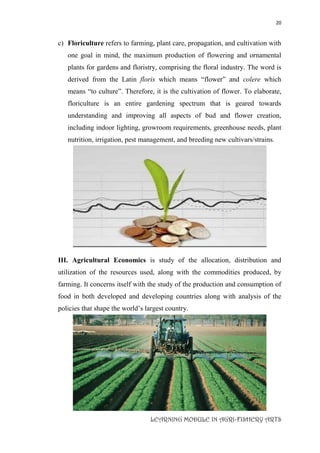
Fish Propagation is defined as the natural or artificial method of
promoting or enhancing reproduction and survival of fish and other aquatic
products. It includes keeping, maintaining and spawning breeders in tanks or
ponds, hatching the eggs in hatchery facilities, and nursing the delicate larvae
up to size suitable for stocking in the grow-our or rearing areas.
212
LEARNING MODULE IN AGRI-FISHERY ARTS
Natural Method
Artificial Method
213
LEARNING MODULE IN AGRI-FISHERY ARTS
Fish Cultivation simply means the rearing of fish and other aquatic
products from very young stage like fry and fingerlings, to marketable size. It
is done in fresh, brackish and marine waters in any of the rearing contraptions
or structures. The other types of sub-classification based on the techniques
applied and financial investments, namely: extensive, semi-intensive and
intensive.
 Extensive Fish Farming
The fish feed entirely from the food web within the pond, which
may be enhanced by the addition of the fertilizer or manure.
 Semi-Intensive Fish Farming
214
LEARNING MODULE IN AGRI-FISHERY ARTS
The fish still obtain significant nutrition from the food web
within their pond, but they are also given supplementary feed.
 Intensive Fish Farming
The fish are kept at too high a stocking density to obtain
significant amount of feed from their environment.
Fish Conservation is the public control and various maintenances of the
various fisheries where fish and other fishery products are deprived. It work
should be designed to insure maximum sustainable yield of fish. For instance,
the continuous use of fishpond without proper maintenance, like applying
fertilizer, lowers the productivity of the soil. It lessens the capacity of fish to
reproduce.
215
LEARNING MODULE IN AGRI-FISHERY ARTS
Fish Capture
Fish Capture is a rule or principle of capturing or operating methods of
fish and carried out distinct means with some regularity. It includes the fishing
gears, technologies and equipments for systematic capturing.
Fish Preservation
It is any operation that can prevent or inhibit the natural process of
breakdown or decomposition taking place in the fish. It is known as fish
processing.
216
LEARNING MODULE IN AGRI-FISHERY ARTS
Activity
EXPLORE FISHERY!
Direction: Answer the following questions.
1. What are the three (3) branches of Fishery? Explain each.
2. What are the different types of fish cultivation? Explain each.
3. What are the different types of sub-classification based on the
techniques applied and financial investments? Explain each.
4. Why is it important to know and understand the importance of fishery
branches?
5. If you were given a capital to build or establish your own fishery
business, in specifically what branch of fishery do you prefer? Explain
your answer and share/present it to the class.
217
LEARNING MODULE IN AGRI-FISHERY ARTS
LESSON 4:
MORPHOLOGY OF COMMON FISH – ITS PARTS AND
FUNCTIONS
External Parts of the Fish and Their Functions
1. Operculum/gill cover - part of the fish that covers the gills
2. Scales - part of the fish that cover the body
218
LEARNING MODULE IN AGRI-FISHERY ARTS
3. Lateral lines - lines along the body of the fish used
to help the fish adapt itself to its new
environment
4. Fins - part of the fish that used for
swimming, balancing and propelling
in water
5. Eyes - part of the fish that used for seeing
6. Mouth - part of the fish that used for
swallowing objects, particularly food
7. Anus - part of the fish that serves as an
excretory organ of the fish where the
waste matter coming from the body of
fish passes out
8. Caudal Peduncle - part of the fish that connect the body
and the tail
9. Nostril - part of the fish that used for smelling
10.Vent - the opening between the anus and the
anal fin where the fish will excrete
either eggs or sperm. Also known as
genital papilla
219
LEARNING MODULE IN AGRI-FISHERY ARTS
Internal Parts of Fish and their Functions
1. Spine - the primary structural framework
upon which the fish’s body is built.
It connects to the skull at the front of
the fish and the tail at the rear. The
spine is made up of numerous
vertebrae, which are hollow and
which protect the delicate spinal
cord
2. Spinal cord - the part that connects the brain to the
rest of the body and relays sensory
information from the body to the
brain, as well as instruction from the
brain to the rest of the body
3. Brain - the control center of the fish where
both automatic functions and higher
behaviours occur. All sensory
information is processed here
220
LEARNING MODULE IN AGRI-FISHERY ARTS
4. Lateral line - one of the fish’s primary sense
organs. It detects underwater
vibration and is capable of
determining the direction of their
source
5. Swim or Air Bladder - a hollow, gas-filled balance
organ that allows a fish to conserve
energy by maintaining neutral
buoyancy in water
6. Kidney - filters liquid waste materials from
the blood. These waste are then
passed out the body
7. Stomach and intestines - break down food and absorb
nutrients
8. Pyloric caeca - finger like projection located near
the functions of the stomach and the
Intestine. It known to secrete enzymes
that aid digestion. It may also
function to absorb digested food or do
both
9. Liver - it assists digestion by secreting
enzymes that break down fats, and
also serves as storage area for fats and
carbohydrates.
10.Heart - circulates blood throughout the body
221
LEARNING MODULE IN AGRI-FISHERY ARTS
11.Muscle - provide movement and locomotion.
These are parts of the fish that are
usually eaten. They compose the fillet
of the fish
12.Gonad - hormone-secreting sexual gland of a
fish.
Fish Scales Tell the Age of a Fish
Look at the image of the fish scale. Like a tree, scales show rings that
indicate periods of growth. Rings that are farther apart occur when the fish
grows well and there is a lot of food in the summer season. Rings that are close
together occur when the fish does not get much food and grows slowly. On the
scale you can identify the summer growth and the winter growth. (There will
be several rings in each).
The core represents the fish when it was first born, as a fry. The rings
near the edge are the most recent periods of growth.
222
LEARNING MODULE IN AGRI-FISHERY ARTS
Types of Fish Scales
Placoid - It resembles a miniature tooth called denticles. Ex. shark scales
Cycloid - It is oval or circular in outline and has a smooth and exposed
rear edge.
223
LEARNING MODULE IN AGRI-FISHERY ARTS
Ctenoid – It is scales that have a rear edges made of small brush-like
spines or comb liked teeth. Ex. Scales of perch, pongies and bass
Ganoid – It is a four- sided plate that fits closely against adjacent plates
without overlapping.
Parts of Gills
Diagrammic Representation of Two Forms of Fish Gills
1. Gills Filaments - used for exchange of gases such as
oxygen and carbon dioxide
2. Gills Arch - used for support and passing for
blood to and the gill filaments
3. Gill Rakers - used for straining food from the water
224
LEARNING MODULE IN AGRI-FISHERY ARTS
Activity
BE A FISH MORPHOLOGY RESEARCHER!
Direction: Do the instructions properly.
INSTRUCTIONS
1. Collect samples of fish and identify the external and internal parts.
2. Research on the morphology of fishes, evolution of fishes, some fish
culture facilities in the country, classification, construction and
operation of common fishing used in the Philippines.
3. Watch a video presentation about the morphology of fish.
4. Bring some fish samples to be dissected and identified.
Assessment:
The work of the students will be evaluated by your teacher using the
given criteria. The students must have at least attained 75 percent to pass.
1. Accuracy 70%
2. Presentation 20%
3. Neatness 10 %
225
LEARNING MODULE IN AGRI-FISHERY ARTS
FISH CULTURE
take the challenge!
At the end of this chapter, the students are expected to:
Lesson 1: Understand the Aspects, Classifications, Methods of
Fish Culture
Lesson 2: Recognize Terminologies Used in Fish Culture
Lesson 3: Identify the Facilities, Parts of Fish Pond and their
Functions. Illustrate Fish Pond Layout
Lesson 4: Identify the Cultivable Fish and Crustacean Species
CHAPTER 7
226
LEARNING MODULE IN AGRI-FISHERY ARTS
PRE-TEST
Test I. Multiple choice
Direction: Encircle the letter of the correct answer.
1. It is the rearing of fish under controlled or semi-controlled condition.
a. Fish Culture
b. Fish Cultivation
c. Fish Propagation
d. Fish Conservation
2. It is the process of increasing fish life either by natural or artificial
means of reproduction.
a. Fish Culture
b. Fish Cultivation
c. Fish Propagation
d. Fish Conservation
3. It is the scientific means of utilizing fish and other awuatic products/
resources.
a. Fish Culture
b. Fish Cultivation
c. Fish Propagation
d. Fish Conservation
4. What is the fish culture classification according to its purpose?
a. Intensive
b. Recreation
c. Natural or Artificial
d. Extensive
227
LEARNING MODULE IN AGRI-FISHERY ARTS
5. What is fish culture method under taken in net closures in shallow
protected areas of inland waters?
a. Fish Pond
b. Fish Pen
c. Fish Cage
d. Fish tank
6. It is the degree of water freshness and saltiness.
a. Freshness
b. Saltiness
c. pH
d. Salinity
7. It refers to fish species that go upstream from saltwater to freshwater to
spawn.
a. Anadromous
b. Catadromous
c. Endemic
d. Exotic
8. It refers to the fish species that go downstream from freshwater to
saltwater to spawn.
a. Anadromous
b. Catadromous
c. Endemic
d. Exotic
9. What is the rivalry for food, space and oxygen inside the fish pond?
a. Competition
b. Cannibalism
c. Survival
d. Fighting
228
LEARNING MODULE IN AGRI-FISHERY ARTS
10.What is the linear relationship of undergoing the process of eating and
being eaten?
a. Food Web
b. Food Chain
c. Food System
d. Food Cycle
11.It is the smallest and cleanest compartment of fish pond.
a. Fingerlings Pond
b. Fry Pond
c. Nursery Pond
d. Delivery Pond
12.What is an area that serves as water reservoir where water is stored
before going to other pond compartment?
a. Main Pond
b. Head Pond
c. First Pond
d. Primary Pond
13.It is the dike that surrounds the smallest compartment.
a. Least Dike
b. Small Dike
c. Tertiary Dike
d. Third Dike
14.What is the gate in fish pond that can be found in the largest
compartment?
a. Main Dike
b. Head Dike
c. First Dike
d. Primary Dike
229
LEARNING MODULE IN AGRI-FISHERY ARTS
15.A small unframed net enclosure with entire upper opened is called ___.
a. Fish Tank
b. Fish Pen
c. Hapa
d. Payaw
16.What is the common name of Oreochromis niloticus?
a. Nile Tilapia
b. Mozambique Tilapia
c. Red Tilapia
d. Domestic Tilapia
17.What is the common name of Penaeus monodon?
a. Giant Tiger Prawn
b. Giant Freshwater Prawn
c. Indian White Prawn
d. Banana Prawn
18.What is the common name of Scylla serrata?
a. Swamp Crab
b. Mud Crab
c. Sand Crab
d. Hermit Crab
19.What is the common name of Panulirus ornatus?
a. Ornate Spiny Lobster
b. Ornate Greasy Lobster
c. Ornate Red Lobster
d. Ornate Tiger Lobster
20.What is the common name of Perna viridis?
a. Green Mussel
b. Black Mussel
c. Grey Mussel
d. Yellow green Mussel
230
LEARNING MODULE IN AGRI-FISHERY ARTS
DEFINITION OF TERMS
Fish Cage – is a structured-based net that is ether stationary or movable.
Fish Conservation – is the scientific means of conserving fish and other
fishery aquatic products/resources.
Fish Cultivation – is the rearing of fish under controlled and semi-controlled
condition.
Fish Pen – is an enclosure of net or bamboo slats with sturdy posts staked at
the bottom of water and used for the culture of fish from fry to marketable size.
Fish Pond – is a confined body of water where fish are raised under controlled
conditions.
Fish Propagation – is the process of increasing fish life either by natural or
artificial means of reproduction.
Fish Tank – is a structure made of brick tile, concrete or polyvinyl chloride
(pvc) used for the purpose of culturing fish from fry, to marketable size. It also
can be used as a breeding tank, or as conditioning tank.
Hapa – is a small unframed net enclosure with the entire upper opened.
Raceway – is an enclosure of concrete soil or added materials.
231
LEARNING MODULE IN AGRI-FISHERY ARTS
LESSON 1:
ASPECTS, CLASSIFICATIONS AND METHODS
OF FISH CULTURE
Many programs and activities had been done in response to the
problems regarding the shortage of the supply of fish in the country. One of
which these program is Fish Culture. Fish culture then must be introduced to
enhance awareness and adopt some of the technology and its adoption as
additional source of food and income.
Nature and Scope of Fish Culture
It is the rearing of fish from fry to marketable size. It also cultivates
other aquatic products such as crabs, prawns and shrimps. Fish cultivation is
undertaken in fresh, brackish and marine waters based from the environment
and water supply.
The fresh water type of fish cultivation is carried out in lakes, rivers,
dams or reservoirs and marshes. Structures used for this type are fish ponds,
fish pens, fish cage, fish tank and raceways. The species of fish that are usually
raised are tilapia, carp, catfish, mudfish and milkfish.
232
LEARNING MODULE IN AGRI-FISHERY ARTS
The brackish water type of fish cultivation is carried out in tidal flats or
along margins of estuarine areas. The structures as those in freshwater are used
in this type is the same, except the raceways. The major species of fish
cultivated are tilapia, milkfish, shrimps and crabs. Fish pond is the predominant
type of fish cultivation in the country. It contributes utmost production of
inland waters. Milkfish is the number one product.
The marine water type of fish cultivation is carried out in salt waters or
open ocean waters. The farms are positioned in deeper and less sheltered
waters, where currents are stronger than they are inshore. The structures used
for this type are fish cage, fish tank, fish pond and raceways. The species of
fish that are shellfish like prawns, or oysters and seaweed.
Phases or Aspects of Fish Culture:
1. Fish Cultivation
The rearing of fish under controlled and semi-controlled condition.
233
LEARNING MODULE IN AGRI-FISHERY ARTS
2. Fish Propagation
The process of increasing fish life either by natural or artificial means of
reproduction.
3. Fish Conservation
The scientific means of conserving fish and other fishery aquatic
234
LEARNING MODULE IN AGRI-FISHERY ARTS
products/resources. It helps to keep the sport of fishing alive. Also, helps to
maintain the balance of certain ecosystems. Fish are important to the planet
and fish conservation can help maintain nature’s balance.
Classification of Fish Culture
1. . According to extent of financial investment
a. Intensive - utilizes limited area with very high investment
b. Extensive - utilizes wide area with minimal capital and very
low production
c. Semi-intensive - employ some or the majority of the modern
techniques of production
2. According to purpose
a. for commerce or for business
b. for recreation or for enjoyment
c. for educational and cultural or scientific pursuit
d. for food production
3. According to design
a. natural pond
b. artificial pond
4. According to state of water
a. still water
b. running water
5. According to salinity
a. freshwater
b. brackish-water
c. marine or saltwater
235
LEARNING MODULE IN AGRI-FISHERY ARTS
6. According to temperature
a. warm water or hot water
b. cold water
7. According to species raised
a. freshwater species
b. brackish-water species
c. marine or saltwater species
Methods of Fish Culture
Based on the structures used in fish cultivation, they can be classified
into five methods. These are the fish pond, fish pen, fish cage, fish tank and
open-water method.
Fish pond is the most widely used. Fry or fingerlings of one or more
species are stocked and reared in pond up to harvest time. Natural food is
grown in pond. The supplementary feed is added. The method of harvesting is
draining the pond. Retrieval of fish in this way is complete. Another method of
harvesting is freshening in case of bangus. Having positive rheotaxism, the fish
are induced to go against water current by the gate and concentrated into a
catching pond where they are scooped.
The fish pen method of fish cultivation is undertaken in net enclosures
in shallow protected areas of inland waters. Bamboo and wood materials ate
used as post and braces. Its lower end is embedded in the mud to prevent
escape of stock by excavating under, while the upper end is extended two
meters or more beyond the water level to escape of fish by jumping out.
Harvest of fish is done by seining or shocking them with electricity.
The fish cage method of fish cultivation is also undertaken in inland
bodies of water, both in flowing and still water ones. The structure used is also
made of nets. PVC pipes as framing materials is preferred to that of wood or
bamboo. A cage is much smaller than a fish pen. The cage is closed on all sides
236
LEARNING MODULE IN AGRI-FISHERY ARTS
and installed in suspension. Fish cage is stationary and movable. Floating and
fixed cages have open top. Growth rate of fish is dependent on the kind and
amount of food given and suitability of the environment. Harvesting of stock is
relatively easy and complete. The fish is either scooped or the cage is merely
brought out of the water to empty the fish.
The fish tank method of fish cultivation is practiced primarily by fish
hobbyists and in pet shops. The method employs varying sizes and shapes of
fish culture structures. These include glass bowls or aquaria and wooden or
concrete tanks. This method cultivation is done outdoor and indoor. The
method involves rearing or breeding of ornamental or fancy, colourful species
of fish.
A fifth method of fish cultivation is open-water method. It is done in
bays, coastal lagoons, canals and similar environments.
237
LEARNING MODULE IN AGRI-FISHERY ARTS
Activity
BE A FISH CULTURIST!
I. Identification. Aspects and Methods of Fish Culture
Direction: Identify each item. Write the correct answer before the
number.
1. It is the scientific means of utilizing fish and other fishery aquatic
products/resources.
2. It is the process of increasing fish life either by natural or artificial
means of reproduction.
3. It is raising of fish under controlled or semi-controlled condition.
4. It is undertaken in net enclosures in shallow protected areas of inland
waters.
5. It is also undertaken in inland bodies of water, preferably in flowing
ones.
6. It is done in bays, coastal lagoons and similar environments.
7. It is the most widely used method. Fry or fingerlings of one or more
species are stocked and reared in pond up to harvest time.
II. Enumeration. Classification of Fish Culture
Direction: Enumerate each item.
1. According to purpose.
2. According to design.
3. According to state of water.
4. According to salinity.
5. According to temperature.
6. According to species raised.
7. According to extent of financial investment.
238
LEARNING MODULE IN AGRI-FISHERY ARTS
LESSON 2:
DIFFERENT TERMINOLOGIES USED IN FISH CULTURE
In every area of specialization, there are terminologies used to give a
specific meaning for a matter. This will served as a common idea to the
professionals in their respective fields. So as is in this area, there are scientific
terminologies. In this lesson, it will tackle about various common terminologies
used in fish culture.
Terminologies Used in the Study of Fish Culture
1. Anadromous - are species of fish that go upstream from salt
water to freshwater to spawn. ex: bangus
2. Biomass - is the total weight of the animal in the given
environment.
239
LEARNING MODULE IN AGRI-FISHERY ARTS
3. Cannibalistic - are species of fish that feed on their
own kind.
4. Carnivorous - are species of fish that feed on other
animals.
5. Catadromous - are species of fish that go down from
freshwater to saltwater to spawn.
ex: eels
6. Competition - is the rivalry for food, space and
oxygen inside the fishpond.
7. Endemic or indigenous - is native to the locality
8. Exotic or digenous - is introduced by other countries
9. Fecundity - is the number of eggs laid by a female
fish in one spawning.
10.Food chain - is the linear relationship of
undergoing the process of eating and
being eaten.
11.Habitat - is the place where plants and animals
grow and naturally live.
12.Herbivorous - are species of fish that feed on plants
and vegetables only
13.Lab-lab - is the vernacular term for all the
greenish, brownish or yellowish crust
of micro benthic fauna and flora,
240
LEARNING MODULE IN AGRI-FISHERY ARTS
which are found growing in matrix or
mat at the pond floor.
14.Milt - is the male reproductive gland of
fishes
15.Omnivorous - are species of fish that feed on both
plants and animals
16.Oviparous - are species of fish whose eggs are
fertilized and developed outside the
body. ex: tilapia
17.Ovoviviparous - are species of fish whose eggs are
fertilized and developed within the
body but the young when born alive
do not receive nourishment from the
mother fish. ex: Rays and Sharks
18.pH - is the hydrogen ion-concentration of
water.
19.Photosynthesis - is the process by which plants
manufacture their food with the aid of
sunlight.
20.Plankton - is the biological association of minute
plants and animals which are found
growing on the surface of the water.
21.Predators - are species of fish feeding on other
fishes specially the cultivable ones.
241
LEARNING MODULE IN AGRI-FISHERY ARTS
22.Prolific - is the process of producing young in
great numbers
23.Sabalo - is the bangus breeder or spawner
24.Salinity - is the degree of freshness and
saltiness of water.
25.Scavenger - are species of fish that feed on
decaying organic matter.
26.Spat - is the larvae of oyster and mussel
which are free swimming in water.
27.Standing crop - is the total number of fish stocked at a
given area at a given time.
28.Temperature - is the degree of coldness and hotness
of water.
29.Tide - is the periodic rise and fall of
seawater.
30.Viviparous - are species of fish that bring forth
living young which during their early
development receive nourishment
from their mother fish.
242
LEARNING MODULE IN AGRI-FISHERY ARTS
Activity
TEST YOUR FISH CULTURE VOCABULARY
I. Identification. Identify the following given statements.
1. It is the total weight of the animal in the given environment.
2. It is the process of producing young in great numbers.
3. It is the hydrogen ion-concentration of water.
4. It is the number of eggs laid by a female fish in one spawning.
5. It is the biological association of minute plants and animals which
are found growing on the surface of the water.
243
LEARNING MODULE IN AGRI-FISHERY ARTS
LESSON 3:
FISH CULTURE FACILITIES
Many facilities that can operate in fish culture. In this lesson, we only
tackle the common and frequently used facilities. They are Fish Pond, Fish
Cage, Fish Pen, Fish Tank, Hapa and Raceway. All of them will be discussed
below.
1. FISH POND
According to the www.agriculturenigeria.com that fish pond is a
confined body of water where fish are raised under controlled
conditions. Fish can also be raised in plastics, fiber stars and wooden
rafts. There are three main types of ponds in construction. This either be
earthen pond, concrete pond and riprap.
244
LEARNING MODULE IN AGRI-FISHERY ARTS
Fish Earthen Pond
Fish Concrete Pond
Fish Riprap Pond
245
LEARNING MODULE IN AGRI-FISHERY ARTS
Compartments of a Fish Pond and each Function
1. Nursery pond - is the smallest and the cleanest compartment
where fish are reared from fry up to pre-
fingerling size.
2. Transition pond - is a compartment where fish are reared from
pre-fingerling size to post fingerling size
before stocking compartments, it is also
known as stunting pond.
3. Rearing pond - is the largest compartment of a fishpond
where fishes are reared from post fingerlings
up to marketable size.
4. Breeding pond - is a compartment where spawners are
confined and are used purposely for the
production of fry.
5. Catching pond - is an area that serves as catchment basin for
fish harvest.
6. Head pond - is an area that serves as water reservoir
where water is stored before going to other
pond compartments.
7. Water supply canal - is a canal used to supply water throughout
the whole fish pond system.
246
LEARNING MODULE IN AGRI-FISHERY ARTS
Interpreting Plans and Layout
Fish Pond Layout
Legend:
] [ - Main Gate
) ( - Secondary Gate
| | – Tertiary Gate
HP – Head Pond
NP – Nursery Pond
TP – Transition Pond
RP – Rearing Pond
WSC – Water Supply Canal
CP – Catching Pond
247
LEARNING MODULE IN AGRI-FISHERY ARTS
Kinds of Dikes
1. Main dike – is the largest of all dikes that surrounds the whole
fishpond project.
2. Secondary dike – is the dike that surrounds the big compartment.
3. Tertiary dike – is the dike that surrounds the small compartment.
248
LEARNING MODULE IN AGRI-FISHERY ARTS
Kinds of Gates
1. Main gate – is the largest gate that serves as water entrance in the
whole fishpond system.
2. Secondary gate – is the gate that can be found in the large
compartment.
3. Tertiary gate – is the gate that can be found in the small compartment.
249
LEARNING MODULE IN AGRI-FISHERY ARTS
2. Fish Cage
Fish Cage is a structured-based net that is ether stationary or
movable. Set in water and surrounded all sides by bamboo slats and
provided with an anchor at the bottom. It is used for the culture of fish
from fry to marketable size.
3. Fish Pen
It is an enclosure of net or bamboo slats with sturdy posts staked
at the bottom of water and used for the culture of fish from fry to
marketable size. The fish pen is fastened permanently against sturdy
post and frames.
250
LEARNING MODULE IN AGRI-FISHERY ARTS
4. Fish Tank
It is structure made of brick tile, concrete or polyvinyl chloride
(pvc) used for the purpose of culturing fish from fry, to marketable size.
It also can be used as a breeding tank, or as conditioning tank.
5. Hapa
A small unframed net enclosure with the entire upper opened. It
is suspended by poles with ample portion extending beyond the water
level to prevent the fish from jumping out.
251
LEARNING MODULE IN AGRI-FISHERY ARTS
6. Raceway
It is an enclosure of concrete soil or added materials. The shape is
likely of the canal through which constant water flows. Fish are raised in
the raceway at high density and their waste products are carried out by
the water passing through the areas.
252
LEARNING MODULE IN AGRI-FISHERY ARTS
Activity
FISH FACILITIES IDENTIFIER
I. Identification.
Direction: Identify each item. Write your correct answer before the
number.
1. It is a confined body of water where fish are raised under controlled
conditions.
2. It is fastened permanently against sturdy post and frames.
3. It is a structured-based net that is ether stationary or movable.
4. It is suspended by poles with ample portion extending beyond the
water level to prevent the fish from jumping out.
5. It is an enclosure of concrete soil or added materials. The shape is
likely of the canal through which constant water flows.
6. It is structure made of brick tile or concrete used for the purpose of
culturing fish from fry, to marketable size.
7. It is a compartment where fish are reared from pre-fingerling size to
post fingerling size before stocking them in to other larger
compartments, it is also known as stunting pond.
8. It is a compartment where spawners are confined and are used
purposely for the production of fry or fingerling.
9. It is the smallest and the cleanest compartment where fish are reared
from fry up to pre-fingerling size.
10.It is the largest compartment of a fishpond where fishes are reared
from post fingerlings up to marketable size.
11.It is an area that serves as water reservoir where water is stored
before going to other pond compartments.
253
LEARNING MODULE IN AGRI-FISHERY ARTS
12.It is the canal used to supply water throughout the whole fish pond
system.
13.It is an area that serves as catchment basin for fish harvest.
14.It is the dike that surrounds the smallest compartment.
15.It is the dike that surrounds the biggest compartment.
16.It is the dike that surrounds the whole fish pond.
17.It is the gate that can be found in the largest compartment.
18.It is the gate that can be found in the smallest compartment.
19.It is a large gate that serves as water entrance in the whole fish pond
system.
20.It is a confined body of water where fish are raised under controlled
conditions.
DEVELOPING OWN FISH POND LAYOUT
II. Illustration.
Direction: Bring the materials needed. Do the procedures properly.
Materials:
 Pencil
 Ruler
 Bond Paper
 Folder
Procedures:
1. Prepare your materials.
2. Develop your own Fish Pond Layout. All kinds of compartments,
dikes and gates must be included.
3. Put your outcome to the folder.
4. Submit it to your teacher for assessment.
254
LEARNING MODULE IN AGRI-FISHERY ARTS
Assessment:
The work of the students will be evaluated by your teacher using the
given criteria. The students’ outcome must be attained at least 75 percent of
points to pass the lesson.
1. Completeness – 40%
2. Accuracy – 40%
3. Neatness – 20%
255
LEARNING MODULE IN AGRI-FISHERY ARTS
LESSON 4:
CULTIVABLE FISH AND CRUSTACEAN SPECIES
There are vast species of aquatic animals with their unique
characteristics around the globe in freshwaters, brackish waters and saltwater
yet not all of them are edible to consume by human for food because of health
issues if eaten and the threat of extinction to their race which are protected by
local governments. So, there are only specific species of fish for food and
legally to produce and commerce. In this lesson, it will discuss about the
Philippine common species of cultivable fish and crustaceans in fish facilities,
their characteristics and natural food according to their water habitats.
256
LEARNING MODULE IN AGRI-FISHERY ARTS
Common Cultivable Fish Species:
Nile Tilapia (Oreochromis niloticus) is a tropical species that prefers
to live in shallow water. The lower and upper lethal temperatures for Nile
Tilapia are 12˚C and 42˚C, respectively, while the preferred temperature ranges
from 31˚C to 36˚C. It is an omnivorous grazer that feeds on phytoplankton,
periphyton aquatic plants, small invertebrates, benthic fauna, dentitus and
bacterial films associated with detritus. Nile Tilapia can live longer than 10
years and reach an exceeding weight of 5 kg.
Mozambique Tilapia (Oreochromis mossambicus) is a freshwater and
brackish water inhabitant. It lives in warm, weedy pools of sluggish stream,
canals and ponds. Is mainly diurnal, occurs at temoeratures ranging from 8˚C to
42˚C. Omnivorous, feeds on almost anything from algae to insects but also
crustaceans and fishes. Mozambique Tilapia reaches a maximum size to 36 cm.
257
LEARNING MODULE IN AGRI-FISHERY ARTS
Common Carp (Cyprinus carpio) is live in the middle and lower
streams of rivers, in inundated areas, and shallow confined waters such as lakes
and water reservoirs. Carps are mainly bottom dwellers but search for food in
the middle and upper layers of water body. Best growth is obtained when water
temperature ranges between 23˚C and 30˚C. The fish can survive cold winter
periods. It is omnivorous, with a high tendency towards the consumption of
animal food such as water insects, larvae of insects, worms, molluscs, and
zooplanktons. Common carps can reach 0.6 to 1 kg body weight within one
season in the polycultural fish ponds of tropical and subtropical areas.
Bighead Carp (Hypopthalmichthys nobilis) is a eurythermic fish,
being to tolerate water temperatures of 0.5˚C to 38˚C. It inhabits lakes, rivers
and reservoirs. Bighead carp normally dwell in the upper layer of the water
column and prefers high fertility water with abundant natural food. Basically, it
is a zooplankton eater throughout its life under natural conditions yet also
258
LEARNING MODULE IN AGRI-FISHERY ARTS
consumes artificial feed in culture ponds. Bighead Carp are fast growing and
become very large in size reaching a maximum weight of 40 kg.
Philippine Catfish (Clarias batrachus) is an air breathing fish inhabit
in lowland streams, swamps, ponds, ditches, rice paddies and pools left in low
spots after flood. It can walk and leave the water to migrate to another water
bodies using its auxiliary breathing organs. It usually confined to stagnant,
muddy water and tolerates temperature from 10˚C to 28˚C. Omnivorous that
feed on insect larvae, earthworms, shell, shrimps, small fishes, aquatic plants
and debris. Approximately, its maximum length is 47 cm and maximum weight
of 1.2 kg.
Bighead Catfish (Clarias macrocephalus) is an air breathing fish lives
in lowland wetland and rivers. Occurs in shallow, open water and is capable of
lying buried mud for lengthy period in the time of ponds and lakes evaporate
during dry seasons. It can also extend its fins to move out of the water. Found
in medium to large-sized rivers, stagnant water bodies including sluggish
259
LEARNING MODULE IN AGRI-FISHERY ARTS
flowing canals and flooded fields. It can tolerate temperatures from 10˚C to
28˚. Omnivorous that feed on aquatic insect, young shrimps, small fishes and
aquatic plants. Its maximum length is 120 cm and maximum weight is 45 kg.
North African Catfish (Clarias gariepinus) is found in lakes, streams,
rivers, swamps and floodplains, many of which are subject to seasonal drying.
The most common habitats are floodplain swamps and pools where they can
survive during the dry season(s) due to their accessory air breathing organs. It
undertake lateral migrations from the larger water bodies, in which they feed
on aquatic insects, worms, gastropods, small crustaceans, small fishes, aquatic
plants, terrestrial seeds and berries, small birds and small mammal as being an
omnivorous. It can live in the temperature of 10˚C to 28˚C. The record
individual from Country of Malawi was 16.1 in kg and the max length is 150
cm.
Snakehead Murrel (Channa striata) is a ray-finned fish that perch-
260
LEARNING MODULE IN AGRI-FISHERY ARTS
like in form and its head is like of a snake. It is a fresh and brackish water
inhabitant such as ponds, streams, rivers, stagnant and muddy plains. Found
mainly in swamps but also occurs in lowland rivers. It can survive in dry
season by burrowing in bottom mud of lakes, canals and swamps as long as
skin and breathing apparatus remain moist and subsists on the stored fat. Feed
on fish, frogs, snakes, insects, earthworms, tadpoles and small crustaceans as
being a carnivore. Snakehead murrel can live in temperature of 23˚C to 27˚C.
Its maximum length is 100cm and weight of 3kg.
Giant Gourami (Osphronemus gouramy) is a laterally compressed
(compressiform) fish. It has the ability to breath air through a specific organ
called labyrinth (a much-folded suprabranchial accessory breathing organ),
which appears in juviniles about 30 days after hatching and become functional
around 40 days. This fish is omnivorous but with a strong vegetarian tendency,
it can ingest various aquatic and terrestrial plants, although it can also eat a
wide range of other food resources such as frogs, tadpoles, snails, small fishes
and other small aquatic animals. Giant gourami prefers calm fresh waters
especially slow-moving areas such as lakes and large rivers. They are also
found in flood plains and irrigation canals. It lives in tropical temperature of
water. It can reach a remarkable size but normally the maximum size is 45-50
cm. Growth rate is quite slow and may reach commercial size of 500 to 750 g
within 9-14 months of growout. To achieve larger sizes 1 to 2 kg, an extended
261
LEARNING MODULE IN AGRI-FISHERY ARTS
period of growout rearing is required, generally compromising 25 to 35 months
in total.
Barramundi (Lates calcarifer) is also known as seabass, it inhabit
freshwater, brackish water and marine habitats including streams, lakes,
billabongs, estuaries and coastal waters. Barramundi are opportunistic
predators; crustaceans and fish predominate in the diet of adults. It is highly
fecund; a single female (120 cm) may produce 30-40 million eggs.
Consequently, only small numbers of broodstock are necessary to provide
adequate numbers of larvae for large-scale hatchery production. Larvae recruit
into estuarine nursery swamps where they remain for several months before
they move out into the freshwater reaches of coastal rivers and creeks
considering them as a diadromous fish. They usually occur at a temperature
range of 26˚C to 29˚C and between 10 to 40 m deep. Its size is commonly
between at 25 to 100 cm.
262
LEARNING MODULE IN AGRI-FISHERY ARTS
Orange-spotted Grouper (Epinephelus coioides) has body elongated,
not very compressed, light greyish brown dorsally, shading to whitish on side
and ventrally, with numerous brownish orange or brownish yellow spots on the
size of pupil or smaller on head and body. It inhabits turbid coastal reefs and is
often found in brackish water over mud and rubble. Juveniles are common in
the shallow waters of estuaries over sand, mud, gravels and among mangroves.
It feeds on small fishes, shrimp and crabs. It is generally cultured in floating net
cages or earthen pond, but cage culture is more common in Southeast Asia.
Most of the brooders are collected from wild and reared for 1 to 7 years using
seawater at a constant temperature of 27˚C to 28˚C. The fish are fed with
frozen sardines, mackerels, cuttlefish, squids and top-shell clams because these
foods have high contents of cholesterol, phospholipids and polyunsaturated
fatty acids.
263
LEARNING MODULE IN AGRI-FISHERY ARTS
Malabar Grouper (Epinephelus malabaricus) is a ray-finned fish and
has perch-like body. It has light grey to yellowish brown color; five slightly
oblique dark brown bars that bifurcate ventrally; numerous small black spots
and blotches in head and body. It inhabits in marine, brackish, reef-associated
waters such as coral and rocky reefs, tide pools, estuaries, mangrove swamps
and sandy or mud bottom from shore to depths of 150 m. It feed primarily on
fishes and crustaceans. Malabar grouper can tolerate water temperature from
26˚C to 29˚C. Its common maximum length is 234 cm and maximum weight of
150 kg.
Orange-spotted Spinefoot (Siganus guttatus) is also known as rabbit
fish by the similarity of the nose. It is a ray-finned fish with perch-like body. It
has a bright yellow spot adjacent to last few rays of dorsal fin, head with lines
and spots. Its spine is stout, pungent and venomous. Inhabits in marine and
brackish water to include turbid inshore reefs among mangroves; tolerates or
even prefers low salinities. Fry settlers in seagrass beds around river mouths
and adults enter and leave rivers with tides but also found on drop-offs of
inshore fringing reefs down to 6 m. It feeds on benthic algae. Unlike other
siganids, this species is reported to be active at night as being a nocturnal fish.
It can tolerate water temperature from 24˚C to 28˚C. Its common maximum
length is 42 cm.
264
LEARNING MODULE IN AGRI-FISHERY ARTS
Vermiculated Spinefoot (Siganus vermiculatus) is is also known as
rabbit fish by the similarity of the nose. It is a ray-finned fish with perch-like
bluish white body, head brown to brownish or golden yellow with irregular
lines. Its spine is stout, blunt or pungent and venomous. It inhabits in marine
and brackish water, juveniles live among mangroves then move out to lagoon
and coastal reefs as they mature. It feeds on algae growing on seagrass,
mangrove roots and rocks. Adult congregate inshore in groups of several
hundreds to spawn in summer. Adults on coastal reefs are subject to strong
currents. The species has a high fecundity of 350,000 per spawning season. It
can tolerate water temperature from 19˚C to 38˚C. Its common maximum
length is 45 cm.
Spotted Scat (Scatophagus argus) is a ray-finned fish with perch-like
quadrangular body shape. Juveniles with a few large roundish blotches, about
size of eye, dorsal head profile is steep. Eye moderately large and snout is
265
LEARNING MODULE IN AGRI-FISHERY ARTS
rounded. It inhabits in fresh, brackish and marine waters such as harbors,
natural embayments, brackish estuaries and lower reaches of freshwater
streams, frequently occurring among mangroves. It feeds on worms,
crustaceans, insects and plant matters. The dorsal, anal and pelvic spines are
believed by Philippine fishers to be venomous and capable of inflicting
wounds. It can live in the water temperature from 20˚C to 28˚C and usually its
maximum length is 38 cm.
Milkfish (Chanos chanos) is a fusiform, elongated, moderately
compressed, and smooth streamline body fish. It has body color silvery on
belly and sides grading olive-green or blue on back, transparent tissue covers
eye. It is the only species in the Family Chanidae. Its distribution is restricted to
either low latitude tropics or the subtropical northern hemisphere along
continental shelves and around islands, where temperatures are greater than
20˚C. Milkfish only spawn in saline waters. Spawning takes place near coral
reefs during the warm month of the year. Juveniles and adults eat a wide
variety of relative soft and small food items, from microbial mats to detritus,
epiphytes and zooplankton. It attains typical length of 1m but may reach
maximum length of 1.8m.
266
LEARNING MODULE IN AGRI-FISHERY ARTS
Common Cultivable Prawn/Shrimp Species:
Giant Tiger Prawn (Penaeus monodon) is similar to all penaeid
shrimp, the rostrum well developed and toothed dorsally and ventrally. Its
carapace has without longitudinal or transverse sutures. Depending on
substratum, fees and water turbidity, body colors vary from green, brown, red,
grey, blue and transverse band colors on abdomen and carapace are alternated
between blue or black and yellow. Penaeus monodon was originally harvested
together with other shrimp species from traditional trapping-growing ponds or
as a significant by-product of extensive milkfish ponds. It is mature and breeds
only in tropical marine habitats and spends their larval, juvenile, adolescent and
sub-adult stages in coastal estuaries, lagoons or mangrove areas. In the wild,
they show marked nocturnal activity, burrowing into bottom substratum during
day and emerging at night to search for food as benthic feeder. Under natural
conditions, the giant tiger prawn is more of a predator than an omnivorous
scavenger or detritus feeder than other penaeid shrimp. Adults are often found
over muddy sand or sandy bottoms at 20 to 50 m depth in offshore waters. The
females are highly fecund with gravid females producing as many as 500,000
to 750,000 eggs. Hatching occurs 12 to 15 hours after fertilization. It feeds on
benthic detritus, polychaete worms and small crustaceans. Healthy adult
females can grow 25 to 30cm and weighted of 200 to 320g while healthy adult
males can grow 20 to 25cm and weighted of 100 to 170g.
267
LEARNING MODULE IN AGRI-FISHERY ARTS
Indian White Prawn (Penaeus indicus) is similar to all penaeid
shrimp, carapace rather smooth, lacking gastro frontal and hepatic crest, ad
rostral crest extending as far as or just before epigastric tooth, rostrum slightly
curve at tip and sigmoidal-shaped, usually bearing 7 to 9 upper teeth (including
those on carapace) and 3 to 6 lower teeth, rostral crest generally slightly
elevated in large specimen including adult females. Its body color is semi-
translucent, somewhat yellowish white (small specimens) or greyish green and
covered with numerous minute dark brown dots, eyes light brown mesh-like
stripes, rostral and abdominal dorsal crests reddish brown to dark brown. The
methods of brackish water aquaculture are applied whether in cultures practices
followed such as traditional, extensive, modified extensive, semi-intensive or
intensive. It inhabits the coast of East and South Africa, Southwest and East
coast of India, Bangladesh, Thailand, Malaysia, Philippines, Indonesia,
Southern China and Northern coast of Australia. Penaeus indicus is non-
burrowing, active both day and night, and prefers a sandy mud bottom. Adults
are normally found at depths less than 30m but have also been caught from
90m. The shrimp mature and breed mostly in marine habitats and spend the
juvenile and sub-adult stages of 30 to 120 mm total in length (TL) in coastal
estuaries, backwaters or lagoons. Juveniles can tolerate a much wider range of
salinity (5-40%) than asults. On the southwest coast of India the juveniles
support a good commercial fishery in the backwaters and paddy fields. It is also
highly fecund, ranging from 68,000 to 1,254,200 eggs from females of 140-
200mm TL. Depending upon the temperature, hatching takes place within 8-12
268
LEARNING MODULE IN AGRI-FISHERY ARTS
hours after spawning. The postlarvae migrate into the estuaries, settle and feed
on benthic detritus, polychaete worms and small crustaceans, and remain there
until they attain 110-120 mm TL. These sub-adults then return to the sea and
get recruited into the fishery. The size of Penaeus indicus used for broodstock
development should preferably be above 145mm TL (20g) for females and
140mm (17g) for males.
Banana Prawn (Fenneropenaeus merguinsis) is widely distributed in
the Indo-West Pacific region in both tropical and subtropical waters. To include
from Persian Gulf to Thailand, Hong Kong, the Philippines, Indonesia, New
Guinea, New Caledonia and North Australia. It inhabits in the bottom mud,
estuarine and marine about 10 to 45 m in depths. Its usually maximum total
length is 240 mm (female). It has been cultured in extensive ponds with natural
seeding for a long time in Asia and recently in semi-intensive and intensive
ponds. Supplementary feeding occurred only later in improved extensive
farming, with usually stocked with wild caught or hatchery-produced
postlarvae. Although F. merguinsis does not grow as fast as P. monodon, their
ability to mature and spawn in captivity and their short life cycle ensure a
consistent production of postlarvae and a great opportunity to domesticate the
species. This would eliminate the reliance of the prawn farming industry on
wild broodstock and more importantly, allows the development of fast growing
or pathogen-free stocks through selective breeding. Such low cost of
broodstock, ease in larvae rearing and potentially low feed cost.
269
LEARNING MODULE IN AGRI-FISHERY ARTS
Greasyback Prawn (Metapenaeus ensis) is commonly called mud
prawn, sand prawn in catering trade. It is popular due to its rich-tasting
nutritious flesh. Cahracteristics of M. ensis include a wide distribution, strong
adaptability, omnivorous feeding habit, fast growth and high commercial value.
It breeds in seawater or brackish water but it can also be bred in freshwater
after domestication. After 100 days in cultivation with a favourable
environment and abundant food, juveniles will grow into adult commercial
shrimps of 10cm in length.
Giant Freshwater Prawn (Macrobrachium rosenbergii) is the largest
Macrobrachium species. The maximum recorded size for males and females
are 33cm and 29cm in length. Mature male prawns are larger than females. The
head of the male is also proportionately larger and the abdomen is narrower. M.
rosenbergii is nocturnal, bottom dwelling and sluggish in nature and is
territorial. During the day they remain half buried in sediments and prefers
270
LEARNING MODULE IN AGRI-FISHERY ARTS
shallow, detritus rich and vegetated areas. In temperature regions, the breeding
season is summer while in tropical regions it is to the onset of the rainy season.
Its spawning occurs two or more times per season.
Common Cultivable Crab Species:
Swamp Crab (Scylla serrata) is a crab with smooth carapace and
strong transversal ridges. Its gastric zone is on the carapace with deep H-
shaped groove. Front with 4 broad lobes, all more or less in line with each
other, 9 broad teeth on each anterolateral margin, all of them with similar size
and projecting obliquely outwards. It has a strong chelipeds with well
developed spines on the outer surface of carpus and on the anterior and
posterior dorsal parts of propodus. Its carapace color is green to almost black
with legs that may be marbled. The three other Scylla species prefer less saline
water. Farming of this species has developed from low density pond
polyculture with fish and shrimp, using wild seeds introduces tidally or
intentionally, to monoculture in ponds and pens. Typically associated with
mangroves in estuaries and sheltered coastal habitats, they are found in soft
muddy bottoms where they dig deep burrows. Their courtship and mating occur
in estuaries. Mature S. serrate migrates offshore (up to 50km) to spawn. They
may spawn at any time during the year. The number of eggs produces may
range from 1 to 6 million in a single spawning with at least 3 batches. Males
271
LEARNING MODULE IN AGRI-FISHERY ARTS
can grow up to 3kg with 28cm carapace width. Mature females have wide and
dark abdomens and dark orange ovaries that fill the cavity under the carapace.
Mud Crab (Scylla paramamosain) is a crab with a carapace usually
green to light green, plam green to greenish blue with lower surface and base of
fingers usually pale yellow to yellowish orange. Its carapace common width is
between 15 and 18cm. Inhabits rock areas, near reef and mangroves. Members
of the order Decapoda are mostly gonochronic. Mating behaviour:
Precopulatory courtship ritual is common (through olfactory and tactile cues);
usually indirect sperm transfer. Its recorded maximum carapace length is 20cm.
Common Cultivable Lobster Species:
Ornate Spiny Lobster (Panulirus ornatus) is a lobster under the
family of Palinuridae. It has maximum total body length of 50cm but usually
much smaller (30 to 35cm). It is found in shallow, sometimes slightly turbid
272
LEARNING MODULE IN AGRI-FISHERY ARTS
coastal waters from 1 to 8m depth, with a record of 50m deep. It inhabits sandy
and muddy substrates, sometimes on rocky bottom, often near the mouth of
rivers but also on coral reefs. Juveniles occur in holes and crevices which are
partially covered by seagrass or macroalgae. It is solitary, may live in pairs and
has been found in larger concentrations. It is an omnivore species. Members of
the order Decapoda are mostly gonochronic. Mating behaviour: Precopulatory
courtship ritual is common (through olfactory and tactile cues); it is also
indirect sperm transfer. It can found in the Indo-West Pacific region.
Common Cultivable Mollusk Species:
Slipper Cupped Oyster (Crassostrea iredalei) is a shell medium sized,
very variable in shape but generally higher than long, roughly rounded, oblique
triangular or elongate ovate in outline. It’s left (lover) valve rather thick but
light weighted, more convex and larger than right (upper) valve. The color of
outside shell is dirty white, often flushed with pale greyish brown. The right
valve is frequently with a few darker purplish grey radial bands in early stages
of growth. The interior of valves are whitish and shiny, often with irregular
areas of chalky white, deep puple-brown on posterior adductor scar. Its
geographical distribution is restricted to the Philippine Archipelago and
Malaysia. C. iredalei attached to hard objects or growing in bunches, on
various soft bottoms, especially in bays and estuaries with somewhat reduced
salinity, intertidal and shallow subtidal water, and suspension-feeding. This
brackish water species is noted for its tasty creamy flesh and its culture
273
LEARNING MODULE IN AGRI-FISHERY ARTS
required a salinity range of 15 to 25ppt. Its recorded maximum shell height is
15cm and commonly 8cm in length.
Donkey’s Ear Abalone (Haliotis asinina) is actively collected in the
Southeast Asian countries for its shell and large fleshy animal. It is common
but not aggregating in dense populations. The depth where they are usually
found is at 0 to 10m. In life, the exceptionally large green mantle almost covers
the shell which is them devoid of encrusting marine growths, unlike of the
other species. It is active at night, feeds on epilithic algae by grazing. Found in
intertidal, on coral reefs. H. asinine is mostly gonochronic and broadcast
spawners. Life cycle: Embryos develop into planktonic trocophore larvae and
later into juvenile veligers before becoming fully grown adults. Its recorded
maximum length is 12cm and its common size is 9cm.
Green Mussel (Perna viridis) is an economically important mussel, a
bivalve belonging to the family of Mytilidae. It is harvested in the wild and
274
LEARNING MODULE IN AGRI-FISHERY ARTS
grown in aquaculture facilities in its native area. The shell tapers to a sharp,
downturned beak and has a smooth surface covered with a periostracum. The
ventral margin of the shell is straight or weakly concave. The ridge which
supports the ligament connecting the two shell valves is finely pitted. The beak
has interlocking teeth; one in the right valve and two in the left. The wavy
posterior end of the paleal line and the large kidney-shaped adductor muscle
are diagnostic features of this species. Periostracum can be vivid green to dark
brownish-green near the outer edge and olive-green near the attachment point.
The interior of the shell valves is shiny and pale bluish green. It can usually
found up to 10m depth and forms dense population (up to 35,000 individuals
per square meter). This species in an efficient filter feeder, feeding on small
zooplankton, phytoplankton and other suspended fine organic material. Sexes
are separate and fertilisation is external. Spawning generally occurs twice a
year between early spring and late autumn, however, in the Philippines and
Malaysia spawning occurs year round. Sexual maturity occurs at 15 to 30mm
shell length. Life span is about 3 years. It is found in estuarine habitats with
salinities ranging from 18 to 33 ppt and temperatures from 11˚C to 32˚C. It can
reach 150mm.
Common Enemies of Fish and Crustacean
1. Predator - fish and other animals that prey on the cultured
species of fish and crustacean
2. Competitors - fish and other animals that compete with the
cultured species in terms of food, space and oxygen
3. Nuisances - crustaceans and other animals that do a lot of
damage to the food and in the habitat of fish
275
LEARNING MODULE IN AGRI-FISHERY ARTS
Characteristics of Fish and Crustacean that are Suitable for Pond Culture
1. Fish should be palatable and good tasting – the fish must have a
delicate flavour.
2. Fish must be a fast grower – the fish must be able to grow rapidly or
can give a possibility of four or more harvests a year.
3. Fish should be resistant to pests, diseases and parasites – the fish
should not succumb to abrupt changes in temperature or salinity and
can tolerate such conditions in all its existence.
4. Fish should be a universal feeder – the culture fish require food
which can be grown easily and abundantly under favourable
conditions.
5. Fish should have high market demand – the fish must command a
high price to recover the expenses incurred.
6. Fish should not be destructive in confinement, either to its kind or to
other species or to its environment – the fish should be prolific which
means that reproduce very often to have a continuous supply of fry
or stocks.
276
LEARNING MODULE IN AGRI-FISHERY ARTS
Activity
Direction: Identify the common names of the aquatic species in the ff:
1. Oreochromis mossambicus
2. Hypopthalmichthys nobilis
3. Clarias batrachus
4. Channa striata
5. Osphronemus gouramy
6. Lates calcarifer
7. Epinephelus malabaricus
8. Siganus vermiculatus
9. Scatophagus argus
10.Chanos chanos
11.Metapenaeus ensis
12.Scylla paramamosain
13.Panulirus ornatus
14.Crassostrea iredalei
15.Haliotis asinine
277
LEARNING MODULE IN AGRI-FISHERY ARTS
Post-TEST
Test I. Multiple choice
Direction: Encircle the letter of the correct answer.
1. It is the rearing of fish under controlled or semi-controlled condition.
1. Fish Culture
2. Fish Cultivation
3. Fish Propagation
4. Fish Conservation
2. It is the process of increasing fish life either by natural or artificial
means of reproduction.
1. Fish Culture
2. Fish Cultivation
3. Fish Propagation
4. Fish Conservation
3. It is the scientific means of utilizing fish and other awuatic products/
resources.
1. Fish Culture
2. Fish Cultivation
3. Fish Propagation
4. Fish Conservation
4. What is the fish culture classification according to its purpose?
1. Intensive
2. Recreation
3. Natural or Artificial
4. Extensive
278
LEARNING MODULE IN AGRI-FISHERY ARTS
5. What is fish culture method under taken in net closures in shallow
protected areas of inland waters?
1. Fish Pond
2. Fish Pen
3. Fish Cage
4. Fish tank
6. It is the degree of water freshness and saltiness.
1. Freshness
2. Saltiness
3. pH
4. Salinity
7. It refers to fish species that go upstream from saltwater to freshwater to
spawn.
1. Anadromous
2. Catadromous
3. Endemic
4. Exotic
8. It refers to the fish species that go downstream from freshwater to
saltwater to spawn.
1. Anadromous
2. Catadromous
3. Endemic
4. Exotic
9. What is the rivalry for food, space and oxygen inside the fish pond?
1. Competition
2. Cannibalism
3. Survival
4. Fighting
279
LEARNING MODULE IN AGRI-FISHERY ARTS
10.What is the linear relationship of undergoing the process of eating and
being eaten?
1. Food Web
2. Food Chain
3. Food System
4. Food Cycle
11.It is the smallest and cleanest compartment of fish pond.
1. Fingerlings Pond
2. Fry Pond
3. Nursery Pond
4. Delivery Pond
12.What is an area that serves as water reservoir where water is stored
before going to other pond compartment?
1. Main Pond
2. Head Pond
3. First Pond
4. Primary Pond
13.It is the dike that surrounds the smallest compartment.
1. Least Dike
2. Small Dike
3. Tertiary Dike
4. Third Dike
14.What is the gate in fish pond that can be found in the largest
compartment?
1. Main Dike
2. Head Dike
3. First Dike
4. Primary Dike
280
LEARNING MODULE IN AGRI-FISHERY ARTS
15.A small unframed net enclosure with entire upper opened is called ___.
1. Fish Tank
2. Fish Pen
3. Hapa
4. Payaw
16.What is the common name of Oreochromis niloticus?
e. Nile Tilapia
f. Mozambique Tilapia
g. Red Tilapia
h. Domestic Tilapia
17.What is the common name of Penaeus monodon?
1. Giant Tiger Prawn
2. Giant Freshwater Prawn
3. Indian White Prawn
4. Banana Prawn
18.What is the common name of Scylla serrata?
1. Swamp Crab
2. Mud Crab
3. Sand Crab
4. Hermit Crab
19.What is the common name of Panulirus ornatus?
1. Ornate Spiny Lobster
2. Ornate Greasy Lobster
3. Ornate Red Lobster
4. Ornate Tiger Lobster
20.What is the common name of Perna viridis?
1. Green Mussel
2. Black Mussel
3. Grey Mussel
4. Yellow green Mussel
281
LEARNING MODULE IN AGRI-FISHERY ARTS
FISH CAPTURE
take the challenge!
At the end of this chapter, the students are expected to:
Lesson 1.1: Identify the Fishing Methods and Gears
Lesson 1.2: Perform the Fishing Gear Construction and
Operation
Lesson 1.3: Identify the Fishing Gear Proper Handling and
Safety Measures
Lesson 2: Identify the Common Commercial Species of
Aquatic Resources
CHAPTER 8
282
LEARNING MODULE IN AGRI-FISHERY ARTS
PRE-TEST
Test I. Multiple choice
Direction: Write the letter of the correct answer before the number.
1. It is the fishing method that is composed of simplest forms of gathering
aquatic resources. What is it?
a. Active Gear
b. Passive Gear
c. Alternative Gear
d. Basic Gear
2. This grappling instrument is locally known as panilo. What is the
common name for panilo?
a. Traps
b. Snares
c. Dredges
d. Hidden Holes
3. Which gear is used by man to catch fish from distance by throwing
sharp objects?
a. Throwing Gear
b. Wounding Gear
c. Distance Gear
d. Scratching Gear
4. This kind of gear is leading the fish into a enclosure from which it
cannot escape. What is this gear?
a. Dredges
b. Traps
c. Snares
d. Net Enclosure
283
LEARNING MODULE IN AGRI-FISHERY ARTS
5. What method of fishing is with hooks and baits?
a. Fishing with Nylon
b. Fishing with Line
c. Competitive Fishing
d. Traditional Fishing
6. ______ extremely long line with a large series of baited hooks.
a. Long Lines
b. Long Nylons
c. Comprehensive Lines
d. Comprehensive Nylons
7. It is a type of gear that works on the principle of covering. What type of
gear is it?
a. Falling Gear
b. Covering Gear
c. Traping Gear
d. Snaring Gear
8. This gear is usually made of woven or knitted fibers with mesh to
confine fish. What is this gear?
a. Fish Net
b. Fish Filter
c. Fish Impounding Net
d. Fish Capturing Net
9. It is the net that take fish by submerging a hanging net and swiftly lifting
the gear to capture or enclose the fish. What is this gear?
a. Pound Nets
b. Fyke Nets
c. Scooping Nets
d. Hanging Nets
284
LEARNING MODULE IN AGRI-FISHERY ARTS
10. A gear uses a scare line or other devices to frighten fish toward the net.
What is this gear?
a. Drive-under Gear
b. Drive-on Gear
c. Drive-out Gear
d. Drive-in Gear
11.It is a net which are pulled through the water or wear bottom or even
pelagically for an unlimited time. What is this gear?
a. Pulled Gear
b. Flowed Gear
c. Drived Gear
d. Dragged Gear
12. The process of fish capture is done by surrounding a certain area of
water with school of fish and towing the gear over this area with both
ends to a fixed point on the shore or on a vessel. In what kind of gear
belongs to this?
a. Broad Nets
b. Gill Nets
c. Surrounding Nets
d. Seine Nets
13.It is a simple walled curtain-like nets which are set vertically in water.
What is this gear?
a. Broad Nets
b. Surrounding Nets
c. Gill Nets
d. Seine Nets
14.What is the common name for Clarias batrachus?
a. Tulingan
b. Catfish
c. Anchovy
d. Big-eyed Scad
285
LEARNING MODULE IN AGRI-FISHERY ARTS
15.What is the common name for Selar crumenopthalmus?
a. Tulingan
b. Catfish
c. Anchovy
d. Big-eyed Scad
16.What is the common name for Engraulidae?
a. Tulingan
b. Catfish
c. Anchovy
d. Big-eyed Scad
17.What is the common name for Euthynnus affinis?
a. Tulingan
b. Catfish
c. Anchovy
d. Big-eyed Scad
18.What is the local name for Decapterus macrosoma?
a. Tuna
b. Galunggong
c. Tilapia
d. Bangus
19.What is the local name for Scylla serrata?
a. Alimango
b. Alimasag
c. Hipon
d. Sugpo
20.What is the scientific name for Bangus?
a. Oreochromis niloticus
b. Chanos chanos
c. Clarias batrachus
d. Scatophagus argus
286
LEARNING MODULE IN AGRI-FISHERY ARTS
DEFINITION OF TERMS
Dredge is an apparatus usually in the form of an oblong iron frame with an
attached bag net used especially for gathering fish and shellfish.
Jigger is an interesting and often novel device with a practical use for catching
squids.
Trawl is a large net that boat pulls along the bottom of the ocean to catch fish.
Troll is to fish with a hook that you pull through water.
287
LEARNING MODULE IN AGRI-FISHERY ARTS
LESSON 1:
FISHING METHODS AND GEARS
There are various fishing gear used in catching fish and other fish
products and different methods of construction and operation are involved.
Some fishermen and their relatives practice the different ways of constructing a
gear to augment family income.
Basic Philippine Fishing Methods and Gears
1. Passive gear using bare hand – a method that is composed of the simplest
forms of gathering aquatic resources (I.e. hand picking and diving)
2. Active gear - a method that depend on the psychological reaction of fish to
certain physical or chemical properties
a. Mechanical stupefying
1. Hitting a fish directly with any object like stones, clubs, hammers
etc.
288
LEARNING MODULE IN AGRI-FISHERY ARTS
2. Hitting a submerged stone with another where fish is hiding.
3. Using of dynamite detonated by a blasting cap with a short fuse.
3. Fishing Using Miscellaneous Hand Or Grappling Instruments - are generally
used for gathering sessile or trapped animals (panikwat)
English Names Local Names
1. Shovels - Pala
2. Tongs - Sipit
3. Gafts - Gantso
4. Hoes - Panghukay
5. Picks - Patik, Piko
6. Scrapers - Pangayod
7. Spades - Pangdukal
8. Grabs - Pandakut
9. Rakes - Kalaykay, Lawiswis, Pangahig (Tagalog)
Palunpat (Ilonggo), Tako, Sagad (Iloko)
Saliwsiw (Bikol), Kalaskas (Kapangpangan)
10. Tweezers - Pambunot
11. Dredges - Pangahig
12. Scoops - Panalok, Bithay (Tagalog), Sihud (Sebu)
Parwas, Tagban (Iloko), Sangya (Bisaya)
Sagudsod (Kapangpangan)
13. Pokers - Pangsundot
14. Clamps - Pang-ipit
15. Snares - Panilo (Tagalog), Panghilot (Bukidnon),
Hikog (Aklan)
4. Wounding Gear - gears used by man who to wound a fish from some
distance either by throwing pointed objects or using special equipment.
289
LEARNING MODULE IN AGRI-FISHERY ARTS
a. Spears, Lances and Arrows - instruments with pointed barbed or
barbless blades at the right straight tip which are not removable from the
handle and generally thrown by hand or sometimes from a gun or bow-like
device like pana, sibat, salapang or tiksal
b. Harpoons - pointed instruments with barbed blades detachable from
the handle and either thrown by hand or discharged from a gun, panibat, or
pamaril.
290
LEARNING MODULE IN AGRI-FISHERY ARTS
c. Fishing Rifle is a fishing implement designed to launch a spear at fish
or other underwater animals.
5. Barriers and Traps - gears that lead the fish into a situation or enclosure from
which it cannot escape or from which the way of escape is not easily located.
a. Barricades - complete barriers made of wooden trunks, debris, mud,
weeds, banana stalks, rocks or bamboo webbing built across the natural
migration path of fish.
291
LEARNING MODULE IN AGRI-FISHERY ARTS
b. Fish shelter - a structure made of anchored bunches of twigs and
bushes, piles of rocks or poles which become the hiding place for fishes.
c. Fish coral - a guiding barrier constructed of bamboo, brush or chicken
wire which is set in tidal waters or along natural ways of fishes.
292
LEARNING MODULE IN AGRI-FISHERY ARTS
c. Fish pots - basket-like enticing devices usually baited and made of
bamboo, chicken wire, rattan and other suitable materials.
6. Fishing with lines - method of line fishing with hooks that follows the
principle of offering the fish real or artificial bait which it tries to catch.
a. Handlines - long simple lines with one or small series of hooks
requiring constant attention
 Simple handline or drop line-pangawil or kawil - single line with one
or two barbed hooks
293
LEARNING MODULE IN AGRI-FISHERY ARTS
 Multiple handline - single with line series of barbed hooks
 Jigger - used in catching squids (kawil pangpusit)
294
LEARNING MODULE IN AGRI-FISHERY ARTS
 Pole and line - handline attached to a pole (bingwit) used with
various kinds baits (baliwasnan or bingwit)
 Troll line - handline with a hook at the free end with natural or
artificial bait drawn or towed by a fast-moving banca or boat.
295
LEARNING MODULE IN AGRI-FISHERY ARTS
7. Longlines - extremely long lines with a large series of baited hooks either set
or drifting that requires only periodical attention at more or less a fixed time
intervals.
a. Set long lines – are lines anchored or fixed and not free to move with
the current.
296
LEARNING MODULE IN AGRI-FISHERY ARTS
b. Drift long lines - lines without fixed attachments.
8. Falling Gear - a type of gear that works on the principle of covering the fish
with a gear
a. Cover pot (salakab)
297
LEARNING MODULE IN AGRI-FISHERY ARTS
b. Cover net (panaklob)
c. Cast net – a conical net wich when thrown forms a circle covering the
fish.
9. Fish Impounding Nets – gear usually made of woven or knitted fibers with
mesh to confine the fish
298
LEARNING MODULE IN AGRI-FISHERY ARTS
a. Filter nets – a conical bag net without funnel – shaped valves made of
sinamay cloth or cotton netting fixed shrimps, crabs, fishes etc.
b. Hoop nets – funnel – shaped bag-nets constructed over circular
frames that have non-return valves but no wings. Can catch fishes in rivers and
places with fast currents by straining the water (bukato na lambat)
299
LEARNING MODULE IN AGRI-FISHERY ARTS
c. Fyke nets – winged conical filter nets with a series of circular hoops
leading into a closed sac or trap with a small opening that makes exit difficult.
(dayakos)
d. Pound nets – fixed impounding net supported by stakes or held in
place or maintained in form by a combination of floats or buoys and weights
and anchors (otoshi-ami)
300
LEARNING MODULE IN AGRI-FISHERY ARTS
10. Scooping nets – net that take fish by submerging a hanging net and swiftly
lifting the gear to capture or enclose the fish over it.
a. Dip nets (salap or salok)
b. Carb lift nets (bintol)
301
LEARNING MODULE IN AGRI-FISHERY ARTS
c. Lift net (salambaw)
d. Lever net (salambaw)
302
LEARNING MODULE IN AGRI-FISHERY ARTS
e. Blanket nets (paduyan)
f. Bag net (basin)
303
LEARNING MODULE IN AGRI-FISHERY ARTS
g. New Look – a lift net is like a bag net but the handling process is
accomplished from a rectangular platform supported by four-corner posts.
h. Two Boat or Four Boat Lift Net- lift nets in which the corners are
lifted from anchored boats.
304
LEARNING MODULE IN AGRI-FISHERY ARTS
i. Push Nets – a small triangular fishing net with a rigid frame that is
pushed along the bottom in shallow waters and is used in parts of the
southwestern Pacific for taking shrimps and small bottom-dwelling fishes.
j. Skimming Nets – lift push nets operated in deeper water from a small
banca or raft that use a skimming motion while drifting with the boat. (anod
sulong)
11. Drive-in Gear – a gear uses a scare line or other devices to frighten the fish
toward the net. The harvest of the fish is affected by the lifting process of the
nets.
305
LEARNING MODULE IN AGRI-FISHERY ARTS
a. Drive-in-net (kalaskas)
b. Muro-ami
12. Dragged Gear – nets which are pulled through the water or near the bottom
or even pelagically for an unlimited time
306
LEARNING MODULE IN AGRI-FISHERY ARTS
a. Dredges – net used to collect shell fish by raking or scratching action.
(kaladkad)
b. Trawls – nets in the form of a conical bag with the mouth kept open
by various devices and the entire gear is towed behind a moving boat.
(galadgad or taksay). I.e, bottom trawl and mid-water or pelagic trawl
a. Bottom Trawl
307
LEARNING MODULE IN AGRI-FISHERY ARTS
b. Mid-water or pelagic Trawl
13. Seine nets – nets that consist of a bust or bag with very long wings or
towing warps. The capture of fish is done by surrounding a certain area of
water with school of fish and towing the gear over this area with both ends to a
fixed point on the shore or on a vessel
a. Beach seine (bayakos or pukod)
308
LEARNING MODULE IN AGRI-FISHERY ARTS
b. Lampara or sahid
c. Fish coral seine (segni in Bisaya)
309
LEARNING MODULE IN AGRI-FISHERY ARTS
d. Reef seine - can operate on reefs or over rough grounds.
14. Surrounding Nets - fishing devices made of long walls of webbings;
capture of fish is by surrounding the fish not only from the side but also from
beneath.
a. Round haul seine (sapyaw)
310
LEARNING MODULE IN AGRI-FISHERY ARTS
b. Purse seine (pangulong)
c. Ring net (kubkob)
311
LEARNING MODULE IN AGRI-FISHERY ARTS
d. Scoop nets (gayad)
e. Stop seine (pangulong)
312
LEARNING MODULE IN AGRI-FISHERY ARTS
15. Gill Nets - simple walled curtain-like nets set vertically in water.
a. Set gill nets - are nets that anchored or fixed – largarete patuloy,
palagiang paningahan.
b. Drift gill nets - gill nets that are set free from the bottom and free to
drift with the current (panti)
313
LEARNING MODULE IN AGRI-FISHERY ARTS
c. Encircling gill net - nets spread out in a circle and gilling process is
hastened by frightening the fish with various devices mostly by noise. (bating
or halang)
d. Trammed nets - the capture is by entangling the fish itself in the
pockets or spaces created by the nets while the fish is try to escape.
(transmalyo)
314
LEARNING MODULE IN AGRI-FISHERY ARTS
16. Traps For Jumping or Flying Fishes - a method of catching fish that it
jumps, falls back into a horizontal floating or suspended net, raft trap, or even
in an empty boat or box (pangsiriw in Iloko).
315
LEARNING MODULE IN AGRI-FISHERY ARTS
Activity
TIME TO THINK!
I. Application
Direction: Follow the instructions and answer the questions below.
Part 1- Instruction: Visit a fishing village. Observe the different techniques and
gear employed in catching fishes and other aquatic resources
1. Why is there a need to get acquainted with the different fishing gear
used in the Philippines?
2. How are these fishing gear classified?
3. If you were given a chance to go with a fisherman to fish what would
you do to have more catch and which of the gear would you recommend?
Why?
4. Do you think the kind of gear and the method of operation have a role
in a successful fishing operation? Why?
3 4 5
Accuracy The answers are
totally inaccurate
to the questions.
The answers are
mostly accurate to
the questions.
The answers are
all accurate to
the questions.
Correctness The answers are
totally incorrect
to the questions.
The answers are
mostly correct to
the questions.
The answers are
all correct to the
questions.
316
LEARNING MODULE IN AGRI-FISHERY ARTS
Part 2- Instruction: Gather pictures regarding fishing gear and their
operations.
Research and analyze by means of the internet additional information on
fishing gear classifications and operations. Present your work to the class.
Analyze how effective this method is for capturing or gathering fishes.
HANDLINE MAKING
II. Application
Direction: Bring the materials and do the procedures below.
You may now start making a simple hand line. The materials needed are:
 Bamboo pole – 3 to 5 meters long, 2 inches in diameter and tapered at
one end
 Synthetic line – no. 8, 3 ½ meters long
 Terminal tackle – a term applied to things like hooks and baits that are
attached to the end of the fishing line.
Tools needed:
 Bolo
 Spoke shave
 Hammer
After preparing the needed materials and hooks, follow the procedures below:
1. Safety first. Always work with care and safety.
2. Thread one end of the line through the hole of the hook and tie into
two knots to secure the hook.
3. Tie the other end of the line twice around the tapered end of the pole
just beside the internodes to keep this from slipping.
4. Tie with a square knot.
5. Place the bait on the hook.
317
LEARNING MODULE IN AGRI-FISHERY ARTS
Activity
Direction: Investigate/research and make a journal on the safety
measures in fish capture in the following workplaces:
1. Inlands/Ponds
2. Lakes/Bays
3. Seas/Ocean
318
LEARNING MODULE IN AGRI-FISHERY ARTS
LESSON 2:
COMMON COMMERCIAL SPECIES OF AQUATIC
RESOURCES
The main purpose of capture fisheries is to provide and sustain seafood
in the highly demanding market. In this lesson, it tackles about the common
commercial species that being patronize of today’s society. It contains the
pictures and common, local, scientific names to determine the usually known
aquatic resources. The contents are from the trusted references in the
Philippines and around the globe (such as Bureau of Fish and Aquatic
Resources the Food and Agriculture of the United Nations) for its reliable and
most accurate information.
319
LEARNING MODULE IN AGRI-FISHERY ARTS
COMMON COMMERCIAL FISHES
Local Name: Bangus
Common Name: Milkfish
Scientific Name: Chanos chanos
Local Name: Tilapia
Common Name: Tilapia
Scientific Name: Oreochromis spp.
320
LEARNING MODULE IN AGRI-FISHERY ARTS
Local Name: Tulingan
Common Name: Mackerel Tuna
Scientific Name: Euthynnus affinis
Local Name: Hito
Common Name: Catfish
Scientific Name: Clarias batrachus
321
LEARNING MODULE IN AGRI-FISHERY ARTS
Local Name: Hito
Common Name: Catfish
Scientific Name: Clarias batrachus
Local Name: Dilis
Common Name: Anchovy
Scientific Name: Stolephorus commersonii
322
LEARNING MODULE IN AGRI-FISHERY ARTS
Local Name: Tamban
Common Name: Herrings
Scientific Name: Clupea
Local Name: Galunggong
Common Name: Big-bodied Round Scad
Scientific Name: Decapterus macrosoma
323
LEARNING MODULE IN AGRI-FISHERY ARTS
Local Name: Albacora
Common Name: Yellowfin Tuna
Scientific Name: Thnnus albacares
Local Name: Talakitok
Common Name: Bigeye Trevally
Scientific Name: Caranx sexfasciatus
324
LEARNING MODULE IN AGRI-FISHERY ARTS
Local Name: Tambakol
Common Name: Skipjack Tuna
Scientific Name: Katsuwonus pelamis
Local Name: Hiwas
Common Name: Moonfish
Scientific Name: Mene maculate
325
LEARNING MODULE IN AGRI-FISHERY ARTS
Local Name: Lapu-lapu
Common Name: Orange-spotted Grouper
Scientific Name: Epinephelus coioides
Local Name: Matangbaka
Common Name: Bigeye Scad
Scientific Name: Selar crumennopthalmus
326
LEARNING MODULE IN AGRI-FISHERY ARTS
Local Name: Maya-maya
Common Name: Crimson Snapper
Scientific Name: Lutjanus erythropterus
Local Name: Sapsap
Common Name: Slip Mouth
Scientific Name: Leiognathus equulus
327
LEARNING MODULE IN AGRI-FISHERY ARTS
Local Name: Dalagang Bukid
Common Name: Redbelly Yellow Tail Fusilier
Scientific Name: Caesio cunning
Local Name: Dumpilas
Common Name: Hamilton’s Thryssa
Scientific Name: Thryssa hamiltonii
328
LEARNING MODULE IN AGRI-FISHERY ARTS
Local Name: Hasa-hasa
Common Name: Short-bodied Mackerel
Scientific Name:
Local Name: Salmon
Common Name: Hawaiian Salmon/Rainbow Runner
Scientific Name: Elagatis bipinnulata
329
LEARNING MODULE IN AGRI-FISHERY ARTS
COMMON COMMERCIAL CRUSTACEAN
Local Name: Alimango
Common Name: Swamp Crab
Scientific Name: Scylla serrata
Local Name: Alimasag
Common Name: Fresh Crab
Scientific Name: Brachyura
330
LEARNING MODULE IN AGRI-FISHERY ARTS
Local Name: Sugpo
Common Name: Giant Tiger Prawn
Scientific Name: Penaeus monodon
331
LEARNING MODULE IN AGRI-FISHERY ARTS
Activity
SCIENTIFIC NAMES IDENTIFIER
Direction: Write the scientific names of the following aquatic species’
local/common name.
1. Bangus
2. Tilapia
3. Galunggong
4. Dilis
5. Tamban
6. Crimson Snapper
7. Orange-spotted Grouper
8. Albacora
9. Swamp Crap
10.Giant Tiger Prawn
332
LEARNING MODULE IN AGRI-FISHERY ARTS
Post-TEST
Test I. Multiple choice
Direction: Write the letter of the correct answer before the number.
1. It is the fishing method that is composed of simplest forms of gathering
aquatic resources. What is it?
e. Active Gear
f. Passive Gear
g. Alternative Gear
h. Basic Gear
2. This grappling instrument is locally known as panilo. What is the
common name for panilo?
e. Traps
f. Snares
g. Dredges
h. Hidden Holes
3. Which gear is used by man to catch fish from distance by throwing
sharp objects?
a. Throwing Gear
b. Wounding Gear
c. Distance Gear
d. Scratching Gear
4. This kind of gear is leading the fish into a enclosure from which it
cannot escape. What is this gear?
a. Dredges
b. Traps
c. Snares
d. Net Enclosure
333
LEARNING MODULE IN AGRI-FISHERY ARTS
5. What method of fishing is with hooks and baits?
a. Fishing with Nylon
b. Fishing with Line
c. Competitive Fishing
d. Traditional Fishing
6. ______ extremely long line with a large series of baited hooks.
a. Long Lines
b. Long Nylons
c. Comprehensive Lines
d. Comprehensive Nylons
7. It is a type of gear that works on the principle of covering. What type of
gear is it?
a. Falling Gear
b. Covering Gear
c. Traping Gear
d. Snaring Gear
8. This gear is usually made of woven or knitted fibers with mesh to
confine fish. What is this gear?
a. Fish Net
b. Fish Filter
c. Fish Impounding Net
d. Fish Capturing Net
9. It is the net that take fish by submerging a hanging net and swiftly lifting
the gear to capture or enclose the fish. What is this gear?
a. Pound Nets
b. Fyke Nets
c. Scooping Nets
d. Hanging Nets
334
LEARNING MODULE IN AGRI-FISHERY ARTS
10. A gear uses a scare line or other devices to frighten fish toward the net.
What is this gear?
a. Drive-under Gear
b. Drive-on Gear
c. Drive-out Gear
d. Drive-in Gear
11.It is a net which are pulled through the water or wear bottom or even
pelagically for an unlimited time. What is this gear?
a. Pulled Gear
b. Flowed Gear
c. Drived Gear
d. Dragged Gear
12. The process of fish capture is done by surrounding a certain area of
water with school of fish and towing the gear over this area with both
ends to a fixed point on the shore or on a vessel. In what kind of gear
belongs to this?
a. Broad Nets
b. Gill Nets
c. Surrounding Nets
d. Seine Nets
13.It is a simple walled curtain-like nets which are set vertically in water.
What is this gear?
a. Broad Nets
b. Surrounding Nets
c. Gill Nets
d. Seine Nets
14.What is the common name for Clarias batrachus?
a. Tulingan
b. Catfish
c. Anchovy
d. Big-eyed Scad
335
LEARNING MODULE IN AGRI-FISHERY ARTS
15.What is the common name for Selar crumenopthalmus?
a. Tulingan
b. Catfish
c. Anchovy
d. Big-eyed Scad
16.What is the common name for Engraulidae?
a. Tulingan
b. Catfish
c. Anchovy
d. Big-eyed Scad
17.What is the common name for Euthynnus affinis?
a. Tulingan
b. Catfish
c. Anchovy
d. Big-eyed Scad
18.What is the local name for Decapterus macrosoma?
a. Tuna
b. Galunggong
c. Tilapia
d. Bangus
19.What is the local name for Scylla serrata?
a. Alimango
b. Alimasag
c. Hipon
d. Sugpo
20.What is the scientific name for Bangus?
a. Oreochromis niloticus
b. Chanos chanos
c. Clarias batrachus
d. Scatophagus argus
336
LEARNING MODULE IN AGRI-FISHERY ARTS
FISH Preservation
take the challenge!
At the end of this chapter, the students are expected to:
Lesson 1.1: Determine the Fish Preservation Terminologies
Lesson 1.2: Identify the Body, Cuts and Market Forms of Fish
Lesson 2.1: Understand the Fish Preservation Principles
Lesson 2.2: Differentiate the Characteristics of Fresh from
Stale Fish
Lesson 2.3: Enumerate the Agents of Spoilage
Lesson 3.1: Identify the Types of Fish Curing with Principles
CHAPTER 9
337
LEARNING MODULE IN AGRI-FISHERY ARTS
Lesson 3.2: Perform the Methods of Cutting Fish
Lesson 3.3: Familiarize the Tools and Equipment
PRE-TEST
Test I. Multiple choice
Direction: Write the letter of the correct answer before the number.
1. It is any operation that can prevent or inhibit the natural process of
breakdown or decomposition taking place in the fish.
a. Fish Restoration
b. Fish Curing
c. Fish Preservation
d. Fish Salting
2. It refers to a mixture of salt and water.
a. Solution
b. Dilution
c. Brine
d. Salinity
3. What is the stiffening of the muscles or tissues of the fish several hours
after death?
a. Anabolism
b. Catabolism
c. Rigor Mortis
d. Putrefaction
338
LEARNING MODULE IN AGRI-FISHERY ARTS
4. This is the form of fish whose scales, internal organs, fins, head and tail
are removed. This statement is referring to?
a. Dressed Fish
b. Eviscerated Fish
c. Viscera
d. Market Fish
5. The ribbon-liked species of fish body forms is called _______.
a. Anguilliform
b. Taeniform
c. Globiform
d. Ribboniform
6. It is the breakdown of tissues caused by enzyme.
a. Rigor Mortis
b. Putrefaction
c. Autolysis
d. Decaying
7. The eyes of fresh fish is bright, bulging pupil, velvet black corneas is
transparent. This statement is _____.
a. Assumption
b. Hypothesis
c. Fallacy
d. Factual
8. Enzyme is responsible in the breakdown of plant and animal compound
materials after death. This statement is _____.
a. Factual
b. Fallacy
c. Hypothesis
d. Assumption
339
LEARNING MODULE IN AGRI-FISHERY ARTS
9. Microorganisms are the proteins that act as biochemical catalyst in the
other living organisms. This statement is _____.
a. Assumption
b. Hypothesis
c. Fallacy
d. Factual
10. Bacillus is the term for rod-shaped bacteria. This statement is ____.
a. Factual
b. Fallacy
c. Hypothesis
d. Assumption
11. Cold smoking is the method of smoking in which the fish are hung at
some distance from a low smoldering fire and cured at temperatures
ranging from 90˚F to 110˚F. This statement is ______.
a. Assumption
b. Hypothesis
c. Fallacy
d. Factual
12. It includes all the methods of fish preservation except refrigeration and
canning. This statement is _______.
a. Drying and Dehydration
b. Fish Pickling
c. Salting
d. Fish Curing
13. What are the devices used to measure liquids and solid ingredients?
a. Measuring Containers
b. Measuring Beaks
c. Measuring Spoon and Cups
d. Measuring Vials
340
LEARNING MODULE IN AGRI-FISHERY ARTS
14. What are containers used for washing and for the preparation of brine?
a. Basins
b. Fish Preservation Bowls
c. Styrofoam Containers
d. Washing Containers
15. It refers to a machine or instrument that is used to close the open ends of
tin cans.
a. Tin Can Presser
b. Can Sealer
c. Can Cover
d. Can Pressure Closer
341
LEARNING MODULE IN AGRI-FISHERY ARTS
DEFINITION OF TERMS
Aerobic is a microorganism that requires free oxygen in order to live.
Colander is a receptacle for draining purposes.
Enzymes are the proteins that act as biochemical catalysts in living organisms.
Eviscerate is the removal of internal organs of fish.
Impure Salt is a kind of salt that is firm and rusty in color.
Smoking is a method of preserving fish by the application of smoke and other
interrelated processes such as salting, drying and heat treatment.
Splitted is the form of fish that is precluded open alongside the dorsal side
from head to tail.
Taeniform is the ribbon like body shape.
Thermophilic is a microorganism that thrives at high temperature
342
LEARNING MODULE IN AGRI-FISHERY ARTS
LESSON 1:
TERMINOLOGIES AND FORMS OF FISH
There are methods and ways of controlling and delaying the spoilage of
fish and other fish products.
Knowledge of fish processing will help you put up your business that
can improve the standard of living of your family.
Fish Preservation - is any operation that can prevent or inhibit the
natural process of breakdown or decomposition taking place in the fish. It is
known as fish processing.
343
LEARNING MODULE IN AGRI-FISHERY ARTS
Terminologies in Fish Preservation
1. Autolysis - softening of tissue due to digestive action of
enzyme
2. Brine - mixture of salt and water
3. Can sealer - a machine used to close the open end of
tin can
4. Canning - method of preparing food in a hermetically
sealed container by the application of heat
5. Dehydration - removal of moisture under controlled
conditions
6. Drying - method of preservation by lowering the
moisture content through the application of
natural or artificial heat
7. Eviscerate - removal of internal organs of fish
8. Exhausting - elimination of air inside the can
9. Gibbing - process of removing internal organs by
cutting a triangular cut at the throat of the
fish
10. Icing - the application of ice to lower the
temperature of the fish
344
LEARNING MODULE IN AGRI-FISHERY ARTS
11. pH - refers to hydrogen-ion concentration
12. Pickling - the process of curing of fish in vinegar and
spices
13. Pressure Cooker- a closed metal fitted by a pressure gauge,
control valve and pet cock
14. Pressure Gauge - a device used to measure and maintain
pressure during processing
15. Refrigeration - method of preservation by lowering the
temperature to point wherein bacterial
growth is inhibited
16.Rigor Mortis - stiffening of the muscles or tissues of the
fish several hours after death
17.Salting - method of preserving fish with salt as its
main preservative
18.Smoking - process of preserving fish with the
application of smoke and other interrelated
processes such as salting, drying, and
heating treatments
19.Vacuum - empty space without air
20.Viscera - internal organ, entrails of fish
345
LEARNING MODULE IN AGRI-FISHERY ARTS
Market Forms and Cuts of Fish
1. Whole or round fish is the structure of fish that is all parts are
nevertheless intact.
2. Drawn fish is the form of fish whose inside organs are eradicated with
the resource of making a slit alongside the belly wall and the entrails pulled
out.
346
LEARNING MODULE IN AGRI-FISHERY ARTS
3. Dressed Fish is the form of fish whose scales, inner organs, fins, head
and tail are removed.
4. Steaks are cross sections of a cleaned fish which are around 1-2 cm
thick.
347
LEARNING MODULE IN AGRI-FISHERY ARTS
5. Splitted is the form of fish that is precluded open alongside the dorsal
side from head to tail.
6. Live fish is the form of fish that is furnished alive.
348
LEARNING MODULE IN AGRI-FISHERY ARTS
7. Fillets are the fleshy facets of the fish which are separated from the
backbone and the ribs.
a. Butterfly Fillet is the fillets that are joined mutually on the
ventral sides through performance of the underside skin.
b. Single Fillet is the fillet form whose side of a fish cut away
from the backbone.
349
LEARNING MODULE IN AGRI-FISHERY ARTS
8. Sticks are the cuts kinds fillets or steaks. They are typically from fish
that has been minced and shaped, breaded and frozen.
Common Body Forms of Fish
1. Fusiform is the torpedo like physique shape. Ex: galunggong
350
LEARNING MODULE IN AGRI-FISHERY ARTS
2. Compressiform is the flat and compress laterally. Ex: Slipmouth
3. Depressiform is the depressed dorsal vertically. Ex: Stringray
351
LEARNING MODULE IN AGRI-FISHERY ARTS
4. Taeniform is the ribbon like body shape Ex: hairtail
5. Anguilliform is the serpentine like physique shape. Ex: Eel
352
LEARNING MODULE IN AGRI-FISHERY ARTS
6. Globiform is the round and globular like physique shape. Ex Puffer
fish
353
LEARNING MODULE IN AGRI-FISHERY ARTS
Activity
TEST YOUR FISH PRESERVATION VOCABULARY
I. Identification. Identify the following given statements.
1. It is the stiffening of the muscles or tissues of the fish several
hours after death.
2. It is the removal of internal organs of fish.
3. It is the mixture of salt and water.
4. It is the process of curing of fish in vinegar and spices.
5. It is a method of preservation by lowering the moisture
content through the application of natural or artificial heat
6. It is a market forms and cuts of fish whose internal organs are
removed by making a slit along the belly wall and the entrails
pulled out.
7. It is a market forms and cuts of fish that is cut open along the
dorsal side from head to tail.
8. It is a market forms and cuts from fillets or steaks. They are
usually from fish that has been minced and shaped, breaded
and frozen.
9. It is a kind of fillets that are joined together on the ventral
sides by the underside skin.
10.It is a market form and cuts of fish that are cross sections of a
cleaned fish which are around 1-2 cm thick.
11.It is a body form of fish that are torpedo-shaped like.
12.It is a body form of fish that are flat and compressed laterally.
13.It is a body form of fish that are serpentine-shaped like.
14.It is a body form of fish that are ribbon-shaped like.
15.It is a body form of fish that are short, round and globular
body.
354
LEARNING MODULE IN AGRI-FISHERY ARTS
LESSON 2:
FISH PRESERVATION PRINCIPLES
AND AGENTS OF SPOILAGE
Principles of Fish Preservation
1. Prevent or delay microbial decomposition of fish
2. Prevent or delay self-decomposition.
3. Prevent other causes of spoilage of fish like physical damage
Changes in Fish After Death
1. Changes in Appearance are the color starts to fade until it becomes
dull as spoilage progresses.
2. Rigor mortis is characterized by the stiffening of the muscle tissue.
This state lasts only for a few minutes in some fish to several hours in others.
The fish in this state is considered fresh.
355
LEARNING MODULE IN AGRI-FISHERY ARTS
3. Autolysis is the breakdown of tissues caused by enzymes. Since it
softens the tissue, it proves the activity of microorganisms.
4. Putrefaction is the state when the components of the flesh are
assimilable forms. It is accompanied by a foul odor, which is the result of the
breakdown of protein. The fish at this stage is spoiled and undesirable.
Characteristics of Fresh and Stale Fish
Fresh Fish Stale Fish
Eyes
Bright, bulging pupils
velvet, black corneas
transparent
Dull, wrinkled, sunken
pupils, dull black
corneas opaque
Gills
Bright red, covered with
clear slime, fresh odor
under gill cover
Dull brown or gray,
slime cloudy, odor
under gill cover sour
and offensive
Flesh
Firm, stiff body;
impression made by
fingers do not remain
Soft and flabby;
impression made by
fingers remain
Belly walls Intact
Often ruptured, viscera
protruding
Muscle Tissue White
Pinkish, especially
around backbone
Vent Pink, not protruding Pale brown protruding
Odor Fresh, fishy odor Stale, sour or putrid
Color Bright Faded and dull
356
LEARNING MODULE IN AGRI-FISHERY ARTS
Fresh Fish
Stale Fish
357
LEARNING MODULE IN AGRI-FISHERY ARTS
Agents of Spoilage
1. Microorganisms
Three Main Groups of Microorganism
a. Bacteria - responsible in the breakdown of plant and animal material
and the possible the return of simple inorganic compounds to the soil. The
result of this breakdown is spoilage, fermentation and decay. Since fish is an
organic matter, it spoils easily. As soon as it dies, bacteria act on it.
b. Molds - fuzzy or cottony organisms that grow on the surface of the
food. They are responsible for the white, orange, black, green or blue green
colonies on the surface of the food.
358
LEARNING MODULE IN AGRI-FISHERY ARTS
c. Yeasts - whitish to yellowish colonies on the surface of the food. They
appear as a film on the surface of the liquid or as sediments at the bottom.
2. Enzymes - proteins that act as biochemical catalysts in living
organisms. They are normally present along the digestive tract and help in the
breakdown of food into assimilable forms.
359
LEARNING MODULE IN AGRI-FISHERY ARTS
Classification of Bacteria According to Shape
1. Coccus - round
2. Bacillus - rod-shaped
3. Spirillus - spiral
4. Staphylococcus - grapelike
5. Streptococcus - chainlike
Classification of Bacteria According to Their Temperature Requirement
1. Thermophilic - thrive at high temperature (heat loving)
2. Psychrophilic - thrive best at low temperature
(cold-loving organisms)
3. Mesophilic - those that thrive between low and high
temperatures
Classification of Bacteria According to Their Oxygen Requirement
1. Aerobic - requires free oxygen in order to live
2. Anaerobic - lives in the absence of free oxygen
3. Facultative - grows with or without free oxygen
Types of Enzymes
1. Lipolytic - enzyme that acts on fats
2. Proteolytic - enzyme that acts on proteins
3. Amylolitic - enzyme that acts on carbohydrates
360
LEARNING MODULE IN AGRI-FISHERY ARTS
Activity
I. True or False. Write True if the characteristics of fish in the
statement is fresh and False if it is otherwise.
1. The eyes of fish are dull, wrinkled, sunken pupils, dull black and
corneas opaque.
2. The gills of fish are bright red, covered with clear slime.
3. The flesh of the fish is soft and flabby.
4. The belly walls of the fish are viscera protruding.
5. The muscle tissues of the fish are pinkish.
6. The vent of the fish is pink.
7. The odor of the fish is putrid.
8. The color of the fish is bright.
II. Enumeration
1. Two agents of spoilage
2. Three main groups of microorganism
3. Classification of bacteria according to shape
4. Classification of bacteria according to temperature requirement
5. Classification of bacteria according to oxygen requirement
6. Types of enzymes
III. Essay.
1. How important is the fish preservation principles to ensure and secure
the quality of the fish products? Why do you say so?
2. Why do you need to know the characteristics of fresh and stale fish?
3. Why do you need to know and understand the agents of spoilage?
361
LEARNING MODULE IN AGRI-FISHERY ARTS
LESSON 3:
METHODS, TOOLS AND EQUIPMENTS
METHODS OF FISH PRESERVATION
1. Fish Curing
It includes all the methods of fish preservation except refrigeration and
canning. It is the process of preservation by the use of preservatives and other
chemicals for the purpose of keeping fish and other fishery products fresh for
future use.
Types of Fish Curing
362
LEARNING MODULE IN AGRI-FISHERY ARTS
A. Salting is the application of salt to product. It is considered the basis
of all methods of fish preservation
Salt is the colorless or white crystalline compound known chemically as
sodium chloride (NaCl) occurring abundantly in nature, both in solid form and
in solution.
Factors Affecting Salting
a. Composition of Salt
363
LEARNING MODULE IN AGRI-FISHERY ARTS
 Pure Salt is the better quality salt. It is soft and flabby and has
yellowish white color.
 Impure Salt is firm and rusty in color.
b. Temperature
Its condition makes the certain object require enough quantity
and quality of efforts to produce the favourable state. High temperature makes
salt dissolve faster, permitting a rapid penetration of the product with salt.
c. Methods of Salting
 Kench Salting
 Dry Salting to Make Brine
 Brine Salting
 Fermenting
d. Methods of Cleaning
 Whole Fish
 Splitted Fish
 Gutted Fish
364
LEARNING MODULE IN AGRI-FISHERY ARTS
e. Size of the Fish
It defines how required salt is needed and depends on how the
speed of salting occurs. The small sized of fish is salted faster than larger size
of fish
f. Storage of Fish
B. Drying and Dehydration is the lowering of water content of the
product to a degree where bacteria cannot grow and reproduce with the aid of
heat.
 Drying known as natural drying used
 Dehydration is of chemical devices to provide artificial heat for
drying
365
LEARNING MODULE IN AGRI-FISHERY ARTS
Factors Affecting Drying
a. Humidity of air
b. Velocity of the wind
c. Intensity of the sunshine
 Humidity – amount of moisture in air
 Velocity – speed of air/wind
Factors Affecting Dehydration
a. Kind of drier used
b. Temperature range
c. Storage of finished product
d. Relative humidity
The finished products of drying and dehydration are commonly called
daing or tuyo.
C. Smoking is a method of preserving fish by the application of smoke
and other interrelated processes such as salting, drying and heat treatment.
366
LEARNING MODULE IN AGRI-FISHERY ARTS
Smokehouse - an airtight container where smoke can be introduced
Types of Smoking
 Hot Smoking or barbecuing - a slow type of broiling that places the
product in close proximity to the fire. The food is cooked and smoked in
temperature ranging 150◦F to 190◦F.
 Cold smoking - method of smoking in which the fish are hung at some
distance from a low smouldering fire and cured at temperatures ranging
from 90◦F to 110◦F.
Factors Affecting Smoking
 Kind of Fish - fat fish are preferable to lean ones. Scaly fish are usually
used to obtain an attractive appearance of the finished product
 Condition of raw materials
 Kind of smoke-producing materials
a. Hard wood - good quality of smoke is produced
b. Soft wood - thin smoke is produced; thus, a low grade of
smoked product
 Length of smoke curing
367
LEARNING MODULE IN AGRI-FISHERY ARTS
C. Pickling is the preservation of food by the use of vinegar and other
spices. Pickling of fish as a method of preservation is not commercially done in
the Philippines because the preservative action of vinegar is short. Pickling has
some digestive action in fish which renders it softer and pastier. Pickled fish is
usually used as appetizer so preservation by this method is recommended for
use at home.
2. Canning or Bottling is the application of heat to food in a hermetically
sealed container at a temperature and for a period of time
sufficient to destroy microorganisms and to render any
bacterial cell for a definite period of time.
368
LEARNING MODULE IN AGRI-FISHERY ARTS
Basic Canning Equipment
 Can sealer is a machine or instrument that is used to close the open ends
of tin cans.
 Pressure cooker is a modern household device used for processing food
for a definite period of time and pressure.
369
LEARNING MODULE IN AGRI-FISHERY ARTS
 Tin cans and glass jars are containers locally available for canning
purposes only.
 Measuring spoons & cups are devices used to measure liquids and solids
ingredients.
370
LEARNING MODULE IN AGRI-FISHERY ARTS
 Colander is a receptacle for draining purposes.
 Basins are containers used for washing and for the preparation of brine.
371
LEARNING MODULE IN AGRI-FISHERY ARTS
 Thermometer is a device used to check temperatures of cooking, drying
and cold storage.
 A clock is an instrument used to determine the length of processing,
salting, steaming or frying
372
LEARNING MODULE IN AGRI-FISHERY ARTS
 Knives are tools used in cleaning, cutting fish into accurate sizes
 Cutting board is a durable board used primarily as guide so that exact
sizes of fish will fit into the different containers.
373
LEARNING MODULE IN AGRI-FISHERY ARTS
Activity
I. Identification
1. It is a type of fish curing that lowering of water content of the product a
degree where bacteria cannot grow and reproduce.
2. It is a type of fish curing that applies of salt to the fish.
3. It is a type of fish curing by the application of smoke and other
interrelated processes such as salting, drying and heat treatment.
4. It is a type of fish curing that the preservation of food by the use of
vinegar and other spices.
5. It is a machine or instrument that is used to close the open end of tin
cans.
6. It is containers locally available for canning purposes only.
7. It is a receptacle for draining purposes.
8. It is a device used to check temperatures of cooking, drying and cold
storage.
9. It is a modern household device used for processing food for a definite
period of time and pressure.
10.It is an instrument used to determine the length of processing, salting,
steaming or frying.
II. Application
1. Research a proper tutorial video on how to perform all methods of fish
cutting.
2. Bring and prepare all tools and materials needed to perform fish cutting.
(fish, sharp knife, cutting board, gloves, apron, hairnet, facemask)
3. Make all market forms and cuts of fish properly while presenting it to
the class.
4. Clean your working area.
374
LEARNING MODULE IN AGRI-FISHERY ARTS
Assessment:
The work of the students will be evaluated by your teacher using the
given criteria. The students must have at least attained 75 percent to pass the
lesson.
1. Accuracy 60%
2. Presentation 20%
3. Neatness 10 %
4. Safety 10%
375
LEARNING MODULE IN AGRI-FISHERY ARTS
Post-TEST
Test I. Multiple choice
Direction: Write the letter of the correct answer before the number.
1. It is any operation that can prevent or inhibit the natural process of
breakdown or decomposition taking place in the fish.
a. Fish Restoration
b. Fish Curing
c. Fish Preservation
d. Fish Salting
2. It refers to a mixture of salt and water.
a. Solution
b. Dilution
c. Brine
d. Salinity
3. What is the stiffening of the muscles or tissues of the fish several hours
after death?
a. Anabolism
b. Catabolism
c. Rigor Mortis
d. Putrefaction
4. This is the form of fish whose scales, internal organs, fins, head and tail
are removed. This statement is referring to?
a. Dressed Fish
b. Eviscerated Fish
c. Viscera
d. Market Fish
376
LEARNING MODULE IN AGRI-FISHERY ARTS
5. The ribbon-liked species of fish body forms is called _______.
a. Anguilliform
b. Taeniform
c. Globiform
d. Ribboniform
6. It is the breakdown of tissues caused by enzyme.
a. Rigor Mortis
b. Putrefaction
c. Autolysis
d. Decaying
7. The eyes of fresh fish is bright, bulging pupil, velvet black corneas is
transparent. This statement is _____.
a. Assumption
b. Hypothesis
c. Fallacy
d. Factual
8. Enzyme is responsible in the breakdown of plant and animal compound
materials after death. This statement is _____.
a. Factual
b. Fallacy
c. Hypothesis
d. Assumption
9. Microorganisms are the proteins that act as biochemical catalyst in the
other living organisms. This statement is _____.
a. Assumption
b. Hypothesis
c. Fallacy
d. Factual
377
LEARNING MODULE IN AGRI-FISHERY ARTS
10. Bacillus is the term for rod-shaped bacteria. This statement is ____.
a. Factual
b. Fallacy
c. Hypothesis
d. Assumption
11. Cold smoking is the method of smoking in which the fish are hung at
some distance from a low smoldering fire and cured at temperatures
ranging from 90˚F to 110˚F. This statement is ______.
a. Assumption
b. Hypothesis
c. Fallacy
d. Factual
12. It includes all the methods of fish preservation except refrigeration and
canning. This statement is _______.
a. Drying and Dehydration
b. Fish Pickling
c. Salting
d. Fish Curing
13. What are the devices used to measure liquids and solid ingredients?
a. Measuring Containers
b. Measuring Beaks
c. Measuring Spoon and Cups
d. Measuring Vials
14. What are containers used for washing and for the preparation of brine?
a. Basins
b. Fish Preservation Bowls
c. Styrofoam Containers
d. Washing Containers
378
LEARNING MODULE IN AGRI-FISHERY ARTS
15. It refers to a machine or instrument that is used to close the open ends of
tin cans.
a. Tin Can Presser
b. Can Sealer
c. Can Cover
d. Can Pressure Closer
379
LEARNING MODULE IN AGRI-FISHERY ARTS
380
LEARNING MODULE IN AGRI-FISHERY ARTS
answer keys
CHAPTER 1 PRE-TEST
Test I. Multiple Choice
1) C. Agriculture
2) C. Olericulture
3) C. Perennial Crops
4) C. Poultry Farming
5) B. Agricultural Economics
6) D. Agricultural Engineering
7) C. Pomology
8) D. Horticulture
9) A. Nomadic Pastoralism
10) C. Agriculture
Test II. True or False
1) False
2) False
3) True
4) True
5) False
CHAPTER 1 POST TEST
Test I. Identification
1) Agriculture
2) Crop Production or
Agronomy
3) Apiculture
4) Poultry Farming
5) Agricultural Economics
6) Agricultural Engineering
7) Pomology
8) Olericulture
9) Nomadic Pastoralism
10) Swine Farming
Test II. Modified True or False
1) True
2) False, Industrial Crops
3) False, Cross Pollinated
Crops
4) False, Fiber Crops
5) False, Asexual Crops
6) False, Oil Crops
7) True
8) True
9) False, Lianas
10)False, Biennial
Test III. Fill in the blank
1) Oryza sativa Linn
2) Zea mays L.
3) Niyog
4) Saccharum officinarum L.
5) Saging
6) Pinya
7) Coffea sp.
8) Mangga
9) Nicotiana tabacum
10)Archis hypogaea Linn.
11)Munggo
12)Kamoteng Kahoy
13)Sweet Potato
14)Lycopersicon esculentum
15)Bawang
381
LEARNING MODULE IN AGRI-FISHERY ARTS
Test IV. Identification
1) Leaf
2) Lamina
3) Xylem
4) Phloem
5) Transpiration
6) Androecium
7) Gynoecium
8) Root Cap
9) Fruit
10)Venus Fly Trap
Test V. Essay
The essay is to be assessed and
graded by teachers’ criteria.
CHAPTER 2 PRE-TEST
Test I. Multiple choice
1) C. Grab Hoe
2) B. Bolo
3) B. Pruning Shear
4) D. All of the Above
5) C. Rake
6) B. Shovel
7) C. Wheel Barrow
8) D. Native Harrow
9) A. Disc Harrow
10)B. Knife
11)D. Pick-Mattock
12)B. Hand Tools
13)D. Rake
14)C. Farm Implements
15)C. Farm Equipments
Test II. True or False
1) F
2) T
3) T
4) F
5) T
CHAPTER 2 POST-TEST
Test I. Identification
1) Bolo
2) Grab-Hoe
3) Knife
4) Sprayer
5) Water Pail
6) Sickle
7) Rotavator
8) Axe
9) Pruning Shear
10)Hand Fork
Test II. Enumeration
1) - Bolo
- Crowbar
- Pick-mattock
- Grab-hoe
- Spade
- Shovel
- Rake
- Light hoe
- Hand trowel
- Hand cultivator
- Hand fork
- Pruning shears
- Axe
- Knife
- Sprinkler
- Water pails
- Sprayers
382
LEARNING MODULE IN AGRI-FISHERY ARTS
- Wheel barrow
- Sickle
2) - Hand Tractor
- Four Wheel Tractor
- Water Pump
- Thresher
- Corn Dehusker
- Rice Harvester
- Grass Cutter
- Rice Seeder
- Miller
3) - Plow
- Harrow
- Rotavator
Test III. Matching Type
1) G. Plowing Using Animal
2) E. Clearing of the Land
Using Hoe
3) J. Plowing Using Tractor
4) H. Transplanting Of
Seedlings
5) F. Harrowing Using Hand
Tractor
6) D. Pulling Of Seedlings
7) B. Fertilizer
8) K. Seeds
9) A. Pest Control
10)C. Fertilizer Application
Test IV. Essay
The essay is to be assessed and
graded by teachers’ criteria.
CHAPTER 3 PRE AND POST
TEST
Test I. Calculation
A. 1) 100cm
2) 5m
3) 8,000m
4) 100,000cm
5) 3km
B. 1) 250,000m2
2) 400,000m2
3) 300,000m2
4) 560,000m2
5) 720,000m2
C. 1) 9 trees were replaced
2) 6 hectares are
harvested
3) 80 farmers are present
4) P125 increase in
farmers family
5) 45kg of seeds are
dormant
CHAPTER 4 PRE AND POST
TEST
Test I: Multiple Choice
1) C. Row Planting
2) C. Multiple Row Planting
3) D. Direct Seeding
4) A. Spatial Arrangement
5) D. Topographic Data
6) D. Water Capacity
7) D. Soil and Crop
Characteristics
8) D. Surface Irrigation
9) A. Border Irrigation
383
LEARNING MODULE IN AGRI-FISHERY ARTS
10)D. Strip Width
11)B. Strip Slope
12)D. Selection of the Advance
Stream
13)C. Construction of Levees
14)A. Strip Length
15)D. Sprinkler Irrigation
Test II. True or False
1) True
2) True
3) False
4) True
5) True
6) False
7) False
8) False
9) True
10)True
CHAPTER 5 PRE-TEST
Test I. Multiple Choice
1) D. Hazard
2) A. Risk
3) B. Exposure
4) D. Physical
5) A. Mechanical and/or
Electrical
6) A. Chemicals
7) A. Biological
8) A. Psychosocial
Environment
9) A. Safety
10)A. Occupational Safety
CHAPTER 5 POST TEST
Test I. Multiple Choice
1) D. Hazard
2) A. Risk
3) B. Exposure
4) D. Physical
5) A. Mechanical and/or
Electrical
6) A. Chemicals
7) A. Biological
8) A. Psychosocial
Environment
9) A. Safety
10)A. Occupational Safety
Test II. Enumeration
Tips In Cleaning Equipments, Tools
And Garbage Cans
•Remove as much as possible plant
debris, soil and residues of any
kind, use a brush or another
appropriate tool when necessary.
•Inspect equipment for physical
damage which might injure, spoil
and contaminate fresh vegetables, if
found, repair them.
•Inspect equipment, tools and
garbage cans for any missed plant
debris, soil and residues, if found,
clean again.
•If cleaning and/or disinfection
chemicals are used, follow label
instructions for mixing.
•As required, apply cleaning
materials such as detergent and/or
disinfection chemicals, and ensure
that no spots are missed.
384
LEARNING MODULE IN AGRI-FISHERY ARTS
•Rinse with safe water, if there are
parts of the equipment that cannot
be rinsed with water, use a clean
wet towel and follow the same
procedures for cleaning.
•Ensure that small equipment and
tools do not touch the ground floor
after the cleaning procedures.
•When possible place in the full sun
for rapid drying.
•Store equipment and tools properly
to avoid contamination.
Tips In Cleaning Areas For
Handing And Storing Fresh
Produce
•The farmer and/or farm workers
responsible for cleaning these areas
must adhere as much as possible to
the following procedures:
•Unplug any electrical equipment
and if possible, cover with plastic
electrical motors, electrical boxes,
connections, light fixtures, etc. do
not use packaging materials for this
task.
•Remove trash and any accumulated
plant debris from the floors.
Tip In Cleaning Hygienic Facilities
•As required, apply cleaning
materials or disinfection chemicals
to entire floor surface area, scrub
areas with brush if needed, and
ensure that no spots are missed.
•Rinse floor and drains.
•Remove excess water and allow
drying out at room temperature.
•Ensure that hygienic facilities have
enough toilet paper, soap and
disposable towel.
Environment Laws
 Presidential Decree (PD) 1152
(Philippine Environmental
Code)
 Republic Act (RA) 6969 (Toxic
Substances, Hazardous and
Nuclear Wastes Control Act)
 PD 984 (Pollution Control Law)
 PD 1586 (Environmental Impact
Assessment System Law)
 RA 8749 (Clean Air Act)
 RA 9003 (Ecological Solid
Waste Management Act)
CHAPTER 6 PRE AND POST
TEST
Test I. Multiple Choice
1) B. Ichthyology
2) A. Fish Culture
3) A. Endemic Or Indigenous
4) C. Educational And Cultural
or Scientific Pursuit
5) B. Competition
6) B. 42,000 Years Ago
7) B. Cave
8) A. Egypt
9) C. Gill Net
10)D. Recreational
385
LEARNING MODULE IN AGRI-FISHERY ARTS
11) B. Fish Capture
12) A. Fish Preservation
13) C. Fish Propagation
14) A. Fish Cultivation
15) B. Fish Conservation
16) D. Scales
17) C. Caudal Peduncle
18) C. Kidney
19) A. Liver
20) B. Nostril
21) B. Placoid
22) D. Ganoid
23) A. Gill Filament
24) C. Gill Rakers
25) C. Gill Arch
CHAPTER 6 PRE AND POST
TEST
Test I: Multiple Choice
1) B. Fish Cultivation
2) C. Fish Propagation
3) D. Fish Conservation
4) B. Recreation
5) B. Fish Pen
6) D. Salinity
7) A. Anadromous
8) B. Catadromous
9) A. Competition
10)B. Food Chain
11)C. Nursery Pond
12)B. Head Pond
13)C. Tertiary Dike
14)A. Main Gate
15)C. Hapa
16)A. Nile Tilapia
17)A. Giant Tiger Prawn
18)A. Swamp Crab
19)A. Ornate Spiny Lobster
20)A. Green Mussel
CHAPTER 7 PRE AND POST
TEST
Test I. Multiple Choice
1) B. Fish Cultivation
2) C. Fish Propagation
3) D. Fish Conservation
4) B. Recreation
5) B. Fish Pen
6) D. Salinity
7) A. Anadromous
8) B. Catadromous
9) A. Competition
10)B. Food Chain
11)C. Nursery Pond
12)B. Head Pond
13)C. Tertiary Dike
14)A. Main Gate
15)C. Hapa
CHAPTER 8 PRE AND POST
TEST
Test I. Multiple Choice
1) B. Passive Gear
2) B. Snares
3) B. Wounding Gear
4) B. Traps
5) B. Fishing with Line
6) A. Longlines
7) A. Falling Gear
8) C. Fish Impounding Net
9) C. Scooping Nets
10)D. Drive-in Gear
11)D. Dragged Gear
12)Seine Nets
13)C. Gill Nets
14)B. Catfish
15)D. Big-eyed Scad
16)C. Anchovy
386
LEARNING MODULE IN AGRI-FISHERY ARTS
17)A. Tulingan
18)B. Galunggong
19)B. Alimasag
20)B. Chanos chanos
CHAPTER 9 PRE AND POST
TEST
Test I. Multiple Choice
1) C. Fish Preservation
2) C. Brine
3) C. Rigor Mortis
4) A. Dressed Fish
5) B. Taeniform
6) C. Autolysis
7) D. Factual
8) B. Fallacy
9) C. Fallacy
10)A. Factual
11)D. Factual
12)D. Fish Curing
13)C. Measuring Spoons
& Cups
14)A. Basins
15)B. Can Sealer
LEARNING MODULE IN AGRI-FISHERY ARTS
BibliographY
388
LEARNING MODULE IN AGRI-FISHERY ARTS
Electronic Resources
https://www.encyclopedia.com/food/encyclopedias-almanacs-
transcripts-and-maps/livestock-production
https://peda.net/kenya/ass/subjects2/agriculture/form-one/ita/alp#
https://extension.psu.edu/introduction-to-livestock-production
http://www.oxfordhandbooks.com/view/10.1093/oxfordhb/97801
99235810.001.0001/oxfordhb-9780199235810-e-10
https://www.britannica.com/topic/poultry-farming
https://en.wikipedia.org/wiki/Pig_farming
http://www.spiegel.de/international/europe/danish-pig-farmers-
reduce-antibiotics-to-prevent-drug-resistance-a-933344.html
https://apicultural.wordpress.com/2013/03/06/what-is-apiculture/
https://www.noaa.gov/stories/what-is-aquaculture
https://www.ufs.ac.za/natagri/departments-and-divisions/soil--
and-crop--and-climate-sciences-home/disciplines-and-centres/crop-
production
https://www.environmentalscience.org/career/agricultural-
engineer
http://www.yourarticlelibrary.com/crops/production-
crops/classification-of-crops-7-categories-crop-production/77212
https://www.pmfias.com/plant-parts-functions/
https://www.britanica.com/topic/crop-agriculture/
https://www.alibaba.com/
https://www.indiamart.com/
https://www.toolstation.com/
https://www.123RF.com/
https://www.anticura.com/
https://www.amazon.com/
https://www.grainger.com/
https://www.gltnhs-tle.weebly.com/
https://www.discountcutlery.com/
https://www.mitre10.co.nz/
https://www.globalagrishopping.org/
https://www.gutenburg.org/
https://www.quora.com/
https://www.pinterest.com/
https://www.jury.co.nz/
https://www.mitchigangardener.com/
https://whiteflowerfarm.com/
https://thefamilyhandyman.com/
389
LEARNING MODULE IN AGRI-FISHERY ARTS
https://asi.ucdavis.edu/
https://www.easy-cert.com/htm/betriebsmittel.htm/
https://www.teachmefinance.com/Scientific_Terms/Farm%20Inp
uts%20.html
https://www.nmda.nmsu.edu/nmda-
homepage/divisions/aps/fsf/seed-2/
https://www.healthyhandyman.com/organic-vs-inorganic-
fertilizer/
https://www.agrify.ph/products/acend-500ml/
https://www.agriquest.info/quality_seed.php/
https://www.lexico.com/en/defintion/fertilizer/
https://www.en.m.wikipedia.org/wiki/Farmworker
https://www.google.com.ph/search?q=plowing+using+animal&s
ource=lnms&tbm=isch&sa=X&ved=2ahUKEwjh9vuGjfvnAhXBzIsBH
exGCOsQ_AUoAXoECA8QAw#imgrc=1hVSwI7xBGgPTM/
https://www.google.com.ph/search?q=plowing+using+tractor&tb
m=isch&ved=2ahUKEwjJ9qeKjfvnAhUMY5QKHV11BcEQ2-
cCegQIABAA&oq=plowing+using+tractor&gs_l=img.3...1239850.124
6297..1247204...0.0..0.0.0.......0....1..gws-wiz-
img.mdVw4XvYqPc&ei=iJ9cXsmSJIzG0QTd6pWIDA#imgrc=4Kxt5R
M7VJXL5M
https://gltnhs-tle.weebly.com/lesson-23.html
https://www.google.com.ph/search?q=transplanting+of+seedlings
&tbm=isch&ved=2ahUKEwijm4T6mPvnAhWBzYsBHcRaC_oQ2-
cCegQIABAA&oq=transplanting+of+seedlings&gs_l=img.12...409781.
2496178..2498344...0.0..4.4230.16759.9-4......0....1..gws-wiz-
img.....0.qgZjHrEyuUs&ei=-
6tcXuOxKYGbr7wPxLWt0A8#imgrc=Cf44ppXl-eBcXM
https://www.google.com.ph/search?q=pest+control+in+farm&tb
m=isch&ved=2ahUKEwiO0873o_vnAhVGUJQKHRZSClUQ2-
cCegQIABAA#imgrc=PXK02K5pJ9wBHM
https://www.google.com.ph/search?q=irrigation+in+the+philppin
es&tbm=isch&ved=2ahUKEwjY7KbQpPvnAhVMyZQKHdPVANEQ2
-
cCegQIABAA&oq=irrigation+in+the+philppines&gs_l=img.3...26181.3
5544..36080...0.0..0.0.0.......0....1..gws-wiz-
img.F9vAC8aoBoI&ei=ObhcXpjsF8yS0wTTq4OIDQ#imgrc=VRqg2N
66IUULPM/
390
LEARNING MODULE IN AGRI-FISHERY ARTS
https://www.google.com.ph/search?q=weeding+in+the+philippin
es&tbm=isch&ved=2ahUKEwiRpamypfvnAhVH5JQKHRcLDpwQ2-
cCegQIABAA#imgrc=_22l5SNPDVB1lM/
https://www.google.com.ph/search?q=harvesting+in+the+philipp
ines&tbm=isch&ved=2ahUKEwiztLO6pfvnAhXaEKYKHZhtBlQQ2-
cCegQIABAA&oq=harvesting+in+the+philippines&gs_l=img.3..0i67j0
l9.420218.432646..433218...0.0..3.2600.13813.7-6j2j1......0....1..gws-
wiz-
img.....0.PTyT4UtnpoU&ei=F7lcXvPMNtqhmAWY25mgBQ#imgrc=yl
jja6ttRpXFyM&imgdii=4VZCKizqN8q5XM
https://www.google.com.ph/search?q=transplanting+of+seedlings
&source=lnms&tbm=isch&sa=X&ved=2ahUKEwjtxYSfoYLoAhVXw
osBHcu9Bb0Q_AUoAXoECBAQAw&biw=1364&bih=697#imgrc=Q7
e4OLRqb3AhlM&imgdii=JOIjQ6LiagXORM/
https://www.google.com.ph/search?q=threshing+rice&tbm=isch
&ved=2ahUKEwihp_ztooLoAhUnxIsBHXu-CVYQ2-
cCegQIABAA&oq=threshing+rice&gs_l=img.1.0.0i19l2j0i5i30i19j0i8i
30i19.66685.73271..75670...2.0..1.1003.10676.4-2j3j8j1......0....1..gws-
wiz-
img.....0..0i67j0j0i10i19j0i30i19j0i30.QY0DvGnWovE&ei=5GFgXqGl
N6eIr7wP-_ymsAU&bih=697&biw=1364#imgrc=zvugdfnps0IlJM/
https://www.google.com.ph/search?q=drying+rice&tbm=isch&ve
d=2ahUKEwipp_iXo4LoAhVG3pQKHRKVBwQQ2-
cCegQIABAA&oq=drying+rice&gs_l=img.1.0.0j0i30l4j0i8i30l3.10318
2.107572..110354...0.0..4.1013.11790.6-12j1......0....1..gws-wiz-
img.....0..0i67.qC95GvM0ISw&ei=PGJgXqmZOMa80wSSqp4g&bih=6
97&biw=1364#imgrc=W1js3KE2calmGM/
https://www.google.com.ph/search?q=threshing+corn&tbm=isch
&ved=2ahUKEwis7fPOo4LoAhVN3pQKHTUXACcQ2-
cCegQIABAA&oq=threshin&gs_l=img.1.0.0l3j0i30l7.95680.98947..10
0787...0.0..4.504.5092.2-2j4j6j1......0....1..gws-wiz-
img.....0..0i8i30j0i67j0i131.oY-z-
Lv8qyY&ei=sGJgXqzVC8280wS1roC4Ag&bih=697&biw=1364#imgr
c=kiBBlm-WoIkdqM/
https://www.mindanews.com/wp-
content/uploads/2012/06/09corndry.jpg
https://www.bworldonline.com/wp-
content/uploads/2017/12/2017052200b2c.jpg
https://news.mb.com.ph/wp-
content/uploads/2017/02/irrigation1.jpg
391
LEARNING MODULE IN AGRI-FISHERY ARTS
https://lh3.googleusercontent.com/proxy/xo4mNgaUVQ-pQUL-
X9RIrBDR480_FrSHl7QGD-
5kiUXiIjdMocQGCWn0x9Zo2IR_IaxTgZVEb5rJjI-
pNeigoW7yDCB6eqSquHIoG1tVHsE3bY9Lww
https://www.britannica.com/animal/fish
https://enrypted-tbh0.gstatic.com/
images?q=tbn%3AANd9GcQZcltorrmH9bOKZWqeGPmBHP60uKVM
aZoqWRIJYb09pHStge7D/
https://enrypted-
tbh0.gstatic.com/images?q=tbn%3AANd9GcSFt3oc5IELkJD4qjqjBH-
eU5e1j3UlplEmKY_ebPKILMyLLOU/
https://enrypted-tbh0.gstatic.com/
images?q=tbn%3AANd9GcR_kjZksWmeDX-
A7Osue7cgiF3j3Mnb*1bc_1KhmOZL2WpOu0t_/
https://enrypted-tbh0.gstatic.com/
images?q=tbn%3AANd9GcSQTyhQOnRtg05gipMMj_WOPQI_Ux4jM
WIScaPbCz84xMhdcsZG/
https://enrypted-tbh0.gstatic.com/
images?q=tbn%3AANd9GcTkMUI2uLqt0nqkfXXrJIKM7bpEsFU6ydb
b1uqD3DphgtKNj6P7/
https://enrypted-tbh0.gstatic.com/
images?q=tbn%3AANd9GcTE1yDHV2QeJ_Mop8obdHK3AqvdDCW
ZpMawqaKhU3TyLbotxBh2/
https://enrypted-tbh0.gstatic.com/
images?q=tbn%3AANd9GcTyYyqM4FYZ9M*Bhi2zpNgW3q9v2e8pA
GfQaVw3q7DGZs31qRaX/
https://enrypted-tbh0.gstatic.com/
images?q=tbn%3AANd9GcQJUNt_ec3xsemWol1RzT7DfyPhpIQMLsk
wJIF2DoLfCVTjROV8/
https://www.fishhead.com/articles/ventsex.htm/
https://en.wikipedia.org/wiki/Tianyuan_man/
https://adventure.howstuffworks.com/outdoor-
activities/fishing/fish-conservation/
https://m.theindependentbd.com//arcprint/details/60360/2016-09-
18/
https://www.thehindu.com/news/national/andhra-
pradesh/article11204209.ece/amp/
https://yellowstoneparknews.blogspot.com/2010/12/natie-fish-
conservation.html?m=1/
392
LEARNING MODULE IN AGRI-FISHERY ARTS
https://farmerscrees.com/blog/a-better-way-to-build-earthen-
ponds-lessons-from-the-180000-capacity-fish-farm/
https://www.msmehub.org/article/2020/03/putting-together-start-
up-costs-for-a-fish-farming-business/
https://www.lilypadbaby.com/building-a-cement-pond/
https://e-knet.com/sectors/marine-and-fisheries/solutions/fish-
farming-cage/
https://www.pe-fittings.com/hdpe-fittings/hdpe-circular-fish-
farming-cage/
https://news.mb.com.ph/2017/11/03/fish-pens/
https://www.indiamart.com/proddetails/fish-farming-tank-
20328116297.html/
https://michaelkellya.blogspot.com/2017/11/of-fish-in-hapa-
hapa-is-normally-made.html?m=1/
https://www.agriculture.com.ph/2020/02/27/growing-tilapia-in-a-
raceway/
https://www.google.com.ph/url?sa=t&source=web&rct=j&url=ht
tps://repository.seafdec.org.ph/bitstream/handle/10862/114/adsea94p137
-
147.pdf&ved=2ahUKEwiZupaZxbzoAhV5xosBHfyKBI4QFjABegQIC
BAG&usg=AOvVaw1k39HsxtR9VUjYKPIBDIL/
https://www.fao.org/fishery/countrysector/naso_philippines/en#tc
N70085/
https://www.researchgate.net/figure/Nike-tilapia-Oreochromis-
niloticus-Source-Aquaculture-Aguaverde_fig2_303544532/
https://www.fao.org/fishery/culturedspecies/Oreochromis_nilotic
us/en/
https://www.fao.org/fishery/species/2408/en/
https://www.fao.org/fishery/culturedspecies/Chanos_chanos/en/
https://www.shuttershock.com/image-photo/raw-chanos-isolated-
on-white-background-711038758/
https://fao.org/fishery/culturedspecies/Hypophtalmichthys_nobili
s/en/
https://nas.er.usgs.gov/queries/factsheet.aspx?SpeciesID=551/
https://www.fao.org/fishery/culturedspecies/Cyprinus_carpio/en/
https:// wipo-analytics.github.io/asean_marine/species.html/
https://www.fishbase.de/summary/Clarias-macrocephalis.html/
https://www.fishbase.in/summary/Clarias-batrachus.html/
https://www.indiamart.com/proddetail/clarias-batrachus-
4420517291.html/
393
LEARNING MODULE IN AGRI-FISHERY ARTS
https://www.fao.org/fishery/culturedspecies/Clarias_gariepinus/e
n/
https://fish-of-the-world.fandom.com/wiki/Clarias_gariepinus/
https://www.fishbase.in/summary/Channa-striata.html/
https://www.fao.org/fishery/culturedspecies/Osphronemus_gora
my/en/
https://en.wikipedia.org/wiki/Giant_gourami/
https://www.fao.org/fishery/culturedspecies/Lates_calcarifer/en/
https://www.fao.org/uploads/pics/BarramundiF1_01.jpg/
https://www.fao.org/fishery/culturedspecies/Epinephelus_coioide
s/en/
https://fishingthephilippines.files.wordpress.com/2012/09/166247
1_833925389957112_848661391_n.jpg/
https://www.fishbase.se.summary/Epinephelus-malabaricus.html/
https://www.fishsource.org/stock_page/2117/
https://www.fishbase.se/summary/4588/
https://www.philstar.com/business/agriculture/2019/06/02/19228
22/bfar-team-makes-global-headlines-fish-culturing/amp/
https://www.fishbase.se/summary/4561
https://www.fishesofaustralia.net.au/home/species/1888
https://www.fishbase.se/summary/Scatophagus-argus.html
https://www.image.ala.org.au/image/proxyImageThumbnailLarge
?imageId=0221edd7-1621-402f-ad1e-18ee94d883ea
https://www.2.bp.blogspot.com/_za46HP3aJNk/S80U_lyYwsI/A
AAAAAAAAAs/UA6-VUIPdm8/s1600/black-tiger-prawn.jpg
https://www.fao.org/fishery/culturedspecies/Penaeus_monodon/e
n
https://www.fao.org/fishery/culturedspecies/Penaeus_vannamei/e
n
https://www.alibaba.com/product-detail/Ecuadorian-Penaeus-
Vannamei-Shrimp_50016480662.html
https://www.dreamstime.com/photos-iamges/penaeus-
indicus.html
https://www.cabi.org/isc/datasheet/71088#tooverview
https://www.fooduniversity.com/foodu/seafood_c/resources/shell
fish/shrimp/BananaPrawn/bananaprawn.htm
https://www.cabi.org/isc/datasheet/74708#tooverview
https://www.alchetron.com/Metapenaeus
https://www.en.wikipedia.org/wiki/Metapenaeus_ensis
https://www.fao.org/fishery/culturedspecies/Scylla_serrata/en
394
LEARNING MODULE IN AGRI-FISHERY ARTS
https://www.researchgate.net/figure/Photograph-of-Scylla-
serrata-Forskal-1775-dorsal-view-of-male-carapace-width-
9r65_fig4_261066328
https://www.commons.wikipedia.org/wiki/File:Scyl_param_1802
25-5311823_mrd.JPG
https://www.sealifebase.ca/summary/Scylla-paramamosain.html
https://www.fao.org/fishery/culturedspecies/Macrobrahium_rose
nbergii/en
https://www.sealifebase.ca/summary/Panulirus-ornatus.html
https://www.commons.wikipedia.org/wiki/File:Panulirus_ornatus
.jpg
https://www.sealifebase.ca/summary/Haliotis-asinina.html
https://www.encrypted-
tbn0.gstatis.com/images?q=tbn%3AANd9GcSJUfoey7VNB6fySHh4ulE
RqPWvsoHHx_7kbitkyBb6FC99QJwW&usqp=CAU
https://www.tradekorea.com/product/detail/P647732/Dried-
Eucheuma-Spinosum-Seaweed.html
https://www.seaweedmalaysia.wordpress.com/seaweed-malaysia-
photo/ec2-2/
https://www.algaebase.org/search/species/detail/?tc=accept&spec
ies_id=17009
https://www.fao.org/3/x5819e/5819e06.htm#1.1%20taxonomy
https://www.cabi.org/isc/datasheet/102037
https://www.cabi.org/isc/datasheet/107771
https://www.encrypted-
tbn0.gstatic.com/images?q=tbn%3AANd9GcRebzpcx10tm2M3nZIEg2
XqnjZzBPqyph023fPMMU8-hk75xPd9&usqp=CAU
https://www.en.wikipedia.org/wiki/Caulerpa_lentillifera
https://www.shuttertock.com/search/caulerpa+lentillifera
https://www.facebook.com/story.php?story_fbid=408701709690
622&id=408677459690622&id=4086774559693047&refid=17&_ft=mf
_story_key.408701709690622%3Atop_level_post_id.408701709690622
%Atl_objid.408701709690622%3Acontent_owner_id_new.4086774596
93047%#Athrowback_story_fbid.4087017096906622%3Apage_id.4086
77459693047%3Aphoto_attachments_list
https://www.fao.org/fishery/species/2691/en
https://www.iucnredlist.org/species/63338/12659743
https://www.pinterest.ph/pin/438678819934444347/
395
LEARNING MODULE IN AGRI-FISHERY ARTS
https://www.researchgate.net/figure/The-individual-Epinephelus-
malabaricus-caught-from-inside-the-breakwater-at-the-
entrance_fig1_235925216
https://www.fao.org/foshery/affris/species-profiles/giant-river-
prawn/giant-river-prawn-home/en/
https://www.marinersmuseum.org/sites/micro/cbhf/captions/nam
005-02.html
https://www.icollector.com/Modern-Replica-Native-American-
Indian-Arrows-5_i26511196
https://www.sea-ex.com/fishphotos/tuna,2.htm
https://www.shuttershock.com/search/skipjack+tuna
https://www.clovegarden.com/ingred/sf_ponyz.html
https://www.briancoad.com/Dictionary/DicPics/drive%20in%20n
et.htm
https://www.marlin.ac.uk/species/detail/45
https://www.en.wikipedia.org/wiki/Speargun
https://www.floridamuseum.ufl.edu/discover-fish/species-
profiles/thunnus-albacares/
https://www.commons.m.wikimedia.org/wiki/File:Selar_crumeno
phthalmus_-_pone.0010676.g079.png
https://www.talkaboutfish.com/red-fishes-basses-congers-
etc/fusilier
https://www.indiabiodiversity.org/species/show/233675
https://www.en.wikipediea.org/wiki/Short_mackerel
https://www.tridge.com/intelligence/short-mackerel
https://www.en.wikipedia.org/wiki/Rainbow_runner
https://www.en.wikipedia.org/wiki/Crab
https://www.zmescience.com/ecology/animals-ecology/blowfish-
dont-hold-breath-0665/
https://www.differencebetween.net/science/nature/animals-
nature/difference-between-manta-ray-and-stingray/
https://www.123rf.com/photo_39663147_whole-round-fresh-
tilapia-fish-on-white-background.html
https://www.flickr.com/photos/8427660@N02/2494668670
https://www.sciencedirect.com/topics/neuroscience/scanning-
electron-microscope
https://www.quora.com/What-is-bread-mold-commonly-known-
as
https://www.biology-pages.info/Y/Yeast.html
https://www.youtu.be/R7rHap4j-Cc
396
LEARNING MODULE IN AGRI-FISHERY ARTS
https://www.thesaltvalley.com/salting-fish-preservation/
https://www.baking-sense.com/2017/03/29/baking-ingredient-
salt/
https://www.koolmaxgroup.com/blog/wp-
content/uploads/2017/10/seafood.jpg
https://www.food.list.co.uk/article/43280-a-brief-guide-to-
scotlands-snoked-fish/amp/
https://www.pinterest.nz/pin/288300813642996610
https://www.amazon.com/All-American-Electric-Can-
Sealer/dp/B001DHI1T6
https://www.familyapplianceph.com/product/spc-6qs/
https://www.nicepng.com/maxp/u2w7e6e6a9w7ya9
https://www.m.made-in-china.com/product/MAson-Glass-Jar-
Container-Glass-Packaging-699626602.html
https://www.roadtothefarm.com/product/kitchen-13-piece-
measuring-cups-and-spoons-set-sturdy-stainless-steel-7-measuring-
cups-and-6-measuring-spoons-stackable-by-laxinis-world/
https://www.thespruceeats.com/best-colander-4158877
https://www.shuttershock.com/search/plastic+basin?image_tupe=
photo
https://www.vectorstock.com/royalty-free-vector/set-of-realistic-
thermometers-for-different-needs-vector-20455528
https://www.hiconsumption.com/best-alarm-clocks/
https://www.finalscope.com/different-type-of-knives-and-their-
uses
https://www.bbcgoodfood.com/howto/guide/board-choice
Learning Material Resource
K TO 12 Basic education Program Learning Materials Grade 7
or 8 TLE Technology and Livelihood Education Agriculture and Fishery
Arts Fishery Arts by Republic of the Philippines Department of
Education Bureau of Secondary Education.
***Disclaimer***
Most of the images and graphic illustrations taken from the
online resources are owned by the original makers and are used solely as
support materials for academic purposes.

LEARNING_MODULE_IN_AGRI_FISHERY_ARTS_AGR.pdf

  • 1.
    LEARNING MODULE INAGRI-FISHERY ARTS Republic of the Philippines Batangas State University Balayan Campus Caloocan, Balayan, Batangas AGRI-FISHERY ARTS LEARNING MODULE
  • 2.
    ii LEARNING MODULE INAGRI-FISHERY ARTS ACKNOWLEDGEMENT This Learning Module was developed for all students of Bachelor of Science in Industrial Education Major in Industrial Arts, Bachelor of Technical- Vocational Teacher Education, and for those people who were hungry and thirsty in knowledge about Agriculture and Fishery Arts. This Learning Module in Agri-Fishery Arts was perseveringly developed by the following researchers: MODULE WRITERS Aljohn S. Bituin Rosalie R. Calisura Lady Len A. Fabricante Aljer V. Lagus ADVISER/CO-AUTHOR Mr. Melecio Joseph B. Bo Fishery Technologist/Instructor III
  • 3.
    iii LEARNING MODULE INAGRI-FISHERY ARTS What Is This Module About? Welcome to the Agri-Fishery Arts! In order to make the learning easier, we developed this learning module in Agri-Fishery Arts that will guide the students to know better in a faster yet competitive way. This learning module will may serves as reference to the teacher and student in the exciting journey of knowing and acquiring factual knowledge in the field of Agriculture and Fishery sector. The purpose of this module is to give knowledge for all students about Agri-Fishery Arts subject as part of the curriculum of Bachelor of Science in Industrial Education students and also in the new curriculum of Bachelor in Technical-Vocational Teacher Education which is the Introduction to Agri- Fishery Arts. This module covers nine (9) chapters that were composed of twenty- eight (28) lessons. They are including in the following: Chapter One: Basic Concept of Agricultural Crop – Lesson 1: Define and Appreciate Agriculture, Lesson 2: Brief History of Agriculture, Lesson 3: Branches of Agriculture, Lesson 4: Types of Agricultural Crops, Lesson 5: Types of Commercial Food Crops in the Philippines, Lesson 6: Parts of the Plant and Its Function. Chapter Two: Farm Tools, Equipments, Inputs and Labor – Lesson 1: Recognize and Select Farm Tools, Lesson 2: Identify and Select Farm Equipments, Lesson 3: Perform Maintenance, Lesson 4: Farm Inputs and Labor.
  • 4.
    iv LEARNING MODULE INAGRI-FISHERY ARTS Chapter Three: Basic Calculation – Lesson 1: Perform Basic Workplace Calculation. Chapter Four: Plans and Drawings – Lesson 1: Farm Plans and Lay- Out, Lesson 2: Irrigation Plan and Design. Chapter Five: Apply Safety Measures in Farm Operations – Lesson 1: Safety Measures in Farm Operations, Lesson 2: Safe Keep/Dispose Materials and Outfit. Chapter Six: Basic Concept of Fishery – Lesson 1: Definition of Fishery and Its Importance, Lesson 2: History of Fishery, Lesson 3 Branches of Fishery, Lesson 4: Morphology of Fish. Chapter Seven: Fish Culture – Lesson 1: Aspects, Classification and Methods of Fish Culture, Lesson 2: Terminologies in Fish Culture, Lesson 3: Facilities, Parts of Fish Pond and their Functions, Lesson 4: Cultivable Fish and Crustacean Species Chapter Eight: Fish Capture – Lesson 1: Fishing Methods, Gears, Construction, Operation, Proper Handling and Safety Measures, Lesson 2: Common Commercial Species of Aquatic Species Chapter Nine: Fish Preservation – Lesson 1: Fish Preservation Terminologies, Fish Body, Cuts and Market Forms, Lesson 2: Fish Preservation Principles, Characteristics of Fresh from Stale Fish, Agents of Spoilage, Lesson 3: Types of Fish Curing with their Principles, Methods of Cutting Fish and Tools and Equipments. This learning module aims to give students accurate and reliable information in Agriculture and Fishery Arts to apply the ability and skills
  • 5.
    v LEARNING MODULE INAGRI-FISHERY ARTS required for the cultivation and development of natural resources of the Philippines. It will surely help the students to understand more the purpose and importance of Agri-Fishery Arts in the everyday lives.
  • 6.
    vi LEARNING MODULE INAGRI-FISHERY ARTS How Do You Use This Module? This Module has nine Chapters and each has the following parts:  Title  Learning Outcomes  Pre-Test  Definition of Terms  Lesson Proper  Activity  Post-Test  Answer Key (at the later part of the module) To get the most learning from this module, you need to comply the following: 1. Begin by analysing the chapter picture, then reading and understanding the Learning Outcomes. These will show what you should know and be able to do at the end of this module. 2. Find out what you already know by taking the Pre-Test then check it with the use of answer key. If you get perfect score in each item, now you may proceed to the next chapter. This means that you don’t have to go through the entire chapter because you already acquired the knowledge supposed to teach you. On the other hand, if you failed to get a perfect score in each items correctly, you must proceed and study well
  • 7.
    vii LEARNING MODULE INAGRI-FISHERY ARTS the information in the lesson especially to the points where you don’t know. 3. Understand unfamiliar words using the definition of terms. 4. Study well the lesson proper as much as you can. It provides essential information that you needed to know. 5. Do the required learning activities. This part of the module where the demonstration and application occurs. Every lesson has an activity which provides the first-hand experiences if possible and mind- provoking questions for the newly acquired knowledge to be strengthened. 6. Take the Post-Test. Check if you can get a perfect score in the assessment test. After you take, refer to the answer key for correction. The result of the test will determine how much you learn in the topic. When you get a perfect score in the Post-Test, you may now proceed to the next chapter, but if not you must repeat to study the entire lesson proper and review especially those items which you get incorrectly. When you are confident to perfect the test and then retake the Post-Test. Don’t cheat yourself because no one will benefit!
  • 8.
    viii LEARNING MODULE INAGRI-FISHERY ARTS TABLE OF CONTENTS Acknowledgement ii What Is This Module About? iii How Do You Use This Module? vi AGRICULTURE ARTS CHAPTER 1 – Basic Concepts of Agricultural Crop Production 2 Lesson 1 Definition and Importance of Agriculture 7 Lesson 2 Brief History of Agriculture 10 Lesson 3 Branches of Agriculture 15 Lesson 4 Types of Agricultural Crops and Its Classifications 23 Lesson 5 Types Of Commercial Food Crops in the Philippines 35 Lesson 6 Plant Parts and Its Function 40 CHAPTER 2 – Farm Tools, Equipments, Inputs and Labor 60 Lesson 1 Farm Tools 65 Lesson 2 Farm Equipment 76 Lesson 3 Maintenance 81 Lesson 4 Farm Inputs and Labor 88 CHAPTER 3 – Basic Calculation 101 Lesson 1 Basic Workplace Calculation 104
  • 9.
    ix LEARNING MODULE INAGRI-FISHERY ARTS CHAPTER 4- Farm Plans and Drawing 128 Lesson 1 Farm Plans and Layout 135 Lesson 2 Irrigation Plans and Design 147 CHAPTER 5- Safety Measures in Farm Operations 166 Lesson 1 Safety Measures in Farm Operation 171 Lesson 2 Safe Keep/Dispose Tools, Materials and Outfit 182 FISHERY ARTS CHAPTER 6 – Basic Concept of Fishery 195 Lesson 1 Definition of Fishery and Its Importance 202 Lesson 2 Brief History of Fishery 206 Lesson 3 Branches of Fishery 210 Lesson 4 Morphology of Fish 217 CHAPTER 7 – Fish Culture 225 Lesson 1 Aspects, Classifications and Methods of Fish Culture 231 Lesson 2 Terminologies in Fish Culture 238 Lesson 3 Facilities, Parts of Fish Pond and Their Functions 243 Lesson 4 Cultivable Fish and Crustacean Species 255
  • 10.
    x LEARNING MODULE INAGRI-FISHERY ARTS CHAPTER 8 – Fish Capture 281 Lesson 1.1 Fishing Methods and Gears 287 Lesson 1.2 Fishing Gear Construction and Operation 316 Lesson 1.3 Fishing Gear Proper Handling and Safety Measures 317 Lesson 2 Common Commercial Species of Aquatic Resources 318 CHAPTER 9 – Fish Preservation 336 Lesson 1.1 Fish Preservation Terminologies 342 Lesson 1.2 Body, Cuts and Market Forms of Fish 345 Lesson 2.1 Fish Preservation Principles 354 Lesson 2.2 Characteristics of Fresh from Stale Fish 355 Lesson 2.3 Agents of Spoilage 357 Lesson 3.1 Types of Fish Curing with Their Principles 361 Lesson 3.2 Tools and Equipment 368 Answer Key 380 Bibliography 387
  • 11.
    LEARNING MODULE INAGRI-FISHERY ARTS Agriculture art
  • 12.
    2 LEARNING MODULE INAGRI-FISHERY ARTS Basic Concepts of Agricultural Crop Production take the challenge! At the end of this chapter, the students are expected to: Lesson 1: Define and Appreciate Agriculture Lesson 2: Understand the Brief History of Agriculture Lesson 3: Distinguish the Branches of Agriculture Lesson 4: Determine the Types of Agricultural Crops CHAPTER 1
  • 13.
    3 LEARNING MODULE INAGRI-FISHERY ARTS take the challenge! At the end of this chapter, the students are expected to: Lesson 5: Define the Different Types of Commercial Food Crops in the Philippines, Its Common, Local and Scientific Names Lesson 6: Identify and Explain the Parts of the Plants and Its Function PRE-TEST Test I. Multiple choice Direction: Encircle the letter of the correct answer. 1. What is the science, art and practice of farming which includes the cultivation of the soil for the growing of crops, fruit-bearing trees and livestock production? a. agronomy b. horticulture c. agriculture d. olericulture 2. It is the science dealing with the cultivation of vegetable crops. a. horticulture b. agronomy c. olericulture d. agriculture 3. It is a plant that lives more than two years. a. annual crops b. biennial crops c. perennial crops d. millennial crops
  • 14.
    4 LEARNING MODULE INAGRI-FISHERY ARTS 4. It refers to the raising of birds either domestically or commercially, primarily for meat and eggs including feathers. a. swine raising b. bird culture c. poultry farming d. zoology 5. _________ is the study of the allocation, distribution and utilization of the resources used along with the commodities produced, by farming. a. agricultural management b. agricultural economics c. agricultural administration d. agricultural organization 6. _________ is the area of engineering concerned with the design, construction and improvement of farming equipment and machinery. a. agricultural construction b. agricultural design c. agricultural system d. agricultural engineering 7. _________ is the cultivation of fruit crops. a. floriculture b. fruiticulture c. pomology d. horticulture 8. _________ is the science and art of growing and caring for plants, especially flowers, fruits, and vegetables. a. floriculture b. olericulture c. pomology d. horticulture
  • 15.
    5 LEARNING MODULE INAGRI-FISHERY ARTS 9. _________ is the husbandry of grazing animals viewed as an ideal way of making a living and the regular movement of all or part of the society considered a normal and natural part of life. a. nomadic pastoralism b. greek pastoralism c. roman pastoralism d. pastoralism 10. ________ is the vital part of every economy. a. Farming b. Agro-industrial c. Agriculture d. Agribusiness Test II: True or False Directions: Write True if the statement is correct and False if it is wrong. ___________1. Agriculture is only the cultivation of soil to prepare for planting. __________ 2. Agriculture is one of the best examples of farming. __________ 3. Animal Husbandry is a branch of agriculture. __________ 4. The major source of raw materials is from the product of agriculture. __________ 5. Agriculture obstructs the economic growth because of the industrial and commercial buildings are unable to expand their land possessions.
  • 16.
    6 LEARNING MODULE INAGRI-FISHERY ARTS DEFINITION OF TERMS Agriculture – it is the science, art and practice of cultivating the soil, producing crops and raising livestock and in varying degrees the preparation and marketing and resulting of products Farm Equipment - These are machineries used in crop production. They are used in land preparation and in transporting farm inputs and products. These equipment need a highly skilled operator to use Farm Implements - accessories pulled by animals or mounted to machineries to make the work easier Farm Tools - objects that are usually light and are used without the help of animals and machines Fertile Crescent – semicircle of fertile land stretching from southeast coast of Mediterranean around Syrian Desert, North of Arabia to Persian Gulf Neolithic – of or relating to the latest period of the Stone Age characterized by polished stone implements Parthenocarpy – the production of fruits without fertilization
  • 17.
    7 LEARNING MODULE INAGRI-FISHERY ARTS LESSON 1: DEFINITION AND IMPORTANCE OF AGRICULTURE What is Agriculture? Nominal Definition (explains what a name is) Agriculture comes from the Latin words ager, agri meaning field and cultura meaning growing, cultivation. Therefore it means “growing and cultivating of the field.” Real Definition (explains what a thing is) Agriculture is the science or practice of farming which includes the cultivation of the soil for the growing of crops and fruit-bearing trees. It also considers the raising of animals to provide food and other raw materials which can produce another product.
  • 18.
    8 LEARNING MODULE INAGRI-FISHERY ARTS Elements in the Definition of Agriculture  It is a science, because of systematically organized body of knowledge which not only based on opinions, hypothesis and theories but on factual and absolute knowledge. Also, it is a practice because of the actual applications of the ideas.  Of farming, because is the act or process of working the ground, planting seeds, and growing edible plants. It can also include raising animals for milk, meat and wool. VALUE OF AGRICULTURE Agriculture has a vital role in the life and progress of an economy. It does provide food which is the basic needs of mankind, not only to sustain food and raw material but also employment opportunities to a vast number of the population of a country. It can be a source of livelihood which can contribute to micro and macro community, supplying and sustaining food and fodder that are the basic necessities of human to live, promoting the diplomatic friendship facilitated by trading system in local, national and international arena, marketable surplus products, source of saving of the entire national budget and basis of the economic development of a country. Without agriculture, the economy will be at high risk to food security that may result into serious national problems. The effect may be adverse or even worse.
  • 19.
    9 LEARNING MODULE INAGRI-FISHERY ARTS Activity Direction: Answer the following questions. 1. What is the definition of agriculture? Justify. 2. Cite a value of agriculture that without it can create serious national problem.
  • 20.
    10 LEARNING MODULE INAGRI-FISHERY ARTS LESSON 2: BRIEF HISTORY OF AGRICULTURE Agriculture was developed at least 10,000 years ago, and it has undergone significant developments since the time of the earliest cultivation. Ancient Origins The Fertile Crescent of the Middle East was the site of the earliest planned sowing and harvesting of plants that had previously been gathered in the wild. Independent development of agriculture occurred in northern and southern China, Africa's Sahel, New Guinea and several regions of the Americas. Barley has been found in archeological sites in Levant, and East of the Zagros Mountains in Iran. The eight so-called Neolithic founder crops of agriculture includes emmer wheat einkorn wheat, hulled barley, peas, lentils, bitter vetch, chick peas and flax. Bitter vetch and lentils along with almonds and pistachios appear in Franchthi Cave Greece simultaneously, about 9,000 BC. Neither was native
  • 21.
    11 LEARNING MODULE INAGRI-FISHERY ARTS to Greece, and they appear 2,000 years prior to domesticated wheat in the same location. This suggests that the cultivation of legumes and nuts preceded that of grain in some Neolithic cultures. By 7,000 BC, small-scale agriculture reached Egypt. From at least 7,000 BC the Indian subcontinent saw farming of wheat and barley, as attested by archaeological excavation at Mehrgarh in Balochistan. By 6,000 BC, mid-scale farming was entrenched on the banks of the Nile. About this time, agriculture was developed independently in the Far East, with rice, rather than wheat, as the primary crop. Chinese and Indonesian farmers went on to domesticate taro and beans including mung, soy and azuki. To complement these new sources of carbohydrates, highly organized net fishing of rivers, lakes and ocean shores in these areas brought in great volumes of essential protein. Collectively, these new methods of farming and fishing inaugurated human population boom dwarfing all previous expansions, and it continues today. By 5,000 BC, the Sumerians had developed core agricultural techniques including large scale intensive cultivation of land, mono-cropping, organized irrigation, and use of a specialized labour force, particularly along the waterway now known as the Shatt al-Arab, from its Persian Gulf delta to the confluence of the Tigris and Euphrates. Domestication of wild aurochs and mouflon into cattle and sheep, respectively, ushered in the large-scale use of animals for food/fiber and as beasts of burden. The shepherd joined the farmer as an essential provider for sedentary and semi-nomadic societies. Maize, manioc, and arrowroot were first domesticated in the Americas as far back as 5,200 BC. The potato, tomato, pepper, squash, several varieties of bean, tobacco, and several other plants were also developed in the New World, as was extensive terracing of steep hillsides in much of Andean South America. The Greeks and Romans built on techniques pioneered by the Sumerians but made few fundamentally new advances. Southern Greeks struggled with very poor
  • 22.
    12 LEARNING MODULE INAGRI-FISHERY ARTS soils, yet managed to become a dominant society for years. The Romans were noted for an emphasis on the cultivation of crops for trade. Middle Ages During the Middle Ages, Muslim farmers in North Africa and the Near East developed and disseminated agricultural technologies including irrigation systems based on hydraulic and hydrostatic principles, the use of machines and the use of water raising machines, dams, and reservoirs. They also wrote location-specific farming manuals, and were instrumental in the wider adoption of crops including sugar cane, rice, citrus fruit, apricots, cotton, artichokes, aubergines, and saffron. Muslims also brought lemons, oranges, cotton, almonds, figs and sub-tropical crops such as bananas to Spain. The invention of a three field system of crop rotation during the Middle Ages, and the importation of the Chinese-invented moldboard plow, vastly improved agricultural efficiency. Another important development towards the end of this period was the discovery and subsequent cultivation of fodder crops which allowed over-wintering of livestock. Modern Era After 1492, a global exchange of previously local crops and livestock breeds occurred. Key crops involved in this exchange included the tomato, maize, potato, cocoa and tobacco going from the New World to the Old, and several varieties of wheat, spices, coffee, and sugar cane going from the Old World to the New. The most important animal exportations from the Old World to the New were those of the horse and dog (dogs were already present in the pre-Columbian Americas but not in the numbers and breeds suited to farm work). Although not usually food animals, the horse (including donkeys and ponies) and dog quickly filled essential production roles on western hemisphere farms. By the early 1800s, agricultural techniques, implements, seed stocks and cultivated plants selected and given a unique name because of its decorative or
  • 23.
    13 LEARNING MODULE INAGRI-FISHERY ARTS useful characteristics had so improved that yield per land unit was many times seen in the Middle Ages. With the rapid rise of mechanization in the late 19th and 20th centuries, particularly in the form of the tractor, farming tasks could be done with a speed and on a scale previously impossible. These advances have led to efficiencies enabling certain modern farms in the United States, Argentina, Israel, Germany, and a few other nations to output volumes of high quality produce per land unit at what may be the practical limit. The Haber-Bosch method for synthesizing ammonium nitrate represented a major breakthrough and allowed crop yields to overcome previous constraints. In the past century agriculture has been characterized by enhanced productivity, the substitution of labor for synthetic fertilizers and pesticides, selective breeding, mechanization, water pollution, and farm subsidies. In recent years there has been a backlash against the external environmental effects of conventional agriculture, resulting in the organic movement. Agricultural exploration expeditions, since the late nineteenth century, have been mounted to find new species and new agricultural practices in different areas of the world.
  • 24.
    14 LEARNING MODULE INAGRI-FISHERY ARTS Activity Direction: Answer the following questions. Write your answer on one whole piece of yellow pad paper. 1. Collect pictures of agricultural technologies from the ancient origins until the contemporary times. What are the similarities and differences of agricultural technologies comparing to each era? 2. Why is it important to know and understand the history of agriculture?
  • 25.
    15 LEARNING MODULE INAGRI-FISHERY ARTS LESSON 3: BRANCHES OF AGRICULTURE BRANCHES OF AGRICULTURE There are four main branches of agriculture, namely; 1. Livestock Production or Animal Husbandry 2. Crop Production or Agronomy 3. Agricultural Economics 4. Agricultural Engineering I. Livestock Production or Animal Husbandry Animal Husbandry is the branch of agriculture concerned with animals that are raised for meat, fiber, milk, eggs, or other products. The term "livestock" encompasses many species and numerous breeds within animal species which can produce food and other raw materials. Livestock production or Animal Husbandry has 4 common classifications such as:
  • 26.
    16 LEARNING MODULE INAGRI-FISHERY ARTS a.) Nomadic Pastoralism is the husbandry of grazing animals is viewed as an ideal way of making a living and the regular movement of all or part of the society is considered a normal and natural part of life. Pastoral nomadism is commonly practice where climatic conditions produce seasonal pastures but cannot support sustained stationary agriculture because of the animals’ food limitations. b.) Poultry Farming is the raising of birds domestically or commercially, primarily for meat and eggs as well as for feathers. Chickens, turkeys, ducks, and geese are of primary importance, while guinea fowl and squabs (young pigeons) are chiefly of local interest.
  • 27.
    17 LEARNING MODULE INAGRI-FISHERY ARTS c.) Swine Farming is the raising and breeding of domestic pigs as livestock, and is a branch of animal husbandry. Pigs are farmed principally for food (e.g. pork, bacon, gammon) or sometimes skinned. d.) Apiculture is the scientific method of rearing honeybees. The word ‘apiculture’ comes from the Latin word apis meaning bee and colere which means “to culture”. Bees are mainly reared for their honey. So, apiculture or also known as beekeeping is the care and management of honey bees for the production of honey and the wax. In this method of apiculture, bees are bred commercially in apiaries, an area where a lot of beehives can be placed. Apiaries can be set up in areas where there are sufficient bee pastures – usually areas that have flowering plants.
  • 28.
    18 LEARNING MODULE INAGRI-FISHERY ARTS II. Crop Production or Agronomy It is the science dealing with the cultivation of crops and vegetables on a field scales either under rain fed or irrigation conditions. These crops are mainly annuals cultivated food. The requirements of each crop are studied in terms of soil and climate, as well as planting time and techniques, different cultivars, fertilization, weed, disease, and insect control, as well as the effect of stress factors. Crop Production or Agronomy includes: Horticulture is the science and art of growing and caring for plants, especially flowers, fruits, and vegetables. The word is derived from the Latin hortus which means “garden” and colere which means “to culture”. As a general term, it covers all forms of garden management, but in ordinary use it refers to intensive commercial production. Horticulture has 3 branches namely, pomology, olericulture and floriculture.
  • 29.
    19 LEARNING MODULE INAGRI-FISHERY ARTS a) Pomology- is the branch of botany that studies all fruits, specifically the science of growing fruits and nuts. The word is derived from the Latin pomum which means “fruit” and logia which means “field of study”. As a branch of horticulture, it focuses to the cultivation of fruits, nuts, fruit- bearing and nut-bearing trees/plants for human use and consumption. b) Olericulture is the science and art of vegetable growing, dealing with the culture of non-woody (herbaceous) plants for food. The word is derived from the Latin oleris which means “pot herb” and colere which means “to culture”. As language develops over long period of time, it is simply defined as the science and art of growing vegetables crops. It deals with the production, storage processing and marketing of vegetables. It encompasses crop establishment, including cultivar selection, seedbed preparation and establishment of vegetable crops by seed and transplants. It also includes maintenance and care of vegetable crop production.
  • 30.
    20 LEARNING MODULE INAGRI-FISHERY ARTS c) Floriculture refers to farming, plant care, propagation, and cultivation with one goal in mind, the maximum production of flowering and ornamental plants for gardens and floristry, comprising the floral industry. The word is derived from the Latin floris which means “flower” and colere which means “to culture”. Therefore, it is the cultivation of flower. To elaborate, floriculture is an entire gardening spectrum that is geared towards understanding and improving all aspects of bud and flower creation, including indoor lighting, growroom requirements, greenhouse needs, plant nutrition, irrigation, pest management, and breeding new cultivars/strains. III. Agricultural Economics is study of the allocation, distribution and utilization of the resources used, along with the commodities produced, by farming. It concerns itself with the study of the production and consumption of food in both developed and developing countries along with analysis of the policies that shape the world’s largest country.
  • 31.
    21 LEARNING MODULE INAGRI-FISHERY ARTS IV. Agricultural Engineering is the area of engineering concerned with the design, construction and improvement of farming equipment and machinery. Agricultural engineers integrate technology with farming. For example, they design new and improved farming equipment that may work more efficiently, or perform new tasks. They design and build agricultural infrastructure such as dams, water reservoirs, warehouses, and other structures. They may also help engineer solutions for pollution control at large farms. Some agricultural engineers are developing new forms of biofuels from non-food resources like algae and agricultural waste. Such fuels could economically and sustainably replace gasoline without jeopardizing the food supply.
  • 32.
    22 LEARNING MODULE INAGRI-FISHERY ARTS Activity Direction: Answer the following questions. Write your answer on one whole piece of yellow pad paper. 1. What are the four (4) branches of agriculture? Give its importance. 2. What are the four (4) branches of livestock production? Describe each 3. Enumerate the different kinds of agronomy crops. 4. What are the three (3) branches of horticulture? Describe each 5. If you were given a capital to build or establish your own agricultural business, in what branch of crop production do you prefer? Explain and share it to the class.
  • 33.
    23 LEARNING MODULE INAGRI-FISHERY ARTS LESSON 4: TYPES OF AGRICULTURAL CROPS AND ITS CLASSIFICATIONS Agricultural crops are plants that are grown or intentionally managed by man for certain purposes. They are classified in various terms used worldwide. Types of Crops Crops are divided into six falls into categories and they’re as follows: 1. Food Crops 2. Feed Crops 3. Fiber Crops 4. Oil Crops 5. Ornamental Crops 6. Industrial Crops
  • 34.
    24 LEARNING MODULE INAGRI-FISHERY ARTS Descriptions of Crops According to their Categories I. Food Crops – A plant that is primarily raise, culture and harvest for the human consumption. It has two sub categories, the field crops and root crops. a) Field crop is a crop (other than fruits or vegetables) that is grown on a large scale for agricultural purposes. Examples are wheat, rice, corn, sugarcane and other forage crops. These crops typically consist of a large majority of agricultural acreage and crop revenues. b) Root Crops – are underground plant parts edible for human consumption.
  • 35.
    25 LEARNING MODULE INAGRI-FISHERY ARTS II. Feed Crops – A plant that is primarily raise, culture and harvest for the livestock consumption. III. Fiber Crops – A plant that is primarily raise, culture and harvest for its fibers which are used as raw material. IV. Oil Crops – A plant that is primarily raise, culture and harvest as base for biodiesel production.
  • 36.
    26 LEARNING MODULE INAGRI-FISHERY ARTS V. Ornamental Crops – A plant that is primarily raise and culture for decorative purposes especially in gardens and landscape design projects. VI. Industrial Crops – A plant that is cultured for their biological materials which are used in industrial processes into nonedible products. (Example: Tobacco)
  • 37.
    27 LEARNING MODULE INAGRI-FISHERY ARTS Classification of Crops According to their Reproduction 1. Sexual - plants that develop from a seed or a spore after undergoing union of male and female gametes. 2. Asexual – plants which reproduce by any vegetative means without the union of the sexual gametes.
  • 38.
    28 LEARNING MODULE INAGRI-FISHERY ARTS Classification of Crops According to Mode of Pollination I. Naturally Self Pollinated Crops – predominant mode of pollination in this plant is self-pollination. II. Naturally Cross Pollinated Crops – pollen transfer in these plants is from another of one flower in a separate plant.
  • 39.
    29 LEARNING MODULE INAGRI-FISHERY ARTS III. Both Self and Cross Pollination Crops – these plants are largely self- pollinated but in varying amounts. Classifications of Crops According to Growth Habits I. Herb – succulent plants with self-supporting stems. II. Vines – herbaceous climbing or twining plants without self-supporting stem.
  • 40.
    30 LEARNING MODULE INAGRI-FISHERY ARTS III. Lianas – woody climbing or twining plants which depend on other plants for vertical support to climb up to the tree. IV. Shrubs – a small tree or tree like plants generally less than 5 meters in height but other authorities restricted to small, erect woody plants.
  • 41.
    31 LEARNING MODULE INAGRI-FISHERY ARTS V. Trees – plants having erect and continuous growth with a large develop of woody tissue, with a single distinct stem or trunk. VI. Evergreen – plants that maintain their leaves throughout the year. VII. Deciduous – plants which naturally shed off or lose leaves annually for extended periods.
  • 42.
    32 LEARNING MODULE INAGRI-FISHERY ARTS Descriptions of Crops According to their Life Span I. Annual crop is a plant that completes its life cycle, from germination to production of seed, within one growing season, and then dies. Annual crops examples are rice, corn and others. II. Biennial crop is a plant that takes two years to complete its biological lifecycle. Its examples are cabbage, parsley and others.
  • 43.
    33 LEARNING MODULE INAGRI-FISHERY ARTS III. Perennial crop is a plant that lives more than two years. The term is often used to differentiate a plant from shorter-lived annuals and biennials. The term is also widely used to distinguish plants with little or no woody growth from trees and shrubs, which are also technically perennials.
  • 44.
    34 LEARNING MODULE INAGRI-FISHERY ARTS Activity Direction: Using the table below, identify the different crops in your locality according to their categories, classifications and description. Crops Categories Classification According to their Reproduction Classification According to Mode of Pollination Classification According to their Growth Habit Description According to their Life Span
  • 45.
    35 LEARNING MODULE INAGRI-FISHERY ARTS LESSON 5: TYPES OF COMMERCIAL FOOD CROPS IN THE PHILIPPINES Food Crop A crop primarily raised and culture for human consumption. There are 5 major categories of common commercial crops in the Philippines they are the following: cereal crops, root and tuber crops, sugar crops, vegetable crops, fruit crops.
  • 46.
    36 LEARNING MODULE INAGRI-FISHERY ARTS a) Cereal Crops – are one of the members of grass family with their seed to eat. b) Root and Tuber Crops – a crop that is root vegetables and thick underground part of the stem which is edible to consume by human. c) Sugar Crops – several species of tall perennial grass that are grown for extraction of sugar product.
  • 47.
    37 LEARNING MODULE INAGRI-FISHERY ARTS d) Vegetable Crops – are edible part/s of the plant. e) Fruit Crops – are groups of different types of fruits that are edible to consume by human. Common Commercial Food Crops in the Philippines COMMON NAME SCIENTIFIC NAME ENGLISH NAME Palay Oryza sativa Linn Rice Mais Zea mays L. Corn/Maize Niyog Cocos nucifera L. Coconut Tubo Saccharum officinarum L. Sugarcane Saging Musa sapientum var. Banana Pinya Ananas comosus L. Pineapple Kape Coffea sp. Coffee Mangga Mangofera indica Mango Tabako Nicotiana tabacum Tobacco Mani Archis hypogaea Linn. Peanut Munggo Vigna radiata L. Mungbean Kamoteng Kahoy Manihot esculenta Crantz. Cassava Kamote Ipomoea batatas Lam Sweet Potato Kamatis Lycopersicon esculentum Mill. Tomato
  • 48.
    38 LEARNING MODULE INAGRI-FISHERY ARTS Bawang Allium sativum Linn. Garlic Sibuyas Allium cepa Linn. Onion bulb Repolyo Brassica oleracea L. Cabbage Talong Solanum melongena Linn. Eggplant Kalamansi Citrus madurensis Lour. Calamansi
  • 49.
    39 LEARNING MODULE INAGRI-FISHERY ARTS Activity Directions: Search from the internet and identify the different common commercial food crops in the Philippines that were given from the lesson. After that, draw at least five (5) different common commercial food crops. In each drawing, write their classifications, local, common and scientific names. The output will be assessed and graded based from the given rubrics below. RUBRICS FOR DRAWING CATEGORY 5 4 3 2 Neatness and Attractiveness Exceptionally well designed, neat and attractiveness. Neat and relatively attractive. Lines are neatly drawn but the drawing appears quite plain. Appears messy and “thrown together” in a hurry. Accuracy of Drawings All drawings are done correctly and are easy to see. Most drawings are done correctly and are easy to see. Some drawings are done correctly and are easy to see. Few drawings are done correctly and are easy to see. Labeling of Names Each drawing has a clear, neat label that describes it. Most drawings have a clear, neat label that describes it. Some drawings have a clear, neat label that describes it. Few drawings have a clear, neat label that describes it.
  • 50.
    40 LEARNING MODULE INAGRI-FISHERY ARTS LESSON 6: PLANT PARTS AND ITS FUNCTION A plant has different parts. The main parts are the roots, stem and the leaves. Each part has a vital role in the life of a plant. The root absorbs water and different nutrients in the ground. The roots also establish the plant as foundation. The stem carries the water and different nutrients from the ground to the leaves. It also supports the foundation. The Roots
  • 51.
    41 LEARNING MODULE INAGRI-FISHERY ARTS The main functions of the root system are absorption of water and minerals from the soil, providing a proper anchorage to the plant parts, storing reserve food material and synthesis of plant growth regulators. In majority of the dicotyledonous plants, the direct elongation of the radicle leads to the formation of primary root which grows inside the soil. It bears lateral roots of several orders that are referred to as secondary, tertiary, and so on. The primary roots and its branches constitute the tap root system. In monocotyledonous plants, the primary root is short lived and is replaced by a large number of roots. These roots originate from the base of the stem and constitute the fibrous root system.
  • 52.
    42 LEARNING MODULE INAGRI-FISHERY ARTS In some plants, roots arise from parts of the plant other than the radicle and are called adventitious roots. The root is covered at the apex by a thimble-like structure called the root cap. It protects the tender apex of the root as it makes its way through the soil. Tap roots of carrot, turnip and adventitious roots of sweet potato, get swollen and store food.
  • 53.
    43 LEARNING MODULE INAGRI-FISHERY ARTS Hanging structures that support a banyan tree are called prop roots. Similarly, the stems of maize and sugarcane have supporting roots coming out of the lower nodes of the stem. These are called stilt roots. In some plants such as Rhizophora growing in swampy areas, many
  • 54.
    44 LEARNING MODULE INAGRI-FISHERY ARTS roots come out of the ground and grow vertically upwards. Such roots, called pneumatophores, help to get oxygen for respiration. The Stem The stem of a plant is one of two structural parts of a vascular plant (a plant that has tissues for moving water and nutrients), the other being the root. The stem is the part above ground which provides support for leaves and buds. It's like the major highway of a plant, and it's vital for plant life. The region of the stem where leaves are born are called nodes while internodes are the portions between two nodes. Some stems perform the function of storage of food, support, protection and of vegetative propagation.
  • 55.
    45 LEARNING MODULE INAGRI-FISHERY ARTS Underground stems of potato, ginger, turmeric, zaminkand, colocasia are modified to store food in them. Stem tendrils which develop from axillary buds, are slender and spirally coiled and help plants to climb such as in gourds (cucumber, pumpkins, watermelon) and grapevines.
  • 56.
    46 LEARNING MODULE INAGRI-FISHERY ARTS Axillary buds of stems may also get modified into woody, straight and pointed thorns. They protect plants from browsing animals. Some plants of arid regions modify their stems into flattened (Opuntia), or fleshy cylindrical (Euphorbia) structures. They contain chlorophyll and carry out photosynthesis. Underground stems of some plants such as grass and strawberry, etc., spread to new niches and when older parts die new plants are formed
  • 57.
    47 LEARNING MODULE INAGRI-FISHERY ARTS The Leaf Leaf is a flattened structure of a higher plant, typically green and blade- like, that is attached to a stem directly or via a stalk. Leaves are the main organs of photosynthesis and transpiration. Leaves originate from shoot apical meristems. Leaf develops at the node and bears a bud in its axil. The axillary bud later develops into a branch.
  • 58.
    48 LEARNING MODULE INAGRI-FISHERY ARTS A typical leaf consists of three main parts: leaf base, petiole and lamina. The petiole help hold the blade to light. Long thin flexible petioles allow leaf blades to flutter in wind, thereby cooling the leaf and bringing fresh air to leaf surface. The lamina or the leaf blade is the green expanded part of the leaf with veins and veinlets. There is, usually, a middle prominent vein, which is known as the midrib. Veins provide rigidity to the leaf blade and act as channels of transport for water, minerals and food materials. Leaf Venation The arrangement of veins and the veinlets in the lamina of leaf is termed as venation. When the veinlets form a network, the venation is termed as reticulate. When the veins run parallel to each other within a lamina, the venation is termed as parallel. Leaves of dicotyledonous plants generally
  • 59.
    49 LEARNING MODULE INAGRI-FISHERY ARTS possess reticulate venation, while parallel venation is the characteristic of most monocotyledons. Modifications of Leaves Leaves of certain insectivorous plants such as pitcher plant, venus-fly trap are also modified leaves for their food. Transpiration Plants absorb mineral nutrients and water from the soil. Not all the water absorbed is utilised by the plant. The water evaporates through the stomata present on the surface of the leaves by the process of transpiration. The evaporation of water from leaves generates a suction pull (the same that you produce when you suck water through a straw) which can pull water to great heights in the tall trees. Transpiration also cools the plant.
  • 60.
    50 LEARNING MODULE INAGRI-FISHERY ARTS Water absorption through roots can be increased by keeping the plants a. in the shade b. in dim light c. under the fan d. covered with a polythene bag When we place a plant under the fan the speed of air flow is very high. Transpiration will take place in presence of high air flow through the stomata. Rate of transpiration increases during windy condition. Increase in the rate of transpiration increases the water absorption also because when transpiration occurs, it will create a transpiration pull and more water absorption will take place. Do Plants Also Respire? In plants each part can independently take in oxygen from the air and give out carbon dioxide. Even roots can respire. Can you guess what would happen if a potted plant is overwatered? Plants carry out photosynthesis only during the day and respiration both during the day time as well as night. Did you know? For us oxygen is essential, but for those organisms which do not use it, oxygen is toxic. In fact, our white blood cells use oxygen to kill invading bacteria. Even for humans, it may be dangerous to breathe pure oxygen for long.
  • 61.
    51 LEARNING MODULE INAGRI-FISHERY ARTS The Flower The flower is the reproductive unit in the angiosperms. It is meant for sexual reproduction. Androecium and gynoecium are reproductive organs. When a flower has both androecium and gynoecium, it is bisexual. A flower having either only stamens or only carpels is unisexual. Aestivation: The mode of arrangement of sepals or petals in floral bud with respect to the other members of the same whorl is known as aestivation. Parts of a Flower
  • 62.
    52 LEARNING MODULE INAGRI-FISHERY ARTS Androecium Androecium is composed of stamens. Each stamen which represents the male reproductive organ consists of a stalk or a filament and an anther. Each anther is usually bilobed and each lobe has two chambers, the pollen-sacs. The pollen grains are produced in pollen-sacs. A sterile stamen is called staminode. Gynoecium Gynoecium is the female reproductive part of the flower and is made up of one or more carpels. A carpel consists of three parts namely stigma, style and ovary. After fertilization, the ovules develop into seeds and the ovary matures into a fruit. Placentation: The arrangement of ovules within the ovary is known as placentation.
  • 63.
    53 LEARNING MODULE INAGRI-FISHERY ARTS The Fruit The fruit is a characteristic feature of the flowering plants. It is a mature or ripened ovary, developed after fertilisation. If a fruit is formed without fertilisation of the ovary, it is called a parthenocarpic fruit. The ovules after fertilization, develop into seeds. Transport Of Water And Minerals In Plants Plants absorb water and minerals by the roots. The roots have root hair. The root hair increase the surface area of the root for the absorption of water and mineral nutrients dissolved in water. The root hair is in contact with the water present between the soil particles. Plants have pipe-like vessels to transport water and nutrients from the soil. The vessels are made of special cells, forming the vascular tissue. The vascular tissue for the transport of water and nutrients in the plant is called
  • 64.
    54 LEARNING MODULE INAGRI-FISHERY ARTS the xylem. The xylem forms a continuous network of channels that connects roots to the leaves through the stem and branches and thus transport water to the entire plant leaves synthesise food. The food has to be transported to all parts of the plant. This is done by the vascular tissue called the phloem. Thus, xylem and phloem transport substances in plants.
  • 65.
    55 LEARNING MODULE INAGRI-FISHERY ARTS Activity Directions: Draw a plant that composed of the different parts which are stated from the lesson. The output will be assessed and graded based from the given rubrics below. RUBRICS FOR DRAWING CATEGORY 5 4 3 2 Neatness and Attractiveness Exceptionally well designed, neat and attractiveness. Neat and relatively attractive. Lines are neatly drawn but the drawing appears quite plain. Appears messy and “thrown together” in a hurry. Accuracy of Drawings All drawings are done correctly and are easy to see. Most drawings are done correctly and are easy to see. Some drawings are done correctly and are easy to see. Few drawings are done correctly and are easy to see. Labeling of Names Each drawing has a clear, neat label that describes it. Most drawings have a clear, neat label that describes it. Some drawings have a clear, neat label that describes it. Few drawings have a clear, neat label that describes it.
  • 66.
    56 LEARNING MODULE INAGRI-FISHERY ARTS Post-TEST Test I. Identification Direction: Write the answer of the space provided before the number. _________1. It is the science or practice of farming which includes the cultivation of the soil for the growing of crops, fruit-bearing trees and livestock production. _________2. What is the science dealing with the cultivation of crops and vegetables on a field scale, either under rain fed or irrigation conditions? _________3. What is the scientific method of rearing honeybees? _________4. It refers to the raising of birds domestically or commercially, primarily for meat and eggs but also for feathers. _________5. What is the study of the allocation, distribution and utilization of the resources used, along with the commodities produced by farming? _________6. What is the area of engineering concerned with the design, construction and improvement of farming equipment and machinery? _________7. What is the scientific study for the maximum production of edible fruit? _________8. What is the growing of vegetables such as French beans, Cabbages and Tomatoes? _________9. What is the husbandry of grazing animals is viewed as an ideal way of making a living and the regular movement of all or part of the society is considered a normal and natural part of life? _________10. It is the raising and breeding of domestic pigs as livestock. Test II: Modified True or False Directions: Write true if the statement is correct and false if it’s not. Then replace the underlined word on the blank space provided before the number. __________ 1.) Food crops are plants that primarily raise, culture and harvest for the human consumption.
  • 67.
    57 LEARNING MODULE INAGRI-FISHERY ARTS __________ 2.) Cereal Crops are plants that cultured for their biological materials which are used in industrial processes into inedible products. __________ 3.) Hybrid Pollinated Crops are pollen transfer in these plants is from another of one flower in a separate plant. __________ 4.) Silk Crops are plants that primarily raise, culture and harvest for its fibers which are used to be a raw material. __________ 5.) Sexual Crops is a classification of plants which reproduce by any vegetative means without the union of the sexual gametes. ___________6.) Diesel Crops are plants that primarily raise, culture and harvest for the base of biodiesel production. ___________7.) Feed Crops are plants that primarily raise, culture and harvest for the livestock consumption. ___________8.) Deciduous are plants which naturally shed off or lose leaves annually for extended periods. ___________9.) Aerial plants are small woody climbing or twining plants which depend on other plants for vertical support to climb up to the tree. ___________10.) Bienial is a plant which requires two growing seasons to complete its life cycle first for vegetative growth and accumulation. III. Fill in the blank Direction: Write the correct answer on the space provided. COMMON NAME SCIENTIFIC NAME ENGLISH NAME Palay 1._______________ Rice Mais 2._______________ Corn/Maize 3.______________ Cocos nucifera L. Coconut Tubo 4._______________ Sugarcane 5.______________ Musa sapientum var. Banana 6.______________ Ananas comosus L. Pineapple Kape 7._______________ Coffee 8.______________ Mangifera indica L. Mango Tabako 9._______________ Tobacco Mani 10._______________ Peanut
  • 68.
    58 LEARNING MODULE INAGRI-FISHERY ARTS 11._____________ Vigna radiata L. Mungbean 12._____________ Manihot esculenta Crantz. Cassava Kamoteng Baging Ipomoea batatas Lam 13._______________ Kamatis 14.________________ Tomato 15._____________ Allium sativum Linn. Garlic IV. Identification Direction: Using the keyword below, identify the following statements. Write the answer on the space provided. Lamina Leaf Phloem Flower Root Cap Androecium Fly Eater Plant Transpiration Xylem Venus-Fly Trap Gynoecium Fruit ___________1) It is a lateral outgrowth of stem developed exogeneously at the node. These are green in colour to perform the function of photosynthesis. ___________2) It is the green expanded part of the leaf with veins and veinlets. ___________3) It is the vascular tissue for the transport of water and nutrients in the plant. ___________4) Food has to be transported to all parts of the plant. This is done by the vascular tissue called _______. ___________5 Water comes out of leaves in the form of vapour by a process called __________. ___________6) It is a part of the flower that composed of stamens. ___________7) What is the female reproductive part of the flower and is made up of one or more carpels? ___________8) It is the part of the root which is covered at the apex by a thimble-like structure. ___________9) It is a characteristic feature of the flowering plants.
  • 69.
    59 LEARNING MODULE INAGRI-FISHERY ARTS ___________10) A carnivorous plant. V. Essay Direction: Write an essay of what you have learned in the ff:  Definition and Importance of Agriculture (10 pts)  History of Agriculture (10pts)
  • 70.
    60 LEARNING MODULE INAGRI-FISHERY ARTS Farm Tools, Equipments, Inputs AND LABOR take the challenge! At the end of this chapter, the students are expected to: Lesson 1: Recognize and Select Farm tools Lesson 2: Identify and Select Farm Equipments Lesson 3: Perform Maintenance Lesson 4: Remember and Understand the Farm Inputs and Labor CHAPTER 2
  • 71.
    61 LEARNING MODULE INAGRI-FISHERY ARTS PRE-TEST Test I. Multiple choice Direction: Write the letter of the correct answer before the number. 1) A proper tool for digging. a. Bolo b. Crowbar c. Grub hoe d. Pruning shear 2) A proper tool for cutting grasses. a. Shovel b. Bolo c. Crowbar d. Mattock 3) Which tool does not belong to the group according to its use as? a. Crowbar b. Pruning shear c. Mattock d. Shovel 4) Farm tools are very important in agricultural crop production because they __________. a. Make work faster b. Male work easier c. Save time and effort d. All of the above 5) A farm tool used for cleaning the ground and levelling the topsoil. a. Shovel b. Pick-Mattock c. Rake d. Spade 6) A farm tool that looks like a spoon primarily used for transferring the soil. a. Spade b. Shovel c. Rake d. Wheel barrow
  • 72.
    62 LEARNING MODULE INAGRI-FISHERY ARTS 7) An open container with a single pair of wheel at the front and two handle at the rear used for transport materials to another place. a. Trailer b. Hand tractor c. Wheel barrow d. Improvised Basket 8) It is an implement which is pulled by working animal to till the soil. a. Disc harrow b. Disc plow c. Native plow d. Native harrow 9) It is an implement mounted to a tractor that is used to pulverize the newly plowed soil. a. Disc harrow b. Disc plow c. Native plow d. Native harrow 10) A farm tool primarily used to operate horticultural works. a. Pruning shear b. Knife c. Cutter d. Harvester 11) Which of the following farming is used for digging canals, breaking hard topsoil and for digging up stones and tree stumps? a. Shovel b. Spade c. Hoe d. Pick-mattock 12) It is a tool used without the help of animals or machines. Being used in performing farm activities which involve small areas like school garden and home garden. a. Shovel b. Hand tools c. Grass cutter d. Grab hoe 13) It is a tool used for cleaning the ground and leveling the topsoil. a. Sickle b. Spade c. Prunning shears d. Rake 14) Which of the following is the accessories which is being pulled by working animals or mounted to machineries usually used in the preparation of land. Usually made of a special kind of metal.
  • 73.
    63 LEARNING MODULE INAGRI-FISHERY ARTS a. Farm tools b. Farm equipments c. Farm implements d. None of the Above 15) Which of the following is equipment used in land preparation and in transporting farm inputs and products? This equipment needs a highly skilled operator to use. a. Farm tools b. Farm implements c. Farm equipments d. All of the above II. True or False. Direction: Read and analyze each statement below. Write T if the statement is correct; F if the statement is incorrect on the space provided. ______1) Hand tractor is used to draw irrigation water from a source. ______2) Tools that are worn out should be separated and be fixed immediately to avoid accident. ______3) When sharpening with a file, do not use oil; metal filings will accumulate and clog the file's serrations. ______4) Water will help tools to work as intended and will prevent the formation of rust. ______5) For pruners, use a whetstone because it produces a very sharp cutting edge.
  • 74.
    64 LEARNING MODULE INAGRI-FISHERY ARTS DEFINITION OF TERMS Farm Equipments - These are machineries used in crop production. They are used in land preparation and in transporting farm inputs and products. These equipments need a highly skilled operator to use Farm Implements - accessories pulled by animals or mounted to machineries to make the work easier. Farm Tools - objects that are usually light and are used without the help of animals and machines Preventive Maintenance - an activity or operation done to prevent malfunction of tools and equipment and it is done to prolong the useful life of tools and equipment Repair - to restore to good condition something broken or damaged.
  • 75.
    65 LEARNING MODULE INAGRI-FISHERY ARTS LESSON 1: SELECT AND USING FARM TOOLS FARM TOOLS IN AGRICULTURAL CROP PRODUCTION Farm tools, implements, and equipment play very important role in agricultural crop production. Their availability makes the work much easier and faster. However, even if one may have the most sophisticated tools and implements, but does not know how to use them, they are useless. In order to do crop production operations successfully, one must have a good working knowledge of the tools, implements and equipment before using them. Hand Tools Hand tools are usually light and are used without the help of animals or machines. They are being used in performing farm activities which involve small areas like school garden and home garden. Examples:
  • 76.
    66 LEARNING MODULE INAGRI-FISHERY ARTS Axe is for cutting bigger size post. Bolo is used for cutting tall grasses and weeds and chopping branches of trees. Crowbar is used for digging big holes and for digging out big stones and stumps.
  • 77.
    67 LEARNING MODULE INAGRI-FISHERY ARTS Grab-hoe is used for breaking hard topsoil and pulverizing soil. Hand Cultivator is used for cultivating the garden plot by loosening the soil and removing weeds around the plant. Hand Fork is used for inter row cultivation.
  • 78.
    68 LEARNING MODULE INAGRI-FISHERY ARTS Hand Trowel is used for loosening the soil around the growing plants and putting small amount of manure fertilizer in the soil. Knife is for cutting planting materials and for performing other operations in horticulture.
  • 79.
    69 LEARNING MODULE INAGRI-FISHERY ARTS Light Hoe is used for loosening and leveling soil and digging out furrows for planting. Pick-mattock is used for digging canals, breaking hard topsoil and for digging up stones and tree stumps. Pruning Shears is for cutting branches of planting materials and unnecessary branches of plants.
  • 80.
    70 LEARNING MODULE INAGRI-FISHERY ARTS Rake is used for cleaning the ground and leveling the topsoil. Shovel is used in removing trash, digging loose soil, moving soil from one place to another and for mixing soil media. Sickle is a hand-held agricultural tool with a variously curved blade typically used for cutting weeds.
  • 81.
    71 LEARNING MODULE INAGRI-FISHERY ARTS Spade is used for removing trash or soil, digging canals or ditches and mixing soil media. Spading Fork is used for loosening the soil, digging out root crops and turning over the materials in a compost heap. Sprayers are for spraying insecticides, foliar fertilizers, fungicides and herbicides.
  • 82.
    72 LEARNING MODULE INAGRI-FISHERY ARTS Sprinkler is for watering seedlings and young plants. Wheel barrow is used for hauling trash, manures, fertilizers, planting materials and other equipment. Water Pail is for hauling water, manure and fertilizers.
  • 83.
    73 LEARNING MODULE INAGRI-FISHERY ARTS Farm Implements These are accessories which are being pulled by working animals or mounted to machineries (hand tractor, tractor) which are usually used in the preparation of land. These are usually made of a special kind of metal. Examples: Native Plow Disc Plow Plows are farm implements either pulled by a working animal or a tractor. The plow is specifically used for tilling large areas, making furrows and inter row cultivation. Plows pulled by working animals are made of either a combination of metal and wood or pure metal. They are used to till areas with a shallower depth than that of the disc plows which are pulled by tractors.
  • 84.
    74 LEARNING MODULE INAGRI-FISHERY ARTS Native Wooden Harrow Disc Harrow Harrows are used for tilling and pulverizing the soil. The native wooden harrow is made of wood with metal teeth and pulled by a carabao while the disc harrow is made of metal mounted to a tractor. Rotavator is an implement mounted to a tractor used for tilling and pulverizing the soil.
  • 85.
    75 LEARNING MODULE INAGRI-FISHERY ARTS Activity PROPER USE OF SHOVEL Direction: Bring your own Personal Protective Equipments and Tools which are stated below. Use them and perform those procedures. Your performance will be assessed based from the given rubrics. PPE and Tools needed:  Footwear  Long pants  Gloves  Rag  Shovel Procedure: Make sure that before you perform this activity, you are wearing appropriate personal protective equipment. Follow these instructions 1. Keep feet wide apart. Place front foot close to shovel. 2. Put weight on front foot. Use leg to push shovel. 3. Shift weight to rear foot. Keep load close to body. 4. Turn feet in direction of throw. 5. Perform housekeeping. Assessment: The passing rate is 75 points. Below passing points will retake the activity until the takers pass. Rubrics Score (Points) 20 15 10 5 Proper distance of the feet from each other The weight is on front foot The load is close to your body Direction of the feet when throwing load Practice good housekeeping
  • 86.
    76 LEARNING MODULE INAGRI-FISHERY ARTS LESSON 2: SELECT FARM EQUIPMENT COMMON FARM EQUIPMENT These are machineries used in crop production. They are used in land preparation and in transporting farm inputs and products. These equipments need a highly skilled operator to use. Hand Tractor is used to pull a plow and harrow in preparing a large area of land.
  • 87.
    77 LEARNING MODULE INAGRI-FISHERY ARTS Four Wheel Tractor is used to pull disc plow and disc harrow in preparing much bigger area of land. Water Pump is used to draw irrigation water from a source. Thresher is a piece of farm equipment that threshers grain, that is, it removes the seeds from the stalks.
  • 88.
    78 LEARNING MODULE INAGRI-FISHERY ARTS Corn Dehusker machine is used to peel the skin of corn and make maize removed from the cob. Rice Harvester makes the harvesting process easier by combining six operations such as gathering, transporting, reaping, threshing, cleaning and bagging into one machine.
  • 89.
    79 LEARNING MODULE INAGRI-FISHERY ARTS Grass Cutter a device used to cut the grass, as a lawn mower. Rice Seeder is for sowing germinated paddy seed directly in wetland field. Miller is to remove the husk and the bran layers, and produce an edible white rice.
  • 90.
    80 LEARNING MODULE INAGRI-FISHERY ARTS Activity WATCH AND LEARN! Direction: Make a group that composed of 5 students. In each group, search and download in each at least three (3) videos on how the different common farm equipment works. After that, show/present it to class. Make sure that all students will watch all videos carefully. RUBRICS FOR VIDEO PRESENTATION CATEGORY 5 4 3 2 Accuracy All videos are shown correctly. Most videos are shown correctly. Some videos are shown correctly. Few videos are shown correctly. Teamwork All group members were participated the activity. Most group members were participated the activity. Some group members were participated the activity. Few group members were participated the activity.
  • 91.
    81 LEARNING MODULE INAGRI-FISHERY ARTS LESSON 3: PERFORM MAINTENANCE PRE-OPERATIVE CHECK UP OF FARM TOOLS AND EQUIPMENT Imagine that the long, hot summer vacation has finally come to an end and it‘s the beginning of the school year and you are ready to start working your vegetable gardens. But before that let us check first our tools, implements and equipment you are going to use. Grab with your working clothes and personal protective equipment (PPE). Proceed to the shop to retrieve your tools so that you can start clearing away the last remnants of summer and begin tools to see that they are covered with rust and dirt that has hardened and crusty globs of oil that have collected dust last vacation. It seems that you are going to spend more time cleaning breaking the soil for a new year. Imagine your frustration as you start pulling out all of your and repairing tools on this nice day than you will actually use them.
  • 92.
    82 LEARNING MODULE INAGRI-FISHERY ARTS How to Clean Your Tools and Equipments: Let‘s start with the basics. Your shovel, spade, hoe, or even the blades on a hedge trimmer will be a lot easier to use if you take a few minutes to knock some of the rust off the blade. Not only will this extend the life of the tool, but also it will cut through the soil better, and thus require less effort to use, if it has a nice sharp blade. It is a good idea to keep a large whetstone in your shop. A whetstone is an ideal tool to use to keep all of the cutting edges of your garden tools honed. It will work well on your pruning shear, as well as many other common garden tools.
  • 93.
    83 LEARNING MODULE INAGRI-FISHERY ARTS The best way to use the stone is to find a way to stabilize the tool that you want to work on. A bench vise is ideal. You will be able to clamp the tool into place at an angle, so you can work on it. Clamping the garden tool into place with a vise frees up both of your hands to use the whetstone and gives you more control over what you are doing. Apply a little bit of lubricating oil to the end of the tool and carefully begin to work the stone over the blade. Maintain a 30-degree angle between the stone and the blade to form the ideal cutting edge for your tool. Not only will the edge become sharper, but you will also be removing any pitting and rust that has formed at the edge of your tool‘s blade. In instances where the moving parts of your garden tools (such as with of any new pruners, shears, and loppers) have frozen in place, like springs and pivot joints, you should disassemble them first carefully break free any rust or dirt that may keep the tool from functioning properly. Clean accumulated rust
  • 94.
    84 LEARNING MODULE INAGRI-FISHERY ARTS and dirt off all metal surfaces with a wire brush. Remove stubborn rust from small tools with fine steel wool. Using an old toothbrush with some lightweight lubricating oil is a great way to work fresh oil into the joints of most garden tools. Not only will this fresh oil helps your tool to work as it was intended, but it will also prevent the formation of rust. Use medium-grit sandpaper to remove rust on larger tools such as shovels, spades, and hoes. Once your tools are cleaned, they're ready to be sharpened. When sharpening, try to maintain the original factory bevel or angle. For pruners, use a whetstone because it produces a very sharp cutting edge. Depending on the type of whetstone, apply a few drops of oil or water to the stone. With the beveled side of the blade against the stone, rub the sharp edge of the blade toward the stone in a curved motion, as if you were trying to shave off a thin slice from the stone. When working with a file, stabilize the blades in a vise or against a solid surface such as a work bench to avoid injury and ensure an even stroke.
  • 95.
    85 LEARNING MODULE INAGRI-FISHERY ARTS Always push the file across the blade in a motion away from your body. Move the file diagonally, so that its cutting teeth are biting into the metal on the tool. When sharpening with a file, do not use oil; metal filings will accumulate and clog the file's serrations. Farm implements like ordinary plow and wooden harrow should be checked thoroughly before use. Loosened bolts and nuts should be tightened firmly. Disc plow and harrow should also be lubricated on their moving parts like bearings. Tractors should be tuned-up very well by skilled operator. Check on their oil, lubricant, fuel and cooling system.
  • 96.
    86 LEARNING MODULE INAGRI-FISHERY ARTS Activity WELL-MAINTAINED, WELL EFFECTIVE Direction: Bring the following materials and tools needed. Perform the procedures properly. Materials:  1 Bottle/Container of Any Industrial Oil  A piece of Rag  Pieces of Sand Paper 300  PPE such as gloves, eye protector goggles or glasses and dust mask Tools:  A set of Hedge Shear  A set of Metal Clamp  A Pile  A Wrench (the size is based from the pivot nut of the hedge shear)  A Bench Vise (look for School Facilities if available) Procedure: Step 1: Safety First. Wear all your Personal Protective Equipments. Prevention to an accident is better than cure. Step 2: Tighten the pivot nut. Before sharpening, check the pivot nut. It could be loose, making the blades drift apart while cutting and tearing the twig instead of cutting it clean. The nut should be snug with no play in the pivot. With the nut tightened, check the tool; if it cuts cleanly, it doesn't need sharpening. If it still cuts poorly, look down each blade to make sure it's not bent. If a blade is slightly bent, loosen the pivot nut and separate the blades. To
  • 97.
    87 LEARNING MODULE INAGRI-FISHERY ARTS straighten the blade, put it in a vise, slip on some thick leather gloves and tweak it until it's straight. Step 3: Hold the metal clamp using a vise. Examine the factory edge. Hold the pile with both hands and mimic the direction of the bevel. Move the pile in one direction, away from you. Don't use small, jerky strokes or you'll lose the factory edge. As you work, you can see the clean metal path left by the pile. Adjust your angle as needed to pile the entire edge evenly. Repeat this motion several times until you expose clean metal over the whole edge. Usually it'll take only about 10 strokes. Do the same with the other blade. Step 4: Sand the back side of the blade. Place a sheet of 300-grit wet/dry sandpaper on a smooth, flat piece of plywood. You'll be able to feel the burrs (be careful— they're sharp) on the back side of each blade caused by the filing action. To remove them, lightly sand the back side of the blade. Keep the blade flat and move it in a circular motion. After making several circles, pick up the blade and gently feel the edge. When the burrs left by the file disappear, assemble the blades and lightly oil the moving parts. Step 5: Perform house keeping Assessment: The students must do properly all criteria below to pass and if it’s not they must retake the activity until they pass.  The blade is properly sharpened.  The nut is properly removed and returned.  The step by step procedures are correctly followed.  The safety precautions are properly observed.
  • 98.
    88 LEARNING MODULE INAGRI-FISHERY ARTS LESSON 4: FARM INPUTS AND LABOR FARM INPUTS They are defined as products permitted for use in organic farming. These include feedstuffs, fertilizers and permitted plant protection products. The resources that are used in farm production. The following are examples: Seed is a material which is used for planting or regeneration purpose. However scientifically, it is a fertilized matured ovule together covered with
  • 99.
    89 LEARNING MODULE INAGRI-FISHERY ARTS seed coat and it is a propagating material. Thus, seed is the most vital and crucial input for crop production. Fertilizer is a chemical or natural substance added to soil or land to increase its fertility. There are two types of fertilizer; organic and inorganic. Pesticide is a substance used for destroying insects or other organisms harmful to cultivated plants or animals. FARM LABOR Farm labor is the manpower to perform agricultural works such as land preparation, planting, sowing, plant caring, maintenance, harvesting, and storing. It is the comprehensive efforts by an individual or group of men to successfully fulfill the needs of the demand of farm operations.
  • 100.
    90 LEARNING MODULE INAGRI-FISHERY ARTS LABOR REQUIREMENT FOR LAND PREPARATION Plowing using animal Plowing using tractor Clearing of the land using hoe
  • 101.
    91 LEARNING MODULE INAGRI-FISHERY ARTS Harrowing using hand tractor LABOR REQUIREMENT IN PLANTING OF SEEDLINGS Transplanting of seedlings LABOR REQUIREMENT FOR PLANT CARE Fertilizer Application
  • 102.
    92 LEARNING MODULE INAGRI-FISHERY ARTS Pest Control Irrigation Weeding
  • 103.
    93 LEARNING MODULE INAGRI-FISHERY ARTS Harvesting Threshing Rice Drying Rice
  • 104.
    94 LEARNING MODULE INAGRI-FISHERY ARTS Threshing Corn Drying Corn Storing
  • 105.
    95 LEARNING MODULE INAGRI-FISHERY ARTS Activity ESTIMATING FARM INPUTS AND LABOR REQUIREMENTS Direction: Follow the instructions below. 1. Visit a vegetable farm near to your school or home 2. Get the following data of the ff: a. Area b. Crop c. Age of crop d. Quantity of planting materials (in kgs) e. Number of workers prepared the land f. Number of days consumed in preparing the area g. Amount of salary given to each worker during land preparation h. Number of worker planted the area i. Number of days consumed in planting the area j. Amount of salary paid in planting the area k. Number of worker fertilized the area from planting up to the date of this survey. l. Quantity of fertilizer used from planting up to the date where survey was made m. Amount of salary paid in applying fertilizer from planting to the date of this survey n. Quantity of fertilizer to be used after the survey until harvesting o. Number of workers required to perform fertilization after the survey until final harvesting p. Amount of salary needed for fertilizer application after this survey until harvesting
  • 106.
    96 LEARNING MODULE INAGRI-FISHERY ARTS q. Estimated irrigation expenses from planting up to harvesting r. Estimated worker hired to perform irrigation from planting to harvesting. s. Estimated days for spraying pesticides t. Estimated workers needed for spraying insecticides u. Estimated cost of insecticide used in spraying v. Workers salary during spraying of insecticides w. Estimated number of weeding operation x. Estimated worker needed in weeding y. Workers salary during weeding z. Estimated worker employ during harvesting 3. Present your data in tabular form Assessment: The students must do properly all criteria below to pass and if it’s not they must retake the activity until they pass.  Required measuring tool is used in measuring the area.  The data gathered is consistent.  The respondent answers the question carefully.  Data are presented in tabular form
  • 107.
    97 LEARNING MODULE INAGRI-FISHERY ARTS Post-TEST Test I.Identification Direction: Identify each farm tool, equipment and implements. Write your answer in the space provided. _________1. It is a farm tool used for cutting tall grasses and weeds and chopping branches of trees. _________2. It is a farm tool used for breaking hard topsoil and pulverizing soil. _________3. It is handy tool used for cutting planting materials and for performing other operations in horticulture. _________4. A farm tool used for spraying insecticides, foliar fertilizers, fungicides and herbicides. _________5. It is a farm tool used for hauling trash, manures, fertilizers, planting materials and other equipment. _________6. It is a hand-held agricultural tool with a variously curved blade typically used for cutting weeds. _________7. It is an implement mounted to a tractor used for tilling and pulverizing the soil. _________8. It is used for cutting bigger size post. _________9.It is used for cutting branches of planting materials and unnecessary branches of plants. _________10. It is a farm tool use for inter row cultivation. Test II. Enumeration Direction: Enumerate the following: 1. Give at least ten (10) different hand tools used in farming. 2. Give at least five (5) different farm equipment. 3. Give three (3) different farm implement.
  • 108.
    98 LEARNING MODULE INAGRI-FISHERY ARTS Test III. Matching Type Direction: Match column A with column B. Write the letter of the correct answer before the number. A B ______1) a. Pest Control ______2) b. Fertilizer ______3) c. Fertilizer Application ______4) d. Pulling of Seedlings
  • 109.
    99 LEARNING MODULE INAGRI-FISHERY ARTS ______5) e. Clearing of the land using hoe ______6) f. Harrowing using hand tractor ______7) g. Plowing using animal ______8) h. Transplanting of Seedlings ______9) j. Plowing using tractor
  • 110.
    100 LEARNING MODULE INAGRI-FISHERY ARTS ______10) k. Seeds Test IV. Essay Direction: Answer the following questions. 1. How to clean your tools and equipment? 2. What is the importance of preventive maintenance? Justify.
  • 111.
    101 LEARNING MODULE INAGRI-FISHERY ARTS Basic Calculation take the challenge! At the end of this chapter, the students are expected to: Lesson 1: Perform Farm Basic Workplace Calculation CHAPTER 3
  • 112.
    102 LEARNING MODULE INAGRI-FISHERY ARTS PRE-TEST Test I. Calculation Direction: Solve a mathematical computation each number has 2 points. A. Convert the following: 1. 1m=____cm 2. 500cm=_____m 3. 8km=______m 4. 1km=_____cm 5. 3000 m=___km B. Find the area (hectare) of the following. 1. 500m x 500m 2. 200mx2000m 3. 500mx600m 4. 800mx700m 5. 800mx900m C. Compute the following: 1. 10% of 90 trees were replaced 2. 20% of 30 hectares are harvested 3. 80% of 100 farmers are present 4. 50% of P250 increase in farmers salary 5. 30% of 150 kg seeds are dormant
  • 113.
    103 LEARNING MODULE INAGRI-FISHERY ARTS DEFINITION OF TERMS Net Income- the value Area- refers to the size of the surface Graph- a drawing in which the relationship between two (or more) items of information (e.g. Time and plant growth) is shown in a symbolic way Gross Income/Sales- the equivalent value of the product sold Interest- the corresponding value that will be added to the principal as payment for using money of the lender remains after all the expenses have been deducted from the gross income or sales Principal –refers to the amount you owed Volume- the content of a body or object Acronyms MAD( Man Animal Day) refers to the number of day/s the work will be completed by 1 person and 1 animal. MD-(Manday) refers to the number of day/s the work will be completed by 1 person
  • 114.
    104 LEARNING MODULE INAGRI-FISHERY ARTS LESSON 1: BASIC WORKPLACE CALCULATIONS PERFORM CALCULATION It is important to be able to measure and calculate surface areas. It might be necessary to calculate, for example, the surface area of the cross-section of a canal or the surface area of a farm. This section will discuss the calculation of some of the most common surface areas: triangle, square, rectangle, rhombus, parallelogram, trapezium and circle.
  • 115.
    105 LEARNING MODULE INAGRI-FISHERY ARTS The height (h) of a triangle, a rhombus, a parallelogram or a trapezium, is the distance from a top corner to the opposite side called base (b). The height is always perpendicular to the base; in other words, the height makes a "right angle" with the base. An example of a right angle is the corner of this page. In the case of a square or a rectangle, the expression length (1) is commonly used instead of base and width (w) instead of height. In the case of a circle the expression diameter (d) is used. The height (h), base (b), width (w), length (1) and diameter (d) of the most common surface areas TRIANGLES The surface area or surface (A) of a triangle is calculated by the formula: A (triangle) = 0.5 x base x height = 0.5 x b x h
  • 116.
    106 LEARNING MODULE INAGRI-FISHERY ARTS Triangles can have many shapes but the same formula is used for all of them. SQUARES AND RECTANGLES The surface area or surface (A) of a square or a rectangle is calculated by the formula: Area=Length x Width In a square the lengths of all four sides are equal and all four angles are right angles. In a rectangle, the lengths of the opposite sides are equal and all four angles are right angles. All lengths and widths in a square are equal. All lengths and widths in a rectangle are not equal. RHOMBUSES AND PARALLELOGRAMS The surface area or surface (A) of a rhombus or a parallelogram is calculated by the formula: Area= Base x Height
  • 117.
    107 LEARNING MODULE INAGRI-FISHERY ARTS In a rhombus the lengths of all four sides are equal; none of the angles are right angles; opposite sides run parallel. In a parallelogram the lengths of the opposite sides are equal; none of the angles are right angles; opposite sides run parallel. TRAPEZIUMS The surface area or surface (A) of a trapezium is calculated by the formula: Area=0.5 (Base+Top) x Height The top (a) is the side opposite and parallel to the base (b). In a trapezium only the base and the top run parallel. Another method to calculate the surface area of a trapezium is to divide the trapezium into a rectangle and two triangles, to measure their sides and to determine separately the surface areas of the rectangle and the two triangles. Splitting a trapezium into one rectangle and two triangles. Note that A = A1+ A2 + A3 = 1 + 6 + 2 =9 cm2
  • 118.
    108 LEARNING MODULE INAGRI-FISHERY ARTS CIRCLES The surface area or surface (A) of a circle is calculated by the formula: Area=1/4(3.14x d2 ) Whereby d is the diameter of the circle and ¶ (a Greek letter, pronounced Pi) a constant (¶ = 3.14). A diameter (d) is a straight line which divides the circle in two equal parts. METRIC CONVERSIONS The basic unit of length in the metric system is the meter (m). One meter can be divided into 10 decimeters (dm), 100 centimeters (cm) or 1000 millimeters (mm); 100 m equals to 1 hectometer (hm); while 1000 m is 1 kilometer (km). 1 m = 10 dm = 100 cm = 1000 mm 0.1 m = 1 dm = 10 cm = 100 mm 0.01 m = 0.1 dm = 1 cm = 10 mm 0.001 m = 0.01 dm = 0.1 cm = 1 mm 1 km = 10 hm = 1000 m 0.1 km = 1 hm = 100 m 0.01 km = 0.1 hm = 10 m 0.01 = 0.01 hm = 1 m
  • 119.
    109 LEARNING MODULE INAGRI-FISHERY ARTS Units of surface The basic unit of area in the metric system is the square meter (m), which is obtained by multiplying a length of 1 meter by a width of 1 meter. 1 Surface Area in Hectare (ha)=100m x 100m= 10 000m2 A square meter 1 m2 = 100 dm2 = 10 000 cm2 = 1 000 000 mm2 0.01 m2 = 1 dm2 = 100 cm2 = 10 000 mm2 0.0001 m2 = 0.01 dm2 = 1 cm2 = 100 mm2 0.000001 m2 = 0.0001 dm2 = 0.01 cm2 = 1 mm2 1 km2 = 100 ha2 = 1 000 000 m2 0.01 km2 = 1 ha2 = 10 000 m2 0.000001 km2 = 0.0001 ha2 = 1 m2 SURFACE AREAS OF CANAL CROSS-SECTIONS AND FARMS This Section explains how to apply the surface area formulas to two common practical problems that will often be met in the field.
  • 120.
    110 LEARNING MODULE INAGRI-FISHERY ARTS DETERMINATION OF THE SURFACE AREAS OF CANAL CROSS- SECTIONS The most common shape of a canal cross-section is a trapezium or, more truly, an "up-side-down" trapezium. Canal Cross Section The area (A B C D), hatched on the above drawing, is called the canal cross-section and has a trapezium shape. Thus, the formula to calculate its surface is similar to the formula used to calculate the surface area of a trapezium: Surface area of the canal cross-section= 0.5 (base + top line) x canal depth =0.5 (b +a) x h Whereby: base (b) = bottom width of the canal top line (a) = top width of the canal canal depth (h) = height of the canal (from the bottom of the canal to the top of the embankment)
  • 121.
    111 LEARNING MODULE INAGRI-FISHERY ARTS Wettted Cross-Section of a Canal The area (A B C D), hatched on the above drawing, is called the wetted canal cross-section or wetted cross-section. It also has a trapezium shape and the formula to calculate its surface area is: Surface area of the wetted canal cross-section = 0.5 (base + top line) x water depth = 0.5 (b + a1) x h1 Whereby: base (b) = bottom width of the canal top line (a1) = top width of the water level water depth (h1) = the height or depth of the water in the canal (from the bottom of the canal to the water level). DETERMINATION OF THE SURFACE AREA OF A FARM It may be necessary to determine the surface area of a farmer's field. For example, when calculating how much irrigation water should be given to a certain field, the size of the field must be known. When the shape of the field is regular and has, for example, a rectangular shape, it should not be too difficult to calculate the surface area once the length of the field (that is the base of its regular shape) and the width of the field have been measured.
  • 122.
    112 LEARNING MODULE INAGRI-FISHERY ARTS Field of regular shape Field of irregular shape In this case, the field should be divided in several regular areas (square, rectangle, triangle, etc.).
  • 123.
    113 LEARNING MODULE INAGRI-FISHERY ARTS Division of irregular field into regular areas Surface area of the square: As = length x width = 30 m x 30 m = 900 m2 Surface area of the rectangle: Ar = length x width = 50 m x 15 m = 750 m2 Surface area of the triangle: At = 0.5 x base x height = 0.5 x 20 m x 30 m = 300 m2 Total surface area of the field: A = As + Ar + At = 900 m2 + 750 m2 + 300 m2 = 1950 m2 INTRODUCTION TO VOLUME A volume (V) is the content of a body or object. Take for example a block. A block has a certain length (l), width (w) and height (h). With these three data, the volume of the block can be calculated using the formula: V (block) = length x width x height = l x w x h
  • 124.
    114 LEARNING MODULE INAGRI-FISHERY ARTS UNITS OF VOLUME The basic unit of volume in the metric system is the cubic meter (m3 ) which is obtained by multiplying a length of 1 meter, by a width of 1 meter and a height of 1 meter. One cubic meter 1m3 = 1.000 dm3 = 1 000 000 cm3 = 1 000 000 000 mm3 0.001 m3 = 1 dm3 = 1 000 cm3 = 1 000 000 mm3 0.000001 m3 = 0.001 dm3 = 1 cm3 = 1 000 mm3 0.000000001 m3 = 0.000001 dm3 = 0.001 cm3 = 1 mm3 VOLUME OF WATER ON A FIELD Suppose a one-liter bottle is filled with water. The volume of the water is 1 liter or 1 dm3 . When the bottle of water is emptied on a table, the water will spread out over the table and form a thin water layer. The amount of water on the table is the same as the amount of water that was in the bottle. The volume of water remains the same; only the shape of the "water body" changes.
  • 125.
    115 LEARNING MODULE INAGRI-FISHERY ARTS One Liter of water spread over a table A similar process happens if you spread irrigation water from a storage reservoir over a farmer's field. A volume of 100 m3 of water spreas over an area of one hectare The formula to use is: As the first step, the volume of water must be calculated. It is the volume of the filled reservoir, calculated with formula: Volume (V) = length x width x height = 5 m x 10 m x 2 m = 100 m3 As the second step, the thickness of the water layer is calculated using formula:
  • 126.
    116 LEARNING MODULE INAGRI-FISHERY ARTS Given Surface of the field = 10 000 m2 Volume of water = 100 m3 Formula: d= Volume of Water (m3 ) Surface of the Field (m2 ) Answer: d= 100 (m3 ) 10 000 (m2 ) d = 0.01 m or d = 10 mm A water layer 1 mm thick is spread over a field of 1 ha. Calculate the volume of the water (in m3 ). One millimeter water depth on a field of one hectare The formula to use is: Volume of water (V) = Surface of the field (A) x Water depth (d) Given: Surface of the field = 10 000 m2 Water depth = 1 mm =1/1 000 = 0.001m Answer: Formula: Surface of the field (m²) x water depth (m) Volume (m3) V = 10 000 m2 x 0.001 m V = 10 m3 or 10 000 liters
  • 127.
    117 LEARNING MODULE INAGRI-FISHERY ARTS INTRODUCTION TO FLOW-RATE The flow-rate of a river, or of a canal, is the volume of water discharged through this river, or this canal, during a given period of time. Related to irrigation, the volume of water is usually expressed in liters (l) or cubic meters (m3 ) and the time in seconds (s) or hours (h). The flow-rate is also called discharge-rate. CALCULATION AND UNITS The water running out of a tap fills a one liter bottle in one second. Thus the flow rate (Q) is one liter per second (1 l/s). A flow-rate of one liter per second PROBLEM The water supplied by a pump fills a drum of 200 liters in 20 seconds. What is the flow rate of this pump? The formula used is: Q= Flow-Rate (l/s)= Volume of Water (liters) Time (seconds) Given: Volume of water: 200 L Time: 20s Answer: Q= Volume of Water_ =200l= 10 l/s Time 20s
  • 128.
    118 LEARNING MODULE INAGRI-FISHERY ARTS The unit "liter per second" is commonly used for small flows, e.g. a tap or a small ditch. For larger flows, e.g. a river or a main canal, the unit "cubic metre per second" (m3 /s) is more conveniently used. PROBLEM A river discharges 100 m3 of water to the sea every 2 seconds. What is the flow-rate of this river expressed in m3 /s? The formula used is: Q= Flow-Rate (m3 /s)= Volume of Water (m3 ) Time (seconds) Given: Volume of water: 100 m3 Time: 2s Answer: Q= Volume of Water_ =200m3 = 50 m3 /s Time 2s The discharge rate of a pump is often expressed in m3 per hour (m3 /h) or in liters per minute (l/min). Formula: Q = Flow-Rate (l/min) = Volume of Water (litres) Time (minutes) or Q = Flow-Rate (m3 /h) = Volume of Water (m3 ) Time (hours)
  • 129.
    119 LEARNING MODULE INAGRI-FISHERY ARTS INTRODUCTION TO PERCENTAGE In relation to agriculture, the words percentage will be met regularly. For instance "60 percent of the total area is irrigated during the dry season". In this Section the meaning of the word "percentage" will be discussed. PERCENTAGE The word "percentage" means literally "per hundred"; in other words one percent is the one hundredth part of the total. You can either write percent, or %, or 1/100, or 0.01. Some examples are: 5 percent = 5% =5/100 = 0.05 20 percent = 20% = 20/100= 0.20 25 percent = 25% = 25/100 = 0.25 50 percent = 50% = 50/100 =0.50 100 percent = 100% = 100/100 = 1 150 percent = 150% = 150/100 = 1.5 QUESTION How many oranges are in 1% of a total of 300 oranges? Three oranges are in 1% of 300 oranges
  • 130.
    120 LEARNING MODULE INAGRI-FISHERY ARTS ANSWER 1% of 300 oranges = 1/100 x 300 = 3 oranges INTRODUCTION TO GRAPHS A graph is a drawing in which the relationship between two (or more) items of information (e.g. time and plant growth) is shown in a symbolic way. To this end, two lines are drawn at a right angle. The horizontal one is called the x axis and the vertical one is called the y axis. Where the x axis and the y axis intersect is the "0" (zero) point. The plotting of the information on the graph is discussed in the following examples. A graph EXAMPLE 1 Suppose it is necessary to make a graph of the growth rate of a corn plant. Each week the height of the plant is measured. One week after planting the seed, the plant measures 2 cm in height, two weeks after planting it measures 5 cm and 3 weeks after planting the height is 10 cm.
  • 131.
    121 LEARNING MODULE INAGRI-FISHERY ARTS Measuring the growth rate of a corn plant These results can be plotted on a graph. The time (in weeks) will be indicated on the x axis; 2 cm on the axis represents 1 week. The plant height (in centimeters) will be indicated on the y axis; 1 cm on the axis represents 1 cm of plant height. After 1 week the height is 2 cm; this is indicated on the graph with A; after 2 weeks the height is 5 cm, see B, and after 3 weeks the height is 10 cm, see C. At planting (Time = 0) the height was zero, see D. Now connect the crosses with a straight line. The line indicates the growth rate of the plant; this is the height increase over time. It can be seen from the graph that the plant is growing faster and faster (during the first week 2 cm and during the third week 5 cm); the line from B to C is steeper than the line from D to A.
  • 132.
    122 LEARNING MODULE INAGRI-FISHERY ARTS Graph of the growth rate of a corn plant From the graph can be read what the height of the plant was after, say 2 1/2 weeks; see the dotted line. Locate on the horizontal axis 2 1/2 weeks and follow the dotted line upwards until the dotted line crosses the graph. From this crossing follow the dotted line to the left until the vertical axis is reached. Now take the reading: 7.5 cm, which means that the plant had a height of 7.5 cm after 2 1/2 weeks. This height has not been measured in reality, but with the graph the height can be determined anyway. QUESTION What was the height of the plant after 1 1/2 weeks? ANSWER The height of the plant after 1 1/2 weeks was 3.5 cm. EXAMPLE 2 Another example to illustrate how a graph should be made is the variation of the temperature over one full day (24 hours). Suppose the outside temperature (always in the shade) is measured, with a thermometer, every two hours, starting at midnight and ending the following midnight. Suppose the following results are found:
  • 133.
    123 LEARNING MODULE INAGRI-FISHERY ARTS Time(hr) Temperature(°C) 0 16 2 13 4 6 6 8 8 13 10 19 12 24 14 28 16 2 18 27 20 22 22 19 24 16 Graph showing temperature over 24 hours; mistake 16 hour reading On the x axis indicate the time in hours, whereby 1 cm on the graph is 2 hours. On the y axis indicate the temperature in degrees Celsius (°C), whereby 1 cm on the graph is 5°C. Now indicate (with crosses) the values from the table (above) on the graph paper and connect the crosses with straight dotted lines.
  • 134.
    124 LEARNING MODULE INAGRI-FISHERY ARTS Graph showing temperature over 24 hours; estimated correction of mistake At this stage, if you look attentively at the graph, you will note that there is a very abrupt change in its shape around the sixteenth hour. The outside temperature seems to have fallen from 28°C to 2°C in two hours‘ time! That does not make sense, and the reading of the thermometer at the sixteenth hour must have been wrong. This cross cannot be taken in consideration for the graph and should be rejected. The only dotted line we can accept is the straight one in between the reading at the fourteenth hour and the reading at the eighteenth hour. Graph showing temperature over 24 hours; smooth curve In reality the temperature will change more gradually than indicated by the dotted line; that is why a smooth curve is made (continuous line). The
  • 135.
    125 LEARNING MODULE INAGRI-FISHERY ARTS smooth curve represents the most realistic approximation of the temperature over 24 hours. From the graph it can be seen that the minimum or lowest temperature was reached around 4 o'clock in the morning and was about 6°C. The highest temperature was reached at 4 o'clock in the afternoon and was approximately 29°C. QUESTION What was the temperature at 7, 15 and 23 hours? (Always use the smooth curve to take the readings). ANSWER Temperature at 7 hours: 10°C Temperature at 15 hours: 29°C Temperature at 23 hours: 17°C
  • 136.
    126 LEARNING MODULE INAGRI-FISHERY ARTS Activity PROJECT PROPOSAL Direction: Do the instructions properly. SPECIFIC INSTRUCTIONS: 1. Get a copy of a simple project proposal from any sources (it is suggested that your choice is related to crop production). 2. Study the different parts and make your own version. 3. Submit your proposal with estimated cost before the end of the quarter or grading period. Assessment: The students must do properly all criteria below to pass and if it’s not they must retake the activity until they pass.  Project proposal is simple and easy to understand  Project proposal is related to your course  Data are reliable and applicable (prices)  Sample of project plan is taken from a reliable source
  • 137.
    127 LEARNING MODULE INAGRI-FISHERY ARTS Post-TEST Test I. Calculation Direction: Solve a mathematical computation each number has 2 points. D. Convert the following: 6. 1m=____cm 7. 500cm=_____m 8. 8km=______m 9. 1km=_____cm 10.3000 m=___km E. Find the area (hectare) of the following. 6. 500m x 500m 7. 200mx2000m 8. 500mx600m 9. 800mx700m 10.800mx900m F. Compute the following: 6. 10% of 90 trees were replaced 7. 20% of 30 hectares are harvested 8. 80% of 100 farmers are present 9. 50% of P250 increase in farmers salary 10.30% of 150 kg seeds are dormant
  • 138.
    128 LEARNING MODULE INAGRI-FISHERY ARTS Plans and Drawing take the challenge! At the end of this chapter, the students are expected to: Lesson 1: Interpret Farm Plans and Lay-out Lesson 2: Interpret Irrigation Plan and Design CHAPTER 4
  • 139.
    129 LEARNING MODULE INAGRI-FISHERY ARTS PRE-TEST Test I: Multiple choice Direction: Write the letter of the correct answer before the number. 1) Which of the following is a type of planting arrangement applied in conventional horizontal farming or gardening is a system of growing crops in linear pattern in at least one direction rather than planting without any distinct arrangement. a. Tree planting b. Vegetable planting c. Row planting d. None of the above 2) ________ is a system of growing crops in blocks or strips of 2 or more rows. a. Single row planting b. Double row planting c. Multiple row planting d. Half row planting 3) _________ is a method of planting in which seeds are directly planted on the ground in the farm or any growing surface while transplanting makes use of pre-grown plants, seedlings or vegetative propagated clones. a. Row planting b. Indirect seeding c. Drill method d. Direct seeding 4) ________is the systematic apportioning of the farm area or any growing surface for crop production. a. Spatial Arrangement
  • 140.
    130 LEARNING MODULE INAGRI-FISHERY ARTS b. Kinesthetic Arrangement c. Strategic Arrangement d. Proficient Arrangement 5) Which of the following it pertains to the field shape must be accurately drawn showing pertinent obstructions, features and elevation details? a. Internet data b. Site assessment c. Geographical data d. Topographic data 6) Which of the following pertains to the water supply must be clearly indicated showing location and available capacity. a. Topographic data b. Water irrigation c. food consumption d. Water capacity 7) _________refers to the soil and crop limitations must be accounted for to reduce runoff and deep percolation by mismanagement of the irrigation system. a. Soil capacity b. Water capacity c. Soil erosion d. Soil and crop characteristics 8) It is a type of irrigation design where water is applied to the field in either the controlled or uncontrolled manner. a. Sprinkler Irrigation b. Drip Irrigation c. Trickle Irrigation d. Surface Irrigation 9) It is a type of irrigation design that has a controlled surface flooding is practiced whereby the field is divided up into strips by parallel ridges or
  • 141.
    131 LEARNING MODULE INAGRI-FISHERY ARTS dikes and each strip is irrigated separately by introducing water upstream and it progressively covers the entire strip. a. Border irrigation b. Furrow irrigation system c. Highland irrigation system d. Lowland irrigation system 10) It is a parameter design of borders in irrigation system where the Cross slopes must be eliminated by levelling. a. Strip length b. Strip diameter c. Slope height d. Strip width 11) It is a parameter design of borders where the longitudinal slopes should be almost same as for the furrow irrigation. a. Strip length b. Strip slope c. Strip width d. Strip height 12) It is a parameter design of border in irrigation where the maximum advance stream used should be non-erosive and therefore depends on the protection afforded by the crop cover. a. Strip length b. Strip slope c. Construction of levees d. Selection of the advance stream 13) It is a parameter design of border in irrigation where Levees should be big enough to withstand erosion and of sufficient height to contain the irrigation stream. a. Strip length b. Strip slope c. Construction of levees
  • 142.
    132 LEARNING MODULE INAGRI-FISHERY ARTS d. Selection of the advance stream 14) It is a parameter design of border in irrigation where The ideal lengths can be obtained by field tests. a. Strip length b. Strip slope c. Construction of levees d. Selection of the advance stream 15)It is a type of irrigation design where the ideal areas where water is scarce. a. Border irrigation b. Furrow irrigation c. Lower land irrigation d. Sprinkler irrigation II. True or False. Write true if the statement is correct and false if it is otherwise. __________ 1) The specific advantages of row planting over broadcasting or scatter planting include the light absorption is maximized and, conversely, the excessive shading effect of other plants is minimized thus favoring more efficient photosynthesis and improved crop yield. Also, the wind passage along the interrows is enhanced which increases gas exchanges and prevents excessive humidity. __________ 2) Single row planting of the intercrop can also be done between the rows of the maincrop. __________ 3) There are three planting crop method: direct seeding, indirect seeding and transplanting. __________ 4) Water required by crops is supplied by nature in the form of precipitation, thus when it becomes scarce or its distribution does not coincide with demand peaks, it is then necessary to supply it artificially, by irrigation.
  • 143.
    133 LEARNING MODULE INAGRI-FISHERY ARTS __________ 5) Proper design of an irrigation system requires that the pumping system precisely match to the irrigation distribution system so that the pressure and flow rate required can be efficiently provided by the pumping system. __________ 6) Irrigation water management involves determining when to irrigate, the amount of water to apply at each irrigation event and during each stage of plant, and operating and maintaining the irrigation system. __________ 7) The primary functions of farm irrigation system include crop and soil cooling, protecting crops from frost damage, delaying fruit and bud development, and controlling wind erosion, providing water for seed germination, application of chemicals, and land application of wastes. __________ 8) The secondary function of farm irrigation systems is to supply crops with irrigation water in the quantities and at the time it is needed. __________ 9) A project plan enables the designer to lay out the irrigation system in the most cost effective way. The plan is used to generate a material list and to evaluate the anticipated project costs. __________ 10) The plan provides a record for future reference. It can be used for overall farm planning and identifies limits of expansion potential.
  • 144.
    134 LEARNING MODULE INAGRI-FISHERY ARTS DEFINITION OF TERMS Lay-outing-locating the position of plant in the field Intercropping-the planting of other crop within the row of the main crop Monocropping- the growing of single crop Irrigation- the application of water to the soil by any other means than rainfall
  • 145.
    135 LEARNING MODULE INAGRI-FISHERY ARTS LESSON 1: FARM PLANS AND LAYOUT The Farming for the Future (FFTF) program can help you to plan the best farm layout. It is an initiative of NSW Government agencies focusing on whole farm planning. A whole farm plan considers the farm‘s physical, financial and human/personal resources for both now and the future. Site assessment An on-site assessment of a farm is necessary so that a map can be drawn of the property‘s topography, boundaries, soils, water resources and so on, and a farm business plan can be formulated. Government plans Acquaint yourself with relevant Regional Environmental Plans (REPs), Local Environmental Plans (LEPs), and Development Control Plans (DCPs)
  • 146.
    136 LEARNING MODULE INAGRI-FISHERY ARTS and their short and long-term effects on your proposed or existing farm enterprise. This will help reduce unforeseen risks and enhance your farm business. Council‘s building approval or development consent (DAs) may be needed for siting greenhouses, siting and constructing dams or erecting hail and windbreak netting. Council approval to clear land or a no burning of crop debris or waste materials on farm‘ may apply. Consent will be required if odor or noise is a nuisance likely to be generated from the development.
  • 147.
    137 LEARNING MODULE INAGRI-FISHERY ARTS
  • 148.
    138 LEARNING MODULE INAGRI-FISHERY ARTS How Crops are Arranged in Row Planting Row planting as applied in conventional horizontal farming or gardening is asystem of growing crops in linear pattern in at least one direction rather than planting without any distinct arrangement. It is practiced in most crops whether direct seeded, transplanted or grown from vegetative planting materials, both in monocropping and multiple cropping. Crops are planted in rows or straight lines, either singly or in multiple rows, mainly to enhance maximum yields as well as for convenience. An east- west row orientation is preferred to maximize light absorption, but this is not always possible. In many cases the topography that includes the shape, terrain and slope of the land, as well as the location of existing vegetation, roads, irrigation lines, buildings and physical barriers, dictate the row orientation. The specific advantages of row planting over broadcasting or scatter planting include the following: (1) light absorption is maximized and, conversely, the excessive shading effect of other plants is minimized thus favoring more efficient photosynthesis and improved crop yield; (2) wind passage along the interrows is enhanced which increases gas exchanges and prevents excessive humidity; (3) access through the interrows facilitates cultivation, weeding, and other farm operations including hauling; (4) movement within the crop area is convenient and allows close inspection of individual plants; and (5) visibility is enhanced. Row Planting Arrangement
  • 149.
    139 LEARNING MODULE INAGRI-FISHERY ARTS Row-planted crops are either arranged in equidistant single rows or in multiple rows. Planting insingle rowsis most common in monocropping or sole cropping, the growing of a single crop. Different systems of planting arrangement within the row are practiced in both single and multiple row planting, depending on the characteristics and requirement of the crop, particularly its extent of canopy expansion. In the hill method of plantingcrops by direct seeding, the crops are arranged, singly or in group, in uniform distances. But in the drill method, the only consideration is a uniform number ofplants per linear meter. In row-planted fruit trees and other perennial crops like coconut, oil palm and rubber, the common types of planting or spatial arrangement are the square, rectangular, quincunx, and triangular or hexagonal. Multiple Row Planting Arrangement
  • 150.
    140 LEARNING MODULE INAGRI-FISHERY ARTS Multiple row planting is a system of growing crops in blocks or strips of 2 or more rows. The adjacent blocks are separated by a space which may remain vacant or planted to other crops. This planting arrangement is common in multiplecropping in which two or more crops are grown in the same piece of land. It is alsoemployed in monocropping where an alley wide enough to facilitate passage is needed. Coconut and other perennial crops are often intercropped with multiple rows of annual crops like corn and pineapple. This is a common practice of maximizing the use of vacant interrow spaces when the maincrop has not fully developed thus allowing sufficient light exposure. In some farms, the intercrop consists of multiple rows of such crops as coffee, cacao and banana. In this system, both single row planting (for the maincrop) and multiple row planting (for the intercrop) are combined. In vegetable production that employs close spacing and where crops should be within easy reach, the common practice is to plant in plots having multiple rows. A space between plots is provided to allow passage. Spatial Arrangement in Intercropping Spatial arrangement is the systematic apportioning of the farm area or anygrowing surface for crop production. In multiple cropping by intercropping, the intercrop can be planted in any of the following ways: (1) within the rows of the maincrop, (2) between the rows of the maincrop, and (3) in replacement series Planting of the intercrop between two adjacent hills within the same row of the main crop allows interrow cultivation but the intercrop has limited exposure to sunlight. This is exemplified by the planting of peanut or mungbean between corn plants within the same row or two coffee plants that are 3 m apart between coconut plants. Single row planting of the intercrop can also be done between the rows of the maincrop. For example, peanut or mungbean can be dibbled between two adjacent rows of corn. This system of planting arrangement is likewise
  • 151.
    141 LEARNING MODULE INAGRI-FISHERY ARTS common in coconut farms where fruit trees like durian, lanzones and mangosteen are grown in single rows between coconut. In replacement series, one or more rows that are intended for the maincrop are replaced with the intercrop. For example, a 3:2 corn+mungbean intercrop means that for every 4 rows that are intended for sole corn, only 3 rows are planted to corn and one row may be substituted with 2 rows of mungbean. Another practice is in strip intercropping, for example the simultaneous growing of 6 rows corn and 12rows soybean in alternating strips. These particular examples result to multiple row planting arrangement. Methods of Planting Crops in the Farm In general, there are two methods of planting crops: direct seeding and transplanting. Direct seeding is either by broadcast, hill or dibble, or by drill method. The hill and the drill methods are alternative options in row planting. Direct Seeding Direct seeding or direct sowing is a method of planting in which seeds are directly planted on the ground in the farm or any growing surface. It generally applies to large-seeded vegetables as well as in cereals and grain legumes.The term direct seeding is also commonly used to refer to the planting of seedpieces or underground vegetative planting materials directly into the soil.
  • 152.
    142 LEARNING MODULE INAGRI-FISHERY ARTS Planting crops by broadcasting or sabog tanim, or scatter planting, commonly applies to small seeds, like rice and mungbean, that are capable of germination and sustained growth without soil cover. There is no control of plant-to-plant spacing. The seeds are simply distributed on a well prepared ground by hand or with a mechanical broadcaster. With hand broadcasting, a volume of seeds is held by the hand and thrown with a wide swath. Skill is important to ensure even distribution of seeds per unit ground area based on the desired seeding rate per hectare. For example, a seeding rate of 100 kg per hectare means that the seeds have to be distributed at an average of 0.01 kg or 10 g per sq meter. Assuming that the crop is rice with a weight of 1000 grains of 29 grams, this is equivalent to a seeding rate of about 345 seeds per sq meter. Excessive seeding per unit area will mean that the prepared seeds will have been completely sown but a portion of the farm is still unplanted, and so additional seeds need to be procured. Conversely, seeding below the average will complete the planting of the entire farm with some seeds still left. In lowland rice, the seeds are broadcasted on puddled soil or over water and allowed to germinate without covering. The broadcast method of planting crops is also common with mungbean and cowpea grown as green manure. But in upland farming, it is best to pass a tooth harrow or rake after broadcasting to cover the seeds. The soil covering will hide the seeds from seed-harvesting organisms like chicken and birds. It will also ensure that the seeds have full contact with the soil which will maximize germination and improve the chance of the seedlings to fully develop. In pasture establishment, a large herd of livestock can be released after broadcasting to press the seeds into the ground by their hooves. Dibbling is an old method of planting crops practiced by subsistence farmers in hilly lands. In both the hill and drill methods of planting crops by direct seeding, there is a desired row-to-row spacing. Hills with a single or multiple number of plants are spaced uniformly within each row so that in the hill method there is always a reference to hill distance and number of plants per hill. A hill is that
  • 153.
    143 LEARNING MODULE INAGRI-FISHERY ARTS specific spot on the ground on which a plant or a group of plants is grown. In contrast, there is no uniform spacing between plants in the row in the drill method, but uniformity in number of plants per linear meter is intended. The hill method of direct seeding is done by dropping seeds in holes made by a dibbler or in furrows that are more or less equidistant. But with mechanized farming, a combine furrower-planter is commonly used. In planting corn under rainfed conditions at a population density of, for instance, 60,000 plants per hectare at 1 plant per hill in rows 70 cm apart, the farmer walks forward along a furrow and drops a seed every 23.8 cm to the bottom of the furrow. He does not carry a measuring tool, he just estimates distances on the ground with impressive accuracy borne of long experience. To cover the seeds, he merely sweeps the ridge at either side of the furrow by one foot to push some soil toward the seed and steps thereon to press the soil on top of the seed. The drill method of planting crops is done, either manually or mechanically, by releasing seeds continuously, as if pouring water from a bottle with a small opening. Manual drilling applies to small seeds like rice, millet, and mungbean and is usually done by hand. It can also be accomplished by placing small, roundish seeds in a bottle with a hole on the cover. The seeds are simply released by tilting and slightly shaking the bottle so that the seeds drop one after the other or in a cascade through the hole and toward the ground. The seeds are drilled with or without furrows. In rice, drilling in puddled soil in linear direction is a modification of seed broadcasting in which plants are dispersed without plant-to-plant spacing. But in rainfed sorghum, mungbean, and other grain legumes, the seeds are always drilled at the bottom of the furrow, covered with soil by raking or by foot, and stepped on to press the soil. Just like in the hill method of planting crops, an even distribution of drilled seeds is intended but varies with the seeding rate per hectare and row distance. With a seeding rate of 100 kg per hectare in rows 20 cm apart, the calculated average seeding rate per linear meter in the row is 2 grams. With
  • 154.
    144 LEARNING MODULE INAGRI-FISHERY ARTS 1000 grain weight of 29 grams for rice, this is equivalent to a seeding rate of about 70 seeds per linear meter. But if the row distance is widened to 25 cm, the average seeding rate will increase to 2.5 grams or 86-87 seeds per linear meter. Transplanting The term transplanting is also used to refer to the practice of replanting an already established plant in one location and moving it elsewhere. It is a method of planting in which makes use of pre-grown plants, seedlings or vegetatively propagated clones. Transplanting is most common with small- seeded vegetables, vegetatively propagated crops, ornamental crops, fruit trees and many perennial crops. Transplanting is also convenient with a few plants that can be transferred with a ball of soil around the roots. In some vegetables, it is common to prick seedlings from the seedbed and transplant them bareroot to the garden plot. In perennial species like coffee at a time when rainfall has become frequent and light is not intense, uprooted wildlings or bareroot transplants have been directly planted.
  • 155.
    145 LEARNING MODULE INAGRI-FISHERY ARTS Activity FARM LAYOUT Direction: Bring the following materials needed. Do the instructions properly. MATERIALS NEEDED: Quantity Description 2 sheets Bond paper short 1 pc Pencil 1 pc Ruler INSTRUCTIONS: 1. Put 1 inch border lines on your bond paper 2. Use the following data in making your layout. Imagine that 1 cm on your drawing is equivalent to 1m a. Width= 16 m b. Length=19 m c. Planting distance Between row=1m Between hill=0.5 m 3. Sketch inside the border lines your plot layout 4. Submit your output to your teacher
  • 156.
    146 LEARNING MODULE INAGRI-FISHERY ARTS Assessment: The work of the students will be evaluated by your teacher using the given criteria. The students must have at least attained 75 percent to pass the lesson. 1. Accuracy 70% 2. Presentation 20% 3. Neatness 10 %
  • 157.
    147 LEARNING MODULE INAGRI-FISHERY ARTS LESSON 2: PLAN AND DESIGN IRRIGATION SYSTEM PLAN AND DESIGN Water required by crops is supplied by nature in the form of precipitation, but when it becomes scarce or its distribution does not coincide with demand peaks, it is then necessary to supply it artificially, by irrigation. Several irrigation methods are available, and the selection of one depends on factors such as water availability, crop, soil characteristics, land topography, and associated cost. Proper design of an irrigation system requires that the pumping system precisely match to the irrigation distribution system so that the pressure and flow rate required can be efficiently provided by the pumping system. The energy required to pump water is determined by the total dynamic head (water lift, pipe friction, system pressure, etc.), the water flow rate desired and the pumping system's efficiency.
  • 158.
    148 LEARNING MODULE INAGRI-FISHERY ARTS Irrigation water management involves determining when to irrigate, the amount of water to apply at each irrigation event and during each stage of plant, and operating and maintaining the irrigation system. The main management objective is to manage the production system for profit without compromising environment and in agreement with water availability. A major management activity involves irrigation scheduling or determining when and how much water to apply, considering the irrigation method and other field characteristics. FUNCTIONS OF FARM IRRIGATION SYSTEMS The primary function of farm irrigation systems is to supply crops with irrigation water in the quantities and at the time it is needed. Specific function includes: 1. Diverting water from the water source. 2. Conveying it to individual fields within the farm. 3. Distributing it within each field. 4. Providing a means for measuring and regulating flows. Other functions of farm irrigation system include crop and soil cooling, protecting crops from frost damage, delaying fruit and bud development, and controlling wind erosion, providing water for seed germination, application of chemicals, and land application of wastes. REASONS FOR AN IRRIGATION PLAN  A project plan enables the designer to lay out the irrigation system in the most cost effective way. The plan is used to generate a material list and to evaluate the anticipated project costs.  The plan provides step by step information on system installation. Information on crop spacing, sprinklers, pumping requirements, pipeline sizes and lengths should be included on the plan. Pertinent obstructions
  • 159.
    149 LEARNING MODULE INAGRI-FISHERY ARTS such as roads, trees, gas, oil, water, telephone or transmission lines must also be indicated.  Specification, design standards and work schedules as set out on a plan form the basis of any contractual agreements between the installation contractor and the farmer.  The plan provides a record for future reference. It can be used for overall farm planning and identifies limits of expansion potential. ESSENTIAL FEATURES OF A PLAN  Topographic Data - the field shape must be accurately drawn showing pertinentobstructions, features and elevation details.  Water Source Capacity - the water supply must be clearly indicatedshowing location and available capacity.  Depending on the water source, a well log or water license must accompany the irrigation plan. Irrigation reservoirs also require Water Management Branchlicensing.  Soil and Crop Characteristics - soil and crop limitations must be accounted for toreduce runoff and deep percolation by mismanagement of the irrigation system.  Design Parameters - soil water holding capacity, maximum application rate andclimatic data must be used to select the correct irrigation system design.  Design Data - the nozzle selected, operating pressure, discharge rate and sprinklerspacing must all be shown on the plan. The irrigation interval, set time, application rate and net amount applied must also be calculated.
  • 160.
    150 LEARNING MODULE INAGRI-FISHERY ARTS DIFFERENT DESIGNS OF IRRIGATION SYSTEMS 1. SURFACE IRRIGATION- water is applied to the field in either the controlled or uncontrolled manner. Surface irrigation consisted of: 1.1 Furrow system A. FURROW IRRIGATION BY CUTTING THE RIDGE
  • 161.
    151 LEARNING MODULE INAGRI-FISHERY ARTS B .FURROW IRRIGATION WITH SIPHONS The Major Design Considerations in Surface Irrigation Include: 1. Storing the readily available moisture in the root zone, if possible; 2. Obtaining as uniform water application as possible; 3. Minimizing soil erosion by applying non-erosive streams; 4. Minimizing runoff at the end of the furrow by using a re-use system or a cut –back stream; 5. Minimizing labor requirements by having good land preparation, 6. Good design and experienced labor and 7. Facilitating use of machinery for land preparation, cultivation, furrowing, harvesting etc. 1.2 Border Irrigation System 1. In border irrigation, controlled surface flooding is practiced whereby the field is divided up into strips by parallel ridges or dikes and each strip is
  • 162.
    152 LEARNING MODULE INAGRI-FISHERY ARTS irrigated separately by introducing water upstream and it progressively covers the entire strip. 2. Border irrigation is suited for crops that can withstand flooding for a short time e.g. wheat. 3. It can be used for all crops provided that the system is designated to provide the needed water control for irrigation of crops. 4. It is suited to soils between extremely high and very low infiltration rates. 5. In border irrigation, water is applied slowly. 6. The root zone is applied with water gradually down the field. 7. At a time, the application flow is cut-off to reduce water loses. 8. Ideally, there is no runoff and deep percolation. 9. The problem is that the time to cut off the inflow is difficult to determine. Design Parameters of Border Irrigation System a) Strip width: Cross slopes must be eliminated by leveling. Since there are no furrows to restrict lateral movement, any cross slope will make water move down one side leading to poor application efficiency and possibly erosion. -The stream size available should also be considered in choosing a strip width. -The size should be enough to allow complete lateral spreading throughout the length of the strip. -The width of the strip for a given water supply is a function of the length -The strip width should be at least bigger than the size of vehicle tract for construction where applicable. b) Strip Slope: Longitudinal slopes should be almost same as for the furrowirrigation.
  • 163.
    153 LEARNING MODULE INAGRI-FISHERY ARTS c) Construction of Levees: Levees should be big enough to withstand erosion,and of sufficient height to contain the irrigation stream. d) Selection of the Advance Stream: The maximum advance stream used shouldbe non-erosive and therefore depends on the protection afforded by the crop cover. Clay soils are less susceptible to erosion but suffer surface panning at high water velocities. Table 3.4 gives the maximum flows recommendable for bare soils. e) The Length of the Strip: The ideal lengths can be obtained by field tests. 1.3 Basin Irrigation System Characteristics: 1. In basin irrigation, water is flooded in wider areas. It is ideal for irrigating rice. 2. The area is normally flat. 3. In basin irrigation, a very high stream size is introduced into the basin so that rapid movement of water is obtained. 4. Water does not infiltrate a lot initially. 5. At the end, close the water inlet to avoid water loss in the pond. 6. The opportunity time difference between the upward and the downward ends are reduced.
  • 164.
    154 LEARNING MODULE INAGRI-FISHERY ARTS 7. The size of basin is related to stream size and soil type. Suggested basin areas for different soil types and rates of water flow Flow rate Soil Type Sand Sandy loam Clay loam Clay l/s m3 /hr Hectares 30 108 0.02 0.06 0.12 0.20 60 216 0.04 0.12 0.24 0.40 90 324 0.06 0.18 0.36 0.60 120 432 0.08 0.24 0.48 0.80 150 540 0.10 0.30 0.60 1.00 180 648 0.12 0.36 0.72 1.20 210 756 0.14 0.42 0.84 1.40 240 864 0.16 0.48 0.96 1.60 300 1080 0.20 0.60 1.20 2.00 Note: The size of basin for clays is 10 times that of sand as the infiltration rate forclay is low leading to higher irrigation time. The size of basin also increases as the flow rate increases. The table is only a guide and practical values from an area should be relied upon. There is the need for field evaluation.
  • 165.
    155 LEARNING MODULE INAGRI-FISHERY ARTS 2. SPRINKLER IRRIGATION The sprinkler system is ideal in areas where water is scarce. A Sprinkler system conveys water through pipes and applies it with a minimum amount of losses.  Water is applied in form of sprays sometimes simulating natural rainfall.  The difference is that this rainfall can be controlled in duration and intensity.  If well planned, designed and operated, it can be used in sloping land to reduce erosion where other systems are not possible. Components of a Sprinkler Irrigation System Types of Conventional Sprinkler Systems a) Fully portable system: The laterals, mains, sub-mains and the pumping plantare all portable. The system is designed to be moved from one field to another or other pumping sites that are in the same field.
  • 166.
    156 LEARNING MODULE INAGRI-FISHERY ARTS b) Semi-portable system: Water source and pumping plant are fixed in locations.Other components can be moved. The system cannot be moved from field to field or from farm to farm except when more than one fixed pumping plant is used. c) Fully permanent system: Permanent laterals, mains, sub-mains as well as fixedpumping plant. Sometimes laterals and mainlines may be buried. The sprinkler may be permanently located or moved along the lateral. It can be used on permanent irrigation fields and for relatively high value crops e.g. Orchards and vineyards. Labor savings throughout the life of the system may later offset high installation cost. 3. DRIP OR TRICKLE IRRIGATION Advantages: a) Water is applied directly to the crop ie entire field is not wetted. b) Water is conserved c) Weeds are controlled because only the places getting water can grow weeds. d) There is a low pressure system. e) There is a slow rate of water application somewhat matching the consumptive use. Application rate can be as low as 1 – 12 l/hr. f) There is reduced evaporation, only potential transpiration is considered. g) There is no need for a drainage system.
  • 167.
    157 LEARNING MODULE INAGRI-FISHERY ARTS Components of a Drip Irrigation System
  • 168.
    158 LEARNING MODULE INAGRI-FISHERY ARTS Activity SKETCH IRRIGATION PLAN Direction: Bring the following materials needed. Do the instructions properly. MATERIALS NEEDED: Quantity Description 2 sheets Bond paper short 1 pc Pencil 1 pc Ruler INSTRUCTIONS: 1. After knowing different irrigation designs, select 1 design applicable in your area. 2. Using the materials above sketch the irrigation design applicable in your locality. 3. Explain, why did you considered this design on another sheet of bond paper. 4. Submit your output to your teacher after 1 day. 5. Your teacher will ask you to present your work in front of your classmates. 6. Save your work for the next activity.
  • 169.
    159 LEARNING MODULE INAGRI-FISHERY ARTS Assessment: The work of the students will be evaluated by your teacher using the given criteria. The students must have at least attained 75 percent to pass the lesson. 1. Content 50% 2. Applicability 20% 3. Presentation 20% 4. Neatness 10 % CREATE A MINITURE IRRIGATION CANAL Direction: Bring the following materials needed. Do the instructions properly. MATERIALS NEEDED: Quantity Description 1 pc Illustration board 10 bar Activity clay INSTRUCTIONS: 1. Your teacher will form you into groups (5 members in a group) 2. From your assignment sheet select the best work among your group. 3. Decide which work will serve as your pattern in creating your miniature irrigation canal.
  • 170.
    160 LEARNING MODULE INAGRI-FISHERY ARTS 4. You will be given 1 hour to finish your group activity 5. Submit your completed output to your teacher for evaluation. Assessment: The work of the students will be evaluated by your teacher using the given criteria. The students must have at least attained 75 percent to pass the lesson. 1. Accuracy 50% 2. Design 20% 3. Presentation 20% 4. Neatness 10 %
  • 171.
    161 LEARNING MODULE INAGRI-FISHERY ARTS POST-TEST Test I: Multiple choice Direction: Write the letter of the correct answer before the number. 1) Which of the following is a type of planting arrangement applied in conventional horizontal farming or gardening is a system of growing crops in linear pattern in at least one direction rather than planting without any distinct arrangement. e. Tree planting f. Vegetable planting g. Row planting h. None of the above 2) ________ is a system of growing crops in blocks or strips of 2 or more rows. e. Single row planting f. Double row planting g. Multiple row planting h. Half row planting 3) _________ is a method of planting in which seeds are directly planted on the ground in the farm or any growing surface while transplanting makes use of pre-grown plants, seedlings or vegetative propagated clones. e. Row planting f. Indirect seeding g. Drill method h. Direct seeding 4) ________is the systematic apportioning of the farm area or any growing surface for crop production. e. Spatial Arrangement
  • 172.
    162 LEARNING MODULE INAGRI-FISHERY ARTS f. Kinesthetic Arrangement g. Strategic Arrangement h. Proficient Arrangement 5) Which of the following it pertains to the field shape must be accurately drawn showing pertinent obstructions, features and elevation details? e. Internet data f. Site assessment g. Geographical data h. Topographic data 6) Which of the following pertains to the water supply must be clearly indicated showing location and available capacity. e. Topographic data f. Water irrigation g. food consumption h. Water capacity 7) _________refers to the soil and crop limitations must be accounted for to reduce runoff and deep percolation by mismanagement of the irrigation system. e. Soil capacity f. Water capacity g. Soil erosion h. Soil and crop characteristics 8) It is a type of irrigation design where water is applied to the field in either the controlled or uncontrolled manner. e. Sprinkler Irrigation f. Drip Irrigation g. Trickle Irrigation h. Surface Irrigation 9) It is a type of irrigation design that has a controlled surface flooding is practiced whereby the field is divided up into strips by parallel ridges or
  • 173.
    163 LEARNING MODULE INAGRI-FISHERY ARTS dikes and each strip is irrigated separately by introducing water upstream and it progressively covers the entire strip. e. Border irrigation f. Furrow irrigation system g. Highland irrigation system h. Lowland irrigation system 10) It is a parameter design of borders in irrigation system where the Cross slopes must be eliminated by levelling. e. Strip length f. Strip diameter g. Slope height h. Strip width 11) It is a parameter design of borders where the longitudinal slopes should be almost same as for the furrow irrigation. e. Strip length f. Strip slope g. Strip width h. Strip height 12) It is a parameter design of border in irrigation where the maximum advance stream used should be non-erosive and therefore depends on the protection afforded by the crop cover. e. Strip length f. Strip slope g. Construction of levees h. Selection of the advance stream 13) It is a parameter design of border in irrigation where Levees should be big enough to withstand erosion and of sufficient height to contain the irrigation stream. e. Strip length f. Strip slope g. Construction of levees
  • 174.
    164 LEARNING MODULE INAGRI-FISHERY ARTS h. Selection of the advance stream 14) It is a parameter design of border in irrigation where The ideal lengths can be obtained by field tests. e. Strip length f. Strip slope g. Construction of levees h. Selection of the advance stream 15)It is a type of irrigation design where the ideal areas where water is scarce. e. Border irrigation f. Furrow irrigation g. Lower land irrigation h. Sprinkler irrigation II. True or False. Write true if the statement is correct and false if it is otherwise. __________ 1) The specific advantages of row planting over broadcasting or scatter planting include the light absorption is maximized and, conversely, the excessive shading effect of other plants is minimized thus favoring more efficient photosynthesis and improved crop yield. Also, the wind passage along the interrows is enhanced which increases gas exchanges and prevents excessive humidity. __________ 2) Single row planting of the intercrop can also be done between the rows of the maincrop. __________ 3) There are three planting crop method: direct seeding, indirect seeding and transplanting. __________ 4) Water required by crops is supplied by nature in the form of precipitation, thus when it becomes scarce or its distribution does not coincide with demand peaks, it is then necessary to supply it artificially, by irrigation.
  • 175.
    165 LEARNING MODULE INAGRI-FISHERY ARTS __________ 5) Proper design of an irrigation system requires that the pumping system precisely match to the irrigation distribution system so that the pressure and flow rate required can be efficiently provided by the pumping system. __________ 6) Irrigation water management involves determining when to irrigate, the amount of water to apply at each irrigation event and during each stage of plant, and operating and maintaining the irrigation system. __________ 7) The primary functions of farm irrigation system include crop and soil cooling, protecting crops from frost damage, delaying fruit and bud development, and controlling wind erosion, providing water for seed germination, application of chemicals, and land application of wastes. __________ 8) The secondary function of farm irrigation systems is to supply crops with irrigation water in the quantities and at the time it is needed. __________ 9) A project plan enables the designer to lay out the irrigation system in the most cost effective way. The plan is used to generate a material list and to evaluate the anticipated project costs. __________ 10) The plan provides a record for future reference. It can be used for overall farm planning and identifies limits of expansion potential.
  • 176.
    166 LEARNING MODULE INAGRI-FISHERY ARTS SAFETY MEASURES IN FARM OPERATIONS take the challenge! At the end of this chapter, the students are expected to: Lesson 1: Apply Appropriate Safety Measure in Farm Operations Lesson 2: Safe Keep/ Dispose Materials and Outfit CHAPTER 5
  • 177.
    167 LEARNING MODULE INAGRI-FISHERY ARTS PRE-TEST Test I. Multiple choice Direction: Write the letter of the best answer before the number. 1) It is the potential for harm, or adverse effect on an employee‘s health. Anything which may cause injury or ill health to anyone at or near a workplace a. Chemicals b. Exposure c. Risk d. Hazard 2) It is the likelihood that a hazard will cause injury or ill health to anyone at or near workplace. a. Risk b. Exposure c. Hazard d. Chemicals 3) This occurs when a person comes into contact with a hazard. a. Risk b. Exposure c. Hazard d. Chemicals 4) This includes floors, stairs, work platforms, steps, ladders, fire, falling objects, slippery surfaces, manual handling (lifting, pushing, pulling), excessively loud and prolonged noise, vibration, heat and cold, radiation, poor lighting, ventilation, air quality. a. Chemicals b. Mechanical and/or electrical c. Psychosocial environment
  • 178.
    168 LEARNING MODULE INAGRI-FISHERY ARTS d. Physical 5) It includes electricity, machinery, equipment, pressure vessels, dangerous goods, fork lifts, cranes, hoists. a. Mechanical and/or electrical b. Chemicals c. Biological d. Psychosocial environment 6) It includes chemical substances such as acids or poisons and those that could lead to fire or explosion, like pesticides, herbicides, cleaning agents, dusts and fumes from various processes such as welding a. Chemicals b. Psychosocial environment c. Mechanical and/or electrical d. Biological 7) It includes bacteria, viruses, molds, mildew, insects, vermin, animals a. Biological b. Chemicals c. Mechanical and/or electrical d. Psychosocial environment 8) It includes workplace stressors arising from a variety of sources. a. Psychosocial environment b. Biological c. Chemicals d. Mechanical and/or electrical 9) It is the physical or environmental conditions of work which comply with the prescribed Occupational Health Safety (OHS) standards and which allow the workers to perform his or her job without or within acceptable exposure to hazards. a. Safety b. Biological c. Psychosocial environment
  • 179.
    169 LEARNING MODULE INAGRI-FISHERY ARTS d. Chemicals 10) It is the practices related to production and work process a. Occupational safety b. Safety c. Psychosocial environment d. Biological
  • 180.
    170 LEARNING MODULE INAGRI-FISHERY ARTS DEFINITION OF TERMS Cleaning - the act or process of removing dirt from tools, containers and farm facilities. Disinfection Chemicals - refers to the chemical used in cleaning which has the ability to killmicroorganisms especially pathogens. Health - a sound state of the body and mind of the workers that enable him or her to performthe job normally Occupational Safety - the practices related to production and work process Safety - the physical or environmental conditions of work which comply with the prescribed Occupational Health Safety (OHS) standards and which allow the workers to perform his or her job without or within acceptable exposure to hazards Sharpening - the process of thinning the edge of the tools like knife, pruning shears, hedgeshears, etc.
  • 181.
    171 LEARNING MODULE INAGRI-FISHERY ARTS LESSON 1: SAFETY MEASURE IN FARM OPERATIONS APPLY APPROPRIATE SAFETY MEASURES WHILE WORKING IN FARM Many hazards are present in the farm. If the farmers are not aware of these hazards these may cause injury to their body or may cause diseases and even death. Farmer should always apply appropriate safety measures while working in the farm. In this lesson the students with the guidance and supervision of their teacher should identify farm works that involve the use of chemicals and hazardous tools and equipment; determine the uses of Personal Protective Equipment (PPE) and determine farm emergency procedures regarding safety working environment. HAZARD, RISK AND EXPOSURE IN THE FARM Agricultural crop production deals with a lot of activities to be done in the different workplace. While performing these activities we expose ourselves to a lot of risk. Workplace hazard is a major cause of accident, injury, or harm
  • 182.
    172 LEARNING MODULE INAGRI-FISHERY ARTS to a worker who performs such task. These hazards should be the major concern of all who are involved in a certain job or work. It is important to distinguish hazard, risk and exposure when undertaking risk management.  Hazard is the potential for harm, or adverse effect on an employee‘s health. anything which may cause injury or ill health to anyone at or near a workplace is a hazard.  Risk is the likelihood that a hazard will cause injury or ill health to anyone at or near aworkplace. The level of risk increases with the severity of the hazard and the duration and frequency of exposure.  Exposure occurs when a person comes into contact with a hazard. Types of Hazard Hazards are classified into five different types. They are: 1. Physical - includes floors, stairs, work platforms, steps, ladders, fire, falling objects,slippery surfaces, manual handling (lifting, pushing, pulling), excessively loud and prolonged noise, vibration, heat and cold, radiation, poor lighting, ventilation, air quality 2. Mechanical and/or electrical - includes electricity, machinery, equipment, pressurevessels, dangerous goods, fork lifts, cranes, hoists 3. Chemical - includes chemical substances such as acids or poisons and those thatcould lead to fire or explosion, like pesticides, herbicides, cleaning agents, dusts and fumes from various processes such as welding 4. Biological - includes bacteria, viruses, mold, mildew, insects, vermin, animals 5. Psychosocial environment - includes workplace stressors arising from a variety ofsources.
  • 183.
    173 LEARNING MODULE INAGRI-FISHERY ARTS Farm emergency procedures regarding safety working environment 1. Identify the potential emergencies. The emergencies that may occur on a crop production farm could include: a. Fire f. snake or spider bite b. Flood g. chemical exposure c. Typhoon h. injuries d. machinery entrapment i. illness e. electrical shock j. accidents 2. Provide emergency facilities appropriate for the sorts of emergencies that might occur on the farm (e.g. deluge showers, eye washes, fire fighting equipment, first aid kits). 3. Make sure that the correct equipment is available to contain and handle any chemical or other dangerous materials spills that might happen. 4. To help minimize the risk of personal injury or property damage in the event of an emergency, people working on and visiting the farm need to know and understand the emergency procedures and their responsibilities. 5. Instruct everyone working on the farm in the emergency response procedures 6. Everyone should know the location of fire alarms, fire extinguishers and first aid kits; how and where to contact emergency services; and where to safely assemble in the event of an emergency. The following factors may increase risk of injury or illness for farm workers:  Age –injury rates are highest among children age 15 and under and adults over 65.  Equipment and Machinery –most farm accidents and fatalities involve machinery. Proper machine guarding and doing equipment maintenance according to manufacturers‘ recommendation can help prevent accidents.
  • 184.
    174 LEARNING MODULE INAGRI-FISHERY ARTS FARM WORKS THAT INVOLVE USING CHEMICALS AND HAZARDOUS TOOLS AND EQUIPMENT 1. Spraying Chemicals Many different chemicals are used on a farm including pesticides. These chemicals are used to fertilize and control pests such as insects, weeds, mollusk, etc. Most of these chemicals are applied by spraying Examples of chemical hazards: a. Spraying in a strong wind and the spray drifting over a dam or the farm house. b. Washing spray equipment and the water running into open drains, collecting in puddles, or running into stockyards or dams. c. Containers or chemicals left lying around. Empty containers lying in a heap. Some ways you can reduce the risk of hazards from chemicals are:  Use personal protective equipment such as respirators, waterproof clothes, rubber gloves and waterproof footwear.  Make sure chemicals are safely stored and cupboards locked.  Never spray chemicals on days when there is a high wind.  Know first aid procedures.  Keep a list of all hazardous substances used on the farm. Safe use of chemicals Consider if a chemical substance is really needed. a. Eliminate a hazardous substance, or if that is not possible, substitute it with less hazardous one. b. Safe work practices or personal protective equipment should be used c. Keep records of farm chemicals. 2. Land Preparation Using Tractor
  • 185.
    175 LEARNING MODULE INAGRI-FISHERY ARTS a. Victims fall off or are thrown from the tractor b. Run over by either the tractor or an implement being towed, or both. c. Overturn Safety Reminders  Use seat belts when driving tractors.  ROPS will protect the operator from serious injuries. Causes of run over accidents  Sudden stops  Driving over holes, stumps and debris, or a sharp turn How to prevent runover  Never allow riders on tractors.  Discuss with family members and farm workers the potential risks of riding tractor.  It's also helpful to post 'no riders' decals on all tractors to remind others about the policy.  Use or provide other vehicles that allow passengers, such as trucks or cars, when transportation is needed to fields or remote work sites. PERSONAL PROTECTIVE EQUIPMENT (PPE) Personal protective equipment (PPE) can reduce the number and severity of farm work related injuries and illnesses. Personal protective equipment not only helps protect people but also improves productivity and profits. Farmers and ranchers can share in these benefits by using the appropriate protective equipment for themselves, family members and employees when the job and its potential hazards call for it.
  • 186.
    176 LEARNING MODULE INAGRI-FISHERY ARTS Hard Hat Protect your head with a hard hat when performing construction work, trimming trees, repairing machinery, and doing other jobs with head injury risks. Use a sun safety hat (one with a wide brim and neck protection) to assist in the prevention of skin cancer. Safety Eyewear Protect your vision with appropriate safety eyewear (safety glasses, goggles, face-shields) when applying pesticides, fertilizers, working in the shop, or in heavy dust conditions.
  • 187.
    177 LEARNING MODULE INAGRI-FISHERY ARTS Earmuffs and Ear Plugs Protect your hearing with acoustic earmuffs or plugs when operating noisy equipment such as grain dryers, feed grinders, older tractors, chain saws, etc. Dust Masks, Cartridge Respirators and Gas Masks Protect your lungs with the correct respiratory equipment when working in dusty or moldy conditions, spray painting, applying chemicals, working in bins, tanks, silos, and manure storage places.
  • 188.
    178 LEARNING MODULE INAGRI-FISHERY ARTS Protective Suit Safety Clothing is important in the workplace as it protects users against any health and safety risk at work. It lessens the likelihood of injury, illness and legal issues, and ensures a safe, happy working environment. Safety Gloves Safety Gloves are designed to keep the users’ hand from hazards including cuts, chemical burns, abrasions, crushing or contact with bio-hazards.
  • 189.
    179 LEARNING MODULE INAGRI-FISHERY ARTS Safety Shoes Safety footwear is essential to ensure safe and healthy feet. Steel toe boots and shoes protect the users’ feet, it help prevent injuries to them, and reduce the severity of injuries that may occur in the workplace.
  • 190.
    180 LEARNING MODULE INAGRI-FISHERY ARTS Activity CONDUCT HAZARD REPORT Direction: Bring the following materials needed. Do the instructions properly. MATERIALS NEEDED: Quantity Description 2 sheets Bond paper short 1 pc Pencil/Ballpen INSTRUCTIONS: 1. Visit farm near your school or home 2. Observe the surroundings 3. List all the possible hazard observed 4. Classify these hazards 5. Identify persons who are at risk with this hazards 6. Suggest all possible solution to reduce or eliminate the risk 7. Report your findings to your teacher Assessment: The work of the students will be evaluated by your teacher using the given criteria. The students must have at least attained 75 percent to pass. 1. Potential hazard are properly identified. – 30% 2. Suggestions are made to reduce the risk. – 25% 3. Potential victims are properly identified. – 25% 4. Report is properly made. – 20%
  • 191.
    181 LEARNING MODULE INAGRI-FISHERY ARTS WEAR APPROPRIATE PPE MATERIALS NEEDED: Quantity Description 1 pc Hard hat 1 pc Facemask 1 pc Footwear 1 pc Goggles 1 pc Earmuffs 2 sheets Bond paper 1 pc 1 pencil or ballpen INSTRUCTIONS: 1. PPE will be prepared by your teacher ahead of this activity 2. The teacher will give specific farm activities, based on this farm activities you will identify and wear the necessaryPPE 3. You will demonstrate the farm activities given by your teacher through action or body language. 4. After the specific farm activities. Remove the PPE from your body and write the reasons why you need to wear that particular PPE when performing that task. Assessment: The work of the students will be evaluated by your teacher using the given criteria. The students must have at least attained 75 percent to pass. 1. Identification and selection of correct PPE – 50% 2. Re-enactment of farm activities – 30% 3. Written report – 20%
  • 192.
    182 LEARNING MODULE INAGRI-FISHERY ARTS LESSON 2: SAFE KEEP/ DISPOSE TOOLS, MATERIALS AND OUTFIT Cleaning, Storing and Waste Management Protect Tools from the Elements Blades such as electric hedge trimmer blades, hoe, shovel, and other metal surfaces can be sprayed with lubricant oil. Spray the blades then turn them on to make sure oil works into all areas. All electrical and petrol gardening equipment need to be covered over with a blanket or sheet if kept in the shed. This will prevent dust and dirt getting to them. General Cleaning Procedures: The farmer and/or farm workers responsible for cleaning must adhere as much as possible to the following procedures:  Be properly trained on the cleaning procedures.
  • 193.
    183 LEARNING MODULE INAGRI-FISHERY ARTS  Develop a cleaning program and schedule according to the recommended frequency and the cleaning program should be monitored to ensure its effectiveness.  Cleaning must not take place while fresh vegetables are being harvested, packed, handled and stored.  Water that is used for cleaning must be safe.  The cleaning of equipment, tools and containers must take place in a designated area away from field and the storage of agricultural inputs and fresh vegetables.  When using cleaning and disinfection chemicals, the farmer and/or farm workers must become familiar with the instruction use of these products.  Strictly adhere to all precautionary statements and mixing instructions.  Protect equipment, tools, containers and fresh vegetables when working with any chemicals. Cleaning re-usable containers: The farmer and/or farm workers responsible for cleaning re-usable containers must adhere as much as possible to the following procedures:  Remove as much as possible plant debris, soil and residues of any kind, use a brush or appropriate tool when necessary.  Inspect containers for physical damage which might injure, spoil and contaminate fresh vegetables, if found, repair them.  Inspect containers for any missed plant debris, soil and residues, if found, re-clean.  If cleaning and/or disinfection chemicals are used, follow label instructions for mixing.  Rinse containers with clean water.  When possible, containers should be placed under the full sun for rapid drying.  Store re-usable containers properly to avoid contamination.
  • 194.
    184 LEARNING MODULE INAGRI-FISHERY ARTS Cleaning equipment, tools and garbage cans: The farmer and/or farm workers responsible for cleaning the equipment (e.g. tables, racks, plastic sheet, etc.), tools (e.g. secateurs, knifes, brushes, etc.) and garbage cans must adhere as much as possible to the following procedures:  Remove as much as possible plant debris, soil and residues of any kind, use a brush or another appropriate tool when necessary.  Inspect equipment for physical damage which might injure, spoil and contaminate fresh vegetables, if found, repair them.  Inspect equipment, tools and garbage cans for any missed plant debris, soil and residues, if found, clean again.  If cleaning and/or disinfection chemicals are used, follow label instructions for mixing.  As required, apply cleaning materials such as detergent and/or disinfection chemicals, and ensure that no spots are missed.  Rinse with safe water, if there are parts of the equipment that cannot be rinsed with water, use a clean wet towel and follow the same procedures for cleaning.  Ensure that small equipment and tools do not touch the ground floor after the cleaning procedures.  When possible place in the full sun for rapid drying.  Store equipment and tools properly to avoid contamination. Cleaning areas for handling and storing fresh produce:  The farmer and/or farm workers responsible for cleaning these areas must adhere as much as possible to the following procedures:  Unplug any electrical equipment and if possible, cover with plastic electrical motors, electrical boxes, connections, light fixtures, etc. do not use packaging materials for this task.  Remove trash and any accumulated plant debris from the floors.
  • 195.
    185 LEARNING MODULE INAGRI-FISHERY ARTS Using low pressure water to:  Rinse the entire ceiling infrastructure and light fixtures to remove any dust and soil build up.  Rinse walls, windows and doors from the top downward  Rinse the entire floor surface to remove any soil build up. Be careful not to splash water onto the equipment.  If necessary, scrub areas with brush and cleaning materials such as detergent, and ensure that no spots are missed.  After scrubbing areas with cleaning materials, rinse surface areas as described previously wash out drains; be careful of not splashing water onto equipments.  If cleaning and/or disinfection chemicals are used, follow label instructions for mixing. Cleaning hygienic facilities: The farmer and/or farm workers responsible for cleaning hygienic facilities must adhere as much as possible to the following procedures: Pick up trash from the floors and put in trash can. By using the proper detergent, clean toilets, sinks and any other fixtures. Using low pressure water, rinse the entire floor surface to remove any soil build up. If cleaning and/or disinfection chemicals are used, follow label instructions for mixing.  As required, apply cleaning materials or disinfection chemicals to entire floor surface area, scrub areas with brush if needed, and ensure that no spots are missed.  Rinse floor and drains.  Remove excess water and allow drying out at room temperature.  Ensure that hygienic facilities have enough toilet paper, soap and disposable towel.
  • 196.
    186 LEARNING MODULE INAGRI-FISHERY ARTS Technique in storing chemicals Chemicals are used on farms for a variety of purposes. The safe management of chemicals requires access to information and responsible action. Manufacturers, suppliers and users of farm chemicals all have an important role to play. Chemical substances present different types of risks to people‘s health, safety and the environment. For this reason there are different laws controlling them. The purpose of these laws is to ensure that chemicals are used safely and efficiently so that risks to human health, the environment and damage to property are minimized. Safe Management of chemicals involves:  Correct labeling and packaging;  Provision of material safety data sheets (MSDS);  Safe transport, storage, use and disposal of substances. Labeling and Packaging of Chemicals Chemicals must be supplied in packages that are correctly labeled and suitable for the substance. Information provided on the label will depend on the type of substance and the risks associated with it. Items to look for are: 1. Signal words such as CAUTION, POISON or DANGEROUS POISON used for scheduled poisons – a signal word alerts users to the possibility of poisoning if the substance is swallowed, inhaled or absorbed through the skin. 2. The Dangerous Goods (ADG) diamond if there is an immediate risk to health or safety e.g. flammable liquids. 3. Risk phrases describing the type of health effects e.g. irritating the skin, and safety phrases stating precautions for safe handling, storage, spills, disposal and fire e.g. keep away from combustible material.
  • 197.
    187 LEARNING MODULE INAGRI-FISHERY ARTS Ensure that containers remain labeled Farmers must ensure that the original labels remain on containers of substances. If a substance is poured into a second container such as a spray tank then that container must be labeled with the product name and appropriate risk and safety phrases. These can generally be copied from the parent container. Labeling is not necessary if a substance is used immediately and its container is thoroughly cleaned. There are good reasons for ensuring that proper containers and appropriate labels were used including:  Using food containers to store poisons can result in poisoning due to accidental swallowing.  Insurance companies may question liability if something goes wrong and an unlabeled container has been the cause of an incident.  Produce cannot be exported if maximum residues limits are exceeded labels provide advice on permitted use and withholding periods for agricultural and veterinary chemicals. Material Safety Data Sheets Material safety data sheets (MSDS) must be produced by the manufacturer or importer of hazardous substance. The MSDS is not just a piece of paper. It provides important and useful advice about what is in the product, its health effects, safe use and handling, storage, disposal, first aid and emergency operation. Farmers must obtain the MSDS from their supplier and keep them in a register where they are available to people who could be exposed to the hazardous substance. The register is a collection of the MSDS and other information which can be kept in a folder, filing cabinet or other practical system. The register can be kept in the house, workplace or the chemical store, so long as it remains accessible to emergency service personnel and any employees who may be exposed to hazardous substances.
  • 198.
    188 LEARNING MODULE INAGRI-FISHERY ARTS Storage and Transport of Chemicals Safe storage of farm chemicals is needed to protect them from the elements, restrict access to them, prevent contamination of the environment, food or livestock and ensure separation from other incompatible chemicals. Arrangements must be in place to contain any spillage of the chemical. After considering the potential risk to people‘s health or to the environment, a farmer might decide that a locked shed with a roof and concrete floor, which is bounded to contain any spills, is the best way to provide safe storage. Remember, you should never store oxidizing agents with fuels. That is – never store substances labeled yellow diamond with a red diamond. Safe transport of farm chemicals depends on what the substance is, how much there is, where it is to be transported and what else is to be transported with it. In general, small quantities (less than 250 liters) can be transported on vehicle provided that the container is properly secured and safe from spillage. Disposal of Farm Chemicals Empty farm chemical containers and unwanted chemicals need to be disposed of properly. Prior to disposal of empty containers, wash the container out three times and use the rinse water to dilute further batches of the chemical to working strength. To wash a container you do not need to fill it each time. If you only have six liters of water, it is more efficient to use three washes of two liters each, than it is to rinse once with the full six liters. ENVIRONMENTAL LAWS Presidential Decree (PD) 1152, ―the Philippine Environmental Code, which took effect in 1977, provides a basis for an integrated waste management regulation starting from waste source to methods of disposal. PD 1152 has further mandated specific guidelines to manage municipal wastes (solid and liquid), sanitary landfill and incineration, and disposal sites in the Philippines.
  • 199.
    189 LEARNING MODULE INAGRI-FISHERY ARTS In 1990, the Philippine Congress enacted the Toxic Substances, Hazardous and Nuclear Wastes Control Act, commonly known as Republic Act (RA) 6969, a law designed to respond to increasing problems associated with toxic chemicals and hazardous and nuclear wastes. RA 6969 mandates control and management of import, manufacture, process, distribution, use, transport, treatment, and disposal of toxic substances and hazardous and nuclear wastes in the country. The Act seeks to protect public health and the environment from unreasonable risks posed by these substances in the Philippines. Apart from the basic policy rules and regulations of RA 6969, hazardous waste management must also comply with the requirements of other specific environmental laws, such as PD 984 (Pollution Control Law), PD 1586 (Environmental Impact Assessment System Law), RA 8749 (Clean Air Act) and RA 9003 (Ecological Solid Waste Management Act) and their implementing rules and regulations.
  • 200.
    190 LEARNING MODULE INAGRI-FISHERY ARTS Activity MAKE POSTER ON PROPER WASTE DISPOSAL Direction: Bring the following materials needed. Do the instructions properly. MATERIALS NEEDED: Quantity Description 1 pc White cartolina 1 pc Pencil 1 pc Ruler 1 set Crayon INSTRUCTIONS: 1. Prepare the needed materials 2. You learned on the information sheet 2.1, the proper way of disposing waste and the government laws regarding this. Imagine you are a farmer and you need to dispose your farm waste, what will you do? 3. Answer question in the previous number by drawing or illustration 4. 4 .Submit your work after 1 day to your teacher for evaluation Assessment: The work of the students will be evaluated by your teacher using the given criteria. The students must have at least attained 75 percent to pass. 1. Content and Message 70% 2. Creativity 20% 3. Neatness 10 %
  • 201.
    191 LEARNING MODULE INAGRI-FISHERY ARTS SLOGAN MAKING CONTEST MATERIALS NEEDED: Quantity Description 2 sheets Bond paper 1 pc Pentel pen/ Marker INSTRUCTIONS: 1. Prepare the materials needed 2. Think of a slogan on the proper use of tools and equipment. 3. The slogan may be express using local dialect 4. You will be given 20 minutes to prepare your slogan 5. Submit your output when it is already complete within time limit. 6. The teacher will select the best slogan and will receive additional points for this activity Assessment: The work of the students will be evaluated by your teacher using the given criteria. The students must have at least attained 75 percent to pass. 1. Relevance 60% 2. Rhyme 20% 3. Presentation 10% 4 .Neatness 10 %
  • 202.
    192 LEARNING MODULE INAGRI-FISHERY ARTS POST-TEST Test I. Multiple choice Direction: Write the letter of the correct answer before the number. 1) It is the potential for harm, or adverse effect on an employee‘s health. Anything which may cause injury or ill health to anyone at or near a workplace a. Chemicals b. Exposure c. Risk d. Hazard 2) It is the likelihood that a hazard will cause injury or ill health to anyone at or near workplace. a. Risk b. Exposure c. Hazard d. Chemicals 3) This occurs when a person comes into contact with a hazard. a. Risk b. Exposure c. Hazard d. Chemicals 4) This includes floors, stairs, work platforms, steps, ladders, fire, falling objects, slippery surfaces, manual handling (lifting, pushing, pulling), excessively loud and prolonged noise, vibration, heat and cold, radiation, poor lighting, ventilation, air quality. a. Chemicals b. Mechanical and/or electrical c. Psychosocial environment d. Physical 5) It includes electricity, machinery, equipment, pressure vessels, dangerous goods, fork lifts, cranes, hoists. a. Mechanical and/or electrical b. Chemicals c. Biological d. Psychosocial environment
  • 203.
    193 LEARNING MODULE INAGRI-FISHERY ARTS 6) It includes chemical substances such as acids or poisons and those that could lead to fire or explosion, like pesticides, herbicides, cleaning agents, dusts and fumes from various processes such as welding a. Chemicals b. Psychosocial environment c. Mechanical and/or electrical d. Biological 7) It includes bacteria, viruses, mold, mildew, insects, vermin, animals a. Biological b. Chemicals c. Mechanical and/or electrical d. Psychosocial environment 8) It includes workplace stressors arising from a variety of sources. a. Psychosocial environment b. Biological c. Chemicals d. Mechanical and/or electrical 9) It is the physical or environmental conditions of work which comply with the prescribed Occupational Health Safety (OHS) standards and which allow the workers to perform his or her job without or within acceptable exposure to hazards. a. Safety b. Biological c. Psychosocial environment d. Chemicals 10)It is the practices related to production and work process 1. Occupational safety 2. Safety 3. Psychosocial environment 4. Biological Test II. Enumeration 1) Give at least two (2) tips in cleaning equipments, tools and garbage cans 2) Give at least two (2) tips in cleaning areas for handling and storing fresh produce 3) Give at least two (2) tips in cleaning hygienic facilities 4) Give at least two (4) environmental law
  • 204.
    LEARNING MODULE INAGRI-FISHERY ARTS FISHERY arts
  • 205.
    195 LEARNING MODULE INAGRI-FISHERY ARTS Basic Concept of Fishery take the challenge! At the end of this chapter, the students are expected to: Lesson 1: Recognize Fishery and Its Importance Lesson 2: Discuss the History of Fishery Lesson 3: Distinguish the Branches of Fishery Lesson 4: Identify the Morphology of Fish CHAPTER 6
  • 206.
    196 LEARNING MODULE INAGRI-FISHERY ARTS PRE-TEST Test I. Multiple Choice Direction: Write the correct answer before the number. 1. A science that deals with the study of fishes is called _____. a. Aquaculture b. Ichthyology c. Biology d. Fish culture 2. The human effort of raising the maximum productivity of fish and other fishery products to satisfy human needs is ______. a. Fish Culture b. Fish Capture c. Fish Cultivation d. Fish Propagation 3. When fishes are imported or introduced into the country they are classified as _____. a. Endemic or Indigenous b. Native c. Wild d. Exotic 4. A fishpond which is used by students in school is intended for: a. commercial or business b. recreational or enjoyment c. educational and cultural or scientific pursuit
  • 207.
    197 LEARNING MODULE INAGRI-FISHERY ARTS d. food production 5. _____exists when the pond is overstocked and has lesser growth of natural food, a rivalry for food, space and oxygen. a. Spawning b. Competition c. Fighting d. Cannibalism 6. When is the event of evident regular eating of fresh water fish? a. 41,000 years ago b. 42,000 years ago c. 37,000 years ago d. 38,000 years ago 7. Carved painting in the ______ was supported the evidence that fishing was occurring in the early ages. a. Stone b. Cave c. Wood d. Artefacts 8. In what ancient country is famously known as the sea-side settlers and heavily dependent to fishing? a. Egypt b. Macedonia c. Persia d. China 9. In ancient times, for a larger catch of fish, fishermen used _______. a. Fish Net b. Small Net c. Gill Net d. Fin Net
  • 208.
    198 LEARNING MODULE INAGRI-FISHERY ARTS 10. Except primarily for food, fishing is used as _______ activity. a. Leisure b. Professional c. Physical d. Recreational 11. It deals with the scientific method of catching fish. a. Fish Catching b. Fish Capture c. Fish Harvesting d. Fish Hunting 12. It deals with the scientific method of preserving fish and other aquatic products to prevent spoilage. a. Fish Preservation b. Fish Conservation c. Fish Reservation d. Fish Protection 13. It is defined as natural or artificial method of promoting or enhancing reproduction and survival of fish and other aquatic products. a. Fish Cultivation b. Fish Culture c. Fish Propagation d. Fish Reproduction 14. It is the rearing of fish and other aquatic products from very young stage like fry and fingerlings up to the marketable size. a. Fish Cultivation b. Fish Culture c. Fish Propagation d. Fish Reproduction
  • 209.
    199 LEARNING MODULE INAGRI-FISHERY ARTS 15. It is the public control and various maintenance of the diverse fishery where fish and other aquatic products are deprived. a. Fish Preservation b. Fish Conservation c. Fish Reservation d. Fish Protection 16. It is a part of the fish which connect the body and its tail? a. Lateral Lines b. Anus c. Caudal Peduncle d. Operculum 17. It is a part of the fish that covers its body. a. Slime b. Fins c. Lateral Lines d. Scales 18. What part of the fish is responsible for filtering liquid waste material from blood? a. Liver b. Heart c. Kidney d. Pyloric Caeca 19. It is a part of fish which assist digestion by secreting enzymes that break down fats. a. Liver b. Pancreas c. Kidney d. Intestines 20. It is a part of fish which is responsible for smelling. a. Nose
  • 210.
    200 LEARNING MODULE INAGRI-FISHERY ARTS b. Nostril c. Snout d. Mouth 21. What is a type of fish scales which resembles a miniature tooth? a. Cycloid b. Planoid c. Shark-like Scale d. Sharp Scale 22. What is a type of fish scale has a four-sided plate? a. Cycloid b. Planoid c. Ctenoid d. Ganoid 23. What is a part of fish scale which used for exchange of gases such as oxygen and carbon dioxide? a. Gill Filaments b. Gill Arch c. Gill Bladder d. Gill Filter 24. What is a part of fish gill which used for straining food from water? a. Gill Filter b. Gill Rake c. Gill Rakers d. Gill Strainer 25.What is a part of fish gill which used for support and passing for blood to gill filament? a. Gill Bladder b. Gill Rake c. Gill Arch d. Gill Strands
  • 211.
    201 LEARNING MODULE INAGRI-FISHERY ARTS DEFINITION OF TERMS Fishery (plural: fisheries) - is an organized effort by humans to catch fish or other aquatic species, an activity known as fishing. Tianyuan Man – are the remains of one of the earliest modern human to inhabit East Asia Fish Culture – the human effort of raising the maximum productivity of fish and other fishery aquatic products and maintaining the supply of these products to satisfy human needs Fish Capture – branch of fishery science deals with the scientific method of catching fish as well and the type of fishing gear used Fish Preservation – branch of fishery science that deals with the scientific method of preserving fish and other fishery aquatic products to prevent spoilage
  • 212.
    202 LEARNING MODULE INAGRI-FISHERY ARTS LESSON 1: DEFINITION OF FISHERY AND ITS IMPORTANCE What is FISHERY? As the time goes by, different centuries and generation are past. The original term of fish were interpret by various early people. The term has a different version to another set of people. From the Proto-Indo-European(4500 BC to 2500 BC) it is used as peysk/pisk. It was used for numbered centuries, then, the term was again change because of the passing of generation to generation and another generation. The term in the language of Proto-Germanic (500 BC) was fiskaz. The term in West Frisian was fisk, in Dutch was vis, in Danish and Norwegian was fisk, in German was fisch. Old English adopted it and later it was coined as fisc. Today, the contemporary English now term it as fish. In our Philipinelocal term is isda. Fish is approximately 34,000 species of vertebrate scaly-skinned animal, which swims and found in the fresh and salt waters of the world. It breathes
  • 213.
    203 LEARNING MODULE INAGRI-FISHERY ARTS under the water because of their gills, absorbing the oxygen from the water to suffice the needs of body to live. Fish is a vertebrate being because they have a skeleton with a spine. Just like mammals, birds, reptiles and amphibians, fish have a skeleton made from bone. But rays and sharks have a skeleton made of a rubbery, softer substance called cartilage. A fish wiggle its tail to swim through water. Their fins function as the steer and support their body to stay upright. Fins are covered in skin without scale. Bony rays supported the fins to maintain the structure and functionality of fins. A fish has an armored body by scales to protect from the parasites and other injuries. Scales also gives the fish a reflectors and coloration to hide and camouflage themselves from the predators’ sight. Fishery (plural: fisheries) is an organized effort by humans to catch fish or other aquatic species, an activity known as fishing including the processing and marketing as well as protecting and conserving fish and other fishery product for sustainable use. VALUE OF fishery Fishery has a vital role in the life and progress of an economy. It does provide food which is the basic needs of mankind, yet not only sustain food and raw material but also employment opportunities to a vast number of the population in country. It can be a source of livelihood which can lead to
  • 214.
    204 LEARNING MODULE INAGRI-FISHERY ARTS contribute to micro and macro community; supplying, sustaining food and fodder that are the basic necessities of human to live, promoting the diplomatic relationship facilitated by trading system in local, national and international, marketable surplus products, protect our environment and natural resources, another source of savings of the entire national budget and basis of the economic development of a country. Without fishery, the economy will be at high risk to food security that may be resulted into serious national problems. The above mentioned statements may occur obverse and the opposite of those things may happen.
  • 215.
    205 LEARNING MODULE INAGRI-FISHERY ARTS Activity IMPORTANCE OF FISHERY Direction: Based from what your own views, answer the following questions. 1. What is the definition of Fishery? 2. What is the value of Fishery? 3. Does our archipelagic nation in fishery sector can suffice the needs of the people in our country? Explain why or why not. 4. In what ways you can promote the Fishery industry to your barangay? Justify.
  • 216.
    206 LEARNING MODULE INAGRI-FISHERY ARTS LESSON 2: BRIEF HISTORY OF FISHERY Regular eating of freshwater fish was evident in 42,000 and 39,000 years ago by the Tianyuan man. Hunter-gatherer lifestyle was the mostly work of the people. So, they move a lot because they seek their food. The only permanent settlement is the cave and/or shell midden. Discarded fish bone and carved painting in the caves was supported the evidence that fishing was occurring in the early ages. Based from the arts was observed, they hunt fish at the salt and freshwater. One of the examples is from the Southern France, the cave art is 16,000 years old. It represents the marine animals and spearfishing with barbed poles also known as harpoons. Main fishing methods appearing in the Neolithic times between 8,000 and 4,000 years ago. One of the early fishing hooks was gorge hook used by Native Americans of the California coast between 7,500 to 3,000 year ago. Some other tribes used plant toxins to numb fish and fish it out easily. Harappans (people that lived during the Bronze Age at the place of today’s archaeological site in Punjab, Eastern Pakistan,) used one of the first bronze harpoons.
  • 217.
    207 LEARNING MODULE INAGRI-FISHERY ARTS Ancient Egypt was famously known as the sea-side settlers and heavily dependent to the fishing. Method of fishing used on the Nile River was shown at their artworks which are at the wall tomb, on drawing and papyrus documents. Ancient Egyptian fished in small reed ships Nile perch, catfish and eels, and used woven nets, weir baskets, harpoons, and hook and line to catch them. The first metal barbed fish hooks appeared during the 12th dynasty. Ancient Greeks considered fisherman of very low status so that they depicted them in art. Despite of this, Museum of Fine Arts, Boston, has a Greek wine cup from 500 BC that shows a boy that crouches on a rock and has a fishing rod in his hand and a fish trap in water below him. Basically – all civilizations that lived near the water have developed some forms of fishing and relied on fish as a part of their diet to some extent. It is not known when commercial fishing started but was characteristic for it was that is used types of fishing which allowed for a larger catch. To do that, fishermen used gillnets which existed from ancient times. Thy were used in Middle East, North America and other places and are still used in pacific Northwest, Canada and Alaska. Early fishermen used nets close to the coast but with improvements in navigation and communication devices, mobility of fishing vessels increased largely and they started conquering the oceans. Beside fish, catch of commercial fishermen are sea cucumbers (so called “trepanging”) for markets of Southern China and the rest of Southeast Asia. Except primarily for food, fishing is used as recreational activity. The first mention of recreational fishing dates from 15th century and it comes from essay “Treatyse of Fysshyngewyth an Angle” by dame Juliana Berners, the prioress of the Benedictine Sopwell Nunnery. This type of fishing became popular during the 16th and 17th centuries and it was performed on rivers and lakes. When the first motorboats appeared in 19th century, big-game fishing started to be popular. Dr.Charles Frederick Holder, a marine biologist and early conservationist is considered an inventor of this branch of fishing.
  • 218.
    208 LEARNING MODULE INAGRI-FISHERY ARTS Fishing is still today popular as a sport and as part of economy of some country. Fishery is the business of catching, handling, taking, marketing, and preserving of the fish and other fishery products.
  • 219.
    209 LEARNING MODULE INAGRI-FISHERY ARTS Activity DISSEMINATE! Direction: Based from your learning about the lesson, answer the following questions briefly. 1. Discuss the history of fishery way back from the ancient origins until the contemporary times. Emphasize the innovations that are made. 2. Why is it important to know and understand the history of fishery? Explain your answer. 3. How can you appreciate the history of fishery?
  • 220.
    210 LEARNING MODULE INAGRI-FISHERY ARTS LESSON 3: BRANCHES OF FISHERY BRANCHES OF FISHERY There are 3 branches of fishery and they are follows: 1. Fish Culture – the human effort of raising the maximum productivity of fish and other fishery aquatic products and maintaining the supply of these products to satisfy human needs. 2. Fish Capture – branch of fishery science deals with the scientific method of catching fish as well and the type of fishing gear used. 3. Fish Preservation – branch of fishery science that deals with the scientific method of preserving fish and other fishery aquatic products to prevent spoilage.
  • 221.
    211 LEARNING MODULE INAGRI-FISHERY ARTS BRANCHES OF FISHERY ARTS OVERVIEW Fish Culture Fish culture is an art and science of raising, rearing and propagating of fish and other aquatic products under controlled or semi-controlled environment. It is primarily practice for the support and sustenance to human needs for consumption. Fish culture under controlled condition is one undertaken in an aquarium, tank, hapa, fish cage, pen or pond. Fish culture has three major phases: fish propagation, fish cultivation and fish conservation. Fish Propagation is defined as the natural or artificial method of promoting or enhancing reproduction and survival of fish and other aquatic products. It includes keeping, maintaining and spawning breeders in tanks or ponds, hatching the eggs in hatchery facilities, and nursing the delicate larvae up to size suitable for stocking in the grow-our or rearing areas.
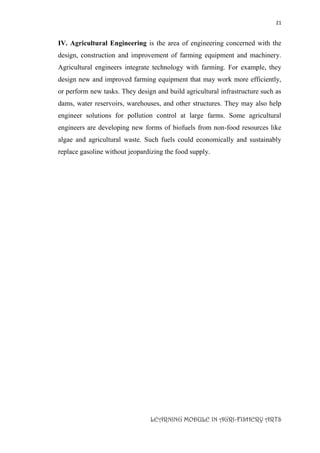
  • 222.
    212 LEARNING MODULE INAGRI-FISHERY ARTS Natural Method Artificial Method
  • 223.
    213 LEARNING MODULE INAGRI-FISHERY ARTS Fish Cultivation simply means the rearing of fish and other aquatic products from very young stage like fry and fingerlings, to marketable size. It is done in fresh, brackish and marine waters in any of the rearing contraptions or structures. The other types of sub-classification based on the techniques applied and financial investments, namely: extensive, semi-intensive and intensive.  Extensive Fish Farming The fish feed entirely from the food web within the pond, which may be enhanced by the addition of the fertilizer or manure.  Semi-Intensive Fish Farming
  • 224.
    214 LEARNING MODULE INAGRI-FISHERY ARTS The fish still obtain significant nutrition from the food web within their pond, but they are also given supplementary feed.  Intensive Fish Farming The fish are kept at too high a stocking density to obtain significant amount of feed from their environment. Fish Conservation is the public control and various maintenances of the various fisheries where fish and other fishery products are deprived. It work should be designed to insure maximum sustainable yield of fish. For instance, the continuous use of fishpond without proper maintenance, like applying fertilizer, lowers the productivity of the soil. It lessens the capacity of fish to reproduce.
  • 225.
    215 LEARNING MODULE INAGRI-FISHERY ARTS Fish Capture Fish Capture is a rule or principle of capturing or operating methods of fish and carried out distinct means with some regularity. It includes the fishing gears, technologies and equipments for systematic capturing. Fish Preservation It is any operation that can prevent or inhibit the natural process of breakdown or decomposition taking place in the fish. It is known as fish processing.
  • 226.
    216 LEARNING MODULE INAGRI-FISHERY ARTS Activity EXPLORE FISHERY! Direction: Answer the following questions. 1. What are the three (3) branches of Fishery? Explain each. 2. What are the different types of fish cultivation? Explain each. 3. What are the different types of sub-classification based on the techniques applied and financial investments? Explain each. 4. Why is it important to know and understand the importance of fishery branches? 5. If you were given a capital to build or establish your own fishery business, in specifically what branch of fishery do you prefer? Explain your answer and share/present it to the class.
  • 227.
    217 LEARNING MODULE INAGRI-FISHERY ARTS LESSON 4: MORPHOLOGY OF COMMON FISH – ITS PARTS AND FUNCTIONS External Parts of the Fish and Their Functions 1. Operculum/gill cover - part of the fish that covers the gills 2. Scales - part of the fish that cover the body
  • 228.
    218 LEARNING MODULE INAGRI-FISHERY ARTS 3. Lateral lines - lines along the body of the fish used to help the fish adapt itself to its new environment 4. Fins - part of the fish that used for swimming, balancing and propelling in water 5. Eyes - part of the fish that used for seeing 6. Mouth - part of the fish that used for swallowing objects, particularly food 7. Anus - part of the fish that serves as an excretory organ of the fish where the waste matter coming from the body of fish passes out 8. Caudal Peduncle - part of the fish that connect the body and the tail 9. Nostril - part of the fish that used for smelling 10.Vent - the opening between the anus and the anal fin where the fish will excrete either eggs or sperm. Also known as genital papilla
  • 229.
    219 LEARNING MODULE INAGRI-FISHERY ARTS Internal Parts of Fish and their Functions 1. Spine - the primary structural framework upon which the fish’s body is built. It connects to the skull at the front of the fish and the tail at the rear. The spine is made up of numerous vertebrae, which are hollow and which protect the delicate spinal cord 2. Spinal cord - the part that connects the brain to the rest of the body and relays sensory information from the body to the brain, as well as instruction from the brain to the rest of the body 3. Brain - the control center of the fish where both automatic functions and higher behaviours occur. All sensory information is processed here
  • 230.
    220 LEARNING MODULE INAGRI-FISHERY ARTS 4. Lateral line - one of the fish’s primary sense organs. It detects underwater vibration and is capable of determining the direction of their source 5. Swim or Air Bladder - a hollow, gas-filled balance organ that allows a fish to conserve energy by maintaining neutral buoyancy in water 6. Kidney - filters liquid waste materials from the blood. These waste are then passed out the body 7. Stomach and intestines - break down food and absorb nutrients 8. Pyloric caeca - finger like projection located near the functions of the stomach and the Intestine. It known to secrete enzymes that aid digestion. It may also function to absorb digested food or do both 9. Liver - it assists digestion by secreting enzymes that break down fats, and also serves as storage area for fats and carbohydrates. 10.Heart - circulates blood throughout the body
  • 231.
    221 LEARNING MODULE INAGRI-FISHERY ARTS 11.Muscle - provide movement and locomotion. These are parts of the fish that are usually eaten. They compose the fillet of the fish 12.Gonad - hormone-secreting sexual gland of a fish. Fish Scales Tell the Age of a Fish Look at the image of the fish scale. Like a tree, scales show rings that indicate periods of growth. Rings that are farther apart occur when the fish grows well and there is a lot of food in the summer season. Rings that are close together occur when the fish does not get much food and grows slowly. On the scale you can identify the summer growth and the winter growth. (There will be several rings in each). The core represents the fish when it was first born, as a fry. The rings near the edge are the most recent periods of growth.
  • 232.
    222 LEARNING MODULE INAGRI-FISHERY ARTS Types of Fish Scales Placoid - It resembles a miniature tooth called denticles. Ex. shark scales Cycloid - It is oval or circular in outline and has a smooth and exposed rear edge.
  • 233.
    223 LEARNING MODULE INAGRI-FISHERY ARTS Ctenoid – It is scales that have a rear edges made of small brush-like spines or comb liked teeth. Ex. Scales of perch, pongies and bass Ganoid – It is a four- sided plate that fits closely against adjacent plates without overlapping. Parts of Gills Diagrammic Representation of Two Forms of Fish Gills 1. Gills Filaments - used for exchange of gases such as oxygen and carbon dioxide 2. Gills Arch - used for support and passing for blood to and the gill filaments 3. Gill Rakers - used for straining food from the water
  • 234.
    224 LEARNING MODULE INAGRI-FISHERY ARTS Activity BE A FISH MORPHOLOGY RESEARCHER! Direction: Do the instructions properly. INSTRUCTIONS 1. Collect samples of fish and identify the external and internal parts. 2. Research on the morphology of fishes, evolution of fishes, some fish culture facilities in the country, classification, construction and operation of common fishing used in the Philippines. 3. Watch a video presentation about the morphology of fish. 4. Bring some fish samples to be dissected and identified. Assessment: The work of the students will be evaluated by your teacher using the given criteria. The students must have at least attained 75 percent to pass. 1. Accuracy 70% 2. Presentation 20% 3. Neatness 10 %
  • 235.
    225 LEARNING MODULE INAGRI-FISHERY ARTS FISH CULTURE take the challenge! At the end of this chapter, the students are expected to: Lesson 1: Understand the Aspects, Classifications, Methods of Fish Culture Lesson 2: Recognize Terminologies Used in Fish Culture Lesson 3: Identify the Facilities, Parts of Fish Pond and their Functions. Illustrate Fish Pond Layout Lesson 4: Identify the Cultivable Fish and Crustacean Species CHAPTER 7
  • 236.
    226 LEARNING MODULE INAGRI-FISHERY ARTS PRE-TEST Test I. Multiple choice Direction: Encircle the letter of the correct answer. 1. It is the rearing of fish under controlled or semi-controlled condition. a. Fish Culture b. Fish Cultivation c. Fish Propagation d. Fish Conservation 2. It is the process of increasing fish life either by natural or artificial means of reproduction. a. Fish Culture b. Fish Cultivation c. Fish Propagation d. Fish Conservation 3. It is the scientific means of utilizing fish and other awuatic products/ resources. a. Fish Culture b. Fish Cultivation c. Fish Propagation d. Fish Conservation 4. What is the fish culture classification according to its purpose? a. Intensive b. Recreation c. Natural or Artificial d. Extensive
  • 237.
    227 LEARNING MODULE INAGRI-FISHERY ARTS 5. What is fish culture method under taken in net closures in shallow protected areas of inland waters? a. Fish Pond b. Fish Pen c. Fish Cage d. Fish tank 6. It is the degree of water freshness and saltiness. a. Freshness b. Saltiness c. pH d. Salinity 7. It refers to fish species that go upstream from saltwater to freshwater to spawn. a. Anadromous b. Catadromous c. Endemic d. Exotic 8. It refers to the fish species that go downstream from freshwater to saltwater to spawn. a. Anadromous b. Catadromous c. Endemic d. Exotic 9. What is the rivalry for food, space and oxygen inside the fish pond? a. Competition b. Cannibalism c. Survival d. Fighting
  • 238.
    228 LEARNING MODULE INAGRI-FISHERY ARTS 10.What is the linear relationship of undergoing the process of eating and being eaten? a. Food Web b. Food Chain c. Food System d. Food Cycle 11.It is the smallest and cleanest compartment of fish pond. a. Fingerlings Pond b. Fry Pond c. Nursery Pond d. Delivery Pond 12.What is an area that serves as water reservoir where water is stored before going to other pond compartment? a. Main Pond b. Head Pond c. First Pond d. Primary Pond 13.It is the dike that surrounds the smallest compartment. a. Least Dike b. Small Dike c. Tertiary Dike d. Third Dike 14.What is the gate in fish pond that can be found in the largest compartment? a. Main Dike b. Head Dike c. First Dike d. Primary Dike
  • 239.
    229 LEARNING MODULE INAGRI-FISHERY ARTS 15.A small unframed net enclosure with entire upper opened is called ___. a. Fish Tank b. Fish Pen c. Hapa d. Payaw 16.What is the common name of Oreochromis niloticus? a. Nile Tilapia b. Mozambique Tilapia c. Red Tilapia d. Domestic Tilapia 17.What is the common name of Penaeus monodon? a. Giant Tiger Prawn b. Giant Freshwater Prawn c. Indian White Prawn d. Banana Prawn 18.What is the common name of Scylla serrata? a. Swamp Crab b. Mud Crab c. Sand Crab d. Hermit Crab 19.What is the common name of Panulirus ornatus? a. Ornate Spiny Lobster b. Ornate Greasy Lobster c. Ornate Red Lobster d. Ornate Tiger Lobster 20.What is the common name of Perna viridis? a. Green Mussel b. Black Mussel c. Grey Mussel d. Yellow green Mussel
  • 240.
    230 LEARNING MODULE INAGRI-FISHERY ARTS DEFINITION OF TERMS Fish Cage – is a structured-based net that is ether stationary or movable. Fish Conservation – is the scientific means of conserving fish and other fishery aquatic products/resources. Fish Cultivation – is the rearing of fish under controlled and semi-controlled condition. Fish Pen – is an enclosure of net or bamboo slats with sturdy posts staked at the bottom of water and used for the culture of fish from fry to marketable size. Fish Pond – is a confined body of water where fish are raised under controlled conditions. Fish Propagation – is the process of increasing fish life either by natural or artificial means of reproduction. Fish Tank – is a structure made of brick tile, concrete or polyvinyl chloride (pvc) used for the purpose of culturing fish from fry, to marketable size. It also can be used as a breeding tank, or as conditioning tank. Hapa – is a small unframed net enclosure with the entire upper opened. Raceway – is an enclosure of concrete soil or added materials.
  • 241.
    231 LEARNING MODULE INAGRI-FISHERY ARTS LESSON 1: ASPECTS, CLASSIFICATIONS AND METHODS OF FISH CULTURE Many programs and activities had been done in response to the problems regarding the shortage of the supply of fish in the country. One of which these program is Fish Culture. Fish culture then must be introduced to enhance awareness and adopt some of the technology and its adoption as additional source of food and income. Nature and Scope of Fish Culture It is the rearing of fish from fry to marketable size. It also cultivates other aquatic products such as crabs, prawns and shrimps. Fish cultivation is undertaken in fresh, brackish and marine waters based from the environment and water supply. The fresh water type of fish cultivation is carried out in lakes, rivers, dams or reservoirs and marshes. Structures used for this type are fish ponds, fish pens, fish cage, fish tank and raceways. The species of fish that are usually raised are tilapia, carp, catfish, mudfish and milkfish.
  • 242.
    232 LEARNING MODULE INAGRI-FISHERY ARTS The brackish water type of fish cultivation is carried out in tidal flats or along margins of estuarine areas. The structures as those in freshwater are used in this type is the same, except the raceways. The major species of fish cultivated are tilapia, milkfish, shrimps and crabs. Fish pond is the predominant type of fish cultivation in the country. It contributes utmost production of inland waters. Milkfish is the number one product. The marine water type of fish cultivation is carried out in salt waters or open ocean waters. The farms are positioned in deeper and less sheltered waters, where currents are stronger than they are inshore. The structures used for this type are fish cage, fish tank, fish pond and raceways. The species of fish that are shellfish like prawns, or oysters and seaweed. Phases or Aspects of Fish Culture: 1. Fish Cultivation The rearing of fish under controlled and semi-controlled condition.
  • 243.
    233 LEARNING MODULE INAGRI-FISHERY ARTS 2. Fish Propagation The process of increasing fish life either by natural or artificial means of reproduction. 3. Fish Conservation The scientific means of conserving fish and other fishery aquatic
  • 244.
    234 LEARNING MODULE INAGRI-FISHERY ARTS products/resources. It helps to keep the sport of fishing alive. Also, helps to maintain the balance of certain ecosystems. Fish are important to the planet and fish conservation can help maintain nature’s balance. Classification of Fish Culture 1. . According to extent of financial investment a. Intensive - utilizes limited area with very high investment b. Extensive - utilizes wide area with minimal capital and very low production c. Semi-intensive - employ some or the majority of the modern techniques of production 2. According to purpose a. for commerce or for business b. for recreation or for enjoyment c. for educational and cultural or scientific pursuit d. for food production 3. According to design a. natural pond b. artificial pond 4. According to state of water a. still water b. running water 5. According to salinity a. freshwater b. brackish-water c. marine or saltwater
  • 245.
    235 LEARNING MODULE INAGRI-FISHERY ARTS 6. According to temperature a. warm water or hot water b. cold water 7. According to species raised a. freshwater species b. brackish-water species c. marine or saltwater species Methods of Fish Culture Based on the structures used in fish cultivation, they can be classified into five methods. These are the fish pond, fish pen, fish cage, fish tank and open-water method. Fish pond is the most widely used. Fry or fingerlings of one or more species are stocked and reared in pond up to harvest time. Natural food is grown in pond. The supplementary feed is added. The method of harvesting is draining the pond. Retrieval of fish in this way is complete. Another method of harvesting is freshening in case of bangus. Having positive rheotaxism, the fish are induced to go against water current by the gate and concentrated into a catching pond where they are scooped. The fish pen method of fish cultivation is undertaken in net enclosures in shallow protected areas of inland waters. Bamboo and wood materials ate used as post and braces. Its lower end is embedded in the mud to prevent escape of stock by excavating under, while the upper end is extended two meters or more beyond the water level to escape of fish by jumping out. Harvest of fish is done by seining or shocking them with electricity. The fish cage method of fish cultivation is also undertaken in inland bodies of water, both in flowing and still water ones. The structure used is also made of nets. PVC pipes as framing materials is preferred to that of wood or bamboo. A cage is much smaller than a fish pen. The cage is closed on all sides
  • 246.
    236 LEARNING MODULE INAGRI-FISHERY ARTS and installed in suspension. Fish cage is stationary and movable. Floating and fixed cages have open top. Growth rate of fish is dependent on the kind and amount of food given and suitability of the environment. Harvesting of stock is relatively easy and complete. The fish is either scooped or the cage is merely brought out of the water to empty the fish. The fish tank method of fish cultivation is practiced primarily by fish hobbyists and in pet shops. The method employs varying sizes and shapes of fish culture structures. These include glass bowls or aquaria and wooden or concrete tanks. This method cultivation is done outdoor and indoor. The method involves rearing or breeding of ornamental or fancy, colourful species of fish. A fifth method of fish cultivation is open-water method. It is done in bays, coastal lagoons, canals and similar environments.
  • 247.
    237 LEARNING MODULE INAGRI-FISHERY ARTS Activity BE A FISH CULTURIST! I. Identification. Aspects and Methods of Fish Culture Direction: Identify each item. Write the correct answer before the number. 1. It is the scientific means of utilizing fish and other fishery aquatic products/resources. 2. It is the process of increasing fish life either by natural or artificial means of reproduction. 3. It is raising of fish under controlled or semi-controlled condition. 4. It is undertaken in net enclosures in shallow protected areas of inland waters. 5. It is also undertaken in inland bodies of water, preferably in flowing ones. 6. It is done in bays, coastal lagoons and similar environments. 7. It is the most widely used method. Fry or fingerlings of one or more species are stocked and reared in pond up to harvest time. II. Enumeration. Classification of Fish Culture Direction: Enumerate each item. 1. According to purpose. 2. According to design. 3. According to state of water. 4. According to salinity. 5. According to temperature. 6. According to species raised. 7. According to extent of financial investment.
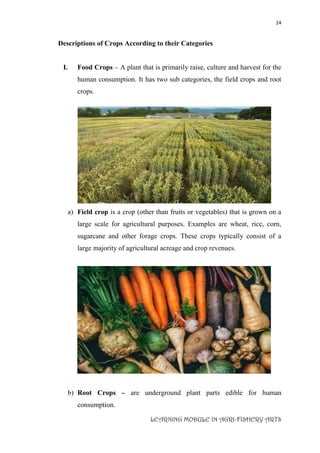
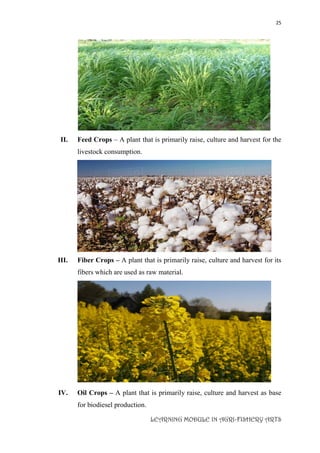
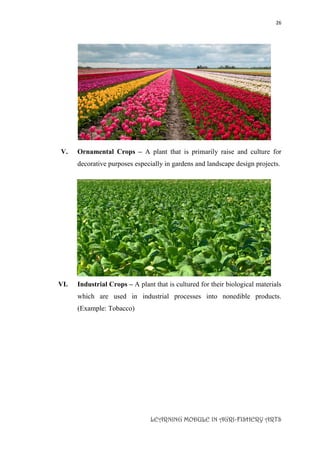
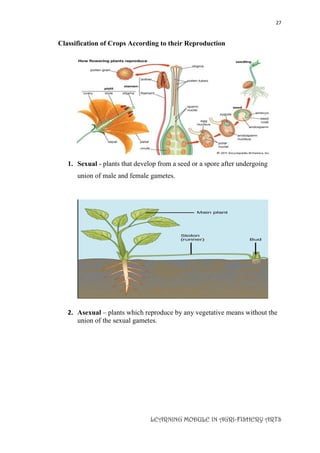
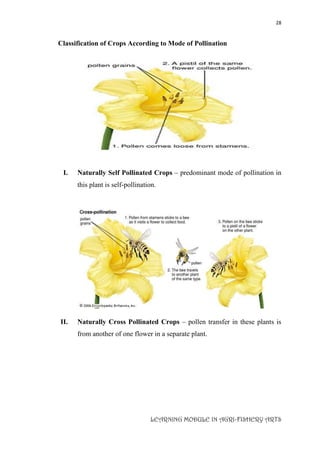
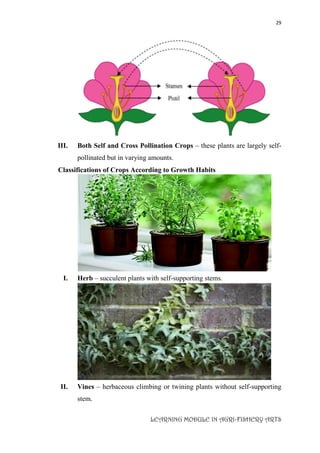
  • 248.
    238 LEARNING MODULE INAGRI-FISHERY ARTS LESSON 2: DIFFERENT TERMINOLOGIES USED IN FISH CULTURE In every area of specialization, there are terminologies used to give a specific meaning for a matter. This will served as a common idea to the professionals in their respective fields. So as is in this area, there are scientific terminologies. In this lesson, it will tackle about various common terminologies used in fish culture. Terminologies Used in the Study of Fish Culture 1. Anadromous - are species of fish that go upstream from salt water to freshwater to spawn. ex: bangus 2. Biomass - is the total weight of the animal in the given environment.
  • 249.
    239 LEARNING MODULE INAGRI-FISHERY ARTS 3. Cannibalistic - are species of fish that feed on their own kind. 4. Carnivorous - are species of fish that feed on other animals. 5. Catadromous - are species of fish that go down from freshwater to saltwater to spawn. ex: eels 6. Competition - is the rivalry for food, space and oxygen inside the fishpond. 7. Endemic or indigenous - is native to the locality 8. Exotic or digenous - is introduced by other countries 9. Fecundity - is the number of eggs laid by a female fish in one spawning. 10.Food chain - is the linear relationship of undergoing the process of eating and being eaten. 11.Habitat - is the place where plants and animals grow and naturally live. 12.Herbivorous - are species of fish that feed on plants and vegetables only 13.Lab-lab - is the vernacular term for all the greenish, brownish or yellowish crust of micro benthic fauna and flora,
  • 250.
    240 LEARNING MODULE INAGRI-FISHERY ARTS which are found growing in matrix or mat at the pond floor. 14.Milt - is the male reproductive gland of fishes 15.Omnivorous - are species of fish that feed on both plants and animals 16.Oviparous - are species of fish whose eggs are fertilized and developed outside the body. ex: tilapia 17.Ovoviviparous - are species of fish whose eggs are fertilized and developed within the body but the young when born alive do not receive nourishment from the mother fish. ex: Rays and Sharks 18.pH - is the hydrogen ion-concentration of water. 19.Photosynthesis - is the process by which plants manufacture their food with the aid of sunlight. 20.Plankton - is the biological association of minute plants and animals which are found growing on the surface of the water. 21.Predators - are species of fish feeding on other fishes specially the cultivable ones.
  • 251.
    241 LEARNING MODULE INAGRI-FISHERY ARTS 22.Prolific - is the process of producing young in great numbers 23.Sabalo - is the bangus breeder or spawner 24.Salinity - is the degree of freshness and saltiness of water. 25.Scavenger - are species of fish that feed on decaying organic matter. 26.Spat - is the larvae of oyster and mussel which are free swimming in water. 27.Standing crop - is the total number of fish stocked at a given area at a given time. 28.Temperature - is the degree of coldness and hotness of water. 29.Tide - is the periodic rise and fall of seawater. 30.Viviparous - are species of fish that bring forth living young which during their early development receive nourishment from their mother fish.
  • 252.
    242 LEARNING MODULE INAGRI-FISHERY ARTS Activity TEST YOUR FISH CULTURE VOCABULARY I. Identification. Identify the following given statements. 1. It is the total weight of the animal in the given environment. 2. It is the process of producing young in great numbers. 3. It is the hydrogen ion-concentration of water. 4. It is the number of eggs laid by a female fish in one spawning. 5. It is the biological association of minute plants and animals which are found growing on the surface of the water.

  • 253.
    243 LEARNING MODULE INAGRI-FISHERY ARTS LESSON 3: FISH CULTURE FACILITIES Many facilities that can operate in fish culture. In this lesson, we only tackle the common and frequently used facilities. They are Fish Pond, Fish Cage, Fish Pen, Fish Tank, Hapa and Raceway. All of them will be discussed below. 1. FISH POND According to the www.agriculturenigeria.com that fish pond is a confined body of water where fish are raised under controlled conditions. Fish can also be raised in plastics, fiber stars and wooden rafts. There are three main types of ponds in construction. This either be earthen pond, concrete pond and riprap.
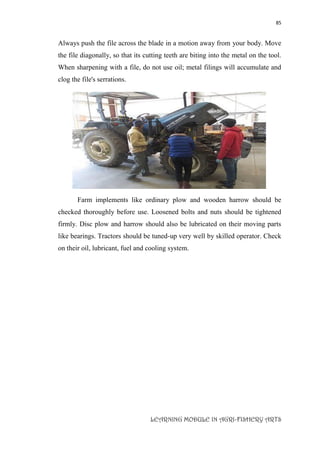
  • 254.
    244 LEARNING MODULE INAGRI-FISHERY ARTS Fish Earthen Pond Fish Concrete Pond Fish Riprap Pond
  • 255.
    245 LEARNING MODULE INAGRI-FISHERY ARTS Compartments of a Fish Pond and each Function 1. Nursery pond - is the smallest and the cleanest compartment where fish are reared from fry up to pre- fingerling size. 2. Transition pond - is a compartment where fish are reared from pre-fingerling size to post fingerling size before stocking compartments, it is also known as stunting pond. 3. Rearing pond - is the largest compartment of a fishpond where fishes are reared from post fingerlings up to marketable size. 4. Breeding pond - is a compartment where spawners are confined and are used purposely for the production of fry. 5. Catching pond - is an area that serves as catchment basin for fish harvest. 6. Head pond - is an area that serves as water reservoir where water is stored before going to other pond compartments. 7. Water supply canal - is a canal used to supply water throughout the whole fish pond system.
  • 256.
    246 LEARNING MODULE INAGRI-FISHERY ARTS Interpreting Plans and Layout Fish Pond Layout Legend: ] [ - Main Gate ) ( - Secondary Gate | | – Tertiary Gate HP – Head Pond NP – Nursery Pond TP – Transition Pond RP – Rearing Pond WSC – Water Supply Canal CP – Catching Pond
  • 257.
    247 LEARNING MODULE INAGRI-FISHERY ARTS Kinds of Dikes 1. Main dike – is the largest of all dikes that surrounds the whole fishpond project. 2. Secondary dike – is the dike that surrounds the big compartment. 3. Tertiary dike – is the dike that surrounds the small compartment.
  • 258.
    248 LEARNING MODULE INAGRI-FISHERY ARTS Kinds of Gates 1. Main gate – is the largest gate that serves as water entrance in the whole fishpond system. 2. Secondary gate – is the gate that can be found in the large compartment. 3. Tertiary gate – is the gate that can be found in the small compartment.
  • 259.
    249 LEARNING MODULE INAGRI-FISHERY ARTS 2. Fish Cage Fish Cage is a structured-based net that is ether stationary or movable. Set in water and surrounded all sides by bamboo slats and provided with an anchor at the bottom. It is used for the culture of fish from fry to marketable size. 3. Fish Pen It is an enclosure of net or bamboo slats with sturdy posts staked at the bottom of water and used for the culture of fish from fry to marketable size. The fish pen is fastened permanently against sturdy post and frames.
  • 260.
    250 LEARNING MODULE INAGRI-FISHERY ARTS 4. Fish Tank It is structure made of brick tile, concrete or polyvinyl chloride (pvc) used for the purpose of culturing fish from fry, to marketable size. It also can be used as a breeding tank, or as conditioning tank. 5. Hapa A small unframed net enclosure with the entire upper opened. It is suspended by poles with ample portion extending beyond the water level to prevent the fish from jumping out.
  • 261.
    251 LEARNING MODULE INAGRI-FISHERY ARTS 6. Raceway It is an enclosure of concrete soil or added materials. The shape is likely of the canal through which constant water flows. Fish are raised in the raceway at high density and their waste products are carried out by the water passing through the areas.
  • 262.
    252 LEARNING MODULE INAGRI-FISHERY ARTS Activity FISH FACILITIES IDENTIFIER I. Identification. Direction: Identify each item. Write your correct answer before the number. 1. It is a confined body of water where fish are raised under controlled conditions. 2. It is fastened permanently against sturdy post and frames. 3. It is a structured-based net that is ether stationary or movable. 4. It is suspended by poles with ample portion extending beyond the water level to prevent the fish from jumping out. 5. It is an enclosure of concrete soil or added materials. The shape is likely of the canal through which constant water flows. 6. It is structure made of brick tile or concrete used for the purpose of culturing fish from fry, to marketable size. 7. It is a compartment where fish are reared from pre-fingerling size to post fingerling size before stocking them in to other larger compartments, it is also known as stunting pond. 8. It is a compartment where spawners are confined and are used purposely for the production of fry or fingerling. 9. It is the smallest and the cleanest compartment where fish are reared from fry up to pre-fingerling size. 10.It is the largest compartment of a fishpond where fishes are reared from post fingerlings up to marketable size. 11.It is an area that serves as water reservoir where water is stored before going to other pond compartments.
  • 263.
    253 LEARNING MODULE INAGRI-FISHERY ARTS 12.It is the canal used to supply water throughout the whole fish pond system. 13.It is an area that serves as catchment basin for fish harvest. 14.It is the dike that surrounds the smallest compartment. 15.It is the dike that surrounds the biggest compartment. 16.It is the dike that surrounds the whole fish pond. 17.It is the gate that can be found in the largest compartment. 18.It is the gate that can be found in the smallest compartment. 19.It is a large gate that serves as water entrance in the whole fish pond system. 20.It is a confined body of water where fish are raised under controlled conditions. DEVELOPING OWN FISH POND LAYOUT II. Illustration. Direction: Bring the materials needed. Do the procedures properly. Materials:  Pencil  Ruler  Bond Paper  Folder Procedures: 1. Prepare your materials. 2. Develop your own Fish Pond Layout. All kinds of compartments, dikes and gates must be included. 3. Put your outcome to the folder. 4. Submit it to your teacher for assessment.
  • 264.
    254 LEARNING MODULE INAGRI-FISHERY ARTS Assessment: The work of the students will be evaluated by your teacher using the given criteria. The students’ outcome must be attained at least 75 percent of points to pass the lesson. 1. Completeness – 40% 2. Accuracy – 40% 3. Neatness – 20%
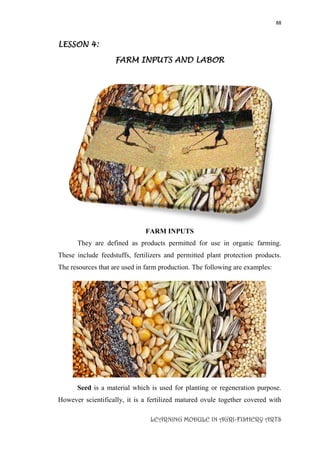

  • 265.
    255 LEARNING MODULE INAGRI-FISHERY ARTS LESSON 4: CULTIVABLE FISH AND CRUSTACEAN SPECIES There are vast species of aquatic animals with their unique characteristics around the globe in freshwaters, brackish waters and saltwater yet not all of them are edible to consume by human for food because of health issues if eaten and the threat of extinction to their race which are protected by local governments. So, there are only specific species of fish for food and legally to produce and commerce. In this lesson, it will discuss about the Philippine common species of cultivable fish and crustaceans in fish facilities, their characteristics and natural food according to their water habitats.
  • 266.
    256 LEARNING MODULE INAGRI-FISHERY ARTS Common Cultivable Fish Species: Nile Tilapia (Oreochromis niloticus) is a tropical species that prefers to live in shallow water. The lower and upper lethal temperatures for Nile Tilapia are 12˚C and 42˚C, respectively, while the preferred temperature ranges from 31˚C to 36˚C. It is an omnivorous grazer that feeds on phytoplankton, periphyton aquatic plants, small invertebrates, benthic fauna, dentitus and bacterial films associated with detritus. Nile Tilapia can live longer than 10 years and reach an exceeding weight of 5 kg. Mozambique Tilapia (Oreochromis mossambicus) is a freshwater and brackish water inhabitant. It lives in warm, weedy pools of sluggish stream, canals and ponds. Is mainly diurnal, occurs at temoeratures ranging from 8˚C to 42˚C. Omnivorous, feeds on almost anything from algae to insects but also crustaceans and fishes. Mozambique Tilapia reaches a maximum size to 36 cm.
  • 267.
    257 LEARNING MODULE INAGRI-FISHERY ARTS Common Carp (Cyprinus carpio) is live in the middle and lower streams of rivers, in inundated areas, and shallow confined waters such as lakes and water reservoirs. Carps are mainly bottom dwellers but search for food in the middle and upper layers of water body. Best growth is obtained when water temperature ranges between 23˚C and 30˚C. The fish can survive cold winter periods. It is omnivorous, with a high tendency towards the consumption of animal food such as water insects, larvae of insects, worms, molluscs, and zooplanktons. Common carps can reach 0.6 to 1 kg body weight within one season in the polycultural fish ponds of tropical and subtropical areas. Bighead Carp (Hypopthalmichthys nobilis) is a eurythermic fish, being to tolerate water temperatures of 0.5˚C to 38˚C. It inhabits lakes, rivers and reservoirs. Bighead carp normally dwell in the upper layer of the water column and prefers high fertility water with abundant natural food. Basically, it is a zooplankton eater throughout its life under natural conditions yet also
  • 268.
    258 LEARNING MODULE INAGRI-FISHERY ARTS consumes artificial feed in culture ponds. Bighead Carp are fast growing and become very large in size reaching a maximum weight of 40 kg. Philippine Catfish (Clarias batrachus) is an air breathing fish inhabit in lowland streams, swamps, ponds, ditches, rice paddies and pools left in low spots after flood. It can walk and leave the water to migrate to another water bodies using its auxiliary breathing organs. It usually confined to stagnant, muddy water and tolerates temperature from 10˚C to 28˚C. Omnivorous that feed on insect larvae, earthworms, shell, shrimps, small fishes, aquatic plants and debris. Approximately, its maximum length is 47 cm and maximum weight of 1.2 kg. Bighead Catfish (Clarias macrocephalus) is an air breathing fish lives in lowland wetland and rivers. Occurs in shallow, open water and is capable of lying buried mud for lengthy period in the time of ponds and lakes evaporate during dry seasons. It can also extend its fins to move out of the water. Found in medium to large-sized rivers, stagnant water bodies including sluggish
  • 269.
    259 LEARNING MODULE INAGRI-FISHERY ARTS flowing canals and flooded fields. It can tolerate temperatures from 10˚C to 28˚. Omnivorous that feed on aquatic insect, young shrimps, small fishes and aquatic plants. Its maximum length is 120 cm and maximum weight is 45 kg. North African Catfish (Clarias gariepinus) is found in lakes, streams, rivers, swamps and floodplains, many of which are subject to seasonal drying. The most common habitats are floodplain swamps and pools where they can survive during the dry season(s) due to their accessory air breathing organs. It undertake lateral migrations from the larger water bodies, in which they feed on aquatic insects, worms, gastropods, small crustaceans, small fishes, aquatic plants, terrestrial seeds and berries, small birds and small mammal as being an omnivorous. It can live in the temperature of 10˚C to 28˚C. The record individual from Country of Malawi was 16.1 in kg and the max length is 150 cm. Snakehead Murrel (Channa striata) is a ray-finned fish that perch-
  • 270.
    260 LEARNING MODULE INAGRI-FISHERY ARTS like in form and its head is like of a snake. It is a fresh and brackish water inhabitant such as ponds, streams, rivers, stagnant and muddy plains. Found mainly in swamps but also occurs in lowland rivers. It can survive in dry season by burrowing in bottom mud of lakes, canals and swamps as long as skin and breathing apparatus remain moist and subsists on the stored fat. Feed on fish, frogs, snakes, insects, earthworms, tadpoles and small crustaceans as being a carnivore. Snakehead murrel can live in temperature of 23˚C to 27˚C. Its maximum length is 100cm and weight of 3kg. Giant Gourami (Osphronemus gouramy) is a laterally compressed (compressiform) fish. It has the ability to breath air through a specific organ called labyrinth (a much-folded suprabranchial accessory breathing organ), which appears in juviniles about 30 days after hatching and become functional around 40 days. This fish is omnivorous but with a strong vegetarian tendency, it can ingest various aquatic and terrestrial plants, although it can also eat a wide range of other food resources such as frogs, tadpoles, snails, small fishes and other small aquatic animals. Giant gourami prefers calm fresh waters especially slow-moving areas such as lakes and large rivers. They are also found in flood plains and irrigation canals. It lives in tropical temperature of water. It can reach a remarkable size but normally the maximum size is 45-50 cm. Growth rate is quite slow and may reach commercial size of 500 to 750 g within 9-14 months of growout. To achieve larger sizes 1 to 2 kg, an extended
  • 271.
    261 LEARNING MODULE INAGRI-FISHERY ARTS period of growout rearing is required, generally compromising 25 to 35 months in total. Barramundi (Lates calcarifer) is also known as seabass, it inhabit freshwater, brackish water and marine habitats including streams, lakes, billabongs, estuaries and coastal waters. Barramundi are opportunistic predators; crustaceans and fish predominate in the diet of adults. It is highly fecund; a single female (120 cm) may produce 30-40 million eggs. Consequently, only small numbers of broodstock are necessary to provide adequate numbers of larvae for large-scale hatchery production. Larvae recruit into estuarine nursery swamps where they remain for several months before they move out into the freshwater reaches of coastal rivers and creeks considering them as a diadromous fish. They usually occur at a temperature range of 26˚C to 29˚C and between 10 to 40 m deep. Its size is commonly between at 25 to 100 cm.
  • 272.
    262 LEARNING MODULE INAGRI-FISHERY ARTS Orange-spotted Grouper (Epinephelus coioides) has body elongated, not very compressed, light greyish brown dorsally, shading to whitish on side and ventrally, with numerous brownish orange or brownish yellow spots on the size of pupil or smaller on head and body. It inhabits turbid coastal reefs and is often found in brackish water over mud and rubble. Juveniles are common in the shallow waters of estuaries over sand, mud, gravels and among mangroves. It feeds on small fishes, shrimp and crabs. It is generally cultured in floating net cages or earthen pond, but cage culture is more common in Southeast Asia. Most of the brooders are collected from wild and reared for 1 to 7 years using seawater at a constant temperature of 27˚C to 28˚C. The fish are fed with frozen sardines, mackerels, cuttlefish, squids and top-shell clams because these foods have high contents of cholesterol, phospholipids and polyunsaturated fatty acids.
  • 273.
    263 LEARNING MODULE INAGRI-FISHERY ARTS Malabar Grouper (Epinephelus malabaricus) is a ray-finned fish and has perch-like body. It has light grey to yellowish brown color; five slightly oblique dark brown bars that bifurcate ventrally; numerous small black spots and blotches in head and body. It inhabits in marine, brackish, reef-associated waters such as coral and rocky reefs, tide pools, estuaries, mangrove swamps and sandy or mud bottom from shore to depths of 150 m. It feed primarily on fishes and crustaceans. Malabar grouper can tolerate water temperature from 26˚C to 29˚C. Its common maximum length is 234 cm and maximum weight of 150 kg. Orange-spotted Spinefoot (Siganus guttatus) is also known as rabbit fish by the similarity of the nose. It is a ray-finned fish with perch-like body. It has a bright yellow spot adjacent to last few rays of dorsal fin, head with lines and spots. Its spine is stout, pungent and venomous. Inhabits in marine and brackish water to include turbid inshore reefs among mangroves; tolerates or even prefers low salinities. Fry settlers in seagrass beds around river mouths and adults enter and leave rivers with tides but also found on drop-offs of inshore fringing reefs down to 6 m. It feeds on benthic algae. Unlike other siganids, this species is reported to be active at night as being a nocturnal fish. It can tolerate water temperature from 24˚C to 28˚C. Its common maximum length is 42 cm.
  • 274.
    264 LEARNING MODULE INAGRI-FISHERY ARTS Vermiculated Spinefoot (Siganus vermiculatus) is is also known as rabbit fish by the similarity of the nose. It is a ray-finned fish with perch-like bluish white body, head brown to brownish or golden yellow with irregular lines. Its spine is stout, blunt or pungent and venomous. It inhabits in marine and brackish water, juveniles live among mangroves then move out to lagoon and coastal reefs as they mature. It feeds on algae growing on seagrass, mangrove roots and rocks. Adult congregate inshore in groups of several hundreds to spawn in summer. Adults on coastal reefs are subject to strong currents. The species has a high fecundity of 350,000 per spawning season. It can tolerate water temperature from 19˚C to 38˚C. Its common maximum length is 45 cm. Spotted Scat (Scatophagus argus) is a ray-finned fish with perch-like quadrangular body shape. Juveniles with a few large roundish blotches, about size of eye, dorsal head profile is steep. Eye moderately large and snout is
  • 275.
    265 LEARNING MODULE INAGRI-FISHERY ARTS rounded. It inhabits in fresh, brackish and marine waters such as harbors, natural embayments, brackish estuaries and lower reaches of freshwater streams, frequently occurring among mangroves. It feeds on worms, crustaceans, insects and plant matters. The dorsal, anal and pelvic spines are believed by Philippine fishers to be venomous and capable of inflicting wounds. It can live in the water temperature from 20˚C to 28˚C and usually its maximum length is 38 cm. Milkfish (Chanos chanos) is a fusiform, elongated, moderately compressed, and smooth streamline body fish. It has body color silvery on belly and sides grading olive-green or blue on back, transparent tissue covers eye. It is the only species in the Family Chanidae. Its distribution is restricted to either low latitude tropics or the subtropical northern hemisphere along continental shelves and around islands, where temperatures are greater than 20˚C. Milkfish only spawn in saline waters. Spawning takes place near coral reefs during the warm month of the year. Juveniles and adults eat a wide variety of relative soft and small food items, from microbial mats to detritus, epiphytes and zooplankton. It attains typical length of 1m but may reach maximum length of 1.8m.
  • 276.
    266 LEARNING MODULE INAGRI-FISHERY ARTS Common Cultivable Prawn/Shrimp Species: Giant Tiger Prawn (Penaeus monodon) is similar to all penaeid shrimp, the rostrum well developed and toothed dorsally and ventrally. Its carapace has without longitudinal or transverse sutures. Depending on substratum, fees and water turbidity, body colors vary from green, brown, red, grey, blue and transverse band colors on abdomen and carapace are alternated between blue or black and yellow. Penaeus monodon was originally harvested together with other shrimp species from traditional trapping-growing ponds or as a significant by-product of extensive milkfish ponds. It is mature and breeds only in tropical marine habitats and spends their larval, juvenile, adolescent and sub-adult stages in coastal estuaries, lagoons or mangrove areas. In the wild, they show marked nocturnal activity, burrowing into bottom substratum during day and emerging at night to search for food as benthic feeder. Under natural conditions, the giant tiger prawn is more of a predator than an omnivorous scavenger or detritus feeder than other penaeid shrimp. Adults are often found over muddy sand or sandy bottoms at 20 to 50 m depth in offshore waters. The females are highly fecund with gravid females producing as many as 500,000 to 750,000 eggs. Hatching occurs 12 to 15 hours after fertilization. It feeds on benthic detritus, polychaete worms and small crustaceans. Healthy adult females can grow 25 to 30cm and weighted of 200 to 320g while healthy adult males can grow 20 to 25cm and weighted of 100 to 170g.
  • 277.
    267 LEARNING MODULE INAGRI-FISHERY ARTS Indian White Prawn (Penaeus indicus) is similar to all penaeid shrimp, carapace rather smooth, lacking gastro frontal and hepatic crest, ad rostral crest extending as far as or just before epigastric tooth, rostrum slightly curve at tip and sigmoidal-shaped, usually bearing 7 to 9 upper teeth (including those on carapace) and 3 to 6 lower teeth, rostral crest generally slightly elevated in large specimen including adult females. Its body color is semi- translucent, somewhat yellowish white (small specimens) or greyish green and covered with numerous minute dark brown dots, eyes light brown mesh-like stripes, rostral and abdominal dorsal crests reddish brown to dark brown. The methods of brackish water aquaculture are applied whether in cultures practices followed such as traditional, extensive, modified extensive, semi-intensive or intensive. It inhabits the coast of East and South Africa, Southwest and East coast of India, Bangladesh, Thailand, Malaysia, Philippines, Indonesia, Southern China and Northern coast of Australia. Penaeus indicus is non- burrowing, active both day and night, and prefers a sandy mud bottom. Adults are normally found at depths less than 30m but have also been caught from 90m. The shrimp mature and breed mostly in marine habitats and spend the juvenile and sub-adult stages of 30 to 120 mm total in length (TL) in coastal estuaries, backwaters or lagoons. Juveniles can tolerate a much wider range of salinity (5-40%) than asults. On the southwest coast of India the juveniles support a good commercial fishery in the backwaters and paddy fields. It is also highly fecund, ranging from 68,000 to 1,254,200 eggs from females of 140- 200mm TL. Depending upon the temperature, hatching takes place within 8-12
  • 278.
    268 LEARNING MODULE INAGRI-FISHERY ARTS hours after spawning. The postlarvae migrate into the estuaries, settle and feed on benthic detritus, polychaete worms and small crustaceans, and remain there until they attain 110-120 mm TL. These sub-adults then return to the sea and get recruited into the fishery. The size of Penaeus indicus used for broodstock development should preferably be above 145mm TL (20g) for females and 140mm (17g) for males. Banana Prawn (Fenneropenaeus merguinsis) is widely distributed in the Indo-West Pacific region in both tropical and subtropical waters. To include from Persian Gulf to Thailand, Hong Kong, the Philippines, Indonesia, New Guinea, New Caledonia and North Australia. It inhabits in the bottom mud, estuarine and marine about 10 to 45 m in depths. Its usually maximum total length is 240 mm (female). It has been cultured in extensive ponds with natural seeding for a long time in Asia and recently in semi-intensive and intensive ponds. Supplementary feeding occurred only later in improved extensive farming, with usually stocked with wild caught or hatchery-produced postlarvae. Although F. merguinsis does not grow as fast as P. monodon, their ability to mature and spawn in captivity and their short life cycle ensure a consistent production of postlarvae and a great opportunity to domesticate the species. This would eliminate the reliance of the prawn farming industry on wild broodstock and more importantly, allows the development of fast growing or pathogen-free stocks through selective breeding. Such low cost of broodstock, ease in larvae rearing and potentially low feed cost.
  • 279.
    269 LEARNING MODULE INAGRI-FISHERY ARTS Greasyback Prawn (Metapenaeus ensis) is commonly called mud prawn, sand prawn in catering trade. It is popular due to its rich-tasting nutritious flesh. Cahracteristics of M. ensis include a wide distribution, strong adaptability, omnivorous feeding habit, fast growth and high commercial value. It breeds in seawater or brackish water but it can also be bred in freshwater after domestication. After 100 days in cultivation with a favourable environment and abundant food, juveniles will grow into adult commercial shrimps of 10cm in length. Giant Freshwater Prawn (Macrobrachium rosenbergii) is the largest Macrobrachium species. The maximum recorded size for males and females are 33cm and 29cm in length. Mature male prawns are larger than females. The head of the male is also proportionately larger and the abdomen is narrower. M. rosenbergii is nocturnal, bottom dwelling and sluggish in nature and is territorial. During the day they remain half buried in sediments and prefers
  • 280.
    270 LEARNING MODULE INAGRI-FISHERY ARTS shallow, detritus rich and vegetated areas. In temperature regions, the breeding season is summer while in tropical regions it is to the onset of the rainy season. Its spawning occurs two or more times per season. Common Cultivable Crab Species: Swamp Crab (Scylla serrata) is a crab with smooth carapace and strong transversal ridges. Its gastric zone is on the carapace with deep H- shaped groove. Front with 4 broad lobes, all more or less in line with each other, 9 broad teeth on each anterolateral margin, all of them with similar size and projecting obliquely outwards. It has a strong chelipeds with well developed spines on the outer surface of carpus and on the anterior and posterior dorsal parts of propodus. Its carapace color is green to almost black with legs that may be marbled. The three other Scylla species prefer less saline water. Farming of this species has developed from low density pond polyculture with fish and shrimp, using wild seeds introduces tidally or intentionally, to monoculture in ponds and pens. Typically associated with mangroves in estuaries and sheltered coastal habitats, they are found in soft muddy bottoms where they dig deep burrows. Their courtship and mating occur in estuaries. Mature S. serrate migrates offshore (up to 50km) to spawn. They may spawn at any time during the year. The number of eggs produces may range from 1 to 6 million in a single spawning with at least 3 batches. Males
  • 281.
    271 LEARNING MODULE INAGRI-FISHERY ARTS can grow up to 3kg with 28cm carapace width. Mature females have wide and dark abdomens and dark orange ovaries that fill the cavity under the carapace. Mud Crab (Scylla paramamosain) is a crab with a carapace usually green to light green, plam green to greenish blue with lower surface and base of fingers usually pale yellow to yellowish orange. Its carapace common width is between 15 and 18cm. Inhabits rock areas, near reef and mangroves. Members of the order Decapoda are mostly gonochronic. Mating behaviour: Precopulatory courtship ritual is common (through olfactory and tactile cues); usually indirect sperm transfer. Its recorded maximum carapace length is 20cm. Common Cultivable Lobster Species: Ornate Spiny Lobster (Panulirus ornatus) is a lobster under the family of Palinuridae. It has maximum total body length of 50cm but usually much smaller (30 to 35cm). It is found in shallow, sometimes slightly turbid
  • 282.
    272 LEARNING MODULE INAGRI-FISHERY ARTS coastal waters from 1 to 8m depth, with a record of 50m deep. It inhabits sandy and muddy substrates, sometimes on rocky bottom, often near the mouth of rivers but also on coral reefs. Juveniles occur in holes and crevices which are partially covered by seagrass or macroalgae. It is solitary, may live in pairs and has been found in larger concentrations. It is an omnivore species. Members of the order Decapoda are mostly gonochronic. Mating behaviour: Precopulatory courtship ritual is common (through olfactory and tactile cues); it is also indirect sperm transfer. It can found in the Indo-West Pacific region. Common Cultivable Mollusk Species: Slipper Cupped Oyster (Crassostrea iredalei) is a shell medium sized, very variable in shape but generally higher than long, roughly rounded, oblique triangular or elongate ovate in outline. It’s left (lover) valve rather thick but light weighted, more convex and larger than right (upper) valve. The color of outside shell is dirty white, often flushed with pale greyish brown. The right valve is frequently with a few darker purplish grey radial bands in early stages of growth. The interior of valves are whitish and shiny, often with irregular areas of chalky white, deep puple-brown on posterior adductor scar. Its geographical distribution is restricted to the Philippine Archipelago and Malaysia. C. iredalei attached to hard objects or growing in bunches, on various soft bottoms, especially in bays and estuaries with somewhat reduced salinity, intertidal and shallow subtidal water, and suspension-feeding. This brackish water species is noted for its tasty creamy flesh and its culture
  • 283.
    273 LEARNING MODULE INAGRI-FISHERY ARTS required a salinity range of 15 to 25ppt. Its recorded maximum shell height is 15cm and commonly 8cm in length. Donkey’s Ear Abalone (Haliotis asinina) is actively collected in the Southeast Asian countries for its shell and large fleshy animal. It is common but not aggregating in dense populations. The depth where they are usually found is at 0 to 10m. In life, the exceptionally large green mantle almost covers the shell which is them devoid of encrusting marine growths, unlike of the other species. It is active at night, feeds on epilithic algae by grazing. Found in intertidal, on coral reefs. H. asinine is mostly gonochronic and broadcast spawners. Life cycle: Embryos develop into planktonic trocophore larvae and later into juvenile veligers before becoming fully grown adults. Its recorded maximum length is 12cm and its common size is 9cm. Green Mussel (Perna viridis) is an economically important mussel, a bivalve belonging to the family of Mytilidae. It is harvested in the wild and
  • 284.
    274 LEARNING MODULE INAGRI-FISHERY ARTS grown in aquaculture facilities in its native area. The shell tapers to a sharp, downturned beak and has a smooth surface covered with a periostracum. The ventral margin of the shell is straight or weakly concave. The ridge which supports the ligament connecting the two shell valves is finely pitted. The beak has interlocking teeth; one in the right valve and two in the left. The wavy posterior end of the paleal line and the large kidney-shaped adductor muscle are diagnostic features of this species. Periostracum can be vivid green to dark brownish-green near the outer edge and olive-green near the attachment point. The interior of the shell valves is shiny and pale bluish green. It can usually found up to 10m depth and forms dense population (up to 35,000 individuals per square meter). This species in an efficient filter feeder, feeding on small zooplankton, phytoplankton and other suspended fine organic material. Sexes are separate and fertilisation is external. Spawning generally occurs twice a year between early spring and late autumn, however, in the Philippines and Malaysia spawning occurs year round. Sexual maturity occurs at 15 to 30mm shell length. Life span is about 3 years. It is found in estuarine habitats with salinities ranging from 18 to 33 ppt and temperatures from 11˚C to 32˚C. It can reach 150mm. Common Enemies of Fish and Crustacean 1. Predator - fish and other animals that prey on the cultured species of fish and crustacean 2. Competitors - fish and other animals that compete with the cultured species in terms of food, space and oxygen 3. Nuisances - crustaceans and other animals that do a lot of damage to the food and in the habitat of fish
  • 285.
    275 LEARNING MODULE INAGRI-FISHERY ARTS Characteristics of Fish and Crustacean that are Suitable for Pond Culture 1. Fish should be palatable and good tasting – the fish must have a delicate flavour. 2. Fish must be a fast grower – the fish must be able to grow rapidly or can give a possibility of four or more harvests a year. 3. Fish should be resistant to pests, diseases and parasites – the fish should not succumb to abrupt changes in temperature or salinity and can tolerate such conditions in all its existence. 4. Fish should be a universal feeder – the culture fish require food which can be grown easily and abundantly under favourable conditions. 5. Fish should have high market demand – the fish must command a high price to recover the expenses incurred. 6. Fish should not be destructive in confinement, either to its kind or to other species or to its environment – the fish should be prolific which means that reproduce very often to have a continuous supply of fry or stocks.
  • 286.
    276 LEARNING MODULE INAGRI-FISHERY ARTS Activity Direction: Identify the common names of the aquatic species in the ff: 1. Oreochromis mossambicus 2. Hypopthalmichthys nobilis 3. Clarias batrachus 4. Channa striata 5. Osphronemus gouramy 6. Lates calcarifer 7. Epinephelus malabaricus 8. Siganus vermiculatus 9. Scatophagus argus 10.Chanos chanos 11.Metapenaeus ensis 12.Scylla paramamosain 13.Panulirus ornatus 14.Crassostrea iredalei 15.Haliotis asinine
  • 287.
    277 LEARNING MODULE INAGRI-FISHERY ARTS Post-TEST Test I. Multiple choice Direction: Encircle the letter of the correct answer. 1. It is the rearing of fish under controlled or semi-controlled condition. 1. Fish Culture 2. Fish Cultivation 3. Fish Propagation 4. Fish Conservation 2. It is the process of increasing fish life either by natural or artificial means of reproduction. 1. Fish Culture 2. Fish Cultivation 3. Fish Propagation 4. Fish Conservation 3. It is the scientific means of utilizing fish and other awuatic products/ resources. 1. Fish Culture 2. Fish Cultivation 3. Fish Propagation 4. Fish Conservation 4. What is the fish culture classification according to its purpose? 1. Intensive 2. Recreation 3. Natural or Artificial 4. Extensive
  • 288.
    278 LEARNING MODULE INAGRI-FISHERY ARTS 5. What is fish culture method under taken in net closures in shallow protected areas of inland waters? 1. Fish Pond 2. Fish Pen 3. Fish Cage 4. Fish tank 6. It is the degree of water freshness and saltiness. 1. Freshness 2. Saltiness 3. pH 4. Salinity 7. It refers to fish species that go upstream from saltwater to freshwater to spawn. 1. Anadromous 2. Catadromous 3. Endemic 4. Exotic 8. It refers to the fish species that go downstream from freshwater to saltwater to spawn. 1. Anadromous 2. Catadromous 3. Endemic 4. Exotic 9. What is the rivalry for food, space and oxygen inside the fish pond? 1. Competition 2. Cannibalism 3. Survival 4. Fighting
  • 289.
    279 LEARNING MODULE INAGRI-FISHERY ARTS 10.What is the linear relationship of undergoing the process of eating and being eaten? 1. Food Web 2. Food Chain 3. Food System 4. Food Cycle 11.It is the smallest and cleanest compartment of fish pond. 1. Fingerlings Pond 2. Fry Pond 3. Nursery Pond 4. Delivery Pond 12.What is an area that serves as water reservoir where water is stored before going to other pond compartment? 1. Main Pond 2. Head Pond 3. First Pond 4. Primary Pond 13.It is the dike that surrounds the smallest compartment. 1. Least Dike 2. Small Dike 3. Tertiary Dike 4. Third Dike 14.What is the gate in fish pond that can be found in the largest compartment? 1. Main Dike 2. Head Dike 3. First Dike 4. Primary Dike
  • 290.
    280 LEARNING MODULE INAGRI-FISHERY ARTS 15.A small unframed net enclosure with entire upper opened is called ___. 1. Fish Tank 2. Fish Pen 3. Hapa 4. Payaw 16.What is the common name of Oreochromis niloticus? e. Nile Tilapia f. Mozambique Tilapia g. Red Tilapia h. Domestic Tilapia 17.What is the common name of Penaeus monodon? 1. Giant Tiger Prawn 2. Giant Freshwater Prawn 3. Indian White Prawn 4. Banana Prawn 18.What is the common name of Scylla serrata? 1. Swamp Crab 2. Mud Crab 3. Sand Crab 4. Hermit Crab 19.What is the common name of Panulirus ornatus? 1. Ornate Spiny Lobster 2. Ornate Greasy Lobster 3. Ornate Red Lobster 4. Ornate Tiger Lobster 20.What is the common name of Perna viridis? 1. Green Mussel 2. Black Mussel 3. Grey Mussel 4. Yellow green Mussel
  • 291.
    281 LEARNING MODULE INAGRI-FISHERY ARTS FISH CAPTURE take the challenge! At the end of this chapter, the students are expected to: Lesson 1.1: Identify the Fishing Methods and Gears Lesson 1.2: Perform the Fishing Gear Construction and Operation Lesson 1.3: Identify the Fishing Gear Proper Handling and Safety Measures Lesson 2: Identify the Common Commercial Species of Aquatic Resources CHAPTER 8
  • 292.
    282 LEARNING MODULE INAGRI-FISHERY ARTS PRE-TEST Test I. Multiple choice Direction: Write the letter of the correct answer before the number. 1. It is the fishing method that is composed of simplest forms of gathering aquatic resources. What is it? a. Active Gear b. Passive Gear c. Alternative Gear d. Basic Gear 2. This grappling instrument is locally known as panilo. What is the common name for panilo? a. Traps b. Snares c. Dredges d. Hidden Holes 3. Which gear is used by man to catch fish from distance by throwing sharp objects? a. Throwing Gear b. Wounding Gear c. Distance Gear d. Scratching Gear 4. This kind of gear is leading the fish into a enclosure from which it cannot escape. What is this gear? a. Dredges b. Traps c. Snares d. Net Enclosure
  • 293.
    283 LEARNING MODULE INAGRI-FISHERY ARTS 5. What method of fishing is with hooks and baits? a. Fishing with Nylon b. Fishing with Line c. Competitive Fishing d. Traditional Fishing 6. ______ extremely long line with a large series of baited hooks. a. Long Lines b. Long Nylons c. Comprehensive Lines d. Comprehensive Nylons 7. It is a type of gear that works on the principle of covering. What type of gear is it? a. Falling Gear b. Covering Gear c. Traping Gear d. Snaring Gear 8. This gear is usually made of woven or knitted fibers with mesh to confine fish. What is this gear? a. Fish Net b. Fish Filter c. Fish Impounding Net d. Fish Capturing Net 9. It is the net that take fish by submerging a hanging net and swiftly lifting the gear to capture or enclose the fish. What is this gear? a. Pound Nets b. Fyke Nets c. Scooping Nets d. Hanging Nets
  • 294.
    284 LEARNING MODULE INAGRI-FISHERY ARTS 10. A gear uses a scare line or other devices to frighten fish toward the net. What is this gear? a. Drive-under Gear b. Drive-on Gear c. Drive-out Gear d. Drive-in Gear 11.It is a net which are pulled through the water or wear bottom or even pelagically for an unlimited time. What is this gear? a. Pulled Gear b. Flowed Gear c. Drived Gear d. Dragged Gear 12. The process of fish capture is done by surrounding a certain area of water with school of fish and towing the gear over this area with both ends to a fixed point on the shore or on a vessel. In what kind of gear belongs to this? a. Broad Nets b. Gill Nets c. Surrounding Nets d. Seine Nets 13.It is a simple walled curtain-like nets which are set vertically in water. What is this gear? a. Broad Nets b. Surrounding Nets c. Gill Nets d. Seine Nets 14.What is the common name for Clarias batrachus? a. Tulingan b. Catfish c. Anchovy d. Big-eyed Scad
  • 295.
    285 LEARNING MODULE INAGRI-FISHERY ARTS 15.What is the common name for Selar crumenopthalmus? a. Tulingan b. Catfish c. Anchovy d. Big-eyed Scad 16.What is the common name for Engraulidae? a. Tulingan b. Catfish c. Anchovy d. Big-eyed Scad 17.What is the common name for Euthynnus affinis? a. Tulingan b. Catfish c. Anchovy d. Big-eyed Scad 18.What is the local name for Decapterus macrosoma? a. Tuna b. Galunggong c. Tilapia d. Bangus 19.What is the local name for Scylla serrata? a. Alimango b. Alimasag c. Hipon d. Sugpo 20.What is the scientific name for Bangus? a. Oreochromis niloticus b. Chanos chanos c. Clarias batrachus d. Scatophagus argus
  • 296.
    286 LEARNING MODULE INAGRI-FISHERY ARTS DEFINITION OF TERMS Dredge is an apparatus usually in the form of an oblong iron frame with an attached bag net used especially for gathering fish and shellfish. Jigger is an interesting and often novel device with a practical use for catching squids. Trawl is a large net that boat pulls along the bottom of the ocean to catch fish. Troll is to fish with a hook that you pull through water.
  • 297.
    287 LEARNING MODULE INAGRI-FISHERY ARTS LESSON 1: FISHING METHODS AND GEARS There are various fishing gear used in catching fish and other fish products and different methods of construction and operation are involved. Some fishermen and their relatives practice the different ways of constructing a gear to augment family income. Basic Philippine Fishing Methods and Gears 1. Passive gear using bare hand – a method that is composed of the simplest forms of gathering aquatic resources (I.e. hand picking and diving) 2. Active gear - a method that depend on the psychological reaction of fish to certain physical or chemical properties a. Mechanical stupefying 1. Hitting a fish directly with any object like stones, clubs, hammers etc.
  • 298.
    288 LEARNING MODULE INAGRI-FISHERY ARTS 2. Hitting a submerged stone with another where fish is hiding. 3. Using of dynamite detonated by a blasting cap with a short fuse. 3. Fishing Using Miscellaneous Hand Or Grappling Instruments - are generally used for gathering sessile or trapped animals (panikwat) English Names Local Names 1. Shovels - Pala 2. Tongs - Sipit 3. Gafts - Gantso 4. Hoes - Panghukay 5. Picks - Patik, Piko 6. Scrapers - Pangayod 7. Spades - Pangdukal 8. Grabs - Pandakut 9. Rakes - Kalaykay, Lawiswis, Pangahig (Tagalog) Palunpat (Ilonggo), Tako, Sagad (Iloko) Saliwsiw (Bikol), Kalaskas (Kapangpangan) 10. Tweezers - Pambunot 11. Dredges - Pangahig 12. Scoops - Panalok, Bithay (Tagalog), Sihud (Sebu) Parwas, Tagban (Iloko), Sangya (Bisaya) Sagudsod (Kapangpangan) 13. Pokers - Pangsundot 14. Clamps - Pang-ipit 15. Snares - Panilo (Tagalog), Panghilot (Bukidnon), Hikog (Aklan) 4. Wounding Gear - gears used by man who to wound a fish from some distance either by throwing pointed objects or using special equipment.
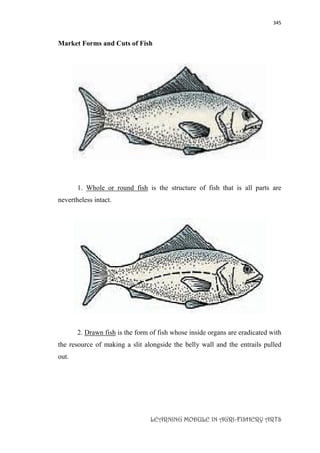
  • 299.
    289 LEARNING MODULE INAGRI-FISHERY ARTS a. Spears, Lances and Arrows - instruments with pointed barbed or barbless blades at the right straight tip which are not removable from the handle and generally thrown by hand or sometimes from a gun or bow-like device like pana, sibat, salapang or tiksal b. Harpoons - pointed instruments with barbed blades detachable from the handle and either thrown by hand or discharged from a gun, panibat, or pamaril.
  • 300.
    290 LEARNING MODULE INAGRI-FISHERY ARTS c. Fishing Rifle is a fishing implement designed to launch a spear at fish or other underwater animals. 5. Barriers and Traps - gears that lead the fish into a situation or enclosure from which it cannot escape or from which the way of escape is not easily located. a. Barricades - complete barriers made of wooden trunks, debris, mud, weeds, banana stalks, rocks or bamboo webbing built across the natural migration path of fish.
  • 301.
    291 LEARNING MODULE INAGRI-FISHERY ARTS b. Fish shelter - a structure made of anchored bunches of twigs and bushes, piles of rocks or poles which become the hiding place for fishes. c. Fish coral - a guiding barrier constructed of bamboo, brush or chicken wire which is set in tidal waters or along natural ways of fishes.
  • 302.
    292 LEARNING MODULE INAGRI-FISHERY ARTS c. Fish pots - basket-like enticing devices usually baited and made of bamboo, chicken wire, rattan and other suitable materials. 6. Fishing with lines - method of line fishing with hooks that follows the principle of offering the fish real or artificial bait which it tries to catch. a. Handlines - long simple lines with one or small series of hooks requiring constant attention  Simple handline or drop line-pangawil or kawil - single line with one or two barbed hooks
  • 303.
    293 LEARNING MODULE INAGRI-FISHERY ARTS  Multiple handline - single with line series of barbed hooks  Jigger - used in catching squids (kawil pangpusit)
  • 304.
    294 LEARNING MODULE INAGRI-FISHERY ARTS  Pole and line - handline attached to a pole (bingwit) used with various kinds baits (baliwasnan or bingwit)  Troll line - handline with a hook at the free end with natural or artificial bait drawn or towed by a fast-moving banca or boat.
  • 305.
    295 LEARNING MODULE INAGRI-FISHERY ARTS 7. Longlines - extremely long lines with a large series of baited hooks either set or drifting that requires only periodical attention at more or less a fixed time intervals. a. Set long lines – are lines anchored or fixed and not free to move with the current.
  • 306.
    296 LEARNING MODULE INAGRI-FISHERY ARTS b. Drift long lines - lines without fixed attachments. 8. Falling Gear - a type of gear that works on the principle of covering the fish with a gear a. Cover pot (salakab)
  • 307.
    297 LEARNING MODULE INAGRI-FISHERY ARTS b. Cover net (panaklob) c. Cast net – a conical net wich when thrown forms a circle covering the fish. 9. Fish Impounding Nets – gear usually made of woven or knitted fibers with mesh to confine the fish
  • 308.
    298 LEARNING MODULE INAGRI-FISHERY ARTS a. Filter nets – a conical bag net without funnel – shaped valves made of sinamay cloth or cotton netting fixed shrimps, crabs, fishes etc. b. Hoop nets – funnel – shaped bag-nets constructed over circular frames that have non-return valves but no wings. Can catch fishes in rivers and places with fast currents by straining the water (bukato na lambat)
  • 309.
    299 LEARNING MODULE INAGRI-FISHERY ARTS c. Fyke nets – winged conical filter nets with a series of circular hoops leading into a closed sac or trap with a small opening that makes exit difficult. (dayakos) d. Pound nets – fixed impounding net supported by stakes or held in place or maintained in form by a combination of floats or buoys and weights and anchors (otoshi-ami)
  • 310.
    300 LEARNING MODULE INAGRI-FISHERY ARTS 10. Scooping nets – net that take fish by submerging a hanging net and swiftly lifting the gear to capture or enclose the fish over it. a. Dip nets (salap or salok) b. Carb lift nets (bintol)
  • 311.
    301 LEARNING MODULE INAGRI-FISHERY ARTS c. Lift net (salambaw) d. Lever net (salambaw)
  • 312.
    302 LEARNING MODULE INAGRI-FISHERY ARTS e. Blanket nets (paduyan) f. Bag net (basin)
  • 313.
    303 LEARNING MODULE INAGRI-FISHERY ARTS g. New Look – a lift net is like a bag net but the handling process is accomplished from a rectangular platform supported by four-corner posts. h. Two Boat or Four Boat Lift Net- lift nets in which the corners are lifted from anchored boats.
  • 314.
    304 LEARNING MODULE INAGRI-FISHERY ARTS i. Push Nets – a small triangular fishing net with a rigid frame that is pushed along the bottom in shallow waters and is used in parts of the southwestern Pacific for taking shrimps and small bottom-dwelling fishes. j. Skimming Nets – lift push nets operated in deeper water from a small banca or raft that use a skimming motion while drifting with the boat. (anod sulong) 11. Drive-in Gear – a gear uses a scare line or other devices to frighten the fish toward the net. The harvest of the fish is affected by the lifting process of the nets.
  • 315.
    305 LEARNING MODULE INAGRI-FISHERY ARTS a. Drive-in-net (kalaskas) b. Muro-ami 12. Dragged Gear – nets which are pulled through the water or near the bottom or even pelagically for an unlimited time
  • 316.
    306 LEARNING MODULE INAGRI-FISHERY ARTS a. Dredges – net used to collect shell fish by raking or scratching action. (kaladkad) b. Trawls – nets in the form of a conical bag with the mouth kept open by various devices and the entire gear is towed behind a moving boat. (galadgad or taksay). I.e, bottom trawl and mid-water or pelagic trawl a. Bottom Trawl
  • 317.
    307 LEARNING MODULE INAGRI-FISHERY ARTS b. Mid-water or pelagic Trawl 13. Seine nets – nets that consist of a bust or bag with very long wings or towing warps. The capture of fish is done by surrounding a certain area of water with school of fish and towing the gear over this area with both ends to a fixed point on the shore or on a vessel a. Beach seine (bayakos or pukod)
  • 318.
    308 LEARNING MODULE INAGRI-FISHERY ARTS b. Lampara or sahid c. Fish coral seine (segni in Bisaya)
  • 319.
    309 LEARNING MODULE INAGRI-FISHERY ARTS d. Reef seine - can operate on reefs or over rough grounds. 14. Surrounding Nets - fishing devices made of long walls of webbings; capture of fish is by surrounding the fish not only from the side but also from beneath. a. Round haul seine (sapyaw)
  • 320.
    310 LEARNING MODULE INAGRI-FISHERY ARTS b. Purse seine (pangulong) c. Ring net (kubkob)
  • 321.
    311 LEARNING MODULE INAGRI-FISHERY ARTS d. Scoop nets (gayad) e. Stop seine (pangulong)
  • 322.
    312 LEARNING MODULE INAGRI-FISHERY ARTS 15. Gill Nets - simple walled curtain-like nets set vertically in water. a. Set gill nets - are nets that anchored or fixed – largarete patuloy, palagiang paningahan. b. Drift gill nets - gill nets that are set free from the bottom and free to drift with the current (panti)
  • 323.
    313 LEARNING MODULE INAGRI-FISHERY ARTS c. Encircling gill net - nets spread out in a circle and gilling process is hastened by frightening the fish with various devices mostly by noise. (bating or halang) d. Trammed nets - the capture is by entangling the fish itself in the pockets or spaces created by the nets while the fish is try to escape. (transmalyo)
  • 324.
    314 LEARNING MODULE INAGRI-FISHERY ARTS 16. Traps For Jumping or Flying Fishes - a method of catching fish that it jumps, falls back into a horizontal floating or suspended net, raft trap, or even in an empty boat or box (pangsiriw in Iloko).
  • 325.
    315 LEARNING MODULE INAGRI-FISHERY ARTS Activity TIME TO THINK! I. Application Direction: Follow the instructions and answer the questions below. Part 1- Instruction: Visit a fishing village. Observe the different techniques and gear employed in catching fishes and other aquatic resources 1. Why is there a need to get acquainted with the different fishing gear used in the Philippines? 2. How are these fishing gear classified? 3. If you were given a chance to go with a fisherman to fish what would you do to have more catch and which of the gear would you recommend? Why? 4. Do you think the kind of gear and the method of operation have a role in a successful fishing operation? Why? 3 4 5 Accuracy The answers are totally inaccurate to the questions. The answers are mostly accurate to the questions. The answers are all accurate to the questions. Correctness The answers are totally incorrect to the questions. The answers are mostly correct to the questions. The answers are all correct to the questions.
  • 326.
    316 LEARNING MODULE INAGRI-FISHERY ARTS Part 2- Instruction: Gather pictures regarding fishing gear and their operations. Research and analyze by means of the internet additional information on fishing gear classifications and operations. Present your work to the class. Analyze how effective this method is for capturing or gathering fishes. HANDLINE MAKING II. Application Direction: Bring the materials and do the procedures below. You may now start making a simple hand line. The materials needed are:  Bamboo pole – 3 to 5 meters long, 2 inches in diameter and tapered at one end  Synthetic line – no. 8, 3 ½ meters long  Terminal tackle – a term applied to things like hooks and baits that are attached to the end of the fishing line. Tools needed:  Bolo  Spoke shave  Hammer After preparing the needed materials and hooks, follow the procedures below: 1. Safety first. Always work with care and safety. 2. Thread one end of the line through the hole of the hook and tie into two knots to secure the hook. 3. Tie the other end of the line twice around the tapered end of the pole just beside the internodes to keep this from slipping. 4. Tie with a square knot. 5. Place the bait on the hook.
  • 327.
    317 LEARNING MODULE INAGRI-FISHERY ARTS Activity Direction: Investigate/research and make a journal on the safety measures in fish capture in the following workplaces: 1. Inlands/Ponds 2. Lakes/Bays 3. Seas/Ocean
  • 328.
    318 LEARNING MODULE INAGRI-FISHERY ARTS LESSON 2: COMMON COMMERCIAL SPECIES OF AQUATIC RESOURCES The main purpose of capture fisheries is to provide and sustain seafood in the highly demanding market. In this lesson, it tackles about the common commercial species that being patronize of today’s society. It contains the pictures and common, local, scientific names to determine the usually known aquatic resources. The contents are from the trusted references in the Philippines and around the globe (such as Bureau of Fish and Aquatic Resources the Food and Agriculture of the United Nations) for its reliable and most accurate information.
  • 329.
    319 LEARNING MODULE INAGRI-FISHERY ARTS COMMON COMMERCIAL FISHES Local Name: Bangus Common Name: Milkfish Scientific Name: Chanos chanos Local Name: Tilapia Common Name: Tilapia Scientific Name: Oreochromis spp.
  • 330.
    320 LEARNING MODULE INAGRI-FISHERY ARTS Local Name: Tulingan Common Name: Mackerel Tuna Scientific Name: Euthynnus affinis Local Name: Hito Common Name: Catfish Scientific Name: Clarias batrachus
  • 331.
    321 LEARNING MODULE INAGRI-FISHERY ARTS Local Name: Hito Common Name: Catfish Scientific Name: Clarias batrachus Local Name: Dilis Common Name: Anchovy Scientific Name: Stolephorus commersonii
  • 332.
    322 LEARNING MODULE INAGRI-FISHERY ARTS Local Name: Tamban Common Name: Herrings Scientific Name: Clupea Local Name: Galunggong Common Name: Big-bodied Round Scad Scientific Name: Decapterus macrosoma
  • 333.
    323 LEARNING MODULE INAGRI-FISHERY ARTS Local Name: Albacora Common Name: Yellowfin Tuna Scientific Name: Thnnus albacares Local Name: Talakitok Common Name: Bigeye Trevally Scientific Name: Caranx sexfasciatus
  • 334.
    324 LEARNING MODULE INAGRI-FISHERY ARTS Local Name: Tambakol Common Name: Skipjack Tuna Scientific Name: Katsuwonus pelamis Local Name: Hiwas Common Name: Moonfish Scientific Name: Mene maculate
  • 335.
    325 LEARNING MODULE INAGRI-FISHERY ARTS Local Name: Lapu-lapu Common Name: Orange-spotted Grouper Scientific Name: Epinephelus coioides Local Name: Matangbaka Common Name: Bigeye Scad Scientific Name: Selar crumennopthalmus
  • 336.
    326 LEARNING MODULE INAGRI-FISHERY ARTS Local Name: Maya-maya Common Name: Crimson Snapper Scientific Name: Lutjanus erythropterus Local Name: Sapsap Common Name: Slip Mouth Scientific Name: Leiognathus equulus
  • 337.
    327 LEARNING MODULE INAGRI-FISHERY ARTS Local Name: Dalagang Bukid Common Name: Redbelly Yellow Tail Fusilier Scientific Name: Caesio cunning Local Name: Dumpilas Common Name: Hamilton’s Thryssa Scientific Name: Thryssa hamiltonii
  • 338.
    328 LEARNING MODULE INAGRI-FISHERY ARTS Local Name: Hasa-hasa Common Name: Short-bodied Mackerel Scientific Name: Local Name: Salmon Common Name: Hawaiian Salmon/Rainbow Runner Scientific Name: Elagatis bipinnulata
  • 339.
    329 LEARNING MODULE INAGRI-FISHERY ARTS COMMON COMMERCIAL CRUSTACEAN Local Name: Alimango Common Name: Swamp Crab Scientific Name: Scylla serrata Local Name: Alimasag Common Name: Fresh Crab Scientific Name: Brachyura
  • 340.
    330 LEARNING MODULE INAGRI-FISHERY ARTS Local Name: Sugpo Common Name: Giant Tiger Prawn Scientific Name: Penaeus monodon
  • 341.
    331 LEARNING MODULE INAGRI-FISHERY ARTS Activity SCIENTIFIC NAMES IDENTIFIER Direction: Write the scientific names of the following aquatic species’ local/common name. 1. Bangus 2. Tilapia 3. Galunggong 4. Dilis 5. Tamban 6. Crimson Snapper 7. Orange-spotted Grouper 8. Albacora 9. Swamp Crap 10.Giant Tiger Prawn
  • 342.
    332 LEARNING MODULE INAGRI-FISHERY ARTS Post-TEST Test I. Multiple choice Direction: Write the letter of the correct answer before the number. 1. It is the fishing method that is composed of simplest forms of gathering aquatic resources. What is it? e. Active Gear f. Passive Gear g. Alternative Gear h. Basic Gear 2. This grappling instrument is locally known as panilo. What is the common name for panilo? e. Traps f. Snares g. Dredges h. Hidden Holes 3. Which gear is used by man to catch fish from distance by throwing sharp objects? a. Throwing Gear b. Wounding Gear c. Distance Gear d. Scratching Gear 4. This kind of gear is leading the fish into a enclosure from which it cannot escape. What is this gear? a. Dredges b. Traps c. Snares d. Net Enclosure
  • 343.
    333 LEARNING MODULE INAGRI-FISHERY ARTS 5. What method of fishing is with hooks and baits? a. Fishing with Nylon b. Fishing with Line c. Competitive Fishing d. Traditional Fishing 6. ______ extremely long line with a large series of baited hooks. a. Long Lines b. Long Nylons c. Comprehensive Lines d. Comprehensive Nylons 7. It is a type of gear that works on the principle of covering. What type of gear is it? a. Falling Gear b. Covering Gear c. Traping Gear d. Snaring Gear 8. This gear is usually made of woven or knitted fibers with mesh to confine fish. What is this gear? a. Fish Net b. Fish Filter c. Fish Impounding Net d. Fish Capturing Net 9. It is the net that take fish by submerging a hanging net and swiftly lifting the gear to capture or enclose the fish. What is this gear? a. Pound Nets b. Fyke Nets c. Scooping Nets d. Hanging Nets
  • 344.
    334 LEARNING MODULE INAGRI-FISHERY ARTS 10. A gear uses a scare line or other devices to frighten fish toward the net. What is this gear? a. Drive-under Gear b. Drive-on Gear c. Drive-out Gear d. Drive-in Gear 11.It is a net which are pulled through the water or wear bottom or even pelagically for an unlimited time. What is this gear? a. Pulled Gear b. Flowed Gear c. Drived Gear d. Dragged Gear 12. The process of fish capture is done by surrounding a certain area of water with school of fish and towing the gear over this area with both ends to a fixed point on the shore or on a vessel. In what kind of gear belongs to this? a. Broad Nets b. Gill Nets c. Surrounding Nets d. Seine Nets 13.It is a simple walled curtain-like nets which are set vertically in water. What is this gear? a. Broad Nets b. Surrounding Nets c. Gill Nets d. Seine Nets 14.What is the common name for Clarias batrachus? a. Tulingan b. Catfish c. Anchovy d. Big-eyed Scad
  • 345.
    335 LEARNING MODULE INAGRI-FISHERY ARTS 15.What is the common name for Selar crumenopthalmus? a. Tulingan b. Catfish c. Anchovy d. Big-eyed Scad 16.What is the common name for Engraulidae? a. Tulingan b. Catfish c. Anchovy d. Big-eyed Scad 17.What is the common name for Euthynnus affinis? a. Tulingan b. Catfish c. Anchovy d. Big-eyed Scad 18.What is the local name for Decapterus macrosoma? a. Tuna b. Galunggong c. Tilapia d. Bangus 19.What is the local name for Scylla serrata? a. Alimango b. Alimasag c. Hipon d. Sugpo 20.What is the scientific name for Bangus? a. Oreochromis niloticus b. Chanos chanos c. Clarias batrachus d. Scatophagus argus
  • 346.
    336 LEARNING MODULE INAGRI-FISHERY ARTS FISH Preservation take the challenge! At the end of this chapter, the students are expected to: Lesson 1.1: Determine the Fish Preservation Terminologies Lesson 1.2: Identify the Body, Cuts and Market Forms of Fish Lesson 2.1: Understand the Fish Preservation Principles Lesson 2.2: Differentiate the Characteristics of Fresh from Stale Fish Lesson 2.3: Enumerate the Agents of Spoilage Lesson 3.1: Identify the Types of Fish Curing with Principles CHAPTER 9
  • 347.
    337 LEARNING MODULE INAGRI-FISHERY ARTS Lesson 3.2: Perform the Methods of Cutting Fish Lesson 3.3: Familiarize the Tools and Equipment PRE-TEST Test I. Multiple choice Direction: Write the letter of the correct answer before the number. 1. It is any operation that can prevent or inhibit the natural process of breakdown or decomposition taking place in the fish. a. Fish Restoration b. Fish Curing c. Fish Preservation d. Fish Salting 2. It refers to a mixture of salt and water. a. Solution b. Dilution c. Brine d. Salinity 3. What is the stiffening of the muscles or tissues of the fish several hours after death? a. Anabolism b. Catabolism c. Rigor Mortis d. Putrefaction
  • 348.
    338 LEARNING MODULE INAGRI-FISHERY ARTS 4. This is the form of fish whose scales, internal organs, fins, head and tail are removed. This statement is referring to? a. Dressed Fish b. Eviscerated Fish c. Viscera d. Market Fish 5. The ribbon-liked species of fish body forms is called _______. a. Anguilliform b. Taeniform c. Globiform d. Ribboniform 6. It is the breakdown of tissues caused by enzyme. a. Rigor Mortis b. Putrefaction c. Autolysis d. Decaying 7. The eyes of fresh fish is bright, bulging pupil, velvet black corneas is transparent. This statement is _____. a. Assumption b. Hypothesis c. Fallacy d. Factual 8. Enzyme is responsible in the breakdown of plant and animal compound materials after death. This statement is _____. a. Factual b. Fallacy c. Hypothesis d. Assumption
  • 349.
    339 LEARNING MODULE INAGRI-FISHERY ARTS 9. Microorganisms are the proteins that act as biochemical catalyst in the other living organisms. This statement is _____. a. Assumption b. Hypothesis c. Fallacy d. Factual 10. Bacillus is the term for rod-shaped bacteria. This statement is ____. a. Factual b. Fallacy c. Hypothesis d. Assumption 11. Cold smoking is the method of smoking in which the fish are hung at some distance from a low smoldering fire and cured at temperatures ranging from 90˚F to 110˚F. This statement is ______. a. Assumption b. Hypothesis c. Fallacy d. Factual 12. It includes all the methods of fish preservation except refrigeration and canning. This statement is _______. a. Drying and Dehydration b. Fish Pickling c. Salting d. Fish Curing 13. What are the devices used to measure liquids and solid ingredients? a. Measuring Containers b. Measuring Beaks c. Measuring Spoon and Cups d. Measuring Vials
  • 350.
    340 LEARNING MODULE INAGRI-FISHERY ARTS 14. What are containers used for washing and for the preparation of brine? a. Basins b. Fish Preservation Bowls c. Styrofoam Containers d. Washing Containers 15. It refers to a machine or instrument that is used to close the open ends of tin cans. a. Tin Can Presser b. Can Sealer c. Can Cover d. Can Pressure Closer
  • 351.
    341 LEARNING MODULE INAGRI-FISHERY ARTS DEFINITION OF TERMS Aerobic is a microorganism that requires free oxygen in order to live. Colander is a receptacle for draining purposes. Enzymes are the proteins that act as biochemical catalysts in living organisms. Eviscerate is the removal of internal organs of fish. Impure Salt is a kind of salt that is firm and rusty in color. Smoking is a method of preserving fish by the application of smoke and other interrelated processes such as salting, drying and heat treatment. Splitted is the form of fish that is precluded open alongside the dorsal side from head to tail. Taeniform is the ribbon like body shape. Thermophilic is a microorganism that thrives at high temperature
  • 352.
    342 LEARNING MODULE INAGRI-FISHERY ARTS LESSON 1: TERMINOLOGIES AND FORMS OF FISH There are methods and ways of controlling and delaying the spoilage of fish and other fish products. Knowledge of fish processing will help you put up your business that can improve the standard of living of your family. Fish Preservation - is any operation that can prevent or inhibit the natural process of breakdown or decomposition taking place in the fish. It is known as fish processing.
  • 353.
    343 LEARNING MODULE INAGRI-FISHERY ARTS Terminologies in Fish Preservation 1. Autolysis - softening of tissue due to digestive action of enzyme 2. Brine - mixture of salt and water 3. Can sealer - a machine used to close the open end of tin can 4. Canning - method of preparing food in a hermetically sealed container by the application of heat 5. Dehydration - removal of moisture under controlled conditions 6. Drying - method of preservation by lowering the moisture content through the application of natural or artificial heat 7. Eviscerate - removal of internal organs of fish 8. Exhausting - elimination of air inside the can 9. Gibbing - process of removing internal organs by cutting a triangular cut at the throat of the fish 10. Icing - the application of ice to lower the temperature of the fish
  • 354.
    344 LEARNING MODULE INAGRI-FISHERY ARTS 11. pH - refers to hydrogen-ion concentration 12. Pickling - the process of curing of fish in vinegar and spices 13. Pressure Cooker- a closed metal fitted by a pressure gauge, control valve and pet cock 14. Pressure Gauge - a device used to measure and maintain pressure during processing 15. Refrigeration - method of preservation by lowering the temperature to point wherein bacterial growth is inhibited 16.Rigor Mortis - stiffening of the muscles or tissues of the fish several hours after death 17.Salting - method of preserving fish with salt as its main preservative 18.Smoking - process of preserving fish with the application of smoke and other interrelated processes such as salting, drying, and heating treatments 19.Vacuum - empty space without air 20.Viscera - internal organ, entrails of fish
  • 355.
    345 LEARNING MODULE INAGRI-FISHERY ARTS Market Forms and Cuts of Fish 1. Whole or round fish is the structure of fish that is all parts are nevertheless intact. 2. Drawn fish is the form of fish whose inside organs are eradicated with the resource of making a slit alongside the belly wall and the entrails pulled out.
  • 356.
    346 LEARNING MODULE INAGRI-FISHERY ARTS 3. Dressed Fish is the form of fish whose scales, inner organs, fins, head and tail are removed. 4. Steaks are cross sections of a cleaned fish which are around 1-2 cm thick.
  • 357.
    347 LEARNING MODULE INAGRI-FISHERY ARTS 5. Splitted is the form of fish that is precluded open alongside the dorsal side from head to tail. 6. Live fish is the form of fish that is furnished alive.
  • 358.
    348 LEARNING MODULE INAGRI-FISHERY ARTS 7. Fillets are the fleshy facets of the fish which are separated from the backbone and the ribs. a. Butterfly Fillet is the fillets that are joined mutually on the ventral sides through performance of the underside skin. b. Single Fillet is the fillet form whose side of a fish cut away from the backbone.
  • 359.
    349 LEARNING MODULE INAGRI-FISHERY ARTS 8. Sticks are the cuts kinds fillets or steaks. They are typically from fish that has been minced and shaped, breaded and frozen. Common Body Forms of Fish 1. Fusiform is the torpedo like physique shape. Ex: galunggong
  • 360.
    350 LEARNING MODULE INAGRI-FISHERY ARTS 2. Compressiform is the flat and compress laterally. Ex: Slipmouth 3. Depressiform is the depressed dorsal vertically. Ex: Stringray
  • 361.
    351 LEARNING MODULE INAGRI-FISHERY ARTS 4. Taeniform is the ribbon like body shape Ex: hairtail 5. Anguilliform is the serpentine like physique shape. Ex: Eel
  • 362.
    352 LEARNING MODULE INAGRI-FISHERY ARTS 6. Globiform is the round and globular like physique shape. Ex Puffer fish
  • 363.
    353 LEARNING MODULE INAGRI-FISHERY ARTS Activity TEST YOUR FISH PRESERVATION VOCABULARY I. Identification. Identify the following given statements. 1. It is the stiffening of the muscles or tissues of the fish several hours after death. 2. It is the removal of internal organs of fish. 3. It is the mixture of salt and water. 4. It is the process of curing of fish in vinegar and spices. 5. It is a method of preservation by lowering the moisture content through the application of natural or artificial heat 6. It is a market forms and cuts of fish whose internal organs are removed by making a slit along the belly wall and the entrails pulled out. 7. It is a market forms and cuts of fish that is cut open along the dorsal side from head to tail. 8. It is a market forms and cuts from fillets or steaks. They are usually from fish that has been minced and shaped, breaded and frozen. 9. It is a kind of fillets that are joined together on the ventral sides by the underside skin. 10.It is a market form and cuts of fish that are cross sections of a cleaned fish which are around 1-2 cm thick. 11.It is a body form of fish that are torpedo-shaped like. 12.It is a body form of fish that are flat and compressed laterally. 13.It is a body form of fish that are serpentine-shaped like. 14.It is a body form of fish that are ribbon-shaped like. 15.It is a body form of fish that are short, round and globular body.
  • 364.
    354 LEARNING MODULE INAGRI-FISHERY ARTS LESSON 2: FISH PRESERVATION PRINCIPLES AND AGENTS OF SPOILAGE Principles of Fish Preservation 1. Prevent or delay microbial decomposition of fish 2. Prevent or delay self-decomposition. 3. Prevent other causes of spoilage of fish like physical damage Changes in Fish After Death 1. Changes in Appearance are the color starts to fade until it becomes dull as spoilage progresses. 2. Rigor mortis is characterized by the stiffening of the muscle tissue. This state lasts only for a few minutes in some fish to several hours in others. The fish in this state is considered fresh.
  • 365.
    355 LEARNING MODULE INAGRI-FISHERY ARTS 3. Autolysis is the breakdown of tissues caused by enzymes. Since it softens the tissue, it proves the activity of microorganisms. 4. Putrefaction is the state when the components of the flesh are assimilable forms. It is accompanied by a foul odor, which is the result of the breakdown of protein. The fish at this stage is spoiled and undesirable. Characteristics of Fresh and Stale Fish Fresh Fish Stale Fish Eyes Bright, bulging pupils velvet, black corneas transparent Dull, wrinkled, sunken pupils, dull black corneas opaque Gills Bright red, covered with clear slime, fresh odor under gill cover Dull brown or gray, slime cloudy, odor under gill cover sour and offensive Flesh Firm, stiff body; impression made by fingers do not remain Soft and flabby; impression made by fingers remain Belly walls Intact Often ruptured, viscera protruding Muscle Tissue White Pinkish, especially around backbone Vent Pink, not protruding Pale brown protruding Odor Fresh, fishy odor Stale, sour or putrid Color Bright Faded and dull
  • 366.
    356 LEARNING MODULE INAGRI-FISHERY ARTS Fresh Fish Stale Fish
  • 367.
    357 LEARNING MODULE INAGRI-FISHERY ARTS Agents of Spoilage 1. Microorganisms Three Main Groups of Microorganism a. Bacteria - responsible in the breakdown of plant and animal material and the possible the return of simple inorganic compounds to the soil. The result of this breakdown is spoilage, fermentation and decay. Since fish is an organic matter, it spoils easily. As soon as it dies, bacteria act on it. b. Molds - fuzzy or cottony organisms that grow on the surface of the food. They are responsible for the white, orange, black, green or blue green colonies on the surface of the food.
  • 368.
    358 LEARNING MODULE INAGRI-FISHERY ARTS c. Yeasts - whitish to yellowish colonies on the surface of the food. They appear as a film on the surface of the liquid or as sediments at the bottom. 2. Enzymes - proteins that act as biochemical catalysts in living organisms. They are normally present along the digestive tract and help in the breakdown of food into assimilable forms.
  • 369.
    359 LEARNING MODULE INAGRI-FISHERY ARTS Classification of Bacteria According to Shape 1. Coccus - round 2. Bacillus - rod-shaped 3. Spirillus - spiral 4. Staphylococcus - grapelike 5. Streptococcus - chainlike Classification of Bacteria According to Their Temperature Requirement 1. Thermophilic - thrive at high temperature (heat loving) 2. Psychrophilic - thrive best at low temperature (cold-loving organisms) 3. Mesophilic - those that thrive between low and high temperatures Classification of Bacteria According to Their Oxygen Requirement 1. Aerobic - requires free oxygen in order to live 2. Anaerobic - lives in the absence of free oxygen 3. Facultative - grows with or without free oxygen Types of Enzymes 1. Lipolytic - enzyme that acts on fats 2. Proteolytic - enzyme that acts on proteins 3. Amylolitic - enzyme that acts on carbohydrates
  • 370.
    360 LEARNING MODULE INAGRI-FISHERY ARTS Activity I. True or False. Write True if the characteristics of fish in the statement is fresh and False if it is otherwise. 1. The eyes of fish are dull, wrinkled, sunken pupils, dull black and corneas opaque. 2. The gills of fish are bright red, covered with clear slime. 3. The flesh of the fish is soft and flabby. 4. The belly walls of the fish are viscera protruding. 5. The muscle tissues of the fish are pinkish. 6. The vent of the fish is pink. 7. The odor of the fish is putrid. 8. The color of the fish is bright. II. Enumeration 1. Two agents of spoilage 2. Three main groups of microorganism 3. Classification of bacteria according to shape 4. Classification of bacteria according to temperature requirement 5. Classification of bacteria according to oxygen requirement 6. Types of enzymes III. Essay. 1. How important is the fish preservation principles to ensure and secure the quality of the fish products? Why do you say so? 2. Why do you need to know the characteristics of fresh and stale fish? 3. Why do you need to know and understand the agents of spoilage?
  • 371.
    361 LEARNING MODULE INAGRI-FISHERY ARTS LESSON 3: METHODS, TOOLS AND EQUIPMENTS METHODS OF FISH PRESERVATION 1. Fish Curing It includes all the methods of fish preservation except refrigeration and canning. It is the process of preservation by the use of preservatives and other chemicals for the purpose of keeping fish and other fishery products fresh for future use. Types of Fish Curing
  • 372.
    362 LEARNING MODULE INAGRI-FISHERY ARTS A. Salting is the application of salt to product. It is considered the basis of all methods of fish preservation Salt is the colorless or white crystalline compound known chemically as sodium chloride (NaCl) occurring abundantly in nature, both in solid form and in solution. Factors Affecting Salting a. Composition of Salt
  • 373.
    363 LEARNING MODULE INAGRI-FISHERY ARTS  Pure Salt is the better quality salt. It is soft and flabby and has yellowish white color.  Impure Salt is firm and rusty in color. b. Temperature Its condition makes the certain object require enough quantity and quality of efforts to produce the favourable state. High temperature makes salt dissolve faster, permitting a rapid penetration of the product with salt. c. Methods of Salting  Kench Salting  Dry Salting to Make Brine  Brine Salting  Fermenting d. Methods of Cleaning  Whole Fish  Splitted Fish  Gutted Fish
  • 374.
    364 LEARNING MODULE INAGRI-FISHERY ARTS e. Size of the Fish It defines how required salt is needed and depends on how the speed of salting occurs. The small sized of fish is salted faster than larger size of fish f. Storage of Fish B. Drying and Dehydration is the lowering of water content of the product to a degree where bacteria cannot grow and reproduce with the aid of heat.  Drying known as natural drying used  Dehydration is of chemical devices to provide artificial heat for drying
  • 375.
    365 LEARNING MODULE INAGRI-FISHERY ARTS Factors Affecting Drying a. Humidity of air b. Velocity of the wind c. Intensity of the sunshine  Humidity – amount of moisture in air  Velocity – speed of air/wind Factors Affecting Dehydration a. Kind of drier used b. Temperature range c. Storage of finished product d. Relative humidity The finished products of drying and dehydration are commonly called daing or tuyo. C. Smoking is a method of preserving fish by the application of smoke and other interrelated processes such as salting, drying and heat treatment.
  • 376.
    366 LEARNING MODULE INAGRI-FISHERY ARTS Smokehouse - an airtight container where smoke can be introduced Types of Smoking  Hot Smoking or barbecuing - a slow type of broiling that places the product in close proximity to the fire. The food is cooked and smoked in temperature ranging 150◦F to 190◦F.  Cold smoking - method of smoking in which the fish are hung at some distance from a low smouldering fire and cured at temperatures ranging from 90◦F to 110◦F. Factors Affecting Smoking  Kind of Fish - fat fish are preferable to lean ones. Scaly fish are usually used to obtain an attractive appearance of the finished product  Condition of raw materials  Kind of smoke-producing materials a. Hard wood - good quality of smoke is produced b. Soft wood - thin smoke is produced; thus, a low grade of smoked product  Length of smoke curing
  • 377.
    367 LEARNING MODULE INAGRI-FISHERY ARTS C. Pickling is the preservation of food by the use of vinegar and other spices. Pickling of fish as a method of preservation is not commercially done in the Philippines because the preservative action of vinegar is short. Pickling has some digestive action in fish which renders it softer and pastier. Pickled fish is usually used as appetizer so preservation by this method is recommended for use at home. 2. Canning or Bottling is the application of heat to food in a hermetically sealed container at a temperature and for a period of time sufficient to destroy microorganisms and to render any bacterial cell for a definite period of time.
  • 378.
    368 LEARNING MODULE INAGRI-FISHERY ARTS Basic Canning Equipment  Can sealer is a machine or instrument that is used to close the open ends of tin cans.  Pressure cooker is a modern household device used for processing food for a definite period of time and pressure.
  • 379.
    369 LEARNING MODULE INAGRI-FISHERY ARTS  Tin cans and glass jars are containers locally available for canning purposes only.  Measuring spoons & cups are devices used to measure liquids and solids ingredients.
  • 380.
    370 LEARNING MODULE INAGRI-FISHERY ARTS  Colander is a receptacle for draining purposes.  Basins are containers used for washing and for the preparation of brine.
  • 381.
    371 LEARNING MODULE INAGRI-FISHERY ARTS  Thermometer is a device used to check temperatures of cooking, drying and cold storage.  A clock is an instrument used to determine the length of processing, salting, steaming or frying
  • 382.
    372 LEARNING MODULE INAGRI-FISHERY ARTS  Knives are tools used in cleaning, cutting fish into accurate sizes  Cutting board is a durable board used primarily as guide so that exact sizes of fish will fit into the different containers.
  • 383.
    373 LEARNING MODULE INAGRI-FISHERY ARTS Activity I. Identification 1. It is a type of fish curing that lowering of water content of the product a degree where bacteria cannot grow and reproduce. 2. It is a type of fish curing that applies of salt to the fish. 3. It is a type of fish curing by the application of smoke and other interrelated processes such as salting, drying and heat treatment. 4. It is a type of fish curing that the preservation of food by the use of vinegar and other spices. 5. It is a machine or instrument that is used to close the open end of tin cans. 6. It is containers locally available for canning purposes only. 7. It is a receptacle for draining purposes. 8. It is a device used to check temperatures of cooking, drying and cold storage. 9. It is a modern household device used for processing food for a definite period of time and pressure. 10.It is an instrument used to determine the length of processing, salting, steaming or frying. II. Application 1. Research a proper tutorial video on how to perform all methods of fish cutting. 2. Bring and prepare all tools and materials needed to perform fish cutting. (fish, sharp knife, cutting board, gloves, apron, hairnet, facemask) 3. Make all market forms and cuts of fish properly while presenting it to the class. 4. Clean your working area.
  • 384.
    374 LEARNING MODULE INAGRI-FISHERY ARTS Assessment: The work of the students will be evaluated by your teacher using the given criteria. The students must have at least attained 75 percent to pass the lesson. 1. Accuracy 60% 2. Presentation 20% 3. Neatness 10 % 4. Safety 10%
  • 385.
    375 LEARNING MODULE INAGRI-FISHERY ARTS Post-TEST Test I. Multiple choice Direction: Write the letter of the correct answer before the number. 1. It is any operation that can prevent or inhibit the natural process of breakdown or decomposition taking place in the fish. a. Fish Restoration b. Fish Curing c. Fish Preservation d. Fish Salting 2. It refers to a mixture of salt and water. a. Solution b. Dilution c. Brine d. Salinity 3. What is the stiffening of the muscles or tissues of the fish several hours after death? a. Anabolism b. Catabolism c. Rigor Mortis d. Putrefaction 4. This is the form of fish whose scales, internal organs, fins, head and tail are removed. This statement is referring to? a. Dressed Fish b. Eviscerated Fish c. Viscera d. Market Fish
  • 386.
    376 LEARNING MODULE INAGRI-FISHERY ARTS 5. The ribbon-liked species of fish body forms is called _______. a. Anguilliform b. Taeniform c. Globiform d. Ribboniform 6. It is the breakdown of tissues caused by enzyme. a. Rigor Mortis b. Putrefaction c. Autolysis d. Decaying 7. The eyes of fresh fish is bright, bulging pupil, velvet black corneas is transparent. This statement is _____. a. Assumption b. Hypothesis c. Fallacy d. Factual 8. Enzyme is responsible in the breakdown of plant and animal compound materials after death. This statement is _____. a. Factual b. Fallacy c. Hypothesis d. Assumption 9. Microorganisms are the proteins that act as biochemical catalyst in the other living organisms. This statement is _____. a. Assumption b. Hypothesis c. Fallacy d. Factual
  • 387.
    377 LEARNING MODULE INAGRI-FISHERY ARTS 10. Bacillus is the term for rod-shaped bacteria. This statement is ____. a. Factual b. Fallacy c. Hypothesis d. Assumption 11. Cold smoking is the method of smoking in which the fish are hung at some distance from a low smoldering fire and cured at temperatures ranging from 90˚F to 110˚F. This statement is ______. a. Assumption b. Hypothesis c. Fallacy d. Factual 12. It includes all the methods of fish preservation except refrigeration and canning. This statement is _______. a. Drying and Dehydration b. Fish Pickling c. Salting d. Fish Curing 13. What are the devices used to measure liquids and solid ingredients? a. Measuring Containers b. Measuring Beaks c. Measuring Spoon and Cups d. Measuring Vials 14. What are containers used for washing and for the preparation of brine? a. Basins b. Fish Preservation Bowls c. Styrofoam Containers d. Washing Containers
  • 388.
    378 LEARNING MODULE INAGRI-FISHERY ARTS 15. It refers to a machine or instrument that is used to close the open ends of tin cans. a. Tin Can Presser b. Can Sealer c. Can Cover d. Can Pressure Closer
  • 389.
    379 LEARNING MODULE INAGRI-FISHERY ARTS
  • 390.
    380 LEARNING MODULE INAGRI-FISHERY ARTS answer keys CHAPTER 1 PRE-TEST Test I. Multiple Choice 1) C. Agriculture 2) C. Olericulture 3) C. Perennial Crops 4) C. Poultry Farming 5) B. Agricultural Economics 6) D. Agricultural Engineering 7) C. Pomology 8) D. Horticulture 9) A. Nomadic Pastoralism 10) C. Agriculture Test II. True or False 1) False 2) False 3) True 4) True 5) False CHAPTER 1 POST TEST Test I. Identification 1) Agriculture 2) Crop Production or Agronomy 3) Apiculture 4) Poultry Farming 5) Agricultural Economics 6) Agricultural Engineering 7) Pomology 8) Olericulture 9) Nomadic Pastoralism 10) Swine Farming Test II. Modified True or False 1) True 2) False, Industrial Crops 3) False, Cross Pollinated Crops 4) False, Fiber Crops 5) False, Asexual Crops 6) False, Oil Crops 7) True 8) True 9) False, Lianas 10)False, Biennial Test III. Fill in the blank 1) Oryza sativa Linn 2) Zea mays L. 3) Niyog 4) Saccharum officinarum L. 5) Saging 6) Pinya 7) Coffea sp. 8) Mangga 9) Nicotiana tabacum 10)Archis hypogaea Linn. 11)Munggo 12)Kamoteng Kahoy 13)Sweet Potato 14)Lycopersicon esculentum 15)Bawang
  • 391.
    381 LEARNING MODULE INAGRI-FISHERY ARTS Test IV. Identification 1) Leaf 2) Lamina 3) Xylem 4) Phloem 5) Transpiration 6) Androecium 7) Gynoecium 8) Root Cap 9) Fruit 10)Venus Fly Trap Test V. Essay The essay is to be assessed and graded by teachers’ criteria. CHAPTER 2 PRE-TEST Test I. Multiple choice 1) C. Grab Hoe 2) B. Bolo 3) B. Pruning Shear 4) D. All of the Above 5) C. Rake 6) B. Shovel 7) C. Wheel Barrow 8) D. Native Harrow 9) A. Disc Harrow 10)B. Knife 11)D. Pick-Mattock 12)B. Hand Tools 13)D. Rake 14)C. Farm Implements 15)C. Farm Equipments Test II. True or False 1) F 2) T 3) T 4) F 5) T CHAPTER 2 POST-TEST Test I. Identification 1) Bolo 2) Grab-Hoe 3) Knife 4) Sprayer 5) Water Pail 6) Sickle 7) Rotavator 8) Axe 9) Pruning Shear 10)Hand Fork Test II. Enumeration 1) - Bolo - Crowbar - Pick-mattock - Grab-hoe - Spade - Shovel - Rake - Light hoe - Hand trowel - Hand cultivator - Hand fork - Pruning shears - Axe - Knife - Sprinkler - Water pails - Sprayers
  • 392.
    382 LEARNING MODULE INAGRI-FISHERY ARTS - Wheel barrow - Sickle 2) - Hand Tractor - Four Wheel Tractor - Water Pump - Thresher - Corn Dehusker - Rice Harvester - Grass Cutter - Rice Seeder - Miller 3) - Plow - Harrow - Rotavator Test III. Matching Type 1) G. Plowing Using Animal 2) E. Clearing of the Land Using Hoe 3) J. Plowing Using Tractor 4) H. Transplanting Of Seedlings 5) F. Harrowing Using Hand Tractor 6) D. Pulling Of Seedlings 7) B. Fertilizer 8) K. Seeds 9) A. Pest Control 10)C. Fertilizer Application Test IV. Essay The essay is to be assessed and graded by teachers’ criteria. CHAPTER 3 PRE AND POST TEST Test I. Calculation A. 1) 100cm 2) 5m 3) 8,000m 4) 100,000cm 5) 3km B. 1) 250,000m2 2) 400,000m2 3) 300,000m2 4) 560,000m2 5) 720,000m2 C. 1) 9 trees were replaced 2) 6 hectares are harvested 3) 80 farmers are present 4) P125 increase in farmers family 5) 45kg of seeds are dormant CHAPTER 4 PRE AND POST TEST Test I: Multiple Choice 1) C. Row Planting 2) C. Multiple Row Planting 3) D. Direct Seeding 4) A. Spatial Arrangement 5) D. Topographic Data 6) D. Water Capacity 7) D. Soil and Crop Characteristics 8) D. Surface Irrigation 9) A. Border Irrigation
  • 393.
    383 LEARNING MODULE INAGRI-FISHERY ARTS 10)D. Strip Width 11)B. Strip Slope 12)D. Selection of the Advance Stream 13)C. Construction of Levees 14)A. Strip Length 15)D. Sprinkler Irrigation Test II. True or False 1) True 2) True 3) False 4) True 5) True 6) False 7) False 8) False 9) True 10)True CHAPTER 5 PRE-TEST Test I. Multiple Choice 1) D. Hazard 2) A. Risk 3) B. Exposure 4) D. Physical 5) A. Mechanical and/or Electrical 6) A. Chemicals 7) A. Biological 8) A. Psychosocial Environment 9) A. Safety 10)A. Occupational Safety CHAPTER 5 POST TEST Test I. Multiple Choice 1) D. Hazard 2) A. Risk 3) B. Exposure 4) D. Physical 5) A. Mechanical and/or Electrical 6) A. Chemicals 7) A. Biological 8) A. Psychosocial Environment 9) A. Safety 10)A. Occupational Safety Test II. Enumeration Tips In Cleaning Equipments, Tools And Garbage Cans •Remove as much as possible plant debris, soil and residues of any kind, use a brush or another appropriate tool when necessary. •Inspect equipment for physical damage which might injure, spoil and contaminate fresh vegetables, if found, repair them. •Inspect equipment, tools and garbage cans for any missed plant debris, soil and residues, if found, clean again. •If cleaning and/or disinfection chemicals are used, follow label instructions for mixing. •As required, apply cleaning materials such as detergent and/or disinfection chemicals, and ensure that no spots are missed.
  • 394.
    384 LEARNING MODULE INAGRI-FISHERY ARTS •Rinse with safe water, if there are parts of the equipment that cannot be rinsed with water, use a clean wet towel and follow the same procedures for cleaning. •Ensure that small equipment and tools do not touch the ground floor after the cleaning procedures. •When possible place in the full sun for rapid drying. •Store equipment and tools properly to avoid contamination. Tips In Cleaning Areas For Handing And Storing Fresh Produce •The farmer and/or farm workers responsible for cleaning these areas must adhere as much as possible to the following procedures: •Unplug any electrical equipment and if possible, cover with plastic electrical motors, electrical boxes, connections, light fixtures, etc. do not use packaging materials for this task. •Remove trash and any accumulated plant debris from the floors. Tip In Cleaning Hygienic Facilities •As required, apply cleaning materials or disinfection chemicals to entire floor surface area, scrub areas with brush if needed, and ensure that no spots are missed. •Rinse floor and drains. •Remove excess water and allow drying out at room temperature. •Ensure that hygienic facilities have enough toilet paper, soap and disposable towel. Environment Laws  Presidential Decree (PD) 1152 (Philippine Environmental Code)  Republic Act (RA) 6969 (Toxic Substances, Hazardous and Nuclear Wastes Control Act)  PD 984 (Pollution Control Law)  PD 1586 (Environmental Impact Assessment System Law)  RA 8749 (Clean Air Act)  RA 9003 (Ecological Solid Waste Management Act) CHAPTER 6 PRE AND POST TEST Test I. Multiple Choice 1) B. Ichthyology 2) A. Fish Culture 3) A. Endemic Or Indigenous 4) C. Educational And Cultural or Scientific Pursuit 5) B. Competition 6) B. 42,000 Years Ago 7) B. Cave 8) A. Egypt 9) C. Gill Net 10)D. Recreational
  • 395.
    385 LEARNING MODULE INAGRI-FISHERY ARTS 11) B. Fish Capture 12) A. Fish Preservation 13) C. Fish Propagation 14) A. Fish Cultivation 15) B. Fish Conservation 16) D. Scales 17) C. Caudal Peduncle 18) C. Kidney 19) A. Liver 20) B. Nostril 21) B. Placoid 22) D. Ganoid 23) A. Gill Filament 24) C. Gill Rakers 25) C. Gill Arch CHAPTER 6 PRE AND POST TEST Test I: Multiple Choice 1) B. Fish Cultivation 2) C. Fish Propagation 3) D. Fish Conservation 4) B. Recreation 5) B. Fish Pen 6) D. Salinity 7) A. Anadromous 8) B. Catadromous 9) A. Competition 10)B. Food Chain 11)C. Nursery Pond 12)B. Head Pond 13)C. Tertiary Dike 14)A. Main Gate 15)C. Hapa 16)A. Nile Tilapia 17)A. Giant Tiger Prawn 18)A. Swamp Crab 19)A. Ornate Spiny Lobster 20)A. Green Mussel CHAPTER 7 PRE AND POST TEST Test I. Multiple Choice 1) B. Fish Cultivation 2) C. Fish Propagation 3) D. Fish Conservation 4) B. Recreation 5) B. Fish Pen 6) D. Salinity 7) A. Anadromous 8) B. Catadromous 9) A. Competition 10)B. Food Chain 11)C. Nursery Pond 12)B. Head Pond 13)C. Tertiary Dike 14)A. Main Gate 15)C. Hapa CHAPTER 8 PRE AND POST TEST Test I. Multiple Choice 1) B. Passive Gear 2) B. Snares 3) B. Wounding Gear 4) B. Traps 5) B. Fishing with Line 6) A. Longlines 7) A. Falling Gear 8) C. Fish Impounding Net 9) C. Scooping Nets 10)D. Drive-in Gear 11)D. Dragged Gear 12)Seine Nets 13)C. Gill Nets 14)B. Catfish 15)D. Big-eyed Scad 16)C. Anchovy
  • 396.
    386 LEARNING MODULE INAGRI-FISHERY ARTS 17)A. Tulingan 18)B. Galunggong 19)B. Alimasag 20)B. Chanos chanos CHAPTER 9 PRE AND POST TEST Test I. Multiple Choice 1) C. Fish Preservation 2) C. Brine 3) C. Rigor Mortis 4) A. Dressed Fish 5) B. Taeniform 6) C. Autolysis 7) D. Factual 8) B. Fallacy 9) C. Fallacy 10)A. Factual 11)D. Factual 12)D. Fish Curing 13)C. Measuring Spoons & Cups 14)A. Basins 15)B. Can Sealer
  • 397.
    LEARNING MODULE INAGRI-FISHERY ARTS BibliographY
  • 398.
    388 LEARNING MODULE INAGRI-FISHERY ARTS Electronic Resources https://www.encyclopedia.com/food/encyclopedias-almanacs- transcripts-and-maps/livestock-production https://peda.net/kenya/ass/subjects2/agriculture/form-one/ita/alp# https://extension.psu.edu/introduction-to-livestock-production http://www.oxfordhandbooks.com/view/10.1093/oxfordhb/97801 99235810.001.0001/oxfordhb-9780199235810-e-10 https://www.britannica.com/topic/poultry-farming https://en.wikipedia.org/wiki/Pig_farming http://www.spiegel.de/international/europe/danish-pig-farmers- reduce-antibiotics-to-prevent-drug-resistance-a-933344.html https://apicultural.wordpress.com/2013/03/06/what-is-apiculture/ https://www.noaa.gov/stories/what-is-aquaculture https://www.ufs.ac.za/natagri/departments-and-divisions/soil-- and-crop--and-climate-sciences-home/disciplines-and-centres/crop- production https://www.environmentalscience.org/career/agricultural- engineer http://www.yourarticlelibrary.com/crops/production- crops/classification-of-crops-7-categories-crop-production/77212 https://www.pmfias.com/plant-parts-functions/ https://www.britanica.com/topic/crop-agriculture/ https://www.alibaba.com/ https://www.indiamart.com/ https://www.toolstation.com/ https://www.123RF.com/ https://www.anticura.com/ https://www.amazon.com/ https://www.grainger.com/ https://www.gltnhs-tle.weebly.com/ https://www.discountcutlery.com/ https://www.mitre10.co.nz/ https://www.globalagrishopping.org/ https://www.gutenburg.org/ https://www.quora.com/ https://www.pinterest.com/ https://www.jury.co.nz/ https://www.mitchigangardener.com/ https://whiteflowerfarm.com/ https://thefamilyhandyman.com/
  • 399.
    389 LEARNING MODULE INAGRI-FISHERY ARTS https://asi.ucdavis.edu/ https://www.easy-cert.com/htm/betriebsmittel.htm/ https://www.teachmefinance.com/Scientific_Terms/Farm%20Inp uts%20.html https://www.nmda.nmsu.edu/nmda- homepage/divisions/aps/fsf/seed-2/ https://www.healthyhandyman.com/organic-vs-inorganic- fertilizer/ https://www.agrify.ph/products/acend-500ml/ https://www.agriquest.info/quality_seed.php/ https://www.lexico.com/en/defintion/fertilizer/ https://www.en.m.wikipedia.org/wiki/Farmworker https://www.google.com.ph/search?q=plowing+using+animal&s ource=lnms&tbm=isch&sa=X&ved=2ahUKEwjh9vuGjfvnAhXBzIsBH exGCOsQ_AUoAXoECA8QAw#imgrc=1hVSwI7xBGgPTM/ https://www.google.com.ph/search?q=plowing+using+tractor&tb m=isch&ved=2ahUKEwjJ9qeKjfvnAhUMY5QKHV11BcEQ2- cCegQIABAA&oq=plowing+using+tractor&gs_l=img.3...1239850.124 6297..1247204...0.0..0.0.0.......0....1..gws-wiz- img.mdVw4XvYqPc&ei=iJ9cXsmSJIzG0QTd6pWIDA#imgrc=4Kxt5R M7VJXL5M https://gltnhs-tle.weebly.com/lesson-23.html https://www.google.com.ph/search?q=transplanting+of+seedlings &tbm=isch&ved=2ahUKEwijm4T6mPvnAhWBzYsBHcRaC_oQ2- cCegQIABAA&oq=transplanting+of+seedlings&gs_l=img.12...409781. 2496178..2498344...0.0..4.4230.16759.9-4......0....1..gws-wiz- img.....0.qgZjHrEyuUs&ei=- 6tcXuOxKYGbr7wPxLWt0A8#imgrc=Cf44ppXl-eBcXM https://www.google.com.ph/search?q=pest+control+in+farm&tb m=isch&ved=2ahUKEwiO0873o_vnAhVGUJQKHRZSClUQ2- cCegQIABAA#imgrc=PXK02K5pJ9wBHM https://www.google.com.ph/search?q=irrigation+in+the+philppin es&tbm=isch&ved=2ahUKEwjY7KbQpPvnAhVMyZQKHdPVANEQ2 - cCegQIABAA&oq=irrigation+in+the+philppines&gs_l=img.3...26181.3 5544..36080...0.0..0.0.0.......0....1..gws-wiz- img.F9vAC8aoBoI&ei=ObhcXpjsF8yS0wTTq4OIDQ#imgrc=VRqg2N 66IUULPM/
  • 400.
    390 LEARNING MODULE INAGRI-FISHERY ARTS https://www.google.com.ph/search?q=weeding+in+the+philippin es&tbm=isch&ved=2ahUKEwiRpamypfvnAhVH5JQKHRcLDpwQ2- cCegQIABAA#imgrc=_22l5SNPDVB1lM/ https://www.google.com.ph/search?q=harvesting+in+the+philipp ines&tbm=isch&ved=2ahUKEwiztLO6pfvnAhXaEKYKHZhtBlQQ2- cCegQIABAA&oq=harvesting+in+the+philippines&gs_l=img.3..0i67j0 l9.420218.432646..433218...0.0..3.2600.13813.7-6j2j1......0....1..gws- wiz- img.....0.PTyT4UtnpoU&ei=F7lcXvPMNtqhmAWY25mgBQ#imgrc=yl jja6ttRpXFyM&imgdii=4VZCKizqN8q5XM https://www.google.com.ph/search?q=transplanting+of+seedlings &source=lnms&tbm=isch&sa=X&ved=2ahUKEwjtxYSfoYLoAhVXw osBHcu9Bb0Q_AUoAXoECBAQAw&biw=1364&bih=697#imgrc=Q7 e4OLRqb3AhlM&imgdii=JOIjQ6LiagXORM/ https://www.google.com.ph/search?q=threshing+rice&tbm=isch &ved=2ahUKEwihp_ztooLoAhUnxIsBHXu-CVYQ2- cCegQIABAA&oq=threshing+rice&gs_l=img.1.0.0i19l2j0i5i30i19j0i8i 30i19.66685.73271..75670...2.0..1.1003.10676.4-2j3j8j1......0....1..gws- wiz- img.....0..0i67j0j0i10i19j0i30i19j0i30.QY0DvGnWovE&ei=5GFgXqGl N6eIr7wP-_ymsAU&bih=697&biw=1364#imgrc=zvugdfnps0IlJM/ https://www.google.com.ph/search?q=drying+rice&tbm=isch&ve d=2ahUKEwipp_iXo4LoAhVG3pQKHRKVBwQQ2- cCegQIABAA&oq=drying+rice&gs_l=img.1.0.0j0i30l4j0i8i30l3.10318 2.107572..110354...0.0..4.1013.11790.6-12j1......0....1..gws-wiz- img.....0..0i67.qC95GvM0ISw&ei=PGJgXqmZOMa80wSSqp4g&bih=6 97&biw=1364#imgrc=W1js3KE2calmGM/ https://www.google.com.ph/search?q=threshing+corn&tbm=isch &ved=2ahUKEwis7fPOo4LoAhVN3pQKHTUXACcQ2- cCegQIABAA&oq=threshin&gs_l=img.1.0.0l3j0i30l7.95680.98947..10 0787...0.0..4.504.5092.2-2j4j6j1......0....1..gws-wiz- img.....0..0i8i30j0i67j0i131.oY-z- Lv8qyY&ei=sGJgXqzVC8280wS1roC4Ag&bih=697&biw=1364#imgr c=kiBBlm-WoIkdqM/ https://www.mindanews.com/wp- content/uploads/2012/06/09corndry.jpg https://www.bworldonline.com/wp- content/uploads/2017/12/2017052200b2c.jpg https://news.mb.com.ph/wp- content/uploads/2017/02/irrigation1.jpg
  • 401.
    391 LEARNING MODULE INAGRI-FISHERY ARTS https://lh3.googleusercontent.com/proxy/xo4mNgaUVQ-pQUL- X9RIrBDR480_FrSHl7QGD- 5kiUXiIjdMocQGCWn0x9Zo2IR_IaxTgZVEb5rJjI- pNeigoW7yDCB6eqSquHIoG1tVHsE3bY9Lww https://www.britannica.com/animal/fish https://enrypted-tbh0.gstatic.com/ images?q=tbn%3AANd9GcQZcltorrmH9bOKZWqeGPmBHP60uKVM aZoqWRIJYb09pHStge7D/ https://enrypted- tbh0.gstatic.com/images?q=tbn%3AANd9GcSFt3oc5IELkJD4qjqjBH- eU5e1j3UlplEmKY_ebPKILMyLLOU/ https://enrypted-tbh0.gstatic.com/ images?q=tbn%3AANd9GcR_kjZksWmeDX- A7Osue7cgiF3j3Mnb*1bc_1KhmOZL2WpOu0t_/ https://enrypted-tbh0.gstatic.com/ images?q=tbn%3AANd9GcSQTyhQOnRtg05gipMMj_WOPQI_Ux4jM WIScaPbCz84xMhdcsZG/ https://enrypted-tbh0.gstatic.com/ images?q=tbn%3AANd9GcTkMUI2uLqt0nqkfXXrJIKM7bpEsFU6ydb b1uqD3DphgtKNj6P7/ https://enrypted-tbh0.gstatic.com/ images?q=tbn%3AANd9GcTE1yDHV2QeJ_Mop8obdHK3AqvdDCW ZpMawqaKhU3TyLbotxBh2/ https://enrypted-tbh0.gstatic.com/ images?q=tbn%3AANd9GcTyYyqM4FYZ9M*Bhi2zpNgW3q9v2e8pA GfQaVw3q7DGZs31qRaX/ https://enrypted-tbh0.gstatic.com/ images?q=tbn%3AANd9GcQJUNt_ec3xsemWol1RzT7DfyPhpIQMLsk wJIF2DoLfCVTjROV8/ https://www.fishhead.com/articles/ventsex.htm/ https://en.wikipedia.org/wiki/Tianyuan_man/ https://adventure.howstuffworks.com/outdoor- activities/fishing/fish-conservation/ https://m.theindependentbd.com//arcprint/details/60360/2016-09- 18/ https://www.thehindu.com/news/national/andhra- pradesh/article11204209.ece/amp/ https://yellowstoneparknews.blogspot.com/2010/12/natie-fish- conservation.html?m=1/
  • 402.
    392 LEARNING MODULE INAGRI-FISHERY ARTS https://farmerscrees.com/blog/a-better-way-to-build-earthen- ponds-lessons-from-the-180000-capacity-fish-farm/ https://www.msmehub.org/article/2020/03/putting-together-start- up-costs-for-a-fish-farming-business/ https://www.lilypadbaby.com/building-a-cement-pond/ https://e-knet.com/sectors/marine-and-fisheries/solutions/fish- farming-cage/ https://www.pe-fittings.com/hdpe-fittings/hdpe-circular-fish- farming-cage/ https://news.mb.com.ph/2017/11/03/fish-pens/ https://www.indiamart.com/proddetails/fish-farming-tank- 20328116297.html/ https://michaelkellya.blogspot.com/2017/11/of-fish-in-hapa- hapa-is-normally-made.html?m=1/ https://www.agriculture.com.ph/2020/02/27/growing-tilapia-in-a- raceway/ https://www.google.com.ph/url?sa=t&source=web&rct=j&url=ht tps://repository.seafdec.org.ph/bitstream/handle/10862/114/adsea94p137 - 147.pdf&ved=2ahUKEwiZupaZxbzoAhV5xosBHfyKBI4QFjABegQIC BAG&usg=AOvVaw1k39HsxtR9VUjYKPIBDIL/ https://www.fao.org/fishery/countrysector/naso_philippines/en#tc N70085/ https://www.researchgate.net/figure/Nike-tilapia-Oreochromis- niloticus-Source-Aquaculture-Aguaverde_fig2_303544532/ https://www.fao.org/fishery/culturedspecies/Oreochromis_nilotic us/en/ https://www.fao.org/fishery/species/2408/en/ https://www.fao.org/fishery/culturedspecies/Chanos_chanos/en/ https://www.shuttershock.com/image-photo/raw-chanos-isolated- on-white-background-711038758/ https://fao.org/fishery/culturedspecies/Hypophtalmichthys_nobili s/en/ https://nas.er.usgs.gov/queries/factsheet.aspx?SpeciesID=551/ https://www.fao.org/fishery/culturedspecies/Cyprinus_carpio/en/ https:// wipo-analytics.github.io/asean_marine/species.html/ https://www.fishbase.de/summary/Clarias-macrocephalis.html/ https://www.fishbase.in/summary/Clarias-batrachus.html/ https://www.indiamart.com/proddetail/clarias-batrachus- 4420517291.html/
  • 403.
    393 LEARNING MODULE INAGRI-FISHERY ARTS https://www.fao.org/fishery/culturedspecies/Clarias_gariepinus/e n/ https://fish-of-the-world.fandom.com/wiki/Clarias_gariepinus/ https://www.fishbase.in/summary/Channa-striata.html/ https://www.fao.org/fishery/culturedspecies/Osphronemus_gora my/en/ https://en.wikipedia.org/wiki/Giant_gourami/ https://www.fao.org/fishery/culturedspecies/Lates_calcarifer/en/ https://www.fao.org/uploads/pics/BarramundiF1_01.jpg/ https://www.fao.org/fishery/culturedspecies/Epinephelus_coioide s/en/ https://fishingthephilippines.files.wordpress.com/2012/09/166247 1_833925389957112_848661391_n.jpg/ https://www.fishbase.se.summary/Epinephelus-malabaricus.html/ https://www.fishsource.org/stock_page/2117/ https://www.fishbase.se/summary/4588/ https://www.philstar.com/business/agriculture/2019/06/02/19228 22/bfar-team-makes-global-headlines-fish-culturing/amp/ https://www.fishbase.se/summary/4561 https://www.fishesofaustralia.net.au/home/species/1888 https://www.fishbase.se/summary/Scatophagus-argus.html https://www.image.ala.org.au/image/proxyImageThumbnailLarge ?imageId=0221edd7-1621-402f-ad1e-18ee94d883ea https://www.2.bp.blogspot.com/_za46HP3aJNk/S80U_lyYwsI/A AAAAAAAAAs/UA6-VUIPdm8/s1600/black-tiger-prawn.jpg https://www.fao.org/fishery/culturedspecies/Penaeus_monodon/e n https://www.fao.org/fishery/culturedspecies/Penaeus_vannamei/e n https://www.alibaba.com/product-detail/Ecuadorian-Penaeus- Vannamei-Shrimp_50016480662.html https://www.dreamstime.com/photos-iamges/penaeus- indicus.html https://www.cabi.org/isc/datasheet/71088#tooverview https://www.fooduniversity.com/foodu/seafood_c/resources/shell fish/shrimp/BananaPrawn/bananaprawn.htm https://www.cabi.org/isc/datasheet/74708#tooverview https://www.alchetron.com/Metapenaeus https://www.en.wikipedia.org/wiki/Metapenaeus_ensis https://www.fao.org/fishery/culturedspecies/Scylla_serrata/en
  • 404.
    394 LEARNING MODULE INAGRI-FISHERY ARTS https://www.researchgate.net/figure/Photograph-of-Scylla- serrata-Forskal-1775-dorsal-view-of-male-carapace-width- 9r65_fig4_261066328 https://www.commons.wikipedia.org/wiki/File:Scyl_param_1802 25-5311823_mrd.JPG https://www.sealifebase.ca/summary/Scylla-paramamosain.html https://www.fao.org/fishery/culturedspecies/Macrobrahium_rose nbergii/en https://www.sealifebase.ca/summary/Panulirus-ornatus.html https://www.commons.wikipedia.org/wiki/File:Panulirus_ornatus .jpg https://www.sealifebase.ca/summary/Haliotis-asinina.html https://www.encrypted- tbn0.gstatis.com/images?q=tbn%3AANd9GcSJUfoey7VNB6fySHh4ulE RqPWvsoHHx_7kbitkyBb6FC99QJwW&usqp=CAU https://www.tradekorea.com/product/detail/P647732/Dried- Eucheuma-Spinosum-Seaweed.html https://www.seaweedmalaysia.wordpress.com/seaweed-malaysia- photo/ec2-2/ https://www.algaebase.org/search/species/detail/?tc=accept&spec ies_id=17009 https://www.fao.org/3/x5819e/5819e06.htm#1.1%20taxonomy https://www.cabi.org/isc/datasheet/102037 https://www.cabi.org/isc/datasheet/107771 https://www.encrypted- tbn0.gstatic.com/images?q=tbn%3AANd9GcRebzpcx10tm2M3nZIEg2 XqnjZzBPqyph023fPMMU8-hk75xPd9&usqp=CAU https://www.en.wikipedia.org/wiki/Caulerpa_lentillifera https://www.shuttertock.com/search/caulerpa+lentillifera https://www.facebook.com/story.php?story_fbid=408701709690 622&id=408677459690622&id=4086774559693047&refid=17&_ft=mf _story_key.408701709690622%3Atop_level_post_id.408701709690622 %Atl_objid.408701709690622%3Acontent_owner_id_new.4086774596 93047%#Athrowback_story_fbid.4087017096906622%3Apage_id.4086 77459693047%3Aphoto_attachments_list https://www.fao.org/fishery/species/2691/en https://www.iucnredlist.org/species/63338/12659743 https://www.pinterest.ph/pin/438678819934444347/
  • 405.
    395 LEARNING MODULE INAGRI-FISHERY ARTS https://www.researchgate.net/figure/The-individual-Epinephelus- malabaricus-caught-from-inside-the-breakwater-at-the- entrance_fig1_235925216 https://www.fao.org/foshery/affris/species-profiles/giant-river- prawn/giant-river-prawn-home/en/ https://www.marinersmuseum.org/sites/micro/cbhf/captions/nam 005-02.html https://www.icollector.com/Modern-Replica-Native-American- Indian-Arrows-5_i26511196 https://www.sea-ex.com/fishphotos/tuna,2.htm https://www.shuttershock.com/search/skipjack+tuna https://www.clovegarden.com/ingred/sf_ponyz.html https://www.briancoad.com/Dictionary/DicPics/drive%20in%20n et.htm https://www.marlin.ac.uk/species/detail/45 https://www.en.wikipedia.org/wiki/Speargun https://www.floridamuseum.ufl.edu/discover-fish/species- profiles/thunnus-albacares/ https://www.commons.m.wikimedia.org/wiki/File:Selar_crumeno phthalmus_-_pone.0010676.g079.png https://www.talkaboutfish.com/red-fishes-basses-congers- etc/fusilier https://www.indiabiodiversity.org/species/show/233675 https://www.en.wikipediea.org/wiki/Short_mackerel https://www.tridge.com/intelligence/short-mackerel https://www.en.wikipedia.org/wiki/Rainbow_runner https://www.en.wikipedia.org/wiki/Crab https://www.zmescience.com/ecology/animals-ecology/blowfish- dont-hold-breath-0665/ https://www.differencebetween.net/science/nature/animals- nature/difference-between-manta-ray-and-stingray/ https://www.123rf.com/photo_39663147_whole-round-fresh- tilapia-fish-on-white-background.html https://www.flickr.com/photos/8427660@N02/2494668670 https://www.sciencedirect.com/topics/neuroscience/scanning- electron-microscope https://www.quora.com/What-is-bread-mold-commonly-known- as https://www.biology-pages.info/Y/Yeast.html https://www.youtu.be/R7rHap4j-Cc
  • 406.
    396 LEARNING MODULE INAGRI-FISHERY ARTS https://www.thesaltvalley.com/salting-fish-preservation/ https://www.baking-sense.com/2017/03/29/baking-ingredient- salt/ https://www.koolmaxgroup.com/blog/wp- content/uploads/2017/10/seafood.jpg https://www.food.list.co.uk/article/43280-a-brief-guide-to- scotlands-snoked-fish/amp/ https://www.pinterest.nz/pin/288300813642996610 https://www.amazon.com/All-American-Electric-Can- Sealer/dp/B001DHI1T6 https://www.familyapplianceph.com/product/spc-6qs/ https://www.nicepng.com/maxp/u2w7e6e6a9w7ya9 https://www.m.made-in-china.com/product/MAson-Glass-Jar- Container-Glass-Packaging-699626602.html https://www.roadtothefarm.com/product/kitchen-13-piece- measuring-cups-and-spoons-set-sturdy-stainless-steel-7-measuring- cups-and-6-measuring-spoons-stackable-by-laxinis-world/ https://www.thespruceeats.com/best-colander-4158877 https://www.shuttershock.com/search/plastic+basin?image_tupe= photo https://www.vectorstock.com/royalty-free-vector/set-of-realistic- thermometers-for-different-needs-vector-20455528 https://www.hiconsumption.com/best-alarm-clocks/ https://www.finalscope.com/different-type-of-knives-and-their- uses https://www.bbcgoodfood.com/howto/guide/board-choice Learning Material Resource K TO 12 Basic education Program Learning Materials Grade 7 or 8 TLE Technology and Livelihood Education Agriculture and Fishery Arts Fishery Arts by Republic of the Philippines Department of Education Bureau of Secondary Education. ***Disclaimer*** Most of the images and graphic illustrations taken from the online resources are owned by the original makers and are used solely as support materials for academic purposes.