Lord Jesus, Iask for Your help as I begin this new school year.
Allow me to experience Your presence in the many blessings You
put before me. Open my eyes to the new challenges and exciting
opportunities that this new school year brings. Open my heart
and mind to new friends and new teachers. Give me a generous
spirit to be enthusiastic with my studies and courage to accept
new opportunities. Help me to be attentive to my teachers and
let me experience Your presence in my new friends. Jesus,
inspire me to do my best this year! Amen.
PRAYER
China is believedto be the
birthplace of aquaculture,
dating back to 2953 B.C.
under Fu Hi.
10.
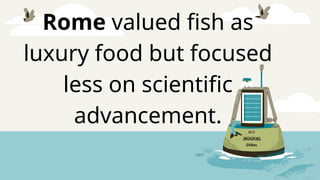
Rome valued fishas
luxury food but focused
less on scientific
advancement.
11.
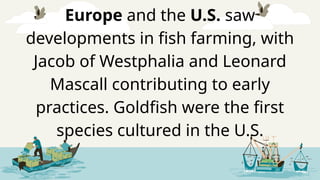
Europe and theU.S. saw
developments in fish farming, with
Jacob of Westphalia and Leonard
Mascall contributing to early
practices. Goldfish were the first
species cultured in the U.S.
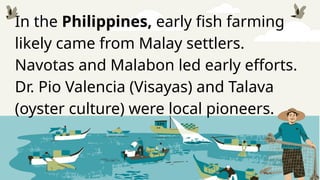
In the Philippines,early fish farming
likely came from Malay settlers.
Navotas and Malabon led early efforts.
Dr. Pio Valencia (Visayas) and Talava
(oyster culture) were local pioneers.
16.
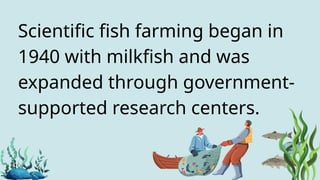
Scientific fish farmingbegan in
1940 with milkfish and was
expanded through government-
supported research centers.
By the endof the lesson, learners are
expected to:
Identify and describe various
career and business opportunities
in aquaculture, including their
roles and responsibilities.
22.
Learners will understandhow
these opportunities contribute to
the aquaculture industry and how
they align with their personal
interests, skills, and future
aspirations.
CAREER
OPPORTUNITIES
JOB DESCRIPTION
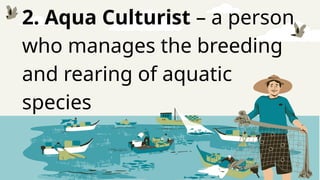
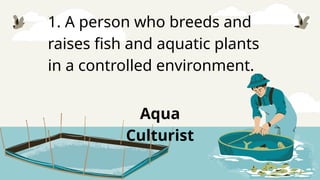
Aqua Culturist
Anindividual specializes in the practice of aquaculture, which involves
the breeding, rearing, and harvesting of aquatic organisms such as
fish, shellfish, and aquatic plants.
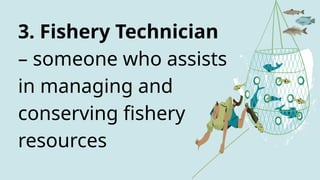
Fishery Technician
A professional who works in the field of fisheries management and
conservation. Their responsibilities include data collection, fisheries
monitoring and habitat restoration.
Fish Farm Caretaker
Responsible for the day-to-day care and maintenance of fish stocks in
aquaculture facilities.
Fish Farm Aide/Worker
a variety of tasks related to the maintenance and operation of the fish
farm like feeding, water quality monitoring, cleaning and
maintenance and harvesting
36.
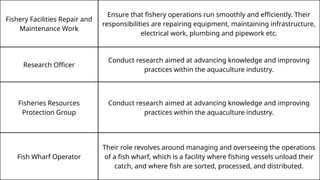
Fishery Facilities Repairand
Maintenance Work
Ensure that fishery operations run smoothly and efficiently. Their
responsibilities are repairing equipment, maintaining infrastructure,
electrical work, plumbing and pipework etc.
Research Officer
Conduct research aimed at advancing knowledge and improving
practices within the aquaculture industry.
Fisheries Resources
Protection Group
Conduct research aimed at advancing knowledge and improving
practices within the aquaculture industry.
Fish Wharf Operator
Their role revolves around managing and overseeing the operations
of a fish wharf, which is a facility where fishing vessels unload their
catch, and where fish are sorted, processed, and distributed.
37.
BUSINESS
OPPORTUNITIES
DESCRIPTION
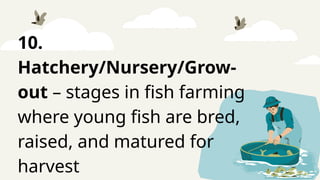
Fish Farm Owner(hatchery,
nursery, and grow-out)
A fish farm owner is an individual or entity that owns and
operates a fish farm or aquaculture facility.
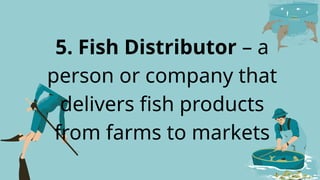
Fish Distributor
Facilitate the distribution of fish and seafood products from suppliers to
various customers, including retailers, restaurants, wholesalers, and
consumers.
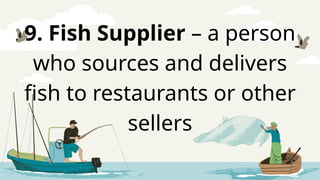
Fish Supplier
Main responsibility is to source, procure, and supply fish and seafood
products to various clients, including retailers, restaurants, wholesalers, and
distributors.
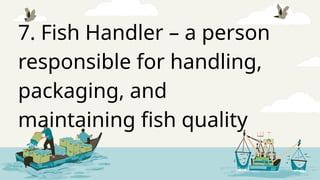
Fish Handler
fish and seafood products efficiently and safely throughout
various stages of processing, packaging, and distribution.
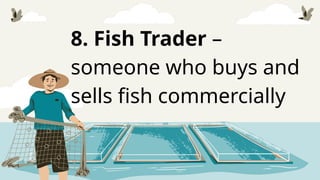
Fish Trader
Primary responsibility is to buy and sell fish and seafood products for
commercial purposes. They will be involved in sourcing fish from suppliers,
negotiating prices, managing inventory, and selling to customers, such as
wholesalers, retailers, restaurants, and consumers.
Aquaculture offers awide range
of career and business
opportunities that support food
production, environmental
conservation, and local
economies. Whether as a
caretaker, technician,
50.
researcher, or
entrepreneur, eachrole
plays an important part in
sustaining the aquaculture
industry and providing
livelihood for many
people.