Unit 3
parameters and graphics
By Alex Cheung
2
Constants
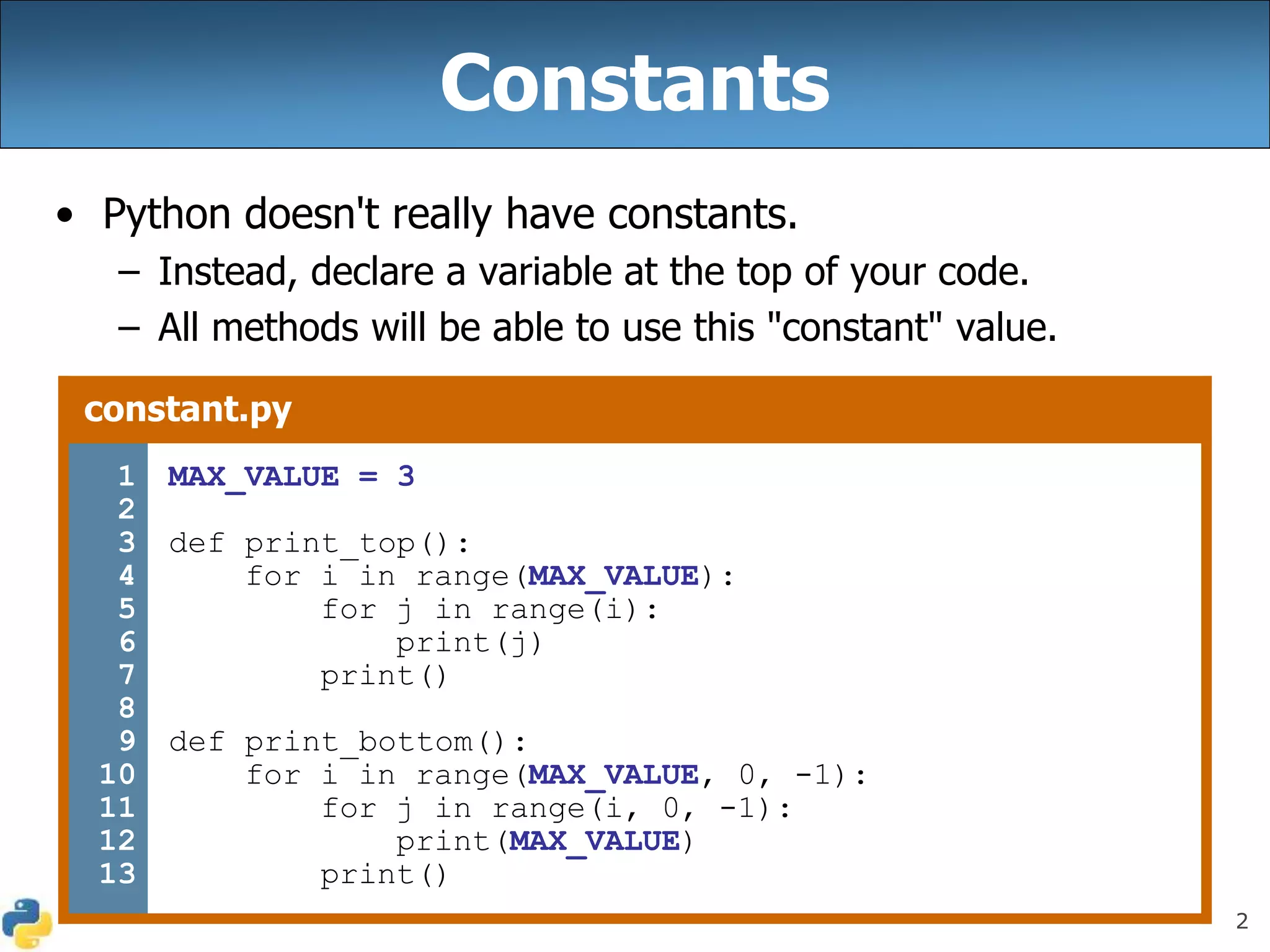
• Python doesn't really have constants.
– Instead, declare a variable at the top of your code.
– All methods will be able to use this "constant" value.
constant.py
1
2
3
4
5
6
7
8
9
10
11
12
13
MAX_VALUE = 3
def print_top():
for i in range(MAX_VALUE):
for j in range(i):
print(j)
print()
def print_bottom():
for i in range(MAX_VALUE, 0, -1):
for j in range(i, 0, -1):
print(MAX_VALUE)
print()
3
Exercise
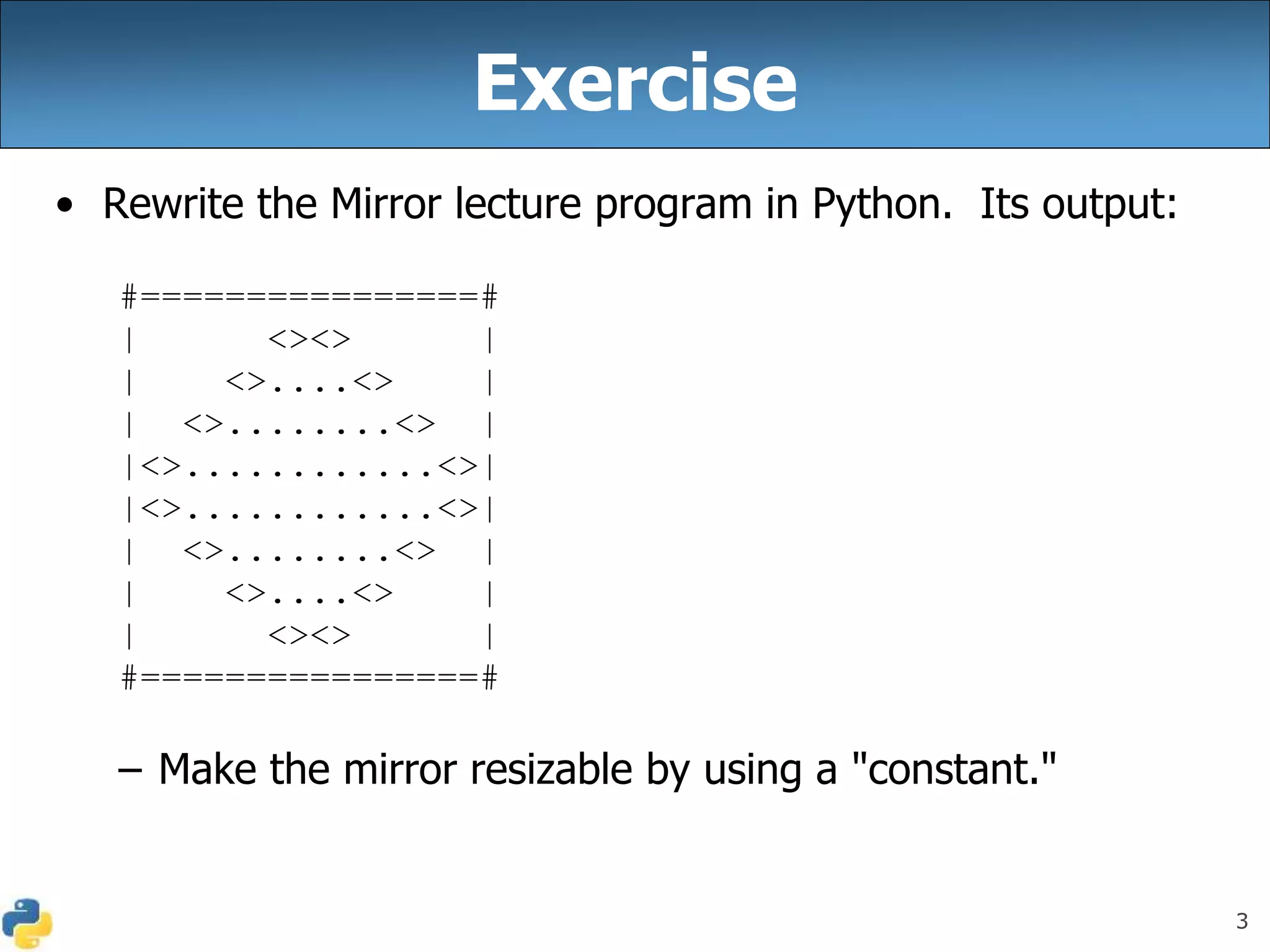
• Rewrite the Mirror lecture program in Python. Its output:
#================#
| <><> |
| <>....<> |
| <>........<> |
|<>............<>|
|<>............<>|
| <>........<> |
| <>....<> |
| <><> |
#================#
– Make the mirror resizable by using a "constant."
4
Exercise Solution
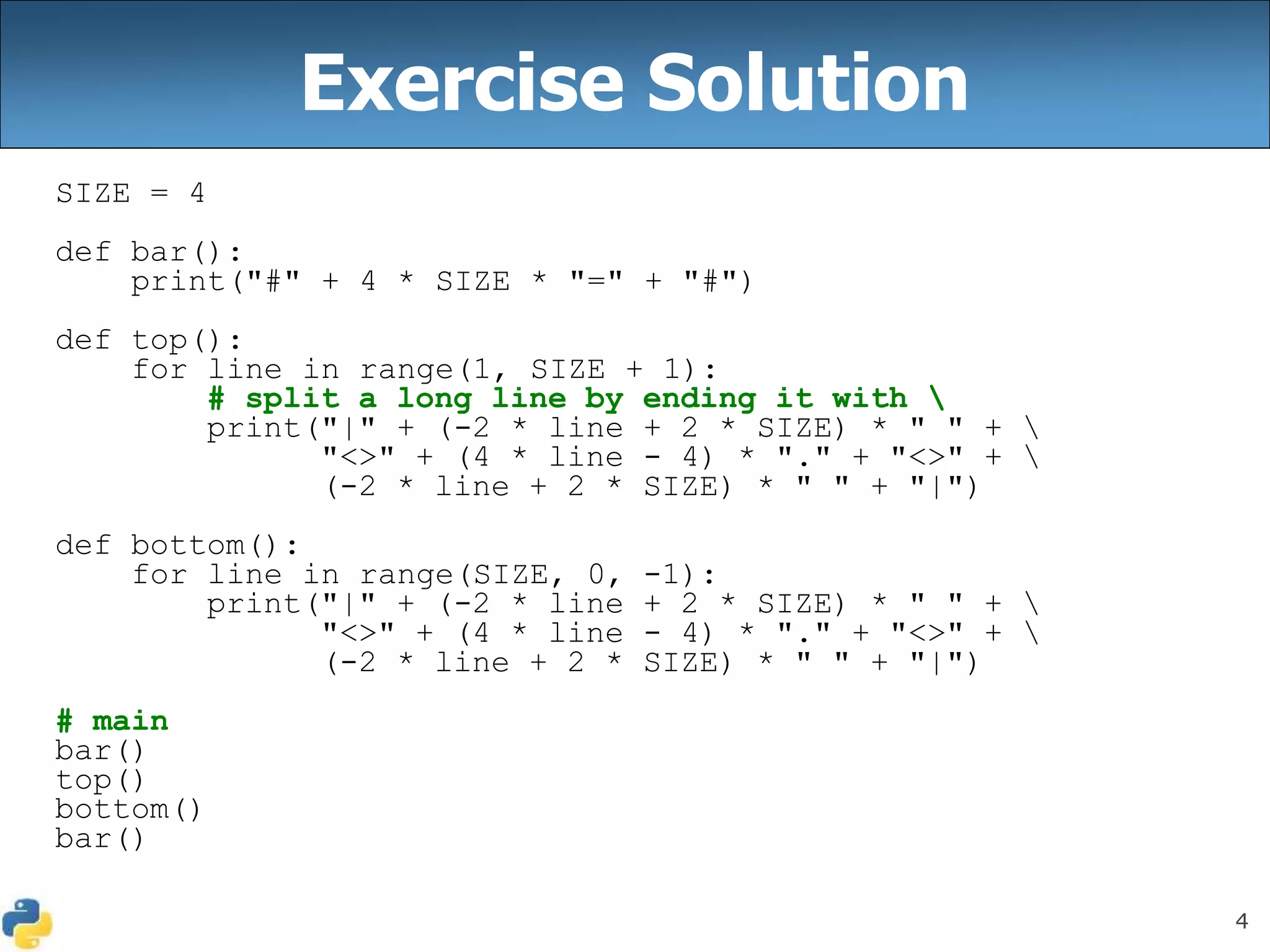
SIZE = 4
def bar():
print("#" + 4 * SIZE * "=" + "#")
def top():
for line in range(1, SIZE + 1):
# split a long line by ending it with 
print("|" + (-2 * line + 2 * SIZE) * " " + 
"<>" + (4 * line - 4) * "." + "<>" + 
(-2 * line + 2 * SIZE) * " " + "|")
def bottom():
for line in range(SIZE, 0, -1):
print("|" + (-2 * line + 2 * SIZE) * " " + 
"<>" + (4 * line - 4) * "." + "<>" + 
(-2 * line + 2 * SIZE) * " " + "|")
# main
bar()
top()
bottom()
bar()
5
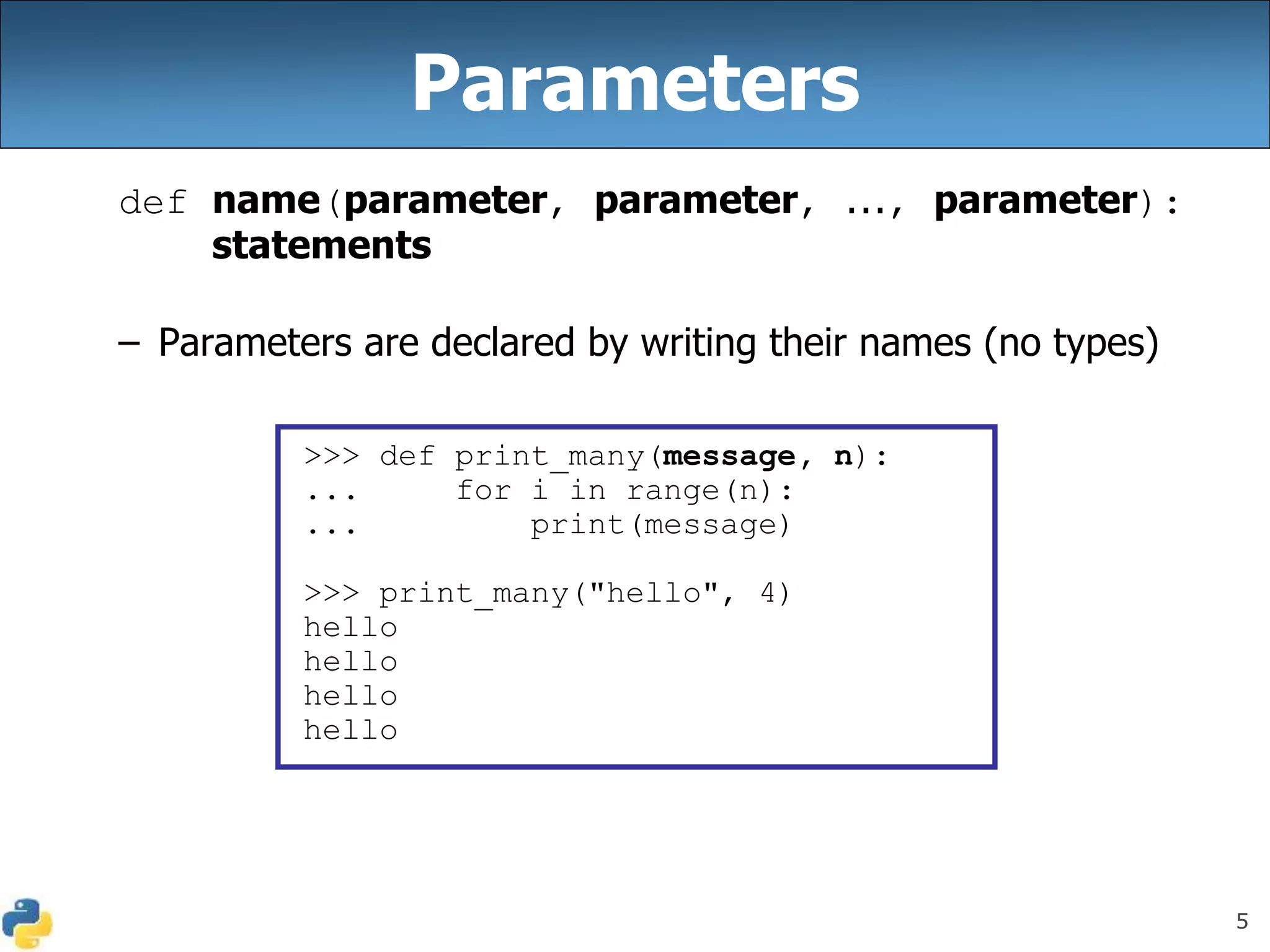
Parameters
def name(parameter, parameter, ..., parameter):
statements
– Parameters are declared by writing their names (no types)
>>> def print_many(message, n):
... for i in range(n):
... print(message)
>>> print_many("hello", 4)
hello
hello
hello
hello
6
Exercise
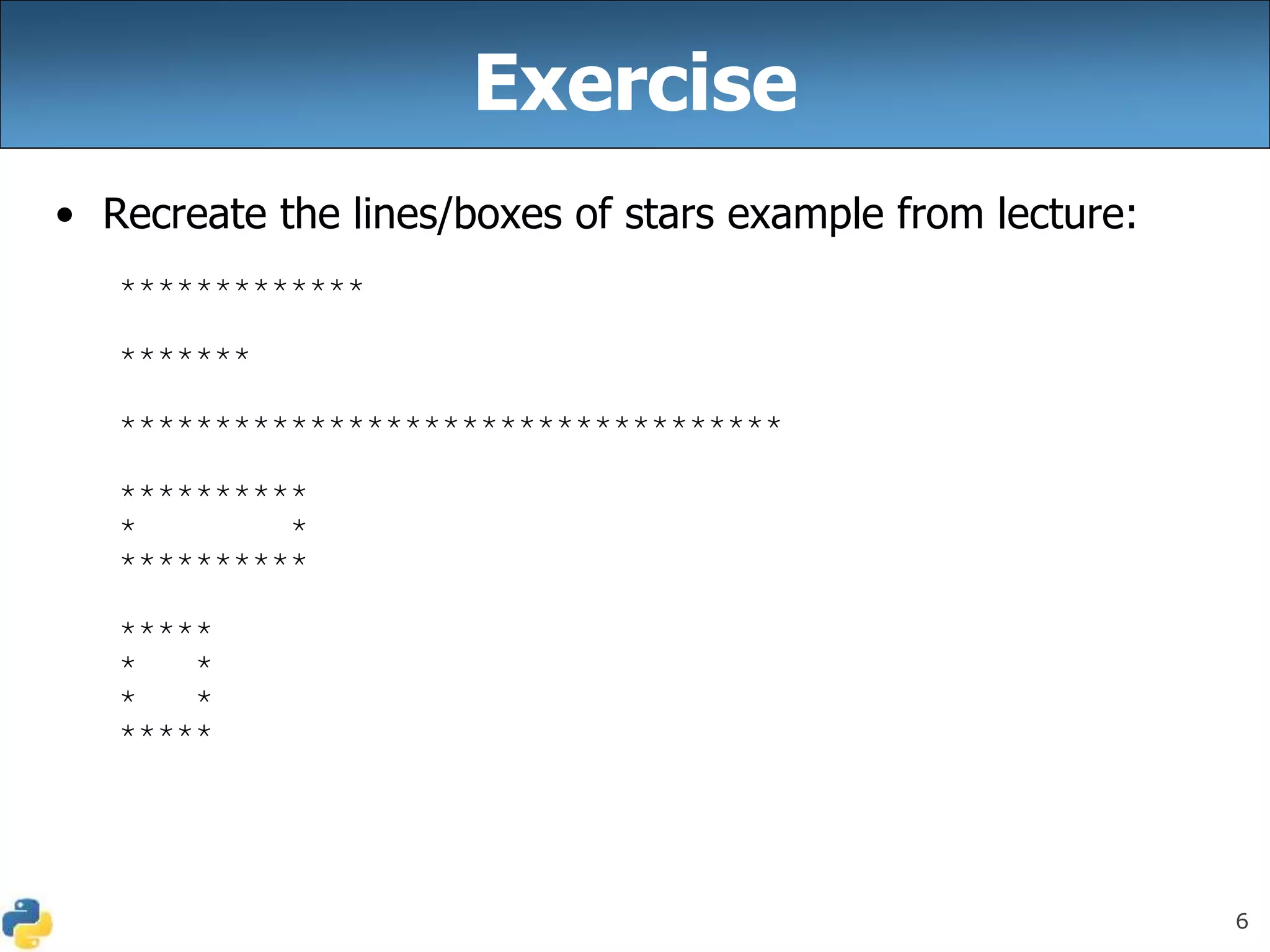
• Recreate the lines/boxes of stars example from lecture:
*************
*******
***********************************
**********
* *
**********
*****
* *
* *
*****
7
Exercise Solution
stars.py
1
2
3
4
5
6
7
8
9
1
0
1
1
1
2
1
3
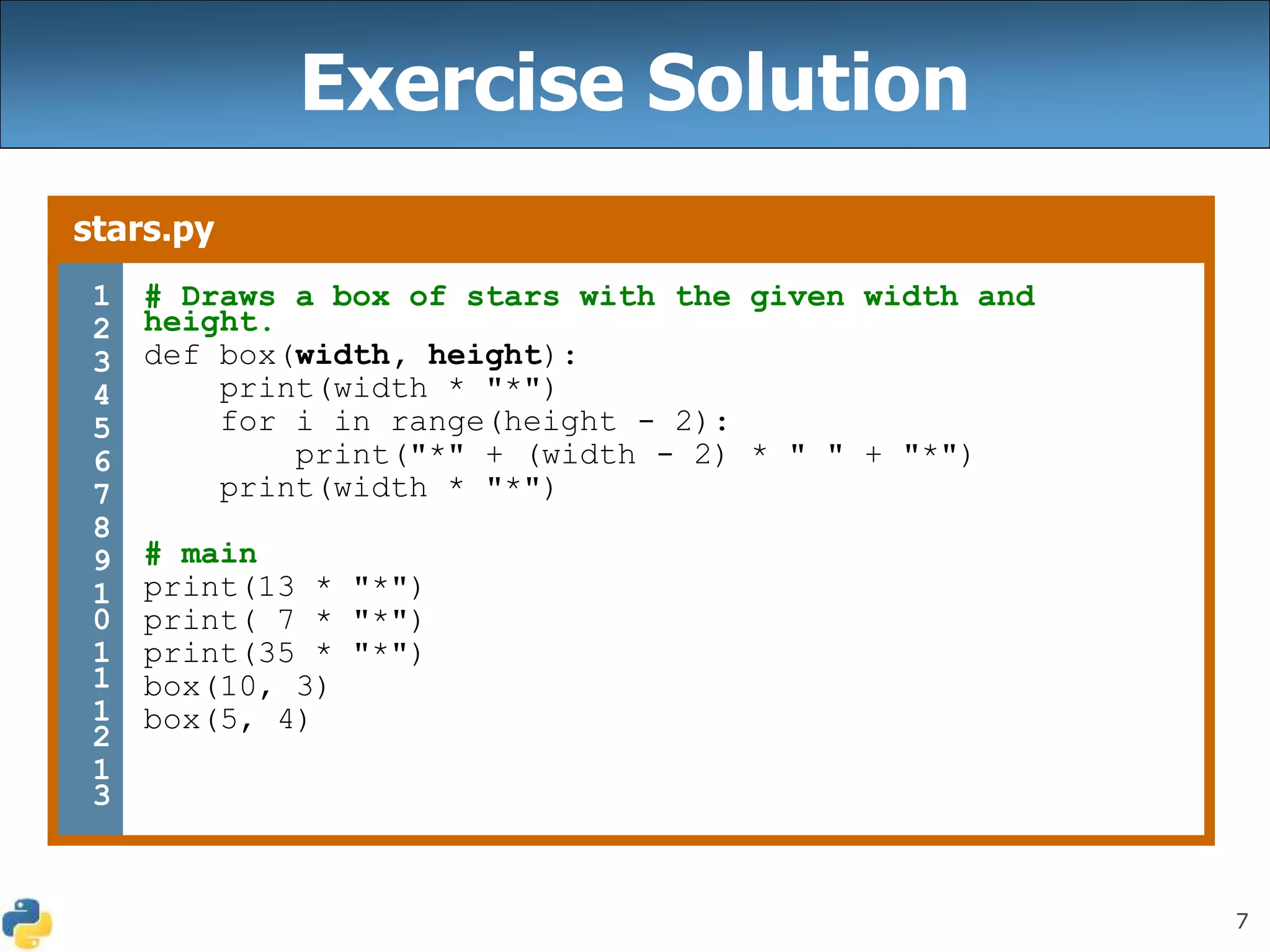
# Draws a box of stars with the given width and
height.
def box(width, height):
print(width * "*")
for i in range(height - 2):
print("*" + (width - 2) * " " + "*")
print(width * "*")
# main
print(13 * "*")
print( 7 * "*")
print(35 * "*")
box(10, 3)
box(5, 4)
8
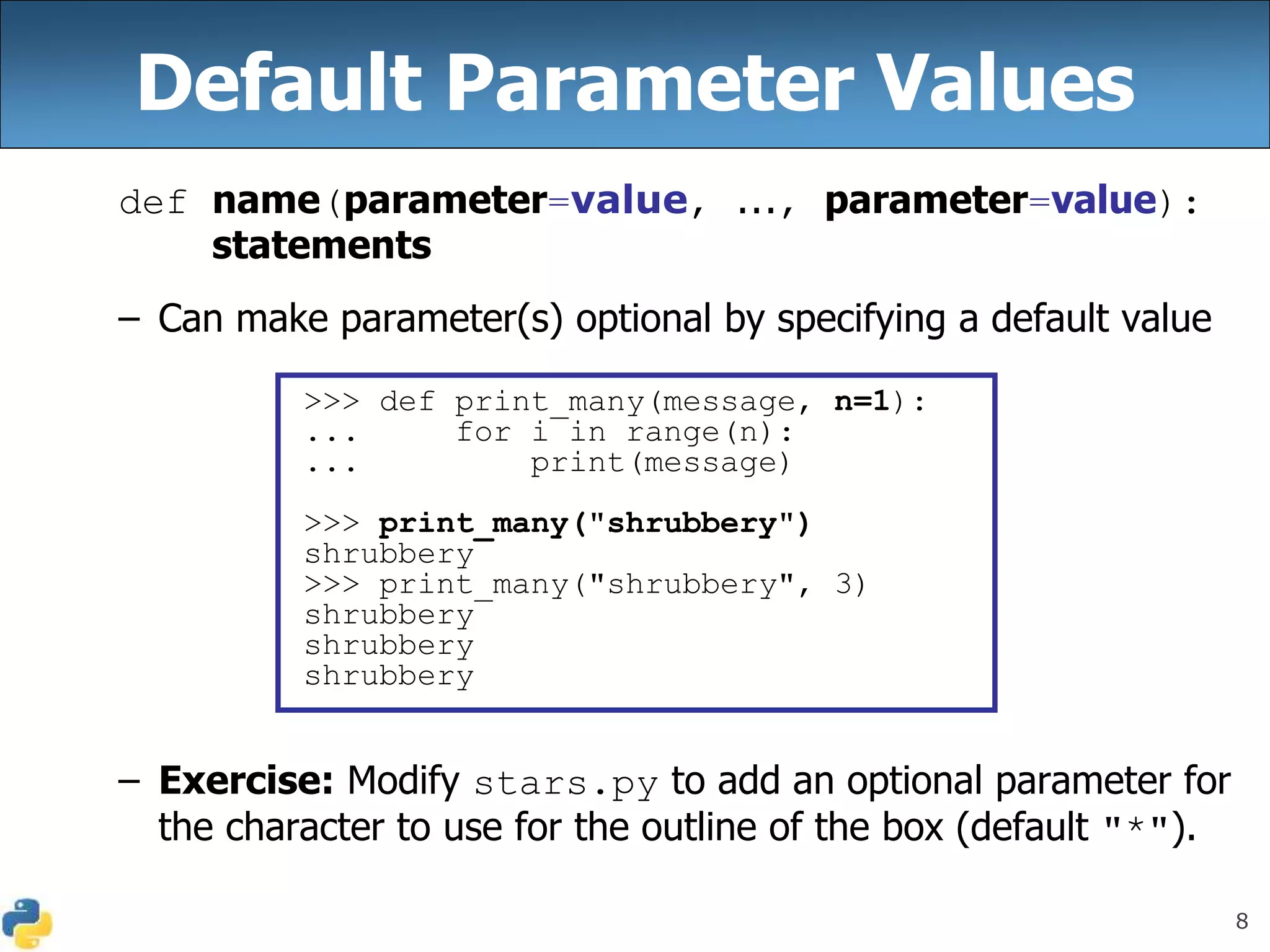
Default Parameter Values
def name(parameter=value, ..., parameter=value):
statements
– Can make parameter(s) optional by specifying a default value
– Exercise: Modify stars.py to add an optional parameter for
the character to use for the outline of the box (default "*").
>>> def print_many(message, n=1):
... for i in range(n):
... print(message)
>>> print_many("shrubbery")
shrubbery
>>> print_many("shrubbery", 3)
shrubbery
shrubbery
shrubbery
9
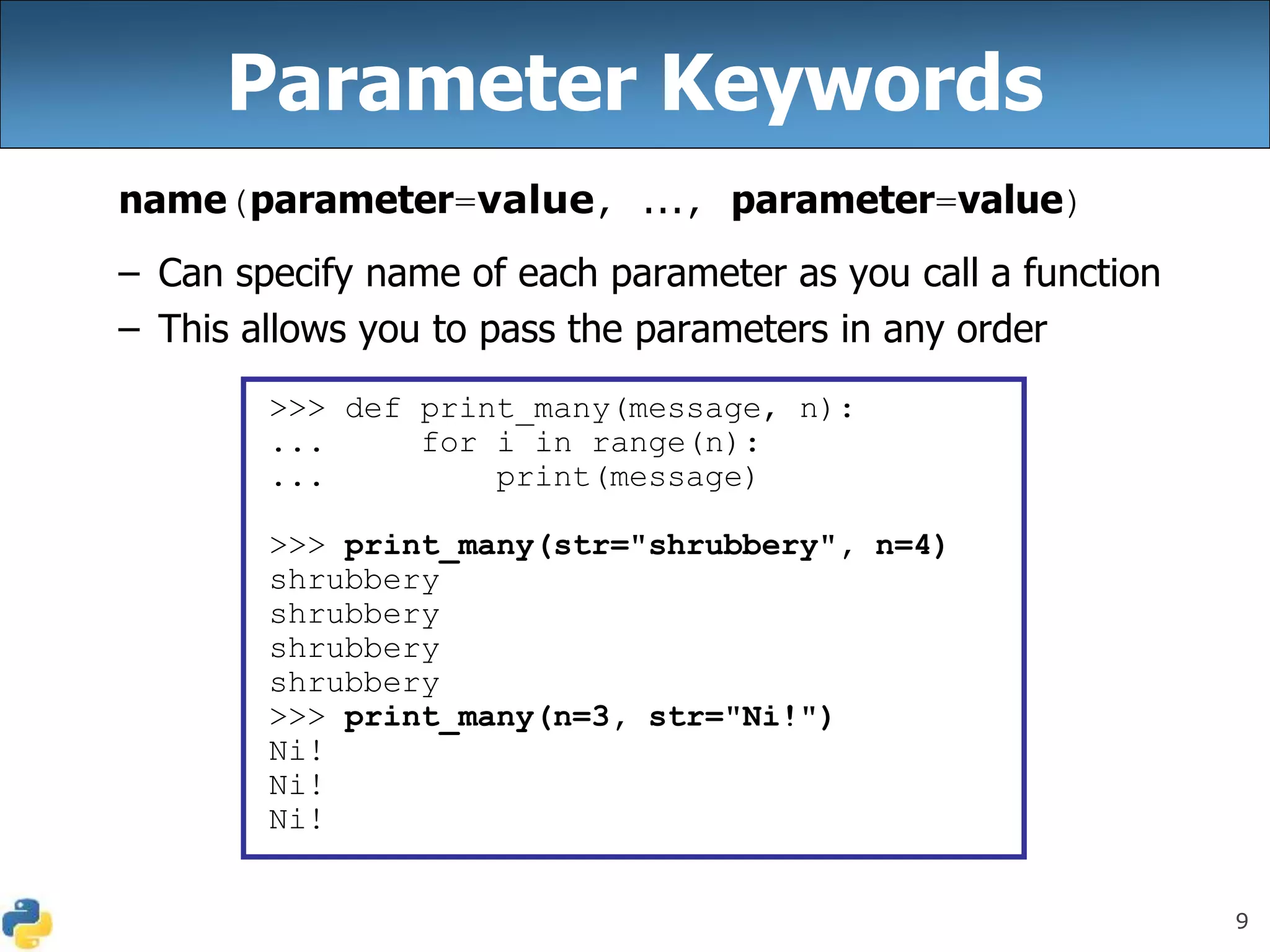
Parameter Keywords
name(parameter=value, ..., parameter=value)
– Can specify name of each parameter as you call a function
– This allows you to pass the parameters in any order
>>> def print_many(message, n):
... for i in range(n):
... print(message)
>>> print_many(str="shrubbery", n=4)
shrubbery
shrubbery
shrubbery
shrubbery
>>> print_many(n=3, str="Ni!")
Ni!
Ni!
Ni!
10
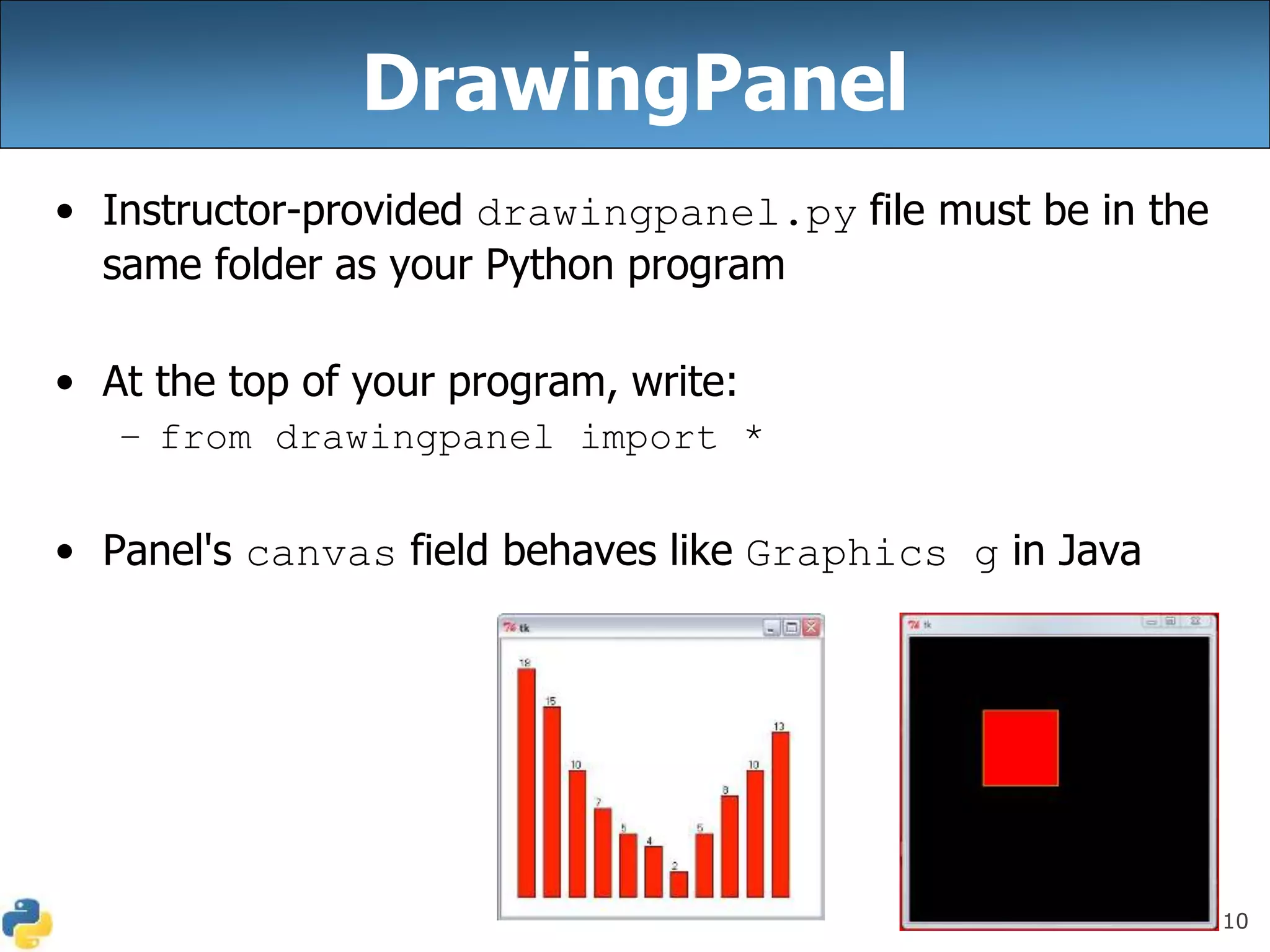
DrawingPanel
• Instructor-provided drawingpanel.py file must be in the
same folder as your Python program
• At the top of your program, write:
– from drawingpanel import *
• Panel's canvas field behaves like Graphics g in Java
11
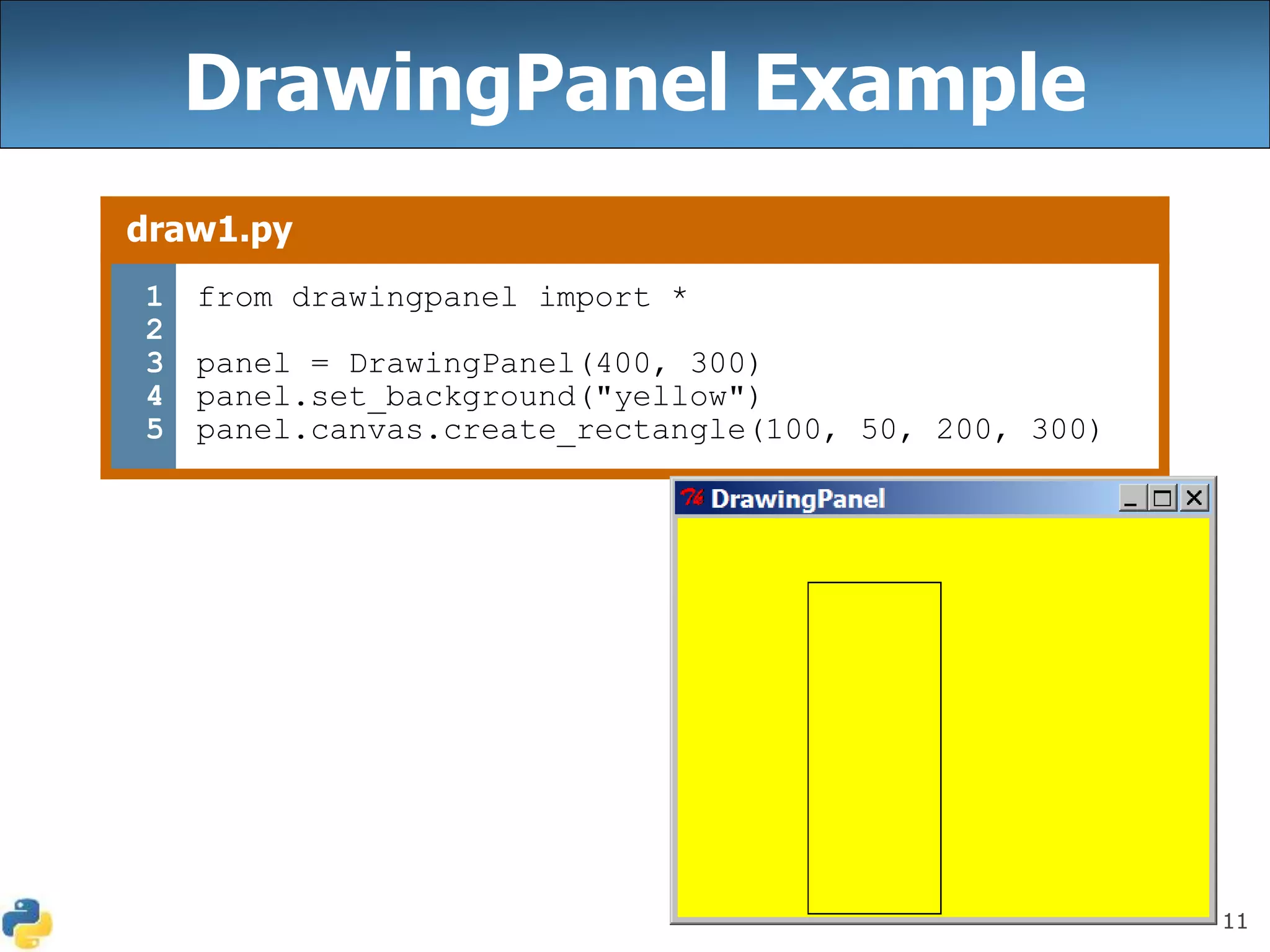
DrawingPanel Example
draw1.py
1
2
3
4
5
from drawingpanel import *
panel = DrawingPanel(400, 300)
panel.set_background("yellow")
panel.canvas.create_rectangle(100, 50, 200, 300)
12
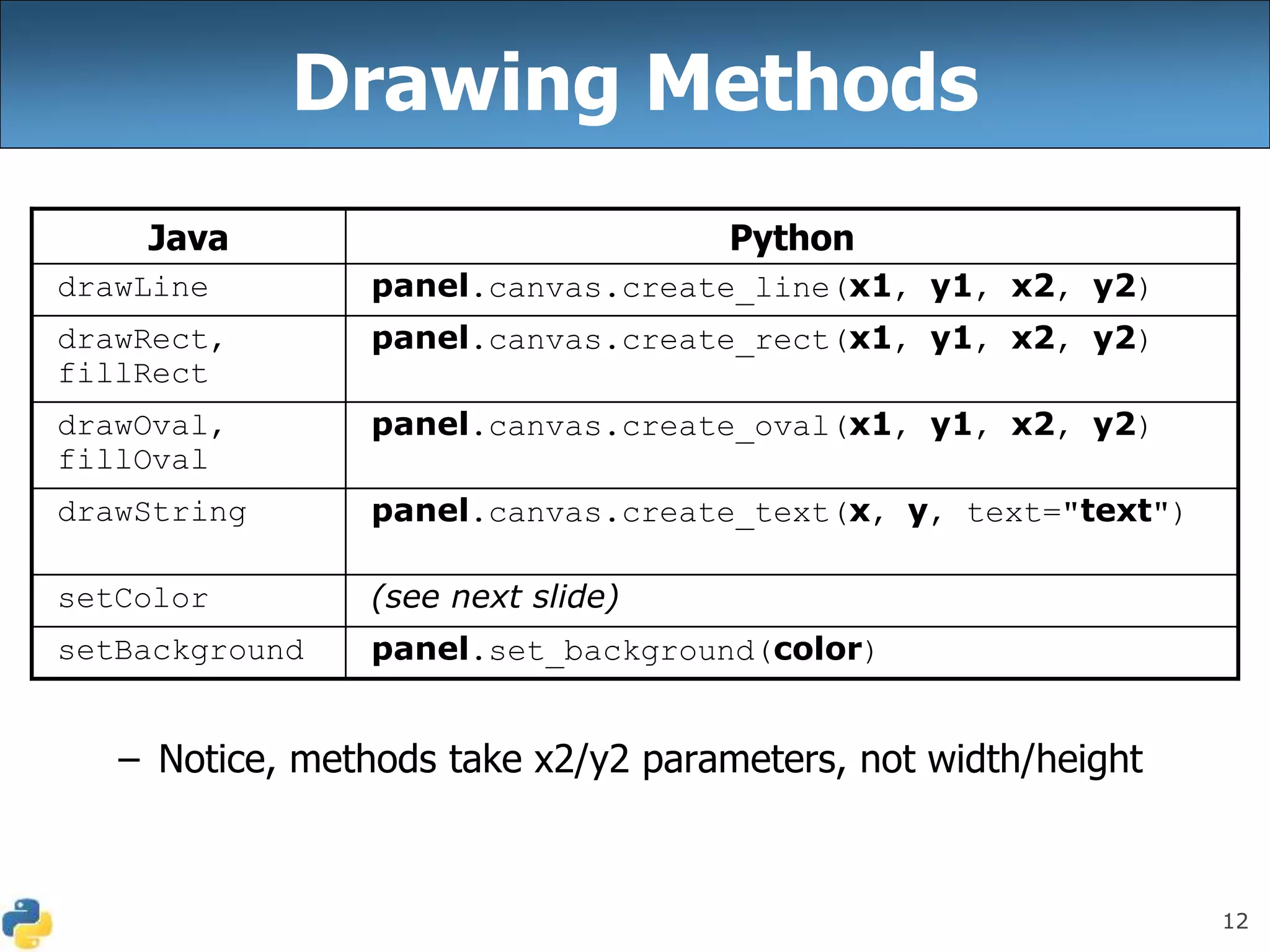
– Notice, methods take x2/y2 parameters, not width/height
Drawing Methods
Java Python
drawLine panel.canvas.create_line(x1, y1, x2, y2)
drawRect,
fillRect
panel.canvas.create_rect(x1, y1, x2, y2)
drawOval,
fillOval
panel.canvas.create_oval(x1, y1, x2, y2)
drawString panel.canvas.create_text(x, y, text="text")
setColor (see next slide)
setBackground panel.set_background(color)
13
Colors and Fill
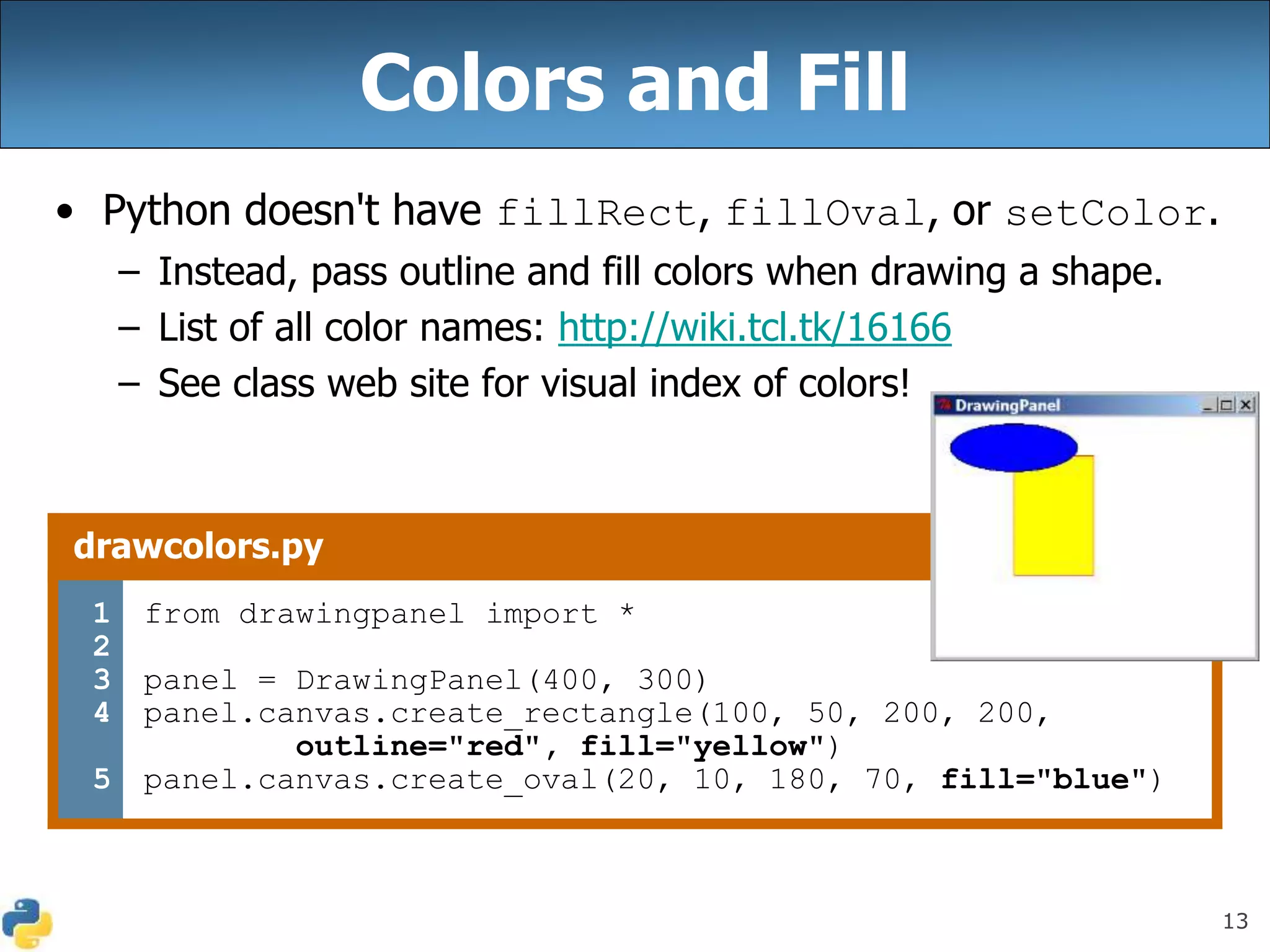
• Python doesn't have fillRect, fillOval, or setColor.
– Instead, pass outline and fill colors when drawing a shape.
– List of all color names: http://wiki.tcl.tk/16166
– See class web site for visual index of colors!
drawcolors.py
1
2
3
4
5
from drawingpanel import *
panel = DrawingPanel(400, 300)
panel.canvas.create_rectangle(100, 50, 200, 200,
outline="red", fill="yellow")
panel.canvas.create_oval(20, 10, 180, 70, fill="blue")
14
Polygons
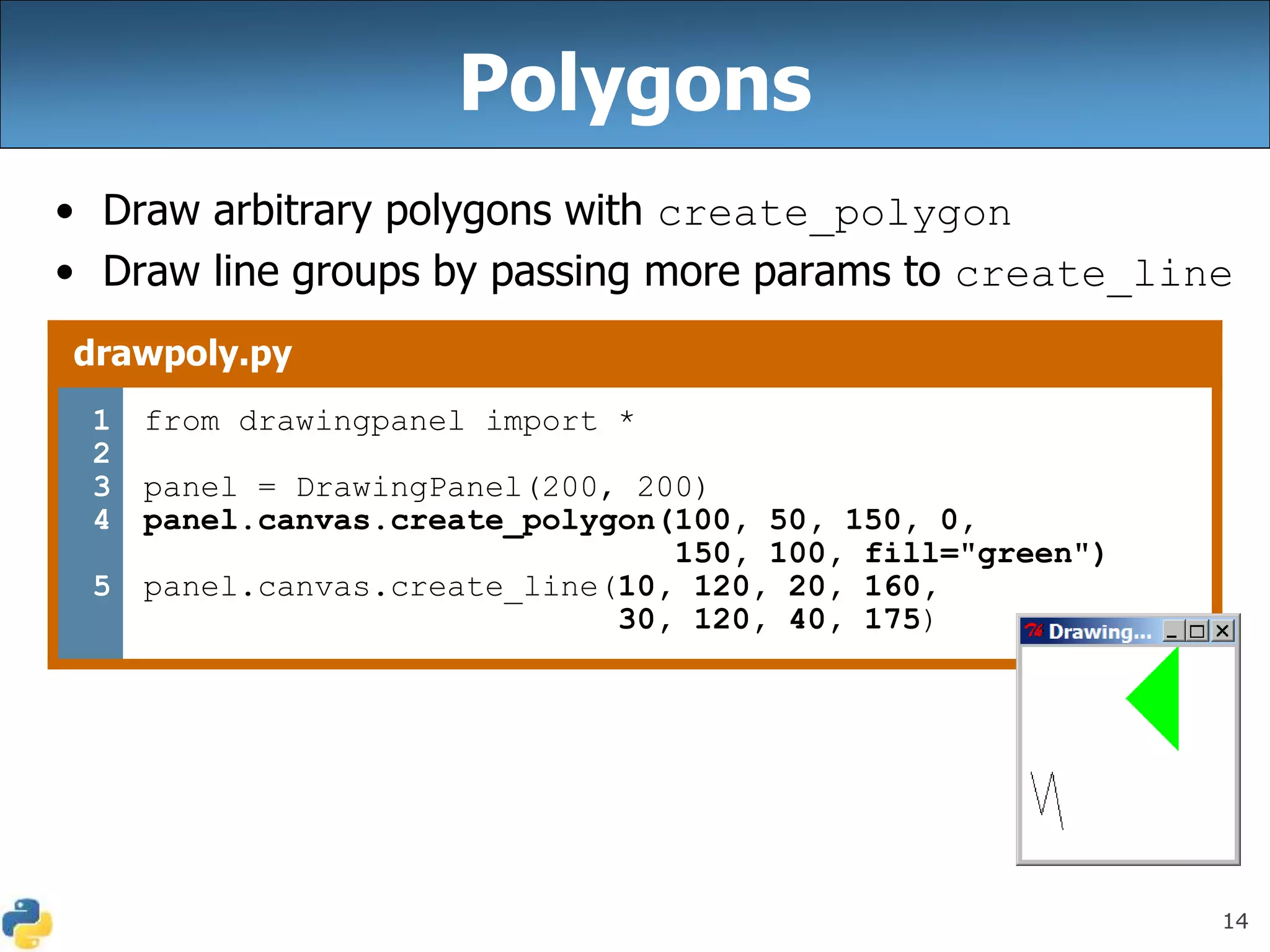
• Draw arbitrary polygons with create_polygon
• Draw line groups by passing more params to create_line
drawpoly.py
1
2
3
4
5
from drawingpanel import *
panel = DrawingPanel(200, 200)
panel.canvas.create_polygon(100, 50, 150, 0,
150, 100, fill="green")
panel.canvas.create_line(10, 120, 20, 160,
30, 120, 40, 175)
15
Exercise
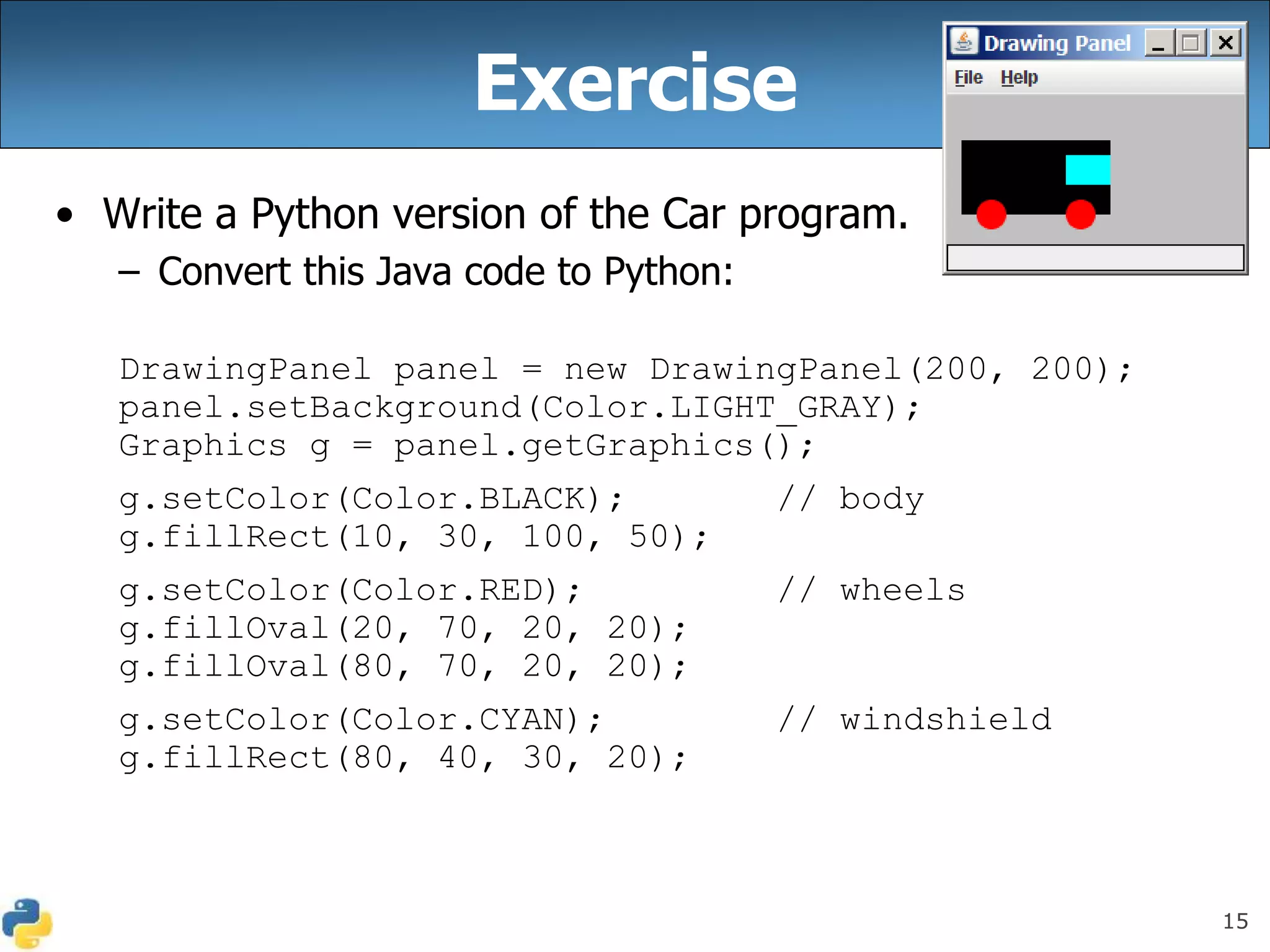
• Write a Python version of the Car program.
– Convert this Java code to Python:
DrawingPanel panel = new DrawingPanel(200, 200);
panel.setBackground(Color.LIGHT_GRAY);
Graphics g = panel.getGraphics();
g.setColor(Color.BLACK); // body
g.fillRect(10, 30, 100, 50);
g.setColor(Color.RED); // wheels
g.fillOval(20, 70, 20, 20);
g.fillOval(80, 70, 20, 20);
g.setColor(Color.CYAN); // windshield
g.fillRect(80, 40, 30, 20);
16
Exercise
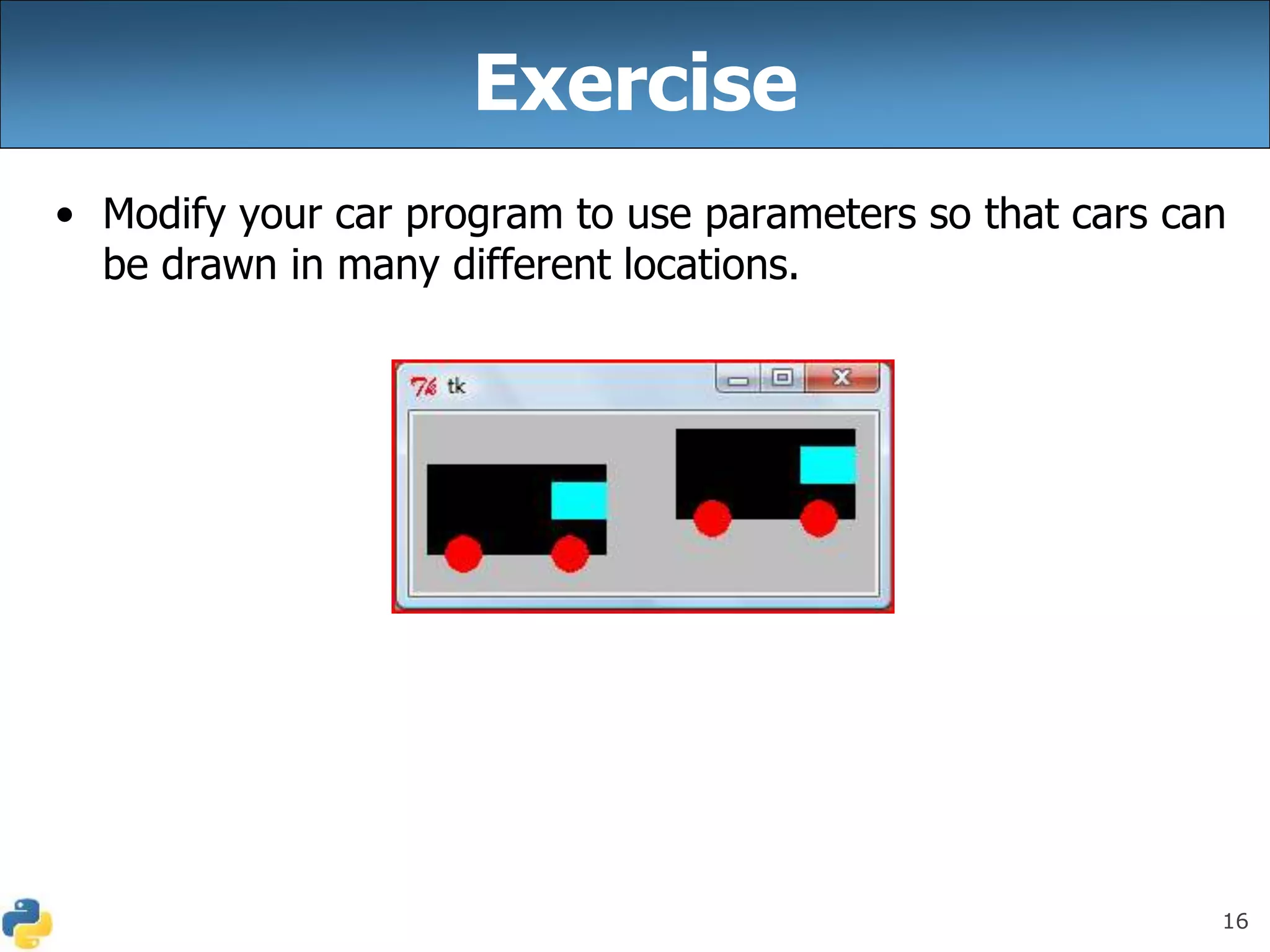
• Modify your car program to use parameters so that cars can
be drawn in many different locations.
17
Exercise
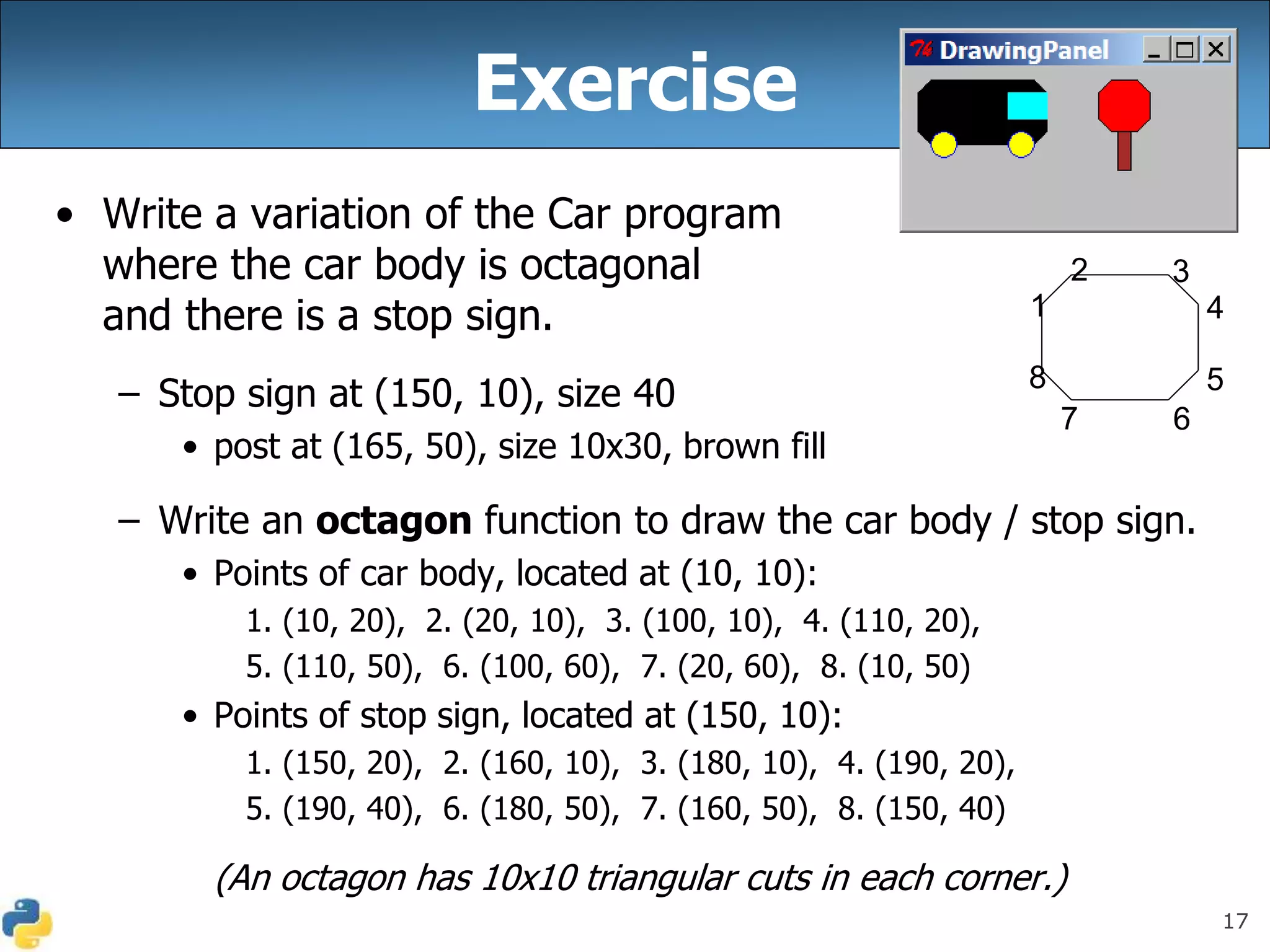
• Write a variation of the Car program
where the car body is octagonal
and there is a stop sign.
– Stop sign at (150, 10), size 40
• post at (165, 50), size 10x30, brown fill
– Write an octagon function to draw the car body / stop sign.
• Points of car body, located at (10, 10):
1. (10, 20), 2. (20, 10), 3. (100, 10), 4. (110, 20),
5. (110, 50), 6. (100, 60), 7. (20, 60), 8. (10, 50)
• Points of stop sign, located at (150, 10):
1. (150, 20), 2. (160, 10), 3. (180, 10), 4. (190, 20),
5. (190, 40), 6. (180, 50), 7. (160, 50), 8. (150, 40)
(An octagon has 10x10 triangular cuts in each corner.)
1
2 3
4
5
6
7
8
18
Animation
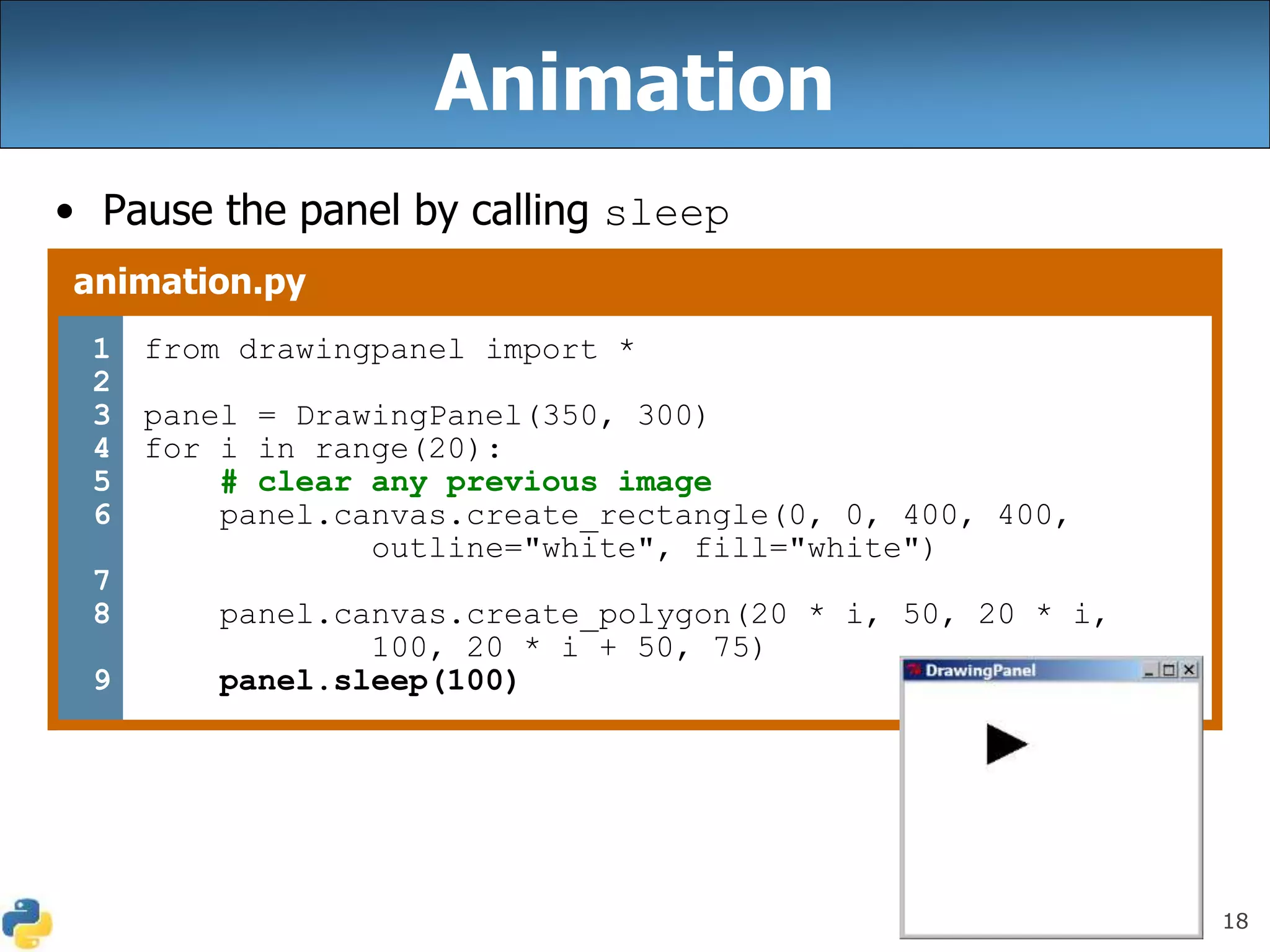
• Pause the panel by calling sleep
animation.py
1
2
3
4
5
6
7
8
9
from drawingpanel import *
panel = DrawingPanel(350, 300)
for i in range(20):
# clear any previous image
panel.canvas.create_rectangle(0, 0, 400, 400,
outline="white", fill="white")
panel.canvas.create_polygon(20 * i, 50, 20 * i,
100, 20 * i + 50, 75)
panel.sleep(100)
19
Exercise
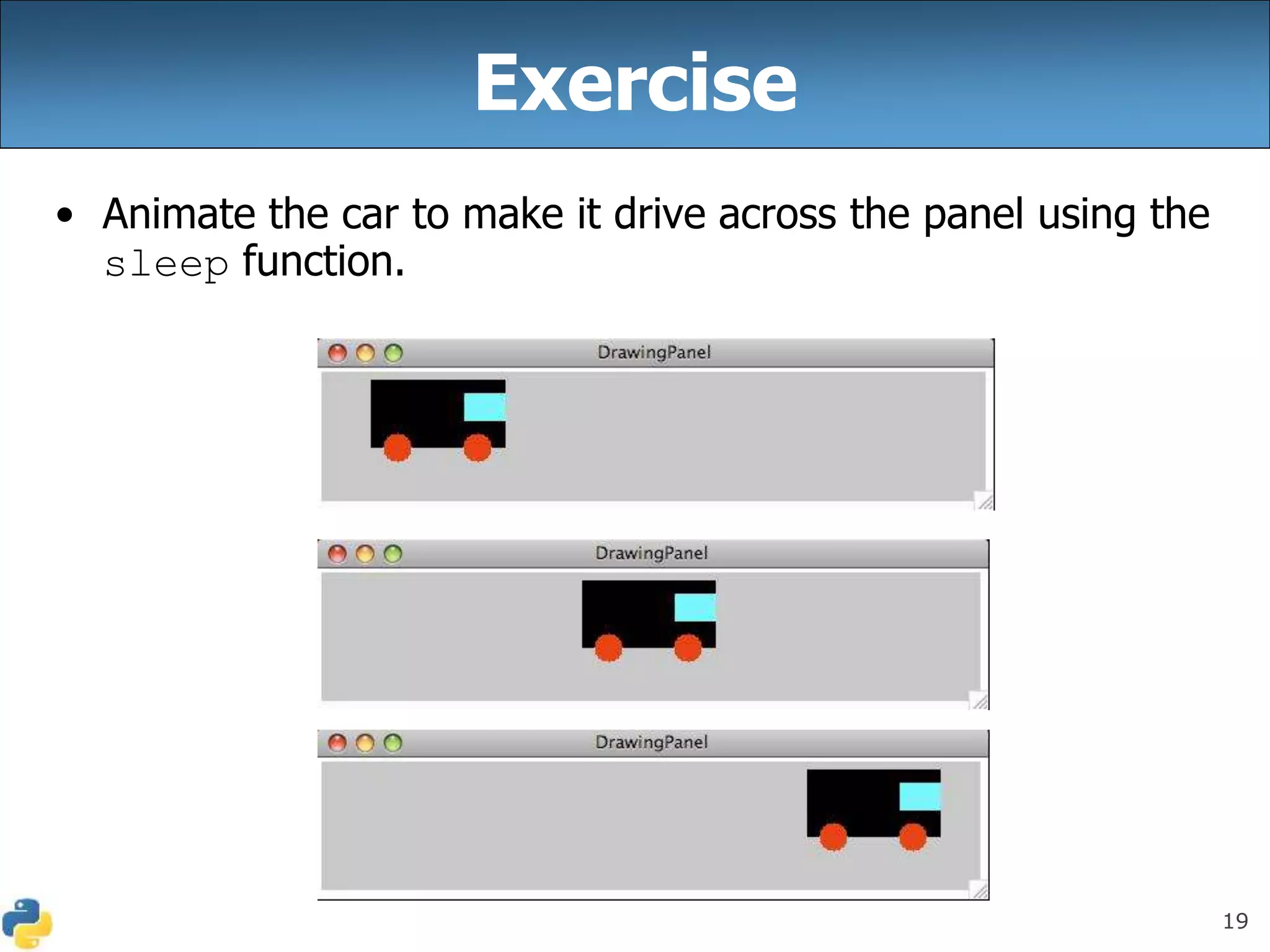
• Animate the car to make it drive across the panel using the
sleep function.
Python 03-parameters-graphics.pptx

  • 1.
    Unit 3 parameters andgraphics By Alex Cheung
  • 2.
    2 Constants • Python doesn'treally have constants. – Instead, declare a variable at the top of your code. – All methods will be able to use this "constant" value. constant.py 1 2 3 4 5 6 7 8 9 10 11 12 13 MAX_VALUE = 3 def print_top(): for i in range(MAX_VALUE): for j in range(i): print(j) print() def print_bottom(): for i in range(MAX_VALUE, 0, -1): for j in range(i, 0, -1): print(MAX_VALUE) print()
  • 3.
    3 Exercise • Rewrite theMirror lecture program in Python. Its output: #================# | <><> | | <>....<> | | <>........<> | |<>............<>| |<>............<>| | <>........<> | | <>....<> | | <><> | #================# – Make the mirror resizable by using a "constant."
  • 4.
    4 Exercise Solution SIZE =4 def bar(): print("#" + 4 * SIZE * "=" + "#") def top(): for line in range(1, SIZE + 1): # split a long line by ending it with print("|" + (-2 * line + 2 * SIZE) * " " + "<>" + (4 * line - 4) * "." + "<>" + (-2 * line + 2 * SIZE) * " " + "|") def bottom(): for line in range(SIZE, 0, -1): print("|" + (-2 * line + 2 * SIZE) * " " + "<>" + (4 * line - 4) * "." + "<>" + (-2 * line + 2 * SIZE) * " " + "|") # main bar() top() bottom() bar()
  • 5.
    5 Parameters def name(parameter, parameter,..., parameter): statements – Parameters are declared by writing their names (no types) >>> def print_many(message, n): ... for i in range(n): ... print(message) >>> print_many("hello", 4) hello hello hello hello
  • 6.
    6 Exercise • Recreate thelines/boxes of stars example from lecture: ************* ******* *********************************** ********** * * ********** ***** * * * * *****
  • 7.
    7 Exercise Solution stars.py 1 2 3 4 5 6 7 8 9 1 0 1 1 1 2 1 3 # Drawsa box of stars with the given width and height. def box(width, height): print(width * "*") for i in range(height - 2): print("*" + (width - 2) * " " + "*") print(width * "*") # main print(13 * "*") print( 7 * "*") print(35 * "*") box(10, 3) box(5, 4)
  • 8.
    8 Default Parameter Values defname(parameter=value, ..., parameter=value): statements – Can make parameter(s) optional by specifying a default value – Exercise: Modify stars.py to add an optional parameter for the character to use for the outline of the box (default "*"). >>> def print_many(message, n=1): ... for i in range(n): ... print(message) >>> print_many("shrubbery") shrubbery >>> print_many("shrubbery", 3) shrubbery shrubbery shrubbery
  • 9.
    9 Parameter Keywords name(parameter=value, ...,parameter=value) – Can specify name of each parameter as you call a function – This allows you to pass the parameters in any order >>> def print_many(message, n): ... for i in range(n): ... print(message) >>> print_many(str="shrubbery", n=4) shrubbery shrubbery shrubbery shrubbery >>> print_many(n=3, str="Ni!") Ni! Ni! Ni!
  • 10.
    10 DrawingPanel • Instructor-provided drawingpanel.pyfile must be in the same folder as your Python program • At the top of your program, write: – from drawingpanel import * • Panel's canvas field behaves like Graphics g in Java
  • 11.
    11 DrawingPanel Example draw1.py 1 2 3 4 5 from drawingpanelimport * panel = DrawingPanel(400, 300) panel.set_background("yellow") panel.canvas.create_rectangle(100, 50, 200, 300)
  • 12.
    12 – Notice, methodstake x2/y2 parameters, not width/height Drawing Methods Java Python drawLine panel.canvas.create_line(x1, y1, x2, y2) drawRect, fillRect panel.canvas.create_rect(x1, y1, x2, y2) drawOval, fillOval panel.canvas.create_oval(x1, y1, x2, y2) drawString panel.canvas.create_text(x, y, text="text") setColor (see next slide) setBackground panel.set_background(color)
  • 13.
    13 Colors and Fill •Python doesn't have fillRect, fillOval, or setColor. – Instead, pass outline and fill colors when drawing a shape. – List of all color names: http://wiki.tcl.tk/16166 – See class web site for visual index of colors! drawcolors.py 1 2 3 4 5 from drawingpanel import * panel = DrawingPanel(400, 300) panel.canvas.create_rectangle(100, 50, 200, 200, outline="red", fill="yellow") panel.canvas.create_oval(20, 10, 180, 70, fill="blue")
  • 14.
    14 Polygons • Draw arbitrarypolygons with create_polygon • Draw line groups by passing more params to create_line drawpoly.py 1 2 3 4 5 from drawingpanel import * panel = DrawingPanel(200, 200) panel.canvas.create_polygon(100, 50, 150, 0, 150, 100, fill="green") panel.canvas.create_line(10, 120, 20, 160, 30, 120, 40, 175)
  • 15.
    15 Exercise • Write aPython version of the Car program. – Convert this Java code to Python: DrawingPanel panel = new DrawingPanel(200, 200); panel.setBackground(Color.LIGHT_GRAY); Graphics g = panel.getGraphics(); g.setColor(Color.BLACK); // body g.fillRect(10, 30, 100, 50); g.setColor(Color.RED); // wheels g.fillOval(20, 70, 20, 20); g.fillOval(80, 70, 20, 20); g.setColor(Color.CYAN); // windshield g.fillRect(80, 40, 30, 20);
  • 16.
    16 Exercise • Modify yourcar program to use parameters so that cars can be drawn in many different locations.
  • 17.
    17 Exercise • Write avariation of the Car program where the car body is octagonal and there is a stop sign. – Stop sign at (150, 10), size 40 • post at (165, 50), size 10x30, brown fill – Write an octagon function to draw the car body / stop sign. • Points of car body, located at (10, 10): 1. (10, 20), 2. (20, 10), 3. (100, 10), 4. (110, 20), 5. (110, 50), 6. (100, 60), 7. (20, 60), 8. (10, 50) • Points of stop sign, located at (150, 10): 1. (150, 20), 2. (160, 10), 3. (180, 10), 4. (190, 20), 5. (190, 40), 6. (180, 50), 7. (160, 50), 8. (150, 40) (An octagon has 10x10 triangular cuts in each corner.) 1 2 3 4 5 6 7 8
  • 18.
    18 Animation • Pause thepanel by calling sleep animation.py 1 2 3 4 5 6 7 8 9 from drawingpanel import * panel = DrawingPanel(350, 300) for i in range(20): # clear any previous image panel.canvas.create_rectangle(0, 0, 400, 400, outline="white", fill="white") panel.canvas.create_polygon(20 * i, 50, 20 * i, 100, 20 * i + 50, 75) panel.sleep(100)
  • 19.
    19 Exercise • Animate thecar to make it drive across the panel using the sleep function.