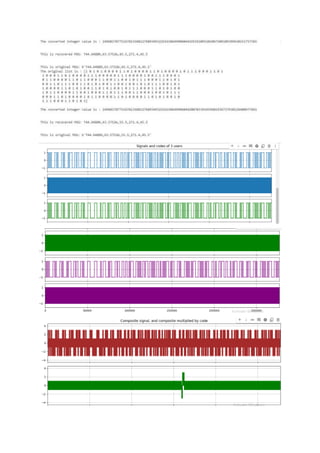
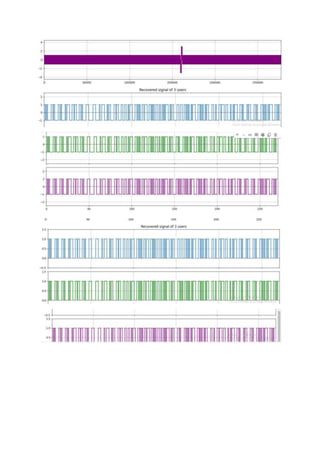
The document is a Python script for simulating CDMA communication, specifically modified for testing with a Subnero surface modem and a spreading factor of 1024. It includes functions for circular convolution, correlation, despreading, and generating PN sequences for GPS signals, while processing and visualizing signals from three users. The output includes recovered messages from original transmitted data, showcasing the functionality of the simulation.
![CDMA simulation code
#!/usr/bin/env python
# coding: utf-8
# Author : Jay Patel, Dalhousie University
# This code is modified for testing on Subnero Surface Modem.
# Final testing with spreading factor 1024.
import codecs
import pylab as plt
import numpy as np
from numpy import fft
# messages that needs to be converted
s0 = 'T44.6488N,63.5752W,35.5,271.4,45.5'.encode('utf-8')
s1 = 'T44.6488N,63.5752W,45.5,271.4,45.5'.encode('utf-8')
s2 = 'T44.6488N,63.5752W,55.5,271.4,45.5'.encode('utf-8')
def cconv(x, y):
"""Calculate the circular convolution of 1-D input numpy arrays
using DFT
From the Signal Processing Library:
http://mubeta06.github.io/python/sp/filter.html
"""
return fft.ifft(fft.fft(x)*fft.fft(y))
def ccorr(x, y):
"""Calculate the circular correlation of 1-D input numpy arrays
using DFT
From the Signal Processing Library:
http://mubeta06.github.io/python/sp/filter.html
"""
return fft.ifft(fft.fft(x)*fft.fft(y).conj())
def despread(composite, code, codelength):
l = len(composite)//codelength
despread = composite*(code*-2.0+1)
recovered = []
for i in range(l):
recovered = np.append(recovered,
1.0*sum(despread[i*codelength:i*codelength+codelength])//codelength)
recovered = np.repeat(recovered, codelength)
return recovered
def bitfield(n):
"""Convert integer into bitfield (as list)
From StackOverflow: http://stackoverflow.com/a/10322018/](https://image.slidesharecdn.com/cdmasimulationcode-240605192133-3e961e03/85/CDMA-simulation-code-for-wireless-Network-docx-1-320.jpg)
![CDMA simulation code
#!/usr/bin/env python
# coding: utf-8
# Author : Jay Patel, Dalhousie University
# This code is modified for testing on Subnero Surface Modem.
# Final testing with spreading factor 1024.
import codecs
import pylab as plt
import numpy as np
from numpy import fft
# messages that needs to be converted
s0 = 'T44.6488N,63.5752W,35.5,271.4,45.5'.encode('utf-8')
s1 = 'T44.6488N,63.5752W,45.5,271.4,45.5'.encode('utf-8')
s2 = 'T44.6488N,63.5752W,55.5,271.4,45.5'.encode('utf-8')
def cconv(x, y):
"""Calculate the circular convolution of 1-D input numpy arrays
using DFT
From the Signal Processing Library:
http://mubeta06.github.io/python/sp/filter.html
"""
return fft.ifft(fft.fft(x)*fft.fft(y))
def ccorr(x, y):
"""Calculate the circular correlation of 1-D input numpy arrays
using DFT
From the Signal Processing Library:
http://mubeta06.github.io/python/sp/filter.html
"""
return fft.ifft(fft.fft(x)*fft.fft(y).conj())
def despread(composite, code, codelength):
l = len(composite)//codelength
despread = composite*(code*-2.0+1)
recovered = []
for i in range(l):
recovered = np.append(recovered,
1.0*sum(despread[i*codelength:i*codelength+codelength])//codelength)
recovered = np.repeat(recovered, codelength)
return recovered
def bitfield(n):
"""Convert integer into bitfield (as list)
From StackOverflow: http://stackoverflow.com/a/10322018/](https://image.slidesharecdn.com/cdmasimulationcode-240605192133-3e961e03/75/CDMA-simulation-code-for-wireless-Network-docx-1-2048.jpg)
!["""
return [int(digit) for digit in bin(n)[2:]]
def shift(register, feedback, output):
"""GPS Shift Register
From https://natronics.github.io/blag/2014/gps-prn/
:param list feedback: which positions to use as feedback (1
indexed)
:param list output: which positions are output (1 indexed)
:returns output of shift register:
"""
# calculate output
out = [register[i - 1] for i in output]
if len(out) > 1:
out = sum(out) % 2
else:
out = out[0]
# modulo 2 add feedback
fb = sum([register[i - 1] for i in feedback]) % 2
# shift to the right
for i in reversed(range(len(register[1:]))):
register[i + 1] = register[i]
# put feedback in position 1
register[0] = fb
return out
SV = {
1: [2,6],
2: [3,7],
3: [4,8],
4: [5,9],
5: [1,9],
6: [2,10],
7: [1,8],
8: [2,9],
9: [3,10],
10: [2,3],
11: [3,4],
12: [5,6],
13: [6,7],
14: [7,8],
15: [8,9],](https://image.slidesharecdn.com/cdmasimulationcode-240605192133-3e961e03/85/CDMA-simulation-code-for-wireless-Network-docx-2-320.jpg)
![16: [9,10],
17: [1,4],
18: [2,5],
19: [3,6],
20: [4,7],
21: [5,8],
22: [6,9],
23: [1,3],
24: [4,6],
25: [5,7],
26: [6,8],
27: [7,9],
28: [8,10],
29: [1,6],
30: [2,7],
31: [3,8],
32: [4,9],
}
def PRN(sv):
"""Build the CA code (PRN) for a given satellite ID
https://github.com/natronics/gps/blob/master/gps/prn.py
:param int sv: satellite code (1-32)
:returns list: ca code for chosen satellite
"""
# init registers
G1 = [1 for i in range(10)]
G2 = [1 for i in range(10)]
ca = [] # stuff output in here
# create sequence
for i in range(1023):
g1 = shift(G1, [3 ,10], [10])
g2 = shift(G2, [2 ,3 ,6 ,8 ,9 ,10], SV[sv]) # <- sat chosen
here from table
# modulo 2 add and append to the code
ca.append((g1 + g2) % 2)
# return C/A code!
return ca
def de_repeater(seq, size):
chunks = []
index = 0](https://image.slidesharecdn.com/cdmasimulationcode-240605192133-3e961e03/85/CDMA-simulation-code-for-wireless-Network-docx-3-320.jpg)
![while index < len(seq):
#print(list(seq[index:index+size]))
#print(len(list(seq[index:index+size])))
chunks.append(list(seq[index:index+size]))
index+=size
bits = []
for List in chunks:
#print(max(set(List), key = List.count))
bits.append(max(set(List), key = List.count))
return bits
# Two Gold codes. See
# Gold, R. "Optimal binary sequences for spread spectrum multiplexing
(Corresp.)"
# IEEE Transactions on Information Theory. (October 1967)
# g0 = np.array([0, 0, 0, 0, 0, 0, 0, 1, 1, 1, 1, 0, 1, 1, 0, 1, 1, 1,
1, 1, 0, 1,
# 1, 1, 0, 1, 0, 0, 0, 1, 0], dtype=int)
# g30 = np.array([0, 0, 0, 0, 1, 0, 1, 0, 1, 0, 1, 1, 1, 1, 0, 0, 0, 0,
1, 0, 1, 0,
# 0, 0, 0, 1, 1, 0, 0, 0, 1])
g0 = np.array(PRN(1))
g5 = np.array(PRN(5))
g30 = np.array(PRN(10))
codelength = len(g0) # 2^8 = 255
# print(codelength)
# Primary user data
p = s0.hex()
p = int(p, 16)
p = np.array(bitfield(p))
p_len = len(p)
p = np.repeat(p, codelength)
p_code = []
for i in range(p_len):
p_code = np.append(p_code, g30)
# First secondary user and his code
q = s1.hex()
q = int(q, 16)
q = np.array(bitfield(q))
q_len = len(q)
q = np.repeat(q, codelength)
q_code = []](https://image.slidesharecdn.com/cdmasimulationcode-240605192133-3e961e03/85/CDMA-simulation-code-for-wireless-Network-docx-4-320.jpg)
![for i in range(q_len):
q_code = np.append(q_code, g5)
q_spread = np.logical_xor(q_code, q).astype(int)
# Second secondary user and her code
r = s2.hex()
r = int(r, 16)
r = np.array(bitfield(r))
r_len = len(r)
r = np.repeat(r, codelength)
r_code = []
for i in range(r_len):
r_code = np.append(r_code, g0)
r_spread = np.logical_xor(r_code, r).astype(int)
# Composite sigal from all three users
composite = (p*2-1) + (r_spread*2-1) + (q_spread*2-1)
#TO double check the values of the composite signal
# np.set_printoptions(threshold=np.inf)
# composite
# Don't like the way it prints
# for i in composite:
# print(i)
f, (ax0, ax1, ax2, ax3, ax4, ax5) = plt.subplots(6, sharex=True,
sharey=True, figsize=(15,10))
ax0.set_title('Signals and codes of 3 users')
ax0.step(range(len(p)),p*2-1)
ax0.axis((0,len(r),-1.5,1.5));ax0.grid()
ax1.step(range(len(p_code)),p_code*2-1);ax1.grid()
ax2.step(range(len(r)),r*2-1, color="green");ax2.grid()
ax3.step(range(len(r_code)),r_code*2-1, color="green");ax3.grid()
ax4.step(range(len(q)),q*2-1, color="purple");ax4.grid()
ax5.step(range(len(q_code)),q_code*2-1, color="purple");ax5.grid()
f.subplots_adjust(hspace=0.1)
plt.setp([a.get_xticklabels() for a in f.axes[:-1]], visible=False)
f, (ax0, ax1, ax2) = plt.subplots(3, sharex=True, sharey=True,
figsize=(15,8))
ax0.set_title('Composite signal, and composite multiplied by code')
ax0.step(range(len(composite)),composite, color="brown")
ax0.axis((0,len(r),-4.5,4.5));ax0.grid()
ax1.step(range(len(composite)),composite*q_code,
color="green");ax1.grid()
ax2.step(range(len(composite)),composite*r_code,
color="purple");ax2.grid()](https://image.slidesharecdn.com/cdmasimulationcode-240605192133-3e961e03/85/CDMA-simulation-code-for-wireless-Network-docx-5-320.jpg)
![f.subplots_adjust(hspace=0.1)
plt.setp([a.get_xticklabels() for a in f.axes[:-1]], visible=False)
p_recovered = np.array([], dtype = float)
for i in range(p_len):
p_recovered = np.append(p_recovered,
1.0*sum(composite[i*codelength:i*codelength+codelength])/codelength)
p_recovered = np.repeat(p_recovered, codelength)
r_recovered = despread(composite, r_code, codelength)
q_recovered = despread(composite, q_code, codelength)
a1 = de_repeater(p_recovered, 1024)
a2 = de_repeater(q_recovered, 1024)
a3 = de_repeater(r_recovered, 1024)
a1 = np.around(np.array(a1))
a2 = np.around(np.array(a2))
a3 = np.around(np.array(a3))
a1 = np.where(a1 == 0.0, 1.0, a1)
a2 = np.where(a2 == 0.0, 1.0, a2)
a3 = np.where(a3 == 0.0, 1.0, a3)
a1 = np.where(a1 <= -1.0, -1.0, a1)
a2 = np.where(a2 <= -1.0, -1.0, a2)
a3 = np.where(a3 <= -1.0, -1.0, a3)
g, (ax0, ax1, ax2) = plt.subplots(3, sharex=True, sharey=True,
figsize=(15,8))
ax0.set_title('Recovered signal of 3 users')
ax0.step(range(len(a1)),a1, color='gray')
ax0.step(range(len(a1)),a1)
ax0.axis((0,len(a1),-2.5,2.5))
ax0.axhline(color="gray", linestyle="dashed");ax0.grid()
ax2.step(range(len(a3)),a3, color='gray')
ax2.step(range(len(a3)),a3, color="purple")
ax2.axhline(color="gray", linestyle="dashed");ax1.grid()
ax1.step(range(len(a2)),a2, color='gray')
ax1.step(range(len(a2)),a2, color="green")
ax1.axhline(color="gray", linestyle="dashed");ax2.grid()
g.subplots_adjust(hspace=0.1)
plt.setp([a.get_xticklabels() for a in f.axes[:-1]], visible=False)
a1 = np.where(a1 <= -1.0, 0.0, a1)
a2 = np.where(a2 <= -1.0, 0.0, a2)
a3 = np.where(a3 <= -1.0, 0.0, a3)
g, (ax0, ax1, ax2) = plt.subplots(3, sharex=True, sharey=True,
figsize=(15,8))
ax0.set_title('Recovered signal of 3 users')
ax0.step(range(len(a1)),a1, color='gray')
ax0.step(range(len(a1)),a1)
ax0.axis((0,len(a1),-0.5,1.5))
ax0.axhline(color="gray", linestyle="dashed");ax0.grid()
ax1.step(range(len(a3)),a3, color='gray')](https://image.slidesharecdn.com/cdmasimulationcode-240605192133-3e961e03/85/CDMA-simulation-code-for-wireless-Network-docx-6-320.jpg)
![ax1.step(range(len(a3)),a3, color="green")
ax1.axhline(color="gray", linestyle="dashed");ax1.grid()
ax2.step(range(len(a2)),a2, color='gray')
ax2.step(range(len(a2)),a2, color="purple")
ax2.axhline(color="gray", linestyle="dashed");ax2.grid()
g.subplots_adjust(hspace=0.1)
plt.setp([a.get_xticklabels() for a in f.axes[:-1]], visible=False)
a1 = a1.astype(int)
a2 = a2.astype(int)
a3 = a3.astype(int)
# Python3 code to demonstrate
# converting binary list to integer
# using join() + list comprehension
# initializing list
test_list = a1
# printing original list
print ("The original list is : " + str(test_list))
# using join() + list comprehension
# converting binary list to integer
res = int("".join(str(x) for x in test_list), 2)
# printing result
print ("nThe converted integer value is : " + str(res))
print("n")
de = "{0:x}".format(res)
print("This is recovered MSG:",codecs.decode(de, "hex").decode('utf-
8'))
print("n")
print("This is original MSG:",s0)
# Python3 code to demonstrate
# converting binary list to integer
# using join() + list comprehension
# initializing list
test_list = a2
# printing original list
print ("The original list is : " + str(test_list))
# using join() + list comprehension
# converting binary list to integer
res = int("".join(str(x) for x in test_list), 2)
# printing result](https://image.slidesharecdn.com/cdmasimulationcode-240605192133-3e961e03/85/CDMA-simulation-code-for-wireless-Network-docx-7-320.jpg)