Things I learned while running neural networks
on microcontroller
Saradindu Sengupta
PyData Global 2022
Senior ML Engineer @Nunam
Where I work on building learning systems to forecast health and failure of Li-ion batteries.
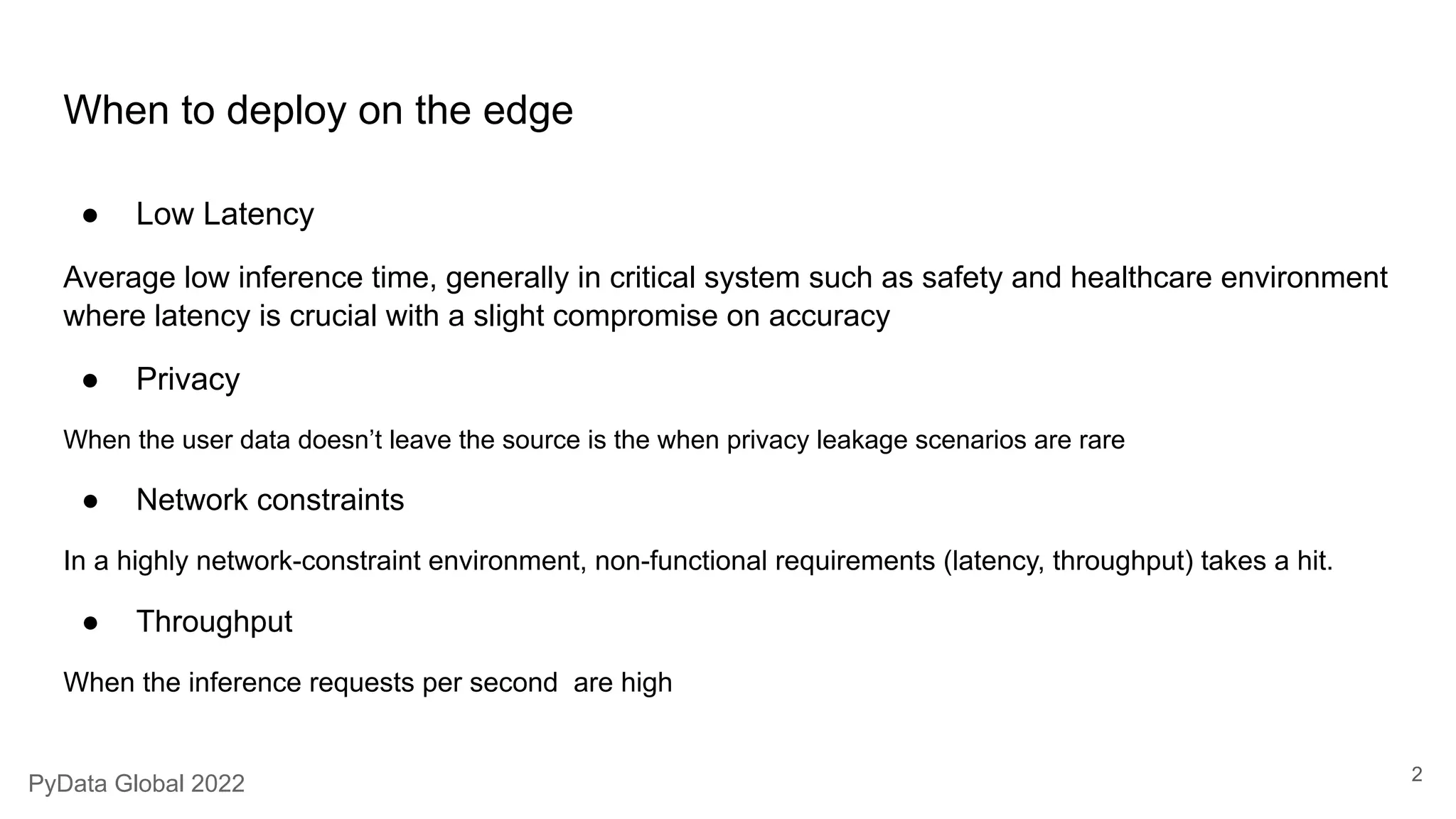
When to deploy on the edge
● Low Latency
Average low inference time, generally in critical system such as safety and healthcare environment
where latency is crucial with a slight compromise on accuracy
● Privacy
When the user data doesn’t leave the source is the when privacy leakage scenarios are rare
● Network constraints
In a highly network-constraint environment, non-functional requirements (latency, throughput) takes a hit.
● Throughput
When the inference requests per second are high
2
PyData Global 2022
Patterns
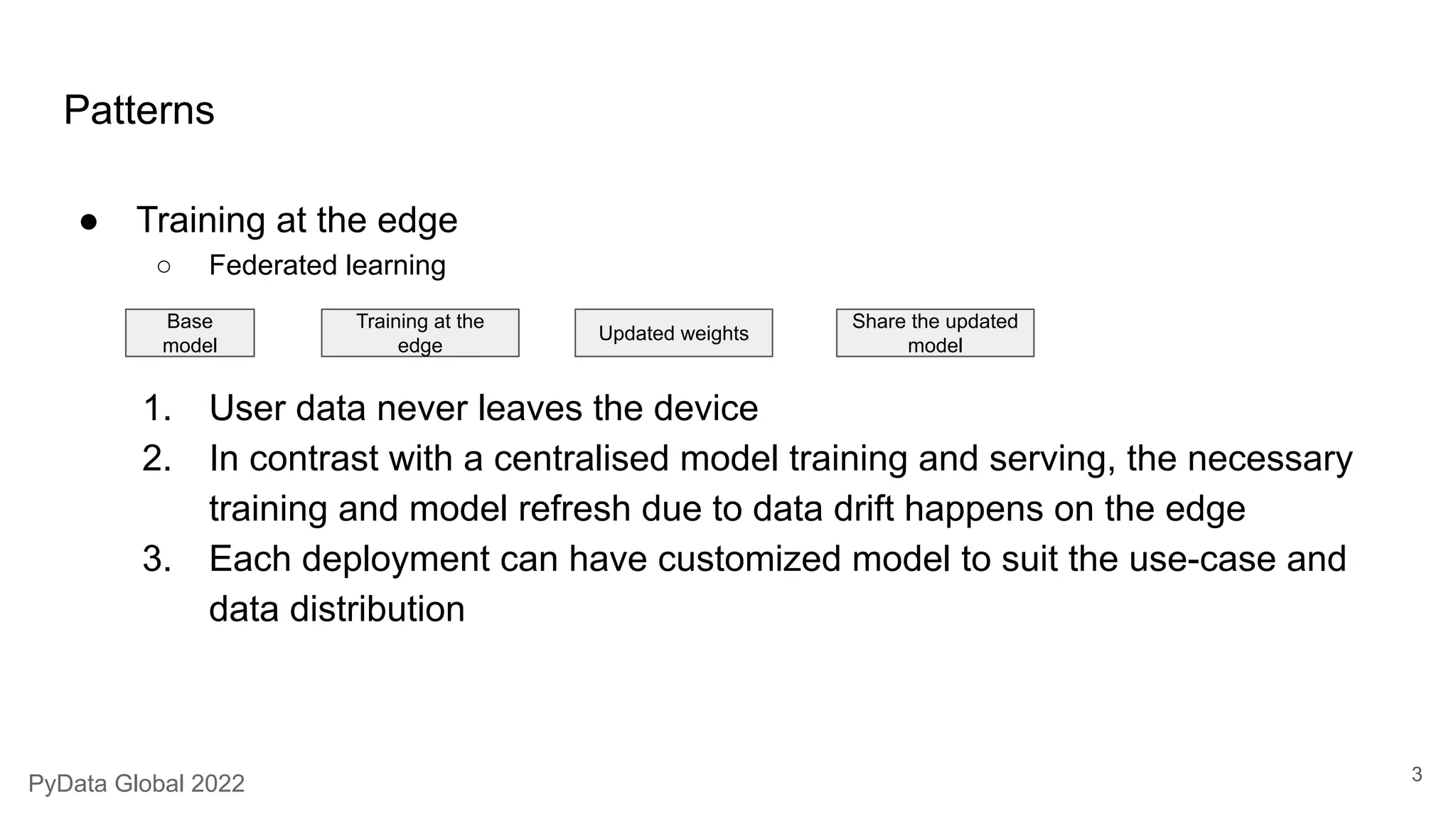
● Training at the edge
○ Federated learning
1. User data never leaves the device
2. In contrast with a centralised model training and serving, the necessary
training and model refresh due to data drift happens on the edge
3. Each deployment can have customized model to suit the use-case and
data distribution
Training at the
edge
Updated weights
Base
model
Share the updated
model
3
PyData Global 2022
Patterns
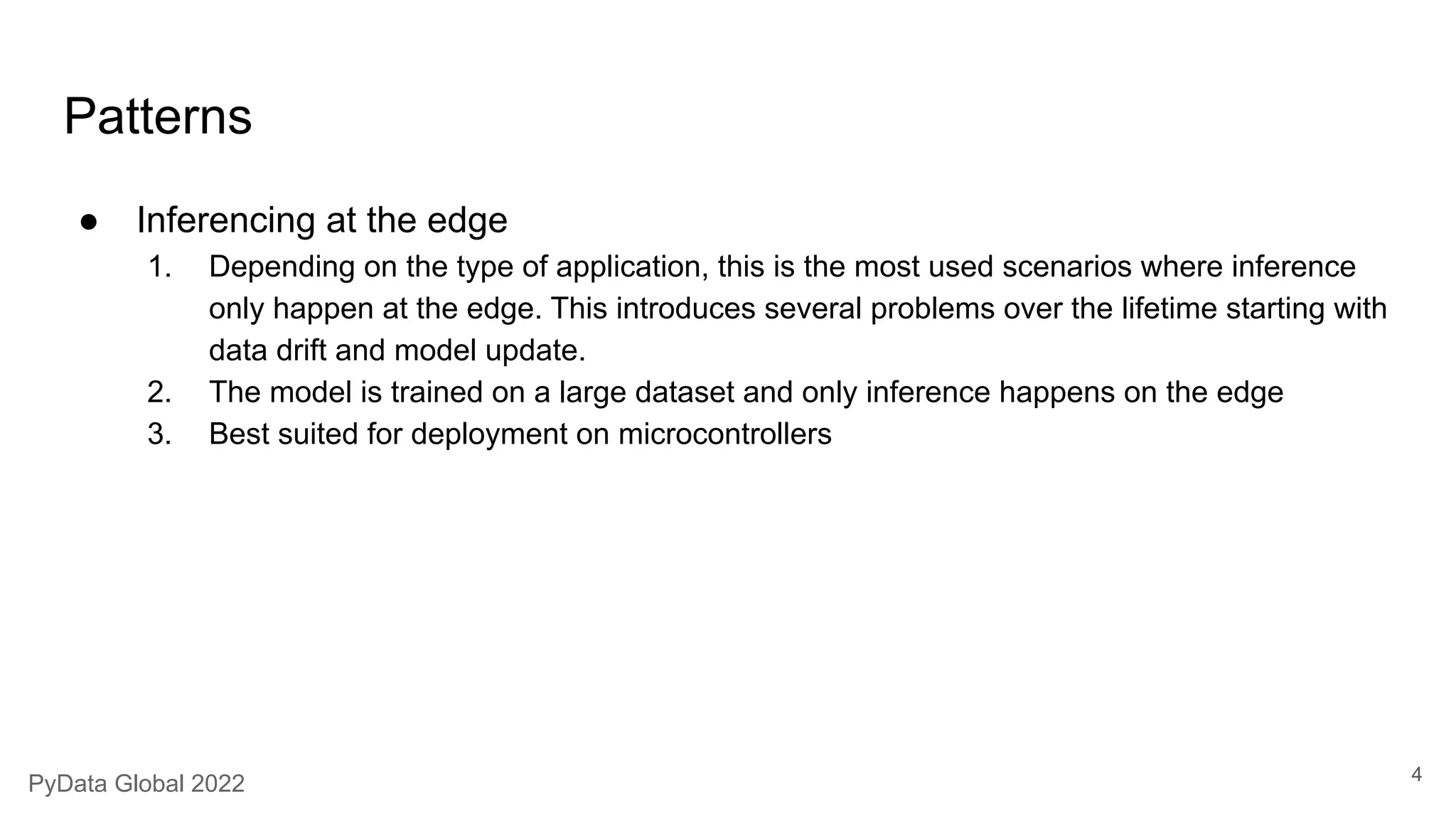
● Inferencing at the edge
1. Depending on the type of application, this is the most used scenarios where inference
only happen at the edge. This introduces several problems over the lifetime starting with
data drift and model update.
2. The model is trained on a large dataset and only inference happens on the edge
3. Best suited for deployment on microcontrollers
4
PyData Global 2022
Model quantization
What
Reduce the floating-point precision to store the model parameters from 32-bit to 16-bit or 8-bit
Why
● Reduce memory footprint
● Reduce memory usage
Drawbacks
● Reduced accuracy dependending on the type of quantization
● (Full integer quantization with int16 activations and int8 weights)[3]
● But how much size is reduced
● All most 4x reduction in models with primarily convolution layers[5]
5
PyData Global 2022
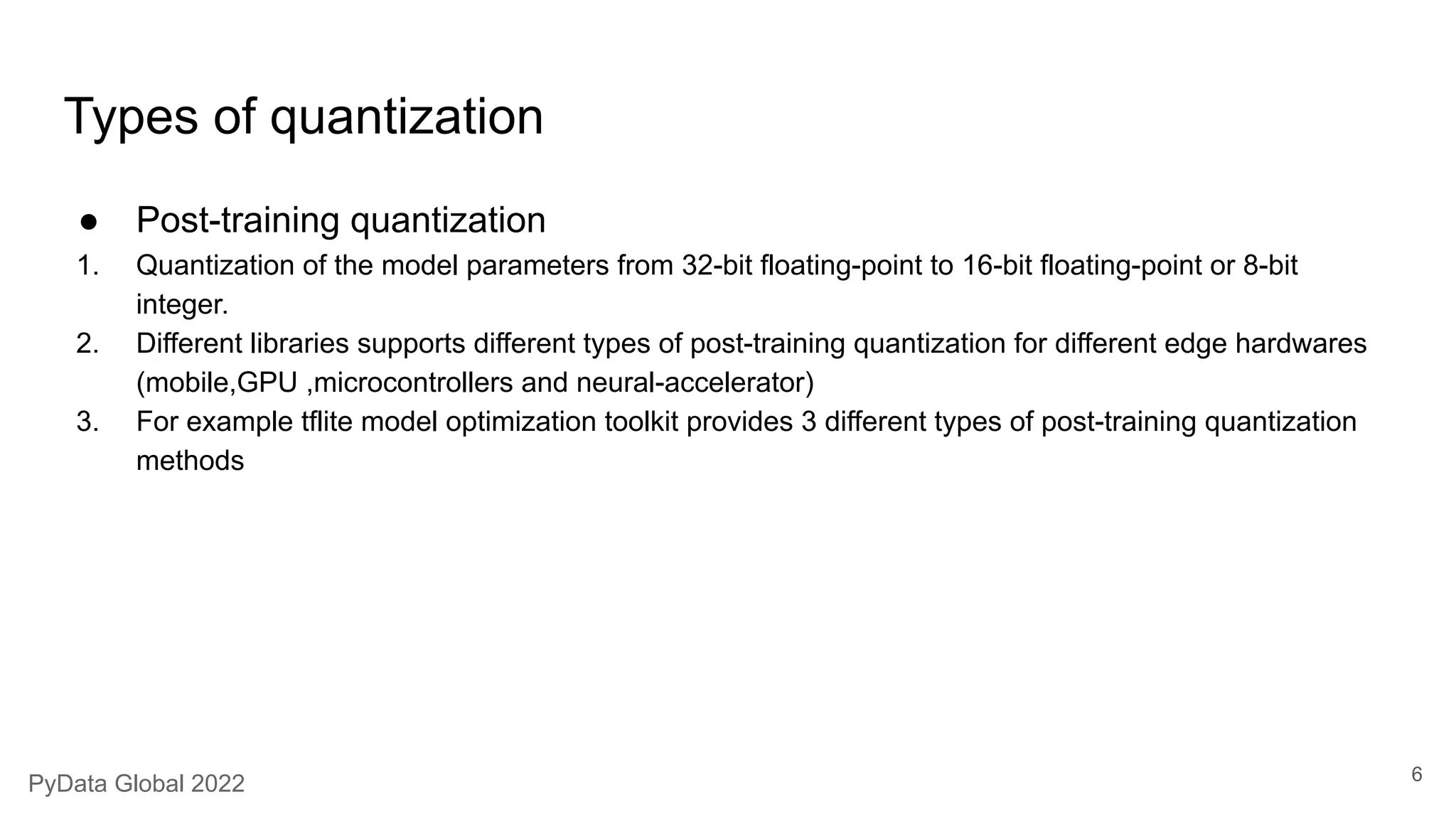
Types of quantization
● Post-training quantization
1. Quantization of the model parameters from 32-bit floating-point to 16-bit floating-point or 8-bit
integer.
2. Different libraries supports different types of post-training quantization for different edge hardwares
(mobile,GPU ,microcontrollers and neural-accelerator)
3. For example tflite model optimization toolkit provides 3 different types of post-training quantization
methods
6
PyData Global 2022
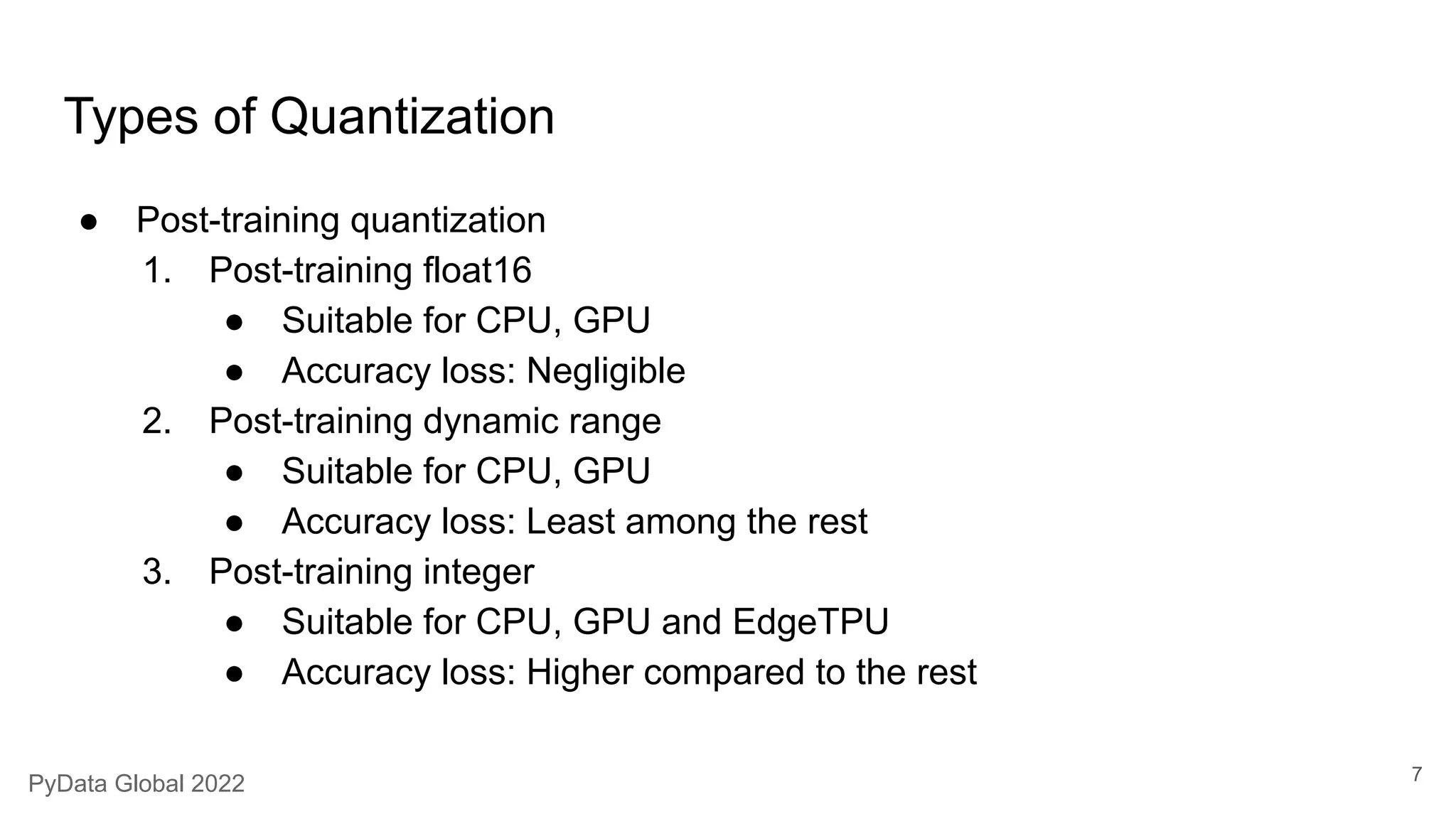
Types of Quantization
● Post-training quantization
1. Post-training float16
● Suitable for CPU, GPU
● Accuracy loss: Negligible
2. Post-training dynamic range
● Suitable for CPU, GPU
● Accuracy loss: Least among the rest
3. Post-training integer
● Suitable for CPU, GPU and EdgeTPU
● Accuracy loss: Higher compared to the rest
7
PyData Global 2022
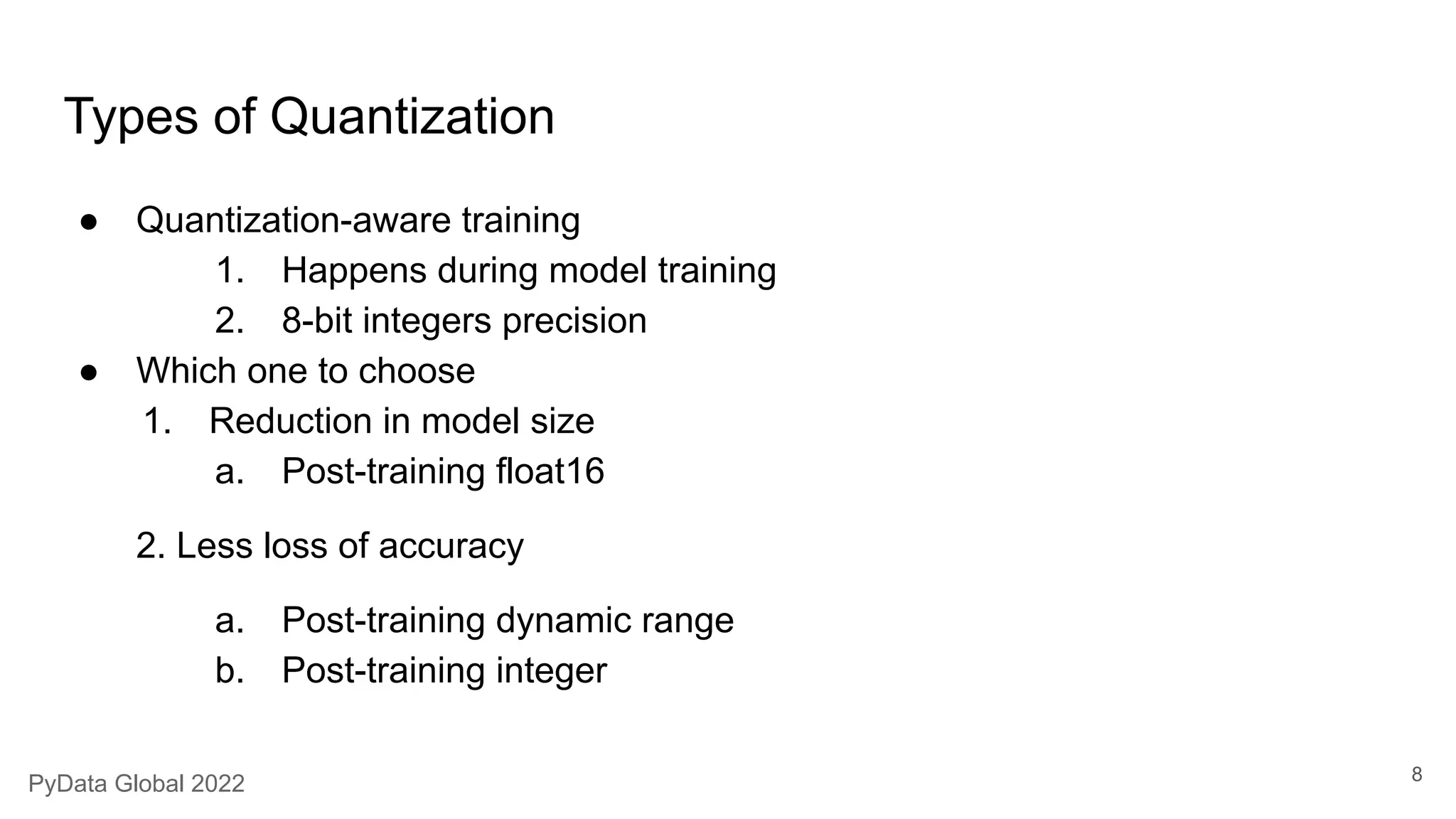
Types of Quantization
● Quantization-aware training
1. Happens during model training
2. 8-bit integers precision
● Which one to choose
1. Reduction in model size
a. Post-training float16
2. Less loss of accuracy
a. Post-training dynamic range
b. Post-training integer
8
PyData Global 2022
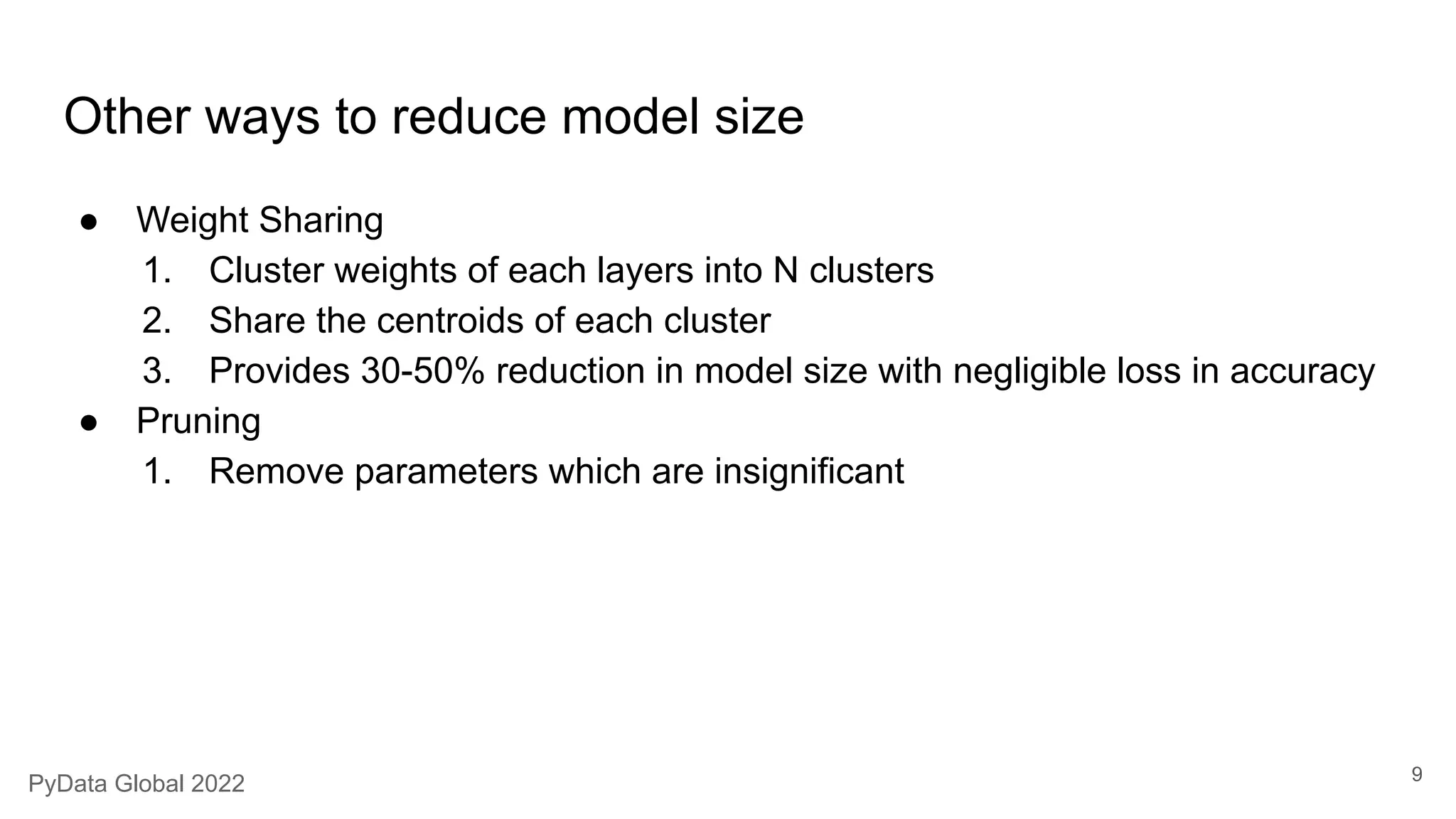
Other ways to reduce model size
● Weight Sharing
1. Cluster weights of each layers into N clusters
2. Share the centroids of each cluster
3. Provides 30-50% reduction in model size with negligible loss in accuracy
● Pruning
1. Remove parameters which are insignificant
9
PyData Global 2022
Benchmarks
1. Benchmark results of the recent Tiny MLPerf v0.7 [Link][Paper]
2. EdgeTPU benchmark result of different neural net architectures [Link]
10
PyData Global 2022
References
1. https://www.tensorflow.org/lite/performance/model_optimization#quantization
2. https://www.tensorflow.org/model_optimization/guide/clustering#results
3. https://www.tensorflow.org/lite/performance/model_optimization#full_integer_
quantization_with_int16_activations_and_int8_weights
4. https://www.tensorflow.org/model_optimization/guide/quantization/training#res
ults
5. https://blog.tensorflow.org/2018/09/introducing-model-optimization-toolkit.html
11
PyData Global 2022
Thank You
12
PyData Global 2022
/in/saradindusengupta
@iamsaradindu /saradindusengupta

PyData Global 2022 - Things I learned while running neural networks on microcontroller

  • 1.
    Things I learnedwhile running neural networks on microcontroller Saradindu Sengupta PyData Global 2022 Senior ML Engineer @Nunam Where I work on building learning systems to forecast health and failure of Li-ion batteries.
  • 2.
    When to deployon the edge ● Low Latency Average low inference time, generally in critical system such as safety and healthcare environment where latency is crucial with a slight compromise on accuracy ● Privacy When the user data doesn’t leave the source is the when privacy leakage scenarios are rare ● Network constraints In a highly network-constraint environment, non-functional requirements (latency, throughput) takes a hit. ● Throughput When the inference requests per second are high 2 PyData Global 2022
  • 3.
    Patterns ● Training atthe edge ○ Federated learning 1. User data never leaves the device 2. In contrast with a centralised model training and serving, the necessary training and model refresh due to data drift happens on the edge 3. Each deployment can have customized model to suit the use-case and data distribution Training at the edge Updated weights Base model Share the updated model 3 PyData Global 2022
  • 4.
    Patterns ● Inferencing atthe edge 1. Depending on the type of application, this is the most used scenarios where inference only happen at the edge. This introduces several problems over the lifetime starting with data drift and model update. 2. The model is trained on a large dataset and only inference happens on the edge 3. Best suited for deployment on microcontrollers 4 PyData Global 2022
  • 5.
    Model quantization What Reduce thefloating-point precision to store the model parameters from 32-bit to 16-bit or 8-bit Why ● Reduce memory footprint ● Reduce memory usage Drawbacks ● Reduced accuracy dependending on the type of quantization ● (Full integer quantization with int16 activations and int8 weights)[3] ● But how much size is reduced ● All most 4x reduction in models with primarily convolution layers[5] 5 PyData Global 2022
  • 6.
    Types of quantization ●Post-training quantization 1. Quantization of the model parameters from 32-bit floating-point to 16-bit floating-point or 8-bit integer. 2. Different libraries supports different types of post-training quantization for different edge hardwares (mobile,GPU ,microcontrollers and neural-accelerator) 3. For example tflite model optimization toolkit provides 3 different types of post-training quantization methods 6 PyData Global 2022
  • 7.
    Types of Quantization ●Post-training quantization 1. Post-training float16 ● Suitable for CPU, GPU ● Accuracy loss: Negligible 2. Post-training dynamic range ● Suitable for CPU, GPU ● Accuracy loss: Least among the rest 3. Post-training integer ● Suitable for CPU, GPU and EdgeTPU ● Accuracy loss: Higher compared to the rest 7 PyData Global 2022
  • 8.
    Types of Quantization ●Quantization-aware training 1. Happens during model training 2. 8-bit integers precision ● Which one to choose 1. Reduction in model size a. Post-training float16 2. Less loss of accuracy a. Post-training dynamic range b. Post-training integer 8 PyData Global 2022
  • 9.
    Other ways toreduce model size ● Weight Sharing 1. Cluster weights of each layers into N clusters 2. Share the centroids of each cluster 3. Provides 30-50% reduction in model size with negligible loss in accuracy ● Pruning 1. Remove parameters which are insignificant 9 PyData Global 2022
  • 10.
    Benchmarks 1. Benchmark resultsof the recent Tiny MLPerf v0.7 [Link][Paper] 2. EdgeTPU benchmark result of different neural net architectures [Link] 10 PyData Global 2022
  • 11.
    References 1. https://www.tensorflow.org/lite/performance/model_optimization#quantization 2. https://www.tensorflow.org/model_optimization/guide/clustering#results 3.https://www.tensorflow.org/lite/performance/model_optimization#full_integer_ quantization_with_int16_activations_and_int8_weights 4. https://www.tensorflow.org/model_optimization/guide/quantization/training#res ults 5. https://blog.tensorflow.org/2018/09/introducing-model-optimization-toolkit.html 11 PyData Global 2022
  • 12.
    Thank You 12 PyData Global2022 /in/saradindusengupta @iamsaradindu /saradindusengupta