


















www.pwc.co.uk

Unlocking
Potential:
Finance effectiveness
benchmark study
2013
October 2013
Today’s top tier finance
functions are increasingly
called upon to fill diverse
roles. In addition to their
traditional accounting and
reporting duties, today’s
modern finance groups
must now provide thought
leadership, generate
insights from increasingly
diverse data, spearhead
finance-business
partnerships, and assume a
more central role in
corporate business strategy.
How are top tier finance
functions evolving to meet
these challenges?
Contents
Introduction ������������������������������������������������������������������������������������������������������������������������������ 4
Overview������������������������������������������������������������������������������������������������������������������������������������ 7
Finance supporting the business��������������������������������������������������������������������������������������������� 8
Business insight������������������������������������������������������������������������������������������������������������������������ 12
Human talent �������������������������������������������������������������������������������������������������������������������������� 18
Technology ������������������������������������������������������������������������������������������������������������������������������26
The key to future finance evolution��������������������������������������������������������������������������������������34
The nexus of insight, efficiency and human talent�������������������������������������������������������������� 41
The model of success ��������������������������������������������������������������������������������������������������������������44
Case studies  insights
PGE – Driving actionable insights. . . . . . . . . . . . . . . . . . . . . . . . . . . . . . . . . . . . . . . . . . . 10
BD – Business leaders, not just partners . . . . . . . . . . . . . . . . . . . . . . . . . . . . . . . . . . . . . . . 14
Facing adaptive challenges. . . . . . . . . . . . . . . . . . . . . . . . . . . . . . . . . . . . . . . . . . . . . . . . . . 16
Finding  nurturing talent . . . . . . . . . . . . . . . . . . . . . . . . . . . . . . . . . . . . . . . . . . . . . . . . . . 21
Workforce intelligence – Stepping stones to improved workforce ROI . . . . . . . . . . . . . . 22
British American Tobacco – Unlocking time and value. . . . . . . . . . . . . . . . . . . . . . . . . . . 24
Skandia – Streamlining the system . . . . . . . . . . . . . . . . . . . . . . . . . . . . . . . . . . . . . . . . . . . 29
A silver lining for every cloud?. . . . . . . . . . . . . . . . . . . . . . . . . . . . . . . . . . . . . . . . . . . . . . . 30
Jaguar Land Rover – Cashing up the plan. . . . . . . . . . . . . . . . . . . . . . . . . . . . . . . . . . . . . . 32
Corning – Successfully bringing shared services to China . . . . . . . . . . . . . . . . . . . . . . . . 36
Treasury in emerging markets . . . . . . . . . . . . . . . . . . . . . . . . . . . . . . . . . . . . . . . . . . . . . . . 38
Lean into finance – A different way to lead a finance organisation . . . . . . . . . . . . . . . . . 42
2 | Finance effectiveness benchmark study 2013 | PwC
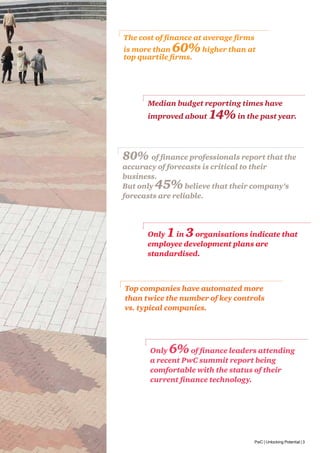
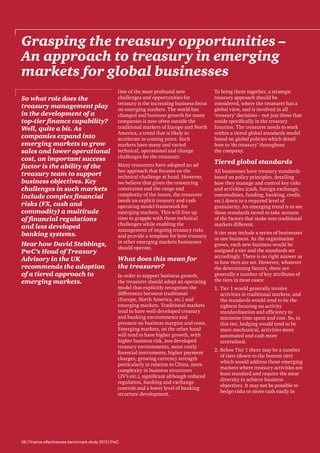
The cost of finance at average firms

60% higher than at

is more than
top quartile firms.

Median budget reporting times have
improved about

14% in the past year.

80% of finance professionals report that the
accuracy of forecasts is critical to their
business.
believe that their company’s
But only
forecasts are reliable.

45%

1 3

Only in organisations indicate that
employee development plans are
standardised.

Top companies have automated more
than twice the number of key controls
vs. typical companies.

6%

Only
of finance leaders attending
a recent PwC summit report being
comfortable with the status of their
current finance technology.

PwC | Unlocking Potential | 3
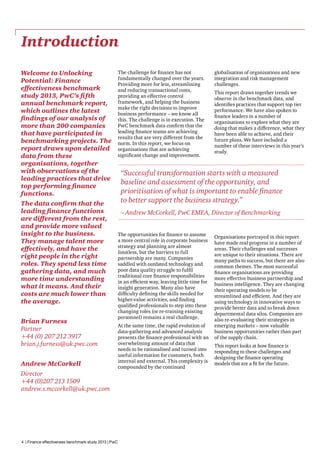
Introduction
Welcome to Unlocking
Potential: Finance
effectiveness benchmark
study 2013, PwC’s fifth
annual benchmark report,
which outlines the latest
findings of our analysis of
more than 200 companies
that have participated in
benchmarking projects. The
report draws upon detailed
data from these
organisations, together
with observations of the
leading practices that drive
top performing finance
functions.
The data confirm that the
leading finance functions
are different from the rest,
and provide more valued
insight to the business.
They manage talent more
effectively, and have the
right people in the right
roles. They spend less time
gathering data, and much
more time understanding
what it means. And their
costs are much lower than
the average.
Brian Furness
Partner
+44 (0) 207 212 3917
brian.j.furness@uk.pwc.com
Andrew McCorkell
Director
+44 (0)207 213 1509
andrew.s.mccorkell@uk.pwc.com

4 | Finance effectiveness benchmark study 2013 | PwC

The challenge for finance has not
fundamentally changed over the years.
Providing more for less, streamlining
and reducing transactional costs,
providing an effective control
framework, and helping the business
make the right decisions to improve
business performance – we know all
this. The challenge is in execution. The
PwC benchmark data confirm that the
leading finance teams are achieving
results that are very different from the
norm. In this report, we focus on
organisations that are achieving
significant change and improvement.

globalisation of organisations and new
integration and risk management
challenges.
This report draws together trends we
observe in the benchmark data, and
identifies practices that support top tier
performance. We have also spoken to
finance leaders in a number of
organisations to explore what they are
doing that makes a difference, what they
have been able to achieve, and their
future plans. We have included a
number of these interviews in this year’s
study.

“Successful transformation starts with a measured
baseline and assessment of the opportunity, and
prioritisation of what is important to enable finance
to better support the business strategy.”
– Andrew McCorkell, PwC EMEA, Director of Benchmarking
The opportunities for finance to assume
a more central role in corporate business
strategy and planning are almost
limitless, but the barriers to full
partnership are many. Companies
saddled with outdated technology and
poor data quality struggle to fulfil
traditional core finance responsibilities
in an efficient way, leaving little time for
insight generation. Many also have
difficulty defining the skills needed for
higher-value activities, and finding
qualified professionals to step into these
changing roles (or re-training existing
personnel) remains a real challenge.
At the same time, the rapid evolution of
data-gathering and advanced analysis
presents the finance professional with an
overwhelming amount of data that
needs to be rationalised and turned into
useful information for customers, both
internal and external. This complexity is
compounded by the continued

Organisations portrayed in this report
have made real progress in a number of
areas. Their challenges and successes
are unique to their situations. There are
many paths to success, but there are also
common themes. The most successful
finance organisations are providing
more effective business partnership and
business intelligence. They are changing
their operating models to be
streamlined and efficient. And they are
using technology in innovative ways to
provide better data and to break down
departmental data silos. Companies are
also re-evaluating their strategies in
emerging markets – now valuable
business opportunities rather than part
of the supply chain.
This report looks at how finance is
responding to these challenges and
designing the finance operating
models that are a fit for the future.
How we rate finance functions
As finance functions seek to keep pace
with mounting business and regulatory
demands, our benchmark analysis can
provide a clear assessment of strengths,
weaknesses and areas for improvement
– a baseline from which to measure
progress. The analysis combines a
qualitative assessment
and comparative metrics across the
complementary dimensions of
business insight, efficiency,
compliance and control.
Business insight looks at evaluations
such as a comparison of time spent on
analysis and data gathering and an
assessment of budgeting and forecasting
processes and the quality
of their outputs.
Efficiency analyses transactional
processes using a range of key
determinants including the complexity
of systems and time to close/report.

Compliance and control examines
such areas as tax compliance, treasury,
audit and risk management.
The resulting analysis not only compares
these ratings against your peers, but also
seeks to assess whether they are
operating in equilibrium and are
meeting the overall objectives of the
business. For example, over-emphasising
cost may, in some companies, inhibit the
function’s ability to provide insight
and value.
Benchmarking is an important
component of PwC projects, and
involves gathering (in strict confidence)
a full and accurate baseline of efficiency
and effectiveness metrics related to the
client’s finance function. In each case,
we work with clients on a process-byprocess basis to understand how these
results are achieved. The benchmarking
of finance forms part of PwC’s wider

benchmark services covering a range of
integrated support areas. In addition to
finance benchmarking, PwC also
provides benchmarking services specific
to:
•	 SGA
•	 Human Resources
•	 Information Technology
•	 Procurement
•	 Supply Chain
•	 Innovation
If you would like to complete a
benchmark assessment or would like to
discuss any of the issues raised in this
report, please contact your local PwC
representative.

PwC | Unlocking Potential | 5
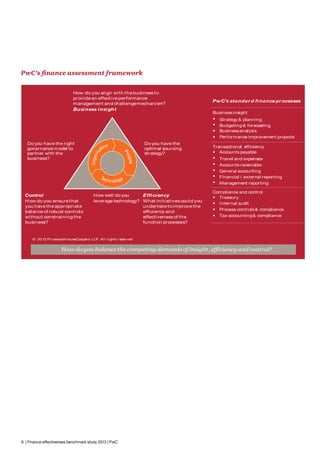
PwC’s finance assessment framework

Do you have the right
governance model to
partner with the
business?

Control
H ow do you ensure that
you have the appropriate
balance of robust controls
without constraining the
business?

s

How do you align with the business to
provide an effective performance
management and challenge mechanism?
Busi ness i nsi ght

Do you have the
optimal sourcing
strategy?

How well do you
Effi ci ency
leverage technology? What initiatives could you
undertake to improve the
efficiency and
effectiveness of the
function processes?

Pw C’s sta nda r d fi na nce pr ocesses
Business insight
• Strategy  planning
• Budgeting  forecasting
• Business analysis
• Performance improvement projects
Transactional efficiency
• Accounts payable
• Travel and expenses
• Accounts receivable
• General accounting
• Financial / external reporting
• Management reporting
Compliance and control
• Treasury
• I nternal audit
• Process controls  compliance
• Tax accounting  compliance

© 20 13 Pr i cewater houseCooper s LLP. Al l r i ghts r eser ved

How do you balance the competing demands of insight, efficiency and control?

Unlocking Potential

6 | Finance effectiveness benchmark study 2013 | PwC

6
Overview
The potential gains to be realised by the
synergy between a fully evolved finance
organisation and the business at large
are compelling. Unlocking this potential
is a task that requires attention to a
number of critical components.
Companies that are able to lead this
evolution will likely realise cost
efficiencies, more timely and accurate
forecasting, truly informative
management reports, and significant
operational gains through improved
decision making and a real partnership
between finance and the business units.
Achieving this leading performance
does not necessarily mean that finance
costs need to rise. Finance cost as a
percentage of revenue has stabilised this
year following several years of growth
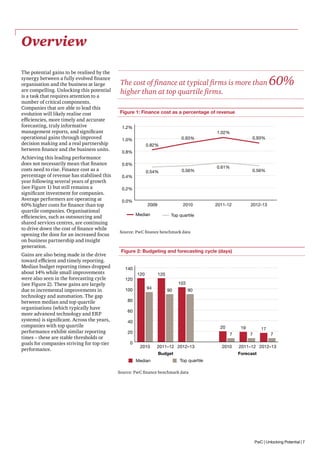
(see Figure 1) but still remains a
significant investment for companies.
Average performers are operating at
60% higher costs for finance than top
quartile companies. Organisational
efficiencies, such as outsourcing and
shared services centres, are continuing
to drive down the cost of finance while
opening the door for an increased focus
on business partnership and insight
generation.
Gains are also being made in the drive
toward efficient and timely reporting.
Median budget reporting times dropped
about 14% while small improvements
were also seen in the forecasting cycle
(see Figure 2). These gains are largely
due to incremental improvements in
technology and automation. The gap
between median and top quartile
organisations (which typically have
more advanced technology and ERP
systems) is significant. Across the years,
companies with top quartile
performance exhibit similar reporting
times – these are stable thresholds or
goals for companies striving for top-tier
performance.

The cost of finance at typical firms is more than
higher than at top quartile firms.

60%

Figure 1: Finance cost as a percentage of revenue
1.2%

1.02%
0.93%

0.93%

1.0%
0.82%
0.8%
0.6%
0.54%

2009

0.4%

0.56%

2010

0.61%

0.56%

0.2%
0.0%

Median

2011-12

2012-13

Top quartile

Source: PwC finance benchmark data

Figure 2: Budgeting and forecasting cycle (days)
140
120
100

120

120
94

103
90

90

80
60
40
20

20
0

19
7

2010

2011–12 2012–13
Budget

Median

2010

17

7

7

2011–12 2012–13
Forecast

Top quartile

Source: PwC finance benchmark data

PwC | Unlocking Potential | 7
Finance supporting the business
Finance functions today are generally
succeeding in their traditional role of
supporting the business. Finance
professionals and the consumers of their
services within companies view finance
departments as strong in their standard
functions of general accounting (i.e.,
reconciling and consolidating corporate
financial information) and external
reporting (i.e., preparing consolidated
financial information to meet external
regulations). Three in four companies
also see business and finance strategies
sharing the same objectives and being
closely aligned.
However, finance functions are
struggling in two significant areas
related to business insight. One place
this is revealed is in PwC benchmarking
engagements, where finance
professionals and their ‘customers’
across the business
are asked to rate the various
services that finance provides for
importance, and for performance.
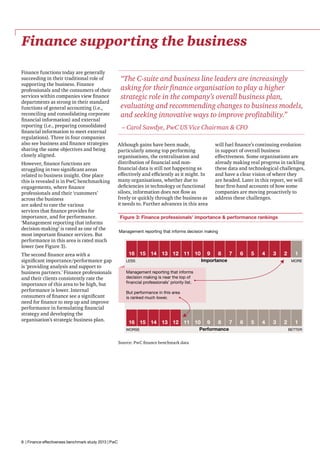
‘Management reporting that informs
decision-making’ is rated as one of the
most important finance services. But
performance in this area is rated much
lower (see Figure 3).
The second finance area with a
significant importance/performance gap
is ‘providing analysis and support to
business partners.’ Finance professionals
and their clients consistently rate the
importance of this area to be high, but
performance is lower. Internal
consumers of finance see a significant
need for finance to step up and improve
performance in formulating financial
strategy and developing the
organisation’s strategic business plan.

“The C-suite and business line leaders are increasingly
asking for their finance organisation to play a higher
strategic role in the company’s overall business plan,
evaluating and recommending changes to business models,
and seeking innovative ways to improve profitability.”
– Carol Sawdye, PwC US Vice Chairman  CFO
Although gains have been made,
particularly among top performing
organisations, the centralisation and
distribution of financial and nonfinancial data is still not happening as
effectively and efficiently as it might. In
many organisations, whether due to
deficiencies in technology or functional
siloes, information does not flow as
freely or quickly through the business as
it needs to. Further advances in this area

Figure 3: Finance professionals’ importance  performance rankings
Management reporting that informs decision making

16 15 14 13 12 11 10

9

8

7

6

5

4

3

2

Importance

LESS

1
MORE

Management reporting that informs
decision making is near the top of
financial professionals’ priority list.
But performance in this area
is ranked much lower.

16 15 14 13 12 11 10
WORSE

Source: PwC finance benchmark data

8 | Finance effectiveness benchmark study 2013 | PwC

will fuel finance’s continuing evolution
in support of overall business
effectiveness. Some organisations are
already making real progress in tackling
these data and technological challenges,
and have a clear vision of where they
are headed. Later in this report, we will
hear first-hand accounts of how some
companies are moving proactively to
address these challenges.

9

8

Performance

7

6

5

4

3

2

1
BETTER
Finance’s evolution from
support service to
change agent
Finance has traditionally served as a
corporate support function, reacting to
the company’s tactical needs, rather
than acting as the creative force behind
insight and change. However, many
companies have experienced finance
taking a more active role in driving
business performance and strategy.
About 2 in 5 (42%) companies see
finance as a facilitator in the strategic
planning process, rather than merely
playing a supporting role. Meanwhile,
about half (53%) of benchmarking
clients see finance working closely with
the CEO in developing the company’s
business strategy.
Finance organisations are transitioning
from a focus on accounting to advanced
budgeting and planning. By successfully
mastering the necessary closing tasks
and increasing both speed and accuracy,
finance has been invited to address
broader questions, such as ‘what are the
best KPIs for measuring success?’ and
‘how can the organisation match the
budgeting and planning process to client
needs?’
Additionally, organisations are realising
that they cannot effectively manage the
business by finance metrics alone. Many
additional pools of data are becoming
available (both internal and external to
companies). More insightful finance
functions are increasingly using nonfinancial data (such as customer
satisfaction and product information) to
identify areas where company
performance can be improved or costs
can be reduced. The finance team at one
innovative PwC client forecasts call
centre traffic, and utilises that as one of
the factors to optimise staffing levels.
Other innovative clients track their
consumer preference rankings, and
conduct modelling to identify the factors
that can improve their rank.

PwC | Unlocking Potential | 9
PGE – Driving actionable insights
The finance organisation
at Pacific Gas and Electric
(PGE) has evolved from
a transaction-based
reporting organisation
to a provider of actionable
business insights. Jason
Wells, Vice President of
Finance, talked with us
about this transformation
and about the benefits that
PGE is reaping as a
result.

PGE is one of the largest energy utility
companies in the United States.
Approximately 20,000 employees carry
out its primary business – the supply,
transmission and delivery of energy. The
company provides natural gas and
electric service to approximately 15
million people throughout a 70,000
square mile service area in northern and
central California.
PGE has a leading finance organisation
that has begun to reap the rewards of
moving past governance and reporting
to realise the benefits of truly partnering
with the business to drive performance.
Jason Wells explains that several years
ago PGE realised that the finance
organisation was spending too much
time on transactional activities, monthly
reports, annual budgets and forecasts.
This got in the way of providing
actionable insights to the organisation.
Mr. Wells describes how two years ago
they began to simplify the planning
process. PGE upgraded to a new SAP
product and then took a step back to
redesign the planning process, spending
a year and a half on system performance
and stabilisation to make both the
processes and the technology work
faster, better, and more efficiently.
Through this transformation, Mr. Wells
explains, the most significant
improvements were process-driven,
rather than technology driven. PGE
considered what was being tracked, as
well as how.
For example, the finance organisation
found that they had previously devoted
substantial time to forecasting a number
of items at a very granular level.
However, the granular forecasts were
not very accurate, and really not
necessary for decision-making.
Forecasting at a less granular level was
very simple, much more accurate, and
more appropriate for decision-making.
Mr. Wells listed several processes that
this granularity issue applied to: it’s
better to budget projects at a ‘planning

10 | Finance effectiveness benchmark study 2013 | PwC

order level’ than at the detailed ‘work
order level,’ and it’s better to forecast
overall ancillary employee-related costs
and not items such as specific employeelevel parking costs. The finance team
changed the granularity of their
forecasts and spent the saved time
developing greater insights into the
factors driving the costs.
Mr. Wells explains that PGE has
continued to build on this decision and
centralised its finance personnel to
create finance centre of excellence. This
reduced costs and improved the sharing
of leading practices. Now, the company
continues to build on that success,
rolling out new finance improvements
quickly via this centralised centre. Mr.
Wells stressed that, while the centre is
centralised, finance personnel are
encouraged to maintain a strong
relationship with the rest of the
organisation through field visits,
ride-alongs, and trips to power plants
and substations. This keeps the finance
staff connected to the rest of the
company and improves understanding,
which supports finance’s evolving role as
a business partner.
PGE has also adjusted hiring and
training practices, as the new drive
toward providing insight demanded
employees with new skill sets. In
addition to individuals with the core
base of traditional finance, PGE began
to hire finance employees from different
disciplines, creating a more diversified
team. Individuals from operations
research and IT backgrounds were hired
to bring a more data-driven focus, as
well as the background to improve
systems and find more efficient
methods of reporting.
The organisation also created a culture
focused on staff development to help
existing employees fulfil their career
aspirations. Corporate-wide training
was offered in areas such as ethics,
management and completing employee
reviews. In addition, targeted training
was also developed and offered in
technical finance skills, as well as skills
such as communicating vast amounts of
data concisely and influencing
effectively. Training was geared for
employees at every level of the
organisation, increasing in complexity
as individuals moved through the
programme. This was a significant
investment for PGE, but has allowed
for steady improvement of the
finance function.

Finance as a strategic
partner
These changes throughout the finance
organisation allowed it to become more
of a strategic partner to the business
units. Over time, finance is moving
more and more into performance
management and away from simple
reporting of financial results. As a
result, PGE finance is evolving
from a transactional organisation
to one focused on generating
actionable insights.

receptive business units. Initial successes
built upon themselves and helped the
broader organisation see finance in a new
light.
One early project involved external
benchmarking to identify areas where
PGE was not contracting effectively.
This allowed the company to negotiate
more favorable terms when contracts
came up for renewal. Finance was also
able to help guide the consolidation of
contracts for better buying power.
Through this effort, PGE was able to
drive $50M in annual costs out of
business. The success of this project
enabled the business units to see finance
as a partner, rather than simply a
reporter of financial results.
Other successful projects involved
optimising travel time for maintenance
crews, unitising and optimising the costs
of routine work such as electric pole
replacements, addressing customer
satisfaction issues, and gaining a better
understanding of non-billable time. For
this last project, finance noted that

PGE finance is evolving from a transactional
organisation to one focused on generating
actionable insights.
Initially, Mr. Wells explains, the finance
organisation needed to reorient the
image of finance as being a basic
governance-focused organisation to
that of a valuable insight-generating
partner supporting the business. Finance
needed to help stakeholders understand
what they were trying to achieve
operationally and that finance was
looking at all avenues to help its partners
in all business units. This took time, but
finance slowly built credibility. They
achieved this through pilot projects with

maintenance crews had about a half
billion dollars of non-billable time each
year. However, the existing timekeeping
system only allowed knowledge capture
for about 35% of that time. Over 65% was
bucketed in an ‘other’ category. Finance
assisted the business in establishing
better timekeeping codes. Finance
partners spent time in each division to
better understand the optimal balance of
codes to capture activities without
overloading employees with possible
codes. They worked with employees in

the field to help them see which parts of
their non-billable time acted as
roadblocks getting in the way
of them doing their jobs effectively. The
new codes also resulted in better data.
Now the business units and finance are
better able to track productivity and
determine what drives productivity
problems, address those problems,
and improve efficiency.
Risk management has also been a
significant area of focus for the new
finance organisation. Three years ago,
the company’s budgeting process was
criticised for being too financially
focused and not taking sufficient account
of operational risks. Finance drove the
effort to overhaul its budget process,
more formally incorporating discussions
of risk and operational strategy into the
process. Today, there is a formalised
budgeting process which deliberately
examines operational risk well before the
technical budget discussion occurs each
year. Quantifying and reducing risk, and
helping to inform a risk-based
prioritisation of resources, have been
significant steps forward for PGE.
Through its efforts in the areas of
organisation, automation, and employee
development, PGE has realised the
transition of finance from a reporter of
financial results to a provider of
actionable insights. As a result, the
organisation has realised significant
gains in operational efficiency, strategic
prioritisation, and revenue. However, Mr.
Wells is also quick to point out that the
finance improvement process continues,
as the organisation applies these
principles to additional areas. They have
come a long way, but there is still a lot of
work to be done.

PwC | Unlocking Potential | 11
Business insight
Today’s CFO must move beyond
budgeting and control and assume the
role of a ‘Chief Performance Officer’ – to
take responsibility for driving company
performance and delivering strategic
analyses to key stakeholders, both
internal and external to the
organisation.
In a recent PwC publication titled
‘Finance Matters: Finance function of the
future,’ we noted that finance leaders
need to create the conditions for
effective navigation, which means that
rather than acting as a support function,
leading finance departments must
actively drive the organisation to its
chosen destination, while at the same
time acting as mediators to a much
broader set of stakeholders, with varied
points of view and differing
expectations1.
PwC benchmarking shows movement
towards this ideal, but remaining
challenges as well. As mentioned
previously, over 2 in 5 finance
professionals currently see finance as a
facilitator of strategic planning rather
than being relegated to a reporting role
or only performing the monthly
accounting close. Yet, unrealised
opportunities for increased coordination
between the finance function and the
business at large clearly remain, with
potential gains in the areas of high-level
corporate strategy and leveraging
additional efficiencies within the finance
function itself. Over 2 in 5 (43%) of
nearly 1,500 finance professional
benchmark participants surveyed
believe that improving collaboration
related to internal finance processes
would help make the current finance
process in their organisations
more efficient.

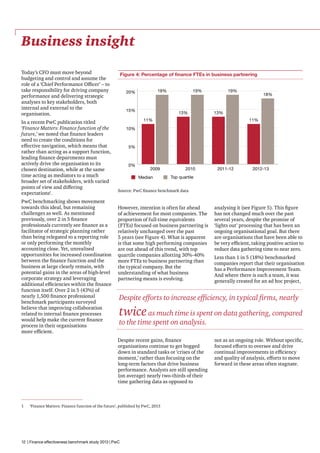
Figure 4: Percentage of finance FTEs in business partnering
19%

20%

15%

19%

13%

18%

13%

11%

11%

10%

5%

0%

2009
Median

2010

2011-12

2012-13

Top quartile

Source: PwC finance benchmark data

However, intention is often far ahead
of achievement for most companies. The
proportion of full-time equivalents
(FTEs) focused on business partnering is
relatively unchanged over the past
5 years (see Figure 4). What is apparent
is that some high performing companies
are out ahead of this trend, with top
quartile companies allotting 30%-40%
more FTEs to business partnering than
the typical company. But the
understanding of what business
partnering means is evolving.

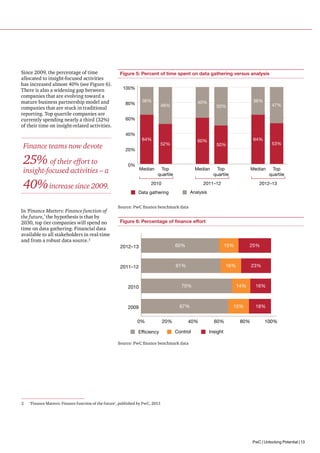
analysing it (see Figure 5). This figure
has not changed much over the past
several years, despite the promise of
‘lights out’ processing that has been an
ongoing organisational goal. But there
are organisations that have been able to
be very efficient, taking positive action to
reduce data gathering time to near zero.
Less than 1 in 5 (18%) benchmarked
companies report that their organisation
has a Performance Improvement Team.
And where there is such a team, it was
generally created for an ad hoc project,

Despite efforts to increase efficiency, in typical firms, nearly

twice as much time is spent on data gathering, compared

to the time spent on analysis.

Despite recent gains, finance
organisations continue to get bogged
down in standard tasks or ‘crises of the
moment,’ rather than focusing on the
long-term factors that drive business
performance. Analysts are still spending
(on average) nearly two-thirds of their
time gathering data as opposed to

1	

19%

‘Finance Matters: Finance function of the future’, published by PwC, 2013

12 | Finance effectiveness benchmark study 2013 | PwC

not as an ongoing role. Without specific,
focused efforts to oversee and drive
continual improvements in efficiency
and quality of analysis, efforts to move
forward in these areas often stagnate.
Since 2009, the percentage of time
allocated to insight-focused activities
has increased almost 40% (see Figure 6).
There is also a widening gap between
companies that are evolving toward a
mature business partnership model and
companies that are stuck in traditional
reporting. Top quartile companies are
currently spending nearly a third (32%)
of their time on insight-related activities.

Figure 5: Percent of time spent on data gathering versus analysis
100%
36%

80%

25% of their effort to

insight-focused activities – a

40% increase since 2009.
In ‘Finance Matters: Finance function of
the future,’ the hypothesis is that by
2030, top tier companies will spend no
time on data gathering. Financial data
available to all stakeholders in real-time
and from a robust data source.2

36%

50%

47%

60%
40%

Finance teams now devote

40%

48%

64%

60%

52%

20%
0%

Median

Top
quartile

Median

2010

64%

50%

Top
quartile

53%

Median

2011–12

Top
quartile

2012–13

Analysis

Data gathering
Source: PwC finance benchmark data

Figure 6: Percentage of finance effort

2012–13

60%

2011–12

61%

Efficiency

20%

40%
Control

23%

14%

67%

2009

25%

16%

70%

2010

0%

15%

15%
60%

80%

16%

18%
100%

120%

Insight

Source: PwC finance benchmark data

2	

‘Finance Matters: Finance function of the future’, published by PwC, 2013

PwC | Unlocking Potential | 13
BD – Business leaders, not just partners
The finance function at
Becton Dickinson and
Company (BD) has evolved
beyond business partnering
to being business leaders
within the organisation.
Analyses of the drivers of
shareholder value guide
their focus. Recently,
reacting to a slower growth
environment, they have
focused on cash metrics.
Suketu Upadhyay, Senior
Vice President, Finance
spoke with us about the
role of finance at BD, the
positive impact of their
finance leadership, and
reactions from Wall Street.

BD is a global medical technology
company that is focused on improving
drug delivery, enhancing the diagnosis
of infectious diseases and cancers, and
advancing drug discovery. BD develops,
manufactures and sells medical supplies,
devices, laboratory instruments,
antibodies, reagents and diagnostic
products through its three segments: BD
Medical, BD Diagnostics and BD
Biosciences. It serves healthcare
institutions, life sciences researchers,
clinical laboratories, the pharmaceutical
industry and the general public.
In a recent interview with PwC, Suketu
Upadhyay described finance’s leadership
and close partnering with the business
units. Mr. Upadhyay explained that the
finance function at BD is very committed
to business partnering and approaches
their partner relationships with the
business on a concierge basis. They do a
lot of ad hoc reporting for the business
units in addition to standard reporting.
They also tailor reporting to meet the
needs of BD’s six business units and eight
global regions. Finance at BD has a lot of
credibility in the organisation, which
has been built up through their excellent
work across several decades.
Now, Mr. Upadhyay states, finance
personnel need to be business leaders,
not just business partners. They have a
stake in driving the strategy of the
company. Their role is not just to provide
insight, but also to formulate opinions
and strategy, and help guide the
company based upon their fundamental
understanding of financials and how
they are linked to investor return. With
that in mind, finance personnel at BD
have spent the past year analysing the
factors which drive total shareholder
return at the business. They observed

14 | Finance effectiveness benchmark study 2013 | PwC

casual and correlational relationships
and ran regression analyses in an attempt
to link organisational metrics to overall
enterprise value. They wanted to give BD
the ability to focus on the right KPIs to
ultimately drive shareholder value.
Previously, while the business was
growing rapidly, finance’s focus had not
been on cash management. Now, however,
in a slower growth environment, finance’s
shareholder value driver analyses
revealed some surprising results: revenue
and earnings per share growth are less
related to shareholder value than cash
metrics such as return on investment
capital (ROIC) and return on total assets.
Through their analyses, they discovered
that ROIC is highly correlated with
overall firm value (R2  0.90). To take
action on this, BD’s finance team worked
to determine the levers that drive ROIC.
They wanted to know what each business
unit could do to improve performance. So
they dissected the key drivers and
partnered with the business units to
determine actions individual employees
could take to improve those metrics.
Finance personnel then worked to
communicate throughout the company
why ROIC matters and that everyone has
a part to play in its improvement.
Mr. Upadhyay explains that a year ago,
employees would not have heard of
ROIC. Today most employees know
about ROIC, and that cash is related to
shareholder value. In fact, he claims
that most would be able to tell you the
key levers will free up cash for
investment. BD has developed
reporting, increased reporting
transparency, and even incorporated
cash flow metrics into the organisation’s
employee incentive system.
Mr. Upadhyay believes that to
successfully drive organisational change
on such a large scale, one needs
evangelism, creating a clear sense of
purpose that the initiative is something
that the company needs to do, coupled
with clear, widespread communication.
You need to give the leadership team
and key employees the data that
supports your initiative and keep
putting the information in front of them.
He states that you need to be able to tell
your story in a meaningful, engaging
and entertaining way, and you need to
tell it every chance you have. You also

The current ROIC-focused initiative at
BD has been quite successful for the
company so far. Mr. Upadhyay described
how BD managers have spoken with
investment analysts about their new
ROIC-based compensation metrics and
Wall Street is excited about them. ‘BD
stock has appreciated this year, and
while it cannot be directly attributed to
the new focus on ROIC, if BD continues
to out-index its peer group, it will
ultimately translate into market
capitalisation expansion.’ Additionally,
BD’s peers and primary competitors
have begun speaking the language of

Traditionally, finance professionals are trained to acquire
analytic skills which, along with contextual knowledge
allow them to make key decisions for their organisations.
These organisational challenges, which are solved via the
application of knowledge and analysis of data, are
known as technical challenges.
need ‘surround sound,’ so that key
employees are hearing the message from
multiple sources. To this end, Mr.
Upadhyay states that you need to have
key members of the management team,
the CEO, and the CFO on board early in
the process. Creating the burning
platform for change is a critical first
step. Also, across the organisation,
working on change management
engagement is crucial. Without it, there
will be widespread resistance that will
ultimately decrease the effectiveness,
or even the viability of any finance
transformation initiative.

ROIC. There is growing awareness on
Wall Street about the importance of cash
flow metrics, and Mr. Upadhyay believes
BD’s finance initiatives have positioned
BD well to excel in this area.

PwC | Unlocking Potential | 15
Facing adaptive challenges
Mark Dawson, PwC UK Partner, has
highlighted the distinction between
technical and adaptive challenges. He
points out that as the finance function
evolves, finance professionals are
increasingly presented with adaptive,
rather than technical challenges.
Traditionally, finance professionals are
trained to acquire analytic skills which,
along with contextual knowledge allow
them to make key decisions for their
organisations. These organisational
challenges, which are solved via the
application of knowledge and analysis of
data, are known as technical challenges.
However, more and more, especially
among the higher levels of finance
organisations, professionals are required
to make decisions about situations for
which the data either doesn’t exist, is
contradictory, or is simply
overwhelming. They must extrapolate
beyond their data, sometimes making
large strategic decisions, relying on their
experience and intuition to choose an
optimal solution among a series of
possible solutions, some slightly better
and some worse. They must learn to face
these adaptive challenges – to manage
this uncertainty and find a comfort level
in decision-making in the absence of
firm data.

The CFO of a global engine
manufacturer spoke recently at a PwC
event, describing an adaptive challenge
that he faced more than a decade ago.
His challenge was to bid on an engine
contract for the next generation widebody jets. There were several aspects of
uncertainty that made the bidding
decision a high-stakes adaptive
challenge. First, at the time, airline
manufacturers were driving a hard
bargain on price. They were asking their
engine partners to agree to prices that,
using traditional analytic techniques,
appeared to leave no potential for profit.
Additionally, they required guarantees
that the engines (which were in the
design phase, so they did not yet exist)
would meet certain performance
standards. Further, they knew they
would need to finance the airlines’
ultimate purchases, which required
projections about the financial markets
several decades into the future.
The adaptive challenge was to
incorporate uncertain future
technological step changes into the cost
and risk profiles that must underpin the
best offer price. In addition, industry
trends suggested that failure to enter the
wide body market at the start of the
transition to the next generation design
would lock the company out of the
fastest growing sector of its market
for decades.

16 | Finance effectiveness benchmark study 2013 | PwC

Despite a general lack of data enabling
traditional analytics, the organisation
decided that this contract had the
potential to be extremely successful
and profitable in the long-term. They
went forward with their bid, and won
the contract. Today, their engines lead
the wide body market and the
organisation has realised billions in cash
flow for investors due to this
courageous decision.
Mark Dawson confirms that today’s
CFOs require different skills to handle
adaptive challenges. ‘It is a paradox that
we have more and better organised data
than ever, but the nature of big decisions
requires CFOs to move beyond using
data to provide answers. Of course data
is fundamental in supporting judgment,
but this judgment often seeks to
reconcile conflicting or incomplete data.
The role of the CFO is to have the
best-informed hunch around the
executive table and to make explicit the
decision making process of the whole
team.’
Mark Dawson is a PwC UK Consulting
Partner who advises boards and CEOs of
FTSE 100 firms and global leaders in
financial services, oil and gas, and retail
industries seeking to align strategy and
leadership with supporting business and
HR processes and practices.
PwC | Unlocking Potential | 17
Human talent
To build on reliable data and reporting
and turn that in to real insight,
companies need experienced, creative
and highly skilled finance professionals.
Yet companies continue to struggle to
find and maintain the right mix of
personnel for the finance function
as it evolves. Salaries in finance continue
to grow (see Figure 7)
at least partially due to finance
departments having an increasing
number of people in higher impact,
more highly compensated positions.
This increased investment in high-level
roles underscores the importance of
ensuring that the right individuals fill
these positions. Personnel who can
glean insights from volumes of data and
communicate effectively across
a wide range of audiences
are rare. Significant effort must
be made to identify and train the right
people.

Finance staff with good
insight and partnering skills
are in heavy demand –
innovative organisations are
competing for talent,
seeking non-traditional
hires, improved training
programmes, and increasing
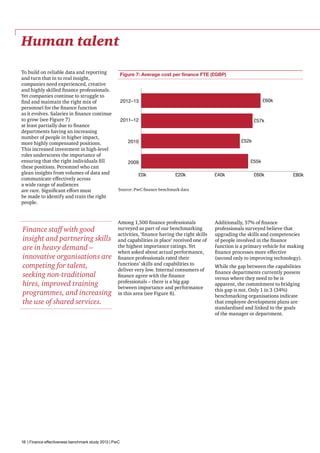
the use of shared services.

Figure 7: Average cost per finance FTE (£GBP)

£60k

2012–13

2011–12

£57k

£52k

2010

£55k

2009
£0k

£20k

£40k

£60k

£80k

Source: PwC finance benchmark data

Among 1,500 finance professionals
surveyed as part of our benchmarking
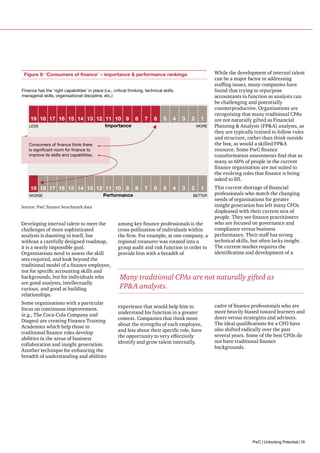
activities, ‘finance having the right skills
and capabilities in place’ received one of
the highest importance ratings. Yet
when asked about actual performance,
finance professionals rated their
functions’ skills and capabilities to
deliver very low. Internal consumers of
finance agree with the finance
professionals – there is a big gap
between importance and performance
in this area (see Figure 8).

18 | Finance effectiveness benchmark study 2013 | PwC

Additionally, 57% of finance
professionals surveyed believe that
upgrading the skills and competencies
of people involved in the finance
function is a primary vehicle for making
finance processes more effective
(second only to improving technology).
While the gap between the capabilities
finance departments currently possess
versus where they need to be is
apparent, the commitment to bridging
this gap is not. Only 1 in 3 (34%)
benchmarking organisations indicate
that employee development plans are
standardised and linked to the goals
of the manager or department.
Figure 8: ‘Consumers of finance’ – importance  performance rankings
Finance has the ‘right capabilities’ in place (i.e., critical thinking, technical skills,
managerial skills, organisational discipline, etc.)

19 18 17 16 15 14 13 12 11 10 9
LESS

8

7

6

5

4

3

2

Importance

1
MORE

Consumers of finance think there
is significant room for finance to
improve its skills and capabilities.

19 18 17 16 15 14 13 12 11 10 9
WORSE

Performance

8

7

6

5

4

3

2

1

BETTER

Source: PwC finance benchmark data

Developing internal talent to meet the
challenges of more sophisticated
analysis is daunting in itself, but
without a carefully designed roadmap,
it is a nearly impossible goal.
Organisations need to assess the skill
sets required, and look beyond the
traditional model of a finance employee,
not for specific accounting skills and
backgrounds, but for individuals who
are good analysts, intellectually
curious, and good at building
relationships.
Some organisations with a particular
focus on continuous improvement.
(e.g., The Coca-Cola Company and
Diageo) are creating Finance Training
Academies which help those in
traditional finance roles develop
abilities in the areas of business
collaboration and insight generation.
Another technique for enhancing the
breadth of understanding and abilities

among key finance professionals is the
cross-pollination of individuals within
the firm. For example, at one company, a
regional treasurer was rotated into a
group audit and risk function in order to
provide him with a breadth of

While the development of internal talent
can be a major factor in addressing
staffing issues, many companies have
found that trying to repurpose
accountants to function as analysts can
be challenging and potentially
counterproductive. Organisations are
recognising that many traditional CPAs
are not naturally gifted as Financial
Planning  Analysis (FPA) analysts, as
they are typically trained to follow rules
and structure, rather than think outside
the box, as would a skilled FPA
resource. Some PwC finance
transformation assessments find that as
many as 60% of people in the current
finance organisation are not suited to
the evolving roles that finance is being
asked to fill.
This current shortage of financial
professionals who match the changing
needs of organisations for greater
insight generation has left many CFOs
displeased with their current mix of
people. They see finance practitioners
who are focused on governance and
compliance versus business
performance. Their staff has strong
technical skills, but often lacks insight.
The current market requires the
identification and development of a

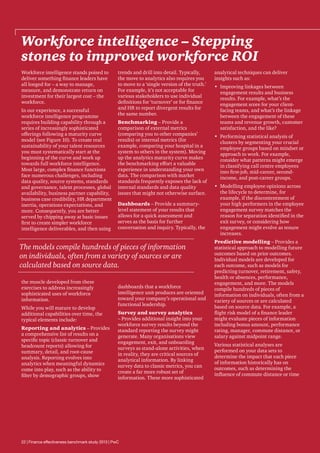
Many traditional CPAs are not naturally gifted as
FPA analysts.
experience that would help him to
understand his function in a greater
context. Companies that think more
about the strengths of each employee,
and less about their specific role, have
the opportunity to very effectively
identify and grow talent internally.

cadre of finance professionals who are
more heavily biased toward learners and
doers versus strategists and advisors.
The ideal qualifications for a CFO have
also shifted radically over the past
several years. Some of the best CFOs do
not have traditional finance
backgrounds.

PwC | Unlocking Potential | 19
Meanwhile, the outsourcing of basic
finance functions to shared services
and lower cost offshore environments
continues apace, as organisations
look for ways to fund their increased
need for insight generation and
management. The need for lowering
costs has never been more apparent: the
average cost for a Finance FTE in the
past year was £60,000 and the average
cost for an ‘insight’ FTE was £93,000
(see Figure 9). While a movement
toward shared services has provided
some enhanced efficiencies, this
evolution has not addressed the need for
more efficient work flows to free
up resources. In many instances, the
long-term culture of the organisation is
getting in the way of this evolution.
Often, shared services and outsourcing
can partially offset the finance talent
gap. As time is freed up to focus on
insight, existing staff can be moved
into these roles. Sometimes, lackluster
performers are just in the wrong
positions, and excel in a new role.
That said, the difficult reality for many
companies today is that a large number
of existing team members are not able to
function in the new finance environment
that the company needs to build. Many
just do not have the fundamental
abilities needed for their evolving roles.

A few unique and forward thinking
organisations are applying human
capital analytics to forecast internal
talent needs and identify skill sets not
currently in the organisation. Some
successful finance organisations are
making investments in individuals with
backgrounds in operations research,

data analytics and even traditional IT.
These professionals often have greater
proficiency in the identification of
hidden opportunities in both financial
spreadsheets and other organisational
datasets which can lead to true forward
progress for the business.

Figure 9: Average cost per finance ‘insight’ FTE (£GBP)

£115k
2012-13

£93k
£114k

2011-12

£91k
£103k

2010

£83k
£97k

2009

£77k

£0k

£20k

Median

£40k

Top quartile

Source: PwC finance benchmark data

20 | Finance effectiveness benchmark study 2013 | PwC

£60k

£80k

£100k

£120k

£140k
Finding  nurturing talent
As the finance function
evolves, organisations have
come under increasing
pressure to attract, retain,
and motivate top talent.
Today, it is not enough for
finance personnel to have
strong accounting and
transactional skills. They
must be able to glean
actionable insights from
data, communicate well
with business leaders and
partners in the business
units, and engage others to
support change
management companywide. CFOs must learn how
to find the right people and
motivate them for the
demands they will face in
the finance function as it
evolves.

A 2011 staffing survey found that
mix of financial and non-financial
positions in finance and accounting were compensation – including flexible
among the top 10 jobs that US employers working hours, quick career progression
say are the hardest to fill. CFOs say one of and rotational job assignments, even
the key challenges is finding candidates
outside finance. Organisations and their
with business knowledge and communi- employees are also becoming
cation skills. Hiring in finance is made
increasingly global, leading to further
more challenging by the complex
challenges. Finance chiefs need to rotate
demands of rapid growth, acquisitions,
their human capital resources across the
and changing finance regulations.
globe, and embrace international talent
Additionally, CFOs’ teams are bogged
as part of their people strategy.
down with the finance essentials of
Finally, building a strong finance team
transaction processing, compliance and
starts with the CFO. According to
control. They’re often supporting overly Percival, a ‘strong’ CFO is one who is
complex business, management and legal proactive, seeking to build solid
reporting structures that may need to be communication with other parts of the
simplified. Additionally, today’s finance
company, from the shop floor right up to
department is expected to spend more and the chief executive’s office – in ways that
more time outside of finance, lending their clearly articulate the business
expertise to company-wide strategy and expectations of the finance organisation.
growth.
“Today, the CFO doesn’t wait for the
With talent shortages an ongoing concern,
finance teams need to focus on staff
development. Human resources experts
often refer to a rule of thumb: 70% of
learning transpires in the course of
day-to-day work, 20% through informal
learning and coaching, and 10% through
formal classroom-based instruction. The
good news is that there are a number of
learning approaches that can be tailored
to a CFO’s team – and CFOs can delegate
some responsibilities to other team
members. Practical on-the-job coaching,
for instance, can be provided through
team-based learning – such as having
junior staff ‘shadow’ senior managers.

CEO or business unit manager to say,
‘Here’s an issue; I’d like you to go do
some analysis,” says Percival. “The CFO
needs to decide (on his or her own) what
the issues are, and bring them to the
table and say, ‘We haven’t discussed this,
but it’s an important part of our future
and we need to be talking about it.
Here’s an analysis and what some of the
potential solutions are.” CFOs also need
to reinforce a sense of mission
throughout their finance teams.
Successful CFOs provide a vision that
excites people about coming to work. A
sense of purpose often motivates people
more than money, and the CFO is
responsible for providing that. Wharton
CFOs must also work to find the right
talent for the roles that need to be filled. management professor Adam Grant has
Team members are needed who can build examined what motivates staff in
numerous settings over recent years and
trust and ‘collegial’ relationships across
has found that employees who know
the company, according to John R.
that their work has a meaningful,
Percival, a Wharton adjunct finance
positive impact on others are not just
professor. They need a team that
happier than those who don’t – they are
‘technically is very good but can think
vastly more productive, too.
beyond the pure accounting aspects of
the business, think about the future and
deal with issues like organic growth
Ed Ponagai is a Partner in PwC’s
versus acquisition.’
Finance Effectiveness practice, where he
CFOs also need to meet the needs of a
diverse pool of employees. Many hires will
come from the Millennial generation and
have career aspirations, attitudes about
work, and knowledge of new technologies
that are far different than those of older
generations. The finance organisations
that are the most attractive to this
generation are able to provide a new

focuses on Finance Transformation and
helping CFOs operationalise
transformation priorities. This
discussion is based on a previously
published paper by PwC and
Knowledge@Wharton entitled ‘People
Performance: How CFOs can build the
bench strength they need today... and
tomorrow.’

PwC | Unlocking Potential | 21
Workforce intelligence – Stepping
stones to improved workforce ROI
Workforce intelligence stands poised to
deliver something finance leaders have
all longed for – a way to manage,
measure, and demonstrate return on
investment for their largest cost – the
workforce.
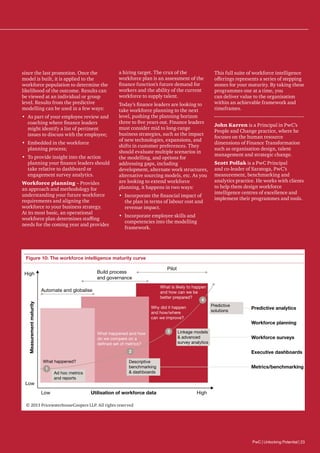
In our experience, a successful
workforce intelligence programme
requires building capability through a
series of increasingly sophisticated
offerings following a maturity curve
model (see Figure 10). To create real
sustainability of your talent resources
you must systematically start at the
beginning of the curve and work up
towards full workforce intelligence.
Most large, complex finance functions
face numerous challenges, including
data quality, source systems, standards
and governance, talent processes, global
availability, business partner capability,
business case credibility, HR department
inertia, operations expectations, and
more. Consequently, you are better
served by chipping away at basic issues
first to create simpler workforce
intelligence deliverables, and then using

trends and drill into detail. Typically,
the move to analytics also requires you
to move to a ‘single version of the truth.’
For example, it’s not acceptable for
various stakeholders to use individual
definitions for ‘turnover’ or for finance
and HR to report divergent results for
the same number.
Benchmarking – Provide a
comparison of external metrics
(comparing you to other companies’
results) or internal metrics (for
example, comparing your hospital in a
system to others in the system). Moving
up the analytics maturity curve makes
the benchmarking effort a valuable
experience in understanding your own
data. The comparison with market
standards frequently exposes the lack of
internal standards and data quality
issues that might not otherwise surface.
Dashboards – Provide a summarylevel statement of your results that
allows for a quick assessment and
serves as the basis for further
conversation and inquiry. Typically, the

The models compile hundreds of pieces of information
on individuals, often from a variety of sources or are
calculated based on source data.
the muscle developed from these
exercises to address increasingly
sophisticated uses of workforce
information.
While you will mature to develop
additional capabilities over time, the
typical elements include:
Reporting and analytics – Provides
a comprehensive list of results on a
specific topic (classic turnover and
headcount reports) allowing for
summary, detail, and root-cause
analysis. Reporting evolves into
analytics when meaningful dynamics
come into play, such as the ability to
filter by demographic groups, show

dashboards that a workforce
intelligence unit produces are oriented
toward your company’s operational and
functional leadership.
Survey and survey analytics
– Provides additional insight into your
workforce survey results beyond the
standard reporting the survey might
generate. Many organisations view
engagement, exit, and onboarding
surveys as stand-alone activities, when
in reality, they are critical sources of
analytical information. By linking
survey data to classic metrics, you can
create a far more robust set of
information. These more sophisticated

22 | Finance effectiveness benchmark study 2013 | PwC

analytical techniques can deliver
insights such as:
•	 Improving linkages between
engagement results and business
results. For example, what’s the
engagement score for your clientfacing teams, and what’s the linkage
between the engagement of these
teams and revenue growth, customer
satisfaction, and the like?
•	 Performing statistical analysis of
clusters by segmenting your crucial
employee groups based on mindset or
approach to work. For example,
consider what patterns might emerge
in classifying call centre employees
into first-job, mid-career, secondincome, and post-career groups.
•	 Modelling employee opinions across
the lifecycle to determine, for
example, if the discontentment of
your high performers in the employee
engagement survey matches the
reason for separation identified in the
exit survey, or considering how
engagement might evolve as tenure
increases.
Predictive modelling – Provides a
statistical approach to modelling future
outcomes based on prior outcomes.
Individual models are developed for
each outcome, such as models for
predicting turnover, retirement, safety,
health or absences, performance,
engagement, and more. The models
compile hundreds of pieces of
information on individuals, often from a
variety of sources or are calculated
based on source data. For example, a
flight risk model of a finance leader
might evaluate pieces of information
including bonus amount, performance
rating, manager, commute distance, or
salary against midpoint range.
Various statistical analyses are
performed on your data sets to
determine the impact that each piece
of information historically has on
outcomes, such as determining the
influence of commute distance or time
since the last promotion. Once the
model is built, it is applied to the
workforce population to determine the
likelihood of the outcome. Results can
be viewed at an individual or group
level. Results from the predictive
modelling can be used in a few ways:
•	 As part of your employee review and
coaching where finance leaders
might identify a list of pertinent
issues to discuss with the employee;
•	 Embedded in the workforce
planning process;
•	 To provide insight into the action
planning your finance leaders should
take relative to dashboard or
engagement survey analytics.
Workforce planning – Provides
an approach and methodology for
understanding your future workforce
requirements and aligning the
workforce to your business strategy.
At its most basic, an operational
workforce plan determines staffing
needs for the coming year and provides

a hiring target. The crux of the
workforce plan is an assessment of the
finance function’s future demand for
workers and the ability of the current
workforce to supply talent.
Today’s finance leaders are looking to
take workforce planning to the next
level, pushing the planning horizon
three to five years out. Finance leaders
must consider mid to long-range
business strategies, such as the impact
of new technologies, expansions, and
shifts in customer preferences. They
should evaluate multiple scenarios in
the modelling, and options for
addressing gaps, including
development, alternate work structures,
alternative sourcing models, etc. As you
are looking to extend workforce
planning, it happens in two ways:
•	 Incorporate the financial impact of
the plan in terms of labour cost and
revenue impact.

This full suite of workforce intelligence
offerings represents a series of stepping
stones for your maturity. By taking these
programmes one at a time, you
can deliver value to the organisation
within an achievable framework and
timeframes.
John Karren is a Principal in PwC’s
People and Change practice, where he
focuses on the human resource
dimensions of Finance Transformation
such as organisation design, talent
management and strategic change.
Scott Pollak is a PwC Principal
and co-leader of Saratoga, PwC’s
measurement, benchmarking and
analytics practice. He works with clients
to help them design workforce
intelligence centres of excellence and
implement their programmes and tools.

•	 Incorporate employee skills and
competencies into the modelling
framework.

Figure 10: The workforce intelligence maturity curve
Pilot

Build process
and governance

High

What is likely to happen
and how can we be
better prepared?
4

Measurement maturity

Automate and globalise

Predictive
solutions

Why did it happen
and how/where
can we improve?
What happened and how
do we compare on a
defined set of metrics?

3

Predictive analytics
Workforce planning

Linkage models
 advanced
survey analytics

Workforce surveys

2
What happened?
1

Low
Low

Ad hoc metrics
and reports

Executive dashboards

Descriptive
benchmarking
 dashboards

Metrics/benchmarking

Utilisation of workforce data

High

© 2013 PricewaterhouseCoopers LLP. All rights reserved

PwC | Unlocking Potential | 23
British American Tobacco – Unlocking
time and value
British American Tobacco
(BAT) is undertaking a
transformational finance
journey which has seen the
company establish higher
value-adding shared
services centres as part of a
complete restructuring of
the finance organisation.
The ultimate goal is to
deliver value through
service excellence and
unleash time and value for
the business by working
more efficiently and
effectively. Terry
McConnell, Group Head of
Finance Transformation
and Shared Services, spoke
with us about this journey
and the key components
which have enabled
its success.

British American Tobacco is one of the
world’s largest international tobacco
companies, with 13% global market
share and market leadership in more
than 60 countries. BAT is one of the
world’s most international businesses
with more than 200 brands sold in
around 180 markets, and more than
55,000 employees. BAT produces
cigarettes in 44 factories across 39
countries, and buys more than
400,000 tons of tobacco leaf per year
from more than 100,000 directly
contracted farmers.
Terry McConnell explains that BAT’s
finance transformation journey began in
2007 when it sought to increase
efficiency across its global operations.
The company began with a
benchmarking study, which revealed
significant areas of potential
improvement. To address these
opportunities, BAT established regional
shared services centres in Romania,
South Africa, Malaysia, and Costa Rica,
plus two in-country centres in Brazil and
Russia. All transactional finance activity
was subsequently migrated to the new
centres and a solid shared services
foundation was created.

Through the current phase of
transformation, BAT finance aspires to
simultaneously achieve greater
efficiency and effectiveness. They are
seeking a path of continuous
improvement, creating better business
partnerships while reducing costs. They
are planning to do this by working more
intelligently, employing a high degree of
automation, and building a more
effective finance model through analysis
and various process improvement
techniques.
According to Mr. McConnell, Shared
Services’ ultimate goal is to unleash
time and value for the organisation.
They want to increase the ease and
efficiency of finance planning and
reporting in order to enable the rest of
the organisation to better focus on value
generating activities. By migrating
higher value services such as planning
and reporting to the shared services
centres, finance’s business partnering
teams are able to achieve a sharper
focus on supporting productivity and
revenue generation value drivers, which
include a focus on global resource
allocation, pricing and tax, and analysis
and insight on the end-to-end supply
chain. Centres of excellence focus on

“We passionately believe in delivering value through
service excellence”
– Terry McConnell, BAT, Group Head of Finance Transformation and
Shared Services
Since 2011, BAT has been reviewing its
target operating model, including how
finance would best integrate with and
contribute to the business. The resulting
finance model includes the creation of
centres of excellence for finance
processes beyond the original
transactional focus (i.e., audit, tax,
treasury, and group financial control)
and the shared service centres are
being enabled to take on more advanced
tasks.

24 | Finance effectiveness benchmark study 2013 | PwC

driving working capital and operating
margin initiatives. The establishment
and articulation of these key value
drivers enables BAT finance to explain
to stakeholders that ‘this is where we
plan to dedicate our time and focus’.
This has also enabled BAT finance to
clarify the key business metrics it
requires. In addition, a set of standard
reports for use by the business has been
developed. And today, BAT finance is
working to develop a self-service
capability, enabling business line
staff who need information to access
it themselves and work with it in
the system.
Automation for the future
Early on, BAT finance realised that a key
enabler to efficiency and effectiveness
would be high-level automation of
planning and reporting. Automation
enables value generation, releasing
time to free up the business partnering
organisation to focus on key value drivers
within the business. Mr. McConnell
explains that Malaysia, with both a
strong retained commercial finance
organisation and nearby shared services
centre, was designated as a pilot site for
the new finance organisation.
Forecasting and consolidation are
enabled through the ERP system and a
common business planning and
forecasting technology. A focus on
integration and automation has enabled
BAT to drive forecasting through the ERP
system with great success.
BAT is ultimately working toward a
Global ERP Template, which will allow
for standardisation of data across
regions. Data is currently fragmented
across legacy systems, and the Global
Template will allow BAT to collect
information in a consistent manner and
share it across regions and the business
more effectively. Key data will flow from
the single ERP system through the entire
organisation so that data may be
analysed worldwide in order to identify
new areas for gains in efficiency.
Mr. McConnell stresses that data
integrity is absolutely fundamental.
Without it, the whole system falls apart.
At BAT, all standard variance analysis
will ultimately be automated.
Materiality variances will be built
into the system on a rolling basis.
Throughout each reporting cycle, one
will be able to see what level of material
change has occurred, and warnings will
be automatically generated if anything
is out of tolerance. Data integrity roles
are embedded in planning  reporting
teams. Checks and balances will all be
either automated or built into
shared services.

The right people with the
right skills
BAT Finance understood that in order
to achieve its goal of simultaneous
efficiency and effectiveness, they would
need to focus upon the capabilities of
their finance personnel. Within Shared
Services, BAT started by recruiting
people with the skills required for their
new vision of finance and embedding
them throughout pilot markets. A strong
focus was also placed on the onboarding
process. Coaching, mentoring and
career planning were reinforced for new
personnel from the time of hire.
Training programmes were developed to
improve Shared Services staff’s product
knowledge. Staff were taken on field
visits, and they worked alongside
sales representatives to raise
business awareness.
The focus on hiring at BAT is now a mix
of mid-career professionals and younger
professionals who are newly graduated
or have shown strong promise in their
school careers. Individuals with change
management skills are also highly
prized in BAT’s fast moving and
changing organisation. BAT works to
find the right recruits and train them in
both the technical and commercial
capabilities needed for success. All
shared services personnel are
continuously exposed to the concepts of
service excellence and are encouraged
to deliver ‘an extra one percent’ on
everything they do.
Mr. McConnell described how BAT fills
certain key positions strategically by
moving staff across various locations.
Some of the best people from their local
markets are moved to fill some of the key
finance Shared Services roles. This
allows BAT to bring in the knowledge of
local market operations to the Shared
Services Centre, thus enabling staff at
the Centre to act as better partners for
the business. This is increasingly
important as the Centre is moving up
the value curve, taking on more and
more complex tasks.

By focusing on system enablement early
in the process many of the tasks formerly
carried out by accountants can now be
filled through automation. At the same
time, Mr. McConnell explains, it became
clear more capable business analysts
were required. Personnel with an IT
background who can really understand
the business bring a different skill set,
and are invaluable to helping solve
problems as they are identified. These
personnel have become a key part of the
process organisation at BAT.

Current status
BAT reports great success with the
transformation it has achieved in the
Malaysian pilot and with the value
provided to the organisation through
the higher value services being provided
from Shared Services. Shared Services is
moving from a regional to a globally
integrated organisation and is
implementing a service management
framework of service excellence and
value generation. In addition to
transactional finance, aspects of HR and
IT have also moved to Shared Services,
with the three areas working
collaboratively to enhance synergies.
Automation has freed up time, enabling
staff to focus on new opportunities, such
as analysing procurement strategies and
evaluating working capital
opportunities. There has been a huge
transformation within finance from pure
reporting to analysis and insight. Mr.
McConnell believes that the orientation
toward service excellence will continue
to pay off well into the future. Five to ten
percent improvements in operational
savings might be achieved year over
year, as the organisation finds new
continuous improvement opportunities
to prioritise. BAT appears to have found
that sweet spot, where they are
approaching high levels of efficiency,
and unlocking time for business analysts
to focus on providing insights and value
to the organisation, not just gathering
and manipulating data.

PwC | Unlocking Potential | 25
Technology
Maximising efficiency can be limited by
the tools at hand, and financial
professionals are acutely aware that
their company’s progress is bounded in
many cases by investments (or lack
thereof) in technology. When asked to
hypothetically partition the use of
improvement funds across seven areas,
data/systems requests are by far the
largest proportion, with over a third of
targeted allocation requests (see Figure
11).
Despite the existence of many platforms
designed to enhance reporting efficiency
and accessibility, many companies are
still mired in manually generated
spreadsheets. Additionally,
organisations find themselves struggling
with multiple legacy systems which
effectively silo crucial data. These
limitations create a drag on reporting
efficiency, sophistication and depth,
consigning much reporting to traditional
regulatory and management reports,
with limited forecasting ability and little
opportunity for insight.
Organisations must work harder
to develop dashboards and other
analytic tools to help them turn data
into knowledge in time-efficient,
accurate and insightful ways. The
massive growth in available information
is forcing finance to move beyond simple
spreadsheets and rewarding those
organisations that employ advanced
visualisation. That said, only 17% of
companies have a self-service reporting
application, and nearly half are
still loading information into
spreadsheets which require
manual manipulation.

Figure 11: Preferred allocation of resources
If the company were to focus on making improvements in any of the following areas
and you were given funds for improvements, how would you allocate the funds in
order to realise these improvements?
6%
7%
8%

34%

8%
19%

19%

Data/Systems
Human assets
Processes
Organisational structure
Mindset/Culture
Decision rights between function
and company
Performance measures and rewards

Source: PwC finance benchmark data

Companies are still struggling to
complete high-quality reports, often due
to two significant barriers. First,
organisations are still taking an
enormous amount of time just to get the
data right. Hurdles include the
technological challenges of interfacing

data models. Long-term embedded
practices are often hard to abandon. It
is not unusual during finance
transformation assessments, companies
find that significant effort is being put
into generating ongoing reports that no
one reads. The justification for the

“For many companies, a crucial first step in insight
generation is getting data out of departmental silos,
where it can be available for larger analyses and strategic
decision making.”
– Ed Shapiro, PwC Americas, Director of Benchmarking
with legacy tools and siloed information.
Nearly two-thirds of analysts’ time is
spent on the data gathering process,
with only a third spent on actual
analysis. Second, corporate management
issues often hinder the operating and

26 | Finance effectiveness benchmark study 2013 | PwC

report may be ‘because we’ve always
produced that,’ or a one-time request
may have inadvertently become part of
the standard reporting process.
Eliminating unnecessary reporting can
lead to significant cost savings.
Even as finance technology evolves, the
automation of key controls remains a
relatively rare event. Only 11% of key
controls are automated in a typical
company (see Figure 12). However, top
quartile companies more than double
this percentage, automating 25% of key
control functions.
When asked how to create a more
efficient finance process, improved
technology was the most frequently
cited suggestion, with nearly sixty
percent (58%) of finance professionals
surveyed indicating this as a need for
their organisations. In terms of specific
technology gaps, those areas that
receive the weakest ratings for
supporting finance functions involve
workflow automation and systems
integration (see Figure 13). Additionally,
efficient and centralised data
warehouses still remain an aspirational
goal for many companies.
Only 6% of attendees at PwC’s 2013
Finance Leaders’ Summit indicate that
they are comfortable with their current
finance technology, and not looking to
make changes over the next two years.
While 39% are actively looking to make
major changes, 17% are looking at
minor changes, and 31% already have
the change process underway.
Fifty-eight percent of the conference
attendees believe that their
organisations face substantial or critical
cyber risk, yet only 13% indicate they
actively manage to mitigate risk and
have management intelligence tools to
measure effectiveness. Fifty-three
percent indicate they have very little or
insufficient data to manage cyber risk
well. Additionally, only 12% of PwC
benchmarking companies indicate that
they have a formal process for assessing
risk in technology.
This is not to say that there have not
been any recent improvements in
technology and reporting. There has
indeed been movement away from large
and unwieldy finance reporting towards
widely accessible and understandable
metrics. Advanced dashboards are
increasingly employed as a method of
knowledge transfer that can improve
focus and clarity in corporate thinking.

Figure 12: Percentage of key controls automated

25%

Top quartile

11%

Median
0%

10%

20%

30%

40%

Source: PwC finance benchmark data

Figure 13: Technology’s support of finance functions
How well does the technology environment support your needs in finance?
Secure and
stable environment

4.91
4.74

Accurate data
Easily accessible data

3.49

User self service

3.44

Simple to use
technology tools

3.34

Automated workflow

3.22

Integrated systems

3.14
1

2

Weak

3

4

5

6

7
Strong

Source: PwC finance benchmark data

Companies that effectively utilise such
dashboards develop a common
language for decision makers and other
key personnel. They are able to not only
track and critique performance, but
engage in meaningful discussions about
the likely determinants of these critical
metrics. Business intelligence tools aid

in the centralisation of data and the
automation of reporting. In addition,
data visualisation tools provide deep
and rich capabilities that can
communicate an immediacy that is
often lacking in traditional financial
spreadsheet reporting.

“In the coming years, some form of SaaS or cloud
technology will play an important role in the finance
organisations for many companies.”
– Carol Sawdye, PwC US CFO

PwC | Unlocking Potential | 27
Jaguar Land Rover (JLR) has focused on
moving from spreadsheet-bound data
systems to shared information platforms.
This has produced a deeper, more
granular understanding of the business
that is shared across functions. With
sales in over 200 markets, JLR is now
able to forecast by base model and
variant across all countries, and has
successfully addressed difficulties with
predictability in volatile markets. One
JLR goal is to be able to make decisions
on the allocation of build slots based on
total transparency of the cash impact of
the model, variant and market.

Technology in Finance: It can be improved
•	Only 17% of companies have a self-service
reporting application.
•	Almost 50% have reporting processes that rely
on manual spreadsheet manipulation.
•	50% have data warehousing in place, but only
11% have applied a standard data taxonomy.
•	Improving finance technology is the #1 method
that finance professionals identify for making
finance processes more effective.
•	Only 6% of finance leaders attending a recent
PwC Summit report being comfortable with the
status of their current finance technology.

Technology in the service
of insight
It is not enough to invest in technology
alone. Technology must be directed
toward insight. In order to free up
resources for insight analysis, progress
needs to be made in the standardisation
and efficiency of data capture, analysis,
and reporting. In our benchmarking
survey, technology’s ability to support
the needs of finance was seen as strong
relative to accuracy and security, but
weak when it comes to simplicity,
integration, and workflow. As stated
earlier, the labour associated with
manual data gathering proves a
significant hurdle in moving toward
more efficient processes, with
approximately two-thirds of financial
analysts’ time spent in data gathering
versus analytics.
Centralisation and standardisation
remain challenges as well. Nearly 3 in 5
(57%) companies do not have a single
enterprise database to satisfy
management reporting requirements,
and 3 in 4 (72%) do not have a single
database to satisfy financial reporting
requirements. Data is often siloed within
individual business units or different
regions of the organisation, making it
difficult to reconcile numbers and to
produce even simple company-wide
financial reports.

Finance professionals also note that their
current finance technology systems are
weakest at creating an automated
workflow and integration. Less than 1 in
10 (9%) have a mature Balanced
Scorecard (BSC) developed. An
additional 50% indicate a BSC is utilised
but in need of improvement. Speed and
accuracy of forecasting are also
becoming increasingly central to success.
Moving away from ‘black box’
predictions and understanding the
specific drivers of these forecasts has
become increasingly important. This is
difficult to achieve without significant
automation and integration.
Organisations working toward change
encounter difficulties implementing
new ERP systems, requiring significant
staff time and a reconsideration or
adjustment of legacy tools within the
organisation. Among the primary
hurdles are the existing levels of
customised and intricate systems in
place. Only 18% of technology systems
are described as standard while a third
(34%) are described as highly complex.
Once these challenges are mastered,
ERP systems can contribute
significantly to insight generation and
advanced planning. Cloud platforms

28 | Finance effectiveness benchmark study 2013 | PwC

also present new opportunities for
information sharing and efficiency as
well as offering new risks that need to
be managed. The movement toward
using cloud technology varies widely
as companies consider how to best
leverage these platforms. But Carol
Sawdye, PwC US CFO, feels that in the
coming years, some form of SaaS or
cloud technology will play an important
role in the finance organisations for
many companies. While many people
assume that cloud technologies are
always riskier, Ms Sawdye points out
that too many businesses jump to the
conclusion that their data is safer within
their own walls. As many cyber security
breaches have shown us, that is not
always true.
Among organisations following better
practices, advanced technology and
analytics allow for more complex
evaluation of potential business
scenarios and their possible impact.
Integrated systems and automated
reporting free up the time and resources
for finance professionals to create better
budgets, more current and accurate
forecasts, and offer the opportunity for
a real focus on insight-generation.
Skandia – Streamlining the system
Skandia, one of the Nordic’s leading
independent providers of solutions for
long-term savings and investments,
needed to radically overhaul its
approach to financial planning. The
company lacked integration in the areas
of business planning and forecasting.
These processes were extremely time
consuming, manual, and completely
dependent upon spreadsheets.
Additionally, data was being pulled into
spreadsheets from multiple sources,
leading to questions of data integrity.

solution. Through these sessions, several
key design principles were developed to
govern future decision-making. These
principles stated that processes had to be
simple, consistent and ‘lean.’ Also,
financial plans should be calculated
using business drivers or assumptions
and data integration would be
automated (as far as possible) with all
source systems. Workshops were run to
discuss better practices in planning and
budgeting and to define the key design
principles.

Skandia embarked upon a year-long
project to create processes that were
more consistent and efficient, and more
driven by business needs and
assumptions. They also aimed to
automate planning to the extent
possible in order to minimise the
number of data streams and integration
processes necessary for planning
and forecasting.

Next, a Hyperion planning prototype
was built, following the system design
specification agreed to earlier, and used
to clarify understanding of the business
and educate stakeholders on the tool,
including the look and feel of the end
result. Skandia learned that this
application would deliver the benefits
required by the autonomous business
units, while simplifying integration
and management.

To address these goals, Skandia
designed and implemented Oracle’s
Hyperion Planning and redesigned the
financial planning process using lean
principles and driver-based calculation
logic. Additionally, Skandia moved to
continuous planning, integrating a
number of key planning processes
across all business units to create a
common view and simplifying the
data required for reporting.
The project began with a series of
‘visioning’ sessions designed to research
the problem and agree upon a common

Implementation was overseen by a
steering committee and divided into
work streams. The solution architect had
oversight across all work streams,
ensuring a consistent approach and
resolution of issues. A design authority
group was also created to review the
design and resolve issues across work
streams. The original design and all
change requests were held to the key
design principles agreed to during the
planning stage. Weekly team meetings
also ensured consistency and helped the
implementation stay on track.

Skandia Finance Senior Programme
Manager, Bill Revellese talks about the
improvements, ‘Planning used to be a
collection of linked spreadsheets across
many departments. Now the
organisation and processes are set up in
a way that facilitates connection and
communication between departments.
Changes in the sales plans are easily
imported to the financial plans with the
click of a button. The financial plans for
the insurance business are fed real time,
enabling business rule-driven Market
Consistent Embedded Value and reserve
projections. In the past, you would have
to wait for days to get something back
from the actuaries. Today, they have all
the information they need from the
income statement and balance sheet –
and subsequently run the calculations to
produce their outputs in a fraction of the
time. Common data structures
eliminated the need for hours spent
maintaining spreadsheets and
updating links.’
Twelve months later, Skandia is
spending 387 fewer person-days each
year on planning and forecasting and
saving over £330GBP annually. Planning
is faster overall and people are much
more confident in the results. For the
first time, management can forecast
based on where they are today rather
than where they were a year ago.

PwC | Unlocking Potential | 29
A silver lining for every cloud?
There have been many predictions over
the years regarding the ways in which
technology will transform the finance
function. Whether it be through client
server computing, empowering end
users and putting businesses in control
of IT, or the ERP integration of business
processes from the front office to
reporting. Many have welcomed these
new technologies, the innovation they
bring, and the potential they offer for
improving the efficiency and
effectiveness of finance processes.
Others are naturally skeptical about the
realities of such claims. They assume
that the benefits are never quite as great,
the costs never quite as low and the
integration, flexibility and ease of use
are never quite in line with
expectations. Who’s right?
This article will consider the skeptics’
point of view and look at the impact of
‘cloud’ applications in client finance
functions. Does cloud computing have a
silver lining?
What is cloud computing and what does
it offer the finance function? There are
multiple definitions. From a technical IT
perspective, cloud computing is a model
for enabling convenient and on-demand
network access via the internet to a
shared pool of computing resources.
From an end-user perspective, it means
that finance applications no longer
reside on the company server but on the
computing resources of the cloud service
provider.

Since interactions with cloud
applications and the IT resources are
through the internet, a primary benefit
is the ability to access these applications
from any internet-enabled platform.
Looking at what organisations have
achieved so far, this new way of hosting
finance applications has the potential to
deliver immediate, tangible benefits. In
talking to cloud application users in a
wide variety of finance areas (including
budgeting, reporting, business
intelligence, transaction recording,
consolidation, disclosure management
and strategic financial planning) it is
the infrastructure benefits that have
had the greatest initial impact. Cloud
computing can deliver speed of
implementation, cost savings,
convenience, and performance
benefits to the finance function
in the following ways:
•	 Cloud vendors are able to provide
immediate application platform
access for their clients. Instead of
waiting to acquire new infrastructure
to run the new application, cloud
vendors have the bandwidth, server,
and storage infrastructure already in
place, though the client will still need
to implement their own instance of
the software. Still, this typically
permits a faster start-up period for
the application.
•	 Cloud vendors can provide elastic
access to applications, meaning there
could be 200 concurrent users
accessing monthly consolidation
applications on working days 4 to 6
and only 8 users from working day 7
and beyond. Vendors can provide the
scalability to meet the demands of 8

30 | Finance effectiveness benchmark study 2013 | PwC

users or 200, meaning it is no
longer necessary to scale your
infrastructure to support peak
usage. This can produce significant
hardware cost savings and
represents a major change from
the traditional in-house model.
•	 Cloud vendors can have much more
scalable licensing models, which
again, can reduce up-front
investment in new finance software.
Additionally, since cloud providers
typically take responsibility for
creating and managing application
infrastructure and connectivity, this
can significantly reduce the cost of
IT staffing.
•	 Cloud vendors often take
responsibility for upgrading the
applications and infrastructure,
sometimes invisibly to the end user,
again reducing complexity, cost and
dependency on internal IT resources.
•	 Cloud vendors offer various levels
of resiliency in their infrastructure
and will use mirrored solutions,
advanced load balancing and
advanced disaster recovery
techniques to assure uninterrupted
service delivery. This resiliency is
often far greater than a company
could implement within its own
infrastructure.
As you can see, these potential benefits
are compelling, but most relate to
access, flexibility and infrastructure
costs. While these are significant
benefits, do we see enough evidence of
transformational capability emerging
from the use of cloud applications in
finance to justify the enthusiasm?
The short answer is yes, but maybe not
for the reasons you think. With cloud
applications, there is typically a very
modern application look and feel with an
up-to-date user interface. While this can
certainly speed adoption, it is not a
unique characteristic of cloud
applications. Similarly, the improved
access and scalability of cloud solutions
are proving very effective in ‘high
participation’ processes where mobility
and scalable access are critical (employee
expense management, operational sales
forecasting or employee-distributed
analytics and performance management,
etc.). But again, these are capabilities not
unique to the cloud, but are more easily
deliverable through current cloud-based
technology.
Are cloud-based solutions always
successful? No. And are the successes of
all cloud-based transformations solely
due to the cloud component? No.
Adoption of cloud technology is often
(very appropriately) paired with finance
process transformation. So it is often
impossible to untangle which benefits or
problems are due to the cloud component
or the process transformation and often it
can be the synergy between the two that
helps yield the benefit, or compound to
produce a problem.

The concrete potential benefits
that cloud-based solutions deliver,
particularly in terms of cost, fall
back on the infrastructure, access
and flexibility, considerations
already discussed.
It is also important to manage the risks
associated with a third party cloud
provider. Service levels, stability and
scalability of the provider’s cloud
platform are all key if they are to be
trusted to deliver high availability and
responsiveness for your finance
applications. It is also important to
validate how the cloud vendor is
securing data, keeping in mind that the
vendor may be using a third party to
provide the cloud infrastructure.
Interrelationships on service levels,
security and disaster recovery can be
complex and must be fully evaluated.
But as Carol Sawdye, PwC US CFO,
points out, data security is a top priority
for cloud platform vendors – they know
their whole business depends on it.
In conclusion, cloud computing could
change the way we execute the finance
function over the coming years. The cost
savings, the access flexibility, scalability,

elasticity, and resilience of cloud-based
solutions will continue to drive change.
To date, the benefits of cloud-based
applications have largely been based
on infrastructure advantages, and
adoption has been driven by small
and medium sized organisations or
departments and functions in larger
organisations that are focused on
rapidly deploying tactical applications.
Going forward, as organisations seek to
upgrade their existing capabilities,
cloud-based solutions will increasingly
be considered as a viable alternative
during the evaluation process. This will
result in the growing impact of cloud
solutions in finance, particularly as all
the large vendors move further into
this space.
David Jones is a Director in PwC’s
Enterprise Performance Management
team. He is a thought leader as well as
subject matter expert in the EPM space
and speaks and writes regularly on
the topic.

PwC | Unlocking Potential | 31
Jaguar Land Rover – Cashing up the plan
In many organisations,
the recent finance
challenge has been to
respond to commercial
pressures of a downturn.
Jaguar Land Rover (JLR)
is different – the business
has transformed over
the past 4 years,
targeting new markets
and investing in new
products to become a
remarkable success
story. What is the role of
finance in equipping the
business to cope with
this success, support this
growth and to maximise
returns? Adrian
Cadman, Corporate
Finance Controller,
spoke with us about the
challenges and about the
evolution of finance that
has helped bring JLR to
this point.

Jaguar Land Rover is a British
multinational automotive company
which became a wholly owned subsidiary
of Tata Motors in 2008. It is responsible
for the design, manufacture and sale of
vehicles with the Jaguar, Land Rover and
Range Rover brands, some of the most
iconic in the industry. JLR operates six
facilities for RD, manufacturing and
assembly in the UK, sells in 200 markets
worldwide and is developing new
manufacturing capacity outside the UK in
emerging markets.
When asked in a recent interview what
‘magic’ Tata brought to JLR to turn
around its fortunes, Ratan Tata, the
recently retired Chairman, answered
“I think the general change that I see in
JLR now is that everybody has
enthusiasm about what they are doing
and has confidence and faith in the
direction of the company. We are not the
magicians, they are the magicians.”
While not claiming to be a magician
himself, Adrian talked us through how
finance is transforming in order to
support the growth plans of the business
and continue the recent success story. In
2009, Jaguar Land Rover embarked on a
process of finance transformation to
support its rapid growth, including
system automation and integration. An
ERP project was launched and is being
implemented in waves. It will increase
the finance function’s effectiveness via
the removal of numerous manual tasks,
allowing more time to be spent on high
value activities, increased insight
through access to an integrated set of
data, a single version of ‘the truth,’
automatic reconciliation, and a clear line
of sight back to the source data, as well as
improving the whole control
environment. This is seen as an
important initial step in supporting the
rapid growth of the business. As well as
transformation driven by the ERP system
renewal, JLR finance also set about
refreshing its performance management
processes.
In 2011, JLR sought to create an
integrated solution for the collection and
consolidation of actual, budgetary and
forecast data. At the time, a variety of
legacy systems were being employed for
actual financial reporting, while

32 | Finance effectiveness benchmark study 2013 | PwC

Microsoft Access and Excel were used
for management reporting. The reliance
on spreadsheets led to substantial
manual work and resulted in a poor
audit trail and lack of control over
processes. Additionally, data was siloed
throughout the organisation, and the
reconciliation between financial results
and management results was a
significant manual exercise.
The new consolidation and management
reporting solution, built on an EPM
platform, was implemented in 12
months. It is now successfully embedded
and is delivering benefits of improved
transparency, quality and efficiency in
this core finance process. Buoyed by the
success of the project, JLR immediately
turned its attention to the next
performance management challenge,
the integration of planning across the
organisation.
Since joining JLR in 2011, Adrian
recognised the need to develop the
budgeting, forecasting and planning
processes and systems that would
facilitate a more nimble, transparent
approach, enabling an improvement in
the decision support capabilities for the
business. Adrian commented, ‘this
would allow the transition from the
good old world of data collection and
manipulation in spreadsheets, into a
new world – deployment of a leading
edge planning solution providing
significantly improved commercial
analysis and most importantly, visibility
of current and future performance that
would help support tactical and
strategic decisions’.
JLR’s recent success has driven plans for
future growth and hence, investment. In
order to deliver plans for cost effective
growth, as well as maximising profits
and cash generation, JLR recognised the
need for an improved and more
integrated planning approach. So, in
spring 2012 JLR began to design a more
integrated business planning process. It
first delivered a new solution called
EMFASIS, based on the Oracle EPM
platform, which integrates the central
functions of pricing, volume planning,
manufacturing directs costs, parts and
accessories costs, and finance across
nearly two hundred markets.
EMFASIS processes direct data feeds of
volume forecasts over 36 months (by
derivative and market), and then ‘cashes
up’ these forecasts by applying pricing,
direct and indirect costs (again by
derivative and market). EMFASIS has
revolutionised JLR’s ability to analyse
volume and profit outputs, as well as
KPIs. Automated processing also allows
more time for analysis of market and
model performance both at corporate
HQ and also by finance teams across
the globe, who can easily access the
data for regional market analysis and
scenario planning.
EMFASIS also benefits capacity planning,
as it aids in the projection of future stock
levels of key components. Additionally,
management now has access to global
profitability projections which help direct
them to where they can add millions to
company profit by changing the
allocation of vehicles across global

According to Adrian, JLR’s
move into emerging markets, such as
Russia and China has also helped the
organisation to more fully embrace the
changes in the planning and forecasting
process: ‘These new markets do not have
legacy processes that they are wedded
to, unlike the established markets, and
are therefore more open
to working in the new way. Their
successes in turn show the rest of the
organisation the opportunities of
adopting the new processes and
exploiting the new system.’
Today JLR is extending the planning
integration process across the entire
organisation. Along with EMFASIS, this
project will provide a complete budgeting
and forecasting process and supporting
system, and will include functional
budgets and forecasts on top of the
information already held in EMFASIS.
The new integration will replace

“Improved data and data access is creating greater
transparency across traditional silos, enabling more
collaboration, and creating opportunities for data
analytics.”
– Adrian Cadman, Corporate Finance Controller, Jaguar Land Rover
markets. This new data draws people
together and aids JLR in getting the
right people in the room and encourages
the business to ask the right questions
of finance.
There are challenges to making this
work. Master data is critical, and JLR is
working to tighten data governance
across the functions. The other challenge
is cultural – departments were used to
their own data and systems, and to
making decisions in their own ways.
Driving transparency of commercial
outcomes means that in the future, teams
will work together in a consistent way.
Sponsorship of these initiatives has been
key. For example, the CFO recorded a
video to ensure that everyone across the
global business had a consistent
understanding of the benefits of the new
ways of working, and that joining in with
the new process is not optional, it is
the way JLR is now doing business.

hundreds of planning spreadsheets in
functional silos and create the
opportunity to run far more scenarios,
invest more time in the analysis of
options, and eradicate significant
amounts of manual data entry and
reconciliation. This empowers finance to
partner even more effectively across the
business, to support and sustain further
global growth.
Adrian explains that there are no legacy
systems in place that naturally provide a
company-wide view of how everything
fits together, both actual results as well as
forecasts. ‘There has been a culture in
place of silo management that makes it
very difficult to pull the pieces together.
The ability to join the volume demand to
the manufacturing and supply chain
requirements with a single view, with
clarity on issues and commercial

ramifications in a responsive way is the
clear challenge that we are seeking to
address.’ The integrated planning project
helps bring JLR together as one finance
team sharing one financial planning and
forecasting process and one integrated
set of information. This also will enable
greater control and governance over
master data, as well as offering a wide
range of further analytic and business
partnering opportunities.
While JLR is in the early stages of this
transformation, they are already seeing
the benefits of integration. Having access
to more and better integrated data is
creating greater transparency across
traditional silos and enabling more
collaboration. It is also creating
opportunities for data analytics, which
in turn is creating the need for
developing the skills of the finance teams
and the recruitment of new specialist
finance people.
The ultimate goal is a ‘living business
plan’ which will provide a link between
target setting and integrated business
planning, allowing for a longer term
forecasting horizon, building on trends
seen in the current 36 month view. This
will allow for constant updates of the
forecast and changes to the business plan
as targets evolve.
In JLR, finance has been the driving force
behind this revolution in business
planning, seizing the opportunity to be
the ‘organisational glue.’ The goal for
finance in the future is clear – to continue
the drive to be more influential in
decision making processes, while
providing functions with transparent and
integrated information that allows full
understanding of current performance
and timely review of future options and
overall commercial impact. Adrian
knows that delivering on this vision will
empower finance to fully support JLR’s
continued growth. “I’m not bold enough
to claim that the JLR finance team is full
of magicians, but we are working hard to
transform our key processes for the
benefit of the whole business and to
support its continued success.”

PwC | Unlocking Potential | 33
The key to future finance evolution
The global future
As companies expand their reach into
new markets, challenges multiply and
expanded insight and flexibility become
paramount. Local differences in
regulatory requirements require levels
of adaptation which some companies
have yet to face. Growth into emerging
markets requires insight into the
normative business ethics of the region,
the sensitivity to risk, and robust
financial governance capabilities. Carol
Sawdye, PwC US CFO, points out that
globalisation is not limited to large
businesses. ‘Both small and large
companies are now operating in a global
competitive environment. Increasingly,
companies need their staff to be globally
oriented, more nimble, mobile, and able
to effectively use technology to shrink
those distances and conduct business
across geographic and cultural
boundaries.’
Recent trends have moved away from
country-based finance groups, with
finance teams spanning entire lines of
business rather than having a specific
geographical focus. Movement has been
more and more to global ERP systems,
with companies such as Bristol Meyers
Squib and Dow as early leaders in this
area.
Globalisation is also leading to issues
related to control. Even between the US
and the UK, there are differences in the
maturity of control functions that are
largely influenced by regional regulatory
standards. US benchmarking companies
tend to have more evolved control
functions than do those in the UK across
several dimensions, reflecting the
influence of Sarbanes-Oxley and other
regulations. Three-quarters of US
companies report that control ownership
is clearly defined, while only one-third

of UK companies indicate control
ownership is well-defined. Further, 59%
of US companies indicate that their
current documentation is optimised for
risk management, while only 23% of
UK-based companies indicate this is
true. Countries thought to share much
cultural overlap still experience
dissimilar demands, given regulatory
cultures which produce such
procedural variations.
With further expansion into worldwide
emerging markets, these challenges
will become more acute and heighten
the need for systems that maximise
flexibility and insight. While China and
other Asian countries (as well as South
America) often receive much of the
focus for growth opportunities, Eastern
European countries such as Romania,
the Czech Republic, Slovakia, and
Poland can provide 15%-20% lower
operational cost than those found in
major Western European cities. Each of
these environments will present their
own unique challenges for finance
organisations. Further, the traditional
approach to exporting finance leaders

Addressing unique
industry challenges
Different industries face unique
challenges and varying pressures to
create efficient systems and optimally
deploy their human talent. Consumer
industries, which generally operate
with low margins, must explore
efficiencies wherever they can to
preserve that thin profit margin.
Meanwhile, technology companies in
our benchmarking sample are paying a
premium for human talent, about 30%
more in average remuneration per
finance FTE than the overall average
across industries. Shared services and
outsourcing therefore becomes an even
greater priority for these companies.
Financial services companies live in a
world of high regulation, and their
deployment of finance FTEs reflects that
– 21% of finance FTEs in financial
services fall under the umbrella of
compliance, which is 50% more than
the average across all industries.
Financial services companies also invest
an average of 1.48% in finance cost as a

The cost of finance is higher in the financial services
industry, driven by heavy reporting and regulatory
requirements.
from the centralised home office to
remote offices is no longer a preferred
or sustainable strategy. Companies
need to find other ways to establish a
common culture and approach to issues
like compliance and control.

34 | Finance effectiveness benchmark study 2013 | PwC

percentage of revenue, over 50% more
than the overall median across all
industries of 0.93% (see Figure 14). Yet,
even within industry groups, there is a
substantial gap between median and
top quartile performance in each
category. Efficiency is not driven solely
by the demands and parameters of an
industry. Even companies in a relatively
high-cost industries can develop systems
and operational cultures that mitigate
costs and accelerate performance.
In order to be successful in the future,
organisations will need to effectively
address challenges presented by their
own industries, in addition to those
common to all. As finance professionals
are able to free up time for insight
generation and analysis, they will
increasingly be able to identify key
drivers for their own companies which
will keep them competitive with
industry peers.

Figure 14: Finance cost as a percentage of revenue
1.75%
1.50%

1.48%

1.25%
1.00%

0.96%

0.86%

0.75%

0.63%

0.50%

0.50%
0.26%

0.25%
0.00%
Industries:

High

Medium
Manufacturing
Professional
Services, Technology
Energy/Oil/Minerals

Financial
Services

Median

Low
Tourism/Travel
Retail/Consumer

Top quartile

Source: PwC finance benchmark data

PwC | Unlocking Potential | 35
Corning – Bringing shared services
to China
Corning has established a
Shared Services Centre in
Shanghai. Debra Naylor,
Division Controller, and
Jesse Cates, Division Vice
President, Corning Shared
Services, spoke with us
about the establishment
and development of this
centre and the many
factors that have led to its
success.

Corning Incorporated is the world leader
in specialty glass and ceramics. Corning
creates and makes components that
enable high-technology systems for
consumer electronics, mobile emissions
control, telecommunications and life
sciences. Corning was on the leading edge
in establishing a strong presence in China,
and navigated the cultural and human
resources challenges of global outsourcing
in an emerging nation. Debra Naylor and
Jesse Cates described Corning’s
establishment of a Shared Services Centre
in China. First, they pointed out that
Corning had pre-existing commercial
offices in China, and they emphasised that
their experience and reputation in China
helped drive and support the success of
the new centre. They also had a hiring,
retention and employee rotation plan that
supported their efforts in Asia.
Mr. Cates explained that in 2002 Corning
began a transformation in which they
targeted saving 25% of existing spend in
HR, Finance, Procurement, and IT. They
found at the time that their core finance
activities were systematically inefficient
and consistently higher in cost than those
found in top performing companies.
Additionally, the organisation had highly
disparate systems, with multiple sets of
data and data standards. There were more
than 30 separate payroll systems around
the world and 59 charts of accounts
supporting 20 instances of 14 different
financial software packages. Corning
decided to attack these inefficiencies
internally as a company, and their first
step involved establishing Shared Services
Centres around the world.

36 | Finance effectiveness benchmark study 2013 | PwC

In 2003, Corning organised the Portfolio
Group to manage the organisation’s new
functional initiatives which included
setting up three Shared Services Centres,
standardising data systems, creating a
single dataset, and integrating work
across regions. They began with the
creation of a Shared Services Centre in
the US and then worked to select a site in
Asia. The staff reductions enabled by the
Shared Services Centre in the US
immediately reduced finance costs, and
helped reinforce the company’s
commitment to Shared Services Centres.
Corning’s approach to site selection was
very methodical. The organisation
believed that Asia was the area of highest
growth for the company and thus wanted
their second service centre in that region.
They set up an importance matrix to
analyse the benefits of establishing a
centre in any one of multiple Asian
countries, and cities within countries.
They analysed each potential site in
terms of available labour, labour skillsets,
cost, existing infrastructure, and countrybased incentives. Shanghai was
determined to be very competitive from a
cost perspective and Corning believed
that there would be significant future
growth in China. Also, Corning had set
up a regional headquarters in Shanghai
which earned the company experience in
dealing with the Chinese government,
culture, construction practices and
procurement.
Ms. Naylor described how Corning
learned a lot from the establishment of
the US Shared Services Centre which
helped ensure the success of the Centre in
Shanghai. Additionally, Corning made
the transition to the new Centre slowly,
transferring one process at a time to
Shanghai. Corning focused efforts on
ensuring the solid performance of each
process before transferring the next. The
transition to shared services in Asia began
with fixed assets and then moved on to
other areas of the closed report stream
such as project costing and journal
postings. Today the Shared Service Centre
in Shanghai is processing all accounts
payable, accounts receivable, and general
accounting for Corning’s Asia region. They
have also begun to perform other Corning
functions within Asia such as certain
processes within HR and Supply Chain.
Mr. Cates explained that Corning has had
to be flexible in its approach to staffing in
Asia. The Shanghai Centres’ first internal
client was Corning operations in Japan.
They quickly realised that the Japanese
business unit would not cooperate in the
transfer of transactional accounts unless
they were able to work with employees in
China who were fluent in Japanese.
Corning was able to initially staff the
Shanghai office by hiring Chinese college
graduates who had majored in Japanese
and sending them back to school to get
accounting degrees. This strategy was
very successful, and the trust of the
Japanese business unit was achieved.
Mr. Cates affirmed that change
management is possible on a global level.
While the cultural and legal barriers can
be high, there are solutions for any
problem an organisation faces when
functioning internationally.

Like many international companies in
China, Corning has had to address
retention issues. They faced a 22%
attrition rate three years after the
Shanghai Centre went live. Mr. Cates
attributes the high rate to a combination of
the excellent training that Corning
employees receive, and the Millennial
Generation’s penchant for moving across
multiple jobs in the early part of their
careers. In response to high attrition,
Corning established employee retention
strategies and ran focus groups to learn
what employees sought from Corning. As
a result, Corning altered benefit strategies
and instituted other changes, such as

One of Corning’s aims is to have incountry leadership for each Shared
Services Centre, which will help to ease
cultural differences and aid in employee
retention. To that end, the Shanghai
centre is now led by a Chinese national.
Corning also invests in leadership
development skills for international talent
in order to prepare them to take on
positions of leadership. The organisation
invests in language, leadership, and
process training for promising employees
across the globe.
Today, Corning is promoting native
employees in China and retaining key

Corning invests in global rotation for promising employees,
as well as language, leadership, and process training.
alterations in employee titles, in order to
become a more attractive employer. Today
the Shanghai Shared Services Centre has
reduced annual employee attrition below
regional averages.
One key to Corning’s global expansion
is its policy of employee rotation.
Throughout the organisation, employees
are rotated through a variety of locations,
globally. US employees often spend time
in other regions of the world, while foreign
employees likewise spend time in the US,
getting to know the headquarters and
more about the organisation.

personnel. They have also established a
Shared Services Centre in Budapest. The
next challenge for Corning is moving
toward even greater efficiency across their
Shared Services Centres. The organisation
is currently investigating the best route for
further process improvement. The
enormous efficiencies realised and
valuable lessons learned through the
deployment of Shared Services Centres
have put them in a position to move
forward on their continuous improvement
journey.

PwC | Unlocking Potential | 37
Grasping the treasury opportunities –
An approach to treasury in emerging
markets for global businesses
So what role does the
treasury management play
in the development of a
top-tier finance capability?
Well, quite a bit. As
companies expand into
emerging markets to grow
sales and lower operational
cost, an important success
factor is the ability of the
treasury team to support
business objectives. Key
challenges in such markets
include complex financial
risks (FX, cash and
commodity) a multitude
of financial regulations
and less developed
banking systems.
Hear how David Stebbings,
PwC’s Head of Treasury
Advisory in the UK
recommends the adoption
of a tiered approach to
emerging markets.

One of the most profound new
challenges and opportunities for
treasury is the increasing business focus
on emerging markets. The world has
changed and business growth for many
companies is now often outside the
traditional markets of Europe and North
America, a trend that is likely to
accelerate in coming years. Such
markets have many and varied
technical, operational and change
challenges for the treasurer.
Many treasurers have adopted an ad
hoc approach that focuses on the
technical challenge at hand. However,
we believe that given the resourcing
constraints and the range and
complexity of the issues, the treasurer
needs an explicit treasury and cash
operating model framework for
emerging markets. This will free up
time to grapple with those technical
challenges while enabling the
management of ongoing treasury risks
and provide a template for how treasury
in other emerging markets businesses
should operate.

What does this mean for
the treasurer?
In order to support business growth,
the treasurer should adopt an operating
model that explicitly recognises the
differences between traditional
(Europe, North America, etc.) and
emerging markets. Traditional markets
tend to have well-developed treasury
and banking environments and
pressure on business margins and costs.
Emerging markets, on the other hand
will tend to have higher growth, with
higher business risk, less developed
treasury environments, more costly
financial instruments, higher payment
charges, growing currency strength
particularly in relation to China, more
complexity in business structures
(JV’s etc.), significant although reduced
regulation, banking and exchange
controls and a lower level of banking
structure development.

38 | Finance effectiveness benchmark study 2013 | PwC

To bring these together, a strategic
treasury approach should be
considered, where the treasurer has a
global view, and is involved in all
‘treasury’ decisions – not just those that
reside specifically in the treasury
function. The treasurer needs to work
within a tiered global standards model
based on global policies which detail
how to ‘do treasury’ throughout
the company.

Tiered global standards
All businesses have treasury standards
based on policy principles, detailing
how they manage and control key risks
and activities (cash, foreign exchange,
commodities, funding, banking, credit,
etc.) down to a required level of
granularity. An emerging trend is to see
those standards tiered to take account
of the factors that make non-traditional
markets different.
A tier may include a series of businesses
or one business. As the organisation
grows, each new business would be
assigned a tier and the standards set
accordingly. There is no right answer as
to how tiers are set. However, whatever
the determining factors, there are
generally a number of key attributes of
the tiers in most cases:
1.	 Tier 1 would generally involve
activities in traditional markets, and
the standards would tend to be the
tightest focusing on activity
standardisation and efficiency to
minimise time spent and cost. So, in
this tier, hedging would tend to be
more mechanical, activities more
automated and cash more
centralised.
2.	Below Tier 1 there may be a number
of tiers (down to the bottom tier)
which would address those emerging
markets where treasury activities are
least standard and require the most
diversity to achieve business
objectives. It may not be possible to
hedge risks or move cash easily in
this tier. However, control standards,
particularly around cash and
financial instruments, are likely to be
just as tight if not tighter than Tier 1.
Interestingly this tier may be the
most important for business
performance.

3.	Businesses or locations will move up
through the tiers when key attributes
change – for example when
ownership changes or exchange
controls are relaxed. Hence, the tiers
need to be reviewed on at least an
annual basis.

An example is shown in Figure 15
of high-level standards for an energy
business where the tiers are determined
by business characteristics, location,
level of ownership and the ability
to pool business cash.

Figure 15: Example of indicative high-level tiered standards
The development of tiered standards
Sample business characteristics
and treasury implications

Sample key
group policies

Tier 1 •	 Full ownership and control

Sample key
tier standards
•	 Maximisation of straight through processing
in payment, cash and accounting activities

•	 Located in open economies

•	 Payments via shared services centre

•	 Liquid markets to use derivatives and
borrow cash

•	 Use treasury system for all risks and
instruments

•	 Group treasury has opportunity to centrally
manage risk and treasury activities

•	 Full cash concentration structures

•	 More likely to use of global ERP

•	 Centralised bank account management

•	 Use of global shared services centre for
finance activities

•	 Group treasury provides analysis and full
management of risks

Tier 2 •	 More control restrictions
•	 Generally located in economies with
some government monitoring and foreign
exchange restrictions
•	 Varied systems environment
•	 Group treasury has opportunity to centrally
manage certain treasury activities,
although local execution and analysis may
be required

Tier 3 •	 May have local minority partners
•	 Likely to be located countries with foreign
exchange restrictions
•	 Cash repatriation key issue. Agreement of
other shareholders required to extract cash
so limited cash concentration possible.
•	 Central treasury more likely to have a more
advisory role. Favours local execution
and analysis.
•	 Banking environment less developed

•	 Protection of credit rating
•	 Transaction FX risk hedged
•	 Hedge Accounting applied
•	 No commodity price risk
hedging
•	 Centralise cash as much
as possible

•	 Partial cash concentration perhaps within
region – as much as possible
•	 Treasury transactions undertaken centrally
but maybe on behalf of local businesses
•	 Group treasury has a controlling role with
some management activities
•	 Potential use of global banks for funding

•	 Funding via public debt
•	 Focus on key banks who
lend money plus key local
banks

•	 Group treasury has oversight and control
role – receives reporting
•	 Treasury and cash transactions undertaken
locally
•	 Limited use of treasury systems controls
•	 Centralisation of cash to key in country
accounts at key banks as much as possible
•	 FX conversion via central bank processes
with key banking partners
•	 Local funding from development banks
•	 Some central visibility of cash

© 2013 PricewaterhouseCoopers LLP. All rights reserved

PwC | Unlocking Potential | 39
Some companies have taken the
tiering concept beyond the business
to influence their view of looking at
banking partners or funding
providers – what the business is able
to do with them and how they are
viewed for credit risk purposes,
for example.

A strategic treasury
approach to governance,
organisation and
technology
Tiered standards in themselves will
not meet the challenge. A more
strategic treasury approach is also
required. Key elements of this
require that:
•	 Treasury standards encompass
the entire scope of treasury and
cash activities wherever they
occur in the organisation – not
just in the treasury function;

•	 There is a business focus to
such activities;
•	 A global treasury organisation of
some form and a global approach to
managing risk (at least on an overlay
basis) is put in place to include those
treasury and cash management
activities outside of the treasury
function; and
•	 There is one source of the truth for
treasury and cash information and
analytics via a treasury management
system and a SWIFT or bank-led
solution for visibility of cash
worldwide.
Of course, the organisational model
needs to fit with the culture of the
business, but the trend is clear that even
if risks and positions are not managed
centrally, they should as least be visible
centrally and that management,
whether regional or local, should
conform to tiered standards and
fall within the group-wide
governance model.

40 | Finance effectiveness benchmark study 2013 | PwC

Conclusion
Emerging markets are another
opportunity for the treasurer to show
value to the organisation. However,
while there are many interesting
technical challenges, many treasurers
are often failing to maximise their
effectiveness because they have not put
in place the appropriate approach or
framework to allow adequate focus on
the key issues. Tiered standards and a
strategic treasury approach will aid the
treasurer in achieving this goal.
David Stebbings is a PwC Director
and Head of PwC’s UK Treasury
Advisory practice. He is also a member
of the PwC UK Treasury Committee and
has an oversight role for the PwC UK
Insolvency Treasury Operations. David
works with many multinational
businesses on the treasury challenges
of growing in emerging markets.
The nexus of insight, efficiency,
and human talent
Continuously striving
to improve
As with anything, a necessary condition
for developing a top performing
financial function is the desire to
constantly strive to do better and be
continuously mindful of the ‘art of
the possible.’
Top tier companies are marked by a
strong commitment to continuous
improvement, with senior leadership
focused on evolving process
improvements, and incenting the
organisation heavily to develop these
improvements. These companies are
constantly changing themselves
stretching beyond the challenges of
the present toward the opportunities
of the future.

The first step toward this goal is
spending the time to build a roadmap
which reflects a clearly articulated
vision. Organisations that execute
change well tend to do it fast, avoiding
requirements for perfection in exchange
for tangible, measurable results. These
companies frequently centralise the
decision-making process into the hands
of small teams of people who are adept
in the techniques of change management
and sustainability. One benchmarking
participant was able to enact such swift
change, integrating 37 systems into one
common system within 12 months.
Forward-thinking finance departments
will enact this internally shared vision
by implementing models that increase
the efficiency of current processes, but
also by identifying where the most
meaningful value-added changes can be
effected. Increasingly, processes such as
lean are taking hold within the finance
function, adapting proven models

utilised in other areas of business to
show how finance can execute with
greatest impact.
Conversely companies that struggle with
this tend to keep changing their vision
and their perspective on how to assess
their situation. When core metrics are
consistent and repeatable, finance will
be free to do more in-depth analysis and
produce value-added insights. The
evolutionary process in finance
department growth tends to follow a set
pattern. First, get good at closing books,
then master forecasting, then incentive
programmes, and finally enact driverbased planning tied to operational
metrics. When this final stage is
reached, finance can finally answer the
‘why’ behind the actuals and forecasts,
and recognise the drivers of profit and
loss. And more importantly, they can
identify changes in the business and
processes which will lead to improved
outcomes in the future.

“A hallmark of top tier companies is a strong
commitment to continuous improvement. And
organisations that execute change well tend to do
it fast, avoiding requirements for perfection in
exchange for tangible, measurable results.”
– Brian Furness, PwC EMEA, Partner, Advisory Services

PwC | Unlocking Potential | 41
Lean into finance – A different way to
lead a finance organisation
The idea of lean is simple. Understand
what the customer values and align the
organisational resources to deliver just
that, and no more. Let’s think about a
typical finance function. Countless
hours spent generating reports that are
not read, duplication of effort across
teams, and custom-built processes that
only a few staff can understand.
In other words, our finance functions are
full of waste. We have found that by
applying a holistic approach to lean, it is
possible for finance functions to deliver
between 25%-40% in increased
efficiency, while improving customer
service. The challenge for a finance
organisation is not to replicate Toyota,
the pioneer of lean manufacturing, but
to understand the philosophy of the
approach, and develop a methodology
that fits the organisation’s needs.
Working across a range of finance
functions and industries, we have found
four key requirements to unlocking the
full potential of a lean finance
transformation.
1.	Understand what your
customer really wants
Just what constitutes value adding
work? In lean thinking this can only be
determined by your customer. Working
in a large banking organisation we
found that one finance department
could reduce its demand by 30% by
stopping reports sent to internal
customers. When we interviewed these
customers we found that they did not
actually read the full report. The
original request was based on a highly
specific issue at the time, and the finance
function had continued to produce a
report monthly for one year after the
initial request.

By interviewing these customers,
we asked specific questions to
understand their real needs. What
information do you really use? What
action did this drive? Surprisingly, we
found that stopping a number of reports
had no impact on the business. In other
cases it was possible to streamline the
reporting requirements, thereby
reducing the burden on the finance
organisation.
The key when implementing lean for
the first time is to calibrate your
thinking with an eye toward seeing
waste. Asking questions like, why do
we do this? Does our customer value
this deliverable? What difference are
we making to our customers? Often this
way of thinking allows organisations to
make dramatic changes to the way
they work.
Too often, large transformations focus
solely on technology and structural
changes. We have found that focusing
on standardising on better work
practices often delivers more improved
results than large changes in
technology. The true power of lean is
getting the entire organisation thinking
in a ‘lean’ way. When one starts to
imagine the power of every individual
in the organisation looking for better
ways of working, focusing on adding
customer value, one starts to realise the
potential benefits lean
can bring.
2.	Leadership the lean way
There is a fundamental difference
between manufacturing and finance
processes. In manufacturing, the focus
is on streamlining the flow of materials.
Productivity is maximised by running
machines as efficiently as possible. In

42 | Finance effectiveness benchmark study 2013 | PwC

finance, people are the key asset. So to
increase productivity, one needs to
understand what drives human
performance.
Rather than thinking of ‘leaning’
a process, it often works better to
consider what it takes to improve the
performance of people. Working with a
large finance function in a recruitment
services business, we discovered a large
variation in the performance of
individuals. In one team we measured a
70% difference in output between
different team members.
We have found the key to driving
performance is not to focus on
traditional performance management
techniques for individuals, but to focus
on how leaders are managing. When we
asked leaders where they spent their
time, less than 10% was spent on
activities that would increase the
performance of their team. Spending
time in meetings, email and reporting
were the largest categories consuming
leaders’ time.
By contrast, lean leaders strive to spend
a larger proportion of their time on
value-added activities. For example,
they typically spend 50% of their day on
coaching, planning, problem solving and
giving feedback. These are activities
that will actually improve the
performance of individuals. By spending
time understanding the variation in
performance of individuals, it is possible
to leverage better ways of working
across teams and departments. In the
recruitment services business we helped
increase the productivity of some teams
by 50% by studying higher performers
and sharing better ways of working.
3.	Just in time resourcing

4.	The problem solving mindset

The idea of ‘just in time’ is well known
in manufacturing and supply chain
businesses. One seeks to build and use
inventory just when it is required.
Supermarkets use the idea to re-order
goods as they are purchased through
the point of sale terminals. Automatic
triggers re-order more inventory
depending on consumers’
purchasing patterns.

One of the challenges of lean
transformations is sustaining the early
gains. The initial excitement passes and
the change agents move on to new
projects. The organisation celebrates the
success, but then leaders start to ask
‘what is next?’

In service-based departments this ‘just
in time” principle can be applied to our
people. Again if the key asset is our
people resources, it begs the question,
how do we ensure we have the right
amount of staff when needed? For
example, in one debt collection
department we found individuals
incentivised to hit a collection value
based on a percentage of outstanding
debt on their personal allocated
accounts. Staff might hit their target
midway through the month and have no
reason to continue working, even if their
colleagues were struggling to meet their
collection goals. With ‘just in time’
resourcing, staff are more fluidly
assigned to where they are needed. In
this example, staff were incentivised to
move to other accounts and help their
colleagues meet their targets.
We have found that it is often possible to
dynamically assign people to processes
or jobs that create the most value for the
organisation and its customers. This
untapped ‘latent capacity’ can allow
leaders to achieve significantly more
without having to increase costs. In the
debt collection department example the
client implemented a lean management
system that enabled leaders to visualise
areas to refocus efforts. The results were
startling – debt reduced, cash collection
increased and the Days Sales
Outstanding (DSO) was reduced by
10 days.

Businesses that have sustained their
gains understand that lean is not a
one-off project but a long term journey
of continuous improvement.
We have found that the key to
sustainability lies not only in what an
organisation does after their lean
transformation, but that the activities
before and during the period of change
are equally important to sustained
improvement.

problem identification provides an
opportunity to improve.
Reduced costs, increased quality and
engaged employees. The benefits of lean
are clear. The challenge set forth for
finance leaders is to first realise that this
change must begin with their own way
of thinking and behavior.
Mark Hatton is a Senior Consultant in
PwC’s UK Consulting practice. He is a
specialist in Performance Improvement
in the private sector. Mark is leader of
PwC’s ‘Perform’ solution, a methodology
for transforming the operational
performance of organisations.

Often an organisation invests heavily in
change resources to support the period
of transition. However, it is important
that the change be driven by the
business not the change agents. The
agents working in a project fashion
should focus on building the capability
of line managers, so they can now lead
in a lean way.
This new approach will require line
managers to think differently about
daily problems that occur. For example,
we witnessed a senior leader of an
organisation criticise a member of staff
for not solving a problem that had been
captured and visualised on a central
information dashboard. Team members
started hiding problems, since they
feared the consequence of raising issues.
The problem solving mindset needs to
be embedded across all levels of
management. It becomes the job of
leaders to encourage problem solving,
reduce fear and understand that

PwC | Unlocking Potential | 43
The model of success
Leading finance departments are
emerging as a heterogeneous collection of
professionals whose backgrounds and
experience are matched to the diverse
tasks at hand. Some will come from
traditional accounting backgrounds,
some will be MBAs, some will be IT
experts, and some will emerge from even
more remotely connected areas such as
social science and operations research.
Companies who can recruit the best
talent into these new roles of business
partnership and insight generation will
find they have created a flexible,
proactive, and resilient team that is able
to respond to changes in markets,
industries and corporate structures.

regulatory impact and compliance.
Finance will provide greater
understanding of how existing trends
came to be and what factors are
influencing their forecasts. Finance will
collaborate in the strategic decisionmaking process, affecting key drivers of
the business rather than being trapped in
a supporting role. Finance departments
of the future will find new ways of
orchestrating better performance,
offering more diverse and rewarding
communication to stakeholders,
enhancing resilience in challenging
times and ultimately providing a
more connected and cohesive
finance offering.3

Pairing the need for the acquisition and
development of human talent with the
strategic use of shared services,
outsourcing and centres of excellence,
will help create efficiencies that will allow
a depth of reporting that will go beyond
traditional financial metrics to satisfy
internal stakeholders’ requirements for
understanding business trends,

The companies that will be left behind in
this evolution will be those that are held
prisoner by the technological and
management structures of the past.
Finance needs to innovate in order to
remain relevant. Without information
and analytic platforms that can swiftly
and accurately process transactional

3	

data via centralised and automated
systems, organisations will find that
the grind of basic report production
will serve as an ongoing impediment
to progress. Management teams which
trap the finance group within strict and
unimaginative parameters will also
produce limited and unimaginative
outcomes.
Finance organisations today are poised to
assume a greater role in corporate change
than has been previously imagined.
Increasingly, organisations are
developing the tools and talent needed to
realise this potential in powerful ways,
allowing companies to leverage a
comprehensive and holistic analytical
perspective that draws lines of business
out of their silos and eliminates regional
boundaries in order to move the
organisation forward into a more
competitive future.

Finance Matters: Finance function of the future’, published by PwC, 2013

“Finance organisations need to
continuously innovate in order to remain
relevant – and to assume a greater role in
shaping their company’s strategic
direction.”
– Michael Boyle, PwC Americas, Partner, Advisory Services

44 | Finance effectiveness benchmark study 2013 | PwC
Benchmarking evaluation
As support functions seek to
respond to new business demands,
our benchmarking analysis can
provide an assessment of strengths,
weaknesses and areas
for improvement, while providing
a baseline from which
to measure progress.

PwC provides benchmark analysis
of the functions that comprise SGA
(finance, HR, IT, procurement, sales
and marketing) for a wide range
of leading UK and international
firms. Using a consistent assessment
framework for understanding
the performance of the SGA
functions, the results allow you to
compare your performance across
your organisation and against
other companies.

You can then identify areas for
improvement and formulate a
convincing case for change. Periodic
updates allow you to chart progress
and sustain the momentum of
development.
If you would like to complete a
benchmark assessment or would like
more information please contact:

Jeffrey Ford

Partner
+44 (0) 20 7804 9177
jeffrey.ford@uk.pwc.com

Andrew McCorkell
Director
+44 (0)20 7213 1509
andrew.s.mccorkell@uk.pwc.com

PwC | Unlocking Potential | 45
www.pwc.co.uk
PwC UK helps organisations and individuals create the value they’re looking for. We’re a member of the PwC network of firms in 158 countries with more than 180,000 people
committed to delivering quality in assurance, tax and advisory services. Tell us what matters to you and find out more by visiting us at www.pwc.com/uk.
This publication has been prepared for general guidance on matters of interest only, and does not constitute professional advice. You should not act upon the information contained
in this publication without obtaining specific professional advice. No representation or warranty (express or implied) is given as to the accuracy or completeness of the information
contained in this publication, and, to the extent permitted by law, PricewaterhouseCoopers LLP, its members, employees and agents do not accept or assume any liability,
responsibility or duty of care for any consequences of you or anyone else acting, or refraining to act, in reliance on the information contained in this publication or for any decision
based on it.
© 2013 PricewaterhouseCoopers LLP. All rights reserved. In this document, “PwC” refers to the UK member firm, and may sometimes refer to the PwC network. Each member firm is
a separate legal entity. Please see www.pwc.com/structure for further details.
131009-174042-LA-OS

Etude PwC sur l'efficacité de la fonction finance en entreprise (2013)

  • 1.
    www.pwc.co.uk Unlocking Potential: Finance effectiveness benchmark study 2013 October2013 Today’s top tier finance functions are increasingly called upon to fill diverse roles. In addition to their traditional accounting and reporting duties, today’s modern finance groups must now provide thought leadership, generate insights from increasingly diverse data, spearhead finance-business partnerships, and assume a more central role in corporate business strategy. How are top tier finance functions evolving to meet these challenges?
  • 2.
    Contents Introduction ������������������������������������������������������������������������������������������������������������������������������ 4 Overview������������������������������������������������������������������������������������������������������������������������������������7 Finance supporting the business��������������������������������������������������������������������������������������������� 8 Business insight������������������������������������������������������������������������������������������������������������������������ 12 Human talent �������������������������������������������������������������������������������������������������������������������������� 18 Technology ������������������������������������������������������������������������������������������������������������������������������26 The key to future finance evolution��������������������������������������������������������������������������������������34 The nexus of insight, efficiency and human talent�������������������������������������������������������������� 41 The model of success ��������������������������������������������������������������������������������������������������������������44
  • 3.
    Case studies insights PGE – Driving actionable insights. . . . . . . . . . . . . . . . . . . . . . . . . . . . . . . . . . . . . . . . . . . 10 BD – Business leaders, not just partners . . . . . . . . . . . . . . . . . . . . . . . . . . . . . . . . . . . . . . . 14 Facing adaptive challenges. . . . . . . . . . . . . . . . . . . . . . . . . . . . . . . . . . . . . . . . . . . . . . . . . . 16 Finding nurturing talent . . . . . . . . . . . . . . . . . . . . . . . . . . . . . . . . . . . . . . . . . . . . . . . . . . 21 Workforce intelligence – Stepping stones to improved workforce ROI . . . . . . . . . . . . . . 22 British American Tobacco – Unlocking time and value. . . . . . . . . . . . . . . . . . . . . . . . . . . 24 Skandia – Streamlining the system . . . . . . . . . . . . . . . . . . . . . . . . . . . . . . . . . . . . . . . . . . . 29 A silver lining for every cloud?. . . . . . . . . . . . . . . . . . . . . . . . . . . . . . . . . . . . . . . . . . . . . . . 30 Jaguar Land Rover – Cashing up the plan. . . . . . . . . . . . . . . . . . . . . . . . . . . . . . . . . . . . . . 32 Corning – Successfully bringing shared services to China . . . . . . . . . . . . . . . . . . . . . . . . 36 Treasury in emerging markets . . . . . . . . . . . . . . . . . . . . . . . . . . . . . . . . . . . . . . . . . . . . . . . 38 Lean into finance – A different way to lead a finance organisation . . . . . . . . . . . . . . . . . 42
  • 4.
    2 | Financeeffectiveness benchmark study 2013 | PwC
  • 5.
    The cost offinance at average firms 60% higher than at is more than top quartile firms. Median budget reporting times have improved about 14% in the past year. 80% of finance professionals report that the accuracy of forecasts is critical to their business. believe that their company’s But only forecasts are reliable. 45% 1 3 Only in organisations indicate that employee development plans are standardised. Top companies have automated more than twice the number of key controls vs. typical companies. 6% Only of finance leaders attending a recent PwC summit report being comfortable with the status of their current finance technology. PwC | Unlocking Potential | 3
  • 6.
    Introduction Welcome to Unlocking Potential:Finance effectiveness benchmark study 2013, PwC’s fifth annual benchmark report, which outlines the latest findings of our analysis of more than 200 companies that have participated in benchmarking projects. The report draws upon detailed data from these organisations, together with observations of the leading practices that drive top performing finance functions. The data confirm that the leading finance functions are different from the rest, and provide more valued insight to the business. They manage talent more effectively, and have the right people in the right roles. They spend less time gathering data, and much more time understanding what it means. And their costs are much lower than the average. Brian Furness Partner +44 (0) 207 212 3917 brian.j.furness@uk.pwc.com Andrew McCorkell Director +44 (0)207 213 1509 andrew.s.mccorkell@uk.pwc.com 4 | Finance effectiveness benchmark study 2013 | PwC The challenge for finance has not fundamentally changed over the years. Providing more for less, streamlining and reducing transactional costs, providing an effective control framework, and helping the business make the right decisions to improve business performance – we know all this. The challenge is in execution. The PwC benchmark data confirm that the leading finance teams are achieving results that are very different from the norm. In this report, we focus on organisations that are achieving significant change and improvement. globalisation of organisations and new integration and risk management challenges. This report draws together trends we observe in the benchmark data, and identifies practices that support top tier performance. We have also spoken to finance leaders in a number of organisations to explore what they are doing that makes a difference, what they have been able to achieve, and their future plans. We have included a number of these interviews in this year’s study. “Successful transformation starts with a measured baseline and assessment of the opportunity, and prioritisation of what is important to enable finance to better support the business strategy.” – Andrew McCorkell, PwC EMEA, Director of Benchmarking The opportunities for finance to assume a more central role in corporate business strategy and planning are almost limitless, but the barriers to full partnership are many. Companies saddled with outdated technology and poor data quality struggle to fulfil traditional core finance responsibilities in an efficient way, leaving little time for insight generation. Many also have difficulty defining the skills needed for higher-value activities, and finding qualified professionals to step into these changing roles (or re-training existing personnel) remains a real challenge. At the same time, the rapid evolution of data-gathering and advanced analysis presents the finance professional with an overwhelming amount of data that needs to be rationalised and turned into useful information for customers, both internal and external. This complexity is compounded by the continued Organisations portrayed in this report have made real progress in a number of areas. Their challenges and successes are unique to their situations. There are many paths to success, but there are also common themes. The most successful finance organisations are providing more effective business partnership and business intelligence. They are changing their operating models to be streamlined and efficient. And they are using technology in innovative ways to provide better data and to break down departmental data silos. Companies are also re-evaluating their strategies in emerging markets – now valuable business opportunities rather than part of the supply chain. This report looks at how finance is responding to these challenges and designing the finance operating models that are a fit for the future.
  • 7.
    How we ratefinance functions As finance functions seek to keep pace with mounting business and regulatory demands, our benchmark analysis can provide a clear assessment of strengths, weaknesses and areas for improvement – a baseline from which to measure progress. The analysis combines a qualitative assessment and comparative metrics across the complementary dimensions of business insight, efficiency, compliance and control. Business insight looks at evaluations such as a comparison of time spent on analysis and data gathering and an assessment of budgeting and forecasting processes and the quality of their outputs. Efficiency analyses transactional processes using a range of key determinants including the complexity of systems and time to close/report. Compliance and control examines such areas as tax compliance, treasury, audit and risk management. The resulting analysis not only compares these ratings against your peers, but also seeks to assess whether they are operating in equilibrium and are meeting the overall objectives of the business. For example, over-emphasising cost may, in some companies, inhibit the function’s ability to provide insight and value. Benchmarking is an important component of PwC projects, and involves gathering (in strict confidence) a full and accurate baseline of efficiency and effectiveness metrics related to the client’s finance function. In each case, we work with clients on a process-byprocess basis to understand how these results are achieved. The benchmarking of finance forms part of PwC’s wider benchmark services covering a range of integrated support areas. In addition to finance benchmarking, PwC also provides benchmarking services specific to: • SGA • Human Resources • Information Technology • Procurement • Supply Chain • Innovation If you would like to complete a benchmark assessment or would like to discuss any of the issues raised in this report, please contact your local PwC representative. PwC | Unlocking Potential | 5
  • 8.
    PwC’s finance assessmentframework Do you have the right governance model to partner with the business? Control H ow do you ensure that you have the appropriate balance of robust controls without constraining the business? s How do you align with the business to provide an effective performance management and challenge mechanism? Busi ness i nsi ght Do you have the optimal sourcing strategy? How well do you Effi ci ency leverage technology? What initiatives could you undertake to improve the efficiency and effectiveness of the function processes? Pw C’s sta nda r d fi na nce pr ocesses Business insight • Strategy planning • Budgeting forecasting • Business analysis • Performance improvement projects Transactional efficiency • Accounts payable • Travel and expenses • Accounts receivable • General accounting • Financial / external reporting • Management reporting Compliance and control • Treasury • I nternal audit • Process controls compliance • Tax accounting compliance © 20 13 Pr i cewater houseCooper s LLP. Al l r i ghts r eser ved How do you balance the competing demands of insight, efficiency and control? Unlocking Potential 6 | Finance effectiveness benchmark study 2013 | PwC 6
  • 9.
    Overview The potential gainsto be realised by the synergy between a fully evolved finance organisation and the business at large are compelling. Unlocking this potential is a task that requires attention to a number of critical components. Companies that are able to lead this evolution will likely realise cost efficiencies, more timely and accurate forecasting, truly informative management reports, and significant operational gains through improved decision making and a real partnership between finance and the business units. Achieving this leading performance does not necessarily mean that finance costs need to rise. Finance cost as a percentage of revenue has stabilised this year following several years of growth (see Figure 1) but still remains a significant investment for companies. Average performers are operating at 60% higher costs for finance than top quartile companies. Organisational efficiencies, such as outsourcing and shared services centres, are continuing to drive down the cost of finance while opening the door for an increased focus on business partnership and insight generation. Gains are also being made in the drive toward efficient and timely reporting. Median budget reporting times dropped about 14% while small improvements were also seen in the forecasting cycle (see Figure 2). These gains are largely due to incremental improvements in technology and automation. The gap between median and top quartile organisations (which typically have more advanced technology and ERP systems) is significant. Across the years, companies with top quartile performance exhibit similar reporting times – these are stable thresholds or goals for companies striving for top-tier performance. The cost of finance at typical firms is more than higher than at top quartile firms. 60% Figure 1: Finance cost as a percentage of revenue 1.2% 1.02% 0.93% 0.93% 1.0% 0.82% 0.8% 0.6% 0.54% 2009 0.4% 0.56% 2010 0.61% 0.56% 0.2% 0.0% Median 2011-12 2012-13 Top quartile Source: PwC finance benchmark data Figure 2: Budgeting and forecasting cycle (days) 140 120 100 120 120 94 103 90 90 80 60 40 20 20 0 19 7 2010 2011–12 2012–13 Budget Median 2010 17 7 7 2011–12 2012–13 Forecast Top quartile Source: PwC finance benchmark data PwC | Unlocking Potential | 7
  • 10.
    Finance supporting thebusiness Finance functions today are generally succeeding in their traditional role of supporting the business. Finance professionals and the consumers of their services within companies view finance departments as strong in their standard functions of general accounting (i.e., reconciling and consolidating corporate financial information) and external reporting (i.e., preparing consolidated financial information to meet external regulations). Three in four companies also see business and finance strategies sharing the same objectives and being closely aligned. However, finance functions are struggling in two significant areas related to business insight. One place this is revealed is in PwC benchmarking engagements, where finance professionals and their ‘customers’ across the business are asked to rate the various services that finance provides for importance, and for performance. ‘Management reporting that informs decision-making’ is rated as one of the most important finance services. But performance in this area is rated much lower (see Figure 3). The second finance area with a significant importance/performance gap is ‘providing analysis and support to business partners.’ Finance professionals and their clients consistently rate the importance of this area to be high, but performance is lower. Internal consumers of finance see a significant need for finance to step up and improve performance in formulating financial strategy and developing the organisation’s strategic business plan. “The C-suite and business line leaders are increasingly asking for their finance organisation to play a higher strategic role in the company’s overall business plan, evaluating and recommending changes to business models, and seeking innovative ways to improve profitability.” – Carol Sawdye, PwC US Vice Chairman CFO Although gains have been made, particularly among top performing organisations, the centralisation and distribution of financial and nonfinancial data is still not happening as effectively and efficiently as it might. In many organisations, whether due to deficiencies in technology or functional siloes, information does not flow as freely or quickly through the business as it needs to. Further advances in this area Figure 3: Finance professionals’ importance performance rankings Management reporting that informs decision making 16 15 14 13 12 11 10 9 8 7 6 5 4 3 2 Importance LESS 1 MORE Management reporting that informs decision making is near the top of financial professionals’ priority list. But performance in this area is ranked much lower. 16 15 14 13 12 11 10 WORSE Source: PwC finance benchmark data 8 | Finance effectiveness benchmark study 2013 | PwC will fuel finance’s continuing evolution in support of overall business effectiveness. Some organisations are already making real progress in tackling these data and technological challenges, and have a clear vision of where they are headed. Later in this report, we will hear first-hand accounts of how some companies are moving proactively to address these challenges. 9 8 Performance 7 6 5 4 3 2 1 BETTER
  • 11.
    Finance’s evolution from supportservice to change agent Finance has traditionally served as a corporate support function, reacting to the company’s tactical needs, rather than acting as the creative force behind insight and change. However, many companies have experienced finance taking a more active role in driving business performance and strategy. About 2 in 5 (42%) companies see finance as a facilitator in the strategic planning process, rather than merely playing a supporting role. Meanwhile, about half (53%) of benchmarking clients see finance working closely with the CEO in developing the company’s business strategy. Finance organisations are transitioning from a focus on accounting to advanced budgeting and planning. By successfully mastering the necessary closing tasks and increasing both speed and accuracy, finance has been invited to address broader questions, such as ‘what are the best KPIs for measuring success?’ and ‘how can the organisation match the budgeting and planning process to client needs?’ Additionally, organisations are realising that they cannot effectively manage the business by finance metrics alone. Many additional pools of data are becoming available (both internal and external to companies). More insightful finance functions are increasingly using nonfinancial data (such as customer satisfaction and product information) to identify areas where company performance can be improved or costs can be reduced. The finance team at one innovative PwC client forecasts call centre traffic, and utilises that as one of the factors to optimise staffing levels. Other innovative clients track their consumer preference rankings, and conduct modelling to identify the factors that can improve their rank. PwC | Unlocking Potential | 9
  • 12.
    PGE – Drivingactionable insights The finance organisation at Pacific Gas and Electric (PGE) has evolved from a transaction-based reporting organisation to a provider of actionable business insights. Jason Wells, Vice President of Finance, talked with us about this transformation and about the benefits that PGE is reaping as a result. PGE is one of the largest energy utility companies in the United States. Approximately 20,000 employees carry out its primary business – the supply, transmission and delivery of energy. The company provides natural gas and electric service to approximately 15 million people throughout a 70,000 square mile service area in northern and central California. PGE has a leading finance organisation that has begun to reap the rewards of moving past governance and reporting to realise the benefits of truly partnering with the business to drive performance. Jason Wells explains that several years ago PGE realised that the finance organisation was spending too much time on transactional activities, monthly reports, annual budgets and forecasts. This got in the way of providing actionable insights to the organisation. Mr. Wells describes how two years ago they began to simplify the planning process. PGE upgraded to a new SAP product and then took a step back to redesign the planning process, spending a year and a half on system performance and stabilisation to make both the processes and the technology work faster, better, and more efficiently. Through this transformation, Mr. Wells explains, the most significant improvements were process-driven, rather than technology driven. PGE considered what was being tracked, as well as how. For example, the finance organisation found that they had previously devoted substantial time to forecasting a number of items at a very granular level. However, the granular forecasts were not very accurate, and really not necessary for decision-making. Forecasting at a less granular level was very simple, much more accurate, and more appropriate for decision-making. Mr. Wells listed several processes that this granularity issue applied to: it’s better to budget projects at a ‘planning 10 | Finance effectiveness benchmark study 2013 | PwC order level’ than at the detailed ‘work order level,’ and it’s better to forecast overall ancillary employee-related costs and not items such as specific employeelevel parking costs. The finance team changed the granularity of their forecasts and spent the saved time developing greater insights into the factors driving the costs. Mr. Wells explains that PGE has continued to build on this decision and centralised its finance personnel to create finance centre of excellence. This reduced costs and improved the sharing of leading practices. Now, the company continues to build on that success, rolling out new finance improvements quickly via this centralised centre. Mr. Wells stressed that, while the centre is centralised, finance personnel are encouraged to maintain a strong relationship with the rest of the organisation through field visits, ride-alongs, and trips to power plants and substations. This keeps the finance staff connected to the rest of the company and improves understanding, which supports finance’s evolving role as a business partner. PGE has also adjusted hiring and training practices, as the new drive toward providing insight demanded employees with new skill sets. In addition to individuals with the core base of traditional finance, PGE began to hire finance employees from different disciplines, creating a more diversified team. Individuals from operations research and IT backgrounds were hired to bring a more data-driven focus, as well as the background to improve systems and find more efficient methods of reporting. The organisation also created a culture focused on staff development to help existing employees fulfil their career aspirations. Corporate-wide training was offered in areas such as ethics, management and completing employee reviews. In addition, targeted training
  • 13.
    was also developedand offered in technical finance skills, as well as skills such as communicating vast amounts of data concisely and influencing effectively. Training was geared for employees at every level of the organisation, increasing in complexity as individuals moved through the programme. This was a significant investment for PGE, but has allowed for steady improvement of the finance function. Finance as a strategic partner These changes throughout the finance organisation allowed it to become more of a strategic partner to the business units. Over time, finance is moving more and more into performance management and away from simple reporting of financial results. As a result, PGE finance is evolving from a transactional organisation to one focused on generating actionable insights. receptive business units. Initial successes built upon themselves and helped the broader organisation see finance in a new light. One early project involved external benchmarking to identify areas where PGE was not contracting effectively. This allowed the company to negotiate more favorable terms when contracts came up for renewal. Finance was also able to help guide the consolidation of contracts for better buying power. Through this effort, PGE was able to drive $50M in annual costs out of business. The success of this project enabled the business units to see finance as a partner, rather than simply a reporter of financial results. Other successful projects involved optimising travel time for maintenance crews, unitising and optimising the costs of routine work such as electric pole replacements, addressing customer satisfaction issues, and gaining a better understanding of non-billable time. For this last project, finance noted that PGE finance is evolving from a transactional organisation to one focused on generating actionable insights. Initially, Mr. Wells explains, the finance organisation needed to reorient the image of finance as being a basic governance-focused organisation to that of a valuable insight-generating partner supporting the business. Finance needed to help stakeholders understand what they were trying to achieve operationally and that finance was looking at all avenues to help its partners in all business units. This took time, but finance slowly built credibility. They achieved this through pilot projects with maintenance crews had about a half billion dollars of non-billable time each year. However, the existing timekeeping system only allowed knowledge capture for about 35% of that time. Over 65% was bucketed in an ‘other’ category. Finance assisted the business in establishing better timekeeping codes. Finance partners spent time in each division to better understand the optimal balance of codes to capture activities without overloading employees with possible codes. They worked with employees in the field to help them see which parts of their non-billable time acted as roadblocks getting in the way of them doing their jobs effectively. The new codes also resulted in better data. Now the business units and finance are better able to track productivity and determine what drives productivity problems, address those problems, and improve efficiency. Risk management has also been a significant area of focus for the new finance organisation. Three years ago, the company’s budgeting process was criticised for being too financially focused and not taking sufficient account of operational risks. Finance drove the effort to overhaul its budget process, more formally incorporating discussions of risk and operational strategy into the process. Today, there is a formalised budgeting process which deliberately examines operational risk well before the technical budget discussion occurs each year. Quantifying and reducing risk, and helping to inform a risk-based prioritisation of resources, have been significant steps forward for PGE. Through its efforts in the areas of organisation, automation, and employee development, PGE has realised the transition of finance from a reporter of financial results to a provider of actionable insights. As a result, the organisation has realised significant gains in operational efficiency, strategic prioritisation, and revenue. However, Mr. Wells is also quick to point out that the finance improvement process continues, as the organisation applies these principles to additional areas. They have come a long way, but there is still a lot of work to be done. PwC | Unlocking Potential | 11
  • 14.
    Business insight Today’s CFOmust move beyond budgeting and control and assume the role of a ‘Chief Performance Officer’ – to take responsibility for driving company performance and delivering strategic analyses to key stakeholders, both internal and external to the organisation. In a recent PwC publication titled ‘Finance Matters: Finance function of the future,’ we noted that finance leaders need to create the conditions for effective navigation, which means that rather than acting as a support function, leading finance departments must actively drive the organisation to its chosen destination, while at the same time acting as mediators to a much broader set of stakeholders, with varied points of view and differing expectations1. PwC benchmarking shows movement towards this ideal, but remaining challenges as well. As mentioned previously, over 2 in 5 finance professionals currently see finance as a facilitator of strategic planning rather than being relegated to a reporting role or only performing the monthly accounting close. Yet, unrealised opportunities for increased coordination between the finance function and the business at large clearly remain, with potential gains in the areas of high-level corporate strategy and leveraging additional efficiencies within the finance function itself. Over 2 in 5 (43%) of nearly 1,500 finance professional benchmark participants surveyed believe that improving collaboration related to internal finance processes would help make the current finance process in their organisations more efficient. Figure 4: Percentage of finance FTEs in business partnering 19% 20% 15% 19% 13% 18% 13% 11% 11% 10% 5% 0% 2009 Median 2010 2011-12 2012-13 Top quartile Source: PwC finance benchmark data However, intention is often far ahead of achievement for most companies. The proportion of full-time equivalents (FTEs) focused on business partnering is relatively unchanged over the past 5 years (see Figure 4). What is apparent is that some high performing companies are out ahead of this trend, with top quartile companies allotting 30%-40% more FTEs to business partnering than the typical company. But the understanding of what business partnering means is evolving. analysing it (see Figure 5). This figure has not changed much over the past several years, despite the promise of ‘lights out’ processing that has been an ongoing organisational goal. But there are organisations that have been able to be very efficient, taking positive action to reduce data gathering time to near zero. Less than 1 in 5 (18%) benchmarked companies report that their organisation has a Performance Improvement Team. And where there is such a team, it was generally created for an ad hoc project, Despite efforts to increase efficiency, in typical firms, nearly twice as much time is spent on data gathering, compared to the time spent on analysis. Despite recent gains, finance organisations continue to get bogged down in standard tasks or ‘crises of the moment,’ rather than focusing on the long-term factors that drive business performance. Analysts are still spending (on average) nearly two-thirds of their time gathering data as opposed to 1 19% ‘Finance Matters: Finance function of the future’, published by PwC, 2013 12 | Finance effectiveness benchmark study 2013 | PwC not as an ongoing role. Without specific, focused efforts to oversee and drive continual improvements in efficiency and quality of analysis, efforts to move forward in these areas often stagnate.
  • 15.
    Since 2009, thepercentage of time allocated to insight-focused activities has increased almost 40% (see Figure 6). There is also a widening gap between companies that are evolving toward a mature business partnership model and companies that are stuck in traditional reporting. Top quartile companies are currently spending nearly a third (32%) of their time on insight-related activities. Figure 5: Percent of time spent on data gathering versus analysis 100% 36% 80% 25% of their effort to insight-focused activities – a 40% increase since 2009. In ‘Finance Matters: Finance function of the future,’ the hypothesis is that by 2030, top tier companies will spend no time on data gathering. Financial data available to all stakeholders in real-time and from a robust data source.2 36% 50% 47% 60% 40% Finance teams now devote 40% 48% 64% 60% 52% 20% 0% Median Top quartile Median 2010 64% 50% Top quartile 53% Median 2011–12 Top quartile 2012–13 Analysis Data gathering Source: PwC finance benchmark data Figure 6: Percentage of finance effort 2012–13 60% 2011–12 61% Efficiency 20% 40% Control 23% 14% 67% 2009 25% 16% 70% 2010 0% 15% 15% 60% 80% 16% 18% 100% 120% Insight Source: PwC finance benchmark data 2 ‘Finance Matters: Finance function of the future’, published by PwC, 2013 PwC | Unlocking Potential | 13
  • 16.
    BD – Businessleaders, not just partners The finance function at Becton Dickinson and Company (BD) has evolved beyond business partnering to being business leaders within the organisation. Analyses of the drivers of shareholder value guide their focus. Recently, reacting to a slower growth environment, they have focused on cash metrics. Suketu Upadhyay, Senior Vice President, Finance spoke with us about the role of finance at BD, the positive impact of their finance leadership, and reactions from Wall Street. BD is a global medical technology company that is focused on improving drug delivery, enhancing the diagnosis of infectious diseases and cancers, and advancing drug discovery. BD develops, manufactures and sells medical supplies, devices, laboratory instruments, antibodies, reagents and diagnostic products through its three segments: BD Medical, BD Diagnostics and BD Biosciences. It serves healthcare institutions, life sciences researchers, clinical laboratories, the pharmaceutical industry and the general public. In a recent interview with PwC, Suketu Upadhyay described finance’s leadership and close partnering with the business units. Mr. Upadhyay explained that the finance function at BD is very committed to business partnering and approaches their partner relationships with the business on a concierge basis. They do a lot of ad hoc reporting for the business units in addition to standard reporting. They also tailor reporting to meet the needs of BD’s six business units and eight global regions. Finance at BD has a lot of credibility in the organisation, which has been built up through their excellent work across several decades. Now, Mr. Upadhyay states, finance personnel need to be business leaders, not just business partners. They have a stake in driving the strategy of the company. Their role is not just to provide insight, but also to formulate opinions and strategy, and help guide the company based upon their fundamental understanding of financials and how they are linked to investor return. With that in mind, finance personnel at BD have spent the past year analysing the factors which drive total shareholder return at the business. They observed 14 | Finance effectiveness benchmark study 2013 | PwC casual and correlational relationships and ran regression analyses in an attempt to link organisational metrics to overall enterprise value. They wanted to give BD the ability to focus on the right KPIs to ultimately drive shareholder value. Previously, while the business was growing rapidly, finance’s focus had not been on cash management. Now, however, in a slower growth environment, finance’s shareholder value driver analyses revealed some surprising results: revenue and earnings per share growth are less related to shareholder value than cash metrics such as return on investment capital (ROIC) and return on total assets. Through their analyses, they discovered that ROIC is highly correlated with overall firm value (R2 0.90). To take action on this, BD’s finance team worked to determine the levers that drive ROIC. They wanted to know what each business unit could do to improve performance. So they dissected the key drivers and partnered with the business units to determine actions individual employees could take to improve those metrics. Finance personnel then worked to communicate throughout the company why ROIC matters and that everyone has a part to play in its improvement. Mr. Upadhyay explains that a year ago, employees would not have heard of ROIC. Today most employees know about ROIC, and that cash is related to shareholder value. In fact, he claims that most would be able to tell you the key levers will free up cash for investment. BD has developed reporting, increased reporting transparency, and even incorporated cash flow metrics into the organisation’s employee incentive system.
  • 17.
    Mr. Upadhyay believesthat to successfully drive organisational change on such a large scale, one needs evangelism, creating a clear sense of purpose that the initiative is something that the company needs to do, coupled with clear, widespread communication. You need to give the leadership team and key employees the data that supports your initiative and keep putting the information in front of them. He states that you need to be able to tell your story in a meaningful, engaging and entertaining way, and you need to tell it every chance you have. You also The current ROIC-focused initiative at BD has been quite successful for the company so far. Mr. Upadhyay described how BD managers have spoken with investment analysts about their new ROIC-based compensation metrics and Wall Street is excited about them. ‘BD stock has appreciated this year, and while it cannot be directly attributed to the new focus on ROIC, if BD continues to out-index its peer group, it will ultimately translate into market capitalisation expansion.’ Additionally, BD’s peers and primary competitors have begun speaking the language of Traditionally, finance professionals are trained to acquire analytic skills which, along with contextual knowledge allow them to make key decisions for their organisations. These organisational challenges, which are solved via the application of knowledge and analysis of data, are known as technical challenges. need ‘surround sound,’ so that key employees are hearing the message from multiple sources. To this end, Mr. Upadhyay states that you need to have key members of the management team, the CEO, and the CFO on board early in the process. Creating the burning platform for change is a critical first step. Also, across the organisation, working on change management engagement is crucial. Without it, there will be widespread resistance that will ultimately decrease the effectiveness, or even the viability of any finance transformation initiative. ROIC. There is growing awareness on Wall Street about the importance of cash flow metrics, and Mr. Upadhyay believes BD’s finance initiatives have positioned BD well to excel in this area. PwC | Unlocking Potential | 15
  • 18.
    Facing adaptive challenges MarkDawson, PwC UK Partner, has highlighted the distinction between technical and adaptive challenges. He points out that as the finance function evolves, finance professionals are increasingly presented with adaptive, rather than technical challenges. Traditionally, finance professionals are trained to acquire analytic skills which, along with contextual knowledge allow them to make key decisions for their organisations. These organisational challenges, which are solved via the application of knowledge and analysis of data, are known as technical challenges. However, more and more, especially among the higher levels of finance organisations, professionals are required to make decisions about situations for which the data either doesn’t exist, is contradictory, or is simply overwhelming. They must extrapolate beyond their data, sometimes making large strategic decisions, relying on their experience and intuition to choose an optimal solution among a series of possible solutions, some slightly better and some worse. They must learn to face these adaptive challenges – to manage this uncertainty and find a comfort level in decision-making in the absence of firm data. The CFO of a global engine manufacturer spoke recently at a PwC event, describing an adaptive challenge that he faced more than a decade ago. His challenge was to bid on an engine contract for the next generation widebody jets. There were several aspects of uncertainty that made the bidding decision a high-stakes adaptive challenge. First, at the time, airline manufacturers were driving a hard bargain on price. They were asking their engine partners to agree to prices that, using traditional analytic techniques, appeared to leave no potential for profit. Additionally, they required guarantees that the engines (which were in the design phase, so they did not yet exist) would meet certain performance standards. Further, they knew they would need to finance the airlines’ ultimate purchases, which required projections about the financial markets several decades into the future. The adaptive challenge was to incorporate uncertain future technological step changes into the cost and risk profiles that must underpin the best offer price. In addition, industry trends suggested that failure to enter the wide body market at the start of the transition to the next generation design would lock the company out of the fastest growing sector of its market for decades. 16 | Finance effectiveness benchmark study 2013 | PwC Despite a general lack of data enabling traditional analytics, the organisation decided that this contract had the potential to be extremely successful and profitable in the long-term. They went forward with their bid, and won the contract. Today, their engines lead the wide body market and the organisation has realised billions in cash flow for investors due to this courageous decision. Mark Dawson confirms that today’s CFOs require different skills to handle adaptive challenges. ‘It is a paradox that we have more and better organised data than ever, but the nature of big decisions requires CFOs to move beyond using data to provide answers. Of course data is fundamental in supporting judgment, but this judgment often seeks to reconcile conflicting or incomplete data. The role of the CFO is to have the best-informed hunch around the executive table and to make explicit the decision making process of the whole team.’ Mark Dawson is a PwC UK Consulting Partner who advises boards and CEOs of FTSE 100 firms and global leaders in financial services, oil and gas, and retail industries seeking to align strategy and leadership with supporting business and HR processes and practices.
  • 19.
    PwC | UnlockingPotential | 17
  • 20.
    Human talent To buildon reliable data and reporting and turn that in to real insight, companies need experienced, creative and highly skilled finance professionals. Yet companies continue to struggle to find and maintain the right mix of personnel for the finance function as it evolves. Salaries in finance continue to grow (see Figure 7) at least partially due to finance departments having an increasing number of people in higher impact, more highly compensated positions. This increased investment in high-level roles underscores the importance of ensuring that the right individuals fill these positions. Personnel who can glean insights from volumes of data and communicate effectively across a wide range of audiences are rare. Significant effort must be made to identify and train the right people. Finance staff with good insight and partnering skills are in heavy demand – innovative organisations are competing for talent, seeking non-traditional hires, improved training programmes, and increasing the use of shared services. Figure 7: Average cost per finance FTE (£GBP) £60k 2012–13 2011–12 £57k £52k 2010 £55k 2009 £0k £20k £40k £60k £80k Source: PwC finance benchmark data Among 1,500 finance professionals surveyed as part of our benchmarking activities, ‘finance having the right skills and capabilities in place’ received one of the highest importance ratings. Yet when asked about actual performance, finance professionals rated their functions’ skills and capabilities to deliver very low. Internal consumers of finance agree with the finance professionals – there is a big gap between importance and performance in this area (see Figure 8). 18 | Finance effectiveness benchmark study 2013 | PwC Additionally, 57% of finance professionals surveyed believe that upgrading the skills and competencies of people involved in the finance function is a primary vehicle for making finance processes more effective (second only to improving technology). While the gap between the capabilities finance departments currently possess versus where they need to be is apparent, the commitment to bridging this gap is not. Only 1 in 3 (34%) benchmarking organisations indicate that employee development plans are standardised and linked to the goals of the manager or department.
  • 21.
    Figure 8: ‘Consumersof finance’ – importance performance rankings Finance has the ‘right capabilities’ in place (i.e., critical thinking, technical skills, managerial skills, organisational discipline, etc.) 19 18 17 16 15 14 13 12 11 10 9 LESS 8 7 6 5 4 3 2 Importance 1 MORE Consumers of finance think there is significant room for finance to improve its skills and capabilities. 19 18 17 16 15 14 13 12 11 10 9 WORSE Performance 8 7 6 5 4 3 2 1 BETTER Source: PwC finance benchmark data Developing internal talent to meet the challenges of more sophisticated analysis is daunting in itself, but without a carefully designed roadmap, it is a nearly impossible goal. Organisations need to assess the skill sets required, and look beyond the traditional model of a finance employee, not for specific accounting skills and backgrounds, but for individuals who are good analysts, intellectually curious, and good at building relationships. Some organisations with a particular focus on continuous improvement. (e.g., The Coca-Cola Company and Diageo) are creating Finance Training Academies which help those in traditional finance roles develop abilities in the areas of business collaboration and insight generation. Another technique for enhancing the breadth of understanding and abilities among key finance professionals is the cross-pollination of individuals within the firm. For example, at one company, a regional treasurer was rotated into a group audit and risk function in order to provide him with a breadth of While the development of internal talent can be a major factor in addressing staffing issues, many companies have found that trying to repurpose accountants to function as analysts can be challenging and potentially counterproductive. Organisations are recognising that many traditional CPAs are not naturally gifted as Financial Planning Analysis (FPA) analysts, as they are typically trained to follow rules and structure, rather than think outside the box, as would a skilled FPA resource. Some PwC finance transformation assessments find that as many as 60% of people in the current finance organisation are not suited to the evolving roles that finance is being asked to fill. This current shortage of financial professionals who match the changing needs of organisations for greater insight generation has left many CFOs displeased with their current mix of people. They see finance practitioners who are focused on governance and compliance versus business performance. Their staff has strong technical skills, but often lacks insight. The current market requires the identification and development of a Many traditional CPAs are not naturally gifted as FPA analysts. experience that would help him to understand his function in a greater context. Companies that think more about the strengths of each employee, and less about their specific role, have the opportunity to very effectively identify and grow talent internally. cadre of finance professionals who are more heavily biased toward learners and doers versus strategists and advisors. The ideal qualifications for a CFO have also shifted radically over the past several years. Some of the best CFOs do not have traditional finance backgrounds. PwC | Unlocking Potential | 19
  • 22.
    Meanwhile, the outsourcingof basic finance functions to shared services and lower cost offshore environments continues apace, as organisations look for ways to fund their increased need for insight generation and management. The need for lowering costs has never been more apparent: the average cost for a Finance FTE in the past year was £60,000 and the average cost for an ‘insight’ FTE was £93,000 (see Figure 9). While a movement toward shared services has provided some enhanced efficiencies, this evolution has not addressed the need for more efficient work flows to free up resources. In many instances, the long-term culture of the organisation is getting in the way of this evolution. Often, shared services and outsourcing can partially offset the finance talent gap. As time is freed up to focus on insight, existing staff can be moved into these roles. Sometimes, lackluster performers are just in the wrong positions, and excel in a new role. That said, the difficult reality for many companies today is that a large number of existing team members are not able to function in the new finance environment that the company needs to build. Many just do not have the fundamental abilities needed for their evolving roles. A few unique and forward thinking organisations are applying human capital analytics to forecast internal talent needs and identify skill sets not currently in the organisation. Some successful finance organisations are making investments in individuals with backgrounds in operations research, data analytics and even traditional IT. These professionals often have greater proficiency in the identification of hidden opportunities in both financial spreadsheets and other organisational datasets which can lead to true forward progress for the business. Figure 9: Average cost per finance ‘insight’ FTE (£GBP) £115k 2012-13 £93k £114k 2011-12 £91k £103k 2010 £83k £97k 2009 £77k £0k £20k Median £40k Top quartile Source: PwC finance benchmark data 20 | Finance effectiveness benchmark study 2013 | PwC £60k £80k £100k £120k £140k
  • 23.
    Finding nurturingtalent As the finance function evolves, organisations have come under increasing pressure to attract, retain, and motivate top talent. Today, it is not enough for finance personnel to have strong accounting and transactional skills. They must be able to glean actionable insights from data, communicate well with business leaders and partners in the business units, and engage others to support change management companywide. CFOs must learn how to find the right people and motivate them for the demands they will face in the finance function as it evolves. A 2011 staffing survey found that mix of financial and non-financial positions in finance and accounting were compensation – including flexible among the top 10 jobs that US employers working hours, quick career progression say are the hardest to fill. CFOs say one of and rotational job assignments, even the key challenges is finding candidates outside finance. Organisations and their with business knowledge and communi- employees are also becoming cation skills. Hiring in finance is made increasingly global, leading to further more challenging by the complex challenges. Finance chiefs need to rotate demands of rapid growth, acquisitions, their human capital resources across the and changing finance regulations. globe, and embrace international talent Additionally, CFOs’ teams are bogged as part of their people strategy. down with the finance essentials of Finally, building a strong finance team transaction processing, compliance and starts with the CFO. According to control. They’re often supporting overly Percival, a ‘strong’ CFO is one who is complex business, management and legal proactive, seeking to build solid reporting structures that may need to be communication with other parts of the simplified. Additionally, today’s finance company, from the shop floor right up to department is expected to spend more and the chief executive’s office – in ways that more time outside of finance, lending their clearly articulate the business expertise to company-wide strategy and expectations of the finance organisation. growth. “Today, the CFO doesn’t wait for the With talent shortages an ongoing concern, finance teams need to focus on staff development. Human resources experts often refer to a rule of thumb: 70% of learning transpires in the course of day-to-day work, 20% through informal learning and coaching, and 10% through formal classroom-based instruction. The good news is that there are a number of learning approaches that can be tailored to a CFO’s team – and CFOs can delegate some responsibilities to other team members. Practical on-the-job coaching, for instance, can be provided through team-based learning – such as having junior staff ‘shadow’ senior managers. CEO or business unit manager to say, ‘Here’s an issue; I’d like you to go do some analysis,” says Percival. “The CFO needs to decide (on his or her own) what the issues are, and bring them to the table and say, ‘We haven’t discussed this, but it’s an important part of our future and we need to be talking about it. Here’s an analysis and what some of the potential solutions are.” CFOs also need to reinforce a sense of mission throughout their finance teams. Successful CFOs provide a vision that excites people about coming to work. A sense of purpose often motivates people more than money, and the CFO is responsible for providing that. Wharton CFOs must also work to find the right talent for the roles that need to be filled. management professor Adam Grant has Team members are needed who can build examined what motivates staff in numerous settings over recent years and trust and ‘collegial’ relationships across has found that employees who know the company, according to John R. that their work has a meaningful, Percival, a Wharton adjunct finance positive impact on others are not just professor. They need a team that happier than those who don’t – they are ‘technically is very good but can think vastly more productive, too. beyond the pure accounting aspects of the business, think about the future and deal with issues like organic growth Ed Ponagai is a Partner in PwC’s versus acquisition.’ Finance Effectiveness practice, where he CFOs also need to meet the needs of a diverse pool of employees. Many hires will come from the Millennial generation and have career aspirations, attitudes about work, and knowledge of new technologies that are far different than those of older generations. The finance organisations that are the most attractive to this generation are able to provide a new focuses on Finance Transformation and helping CFOs operationalise transformation priorities. This discussion is based on a previously published paper by PwC and Knowledge@Wharton entitled ‘People Performance: How CFOs can build the bench strength they need today... and tomorrow.’ PwC | Unlocking Potential | 21
  • 24.
    Workforce intelligence –Stepping stones to improved workforce ROI Workforce intelligence stands poised to deliver something finance leaders have all longed for – a way to manage, measure, and demonstrate return on investment for their largest cost – the workforce. In our experience, a successful workforce intelligence programme requires building capability through a series of increasingly sophisticated offerings following a maturity curve model (see Figure 10). To create real sustainability of your talent resources you must systematically start at the beginning of the curve and work up towards full workforce intelligence. Most large, complex finance functions face numerous challenges, including data quality, source systems, standards and governance, talent processes, global availability, business partner capability, business case credibility, HR department inertia, operations expectations, and more. Consequently, you are better served by chipping away at basic issues first to create simpler workforce intelligence deliverables, and then using trends and drill into detail. Typically, the move to analytics also requires you to move to a ‘single version of the truth.’ For example, it’s not acceptable for various stakeholders to use individual definitions for ‘turnover’ or for finance and HR to report divergent results for the same number. Benchmarking – Provide a comparison of external metrics (comparing you to other companies’ results) or internal metrics (for example, comparing your hospital in a system to others in the system). Moving up the analytics maturity curve makes the benchmarking effort a valuable experience in understanding your own data. The comparison with market standards frequently exposes the lack of internal standards and data quality issues that might not otherwise surface. Dashboards – Provide a summarylevel statement of your results that allows for a quick assessment and serves as the basis for further conversation and inquiry. Typically, the The models compile hundreds of pieces of information on individuals, often from a variety of sources or are calculated based on source data. the muscle developed from these exercises to address increasingly sophisticated uses of workforce information. While you will mature to develop additional capabilities over time, the typical elements include: Reporting and analytics – Provides a comprehensive list of results on a specific topic (classic turnover and headcount reports) allowing for summary, detail, and root-cause analysis. Reporting evolves into analytics when meaningful dynamics come into play, such as the ability to filter by demographic groups, show dashboards that a workforce intelligence unit produces are oriented toward your company’s operational and functional leadership. Survey and survey analytics – Provides additional insight into your workforce survey results beyond the standard reporting the survey might generate. Many organisations view engagement, exit, and onboarding surveys as stand-alone activities, when in reality, they are critical sources of analytical information. By linking survey data to classic metrics, you can create a far more robust set of information. These more sophisticated 22 | Finance effectiveness benchmark study 2013 | PwC analytical techniques can deliver insights such as: • Improving linkages between engagement results and business results. For example, what’s the engagement score for your clientfacing teams, and what’s the linkage between the engagement of these teams and revenue growth, customer satisfaction, and the like? • Performing statistical analysis of clusters by segmenting your crucial employee groups based on mindset or approach to work. For example, consider what patterns might emerge in classifying call centre employees into first-job, mid-career, secondincome, and post-career groups. • Modelling employee opinions across the lifecycle to determine, for example, if the discontentment of your high performers in the employee engagement survey matches the reason for separation identified in the exit survey, or considering how engagement might evolve as tenure increases. Predictive modelling – Provides a statistical approach to modelling future outcomes based on prior outcomes. Individual models are developed for each outcome, such as models for predicting turnover, retirement, safety, health or absences, performance, engagement, and more. The models compile hundreds of pieces of information on individuals, often from a variety of sources or are calculated based on source data. For example, a flight risk model of a finance leader might evaluate pieces of information including bonus amount, performance rating, manager, commute distance, or salary against midpoint range. Various statistical analyses are performed on your data sets to determine the impact that each piece of information historically has on outcomes, such as determining the influence of commute distance or time
  • 25.
    since the lastpromotion. Once the model is built, it is applied to the workforce population to determine the likelihood of the outcome. Results can be viewed at an individual or group level. Results from the predictive modelling can be used in a few ways: • As part of your employee review and coaching where finance leaders might identify a list of pertinent issues to discuss with the employee; • Embedded in the workforce planning process; • To provide insight into the action planning your finance leaders should take relative to dashboard or engagement survey analytics. Workforce planning – Provides an approach and methodology for understanding your future workforce requirements and aligning the workforce to your business strategy. At its most basic, an operational workforce plan determines staffing needs for the coming year and provides a hiring target. The crux of the workforce plan is an assessment of the finance function’s future demand for workers and the ability of the current workforce to supply talent. Today’s finance leaders are looking to take workforce planning to the next level, pushing the planning horizon three to five years out. Finance leaders must consider mid to long-range business strategies, such as the impact of new technologies, expansions, and shifts in customer preferences. They should evaluate multiple scenarios in the modelling, and options for addressing gaps, including development, alternate work structures, alternative sourcing models, etc. As you are looking to extend workforce planning, it happens in two ways: • Incorporate the financial impact of the plan in terms of labour cost and revenue impact. This full suite of workforce intelligence offerings represents a series of stepping stones for your maturity. By taking these programmes one at a time, you can deliver value to the organisation within an achievable framework and timeframes. John Karren is a Principal in PwC’s People and Change practice, where he focuses on the human resource dimensions of Finance Transformation such as organisation design, talent management and strategic change. Scott Pollak is a PwC Principal and co-leader of Saratoga, PwC’s measurement, benchmarking and analytics practice. He works with clients to help them design workforce intelligence centres of excellence and implement their programmes and tools. • Incorporate employee skills and competencies into the modelling framework. Figure 10: The workforce intelligence maturity curve Pilot Build process and governance High What is likely to happen and how can we be better prepared? 4 Measurement maturity Automate and globalise Predictive solutions Why did it happen and how/where can we improve? What happened and how do we compare on a defined set of metrics? 3 Predictive analytics Workforce planning Linkage models advanced survey analytics Workforce surveys 2 What happened? 1 Low Low Ad hoc metrics and reports Executive dashboards Descriptive benchmarking dashboards Metrics/benchmarking Utilisation of workforce data High © 2013 PricewaterhouseCoopers LLP. All rights reserved PwC | Unlocking Potential | 23
  • 26.
    British American Tobacco– Unlocking time and value British American Tobacco (BAT) is undertaking a transformational finance journey which has seen the company establish higher value-adding shared services centres as part of a complete restructuring of the finance organisation. The ultimate goal is to deliver value through service excellence and unleash time and value for the business by working more efficiently and effectively. Terry McConnell, Group Head of Finance Transformation and Shared Services, spoke with us about this journey and the key components which have enabled its success. British American Tobacco is one of the world’s largest international tobacco companies, with 13% global market share and market leadership in more than 60 countries. BAT is one of the world’s most international businesses with more than 200 brands sold in around 180 markets, and more than 55,000 employees. BAT produces cigarettes in 44 factories across 39 countries, and buys more than 400,000 tons of tobacco leaf per year from more than 100,000 directly contracted farmers. Terry McConnell explains that BAT’s finance transformation journey began in 2007 when it sought to increase efficiency across its global operations. The company began with a benchmarking study, which revealed significant areas of potential improvement. To address these opportunities, BAT established regional shared services centres in Romania, South Africa, Malaysia, and Costa Rica, plus two in-country centres in Brazil and Russia. All transactional finance activity was subsequently migrated to the new centres and a solid shared services foundation was created. Through the current phase of transformation, BAT finance aspires to simultaneously achieve greater efficiency and effectiveness. They are seeking a path of continuous improvement, creating better business partnerships while reducing costs. They are planning to do this by working more intelligently, employing a high degree of automation, and building a more effective finance model through analysis and various process improvement techniques. According to Mr. McConnell, Shared Services’ ultimate goal is to unleash time and value for the organisation. They want to increase the ease and efficiency of finance planning and reporting in order to enable the rest of the organisation to better focus on value generating activities. By migrating higher value services such as planning and reporting to the shared services centres, finance’s business partnering teams are able to achieve a sharper focus on supporting productivity and revenue generation value drivers, which include a focus on global resource allocation, pricing and tax, and analysis and insight on the end-to-end supply chain. Centres of excellence focus on “We passionately believe in delivering value through service excellence” – Terry McConnell, BAT, Group Head of Finance Transformation and Shared Services Since 2011, BAT has been reviewing its target operating model, including how finance would best integrate with and contribute to the business. The resulting finance model includes the creation of centres of excellence for finance processes beyond the original transactional focus (i.e., audit, tax, treasury, and group financial control) and the shared service centres are being enabled to take on more advanced tasks. 24 | Finance effectiveness benchmark study 2013 | PwC driving working capital and operating margin initiatives. The establishment and articulation of these key value drivers enables BAT finance to explain to stakeholders that ‘this is where we plan to dedicate our time and focus’. This has also enabled BAT finance to clarify the key business metrics it requires. In addition, a set of standard reports for use by the business has been developed. And today, BAT finance is working to develop a self-service capability, enabling business line staff who need information to access it themselves and work with it in the system.
  • 27.
    Automation for thefuture Early on, BAT finance realised that a key enabler to efficiency and effectiveness would be high-level automation of planning and reporting. Automation enables value generation, releasing time to free up the business partnering organisation to focus on key value drivers within the business. Mr. McConnell explains that Malaysia, with both a strong retained commercial finance organisation and nearby shared services centre, was designated as a pilot site for the new finance organisation. Forecasting and consolidation are enabled through the ERP system and a common business planning and forecasting technology. A focus on integration and automation has enabled BAT to drive forecasting through the ERP system with great success. BAT is ultimately working toward a Global ERP Template, which will allow for standardisation of data across regions. Data is currently fragmented across legacy systems, and the Global Template will allow BAT to collect information in a consistent manner and share it across regions and the business more effectively. Key data will flow from the single ERP system through the entire organisation so that data may be analysed worldwide in order to identify new areas for gains in efficiency. Mr. McConnell stresses that data integrity is absolutely fundamental. Without it, the whole system falls apart. At BAT, all standard variance analysis will ultimately be automated. Materiality variances will be built into the system on a rolling basis. Throughout each reporting cycle, one will be able to see what level of material change has occurred, and warnings will be automatically generated if anything is out of tolerance. Data integrity roles are embedded in planning reporting teams. Checks and balances will all be either automated or built into shared services. The right people with the right skills BAT Finance understood that in order to achieve its goal of simultaneous efficiency and effectiveness, they would need to focus upon the capabilities of their finance personnel. Within Shared Services, BAT started by recruiting people with the skills required for their new vision of finance and embedding them throughout pilot markets. A strong focus was also placed on the onboarding process. Coaching, mentoring and career planning were reinforced for new personnel from the time of hire. Training programmes were developed to improve Shared Services staff’s product knowledge. Staff were taken on field visits, and they worked alongside sales representatives to raise business awareness. The focus on hiring at BAT is now a mix of mid-career professionals and younger professionals who are newly graduated or have shown strong promise in their school careers. Individuals with change management skills are also highly prized in BAT’s fast moving and changing organisation. BAT works to find the right recruits and train them in both the technical and commercial capabilities needed for success. All shared services personnel are continuously exposed to the concepts of service excellence and are encouraged to deliver ‘an extra one percent’ on everything they do. Mr. McConnell described how BAT fills certain key positions strategically by moving staff across various locations. Some of the best people from their local markets are moved to fill some of the key finance Shared Services roles. This allows BAT to bring in the knowledge of local market operations to the Shared Services Centre, thus enabling staff at the Centre to act as better partners for the business. This is increasingly important as the Centre is moving up the value curve, taking on more and more complex tasks. By focusing on system enablement early in the process many of the tasks formerly carried out by accountants can now be filled through automation. At the same time, Mr. McConnell explains, it became clear more capable business analysts were required. Personnel with an IT background who can really understand the business bring a different skill set, and are invaluable to helping solve problems as they are identified. These personnel have become a key part of the process organisation at BAT. Current status BAT reports great success with the transformation it has achieved in the Malaysian pilot and with the value provided to the organisation through the higher value services being provided from Shared Services. Shared Services is moving from a regional to a globally integrated organisation and is implementing a service management framework of service excellence and value generation. In addition to transactional finance, aspects of HR and IT have also moved to Shared Services, with the three areas working collaboratively to enhance synergies. Automation has freed up time, enabling staff to focus on new opportunities, such as analysing procurement strategies and evaluating working capital opportunities. There has been a huge transformation within finance from pure reporting to analysis and insight. Mr. McConnell believes that the orientation toward service excellence will continue to pay off well into the future. Five to ten percent improvements in operational savings might be achieved year over year, as the organisation finds new continuous improvement opportunities to prioritise. BAT appears to have found that sweet spot, where they are approaching high levels of efficiency, and unlocking time for business analysts to focus on providing insights and value to the organisation, not just gathering and manipulating data. PwC | Unlocking Potential | 25
  • 28.
    Technology Maximising efficiency canbe limited by the tools at hand, and financial professionals are acutely aware that their company’s progress is bounded in many cases by investments (or lack thereof) in technology. When asked to hypothetically partition the use of improvement funds across seven areas, data/systems requests are by far the largest proportion, with over a third of targeted allocation requests (see Figure 11). Despite the existence of many platforms designed to enhance reporting efficiency and accessibility, many companies are still mired in manually generated spreadsheets. Additionally, organisations find themselves struggling with multiple legacy systems which effectively silo crucial data. These limitations create a drag on reporting efficiency, sophistication and depth, consigning much reporting to traditional regulatory and management reports, with limited forecasting ability and little opportunity for insight. Organisations must work harder to develop dashboards and other analytic tools to help them turn data into knowledge in time-efficient, accurate and insightful ways. The massive growth in available information is forcing finance to move beyond simple spreadsheets and rewarding those organisations that employ advanced visualisation. That said, only 17% of companies have a self-service reporting application, and nearly half are still loading information into spreadsheets which require manual manipulation. Figure 11: Preferred allocation of resources If the company were to focus on making improvements in any of the following areas and you were given funds for improvements, how would you allocate the funds in order to realise these improvements? 6% 7% 8% 34% 8% 19% 19% Data/Systems Human assets Processes Organisational structure Mindset/Culture Decision rights between function and company Performance measures and rewards Source: PwC finance benchmark data Companies are still struggling to complete high-quality reports, often due to two significant barriers. First, organisations are still taking an enormous amount of time just to get the data right. Hurdles include the technological challenges of interfacing data models. Long-term embedded practices are often hard to abandon. It is not unusual during finance transformation assessments, companies find that significant effort is being put into generating ongoing reports that no one reads. The justification for the “For many companies, a crucial first step in insight generation is getting data out of departmental silos, where it can be available for larger analyses and strategic decision making.” – Ed Shapiro, PwC Americas, Director of Benchmarking with legacy tools and siloed information. Nearly two-thirds of analysts’ time is spent on the data gathering process, with only a third spent on actual analysis. Second, corporate management issues often hinder the operating and 26 | Finance effectiveness benchmark study 2013 | PwC report may be ‘because we’ve always produced that,’ or a one-time request may have inadvertently become part of the standard reporting process. Eliminating unnecessary reporting can lead to significant cost savings.
  • 29.
    Even as financetechnology evolves, the automation of key controls remains a relatively rare event. Only 11% of key controls are automated in a typical company (see Figure 12). However, top quartile companies more than double this percentage, automating 25% of key control functions. When asked how to create a more efficient finance process, improved technology was the most frequently cited suggestion, with nearly sixty percent (58%) of finance professionals surveyed indicating this as a need for their organisations. In terms of specific technology gaps, those areas that receive the weakest ratings for supporting finance functions involve workflow automation and systems integration (see Figure 13). Additionally, efficient and centralised data warehouses still remain an aspirational goal for many companies. Only 6% of attendees at PwC’s 2013 Finance Leaders’ Summit indicate that they are comfortable with their current finance technology, and not looking to make changes over the next two years. While 39% are actively looking to make major changes, 17% are looking at minor changes, and 31% already have the change process underway. Fifty-eight percent of the conference attendees believe that their organisations face substantial or critical cyber risk, yet only 13% indicate they actively manage to mitigate risk and have management intelligence tools to measure effectiveness. Fifty-three percent indicate they have very little or insufficient data to manage cyber risk well. Additionally, only 12% of PwC benchmarking companies indicate that they have a formal process for assessing risk in technology. This is not to say that there have not been any recent improvements in technology and reporting. There has indeed been movement away from large and unwieldy finance reporting towards widely accessible and understandable metrics. Advanced dashboards are increasingly employed as a method of knowledge transfer that can improve focus and clarity in corporate thinking. Figure 12: Percentage of key controls automated 25% Top quartile 11% Median 0% 10% 20% 30% 40% Source: PwC finance benchmark data Figure 13: Technology’s support of finance functions How well does the technology environment support your needs in finance? Secure and stable environment 4.91 4.74 Accurate data Easily accessible data 3.49 User self service 3.44 Simple to use technology tools 3.34 Automated workflow 3.22 Integrated systems 3.14 1 2 Weak 3 4 5 6 7 Strong Source: PwC finance benchmark data Companies that effectively utilise such dashboards develop a common language for decision makers and other key personnel. They are able to not only track and critique performance, but engage in meaningful discussions about the likely determinants of these critical metrics. Business intelligence tools aid in the centralisation of data and the automation of reporting. In addition, data visualisation tools provide deep and rich capabilities that can communicate an immediacy that is often lacking in traditional financial spreadsheet reporting. “In the coming years, some form of SaaS or cloud technology will play an important role in the finance organisations for many companies.” – Carol Sawdye, PwC US CFO PwC | Unlocking Potential | 27
  • 30.
    Jaguar Land Rover(JLR) has focused on moving from spreadsheet-bound data systems to shared information platforms. This has produced a deeper, more granular understanding of the business that is shared across functions. With sales in over 200 markets, JLR is now able to forecast by base model and variant across all countries, and has successfully addressed difficulties with predictability in volatile markets. One JLR goal is to be able to make decisions on the allocation of build slots based on total transparency of the cash impact of the model, variant and market. Technology in Finance: It can be improved • Only 17% of companies have a self-service reporting application. • Almost 50% have reporting processes that rely on manual spreadsheet manipulation. • 50% have data warehousing in place, but only 11% have applied a standard data taxonomy. • Improving finance technology is the #1 method that finance professionals identify for making finance processes more effective. • Only 6% of finance leaders attending a recent PwC Summit report being comfortable with the status of their current finance technology. Technology in the service of insight It is not enough to invest in technology alone. Technology must be directed toward insight. In order to free up resources for insight analysis, progress needs to be made in the standardisation and efficiency of data capture, analysis, and reporting. In our benchmarking survey, technology’s ability to support the needs of finance was seen as strong relative to accuracy and security, but weak when it comes to simplicity, integration, and workflow. As stated earlier, the labour associated with manual data gathering proves a significant hurdle in moving toward more efficient processes, with approximately two-thirds of financial analysts’ time spent in data gathering versus analytics. Centralisation and standardisation remain challenges as well. Nearly 3 in 5 (57%) companies do not have a single enterprise database to satisfy management reporting requirements, and 3 in 4 (72%) do not have a single database to satisfy financial reporting requirements. Data is often siloed within individual business units or different regions of the organisation, making it difficult to reconcile numbers and to produce even simple company-wide financial reports. Finance professionals also note that their current finance technology systems are weakest at creating an automated workflow and integration. Less than 1 in 10 (9%) have a mature Balanced Scorecard (BSC) developed. An additional 50% indicate a BSC is utilised but in need of improvement. Speed and accuracy of forecasting are also becoming increasingly central to success. Moving away from ‘black box’ predictions and understanding the specific drivers of these forecasts has become increasingly important. This is difficult to achieve without significant automation and integration. Organisations working toward change encounter difficulties implementing new ERP systems, requiring significant staff time and a reconsideration or adjustment of legacy tools within the organisation. Among the primary hurdles are the existing levels of customised and intricate systems in place. Only 18% of technology systems are described as standard while a third (34%) are described as highly complex. Once these challenges are mastered, ERP systems can contribute significantly to insight generation and advanced planning. Cloud platforms 28 | Finance effectiveness benchmark study 2013 | PwC also present new opportunities for information sharing and efficiency as well as offering new risks that need to be managed. The movement toward using cloud technology varies widely as companies consider how to best leverage these platforms. But Carol Sawdye, PwC US CFO, feels that in the coming years, some form of SaaS or cloud technology will play an important role in the finance organisations for many companies. While many people assume that cloud technologies are always riskier, Ms Sawdye points out that too many businesses jump to the conclusion that their data is safer within their own walls. As many cyber security breaches have shown us, that is not always true. Among organisations following better practices, advanced technology and analytics allow for more complex evaluation of potential business scenarios and their possible impact. Integrated systems and automated reporting free up the time and resources for finance professionals to create better budgets, more current and accurate forecasts, and offer the opportunity for a real focus on insight-generation.
  • 31.
    Skandia – Streamliningthe system Skandia, one of the Nordic’s leading independent providers of solutions for long-term savings and investments, needed to radically overhaul its approach to financial planning. The company lacked integration in the areas of business planning and forecasting. These processes were extremely time consuming, manual, and completely dependent upon spreadsheets. Additionally, data was being pulled into spreadsheets from multiple sources, leading to questions of data integrity. solution. Through these sessions, several key design principles were developed to govern future decision-making. These principles stated that processes had to be simple, consistent and ‘lean.’ Also, financial plans should be calculated using business drivers or assumptions and data integration would be automated (as far as possible) with all source systems. Workshops were run to discuss better practices in planning and budgeting and to define the key design principles. Skandia embarked upon a year-long project to create processes that were more consistent and efficient, and more driven by business needs and assumptions. They also aimed to automate planning to the extent possible in order to minimise the number of data streams and integration processes necessary for planning and forecasting. Next, a Hyperion planning prototype was built, following the system design specification agreed to earlier, and used to clarify understanding of the business and educate stakeholders on the tool, including the look and feel of the end result. Skandia learned that this application would deliver the benefits required by the autonomous business units, while simplifying integration and management. To address these goals, Skandia designed and implemented Oracle’s Hyperion Planning and redesigned the financial planning process using lean principles and driver-based calculation logic. Additionally, Skandia moved to continuous planning, integrating a number of key planning processes across all business units to create a common view and simplifying the data required for reporting. The project began with a series of ‘visioning’ sessions designed to research the problem and agree upon a common Implementation was overseen by a steering committee and divided into work streams. The solution architect had oversight across all work streams, ensuring a consistent approach and resolution of issues. A design authority group was also created to review the design and resolve issues across work streams. The original design and all change requests were held to the key design principles agreed to during the planning stage. Weekly team meetings also ensured consistency and helped the implementation stay on track. Skandia Finance Senior Programme Manager, Bill Revellese talks about the improvements, ‘Planning used to be a collection of linked spreadsheets across many departments. Now the organisation and processes are set up in a way that facilitates connection and communication between departments. Changes in the sales plans are easily imported to the financial plans with the click of a button. The financial plans for the insurance business are fed real time, enabling business rule-driven Market Consistent Embedded Value and reserve projections. In the past, you would have to wait for days to get something back from the actuaries. Today, they have all the information they need from the income statement and balance sheet – and subsequently run the calculations to produce their outputs in a fraction of the time. Common data structures eliminated the need for hours spent maintaining spreadsheets and updating links.’ Twelve months later, Skandia is spending 387 fewer person-days each year on planning and forecasting and saving over £330GBP annually. Planning is faster overall and people are much more confident in the results. For the first time, management can forecast based on where they are today rather than where they were a year ago. PwC | Unlocking Potential | 29
  • 32.
    A silver liningfor every cloud? There have been many predictions over the years regarding the ways in which technology will transform the finance function. Whether it be through client server computing, empowering end users and putting businesses in control of IT, or the ERP integration of business processes from the front office to reporting. Many have welcomed these new technologies, the innovation they bring, and the potential they offer for improving the efficiency and effectiveness of finance processes. Others are naturally skeptical about the realities of such claims. They assume that the benefits are never quite as great, the costs never quite as low and the integration, flexibility and ease of use are never quite in line with expectations. Who’s right? This article will consider the skeptics’ point of view and look at the impact of ‘cloud’ applications in client finance functions. Does cloud computing have a silver lining? What is cloud computing and what does it offer the finance function? There are multiple definitions. From a technical IT perspective, cloud computing is a model for enabling convenient and on-demand network access via the internet to a shared pool of computing resources. From an end-user perspective, it means that finance applications no longer reside on the company server but on the computing resources of the cloud service provider. Since interactions with cloud applications and the IT resources are through the internet, a primary benefit is the ability to access these applications from any internet-enabled platform. Looking at what organisations have achieved so far, this new way of hosting finance applications has the potential to deliver immediate, tangible benefits. In talking to cloud application users in a wide variety of finance areas (including budgeting, reporting, business intelligence, transaction recording, consolidation, disclosure management and strategic financial planning) it is the infrastructure benefits that have had the greatest initial impact. Cloud computing can deliver speed of implementation, cost savings, convenience, and performance benefits to the finance function in the following ways: • Cloud vendors are able to provide immediate application platform access for their clients. Instead of waiting to acquire new infrastructure to run the new application, cloud vendors have the bandwidth, server, and storage infrastructure already in place, though the client will still need to implement their own instance of the software. Still, this typically permits a faster start-up period for the application. • Cloud vendors can provide elastic access to applications, meaning there could be 200 concurrent users accessing monthly consolidation applications on working days 4 to 6 and only 8 users from working day 7 and beyond. Vendors can provide the scalability to meet the demands of 8 30 | Finance effectiveness benchmark study 2013 | PwC users or 200, meaning it is no longer necessary to scale your infrastructure to support peak usage. This can produce significant hardware cost savings and represents a major change from the traditional in-house model. • Cloud vendors can have much more scalable licensing models, which again, can reduce up-front investment in new finance software. Additionally, since cloud providers typically take responsibility for creating and managing application infrastructure and connectivity, this can significantly reduce the cost of IT staffing. • Cloud vendors often take responsibility for upgrading the applications and infrastructure, sometimes invisibly to the end user, again reducing complexity, cost and dependency on internal IT resources. • Cloud vendors offer various levels of resiliency in their infrastructure and will use mirrored solutions, advanced load balancing and advanced disaster recovery techniques to assure uninterrupted service delivery. This resiliency is often far greater than a company could implement within its own infrastructure. As you can see, these potential benefits are compelling, but most relate to access, flexibility and infrastructure costs. While these are significant benefits, do we see enough evidence of transformational capability emerging from the use of cloud applications in finance to justify the enthusiasm?
  • 33.
    The short answeris yes, but maybe not for the reasons you think. With cloud applications, there is typically a very modern application look and feel with an up-to-date user interface. While this can certainly speed adoption, it is not a unique characteristic of cloud applications. Similarly, the improved access and scalability of cloud solutions are proving very effective in ‘high participation’ processes where mobility and scalable access are critical (employee expense management, operational sales forecasting or employee-distributed analytics and performance management, etc.). But again, these are capabilities not unique to the cloud, but are more easily deliverable through current cloud-based technology. Are cloud-based solutions always successful? No. And are the successes of all cloud-based transformations solely due to the cloud component? No. Adoption of cloud technology is often (very appropriately) paired with finance process transformation. So it is often impossible to untangle which benefits or problems are due to the cloud component or the process transformation and often it can be the synergy between the two that helps yield the benefit, or compound to produce a problem. The concrete potential benefits that cloud-based solutions deliver, particularly in terms of cost, fall back on the infrastructure, access and flexibility, considerations already discussed. It is also important to manage the risks associated with a third party cloud provider. Service levels, stability and scalability of the provider’s cloud platform are all key if they are to be trusted to deliver high availability and responsiveness for your finance applications. It is also important to validate how the cloud vendor is securing data, keeping in mind that the vendor may be using a third party to provide the cloud infrastructure. Interrelationships on service levels, security and disaster recovery can be complex and must be fully evaluated. But as Carol Sawdye, PwC US CFO, points out, data security is a top priority for cloud platform vendors – they know their whole business depends on it. In conclusion, cloud computing could change the way we execute the finance function over the coming years. The cost savings, the access flexibility, scalability, elasticity, and resilience of cloud-based solutions will continue to drive change. To date, the benefits of cloud-based applications have largely been based on infrastructure advantages, and adoption has been driven by small and medium sized organisations or departments and functions in larger organisations that are focused on rapidly deploying tactical applications. Going forward, as organisations seek to upgrade their existing capabilities, cloud-based solutions will increasingly be considered as a viable alternative during the evaluation process. This will result in the growing impact of cloud solutions in finance, particularly as all the large vendors move further into this space. David Jones is a Director in PwC’s Enterprise Performance Management team. He is a thought leader as well as subject matter expert in the EPM space and speaks and writes regularly on the topic. PwC | Unlocking Potential | 31
  • 34.
    Jaguar Land Rover– Cashing up the plan In many organisations, the recent finance challenge has been to respond to commercial pressures of a downturn. Jaguar Land Rover (JLR) is different – the business has transformed over the past 4 years, targeting new markets and investing in new products to become a remarkable success story. What is the role of finance in equipping the business to cope with this success, support this growth and to maximise returns? Adrian Cadman, Corporate Finance Controller, spoke with us about the challenges and about the evolution of finance that has helped bring JLR to this point. Jaguar Land Rover is a British multinational automotive company which became a wholly owned subsidiary of Tata Motors in 2008. It is responsible for the design, manufacture and sale of vehicles with the Jaguar, Land Rover and Range Rover brands, some of the most iconic in the industry. JLR operates six facilities for RD, manufacturing and assembly in the UK, sells in 200 markets worldwide and is developing new manufacturing capacity outside the UK in emerging markets. When asked in a recent interview what ‘magic’ Tata brought to JLR to turn around its fortunes, Ratan Tata, the recently retired Chairman, answered “I think the general change that I see in JLR now is that everybody has enthusiasm about what they are doing and has confidence and faith in the direction of the company. We are not the magicians, they are the magicians.” While not claiming to be a magician himself, Adrian talked us through how finance is transforming in order to support the growth plans of the business and continue the recent success story. In 2009, Jaguar Land Rover embarked on a process of finance transformation to support its rapid growth, including system automation and integration. An ERP project was launched and is being implemented in waves. It will increase the finance function’s effectiveness via the removal of numerous manual tasks, allowing more time to be spent on high value activities, increased insight through access to an integrated set of data, a single version of ‘the truth,’ automatic reconciliation, and a clear line of sight back to the source data, as well as improving the whole control environment. This is seen as an important initial step in supporting the rapid growth of the business. As well as transformation driven by the ERP system renewal, JLR finance also set about refreshing its performance management processes. In 2011, JLR sought to create an integrated solution for the collection and consolidation of actual, budgetary and forecast data. At the time, a variety of legacy systems were being employed for actual financial reporting, while 32 | Finance effectiveness benchmark study 2013 | PwC Microsoft Access and Excel were used for management reporting. The reliance on spreadsheets led to substantial manual work and resulted in a poor audit trail and lack of control over processes. Additionally, data was siloed throughout the organisation, and the reconciliation between financial results and management results was a significant manual exercise. The new consolidation and management reporting solution, built on an EPM platform, was implemented in 12 months. It is now successfully embedded and is delivering benefits of improved transparency, quality and efficiency in this core finance process. Buoyed by the success of the project, JLR immediately turned its attention to the next performance management challenge, the integration of planning across the organisation. Since joining JLR in 2011, Adrian recognised the need to develop the budgeting, forecasting and planning processes and systems that would facilitate a more nimble, transparent approach, enabling an improvement in the decision support capabilities for the business. Adrian commented, ‘this would allow the transition from the good old world of data collection and manipulation in spreadsheets, into a new world – deployment of a leading edge planning solution providing significantly improved commercial analysis and most importantly, visibility of current and future performance that would help support tactical and strategic decisions’. JLR’s recent success has driven plans for future growth and hence, investment. In order to deliver plans for cost effective growth, as well as maximising profits and cash generation, JLR recognised the need for an improved and more integrated planning approach. So, in spring 2012 JLR began to design a more integrated business planning process. It first delivered a new solution called EMFASIS, based on the Oracle EPM platform, which integrates the central functions of pricing, volume planning, manufacturing directs costs, parts and accessories costs, and finance across nearly two hundred markets.
  • 35.
    EMFASIS processes directdata feeds of volume forecasts over 36 months (by derivative and market), and then ‘cashes up’ these forecasts by applying pricing, direct and indirect costs (again by derivative and market). EMFASIS has revolutionised JLR’s ability to analyse volume and profit outputs, as well as KPIs. Automated processing also allows more time for analysis of market and model performance both at corporate HQ and also by finance teams across the globe, who can easily access the data for regional market analysis and scenario planning. EMFASIS also benefits capacity planning, as it aids in the projection of future stock levels of key components. Additionally, management now has access to global profitability projections which help direct them to where they can add millions to company profit by changing the allocation of vehicles across global According to Adrian, JLR’s move into emerging markets, such as Russia and China has also helped the organisation to more fully embrace the changes in the planning and forecasting process: ‘These new markets do not have legacy processes that they are wedded to, unlike the established markets, and are therefore more open to working in the new way. Their successes in turn show the rest of the organisation the opportunities of adopting the new processes and exploiting the new system.’ Today JLR is extending the planning integration process across the entire organisation. Along with EMFASIS, this project will provide a complete budgeting and forecasting process and supporting system, and will include functional budgets and forecasts on top of the information already held in EMFASIS. The new integration will replace “Improved data and data access is creating greater transparency across traditional silos, enabling more collaboration, and creating opportunities for data analytics.” – Adrian Cadman, Corporate Finance Controller, Jaguar Land Rover markets. This new data draws people together and aids JLR in getting the right people in the room and encourages the business to ask the right questions of finance. There are challenges to making this work. Master data is critical, and JLR is working to tighten data governance across the functions. The other challenge is cultural – departments were used to their own data and systems, and to making decisions in their own ways. Driving transparency of commercial outcomes means that in the future, teams will work together in a consistent way. Sponsorship of these initiatives has been key. For example, the CFO recorded a video to ensure that everyone across the global business had a consistent understanding of the benefits of the new ways of working, and that joining in with the new process is not optional, it is the way JLR is now doing business. hundreds of planning spreadsheets in functional silos and create the opportunity to run far more scenarios, invest more time in the analysis of options, and eradicate significant amounts of manual data entry and reconciliation. This empowers finance to partner even more effectively across the business, to support and sustain further global growth. Adrian explains that there are no legacy systems in place that naturally provide a company-wide view of how everything fits together, both actual results as well as forecasts. ‘There has been a culture in place of silo management that makes it very difficult to pull the pieces together. The ability to join the volume demand to the manufacturing and supply chain requirements with a single view, with clarity on issues and commercial ramifications in a responsive way is the clear challenge that we are seeking to address.’ The integrated planning project helps bring JLR together as one finance team sharing one financial planning and forecasting process and one integrated set of information. This also will enable greater control and governance over master data, as well as offering a wide range of further analytic and business partnering opportunities. While JLR is in the early stages of this transformation, they are already seeing the benefits of integration. Having access to more and better integrated data is creating greater transparency across traditional silos and enabling more collaboration. It is also creating opportunities for data analytics, which in turn is creating the need for developing the skills of the finance teams and the recruitment of new specialist finance people. The ultimate goal is a ‘living business plan’ which will provide a link between target setting and integrated business planning, allowing for a longer term forecasting horizon, building on trends seen in the current 36 month view. This will allow for constant updates of the forecast and changes to the business plan as targets evolve. In JLR, finance has been the driving force behind this revolution in business planning, seizing the opportunity to be the ‘organisational glue.’ The goal for finance in the future is clear – to continue the drive to be more influential in decision making processes, while providing functions with transparent and integrated information that allows full understanding of current performance and timely review of future options and overall commercial impact. Adrian knows that delivering on this vision will empower finance to fully support JLR’s continued growth. “I’m not bold enough to claim that the JLR finance team is full of magicians, but we are working hard to transform our key processes for the benefit of the whole business and to support its continued success.” PwC | Unlocking Potential | 33
  • 36.
    The key tofuture finance evolution The global future As companies expand their reach into new markets, challenges multiply and expanded insight and flexibility become paramount. Local differences in regulatory requirements require levels of adaptation which some companies have yet to face. Growth into emerging markets requires insight into the normative business ethics of the region, the sensitivity to risk, and robust financial governance capabilities. Carol Sawdye, PwC US CFO, points out that globalisation is not limited to large businesses. ‘Both small and large companies are now operating in a global competitive environment. Increasingly, companies need their staff to be globally oriented, more nimble, mobile, and able to effectively use technology to shrink those distances and conduct business across geographic and cultural boundaries.’ Recent trends have moved away from country-based finance groups, with finance teams spanning entire lines of business rather than having a specific geographical focus. Movement has been more and more to global ERP systems, with companies such as Bristol Meyers Squib and Dow as early leaders in this area. Globalisation is also leading to issues related to control. Even between the US and the UK, there are differences in the maturity of control functions that are largely influenced by regional regulatory standards. US benchmarking companies tend to have more evolved control functions than do those in the UK across several dimensions, reflecting the influence of Sarbanes-Oxley and other regulations. Three-quarters of US companies report that control ownership is clearly defined, while only one-third of UK companies indicate control ownership is well-defined. Further, 59% of US companies indicate that their current documentation is optimised for risk management, while only 23% of UK-based companies indicate this is true. Countries thought to share much cultural overlap still experience dissimilar demands, given regulatory cultures which produce such procedural variations. With further expansion into worldwide emerging markets, these challenges will become more acute and heighten the need for systems that maximise flexibility and insight. While China and other Asian countries (as well as South America) often receive much of the focus for growth opportunities, Eastern European countries such as Romania, the Czech Republic, Slovakia, and Poland can provide 15%-20% lower operational cost than those found in major Western European cities. Each of these environments will present their own unique challenges for finance organisations. Further, the traditional approach to exporting finance leaders Addressing unique industry challenges Different industries face unique challenges and varying pressures to create efficient systems and optimally deploy their human talent. Consumer industries, which generally operate with low margins, must explore efficiencies wherever they can to preserve that thin profit margin. Meanwhile, technology companies in our benchmarking sample are paying a premium for human talent, about 30% more in average remuneration per finance FTE than the overall average across industries. Shared services and outsourcing therefore becomes an even greater priority for these companies. Financial services companies live in a world of high regulation, and their deployment of finance FTEs reflects that – 21% of finance FTEs in financial services fall under the umbrella of compliance, which is 50% more than the average across all industries. Financial services companies also invest an average of 1.48% in finance cost as a The cost of finance is higher in the financial services industry, driven by heavy reporting and regulatory requirements. from the centralised home office to remote offices is no longer a preferred or sustainable strategy. Companies need to find other ways to establish a common culture and approach to issues like compliance and control. 34 | Finance effectiveness benchmark study 2013 | PwC percentage of revenue, over 50% more than the overall median across all industries of 0.93% (see Figure 14). Yet, even within industry groups, there is a substantial gap between median and top quartile performance in each category. Efficiency is not driven solely
  • 37.
    by the demandsand parameters of an industry. Even companies in a relatively high-cost industries can develop systems and operational cultures that mitigate costs and accelerate performance. In order to be successful in the future, organisations will need to effectively address challenges presented by their own industries, in addition to those common to all. As finance professionals are able to free up time for insight generation and analysis, they will increasingly be able to identify key drivers for their own companies which will keep them competitive with industry peers. Figure 14: Finance cost as a percentage of revenue 1.75% 1.50% 1.48% 1.25% 1.00% 0.96% 0.86% 0.75% 0.63% 0.50% 0.50% 0.26% 0.25% 0.00% Industries: High Medium Manufacturing Professional Services, Technology Energy/Oil/Minerals Financial Services Median Low Tourism/Travel Retail/Consumer Top quartile Source: PwC finance benchmark data PwC | Unlocking Potential | 35
  • 38.
    Corning – Bringingshared services to China Corning has established a Shared Services Centre in Shanghai. Debra Naylor, Division Controller, and Jesse Cates, Division Vice President, Corning Shared Services, spoke with us about the establishment and development of this centre and the many factors that have led to its success. Corning Incorporated is the world leader in specialty glass and ceramics. Corning creates and makes components that enable high-technology systems for consumer electronics, mobile emissions control, telecommunications and life sciences. Corning was on the leading edge in establishing a strong presence in China, and navigated the cultural and human resources challenges of global outsourcing in an emerging nation. Debra Naylor and Jesse Cates described Corning’s establishment of a Shared Services Centre in China. First, they pointed out that Corning had pre-existing commercial offices in China, and they emphasised that their experience and reputation in China helped drive and support the success of the new centre. They also had a hiring, retention and employee rotation plan that supported their efforts in Asia. Mr. Cates explained that in 2002 Corning began a transformation in which they targeted saving 25% of existing spend in HR, Finance, Procurement, and IT. They found at the time that their core finance activities were systematically inefficient and consistently higher in cost than those found in top performing companies. Additionally, the organisation had highly disparate systems, with multiple sets of data and data standards. There were more than 30 separate payroll systems around the world and 59 charts of accounts supporting 20 instances of 14 different financial software packages. Corning decided to attack these inefficiencies internally as a company, and their first step involved establishing Shared Services Centres around the world. 36 | Finance effectiveness benchmark study 2013 | PwC In 2003, Corning organised the Portfolio Group to manage the organisation’s new functional initiatives which included setting up three Shared Services Centres, standardising data systems, creating a single dataset, and integrating work across regions. They began with the creation of a Shared Services Centre in the US and then worked to select a site in Asia. The staff reductions enabled by the Shared Services Centre in the US immediately reduced finance costs, and helped reinforce the company’s commitment to Shared Services Centres. Corning’s approach to site selection was very methodical. The organisation believed that Asia was the area of highest growth for the company and thus wanted their second service centre in that region. They set up an importance matrix to analyse the benefits of establishing a centre in any one of multiple Asian countries, and cities within countries. They analysed each potential site in terms of available labour, labour skillsets, cost, existing infrastructure, and countrybased incentives. Shanghai was determined to be very competitive from a cost perspective and Corning believed that there would be significant future growth in China. Also, Corning had set up a regional headquarters in Shanghai which earned the company experience in dealing with the Chinese government, culture, construction practices and procurement. Ms. Naylor described how Corning learned a lot from the establishment of the US Shared Services Centre which helped ensure the success of the Centre in Shanghai. Additionally, Corning made the transition to the new Centre slowly, transferring one process at a time to Shanghai. Corning focused efforts on
  • 39.
    ensuring the solidperformance of each process before transferring the next. The transition to shared services in Asia began with fixed assets and then moved on to other areas of the closed report stream such as project costing and journal postings. Today the Shared Service Centre in Shanghai is processing all accounts payable, accounts receivable, and general accounting for Corning’s Asia region. They have also begun to perform other Corning functions within Asia such as certain processes within HR and Supply Chain. Mr. Cates explained that Corning has had to be flexible in its approach to staffing in Asia. The Shanghai Centres’ first internal client was Corning operations in Japan. They quickly realised that the Japanese business unit would not cooperate in the transfer of transactional accounts unless they were able to work with employees in China who were fluent in Japanese. Corning was able to initially staff the Shanghai office by hiring Chinese college graduates who had majored in Japanese and sending them back to school to get accounting degrees. This strategy was very successful, and the trust of the Japanese business unit was achieved. Mr. Cates affirmed that change management is possible on a global level. While the cultural and legal barriers can be high, there are solutions for any problem an organisation faces when functioning internationally. Like many international companies in China, Corning has had to address retention issues. They faced a 22% attrition rate three years after the Shanghai Centre went live. Mr. Cates attributes the high rate to a combination of the excellent training that Corning employees receive, and the Millennial Generation’s penchant for moving across multiple jobs in the early part of their careers. In response to high attrition, Corning established employee retention strategies and ran focus groups to learn what employees sought from Corning. As a result, Corning altered benefit strategies and instituted other changes, such as One of Corning’s aims is to have incountry leadership for each Shared Services Centre, which will help to ease cultural differences and aid in employee retention. To that end, the Shanghai centre is now led by a Chinese national. Corning also invests in leadership development skills for international talent in order to prepare them to take on positions of leadership. The organisation invests in language, leadership, and process training for promising employees across the globe. Today, Corning is promoting native employees in China and retaining key Corning invests in global rotation for promising employees, as well as language, leadership, and process training. alterations in employee titles, in order to become a more attractive employer. Today the Shanghai Shared Services Centre has reduced annual employee attrition below regional averages. One key to Corning’s global expansion is its policy of employee rotation. Throughout the organisation, employees are rotated through a variety of locations, globally. US employees often spend time in other regions of the world, while foreign employees likewise spend time in the US, getting to know the headquarters and more about the organisation. personnel. They have also established a Shared Services Centre in Budapest. The next challenge for Corning is moving toward even greater efficiency across their Shared Services Centres. The organisation is currently investigating the best route for further process improvement. The enormous efficiencies realised and valuable lessons learned through the deployment of Shared Services Centres have put them in a position to move forward on their continuous improvement journey. PwC | Unlocking Potential | 37
  • 40.
    Grasping the treasuryopportunities – An approach to treasury in emerging markets for global businesses So what role does the treasury management play in the development of a top-tier finance capability? Well, quite a bit. As companies expand into emerging markets to grow sales and lower operational cost, an important success factor is the ability of the treasury team to support business objectives. Key challenges in such markets include complex financial risks (FX, cash and commodity) a multitude of financial regulations and less developed banking systems. Hear how David Stebbings, PwC’s Head of Treasury Advisory in the UK recommends the adoption of a tiered approach to emerging markets. One of the most profound new challenges and opportunities for treasury is the increasing business focus on emerging markets. The world has changed and business growth for many companies is now often outside the traditional markets of Europe and North America, a trend that is likely to accelerate in coming years. Such markets have many and varied technical, operational and change challenges for the treasurer. Many treasurers have adopted an ad hoc approach that focuses on the technical challenge at hand. However, we believe that given the resourcing constraints and the range and complexity of the issues, the treasurer needs an explicit treasury and cash operating model framework for emerging markets. This will free up time to grapple with those technical challenges while enabling the management of ongoing treasury risks and provide a template for how treasury in other emerging markets businesses should operate. What does this mean for the treasurer? In order to support business growth, the treasurer should adopt an operating model that explicitly recognises the differences between traditional (Europe, North America, etc.) and emerging markets. Traditional markets tend to have well-developed treasury and banking environments and pressure on business margins and costs. Emerging markets, on the other hand will tend to have higher growth, with higher business risk, less developed treasury environments, more costly financial instruments, higher payment charges, growing currency strength particularly in relation to China, more complexity in business structures (JV’s etc.), significant although reduced regulation, banking and exchange controls and a lower level of banking structure development. 38 | Finance effectiveness benchmark study 2013 | PwC To bring these together, a strategic treasury approach should be considered, where the treasurer has a global view, and is involved in all ‘treasury’ decisions – not just those that reside specifically in the treasury function. The treasurer needs to work within a tiered global standards model based on global policies which detail how to ‘do treasury’ throughout the company. Tiered global standards All businesses have treasury standards based on policy principles, detailing how they manage and control key risks and activities (cash, foreign exchange, commodities, funding, banking, credit, etc.) down to a required level of granularity. An emerging trend is to see those standards tiered to take account of the factors that make non-traditional markets different. A tier may include a series of businesses or one business. As the organisation grows, each new business would be assigned a tier and the standards set accordingly. There is no right answer as to how tiers are set. However, whatever the determining factors, there are generally a number of key attributes of the tiers in most cases: 1. Tier 1 would generally involve activities in traditional markets, and the standards would tend to be the tightest focusing on activity standardisation and efficiency to minimise time spent and cost. So, in this tier, hedging would tend to be more mechanical, activities more automated and cash more centralised. 2. Below Tier 1 there may be a number of tiers (down to the bottom tier) which would address those emerging markets where treasury activities are least standard and require the most diversity to achieve business objectives. It may not be possible to hedge risks or move cash easily in
  • 41.
    this tier. However,control standards, particularly around cash and financial instruments, are likely to be just as tight if not tighter than Tier 1. Interestingly this tier may be the most important for business performance. 3. Businesses or locations will move up through the tiers when key attributes change – for example when ownership changes or exchange controls are relaxed. Hence, the tiers need to be reviewed on at least an annual basis. An example is shown in Figure 15 of high-level standards for an energy business where the tiers are determined by business characteristics, location, level of ownership and the ability to pool business cash. Figure 15: Example of indicative high-level tiered standards The development of tiered standards Sample business characteristics and treasury implications Sample key group policies Tier 1 • Full ownership and control Sample key tier standards • Maximisation of straight through processing in payment, cash and accounting activities • Located in open economies • Payments via shared services centre • Liquid markets to use derivatives and borrow cash • Use treasury system for all risks and instruments • Group treasury has opportunity to centrally manage risk and treasury activities • Full cash concentration structures • More likely to use of global ERP • Centralised bank account management • Use of global shared services centre for finance activities • Group treasury provides analysis and full management of risks Tier 2 • More control restrictions • Generally located in economies with some government monitoring and foreign exchange restrictions • Varied systems environment • Group treasury has opportunity to centrally manage certain treasury activities, although local execution and analysis may be required Tier 3 • May have local minority partners • Likely to be located countries with foreign exchange restrictions • Cash repatriation key issue. Agreement of other shareholders required to extract cash so limited cash concentration possible. • Central treasury more likely to have a more advisory role. Favours local execution and analysis. • Banking environment less developed • Protection of credit rating • Transaction FX risk hedged • Hedge Accounting applied • No commodity price risk hedging • Centralise cash as much as possible • Partial cash concentration perhaps within region – as much as possible • Treasury transactions undertaken centrally but maybe on behalf of local businesses • Group treasury has a controlling role with some management activities • Potential use of global banks for funding • Funding via public debt • Focus on key banks who lend money plus key local banks • Group treasury has oversight and control role – receives reporting • Treasury and cash transactions undertaken locally • Limited use of treasury systems controls • Centralisation of cash to key in country accounts at key banks as much as possible • FX conversion via central bank processes with key banking partners • Local funding from development banks • Some central visibility of cash © 2013 PricewaterhouseCoopers LLP. All rights reserved PwC | Unlocking Potential | 39
  • 42.
    Some companies havetaken the tiering concept beyond the business to influence their view of looking at banking partners or funding providers – what the business is able to do with them and how they are viewed for credit risk purposes, for example. A strategic treasury approach to governance, organisation and technology Tiered standards in themselves will not meet the challenge. A more strategic treasury approach is also required. Key elements of this require that: • Treasury standards encompass the entire scope of treasury and cash activities wherever they occur in the organisation – not just in the treasury function; • There is a business focus to such activities; • A global treasury organisation of some form and a global approach to managing risk (at least on an overlay basis) is put in place to include those treasury and cash management activities outside of the treasury function; and • There is one source of the truth for treasury and cash information and analytics via a treasury management system and a SWIFT or bank-led solution for visibility of cash worldwide. Of course, the organisational model needs to fit with the culture of the business, but the trend is clear that even if risks and positions are not managed centrally, they should as least be visible centrally and that management, whether regional or local, should conform to tiered standards and fall within the group-wide governance model. 40 | Finance effectiveness benchmark study 2013 | PwC Conclusion Emerging markets are another opportunity for the treasurer to show value to the organisation. However, while there are many interesting technical challenges, many treasurers are often failing to maximise their effectiveness because they have not put in place the appropriate approach or framework to allow adequate focus on the key issues. Tiered standards and a strategic treasury approach will aid the treasurer in achieving this goal. David Stebbings is a PwC Director and Head of PwC’s UK Treasury Advisory practice. He is also a member of the PwC UK Treasury Committee and has an oversight role for the PwC UK Insolvency Treasury Operations. David works with many multinational businesses on the treasury challenges of growing in emerging markets.
  • 43.
    The nexus ofinsight, efficiency, and human talent Continuously striving to improve As with anything, a necessary condition for developing a top performing financial function is the desire to constantly strive to do better and be continuously mindful of the ‘art of the possible.’ Top tier companies are marked by a strong commitment to continuous improvement, with senior leadership focused on evolving process improvements, and incenting the organisation heavily to develop these improvements. These companies are constantly changing themselves stretching beyond the challenges of the present toward the opportunities of the future. The first step toward this goal is spending the time to build a roadmap which reflects a clearly articulated vision. Organisations that execute change well tend to do it fast, avoiding requirements for perfection in exchange for tangible, measurable results. These companies frequently centralise the decision-making process into the hands of small teams of people who are adept in the techniques of change management and sustainability. One benchmarking participant was able to enact such swift change, integrating 37 systems into one common system within 12 months. Forward-thinking finance departments will enact this internally shared vision by implementing models that increase the efficiency of current processes, but also by identifying where the most meaningful value-added changes can be effected. Increasingly, processes such as lean are taking hold within the finance function, adapting proven models utilised in other areas of business to show how finance can execute with greatest impact. Conversely companies that struggle with this tend to keep changing their vision and their perspective on how to assess their situation. When core metrics are consistent and repeatable, finance will be free to do more in-depth analysis and produce value-added insights. The evolutionary process in finance department growth tends to follow a set pattern. First, get good at closing books, then master forecasting, then incentive programmes, and finally enact driverbased planning tied to operational metrics. When this final stage is reached, finance can finally answer the ‘why’ behind the actuals and forecasts, and recognise the drivers of profit and loss. And more importantly, they can identify changes in the business and processes which will lead to improved outcomes in the future. “A hallmark of top tier companies is a strong commitment to continuous improvement. And organisations that execute change well tend to do it fast, avoiding requirements for perfection in exchange for tangible, measurable results.” – Brian Furness, PwC EMEA, Partner, Advisory Services PwC | Unlocking Potential | 41
  • 44.
    Lean into finance– A different way to lead a finance organisation The idea of lean is simple. Understand what the customer values and align the organisational resources to deliver just that, and no more. Let’s think about a typical finance function. Countless hours spent generating reports that are not read, duplication of effort across teams, and custom-built processes that only a few staff can understand. In other words, our finance functions are full of waste. We have found that by applying a holistic approach to lean, it is possible for finance functions to deliver between 25%-40% in increased efficiency, while improving customer service. The challenge for a finance organisation is not to replicate Toyota, the pioneer of lean manufacturing, but to understand the philosophy of the approach, and develop a methodology that fits the organisation’s needs. Working across a range of finance functions and industries, we have found four key requirements to unlocking the full potential of a lean finance transformation. 1. Understand what your customer really wants Just what constitutes value adding work? In lean thinking this can only be determined by your customer. Working in a large banking organisation we found that one finance department could reduce its demand by 30% by stopping reports sent to internal customers. When we interviewed these customers we found that they did not actually read the full report. The original request was based on a highly specific issue at the time, and the finance function had continued to produce a report monthly for one year after the initial request. By interviewing these customers, we asked specific questions to understand their real needs. What information do you really use? What action did this drive? Surprisingly, we found that stopping a number of reports had no impact on the business. In other cases it was possible to streamline the reporting requirements, thereby reducing the burden on the finance organisation. The key when implementing lean for the first time is to calibrate your thinking with an eye toward seeing waste. Asking questions like, why do we do this? Does our customer value this deliverable? What difference are we making to our customers? Often this way of thinking allows organisations to make dramatic changes to the way they work. Too often, large transformations focus solely on technology and structural changes. We have found that focusing on standardising on better work practices often delivers more improved results than large changes in technology. The true power of lean is getting the entire organisation thinking in a ‘lean’ way. When one starts to imagine the power of every individual in the organisation looking for better ways of working, focusing on adding customer value, one starts to realise the potential benefits lean can bring. 2. Leadership the lean way There is a fundamental difference between manufacturing and finance processes. In manufacturing, the focus is on streamlining the flow of materials. Productivity is maximised by running machines as efficiently as possible. In 42 | Finance effectiveness benchmark study 2013 | PwC finance, people are the key asset. So to increase productivity, one needs to understand what drives human performance. Rather than thinking of ‘leaning’ a process, it often works better to consider what it takes to improve the performance of people. Working with a large finance function in a recruitment services business, we discovered a large variation in the performance of individuals. In one team we measured a 70% difference in output between different team members. We have found the key to driving performance is not to focus on traditional performance management techniques for individuals, but to focus on how leaders are managing. When we asked leaders where they spent their time, less than 10% was spent on activities that would increase the performance of their team. Spending time in meetings, email and reporting were the largest categories consuming leaders’ time. By contrast, lean leaders strive to spend a larger proportion of their time on value-added activities. For example, they typically spend 50% of their day on coaching, planning, problem solving and giving feedback. These are activities that will actually improve the performance of individuals. By spending time understanding the variation in performance of individuals, it is possible to leverage better ways of working across teams and departments. In the recruitment services business we helped increase the productivity of some teams by 50% by studying higher performers and sharing better ways of working.
  • 45.
    3. Just in timeresourcing 4. The problem solving mindset The idea of ‘just in time’ is well known in manufacturing and supply chain businesses. One seeks to build and use inventory just when it is required. Supermarkets use the idea to re-order goods as they are purchased through the point of sale terminals. Automatic triggers re-order more inventory depending on consumers’ purchasing patterns. One of the challenges of lean transformations is sustaining the early gains. The initial excitement passes and the change agents move on to new projects. The organisation celebrates the success, but then leaders start to ask ‘what is next?’ In service-based departments this ‘just in time” principle can be applied to our people. Again if the key asset is our people resources, it begs the question, how do we ensure we have the right amount of staff when needed? For example, in one debt collection department we found individuals incentivised to hit a collection value based on a percentage of outstanding debt on their personal allocated accounts. Staff might hit their target midway through the month and have no reason to continue working, even if their colleagues were struggling to meet their collection goals. With ‘just in time’ resourcing, staff are more fluidly assigned to where they are needed. In this example, staff were incentivised to move to other accounts and help their colleagues meet their targets. We have found that it is often possible to dynamically assign people to processes or jobs that create the most value for the organisation and its customers. This untapped ‘latent capacity’ can allow leaders to achieve significantly more without having to increase costs. In the debt collection department example the client implemented a lean management system that enabled leaders to visualise areas to refocus efforts. The results were startling – debt reduced, cash collection increased and the Days Sales Outstanding (DSO) was reduced by 10 days. Businesses that have sustained their gains understand that lean is not a one-off project but a long term journey of continuous improvement. We have found that the key to sustainability lies not only in what an organisation does after their lean transformation, but that the activities before and during the period of change are equally important to sustained improvement. problem identification provides an opportunity to improve. Reduced costs, increased quality and engaged employees. The benefits of lean are clear. The challenge set forth for finance leaders is to first realise that this change must begin with their own way of thinking and behavior. Mark Hatton is a Senior Consultant in PwC’s UK Consulting practice. He is a specialist in Performance Improvement in the private sector. Mark is leader of PwC’s ‘Perform’ solution, a methodology for transforming the operational performance of organisations. Often an organisation invests heavily in change resources to support the period of transition. However, it is important that the change be driven by the business not the change agents. The agents working in a project fashion should focus on building the capability of line managers, so they can now lead in a lean way. This new approach will require line managers to think differently about daily problems that occur. For example, we witnessed a senior leader of an organisation criticise a member of staff for not solving a problem that had been captured and visualised on a central information dashboard. Team members started hiding problems, since they feared the consequence of raising issues. The problem solving mindset needs to be embedded across all levels of management. It becomes the job of leaders to encourage problem solving, reduce fear and understand that PwC | Unlocking Potential | 43
  • 46.
    The model ofsuccess Leading finance departments are emerging as a heterogeneous collection of professionals whose backgrounds and experience are matched to the diverse tasks at hand. Some will come from traditional accounting backgrounds, some will be MBAs, some will be IT experts, and some will emerge from even more remotely connected areas such as social science and operations research. Companies who can recruit the best talent into these new roles of business partnership and insight generation will find they have created a flexible, proactive, and resilient team that is able to respond to changes in markets, industries and corporate structures. regulatory impact and compliance. Finance will provide greater understanding of how existing trends came to be and what factors are influencing their forecasts. Finance will collaborate in the strategic decisionmaking process, affecting key drivers of the business rather than being trapped in a supporting role. Finance departments of the future will find new ways of orchestrating better performance, offering more diverse and rewarding communication to stakeholders, enhancing resilience in challenging times and ultimately providing a more connected and cohesive finance offering.3 Pairing the need for the acquisition and development of human talent with the strategic use of shared services, outsourcing and centres of excellence, will help create efficiencies that will allow a depth of reporting that will go beyond traditional financial metrics to satisfy internal stakeholders’ requirements for understanding business trends, The companies that will be left behind in this evolution will be those that are held prisoner by the technological and management structures of the past. Finance needs to innovate in order to remain relevant. Without information and analytic platforms that can swiftly and accurately process transactional 3 data via centralised and automated systems, organisations will find that the grind of basic report production will serve as an ongoing impediment to progress. Management teams which trap the finance group within strict and unimaginative parameters will also produce limited and unimaginative outcomes. Finance organisations today are poised to assume a greater role in corporate change than has been previously imagined. Increasingly, organisations are developing the tools and talent needed to realise this potential in powerful ways, allowing companies to leverage a comprehensive and holistic analytical perspective that draws lines of business out of their silos and eliminates regional boundaries in order to move the organisation forward into a more competitive future. Finance Matters: Finance function of the future’, published by PwC, 2013 “Finance organisations need to continuously innovate in order to remain relevant – and to assume a greater role in shaping their company’s strategic direction.” – Michael Boyle, PwC Americas, Partner, Advisory Services 44 | Finance effectiveness benchmark study 2013 | PwC
  • 47.
    Benchmarking evaluation As supportfunctions seek to respond to new business demands, our benchmarking analysis can provide an assessment of strengths, weaknesses and areas for improvement, while providing a baseline from which to measure progress. PwC provides benchmark analysis of the functions that comprise SGA (finance, HR, IT, procurement, sales and marketing) for a wide range of leading UK and international firms. Using a consistent assessment framework for understanding the performance of the SGA functions, the results allow you to compare your performance across your organisation and against other companies. You can then identify areas for improvement and formulate a convincing case for change. Periodic updates allow you to chart progress and sustain the momentum of development. If you would like to complete a benchmark assessment or would like more information please contact: Jeffrey Ford Partner +44 (0) 20 7804 9177 jeffrey.ford@uk.pwc.com Andrew McCorkell Director +44 (0)20 7213 1509 andrew.s.mccorkell@uk.pwc.com PwC | Unlocking Potential | 45
  • 48.
    www.pwc.co.uk PwC UK helpsorganisations and individuals create the value they’re looking for. We’re a member of the PwC network of firms in 158 countries with more than 180,000 people committed to delivering quality in assurance, tax and advisory services. Tell us what matters to you and find out more by visiting us at www.pwc.com/uk. This publication has been prepared for general guidance on matters of interest only, and does not constitute professional advice. You should not act upon the information contained in this publication without obtaining specific professional advice. No representation or warranty (express or implied) is given as to the accuracy or completeness of the information contained in this publication, and, to the extent permitted by law, PricewaterhouseCoopers LLP, its members, employees and agents do not accept or assume any liability, responsibility or duty of care for any consequences of you or anyone else acting, or refraining to act, in reliance on the information contained in this publication or for any decision based on it. © 2013 PricewaterhouseCoopers LLP. All rights reserved. In this document, “PwC” refers to the UK member firm, and may sometimes refer to the PwC network. Each member firm is a separate legal entity. Please see www.pwc.com/structure for further details. 131009-174042-LA-OS