Is more less?
Exploring a new world
of corporate reporting
Part 3: Looking to the future
The journey so far
Corporate reporting is struggling to meet the
demands of the modern business world and the
needs of stakeholders.
To address the problem, we’ve researched
proposed solutions and spoken to board directors,
analysts, institutional investors and preparers
across Canada to gather their thoughts.
This is the third report in our journey.
The journey so far
Defining the problem
In the first report, we established that corporate
reporting has become, though for various valid reasons,
overwhelmingly complex and lengthy. This has made it
increasingly difficult for stakeholders to make efficient
and confident decisions.
The primary purpose of corporate reporting is to inform
stakeholders. To do that better, everyone involved –
regulators, standard setters, preparers, corporate board
directors and professional advisors – must play a part.
The journey so far
Quick fixes
In the second report, we proposed that the existing
model can be improved to make corporate reports
more informative for users by:
• using plain language,
• prioritizing information better,
• standardizing and defining non-GAAP measures, and
• employing more technology (e.g. searchable text, links, tags).
The journey so far
How we got here
Corporate reporting in Canada closely follows rules
and regulations set up in the early 1930s by the U.S.
Securities and Exchange Commission (SEC).
These are primarily rooted in making comprehensive
and periodic disclosures to all stakeholders through
the controlled distribution channels and delivery
systems that were available at the time.
The journey so far
Remodelling required
Times have changed – a lot. Stakeholders, like
many, have come to expect to have information
readily accessible to them in a relevant and easily
usable form.
The essence of our reporting framework was set
up 80 years ago. It’s time for an update.
The journey so far
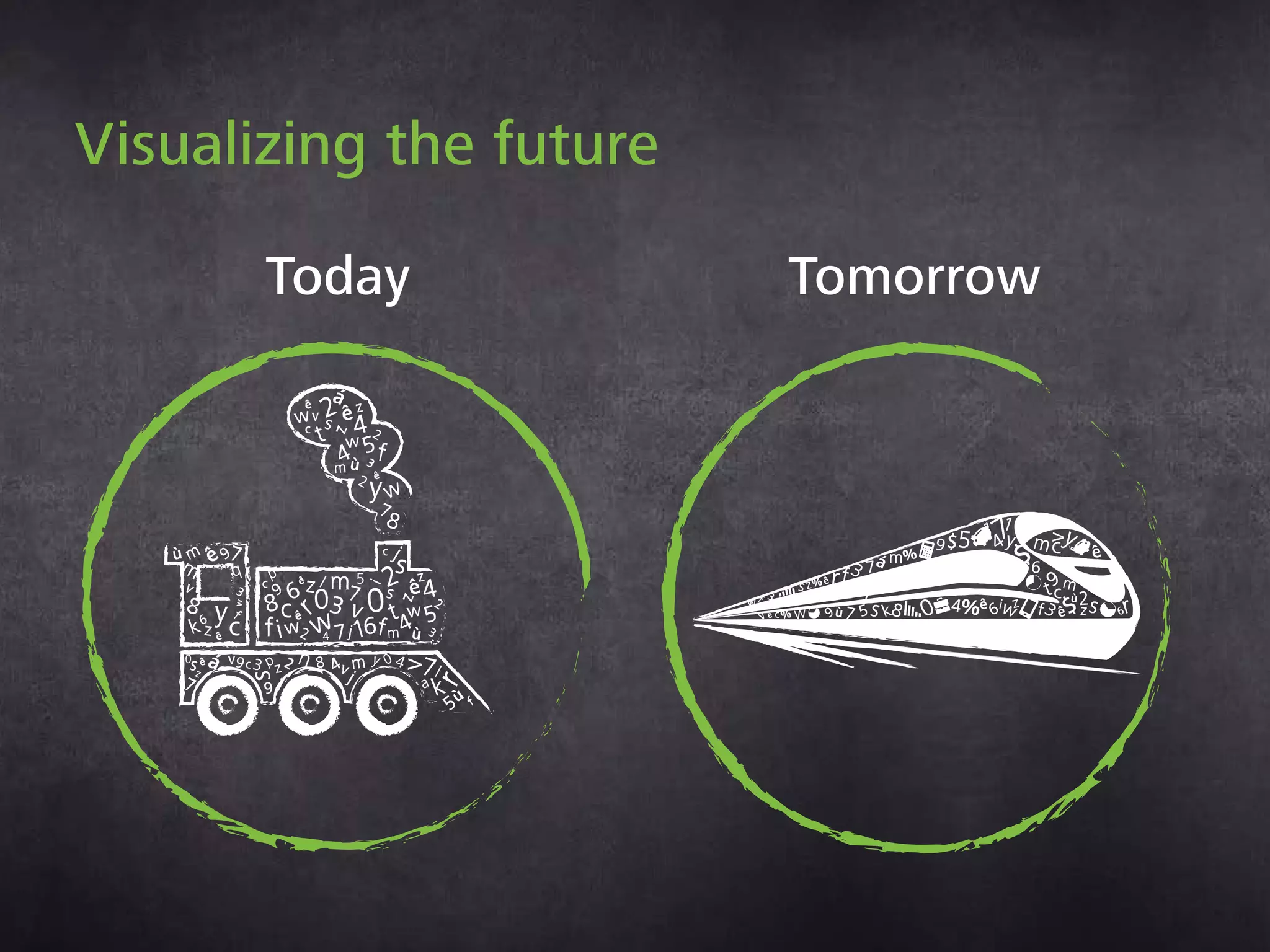
Visualizing the future
Today Tomorrow
Dreaming bigger
• What if we wiped the slate clear of
legacy models and patchwork solutions,
and began again from the start?
• What could we build if we were not
constrained by rules and regulations?
• What would users choose to have?
What might organizations choose
to share?
•
Dreaming of better
Could we also create a framework
that would encourage organizations
to aspire to be better — striving
for long-term growth, for example,
instead of chasing short-term profits?
—
“(Businesses need to) break
free from the tyranny of today’s
earnings report so they can
do what they do best:
innovate, invest and build
tomorrow’s prosperity.”
Hillary Clinton
Tomorrow’s ideal model
The aim of a good corporate
reporting model is to produce
reports that communicate a
clear, succinct story about
how an organization is
managing its resources to
create value over time.
It’s elemental
To that end,
we believe a good
corporate reporting
model comprises
5elements
Five elements of a good model
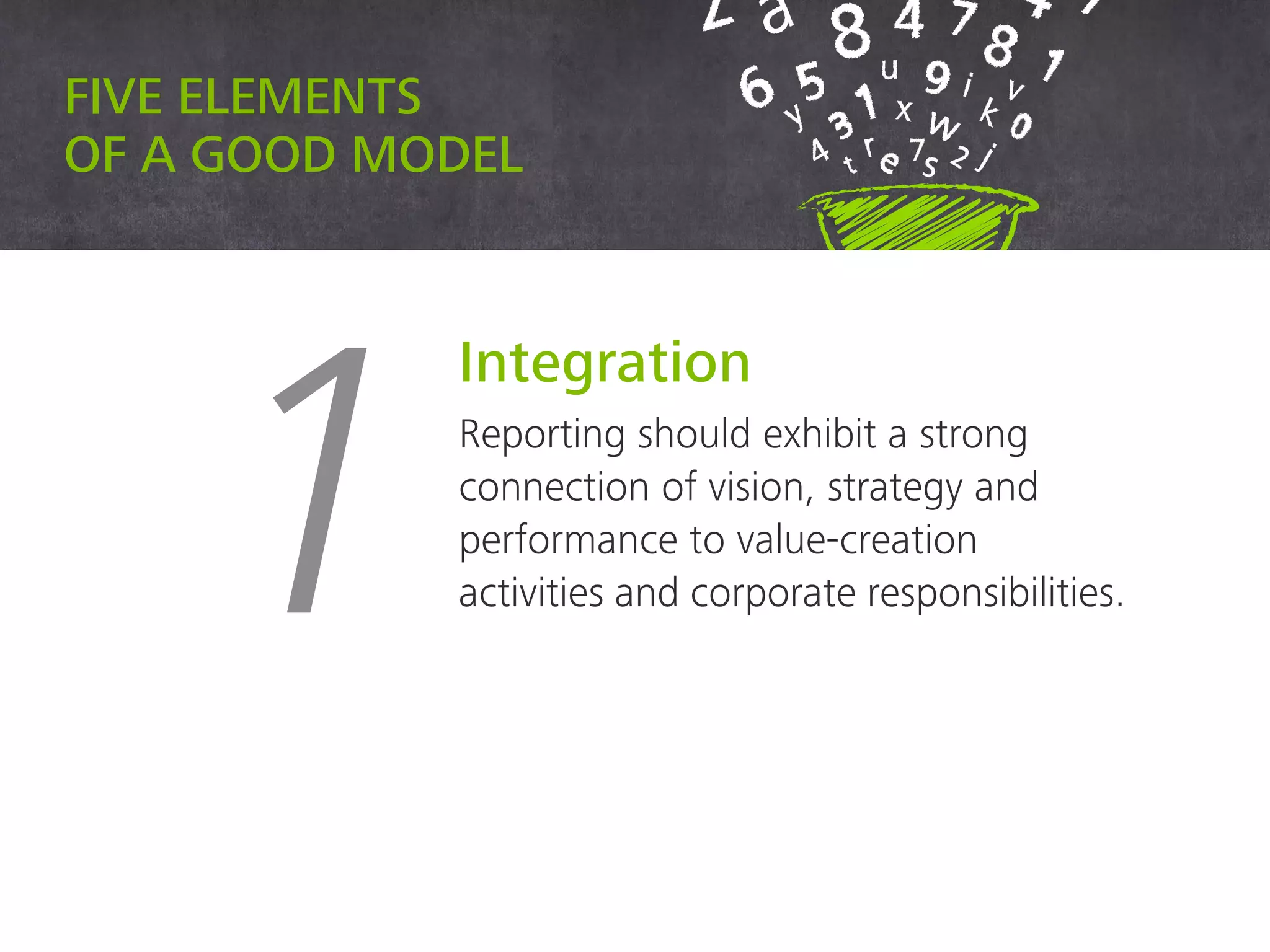
1
Integration
Reporting should exhibit a strong
connection of vision, strategy
and performance to value-
creation activities and corporate
responsibilities.
Five elements of a good model
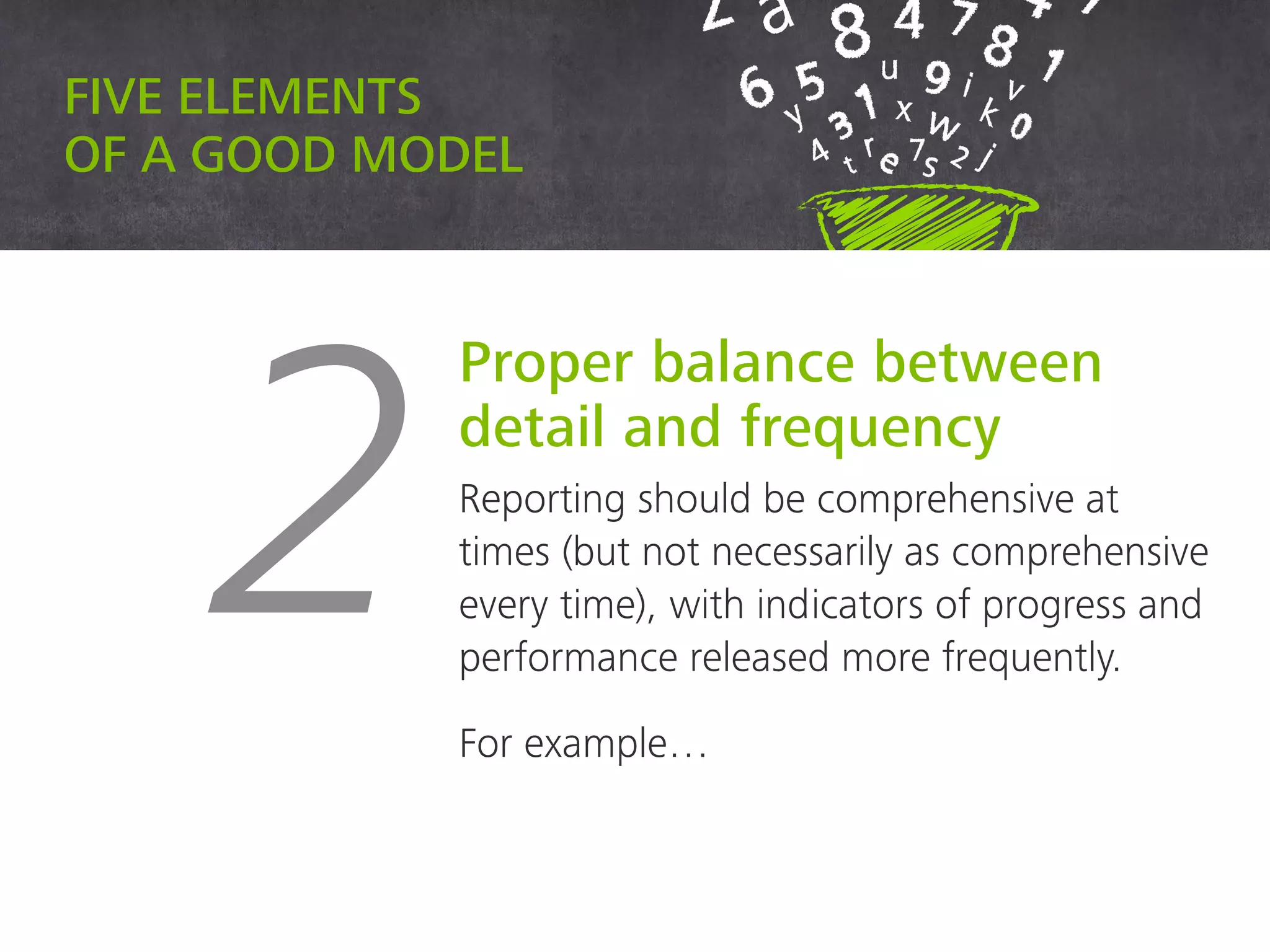
2
Proper balance between
detail and frequency
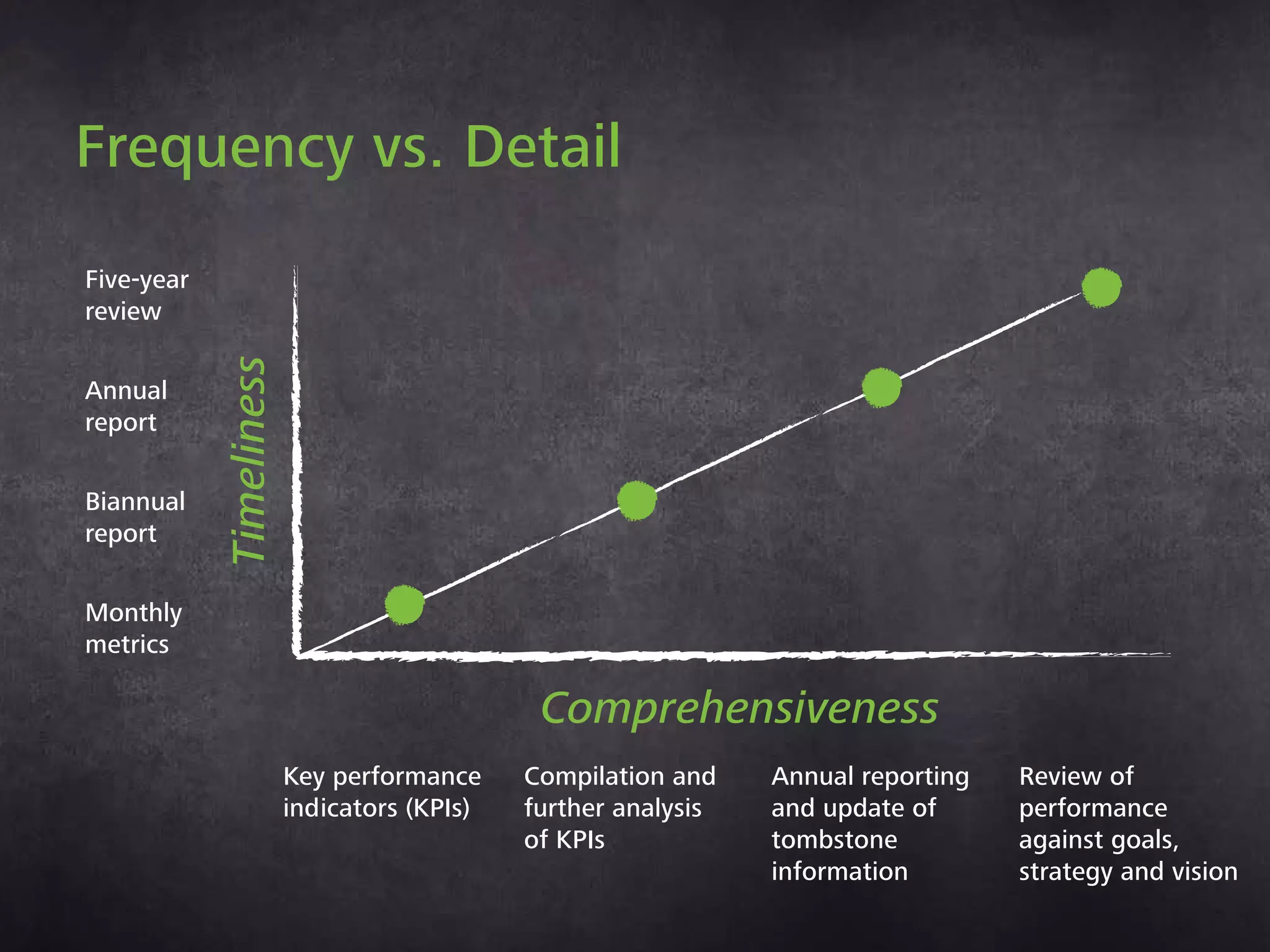
Reporting should be comprehensive at
times (but not necessarily as comprehensive
every time), with indicators of progress and
performance released more frequently.
For example…
Frequency vs. detail
Comprehensiveness
Timeliness
Key performance
indicators (KPIs)
Compilation and
further analysis
of KPIs
Annual report-
ing and update
of tombstone
information
Review of
performance
against goals,
strategy and
vision
Five-year
review
Annual
report
Biannual
report
Monthly
metrics
Five elements of a good model
3
Standardized
performance measures
Reporting of key and relevant metrics
for a particular industry segment
would provide more transparency
and usefulness to stakeholders if such
measures had a standard definition and
meaning within that industry.
Five elements of a good model
4
Technology-enabled
documents
Embedding technology in the reporting
framework – tagged text and links to
relevant supporting information, for example
– would allow report users to easily obtain
and manipulate data as it suits their unique
interests. Paper-based documents (e.g.,
PDFs) don’t let them do that.
Five elements of a good model
5
Support for
long-term growth
Reporting that would emphasize
long-term value creation through
innovation and investment, and
progress against these. This would
reduce focus on the achievement of
short-term value realization.
New measures for success
Let’s look more closely at the
fifth element, which speaks
to an organization’s ability to
create value over the long term.
That calls for a new approach
for identifying and measuring
predictors of success.
New measures for success
Today
In an era of slower change, past performance
(value realization) has been a strong indicator
of future performance. It’s still important for
demonstrating how an organization realizes its
opportunities. However, unlike the business world
of old, the past alone may no longer be the best
indicator of future success.
New measures for success
A new way
In an era of rapid change and disruption,
other metrics and measures may provide better
indicators of how a business is positioned for
future success. These indicators relate to the
organization’s focus on, and ability to create,
future value (value creation).
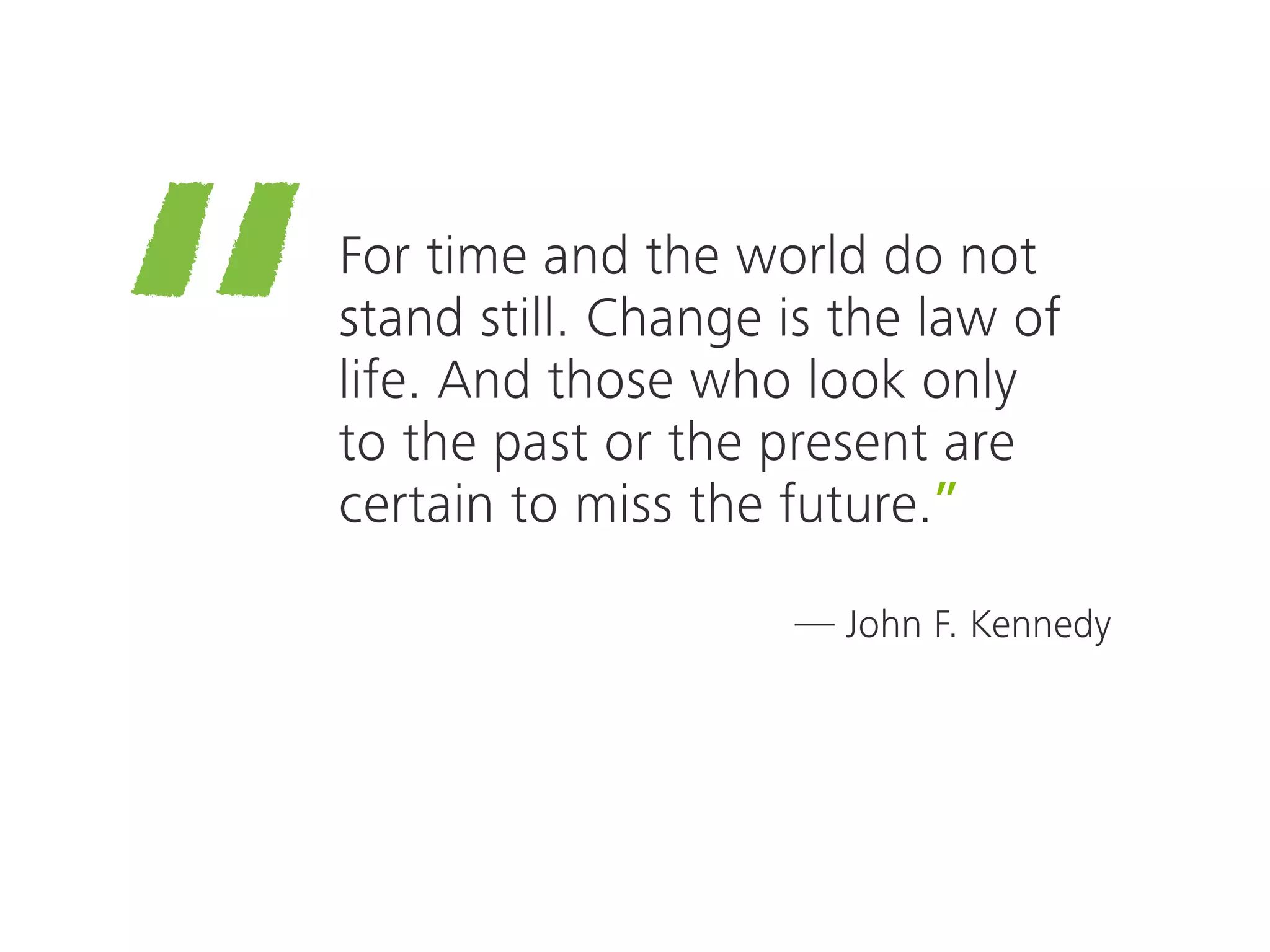
—
“For time and the world do not
stand still. Change is the law of
life. And those who look only
to the past or the present are
certain to miss the future.”
John F. Kennedy
New measures for success
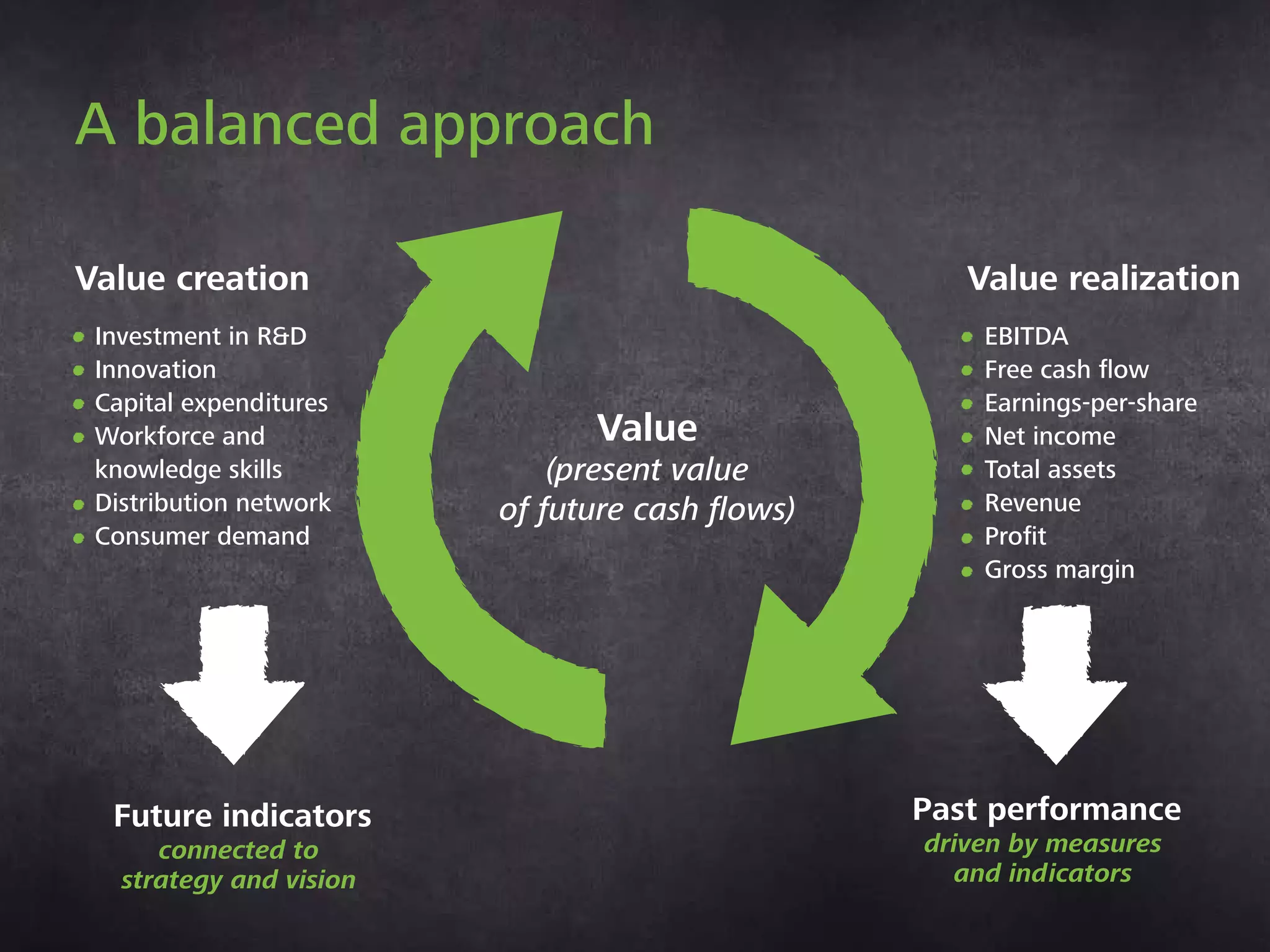
A balanced approach
Measuring and reporting value-creation metrics
and indicators as well as value-realization metrics
would give stakeholders a more comprehensive
picture of an organization’s past performance and
future prospects.
A balanced approach
Value
(present value
of future cash flows)
Mature cash flows
Value creation
Investment in R&D
Innovation
Capital expenditures
Workforce and
knowledge skills
Distribution network
Consumer demand
Future indicators
connected to
strategy and vision
Value realization
EBITDA
Free cash flow
Earnings-per-share
Net income
Total assets
Revenue
Profit
Gross margin
Past performance
driven by measures
and indicators
But, corporate reporting is
not just what is shared – it’s
also when, how and where.
Wanted: more frequent useful data
Today’s stakeholders crave information
What about sharing monthly key value-creation metrics –
just the indicators, nothing more comprehensive?
This is a golden opportunity for organizations to correct
any misinformation in the marketplace. And by building
in forward-looking metrics, they can avoid the impulse to
simply chase short-term targets.
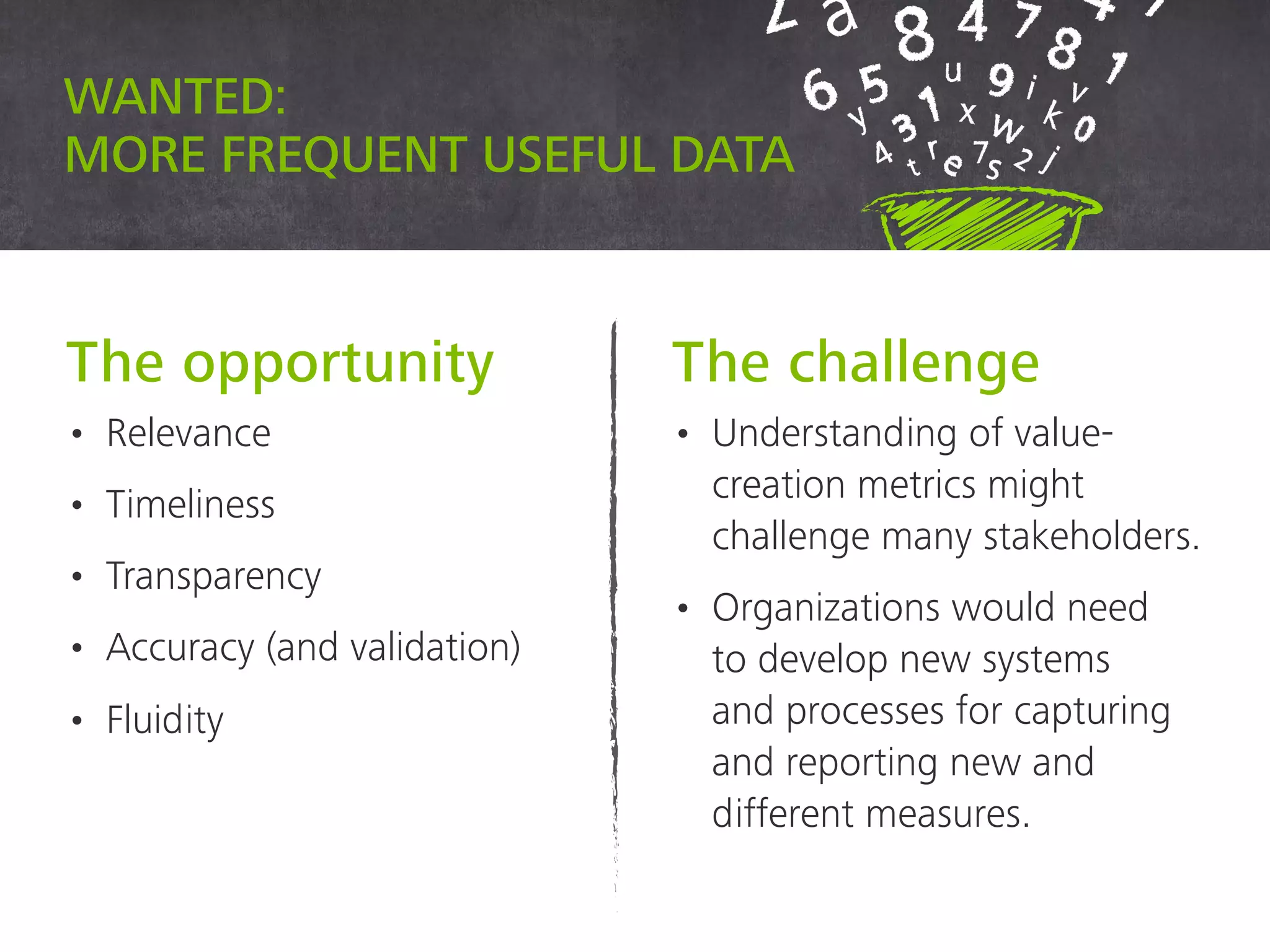
The opportunity
• Relevance
• Timeliness
• Transparency
• Accuracy (and validation)
• Fluidity
The challenge
• Understanding of value-
creation metrics might
challenge many stakeholders.
• Organizations would need
to develop new systems
and processes for capturing
and reporting new and
different measures.
Wanted: more frequent useful data
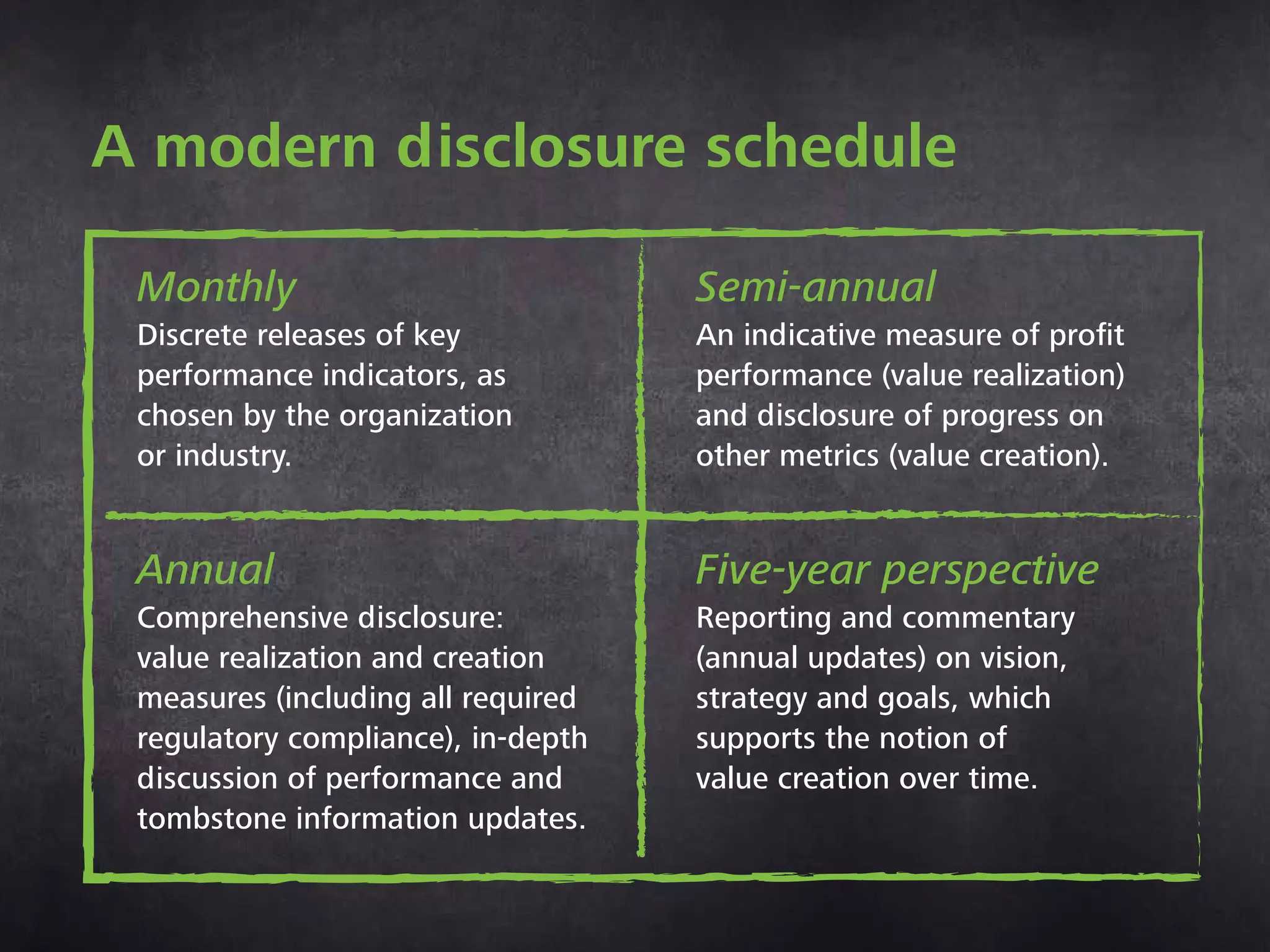
A modern disclosure schedule
Monthly
Discrete releases of key
performance indicators, as
chosen by the organization
or industry.
Semi-annual
An indicative measure of profit
performance (value realization)
and disclosure of progress on
other metrics (value creation).
Annual
Comprehensive disclosure:
value realization and creation
measures (including all required
regulatory compliance), in-depth
discussion of performance and
tombstone information updates.
Five-year perspective
Reporting and commentary
(annual updates) on vision,
strategy and goals, which
supports the notion of value
creation over time.
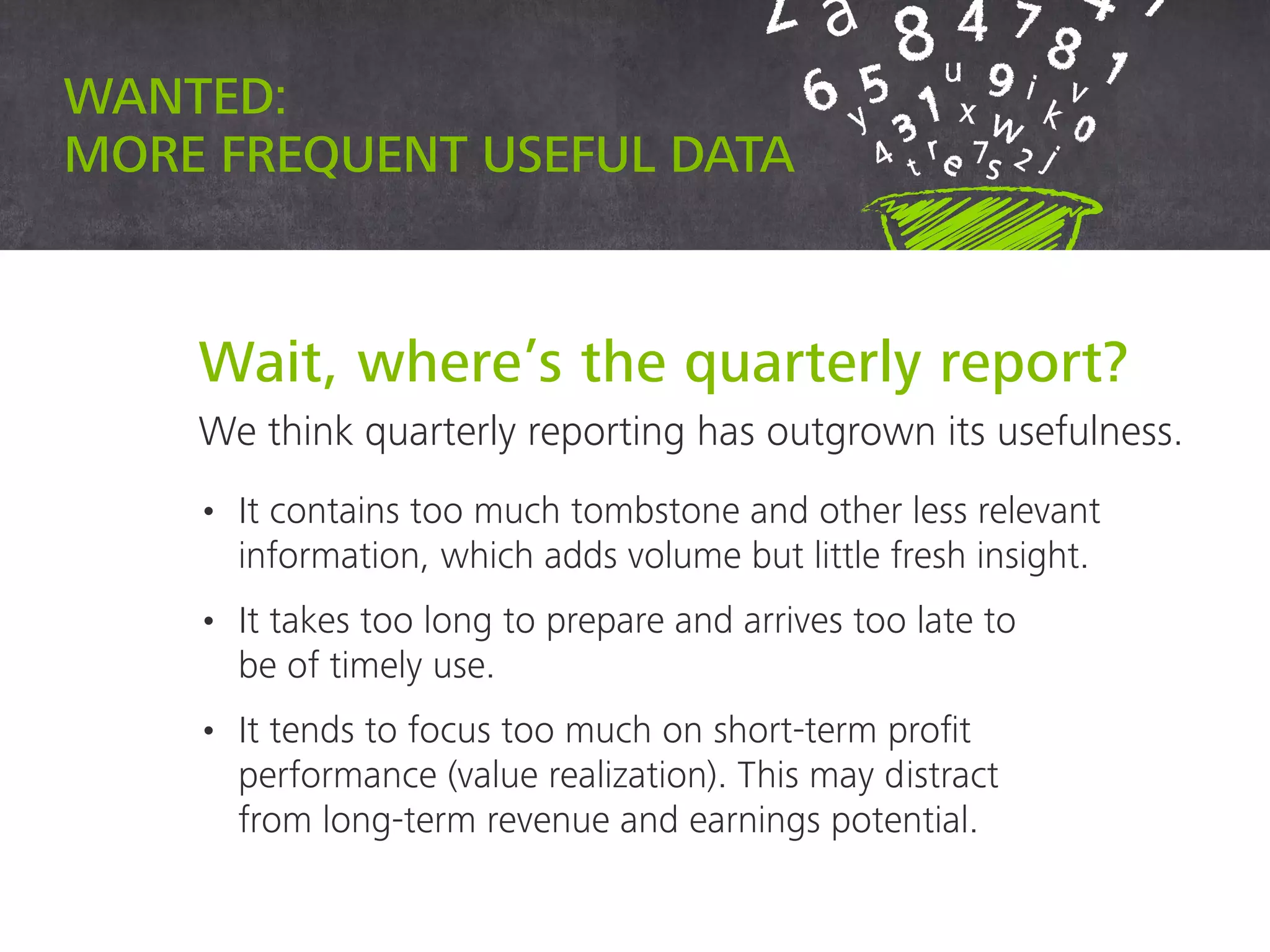
Wait, where’s the quarterly report?
We think quarterly reporting has outgrown its usefulness.
• It contains too much tombstone and other less relevant
information, which adds volume but little fresh insight.
• It takes too long to prepare and arrives too late to
be of timely use.
• It tends to focus too much on short-term profit
performance (value realization). This may distract
from long-term revenue and earnings potential.
Wanted: more frequent useful data
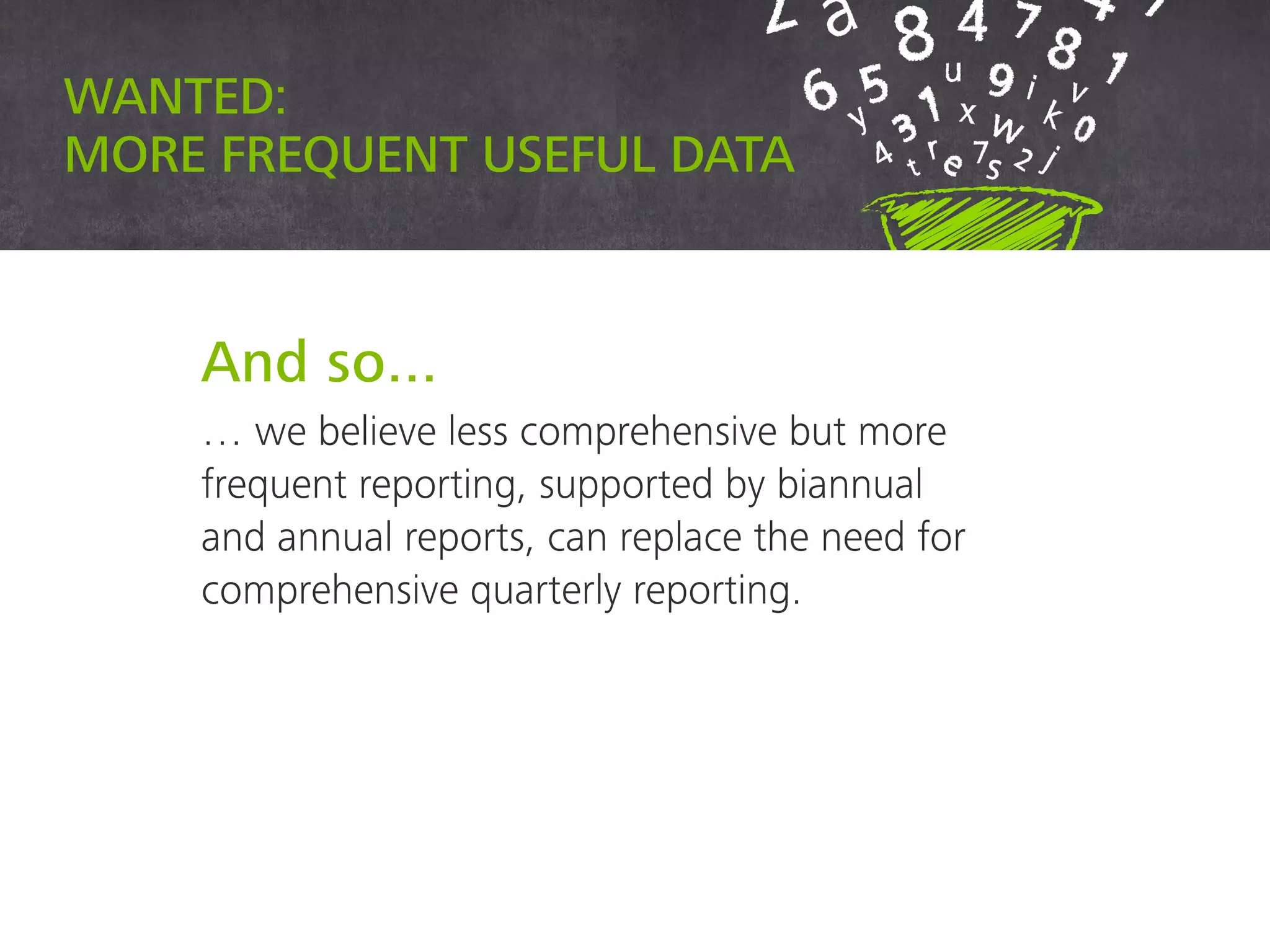
And so...
… we believe less comprehensive but more
frequent reporting, supported by biannual
and annual reports, can replace the need for
comprehensive quarterly reporting.
Wanted:
more frequent useful data
Getting the word out
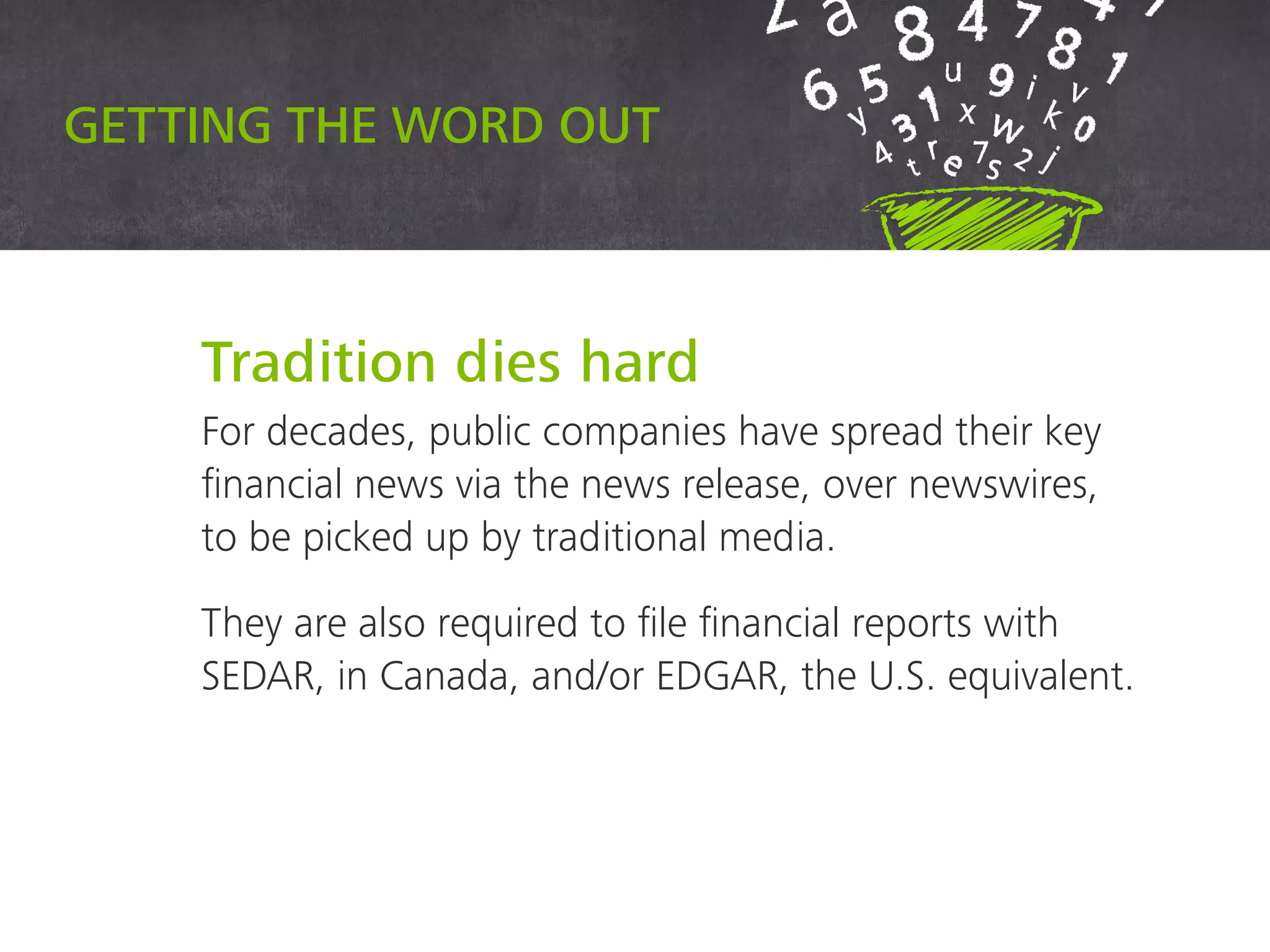
Tradition dies hard
For decades, public companies have spread their key
financial news via the news release, over newswires, to
be picked up by traditional media.
They are also required to file financial reports with
SEDAR, in Canada, and/or EDGAR, the U.S. equivalent.
But it’s the 21st century.
There are faster and
more efficient ways to
communicate to a greater
number of people.
The SEC recognizes social media
like Twitter and Facebook as
legitimate channels for conveying
information to the public.
(yes; that’s less than 140 characters)
Getting the word out
In short
Tweets can convey the key news and then link
to documents that give more information – a
press release, a simple form of key metrics, a
financial report in PDF form, an annual report.
Facebook status updates can be longer,
and can also link to further documentation.
Among the various
worldwide initiatives
to improve corporate
reporting in recent
years, are any getting
close to a better model?
Towards a better model
The proposed framework that has gained the
most traction is integrated reporting. As well
as advocating making reports easier to read and
use, it also comes the closest to demonstrating
and encouraging value creation.
But, it doesn’t address all the issues that
could modernize corporate reporting.
How does integrated
reporting compare with
the ideas that have been
informed by our research
and conversations?
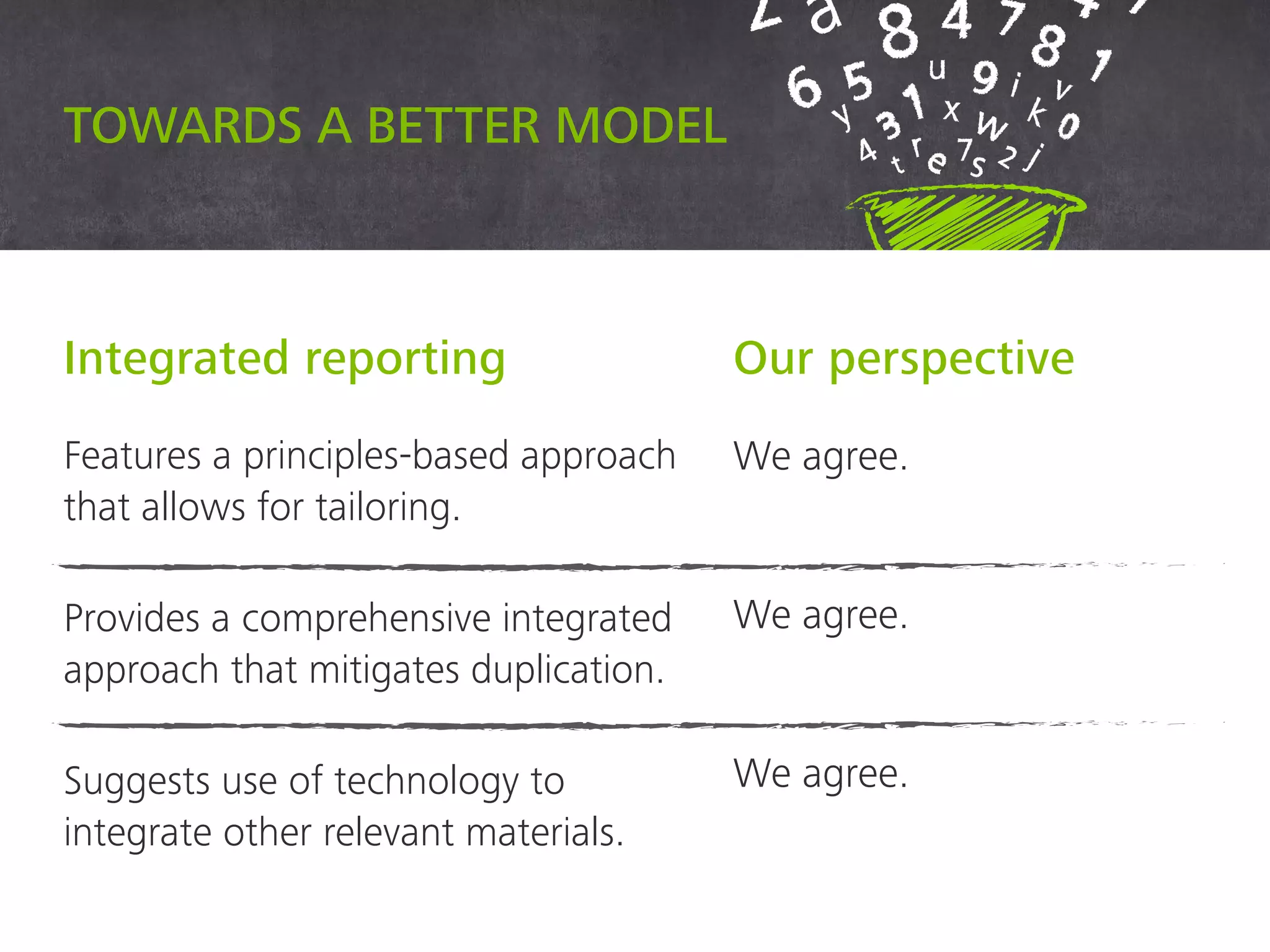
Towards a better model
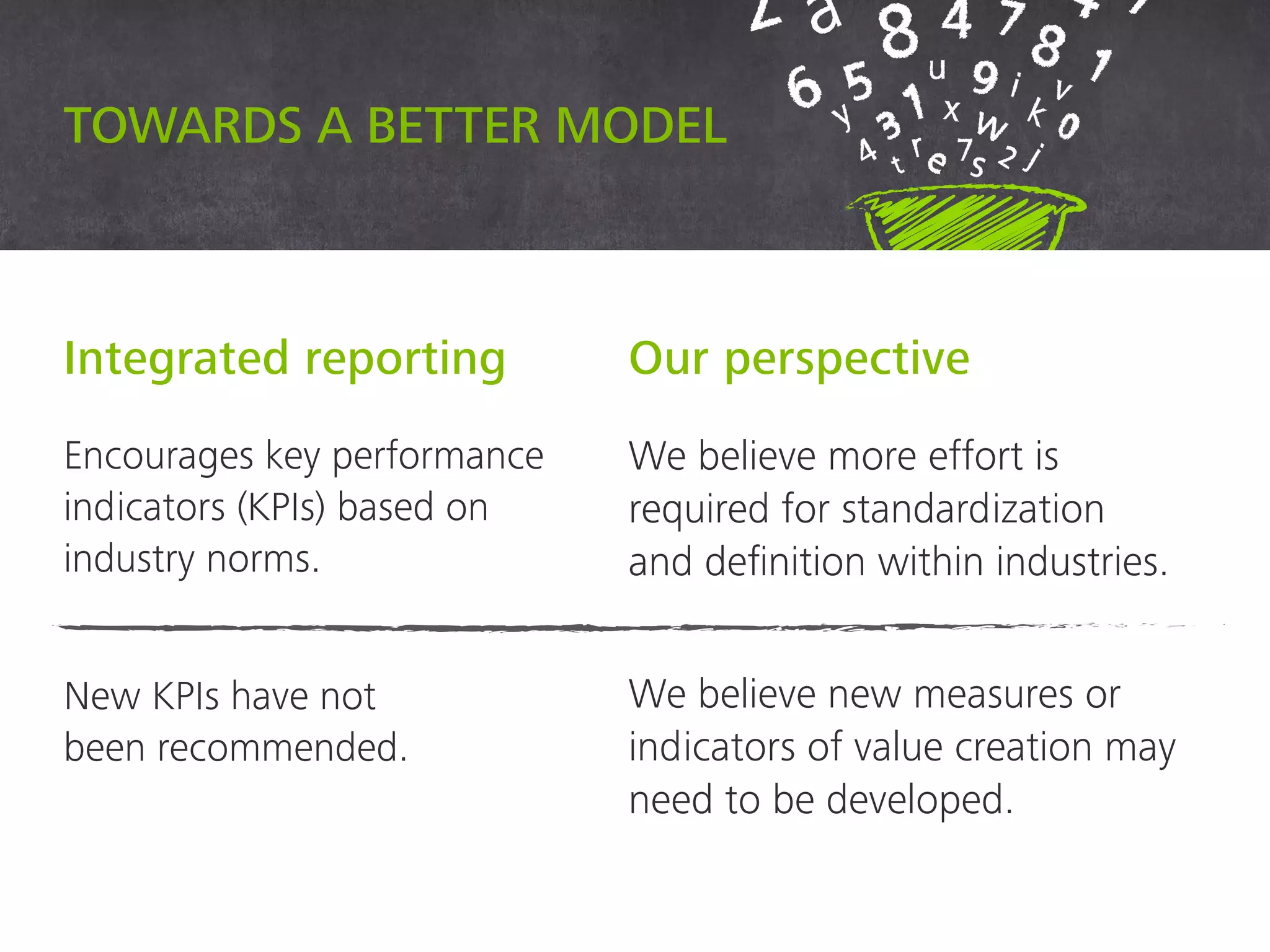
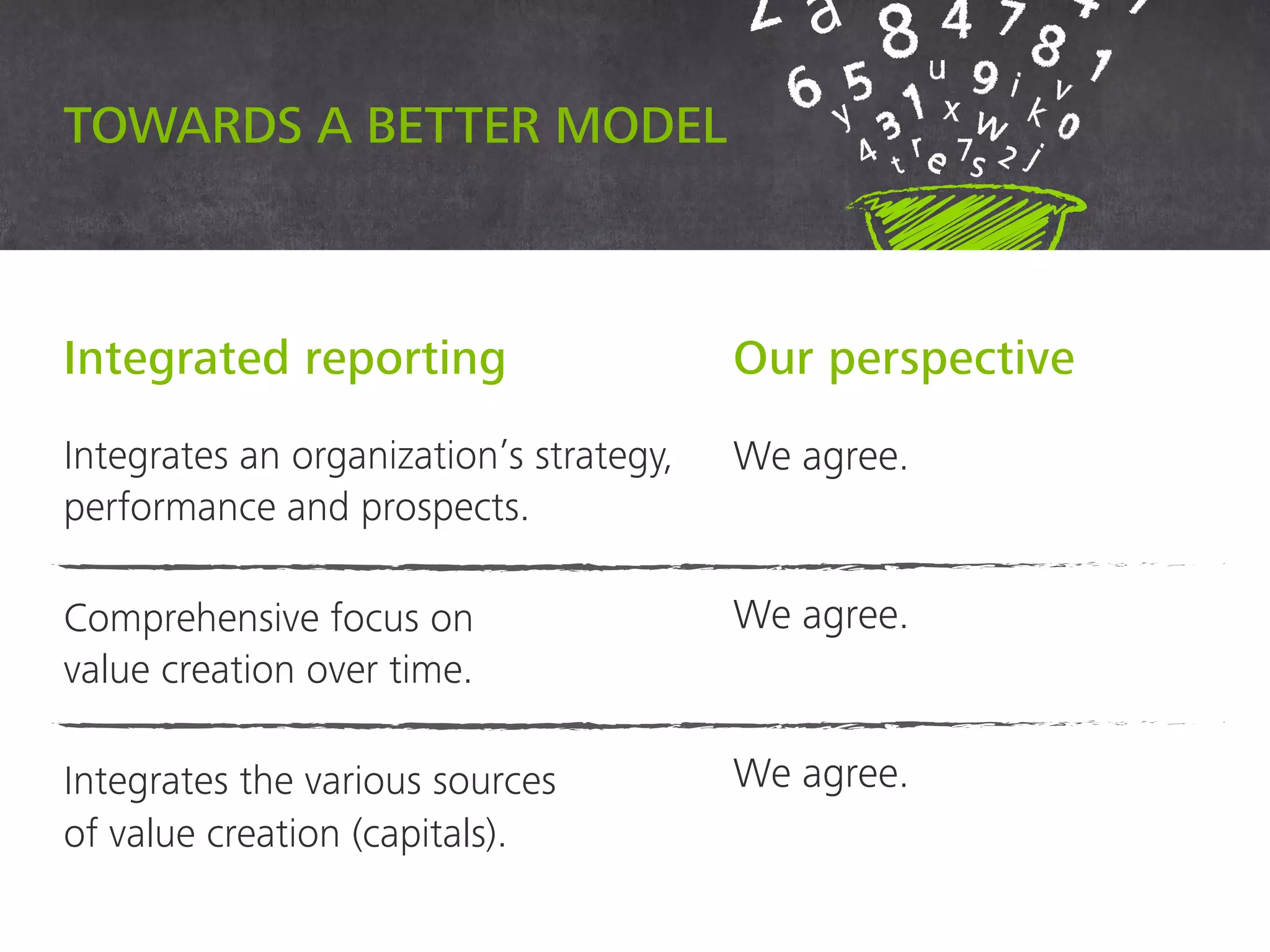
Integrated reporting Our perspective
Integrates an organization’s strategy,
performance and prospects. We agree.
Comprehensive focus on
value creation over time.
We agree.
Integrates the various sources
of value creation (capitals).
We agree.
Features a principles-based
approach that allows for tailoring. We agree.
Provides a comprehensive integrated
approach that mitigates duplication.
We agree.
Suggests use of technology to
integrate other relevant materials.
We agree.
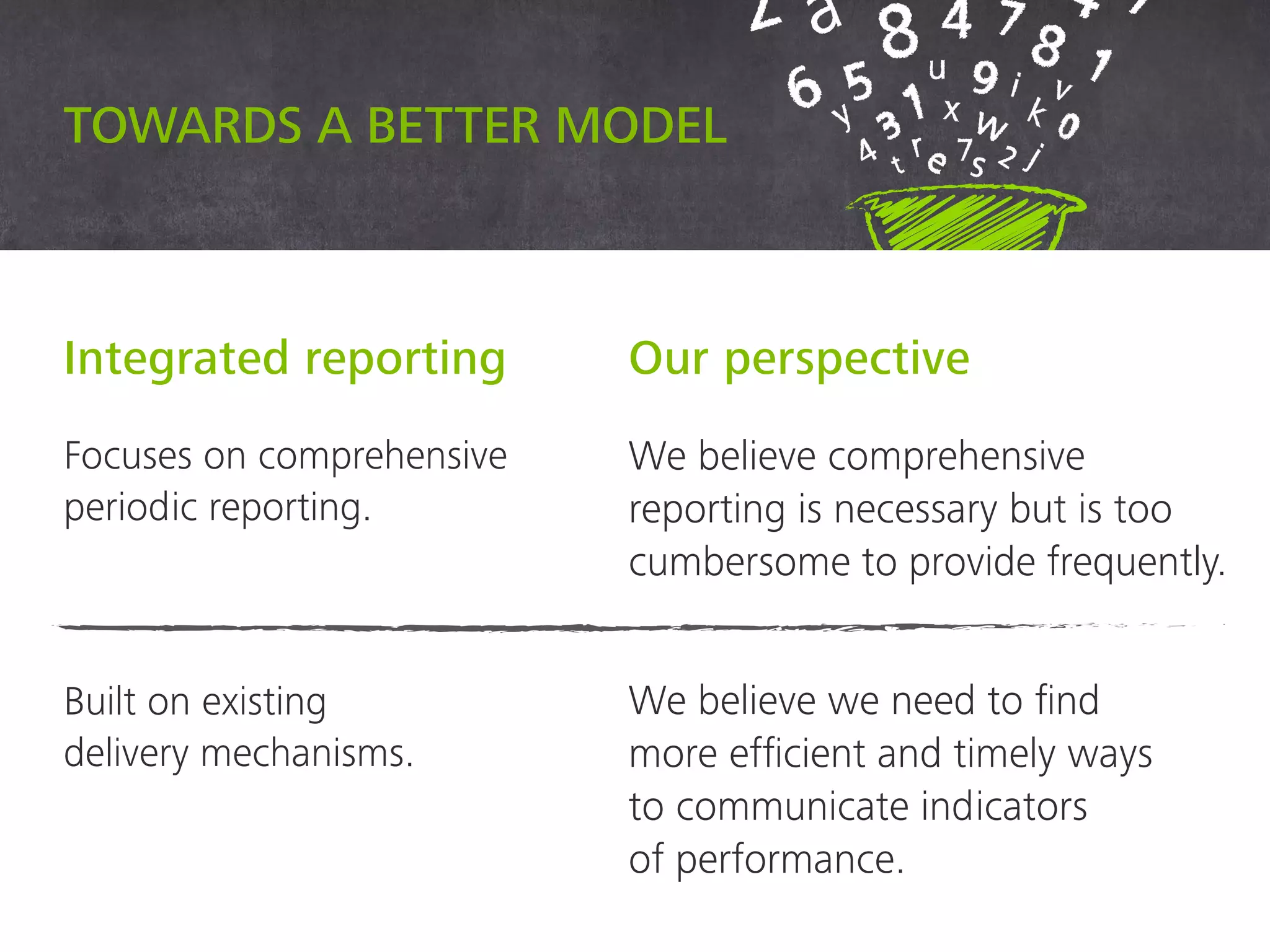
Integrated reporting Our perspective
Towards a better model
Focuses on comprehensive
periodic reporting.
We believe comprehensive reporting
is necessary but is too cumbersome
to provide frequently.
Built on existing
delivery mechanisms.
We believe we need to find
more efficient and timely ways
to communicate indicators
of performance.
Integrated reporting Our perspective
Towards a better model
Encourages key performance
indicators (KPIs) based on
industry norms.
We believe more effort is
required for standardization
and definition within industries.
New KPIs have not
been recommended.
We believe new measures or
indicators of value creation
may need to be developed.
Integrated reporting Our perspective
Towards a better model
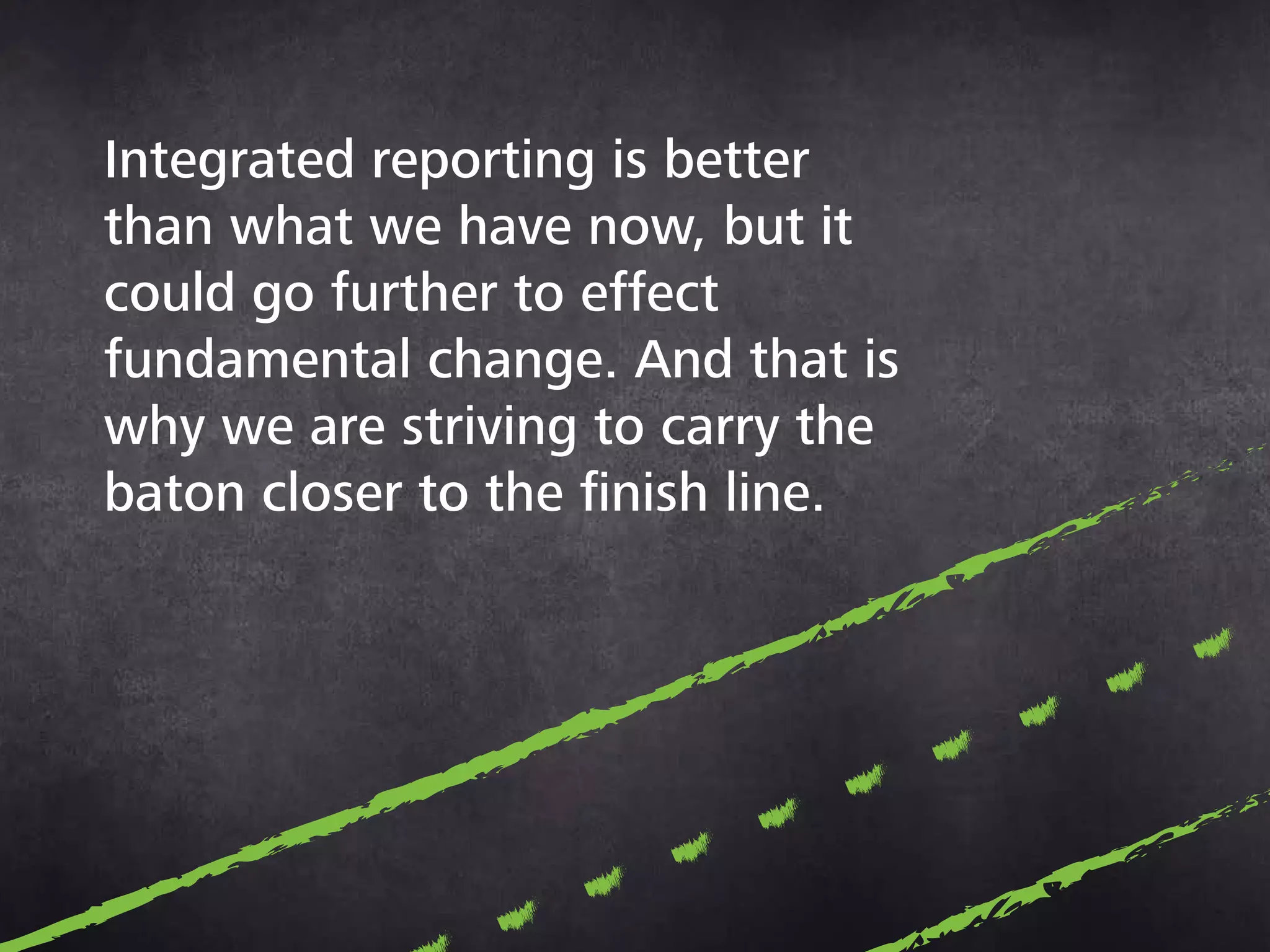
Integrated reporting is
better than what we have
now, but it could go further
to effect fundamental
change. And that is why
we are striving to carry
the baton closer to the
finish line.
In summary, we propose
In summary
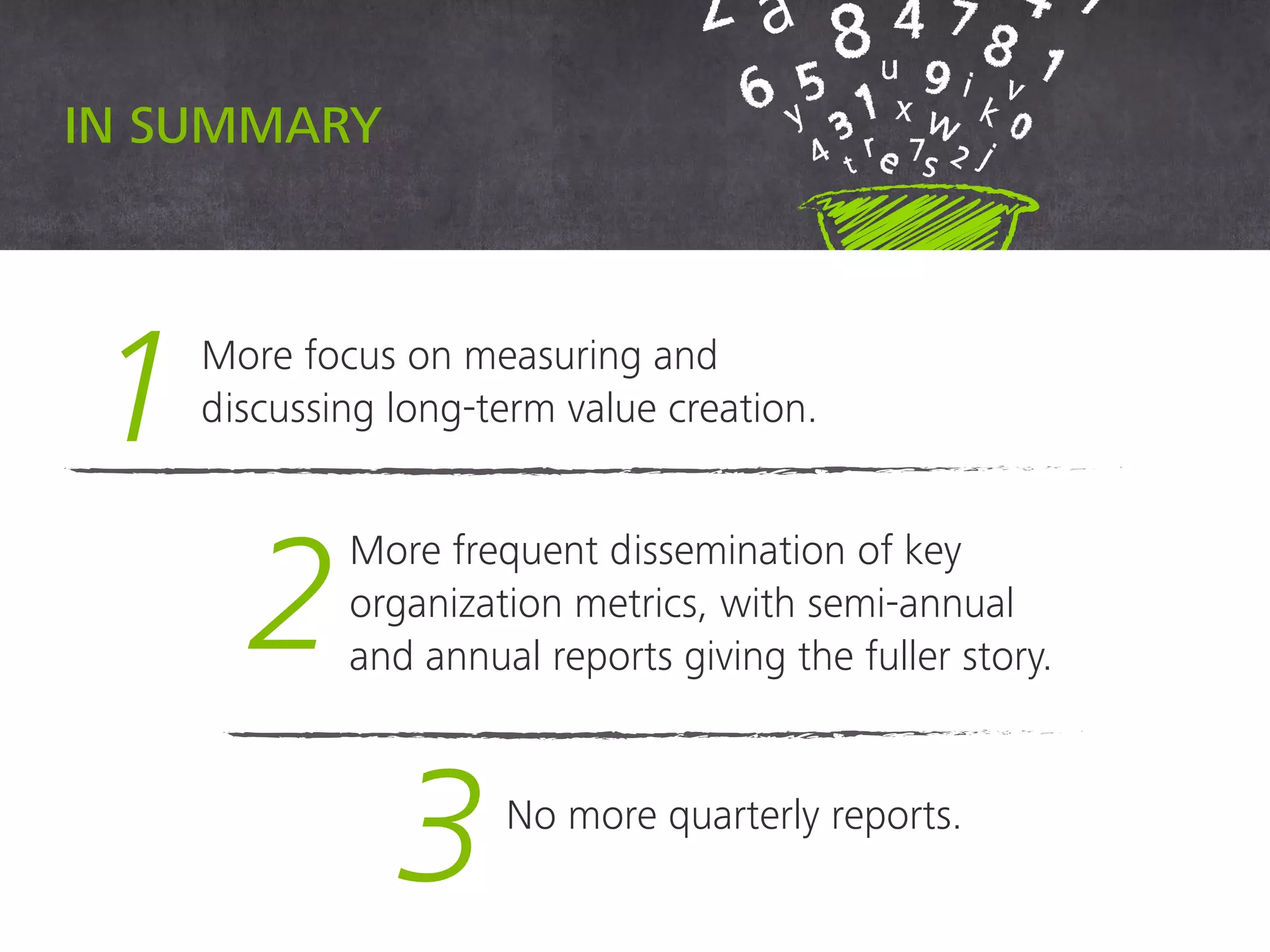
1More focus on measuring and
discussing long-term value creation.
2
More frequent dissemination of key
organization metrics, with semi-annual
and annual reports giving the fuller story.
3 No more quarterly reports.
4 Enhanced comprehension and meaningfulness
through the use of plain language and the
omission of irrelevant or repetitive content.
(See our second report, Beyond the status quo, for more information.)
5
Better use of modern technology,
in both reporting and communicating
with stakeholders.
In summary
—
“If you want something
you’ve never had, you must
be willing to do something
you’ve never done.”
Thomas Jefferson
What do you think?
Join the discussion and help build a corporate
reporting model for the modern business world.
Contacts:
Al Donald
Partner, Audit & Assurance
+1 (416) 643 8760
adonald@deloitte.ca
Stacey Nagle
Partner, Audit & Assurance
+1 (416) 643 8487
stanagle@deloitte.ca
deloitte.ca/corporatereporting
corporatereporting@deloitte.ca
www.deloitte.ca
© Deloitte LLP and affiliated entities.
Designed and produced by the Deloitte Design Studio, Canada. 17-4954H

Corporate reporting: Exploring a new world

  • 1.
    Is more less? Exploringa new world of corporate reporting Part 3: Looking to the future
  • 2.
  • 3.
    Corporate reporting isstruggling to meet the demands of the modern business world and the needs of stakeholders. To address the problem, we’ve researched proposed solutions and spoken to board directors, analysts, institutional investors and preparers across Canada to gather their thoughts. This is the third report in our journey. The journey so far
  • 4.
    Defining the problem Inthe first report, we established that corporate reporting has become, though for various valid reasons, overwhelmingly complex and lengthy. This has made it increasingly difficult for stakeholders to make efficient and confident decisions. The primary purpose of corporate reporting is to inform stakeholders. To do that better, everyone involved – regulators, standard setters, preparers, corporate board directors and professional advisors – must play a part. The journey so far
  • 5.
    Quick fixes In thesecond report, we proposed that the existing model can be improved to make corporate reports more informative for users by: • using plain language, • prioritizing information better, • standardizing and defining non-GAAP measures, and • employing more technology (e.g. searchable text, links, tags). The journey so far
  • 6.
    How we gothere Corporate reporting in Canada closely follows rules and regulations set up in the early 1930s by the U.S. Securities and Exchange Commission (SEC). These are primarily rooted in making comprehensive and periodic disclosures to all stakeholders through the controlled distribution channels and delivery systems that were available at the time. The journey so far
  • 7.
    Remodelling required Times havechanged – a lot. Stakeholders, like many, have come to expect to have information readily accessible to them in a relevant and easily usable form. The essence of our reporting framework was set up 80 years ago. It’s time for an update. The journey so far
  • 8.
  • 9.
    Dreaming bigger • Whatif we wiped the slate clear of legacy models and patchwork solutions, and began again from the start? • What could we build if we were not constrained by rules and regulations? • What would users choose to have? What might organizations choose to share?
  • 10.
    • Dreaming of better Couldwe also create a framework that would encourage organizations to aspire to be better — striving for long-term growth, for example, instead of chasing short-term profits?
  • 11.
    — “(Businesses need to)break free from the tyranny of today’s earnings report so they can do what they do best: innovate, invest and build tomorrow’s prosperity.” Hillary Clinton
  • 12.
    Tomorrow’s ideal model Theaim of a good corporate reporting model is to produce reports that communicate a clear, succinct story about how an organization is managing its resources to create value over time.
  • 13.
    It’s elemental To thatend, we believe a good corporate reporting model comprises 5elements
  • 14.
    Five elements ofa good model 1 Integration Reporting should exhibit a strong connection of vision, strategy and performance to value- creation activities and corporate responsibilities.
  • 15.
    Five elements ofa good model 2 Proper balance between detail and frequency Reporting should be comprehensive at times (but not necessarily as comprehensive every time), with indicators of progress and performance released more frequently. For example…
  • 16.
    Frequency vs. detail Comprehensiveness Timeliness Keyperformance indicators (KPIs) Compilation and further analysis of KPIs Annual report- ing and update of tombstone information Review of performance against goals, strategy and vision Five-year review Annual report Biannual report Monthly metrics
  • 17.
    Five elements ofa good model 3 Standardized performance measures Reporting of key and relevant metrics for a particular industry segment would provide more transparency and usefulness to stakeholders if such measures had a standard definition and meaning within that industry.
  • 18.
    Five elements ofa good model 4 Technology-enabled documents Embedding technology in the reporting framework – tagged text and links to relevant supporting information, for example – would allow report users to easily obtain and manipulate data as it suits their unique interests. Paper-based documents (e.g., PDFs) don’t let them do that.
  • 19.
    Five elements ofa good model 5 Support for long-term growth Reporting that would emphasize long-term value creation through innovation and investment, and progress against these. This would reduce focus on the achievement of short-term value realization.
  • 20.
    New measures forsuccess Let’s look more closely at the fifth element, which speaks to an organization’s ability to create value over the long term. That calls for a new approach for identifying and measuring predictors of success.
  • 21.
    New measures forsuccess Today In an era of slower change, past performance (value realization) has been a strong indicator of future performance. It’s still important for demonstrating how an organization realizes its opportunities. However, unlike the business world of old, the past alone may no longer be the best indicator of future success.
  • 22.
    New measures forsuccess A new way In an era of rapid change and disruption, other metrics and measures may provide better indicators of how a business is positioned for future success. These indicators relate to the organization’s focus on, and ability to create, future value (value creation).
  • 23.
    — “For time andthe world do not stand still. Change is the law of life. And those who look only to the past or the present are certain to miss the future.” John F. Kennedy
  • 24.
    New measures forsuccess A balanced approach Measuring and reporting value-creation metrics and indicators as well as value-realization metrics would give stakeholders a more comprehensive picture of an organization’s past performance and future prospects.
  • 25.
    A balanced approach Value (presentvalue of future cash flows) Mature cash flows Value creation Investment in R&D Innovation Capital expenditures Workforce and knowledge skills Distribution network Consumer demand Future indicators connected to strategy and vision Value realization EBITDA Free cash flow Earnings-per-share Net income Total assets Revenue Profit Gross margin Past performance driven by measures and indicators
  • 26.
    But, corporate reportingis not just what is shared – it’s also when, how and where.
  • 27.
    Wanted: more frequentuseful data Today’s stakeholders crave information What about sharing monthly key value-creation metrics – just the indicators, nothing more comprehensive? This is a golden opportunity for organizations to correct any misinformation in the marketplace. And by building in forward-looking metrics, they can avoid the impulse to simply chase short-term targets.
  • 28.
    The opportunity • Relevance •Timeliness • Transparency • Accuracy (and validation) • Fluidity The challenge • Understanding of value- creation metrics might challenge many stakeholders. • Organizations would need to develop new systems and processes for capturing and reporting new and different measures. Wanted: more frequent useful data
  • 29.
    A modern disclosureschedule Monthly Discrete releases of key performance indicators, as chosen by the organization or industry. Semi-annual An indicative measure of profit performance (value realization) and disclosure of progress on other metrics (value creation). Annual Comprehensive disclosure: value realization and creation measures (including all required regulatory compliance), in-depth discussion of performance and tombstone information updates. Five-year perspective Reporting and commentary (annual updates) on vision, strategy and goals, which supports the notion of value creation over time.
  • 30.
    Wait, where’s thequarterly report? We think quarterly reporting has outgrown its usefulness. • It contains too much tombstone and other less relevant information, which adds volume but little fresh insight. • It takes too long to prepare and arrives too late to be of timely use. • It tends to focus too much on short-term profit performance (value realization). This may distract from long-term revenue and earnings potential. Wanted: more frequent useful data
  • 31.
    And so... … webelieve less comprehensive but more frequent reporting, supported by biannual and annual reports, can replace the need for comprehensive quarterly reporting. Wanted: more frequent useful data
  • 32.
    Getting the wordout Tradition dies hard For decades, public companies have spread their key financial news via the news release, over newswires, to be picked up by traditional media. They are also required to file financial reports with SEDAR, in Canada, and/or EDGAR, the U.S. equivalent.
  • 33.
    But it’s the21st century. There are faster and more efficient ways to communicate to a greater number of people.
  • 34.
    The SEC recognizessocial media like Twitter and Facebook as legitimate channels for conveying information to the public. (yes; that’s less than 140 characters)
  • 35.
    Getting the wordout In short Tweets can convey the key news and then link to documents that give more information – a press release, a simple form of key metrics, a financial report in PDF form, an annual report. Facebook status updates can be longer, and can also link to further documentation.
  • 36.
    Among the various worldwideinitiatives to improve corporate reporting in recent years, are any getting close to a better model?
  • 37.
    Towards a bettermodel The proposed framework that has gained the most traction is integrated reporting. As well as advocating making reports easier to read and use, it also comes the closest to demonstrating and encouraging value creation. But, it doesn’t address all the issues that could modernize corporate reporting.
  • 38.
    How does integrated reportingcompare with the ideas that have been informed by our research and conversations?
  • 39.
    Towards a bettermodel Integrated reporting Our perspective Integrates an organization’s strategy, performance and prospects. We agree. Comprehensive focus on value creation over time. We agree. Integrates the various sources of value creation (capitals). We agree.
  • 40.
    Features a principles-based approachthat allows for tailoring. We agree. Provides a comprehensive integrated approach that mitigates duplication. We agree. Suggests use of technology to integrate other relevant materials. We agree. Integrated reporting Our perspective Towards a better model
  • 41.
    Focuses on comprehensive periodicreporting. We believe comprehensive reporting is necessary but is too cumbersome to provide frequently. Built on existing delivery mechanisms. We believe we need to find more efficient and timely ways to communicate indicators of performance. Integrated reporting Our perspective Towards a better model
  • 42.
    Encourages key performance indicators(KPIs) based on industry norms. We believe more effort is required for standardization and definition within industries. New KPIs have not been recommended. We believe new measures or indicators of value creation may need to be developed. Integrated reporting Our perspective Towards a better model
  • 43.
    Integrated reporting is betterthan what we have now, but it could go further to effect fundamental change. And that is why we are striving to carry the baton closer to the finish line.
  • 44.
  • 45.
    In summary 1More focuson measuring and discussing long-term value creation. 2 More frequent dissemination of key organization metrics, with semi-annual and annual reports giving the fuller story. 3 No more quarterly reports.
  • 46.
    4 Enhanced comprehensionand meaningfulness through the use of plain language and the omission of irrelevant or repetitive content. (See our second report, Beyond the status quo, for more information.) 5 Better use of modern technology, in both reporting and communicating with stakeholders. In summary
  • 47.
    — “If you wantsomething you’ve never had, you must be willing to do something you’ve never done.” Thomas Jefferson
  • 48.
    What do youthink? Join the discussion and help build a corporate reporting model for the modern business world. Contacts: Al Donald Partner, Audit & Assurance +1 (416) 643 8760 adonald@deloitte.ca Stacey Nagle Partner, Audit & Assurance +1 (416) 643 8487 stanagle@deloitte.ca deloitte.ca/corporatereporting corporatereporting@deloitte.ca
  • 49.
    www.deloitte.ca © Deloitte LLPand affiliated entities. Designed and produced by the Deloitte Design Studio, Canada. 17-4954H