

Putting Customers at
the Center of Your
Digital Strategy
Chris Boyer
• System Director, Digital Strategy & Analytics
M Health Fairview
• Platinum Member of the Mayo Clinic Social Media
External Advisory Board
• Co-host of the touch point podcast
http://touchpoint.health
• 2018 inductee into the Healthcare Hall of Fame (Most
Innovative Individual)
• Twitter: @chrisboyer
A Simple Three-Point Framework
1. Know your customers (and their needs/behaviors)
2. Understand their online journey
3. Align your marketing technology stack
3
First, Understand Your “Customer”
“If there’s one reason we have
done better…it is because we have
focused like a laser on customer
experience, and that really does
matter in any business.”
- Jeff Bezos
Primary Audiences
6
Audience Type Description Example Needs (examples)
Health Seekers People and their family members that
receive some form of service or care from
the health system (both wellness and sick
care)
• Consumers
• Prospective patients
• Existing patients
• Family members
• Selecting the right doctor or treatment for them
• Determining the best place to seek care
• Determining how much their treatment will cost
Health Care
Professionals
Clinical and academic professionals –
employed, affiliated, or community-based
– that can potentially utilize services,
research and educations offered by our
health system
• Employed physicians
• Referring physicians
• Residents
• Fellows
• Researchers
• Academic staff
• Referring patients to your system
• Determining if your system is the best place
for continued/ongoing learning
• Easily accessing internal systems to do their work
• Networking with experts in the industry to stay
ahead of the trends
Medical
Staff/Employees
Supportive medical staff that are
employed or contracted with our health
systems
• Nurses
• Medical Staff
• Employees
• Contractors
• Service
vendors/partners
• Being able to communicate easily with one
another
• Learning system-wide efforts to address patient
experience
• Staying abreast of the latest info about the
organization
Corporate/B2B Purchasers, payors, and decision-makers
for large organizations contracting with
the health system for access to care and
services for their members and employees
• Employers
• ACO Partners
• Government Purchasers
• Payers
• Understanding how your B2B offerings will save
them money
• Easily accessing information even while outside
the network
• Transacting with your organization online
Secondary Audiences
7
Audiences Description Examples Needs (examples)
Community
Members
Organizations partnering with our health system to
provide expanded health services to help fulfill our
mission
• Schools/universities
• Faith-based organizations
• Community partners
• Non-profits
• Providing their communities with
information about your org
• Understanding your community
benefit
• Maintaining brand-advocacy
with your system
Constituent People and entities that care about, influence and
impact our organization through governance, policy,
licensure, accreditation, regulation, and/or their
ability to influence public opinions.
• Governing Board
• Foundations
• JAHCO
• Department of Health
• Regulators
• Senators
• Understanding the impact to
your system when passing
legislation
• Ensuring your organization is
compliant throughout the
auditing process
• Ensuring alignment with state
and federal regulations
Be Empathetic
To deeply understand our customer,
we use empathy maps to:
• Establish common ground around who
we’re designing for
• Understand and prioritize their needs at
every step off the journey
8
Empathy Maps
Says
• Direct feedback from customers
• Derived focus groups, surveys (even HCAPS) and
usability studies
Thinks
• What are they thinking during the process
• Can be determined in usability studies
Does
• What actions they take
• Use Google Analytics, CRM,A/B Testing, etc.
Feels
• What worries them? Makes them feel better?
• Often represented as an adjective
9
www.salesforce.com/blog/2019/01/marketing-statistics-to-know.html
Next, Map Their Journey
“You got to start with the
customer experience and work
backwards to technology, not the
other way around.”
- Steve Jobs
A mapping of how customers are exposed to and then select your services.
Typically expressed linearly with “purchase” or “selection” at the end.
13
Path-to-Purchase
SELECTION
A non-linear way to map how consumers engage with
your brand throughout their various experiences.
Customer Journey
Awareness
Where the relationship with a customer
begins. when they first become aware of
the existence of your brand, product, or
service. In most cases, your work will
have started long before this with PR and
branding efforts.
Today, consumers are just as likely to first
hear about your brand via a word-of-
mouth recommendation from friends,
family members, or social media
influencers.
15
Driving Awareness Digitally
Target and Attract
• Identify market and consumer data from CRMs (propensity modeling, etc.)
• Use online PR tools (including online media relations, newsroom, brand journalism, etc.)
• Online Advertising (including PPC, machine learning, display ads and third-party site advertising)
Lead Generation and Email Marketing
• Engage in targeted SEO approaches for your website
Maintain Reputation
• Online Reputation Management (including 3rd party listing management, FB & Google Reviews)
• Social Media and Blog Activity (organic and paid strategies)
• Digital Monitors (promoting addt’l services to existing customers already in our buildings)
Measure
• Use analytics to understand effective response rates, engagement and conversions
16
Engagement
Customers making a significant decision will often
seeks ways to engage with a brand by engaging with
marketing content, following you on social media,
signing up for emails, etc.
In addition, they’ll start paying attention to what
others are saying about you and how you respond.
17
Building Engagement Digitally
Make Things Easier
• On your website, use distributed content, simplified navigation and other tools to guide users to
discover more information about you)
• Embrace tools such as Apps, SMS and other mobile technology to meet the customer where they are
• Chatbots and AI can be used to predict customer’s next actions and guide them through the process
Stay Top–of-Mind
• Create online content to differentiate, proof-points, multi-media content, online risk assessments,
video, webinars, etc.)
• Develop content in different channels (social media, blogs) to engage with users consistently across
channels
• Use email Programs/Marketing Automation to nurture customers
Measure
• CRMs should be used to track all interactions and help inform marketing automation activity by
measuring lead generation, nurturing, content ”stickiness” and user flows) 18
19
Evaluation
Every customer goes through some
method of evaluation, whether it’s
months of research or just a quick “gut
check” before making a decision.
One of the most effective ways to stand
out is by offering robust self-service
tools.
More than 90% of consumers expect to
receive consistent information in this
stage over multiple channels.
Supporting the Evaluation Phase Digitally
Make it Easy to Evaluate
• Develop useful physician and location directories that include content designed to help answer user’s
questions and make decisions
• Develop additional self-service content to ease customers through the process of selection
• Align with 3rd party evaluation tools to ensure your organization compares favorable to others
Stay Top of Mind
• Make sure your online reputation supports the evaluation phase, as online reviews can influence
customers in this phase
• Email/marketing automation can nurture customers through all steps of evaluation
• The social presence of thought-leaders or others in the organization also aids this phase
Measure
• Use analytics to determine what consumers are evaluating and what tools they use, in order to
improve this phase
20
Selection
This is the final stage customers
take before making a final decision.
83% of consumers require support
while making an online purchase,
and 53% will abandon that purchase
if they can’t find a quick answer to
their question.
Using intelligent digital tools to
guide consumers to make the right
selection can be a competitive
differentiator.
21
Aiding Selection Through Digital
Integrate with Back-end Systems
• Audit and understand all online transactional tools, including appointment scheduling (through your
EMR), easy access to your contact center, patient relations, and other systems
• Ensure your online content is optimized for usability (forms, videos, decision-support tools for patients,
referring providers, and other customer types
Optimize Your Digital Front Door
• Leverage online business listings, search engines, and social media
• Using online advertising to promote convenience– i.e. “same day appointments”
Other Tools
• Use email for appointment and event reminders, text messages, etc.
• Offer additional tools such as Chatbots, etc. to streamline the selection process
Measure
• Determine how optimized the selection process is, and your conversion rate
22
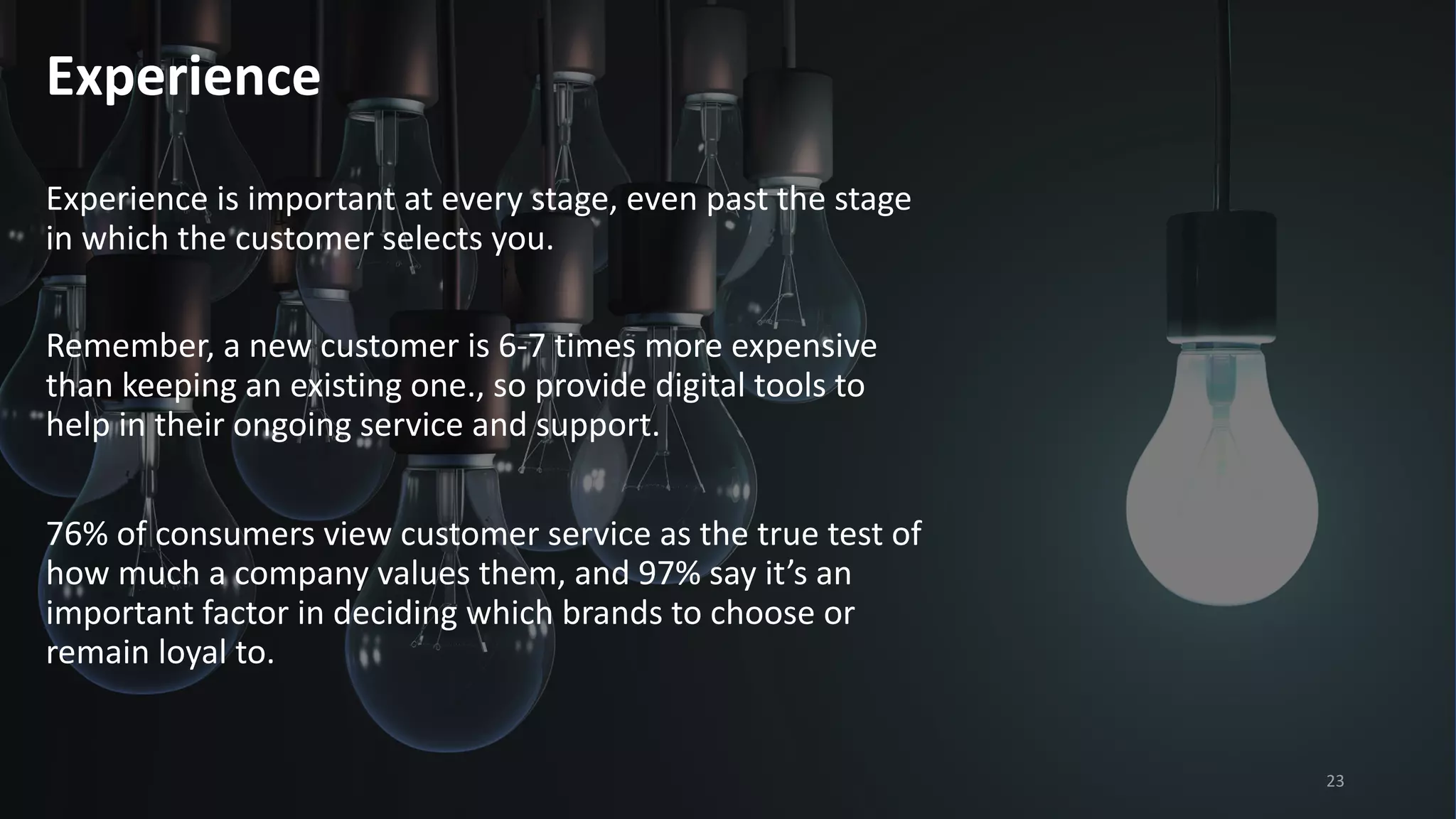
Experience
Experience is important at every stage, even past the stage
in which the customer selects you.
Remember, a new customer is 6-7 times more expensive
than keeping an existing one., so provide digital tools to
help in their ongoing service and support.
76% of consumers view customer service as the true test of
how much a company values them, and 97% say it’s an
important factor in deciding which brands to choose or
remain loyal to.
23
Boosting the Digital Experience
Embrace Transparency
• Audit all online touchpoints to measure experience - patient portals, online bill pay, online customer
comments/complaints, wait times, etc.
• Gather and solicit feedback from your customers (and use that data to drive improvements!)
Keep the Connection
• Enhance the digital delivery of patient education materials, self-care tools/planners and other videos
• Use social Media feedback to share experiences – good and bad – to improve online services
Unify the Offline and Online Experience
• Use CRM/marketing automation to deliver patient communications, newsletters, pro-active reminders
• Consider your onsite digital monitors for wayfinding, transactions, checking-in, etc.
• Consider your app strategy as a way to improve experience - “phone ahead” reminders, post-care
portals, prescription refills, etc.
Measure
• Develop digital experience dashboard metrics to determine areas of opportunities 24
Bonding
This is when you cement your
relationship by nurturing a
connection with proactive
engagement, and taking every
opportunity to create an emotional
connection with your customer.
If done well, they will continue to
utilize your services, remain loyal to
the brand, and—best of all—
encourage others to join them (via
word of mouth or online reviews).
25
Enhancing Bonding through Digital
Be a Resource
• Use your website, patient portal or apps to offer easy ways to refill prescriptions, schedule
appointments tools, and other transactions
• Develop content to support patient education/compliance, self-care tools/planners, videos
Reinforce the Experience
• Leverage social media to share experiences – good and bad, online service recovery strategies
• Offer patients the ability to communicate with you through email, through apps or via text
Stay Personalized
• Use marketing automation to set up personalized emails triggered by key events
• Analyze CRM data to create unique segments and journeys
Measure
• Use NPS and internal data to track the customer lifecycle
26
www.PWC.com/future-of-cx
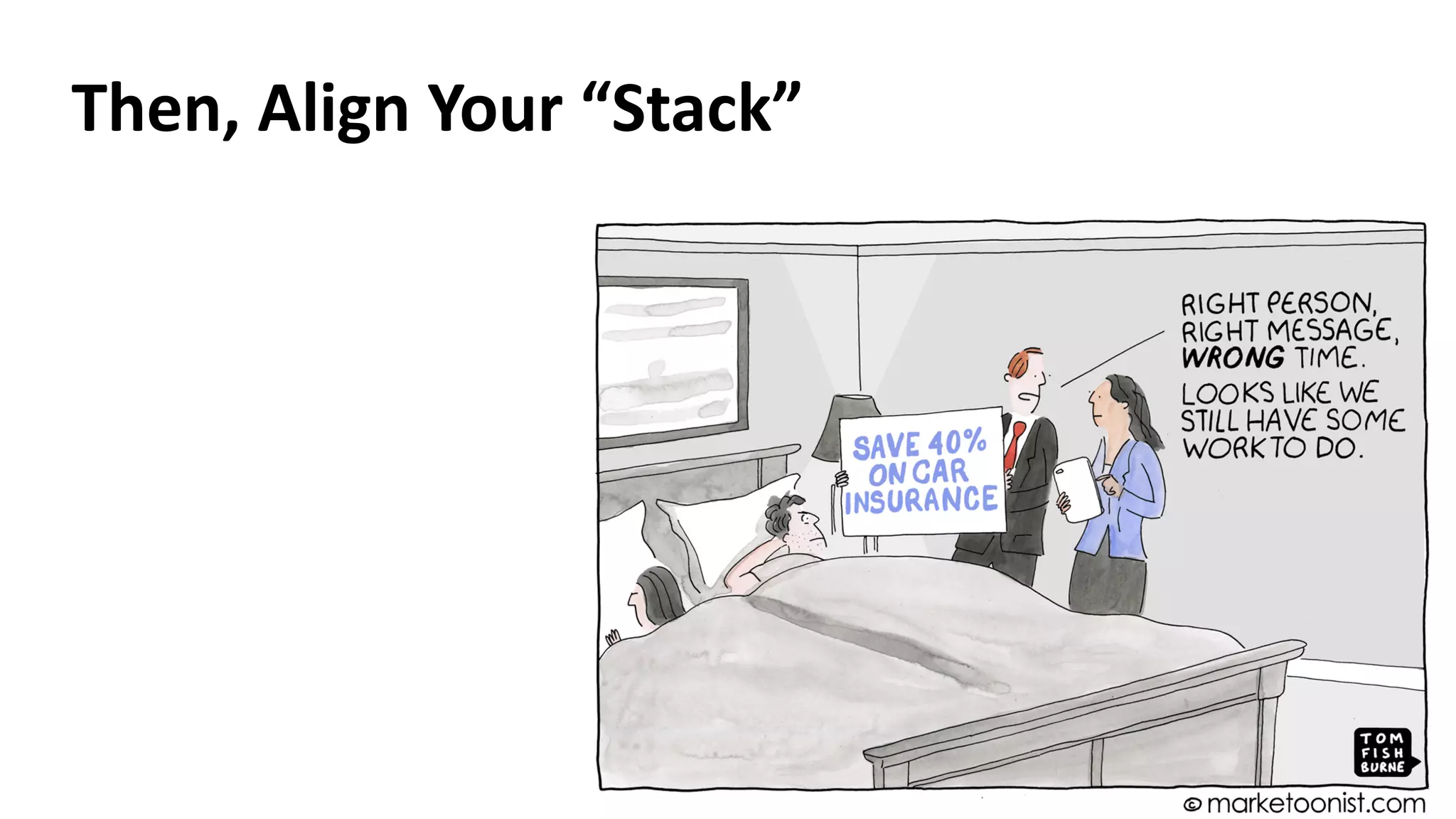
Then, Align Your “Stack”
“Architecture should speak
of its time and place,
but yearn for timelessness”
- Frank Gehry
So Many Tools, So Little Time!
30https://lumapartners.com/content/lumascapes/martech-lumascape/
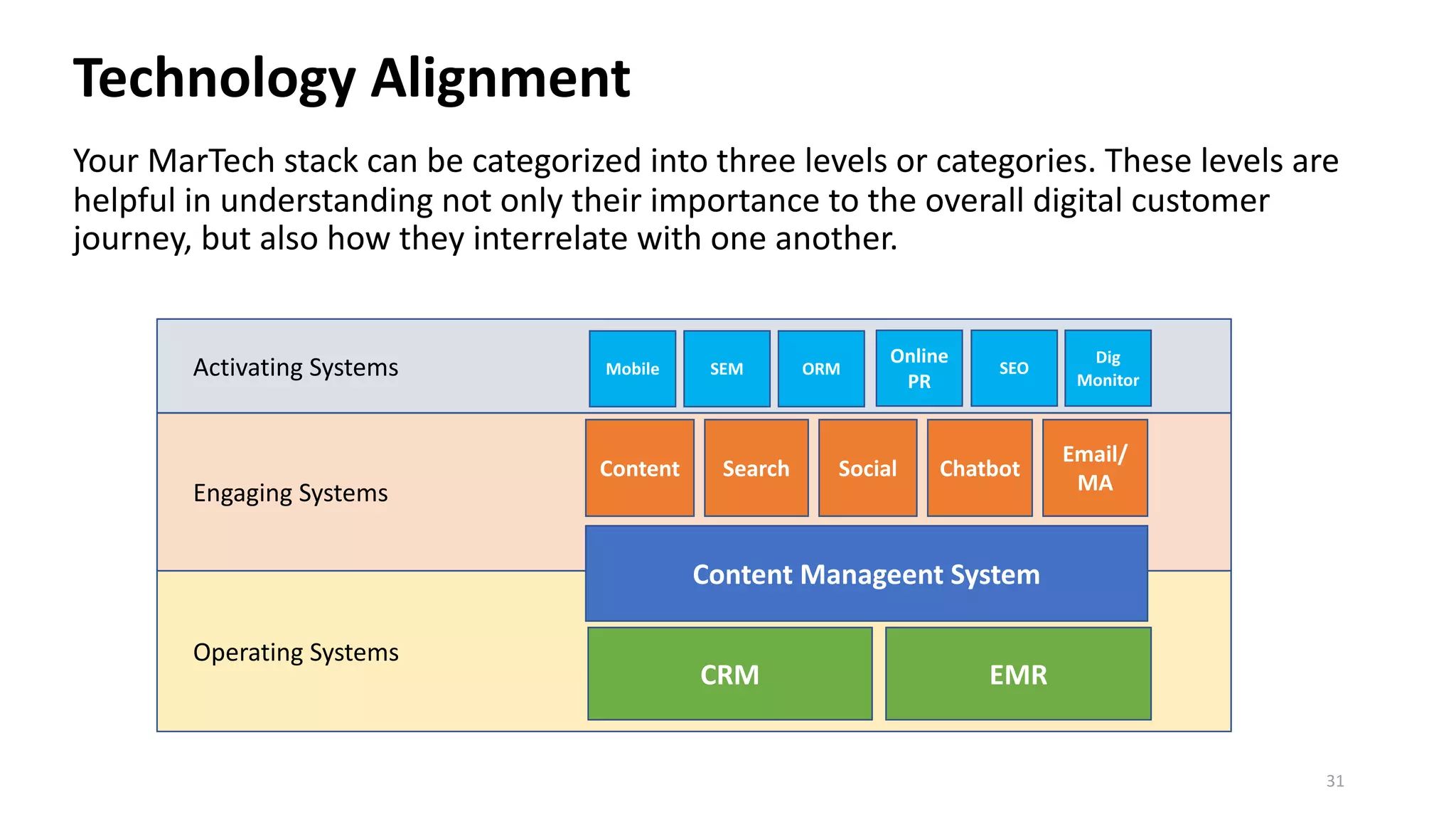
Activating Systems
Engaging Systems
Operating Systems
Technology Alignment
31
Your MarTech stack can be categorized into three levels or categories. These levels are
helpful in understanding not only their importance to the overall digital customer
journey, but also how they interrelate with one another.
Content Manageent System
CRM EMR
Content Search Chatbot
Mobile SEM ORM
Online
PR
SEO
Dig
Monitor
Social
Email/
MA
Operating Systems
32
• Systems upon which most digital activity can be tracked through the entire user journey
• Used to track consistent data/metrics about users
• Often containing the ”single sources of truth” of customer data
Content Management Systems
• Physicians/location directories
• Back-end integration (online bill pay, patient portal)
• Structured content and site personalization
CRM
• Tracking of customer data
• Longitudinal/socioeconomic data
• Targeting & propensity modeling
EMR
• House-holding of patient data
• Appointments and medical refills
• Service recovery/issue tracking
Engaging Systems
33
• Platforms designed to optimize user flow and reduce friction between disjointed phases
• Driven by user needs and designed to “personalize” the overall experience
• Right content, right person, right time
• Allows for bi-directional communication with your organization
Content
• Content marketing
• Multi-media content
• 3rd Party Sites
• Quizzes/HRAs
• Patient Education
• Webinars
Search/Taxonomy/
Decision Support
• Onsite search and
SEO
• Distributeds,
scaleable content IA
• Sorting/rating/rankin
g
Social Media
• Organic content
• Social advertising
• Community
management
Chatbot/AI
• Machine learning
• Predictive modeling
• Task oriented
Email/Marketing
Automation
• Preferences
• Lead management &
nurturing
• Automated
marketing flows
Activating Systems
34
• Programs, strategies and tools used to optimize a specific phase of the user journey
• Often the only touchpoints customers directly interact with
• Wide variety in the application, dependent upon the audience type
• i.e. digital marketing for health-seekers vs. digital recruitment strategies for prospective employees
Mobile
• SMS marketing
• Advertising
• App
development
Online
Advertising
• SEM
• Display ads
• 3rd Party ads
• Music streaming
Reputation
Management
• Listing
management
• Reviews
• Service Recovery
Online
PR
• Brand journalism
• Digital media
relations
SEO
• Keyword
optimization
• Metatags
• Page schema
Digital
Monitors
• Communications
• Kiosks
• Wayfinding
“Stacking” the Customer Journey
35
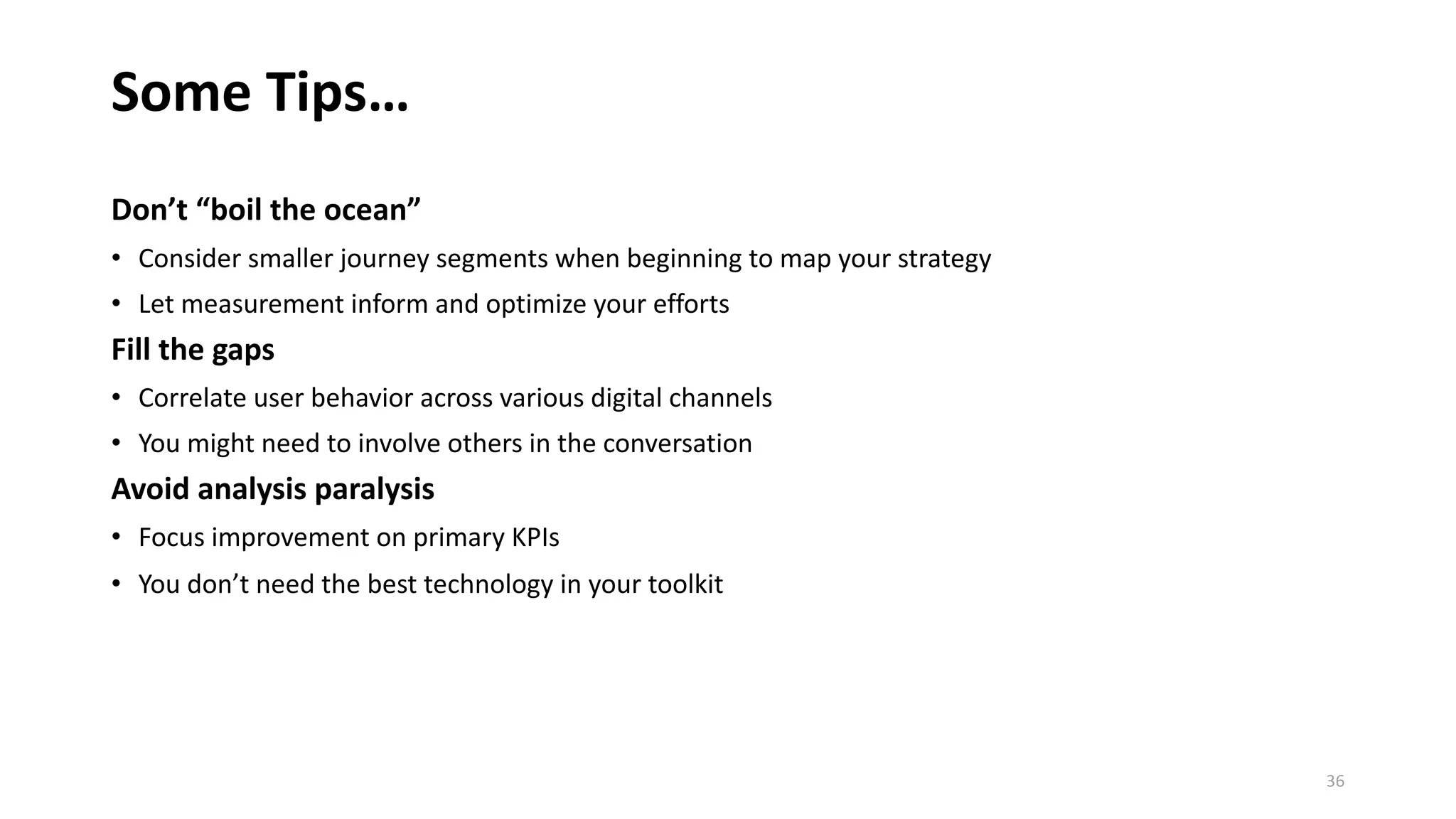
Some Tips…
Don’t “boil the ocean”
• Consider smaller journey segments when beginning to map your strategy
• Let measurement inform and optimize your efforts
Fill the gaps
• Correlate user behavior across various digital channels
• You might need to involve others in the conversation
Avoid analysis paralysis
• Focus improvement on primary KPIs
• You don’t need the best technology in your toolkit
36
37
Chris Boyer
@chrisboyer
www.christopherboyer.com
chris@chrisboyerllc.com

Putting Customers at the Center of Your Digital Strategy

  • 1.
    Putting Customers at theCenter of Your Digital Strategy
  • 2.
    Chris Boyer • SystemDirector, Digital Strategy & Analytics M Health Fairview • Platinum Member of the Mayo Clinic Social Media External Advisory Board • Co-host of the touch point podcast http://touchpoint.health • 2018 inductee into the Healthcare Hall of Fame (Most Innovative Individual) • Twitter: @chrisboyer
  • 3.
    A Simple Three-PointFramework 1. Know your customers (and their needs/behaviors) 2. Understand their online journey 3. Align your marketing technology stack 3
  • 4.
    First, Understand Your“Customer”
  • 5.
    “If there’s onereason we have done better…it is because we have focused like a laser on customer experience, and that really does matter in any business.” - Jeff Bezos
  • 6.
    Primary Audiences 6 Audience TypeDescription Example Needs (examples) Health Seekers People and their family members that receive some form of service or care from the health system (both wellness and sick care) • Consumers • Prospective patients • Existing patients • Family members • Selecting the right doctor or treatment for them • Determining the best place to seek care • Determining how much their treatment will cost Health Care Professionals Clinical and academic professionals – employed, affiliated, or community-based – that can potentially utilize services, research and educations offered by our health system • Employed physicians • Referring physicians • Residents • Fellows • Researchers • Academic staff • Referring patients to your system • Determining if your system is the best place for continued/ongoing learning • Easily accessing internal systems to do their work • Networking with experts in the industry to stay ahead of the trends Medical Staff/Employees Supportive medical staff that are employed or contracted with our health systems • Nurses • Medical Staff • Employees • Contractors • Service vendors/partners • Being able to communicate easily with one another • Learning system-wide efforts to address patient experience • Staying abreast of the latest info about the organization Corporate/B2B Purchasers, payors, and decision-makers for large organizations contracting with the health system for access to care and services for their members and employees • Employers • ACO Partners • Government Purchasers • Payers • Understanding how your B2B offerings will save them money • Easily accessing information even while outside the network • Transacting with your organization online
  • 7.
    Secondary Audiences 7 Audiences DescriptionExamples Needs (examples) Community Members Organizations partnering with our health system to provide expanded health services to help fulfill our mission • Schools/universities • Faith-based organizations • Community partners • Non-profits • Providing their communities with information about your org • Understanding your community benefit • Maintaining brand-advocacy with your system Constituent People and entities that care about, influence and impact our organization through governance, policy, licensure, accreditation, regulation, and/or their ability to influence public opinions. • Governing Board • Foundations • JAHCO • Department of Health • Regulators • Senators • Understanding the impact to your system when passing legislation • Ensuring your organization is compliant throughout the auditing process • Ensuring alignment with state and federal regulations
  • 8.
    Be Empathetic To deeplyunderstand our customer, we use empathy maps to: • Establish common ground around who we’re designing for • Understand and prioritize their needs at every step off the journey 8
  • 9.
    Empathy Maps Says • Directfeedback from customers • Derived focus groups, surveys (even HCAPS) and usability studies Thinks • What are they thinking during the process • Can be determined in usability studies Does • What actions they take • Use Google Analytics, CRM,A/B Testing, etc. Feels • What worries them? Makes them feel better? • Often represented as an adjective 9
  • 10.
  • 11.
  • 12.
    “You got tostart with the customer experience and work backwards to technology, not the other way around.” - Steve Jobs
  • 13.
    A mapping ofhow customers are exposed to and then select your services. Typically expressed linearly with “purchase” or “selection” at the end. 13 Path-to-Purchase
  • 14.
    SELECTION A non-linear wayto map how consumers engage with your brand throughout their various experiences. Customer Journey
  • 15.
    Awareness Where the relationshipwith a customer begins. when they first become aware of the existence of your brand, product, or service. In most cases, your work will have started long before this with PR and branding efforts. Today, consumers are just as likely to first hear about your brand via a word-of- mouth recommendation from friends, family members, or social media influencers. 15
  • 16.
    Driving Awareness Digitally Targetand Attract • Identify market and consumer data from CRMs (propensity modeling, etc.) • Use online PR tools (including online media relations, newsroom, brand journalism, etc.) • Online Advertising (including PPC, machine learning, display ads and third-party site advertising) Lead Generation and Email Marketing • Engage in targeted SEO approaches for your website Maintain Reputation • Online Reputation Management (including 3rd party listing management, FB & Google Reviews) • Social Media and Blog Activity (organic and paid strategies) • Digital Monitors (promoting addt’l services to existing customers already in our buildings) Measure • Use analytics to understand effective response rates, engagement and conversions 16
  • 17.
    Engagement Customers making asignificant decision will often seeks ways to engage with a brand by engaging with marketing content, following you on social media, signing up for emails, etc. In addition, they’ll start paying attention to what others are saying about you and how you respond. 17
  • 18.
    Building Engagement Digitally MakeThings Easier • On your website, use distributed content, simplified navigation and other tools to guide users to discover more information about you) • Embrace tools such as Apps, SMS and other mobile technology to meet the customer where they are • Chatbots and AI can be used to predict customer’s next actions and guide them through the process Stay Top–of-Mind • Create online content to differentiate, proof-points, multi-media content, online risk assessments, video, webinars, etc.) • Develop content in different channels (social media, blogs) to engage with users consistently across channels • Use email Programs/Marketing Automation to nurture customers Measure • CRMs should be used to track all interactions and help inform marketing automation activity by measuring lead generation, nurturing, content ”stickiness” and user flows) 18
  • 19.
    19 Evaluation Every customer goesthrough some method of evaluation, whether it’s months of research or just a quick “gut check” before making a decision. One of the most effective ways to stand out is by offering robust self-service tools. More than 90% of consumers expect to receive consistent information in this stage over multiple channels.
  • 20.
    Supporting the EvaluationPhase Digitally Make it Easy to Evaluate • Develop useful physician and location directories that include content designed to help answer user’s questions and make decisions • Develop additional self-service content to ease customers through the process of selection • Align with 3rd party evaluation tools to ensure your organization compares favorable to others Stay Top of Mind • Make sure your online reputation supports the evaluation phase, as online reviews can influence customers in this phase • Email/marketing automation can nurture customers through all steps of evaluation • The social presence of thought-leaders or others in the organization also aids this phase Measure • Use analytics to determine what consumers are evaluating and what tools they use, in order to improve this phase 20
  • 21.
    Selection This is thefinal stage customers take before making a final decision. 83% of consumers require support while making an online purchase, and 53% will abandon that purchase if they can’t find a quick answer to their question. Using intelligent digital tools to guide consumers to make the right selection can be a competitive differentiator. 21
  • 22.
    Aiding Selection ThroughDigital Integrate with Back-end Systems • Audit and understand all online transactional tools, including appointment scheduling (through your EMR), easy access to your contact center, patient relations, and other systems • Ensure your online content is optimized for usability (forms, videos, decision-support tools for patients, referring providers, and other customer types Optimize Your Digital Front Door • Leverage online business listings, search engines, and social media • Using online advertising to promote convenience– i.e. “same day appointments” Other Tools • Use email for appointment and event reminders, text messages, etc. • Offer additional tools such as Chatbots, etc. to streamline the selection process Measure • Determine how optimized the selection process is, and your conversion rate 22
  • 23.
    Experience Experience is importantat every stage, even past the stage in which the customer selects you. Remember, a new customer is 6-7 times more expensive than keeping an existing one., so provide digital tools to help in their ongoing service and support. 76% of consumers view customer service as the true test of how much a company values them, and 97% say it’s an important factor in deciding which brands to choose or remain loyal to. 23
  • 24.
    Boosting the DigitalExperience Embrace Transparency • Audit all online touchpoints to measure experience - patient portals, online bill pay, online customer comments/complaints, wait times, etc. • Gather and solicit feedback from your customers (and use that data to drive improvements!) Keep the Connection • Enhance the digital delivery of patient education materials, self-care tools/planners and other videos • Use social Media feedback to share experiences – good and bad – to improve online services Unify the Offline and Online Experience • Use CRM/marketing automation to deliver patient communications, newsletters, pro-active reminders • Consider your onsite digital monitors for wayfinding, transactions, checking-in, etc. • Consider your app strategy as a way to improve experience - “phone ahead” reminders, post-care portals, prescription refills, etc. Measure • Develop digital experience dashboard metrics to determine areas of opportunities 24
  • 25.
    Bonding This is whenyou cement your relationship by nurturing a connection with proactive engagement, and taking every opportunity to create an emotional connection with your customer. If done well, they will continue to utilize your services, remain loyal to the brand, and—best of all— encourage others to join them (via word of mouth or online reviews). 25
  • 26.
    Enhancing Bonding throughDigital Be a Resource • Use your website, patient portal or apps to offer easy ways to refill prescriptions, schedule appointments tools, and other transactions • Develop content to support patient education/compliance, self-care tools/planners, videos Reinforce the Experience • Leverage social media to share experiences – good and bad, online service recovery strategies • Offer patients the ability to communicate with you through email, through apps or via text Stay Personalized • Use marketing automation to set up personalized emails triggered by key events • Analyze CRM data to create unique segments and journeys Measure • Use NPS and internal data to track the customer lifecycle 26
  • 27.
  • 28.
    Then, Align Your“Stack”
  • 29.
    “Architecture should speak ofits time and place, but yearn for timelessness” - Frank Gehry
  • 30.
    So Many Tools,So Little Time! 30https://lumapartners.com/content/lumascapes/martech-lumascape/
  • 31.
    Activating Systems Engaging Systems OperatingSystems Technology Alignment 31 Your MarTech stack can be categorized into three levels or categories. These levels are helpful in understanding not only their importance to the overall digital customer journey, but also how they interrelate with one another. Content Manageent System CRM EMR Content Search Chatbot Mobile SEM ORM Online PR SEO Dig Monitor Social Email/ MA
  • 32.
    Operating Systems 32 • Systemsupon which most digital activity can be tracked through the entire user journey • Used to track consistent data/metrics about users • Often containing the ”single sources of truth” of customer data Content Management Systems • Physicians/location directories • Back-end integration (online bill pay, patient portal) • Structured content and site personalization CRM • Tracking of customer data • Longitudinal/socioeconomic data • Targeting & propensity modeling EMR • House-holding of patient data • Appointments and medical refills • Service recovery/issue tracking
  • 33.
    Engaging Systems 33 • Platformsdesigned to optimize user flow and reduce friction between disjointed phases • Driven by user needs and designed to “personalize” the overall experience • Right content, right person, right time • Allows for bi-directional communication with your organization Content • Content marketing • Multi-media content • 3rd Party Sites • Quizzes/HRAs • Patient Education • Webinars Search/Taxonomy/ Decision Support • Onsite search and SEO • Distributeds, scaleable content IA • Sorting/rating/rankin g Social Media • Organic content • Social advertising • Community management Chatbot/AI • Machine learning • Predictive modeling • Task oriented Email/Marketing Automation • Preferences • Lead management & nurturing • Automated marketing flows
  • 34.
    Activating Systems 34 • Programs,strategies and tools used to optimize a specific phase of the user journey • Often the only touchpoints customers directly interact with • Wide variety in the application, dependent upon the audience type • i.e. digital marketing for health-seekers vs. digital recruitment strategies for prospective employees Mobile • SMS marketing • Advertising • App development Online Advertising • SEM • Display ads • 3rd Party ads • Music streaming Reputation Management • Listing management • Reviews • Service Recovery Online PR • Brand journalism • Digital media relations SEO • Keyword optimization • Metatags • Page schema Digital Monitors • Communications • Kiosks • Wayfinding
  • 35.
  • 36.
    Some Tips… Don’t “boilthe ocean” • Consider smaller journey segments when beginning to map your strategy • Let measurement inform and optimize your efforts Fill the gaps • Correlate user behavior across various digital channels • You might need to involve others in the conversation Avoid analysis paralysis • Focus improvement on primary KPIs • You don’t need the best technology in your toolkit 36
  • 37.