Find More Great Reviews at: 
KendallMatthews.com
“Fundamentally, we still 
want the same things that 
we’ve always wanted:
what’s best for ourselves and
those we care about,
the need to be heard and the desire 
to be part of something 
bigger than ourselves so that we 
can make a lasting impact on the 
world.”
If we as marketers and 
communicators can grasp that 
reality and ensure that we’re 
thinking about the needs of 
consumers in this digital age,
we’ll find that awareness will be 
repaid by more attention, 
trust, and loyalty.”
“The rise of social media has granted us 
access to unfiltered consumer 
data in real-time, or near real-time,
that can influence the direction and even 
the creative elements of campaigns.
Rest assured that this is the very 
type of marketing expertise 
that will be highly valued in 
the future.
The geeks shall truly inherit the 
(marketing) earth.”
“Today’s digital media landscape is 
more complex than ever before.
The continuous and rapid introduction of 
new platforms, tools, data sources, and 
media consumption devices (such as 
mobile devices and tablets) have 
created an environment that can make 
any marketer’s head spin.
The challenge now lies in identifying 
which unique composition of all 
those choices is required to produce 
the outcomes needed to achieve 
your digital goals and objectives.”
Specific questions to ask:
1) Which audience segments 
are competitors reaching that 
you are not?
2) What keywords 
are successful for 
your competitors?
3) What sources are 
driving traffic to your 
competitors’ websites?
“Your website exists for a reason. 
More specifically, it exists for a set of 
specific conversion events.”
Leading web analytics platforms 
provide insights regarding this key 
area and answer questions about 
how onsite user behaviors 
lead to conversions.
“Do not get stuck in the trap of 
trying to measure everything just 
because the data is available.”
“Cutting through the clutter and 
positioning your brand, your digital 
outposts, and your brand content in 
the best possible way to be 
discovered is more critical today than 
ever before.
In order to successfully do 
that, brands need to 
first understand how 
they are currently 
positioned,
how consumers are 
currently behaving in 
terms of searching 
for relevant content 
and experiences, and
what competitors are 
actively doing to 
capture consumer 
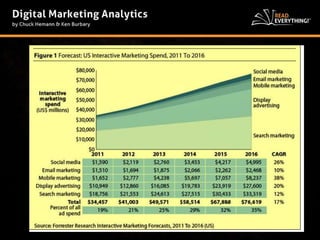
attention first.”
“It’s not obvious on the surface, but 
creating successful, personalized 
user experiences can happen 
only with a keen 
understanding of the 
audience and their needs, 
expectations, and behaviors.
This requires pulling in digital data 
from a variety of sources and 
performing rock-solid analyses.
The end result is a clear picture 
about what makes an audience 
tick, and it is something that you can 
begin to align against as you develop 
your marketing and advertising plans.
We call this process 
audience analysis.”
The term AUDIENCE itself 
can be used as an 
acronym for remembering this 
technique:
Analysis - Who is the audience?
Understanding - What is 
the audience’s knowledge and 
attitude toward the brand?
Demographics - What is the 
audience’s age, gender, 
education, location, and so on?
Interest - Why is the 
audience reading, sharing, and 
interacting with 
your brand content?
Environment - Where 
does the audience spend 
time online?
Needs - What are the 
audience needs associated with 
your brand, product, or service?
Customization - What specific 
needs and/ or interests should the 
brand address in order to add value 
for the audience?
Social data analysis is a big area 
of focus these days. Brands are 
trying to get answers to audience 
questions such as these:
•What conversations 
are taking place 
about my brand?
•What topics and/or 
themes are most 
talked about?
•How does my audience feel 
about specific brand, product, 
or service attributes?
“For marketers, the 
Good News is that 
it’s never been 
easier to produce 
and distribute content to 
an audience.
The BAD NEWS 
is that as a result, it 
has never been 
more difficult to 
get noticed.
More competition puts a bigger 
emphasis on making sure you 
know that your content meets 
the needs and expectations of 
the target audience.”
“The riddle that marketers 
need to solve involves 
understanding the content 
needs of the audience,
how the audience 
consumes content,
and how to deliver 
on that!”
“Often, marketers believe they 
understand what consumers 
want to hear from them.
Often, marketers are wrong.
The brand might want to talk 
about its products, services, 
or latest deals or promotions.
Consumers don’t necessarily 
have an aversion to that 
content, but they are looking for 
a shared value exchange-something 
in it for them.
They are voting either for or 
against a brand with their time 
and attention, and…
…consumers give either a 
direct or implied endorsement 
in the form of likes, shares, 
retweets, favorites, ratings, 
and reviews.”
“Social media conversation data 
is powerful and provides a 
window into consumer behavior 
in a way that marketers have 
never seen.
It is also a real-time source of 
information that shows how a 
program is performing.”
Receiving negative feedback from a 
customer is a little more challenging. 
Following these steps can help you 
handle this situation:
1. Acknowledge the feedback 
publicly and suggest that the 
conversation be taken offline.
2. Note to the angry 
customer that you care 
about the feedback and 
are constantly listening.
3. Ensure resolution 
(as best as possible) 
of the matter quickly 
and professionally.
4. Customers are 
aggravated by unresolved 
issues, especially if a 
resolution was promised.
5. In whatever software 
solution your company is 
using, document all the 
elements of the situation. 
You never know when that 
issue may come up again.
Understand what kinds of 
content your competition 
is producing online:
1. Examine content engagement 
(Facebook, Twitter, YouTube, etc.)
2. Post frequency (how 
often and when?)
3. Paid vs. earned
4. Is YOUR target 
audience participating?
“After you have identified the 
keywords people are using 
online, it is important to cross-reference 
those words against 
the words you are using on all 
your properties.
Do they match the 
words you are 
tagging on your 
website? If not, why?
The goals should be to 
customize your content to 
what the community is looking 
for and also to make it as 
visible as possible.
Are these words the 
same words you are 
using in social media 
posts? If not, why?
Again, you need to 
ensure that you are 
giving the right content 
and that it is very visible.
What about on your 
blog? The same idea fits.
Conduct an inventory of 
the words you are using 
in tags versus the words 
you have identified that 
match these issues.”
“Who is the customer?
It’s a simple question, but 
it’s difficult to answer 
based on the data sources 
and research you use.
Don’t guess who 
the customer is; 
know!”
“Think about it for a 
moment:
If you do a Google 
search for your name, 
what typically appears?”
“By this point in the book, 
you have probably guessed 
that we think digital media is 
important.
We’re not the only people who 
think so. According to a recent 
report from Econsultancy, 68% 
of companies report that they 
expect increases for their 
digital budgets over the next 12 
months.
Anecdotally, we have heard 
from several client-side 
marketing professionals that 
digital spending is going up, 
while television spending is 
decreasing….
This is not a trend that is likely to 
slow, especially as brands attempt to 
continue to capitalize on a new 
channel that allows them to more 
frequently communicate with key 
stakeholders and drive new business 
leads.
What is also not going to change 
is the abundance of data 
available to communications 
professionals.
In fact, the amount of 
data is likely to go up 
from here as social 
media becomes 
more mainstream.”
“The fact that 25% of your fans on 
Facebook or followers on Twitter 
are engaged with your content does 
not necessarily translate into sales.”
Potential Tactics 
• Build a Facebook brand page 
• Establish a Twitter account 
• Launch a YouTube channel
•Outreach to mainstream news outlets 
to further a particular message 
• Activate bloggers to grow the share 
of conversation
“Because using mobile devices to consume 
information has become so common, more 
marketers are trying to…
understand how they can 
reach consumers on the go.
Companies are developing 
apps and new websites in 
order to capture consumers 
wherever they live.”
“One of the things that most of us who work in some sort of 
marketing-related profession take for granted is the use of a 
smartphone device.
Many assume that all those who 
utilize mobile technology are 
doing so from a smartphone 
device.
But that could not be further 
from the truth.
There are still many people 
using older cellular technology, 
like flip phones.”
“Marketers need to consider how their content is going to be 
viewed, consumed, and shared on a smartphone.
Although some people are still 
utilizing older technologies, a 
smartphone growth rate of 42% 
needs to be taken seriously.”
“Android devices are still growing more quickly than iOS 
devices worldwide.
In fact, Android devices are 
growing six times faster than 
iOS devices.
Android devices are taking more 
of the market because Android 
is a more open platform for 
developers, has greater device 
security, and has more 
widespread availability.”
“The bottom line is that marketers 
need to consider all platforms when 
building new mobile-optimized 
content.”
“Just in the past two years, the amount of traffic Internet 
sites has received from mobile devices has exploded. 
According to StatCounter (see Figure 20.4), 1% of site traffic 
came from mobile devices as of December 2009.
As of December 2012, that 
number had climbed to 13%.
This is a staggering increase, 
and the trend line is only going 
to go higher as mobile device 
and smartphone adoption 
continues to rise.
In some markets, the amount of 
traffic coming from mobile 
devices has surpassed the 
amount coming from desktops.”
Interesting Statistics 
•Gartner predicts that by the end of 2013, more than 60% of Fortune 500 
companies will “actively engage” customers with Facebook marketing, up from 
20% in the fourth quarter of 2011.
•Only 25% of business-run social media 
accounts are defined by meaningful 
customer engagement and consistent 
content distribution (Altimeter Group).
•In the past year, 17% of customers have 
used social media to get a customer 
service response (American Express 2012 
Customer Barometer).
• Customers who engage with companies via social media spend 20% to 
40% more money with those companies than other customers (Bain & 
Company).
• More than 20% of consumers use social 
media to seek information or to find deals 
or recommendations (J.D. Power and 
Associates). 
•
•One survey found that 60% of customers 
feel companies have generally improved 
their response times over social media 
channels (American Express 2012 
Customer Barometer).
“Content is the lifeblood of any marketing program, 
digital or otherwise.
If your content is not 
appropriately tailored for 
the audience you are trying 
to reach, the program will 
fail.
It really is that simple.”
Order Now Through Amazon: 
http://amzn.to/1eqj6oU
Find More Great Reviews at: 
KendallMatthews.com

Digital Marketing Analytics: Book Review

  • 2.
    Find More GreatReviews at: KendallMatthews.com
  • 3.
    “Fundamentally, we still want the same things that we’ve always wanted:
  • 4.
  • 5.
  • 6.
    the need tobe heard and the desire to be part of something bigger than ourselves so that we can make a lasting impact on the world.”
  • 7.
    If we asmarketers and communicators can grasp that reality and ensure that we’re thinking about the needs of consumers in this digital age,
  • 8.
    we’ll find thatawareness will be repaid by more attention, trust, and loyalty.”
  • 9.
    “The rise ofsocial media has granted us access to unfiltered consumer data in real-time, or near real-time,
  • 10.
    that can influencethe direction and even the creative elements of campaigns.
  • 11.
    Rest assured thatthis is the very type of marketing expertise that will be highly valued in the future.
  • 12.
    The geeks shalltruly inherit the (marketing) earth.”
  • 13.
    “Today’s digital medialandscape is more complex than ever before.
  • 14.
    The continuous andrapid introduction of new platforms, tools, data sources, and media consumption devices (such as mobile devices and tablets) have created an environment that can make any marketer’s head spin.
  • 15.
    The challenge nowlies in identifying which unique composition of all those choices is required to produce the outcomes needed to achieve your digital goals and objectives.”
  • 17.
  • 18.
    1) Which audiencesegments are competitors reaching that you are not?
  • 19.
    2) What keywords are successful for your competitors?
  • 20.
    3) What sourcesare driving traffic to your competitors’ websites?
  • 21.
    “Your website existsfor a reason. More specifically, it exists for a set of specific conversion events.”
  • 22.
    Leading web analyticsplatforms provide insights regarding this key area and answer questions about how onsite user behaviors lead to conversions.
  • 23.
    “Do not getstuck in the trap of trying to measure everything just because the data is available.”
  • 24.
    “Cutting through theclutter and positioning your brand, your digital outposts, and your brand content in the best possible way to be discovered is more critical today than ever before.
  • 25.
    In order tosuccessfully do that, brands need to first understand how they are currently positioned,
  • 26.
    how consumers are currently behaving in terms of searching for relevant content and experiences, and
  • 27.
    what competitors are actively doing to capture consumer attention first.”
  • 29.
    “It’s not obviouson the surface, but creating successful, personalized user experiences can happen only with a keen understanding of the audience and their needs, expectations, and behaviors.
  • 30.
    This requires pullingin digital data from a variety of sources and performing rock-solid analyses.
  • 31.
    The end resultis a clear picture about what makes an audience tick, and it is something that you can begin to align against as you develop your marketing and advertising plans.
  • 32.
    We call thisprocess audience analysis.”
  • 33.
    The term AUDIENCEitself can be used as an acronym for remembering this technique:
  • 34.
    Analysis - Whois the audience?
  • 35.
    Understanding - Whatis the audience’s knowledge and attitude toward the brand?
  • 36.
    Demographics - Whatis the audience’s age, gender, education, location, and so on?
  • 37.
    Interest - Whyis the audience reading, sharing, and interacting with your brand content?
  • 38.
    Environment - Where does the audience spend time online?
  • 39.
    Needs - Whatare the audience needs associated with your brand, product, or service?
  • 40.
    Customization - Whatspecific needs and/ or interests should the brand address in order to add value for the audience?
  • 41.
    Social data analysisis a big area of focus these days. Brands are trying to get answers to audience questions such as these:
  • 42.
    •What conversations aretaking place about my brand?
  • 43.
    •What topics and/or themes are most talked about?
  • 44.
    •How does myaudience feel about specific brand, product, or service attributes?
  • 45.
    “For marketers, the Good News is that it’s never been easier to produce and distribute content to an audience.
  • 46.
    The BAD NEWS is that as a result, it has never been more difficult to get noticed.
  • 47.
    More competition putsa bigger emphasis on making sure you know that your content meets the needs and expectations of the target audience.”
  • 48.
    “The riddle thatmarketers need to solve involves understanding the content needs of the audience,
  • 49.
    how the audience consumes content,
  • 50.
    and how todeliver on that!”
  • 51.
    “Often, marketers believethey understand what consumers want to hear from them.
  • 52.
  • 53.
    The brand mightwant to talk about its products, services, or latest deals or promotions.
  • 54.
    Consumers don’t necessarily have an aversion to that content, but they are looking for a shared value exchange-something in it for them.
  • 55.
    They are votingeither for or against a brand with their time and attention, and…
  • 56.
    …consumers give eithera direct or implied endorsement in the form of likes, shares, retweets, favorites, ratings, and reviews.”
  • 58.
    “Social media conversationdata is powerful and provides a window into consumer behavior in a way that marketers have never seen.
  • 59.
    It is alsoa real-time source of information that shows how a program is performing.”
  • 60.
    Receiving negative feedbackfrom a customer is a little more challenging. Following these steps can help you handle this situation:
  • 61.
    1. Acknowledge thefeedback publicly and suggest that the conversation be taken offline.
  • 62.
    2. Note tothe angry customer that you care about the feedback and are constantly listening.
  • 63.
    3. Ensure resolution (as best as possible) of the matter quickly and professionally.
  • 64.
    4. Customers are aggravated by unresolved issues, especially if a resolution was promised.
  • 65.
    5. In whateversoftware solution your company is using, document all the elements of the situation. You never know when that issue may come up again.
  • 66.
    Understand what kindsof content your competition is producing online:
  • 67.
    1. Examine contentengagement (Facebook, Twitter, YouTube, etc.)
  • 68.
    2. Post frequency(how often and when?)
  • 69.
  • 70.
    4. Is YOURtarget audience participating?
  • 71.
    “After you haveidentified the keywords people are using online, it is important to cross-reference those words against the words you are using on all your properties.
  • 72.
    Do they matchthe words you are tagging on your website? If not, why?
  • 73.
    The goals shouldbe to customize your content to what the community is looking for and also to make it as visible as possible.
  • 74.
    Are these wordsthe same words you are using in social media posts? If not, why?
  • 75.
    Again, you needto ensure that you are giving the right content and that it is very visible.
  • 76.
    What about onyour blog? The same idea fits.
  • 77.
    Conduct an inventoryof the words you are using in tags versus the words you have identified that match these issues.”
  • 78.
  • 79.
    It’s a simplequestion, but it’s difficult to answer based on the data sources and research you use.
  • 80.
    Don’t guess who the customer is; know!”
  • 81.
    “Think about itfor a moment:
  • 82.
    If you doa Google search for your name, what typically appears?”
  • 83.
    “By this pointin the book, you have probably guessed that we think digital media is important.
  • 84.
    We’re not theonly people who think so. According to a recent report from Econsultancy, 68% of companies report that they expect increases for their digital budgets over the next 12 months.
  • 85.
    Anecdotally, we haveheard from several client-side marketing professionals that digital spending is going up, while television spending is decreasing….
  • 86.
    This is nota trend that is likely to slow, especially as brands attempt to continue to capitalize on a new channel that allows them to more frequently communicate with key stakeholders and drive new business leads.
  • 87.
    What is alsonot going to change is the abundance of data available to communications professionals.
  • 88.
    In fact, theamount of data is likely to go up from here as social media becomes more mainstream.”
  • 89.
    “The fact that25% of your fans on Facebook or followers on Twitter are engaged with your content does not necessarily translate into sales.”
  • 90.
    Potential Tactics •Build a Facebook brand page • Establish a Twitter account • Launch a YouTube channel
  • 91.
    •Outreach to mainstreamnews outlets to further a particular message • Activate bloggers to grow the share of conversation
  • 92.
    “Because using mobiledevices to consume information has become so common, more marketers are trying to…
  • 93.
    understand how theycan reach consumers on the go.
  • 94.
    Companies are developing apps and new websites in order to capture consumers wherever they live.”
  • 95.
    “One of thethings that most of us who work in some sort of marketing-related profession take for granted is the use of a smartphone device.
  • 96.
    Many assume thatall those who utilize mobile technology are doing so from a smartphone device.
  • 97.
    But that couldnot be further from the truth.
  • 98.
    There are stillmany people using older cellular technology, like flip phones.”
  • 99.
    “Marketers need toconsider how their content is going to be viewed, consumed, and shared on a smartphone.
  • 100.
    Although some peopleare still utilizing older technologies, a smartphone growth rate of 42% needs to be taken seriously.”
  • 101.
    “Android devices arestill growing more quickly than iOS devices worldwide.
  • 102.
    In fact, Androiddevices are growing six times faster than iOS devices.
  • 103.
    Android devices aretaking more of the market because Android is a more open platform for developers, has greater device security, and has more widespread availability.”
  • 104.
    “The bottom lineis that marketers need to consider all platforms when building new mobile-optimized content.”
  • 105.
    “Just in thepast two years, the amount of traffic Internet sites has received from mobile devices has exploded. According to StatCounter (see Figure 20.4), 1% of site traffic came from mobile devices as of December 2009.
  • 106.
    As of December2012, that number had climbed to 13%.
  • 107.
    This is astaggering increase, and the trend line is only going to go higher as mobile device and smartphone adoption continues to rise.
  • 108.
    In some markets,the amount of traffic coming from mobile devices has surpassed the amount coming from desktops.”
  • 109.
    Interesting Statistics •Gartnerpredicts that by the end of 2013, more than 60% of Fortune 500 companies will “actively engage” customers with Facebook marketing, up from 20% in the fourth quarter of 2011.
  • 110.
    •Only 25% ofbusiness-run social media accounts are defined by meaningful customer engagement and consistent content distribution (Altimeter Group).
  • 111.
    •In the pastyear, 17% of customers have used social media to get a customer service response (American Express 2012 Customer Barometer).
  • 112.
    • Customers whoengage with companies via social media spend 20% to 40% more money with those companies than other customers (Bain & Company).
  • 113.
    • More than20% of consumers use social media to seek information or to find deals or recommendations (J.D. Power and Associates). •
  • 114.
    •One survey foundthat 60% of customers feel companies have generally improved their response times over social media channels (American Express 2012 Customer Barometer).
  • 115.
    “Content is thelifeblood of any marketing program, digital or otherwise.
  • 116.
    If your contentis not appropriately tailored for the audience you are trying to reach, the program will fail.
  • 117.
    It really isthat simple.”
  • 118.
    Order Now ThroughAmazon: http://amzn.to/1eqj6oU
  • 119.
    Find More GreatReviews at: KendallMatthews.com