puta
Dr Raghuveer
Department of Rasashastra
KVG Ayurvedic Medical College Sullia
ayuraghu@rediffmail.com
Introduction
RASADRAVYAS can be used safely only after
pharmaceutical processing.
• These include, Maradana, Dhalana, Jarana etc.
• Agni plays an important role.
• For providing Agni, various Putas have been
described.
4/7/2016 2
Puta
Importance of agni
• Agni is the basic.
• One of the panchmahabhoota.
• Plays a very important role in formation of any type
of medicine.
• Transformation and conversion of dravya and making
them for suitable for use.
• Arkaprakash explained 6 types of agni.
Dhumaagni, Mandagni, Deepaagni,
Madhymaagni, Kharagni, Bhutaagni.
4/7/2016 3
Puta
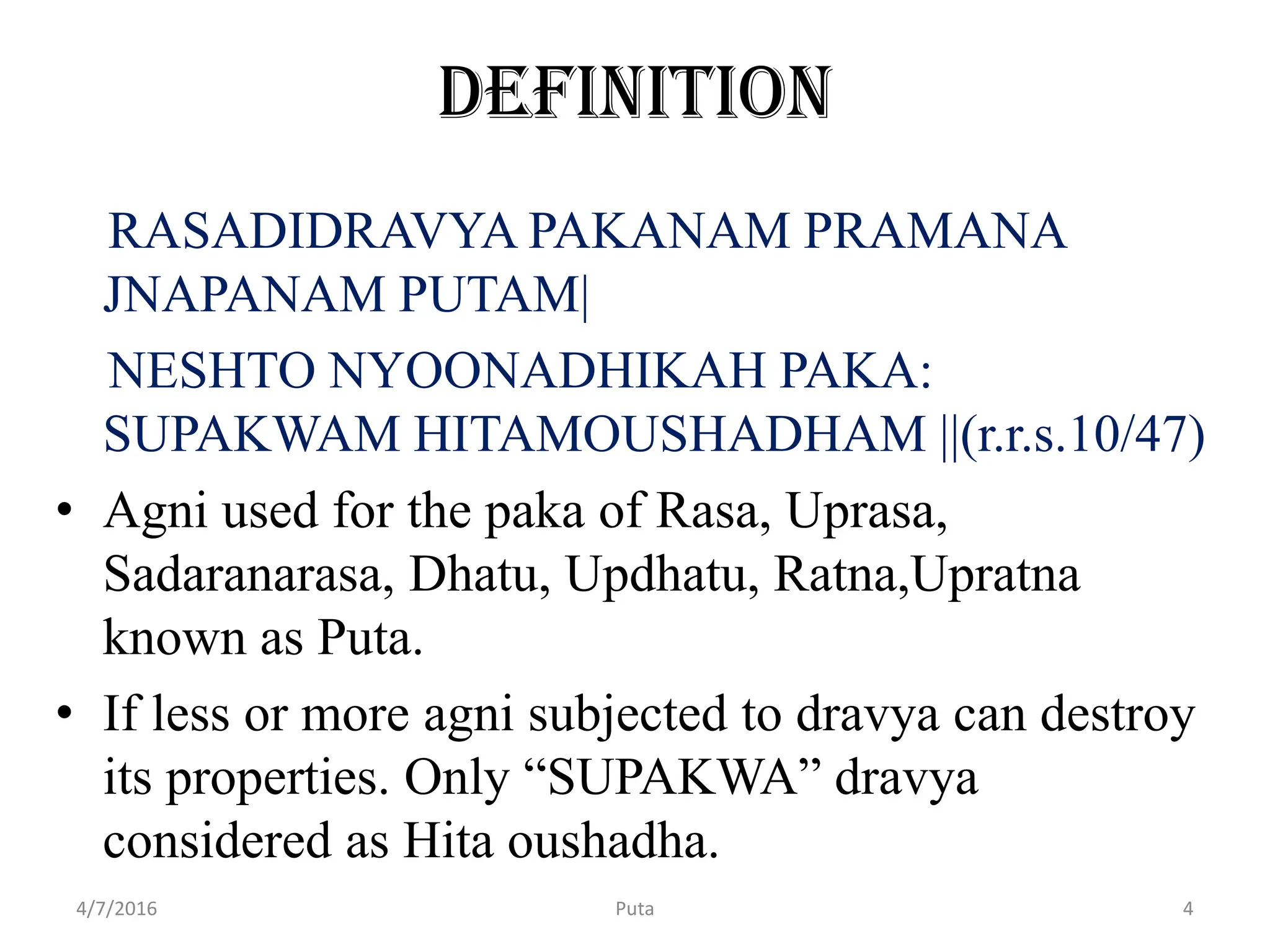
Definition
RASADIDRAVYA PAKANAM PRAMANA
JNAPANAM PUTAM|
NESHTO NYOONADHIKAH PAKA:
SUPAKWAM HITAMOUSHADHAM ||(r.r.s.10/47)
• Agni used for the paka of Rasa, Uprasa,
Sadaranarasa, Dhatu, Updhatu, Ratna,Upratna
known as Puta.
• If less or more agni subjected to dravya can destroy
its properties. Only “SUPAKWA” dravya
considered as Hita oushadha.
4/7/2016 4
Puta
Uses of puta
• Bhasamikarana
• Remove doshas
• Increases quality (Guna`s)
• Convert drugs of minerals, metals origin in to
light form as a result these do not sink in water.
• Develop dipana property which stimulate whole
metabolic process of the body.
4/7/2016 5
Puta
Puta sankhya
• Depends on the Drug subjected for puta
• i.e. Mridu, Madyam, Kathin dravya.
• Varies acc. to different Acharyas .
• Normally it contains 10 – 100 Puta.
• In case of Rasayana Karma of Abhraka it contains
100 – 1000 .
• For vajikarna 10 – 500 (R.S.S.1/35)
• In somala – 1 puta
• Sankha, shukti – 3 puta
• In Suvarna and Tamra number varies from 1 – 40.
• Depends upon the process and nature of drug.
4/7/2016 6
Puta
Puta krama
• Shodhita  Bhavana  Chakrika (Pellets) 
Dry  Sharava samputa  Sandhibandhana
 Dry  Puta  Swangasheeta  Collection
of Bhasma  Bhasma pareeksha
4/7/2016 Puta 7
Types of puta
• Divided in to 3 types, depending upon source
of energy:
• Chandra Puta
• Surya Puta
• Agni Puta
Above 3, Chandra and Surya Puta depends
on the natural source of energy. i.e. on sun and
moon.
4/7/2016 8
Puta
Chandra puta
Acc to (Rasa Tantra Sara.- 1 Pg No.191).
• Explained for Pravla Bhasma.
• Also known as samskra vishesha.
4/7/2016 9
Puta
Surya puta
• Also known as Rudra / Bhanu Puta.
• After bhavna subjected for Sunlight.
• Paka takes place due to sun light.
• Explaination given in Rasa Tantra Sara-2 Pg no 21
• Pravla Bhasma (Surya Puti).
• Also in RRS 5/134.
• RT 3/38,20/22,24.
• Ayurved Prakash 3/255.
4/7/2016 10
Puta
Agni puta
• Artificial source of energy.
Types explained depending upon Agni(Fire)
• For more (Atitivra): Mahaputa etc.
• For moderate(Madhyam): Gajaputa, Kukutaputa etc
• For less (Manda or Atimanda) : Laghuputa etc.
4/7/2016 11
Puta
Agni puta types
• Mahaputa
• Gajaputa
• Kukutaputa
• Varahaputa
• Laghu (Kapota) Puta
• Bhudhraputa
Acc to fuel / Instrument used :
• Govar (Lavakaputa)
• Bhanda (Kumbhaputa)
• Valukaputa
4/7/2016 12
Puta
Mahaputa
• Total no of Cow Dung :1500
• 2 x 2 x 2 (Rajahasta)
• Used for Tamra, Parda, Suvrna,Vajra and
Trivanga Bhasma.
• Acc.to Shargdhara 30 vanyopala.
4/7/2016 13
Puta
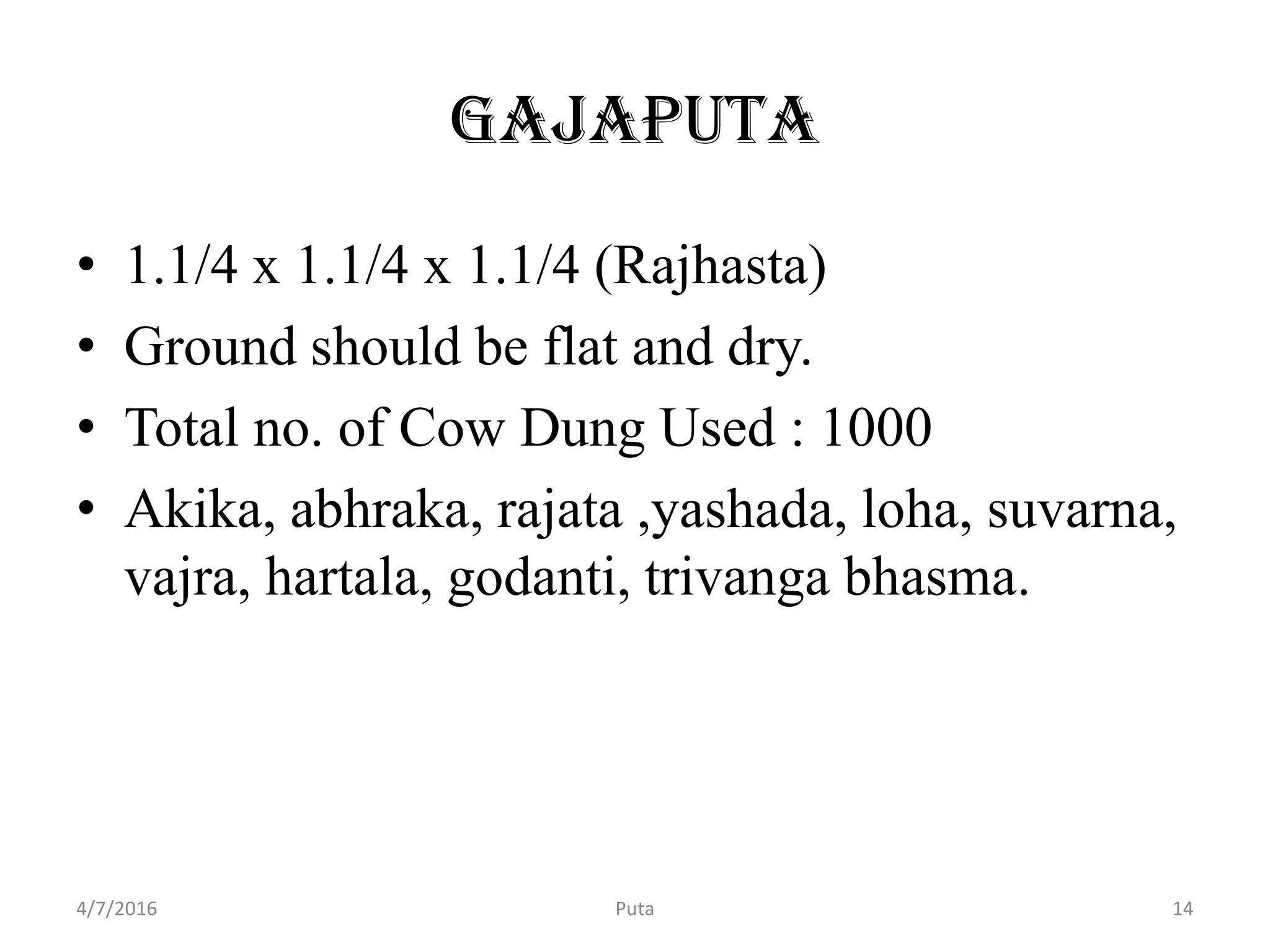
Gajaputa
• 1.1/4 x 1.1/4 x 1.1/4 (Rajhasta)
• Ground should be flat and dry.
• Total no. of Cow Dung Used : 1000
• Akika, abhraka, rajata ,yashada, loha, suvarna,
vajra, hartala, godanti, trivanga bhasma.
4/7/2016 14
Puta
Ardhagajaputa
• Told in different Rasa text but no one explained
• Acharya Yadavji explained about
Ardhagajaputa for the marana of Tamra and
Vanga. (45.3x45.3x45.3)cm.
• Cow dung used: 500
4/7/2016 15
Puta
Varaha puta
• 1 x 1 x 1 (Aratni) (42cm)
Different opinion about no of vanyopala.
• No. of Cow Dung : 150
Acc. to RPS : 500(400+100)
• Also known as krodaputa, varnayakhya.
• Used for abraka, tamra, rajta.
4/7/2016 16
Puta
Kukkuta puta
• 2 x 2 x 2 beeta (46 cm) pit is made on dry and
plane surface.
• Shrava placed in between and ignite fire.
• Acc to RPS 10/46 : Use of 300 vanyopala.
• Some other mentioned about the use of 10
vanyopala.
• Used for Tutha, Parada, Loha, Svarna
Bhasma.
4/7/2016 17
Puta
Kapota puta
• Also known as laghu puta, mriduputa, and
swalpa puta.
• Small pit is made on dry surface
• Shrava samputa is taken and place in
between of 8 vanyopala.
• Used for marana of rajata, svarna.
4/7/2016 18
Puta
Gorvara puta
• Use of dry Cow Dung Powder.
• Mix it with Tusha.
• Acc. to AchryaYadavji (64 tola Dry Cow Dung
Powder + 64 tola Tusha).
• Used for Parada Bhasma.
4/7/2016 19
Puta
Kumbha puta
• Also known as Bhandaputa, mridubhandaputa.
• Tusha is taken in earthen mud pot .
• Fill it up to neck and put the shrava samputa
in middle of pot and ignite fire.
• Bhavaprakasha also explained the same.
• Used for Hartala, Somal Bhasma.
• No explanation about duration of agni.
4/7/2016 20
Puta
Valuka puta
• Different opinion of different Acharyas:
• Acc to RRS : Valuka is taken in earthen mud pot
• Fill it up to neck and put the shrava samputa in
middle of pot and ignite fire.
• Acc to Vagbhata : explained use of Baluka only.
• Some text told about the use of Lavana, Kshara,
etc.
4/7/2016 21
Puta
Bhudara puta
• 2 angula prmana of pit should be made.
• Put aushadhi yukta shrava inside pit .
• Cover pit with vanyopal.
• Set fire.
• Used for jarna and parada bhasma.
4/7/2016 22
Puta
Lavaka puta
• Smallest among all.
• Shodashi pramana (4 tola acc. To KalingaMana).
• Used for bhasmikarna of mridu dravya
i.e.gandhak
• Resembles with Lavaka bird(goraiya).
4/7/2016 23
Puta
Anukta puta
• ANUKTA PUTAMANENA TU SADHYADRAVYA
BALAABALAAT|
• PUTAM VIJYAYA DAATAVYAM
OOHAPOOHAVICHAKSHANAI:|| (r.r.s.10/64)
4/7/2016 24
Puta
Synonyms of vanopala
• Upala
• Chhana
• Utpala
• Chagana
• Gerenideka
• Gobar
4/7/2016 25
Puta
Puta in present day
• Compared with Muffle Furnace.
• A furnace is a device used for heating.
sometimes as a synonym for kiln, a device used
to fire clay to produce ceramics.
• In British English the term furnace is used
exclusively to mean industrial furnaces which
are used for many things, such as the extraction
of metal from ore (smelting).
4/7/2016 26
Puta
Contd…
• Furnace can also refer to a direct fired heater,
used in boiler applications in chemical
industries or for providing heat to chemical
reactions for processes like cracking, and is
part of the standard English names for many
metallurgical furnaces worldwide.
4/7/2016 27
Puta
Types
• Blast furnace
• Steelmaking furnaces:
• Paddling furnace
• Bessemer converter
• Open hearth furnace
• Basic oxygen furnace
• Electric arc furnace
• Electric induction furnace
• Vacuum furnaces
4/7/2016 28
Puta
Introduction
What is a Furnace?
• Equipment to melt metals
– Casting
– Change shape
– Change properties
• Type of fuel important
– Mostly liquid/gaseous fuel or electricity
• Low efficiencies due to
– High operating temperature
– Emission of hot exhaust gases
4/7/2016 29
Puta
Parts
1. Burners: raise or maintain chamber
temperature
2. Chimney: remove combustion gases
3. Furnace chamber: constructed of insulating
materials
4. Hearth: support or carry the steel. Consists of
refractory materials
5. Charging & discharging doors for loading &
unloading stock
4/7/2016 30
Puta
4/7/2016 31
Puta
Digital muffle furnace
4/7/2016 32
Puta
Verticle muffle furnace
4/7/2016 33
Puta
4/7/2016 34
Puta
Barrier Material
• Silica Brick
• >93% SiO2 made from quality rocks
• Iron & steel, glass industry
• Advantages: no softening until fusion point is
reached; high refractoriness; high resistance to
spalling, flux and slag, volume stability
4/7/2016 35
Puta
Type of Furnaces
1.Forging Furnace
• Used to preheat billets/ingots
• Use open fireplace system with radiation heat
transmission (Genration of Radiatior).
• Temp 1200-1250 oC
• Operating cycle
– Heat-up time
– Soaking time
– Forging time (adjustment –cooling)
• Fuel use: depends on material and number of reheats
4/7/2016 36
Puta
Type of Furnaces
2.Re-rolling Mill Furnace – Batch type
• Box type furnace
• Used for heating up scrap/ingots/billets
• Manual charge / discharge of batches
• Temp 1200 oC
• Operating cycle: heat-up, re-rolling
• Output 10 - 15 tons/day
• Fuel use: 180-280 kg coal/ton material
4/7/2016 37
Puta
Type of Furnaces
3.Re-rolling Mill Furnace – Continuous pusher
type
• Not batch, but continuous charge and discharge
• Temp 1250 C
• Operating cycle: heat-up, re-rolling
• Output 20-25 tons/day
• Heat absorption by material is slow, steady,
uniform
4/7/2016 38
Puta
Refractory walls of a furnace interior
with burner blocks
4/7/2016 39
Puta
Refractory lining of a furnace arc
4/7/2016 40
Puta
Type of Furnaces
4.Continuous Reheating Furnaces
• Continuous material flow
• Material temp 900 – 1250 C
• Door size minimal to avoid air infiltration
• Stock kept together and pushed
– Pusher type furnaces
• Stock on moving hearth or structure
– Walking beam, walking hearth, continuous
recirculating bogie, rotary hearth furnaces
4/7/2016 41
Puta
Precaution during operation
To avoid electrical shock,
• 1. Be installed by a competent, qualified
electrician who insures compatibility among
furnace specifications
• 2. Always be disconnected from the electrical
supply prior to maintenance and servicing.
4/7/2016 42
Puta
Contd..
To avoid personal injury:
1. Do not stand directly in front of the
chamber without wearing a heat
resistant face shield, gloves and apron.
2. Do not operate or clean furnace without proper eye
protection.
3. Do not use in the presence of flammable or
combustible materials; fire or explosion may result.
4/7/2016 43
Puta
Importance over puta
• Cost effective
• Any time operatable
• Can adjust temp.according to need
• Minimum heat loss.
4/7/2016 44
Puta
Application
• To prepare Ash of organic, inorganic samples.
• Heat treating small steel parts.
• Ignition tests.
• Gravimetric analysis.
• Determination of volatile and suspended solids.
• Material testing.
• Pre-heating, melting, incinerating.
• Drying
4/7/2016 45
Puta
Present day need
• No standard made for Cow Dung in classical
text. e.g. about shape, size , weight etc.
• No explanation found regarding temperature
and its duration.
• Not possible to use on large scale (Industrial
level)
• Availablity of Standard Cow Dung cakes in
present time.
4/7/2016 46
Puta
Kasisa bhasma nirmana (laghu puta)
4/7/2016 47
Puta
Godanti bhasma nirmana (Gaja puta)
4/7/2016 48
Puta
Reference
• Rasa Ratan Samuchya 10/47-66.
• Rasa Prakash Sudhkar 10/41-54.
• Ayurveda Rasashastra – Dr . C B Jha.
• Ayurveda Rasashastra – Dr. S.N. Mihsra
• www.furnace.com
• www.scribd.com
• www.muffelfurnace.com
• www. boilerefficiency.com
• www. metallurgy.com
4/7/2016 49
Puta
4/7/2016 50
Puta

Puta best ppt for it to understand ppt for it

  • 1.
    puta Dr Raghuveer Department ofRasashastra KVG Ayurvedic Medical College Sullia ayuraghu@rediffmail.com
  • 2.
    Introduction RASADRAVYAS can beused safely only after pharmaceutical processing. • These include, Maradana, Dhalana, Jarana etc. • Agni plays an important role. • For providing Agni, various Putas have been described. 4/7/2016 2 Puta
  • 3.
    Importance of agni •Agni is the basic. • One of the panchmahabhoota. • Plays a very important role in formation of any type of medicine. • Transformation and conversion of dravya and making them for suitable for use. • Arkaprakash explained 6 types of agni. Dhumaagni, Mandagni, Deepaagni, Madhymaagni, Kharagni, Bhutaagni. 4/7/2016 3 Puta
  • 4.
    Definition RASADIDRAVYA PAKANAM PRAMANA JNAPANAMPUTAM| NESHTO NYOONADHIKAH PAKA: SUPAKWAM HITAMOUSHADHAM ||(r.r.s.10/47) • Agni used for the paka of Rasa, Uprasa, Sadaranarasa, Dhatu, Updhatu, Ratna,Upratna known as Puta. • If less or more agni subjected to dravya can destroy its properties. Only “SUPAKWA” dravya considered as Hita oushadha. 4/7/2016 4 Puta
  • 5.
    Uses of puta •Bhasamikarana • Remove doshas • Increases quality (Guna`s) • Convert drugs of minerals, metals origin in to light form as a result these do not sink in water. • Develop dipana property which stimulate whole metabolic process of the body. 4/7/2016 5 Puta
  • 6.
    Puta sankhya • Dependson the Drug subjected for puta • i.e. Mridu, Madyam, Kathin dravya. • Varies acc. to different Acharyas . • Normally it contains 10 – 100 Puta. • In case of Rasayana Karma of Abhraka it contains 100 – 1000 . • For vajikarna 10 – 500 (R.S.S.1/35) • In somala – 1 puta • Sankha, shukti – 3 puta • In Suvarna and Tamra number varies from 1 – 40. • Depends upon the process and nature of drug. 4/7/2016 6 Puta
  • 7.
    Puta krama • Shodhita Bhavana  Chakrika (Pellets)  Dry  Sharava samputa  Sandhibandhana  Dry  Puta  Swangasheeta  Collection of Bhasma  Bhasma pareeksha 4/7/2016 Puta 7
  • 8.
    Types of puta •Divided in to 3 types, depending upon source of energy: • Chandra Puta • Surya Puta • Agni Puta Above 3, Chandra and Surya Puta depends on the natural source of energy. i.e. on sun and moon. 4/7/2016 8 Puta
  • 9.
    Chandra puta Acc to(Rasa Tantra Sara.- 1 Pg No.191). • Explained for Pravla Bhasma. • Also known as samskra vishesha. 4/7/2016 9 Puta
  • 10.
    Surya puta • Alsoknown as Rudra / Bhanu Puta. • After bhavna subjected for Sunlight. • Paka takes place due to sun light. • Explaination given in Rasa Tantra Sara-2 Pg no 21 • Pravla Bhasma (Surya Puti). • Also in RRS 5/134. • RT 3/38,20/22,24. • Ayurved Prakash 3/255. 4/7/2016 10 Puta
  • 11.
    Agni puta • Artificialsource of energy. Types explained depending upon Agni(Fire) • For more (Atitivra): Mahaputa etc. • For moderate(Madhyam): Gajaputa, Kukutaputa etc • For less (Manda or Atimanda) : Laghuputa etc. 4/7/2016 11 Puta
  • 12.
    Agni puta types •Mahaputa • Gajaputa • Kukutaputa • Varahaputa • Laghu (Kapota) Puta • Bhudhraputa Acc to fuel / Instrument used : • Govar (Lavakaputa) • Bhanda (Kumbhaputa) • Valukaputa 4/7/2016 12 Puta
  • 13.
    Mahaputa • Total noof Cow Dung :1500 • 2 x 2 x 2 (Rajahasta) • Used for Tamra, Parda, Suvrna,Vajra and Trivanga Bhasma. • Acc.to Shargdhara 30 vanyopala. 4/7/2016 13 Puta
  • 14.
    Gajaputa • 1.1/4 x1.1/4 x 1.1/4 (Rajhasta) • Ground should be flat and dry. • Total no. of Cow Dung Used : 1000 • Akika, abhraka, rajata ,yashada, loha, suvarna, vajra, hartala, godanti, trivanga bhasma. 4/7/2016 14 Puta
  • 15.
    Ardhagajaputa • Told indifferent Rasa text but no one explained • Acharya Yadavji explained about Ardhagajaputa for the marana of Tamra and Vanga. (45.3x45.3x45.3)cm. • Cow dung used: 500 4/7/2016 15 Puta
  • 16.
    Varaha puta • 1x 1 x 1 (Aratni) (42cm) Different opinion about no of vanyopala. • No. of Cow Dung : 150 Acc. to RPS : 500(400+100) • Also known as krodaputa, varnayakhya. • Used for abraka, tamra, rajta. 4/7/2016 16 Puta
  • 17.
    Kukkuta puta • 2x 2 x 2 beeta (46 cm) pit is made on dry and plane surface. • Shrava placed in between and ignite fire. • Acc to RPS 10/46 : Use of 300 vanyopala. • Some other mentioned about the use of 10 vanyopala. • Used for Tutha, Parada, Loha, Svarna Bhasma. 4/7/2016 17 Puta
  • 18.
    Kapota puta • Alsoknown as laghu puta, mriduputa, and swalpa puta. • Small pit is made on dry surface • Shrava samputa is taken and place in between of 8 vanyopala. • Used for marana of rajata, svarna. 4/7/2016 18 Puta
  • 19.
    Gorvara puta • Useof dry Cow Dung Powder. • Mix it with Tusha. • Acc. to AchryaYadavji (64 tola Dry Cow Dung Powder + 64 tola Tusha). • Used for Parada Bhasma. 4/7/2016 19 Puta
  • 20.
    Kumbha puta • Alsoknown as Bhandaputa, mridubhandaputa. • Tusha is taken in earthen mud pot . • Fill it up to neck and put the shrava samputa in middle of pot and ignite fire. • Bhavaprakasha also explained the same. • Used for Hartala, Somal Bhasma. • No explanation about duration of agni. 4/7/2016 20 Puta
  • 21.
    Valuka puta • Differentopinion of different Acharyas: • Acc to RRS : Valuka is taken in earthen mud pot • Fill it up to neck and put the shrava samputa in middle of pot and ignite fire. • Acc to Vagbhata : explained use of Baluka only. • Some text told about the use of Lavana, Kshara, etc. 4/7/2016 21 Puta
  • 22.
    Bhudara puta • 2angula prmana of pit should be made. • Put aushadhi yukta shrava inside pit . • Cover pit with vanyopal. • Set fire. • Used for jarna and parada bhasma. 4/7/2016 22 Puta
  • 23.
    Lavaka puta • Smallestamong all. • Shodashi pramana (4 tola acc. To KalingaMana). • Used for bhasmikarna of mridu dravya i.e.gandhak • Resembles with Lavaka bird(goraiya). 4/7/2016 23 Puta
  • 24.
    Anukta puta • ANUKTAPUTAMANENA TU SADHYADRAVYA BALAABALAAT| • PUTAM VIJYAYA DAATAVYAM OOHAPOOHAVICHAKSHANAI:|| (r.r.s.10/64) 4/7/2016 24 Puta
  • 25.
    Synonyms of vanopala •Upala • Chhana • Utpala • Chagana • Gerenideka • Gobar 4/7/2016 25 Puta
  • 26.
    Puta in presentday • Compared with Muffle Furnace. • A furnace is a device used for heating. sometimes as a synonym for kiln, a device used to fire clay to produce ceramics. • In British English the term furnace is used exclusively to mean industrial furnaces which are used for many things, such as the extraction of metal from ore (smelting). 4/7/2016 26 Puta
  • 27.
    Contd… • Furnace canalso refer to a direct fired heater, used in boiler applications in chemical industries or for providing heat to chemical reactions for processes like cracking, and is part of the standard English names for many metallurgical furnaces worldwide. 4/7/2016 27 Puta
  • 28.
    Types • Blast furnace •Steelmaking furnaces: • Paddling furnace • Bessemer converter • Open hearth furnace • Basic oxygen furnace • Electric arc furnace • Electric induction furnace • Vacuum furnaces 4/7/2016 28 Puta
  • 29.
    Introduction What is aFurnace? • Equipment to melt metals – Casting – Change shape – Change properties • Type of fuel important – Mostly liquid/gaseous fuel or electricity • Low efficiencies due to – High operating temperature – Emission of hot exhaust gases 4/7/2016 29 Puta
  • 30.
    Parts 1. Burners: raiseor maintain chamber temperature 2. Chimney: remove combustion gases 3. Furnace chamber: constructed of insulating materials 4. Hearth: support or carry the steel. Consists of refractory materials 5. Charging & discharging doors for loading & unloading stock 4/7/2016 30 Puta
  • 31.
  • 32.
  • 33.
  • 34.
  • 35.
    Barrier Material • SilicaBrick • >93% SiO2 made from quality rocks • Iron & steel, glass industry • Advantages: no softening until fusion point is reached; high refractoriness; high resistance to spalling, flux and slag, volume stability 4/7/2016 35 Puta
  • 36.
    Type of Furnaces 1.ForgingFurnace • Used to preheat billets/ingots • Use open fireplace system with radiation heat transmission (Genration of Radiatior). • Temp 1200-1250 oC • Operating cycle – Heat-up time – Soaking time – Forging time (adjustment –cooling) • Fuel use: depends on material and number of reheats 4/7/2016 36 Puta
  • 37.
    Type of Furnaces 2.Re-rollingMill Furnace – Batch type • Box type furnace • Used for heating up scrap/ingots/billets • Manual charge / discharge of batches • Temp 1200 oC • Operating cycle: heat-up, re-rolling • Output 10 - 15 tons/day • Fuel use: 180-280 kg coal/ton material 4/7/2016 37 Puta
  • 38.
    Type of Furnaces 3.Re-rollingMill Furnace – Continuous pusher type • Not batch, but continuous charge and discharge • Temp 1250 C • Operating cycle: heat-up, re-rolling • Output 20-25 tons/day • Heat absorption by material is slow, steady, uniform 4/7/2016 38 Puta
  • 39.
    Refractory walls ofa furnace interior with burner blocks 4/7/2016 39 Puta
  • 40.
    Refractory lining ofa furnace arc 4/7/2016 40 Puta
  • 41.
    Type of Furnaces 4.ContinuousReheating Furnaces • Continuous material flow • Material temp 900 – 1250 C • Door size minimal to avoid air infiltration • Stock kept together and pushed – Pusher type furnaces • Stock on moving hearth or structure – Walking beam, walking hearth, continuous recirculating bogie, rotary hearth furnaces 4/7/2016 41 Puta
  • 42.
    Precaution during operation Toavoid electrical shock, • 1. Be installed by a competent, qualified electrician who insures compatibility among furnace specifications • 2. Always be disconnected from the electrical supply prior to maintenance and servicing. 4/7/2016 42 Puta
  • 43.
    Contd.. To avoid personalinjury: 1. Do not stand directly in front of the chamber without wearing a heat resistant face shield, gloves and apron. 2. Do not operate or clean furnace without proper eye protection. 3. Do not use in the presence of flammable or combustible materials; fire or explosion may result. 4/7/2016 43 Puta
  • 44.
    Importance over puta •Cost effective • Any time operatable • Can adjust temp.according to need • Minimum heat loss. 4/7/2016 44 Puta
  • 45.
    Application • To prepareAsh of organic, inorganic samples. • Heat treating small steel parts. • Ignition tests. • Gravimetric analysis. • Determination of volatile and suspended solids. • Material testing. • Pre-heating, melting, incinerating. • Drying 4/7/2016 45 Puta
  • 46.
    Present day need •No standard made for Cow Dung in classical text. e.g. about shape, size , weight etc. • No explanation found regarding temperature and its duration. • Not possible to use on large scale (Industrial level) • Availablity of Standard Cow Dung cakes in present time. 4/7/2016 46 Puta
  • 47.
    Kasisa bhasma nirmana(laghu puta) 4/7/2016 47 Puta
  • 48.
    Godanti bhasma nirmana(Gaja puta) 4/7/2016 48 Puta
  • 49.
    Reference • Rasa RatanSamuchya 10/47-66. • Rasa Prakash Sudhkar 10/41-54. • Ayurveda Rasashastra – Dr . C B Jha. • Ayurveda Rasashastra – Dr. S.N. Mihsra • www.furnace.com • www.scribd.com • www.muffelfurnace.com • www. boilerefficiency.com • www. metallurgy.com 4/7/2016 49 Puta
  • 50.