Moment of a Force
Name:Purva Avinash Adam
Roll no:01
Grade:X
Subject : Physics
Guide Teacher:Miss Suchita Dambre
Academic year :2022-2023
Learning Objectives
 recall and use the relationship
between the moment of a force and
its distance from the pivot:
Moment = force x perpendicular
distance form pivot
 recall that the weight of a body acts
through the centre gravity
 Define the torque of a couple
Moments
 Forces can make
objects turn if there is
a pivot.
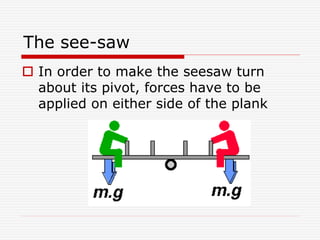
The see-saw
 In order to make the seesaw turn
about its pivot, forces have to be
applied on either side of the plank
The see-saw
 What happens when
one person moves
closer to the fulcrum
or pivot?
 The turning effect of
the force is also
dependent on the
distance of the force
from the pivot.
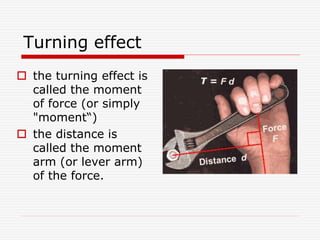
Turning effect
 the turning effect is
called the moment
of force (or simply
"moment“)
 the distance is
called the moment
arm (or lever arm)
of the force.
Moment of a Force
 To work out a
moment, we need to
know two things:
 the force or weight
applied
 the distance from the
pivot that the force or
weight is applied.
 Force and distance
must be
perpendicular to each
other
Moment of a Force
 Product of force and the
perpendicular distance
 From the pivot
Moment and Equilibrium
 Conditions for Equilibrium
 Net force is zero
 Net moment is zero at any point
Example
 Find the force F that will balance the
seesaw.
Example
 Find the force F that will balance the
seesaw.
Center of gravity
 The centre of gravity of an object is
the point where the whole weight of
the object may be considered to act.
Center of gravity
 For a regularly-
shaped object, the
centre of gravity is
at its centre and,
where supported
there, it balances.
Example
 A uniform plank, 100 cm long and weighing
1.0 N is balanced at its midpoint by a
support. A weight of 1.20 N is hanged 5 cm
from the left end. It was found out that an
unknown weight W would balance the plank
if it is positioned 72 cm from the left end.
 What is the weight W of the object?
 How much force is exerted by the support on
the plank?
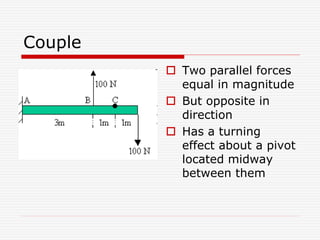
Couple
 Two parallel forces
equal in magnitude
 But opposite in
direction
 Has a turning
effect about a pivot
located midway
between them
Torque of a Couple
 Product of
 One of the forces
 And the distance between them
Thank You

purva.ppt

  • 1.
  • 2.
    Name:Purva Avinash Adam Rollno:01 Grade:X Subject : Physics Guide Teacher:Miss Suchita Dambre Academic year :2022-2023
  • 3.
    Learning Objectives  recalland use the relationship between the moment of a force and its distance from the pivot: Moment = force x perpendicular distance form pivot  recall that the weight of a body acts through the centre gravity  Define the torque of a couple
  • 4.
    Moments  Forces canmake objects turn if there is a pivot.
  • 5.
    The see-saw  Inorder to make the seesaw turn about its pivot, forces have to be applied on either side of the plank
  • 6.
    The see-saw  Whathappens when one person moves closer to the fulcrum or pivot?  The turning effect of the force is also dependent on the distance of the force from the pivot.
  • 7.
    Turning effect  theturning effect is called the moment of force (or simply "moment“)  the distance is called the moment arm (or lever arm) of the force.
  • 8.
    Moment of aForce  To work out a moment, we need to know two things:  the force or weight applied  the distance from the pivot that the force or weight is applied.  Force and distance must be perpendicular to each other
  • 9.
    Moment of aForce  Product of force and the perpendicular distance  From the pivot
  • 10.
    Moment and Equilibrium Conditions for Equilibrium  Net force is zero  Net moment is zero at any point
  • 11.
    Example  Find theforce F that will balance the seesaw.
  • 12.
    Example  Find theforce F that will balance the seesaw.
  • 13.
    Center of gravity The centre of gravity of an object is the point where the whole weight of the object may be considered to act.
  • 14.
    Center of gravity For a regularly- shaped object, the centre of gravity is at its centre and, where supported there, it balances.
  • 15.
    Example  A uniformplank, 100 cm long and weighing 1.0 N is balanced at its midpoint by a support. A weight of 1.20 N is hanged 5 cm from the left end. It was found out that an unknown weight W would balance the plank if it is positioned 72 cm from the left end.  What is the weight W of the object?  How much force is exerted by the support on the plank?
  • 16.
    Couple  Two parallelforces equal in magnitude  But opposite in direction  Has a turning effect about a pivot located midway between them
  • 17.
    Torque of aCouple  Product of  One of the forces  And the distance between them
  • 18.