Purposive Approach
• The purposive approach is a modern version of
the mischief rule.
• It is certainly more flexible than either the
literal rule or the golden rule which tend to
concentrate upon the meaning of individual
words or phrases.
• This rule allows a judge to add or ignore words
in an Act to help them give a decision that
supports, in their view why the Act was
created.
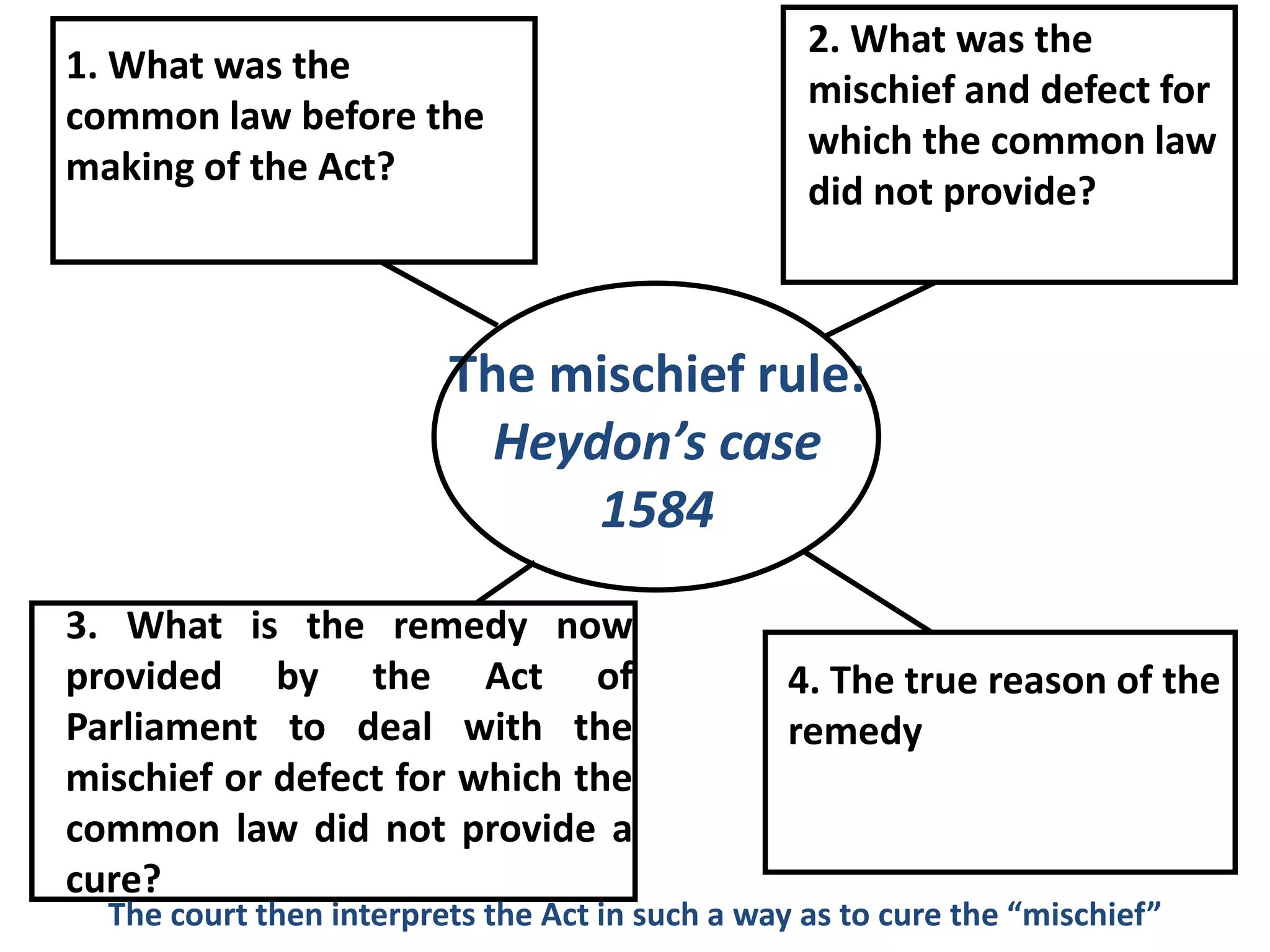
The mischief rule:
Heydon’s case
1584
1. What was the
common law before the
making of the Act?
2. What was the
mischief and defect for
which the common law
did not provide?
3. What is the remedy now
provided by the Act of
Parliament to deal with the
mischief or defect for which the
common law did not provide a
cure?
4. The true reason of the
remedy
The court then interprets the Act in such a way as to cure the “mischief”
• The modern approach to the interpretation of
an Act of Parliament is what is termed the
Purposive Approach.
• The Purposive Approach takes account not
only of the words of the Act according to their
ordinary meaning but also the context.
• ‘Context’ here does not mean simply
‘linguistic context’; the subject-matter, scope,
purpose and (to some extent) background of
the Act are also taken into consideration.
• Very similar to the mischief rule
• It goes beyond ‘filling the gaps’ in a statute
• It looks at what Parliament meant to achieve
• It looks for the purpose of the Act
Literal Rule vs. Purposive Approach
• The literal approach takes each word literally.
The purposive approach is very broad and
does not look at the precise meaning of each
word.
Golden Rule vs. Purposive Approach
• Golden rules look to the actual wording of the
statutes. The mischief and purposive approach
go beyond that.
The Rules of Statutory interpretation
1. The Literal Rule
– Every day meanings of words
2. The Golden Rule
– Words interpreted to avoid absurdity
3. The Mischief Rule
– Words interpreted to fill in the gaps in the original Act
4. The Purposive Approach
– Very wide interpretation to give meaning to purpose
of the Act
R v Secretary of State for Health ex
parte Quintavalle [2003] 2 WLR 692
Cell Nuclear Replacement/Cloning
Human Fertilisation and Embryology Act 1990
• This Act had been passed in response to medical developments in
fertility treatment.
• In July 1978 the first child was born using in vitro fertilisation
techniques (where the egg is fertilised outside the mother’s womb).
• This prompted considerable ethical and scientific debate as to the
social, ethical and legal implications of these scientific
developments.
• In 1982 a Committee of Inquiry was established under the
chairmanship of Dame Mary Warnock and in the light of its report
the 1990 Act was passed.
• This Act aimed to regulate and outlaw certain practices involving
the use of human embryos. However, at the time that the Act was
passed embryos could only be created by a process of fertilisation
with sperm.
• After the Act was passed a new scientific process was developed
known as cell nuclear replacement (CNR). Under this process an
embryo can be created without fertilising an egg but by removing
the nucleus from one egg and replacing it with another nucleus.
This process was used in the cloning process to create the famous
Dolly the sheep.
Fertilizing Egg
• The Pro Life Alliance argued that the Human
Fertilisation and Embryology Authority did not
have authority to licence research with
regards to cloning.
• The Human Fertilisation and Embryology Act
1990 granted the Authority the right to licence
research with regards to embryos.
• An embryo was defined in the Act as ‘a live
human embryo where fertilisation is
complete’. However, embryos created using
cloning are not fertilised.
Held:
• The House of Lords held that the cloned embryos were covered by the
statute taking a purposive approach to statutory interpretation.
Lord Bingham:
• "The court's task, within the permissible bounds of interpretation, is to
give effect to Parliament's purpose. So the controversial provisions
should be read in the context of the statute as a whole, and the
statute as a whole should be read in the historical context of the
situation which led to its enactment….While it is impermissible to ask
what Parliament would have done if the facts had been before it,
there is one important question which may permissibly be asked: it is
whether Parliament, faced with the taxing task of enacting a
legislative solution to the difficult religious, moral and scientific issues
mentioned above, could rationally have intended to leave live human
embryos created by CNR outside the scope of regulation had it known
of them as a scientific possibility. There is only one possible answer to
this question and it is negative."
All India Reporter Karamchari Sangh
v. All India Reporter Ltd. AIR 1988 SC
1325
• The question which arises for consideration in
this case is:
– whether the law reports namely,
• All India Reporter,
• Criminal Law Journal,
• Labour and Industrial Cases,
• Taxation Law Reports,
• Allahabad Law Journal and
• U.P. Law Tribune
published by Respondent , All India Reporter Limited,
are newspapers as defined in the Working Journalists
and Other Newspaper Employees (Conditions of
Service) and Miscellaneous Provisions Act, 1955
– whether the employees of Respondent engaged in the
production or publication of the said law reports are
entitled to the benefits conferred upon the employees
of newspaper establishments by the Act.
Object of the Act
• To regulate certain conditions of service of
working journalists and other employees
employed in the newspaper establishments.
• The expression “newspaper” is defined by
Section 2(b) of the Act as follows:
• “ ‘Newspaper’ means any printed periodical
work containing public news or comments on
public news and includes such other class of
printed periodical work as may, from time to
time, be notified in this behalf by the Central
Government in the official Gazette.”
• In order to be a newspaper, a work must be
(i) a printed work,
(ii) a periodical, and
(iii) should contain public news or comments on
public news.
• A “newspaper employee” is defined by
Section 2(c) of the Act as any working
journalist, and includes any other person
employed to do any work in, or in relation to,
any newspaper establishment.
• “Newspaper establishment” is defined by
Section 2(d) of the Act as an establishment
under the control of any person or body of
persons, whether incorporated or not, for the
production or publication of one or more
newspapers or for conducting any news
agency or syndicate.
• The expression “working journalist” is defined by
Section 2(f) of the Act as a person whose
principal avocation is that of a journalist and
who is employed as such, either whole time or
part-time, in or in relation to, one or more
newspaper establishments and includes an
editor, a leader writer, news editor, sub-editor,
feature writer, copy-tester, reporter,
correspondent, cartoonist, news photographer
and proof-reader, but does not include any such
person who is employed mainly in a managerial
or administrative capacity, or being employed in
a supervisory capacity, performs, either by the
nature of the duties attached to his office or by
reason of the powers vested in him, functions
mainly of a managerial nature.
• It was urged before the High Court on behalf of
Respondent , All India Reporter Limited, that the law
reports published by it were not newspapers as
defined in the Act and therefore the order made by the
Central Government on the basis of the
recommendations of Justice Palekar were not
applicable to its establishment.
• The High Court accepted the plea of Respondent and
declared that the law reports were not newspapers
within the meaning of Section 2(b) of the Act and that
the demand made by the Deputy Labour Commissioner
to comply with the order made by the Central
Government on the basis of the recommendations of
Justice Palekar was unsustainable by its judgment.
• Aggrieved by the decision of the High Court the
appellants have filed this appeal by special leave.
• In order to be a newspaper a work must be a (i)
printed work; (ii) a periodical; and (iii) should
contain public news or comments on public news.
Any other class of printed periodical work as may,
from time to time, be notified in this behalf by
the Central Government in the Official Gazette
may also be a newspaper.
• There is no dispute in the present case that the
law reports are printed works and that they are
periodicals.
• The only question which remains to be
considered is whether they contain public news
or comments on public news.
• The expression “news” is not defined in the
Act.
• According to Shorter Oxford English Dictionary
“news” means tidings, new information of
recent events; new occurrences as a subject of
report or talk.
• The law reports which are being published by
Respondent are reports of recent decisions of the
Supreme Court of India and of the High Courts in India
which are supplied to it by its agents appointed at New
Delhi and other places where High Courts are situated.
• It cannot be disputed that these decisions are of public
importance. Article 141 of the Constitution provides
that the law declared by Supreme Court shall be
binding on all courts within the territory of India.
• Even apart from Article 141 of the Constitution the
decisions of the Supreme Court, which is a court of
record, constitute a source of law as they are the
judicial precedents of the highest court of the land.
• Hence it is difficult to agree with the submission made on
behalf of Respondent that the law reports do not carry any
news and that the public is not interested in them.
• We are of the view that any decision published in the law
reports of Respondent contain information about the
recent events which have taken place in the Supreme Court
or in the High Courts which are public bodies and these are
matters in which the public is interested.
• We find it also difficult to agree with the submission made
on behalf of Respondent that since the law reports are
going to be preserved by the lawyers as reference books
after getting them rebound subsequently they should be
treated as books. It may be that the decisions contained in
these law reports may cease to be items of news after
some time but when they are received by the subscribers
theydo possess the character of works containing news.

Purposive approach

  • 1.
  • 2.
    • The purposiveapproach is a modern version of the mischief rule. • It is certainly more flexible than either the literal rule or the golden rule which tend to concentrate upon the meaning of individual words or phrases. • This rule allows a judge to add or ignore words in an Act to help them give a decision that supports, in their view why the Act was created.
  • 3.
    The mischief rule: Heydon’scase 1584 1. What was the common law before the making of the Act? 2. What was the mischief and defect for which the common law did not provide? 3. What is the remedy now provided by the Act of Parliament to deal with the mischief or defect for which the common law did not provide a cure? 4. The true reason of the remedy The court then interprets the Act in such a way as to cure the “mischief”
  • 4.
    • The modernapproach to the interpretation of an Act of Parliament is what is termed the Purposive Approach. • The Purposive Approach takes account not only of the words of the Act according to their ordinary meaning but also the context. • ‘Context’ here does not mean simply ‘linguistic context’; the subject-matter, scope, purpose and (to some extent) background of the Act are also taken into consideration.
  • 6.
    • Very similarto the mischief rule • It goes beyond ‘filling the gaps’ in a statute • It looks at what Parliament meant to achieve • It looks for the purpose of the Act
  • 7.
    Literal Rule vs.Purposive Approach • The literal approach takes each word literally. The purposive approach is very broad and does not look at the precise meaning of each word. Golden Rule vs. Purposive Approach • Golden rules look to the actual wording of the statutes. The mischief and purposive approach go beyond that.
  • 8.
    The Rules ofStatutory interpretation 1. The Literal Rule – Every day meanings of words 2. The Golden Rule – Words interpreted to avoid absurdity 3. The Mischief Rule – Words interpreted to fill in the gaps in the original Act 4. The Purposive Approach – Very wide interpretation to give meaning to purpose of the Act
  • 9.
    R v Secretaryof State for Health ex parte Quintavalle [2003] 2 WLR 692
  • 11.
  • 12.
    Human Fertilisation andEmbryology Act 1990 • This Act had been passed in response to medical developments in fertility treatment. • In July 1978 the first child was born using in vitro fertilisation techniques (where the egg is fertilised outside the mother’s womb). • This prompted considerable ethical and scientific debate as to the social, ethical and legal implications of these scientific developments. • In 1982 a Committee of Inquiry was established under the chairmanship of Dame Mary Warnock and in the light of its report the 1990 Act was passed. • This Act aimed to regulate and outlaw certain practices involving the use of human embryos. However, at the time that the Act was passed embryos could only be created by a process of fertilisation with sperm. • After the Act was passed a new scientific process was developed known as cell nuclear replacement (CNR). Under this process an embryo can be created without fertilising an egg but by removing the nucleus from one egg and replacing it with another nucleus. This process was used in the cloning process to create the famous Dolly the sheep.
  • 13.
  • 15.
    • The ProLife Alliance argued that the Human Fertilisation and Embryology Authority did not have authority to licence research with regards to cloning. • The Human Fertilisation and Embryology Act 1990 granted the Authority the right to licence research with regards to embryos. • An embryo was defined in the Act as ‘a live human embryo where fertilisation is complete’. However, embryos created using cloning are not fertilised.
  • 16.
    Held: • The Houseof Lords held that the cloned embryos were covered by the statute taking a purposive approach to statutory interpretation. Lord Bingham: • "The court's task, within the permissible bounds of interpretation, is to give effect to Parliament's purpose. So the controversial provisions should be read in the context of the statute as a whole, and the statute as a whole should be read in the historical context of the situation which led to its enactment….While it is impermissible to ask what Parliament would have done if the facts had been before it, there is one important question which may permissibly be asked: it is whether Parliament, faced with the taxing task of enacting a legislative solution to the difficult religious, moral and scientific issues mentioned above, could rationally have intended to leave live human embryos created by CNR outside the scope of regulation had it known of them as a scientific possibility. There is only one possible answer to this question and it is negative."
  • 17.
    All India ReporterKaramchari Sangh v. All India Reporter Ltd. AIR 1988 SC 1325
  • 18.
    • The questionwhich arises for consideration in this case is: – whether the law reports namely, • All India Reporter, • Criminal Law Journal, • Labour and Industrial Cases, • Taxation Law Reports, • Allahabad Law Journal and • U.P. Law Tribune published by Respondent , All India Reporter Limited, are newspapers as defined in the Working Journalists and Other Newspaper Employees (Conditions of Service) and Miscellaneous Provisions Act, 1955 – whether the employees of Respondent engaged in the production or publication of the said law reports are entitled to the benefits conferred upon the employees of newspaper establishments by the Act.
  • 19.
    Object of theAct • To regulate certain conditions of service of working journalists and other employees employed in the newspaper establishments.
  • 20.
    • The expression“newspaper” is defined by Section 2(b) of the Act as follows: • “ ‘Newspaper’ means any printed periodical work containing public news or comments on public news and includes such other class of printed periodical work as may, from time to time, be notified in this behalf by the Central Government in the official Gazette.”
  • 21.
    • In orderto be a newspaper, a work must be (i) a printed work, (ii) a periodical, and (iii) should contain public news or comments on public news.
  • 22.
    • A “newspaperemployee” is defined by Section 2(c) of the Act as any working journalist, and includes any other person employed to do any work in, or in relation to, any newspaper establishment.
  • 23.
    • “Newspaper establishment”is defined by Section 2(d) of the Act as an establishment under the control of any person or body of persons, whether incorporated or not, for the production or publication of one or more newspapers or for conducting any news agency or syndicate.
  • 24.
    • The expression“working journalist” is defined by Section 2(f) of the Act as a person whose principal avocation is that of a journalist and who is employed as such, either whole time or part-time, in or in relation to, one or more newspaper establishments and includes an editor, a leader writer, news editor, sub-editor, feature writer, copy-tester, reporter, correspondent, cartoonist, news photographer and proof-reader, but does not include any such person who is employed mainly in a managerial or administrative capacity, or being employed in a supervisory capacity, performs, either by the nature of the duties attached to his office or by reason of the powers vested in him, functions mainly of a managerial nature.
  • 25.
    • It wasurged before the High Court on behalf of Respondent , All India Reporter Limited, that the law reports published by it were not newspapers as defined in the Act and therefore the order made by the Central Government on the basis of the recommendations of Justice Palekar were not applicable to its establishment. • The High Court accepted the plea of Respondent and declared that the law reports were not newspapers within the meaning of Section 2(b) of the Act and that the demand made by the Deputy Labour Commissioner to comply with the order made by the Central Government on the basis of the recommendations of Justice Palekar was unsustainable by its judgment. • Aggrieved by the decision of the High Court the appellants have filed this appeal by special leave.
  • 26.
    • In orderto be a newspaper a work must be a (i) printed work; (ii) a periodical; and (iii) should contain public news or comments on public news. Any other class of printed periodical work as may, from time to time, be notified in this behalf by the Central Government in the Official Gazette may also be a newspaper. • There is no dispute in the present case that the law reports are printed works and that they are periodicals. • The only question which remains to be considered is whether they contain public news or comments on public news.
  • 27.
    • The expression“news” is not defined in the Act. • According to Shorter Oxford English Dictionary “news” means tidings, new information of recent events; new occurrences as a subject of report or talk.
  • 28.
    • The lawreports which are being published by Respondent are reports of recent decisions of the Supreme Court of India and of the High Courts in India which are supplied to it by its agents appointed at New Delhi and other places where High Courts are situated. • It cannot be disputed that these decisions are of public importance. Article 141 of the Constitution provides that the law declared by Supreme Court shall be binding on all courts within the territory of India. • Even apart from Article 141 of the Constitution the decisions of the Supreme Court, which is a court of record, constitute a source of law as they are the judicial precedents of the highest court of the land.
  • 29.
    • Hence itis difficult to agree with the submission made on behalf of Respondent that the law reports do not carry any news and that the public is not interested in them. • We are of the view that any decision published in the law reports of Respondent contain information about the recent events which have taken place in the Supreme Court or in the High Courts which are public bodies and these are matters in which the public is interested. • We find it also difficult to agree with the submission made on behalf of Respondent that since the law reports are going to be preserved by the lawyers as reference books after getting them rebound subsequently they should be treated as books. It may be that the decisions contained in these law reports may cease to be items of news after some time but when they are received by the subscribers theydo possess the character of works containing news.