Windows Vista
Windows Vista is an operating system released in several
variationsdeveloped by Microsoft for use on personal
computers, includinghome and business desktops, laptops,
tablet PCs, and media center PCs. Prior to its announcement
on July 22, 2005, WindowsVista was known by its
codename "Longhorn." Developmentwas completed on
November 8, 2006; over the following three months it was
released in stages to computer hardware and software
manufacturers, business customers, and retail channels.On
January 30, 2007, it was released worldwide, and was made
availablefor purchase and downloadfrom Microsoft's
website. The release of Windows Vista came more than five
years after the introductionof its predecessor, WindowsXP,
the longest time span between successive releases of
Microsoft Windows desktop operating systems. It was
succeeded by Windows7 which was released to
manufacturing on July 22, 2009, and for the general public
on October 22, 2009.
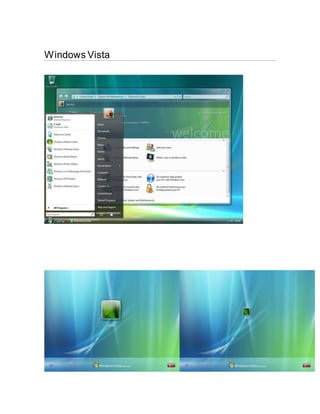
Windows Vista containsmany changes and new features,
includingan updated graphicaluser interface and visual
style dubbed Aero, a redesigned search function,
multimediatools includingWindowsDVD Maker, and
redesigned networking, audio, print, and display sub-
systems. Vista aims to increase the level of communication
between machines on a home network, using peer-to-peer
technology to simplify sharing files and media between
computers and devices. Windows Vista includes version 3.0
of the .NET Framework, allowing software developers to
write applicationswithout traditional WindowsAPIs.
Microsoft's primary stated objectivewith Windows Vista
has been to improve the state of security in the Windows
operating system. One common criticism of Windows XP
and its predecessors is their commonly exploited security
vulnerabilitiesand overall susceptibilityto malware, viruses
and buffer overflows. In light of this, Microsoft chairman Bill
Gates announcedin early 2002 a company-wide
"Trustworthy Computing initiative" whichaimsto
incorporate security work into every aspect of software
developmentat the company. Microsoft stated that it
prioritized improving the security of Windows XP and
Windows Server 2003 above finishing WindowsVista, thus
delayingits completion.

Punto 15

  • 1.
  • 2.
    Windows Vista isan operating system released in several variationsdeveloped by Microsoft for use on personal computers, includinghome and business desktops, laptops, tablet PCs, and media center PCs. Prior to its announcement on July 22, 2005, WindowsVista was known by its codename "Longhorn." Developmentwas completed on November 8, 2006; over the following three months it was released in stages to computer hardware and software manufacturers, business customers, and retail channels.On January 30, 2007, it was released worldwide, and was made availablefor purchase and downloadfrom Microsoft's website. The release of Windows Vista came more than five years after the introductionof its predecessor, WindowsXP, the longest time span between successive releases of Microsoft Windows desktop operating systems. It was succeeded by Windows7 which was released to manufacturing on July 22, 2009, and for the general public on October 22, 2009. Windows Vista containsmany changes and new features, includingan updated graphicaluser interface and visual
  • 3.
    style dubbed Aero,a redesigned search function, multimediatools includingWindowsDVD Maker, and redesigned networking, audio, print, and display sub- systems. Vista aims to increase the level of communication between machines on a home network, using peer-to-peer technology to simplify sharing files and media between computers and devices. Windows Vista includes version 3.0 of the .NET Framework, allowing software developers to write applicationswithout traditional WindowsAPIs. Microsoft's primary stated objectivewith Windows Vista has been to improve the state of security in the Windows operating system. One common criticism of Windows XP and its predecessors is their commonly exploited security vulnerabilitiesand overall susceptibilityto malware, viruses and buffer overflows. In light of this, Microsoft chairman Bill Gates announcedin early 2002 a company-wide "Trustworthy Computing initiative" whichaimsto incorporate security work into every aspect of software developmentat the company. Microsoft stated that it prioritized improving the security of Windows XP and Windows Server 2003 above finishing WindowsVista, thus delayingits completion.