• Windows 8 is the current release of the Windows
 operating system, produced by Microsoft for use on
 personal computers, including home and business
 desktops, laptops, tablets, and home theater PCs.
 Development of Windows 8 started before the release of
 its predecessor in 2009. Its existence was first announced
 at CES 2011, and followed by the release of three pre-
 release versions from September 2011 to May 2012. The
 operating system was released to manufacturing on August
 1, 2012, and was released for general availability on
 October 26, 2012.
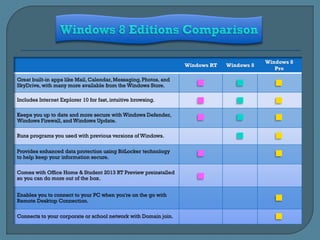
Windows 8
                                                                  Windows RT   Windows 8
                                                                                              Pro

Great built-in apps like Mail, Calendar, Messaging, Photos, and
SkyDrive, with many more available from the Windows Store.

Includes Internet Explorer 10 for fast, intuitive browsing.

Keeps you up to date and more secure with Windows Defender,
Windows Firewall, and Windows Update.

Runs programs you used with previous versions of Windows.
Provides enhanced data protection using BitLocker technology
to help keep your information secure.

Comes with Office Home & Student 2013 RT Preview preinstalled
so you can do more out of the box.


Enables you to connect to your PC when you're on the go with
Remote Desktop Connection.

Connects to your corporate or school network with Domain join.
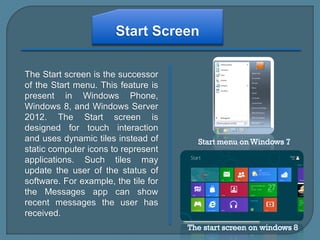
The Start screen is the successor
of the Start menu. This feature is
present in Windows Phone,
Windows 8, and Windows Server
2012. The Start screen is
designed for touch interaction
and uses dynamic tiles instead of
static computer icons to represent
applications. Such tiles may
update the user of the status of
software. For example, the tile for
the Messages app can show
recent messages the user has
received.
   Additional security features in Windows 8 include two new
    authentication methods tailored towards touchscreens (PINs and
    picture passwords), the addition of antivirus capabilities to Windows
    Defender (bringing it in parity with Microsoft's Security Essentials
    software) SmartScreen filtering integrated into the desktop, and
    support for the "Secure Boot" functionality on UEFI systems to
    protect against malware infecting the boot process. Parental controls
    are offered through the integrated Family Safety software, which
    allows parents to monitor and control their children's activities on a
    device with activity reports and safety controls. Windows 8 also
    provides integrated system recovery through the new "Refresh" and
    "Reset" functions. Windows 8's first security patches would be released
    on 13 November 2012, it would contain three critical (most severe as
    per Microsoft) fixes.
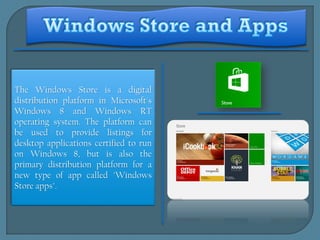
The Windows Store is a digital
distribution platform in Microsoft's
Windows 8 and Windows RT
operating system. The platform can
be used to provide listings for
desktop applications certified to run
on Windows 8, but is also the
primary distribution platform for a
new type of app called "Windows
Store apps".
   Special exceptions are given to web browsers classified as being "New
    experience enabled" (formerly "Metro-style enabled"), which can provide a
    special version to run within the "Metro" shell. Unlike other apps, they can
    be coded using Win32 code instead of Win RT (allowing the reuse of code
    from their desktop versions), permanently run in the background, use
    multiple background processes, and are distributed with desktop web
    browsers rather than through the Windows Store. Despite these looser
    restrictions, they can still take advantage of features typically reserved for
    Windows Store apps, such as the use of contracts to link to other apps.
    However, only the user's default web browser can be used in this setting.
   The developers of both Chrome and Firefox both committed to developing
    versions of their browsers to run in the app environment; while Chrome's
    app simply back ports the existing desktop interface, Firefox's (which is
    currently available in development versions) uses a touch-optimized
    interface inspired by the mobile version of Firefox.
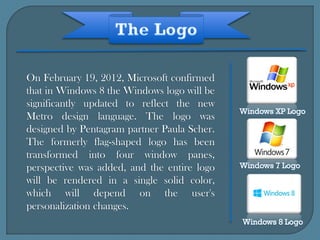
On February 19, 2012, Microsoft confirmed
that in Windows 8 the Windows logo will be
significantly updated to reflect the new
Metro design language. The logo was
designed by Pentagram partner Paula Scher.
The formerly flag-shaped logo has been
transformed into four window panes,
perspective was added, and the entire logo
will be rendered in a single solid color,
which will depend on the user's
personalization changes.
Internet Explorer 10 (IE10) is a version of
the Internet Explorer web browser
released by Microsoft in 2012, and is the
default browser in Windows 8.
On 12 April 2011, Microsoft released the
first "IE10 Platform Preview", which
runs only on Windows 7 and later. While
the second platform preview was also
available for Windows 7 and later,
subsequent platform previews run only
on Windows 8. The first preview release
came four weeks after the final release of
Internet Explorer 9. IE10 reached general
availability on 4 September 2012 as a
component of Windows Server 2012.
A preview of IE10 for Windows 7 was
made available for download in
November 2012.
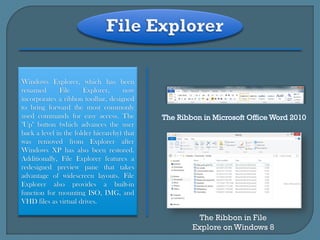
Windows Explorer, which has been
renamed       File     Explorer,     now
incorporates a ribbon toolbar, designed
to bring forward the most commonly
used commands for easy access. The
"Up" button (which advances the user
back a level in the folder hierarchy) that
was removed from Explorer after
Windows XP has also been restored.
Additionally, File Explorer features a
redesigned preview pane that takes
advantage of widescreen layouts. File
Explorer also provides a built-in
function for mounting ISO, IMG, and
VHD files as virtual drives.

                                               The Ribbon in File
                                             Explore on Windows 8
About Windows 8

About Windows 8

  • 2.
    • Windows 8is the current release of the Windows operating system, produced by Microsoft for use on personal computers, including home and business desktops, laptops, tablets, and home theater PCs. Development of Windows 8 started before the release of its predecessor in 2009. Its existence was first announced at CES 2011, and followed by the release of three pre- release versions from September 2011 to May 2012. The operating system was released to manufacturing on August 1, 2012, and was released for general availability on October 26, 2012.
  • 3.
    Windows 8 Windows RT Windows 8 Pro Great built-in apps like Mail, Calendar, Messaging, Photos, and SkyDrive, with many more available from the Windows Store. Includes Internet Explorer 10 for fast, intuitive browsing. Keeps you up to date and more secure with Windows Defender, Windows Firewall, and Windows Update. Runs programs you used with previous versions of Windows. Provides enhanced data protection using BitLocker technology to help keep your information secure. Comes with Office Home & Student 2013 RT Preview preinstalled so you can do more out of the box. Enables you to connect to your PC when you're on the go with Remote Desktop Connection. Connects to your corporate or school network with Domain join.
  • 4.
    The Start screenis the successor of the Start menu. This feature is present in Windows Phone, Windows 8, and Windows Server 2012. The Start screen is designed for touch interaction and uses dynamic tiles instead of static computer icons to represent applications. Such tiles may update the user of the status of software. For example, the tile for the Messages app can show recent messages the user has received.
  • 5.
    Additional security features in Windows 8 include two new authentication methods tailored towards touchscreens (PINs and picture passwords), the addition of antivirus capabilities to Windows Defender (bringing it in parity with Microsoft's Security Essentials software) SmartScreen filtering integrated into the desktop, and support for the "Secure Boot" functionality on UEFI systems to protect against malware infecting the boot process. Parental controls are offered through the integrated Family Safety software, which allows parents to monitor and control their children's activities on a device with activity reports and safety controls. Windows 8 also provides integrated system recovery through the new "Refresh" and "Reset" functions. Windows 8's first security patches would be released on 13 November 2012, it would contain three critical (most severe as per Microsoft) fixes.
  • 6.
    The Windows Storeis a digital distribution platform in Microsoft's Windows 8 and Windows RT operating system. The platform can be used to provide listings for desktop applications certified to run on Windows 8, but is also the primary distribution platform for a new type of app called "Windows Store apps".
  • 7.
    Special exceptions are given to web browsers classified as being "New experience enabled" (formerly "Metro-style enabled"), which can provide a special version to run within the "Metro" shell. Unlike other apps, they can be coded using Win32 code instead of Win RT (allowing the reuse of code from their desktop versions), permanently run in the background, use multiple background processes, and are distributed with desktop web browsers rather than through the Windows Store. Despite these looser restrictions, they can still take advantage of features typically reserved for Windows Store apps, such as the use of contracts to link to other apps. However, only the user's default web browser can be used in this setting.  The developers of both Chrome and Firefox both committed to developing versions of their browsers to run in the app environment; while Chrome's app simply back ports the existing desktop interface, Firefox's (which is currently available in development versions) uses a touch-optimized interface inspired by the mobile version of Firefox.
  • 8.
    On February 19,2012, Microsoft confirmed that in Windows 8 the Windows logo will be significantly updated to reflect the new Metro design language. The logo was designed by Pentagram partner Paula Scher. The formerly flag-shaped logo has been transformed into four window panes, perspective was added, and the entire logo will be rendered in a single solid color, which will depend on the user's personalization changes.
  • 9.
    Internet Explorer 10(IE10) is a version of the Internet Explorer web browser released by Microsoft in 2012, and is the default browser in Windows 8. On 12 April 2011, Microsoft released the first "IE10 Platform Preview", which runs only on Windows 7 and later. While the second platform preview was also available for Windows 7 and later, subsequent platform previews run only on Windows 8. The first preview release came four weeks after the final release of Internet Explorer 9. IE10 reached general availability on 4 September 2012 as a component of Windows Server 2012. A preview of IE10 for Windows 7 was made available for download in November 2012.
  • 10.
    Windows Explorer, whichhas been renamed File Explorer, now incorporates a ribbon toolbar, designed to bring forward the most commonly used commands for easy access. The "Up" button (which advances the user back a level in the folder hierarchy) that was removed from Explorer after Windows XP has also been restored. Additionally, File Explorer features a redesigned preview pane that takes advantage of widescreen layouts. File Explorer also provides a built-in function for mounting ISO, IMG, and VHD files as virtual drives. The Ribbon in File Explore on Windows 8