






PUNJAB RENT
PREMISES,ACT,2009
JUDICIARY CLUB
Rationale Behind Enacting this Act
 Regulation of relationship between
landlord and tenant
 To provide an expeditious mechanism
for settlement of their disputes
 Not only providing benefit to the
parties but also helping in courts
Section 5-10
Creation of Tenancy u/s 5
 General Rules
 A landlord shall not let out a premises to a
tenant
 Exception
 By Tenancy Agreement
Procedure For Creating Tenancy
u/s 5
 Presentation of tenancy
agreement before Rent
Registrar
 Entrance of particulars
of tenancy in a register
by Rent Registrar
 Affixation of Official
seal on tenancy
agreement
 Retaining a copy of
agreement
 Returning original
agreement to the
landlord
The landlord or the
tenant are duty bound to
register the tenancy
agreement regardless its
particulars has been
entered in the prescribed
register of Rent Registrar
Tenancy agreement
before Rent Registrar is a
proof of relationship
between landlord and
tenant
Content s of Tenancy Agreement
 Particulars of land lord and tenant
 Description of premises
 Duration of tenancy
 Rate of rent, rate of enhancement, due date and
mode of paying rent
 Particulars
 of the bank account of the landlord if payment
through bank is a mode of paying rent
 Purpose for which premises is let out
 Amount of advance rent ,security or pagri if any
 If duration of tenancy is fixed but rent is fixed only
for one part of duration, the rent shall be deemed to
remain the same for the remaining duration, in the
absence of any stipulation to the contrary in tenancy
agreement
Mode of paying rent u/s 7
 A tenant shall pay the rent to the
landlord in the mode and on the date
prescribed in the tenancy agreement
 If date of payment is not mentioned
then the tenant shall pay rent not later
than tenth date of the following month
 If mode of payment is not mentioned,
 a tenant shall pay rent through money
order or deposit in the bank account of
the land lord
Existing Tenancy u/s 7
 An existing landlord and tenant are
required to bring the tenancy in
conformity with the provisions of this
act ,not later than two years from the
date of coming into force of this act
Effect of Non-compliance u/s 9
 As a Result of non-compliance the rent
tribunal shall not entertain an
application ( General Rule)
 Non-Compliance on behalf of tenant
 Unless he deposits a fine equal to 5 percent
of the annual value of the rent of premises in
the government treasury
 Non-Compliance of behalf of landlord
 Unless he deposits a fine equal to ten percent
of annual value of the rent of premises in the
Government treasury
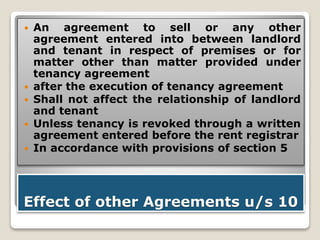
Effect of other Agreements u/s 10
 An agreement to sell or any other
agreement entered into between landlord
and tenant in respect of premises or for
matter other than matter provided under
tenancy agreement
 after the execution of tenancy agreement
 Shall not affect the relationship of landlord
and tenant
 Unless tenancy is revoked through a written
agreement entered before the rent registrar
 In accordance with provisions of section 5
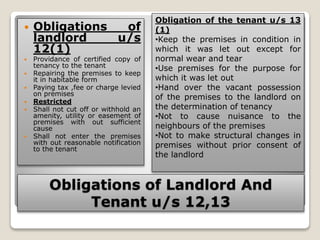
Obligations of Landlord And
Tenant u/s 12,13
 Obligations of
landlord u/s
12(1)
 Providance of certified copy of
tenancy to the tenant
 Repairing the premises to keep
it in habitable form
 Paying tax ,fee or charge levied
on premises
 Restricted
 Shall not cut off or withhold an
amenity, utility or easement of
premises with out sufficient
cause
 Shall not enter the premises
with out reasonable notification
to the tenant
Obligation of the tenant u/s 13
(1)
•Keep the premises in condition in
which it was let out except for
normal wear and tear
•Use premises for the purpose for
which it was let out
•Hand over the vacant possession
of the premises to the landlord on
the determination of tenancy
•Not to cause nuisance to the
neighbours of the premises
•Not to make structural changes in
premises without prior consent of
the landlord
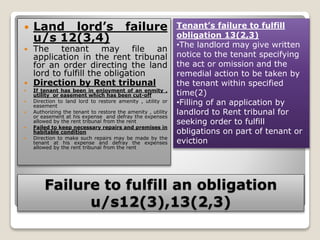
Failure to fulfill an obligation
u/s12(3),13(2,3)
 Land lord’s failure
u/s 12(3,4)
 The tenant may file an
application in the rent tribunal
for an order directing the land
lord to fulfill the obligation
 Direction by Rent tribunal
 If tenant has been in enjoyment of an enmity ,
utility or easement which has been cut-off
 Direction to land lord to restore amenity , utility or
easement
 Authorizing the tenant to restore the amenity , utility
or easement at his expense and defray the expenses
allowed by the rent tribunal from the rent
 Failed to keep necessary repairs and premises in
habitable condition
 Direction to make such repairs may be made by the
tenant at his expense and defray the expenses
allowed by the rent tribunal from the rent
Tenant’s failure to fulfill
obligation 13(2,3)
•The landlord may give written
notice to the tenant specifying
the act or omission and the
remedial action to be taken by
the tenant within specified
time(2)
•Filling of an application by
landlord to Rent tribunal for
seeking order to fulfill
obligations on part of tenant or
eviction
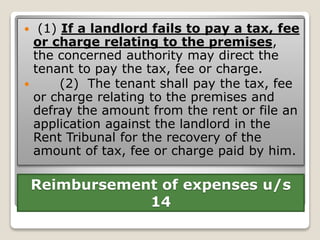
Reimbursement of expenses u/s
14
 (1) If a landlord fails to pay a tax, fee
or charge relating to the premises,
the concerned authority may direct the
tenant to pay the tax, fee or charge.
 (2) The tenant shall pay the tax, fee
or charge relating to the premises and
defray the amount from the rent or file an
application against the landlord in the
Rent Tribunal for the recovery of the
amount of tax, fee or charge paid by him.
Grounds Of Eviction u/s 15
 A landlord may seek eviction of the tenant if–
 (a) the period of tenancy has expired;
 (b) the tenant has failed to pay or tender the
rent within a period of thirty days after the expiry of
the period stipulated in section 7;
 (c) the tenant has committed breach of a term
or condition of the tenancy agreement;
 (d) the tenant has committed a violation of an
obligation under section 13;
 (e) the tenant has used the premises for a
purpose which is different from the purpose for
which it has been let out; or
 (f) the tenant has sub-let the premises without
the prior written consent of the landlord.
Sec 16. Establishment of Rent
Tribunal
 The Government shall establish a Rent Tribunal in a district or an
area as it may deem necessary- Establishing authority
 A Rent Tribunal shall consist of one or more Special Judges
(Rent) to be appointed by the Government in consultation with
the Lahore High Court-Composition of Rent Tribunal
 Subject to this Act, the Lahore High Court may empower a civil
judge or a judicial magistrate to act as Rent Tribunal for a district
or an area- Empowerment to Civil judge as Rent Tribunal
 The Rent Tribunal shall exercise exclusive jurisdiction over a
case under this Act- Exclusive jurisdiction
 If there are more than one Special Judges (Rent) in a district or
an area, a Special Judge (Rent) designated by the Lahore High
Court shall act as an Administrative Special Judge (Rent) in the
district or the area- Special judge (Rent ) As an
Administrative Special Judge
Appointment of Rent Registrar
Sec.17
 (1) The Government shall appoint a Rent
Registrar in a district or an area as it may
deem necessary- Appointment of Rent
Registrar
 (2) The Rent Registrar shall maintain
a register to enter particulars of a tenancy
agreement, agreement to sell or any
other agreement in respect of rented
premises-Maintenance of Register
Sec 18. Staff and establishment
 The Government may appoint staff of a
Rent Tribunal to perform such functions as
may be prescribed.
Sec19. Filing of application
 (1) An application in respect of a rented premises shall be filed in the Rent
Tribunal of the area or the district-Application regarding rented premises
 (2) If an application is filed under sub-section (1), the Administrative
Special Judge (Rent) of the area or the district may take cognizance of the
case or entrust the same to any other Special Judge (Rent)-Jurisdiction to
take cognizance regarding application filled for rented premises
 (3) An application under sub-section
 (1) shall contain a concise statement of facts,
 the relief claimed and
 shall be accompanied by copies of all relevant documents in possession of the
applicant-Requisites for application
 (4) If the application is for eviction of a tenant, the landlord shall submit
his affidavit and affidavits of not more than two witnesses along with the
eviction application-Application for eviction

Sec 20. Application for deposit of
rent
 if a landlord refuses to accept the rent, the tenant
may file an application in the Rent Tribunal for deposit
of the rent-Refusal to accept rent
 The Rent Tribunal shall, without prejudice to the
rights of the landlord, allow the tenant to deposit the
rent for the period for which the landlord has refused
to receive the rent-Deposit of rent
 The Rent Tribunal shall inform the landlord of the
deposit of rent by the tenant and may pass an order
permitting the landlord to collect the same-
Information to landlord regarding deposit of
rent

 (1) If an application is other than application for deposit of rent is filed, the Rent Tribunal shall
issue notice to the respondent in the form prescribed in the Schedule, for appearance of the
respondent on a date not later than ten days through (process server, registered post
acknowledgement due and courier service-) Notice for appearance of respondent

 A notice under sub-section (1) shall be accompanied by copies of the application and the
documents annexed with the application-Annex with notice
 If the respondent fails to appear and
 the Rent Tribunal is satisfied that–
 (a) the notice has not been served
on the respondent or the respondent is willfully avoiding the service of the notice, the
Rent Tribunal may direct service of the notice by:
 (i) affixing a copy of the notice at some conspicuous part of the rented premises or
residence of the respondent; or
 (ii) publication in the press, electronic media or any other mode;
 (b) the notice has been served,
the Rent Tribunal may proceed ex-parte and pass the final order.
Setting aside Ex-parte, Dismissal
in default of applicant ,
Application for restoration
 If an ex-parte order is passed against a respondent, the respondent may,
within ten days from the date of knowledge, apply to the Rent Tribunal for
setting aside the ex-parte order along with an application for leave to contest-
Application for setting aside ex-parte along with leave to contest
 If the respondent shows a sufficient cause for his non appearance
 , the Rent Tribunal may set aside the ex-parte order on such terms as it may
deems fit-Sufficient cause for setting aside ex-parte
The parties may appear in person or through a recognized agent in the Rent
Tribunal-Appearance of parties
 If on a date fixed, the applicant fails to appear, the Rent Tribunal may
dismiss the application-Dismissal in default of applicant
 If an application has been dismissed in default of the appearance of an
applicant and an application for restoration of the same is made within thirty
days of the dismissal order, the Rent Tribunal may restore the application on
such terms as it may deem appropriate-Application for restoration
 A Rent Tribunal shall not allow a respondent to
defend the application unless he obtains leave
to contest-Leave to contest
 a respondent shall file an application for leave
to contest within ten days of his first
appearance in the Rent Tribunal-application
for leave to contest
 An application for leave to contest shall be in
the form of a written reply, stating grounds
on which the leave is sought and shall be
accompanied by an affidavit of the respondent,
copy of all relevant documents in his
possession and, if desired, affidavits of not
more than two witnesses.
 The Rent Tribunal shall not allow leave to
contest to a respondent unless the application
discloses sufficient grounds for production
of oral evidence.
 The Rent Tribunal shall decide the application
for leave to contest within a period of fifteen
days from the date of its filing-disposal of
application
If the leave to contest is refused or the
respondent has failed to fiie application for
leave to contest within the stipulated time, the
Rent Tribunal shall pass the final order-
passing final order

23. Written reply.– If the
leave to contest is granted,
the Rent Tribunal shall treat
the application for leave to
contest as a written reply.
24. Payment of rent and other
dues pending proceedings
 If an eviction application is filed, the Rent Tribunal, while granting
leave to contest, shall direct the tenant to deposit the rent due from
him within a specified time and continue to deposit the same in
accordance with the tenancy agreement or as may be directed by the
Rent Tribunal in the bank account of the landlord or in the Rent
Tribunal till the final order-Deposit of Rent
 If there is a dispute as to the amount of rent due or rate of rent, the
Rent Tribunal shall tentatively determine the dispute and pass the
order for deposit of the rent in terms of sub-section (1)-Tentative
assessment and order of deposit of rent
 In case the tenant has not paid a utility bill, the Rent Tribunal shall
direct the tenant to pay the utility bill-pay utility bills
 If a tenant fails to comply with a direction or order of the Rent
Tribunal, the Rent Tribunal shall forthwith pass the final order-Final
order
Sec25. Recording of evidence
 At the time of grant of leave to contest, the Rent Tribunal shall direct a party
to produce his evidence on a date fixed-Fixation of day for presenting
evidence
 The Rent Tribunal shall treat an affidavit filed by a party as evidence and–
 (a) may, of its own motion, order the attendance of deponent for
cross examination; attendance of deponent
 (b) shall, if so requested by a party, direct production of the deponent
for cross examination-producing deponent
 The Rent Tribunal shall not grant more than two opportunities to a party for
production of the evidence-two opportunities
 The Rent Tribunal shall not grant an adjournment for cross examination of a
witness except for a sufficient cause and on payment of the costs to the
witness as it may deem fit-adjournment to cross-examine witness
 After recording the evidence of the parties, if any, and hearing the
arguments, the Rent Tribunal shall pass the final order-passing of final order
after recording evidence and hearing both parties
 26. Rent Tribunal to exercise powers of
Civil Court.– (1) A Rent Tribunal may
exercise the powers of a Civil Court to
enforce the attendance of a person,
compel the production of evidence,
inspect a premises or issue commission
for examination of a witness or local
inspection.
 (2) A proceeding before a Rent
Tribunal shall be deemed to be judicial
proceedings and the Rent Tribunal shall be
deemed to be a Civil Court within the
meaning of sections 193 and 228 of the
Pakistan Penal Code, 1860 (Act XLV of 1860)
and sections 476 and 480 of the Code of
Criminal Procedure, 1898 (Act V of 1898).
 (3) A Rent Tribunal may pass an
interlocutory order at any stage of a
proceeding before the final order.

27. Period for disposal
of application.– (1) The
Rent Tribunal shall pass
a final order on an
application as
expeditiously as possible
but not latter than four
months from the date of
filing of the application.
(2) If the final order
is not passed on an
application within the
period of four months,
the Rent Tribunal shall
conduct the proceedings
on day to day basis.
28. Appeal.
 A person aggrieved by a final order may, within thirty days, prefer an appeal
in writing to the District Judge of the district-appeal to district judge
 No appeal shall lie against an interlocutory order passed by a Rent Tribunal-
bar to appeal
 the District Judge may hear and dispose of the same or entrust it for disposal
to an Additional District Judge of the district or the area- Disposal of appeal
 The District Judge or the Additional District Judge may, after providing an
opportunity of hearing to the appellant, dismiss the appeal without notice to
the respondent-Dismissal to appeal
 The District Judge or the Additional District Judge may, where the
circumstances so require, suspend the operation of the final order.
 The District Judge or the Additional District Judge may exercise any or all the
powers of a Rent Tribunal
 The District Judge or the Additional District Judge shall decide an appeal
within a period of two months from the date of filing of the appeal.
 No appeal shall lie against an order passed by a District Judge or an
Additional District Judge under this Act-Finality of appeal
Punjab rent premises,act,2009

Punjab rent premises,act,2009

  • 1.
  • 2.
    Rationale Behind Enactingthis Act  Regulation of relationship between landlord and tenant  To provide an expeditious mechanism for settlement of their disputes  Not only providing benefit to the parties but also helping in courts
  • 3.
  • 4.
    Creation of Tenancyu/s 5  General Rules  A landlord shall not let out a premises to a tenant  Exception  By Tenancy Agreement
  • 5.
    Procedure For CreatingTenancy u/s 5  Presentation of tenancy agreement before Rent Registrar  Entrance of particulars of tenancy in a register by Rent Registrar  Affixation of Official seal on tenancy agreement  Retaining a copy of agreement  Returning original agreement to the landlord The landlord or the tenant are duty bound to register the tenancy agreement regardless its particulars has been entered in the prescribed register of Rent Registrar Tenancy agreement before Rent Registrar is a proof of relationship between landlord and tenant
  • 6.
    Content s ofTenancy Agreement  Particulars of land lord and tenant  Description of premises  Duration of tenancy  Rate of rent, rate of enhancement, due date and mode of paying rent  Particulars  of the bank account of the landlord if payment through bank is a mode of paying rent  Purpose for which premises is let out  Amount of advance rent ,security or pagri if any  If duration of tenancy is fixed but rent is fixed only for one part of duration, the rent shall be deemed to remain the same for the remaining duration, in the absence of any stipulation to the contrary in tenancy agreement
  • 7.
    Mode of payingrent u/s 7  A tenant shall pay the rent to the landlord in the mode and on the date prescribed in the tenancy agreement  If date of payment is not mentioned then the tenant shall pay rent not later than tenth date of the following month  If mode of payment is not mentioned,  a tenant shall pay rent through money order or deposit in the bank account of the land lord
  • 8.
    Existing Tenancy u/s7  An existing landlord and tenant are required to bring the tenancy in conformity with the provisions of this act ,not later than two years from the date of coming into force of this act
  • 9.
    Effect of Non-complianceu/s 9  As a Result of non-compliance the rent tribunal shall not entertain an application ( General Rule)  Non-Compliance on behalf of tenant  Unless he deposits a fine equal to 5 percent of the annual value of the rent of premises in the government treasury  Non-Compliance of behalf of landlord  Unless he deposits a fine equal to ten percent of annual value of the rent of premises in the Government treasury
  • 10.
    Effect of otherAgreements u/s 10  An agreement to sell or any other agreement entered into between landlord and tenant in respect of premises or for matter other than matter provided under tenancy agreement  after the execution of tenancy agreement  Shall not affect the relationship of landlord and tenant  Unless tenancy is revoked through a written agreement entered before the rent registrar  In accordance with provisions of section 5
  • 11.
    Obligations of LandlordAnd Tenant u/s 12,13  Obligations of landlord u/s 12(1)  Providance of certified copy of tenancy to the tenant  Repairing the premises to keep it in habitable form  Paying tax ,fee or charge levied on premises  Restricted  Shall not cut off or withhold an amenity, utility or easement of premises with out sufficient cause  Shall not enter the premises with out reasonable notification to the tenant Obligation of the tenant u/s 13 (1) •Keep the premises in condition in which it was let out except for normal wear and tear •Use premises for the purpose for which it was let out •Hand over the vacant possession of the premises to the landlord on the determination of tenancy •Not to cause nuisance to the neighbours of the premises •Not to make structural changes in premises without prior consent of the landlord
  • 12.
    Failure to fulfillan obligation u/s12(3),13(2,3)  Land lord’s failure u/s 12(3,4)  The tenant may file an application in the rent tribunal for an order directing the land lord to fulfill the obligation  Direction by Rent tribunal  If tenant has been in enjoyment of an enmity , utility or easement which has been cut-off  Direction to land lord to restore amenity , utility or easement  Authorizing the tenant to restore the amenity , utility or easement at his expense and defray the expenses allowed by the rent tribunal from the rent  Failed to keep necessary repairs and premises in habitable condition  Direction to make such repairs may be made by the tenant at his expense and defray the expenses allowed by the rent tribunal from the rent Tenant’s failure to fulfill obligation 13(2,3) •The landlord may give written notice to the tenant specifying the act or omission and the remedial action to be taken by the tenant within specified time(2) •Filling of an application by landlord to Rent tribunal for seeking order to fulfill obligations on part of tenant or eviction
  • 13.
    Reimbursement of expensesu/s 14  (1) If a landlord fails to pay a tax, fee or charge relating to the premises, the concerned authority may direct the tenant to pay the tax, fee or charge.  (2) The tenant shall pay the tax, fee or charge relating to the premises and defray the amount from the rent or file an application against the landlord in the Rent Tribunal for the recovery of the amount of tax, fee or charge paid by him.
  • 14.
    Grounds Of Evictionu/s 15  A landlord may seek eviction of the tenant if–  (a) the period of tenancy has expired;  (b) the tenant has failed to pay or tender the rent within a period of thirty days after the expiry of the period stipulated in section 7;  (c) the tenant has committed breach of a term or condition of the tenancy agreement;  (d) the tenant has committed a violation of an obligation under section 13;  (e) the tenant has used the premises for a purpose which is different from the purpose for which it has been let out; or  (f) the tenant has sub-let the premises without the prior written consent of the landlord.
  • 16.
    Sec 16. Establishmentof Rent Tribunal  The Government shall establish a Rent Tribunal in a district or an area as it may deem necessary- Establishing authority  A Rent Tribunal shall consist of one or more Special Judges (Rent) to be appointed by the Government in consultation with the Lahore High Court-Composition of Rent Tribunal  Subject to this Act, the Lahore High Court may empower a civil judge or a judicial magistrate to act as Rent Tribunal for a district or an area- Empowerment to Civil judge as Rent Tribunal  The Rent Tribunal shall exercise exclusive jurisdiction over a case under this Act- Exclusive jurisdiction  If there are more than one Special Judges (Rent) in a district or an area, a Special Judge (Rent) designated by the Lahore High Court shall act as an Administrative Special Judge (Rent) in the district or the area- Special judge (Rent ) As an Administrative Special Judge
  • 17.
    Appointment of RentRegistrar Sec.17  (1) The Government shall appoint a Rent Registrar in a district or an area as it may deem necessary- Appointment of Rent Registrar  (2) The Rent Registrar shall maintain a register to enter particulars of a tenancy agreement, agreement to sell or any other agreement in respect of rented premises-Maintenance of Register
  • 18.
    Sec 18. Staffand establishment  The Government may appoint staff of a Rent Tribunal to perform such functions as may be prescribed.
  • 19.
    Sec19. Filing ofapplication  (1) An application in respect of a rented premises shall be filed in the Rent Tribunal of the area or the district-Application regarding rented premises  (2) If an application is filed under sub-section (1), the Administrative Special Judge (Rent) of the area or the district may take cognizance of the case or entrust the same to any other Special Judge (Rent)-Jurisdiction to take cognizance regarding application filled for rented premises  (3) An application under sub-section  (1) shall contain a concise statement of facts,  the relief claimed and  shall be accompanied by copies of all relevant documents in possession of the applicant-Requisites for application  (4) If the application is for eviction of a tenant, the landlord shall submit his affidavit and affidavits of not more than two witnesses along with the eviction application-Application for eviction 
  • 20.
    Sec 20. Applicationfor deposit of rent  if a landlord refuses to accept the rent, the tenant may file an application in the Rent Tribunal for deposit of the rent-Refusal to accept rent  The Rent Tribunal shall, without prejudice to the rights of the landlord, allow the tenant to deposit the rent for the period for which the landlord has refused to receive the rent-Deposit of rent  The Rent Tribunal shall inform the landlord of the deposit of rent by the tenant and may pass an order permitting the landlord to collect the same- Information to landlord regarding deposit of rent 
  • 22.
     (1) Ifan application is other than application for deposit of rent is filed, the Rent Tribunal shall issue notice to the respondent in the form prescribed in the Schedule, for appearance of the respondent on a date not later than ten days through (process server, registered post acknowledgement due and courier service-) Notice for appearance of respondent   A notice under sub-section (1) shall be accompanied by copies of the application and the documents annexed with the application-Annex with notice  If the respondent fails to appear and  the Rent Tribunal is satisfied that–  (a) the notice has not been served on the respondent or the respondent is willfully avoiding the service of the notice, the Rent Tribunal may direct service of the notice by:  (i) affixing a copy of the notice at some conspicuous part of the rented premises or residence of the respondent; or  (ii) publication in the press, electronic media or any other mode;  (b) the notice has been served, the Rent Tribunal may proceed ex-parte and pass the final order.
  • 23.
    Setting aside Ex-parte,Dismissal in default of applicant , Application for restoration  If an ex-parte order is passed against a respondent, the respondent may, within ten days from the date of knowledge, apply to the Rent Tribunal for setting aside the ex-parte order along with an application for leave to contest- Application for setting aside ex-parte along with leave to contest  If the respondent shows a sufficient cause for his non appearance  , the Rent Tribunal may set aside the ex-parte order on such terms as it may deems fit-Sufficient cause for setting aside ex-parte The parties may appear in person or through a recognized agent in the Rent Tribunal-Appearance of parties  If on a date fixed, the applicant fails to appear, the Rent Tribunal may dismiss the application-Dismissal in default of applicant  If an application has been dismissed in default of the appearance of an applicant and an application for restoration of the same is made within thirty days of the dismissal order, the Rent Tribunal may restore the application on such terms as it may deem appropriate-Application for restoration
  • 25.
     A RentTribunal shall not allow a respondent to defend the application unless he obtains leave to contest-Leave to contest  a respondent shall file an application for leave to contest within ten days of his first appearance in the Rent Tribunal-application for leave to contest  An application for leave to contest shall be in the form of a written reply, stating grounds on which the leave is sought and shall be accompanied by an affidavit of the respondent, copy of all relevant documents in his possession and, if desired, affidavits of not more than two witnesses.  The Rent Tribunal shall not allow leave to contest to a respondent unless the application discloses sufficient grounds for production of oral evidence.  The Rent Tribunal shall decide the application for leave to contest within a period of fifteen days from the date of its filing-disposal of application If the leave to contest is refused or the respondent has failed to fiie application for leave to contest within the stipulated time, the Rent Tribunal shall pass the final order- passing final order  23. Written reply.– If the leave to contest is granted, the Rent Tribunal shall treat the application for leave to contest as a written reply.
  • 26.
    24. Payment ofrent and other dues pending proceedings  If an eviction application is filed, the Rent Tribunal, while granting leave to contest, shall direct the tenant to deposit the rent due from him within a specified time and continue to deposit the same in accordance with the tenancy agreement or as may be directed by the Rent Tribunal in the bank account of the landlord or in the Rent Tribunal till the final order-Deposit of Rent  If there is a dispute as to the amount of rent due or rate of rent, the Rent Tribunal shall tentatively determine the dispute and pass the order for deposit of the rent in terms of sub-section (1)-Tentative assessment and order of deposit of rent  In case the tenant has not paid a utility bill, the Rent Tribunal shall direct the tenant to pay the utility bill-pay utility bills  If a tenant fails to comply with a direction or order of the Rent Tribunal, the Rent Tribunal shall forthwith pass the final order-Final order
  • 27.
    Sec25. Recording ofevidence  At the time of grant of leave to contest, the Rent Tribunal shall direct a party to produce his evidence on a date fixed-Fixation of day for presenting evidence  The Rent Tribunal shall treat an affidavit filed by a party as evidence and–  (a) may, of its own motion, order the attendance of deponent for cross examination; attendance of deponent  (b) shall, if so requested by a party, direct production of the deponent for cross examination-producing deponent  The Rent Tribunal shall not grant more than two opportunities to a party for production of the evidence-two opportunities  The Rent Tribunal shall not grant an adjournment for cross examination of a witness except for a sufficient cause and on payment of the costs to the witness as it may deem fit-adjournment to cross-examine witness  After recording the evidence of the parties, if any, and hearing the arguments, the Rent Tribunal shall pass the final order-passing of final order after recording evidence and hearing both parties
  • 28.
     26. RentTribunal to exercise powers of Civil Court.– (1) A Rent Tribunal may exercise the powers of a Civil Court to enforce the attendance of a person, compel the production of evidence, inspect a premises or issue commission for examination of a witness or local inspection.  (2) A proceeding before a Rent Tribunal shall be deemed to be judicial proceedings and the Rent Tribunal shall be deemed to be a Civil Court within the meaning of sections 193 and 228 of the Pakistan Penal Code, 1860 (Act XLV of 1860) and sections 476 and 480 of the Code of Criminal Procedure, 1898 (Act V of 1898).  (3) A Rent Tribunal may pass an interlocutory order at any stage of a proceeding before the final order.  27. Period for disposal of application.– (1) The Rent Tribunal shall pass a final order on an application as expeditiously as possible but not latter than four months from the date of filing of the application. (2) If the final order is not passed on an application within the period of four months, the Rent Tribunal shall conduct the proceedings on day to day basis.
  • 29.
    28. Appeal.  Aperson aggrieved by a final order may, within thirty days, prefer an appeal in writing to the District Judge of the district-appeal to district judge  No appeal shall lie against an interlocutory order passed by a Rent Tribunal- bar to appeal  the District Judge may hear and dispose of the same or entrust it for disposal to an Additional District Judge of the district or the area- Disposal of appeal  The District Judge or the Additional District Judge may, after providing an opportunity of hearing to the appellant, dismiss the appeal without notice to the respondent-Dismissal to appeal  The District Judge or the Additional District Judge may, where the circumstances so require, suspend the operation of the final order.  The District Judge or the Additional District Judge may exercise any or all the powers of a Rent Tribunal  The District Judge or the Additional District Judge shall decide an appeal within a period of two months from the date of filing of the appeal.  No appeal shall lie against an order passed by a District Judge or an Additional District Judge under this Act-Finality of appeal