East Africa University
DEPARTMENT OF ELECTRONICS AND COMMUNICATION
ENGINEERING
SUBJECT NAME: PULSE & DIGITAL CIRCUITS
LECTURER NAME: Abdulkadir. M . Daar
PULSE & DIGITAL CIRCUITS
COURSE OBJECTIVES:
The student will be made
To understand the concept of wave shaping circuits,
Switching Characteristics of diode and transistor.
To study the design and analysis of various Multivibrators.
To understand the functioning of different types of time-
base Generators.
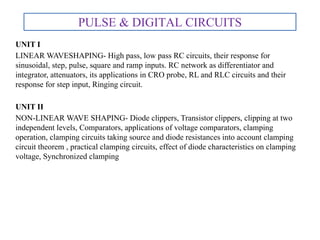
UNIT I
LINEAR WAVESHAPING- High pass, low pass RC circuits, their response for
sinusoidal, step, pulse, square and ramp inputs. RC network as differentiator and
integrator, attenuators, its applications in CRO probe, RL and RLC circuits and their
response for step input, Ringing circuit.
UNIT II
NON-LINEAR WAVE SHAPING- Diode clippers, Transistor clippers, clipping at two
independent levels, Comparators, applications of voltage comparators, clamping
operation, clamping circuits taking source and diode resistances into account clamping
circuit theorem , practical clamping circuits, effect of diode characteristics on clamping
voltage, Synchronized clamping
PULSE & DIGITAL CIRCUITS
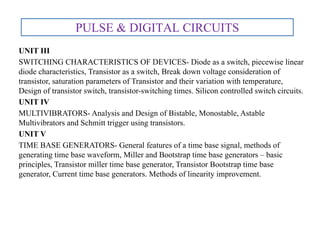
UNIT III
SWITCHING CHARACTERISTICS OF DEVICES- Diode as a switch, piecewise linear
diode characteristics, Transistor as a switch, Break down voltage consideration of
transistor, saturation parameters of Transistor and their variation with temperature,
Design of transistor switch, transistor-switching times. Silicon controlled switch circuits.
UNIT IV
MULTIVIBRATORS- Analysis and Design of Bistable, Monostable, Astable
Multivibrators and Schmitt trigger using transistors.
UNIT V
TIME BASE GENERATORS- General features of a time base signal, methods of
generating time base waveform, Miller and Bootstrap time base generators – basic
principles, Transistor miller time base generator, Transistor Bootstrap time base
generator, Current time base generators. Methods of linearity improvement.
PULSE & DIGITAL CIRCUITS
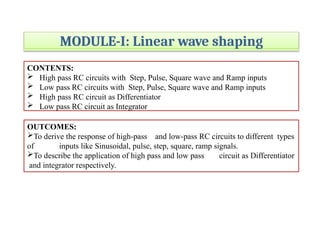
MODULE-I: Linear wave shaping
CONTENTS:
 High pass RC circuits with Step, Pulse, Square wave and Ramp inputs
 Low pass RC circuits with Step, Pulse, Square wave and Ramp inputs
 High pass RC circuit as Differentiator
 Low pass RC circuit as Integrator
OUTCOMES:
To derive the response of high-pass and low-pass RC circuits to different types
of inputs like Sinusoidal, pulse, step, square, ramp signals.
To describe the application of high pass and low pass circuit as Differentiator
and integrator respectively.
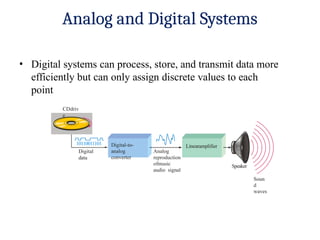
Analog and Digital Systems
• Digital systems can process, store, and transmit data more
efficiently but can only assign discrete values to each
point
CDdriv
e
10110011101
Digital
data
Analog
reproduction
ofmusic
audio signal
Speaker
Soun
d
waves
Digital-to-
analog
converter
Linearamplifier
Cont..
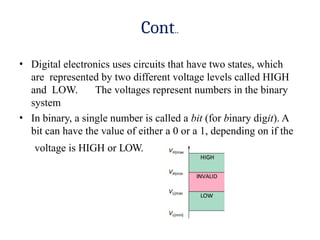
• Digital electronics uses circuits that have two states, which
are represented by two different voltage levels called HIGH
and LOW. The voltages represent numbers in the binary
system
• In binary, a single number is called a bit (for binary digit). A
bit can have the value of either a 0 or a 1, depending on if the
voltage is HIGH or LOW.
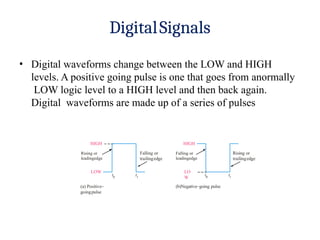
DigitalSignals
• Digital waveforms change between the LOW and HIGH
levels. A positive going pulse is one that goes from anormally
LOW logic level to a HIGH level and then back again.
Digital waveforms are made up of a series of pulses
Falling or
leadingedge
(b)Negative–going pulse
HIGH
Rising or
trailingedge
LO
W
(a) Positive–
goingpulse
HIGH
Rising or
leadingedge
Falling or
trailingedge
LOW
t0
t1
t0
t1
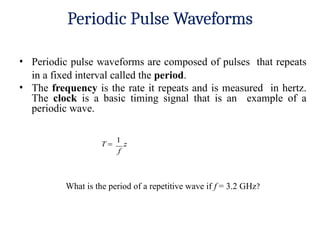
Periodic Pulse Waveforms
• Periodic pulse waveforms are composed of pulses that repeats
in a fixed interval called the period.
• The frequency is the rate it repeats and is measured in hertz.
The clock is a basic timing signal that is an example of a
periodic wave.
What is the period of a repetitive wave if f = 3.2 GHz?
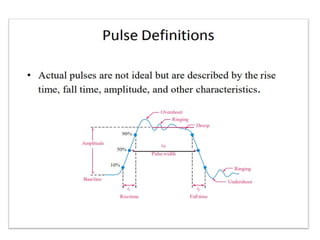
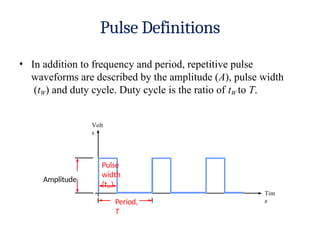
Pulse Definitions
• In addition to frequency and period, repetitive pulse
waveforms are described by the amplitude (A), pulse width
(tW) and duty cycle. Duty cycle is the ratio of tW to T.
Volt
s
Pulse
width
(tW)
Tim
e
Period,
T
Amplitude
LINEAR WAVESHAPING
Linear elements such as resistors, capacitors and inductors are
employed to shape a signal in this linear wave shaping. A Sine
wave input has a sine wave output and hence the non-sinusoidal
inputs are more prominently used to understand the linear wave
shaping.
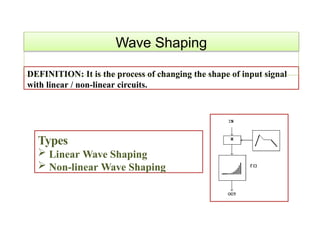
DEFINITION: It is the process of changing the shape of input signal
with linear / non-linear circuits.
Wave Shaping
Types
 Linear Wave Shaping
 Non-linear Wave Shaping
DEFINITION: The process where by the form of a non-
sinusoidal signal is changed by transmission through a linear
network is called linear wave shaping.
Linear Wave Shaping
Types
 High Pass RC Circuit.
 Low Pass RC Circuit.
Non-sinusoidal wave forms
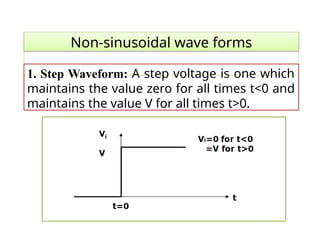
1. Step Waveform: A step voltage is one which
maintains the value zero for all times t<0 and
maintains the value V for all times t>0.
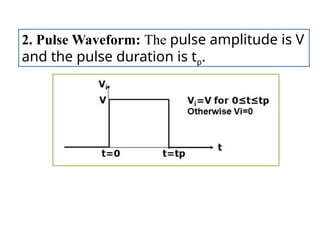
2. Pulse Waveform: The pulse amplitude is V
and the pulse duration is tp.
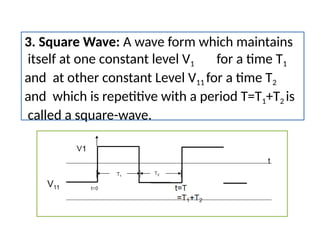
3. Square Wave: A wave form which maintains
itself at one constant level V1 for a time T1
and at other constant Level V11 for a time T2
and which is repetitive with a period T=T1+T2 is
called a square-wave.
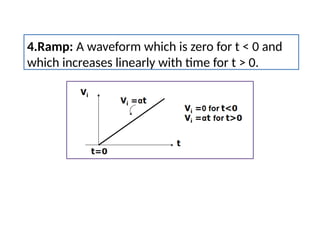
4.Ramp: A waveform which is zero for t < 0 and
which increases linearly with time for t > 0.
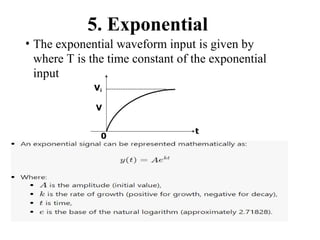
5. Exponential
0
t
• The exponential waveform input is given by
where T is the time constant of the exponential
input
Vi
V

pulse and digital circuits file dadadesd

  • 1.
    East Africa University DEPARTMENTOF ELECTRONICS AND COMMUNICATION ENGINEERING SUBJECT NAME: PULSE & DIGITAL CIRCUITS LECTURER NAME: Abdulkadir. M . Daar
  • 2.
    PULSE & DIGITALCIRCUITS COURSE OBJECTIVES: The student will be made To understand the concept of wave shaping circuits, Switching Characteristics of diode and transistor. To study the design and analysis of various Multivibrators. To understand the functioning of different types of time- base Generators.
  • 3.
    UNIT I LINEAR WAVESHAPING-High pass, low pass RC circuits, their response for sinusoidal, step, pulse, square and ramp inputs. RC network as differentiator and integrator, attenuators, its applications in CRO probe, RL and RLC circuits and their response for step input, Ringing circuit. UNIT II NON-LINEAR WAVE SHAPING- Diode clippers, Transistor clippers, clipping at two independent levels, Comparators, applications of voltage comparators, clamping operation, clamping circuits taking source and diode resistances into account clamping circuit theorem , practical clamping circuits, effect of diode characteristics on clamping voltage, Synchronized clamping PULSE & DIGITAL CIRCUITS
  • 4.
    UNIT III SWITCHING CHARACTERISTICSOF DEVICES- Diode as a switch, piecewise linear diode characteristics, Transistor as a switch, Break down voltage consideration of transistor, saturation parameters of Transistor and their variation with temperature, Design of transistor switch, transistor-switching times. Silicon controlled switch circuits. UNIT IV MULTIVIBRATORS- Analysis and Design of Bistable, Monostable, Astable Multivibrators and Schmitt trigger using transistors. UNIT V TIME BASE GENERATORS- General features of a time base signal, methods of generating time base waveform, Miller and Bootstrap time base generators – basic principles, Transistor miller time base generator, Transistor Bootstrap time base generator, Current time base generators. Methods of linearity improvement. PULSE & DIGITAL CIRCUITS
  • 5.
    MODULE-I: Linear waveshaping CONTENTS:  High pass RC circuits with Step, Pulse, Square wave and Ramp inputs  Low pass RC circuits with Step, Pulse, Square wave and Ramp inputs  High pass RC circuit as Differentiator  Low pass RC circuit as Integrator OUTCOMES: To derive the response of high-pass and low-pass RC circuits to different types of inputs like Sinusoidal, pulse, step, square, ramp signals. To describe the application of high pass and low pass circuit as Differentiator and integrator respectively.
  • 6.
    Analog and DigitalSystems • Digital systems can process, store, and transmit data more efficiently but can only assign discrete values to each point CDdriv e 10110011101 Digital data Analog reproduction ofmusic audio signal Speaker Soun d waves Digital-to- analog converter Linearamplifier
  • 7.
    Cont.. • Digital electronicsuses circuits that have two states, which are represented by two different voltage levels called HIGH and LOW. The voltages represent numbers in the binary system • In binary, a single number is called a bit (for binary digit). A bit can have the value of either a 0 or a 1, depending on if the voltage is HIGH or LOW.
  • 8.
    DigitalSignals • Digital waveformschange between the LOW and HIGH levels. A positive going pulse is one that goes from anormally LOW logic level to a HIGH level and then back again. Digital waveforms are made up of a series of pulses Falling or leadingedge (b)Negative–going pulse HIGH Rising or trailingedge LO W (a) Positive– goingpulse HIGH Rising or leadingedge Falling or trailingedge LOW t0 t1 t0 t1
  • 10.
    Periodic Pulse Waveforms •Periodic pulse waveforms are composed of pulses that repeats in a fixed interval called the period. • The frequency is the rate it repeats and is measured in hertz. The clock is a basic timing signal that is an example of a periodic wave. What is the period of a repetitive wave if f = 3.2 GHz?
  • 11.
    Pulse Definitions • Inaddition to frequency and period, repetitive pulse waveforms are described by the amplitude (A), pulse width (tW) and duty cycle. Duty cycle is the ratio of tW to T. Volt s Pulse width (tW) Tim e Period, T Amplitude
  • 12.
    LINEAR WAVESHAPING Linear elementssuch as resistors, capacitors and inductors are employed to shape a signal in this linear wave shaping. A Sine wave input has a sine wave output and hence the non-sinusoidal inputs are more prominently used to understand the linear wave shaping.
  • 13.
    DEFINITION: It isthe process of changing the shape of input signal with linear / non-linear circuits. Wave Shaping Types  Linear Wave Shaping  Non-linear Wave Shaping
  • 14.
    DEFINITION: The processwhere by the form of a non- sinusoidal signal is changed by transmission through a linear network is called linear wave shaping. Linear Wave Shaping Types  High Pass RC Circuit.  Low Pass RC Circuit.
  • 15.
    Non-sinusoidal wave forms 1.Step Waveform: A step voltage is one which maintains the value zero for all times t<0 and maintains the value V for all times t>0.
  • 16.
    2. Pulse Waveform:The pulse amplitude is V and the pulse duration is tp.
  • 17.
    3. Square Wave:A wave form which maintains itself at one constant level V1 for a time T1 and at other constant Level V11 for a time T2 and which is repetitive with a period T=T1+T2 is called a square-wave.
  • 18.
    4.Ramp: A waveformwhich is zero for t < 0 and which increases linearly with time for t > 0.
  • 19.
    5. Exponential 0 t • Theexponential waveform input is given by where T is the time constant of the exponential input Vi V