NOTRE DAME GIRLS’ ACADEMY,
AMOYO, KWARA, NIGERIA.
…preparing young girls for life
LECTURE
ON
PUBLIC SPEAKING
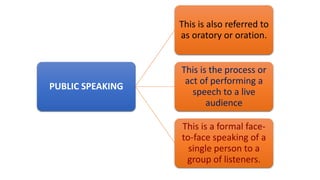
PUBLIC SPEAKING
This is also referred to
as oratory or oration.
This is the process or
act of performing a
speech to a live
audience
This is a formal face-
to-face speaking of a
single person to a
group of listeners.
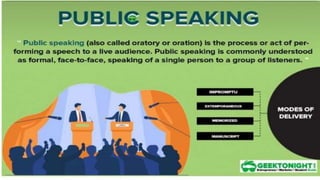
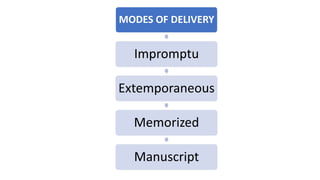
MODES OF DELIVERY
Impromptu
Extemporaneous
Memorized
Manuscript
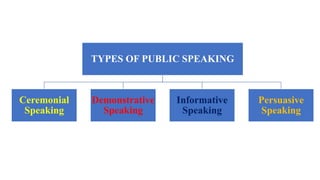
TYPES OF PUBLIC SPEAKING
Ceremonial
Speaking
Demonstrative
Speaking
Informative
Speaking
Persuasive
Speaking
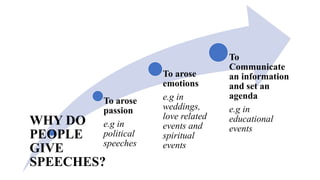
WHY DO
PEOPLE
GIVE
SPEECHES?
To arose
passion
e.g in
political
speeches
To arose
emotions
e.g in
weddings,
love related
events and
spiritual
events
To
Communicate
an information
and set an
agenda
e.g in
educational
events
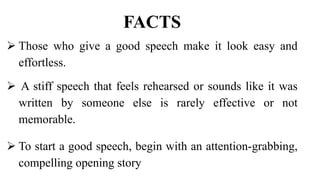
FACTS
 Those who give a good speech make it look easy and
effortless.
 A stiff speech that feels rehearsed or sounds like it was
written by someone else is rarely effective or not
memorable.
 To start a good speech, begin with an attention-grabbing,
compelling opening story
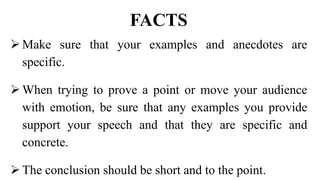
FACTS
 Make sure that your examples and anecdotes are
specific.
 When trying to prove a point or move your audience
with emotion, be sure that any examples you provide
support your speech and that they are specific and
concrete.
 The conclusion should be short and to the point.
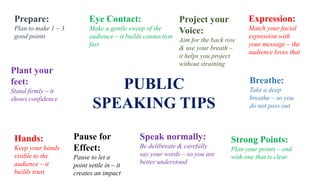
FACTORS THAT ENHANCE A GOOD
SPEECH MAKER
Prepare:
Plan to make 1 – 3
good points
Expression:
Match your facial
expression with
your message – the
audience loves that
Strong Points:
Plan your points – end
with one that is clear
Hands:
Keep your hands
visible to the
audience – it
builds trust
Breathe:
Take a deep
breathe – so you
do not pass out
Eye Contact:
Make a gentle sweep of the
audience – it builds connection
fast
Speak normally:
Be deliberate & carefully
say your words – so you are
better understood
Pause for
Effect:
Pause to let a
point settle in – it
creates an impact
Project your
Voice:
Aim for the back row
& use your breath –
it helps you project
without straining
Plant your
feet:
Stand firmly – it
shows confidence
PUBLIC
SPEAKING TIPS
WHAT ARE THE TOP QUALITIES OF A
GOOD SPEECH?
1. It must have a main idea
A single theme. Research has proven that it is very difficult to
remember and lot of detail when listening to a speech, so be sure to
start with one main idea. What is the point of your speech? What do
you want the audience to come away knowing, understanding or
feeling? Start from there and then work backward.
2.
The use of anecdotes
Use anecdotes. Rather than a laundry list of reasons why your point
is true or significant, try to find a story or an anecdote that supports
the theme you are trying to express. Stories are naturally engaging,
and people tend to remember them better than exposition or lectures
about the same topic. Don't Argue, let your point do better with the
use of short relevant stories.
3. Conversational tone.
Write your speech in the same voice in which you speak. I'm other
words, Write your speech in your very own language and be sure to
write the point as short as possible so as to pick the points
conveniently while delivering the speech.
4. Humor.
Use humor when and where appropriate. Of course, not every
situation and speech is going to call for humor, but if you can present
the information you are hoping to convey in the context of a
humorous story or anecdote, then do so
CONCLUSION
 No matter what your topic is, your speech must be
organized.
 The beginning must lead to a middle and the middle must
lead to an end.
 If you are not organized, your speech will appear same
 Organizing your ideas can help you to gain clarity on the
things you're discussing before you write, so you can be
sure that your speech flows smoothly and isn't confusing
to your audience.
QS & AS
NDGA… Preparing young girls for
THANKS
FOR
LISTENING

Public Speaking.pptx

  • 1.
    NOTRE DAME GIRLS’ACADEMY, AMOYO, KWARA, NIGERIA. …preparing young girls for life
  • 2.
  • 4.
    PUBLIC SPEAKING This isalso referred to as oratory or oration. This is the process or act of performing a speech to a live audience This is a formal face- to-face speaking of a single person to a group of listeners.
  • 5.
  • 6.
    TYPES OF PUBLICSPEAKING Ceremonial Speaking Demonstrative Speaking Informative Speaking Persuasive Speaking
  • 7.
    WHY DO PEOPLE GIVE SPEECHES? To arose passion e.gin political speeches To arose emotions e.g in weddings, love related events and spiritual events To Communicate an information and set an agenda e.g in educational events
  • 8.
    FACTS  Those whogive a good speech make it look easy and effortless.  A stiff speech that feels rehearsed or sounds like it was written by someone else is rarely effective or not memorable.  To start a good speech, begin with an attention-grabbing, compelling opening story
  • 9.
    FACTS  Make surethat your examples and anecdotes are specific.  When trying to prove a point or move your audience with emotion, be sure that any examples you provide support your speech and that they are specific and concrete.  The conclusion should be short and to the point.
  • 10.
    FACTORS THAT ENHANCEA GOOD SPEECH MAKER
  • 12.
    Prepare: Plan to make1 – 3 good points Expression: Match your facial expression with your message – the audience loves that Strong Points: Plan your points – end with one that is clear Hands: Keep your hands visible to the audience – it builds trust Breathe: Take a deep breathe – so you do not pass out Eye Contact: Make a gentle sweep of the audience – it builds connection fast Speak normally: Be deliberate & carefully say your words – so you are better understood Pause for Effect: Pause to let a point settle in – it creates an impact Project your Voice: Aim for the back row & use your breath – it helps you project without straining Plant your feet: Stand firmly – it shows confidence PUBLIC SPEAKING TIPS
  • 14.
    WHAT ARE THETOP QUALITIES OF A GOOD SPEECH? 1. It must have a main idea A single theme. Research has proven that it is very difficult to remember and lot of detail when listening to a speech, so be sure to start with one main idea. What is the point of your speech? What do you want the audience to come away knowing, understanding or feeling? Start from there and then work backward.
  • 15.
    2. The use ofanecdotes Use anecdotes. Rather than a laundry list of reasons why your point is true or significant, try to find a story or an anecdote that supports the theme you are trying to express. Stories are naturally engaging, and people tend to remember them better than exposition or lectures about the same topic. Don't Argue, let your point do better with the use of short relevant stories.
  • 16.
    3. Conversational tone. Writeyour speech in the same voice in which you speak. I'm other words, Write your speech in your very own language and be sure to write the point as short as possible so as to pick the points conveniently while delivering the speech. 4. Humor. Use humor when and where appropriate. Of course, not every situation and speech is going to call for humor, but if you can present the information you are hoping to convey in the context of a humorous story or anecdote, then do so
  • 19.
    CONCLUSION  No matterwhat your topic is, your speech must be organized.  The beginning must lead to a middle and the middle must lead to an end.  If you are not organized, your speech will appear same  Organizing your ideas can help you to gain clarity on the things you're discussing before you write, so you can be sure that your speech flows smoothly and isn't confusing to your audience.
  • 20.
    QS & AS NDGA…Preparing young girls for
  • 21.