PUBLIC NUTRITION:
MULTIDISCIPLINARY CONCEPT
Mrs.T.Devi, M.Sc., M.Phil.,
Assistant Professor of Home Science,
V.V.Vanniaperumal College for Women,
Virudhunagar
 Focuses on improving nutritional status of
populations
 Requires knowledge from multiple disciplines
 Involves coordinated action across sectors
Introduction to Public Nutrition
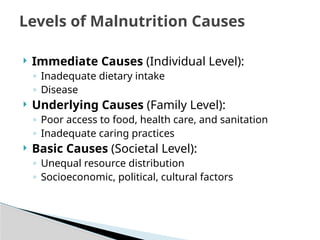
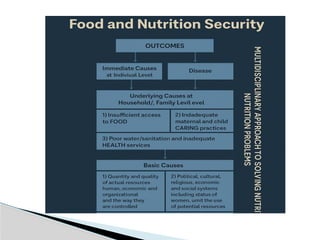
 Immediate Causes (Individual Level):
◦ Inadequate dietary intake
◦ Disease
 Underlying Causes (Family Level):
◦ Poor access to food, health care, and sanitation
◦ Inadequate caring practices
 Basic Causes (Societal Level):
◦ Unequal resource distribution
◦ Socioeconomic, political, cultural factors
Levels of Malnutrition Causes
 There are many kinds of disciplines which have
an impact on nutrition.
 how agriculture and horticulture production,
storage, distribution of food products and
science and technology influence food
consumption and nutritional status of the
population?
 And how can all these fields interact with each
other and with other areas in order to benefit
society?
MULTIDISCIPLINARY APPROACH TO
SOLVING NUTRITION PROBLEMS
 nutrition is an important environmental factor that influences
health and well-being of people.
 Consumption of diets adequate both in quantity and quality is a
prerequisite for the maintenance of good nutritional status.
 Agricultural production that determines food availability is, therefore,
an important determinant of food consumption
 Self sufficiency in food production is of particular importance for
developing countries, not only because they tend to have high rates of
population growth, but also because such countries have malnutrition
as a public health problem.
 The quantitative aspects of food production are undoubtedly of
primary concern, but it cannot be forgotten that the qualitative aspects
are extremely important, if optimal nutrition is to be provided.
 The interphase between agriculture and nutrition, therefore, acquires
considerable practical , importance.
ROLE OF AGRICULTURE IN NUTRITION
 vegetables and fruits constitute an integral
past of the predominantly vegetarian Indian
dietary pattern.
 They provide the much-needed variety to the
meal pattern practiced in most Indian homes.
 An area of 12 million hectares comprising 7% of
the total cropped area of the country is utilized
for growing horticultural crops. Out of this, 12%
is under vegetable cultivation.
 India became the largest producer of fruits
Issues related to horticultural products
 It ranks second to China in vegetable production
 However, per capita consumption of these in the country is very low.
 Consumption of adequate quantities of vegetables, especially, green leafy
vegetables is essential for meeting the dietary requirements of vital
micronutrients.
 Besides, vegetables also provide several phytochemicals and fibre.
 At present, there is an insufficient focus on the cultivation and marketing
of low cost locally acceptable green leafy vegetables, yellow vegetables
and fruits.
 As a result, these vegetables are not available at affordable cost
throughout the year.
 Health and nutrition education emphasizing the importance of consuming
these inexpensive but rich sources of micronutrients will not result in any
change in food habits unless the horticultural resources in the country are
harnessed and managed effectively to meet the growing needs of the
people at an affordable cost.
 we have buffer stocks of good grains in our country.
 These stocks do help to combat acute transient food scarcity, caused
by natural disasters like floods and droughts.
 Early warning systems are in place and food can be rushed to areas of
threatened distress fairly rapidly.
 What is proving more difficult is the task of combating chronic mild
moderate undernutrition in a large number of poor households.
 Inequitable distribution of available food among different segments of
the population and even within the family is one of the major factors
responsible for undernutrition
 Good governance and health and nutrition education hold the key to
improving equitable distribution of food based on need.
 However, it is not just distribution but the proper storage of food which
is also important. This will influence the food availability and food
consumption pattern of people.
DISTRIBUTION OF FOOD PRODUCTS
 After the food has been harvested, it reaches the consumer after undergoing through various processes
to make it acceptable and palatable to the consumers.
 Efforts to augment-the food resources of the community can fulfill the goals of meeting the food and
nutritional requirements of the population, only if they are matched with technologies to prevent and
reduce the post harvest losses caused by variety of physical, biological and mechanical factors.
 Such losses include not only the quantitative aspects but also the deterioration in quality of foods, which
may render them inedible for human consumption or lead to serious health consequences
 After production, food goes through various activities like preprocessing, transportation,
storage, processing and packaging and marketing reaches the consumer in the community.
 The magnitude of losses incurred will depend upon the nature of the food commodity - whether
perishable, semi perishable or more stable
 Various studies have reported food losses during different operations such as 1-5% loss in harvesting, 1-
6% loss in flying, 2-7% loss in transportation, 2-5% loss in storage, 2..6% loss in threshing and 2-10% loss
in milling of paddy crops in India.
 Thus, storage of food is an important link in the chain of events leading to the ultimate delivery of food
at the consumer level.
STORAGE OF FOOD PRODUCTS
 The problems involved in bridging the wide gap
between the national nutritional needs of the
developing countries and available food supplies
can be approached by, the following lines of
action, which can be taken up simultaneously:
 (a) increasing food production through better
agricultural technology
 (b) ensuring effective conservation and
utilization of foods through the application of
modern technology.
TECHNOLOGY TO IMPROVE FOOD
SUPPLY
 Breeding of new food-grain varieties has been directed
to increasing per hectare yields and resistance against
microorganisms
 introduction of high-yielding varieties, particularly of
wheat and rice
 improved dry land agriculture (mulching, recycling of
runoff water to provide supplementary irrigation, and
choice of crop compatible with season), intercropping,
multilevel cropping and mixed farming practices
 Post-harvest conservation by modern procedures is,
therefore, a crucial need to prevent the dissipation of
national efforts to raise food production levels
 Food security may be defined as a physical and
economic access by all people to sufficient food to meet
their dietary needs for a productive and healthy life.
 The concept of food security aims at removing the
imbalance between the demand and supply of food.
 Although national food security is important as
providing a foundation, what is more important is food
security for each and every household and within it to
every member of the family.
 A household is food secure when it has access to food
that is adequate in terms of quality, quantity, safety and
cultural acceptability for all its members.
Understanding the Concept of Food and Nutrition
Security
 Nutritional security can be briefly defined as a
balance between biological requirements in energy
and nutrients and the quantity and quality of foods
consumed.
 Nutritional security thus, requires that household
members have access not only to food, but also to
other requirements for a healthy life, such as health
care, a hygienic environment and knowledge of
personal hygiene.
 Food security is a necessity but insufficient condition
for ensuring nutrition security. There are-some factors
that determine food and nutrition security
 Nutritionist's point of view, the response of
man to food is termed as food related behavior
or food habits.
 There are many factors which affect the food
behavior.
 These are: - Physiological and socio
psychological factors, - Cultural factors, and -
Social factors.
FOOD BEHAVIOR
 Physiological & Socio-psychological:
◦ Hunger, satiety, appetite control
 Cultural Factors:
◦ Food customs, religion, caste practices
 Social Factors:
◦ Gender-based food distribution
◦ The head of the family eats first, then all other men,
sons, daughters and finally the wife and the mother
Food Behavior and Influencing Factors
PUBLIC NUTRITION - MULTIDICIPLINARY CONCEPT.pptx

PUBLIC NUTRITION - MULTIDICIPLINARY CONCEPT.pptx

  • 1.
    PUBLIC NUTRITION: MULTIDISCIPLINARY CONCEPT Mrs.T.Devi,M.Sc., M.Phil., Assistant Professor of Home Science, V.V.Vanniaperumal College for Women, Virudhunagar
  • 2.
     Focuses onimproving nutritional status of populations  Requires knowledge from multiple disciplines  Involves coordinated action across sectors Introduction to Public Nutrition
  • 3.
     Immediate Causes(Individual Level): ◦ Inadequate dietary intake ◦ Disease  Underlying Causes (Family Level): ◦ Poor access to food, health care, and sanitation ◦ Inadequate caring practices  Basic Causes (Societal Level): ◦ Unequal resource distribution ◦ Socioeconomic, political, cultural factors Levels of Malnutrition Causes
  • 5.
     There aremany kinds of disciplines which have an impact on nutrition.  how agriculture and horticulture production, storage, distribution of food products and science and technology influence food consumption and nutritional status of the population?  And how can all these fields interact with each other and with other areas in order to benefit society? MULTIDISCIPLINARY APPROACH TO SOLVING NUTRITION PROBLEMS
  • 6.
     nutrition isan important environmental factor that influences health and well-being of people.  Consumption of diets adequate both in quantity and quality is a prerequisite for the maintenance of good nutritional status.  Agricultural production that determines food availability is, therefore, an important determinant of food consumption  Self sufficiency in food production is of particular importance for developing countries, not only because they tend to have high rates of population growth, but also because such countries have malnutrition as a public health problem.  The quantitative aspects of food production are undoubtedly of primary concern, but it cannot be forgotten that the qualitative aspects are extremely important, if optimal nutrition is to be provided.  The interphase between agriculture and nutrition, therefore, acquires considerable practical , importance. ROLE OF AGRICULTURE IN NUTRITION
  • 7.
     vegetables andfruits constitute an integral past of the predominantly vegetarian Indian dietary pattern.  They provide the much-needed variety to the meal pattern practiced in most Indian homes.  An area of 12 million hectares comprising 7% of the total cropped area of the country is utilized for growing horticultural crops. Out of this, 12% is under vegetable cultivation.  India became the largest producer of fruits Issues related to horticultural products
  • 8.
     It rankssecond to China in vegetable production  However, per capita consumption of these in the country is very low.  Consumption of adequate quantities of vegetables, especially, green leafy vegetables is essential for meeting the dietary requirements of vital micronutrients.  Besides, vegetables also provide several phytochemicals and fibre.  At present, there is an insufficient focus on the cultivation and marketing of low cost locally acceptable green leafy vegetables, yellow vegetables and fruits.  As a result, these vegetables are not available at affordable cost throughout the year.  Health and nutrition education emphasizing the importance of consuming these inexpensive but rich sources of micronutrients will not result in any change in food habits unless the horticultural resources in the country are harnessed and managed effectively to meet the growing needs of the people at an affordable cost.
  • 9.
     we havebuffer stocks of good grains in our country.  These stocks do help to combat acute transient food scarcity, caused by natural disasters like floods and droughts.  Early warning systems are in place and food can be rushed to areas of threatened distress fairly rapidly.  What is proving more difficult is the task of combating chronic mild moderate undernutrition in a large number of poor households.  Inequitable distribution of available food among different segments of the population and even within the family is one of the major factors responsible for undernutrition  Good governance and health and nutrition education hold the key to improving equitable distribution of food based on need.  However, it is not just distribution but the proper storage of food which is also important. This will influence the food availability and food consumption pattern of people. DISTRIBUTION OF FOOD PRODUCTS
  • 10.
     After thefood has been harvested, it reaches the consumer after undergoing through various processes to make it acceptable and palatable to the consumers.  Efforts to augment-the food resources of the community can fulfill the goals of meeting the food and nutritional requirements of the population, only if they are matched with technologies to prevent and reduce the post harvest losses caused by variety of physical, biological and mechanical factors.  Such losses include not only the quantitative aspects but also the deterioration in quality of foods, which may render them inedible for human consumption or lead to serious health consequences  After production, food goes through various activities like preprocessing, transportation, storage, processing and packaging and marketing reaches the consumer in the community.  The magnitude of losses incurred will depend upon the nature of the food commodity - whether perishable, semi perishable or more stable  Various studies have reported food losses during different operations such as 1-5% loss in harvesting, 1- 6% loss in flying, 2-7% loss in transportation, 2-5% loss in storage, 2..6% loss in threshing and 2-10% loss in milling of paddy crops in India.  Thus, storage of food is an important link in the chain of events leading to the ultimate delivery of food at the consumer level. STORAGE OF FOOD PRODUCTS
  • 11.
     The problemsinvolved in bridging the wide gap between the national nutritional needs of the developing countries and available food supplies can be approached by, the following lines of action, which can be taken up simultaneously:  (a) increasing food production through better agricultural technology  (b) ensuring effective conservation and utilization of foods through the application of modern technology. TECHNOLOGY TO IMPROVE FOOD SUPPLY
  • 12.
     Breeding ofnew food-grain varieties has been directed to increasing per hectare yields and resistance against microorganisms  introduction of high-yielding varieties, particularly of wheat and rice  improved dry land agriculture (mulching, recycling of runoff water to provide supplementary irrigation, and choice of crop compatible with season), intercropping, multilevel cropping and mixed farming practices  Post-harvest conservation by modern procedures is, therefore, a crucial need to prevent the dissipation of national efforts to raise food production levels
  • 13.
     Food securitymay be defined as a physical and economic access by all people to sufficient food to meet their dietary needs for a productive and healthy life.  The concept of food security aims at removing the imbalance between the demand and supply of food.  Although national food security is important as providing a foundation, what is more important is food security for each and every household and within it to every member of the family.  A household is food secure when it has access to food that is adequate in terms of quality, quantity, safety and cultural acceptability for all its members. Understanding the Concept of Food and Nutrition Security
  • 14.
     Nutritional securitycan be briefly defined as a balance between biological requirements in energy and nutrients and the quantity and quality of foods consumed.  Nutritional security thus, requires that household members have access not only to food, but also to other requirements for a healthy life, such as health care, a hygienic environment and knowledge of personal hygiene.  Food security is a necessity but insufficient condition for ensuring nutrition security. There are-some factors that determine food and nutrition security
  • 15.
     Nutritionist's pointof view, the response of man to food is termed as food related behavior or food habits.  There are many factors which affect the food behavior.  These are: - Physiological and socio psychological factors, - Cultural factors, and - Social factors. FOOD BEHAVIOR
  • 16.
     Physiological &Socio-psychological: ◦ Hunger, satiety, appetite control  Cultural Factors: ◦ Food customs, religion, caste practices  Social Factors: ◦ Gender-based food distribution ◦ The head of the family eats first, then all other men, sons, daughters and finally the wife and the mother Food Behavior and Influencing Factors