PUBLIC HEALTH Assoc. Prof. Petko Salchev, MD, PhD
C ommunity A group of people which share common views and habits and live at a same geographic location  The members of the group identify themselves exclusively through the values and views of the group
Society  „ Society ” –  is this a mere sum of people or an entity (organism) ?   Two theoretical schools   Collectivistic   –  Saint-Simone ,  Kant ,  Hegel ,  Marx ,  neo-marxists ,  structuralists  Methodological individualism  –  A. Smith ,  D. Hume ,  K. Popper
Collectivistic school Collectivistic notions relate to a defined reality, autonomous and independent from people, like society, party, class; which being real by themselves are still being formed by individuals and it is the scientists duty to search and define the laws for development of this substance
School of methodological individualism   No specific reality corresponds to collective notions ;  Classes, societies, parties do not exist ; There are only individuals ;  Only individuals think and act .
Meanings of the term “society”   Socio-historical organism  Human society in its wholeness – “humanity”   Society as such, regardless in what concrete forms it exists A certain type of society  Society as a geo-social organism   Society as a demo-social organism
Public health Reflects the  integral   interaction between two systems – this of “biological health” and this of “society”   Two-component integral term –  health : society Multidimensional system   Has the features of a   mass phenomenon   Inter-disciplinary term
Public health 1.  Multidimensional category 2.  Two-component category 3.  Mass phenomenon 4.  Systemic phenomenon 5.  Category with intrinsic features (components) of : a .  The collective (community) b .  The best   c .  Prevention  d .  Organization  e .  Management  f .  Epidemiology  g .  Statistics  h .  Sociological observation i .  Value orientation and motivation j .  Expression of certain social health events
Public health Public health is an  interdisciplinary   notion ,  an unique   systemic   phenomenon, based on the multitude and constant complex dynamics of its features – two-component multidimensional structure with mass character, reflecting the dynamic interaction of various social health events, leading to the opportunity for every society member to achieve optimal health and longevity through formation of certain benefits and realizing the individual’s rights to health and longevity.
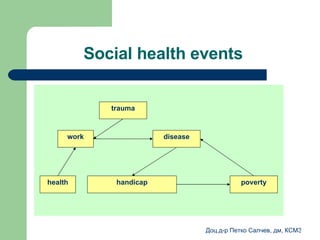
Social health events   work trauma disease handicap poverty health
Main groups of social health events  1.  Health status of the population   2.  Health needs   3.  Health mentality   4.  Health activities   5.  Health relations
Public health indicators  How is public health measured and estimated ?  What is the level of health in a given community, area, region, country ?
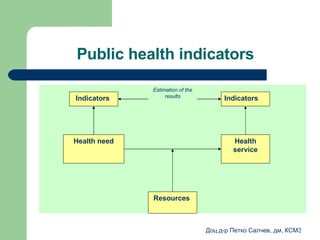
Public health indicators Health need Indicators  Resources  Health service Indicators  Estimation of the results
Public health indicators   „ The health indicator represents a variable, subject to direct measurement, which reflects the health status of individuals in a certain community ” (J.M.Last, 1988)
Criteria for public health indicators validity  –  should be able to really measure the event in question ; reliability  –  results should be the same if the measurement is conducted by different people in same conditions ; sensitivity   –  should react quickly to changes of the process in question ; specificity  –  should reflect correctly specific changes in a concrete situations and not some different changes or changes as such ; applicability  –  should be achievable and giving the ability to collect concrete data ; relevance  –  should contribute to understanding and rationalization of the studied subject or phenomenon ;
Types of indicators Whole numbers Ratios  –  the quantitative expression of relating one health event to another .  The health event in the numerator is not included in the one in the denominator Proportions   –  same as previous but the health event in the numerator is included in the one in the  denominator   Rates   – indicators reflecting the change of one variable towards the change of another variable or a given health event observed in the monitored aggregate for a defined period of time .  A fundamental precondition is that the defined health event and the monitored aggregate correspond in time and place  ( for the same period of time on one and the same territory )
Types of indicators  According to their complexity   - Simple  (Indicateurs simplex) - Complex  (Indicateurs complex) According to their relation to health   Indicators for negative health  ( traditional ) Indicators for positive health  ( non-traditional ) Indicators with neutral or bipolar relation to health  ( mixed type ) According to the event they assess  Demographic  Disease oriented For physical development Social health
Demographic indicators A group of indicators related to the composition and structure of the  environment ,  in which the characteristics of the studied subject are manifested  ( public health ),  and in which it  „ lives ”
Disease oriented indicators A group of indicators related to the  processes ,  happening in the features of the studied subject  ( public health )
Indicators for physical development A group of indicators related to the  status   of the studied subject
Social health indicators A group of indicators, related to the  factors  ( determinants )   and their influence on the subject of study
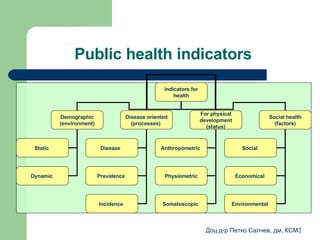
Public health indicators  Indicators for health Demographic (environment) Disease oriented ( processes )  For physical development ( status ) Social health ( factors ) Static  Dynamic  Disease  Prevalence  Incidence  Anthropometric  Physiometric Somatoscopic  Social  Economical  Environmental

Public Health Prez Eng

  • 1.
    PUBLIC HEALTH Assoc.Prof. Petko Salchev, MD, PhD
  • 2.
    C ommunity Agroup of people which share common views and habits and live at a same geographic location The members of the group identify themselves exclusively through the values and views of the group
  • 3.
    Society „Society ” – is this a mere sum of people or an entity (organism) ? Two theoretical schools Collectivistic – Saint-Simone , Kant , Hegel , Marx , neo-marxists , structuralists Methodological individualism – A. Smith , D. Hume , K. Popper
  • 4.
    Collectivistic school Collectivisticnotions relate to a defined reality, autonomous and independent from people, like society, party, class; which being real by themselves are still being formed by individuals and it is the scientists duty to search and define the laws for development of this substance
  • 5.
    School of methodologicalindividualism No specific reality corresponds to collective notions ; Classes, societies, parties do not exist ; There are only individuals ; Only individuals think and act .
  • 6.
    Meanings of theterm “society” Socio-historical organism Human society in its wholeness – “humanity” Society as such, regardless in what concrete forms it exists A certain type of society Society as a geo-social organism Society as a demo-social organism
  • 7.
    Public health Reflectsthe integral interaction between two systems – this of “biological health” and this of “society” Two-component integral term – health : society Multidimensional system Has the features of a mass phenomenon Inter-disciplinary term
  • 8.
    Public health 1. Multidimensional category 2. Two-component category 3. Mass phenomenon 4. Systemic phenomenon 5. Category with intrinsic features (components) of : a . The collective (community) b . The best c . Prevention d . Organization e . Management f . Epidemiology g . Statistics h . Sociological observation i . Value orientation and motivation j . Expression of certain social health events
  • 9.
    Public health Publichealth is an interdisciplinary notion , an unique systemic phenomenon, based on the multitude and constant complex dynamics of its features – two-component multidimensional structure with mass character, reflecting the dynamic interaction of various social health events, leading to the opportunity for every society member to achieve optimal health and longevity through formation of certain benefits and realizing the individual’s rights to health and longevity.
  • 10.
    Social health events work trauma disease handicap poverty health
  • 11.
    Main groups ofsocial health events 1. Health status of the population 2. Health needs 3. Health mentality 4. Health activities 5. Health relations
  • 12.
    Public health indicators How is public health measured and estimated ? What is the level of health in a given community, area, region, country ?
  • 13.
    Public health indicatorsHealth need Indicators Resources Health service Indicators Estimation of the results
  • 14.
    Public health indicators „ The health indicator represents a variable, subject to direct measurement, which reflects the health status of individuals in a certain community ” (J.M.Last, 1988)
  • 15.
    Criteria for publichealth indicators validity – should be able to really measure the event in question ; reliability – results should be the same if the measurement is conducted by different people in same conditions ; sensitivity – should react quickly to changes of the process in question ; specificity – should reflect correctly specific changes in a concrete situations and not some different changes or changes as such ; applicability – should be achievable and giving the ability to collect concrete data ; relevance – should contribute to understanding and rationalization of the studied subject or phenomenon ;
  • 16.
    Types of indicatorsWhole numbers Ratios – the quantitative expression of relating one health event to another . The health event in the numerator is not included in the one in the denominator Proportions – same as previous but the health event in the numerator is included in the one in the denominator Rates – indicators reflecting the change of one variable towards the change of another variable or a given health event observed in the monitored aggregate for a defined period of time . A fundamental precondition is that the defined health event and the monitored aggregate correspond in time and place ( for the same period of time on one and the same territory )
  • 17.
    Types of indicators According to their complexity - Simple (Indicateurs simplex) - Complex (Indicateurs complex) According to their relation to health Indicators for negative health ( traditional ) Indicators for positive health ( non-traditional ) Indicators with neutral or bipolar relation to health ( mixed type ) According to the event they assess Demographic Disease oriented For physical development Social health
  • 18.
    Demographic indicators Agroup of indicators related to the composition and structure of the environment , in which the characteristics of the studied subject are manifested ( public health ), and in which it „ lives ”
  • 19.
    Disease oriented indicatorsA group of indicators related to the processes , happening in the features of the studied subject ( public health )
  • 20.
    Indicators for physicaldevelopment A group of indicators related to the status of the studied subject
  • 21.
    Social health indicatorsA group of indicators, related to the factors ( determinants ) and their influence on the subject of study
  • 22.
    Public health indicators Indicators for health Demographic (environment) Disease oriented ( processes ) For physical development ( status ) Social health ( factors ) Static Dynamic Disease Prevalence Incidence Anthropometric Physiometric Somatoscopic Social Economical Environmental