



NEWS BROADCAST
Public
• Relating to or involving people in general,
rather than being limited to a particular
group of people.
Announcements
• A written or spoken statement that tells
people about something.
“An public announcement is a
statement (written or spoken ) made
to the public or to the media which
gives information about something
that has happened or that will
happen.”
• Public announcements, or PA', are short
messages produced on film, videotape, DVD,
CD, audiotape, news papers or as a computer
file and given to radio ,news papers &
television stations.
• Through a Public Announcement you can bring
your community together around a subject
that is important to you.
• Will your PA be on education, poverty, drunk
driving, or maybe even Haiti disaster relief?
Choose your topic
• Pick a subject that is important to
you, as well as one you can
visualize.
• Keep your focus narrow and to the
point.
• More than one idea confuses your
audience, so have one main idea
per PA.
 You need to know your stuff.
 Try to get the most current and up to
date facts on your topic.
 You want to be convincing and
accurate.
 you need to know what media outlets
are available in your particular
geographic area.
 Find your audience and get their
reaction.
 Are they inspired?
• Are you targeting parents, teens,
teachers or some other social
group?
• Consider your target audience's
needs, preferences, as well as the
things that might turn them off.
• It can be spelled out or implied in
your PA, just make sure that
message is clear.
• You might use visual effects, an
emotional response, humor, or
surprise to catch your target
audience.
• Be careful, however, of using
scare tactics.
• Attention getters are needed, but
they must be carefully selected.
• Create a script and keep your script to
a few simple statements.
• A 30-second PA will typically require
about 5 to 7 concise assertions.
• Highlight the major and minor points
that you want to make.
• Be sure the information presented in
the PA is based on up-to-date, accurate
research, findings and/or data.
• review your work
• Film your footage and edit your PA.
• If you can afford to, make multiple PA.
• Choose points to focus on.
• Check your facts.
• you've only got a few seconds to reach your
audience (often 30 seconds or less), the
language should be simple.
• Make your message crystal clear.
• The content of the writing should have the
right "hooks", words or phrases that grab
attention ,to attract your audience.
• PA's are generally inexpensive.
• Since the airtime is donated, your only cost is
production.
• If you keep to a tight budget, you can make PA
very cheaply.
• PA tend to be really effective at encouraging
the audience to do something.
• for example,
• call a phone number for more information, or
have your pet spayed or neutered.
• PA' can raise awareness of your issue.
• PA depend on donated time.
• PA are often run as "filler" in the
middle of the night or during other
times when only a few people are
listening or watching.
• Stations tend to shy away from
"controversial" PA.
• Stations may not track and report
when your PA have been played, but
they will do this for paid advertising.
• When your group is a nonprofit organization.
• When you have a specific announcement to make
(for example, the time and place of a meeting or
event).
• When you have a clear and easy-to-understand
issue.
• When you're requesting a very specific action.
• When you have good contacts for getting your PA
on the air.
• When you have good writing and production skills.
• When it's going to be part of a larger media
campaign.
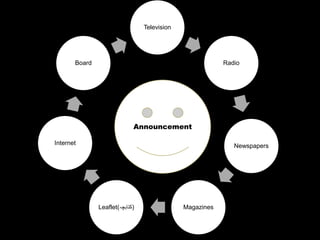
Television
Radio
Newspapers
MagazinesLeaflet(‫)کتابچہ‬
Internet
Board
Announcement
• Finding professional announcers is helpful but not vital.
• Volunteers at community or campus radio stations,
people who read for the blind, and storytellers are all
experienced in doing voiceover work.
• Just keep your target group in mind when choosing
actors.
• It's important to grab the audience's attention quickly
and hold it.
• Try to use short, arresting sentences aimed directly at
the listener at the beginning of the PA to help grab their
attention.
• For example:
• Has one or both of your parents had heart disease? If
so, your chances of developing heart disease later in
life are a lot higher than for most people.
• You must describe each shot in writing, and give
the correct dialogue to go with that shot.
• Drama clubs, community theater groups, and the
drama departments at your local high schools
and universities are great places to find talent.
• Avoid special effects.
• They're generally costly, and usually only
distract viewers from the message.
• Many of them also offer free production courses,
which could be useful to you if you might be
producing videos on a regular basis.
• Check with your cable TV station for details.
• To tell something that is private or
secret to many people.
• Broadcast news is meant for
quick, up-to-the-date information,
not detailed stories.
• Broadcast news is meant to be
heard, not read.
• Present information for the “ear”
to hear.
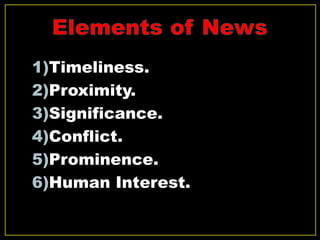
1)Timeliness.
2)Proximity.
3)Significance.
4)Conflict.
5)Prominence.
6)Human Interest.
Timeliness
• News is what happens now, what
happens in the immediate present
or what may happen.
• What has already happened
(historical and background
information) is mentioned briefly
in stories to provide perspective
and explain “why.”
• News is what happens close to us
-either geographically or
emotionally, so we can identify
with the event.
• Stories that happen in our
communities are of interest
because we relate to the
situation.
• News is what affects us in some way,
whether financially (increase in gas
prices), physically (mad cow disease
detected), emotionally (school
shooting).
• If the story is newsworthy, the
information will have direct relevance
to our lives.
• News is whatever happens between two
opposing forces, whether between individuals,
nations or as the result of fateful
occurrences.
Person v. Person
• Political race for public office
Person v. Self
• Student earns GED after dropping out of
school
PROMINENCE
• News is what happens to famous people,
places or things.
• It is important for journalists to cover such
famous people when they do newsworthy
things.
HUMAN INTEREST
• Ultimately, news is anything in which people
are interested.
• If you think a story would interest a majority
of your audience, it is probably newsworthy.
Choice of reading
• Allows user to read anytime and can be carried
anywhere.
• A much affordable form of media when compared
to electronic.
• For an individual, it’s quite an easy proof for any
sort of information .
• People specially living in rural areas can easily
afford a newspaper as compared to TV’s etc.
• Relatively easier form of accessibility public for
campaigns etc.
•
• Print Media
• Electronic media
• A more advanced form of media.
• Introduces more revenues and job opportunities.
• Relatively a more innovative form of media. Thanks to
motion pictures, animation etc.
• A variety of options available unlike print media. People
can surf through different channels, site etc.
• Very appropriate for instant POLLS reviews of public.
• Works better for people with hearing and seeing
disabilities.
• Can be reached faster and can be made LIVE.
• The main intent of any media is to pass information to
pubic. Be it electronic or print media, the public needs
to be aware of the news. Most of the people in daily
lives start with print media and gradually, as the day
passes by, switch to electronic media.
Public announcement limitation and tips

Public announcement limitation and tips

  • 2.
  • 3.
    Public • Relating toor involving people in general, rather than being limited to a particular group of people. Announcements • A written or spoken statement that tells people about something. “An public announcement is a statement (written or spoken ) made to the public or to the media which gives information about something that has happened or that will happen.”
  • 4.
    • Public announcements,or PA', are short messages produced on film, videotape, DVD, CD, audiotape, news papers or as a computer file and given to radio ,news papers & television stations. • Through a Public Announcement you can bring your community together around a subject that is important to you. • Will your PA be on education, poverty, drunk driving, or maybe even Haiti disaster relief?
  • 5.
    Choose your topic •Pick a subject that is important to you, as well as one you can visualize. • Keep your focus narrow and to the point. • More than one idea confuses your audience, so have one main idea per PA.
  • 6.
     You needto know your stuff.  Try to get the most current and up to date facts on your topic.  You want to be convincing and accurate.  you need to know what media outlets are available in your particular geographic area.  Find your audience and get their reaction.  Are they inspired?
  • 7.
    • Are youtargeting parents, teens, teachers or some other social group? • Consider your target audience's needs, preferences, as well as the things that might turn them off. • It can be spelled out or implied in your PA, just make sure that message is clear.
  • 8.
    • You mightuse visual effects, an emotional response, humor, or surprise to catch your target audience. • Be careful, however, of using scare tactics. • Attention getters are needed, but they must be carefully selected.
  • 9.
    • Create ascript and keep your script to a few simple statements. • A 30-second PA will typically require about 5 to 7 concise assertions. • Highlight the major and minor points that you want to make. • Be sure the information presented in the PA is based on up-to-date, accurate research, findings and/or data.
  • 10.
    • review yourwork • Film your footage and edit your PA. • If you can afford to, make multiple PA. • Choose points to focus on. • Check your facts. • you've only got a few seconds to reach your audience (often 30 seconds or less), the language should be simple. • Make your message crystal clear. • The content of the writing should have the right "hooks", words or phrases that grab attention ,to attract your audience.
  • 11.
    • PA's aregenerally inexpensive. • Since the airtime is donated, your only cost is production. • If you keep to a tight budget, you can make PA very cheaply. • PA tend to be really effective at encouraging the audience to do something. • for example, • call a phone number for more information, or have your pet spayed or neutered. • PA' can raise awareness of your issue.
  • 12.
    • PA dependon donated time. • PA are often run as "filler" in the middle of the night or during other times when only a few people are listening or watching. • Stations tend to shy away from "controversial" PA. • Stations may not track and report when your PA have been played, but they will do this for paid advertising.
  • 13.
    • When yourgroup is a nonprofit organization. • When you have a specific announcement to make (for example, the time and place of a meeting or event). • When you have a clear and easy-to-understand issue. • When you're requesting a very specific action. • When you have good contacts for getting your PA on the air. • When you have good writing and production skills. • When it's going to be part of a larger media campaign.
  • 14.
  • 15.
    • Finding professionalannouncers is helpful but not vital. • Volunteers at community or campus radio stations, people who read for the blind, and storytellers are all experienced in doing voiceover work. • Just keep your target group in mind when choosing actors. • It's important to grab the audience's attention quickly and hold it. • Try to use short, arresting sentences aimed directly at the listener at the beginning of the PA to help grab their attention. • For example: • Has one or both of your parents had heart disease? If so, your chances of developing heart disease later in life are a lot higher than for most people.
  • 16.
    • You mustdescribe each shot in writing, and give the correct dialogue to go with that shot. • Drama clubs, community theater groups, and the drama departments at your local high schools and universities are great places to find talent. • Avoid special effects. • They're generally costly, and usually only distract viewers from the message. • Many of them also offer free production courses, which could be useful to you if you might be producing videos on a regular basis. • Check with your cable TV station for details.
  • 17.
    • To tellsomething that is private or secret to many people. • Broadcast news is meant for quick, up-to-the-date information, not detailed stories. • Broadcast news is meant to be heard, not read. • Present information for the “ear” to hear.
  • 18.
  • 19.
    Timeliness • News iswhat happens now, what happens in the immediate present or what may happen. • What has already happened (historical and background information) is mentioned briefly in stories to provide perspective and explain “why.”
  • 20.
    • News iswhat happens close to us -either geographically or emotionally, so we can identify with the event. • Stories that happen in our communities are of interest because we relate to the situation.
  • 21.
    • News iswhat affects us in some way, whether financially (increase in gas prices), physically (mad cow disease detected), emotionally (school shooting). • If the story is newsworthy, the information will have direct relevance to our lives.
  • 22.
    • News iswhatever happens between two opposing forces, whether between individuals, nations or as the result of fateful occurrences. Person v. Person • Political race for public office Person v. Self • Student earns GED after dropping out of school
  • 23.
    PROMINENCE • News iswhat happens to famous people, places or things. • It is important for journalists to cover such famous people when they do newsworthy things. HUMAN INTEREST • Ultimately, news is anything in which people are interested. • If you think a story would interest a majority of your audience, it is probably newsworthy.
  • 24.
    Choice of reading •Allows user to read anytime and can be carried anywhere. • A much affordable form of media when compared to electronic. • For an individual, it’s quite an easy proof for any sort of information . • People specially living in rural areas can easily afford a newspaper as compared to TV’s etc. • Relatively easier form of accessibility public for campaigns etc. • • Print Media
  • 25.
    • Electronic media •A more advanced form of media. • Introduces more revenues and job opportunities. • Relatively a more innovative form of media. Thanks to motion pictures, animation etc. • A variety of options available unlike print media. People can surf through different channels, site etc. • Very appropriate for instant POLLS reviews of public. • Works better for people with hearing and seeing disabilities. • Can be reached faster and can be made LIVE. • The main intent of any media is to pass information to pubic. Be it electronic or print media, the public needs to be aware of the news. Most of the people in daily lives start with print media and gradually, as the day passes by, switch to electronic media.

Editor's Notes

  • #11 http://www.centerdigitaled.com/artsandhumanities/How-to-Create-the-Perfect-Public-Service-Announcement.html
  • #17 http;//ctb.ku.edu communityhealth.ku.edu
  • #22 http://www.coveringkidsandfamilies.org/actioncenter/files/08_CAMP.ppt
  • #23 http://www.kab.net/kabadditionalinformation/seminars/d74242.aspx
  • #24 http://faculty.tamuc.edu/TDeMars/RTV%20440%20writing%20overview%20-%20Chap%201%20S12.ppt
  • #25 http://www.careerride.com/GD-electronic-media-vs-print-media.aspx