Asian Development Foundation College
College of Psychology
Tacloban City
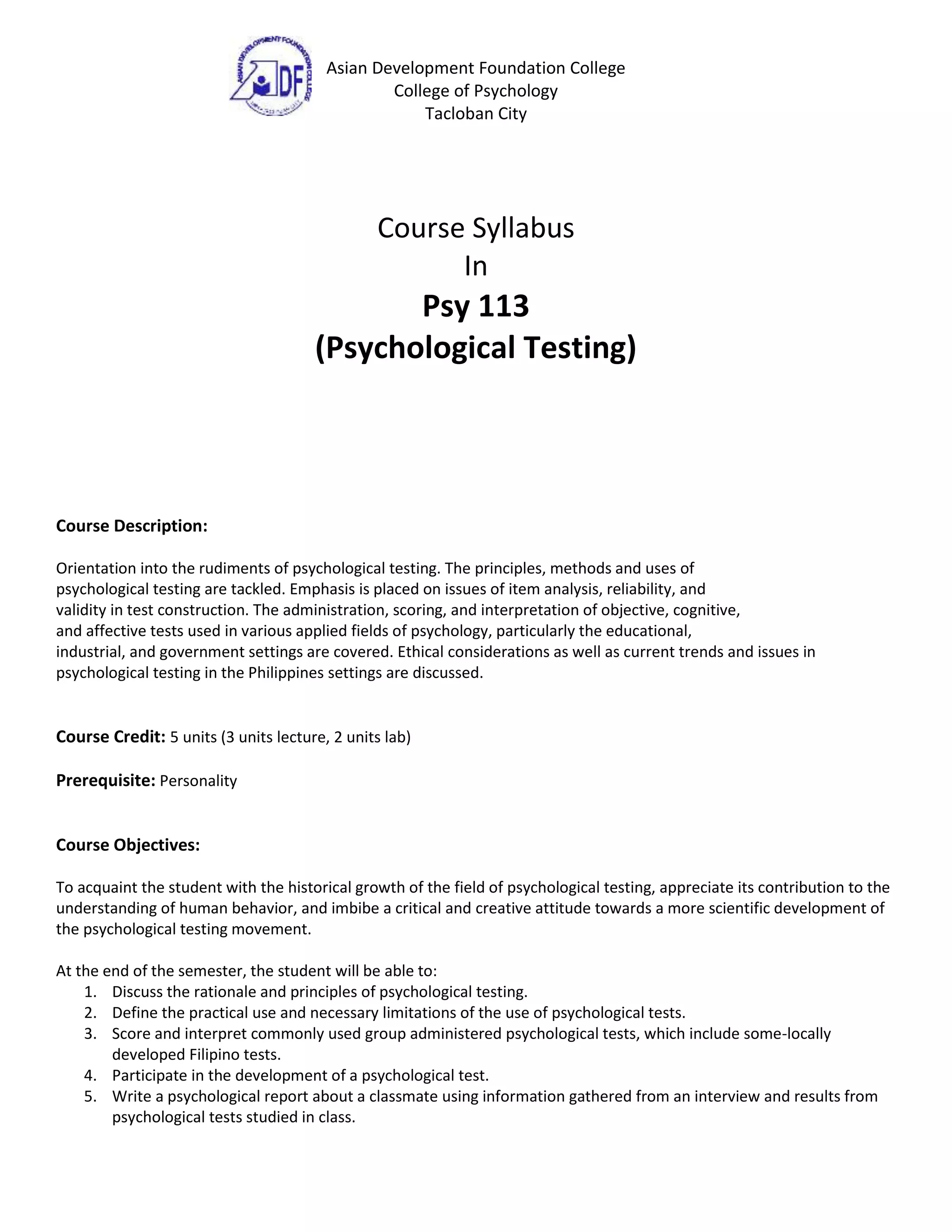
Course Syllabus
In
Psy 113
(Psychological Testing)
Course Description:
Orientation into the rudiments of psychological testing. The principles, methods and uses of
psychological testing are tackled. Emphasis is placed on issues of item analysis, reliability, and
validity in test construction. The administration, scoring, and interpretation of objective, cognitive,
and affective tests used in various applied fields of psychology, particularly the educational,
industrial, and government settings are covered. Ethical considerations as well as current trends and issues in
psychological testing in the Philippines settings are discussed.
Course Credit: 5 units (3 units lecture, 2 units lab)
Prerequisite: Personality
Course Objectives:
To acquaint the student with the historical growth of the field of psychological testing, appreciate its contribution to the
understanding of human behavior, and imbibe a critical and creative attitude towards a more scientific development of
the psychological testing movement.
At the end of the semester, the student will be able to:
1. Discuss the rationale and principles of psychological testing.
2. Define the practical use and necessary limitations of the use of psychological tests.
3. Score and interpret commonly used group administered psychological tests, which include some-locally
developed Filipino tests.
4. Participate in the development of a psychological test.
5. Write a psychological report about a classmate using information gathered from an interview and results from
psychological tests studied in class.
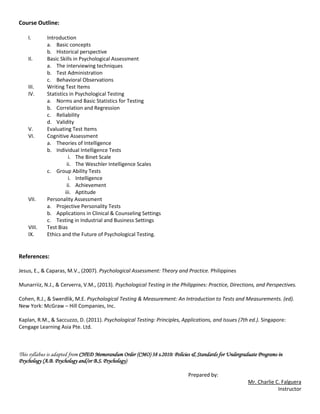
Course Outline:
I. Introduction
a. Basic concepts
b. Historical perspective
II. Basic Skills in Psychological Assessment
a. The interviewing techniques
b. Test Administration
c. Behavioral Observations
III. Writing Test Items
IV. Statistics in Psychological Testing
a. Norms and Basic Statistics for Testing
b. Correlation and Regression
c. Reliability
d. Validity
V. Evaluating Test Items
VI. Cognitive Assessment
a. Theories of Intelligence
b. Individual Intelligence Tests
i. The Binet Scale
ii. The Weschler Intelligence Scales
c. Group Ability Tests
i. Intelligence
ii. Achievement
iii. Aptitude
VII. Personality Assessment
a. Projective Personality Tests
b. Applications in Clinical & Counseling Settings
c. Testing in Industrial and Business Settings
VIII. Test Bias
IX. Ethics and the Future of Psychological Testing.
References:
Jesus, E., & Caparas, M.V., (2007). Psychological Assessment: Theory and Practice. Philippines
Munarriiz, N.J., & Cerverra, V.M., (2013). Psychological Testing in the Philippines: Practice, Directions, and Perspectives.
Cohen, R.J., & Swerdlik, M.E. Psychological Testing & Measurement: An Introduction to Tests and Measurements. (ed).
New York: McGraw – Hill Companies, Inc.
Kaplan, R.M., & Saccuzzo, D. (2011). Psychological Testing: Principles, Applications, and Issues (7th ed.). Singapore:
Cengage Learning Asia Pte. Ltd.
This syllabus is adapted from CHED Memorandum Order (CMO) 38 s.2010: Policies & Standards for Undergraduate Programs in
Psychology (A.B. Psychology and/or B.S. Psychology)
Prepared by:
Mr. Charlie C. Falguera
Instructor

Psychological testing syllabus

  • 1.
    Asian Development FoundationCollege College of Psychology Tacloban City Course Syllabus In Psy 113 (Psychological Testing) Course Description: Orientation into the rudiments of psychological testing. The principles, methods and uses of psychological testing are tackled. Emphasis is placed on issues of item analysis, reliability, and validity in test construction. The administration, scoring, and interpretation of objective, cognitive, and affective tests used in various applied fields of psychology, particularly the educational, industrial, and government settings are covered. Ethical considerations as well as current trends and issues in psychological testing in the Philippines settings are discussed. Course Credit: 5 units (3 units lecture, 2 units lab) Prerequisite: Personality Course Objectives: To acquaint the student with the historical growth of the field of psychological testing, appreciate its contribution to the understanding of human behavior, and imbibe a critical and creative attitude towards a more scientific development of the psychological testing movement. At the end of the semester, the student will be able to: 1. Discuss the rationale and principles of psychological testing. 2. Define the practical use and necessary limitations of the use of psychological tests. 3. Score and interpret commonly used group administered psychological tests, which include some-locally developed Filipino tests. 4. Participate in the development of a psychological test. 5. Write a psychological report about a classmate using information gathered from an interview and results from psychological tests studied in class.
  • 2.
    Course Outline: I. Introduction a.Basic concepts b. Historical perspective II. Basic Skills in Psychological Assessment a. The interviewing techniques b. Test Administration c. Behavioral Observations III. Writing Test Items IV. Statistics in Psychological Testing a. Norms and Basic Statistics for Testing b. Correlation and Regression c. Reliability d. Validity V. Evaluating Test Items VI. Cognitive Assessment a. Theories of Intelligence b. Individual Intelligence Tests i. The Binet Scale ii. The Weschler Intelligence Scales c. Group Ability Tests i. Intelligence ii. Achievement iii. Aptitude VII. Personality Assessment a. Projective Personality Tests b. Applications in Clinical & Counseling Settings c. Testing in Industrial and Business Settings VIII. Test Bias IX. Ethics and the Future of Psychological Testing. References: Jesus, E., & Caparas, M.V., (2007). Psychological Assessment: Theory and Practice. Philippines Munarriiz, N.J., & Cerverra, V.M., (2013). Psychological Testing in the Philippines: Practice, Directions, and Perspectives. Cohen, R.J., & Swerdlik, M.E. Psychological Testing & Measurement: An Introduction to Tests and Measurements. (ed). New York: McGraw – Hill Companies, Inc. Kaplan, R.M., & Saccuzzo, D. (2011). Psychological Testing: Principles, Applications, and Issues (7th ed.). Singapore: Cengage Learning Asia Pte. Ltd. This syllabus is adapted from CHED Memorandum Order (CMO) 38 s.2010: Policies & Standards for Undergraduate Programs in Psychology (A.B. Psychology and/or B.S. Psychology) Prepared by: Mr. Charlie C. Falguera Instructor