The Common Core
   Standards
           Bill Carozza
Principal, Harold Martin School
         Hopkinton, NH
     wcarozza@sau66.org
Standards
Standards

What are they?
Standards

What are they?

Why do we have them?
Standards

What are they?

Why do we have them?

Where did they originate?
Standards

What are they?

Why do we have them?

Where did they originate?

The parallel with the doctor’s physical in regards to
assessing adherence to standards

  We don’t practice for our physical any more than
  we should practice directly for the state exam
History of Standards

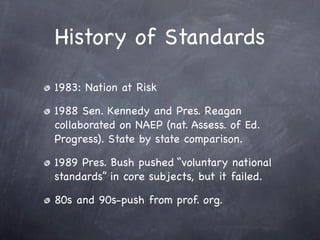
1983: Nation at Risk

1988 Sen. Kennedy and Pres. Reagan
collaborated on NAEP (nat. Assess. of Ed.
Progress). State by state comparison. 

1989 Pres. Bush pushed “voluntary national
standards” in core subjects, but it failed.

80s and 90s-push from prof. org.
Professional Organizations and
          Standards
Professional Organizations and
          Standards
 MATH: NCTM Standards-1989-where it all began.
Professional Organizations and
          Standards
 MATH: NCTM Standards-1989-where it all began.

 SCIENCE: AAAS-Assn. for the Adv, of Science-Project 2061. NRC
 (National Research Council) published in 1996. NSTA-published
 document in 1995.
Professional Organizations and
          Standards
 MATH: NCTM Standards-1989-where it all began.

 SCIENCE: AAAS-Assn. for the Adv, of Science-Project 2061. NRC
 (National Research Council) published in 1996. NSTA-published
 document in 1995.

 SOCIAL STUDIES: History Standards Project in 1995. Controversy
 between history and social studies people. CIVICS: Center for Civic
 Education-1994. ECON: National Council on Econ. Ed.: 1997.
 GEOGRAPHY: 1994 from the Geog. Ed. Standards Project. SS-NCSS
 1994
Professional Organizations and
          Standards
 MATH: NCTM Standards-1989-where it all began.

 SCIENCE: AAAS-Assn. for the Adv, of Science-Project 2061. NRC
 (National Research Council) published in 1996. NSTA-published
 document in 1995.

 SOCIAL STUDIES: History Standards Project in 1995. Controversy
 between history and social studies people. CIVICS: Center for Civic
 Education-1994. ECON: National Council on Econ. Ed.: 1997.
 GEOGRAPHY: 1994 from the Geog. Ed. Standards Project. SS-NCSS
 1994

 ENGLISH/LANGUAGE ARTS: NCTE and IRA Standards in Oct. 1995
Professional Organizations and
          Standards
 MATH: NCTM Standards-1989-where it all began.

 SCIENCE: AAAS-Assn. for the Adv, of Science-Project 2061. NRC
 (National Research Council) published in 1996. NSTA-published
 document in 1995.

 SOCIAL STUDIES: History Standards Project in 1995. Controversy
 between history and social studies people. CIVICS: Center for Civic
 Education-1994. ECON: National Council on Econ. Ed.: 1997.
 GEOGRAPHY: 1994 from the Geog. Ed. Standards Project. SS-NCSS
 1994

 ENGLISH/LANGUAGE ARTS: NCTE and IRA Standards in Oct. 1995

 TECHNOLOGY: ISTE-2000
…continued
…continued
ARTS: Consortium of National Arts Educ.
Associations: 1994
…continued
ARTS: Consortium of National Arts Educ.
Associations: 1994
FOREIGN LANGUAGES: American Council on
the Teaching of Foreign Languages 1996.
…continued
ARTS: Consortium of National Arts Educ.
Associations: 1994
FOREIGN LANGUAGES: American Council on
the Teaching of Foreign Languages 1996.
HEALTH: Joint Comm. On National Health
Education Standards-1994
…continued
ARTS: Consortium of National Arts Educ.
Associations: 1994
FOREIGN LANGUAGES: American Council on
the Teaching of Foreign Languages 1996.
HEALTH: Joint Comm. On National Health
Education Standards-1994
P.E.: NASPE (Nat. Assn. for Sport and P.E.;
1995
How Did the Common Core
  Standards Originate?
How Did the Common Core
  Standards Originate?
Joint project of NGA (National Gov. Assn. and CCSSO
(Council of Chief State School Officers)
How Did the Common Core
  Standards Originate?
Joint project of NGA (National Gov. Assn. and CCSSO
(Council of Chief State School Officers)

Concern: disparities between states and more rigor
needed.
How Did the Common Core
  Standards Originate?
Joint project of NGA (National Gov. Assn. and CCSSO
(Council of Chief State School Officers)

Concern: disparities between states and more rigor
needed.

Truly a non-gov’t initiative
How Did the Common Core
  Standards Originate?
Joint project of NGA (National Gov. Assn. and CCSSO
(Council of Chief State School Officers)

Concern: disparities between states and more rigor
needed.

Truly a non-gov’t initiative

46 States and D.C. have adopted
How Did the Common Core
  Standards Originate?
Joint project of NGA (National Gov. Assn. and CCSSO
(Council of Chief State School Officers)

Concern: disparities between states and more rigor
needed.

Truly a non-gov’t initiative

46 States and D.C. have adopted

Not yet: AK, NE, TX, VA (MN just ELA)
How Did the Common Core
  Standards Originate?
Joint project of NGA (National Gov. Assn. and CCSSO
(Council of Chief State School Officers)

Concern: disparities between states and more rigor
needed.

Truly a non-gov’t initiative

46 States and D.C. have adopted

Not yet: AK, NE, TX, VA (MN just ELA)

Just ELA and Math K-12.
Goals of CC
Are aligned with college and work
experience.

Clear, understandable and consistent

Rigorous content-higher order thinking skills

Built upon strengths of top state and int’l
standards

Evidence based
Key Differences at the
     Core of CC
Key Differences at the
     Core of CC
Reading: meant to establish a “staircase” of
complexity so students are ready for college
and career
Key Differences at the
     Core of CC
Reading: meant to establish a “staircase” of
complexity so students are ready for college
and career

Writing: students should write logical
arguments based on sound reasoning and
research (non-fiction focus)
Key Differences at the
     Core of CC
Reading: meant to establish a “staircase” of
complexity so students are ready for college
and career

Writing: students should write logical
arguments based on sound reasoning and
research (non-fiction focus)

Speaking and Listening: gain, evaluate and
present complex info-using tech
Key Differences at the
     Core of CC
Key Differences at the
     Core of CC

Math K-5: foundation in whole numbers, four
functions, fractions and decimals. Procedural
and conceptual understanding
Key Differences at the
     Core of CC

Math K-5: foundation in whole numbers, four
functions, fractions and decimals. Procedural
and conceptual understanding

HS Math: Math ways of thinking to real
world issues and challenges
NEW PD Needed for
Teachers-New Instruction
 CC focuses on authentic learning

    Need teachers to integrate problem solving, critical
    thinking

    Greater data literacy

    PLCs

    Emerging technology

    School calendar changes
Pause for Questions
Assessment

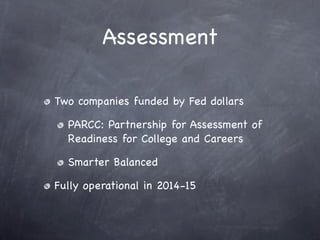
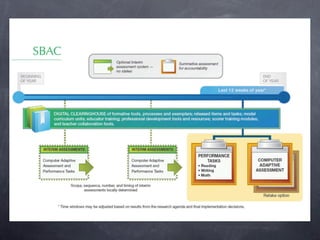
Two companies funded by Fed dollars

  PARCC: Partnership for Assessment of
  Readiness for College and Careers

  Smarter Balanced

Fully operational in 2014-15
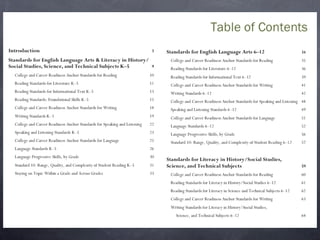
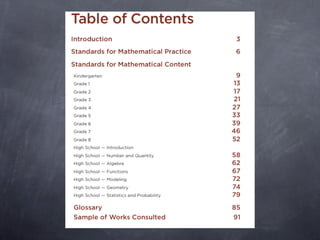
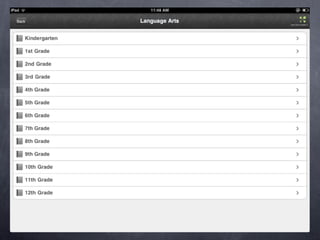
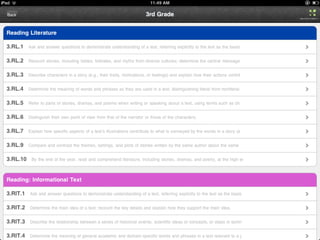
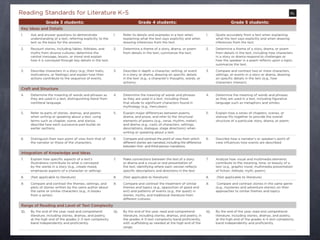
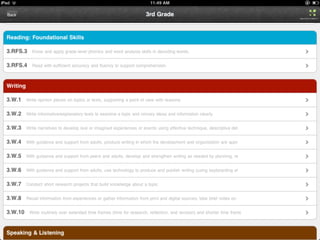
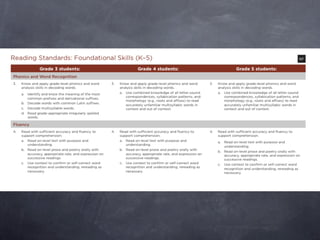
What do the CC Standards
   actually look like?


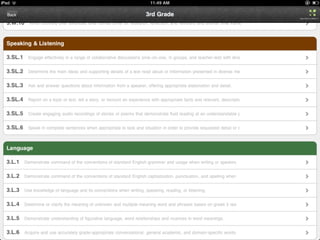
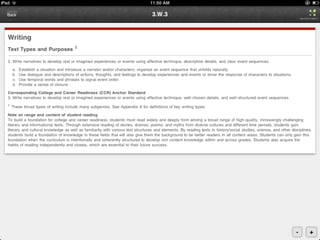
 http://corestandards.org/
Pause for Questions
New teachers?


Be familiar with the history of standards

Know the structure of the CC in ELA/Math

Know what makes the CC important
instructionally
CC and Measuring
Teacher Effectiveness

Traditionally, schools have used a variety of
methods:

  Walk-Throughs

  Formal Observations (pre and post...)

  Instructional Rounds
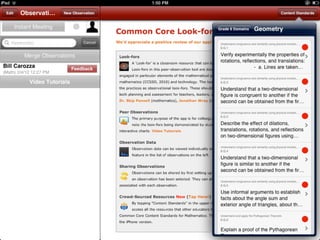
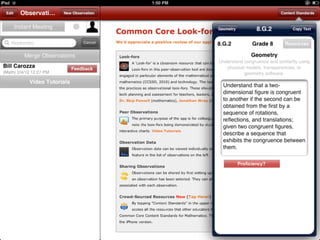
Perhaps Eval by
Adherence by Standard?
Students with
       Disabilities


Universal Design for Learning

  Neuroscience-knowing that all brains learn
  differently. CC authors recognize UDL.
What’s Next?

Development of other subject areas

Development of assessments in time for
2014-15

Slow changing of pedagogy and teaching
strategies

NH...still some legislative struggles
Pause for Questions
One Stop Source for

       Info
http://www.diigo.com/user/wcarozza/
commoncore

Feel free to contact me:

  wcarozza@sau66.org

  Harold Martin School: 603-746-3473

  NHASCD.net, billcarozza.com

PSU Common Core Presentation

  • 1.
    The Common Core Standards Bill Carozza Principal, Harold Martin School Hopkinton, NH wcarozza@sau66.org
  • 4.
  • 5.
  • 6.
  • 7.
    Standards What are they? Whydo we have them? Where did they originate?
  • 8.
    Standards What are they? Whydo we have them? Where did they originate? The parallel with the doctor’s physical in regards to assessing adherence to standards We don’t practice for our physical any more than we should practice directly for the state exam
  • 9.
    History of Standards 1983:Nation at Risk 1988 Sen. Kennedy and Pres. Reagan collaborated on NAEP (nat. Assess. of Ed. Progress). State by state comparison.  1989 Pres. Bush pushed “voluntary national standards” in core subjects, but it failed. 80s and 90s-push from prof. org.
  • 11.
  • 12.
    Professional Organizations and Standards MATH: NCTM Standards-1989-where it all began.
  • 13.
    Professional Organizations and Standards MATH: NCTM Standards-1989-where it all began. SCIENCE: AAAS-Assn. for the Adv, of Science-Project 2061. NRC (National Research Council) published in 1996. NSTA-published document in 1995.
  • 14.
    Professional Organizations and Standards MATH: NCTM Standards-1989-where it all began. SCIENCE: AAAS-Assn. for the Adv, of Science-Project 2061. NRC (National Research Council) published in 1996. NSTA-published document in 1995. SOCIAL STUDIES: History Standards Project in 1995. Controversy between history and social studies people. CIVICS: Center for Civic Education-1994. ECON: National Council on Econ. Ed.: 1997. GEOGRAPHY: 1994 from the Geog. Ed. Standards Project. SS-NCSS 1994
  • 15.
    Professional Organizations and Standards MATH: NCTM Standards-1989-where it all began. SCIENCE: AAAS-Assn. for the Adv, of Science-Project 2061. NRC (National Research Council) published in 1996. NSTA-published document in 1995. SOCIAL STUDIES: History Standards Project in 1995. Controversy between history and social studies people. CIVICS: Center for Civic Education-1994. ECON: National Council on Econ. Ed.: 1997. GEOGRAPHY: 1994 from the Geog. Ed. Standards Project. SS-NCSS 1994 ENGLISH/LANGUAGE ARTS: NCTE and IRA Standards in Oct. 1995
  • 16.
    Professional Organizations and Standards MATH: NCTM Standards-1989-where it all began. SCIENCE: AAAS-Assn. for the Adv, of Science-Project 2061. NRC (National Research Council) published in 1996. NSTA-published document in 1995. SOCIAL STUDIES: History Standards Project in 1995. Controversy between history and social studies people. CIVICS: Center for Civic Education-1994. ECON: National Council on Econ. Ed.: 1997. GEOGRAPHY: 1994 from the Geog. Ed. Standards Project. SS-NCSS 1994 ENGLISH/LANGUAGE ARTS: NCTE and IRA Standards in Oct. 1995 TECHNOLOGY: ISTE-2000
  • 18.
  • 19.
    …continued ARTS: Consortium ofNational Arts Educ. Associations: 1994
  • 20.
    …continued ARTS: Consortium ofNational Arts Educ. Associations: 1994 FOREIGN LANGUAGES: American Council on the Teaching of Foreign Languages 1996.
  • 21.
    …continued ARTS: Consortium ofNational Arts Educ. Associations: 1994 FOREIGN LANGUAGES: American Council on the Teaching of Foreign Languages 1996. HEALTH: Joint Comm. On National Health Education Standards-1994
  • 22.
    …continued ARTS: Consortium ofNational Arts Educ. Associations: 1994 FOREIGN LANGUAGES: American Council on the Teaching of Foreign Languages 1996. HEALTH: Joint Comm. On National Health Education Standards-1994 P.E.: NASPE (Nat. Assn. for Sport and P.E.; 1995
  • 23.
    How Did theCommon Core Standards Originate?
  • 24.
    How Did theCommon Core Standards Originate? Joint project of NGA (National Gov. Assn. and CCSSO (Council of Chief State School Officers)
  • 25.
    How Did theCommon Core Standards Originate? Joint project of NGA (National Gov. Assn. and CCSSO (Council of Chief State School Officers) Concern: disparities between states and more rigor needed.
  • 26.
    How Did theCommon Core Standards Originate? Joint project of NGA (National Gov. Assn. and CCSSO (Council of Chief State School Officers) Concern: disparities between states and more rigor needed. Truly a non-gov’t initiative
  • 27.
    How Did theCommon Core Standards Originate? Joint project of NGA (National Gov. Assn. and CCSSO (Council of Chief State School Officers) Concern: disparities between states and more rigor needed. Truly a non-gov’t initiative 46 States and D.C. have adopted
  • 28.
    How Did theCommon Core Standards Originate? Joint project of NGA (National Gov. Assn. and CCSSO (Council of Chief State School Officers) Concern: disparities between states and more rigor needed. Truly a non-gov’t initiative 46 States and D.C. have adopted Not yet: AK, NE, TX, VA (MN just ELA)
  • 29.
    How Did theCommon Core Standards Originate? Joint project of NGA (National Gov. Assn. and CCSSO (Council of Chief State School Officers) Concern: disparities between states and more rigor needed. Truly a non-gov’t initiative 46 States and D.C. have adopted Not yet: AK, NE, TX, VA (MN just ELA) Just ELA and Math K-12.
  • 30.
    Goals of CC Arealigned with college and work experience. Clear, understandable and consistent Rigorous content-higher order thinking skills Built upon strengths of top state and int’l standards Evidence based
  • 31.
    Key Differences atthe Core of CC
  • 32.
    Key Differences atthe Core of CC Reading: meant to establish a “staircase” of complexity so students are ready for college and career
  • 33.
    Key Differences atthe Core of CC Reading: meant to establish a “staircase” of complexity so students are ready for college and career Writing: students should write logical arguments based on sound reasoning and research (non-fiction focus)
  • 34.
    Key Differences atthe Core of CC Reading: meant to establish a “staircase” of complexity so students are ready for college and career Writing: students should write logical arguments based on sound reasoning and research (non-fiction focus) Speaking and Listening: gain, evaluate and present complex info-using tech
  • 35.
    Key Differences atthe Core of CC
  • 36.
    Key Differences atthe Core of CC Math K-5: foundation in whole numbers, four functions, fractions and decimals. Procedural and conceptual understanding
  • 37.
    Key Differences atthe Core of CC Math K-5: foundation in whole numbers, four functions, fractions and decimals. Procedural and conceptual understanding HS Math: Math ways of thinking to real world issues and challenges
  • 38.
    NEW PD Neededfor Teachers-New Instruction CC focuses on authentic learning Need teachers to integrate problem solving, critical thinking Greater data literacy PLCs Emerging technology School calendar changes
  • 40.
  • 41.
    Assessment Two companies fundedby Fed dollars PARCC: Partnership for Assessment of Readiness for College and Careers Smarter Balanced Fully operational in 2014-15
  • 43.
    What do theCC Standards actually look like? http://corestandards.org/
  • 53.
  • 54.
    New teachers? Be familiarwith the history of standards Know the structure of the CC in ELA/Math Know what makes the CC important instructionally
  • 55.
    CC and Measuring TeacherEffectiveness Traditionally, schools have used a variety of methods: Walk-Throughs Formal Observations (pre and post...) Instructional Rounds
  • 56.
  • 59.
    Students with Disabilities Universal Design for Learning Neuroscience-knowing that all brains learn differently. CC authors recognize UDL.
  • 60.
    What’s Next? Development ofother subject areas Development of assessments in time for 2014-15 Slow changing of pedagogy and teaching strategies NH...still some legislative struggles
  • 61.
  • 62.
    One Stop Sourcefor Info http://www.diigo.com/user/wcarozza/ commoncore Feel free to contact me: wcarozza@sau66.org Harold Martin School: 603-746-3473 NHASCD.net, billcarozza.com