© Copyright 2020 McKinsey & Company. This material contains the confidential and proprietary information of McKinsey & Company
and is intended solely for your internal use and may not be reproduced, disclosed or distributed without McKinsey & Company’s
express prior written consent.
Problem Solving
Problem-Solving
Toolkit
McKinsey & Company
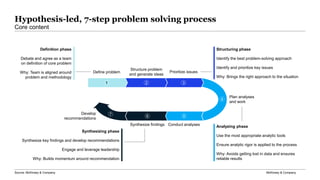
Synthesizing phase
Synthesize key findings and develop recommendations
Engage and leverage leadership
Why: Builds momentum around recommendation
Synthesize findings
Develop
recommendations
Conduct analyses
Plan analyses
and work
Define problem Prioritize issues
Structure problem
and generate ideas
3
2
1
4
6 5
7
Definition phase
Debate and agree as a team
on definition of core problem
Why: Team is aligned around
problem and methodology
Structuring phase
Identify the best problem-solving approach
Identify and prioritize key issues
Why: Brings the right approach to the situation
Analyzing phase
Use the most appropriate analytic tools
Ensure analytic rigor is applied to the process
Why: Avoids getting lost in data and ensures
reliable results
Source: McKinsey & Company
Hypothesis-led, 7-step problem solving process
Core content
McKinsey & Company
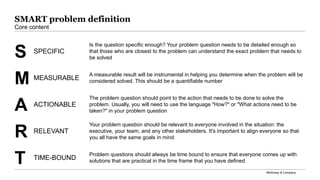
SPECIFIC
S
Is the question specific enough? Your problem question needs to be detailed enough so
that those who are closest to the problem can understand the exact problem that needs to
be solved
M MEASURABLE
A measurable result will be instrumental in helping you determine when the problem will be
considered solved. This should be a quantifiable number
ACTIONABLE
A
The problem question should point to the action that needs to be done to solve the
problem. Usually, you will need to use the language "How?" or "What actions need to be
taken?" in your problem question
RELEVANT
R
Your problem question should be relevant to everyone involved in the situation: the
executive, your team, and any other stakeholders. It's important to align everyone so that
you all have the same goals in mind
T TIME-BOUND
Problem questions should always be time bound to ensure that everyone comes up with
solutions that are practical in the time frame that you have defined
SMART problem definition
Core content
McKinsey & Company
Problem questions (The basic question to be resolved)
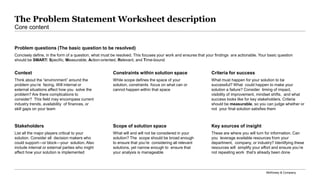
Concisely define, in the form of a question, what must be resolved. This focuses your work and ensures that your findings are actionable. Your basic question
should be SMART: Specific, Measurable, Action-oriented, Relevant, and Time-bound
Context
Think about the “environment” around the
problem you’re facing. Will internal or
external situations affect how you solve the
problem? Are there complications to
consider? This field may encompass current
industry trends, availability of finances, or
skill gaps on your team
Constraints within solution space
While scope defines the space of your
solution, constraints focus on what can or
cannot happen within that space
Criteria for success
What must happen for your solution to be
successful? What could happen to make your
solution a failure? Consider timing of impact,
visibility of improvement, mindset shifts, and what
success looks like for key stakeholders. Criteria
should be measurable, so you can judge whether or
not your final solution satisfies them
Stakeholders
List all the major players critical to your
solution. Consider all decision makers who
could support—or block—your solution. Also
include internal or external parties who might
affect how your solution is implemented
Scope of solution space
What will and will not be considered in your
solution? The scope should be broad enough
to ensure that you’re considering all relevant
solutions, yet narrow enough to ensure that
your analysis is manageable
Key sources of insight
These are where you will turn for information. Can
you leverage available resources from your
department, company, or industry? Identifying these
resources will simplify your effort and ensure you’re
not repeating work that’s already been done
The Problem Statement Worksheet description
Core content
McKinsey & Company 5
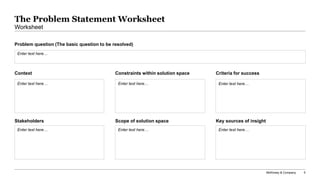
Problem question (The basic question to be resolved)
Context Constraints within solution space Criteria for success
Stakeholders Scope of solution space Key sources of insight
The Problem Statement Worksheet
Worksheet
Enter text here…
Enter text here… Enter text here… Enter text here…
McKinsey & Company
Issue Tree
Worksheet
Enter text here…
Enter text here…
Enter text here…
Enter text here…
Enter text here…
Enter text here…
Enter text here…
Enter text here…
Enter text here…
Enter text here…
Enter text here…
Enter text here…
Enter text here…
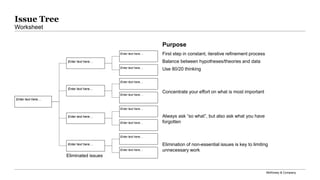
Always ask “so what”, but also ask what you have
forgotten
Elimination of non-essential issues is key to limiting
unnecessary work
Concentrate your effort on what is most important
First step in constant, iterative refinement process
Balance between hypotheses/theories and data
Use 80/20 thinking
Purpose
Eliminated issues
McKinsey & Company 7
Hypothesis Tree
Worksheet
Enter text here…
Enter text here…
Enter text here…
Enter text here…
Enter text here…
Enter text here…
Enter text here…
Enter text here…
Enter text here…
Enter text here…
Enter text here…
Enter text here…
Enter text here…
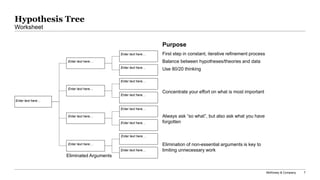
Always ask “so what”, but also ask what you have
forgotten
Elimination of non-essential arguments is key to
limiting unnecessary work
Concentrate your effort on what is most important
First step in constant, iterative refinement process
Balance between hypotheses/theories and data
Use 80/20 thinking
Purpose
Eliminated Arguments
McKinsey & Company 8
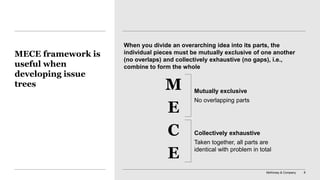
When you divide an overarching idea into its parts, the
individual pieces must be mutually exclusive of one another
(no overlaps) and collectively exhaustive (no gaps), i.e.,
combine to form the whole
M
E
C
E
Mutually exclusive
No overlapping parts
Collectively exhaustive
Taken together, all parts are
identical with problem in total
MECE framework is
useful when
developing issue
trees
McKinsey & Company
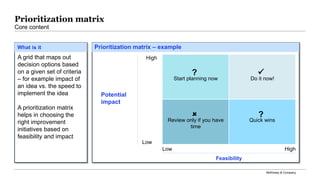
Prioritization matrix – example
What is it
A grid that maps out
decision options based
on a given set of criteria
– for example impact of
an idea vs. the speed to
implement the idea
A prioritization matrix
helps in choosing the
right improvement
initiatives based on
feasibility and impact
Low High
Low
High
Feasibility
 ?

?
Start planning now Do it now!
Review only if you have
time
Quick wins
Potential
impact
Prioritization matrix
Core content
McKinsey & Company 10
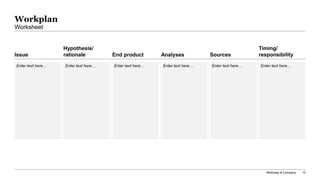
Issue
Hypothesis/
rationale End product Analyses Sources
Timing/
responsibility
Workplan
Worksheet
Enter text here… Enter text here… Enter text here… Enter text here… Enter text here… Enter text here…
McKinsey & Company
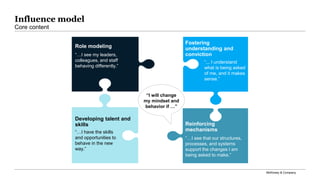
Fostering
understanding and
conviction
Role modeling
“…I have the skills
and opportunities to
behave in the new
way.”
“... I understand
what is being asked
of me, and it makes
sense.”
“…I see my leaders,
colleagues, and staff
behaving differently.”
“…I see that our structures,
processes, and systems
support the changes I am
being asked to make.”
“I will change
my mindset and
behavior if …”
Developing talent and
skills Reinforcing
mechanisms
Influence model
Core content

PS-Problem-Solving-Toolkit.pptx

  • 1.
    © Copyright 2020McKinsey & Company. This material contains the confidential and proprietary information of McKinsey & Company and is intended solely for your internal use and may not be reproduced, disclosed or distributed without McKinsey & Company’s express prior written consent. Problem Solving Problem-Solving Toolkit
  • 2.
    McKinsey & Company Synthesizingphase Synthesize key findings and develop recommendations Engage and leverage leadership Why: Builds momentum around recommendation Synthesize findings Develop recommendations Conduct analyses Plan analyses and work Define problem Prioritize issues Structure problem and generate ideas 3 2 1 4 6 5 7 Definition phase Debate and agree as a team on definition of core problem Why: Team is aligned around problem and methodology Structuring phase Identify the best problem-solving approach Identify and prioritize key issues Why: Brings the right approach to the situation Analyzing phase Use the most appropriate analytic tools Ensure analytic rigor is applied to the process Why: Avoids getting lost in data and ensures reliable results Source: McKinsey & Company Hypothesis-led, 7-step problem solving process Core content
  • 3.
    McKinsey & Company SPECIFIC S Isthe question specific enough? Your problem question needs to be detailed enough so that those who are closest to the problem can understand the exact problem that needs to be solved M MEASURABLE A measurable result will be instrumental in helping you determine when the problem will be considered solved. This should be a quantifiable number ACTIONABLE A The problem question should point to the action that needs to be done to solve the problem. Usually, you will need to use the language "How?" or "What actions need to be taken?" in your problem question RELEVANT R Your problem question should be relevant to everyone involved in the situation: the executive, your team, and any other stakeholders. It's important to align everyone so that you all have the same goals in mind T TIME-BOUND Problem questions should always be time bound to ensure that everyone comes up with solutions that are practical in the time frame that you have defined SMART problem definition Core content
  • 4.
    McKinsey & Company Problemquestions (The basic question to be resolved) Concisely define, in the form of a question, what must be resolved. This focuses your work and ensures that your findings are actionable. Your basic question should be SMART: Specific, Measurable, Action-oriented, Relevant, and Time-bound Context Think about the “environment” around the problem you’re facing. Will internal or external situations affect how you solve the problem? Are there complications to consider? This field may encompass current industry trends, availability of finances, or skill gaps on your team Constraints within solution space While scope defines the space of your solution, constraints focus on what can or cannot happen within that space Criteria for success What must happen for your solution to be successful? What could happen to make your solution a failure? Consider timing of impact, visibility of improvement, mindset shifts, and what success looks like for key stakeholders. Criteria should be measurable, so you can judge whether or not your final solution satisfies them Stakeholders List all the major players critical to your solution. Consider all decision makers who could support—or block—your solution. Also include internal or external parties who might affect how your solution is implemented Scope of solution space What will and will not be considered in your solution? The scope should be broad enough to ensure that you’re considering all relevant solutions, yet narrow enough to ensure that your analysis is manageable Key sources of insight These are where you will turn for information. Can you leverage available resources from your department, company, or industry? Identifying these resources will simplify your effort and ensure you’re not repeating work that’s already been done The Problem Statement Worksheet description Core content
  • 5.
    McKinsey & Company5 Problem question (The basic question to be resolved) Context Constraints within solution space Criteria for success Stakeholders Scope of solution space Key sources of insight The Problem Statement Worksheet Worksheet Enter text here… Enter text here… Enter text here… Enter text here… Enter text here… Enter text here… Enter text here…
  • 6.
    McKinsey & Company IssueTree Worksheet Enter text here… Enter text here… Enter text here… Enter text here… Enter text here… Enter text here… Enter text here… Enter text here… Enter text here… Enter text here… Enter text here… Enter text here… Enter text here… Always ask “so what”, but also ask what you have forgotten Elimination of non-essential issues is key to limiting unnecessary work Concentrate your effort on what is most important First step in constant, iterative refinement process Balance between hypotheses/theories and data Use 80/20 thinking Purpose Eliminated issues
  • 7.
    McKinsey & Company7 Hypothesis Tree Worksheet Enter text here… Enter text here… Enter text here… Enter text here… Enter text here… Enter text here… Enter text here… Enter text here… Enter text here… Enter text here… Enter text here… Enter text here… Enter text here… Always ask “so what”, but also ask what you have forgotten Elimination of non-essential arguments is key to limiting unnecessary work Concentrate your effort on what is most important First step in constant, iterative refinement process Balance between hypotheses/theories and data Use 80/20 thinking Purpose Eliminated Arguments
  • 8.
    McKinsey & Company8 When you divide an overarching idea into its parts, the individual pieces must be mutually exclusive of one another (no overlaps) and collectively exhaustive (no gaps), i.e., combine to form the whole M E C E Mutually exclusive No overlapping parts Collectively exhaustive Taken together, all parts are identical with problem in total MECE framework is useful when developing issue trees
  • 9.
    McKinsey & Company Prioritizationmatrix – example What is it A grid that maps out decision options based on a given set of criteria – for example impact of an idea vs. the speed to implement the idea A prioritization matrix helps in choosing the right improvement initiatives based on feasibility and impact Low High Low High Feasibility  ?  ? Start planning now Do it now! Review only if you have time Quick wins Potential impact Prioritization matrix Core content
  • 10.
    McKinsey & Company10 Issue Hypothesis/ rationale End product Analyses Sources Timing/ responsibility Workplan Worksheet Enter text here… Enter text here… Enter text here… Enter text here… Enter text here… Enter text here…
  • 11.
    McKinsey & Company Fostering understandingand conviction Role modeling “…I have the skills and opportunities to behave in the new way.” “... I understand what is being asked of me, and it makes sense.” “…I see my leaders, colleagues, and staff behaving differently.” “…I see that our structures, processes, and systems support the changes I am being asked to make.” “I will change my mindset and behavior if …” Developing talent and skills Reinforcing mechanisms Influence model Core content