An Investigation into the Antecedents of Customer Satisfaction 
of Online Shopping 
Syed Shah Alam 
University of Malaysia (UKM) 
Norjaya Mohd. Yasin 
University of Malaysia (UKM) 
The aim of this study is to identify the key factors influencing customer satisfaction through online 
shopping. In this study four key dimensions of customer satisfaction of online shopping are identified. It is 
found that website design, reliability, product variety and delivery performances are the four key factors 
which influence consumers’ satisfaction of online shopping. However, there is no significant relationship 
between saved time and satisfaction. Recommendations are presented which may help foster growth of 
Malaysian online retailing in the future. 
INTRODUCTION 
Malaysian online consumers are very minimal compared to the developed countries in the world. A 
mid-2005 survey by the Malaysian Communication and Multimedia Corporation (MCMC), indicates that 
only 9.3% of Internet users had purchased products or services through the Internet during the preceding 
three months. Among those who did so, airline tickets were the most popular items (43.8%) followed by 
books (15.6%) and music (6.8%). Amounts spent on these items were small, however, with 57.7% of 
transactions worth less than RM500. Moreover, it is expected Malaysian online sales will increase every 
year at a high growth. 
Much research has been concentrating on customer satisfaction on online shopping in the world. 
However, there is still a need for closer examination on customer satisfaction in specific countries. Both 
established and new, large and small scale businesses are now using the Internet as a medium of sales of 
their products and services (for example Dell computer, Amzon.com, in the world and jobstreet.com, 
blooming.com, lelong.com, mudah.my and many others in Malaysia). Still, there is a huge research gap 
not only between countries, especially developed and developing countries, which may differ 
significantly (Stiglitz, 1998; Shore, 1998; Spanos et al., 2002). This will limit the generalization of 
research results from developed countries to that of developing country contexts (Dewan & Kraemer, 
2000; Clarke, 2001). 
For those businesses that are selling their products through online, Internet users are their main target 
customers for their products and services. Whether or not they can convert their potential customers into 
real ones and retain them depends, to very a large extent, on the services they offer and the satisfaction 
that consumers perceive to gain (Ho & Wu, 1999). In this scenario of business environment customer 
Journal of Marketing Development and Competitiveness 5(1) 2010 71
satisfaction is of course a critical issue in the success of any business system, whether it is traditional or 
online business. This paper aims at investigating the relationships between customer satisfaction and the 
antecedents of online shopping. From the practitioner perspective, measuring customer satisfaction and 
understanding its underlying dimensions is significant because it enables online sellers to benchmark their 
performance and to identify areas that require improvement. From the customer’s point of view, 
underlying customer satisfaction with online businesses is useful in helping them to assess current and 
potential online sellers’ activities needed. 
FACTORS AFFECTING ONLINE CUSTOMER SATISFACTION 
Customer satisfaction is the ultimate result of meeting a consumer’s expectation from the performance 
of products. Most satisfied customers normally has the intention to re-purchase the products if product 
performance meets his or her expectation. Like traditional business, online businesses also need to satisfy 
their customers. Customer satisfaction is one of the central constructs in the study of consumer behavior 
both in traditional and online business environment. But what determines customer satisfaction with 
online shopping? Prior studies like Churchill and Surprenant (1982); Tse and Wilton (1988); Oliver 
(1980); Ho and Wu (1999); Lee and Joshi (2007) have presented some models of customer satisfaction. 
Among them Oliver (1980) proposed a model that explains consumer satisfaction as a function of 
expectation and expectancy disconfirmation. This study proved empirically that satisfaction significantly 
affects customer’s attitude and their intention to purchase. Churchill and Surprenant (1982) experimental 
study urged disconfirmation as an intervening variable affecting satisfaction. However the effect of 
disconfirmation is adequately captured by expectation and perceived performance. Another study by Tse 
and Wilton (1988) followed the results proposed by Churchill and Surprenant (1982), and investigated 
customer satisfaction formation. Results of a laboratory experiment reveal that performance exerted direct 
significant influences from expected performance and subjective disconfirmation. Moreover, these studies 
were based on traditional retail stores. But there is a doubt whether these studies result are appropriate for 
online shopping perspective. According to Ho and Wu (1999) these studies may not be relevant in online 
store. 
According to Lawson (2000), and Baskerville et al (2007) Roger’s diffusion of innovations model 
(1983, 1995) has been noted as having a profound effect on research into consumer behaviour and 
marketing and frequently used to analyse potential consumer behaviour relating to the introduction of new 
ICTs. Other important theoretical models that attempts to explain the relationship between user beliefs, 
attitudes, intentions, and actual system use include perceived characteristics of innovating (PCI) (Moore 
and Benbasat, 1991), the theory of reasoned action (TRA) Ajzen and Fishbein, (1985), the theory of 
planned behavior (TPB) (Ajzen 1991) and the technology acceptance model (TAM) (Davis, 1989; Davis 
et al 1989). Key difference between the TAM and TRA is that the TAM replaces the attitude measures 
included in the TRA with two technology acceptance measures, i.e. ‘ease of use’, and ‘usefulness’ 
(Bagozzi et al., 1992; Davis et al., 1989). TAM designed to explain perceived usefulness and usage 
intentions in terms of social influence and cognitive instrumental processes (Venkatesh and Davis, 2000. 
These theories and models offer foundations for planning, executing and evaluating the technology 
adoption. 
Some researcher criticize these models as Rau and Samiee (1981) argue that many of these models 
have never been tested as a whole in their original form because they lack specificity and thus are 
difficult, if not impossible, to operationalise. Anckar et al. (2003) argued that TAM model ignores the 
potential existence of perceived critical benefits and barriers to the use of technology. Sheth and Krishnan 
(2005) argue that although current online purchasing environment is complex but the models are still 
remain same. The evolving nature of consumer decision-making in response to the changing decision 
environment makes it increasingly more difficult to “fit” current decision reality to these models 
(Erasmus et al., 2001). 
In this study we utilize five factors i.e. website design, reliability, time saved, product variety, and 
delivery performance. Alam et al. (2008) found that website design is one of the unique features affecting 
72 Journal of Marketing Development and Competitiveness 5(1) 2010
online shopping environment. Shergill and Chen, (2005) identified web site design characteristics as the 
dominant factor which influences consumer perceptions of online purchasing. Ho and Wu (1999) study 
confirmed homepage presentation and reliability are the important factors that have most influential effect 
on online shopping. It can be argued that online shoppers want to receive the right quality and right 
quantity of items that they have ordered within the stipulated time offer by the e-tailers. Consumers also 
expected to bill properly (Jun et al., 2004). Product variety is included in this study because young people 
in Malaysia are like to search varieties product as they normally visit shopping mall almost every 
weekends. Studies like Ahn et al. (2004); Szymanki and Hise (2000) and Athanassopoulos et al (2001) 
have found product variety to be important factor influencing e-satisfaction. Time and cost saving are the 
main advantages of online shopping. According to Devaraj et al. (2002) time efficiency and store 
efficiency are reflected in time cost and price savings respectively. These are the determinants of 
satisfaction. Lee and Joshi (2007); Ahn et al. (2004); Ho (2004); Grewal et al (2004) and Shih (2004) 
studies found that delivery performance has significant influence on customer satisfaction. 
THE RESEARCH MODEL 
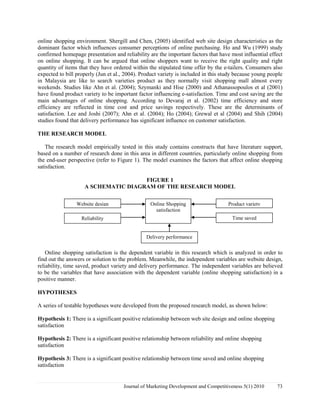
The research model empirically tested in this study contains constructs that have literature support, 
based on a number of research done in this area in different countries, particularly online shopping from 
the end-user perspective (refer to Figure 1). The model examines the factors that affect online shopping 
satisfaction. 
FIGURE 1 
A SCHEMATIC DIAGRAM OF THE RESEARCH MODEL 
Website design Product variety 
Online Shopping 
satisfaction 
Reliability Time saved 
Delivery performance 
Online shopping satisfaction is the dependent variable in this research which is analyzed in order to 
find out the answers or solution to the problem. Meanwhile, the independent variables are website design, 
reliability, time saved, product variety and delivery performance. The independent variables are believed 
to be the variables that have association with the dependent variable (online shopping satisfaction) in a 
positive manner. 
HYPOTHESES 
A series of testable hypotheses were developed from the proposed research model, as shown below: 
Hypothesis 1: There is a significant positive relationship between web site design and online shopping 
satisfaction 
Hypothesis 2: There is a significant positive relationship between reliability and online shopping 
satisfaction 
Hypothesis 3: There is a significant positive relationship between time saved and online shopping 
satisfaction 
Journal of Marketing Development and Competitiveness 5(1) 2010 73
Hypothesis 4: There is a significant positive relationship between product variety and online shopping 
satisfaction 
Hypothesis 5: There is a significant positive relationship between delivery performance and online 
shopping satisfaction 
RESEARCH METHODS 
Sample and Data Collection 
Data for this study was gathered in May 2009 by primary data collection method through consumer 
survey administered among undergraduate students that have purchased at least one item through online 
within the last six months. The respondents were gathered data from two universities in Malaysia. A total 
of 300 questionnaires were distributed but only 230 are usable. Majority of the respondents were female 
(57.8 percent), more than half (55.5 percent) were between the age of 20 and 25. Chinese group was the 
highest contributors of the total respondents (51.3 percent) and the second highest group is represented by 
Malays with (31.6 percent). 
Measures 
The questionnaire was operationalized using items adopted and adapted from the literature on online 
shopping (Lee & Joshi, 2007 and Ho & Wu, 1999). The first part of the questionnaire included questions 
about demographic characteristics of the respondents such as age, gender, and race. The second part 
consisted of questions measuring the online shopping satisfaction and antecedents that influence online 
shopping satisfaction using a Likert scale ranging from 1= strongly disagree to 6 = strongly agree. 
Reliability 
The internal reliability of the items was verified by computing the Cronbach’s alpha (Nunnally, 1978). 
She suggested that a minimum alpha of 0.6 sufficed for early stage of research. The Cronbach alpha 
estimated for satisfaction was 0.734, website design was 0.821, reliability was 0.736, time saved was 
.687, product variety was .765 and delivery performance scale was 0.757. As the Cronbach’s alpha in this 
study were all much higher than 0.6, the constructs were therefore deemed to have adequate reliability. 
Normality of Data and Multi-collinearity 
This study involves a relatively large sample (230 respondents) and therefore, the Central Limit 
Theorem could be applied and hence there is no question on normality of the data. Two major methods 
were utilized in order to determine the presence of multicollinearity among independent variables in this 
study. These methodologies involved calculation of both a Tolerance test and Variance Inflation Factor 
(VIF) (Kleinbaum et al, 1988). The results of these analyses are presented in Table 1. As can be seen from 
this data, i) none of the Tolerance levels is greater than or equal to .01; and ii) all VIF values are well 
below 10. Thus, the measures selected for assessing independent variables in this study do not reach 
levels that indicate multicollinearity. The acceptable Durbin – Watson range is between 1.5 and 2.5. In 
this analysis Durbin – Watson value of 1.862, which is between the acceptable ranges, shows that there 
are no auto correlation problems in the data used in this research. Thus, the measures selected for 
assessing independent variables in this study do not reach levels indicating multicollinearity 
74 Journal of Marketing Development and Competitiveness 5(1) 2010
TABLE 1 
TEST OF COLLINEARITY 
Variable Tolerance VIF 
Website design .826 1.211 
Reliability .697 1.436 
Time saved .770 1.298 
Product variety .782 1.279 
Delivery performance .750 1.334 
HYPOTHESES TESTING 
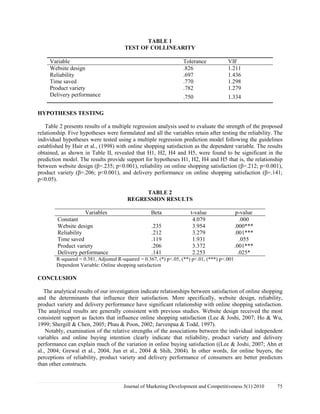
Table 2 presents results of a multiple regression analysis used to evaluate the strength of the proposed 
relationship. Five hypotheses were formulated and all the variables retain after testing the reliability. The 
individual hypotheses were tested using a multiple regression prediction model following the guidelines 
established by Hair et al., (1998) with online shopping satisfaction as the dependent variable. The results 
obtained, as shown in Table II, revealed that H1, H2, H4 and H5, were found to be significant in the 
prediction model. The results provide support for hypotheses H1, H2, H4 and H5 that is, the relationship 
EHWZHHQZHEVLWHGHVLJQȕ S
UHOLDELOLWRQRQOLQHVKRSSLQJVDWLVIDFWLRQȕ S
SURGXFW YDULHW ȕ  S
DQG GHOLYHU SHUIRUPDQFH RQ RQOLQH VKRSSLQJ VDWLVIDFWLRQ ȕ  
p0.05). 
TABLE 2 
REGRESSION RESULTS 
Variables Beta t-value p-value 
Constant 4.079 .000 
Website design .235 3.954 .000*** 
Reliability .212 3.279 .001*** 
Time saved .119 1.931 .055 
Product variety .206 3.372 .001*** 
Delivery performance .141 2.253 .025* 
R-squared = 0.381, Adjusted R-squared = 0.367, (*) p.05, (**) p.01, (***) p.001 
Dependent Variable: Online shopping satisfaction 
CONCLUSION 
The analytical results of our investigation indicate relationships between satisfaction of online shopping 
and the determinants that influence their satisfaction. More specifically, website design, reliability, 
product variety and delivery performance have significant relationship with online shopping satisfaction. 
The analytical results are generally consistent with previous studies. Website design received the most 
consistent support as factors that influence online shopping satisfaction (Lee  Joshi, 2007; Ho  Wu, 
1999; Shergill  Chen, 2005; Phau  Poon, 2002; Jarvenpaa  Todd, 1997). 
Notably, examination of the relative strengths of the associations between the individual independent 
variables and online buying intention clearly indicate that reliability, product variety and delivery 
performance can explain much of the variation in online buying satisfaction ((Lee  Joshi, 2007; Ahn et 
al., 2004; Grewal et al., 2004, Jun et al., 2004  Shih, 2004). In other words, for online buyers, the 
perceptions of reliability, product variety and delivery performance of consumers are better predictors 
than other constructs. 
Journal of Marketing Development and Competitiveness 5(1) 2010 75
From the result of this study, time saves has found no direct and significant effect on satisfaction. 
However, the positive sign on the figure shows that if there is a relationship it will be a positive one. This 
means that the higher the time saved in online shopping the higher the level of satisfaction will have. This 
result is in contradiction on the previous studies done by other researchers (Devaraj et al. 2002). 
However, the contradicting results here might be due to the fact that not many people in Malaysia are 
buying online frequently. They do not see it as a factor that will affect satisfaction because they do not 
have the experience. When the respondents do not have actual experience in shopping online frequently, 
their perception will tend to be different from those who actually have experiences before. It would be 
interesting to study the same factors in connection to online shopping satisfaction on a different, more 
average internet user population. 
RESEARCH LIMITATIONS AND SUGGESTIONS FOR FUTURE RESEARCH 
Like other empirical studies, this study is not without its limitations. Firstly, the nature of sampling 
unit under study cannot be generalized to a larger population as only student was examined and the use of 
single-item measurement for satisfaction construct has low reliability (Churchill, 1979). Secondly, the use 
of cross-sectional data in a single group also limits some of the conclusions obtained. The study can be 
strengthened by increasing the sample size and including participants in other geographical areas. With an 
increased sample size, a more detailed empirical analysis among the independent variables and the 
variables that have multiple categories can be performed. Potential correlations between some of the 
independent variables (e.g. gender, race, education, income level) need to be reported in a future study. 
REFERENCES 
Ahn, T., Ryu, S., Han, I. (2004). The Impact of the Online and Offline Features on the User Acceptance 
of Internet Shopping Mall. Electronic Commerce Research and Applications, 3, (4), 405-420. 
Ajzen, I. (1991). The theory of planned behaviour, Organizational Behaviour and Human Decision 
Processes, 50, 179-211. 
Ajzen, I.,  Fishbein, M. (1985). The prediction of Behavior from attitudinal and normative 
variables. Journal of experimental social Psychology, 466-488 
Alam, S.S., Bakar, Z., Ismail. H.  Ahsan, N. (2008). Young consumers online shopping: an 
empirical study. Journal of Internet Business, 5, 81-98. 
Anckar, B., C. Carlsson,  P. Walden. (2003). Factors Affecting Adoption Decisions and Intents 
in Mobile Commerce: Empirical Insights. 16th Bled eCommerce Conference. eTransformation, 886-900. 
Anthanassopoulos, A, Gounaris, S.  Stathakopoulos, V. (2001). Behavioral Responses to Customer 
Satisfaction: An Empirical Study. European Journal of Markeitng, 35, (5), 687-707. 
Bagozzi, R. P., Davis, F. D.,  Warshaw, P. R. (1992). Development and test of a theory of technological 
learning and usage. Human Relations, 45, (7), 660-686. 
Baskerville et al. (2007). The enduring contradictions of new software development approaches: a 
response to ‘Persistent Problems and Practices in ISD’. Information Systems Journal, 17, (3), 241– 
245. 
Churchil, G.A.  Surprenant. (1982). An Investigation into the Determinant of Customer Satisfaction. 
Journal of Markeitng Research, 16, 491-504. 
76 Journal of Marketing Development and Competitiveness 5(1) 2010

Ps30

  • 1.
    An Investigation intothe Antecedents of Customer Satisfaction of Online Shopping Syed Shah Alam University of Malaysia (UKM) Norjaya Mohd. Yasin University of Malaysia (UKM) The aim of this study is to identify the key factors influencing customer satisfaction through online shopping. In this study four key dimensions of customer satisfaction of online shopping are identified. It is found that website design, reliability, product variety and delivery performances are the four key factors which influence consumers’ satisfaction of online shopping. However, there is no significant relationship between saved time and satisfaction. Recommendations are presented which may help foster growth of Malaysian online retailing in the future. INTRODUCTION Malaysian online consumers are very minimal compared to the developed countries in the world. A mid-2005 survey by the Malaysian Communication and Multimedia Corporation (MCMC), indicates that only 9.3% of Internet users had purchased products or services through the Internet during the preceding three months. Among those who did so, airline tickets were the most popular items (43.8%) followed by books (15.6%) and music (6.8%). Amounts spent on these items were small, however, with 57.7% of transactions worth less than RM500. Moreover, it is expected Malaysian online sales will increase every year at a high growth. Much research has been concentrating on customer satisfaction on online shopping in the world. However, there is still a need for closer examination on customer satisfaction in specific countries. Both established and new, large and small scale businesses are now using the Internet as a medium of sales of their products and services (for example Dell computer, Amzon.com, in the world and jobstreet.com, blooming.com, lelong.com, mudah.my and many others in Malaysia). Still, there is a huge research gap not only between countries, especially developed and developing countries, which may differ significantly (Stiglitz, 1998; Shore, 1998; Spanos et al., 2002). This will limit the generalization of research results from developed countries to that of developing country contexts (Dewan & Kraemer, 2000; Clarke, 2001). For those businesses that are selling their products through online, Internet users are their main target customers for their products and services. Whether or not they can convert their potential customers into real ones and retain them depends, to very a large extent, on the services they offer and the satisfaction that consumers perceive to gain (Ho & Wu, 1999). In this scenario of business environment customer Journal of Marketing Development and Competitiveness 5(1) 2010 71
  • 2.
    satisfaction is ofcourse a critical issue in the success of any business system, whether it is traditional or online business. This paper aims at investigating the relationships between customer satisfaction and the antecedents of online shopping. From the practitioner perspective, measuring customer satisfaction and understanding its underlying dimensions is significant because it enables online sellers to benchmark their performance and to identify areas that require improvement. From the customer’s point of view, underlying customer satisfaction with online businesses is useful in helping them to assess current and potential online sellers’ activities needed. FACTORS AFFECTING ONLINE CUSTOMER SATISFACTION Customer satisfaction is the ultimate result of meeting a consumer’s expectation from the performance of products. Most satisfied customers normally has the intention to re-purchase the products if product performance meets his or her expectation. Like traditional business, online businesses also need to satisfy their customers. Customer satisfaction is one of the central constructs in the study of consumer behavior both in traditional and online business environment. But what determines customer satisfaction with online shopping? Prior studies like Churchill and Surprenant (1982); Tse and Wilton (1988); Oliver (1980); Ho and Wu (1999); Lee and Joshi (2007) have presented some models of customer satisfaction. Among them Oliver (1980) proposed a model that explains consumer satisfaction as a function of expectation and expectancy disconfirmation. This study proved empirically that satisfaction significantly affects customer’s attitude and their intention to purchase. Churchill and Surprenant (1982) experimental study urged disconfirmation as an intervening variable affecting satisfaction. However the effect of disconfirmation is adequately captured by expectation and perceived performance. Another study by Tse and Wilton (1988) followed the results proposed by Churchill and Surprenant (1982), and investigated customer satisfaction formation. Results of a laboratory experiment reveal that performance exerted direct significant influences from expected performance and subjective disconfirmation. Moreover, these studies were based on traditional retail stores. But there is a doubt whether these studies result are appropriate for online shopping perspective. According to Ho and Wu (1999) these studies may not be relevant in online store. According to Lawson (2000), and Baskerville et al (2007) Roger’s diffusion of innovations model (1983, 1995) has been noted as having a profound effect on research into consumer behaviour and marketing and frequently used to analyse potential consumer behaviour relating to the introduction of new ICTs. Other important theoretical models that attempts to explain the relationship between user beliefs, attitudes, intentions, and actual system use include perceived characteristics of innovating (PCI) (Moore and Benbasat, 1991), the theory of reasoned action (TRA) Ajzen and Fishbein, (1985), the theory of planned behavior (TPB) (Ajzen 1991) and the technology acceptance model (TAM) (Davis, 1989; Davis et al 1989). Key difference between the TAM and TRA is that the TAM replaces the attitude measures included in the TRA with two technology acceptance measures, i.e. ‘ease of use’, and ‘usefulness’ (Bagozzi et al., 1992; Davis et al., 1989). TAM designed to explain perceived usefulness and usage intentions in terms of social influence and cognitive instrumental processes (Venkatesh and Davis, 2000. These theories and models offer foundations for planning, executing and evaluating the technology adoption. Some researcher criticize these models as Rau and Samiee (1981) argue that many of these models have never been tested as a whole in their original form because they lack specificity and thus are difficult, if not impossible, to operationalise. Anckar et al. (2003) argued that TAM model ignores the potential existence of perceived critical benefits and barriers to the use of technology. Sheth and Krishnan (2005) argue that although current online purchasing environment is complex but the models are still remain same. The evolving nature of consumer decision-making in response to the changing decision environment makes it increasingly more difficult to “fit” current decision reality to these models (Erasmus et al., 2001). In this study we utilize five factors i.e. website design, reliability, time saved, product variety, and delivery performance. Alam et al. (2008) found that website design is one of the unique features affecting 72 Journal of Marketing Development and Competitiveness 5(1) 2010
  • 3.
    online shopping environment.Shergill and Chen, (2005) identified web site design characteristics as the dominant factor which influences consumer perceptions of online purchasing. Ho and Wu (1999) study confirmed homepage presentation and reliability are the important factors that have most influential effect on online shopping. It can be argued that online shoppers want to receive the right quality and right quantity of items that they have ordered within the stipulated time offer by the e-tailers. Consumers also expected to bill properly (Jun et al., 2004). Product variety is included in this study because young people in Malaysia are like to search varieties product as they normally visit shopping mall almost every weekends. Studies like Ahn et al. (2004); Szymanki and Hise (2000) and Athanassopoulos et al (2001) have found product variety to be important factor influencing e-satisfaction. Time and cost saving are the main advantages of online shopping. According to Devaraj et al. (2002) time efficiency and store efficiency are reflected in time cost and price savings respectively. These are the determinants of satisfaction. Lee and Joshi (2007); Ahn et al. (2004); Ho (2004); Grewal et al (2004) and Shih (2004) studies found that delivery performance has significant influence on customer satisfaction. THE RESEARCH MODEL The research model empirically tested in this study contains constructs that have literature support, based on a number of research done in this area in different countries, particularly online shopping from the end-user perspective (refer to Figure 1). The model examines the factors that affect online shopping satisfaction. FIGURE 1 A SCHEMATIC DIAGRAM OF THE RESEARCH MODEL Website design Product variety Online Shopping satisfaction Reliability Time saved Delivery performance Online shopping satisfaction is the dependent variable in this research which is analyzed in order to find out the answers or solution to the problem. Meanwhile, the independent variables are website design, reliability, time saved, product variety and delivery performance. The independent variables are believed to be the variables that have association with the dependent variable (online shopping satisfaction) in a positive manner. HYPOTHESES A series of testable hypotheses were developed from the proposed research model, as shown below: Hypothesis 1: There is a significant positive relationship between web site design and online shopping satisfaction Hypothesis 2: There is a significant positive relationship between reliability and online shopping satisfaction Hypothesis 3: There is a significant positive relationship between time saved and online shopping satisfaction Journal of Marketing Development and Competitiveness 5(1) 2010 73
  • 4.
    Hypothesis 4: Thereis a significant positive relationship between product variety and online shopping satisfaction Hypothesis 5: There is a significant positive relationship between delivery performance and online shopping satisfaction RESEARCH METHODS Sample and Data Collection Data for this study was gathered in May 2009 by primary data collection method through consumer survey administered among undergraduate students that have purchased at least one item through online within the last six months. The respondents were gathered data from two universities in Malaysia. A total of 300 questionnaires were distributed but only 230 are usable. Majority of the respondents were female (57.8 percent), more than half (55.5 percent) were between the age of 20 and 25. Chinese group was the highest contributors of the total respondents (51.3 percent) and the second highest group is represented by Malays with (31.6 percent). Measures The questionnaire was operationalized using items adopted and adapted from the literature on online shopping (Lee & Joshi, 2007 and Ho & Wu, 1999). The first part of the questionnaire included questions about demographic characteristics of the respondents such as age, gender, and race. The second part consisted of questions measuring the online shopping satisfaction and antecedents that influence online shopping satisfaction using a Likert scale ranging from 1= strongly disagree to 6 = strongly agree. Reliability The internal reliability of the items was verified by computing the Cronbach’s alpha (Nunnally, 1978). She suggested that a minimum alpha of 0.6 sufficed for early stage of research. The Cronbach alpha estimated for satisfaction was 0.734, website design was 0.821, reliability was 0.736, time saved was .687, product variety was .765 and delivery performance scale was 0.757. As the Cronbach’s alpha in this study were all much higher than 0.6, the constructs were therefore deemed to have adequate reliability. Normality of Data and Multi-collinearity This study involves a relatively large sample (230 respondents) and therefore, the Central Limit Theorem could be applied and hence there is no question on normality of the data. Two major methods were utilized in order to determine the presence of multicollinearity among independent variables in this study. These methodologies involved calculation of both a Tolerance test and Variance Inflation Factor (VIF) (Kleinbaum et al, 1988). The results of these analyses are presented in Table 1. As can be seen from this data, i) none of the Tolerance levels is greater than or equal to .01; and ii) all VIF values are well below 10. Thus, the measures selected for assessing independent variables in this study do not reach levels that indicate multicollinearity. The acceptable Durbin – Watson range is between 1.5 and 2.5. In this analysis Durbin – Watson value of 1.862, which is between the acceptable ranges, shows that there are no auto correlation problems in the data used in this research. Thus, the measures selected for assessing independent variables in this study do not reach levels indicating multicollinearity 74 Journal of Marketing Development and Competitiveness 5(1) 2010
  • 5.
    TABLE 1 TESTOF COLLINEARITY Variable Tolerance VIF Website design .826 1.211 Reliability .697 1.436 Time saved .770 1.298 Product variety .782 1.279 Delivery performance .750 1.334 HYPOTHESES TESTING Table 2 presents results of a multiple regression analysis used to evaluate the strength of the proposed relationship. Five hypotheses were formulated and all the variables retain after testing the reliability. The individual hypotheses were tested using a multiple regression prediction model following the guidelines established by Hair et al., (1998) with online shopping satisfaction as the dependent variable. The results obtained, as shown in Table II, revealed that H1, H2, H4 and H5, were found to be significant in the prediction model. The results provide support for hypotheses H1, H2, H4 and H5 that is, the relationship EHWZHHQZHEVLWHGHVLJQȕ S
  • 6.
  • 7.
  • 8.
    DQG GHOLYHU SHUIRUPDQFHRQ RQOLQH VKRSSLQJ VDWLVIDFWLRQ ȕ p0.05). TABLE 2 REGRESSION RESULTS Variables Beta t-value p-value Constant 4.079 .000 Website design .235 3.954 .000*** Reliability .212 3.279 .001*** Time saved .119 1.931 .055 Product variety .206 3.372 .001*** Delivery performance .141 2.253 .025* R-squared = 0.381, Adjusted R-squared = 0.367, (*) p.05, (**) p.01, (***) p.001 Dependent Variable: Online shopping satisfaction CONCLUSION The analytical results of our investigation indicate relationships between satisfaction of online shopping and the determinants that influence their satisfaction. More specifically, website design, reliability, product variety and delivery performance have significant relationship with online shopping satisfaction. The analytical results are generally consistent with previous studies. Website design received the most consistent support as factors that influence online shopping satisfaction (Lee Joshi, 2007; Ho Wu, 1999; Shergill Chen, 2005; Phau Poon, 2002; Jarvenpaa Todd, 1997). Notably, examination of the relative strengths of the associations between the individual independent variables and online buying intention clearly indicate that reliability, product variety and delivery performance can explain much of the variation in online buying satisfaction ((Lee Joshi, 2007; Ahn et al., 2004; Grewal et al., 2004, Jun et al., 2004 Shih, 2004). In other words, for online buyers, the perceptions of reliability, product variety and delivery performance of consumers are better predictors than other constructs. Journal of Marketing Development and Competitiveness 5(1) 2010 75
  • 9.
    From the resultof this study, time saves has found no direct and significant effect on satisfaction. However, the positive sign on the figure shows that if there is a relationship it will be a positive one. This means that the higher the time saved in online shopping the higher the level of satisfaction will have. This result is in contradiction on the previous studies done by other researchers (Devaraj et al. 2002). However, the contradicting results here might be due to the fact that not many people in Malaysia are buying online frequently. They do not see it as a factor that will affect satisfaction because they do not have the experience. When the respondents do not have actual experience in shopping online frequently, their perception will tend to be different from those who actually have experiences before. It would be interesting to study the same factors in connection to online shopping satisfaction on a different, more average internet user population. RESEARCH LIMITATIONS AND SUGGESTIONS FOR FUTURE RESEARCH Like other empirical studies, this study is not without its limitations. Firstly, the nature of sampling unit under study cannot be generalized to a larger population as only student was examined and the use of single-item measurement for satisfaction construct has low reliability (Churchill, 1979). Secondly, the use of cross-sectional data in a single group also limits some of the conclusions obtained. The study can be strengthened by increasing the sample size and including participants in other geographical areas. With an increased sample size, a more detailed empirical analysis among the independent variables and the variables that have multiple categories can be performed. Potential correlations between some of the independent variables (e.g. gender, race, education, income level) need to be reported in a future study. REFERENCES Ahn, T., Ryu, S., Han, I. (2004). The Impact of the Online and Offline Features on the User Acceptance of Internet Shopping Mall. Electronic Commerce Research and Applications, 3, (4), 405-420. Ajzen, I. (1991). The theory of planned behaviour, Organizational Behaviour and Human Decision Processes, 50, 179-211. Ajzen, I., Fishbein, M. (1985). The prediction of Behavior from attitudinal and normative variables. Journal of experimental social Psychology, 466-488 Alam, S.S., Bakar, Z., Ismail. H. Ahsan, N. (2008). Young consumers online shopping: an empirical study. Journal of Internet Business, 5, 81-98. Anckar, B., C. Carlsson, P. Walden. (2003). Factors Affecting Adoption Decisions and Intents in Mobile Commerce: Empirical Insights. 16th Bled eCommerce Conference. eTransformation, 886-900. Anthanassopoulos, A, Gounaris, S. Stathakopoulos, V. (2001). Behavioral Responses to Customer Satisfaction: An Empirical Study. European Journal of Markeitng, 35, (5), 687-707. Bagozzi, R. P., Davis, F. D., Warshaw, P. R. (1992). Development and test of a theory of technological learning and usage. Human Relations, 45, (7), 660-686. Baskerville et al. (2007). The enduring contradictions of new software development approaches: a response to ‘Persistent Problems and Practices in ISD’. Information Systems Journal, 17, (3), 241– 245. Churchil, G.A. Surprenant. (1982). An Investigation into the Determinant of Customer Satisfaction. Journal of Markeitng Research, 16, 491-504. 76 Journal of Marketing Development and Competitiveness 5(1) 2010