INTRODUCTION TO STATIC RELAY SUCH AS
MICROPROCESSOR BASED PROTECTIVE RELAY
NAME- KARUNAKARAN B
ROLL NO- 71381903008
INTRODUCTION
▶ In a protection relay, the term 'static' refers to the absence of moving
parts to create the relay characteristic. Introduction of static
relays began in the early 1960's. Their design is based on the use of
analogue electronic devices instead of coils and magnets to create
the relay characteristic.
STATIC RELAYS
A Static Relay Is A Relay Which Uses Solid State Components Like Transistors, Diodes
Etc. For The Measurement Or Comparison Of Electrical Quantities.
The Static Network Is So Designed Them It Gives An Output Signal In The Tripping
Direction WheneverAThreshold Conditions Reached.
The Output Signal Is Turned Operated A Tripping Device Which May Be Electromagnetic
Or Electrons.
Static Relays Are Capable Or Performing The Same Function With The Use Of Electronic
Control Circuit Which An Electromagnetic Relay Performs With The Use Of Moving Or
Elements.
WORKING PRINCIPLE
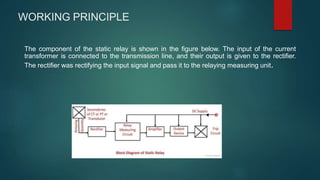
The component of the static relay is shown in the figure below. The input of the current
transformer is connected to the transmission line, and their output is given to the rectifier.
The rectifier was rectifying the input signal and pass it to the relaying measuring unit.
Figure Shows The Essential Components OfA Static Relay.
▶ The relaying quantity (the output of CT and PT or a transducer) is first rectified and
compared with the set values.
▶ The output is actuated when the dynamic input (relaying quantity) reaches the threshold
value. The valued is amplified and given to the output device which is usually an
electromagnetic. This energizes the trip coil and the relay operated
ADVANTAGES OF STATIC RELAY
The following are the benefits of static relays.
▶ The static relay consumes very less power because of which the burden on the measuring
instruments decreases and their accuracy increases.
▶ The static relay gives the quick response, long life, high reliability and accuracy and it is
shockproof.
▶ The reset time of the relay is very less.
▶ It does not have any thermal storage problems.
▶ The relay amplifies the input signal which increases their sensitivity.
▶ The chance of unwanted tripping is less in this relay.
▶ The static relay can easily operate in earthquake-prone areas because they have high
resistance to shock.
DISADVANTAGES OF STATIC RELAY
▶ Reliability cannot be predicted
▶ Construction is not very robust.
▶ Easily affected by surrounding interference.
▶ Auxiliarty DC supply is required.
▶ Affected by voltage transients
APPLICATIONS
▶ Ultra high speed protection of EHV AC transmission line utilizing distance protection.
▶ In over current and earth fault protection schemes.
▶ As main element in deferential relay.
LIMITATIONS OF STATIC RELAY
▶ The components used by the static relay are very sensitive to the electrostatic discharges.
The electrostatic discharges mean sudden flows of electrons between the charged
objects. Thus special maintenance is provided to the components so that it does not affect
by the electrostatic discharges.
▶ The relay is easily affected by the high voltage surges. Thus, precaution should be taken for
avoiding the damages through voltage spikes.
▶ The working of the relay depends on the electrical components.
▶ The relay has less overloading capacity.
▶ The static relay is more costly as compared to the electromagnetic relay.
▶ The construction of the relay is easily affected by the surrounding interference.
INSTANTANEOUS OVERCURRENT RELAY (DEFINE
CURRENT)
▶ Definite current relay operate instantaneously when the current reaches a
predetermined value.
▶ Its operation criterion is only current magnitude (without time delay).
▶ Operating time is constant.
▶ There is no intentional time delay.
▶ Coordination of definite-current relays is based on the fact that the fault current varies
with the position of the fault because of the difference in the impedance between the
fault and the source
▶ The relay located furthest from the source operate for a low current value
▶ The operating currents are progressively increased for the other relays when moving
towards the source.
▶ It operates in 0.1s or less
CONCLUSION
▶ Relays control output circuits of a much higher power.
▶ Safety is increased.
▶ Protective relays are essential for keeping faults in the system isolated and
keep equipment from being damaged.
THANK YOU

P&S PPT.pptx

  • 1.
    INTRODUCTION TO STATICRELAY SUCH AS MICROPROCESSOR BASED PROTECTIVE RELAY NAME- KARUNAKARAN B ROLL NO- 71381903008
  • 2.
    INTRODUCTION ▶ In aprotection relay, the term 'static' refers to the absence of moving parts to create the relay characteristic. Introduction of static relays began in the early 1960's. Their design is based on the use of analogue electronic devices instead of coils and magnets to create the relay characteristic.
  • 3.
    STATIC RELAYS A StaticRelay Is A Relay Which Uses Solid State Components Like Transistors, Diodes Etc. For The Measurement Or Comparison Of Electrical Quantities. The Static Network Is So Designed Them It Gives An Output Signal In The Tripping Direction WheneverAThreshold Conditions Reached. The Output Signal Is Turned Operated A Tripping Device Which May Be Electromagnetic Or Electrons. Static Relays Are Capable Or Performing The Same Function With The Use Of Electronic Control Circuit Which An Electromagnetic Relay Performs With The Use Of Moving Or Elements.
  • 4.
    WORKING PRINCIPLE The componentof the static relay is shown in the figure below. The input of the current transformer is connected to the transmission line, and their output is given to the rectifier. The rectifier was rectifying the input signal and pass it to the relaying measuring unit.
  • 5.
    Figure Shows TheEssential Components OfA Static Relay. ▶ The relaying quantity (the output of CT and PT or a transducer) is first rectified and compared with the set values. ▶ The output is actuated when the dynamic input (relaying quantity) reaches the threshold value. The valued is amplified and given to the output device which is usually an electromagnetic. This energizes the trip coil and the relay operated
  • 6.
    ADVANTAGES OF STATICRELAY The following are the benefits of static relays. ▶ The static relay consumes very less power because of which the burden on the measuring instruments decreases and their accuracy increases. ▶ The static relay gives the quick response, long life, high reliability and accuracy and it is shockproof. ▶ The reset time of the relay is very less. ▶ It does not have any thermal storage problems. ▶ The relay amplifies the input signal which increases their sensitivity. ▶ The chance of unwanted tripping is less in this relay. ▶ The static relay can easily operate in earthquake-prone areas because they have high resistance to shock.
  • 7.
    DISADVANTAGES OF STATICRELAY ▶ Reliability cannot be predicted ▶ Construction is not very robust. ▶ Easily affected by surrounding interference. ▶ Auxiliarty DC supply is required. ▶ Affected by voltage transients
  • 8.
    APPLICATIONS ▶ Ultra highspeed protection of EHV AC transmission line utilizing distance protection. ▶ In over current and earth fault protection schemes. ▶ As main element in deferential relay.

  • 9.
    LIMITATIONS OF STATICRELAY ▶ The components used by the static relay are very sensitive to the electrostatic discharges. The electrostatic discharges mean sudden flows of electrons between the charged objects. Thus special maintenance is provided to the components so that it does not affect by the electrostatic discharges. ▶ The relay is easily affected by the high voltage surges. Thus, precaution should be taken for avoiding the damages through voltage spikes. ▶ The working of the relay depends on the electrical components. ▶ The relay has less overloading capacity. ▶ The static relay is more costly as compared to the electromagnetic relay. ▶ The construction of the relay is easily affected by the surrounding interference.
  • 10.
    INSTANTANEOUS OVERCURRENT RELAY(DEFINE CURRENT) ▶ Definite current relay operate instantaneously when the current reaches a predetermined value.
  • 11.
    ▶ Its operationcriterion is only current magnitude (without time delay). ▶ Operating time is constant. ▶ There is no intentional time delay. ▶ Coordination of definite-current relays is based on the fact that the fault current varies with the position of the fault because of the difference in the impedance between the fault and the source ▶ The relay located furthest from the source operate for a low current value ▶ The operating currents are progressively increased for the other relays when moving towards the source. ▶ It operates in 0.1s or less
  • 12.
    CONCLUSION ▶ Relays controloutput circuits of a much higher power. ▶ Safety is increased. ▶ Protective relays are essential for keeping faults in the system isolated and keep equipment from being damaged.
  • 13.