P R T E S O L - G R A M!                                                                                                           AUGUST 2011


    PRTESOL-GRAM
          A publication of the Puerto Rico Teachers of English to Speakers of Other Languages


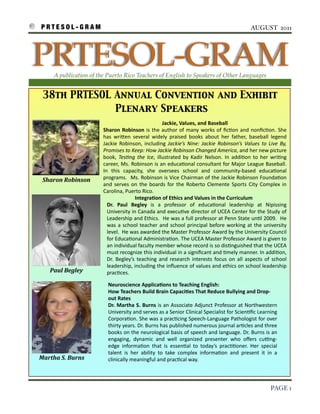
     38th PRTESOL Annual Convention and Exhibit
                  Plenary Speakers
                                                                         Jackie,	
  Values,	
  and	
  Baseball
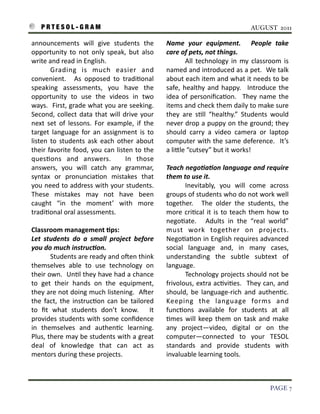
                                Sharon	
   Robinson	
  is	
  the	
  author	
  of	
   many	
  works	
   of	
   fic3on	
   and	
  nonfic3on.	
  She	
  
                                has	
   wri7en	
   several	
   widely	
   praised	
   books	
   about	
   her	
   father,	
   baseball	
   legend	
  
                                Jackie	
  Robinson,	
   including	
   Jackie’s	
   Nine:	
   Jackie	
   Robinson’s	
   Values	
   to	
  Live	
   By,	
  
                                Promises	
  to	
  Keep:	
  How	
  Jackie	
  Robinson	
  Changed	
  America,	
  and	
  her	
  new	
  picture	
  
                                book,	
   TesFng	
   the	
   Ice,	
   illustrated	
   by	
   Kadir	
   Nelson.	
   In	
   addi3on	
   to	
   her	
   wri3ng	
  
                                career,	
  Ms.	
  Robinson	
  is	
  an	
   educa3onal	
  consultant	
   for	
  Major	
  League	
  Baseball.	
  
                                In	
   this	
   capacity,	
   she	
   oversees	
   school	
   and	
   community-­‐based	
   educa3onal	
  
     Sharon	
  Robinson         programs.	
   	
  Ms.	
  Robinson	
  is	
  Vice	
  Chairman	
  of	
  the	
  Jackie	
   Robinson	
  Founda3on	
  
                                and	
   serves	
  on	
   the	
   boards	
   for	
  the	
   Roberto	
   Clemente	
   Sports	
  City	
   Complex	
   in	
  
                                Carolina,	
  Puerto	
  Rico.
                                                       Integra9on	
  of	
  Ethics	
  and	
  Values	
  in	
  the	
  Curriculum
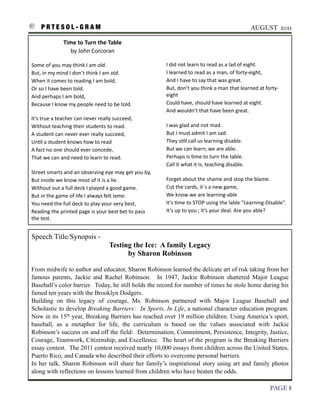
                                  Dr.	
   Paul	
   Begley	
   is	
   a 	
   professor	
   of	
   educa3onal	
   leadership	
   at	
   Nipissing	
  
                                  University	
   in	
  Canada	
  and	
  execu3ve	
   director	
  of	
  UCEA	
  Center	
  for	
  the	
  Study	
  of	
  
                                  Leadership	
  and	
  Ethics.	
  	
  He	
  was	
  a 	
  full	
  professor	
  at	
  Penn	
  State	
  un3l	
  2009.	
  	
  He	
  
                                  was	
  a	
  school	
   teacher	
  and	
  school	
   principal	
  before	
  working	
   at	
  the	
  university	
  
                                  level.	
  	
  He	
  was	
  awarded	
  the	
  Master	
  Professor	
  Award	
  by	
   the	
  University	
  Council	
  
                                  for	
  Educa3onal	
  Administra3on.	
  The	
  UCEA	
  Master	
  Professor	
   Award	
  is	
  given	
  to	
  
                                  an	
  individual	
  faculty	
  member	
  whose	
  record	
  is	
  so	
  dis3nguished	
  that	
  the	
  UCEA	
  
                                  must	
  recognize	
  this 	
  individual	
  in	
   a 	
  significant	
   and	
  3mely	
  manner.	
  In	
   addi3on,	
  
                                  Dr.	
   Begley’s	
   teaching	
   and	
   research	
   interests	
   focus	
  on	
   all	
   aspects	
  of	
   school	
  
                                  leadership,	
  including	
   the	
  influence	
  of	
  values	
  and	
  ethics	
  on	
  school	
  leadership	
  
         Paul	
  Begley           prac3ces.

                                   Neuroscience	
  Applica9ons	
  to	
  Teaching	
  English:	
  
                                   How	
  Teachers	
  Build	
  Brain	
  Capaci9es	
  That	
  Reduce	
  Bullying	
  and	
  Drop-­‐
                                   out	
  Rates
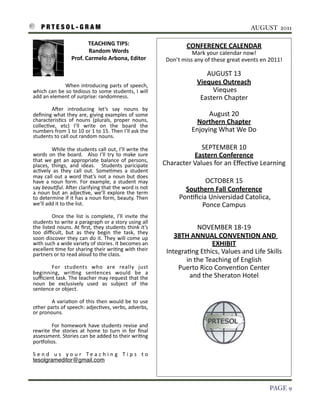
                                   Dr.	
  Martha	
   S.	
  Burns	
  is 	
  an	
  Associate	
  Adjunct	
  Professor	
   at	
  Northwestern	
  
                                   University	
  and	
  serves	
  as	
  a 	
  Senior	
  Clinical	
  Specialist	
  for	
  Scien3fic	
  Learning	
  
                                   Corpora3on.	
  She	
  was	
  a 	
  prac3cing	
  Speech-­‐Language	
  Pathologist	
  for	
  over	
  
                                   thirty	
  years.	
  Dr.	
  Burns	
  has	
  published	
  numerous	
  journal	
  ar3cles	
  and	
  three	
  
                                   books	
  on	
  the	
  neurological	
  basis	
  of	
   speech	
  and	
  language.	
  Dr.	
  Burns	
  is	
  an	
  
                                   engaging,	
   dynamic	
   and	
   well	
   organized	
   presenter	
   who	
   offers 	
   cuZng-­‐
                                   edge	
   informa3on	
   that	
   is	
   essen3al	
   to	
   today’s	
   prac33oner.	
   Her	
   special	
  
                                   talent	
   is 	
   her	
   ability	
   to	
   take	
   complex	
   informa3on	
   and	
   present	
   it	
   in	
   a	
  
    Martha	
  S.	
  Burns          clinically	
  meaningful	
  and	
  prac3cal	
  way.	


!                                                                                                                                                     PAGE 1
P R T E S O L - G R A M!                                                                                                                                                                                                AUGUST 2011

                                                                                                                                                            The	
   mo7o	
   of	
   the	
   Boy	
   scouts	
   is	
  
                                                                                                                                                           “Be 	
   Prepared”.	
   As 	
   the	
   month	
   of	


                                                                                                                                                                                                                                              Ed rn
                                                                                                                                                           August	
  approaches,	
  you	
  and	
  I	
   need	
  to	


                                                                                                                                                                                                                                                ito er
                                                                                                                                                           be	
  prepared	
  to	
  receive 	
  our	
   new	
  students	


                                                                                                                                                                                                                                        Co
                                                                                                                                                           for	
   the 	
   upcoming	
   school	
   year.	
   There	
   are	


                                                                                                                                                                                                                                                   r ’s
                                              PRTESOL-­‐Gram
                                                                                                                                                           some 	
  important	
   items	
   that	
   should	
   be	
  in	
   your	


                                             Table	
  of	
  Contents	
                                                                                                                first	
  aid	
  kit.	
   Use 	
  this	
  checklist	
  to	
  
    	
  Editor’s	
  Corner:	
  A	
  First	
  Aid	
  Kit	
  for	
                                                                                                                      make	
   sure 	
   you’re	
   ready	
   to	
   start	
  
    Teachers.......................................2                                                                                                                                  school.	
   The 	
  key	
   items	
   you’ll 	
  need	
  to	
  
    Dr.	
  Josué	
  Alejandro,	


                                  be	
  ready	
   are 	
   a 	
  toothpick,	
   rubberband,	
  
    2011	
  PRTESOL	
  President..............	
  3	
                                                                                                                                 eraser,	
   gum,	
   chocolate 	
   kiss,	
   bandaid,	
  
                                                                                                                                                                                      pencil,	
   and	
  a 	
  tea	
  bag.	
  You	
  may	
   ask,	
   “Why?”	
  
    	
  Cheap	
  (and	
  free!)	
  Technology	
  That	
                                                                                                                               Let	
  me	
  explain.
    Makes	
  Oral	
  Produc9on	
  Fun	


    by	
  Andrea	
  Dabbs..........................5	
  	
  
                                                                                                                                                                                 Toothpick:	
  This	
  will	
  remind	
  you	
  to	
  dig	
  deep	
  to	
  find	
  
    	
  Time	
  to	
  Turn	
  the	
  Table	


                                                                                                                                                                                 the	
  hidden	
  talents	
  others	
  have.	
  	
  
    by	
  John	
  Corcoran..........................8	
  
    	
  Tes9ng	
  the	
  Ice:	
  	
  A	
  family	
  Legacy	


      Rubber	
  bands:	
  To	
  remind	
  you	
  to	
  be	
  flexible	
  because	
  
    by	
  Sharon	
  Robinson......................8	
                         people	
  and	
  things	
  aren’t	
  always	
  the	
  way	
  you	
  want	
  
    	
  TEACHING	
  TIPS:	
  Random	
  words	


                        them	
  to	
  be.	
  
    Prof.	
  Carmelo	
  Arbona,	
  Editor.......	
  9	
  
                                                                                                                                                                                  Band	
  aid:	
  To	
  help	
  you	
  cure	
  those	
  
    	
  Conference	
  Calendar...................9	
                                                                                                                              hurt	
  feelings,	
  yours	
  or	
  of	
  others.	
  
    	
  Focusing	
  on	
  the	
  Academic	
  Needs	
  
    of	
  La9no	
  Students	


    by	
  Manuel	
  Hernandez	
  Carmona..10	
   Pencil:	
  To	
  jot	
  down	
  every	
  day	
  all	
  the	
  blessings	
  you	
  
                                                                                                                                                         receive.	
  
    	
  Reducing	
  Avoidable	
  Errors	


    by	
  Hazel	
  Davidson........................12	
                                                                                                  	
  
                                                                                                                                                         Eraser:	
  To	
  	
  remember	
  that	
  we	
  all	
  make	
  mistakes	
  
    	
  To	
  Publish	
  Or	
  Not	
  To	
  Publish:	
  An	
                                                                                             and	
  nothing	
  happens.	
  
    Ethical	
  Dilemma	
  For	
  Ac9on	
  
    Research	
  Teachers	


    by	
  Petra	
  E.	
  Avillan-­‐Leon..............14	
                                                                                                                        Bubble	
  gum:	
  To	
  remind	
  you	
  to	
  s3ck	
  to	
  every	
  thing	
  
                                                                                                                                                                                 that	
  takes	
  effort.	
  Persevere.	
  
    Coping	
  with	
  Coinages:	
  New	
  arrivals	


    in	
  the	
  English	
  Language	


    by	
  Dr.	
  Alicia	
  Pousada...................16               A	
  chocolate	
  Kiss:	
  This	
  reminds	
  you	
  that	
  
    	
  Phone9c	
  Reading,	
  Or	
  Sight	
                          everyone	
  needs	
  a	
  kiss	
  and	
  a	
  hug	
  daily.	
  
    Reading?
    by	
  Vivian	
  Mayol	
  Kauffmann.........20                                            Finally,	
  the	
  tea	
  bag:	
  What	
  
                                                                                                                                                                                  for?	
  	
  To	
  take	
  some	
  3me…	
  to	
  
    	
  Using	
  Emergent	
  Classroom	
                                                                                                                                          relax	
  and	
  make	
  a	
  list	
  of	
  all	
  the	
  nice	
  things	
  you	
  
    Situa2ons	
  as	
  Strategic	
  Learning	
                                                                                                                                    have.	
  
    Opportuni2es	
  while	
  Engaging	
  
    Students	
  in	
  Meaningful	
  Research	
                                                                                                                                         Remember:	
  to	
  the	
  world	
  you	
  maybe	
  only	
  
    Milagros	
  Marinez	
  ScheZni,	
  Ed.D.	
  &	
                                                                                                                                                                  somebody,	
  	
  
    Richard	
  Román	
  Spicer,	
  Ed.D.........22                                                                                                                                       but	
  to	
  somebody	
  you	
  may	
  be	
  the	
  world.	


!                                                                                                                                                                                                                                                            PAGE 2
P R T E S O L - G R A M!                                                                                                                                 AUGUST 2011

                PRTESOL	
  President’s	
  Message                                                                   This	
   coming	
   semester	
   we	
   will	
   have	
   three	
  
                                                                                                      more	
   chapter	
   conferences,	
   in	
   August,	
   Northern	
  
                                                                                                      Chapter,	
   in	
   September,	
   Eastern	
   Chapter	
   and	
  
                                                                                                      Southern	
   Chapter	
   in	
   October.	
   Then	
   our	
   most	


     We	
   are	
  glad	
   that	
   we	
   can	
   provide	
   you	
   with	
  
                                                                                                      important	
   event	
   will	
   be	
   our	
   38th	
   Annual	
  
    the	
   second	
   issue	
  of	
   the	
   PRTESOLGRAM	
   before	
   the	
  
                                                                                                      Conven9on	
   on	
   November	
   18-­‐19	
   at	
   the	
   beau9ful	
  
    beginning	
   of	
   the	
   new	
   semester.	
  Hopefully,	
  you	
  will	
  
                                                                                                      and	
   spacious	
   Puerto	
   Rico	
   Conven9on	
   Center.	
   The	
  
    have	
   more	
   3me	
   to	
   read	
   this	
   issue.	
   It	
   has	
   many	
  
                                                                                                      expecta3ons 	
  for	
   our	
  Conven3on	
  are	
  great.	
  	
  We	
  have	
  
    interes3ng	
  ar3cles	
  about	
  ethics,	
  ac3on	
  research,	
  the	
  
                                                                                                      three	
   outstanding	
   plenary	
   speakers;	
   Sharon	
  
    most	
  recent	
  developments 	
  in	
  the	
   English	
   language,	
          	
  
                                                                                                      Robinson	
   (daughter	
   of	
   Jackie	
   Robinson)	
   educator	
  
    educa3onal	
  technology,	
  among	
  others.
                                                                                                      and	
  author,	
   Dr.	
  Paul	
   Begley,	
   	
  from	
  Canada,	
   Director	
  
                The	
  PRTESOL	
   Board	
  has	
   been	
  working	
  hard	
                         of	
   the	
   Interna3onal	
   Center	
   for	
   the	
   Study	
   of	
  
    these	
   past	
   six	
   months	
   organizing	
   professional	
                               Leadership	
   and	
   Ethics,	
   and	
   Dr.	
   Martha	
   Burns	
   an	
  
    development	
   ac3vi3es	
   for	
   our	
   membership.	
   	
   The	
                           expert	
  in	
  the	
  field	
  of	
  neuroscience	
  and	
  learning.	
  	
  We	
  
    first	
   ac3vity	
   was	
   the	
   Southern	
   Chapter	
   Spring	
                            will	
   also	
   have	
   60	
   concurrent	
   sessions	
   offered	
   by	
  
    Ins3tute	
   in	
   April;	
   a	
   great	
   success	
   in	
   terms	
   of	
                  presenters	
  from	
  Puerto	
  Rico,	
  the	
  United	
   States,	
  the	
  
    organiza3on,	
   quality	
   of	
   workshops 	
   and	
   recrui3ng	
                            Virgin	
   islands	
   and	
   the	
  Dominican	
   Republic.	
   	
   Many	
  
    new	
   members.	
   Then	
   we	
  had	
  the	
   Western	
  Chapter	
                           exhibitors	
   with	
   the	
   most	
   up	
   to	
   date	
   educa3onal	
  
    conference	
  at	
  the	
  end	
  April	
  and	
  the	
  Metro	
  Chapter	
                       materials	
  will	
  be	
  there.	
   We	
   invite	
  you	
  to	
  stay	
  at	
  the	
  
    conference	
   in	
   May,	
   both	
   events	
   were	
   also	
   very	
                       new	
   Sheraton	
   Hotel	
   and	
   Casino	
   next	
   to	
   the	
  
    successful.	
   Our	
   last	
   ac3vity	
   of	
   this	
   period	
   was	
   the	
             Conven3on	
   Center.	
   Our	
   conference	
   par3cipants	
  
    Summer	
  Ins9tute	
   which	
  focused	
  on	
  technology	
  and	
                              have	
   been	
   given	
   the	
   excep3onally	
   special	
   rate	
   of	
  
    was	
  held	
   at	
  UPR	
   Aguadilla.	
   	
   This	
   ac3vity	
   gave	
   the	
             $139	
  plus	
  taxes	
  per	
  night	
  per	
  room.	
  
    par3cipants 	
  the	
   opportunity	
   to	
   have	
   five	
   hours	
   of	
  
                                                                                                                     Please	
   join	
   us	
   for	
   this 	
   extraordinary	
  
    intensive	
  training	
  in	
  the	
  effec3ve	
   use	
   of	
  technology	
  
                                                                                                      professional	
   development	
   event	
   for	
   English	
  
    tools	
   for	
   their	
   teaching.	
   	
   I	
   a7ended	
   the	
   higher	
  
                                                                                                      educators,	
   the	
   38th	
   Annual	
   PRTESOL	
   Conven9on	
  
    educa3on	
  workshop	
  offered	
  by	
   Dr.	
  Leonardo	
  Flores	
  
                                                                                                      on	
  November	
  18-­‐19.	
  	
  Preregister	
  so	
   you	
  can	
   get	
  the	
  
    which	
  was	
  indeed	
  excep3onal	
  and	
  engaging.	
  	
  
                                                                                                      best	
  rates	
   and	
  	
  have	
  the	
  opportunity	
  to	
  par9cipate	
  
                   One	
   of	
   my	
   goals	
  for	
   this	
   year	
   has	
   been	
   to	
     in	
  a	
   raffle	
  for	
   a	
   free	
  night	
  at	
  the	
   	
  Sheraton	
  Hotel.	
  
    make	
   PRTESOL	
   more	
   visible	
   and	
   known	
   by	
   all	
                          See	
   the	
   conven3on	
   centerfold	
   for	
   all	
   the	
  
    English	
  educators,	
  poli3cians,	
  and	
  society	
  in	
  general.	
                        informa3on	
   and	
   forms	
   and	
   visit	
   our	
   website	
   for	
  
    We	
   have	
   been	
   distribu3ng	
   PRTESOL	
   promo3onal	
                                 more	
  details.	
  www.puertoricotesol.org
    material	
  which	
  has	
  helped	
  us	
  make	
   new	
  contacts	
  in	
  
                                                                                                      May	
  God	
  bless	
  you.
    different	
  places	
  and	
   ins3tu3ons.	
   	
   At	
  the	
  beginning	
  
    of	
  this 	
  month	
  we	
  went	
  to	
   the	
  legislature	
  where	
  we	
           	
     Dr.	
  Josué	
  Alejandro,
    distributed	
   the	
   PRTESOL	
   brochure	
   and	
   conven3on	
  
    poster	
   and	
   spoke	
   to	
   several	
   key	
   people.	
   	
   We	
  s3ll	
             2011	
  PRTESOL	
  President
    have	
  a 	
  lot	
  of	
  work	
  to	
  do	
  in	
  order	
  to	
  make	
  PRTESOL	
  a	
  
    more	
  visible	
  and	
  respected	
  organiza3on	
  . 	
  Please	
  join	
  
    us	
  in	
  this	
  effort.


!                                                                                                                                                                                 PAGE 3
P R T E S O L - G R A M!                                                                                               AUGUST 2011

    TESOLGRAM is a periodical
    service to English language
    educators and administrators
    published by
         Puerto Rico TESOL,
           P. O. Box 366828,
     San Juan, PR 00936 -6828.
    Newsletter Staff
    Editor: Carmelo Arbona
    Circulation: 1,000.
    Articles on English-
    language teaching, theory,
    and education in general
    are welcomed. Submissions
    must be in MSWord format,
    double-spaced, no longer
    than five pages, and should
    follow APA or TESOL
    Quarterly style. All entries
    are subject to editing for
    style, space, and other
    professional considerations.

    Copyright Notice
    Articles may be reproduced for
    classroom use. Quotations up
    to twenty-five (25) words are
    permitted if credit to the author
    and the TESOLGRAM are
    included. In other situations,
    written permission is required.

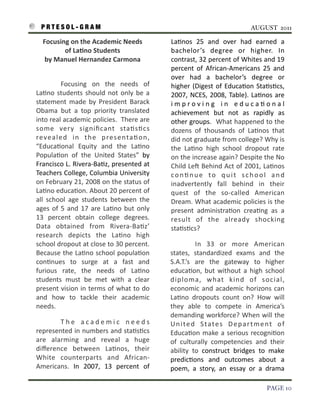
                     Dr. Josué
                     Alejandro,
                     President
                                                             PRTESOL	
  2011	
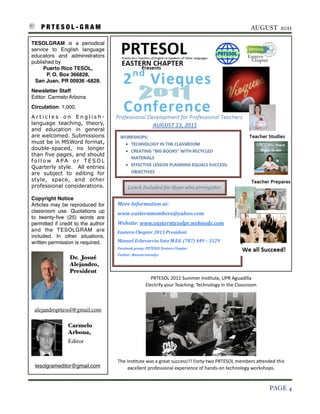
  Summer	
  Ins3tute,	
  UPR	
  Aguadilla
                                                          Electrify	
  your	
  Teaching:	
  Technology	
  in	
  the	
  Classroom


     alejandroprtesol@gmail.com

                    Carmelo
                    Arbona,
                    Editor


                                        The	
  Ins3tute	
  was	
  a	
  great	
  success!!!	
  Forty-­‐two	
  PRTESOL	
  members	
  aIended	
  this	
  
     tesolgrameditor@gmail.com                  excellent	
  professional	
  experience	
  of	
  hands-­‐on	
  technology	
  workshops.


!                                                                                                                                          PAGE 4
P R T E S O L - G R A M!                                                                                                     AUGUST 2011

             Cheap	
  (and	
  free!)	
  	
  Technology	
                        between	
   the	
   real	
   world	
   and	
   the	
  
            That	
  Makes	
  Oral	
  ProducAon	
  Fun                           classroom.

                       Andrea	
  Dabbs                                          PowerPoint	
  NarraAon.
                 ESL	
  Instructor/Trainer                                      	
           Using	
  a	
  headset	
  with	
   a	
  microphone	
  
              www.writewiseconsul3ng.com                                        built-­‐in	
   (approximately	
   $15.00),	
   you	
   can	
  
                                                                                create	
  listening	
  and	
   speaking	
  assessments	
  
    	
         Looking	
   for	
   ways	
   to	
   increase	
                   for	
   your	
  class.	
  Pair	
  it	
   up	
  with	
   Jing,	
  a	
   screen	
  
    authen3c	
   speaking	
   opportuni3es	
   for	
   your	
                   capture	
  soSware	
  from	
  Techsmith.com
    students?	
   	
   With	
   a	
   video	
   camera,	
   free	
              (hIp://www.techsmith.com/download/
    soSware,	
  and	
  a	
  set	
  of	
   headphones	
   with	
  a	
            jing),	
   and	
  you	
   have	
  the	
   capacity	
   to	
   record	
  
    microphone,	
   you	
   can	
   set	
   up	
   a	
   classroom	
            non-­‐readers	
  because	
  the	
   students	
  are	
   able	
  
    rich	
   in	
   authen3c	
   oral	
   assessment	
   that	
   is	
          to	
  listen	
  and	
  repeat.
    fun	
  and	
  easy	
  to	
  manage.	
  	
  When	
  anxiety	
  is	
          The	
   set-­‐up	
   is	
   fairly	
   simple.	
   	
   Create	
   a	
  
    low	
   and	
   excitement	
   is	
   high,	
   your	
   ESL	
              PowerPoint	
   slide	
   show	
   with	
   words,	
  
    assessments	
  won’t	
  feel	
  like	
  assessments	
   at	
                sentences	
   or	
   reading	
   passages.	
   	
   You	
   can	
  
    all.	
                                                                      design	
  it	
  to	
  your	
  liking.	
  	
  ASer	
  it	
  is	
  created,	
  
    	
         With	
   a	
  small	
  amount	
  of	
  prepara3on	
              using	
   the	
   microphone,	
   record	
   whatever	
  
    you	
  can,                                                                 oral	
  components	
   you	
  wish.	
  	
  Dummies.com	
  
          • Lower	
  students’	
  affec3ve	
  filter,                             has	
   a	
  great	
  online	
  video	
   that	
  explains	
   the	
  
          • Use	
   dynamic,	
   not	
   sta3c,	
   tools	
   to	
              h o w -­‐ t o	
   a t	
   h I p : / / y o u t u . b e /
               create	
  forma3ve	
  assessments                                QZp3jumnWUg.	
  
          • Provide	
   a	
   real,	
   authen)c	
   audience	
  
               for	
  students                                                     	
        How	
  to	
   use	
  this	
  in	
   classroom?	
   	
   The	
  
          • Collect	
   data	
   for	
   oral	
   produc3on	
   possibili3es	
  are	
  endless.	
  	
  
               skills                                                              	
        Students	
   can	
   listen	
   and	
   read	
   aloud	
  
                                                                                   with	
   the	
   text	
  or	
  simply	
   listen	
   and	
   repeat.	


         Why	
  these	
  two	
  tools?	
   	
  Not	
  only	
   are	
   For	
   reading	
   prac3ce,	
   students	
   can	
   record	
  
    they	
  cheap,	
  but	
  they	
  are	
  also	
  immediately	
   themselves	
   reading	
   what	
   the	
   instructor	
  
    important	
   to	
   students	
   of	
   all	
   ages.	
   has	
   wriIen	
   on	
   the	
   slides.	
   	
   They	
   simply	


    PowerPoint	
  is	
  the	
  industry	
  standard	
  in	
  the	
   save	
   the	
   narra3on	
   and	
   the	
  instructor	
   can	
  
    business	
  world.	
   Medical,	
  business	
   and	
  law	
   listen	
  back	
  to	
  it	
  later.	
  As	
  students	
  advance,	
  
    offices	
   world-­‐wide	
   use	
   MicrosoS	
   Office	
   they	
   can	
   create	
   their	
   own	
   sentences	
   or	
  
    products.	
   	
   Addi3onally,	
   many	
   students-­‐-­‐ stories	
   and	
  record	
  their	
   own	
  narra3ons	
   as	
  
    especially	
  adults-­‐-­‐	
   are	
  using	
  video	
  cameras	
   well.
    with	
   their	
   families.	
   	
   It	
   is	
   a	
   perfect	
   meld	


!                                                                                                                                                   PAGE 5
P R T E S O L - G R A M!                                                                                                 AUGUST 2011

    	
        Listening,	
   speaking	
   and	
   recording	
                    teachers	
   can	
  use	
   a	
  variety	
   of	
  techniques	
  
    themselves	
   takes	
   the	
   pressure	
   off	
   of	
                    to	
   encourage	
   students	
   to	
   speak	
   in	
  
    students	
   to	
   perform	
   in	
   a	
   more	
   anxiety-­‐             English.	
   Digital	
   cameras	
   come	
   with	
   a	
  
    filled	
  seeng,	
  such	
  as	
  in	
   front	
  of	
  the	
   class.	
  
                                                                         	
      video	
   op3on	
   for	
   short	
   clips	
   and	
   digital	
  
    For	
   some	
   students,	
   even	
   having	
   the	
                     video	
   cameras	
   can	
   be	
   purchased	
   for	
   as	
  
    instructor	
   in	
   the	
   background	
   can	
   be	
                    liIle	
  as	
  $60.00.
    cause	
   for	
  concern.	
   	
  Headphones	
   provide	
                   	
        Monitoring	
   oral	
  produc3on	
  for	
  ESL	
  
    a	
  sense	
  of	
  privacy	
  for	
  many	
  students	
  and,	
             students	
   can	
   be	
   tricky.	
   	
  When	
   students’	
  
    thus,	
  reduce	
  any	
  extra	
  stress.                                   perform	
   speeches,	
   public	
   speaking	
  
                                                                                 anxiety	
   can	
   nega3vely	
   influence	
   their	
  
    	
           Students	
   who	
   need	
   oral	
   prac3ce	
                English	
   produc3on.	
  There	
   is	
   less	
   anxiety	
  
    but	
   cannot	
   read	
   can	
   s3ll	
   use	
   the	
   tool.	
  
                                                                      	
         when	
   performing	
   in	
   front	
   of	
   a	
   video	
  
    The	
   instructor	
   records	
   the	
  narra3on	
   and	
                 camera,	
   as	
   opposed	
   to	
   these	
   more	
  
    the	
  student	
  listen	
  and	
   repeats.	
   	
  Need	
   to	
           tradi3onal	
   “speeches”	
   in	
   class.	
   	
   For	
   ESL	
  
    grade	
   it?	
   	
   Pair	
   this	
   up	
   with	
   screen	
            students,	
   you	
   are	
   more	
   likely	
   to	
   get	
   an	
  
    capture	
   soSware	
   to	
   listen	
   to	
   their	
                     authen3c	
   assessment	
   of	
   their	
   fluency	
  
    responses.	
   Several	
   students	
   can	
   do	
   this	
                and	
  grammar	
  skills.	
  
    in	
  a	
  40-­‐minute	
  class	
  period.	
                                 	
        An	
   easy	
   way	
   to	
   get	
   started	
   	
   with	
  
                                                                                 ESL	
   students	
   of	
   any	
   level	
   is	
   to	
   film	
  
    	
        Do	
   you	
   want	
   pronuncia3on	
                             students	
   reading	
   their	
   wri3ng	
   or	
  
    prac3ce?	
   	
   Add	
   a	
   web	
   camera	
   to	
   the	
              answering	
   a	
   ques3on.	
   These	
   projects	
  
    computer,	
   and	
   students	
   can	
   prac3ce	
                         require	
   virtually	
   no	
   edi3ng,	
   and	
   cheap	
  
    ar3cula3on	
   points	
   on	
   their	
   own.	
   	
   No	
                and	
   easy	
   soSware	
   such	
   as	
   Windows	
  
    “remembering	
  what	
   was	
   said”	
   needs	
   to	
                    Movie	
   Maker	
   make	
   it	
   into	
   a	
   movie	
   in	
  
    happen—it	
   is	
   right	
   there	
   on	
   the	
                        minutes.	
  	
  
    computer	
  to	
   listen	
   back	
   to.	
   	
   Also,	
  it	
  can	
     	
        Beginning	
   and	
   Intermediate	
   ESL	
  
    be	
   graded	
   outside	
   of	
   class,	
  freeing	
  class	
            students	
   can	
   begin	
   videos	
   with	
   learning	
  
    3me	
  for	
  instruc3on.	
  Saving	
  students	
   oral	
                   and	
   reci3ng	
   nursery	
   rhymes.	
   	
   This	
  
    produc3on	
   provides	
   a	
   quick	
   and	
   easy	
                    provides	
   prac3ce	
   with	
   rhyming	
   words,	
  
    digital	
   porkolio	
   of	
   oral	
   produc3on.	
   Data	
               word	
   endings,	
   past	
   tense	
   verbs,	
  
    collec3on	
   for	
   individual	
   students	
   as	
   well	
              ques3ons	
   and	
   tag	
   ques3ons.	
   	
   Tongue	
  
    as	
   the	
   en3re	
   class	
   can	
   be	
   done	
   quickly	
         twisters	
   provide	
   pronuncia3on	
   prac3ce	
  
    and	
  accurately.                                                           with	
   voiced	
   &	
   unvoiced	
   sounds	
   and	
  
                                                                                 other	
   commonly	
   confused	
   beginnings	
  
    Video	
  Cameras.                                                            and	
  endings.
    	
       V i d e o	
   c a m e ra s	
   p r o v i d e	
   a n	
              	
        As	
   students	
   advance,	
   so	
   can	
   the	
  
    u n l i m i t e d	
   re s o u rc e	
   fo r	
   c re a 3 n g	
              projects.	
  	
  How-­‐to	
  projects,	
  informa3onal	
  
    assessments.	
   	
  With	
   very	
   liIle	
   “training”,	
               v i d e o s	
   a n d	
   p u b l i c	
   s e r v i c e	
  

!                                                                                                                                             PAGE 6
P R T E S O L - G R A M!                                                                                                 AUGUST 2011

    announcements	
   will	
   give	
   students	
   the	
                      Name	
   your	
   equipment.	
   	
   People	
   take	
  
    opportunity	
   to	
   not	
   only	
   speak,	
  but	
   also	
            care	
  of	
  pets,	
  not	
  things.
    write	
  and	
  read	
  in	
  English.	
  	
                                	
         All	
   technology	
   in	
   my	
   classroom	
   is	
  
    	
         Grading	
   is	
   much	
   easier	
   and	
                     named	
  and	
  introduced	
  as	
  a	
  pet.	
  	
   We	
  talk	
  
    convenient.	
   	
   As	
   opposed	
   to	
   tradi3onal	
                 about	
  each	
   item	
  and	
  what	
   it	
  needs	
  to	
   be	
  
    speaking	
   assessments,	
   you	
   have	
   the	
                        safe,	
  healthy	
   and	
   happy.	
   	
   Introduce	
   the	
  
    opportunity	
   to	
   use	
   the	
   videos	
   in	
   two	
              idea	
  of	
   personifica3on.	
   	
   They	
   name	
   the	
  
    ways.	
  	
  First,	
  grade	
  what	
  you	
  are	
  seeking.	
     	
     items	
  and	
  check	
  them	
  daily	
  to	
  make	
  sure	
  
    Second,	
   collect	
   data	
   that	
  will	
   drive	
   your	
          they	
   are	
   s3ll	
   “healthy.”	
   Students	
   would	
  
    next	
   set	
   of	
   lessons.	
   For	
   example,	
   if	
   the	
      never	
  drop	
  a	
  puppy	
  on	
   the	
  ground;	
   they	
  
    target	
   language	
   for	
   an	
   assignment	
   is	
   to	
           should	
   carry	
   a	
   video	
   camera	
   or	
   laptop	
  
    listen	
   to	
   students	
   ask	
   each	
   other	
   about	
           computer	
   with	
  the	
  same	
  deference.	
   	
  It’s	
  
    their	
   favorite	
   food,	
   you	
   can	
  listen	
   to	
   the	
     a	
  liIle	
  “cutsey”	
  but	
  it	
  works!
    ques3ons	
   and	
   answers.	
   	
   In	
   those	
  
    answers,	
   you	
   will	
   catch	
   any	
   grammar,	
                  Teach	
  nego6a6on	
  language	
  and	
  require	
  
    syntax	
   or	
   pronuncia3on	
   mistakes	
   that	
                      them	
  to	
  use	
  it.
    you	
  need	
   to	
   address	
   with	
  your	
  students.	
       	
     	
        Inevitably,	
   you	
   will	
   come	
   across	
  
    These	
   mistakes	
   may	
   not	
   have	
   been	
                      groups	
  of	
  students	
   who	
  do	
  not	
  work	
   well	
  
    caught	
   “in	
   the	
   moment’	
   with	
   more	
                      together.	
   	
   The	
   older	
   the	
   students,	
   the	
  
    tradi3onal	
  oral	
  assessments.	
                                        more	
   cri3cal	
   it	
  is	
   to	
   teach	
   them	
   how	
   to	
  
                                                                                nego3ate.	
   	
   Adults	
   in	
   the	
   “real	
   world”	
  
    Classroom	
  management	
  Aps:                                             must	
   work	
   together	
   on	
   projects.	
  
    Let	
   students	
   do	
   a	
   small	
   project	
   before	
            Nego3a3on	
   in	
  English	
  requires	
  advanced	
  
    you	
  do	
  much	
  instruc6on.	
                                          social	
   language	
   and,	
   in	
   many	
   cases,	
  
    	
           Students	
  are	
  ready	
   and	
  oSen	
  think	
            understanding	
   the	
   subtle	
   subtext	
   of	
  
    themselves	
   able	
   to	
   use	
   technology	
   on	
                  language.	
  	
  
    their	
  own.	
  	
   Un3l	
  they	
  have	
  had	
  a	
  chance	
          	
        Technology	
  projects	
   should	
  not	
   be	
  
    to	
   get	
   their	
   hands	
   on	
   the	
   equipment,	
              frivolous,	
  extra	
  ac3vi3es.	
   	
  They	
   can,	
  and	
  
    they	
  are	
  not	
  doing	
  much	
  listening.	
  	
  ASer	
             should,	
   be	
   language-­‐rich	
   and	
   authen3c.	
  
    the	
   fact,	
  the	
   instruc3on	
   can	
   be	
   tailored	
           Keeping	
   the	
   language	
   forms	
   and	
  
    to	
   fit	
   what	
   students	
   don’t	
   know.	
   	
   It	
           func3ons	
   available	
   for	
   students	
   at	
   all	
  
    provides	
   students	
  with	
   some	
   confidence	
                      3mes	
   will	
   keep	
   them	
   on	
   task	
   and	
   make	
  
    in	
   themselves	
   and	
   authen3c	
   learning.	
          	
          any	
   project—video,	
   digital	
   or	
   on	
   the	
  
    Plus,	
   there	
  may	
  be	
  students	
   with	
  a	
  great	
           computer—connected	
   to	
   your	
   TESOL	
  
    deal	
   of	
   knowledge	
   that	
   can	
   act	
   as	
                 standards	
   and	
   provide	
   students	
   with	
  
    mentors	
  during	
  these	
  projects.                                     invaluable	
  learning	
  tools.


!                                                                                                                                            PAGE 7
P R T E S O L - G R A M!                                                                                                                   AUGUST 2011

                         Time	
  to	
  Turn	
  the	
  Table
                            by	
  John	
  Corcoran

    Some	
  of	
  you	
  may	
  think	
  I	
  am	
  old.                               I	
  did	
  not	
  learn	
  to	
  read	
  as	
  a	
  lad	
  of	
  eight.
    But,	
  in	
  my	
  mind	
  I	
  don’t	
  think	
  I	
  am	
  old.                 I	
  learned	
  to	
  read	
  as	
  a	
  man,	
  of	
  forty-­‐eight,
    When	
  it	
  comes	
  to	
  reading	
  I	
  am	
  bold,                           And	
  I	
  have	
  to	
  say	
  that	
  was	
  great.
    Or	
  so	
  I	
  have	
  been	
  told.                                             But,	
  don’t	
  you	
  think	
  a	
  man	
  that	
  learned	
  at	
  forty-­‐
    And	
  perhaps	
  I	
  am	
  bold,	
                                               eight
    Because	
  I	
  know	
  my	
  people	
  need	
  to	
  be	
  told.                  Could	
  have,	
  should	
  have	
  learned	
  at	
  eight.
                                                                                       And	
  wouldn’t	
  that	
  have	
  been	
  great.
    It’s	
  true	
  a	
  teacher	
  can	
  never	
  really	
  succeed,
    Without	
  teaching	
  their	
  students	
  to	
  read.                            I	
  was	
  glad	
  and	
  not	
  mad.
    A	
  student	
  can	
  never	
  ever	
  really	
  succeed,                         But	
  I	
  must	
  admit	
  I	
  am	
  sad.
    Un3l	
  a	
  student	
  knows	
  how	
  to	
  read                                 They	
  s3ll	
  call	
  us	
  learning	
  disable.
    A	
  fact	
  no	
  one	
  should	
  ever	
  concede,                               But	
  we	
  can	
  learn;	
  we	
  are	
  able.
    That	
  we	
  can	
  and	
  need	
  to	
  learn	
  to	
  read.                     Perhaps	
  is	
  3me	
  to	
  turn	
  the	
  table.	
  
                                                                                       Call	
  it	
  what	
  it	
  is,	
  teaching	
  disable.	
  
    Street	
  smarts	
  and	
  an	
  observing	
  eye	
  may	
  get	
  you	
  by,
    But	
  inside	
  we	
  know	
  most	
  of	
  it	
  is	
  a	
  lie.                 Forget	
  about	
  the	
  shame	
  and	
  stop	
  the	
  blame.
    Without	
  out	
  a	
  full	
  deck	
  I	
  played	
  a	
  good	
  game.           Cut	
  the	
  cards,	
  it`s	
  a	
  new	
  game,	
  
    But	
  in	
  the	
  game	
  of	
  life	
  I	
  always	
  felt	
  lame.	
           We	
  know	
  we	
  are	
  learning-­‐able
    You	
  need	
  the	
  full	
  deck	
  to	
  play	
  your	
  very	
  best,          It’s	
  3me	
  to	
  STOP	
  using	
  the	
  lable	
  “Learning-­‐Disable”.
    Reading	
  the	
  printed	
  page	
  is	
  your	
  best	
  bet	
  to	
  pass	
     It’s	
  up	
  to	
  you	
  ;	
  it’s	
  your	
  deal.	
  Are	
  you	
  able?
    the	
  test.


    Speech Title/Synopsis -
                                                       Testing the Ice: A family Legacy
                                                             by Sharon Robinson

    From midwife to author and educator, Sharon Robinson learned the delicate art of risk taking from her
    famous parents, Jackie and Rachel Robinson. In 1947, Jackie Robinson shattered Major League
    Baseball’s color barrier. Today, he still holds the record for number of times he stole home during his
    famed ten years with the Brooklyn Dodgers.
    Building on this legacy of courage, Ms. Robinson partnered with Major League Baseball and
    Scholastic to develop Breaking Barriers: In Sports, In Life, a national character education program.
    Now in its 15th year, Breaking Barriers has reached over 19 million children. Using America’s sport,
    baseball, as a metaphor for life, the curriculum is based on the values associated with Jackie
    Robinson’s success on and off the field: Determination, Commitment, Persistence, Integrity, Justice,
    Courage, Teamwork, Citizenship, and Excellence. The heart of the program is the Breaking Barriers
    essay contest. The 2011 contest received nearly 10,000 essays from children across the United States,
    Puerto Rico, and Canada who described their efforts to overcome personal barriers.
    In her talk, Sharon Robinson will share her family’s inspirational story using art and family photos
    along with reflections on lessons learned from children who have beaten the odds.

!                                                                                                                                                              PAGE 8
P R T E S O L - G R A M!                                                                                                                                           AUGUST 2011

                                            TEACHING	
  TIPS:	


                    CONFERENCE	
  CALENDAR
                                            Random	
  Words	


                   Mark	
  your	
  calendar	
  now!	
  
                                  Prof.	
  Carmelo	
  Arbona,	
  Editor                                                    Don’t	
  miss	
  any	
  of	
  these	
  great	
  events	
  en	
  2011!

                                                                                                                                                AUGUST	
  13
                          When	
  introducing	
   parts	
  of	
   speech,	
  
                                                                                                                                             Vieques	
  Outreach
    which	
   can	
   be	
  so	
   tedious	
  to	
  some	
   students,	
  I	
  will	
                                                             	
  Vieques
    add	
  an	
  element	
  of	
  surprise:	
  randomness.	
                                                                                  Eastern	
  Chapter
    	
      Ater	
   introducing	
   let’s	
   say	
   nouns	
   by	
  
    defining	
  what	
  they	
  are,	
  giving	
  examples	
  of	
   some	
                                                                      August	
  20
    characteris3cs	
   of	
   nouns 	
  (plurals,	
   proper	
   nouns,	
                                                                  Northern	
  Chapter
    collec3ve,	
   etc)	
   I’ll	
   write	
   on	
   the	
   board	
   the	
  
    numbers	
  from	
  1	
  to	
  10	
  or	
  1 	
  to	
  15.	
  Then	
  I’ll	
  ask	
  the	
                                             Enjoying	
  What	
  We	
  Do
    students	
  to	
  call	
  out	
  random	
  nouns.	


            While	
  the	
  students	
  call	
  out,	
  I’ll	
  write	
  the	
                                                      SEPTEMBER	
  10
    words	
  on	
   the	
   board.	
   	
   Also	
   I’ll	
  try	
   to	
  make	
   sure	
                                             Eastern	
  Conference
    that	
  we	
   get	
   an	
   appropriate	
   balance	
   of	
   persons,	
  
    places,	
   things,	
   and	
   ideas.	
   	
   Students	
   paricipate	
                                             Character	
  Values	
  for	
  an	
  Effec3ve	
  Learning
    ac3vely	
   as	
   they	
   call	
   out.	
   Some3mes	
   a 	
   student	
  
    may	
  call	
  out	
  a	
  word	
   that’s	
  not	
   a	
  noun	
   but	
   does	
  
    have	
  a	
   noun	
   form.	
   For	
   example,	
  a	
   student	
   may	
                                                             OCTOBER	
  15
    say	
  beauFful.	
  Ater	
  clarifying	
   that	
  the	
  word	
  is	
  not	
                                                      Southern	
  Fall	
  Conference
    a	
  noun	
  but	
  an	
  adjec3ve,	
  we’ll	
  explore	
  the	
  term	
  
    to	
  determine	
  if	
  it	
  has	
  a 	
  noun	
  form,	
  beauty.	
  Then	
                                               	
  Pon3ficia	
  Universidad	
  Catolica,
    we’ll	
  add	
  it	
  to	
  the	
  list.                                                                                                Ponce	
  Campus
    	
          Once	
   the	
   list	
   is	
   complete,	
   I’ll	
   invite	
   the	
  
    students	
  to	
   write	
  a 	
  paragraph	
   or	
  a	
  story	
  using	
  all	
  
    the	
  listed	
  nouns.	
  At	
  first,	
  they	
  students	
   think	
  it’s	
                                                         NOVEMBER	
  18-­‐19
    too	
   difficult,	
   but	
   as	
   they	
   begin	
   the	
   task,	
   they	
  
    soon	
  discover	
   they	
  can	
  do	
   it.	
  They	
  will	
  come	
  up	
                                           	
  38TH	
  ANNUAL	
  CONVENTION	
  AND	
  	
  
    with	
  such	
  a	
  wide	
  variety	
  of	
  stories.	
  It	
  becomes	
  an	
                                                                EXHIBIT
    excellent	
  3me	
  for	
  sharing	
  their	
  wri3ng	
   with	
  their	
                                              Integra3ng	
  Ethics,	
  Values	
  and	
  Life	
  Skills	
  
    partners	
  or	
  to	
  read	
  aloud	
  to	
  the	
  class.
                                                                                                                                    in	
  the	
  Teaching	
  of	
  English
    	
        For	
   students	
   who	
   are	
   really	
   just	
                                                              Puerto	
  Rico	
  Conven3on	
  Center
    beginning,	
   wri3ng	
   sentences	
   would	
   be	
   a	
  
    sufficient	
  task.	
  The	
  teacher	
  may	
  request	
  that	
  the	
                                                           and	
  the	
  Sheraton	
  Hotel
    noun	
   be	
   exclusively	
   used	
   as 	
   subject	
   of	
   the	
  
    sentence	
  or	
  object.	


         A	
   varia3on	
   of	
  this 	
  then	
  would	
   be	
  to	
  use	
  
    other	
  parts	
  of	
  speech:	
  adjec3ves,	
  verbs,	
  adverbs,	
  
    or	
  pronouns.	


         For	
  homework	
   have	
   students	
  revise	
  and	
  
    rewrite	
   the	
   stories	
   at	
   home	
  to	
   turn	
   in	
   for	
   final	
  
    assessment.	
  Stories	
  can	
  be	
  added	
   to	
  their	
  wri3ng	
  
    porvolios.	
  

    S e n d	
   u s	
   y o u r	
   T e a c h i n g	
   T i p s	
   t o	
  
    tesolgrameditor@gmail.com	


!                                                                                                                                                                                       PAGE 9
P R T E S O L - G R A M!                                                                                                  AUGUST 2011

        Focusing	
  on	
  the	
  Academic	
  Needs	
                                La3nos	
   25	
   and	
   over	
   had	
   earned	
   a	
  
                 of	
  LaAno	
  Students                                            bachelor’s	
   degree	
   or	
   higher.	
   In	
  
         by	
  Manuel	
  Hernandez	
  Carmona	


     contrast,	
  32	
  percent	
  of	
  Whites	
   and	
  19	
  
                                                                                    percent	
   of	
   African-­‐Americans	
   25	
   and	
  
                                                                                    over	
   had	
   a	
   bachelor’s	
   degree	
   or	
  
                    Focusing	
   on	
   the	
   needs	
   of	
                      higher	
   (Digest	
   of	
   Educa3on	
   Sta3s3cs,	
  
    La3no	
   students	
   should	
   not	
   only	
   be	
   a	
                   2007,	
  NCES,	
  2008,	
  Table).	
  La3nos	
   are	
  
    statement	
   made	
   by	
   President	
   Barack	
                            i m p r o v i n g	
   i n	
   e d u c a 3 o n a l	
  
    Obama	
   but	
   a	
   top	
   priority	
   translated	
                       achievement	
   but	
   not	
   as	
   rapidly	
   as	
  
    into	
  real	
  academic	
  policies.	
  	
  There	
   are	
                    other	
  groups.	
  	
  What	
  happened	
  to	
  the	
  
    some	
   very	
   significant	
   sta3s3cs	
                                     dozens	
   of	
   thousands	
   of	
   La3nos	
   that	
  
    reve a l e d	
   i n	
   t h e	
   p re s e nta 3 o n ,	
                       did	
  not	
  graduate	
  from	
  college?	
  Why	
  is	
  
    “Educa3onal	
   Equity	
   and	
   the	
   La3no	
                              the	
   La3no	
   high	
   school	
   dropout	
   rate	
  
    Popula3on	
   of	
   the	
   United	
   States”	
   by	
                        on	
  the	
   increase	
  again?	
  Despite	
  the	
  No	
  
    Francisco	
   L.	
  Rivera-­‐Ba3z,	
  presented	
   at	
                        Child	
   LeS	
  Behind	
  Act	
  of	
  2001,	
  La3nos	
  
    Teachers	
  College,	
  Columbia	
  University	
                                c o n 3 n u e	
   t o	
   q u i t	
   s c h o o l	
   a n d	
  
    on	
  February	
  21,	
  2008	
  on	
  the	
   status	
  of	
                   inadvertently	
   fall	
   behind	
   in	
   their	
  
    La3no	
  educa3on.	
  About	
  20	
  percent	
  of	
                            quest	
   of	
   the	
   so-­‐called	
   American	
  
    all	
   school	
   age	
   students	
   between	
   the	
                       Dream.	
   What	
   academic	
   policies	
  is	
  the	
  
    ages	
   of	
   5	
   and	
   17	
   are	
   La3no	
   but	
   only	
           present	
   administra3on	
   crea3ng	
   as	
   a	
  
    13	
   percent	
   obtain	
   college	
   degrees.	
                            result	
   of	
   the	
   already	
   shocking	
  
    Data	
   obtained	
   from	
   Rivera-­‐Ba3z’	
                                 sta3s3cs?	
  
    research	
   depicts	
   the	
   La3no	
   high	
  
    school	
  dropout	
  at	
  close	
   to	
  30	
   percent.	
       	
                        In	
   33	
   or	
   more	
   American	
  
    Because	
  the	
   La3no	
   school	
  popula3on	
                              states,	
   standardized	
   exams	
   and	
   the	
  
    con3nues	
   to	
   surge	
   at	
   a	
   fast	
   and	
                       S.A.T.’s	
   are	
   the	
   gateway	
   to	
   higher	
  
    furious	
   rate,	
   the	
   needs	
   of	
   La3no	
                          educa3on,	
  but	
   without	
   a	
   high	
   school	
  
    students	
   must	
   be	
   met	
   with	
   a	
   clear	
                     diploma,	
   what	
   kind	
   of	
   social,	
  
    present	
   vision	
   in	
   terms	
   of	
  what	
  to	
  do	
                economic	
   and	
   academic	
   horizons	
   can	
  
    and	
   how	
   to	
   tackle	
   their	
   academic	
                          La3no	
   dropouts	
   count	
   on?	
   How	
   will	
  
    needs.	
  	
                                                                    they	
   able	
   to	
   compete	
   in	
   America’s	
  
                                                                                    demanding	
  workforce?	
   When	
   will	
   the	
  
               T h e	
   a c a d e m i c	
   n e e d s	
                            U n i t e d	
   S ta t e s	
   D e p a r t m e n t	
   o f	
  
    represented	
  in	
  numbers	
  and	
  sta3s3cs	
                               Educa3on	
   make	
   a	
  serious	
   recogni3on	
  
    are	
   alarming	
   and	
   reveal	
   a	
   huge	
                            of	
   culturally	
   competencies	
   and	
   their	
  
    difference	
   between	
   La3nos,	
   their	
                                   ability	
   to	
   construct	
   bridges	
   to	
   make	
  
    White	
   counterparts	
   and	
   African-­‐                                   predic3ons	
   and	
   outcomes	
   about	
   a	
  
    Americans.	
   In	
   2007,	
   13	
   percent	
   of	
                         poem,	
   a	
   story,	
   an	
   essay	
   or	
   a	
   drama	
  

!                                                                                                                                         PAGE 10
P R T E S O L - G R A M!                                                                                              AUGUST 2011

      read	
   in	
   the	
   English	
   classroom?	
   The	
                 Obama	
   administra3on	
   must	
   set	
   an	
  
      U n i t e d	
   S ta t e s	
   D e p a r t m e n t	
   o f	
             example	
   of	
   the	
   change	
   in	
   curriculum	
  
      Educa3on	
   reading	
   program	
   is	
   in	
   dire	
                so	
   desperately	
   needed	
   in	
   schools	
  
      need	
   of	
   a	
   curriculum	
   change.	
                           throughout	
   America.	
   Even	
   city,	
   state	
  
      President	
  Barak	
  Obama’s	
   past	
  poli3cal	
                     and	
   na3onal	
   standardized	
   exams	
  
      campaign	
   focused	
   on	
   the	
   term,	
                          should	
   include	
   a	
   more	
   varied	
   list	
   of	
  
      change.	
   Why	
   not	
   get	
   serious	
   about	
                  authors.	
  How	
   can	
  you	
  engage	
  interest	
  
      changing	
   our	
   academic	
   policies	
   to	
                      in	
   a	
  La3no	
   adolescent	
   by	
  reading	
  one	
  
      help	
  improve	
   the	
   quality	
   of	
  educa3on	
                 poem	
   from	
   a	
   La3no	
   author	
   during	
  
      that	
   La3nos	
   and	
   other	
   Americans	
                        Hispanic	
   Heritage	
   Month?	
   	
   That’s	
  
      deserve	
  as	
  well?                                                   preposterous!	
   I	
   am	
   sure	
   Mar3n	
  
                                                                               Luther	
   King	
   was	
   envisioning	
   Barak	
  
                    Scien3fically	
   based	
   research	
                      Obama’s	
   swearing	
   in	
   as	
   President	
   of	
  
    has	
  validated	
  culturally	
  based	
  literature	
                    the	
  United	
  States	
  in	
   2009.	
   That	
  was	
  a	
  
    as	
  key	
   in	
  the	
  early	
  stages	
  of	
   “learning	
  to	
     dream	
   come	
   true	
   for	
   billions	
   of	
  
    read”.	
   Prior	
   knowledge	
   helps	
   students	
                    Americans,	
   but	
   La3nos	
   dream	
   today	
  
    to	
   build	
   bridges	
   to	
   make	
   predic3ons	
                  of	
  a	
  beIer	
  and	
  quality	
  educa3on	
   that	
  
    and	
   outcomes	
   about	
   the	
   poem,	
   story,	
                  can	
   really	
   make	
   a	
   difference	
   in	
   their	
  
    essay	
   or	
   drama	
   read	
   in	
   the	
   English	
               lives.	
  This	
   is	
   the	
  3me	
   to	
   focus	
   on	
   the	
  
    classroom.	
   Reading	
   for	
   pleasure	
   and	
                      educa3on	
  of	
  La3nos	
  in	
  America!
    iden3ty	
   encourages	
   the	
   recently	
                                             (The	
   author	
   is	
   an	
   associate	
   at	
  
    arrived	
   student	
   to	
   make	
   personal	
                         Souder,	
   Betances	
   &	
   Associates,	
   an	
  
    connec3ons.	
   In	
   a	
   “learning	
   to	
   read”	
                  English	
   Staff	
   Development	
   Specialist	
  in	
  
    environment,	
   pleasure	
   and	
   enjoyment	
                          Puerto	
   Rico	
   and	
   author/editor	
   of	
   the	
  
    form	
   the	
   ini3al	
   jump-­‐off	
   point	
   for	
                  textbook,	
   La3no/a	
   Literature	
   in	
   the	
  
    further	
   literary	
   development.	
   When	
                           English	
   Classroom,	
   Editorial	
   Plaza	
  
    students	
   construct	
   meaning	
   from	
   a	
                        Mayor,	
  2003).
    personal	
   standpoint,	
  engagement	
   with	
  
    reading	
   develops	
   smoothly,	
   and	
  
    academic	
  success	
  is	
  just	
  a	
  step	
  away.

                 The	
   US-­‐DE	
   reading	
   program	
  
      must	
   make	
   a 	
   transi3on	
  from	
  its	
   hard-­‐
      core	
  tradi3onalist	
  approach	
  to	
  a 	
  more	
  
      integrated	
   reading	
  experience.	
  States	
  
      have	
   the	
   authority	
   to	
   design	
   their	
  
      own	
   literature	
   ini3a3ves,	
   but	
   the	


!                                                                                                                                        PAGE 11
P R T E S O L - G R A M!                                                                                                       AUGUST 2011

               Reducing	
  Avoidable	
  Errors                                        ques3ons	
   and	
   prac3se	
   the	
   spelling	
   and	
  
                      by	
  Hazel	
  Davidson                                         pronuncia3on	
  of	
  / /	
  and	
   are	
  confronted	
  a	
  
    ESL	
   teacher	
   from	
   Australia,	
   teaching	
                            few	
   minutes	
   later	
   by	
   almost	
   every	
  
    English	
   to	
   adult	
   immigrants	
   (many	
   of	
                        Slavonic	
   speaker	
   in	
   the	
   class	
   happily	
  
    whom	
   are	
   refugees)	
   from	
   S.	
   &	
   Central	
                    wri3ng	
   wen	
   and	
   whit.	
   	
   Or	
   we	
   list	
  words	
  
    America,	
  the	
  Pacific	
  islands,	
   SE	
  Asia,	
  the	
                    with	
   the	
   digraph	
   au	
   and	
   see	
   because	
  
    Middle	
   East,	
   Europe	
   and	
   Africa.	
   	
   Hazel	
                  spelt	
   with	
   the	
   vowels	
   randomly	
  
    has	
   wriIen	
   with	
   her	
   colleague	
   Dorothy	
                       rearranged	
  yet	
  again.
    Court	
   a	
   number	
   of	
   reading	
   and	
   spelling	
                  Oh,	
  for	
  a	
  way	
  to	
  reduce	
  these	
  elementary	
  
    packages	
  for	
  very	
  low	
  level	
  classes	
  where	
                     avoidable	
  errors!
    most	
   students	
   have	
   had	
   no	
   prior	
  
    schooling	
   and	
   are	
   illiterate,	
   not	
   only	
   in	
               Overview	
  of	
  idea:	
  	
  
    English,	
  but	
  also	
  in	
  their	
  first	
  language.                       	
        ASer	
   years	
   of	
   tearing	
   my	
   hair	
   out	
  
                                                                                      trying	
   to	
   find	
   some	
   solu3on	
   to	
   these	
  
    The	
  students:	
                                                                sorts	
   of	
   problems,	
   I	
   aIended	
   a	
   session	
  
    	
           The	
   students	
   for	
   whom	
   the	
                          en3tled	
   Structured	
   monitoring	
   of	
   second	
  
    technique	
  below	
  can	
  be	
  applied	
   are	
  level	
                     order	
   errors	
   presented	
   by	
   Eugene	
  
    3	
  or	
  level	
  4	
  in	
   the	
  Australian	
  system	
   	
   	
  At	
     Mogilevski	
   of	
   Monash	
   Univ.	
   at	
   the	
  
    level	
   3	
   students	
   are	
   expected	
   to	
   write	
  a	
             AFMLTA	
   Conference	
   in	
   Canberra,	
   July	
  
    report,	
  a	
   formal	
   leIer	
   and	
   a	
  discussion,	
                  2001,	
   where	
   he	
   outlined	
   a	
   strategy	
   he	
  
    each	
  of	
  approximately	
  250	
  words	
   and	
   at	
                      had	
   used	
   successfully	
   with	
   his	
   second	
  
    level	
   4	
   of	
   500	
   words,	
   with	
   reasonably	
                   year	
   university	
   French	
   students.	
   	
   He	
  
    accurate	
   grammar	
   and	
   spelling.	
   	
   The	
                         reported	
   a	
  40%	
   reduc3on	
   in	
   the	
   sorts	
   of	
  
    technique	
  is	
  not	
  appropriate	
  for	
  students	
                        errors	
   I	
   had	
   been	
   trying	
   to	
   eliminate	
   in	
  
    at	
  lower	
  levels	
  than	
  this.                                            my	
   students.	
   	
   This	
   inspired	
   me	
  to	
   try	
   to	
  
                                                                                      follow	
   his	
   example	
   and	
   to	
   modify	
   his	
  
    The	
  background:	
  	
                                                          LOTE	
   (Languages	
   other	
   than	
   English)	
  
    	
          Like	
   most	
   ESL	
   teachers,	
   I	
   have	
                  technique	
  to	
  suit	
  ESL	
  students.
    been	
   frustrated	
   on	
   numerous	
   occasions	
  
    by	
   elementary	
   errors,	
   which	
   students	
                            Procedure:	
  	
  
    repeat	
  over	
   and	
   over	
   again.	
   	
   We	
   revise	
               	
        As	
   recommended	
   by	
   Mogilevski,	
   I	
  
    the	
  simple	
  past	
  and	
  leave	
   it	
  on	
  the	
  board	
              spend	
   a	
  short	
   3me	
   (less	
   than	
   one	
   hour)	
  
    –	
   affirma3ve,	
   nega3ve	
   and	
   interroga3ve	
                            discussing	
   with	
   the	
   students	
   the	
   effects	
  
    –	
   and	
   then	
   set	
   the	
   students	
   to	
   write	
   a	
          of	
  their	
  errors	
  of	
  na3ve-­‐English	
  readers:	
  
    recount,	
   only	
   to	
   find	
   their	
   wri3ng	
                           • that	
   errors	
   which	
   are	
   more	
   or	
   less	
  
    liberally	
   splaIered	
  with	
  I	
  was	
  went,	
  they	
                           inconspicuous	
   in	
   speech	
   are	
   quite	
  
    going,	
  he	
  go…	
  	
  Or	
   we	
  go	
  through	
  the	
  wh	


!                                                                                                                                                  PAGE 12
P R T E S O L - G R A M!                                                                                                        AUGUST 2011

           confron3ng	
   to	
   a	
   na3ve	
   speaker	
   when	
                  wrong	
  in	
   each	
  case.	
  	
  The	
  very	
  elementary	
  
           they	
  appear	
  in	
  wri3ng;	
                                         errors	
  generally	
  drop	
  out	
  very	
  rapidly.	
  
    • that	
   the	
   students	
   therefore	
   make	
                              	
       I	
   repeat	
   this	
   procedure	
   with	
   each	
  
           themselves	
   appear	
   stupid	
   in	
   the	
   eyes	
                 p i e c e	
   o f	
   w r i 3 n g	
   t h e y	
   c o m p l e t e	
  
           of	
  their	
  readers;	
                                                  throughout	
  the	
  term	
   (10	
  weeks)	
  and	
   find	
  
    • that,	
  since	
   they	
  were	
  not	
  stupid,	
   they	
                    they	
   take	
   a	
   very	
   ac3ve	
   interest	
   in	
   the	
  
           would	
   not	
   want	
   to	
   make	
   themselves	
                    progress	
   of	
   their	
   own	
   scores	
   and,	
   in	
   a	
  
           appear	
  to	
  be	
  stupid.	
  	
                                        n u m b e r	
   o f	
   ca s e s ,	
   b e co m e	
   q u i te	
  
    	
             I	
  then	
  go	
  on	
  to	
  explain	
  to	
  them	
  the	
      compe33ve	
  about	
   their	
   results.	
  	
   I 	
  tell	
  the	
  
    procedures	
   I	
   intend	
   to	
   follow	
   in	
   an	
                     class	
   who	
   has	
   scored	
   the	
   lowest	
  
    aIempt	
  to	
  help	
  them	
  reduce	
  their	
  errors.	
              	
      propor3on	
   of	
   errors	
   each	
   3me.	
   	
   In	
   my	
  
    This	
   consists	
   primarily	
   in	
   making	
   them	
                      marking,	
   I	
   emphasise	
   the	
   improvements	
  
    conscious	
  of	
   their	
   frequent	
  problems	
   and	
                      each	
   student	
   has	
   achieved	
   and	
   give	
   a	
  
    recording	
   their	
   progress	
   in	
   elimina3ng	
                          chocolate	
   frog	
   (or	
   dried	
   apricot	
   because	
  
    the	
  avoidable	
  errors;	
  	
  that	
  is,	
  those	
  errors	
               we	
   oSen	
  have	
  diabe3cs	
  in	
  our	
  classes)	
  as	
  
    where	
  they	
   actually	
   know	
  the	
  rules	
   quite	
                   a	
  reward	
  to	
  each	
  student	
  who	
  halves	
  his/
    well	
   and	
   which	
   they	
   nevertheless	
   repeat	
                     her	
   error	
   rate.	
   	
   I	
   also	
   point	
   out	
   that	
  
    frequently	
   through	
   carelessness	
   or	
                                  students	
   who	
   achieved	
   zero	
   or	
   almost	
  
    inaIen3on.                                                                        zero	
   errors	
   on	
   one	
   piece	
   of	
   work	
   can	
  
    	
             The	
  first	
  piece	
  of	
  wri3ng,	
  they	
  do	
  in	
        expect	
  occasional	
   reversals,	
  since	
  no-­‐one	
  
    their	
   usual	
   manner.	
   	
   At	
   the	
   end	
   they	
                can	
  remain	
  perfect	
   all	
   the	
   3me.	
  	
  I	
  do	
  this	
  
    count	
   the	
   number	
   of	
   words	
   they	
   have	
                     because	
   I	
   am	
   aware	
   of	
   the	
   danger	
   of	
  
    wriIen	
   (including	
   ar3cles,	
   preposi3ons	
                              pessimism	
   creeping	
   in	
   for	
   some	
   very	
  
    etc).	
  	
  When	
  I	
  mark	
  the	
  work,	
  I 	
  count	
  their	
          h i g h l y	
   m o 3 v a t e d	
   s t u d e n t s	
   i f	
  
    avoidable	
  errors,	
  the	
  errors	
  where	
   I 	
  know	
                   improvement	
  is	
  not	
  absolutely	
  consistent.
    they	
   are	
   well	
   aware	
   of	
   the	
   gramma3cal	
  
    rules,	
  and	
   the	
   spelling	
  errors	
   in	
   common	
                 Conclusion:
    words	
   they	
   have	
   seen	
   and	
   used	
   many	
                     By	
   the	
   end	
   of	
   the	
   term,	
   I	
   normally	
   find	
  
    3mes	
   before.	
   	
   I	
   convert	
   this	
   error	
  count	
            every	
   student	
   has	
   improved	
   very	
  
    into	
   a 	
  percentage	
  of	
   their	
  word	
  count	
  and	
              s i g n i fi c a n t l y.	
   T h e	
   m o s t	
   d r a m a 3 c	
  
    record	
   that	
   figure	
   in	
   my	
   notes	
   and	
   on	
               improvements	
   occur	
  in	
  the	
  first	
  two	
  weeks	
  
    their	
  marked	
  work	
  in	
  red	
  pen.                                     and	
   aSer	
   that	
   the	
   vast	
   majority	
   of	
   the	
  
    	
             When	
  I	
  return	
  their	
   work,	
  I	
   project	
         students	
   maintain	
   consistently	
   low	
   error	
  
    onto	
   the	
   white	
   board	
   a	
   list	
   of	
   avoidable	
           rates.	
   The	
   students	
   and	
   I	
   are	
   always	
  
    errors	
   they	
   have	
   collec3vely	
   made	
   and	
                      delighted.	
   All	
   student	
   feedback	
   on	
   the	
  
    the	
   students	
   take	
   turns	
   around	
   the	
   class	
               technique	
  has	
  consistently	
  been	
  extremely	
  
    to	
   correct	
   the	
   errors	
   and	
   explain	
   what	
  is	
           posi3ve.


!                                                                                                                                                   PAGE 13
P R T E S O L - G R A M!                                                                                                                  AUGUST 2011

                 To	
  Publish	
  Or	
  Not	
  To	
  Publish:	
                           classroom-­‐	
   ac3on	
  research,	
  Dr	
  Julia	
   Reyes,	
  
     An	
  Ethical	
  Dilemma	
  For	
  AcAon	
  Research	
                               t h e	
   d i r e c t o r	
   o f	
   t h e	
   C e n t r o	
   d e	
  
                           Teachers	
                                                     Inves)gaciones	
   e	
  Innovaciones	
   Educa)vas	
  
                                                                                          y	
   Etnogra=cas	
   (CIIEE)	
   of	
   the	
   Department	
  
             Petra	
  E.	
  Avillan-­‐Leon,	
  	
  M.Ed.	
  ESL,	
                        of	
   Educa3on	
   of	
   Puerto	
   Rico	
   (DEPR)	
   	
   who	
  
                      Ac3on	
  Research	
  Mentor                                         would	
   constantly	
   tell	
   us	
   to	
   publish.	
   The	
  
                                                                                          teachers	
   who	
   par3cipated	
   in	
   the	
   Ac3on	
  
                                                                                          Research	
   Workshops	
   offered	
   by	
   the	
   CIIEE	


   In	
  today’s	
  globalized	
  world	
  more	
  and	
  
                                                                                          from	
  the	
  year	
  2002	
  to	
   2006,	
  were	
  ini3ated	
  
    more	
   we	
   are	
   invited	
   to	
   publish	
   through	
  
                                                                                          in	
   ac3on	
   research	
   	
  with	
   the	
   texts	
   by	
   Julia	
  
    the	
  ever-­‐	
  growing	
  technological	
  media.	
  We	
  
                                                                                          Blández	
  and	
  Antonio	
  Latorre	
  and	
  	
  we	
  were	
  
    read	
   people’s	
   opinions	
   about	
   everything	
  
                                                                                          mentored	
   by	
   educators	
   such	
   as,	
   Dr.	
  
    that	
  happens	
   both	
   locally	
   and	
   globally	
   on	
  
                                                                                          AnneIe	
   López	
  de	
   Mendez	
   and	
   Dr.	
  Yanira	
  
    blogs,	
  in	
  wiki’s	
  and	
  through	
  emails,	
  among	
  
                                                                                          Raices,	
   	
   among	
   other	
   educators	
   from	
   the	
  
    others.	
   But	
   we	
   hardly	
   read	
   teachers’	
  
                                                                                          most	
   pres3gious	
   local	
   universi3es.	
   As	
   we	
  
    opinions	
   on	
   issues	
   related	
   to	
   educa3onal	
  
                                                                                          ventured	
   into	
   the	
   wonderful	
   world	
   of	
  
    policies,	
  teaching	
  strategies	
   that	
  really	
   do	
  
                                                                                          ac3on	
  research,	
  we	
  learned	
  about	
  how	
  we	
  
    work,	
   reflec3ons	
   on	
   their	
   role	
   in	
   society,	
  
                                                                                          could	
  influence	
   educa3onal	
  policy,	
  change	
  
    standardized	
   tes3ng	
   or	
   classroom	
  
                                                                                          or	
   enrich	
   curriculum,	
   improve	
   our	
  
    situa3ons.	
   The	
   local	
   educa3onal	
   agency	
  
                                                                                          teaching	
   prac3ces	
   and	
   con3nue	
   our	
  
    (LEA)	
   readily	
   and	
   recurrently	
   issues	
  
                                                                                          development	
  as	
  educators.	
  We	
   discovered	
  
    comments	
   that	
  indicate	
  how	
  teachers	
   are	
  
                                                                                          that	
  we	
   had	
   “exper3se”,	
  a	
  quality	
   usually	
  
    working	
  towards	
  the	
   country’s	
  educa3onal	
  
                                                                                          adjudicated	
   to	
   external	
   educa3onal	
  
    goals	
   and	
   what	
   parents,	
   students	
   and	
  
                                                                                          researchers,	
   to	
   university	
   professors	
   or	
  
    society	
  expect	
  from	
  them.	
  When	
  teachers	
  
                                                                                          experts	
   in	
   other	
   fields.	
   One	
   major	
  
    meet	
   at	
   workshops,	
   training	
   sessions	
   or	
  
                                                                                          difference	
   was	
   constantly	
   clear,	
   to	
   be	
  
    con3nued	
   educa3on	
   classes	
   a	
   catharsis	
  
                                                                                          considered	
   experts	
  we	
   needed	
   to	
   publish.	
  
    occurs.	
  They	
  share	
   their	
  ideas,	
  frustra3ons	
  
                                                                                          It	
   was	
   in	
   this	
   aspect	
   of	
   research	
   that	
   we	
  
    and	
   concerns;	
  oSen	
   3me	
   concluding	
   that	
  
                                                                                          confronted	
  our	
  ethical	
  dilemma;	
  to	
   publish	
  
    the	
   system	
   does	
   not	
  understand	
   them,	
  is	
  
                                                                                          or	
  not	
  to	
  publish.
    unfair	
   in	
   its	
   evalua3on	
   or	
   is	
   poli3cally	
  
    inclined	
   towards	
   a	
   posi3on	
   that	
   usually	


  But,	
  what	
  is	
  an	
  ethical	
  dilemma?	
   At	
  
    affects	
   adversely	
   the	
  public	
  opinion	
  about	
   present	
   we	
   are	
   very	
   much	
   aware	
   of	
   the	
  
    teachers.                                                                                               importance	
   of	
   ethics.	
   It	
   has	
   become	
   the	
  
                                                                                                            badge	
   that	
   poli3cians,	
   educators,	
   and	


  As	
   a	
   teacher,	
  I	
   have	
   par3cipated	
  of	
  
                                                                                                            business	
   people	
   wear	
   on	
   a	
   daily	
   basis.	
  
    these	
   events	
   but	
   with	
   one	
   difference,	
   I	
  
                                                                                                            There	
   are	
   campaigns	
   on	
   the	
   values	
   that	
  
    always	
  think	
  of	
  the	
  words	
  of	
   my	
   mentor	
  in	
  
                                                                                                            create	
   character	
   and	
   there	
   are	
   na3onal	
  

!                                                                                                                                                              PAGE 14
P R T E S O L - G R A M!                                                                                                                                                             AUGUST 2011

    and	
   local	
   ini3a3ves	
   to	
   develop	
   ethics	
   in	
                   where	
  are	
   the	
   results	
   published?	
   	
  How	
  
    the	
  workplace	
  and	
  in	
  our	
  society.	
  It	
  is	
  an	
                 can	
  the	
  educa3onal	
  community	
  benefit	
  
    issue	
   that	
   moves	
   governments	
   and	
                                   from	
   their	
  findings?	
   How	
  can	
   our	
   best	
  
    marks	
   ci3zens.	
   Consequently,	
   teachers	
                                  prac3ces	
   be	
   considered	
  and	
  eventually	
  
    are	
   not	
   exempt	
   of	
   its	
   effects.	
   Ac3on	
                        influence	
   curriculum	
   choices	
   and	
  
    research	
   teachers	
   when	
   deciding	
   on	
                                 educa3onal	
  policy?	
  To	
  publish	
  or	
  not	
  to	
  
    conduc3ng	
  research	
   about	
  their	
   prac3ce	
                               publish	
  is	
  in	
  fact	
  an	
  ethical	
  dilemma.	
  
    find	
   themselves	
   confronted	
   with	
   two	
                      profeavillan@msn.com	
  	
  
    alterna3ves:	
   “Should	
   I	
   publish	
   my	
  
                                                                              hIp://
    findings	
   and	
  put	
  myself	
  in	
   the	
  eye	
  of	
  the	
  
                                                                              areyouac3onresearcheducators.yolasite.
    observer	
   	
   and	
   expose	
   myself	
   to	
  
                                                                              com	
  
    cri3cism?”	
  or,	
  “Should	
  I	
   keep	
  my	
  findings	
  
    to	
   myself	
   and	
   learn	
   from	
   my	
   errors	
   or	


    successes?”	
  Moreover,	
  many	
  teachers	
  on	
                                                                                                                     References	
  
    a	
  daily	
  basis	
   do	
  small	
  scale	
  inves3ga3ons	
  
                                                                              Blandez,	
   J.	
   (2000).	
   La	
   Inves3gación-­‐
    of	
   their	
   teaching	
   prac3ces	
   or	
   students’	
  
                                                                              acción:	
  Un	
  reto	
  para	
  el	
  profesorado.	
  Guia	
  
    development	
   without	
   the	
   rigors	
   of	
   an	
  
                                                                              prác3ca	
   para	
   grupos	
   de	
   trabajo,	
  
    ac3on	
   research	
   project;	
   oSen	
   3mes	
  
                                                                              seminarios	
   y	
   equipos	
   de	
   inves3gacion.	
  
    because	
   they	
   have	
   not	
   been	
   instructed	
  
                                                                              Barcelona:INDE.
    on	
   the	
   ac3on	
   research	
   process.	
  
    Consequently,	
   when	
   we	
   think	
   of	
   the	
                  Bausela,	
   E.	
  (2005).	
   La	
   docencia	
   a	
   través	
  
    ethics	
   of	
   the	
   researcher	
   we	
   must	
   also	
           de	
   la	
   inves3gación-­‐acción.	
   Retrieved	
   in	
  
    consider	
  this	
   dilemma.	
  Do	
  teachers	
  avoid	
                May	
   2006	
  from	
   hIp://www.une.edu.ve/
    publishing	
   their	
   best	
  prac3ces	
   or	
   ac3on	
              uneweb2005/servicio_comunitario/
    research	
   findings	
   because	
   they	
   are	
                       inves3gacion-­‐accion.pdf
    unsure	
   of	
   the	
   process	
   and	
   its	
   ethical	
           COPE	
   CommiIee	
   on	
   Publica3on	
   Ethics.	
  
    consequences?	
   Are	
   teachers	
   aware	
   that	
                   (2011).	
  Retrieved	
  in	
  June	
  2011	
  from	


    they	
   should	
   publish	
   when	
   they	
   have	


  hIp://www.publica3onethics.org/	


    done	
   an	
   ac3on	
   research	
   project?	
   Is	
   the	
  
    LEA	
   complying	
   with	
   the	
   requirement	
   of	
               E t h i c s	
   i n	
   E d u c a 3 o n a l	
   R e s e a r c h	
  
    teaching	
   the	
   ac3on	
   research	
   process	
   to	
              (annotated	
   bibliography).	
   Retrieved	
   in	
  
    teachers	
   if	
   they	
   expect	
   them	
   to	
   do	
              June	
  2011	
  from	


    classroom	
  research?	


  hIp://www.aare.edu.au/ethics/


   The	
   DEPR	
   in	
   its	
   Curricular	
     aareethc.htm
      Framework	
   published	
   in	
   2003,	
   states	
  
      that	
  teachers	
   do	
  ac3on	
   research.	
  I	
  ask	
  
      myself,	
   if	
   teachers	
   do	
   ac3on	
   research,	
  

!                                                                                                                                                                                                 PAGE 15
P R T E S O L - G R A M!                                                                                                     AUGUST 2011

                   Coping	
  with	
  Coinages:	
                                           •      scuba	
   [self-­‐contained	
   underwater	
  
       New	
  arrivals	
  in	
  the	
  English	
  Language                                        breathing	
  apparatus],	
  etc.
      Dr.	
  Alicia	
  Pousada,	
  University	
  of	
  Puerto	
  
                         Rico,	
  Río	
  Piedras                                        Another	
   approach	
   is	
   to	
   extend	
   the	
  
                                                                                        meaning	
   of	
   an	
   exis3ng	
   word	
   (semanAc	
  
    IntroducAon                                                                         shiV	
  or	
  metaphorical	
  extension):


   Coinages	
  are	
   words	
   that	
  have	
   been	
             • boOomless	
   [“without	
   a	
   boIom,”	
  
    coined	
   or	
   invented	
   by	
   individual	
                                           extended	
   to	
   mean	
   “all	
   you	
   can	
  
    speakers.	
   If	
   the	
   speakers	
   are	
   influen3al,	
                               drink”,	
  as	
   in	
   the	
  boOomless	
   cup	
  of	
  
    these	
   words	
   become	
   part	
   of	
   the	
                                         coffee]
    vocabulary	
   of	
   the	
   speech	
   community	
                                  • rip	
   off	
   [“remove	
   something	
  
    around	
   them.	
   Today,	
   because	
   of	
   the	
                                     violently,”	
   extended	
   to	
   mean	
  
    mass	
   media,	
  coinages	
   are	
   common	
   and	
                                     “steal	
   or	
   cheat,”	
   as	
   in	
   He	
   ripped	
  
    spread	
   very	
   quickly.	
   Part	
   of	
   being	
                                     me	
  off.]	
  	
  
    culturally	
   competent	
   in	
   English	
   is	
                                  • bounce	
   [“move	
   up	
   and	
   down,”	
  
    knowing	
  the	
  meanings	
  of	
  new	
  coinages.	
  	
                                   extended	
   to	
   mean	
   “go	
   or	
   leave,”	


   Another	
   name	
   for	
   coinages	
   is	
                           as	
  in	
  See	
  you	
  later,	
  goOa	
  bounce!]
    neologisms	
   (“new	
   words”).	
   Some	
   good	
                                 • viral	
   [“highly	
  infec3ous,”	
   extended	
  
    websites	
   for	
   checking	
   on	
   recent	
                                            to	
  mean	
  “extremely	
  popular,”	
   as	
  in	
  
    n e o l o g i s m s	
   i n	
   E n g l i s h	
   a r e	
   t h e	
                          My	
  YouTube	
  video	
  just	
  went	
  viral.]	
  	
  
    Birmingham	
   University	
   Research	
   &	
  
    Development	
  Unit	
  for	
  English	
  Studies	
  at:	
                           Words	
  can	
  also	
  undergo	
  conversion	
  (one	
  
    hIp://rdues.bcu.ac.uk/neologisms.shtml	
                                            part	
  of	
  speech	
  becomes	
  another):	
  
    and	
   the	
   Bri3sh	
   Council	
   BBC	
   Teaching	
                             • sit	
  in	
  (verb	
  becomes	
  noun)
    English	
  site	
  at:	
                                                              • giW	
  (noun	
  becomes	
  verb)
    hIp://www.teachingenglish.org.uk/                                                     • impact	
  (noun	
  becomes	
  verb)	


    think/ar3cles/new-­‐words-­‐english.                                                  • e-­‐mail	
  (noun	
  becomes	
  verb)
                                                                                          • green	
   (adjec3ve	
   becomes	
   verb	


  Coinages	
   are	
   created	
   via	
  a	
  variety	
  of	
              m e a n i n g	
         “ t o	
    m a k e	
  
    strategies.	
   	
  A	
   very	
  common	
   technique	
  is	
                               environmentally	
  friendly”)
    to	
  use	
  acronyms	
  (words	
  formed	
  from	
  the	
                            • up	
   (preposi3on	
   becomes	
   verb	
  
    first	
  ini3als	
  of	
  strings	
  of	
  words):	
                                          meaning	
  “to	
  increase”)
              • FYI	
  [for	
  your	
  informa3on]                                        • ho	
   ho	
   ho	
   (interjec3on	
   becomes	
  
              • NATO	
   [North	
   Atlan3c	
   Treaty	
                                         noun	
  meaning	
  “laughter”)
                         Organiza3on                                                      • do’s	
   and	
   don’ts	
   (auxiliaries	
  
              • LOL	
  [laughing	
  out	
  loud]                                                 b e c o m e	
   n o u n s	
   m e a n i n g	
  
              • RSVP	
  [répondez	
  s'il	
  vous	
  plait]


!                                                                                                                                               PAGE 16
P R T E S O L - G R A M!                                                                                                      AUGUST 2011

               “acceptable	
   and	
   unacceptable	
                             loan	
  translaAon,	
  also	
  known	
  as	
  calquing,	
  
               ac3ons”)                                                           in	
   which	
   foreign	
   words	
   or	
   phrases	
   are	
  
                                                                                  translated	
   element	
   by	
   element	
   into	


  Compounding	
  is	
   an	
  extremely	
   popular	
           English:	
   superman	
   (from	
   German	
  
    way	
   to	
   coin	
   new	
   words.	
   Nouns,	
   verbs,	
                Ü b e r m e n s c h ) ,	
   w o r l d v i e w	
   ( f r o m	
  
    adjec3ves,	
   and	
   preposi3ons	
   can	
   be	
                           German	
   Weltanschauung),	
   free	
   verse	
  
    linked	
   to	
  designate	
  new	
  items	
  or	
  ac3ons.	
                 (from	
   French	
   vers	
   libre),	
   by	
   heart	
   (from	
  
    Typically,	
  they	
   begin	
   life	
   as	
   two	
   separate	
           French	
   par	
   coeur),	
   moment	
   of	
   truth	
  
    words	
   that	
   are	
   increasingly	
   found	
                           (from	
   Spanish	
   el	
   momento	
   de	
   la	
   verdad	
  
    together.	
  	
   Then	
  they	
  are	
  hyphenated	
  and	
                  [when	
  the	
  bull	
  is	
  stabbed	
   in	
  a	
  bull	
  fight],	
  
    may	
   eventually	
   move	
   on	
   to	
   being	
   true	
                etc.	
  
    compounds	
   with	
   no	
   hyphen:	
   fast	
   food,	


   Most	
   coinages	
   reveal	
   considerable	
  
    freeze-­‐dried,	
   zip-­‐lock,	
   open-­‐faced,	
                           linguis3c	
   crea3vity.	
   Some3mes	
   they	
   are	
  
    whiteboard,	
   motherboard,	
   	
   suroard,	
                             invenAons	
   with	
   no	
   clear	
   mo3va3on	
  
    etc.	
   	
   While	
   compounding	
   produces	
                            except	
   the	
   desire	
   to	
   be	
   catchy	
   and	
  
    longer	
   words,	
   clippings	
   	
   (abbrevia3ons)	
                     modern-­‐sounding,	
   e.g.	
   Xerox,	
   Velcro,	
  
    create	
   smaller	
   words	
   from	
   long	
   ones,	
                    Snapple,	
   Google,	
   Oreo,	
   Kix,	
   etc.	
  
    usually	
   from	
   the	
   beginning	
   of	
   the	
   word,	
             Inven3ons	
  are	
  oSen	
   seen	
  in	
  trade	
  names	
  
    but	
   occasionally	
   from	
   the	
   end:	
   fax	
                      for	
   new	
   products.	
   Some3mes	
   the	
  
    (facsimile),	
   lab	
   (laboratory),	
   sci-­‐fi	
                          coinages	
  are	
  imita3ons	
  of	
  natural	
   sounds	
  
    (science	
   fic)on),	
   chute	
   (parachute),	
                             (onomatopoeia),	
  e.g.	
  	
   blahs,	
  yahoo,	
  boo-­‐
    phone	
   (telephone),	
   etc.	
   	
   Blends	
   (also	
                   hooing,	
  zipper.	
   	
   On	
   other	
   occasions,	
  the	
  
    called	
   portmanteau	
   words)	
   combine	
                               coinages	
   are	
   eponyms	
   (based	
   on	
  
    aspects	
   of	
   clipping	
   and	
   compounding	
                         people’s	
   names):	
   sandwich,	
   cardigan,	
  
    since	
   they	
   take	
   a	
   piece	
   from	
   the	
                    Fr i s b e e ,	
   A l z h e i m e r ’s ,	
   ca e s a r e a n ,	
  
    beginning	
   of	
   one	
   word	
   and	
   combine	
   it	
                guillo)ne,	
  diesel,	
  sadist,	
  etc.
    with	
   a	
   piece	
   from	
   the	
   end	
   of	
   another	


   Speakers	
  also	
   like	
   to	
  play	
  with	
  sounds,	
  
    word:	
   smog	
   [smoke	
   +	
   fog],	
   brunch	
                        as	
   in	
   reduplicaAon	
   (repe33on	
   of	
  
    [breakfast	
   +	
   lunch],	
   motel	
   [motor	
   +	
                     syllables):	
   no-­‐no	
   (noun),	
  ta-­‐tas	
   (breasts),	
  
    hotel],	
   chunnel	
   [channel	
   +	
   tunnel],	
   and	
                 bye-­‐bye,	
  hoity-­‐toity,	
  chick-­‐flick,	
  itsy-­‐bitsy.	
  
    spork	
  [spoon	
  +	
  fork].	
                                              Finally,	
   back	
   formaAons	
   reveal	
   the	


  Borrowing	
  (or	
  using	
   elements	
   from	
  a	
     budding	
   linguist	
   in	
   all	
   speakers.	
   Words	
  
    foreign	
   language	
   and	
   integra3ng	
   them	
                        are	
   analyzed,	
   broken	
   down,	
   and	
   then	
  
    into	
   English)	
   is	
   a	
   rich	
   source	
   of	
                   reverse	
   engineered	
   according	
   to	
  
    coinages:	
   nouveau	
   riche,	
   coup	
   d’état,	
                       perceived	
  structures	
  and	
   meanings:	
  Such	
  
    macho,	
   mensch,	
   kindergarten,	
   barista,	
                           analyses	
   do	
   not	
   correspond	
   to	
   scholarly	
  
    typhoon,	
  tsunami,	
   etc.	
  A	
  related	
   tac3c	
  is	
               etymologies	
   found	
   in	
   dic3onaries	
   (and	


!                                                                                                                                                  PAGE 17
P R T E S O L - G R A M!                                                                                                             AUGUST 2011

    t h u s	
   a r e	
   t e r m e d	
   f a l s e	
   o r	
   f o l k	
              slouches	
   either,	
   contribu3ng	
   dirty	
   tricks	
  
    etymologies),	
   but	
   they	
   are	
   very	
                                  Thursday,	
   global	
   village,	
   Main	
   Street	
   vs.	
  
    compelling	
   to	
   speakers.	
   Some	
   examples	
                            Wall	
   Street,	
   red	
   states	
   vs.	
   blue	
   states,	
  
    are:                                                                               Purple	
   America,	
   and	
   urban	
   village.	
  
       • cheeseburger,	
   turkey	
   burger,	
   tofu	
                               Health	
   and	
   fitness	
   enthusiasts	
   use	
  terms	
  
               burger,	
  salmon	
  burger	
   	
  [under	
  the	
                     like:	
  carb	
  loading,	
  core,	
  glutes,	
  menopot,	
  
               false	
   assump3on	
   that	
   the	
   ham	
   in	
                   muffin	
   top,	
   and	
   six-­‐pack.	
   New	
   terms	
  
               hamburger	
   (which	
   refers	
   to	
   the	
                        coined	
   by	
   pop	
   psychologists	
   and	
   social	
  
               city	
  of	
   Hamburg)	
  can	
  be	
  separated	
                     commentators	
   to	
   describe	
   social	
  
               and	
  replaced	
  by	
  other	
  proteins]                             rela3onships	
   include:	
   cling	
   factor,	
  
       • Koreagate,	
   Irangate	
   [based	
   on	
                                   cougar,	
   cyberstalker,	
   frenemy,	
   gender-­‐
               analogy	
   to	
   the	
   1972	
   	
   poli3cally-­‐                  inclusive,	
   metrosexual,	
   road	
   rage,	
  
               mo3vated	
   break-­‐in	
   and	
   cover-­‐up	
                        sandwich	
   genera)on,	
   and	
   yada-­‐yada.	
  
               known	
  as	
  Watergate]                                               The	
  fashion	
  world	
  churns	
   out	
  many	
   new	
  
       • enthuse	
   	
   [back	
   formed	
   from	
   the	
                          words	
  each	
  season,	
  among	
  them:	
  do-­‐rag,	
  
               noun	
  enthusiasm]                                                     fashionista,	
   hoodie,	
   skort,	
   and	
   Tencel.	
                      	
  
       • bartend	
   [back	
   formed	
   from	
   the	
                               The	
   food	
   industry	
   makes	
   its	
   linguis3c	
  
               noun	
  bartender]                                                      contribu3on	
   via	
   terms	
   like:	
   Frankenfood,	
  
       • bus	
  ("to	
   clear	
   dirty	
   dishes	
  from	
  the	
                   supersize,	
   tangelo,	
   and	
   vegan.	
   Finally,	
  
               table")	
   from	
   the	
   noun	
   busboy	
                          economists	
   speak	
   of	
   new	
   concepts	
  
               (originally	
   derived	
   from	
   omnibus	
                          involved	
   in	
   produc3on,	
   distribu3on,	
  
               boy,	
  or	
  all-­‐around	
  helper)                                   marke3ng,	
   and	
   personnel	
   management,	
  
                                                                                       such	
   as:	
  bio-­‐waste,	
  Black	
   Friday,	
  boOom	


  Coinages	
   appear	
  in	
   virtually	
   all	
  social	
     feeder,	
   carbon	
   footprint,	
   downsizing,	
  
    domains	
   of	
   our	
   society.	
   Some	
   domains	
                         mall-­‐rats,	
  and	
  silver	
  ceiling.
    lend	
   themselves	
   more	
   readily	
   to	


   Space	
   does	
   not	
  permit	
  me	
   to	
   go	
  
    coinages.	
   The	
   domain	
   of	
   arts	
   and	
                             into	
   the	
   defini3ons	
   of	
   these	
   terms.	
   For	
  
    entertainment	
  is	
   fer3le	
   ground	
   for	
   word	
                       that,	
   I	
   encourage	
   you	
   to	
   check	
   out	
   a	
  
    coinage	
   since	
  it	
  values	
  novelty.	
  Just	
  think	
                   PowerPoint	
   presenta3on	
   of	
   my	
   talk	
   on	
  
    of:	
   bling-­‐bling,	
   buzz	
   (buzz	
   word),	
                             coinages	
  at:	
  
    dayca)on,	
   goth,	
   infomercial,	
   re-­‐giW,	
                               hIp://humanidades.uprrp.edu/ingles/
    stayca)on,	
   yada-­‐yada.	
   Technology	
   is	
                                pdfs/faculty/coping_with_coinages.pdf
    another	
   coinage	
  breeder.	
  Consider	
  words	
  
    like	
   blogging,	
   cugng-­‐edge,	
   flame	
   war	
                            Conclusion
    (flaming)	
   ,	
   gamer,	
   googling,	
   landline,	


  We	
  have	
  seen	
  that	
  coinages	
   are	
  very	
  
    lurker,	
   micropublishing,	
   and	
   newbie.	
                                 common	
   today,	
   and	
   certain	
   social	
  
    Poli3cians	
   and	
   poli3cal	
   analysts	
   are	
   no	
                      domains	
   are	
   more	
   produc3ve	
   than	


!                                                                                                                                                         PAGE 18
P R T E S O L - G R A M!                                                                                                  AUGUST 2011

    others	
   in	
   suppor3ng	
   coinages.	
   	
   Some	
                          linguis)c	
   fig	
   leaves	
   and	
   verbal	
  
    coinages	
   will	
   not	
   stand	
   the	
   test	
   of	
   3me	
              flourishes	
   for	
   the	
   aroul).	
   NY:	
   Crown	
  
    and	
   will	
   expire	
   as	
   fads.	
  Others	
   will	
  fulfill	
            Publishing	
  Group	
  (Random	
  House).
    a	
   true	
   need	
   and	
   take	
   their	
   place	
   in	
   the	
          Safire,	
  W.	
  (1968).	
   The	
   new	
  language	
  
    stable	
   lexicon.	
   We	
   should	
   not	
   be	
   afraid	
                  of	
   poli)cs:	
   An	
   anecdotal	
   dic)onary	
  
    to	
   use	
   newly	
   coined	
   words,	
   since	
   they	
                    of	
   catchwords,	
   slogans,	
  and	
  poli)cal	
  
    permit	
   a 	
  language	
   to	
   grow	
  and	
   help	
  our	
                 usage.	
   New	
   York:	
   Random	
   House	
  
    own	
  personal	
  vocabulary	
  to	
  expand.                                     Publishers.


   So,	
   as	
   you	
   read	
   magazines	
   and	
            Safire,	
   W.	
   (2008).	
   Safire's	
   poli)cal	
  
    newspapers,	
  scan	
  websites,	
  and	
  listen	
  to	
                          dic)onary.	
   Oxford:	
  Oxford	
   University	
  
    TV	
   or	
   radio	
   shows,	
   keep	
   your	
   eyes	
   and	
                Press.
    ears	
   open	
   for	
   new	
   words	
   and	
   new	
                          Steinmetz,	
   S.	
  (2010).	
  There's	
   a	
   word	
  
    usages	
   of	
   old	
   words!	
   You	
   will	
   then	
   be	
   a	
          for	
  it:	
  The	
   explosion	
  of	
  the	
  American	


    cu?ng	
   edge	
   speaker	
   of	
   the	
   English	
                            language	
  since	
  1900.
    language	
   and	
   never	
   be	
   regarded	
   as	
   a	
  
    noob.	
  
                                                                                                  VocabAhead
           Sources                                                                                           EnglishClub.com	
  
           Dent,	
   S.	
   (2004).	
   Larpers	
   and	
                              ESL	
  Site	
  of	
  the	
  Month	
  Award	
  June	
  2011
           shroomers:	
   The	
   language	
   report.	
                                      hap://www.vocabahead.com/
           Oxford:	
  Oxford	
  University	
  Press.
                                                                                  VocabAhead	
   is 	
   a	
   vocabulary	
   building	
   site	
  
           G o e ,	
   M .	
   ( 2 0 0 3 )	
   S p e c i a l i z e d	
  
                                                                                  that	
   is	
   useful	
   for	
   advanced	
   English	
  
           discourse.	
   Linguis)c	
   features	
   and	
                        language	
   learners.	
   Visit	
   the	
   study	
   room,	
  
           changing	
   conven)ons.	
   Bern:	
   Peter	
                         where	
   you	
   will 	
   find	
   video	
   explana3ons	
  of	
  
           Lang.                                                                  at	
   least	
   1000	
   difficult	
   words.	
   If	
   you	
   are	
  
           MacFredries,	
   P.	
   (2011).	
   Word	
   spy:	
                    preparing	
  for	
  exams 	
  or	
  standardized	
  tests,	
  
           The	
   word	
   lover’s	
   guide	
   to	
   new	
                    these	
   words	
   will	
   be	
   extremely	
   useful	
   for	
  
           words.	
  	
   Accessed	
   on	
  March	
  29,	
   2011	
              you.	
  You’ll	
  be	
  less	
  likely	
  to	
  forget	
  the	
  words	
  
           at:	
  hIp://www.wordspy.com/	
  .                                     because	
   they	
   are	
   presented	
   with	
   audio	
  
                                                                                  and	
  visual	
   explana3ons.	
   You	
   can	
  also	
   take	
  
           Mead,	
   L.	
   (2009).	
   Word-­‐coinage;	
                         quizzes	
   to	
   see	
   how	
   well	
   you	
   remember	
  
           Being	
   an	
   inquiry	
   into	
   recent	
                         your	
   new	
   words.	
   As	
   well	
   as	
   using	
   the	
  
           neologisms,	
   also	
   a	
   brief	
   study	
   of	
                videos	
  from	
   VocabAhead,	
   you	
   can	
   upload	
  
           l i t e r a r y	
   s t y l e ,	
   s l a n g ,	
   a n d	
            your	
  own	
  vocabulary	
  videos	
  or	
  view	
  videos	
  
           provincialisms.	
  	
  General	
  Books.                               that	
   have	
   been	
   uploaded	
   by	
   other	
  
           Rawson,	
   H.	
   (1995).	
   Dic)onary	
   of	
                      learners.	
   Top	
   rated	
   videos	
   by	
   users	
   are	
  
           euphemisms	
   and	
   other	
   doubletalk,	
                         promoted	
   to	
  the	
   study	
  room!	
  VocabAhead	
  
                                                                                  apps	
   are	
   also	
   available	
   for	
   your	
   mobile	
  
           2nd	
   ed.	
   	
   (	
   Being	
   a	
   compila)on	
   of	
  
                                                                                  device.


!                                                                                                                                            PAGE 19
P R T E S O L - G R A M!                                                                                                                      AUGUST 2011

              Phone9c	
  Reading,	
  Or	
  Sight	
  Reading?                               almost	
   the 	
   same 	
   as 	
   Spanish	
   vowels.	
   	
   Casa,	
  
         	
  Prof.	
  Vivian	
  Mayol	
  Kauffmann,	
  MA	
  TESL                           amore,	
  fama,	
  pasta.
        Presenta9on	
  given	
  on	
  November	
  13,	
  2010                              	
               The	
   wri3ng	
   systems 	
   of	
   these	
  Romance	
  
              PRTESOL	
  Conven9on,	
  Rio	
  Grande,	
  PR                                languages 	
  are 	
  based	
   on	
   the 	
  Roman	
   alphabet,	
  
                                                                                           also	
  called	
   La3n	
   alphabet.	
   This	
  alphabet	
   is 	
  the	
  
    	
            Imagine	
  that	
   you	
  have 	
  to	
  learn	
  to	
   read	
         most	
   widely	
   used	
   alphabet	
   in	
   the	
  world	
  today.	
  
    in	
   another	
   language	
   and	
   each	
   word	
   has	
   one	
                It	
  is	
  used	
  by	
   Spanish	
   and	
   English.	
   The	
  alphabet	
  
    symbol.	
  Make	
  a 	
  list	
  of	
  animals.	
   How	
   many	
   can	
             is 	
  a 	
  collec3on	
  of	
  symbols 	
  or	
  le7ers 	
  (graphemes)	
  
    you	
   think	
   of?	
   Now,	
   make	
   a 	
  list	
   of	
   food,	
   how	
      that	
  represent	
  sounds	
  (phonemes).	
  A	
   language	
  
    about	
   a 	
  list	
   of	
  feelings?	
   Could	
  you	
   remember	
  a	
          that	
   is 	
  highly	
   phone3c	
   is 	
  a 	
  language	
   that	
   has	
  
    symbol	
  for	
  each	
  of	
  these	
  words?                                         more	
  sound-­‐symbol 	
  correspondence.	
  Spanish	
  is	
  
                  This 	
   is 	
   what	
   happens 	
   to	
   children	
   who	
        a	
  highly	
  phone3c	
  language,	
  while	
  English	
  is	
  not.
    learn	
  to	
  read	
  in	
  Chinese.	
   They	
   have	
  to	
  learn	
  as	
         	
               In	
   Puerto	
   Rico,	
   most	
   students	
  learn	
  to	
  
    many	
   symbols 	
  as 	
  they	
  can	
  to	
  be 	
  able	
  to	
  read	
  in	
     speak	
  and	
  read	
  Spanish	
  before	
  learning	
  English,	
  
    Chinese.	
   According	
  to	
  Norman,	
   in	
  Asia	
   Society:	
                  with	
  the	
  excep3on	
  of	
  those 	
  who	
  a7end	
  English	
  
    “Studies 	
  carried	
   out	
   in	
  China	
   have	
  shown	
   that	
              language	
   schools 	
   or	
   bilingual 	
   schools.	
  
    full 	
   literacy	
   requires 	
   knowledge 	
   of	
   between	
                   Furthermore,	
   some	
   parents	
   believe 	
   that	
  
    three	
  and	
  four	
   thousand	
   characters.”	
  (Norman,	
                       children	
  must	
  learn	
  only	
  English,	
  if	
  they	
  want	
  to	
  
    2008	
  	
  pg.	
  3)                                                                  master	
   this 	
   language.	
   However,	
   studies	
  
                                                                                           performed	
   in	
   the	
   United	
   States	
   comparing	
  
                                                                                           several 	
   bilingual 	
   programs	
   (Ramirez,	
   et.al,	
  
                                                                                           1991;	
   Thomas 	
  &	
  Collier,	
  1996-­‐	
  2001)	
  show	
  that	
  
                                                                                           ESL	
   students 	
   who	
   are 	
   taught	
   their	
   na3ve	
  
                                                                                           language,	
   outperform	
   English	
   immersion	
  
                                                                                           groups 	
   (where	
   students 	
   are	
   taught	
   English	
  
                                                                                           only).	
  
                       Chinese	
  Symbol	
  for	
  LOVE                                                     For	
   Spanish-­‐speaking	
   students 	
   who	
  
    	
                                                                                     have	
  learned	
  the 	
  phone3c	
  reading	
  skills 	
  in	
  their	
  
    	
         The	
   Japanese 	
   wri3ng	
   system,	
   on	
   the	
                   na3ve	
  language,	
  learning	
  to	
  read	
   in	
  English	
  is	
  a	
  
    other	
   hand,	
   is 	
  syllabified,	
   meaning	
   that	
   each	
                 process	
  of	
  transferring	
  these	
  skills 	
  to	
  English.	
  As	
  
    character	
   represents 	
   a 	
   syllable,	
   instead	
   of	
   a	
              we	
  all	
  know,	
   English	
  has	
  some	
  phone3c	
   rules,	
  
    word.	
   The	
   Japanese	
   language	
   is	
   phone3c,	
                          but	
   there 	
  are	
   many	
   words 	
  that	
   do	
   not	
   follow	
  
    meaning	
   that	
   each	
   character	
   represents	
   the	
                       those	
   rules.	
   Understanding	
   the	
   difference	
  
    sound	
  of	
  a 	
  syllable.	
  For	
   example,	
   the 	
  Japanese	
              between	
   phone3c	
   reading	
   and	
   sight	
   reading	
  
    word	
   yama,	
   mountain,	
   is	
   wri7en	
   phone3cally	
                       could	
   help	
   many	
   Spanish-­‐speaking	
   students	
  
    by	
  using	
  the	
  character	
  sounding	
  like 	
  ya	
  with	
  the	
            master	
   English	
   reading.	
   	
   Students 	
  must	
   learn	
  
    character	
   sounding	
   like	
   ma.	
   Another	
   word	
                         the	
  short	
  vowels	
   first.	
  Those	
  are	
  the	
  ones 	
  that	
  
    beginning	
  with	
  ya,	
  ya	
  sai,	
  means	
  vegetables.                         sound	
   almost	
   like 	
  Spanish:	
   cat,	
   pet,	
   pin,	
   pot,	
  
    	
         Other	
  languages	
  are 	
  easier	
  for	
  a 	
  Spanish	
              want,	
  etc.	
  No3ce 	
  that	
  these	
  words 	
  can	
  be 	
  read	
  
    speaker,	
   like	
   the 	
   Romance	
   languages,	
   Italian,	
                   with	
   Spanish	
   decoding	
   skills,	
   consonants	
   also	
  
    Portuguese,	
   and	
   French,	
   among	
   others.	
   These	
                      have	
  the	
  same	
  sounds	
  as	
  in	
  Spanish.	
  
    languages 	
   have	
   evolved	
   from	
   La3n,	
   the	
                                            Examples	
  of	
  short	
  vowels:	


  The	
   cat	
  has	
  
    language	
  of	
  the	
  Romans,	
   and	
  have	
  a 	
  common	
                     a	
  red	
  bed.
    alphabet.	
   Italian	
   vowels,	
   for	
   example,	
   sound	


                                                                                           The	
  dog	
  ran	
  very	
  fast.


!                                                                                                                                                                  PAGE 20
P R T E S O L - G R A M!                                                                                                                                      AUGUST 2011

    The	
  pig	
  hid	
  in	
  the	
  mud.                                                             open,	
   over,	
   put,	
   round,	
   some,	
   stop,	
   take,	
   thank,	
  
                  Long	
   vowels,	
   on	
   the	
   other	
   hand,	
   sound	
                      them,	
  then,	
  think,	
  walk,	
  were,	
  when
    like 	
  the 	
  alphabet	
   name	
   of	
   each	
   le7er	
   and	
   they	
                    2nd	
   Grade:	
   always,	
   around,	
   because,	
   been,	
  
    usually	
  are 	
  followed	
  by	
   a	
  consonant	
  and	
   a 	
  silent	
                     before,	
   best,	
   both,	
   buy,	
   call,	
   cold,	
   does,	
   don't,	
  
    e.	
  For	
  example,	
  name	
  is	
  pronounced	
  /n	
  ei	
  m/                                fast,	
   first,	
   five,	
   found,	
   gave,	
   goes,	
   green,	
   its,	
  
    The	
  first	
  le7er	
  of	
  the	
  alphabet	
  (a)	
  is 	
  pronounced	
  /                     made,	
   many,	
   off,	
   or,	
   pull,	
   read,	
   right,	
   sing,	
   sit,	
  
    ei/	
  in	
  English.                                                                              sleep,	
  tell,	
  their,	
  these,	
  those,	
  upon,	
  us,	
  use,	
  very,	
  
                  Sight	
   reading	
   is	
   more	
   like	
   Chinese 	
   or	
                     wash,	
  which,	
  why,	
  wish,	
  work,	
  would,	
  write,	
  your
    Japanese.	
   Since	
   sight	
   words	
   do	
   not	
   follow	
  
    phone3c	
   rules,	
   they	
   need	
   to	
   be	
   learned	
   by	
                            h7p://en.wikipedia.org/wiki/Dolch_word_list
    memory	
   and	
  recognized	
  as 	
  a 	
  whole,	
  rela3ng	
  the	
  
    word	
  to	
  the	
  image	
  or	
   picture 	
  in	
  your	
  mind.	
  Try	
  to	
                                              Reference	
  List
    read	
  the 	
  following	
   three	
  sentences 	
  with	
  Spanish	
                             Chinese	
   Names.org	
   (2005-­‐2009)	
   Retrieved	
   from	
  
    phone3c	
   sounds.	
   Why	
   do	
   you	
   think	
   spelling	
   of	
                                   h7p://www.chinesenames.org/chinese-­‐
    sight	
  words	
  is	
  difficult	
  for	
  Spanish	
  speakers?                                               symbols/love.htm
                  My	
  friend	
  made	
  me	
  eat	
  a	
  cake.                                      Dolch,	
   E.	
   W.	
   (1948)	
   Problems	
   in	
   Reading.	
  
                                                                                                                 R e t r i e v e d	
               f r o m	
          h7p://
                  Your	
  house	
  is	
  huge	
  and	
  beau9ful.                                                www.dolchsightwords.org/?	


   see 	
  also	
  
                                                                                                                 hMp://en.wikipedia.org/wiki/
                  The	
  horse	
  raced	
  to	
  the	
  finish	
  line.                                           Dolch_word_list
                                                                                                       D o l c h	
   L i s t s :	
   R e t r i e v e d	
   f r o m	
   h 7 p : / /
               Following	
   are	
  lists	
  of	
   words	
  that	
   need	
  to	
                               www.learningbooks.net/
    be	
  learned	
  by	
  memory	
   for	
  students 	
  to	
  be	
  able	
  to	
                               whydolchwords.html#lists
    read	
  in	
   English	
  in	
  the	
  primary	
   grades.	
   The 	
  Dolch	
                     Norman,	
   J.,	
   (2008,	
   Aug.	
   14).	
   Chinese	
   Wri3ng,	
  
    Word	
   List	
   is	
   a	
   list	
   of	
   commonly	
   used	
   English	
                               Tradi3ons 	
   and	
   Transforma3ons,	
   Asia	
  
    words	
   that	
   was 	
   originally	
   compiled	
   by	
   Edward	
                                      Society:	
   EducaFon	
   &Learning.	
   Retrieved	
  
    William	
   Dolch	
   in	
   1948.	
   This 	
   list	
   was	
   based	
   on	
                             Nov.	
   7,	
   2010	
   from	
   h7p://asiasociety.org/
    children's	
  books	
  of	
   the	
  period,	
   and	
  selected	
  220	
                                    educa3on-­‐learning/world-­‐languages/
    "service	
  words"	
   which	
  children	
  need	
  to	
  recognize	
                                        chinese-­‐language-­‐ini3a3ves/chinese-­‐
    in	
  order	
  to	
  achieve	
  reading	
  fluency.	
                                                         wri3ng
    Pre-­‐primer:	
   a,	
   and,	
   away,	
   big,	
   blue,	
   can,	
   come,	
                    Ramirez,	
   et	
   al 	
   (1991)	
   Longitudinal	
   Study	
   of	
  
    down,	
   find,	
  for,	
   funny,	
   go,	
   help,	
   here,	
   I,	
   in,	
   is,	
   it,	
               Instruc3onal	
   Programs	
   for	
   Language-­‐
    jump,	
   li7le,	
   look,	
   make,	
   me,	
   my,	
   not,	
   one,	
   play,	
                           Minority	
   Children.	
   Bilingual	
   Research	
  
    red,	
   run,	
   said,	
   see,	
   the,	
   three,	
   to,	
   two,	
   up,	
   we,	
                      Journal:	
   The	
   Journal	
   of	
   the	
   NaFonal	
  
    where,	
  yellow,	
  you                                                                                     AssociaFon	
   for	
   Bilingual	
   EducaFon,	
   16	
  
    Primer:	
  all,	
  am,	
   are,	
  at,	
  ate,	
  be,	
  black,	
  brown,	
  but,	
                          (1-­‐2)	
  1-­‐62.
    came,	
  did,	
  do,	
  eat,	
  four,	
  get,	
   good,	
  have,	
  he,	
  into,	
                 Romance	
   languages.	
   (2008)	
   The	
   Columbia	
  
    like,	
   must,	
   new,	
   no,	
   now,	
   on,	
   our,	
   out,	
   please,	
                            En c y c l o p e d i a ,	
   6 t h	
   Ed . .	
   Re t r i e ve d	
  
    pre7y,	
   ran,	
   ride,	
   saw,	
   say,	
   she,	
   so,	
   soon,	
   that,	
                           N o v e m b e r	
   0 7 ,	
   2 0 1 0	
   f r o m	
  
    there,	
   they,	
   this,	
   too,	
   under,	
   want,	
   was,	
   well,	
                                E n c y c l o p e d i a . c o m :	
   h 7 p : / /
    went,	
  what,	
  white,	
  who,	
  will,	
  with,	
  yes                                                    w w w. e n c y c l o p e d i a . c o m / d o c / 1 E 1 -­‐
                                                                                                                 Romancel.html
    1st	
  Grade:	
  ater,	
  again,	
  an,	
  any,	
   as,	
  ask,	
   by,	
  could,	
  
    every,	
   fly,	
   from,	
   give,	
   giving,	
   had,	
   has,	
   her,	
   him,	
  
    his,	
   how,	
   just,	
   know,	
   let,	
   live,	
   may,	
   of,	
   old,	
   once,	


!                                                                                                                                                                                    PAGE 21
P R T E S O L - G R A M!                                                                                                                AUGUST 2011

    Using	
  Emergent	
  Classroom	
  Situa6ons	
  
     as	
  Strategic	
  Learning	
  Opportuni6es	
                                        An	
  example	
  of	
  what	
  has 	
  been	
  men3oned	
  in	
   this	
  
                                                                                          ar3cle	
  can	
  be	
  illustrated	
  with	
  the	
  experience 	
  of	
  a	
  
              while	
  Engaging	
  Students	
                                             group	
   of	
   fourth	
   graders	
  from	
   the	
   University	
   of	
  
              in	
  Meaningful	
  Research	
                                              Puerto	
  Rico	
   Elementary	
   School.	
   	
   This	
  group	
   of	
  
             Milagros	
  Marinez	
  ScheZni,	
  Ed.D.                                     students	
   decided	
   to	
   study	
   sports	
   as 	
   a	
   theme	
  
                Richard	
  Román	
  Spicer,	
  Ed.D                                       unit.	
   	
   As	
   the	
   class 	
  developed	
   throughout	
   the	
  
                                                                                          school 	
  year,	
   one	
  of	
   the	
   students	
  came 	
  up	
  with	
  
Educa3onal	
   literature	
   strongly	
   suggests 	
   that	
                           an	
  interes3ng	
  ques3on.	
   	
  She	
   wanted	
  to	
  know	
  if	
  
research	
   within	
   the	
   classroom	
   is 	
   extremely	
                         boys 	
  were	
  more 	
  interested	
  in	
  sports	
  than	
   girls	
  
important	
   in	
  the	
  educa3onal 	
  process	
  (Creswell,	
                         were.	
  	
  
1994;	
   Creswell,	
   2003;	
   Lucca 	
   &	
   Berríos,	
   2003).	


Therefore,	
   educators 	
  should	
   become	
   aware 	
   of	
                        Knowing	
  these 	
  students,	
  this 	
  ques3on	
  generated	
  
this 	
  fact	
   and	
   encourage	
   the	
   development	
   of	
   a	
                a 	
  great	
   debate	
  among	
   them.	
   	
   Ul3mately,	
   they	
  
research-­‐oriented	
  culture	
  among	
  students.	
  	
                                decided	
   they	
   wanted	
   to	
   sa3sfy	
   their	
   curiosity	
  
                                                                                          and	
  gather	
  the	
   evidence	
  needed	
  to	
  answer	
   this	
  
However,	
   even	
   though	
   literature	
   states	
   that	
                         and	
   other	
   “research	
   ques3ons”	
   they	
   came	
   up	
  
authen3c	
   learning	
   experiences,	
   such	
   as	
                                  with.
conduc3ng	
   research,	
   are	
   impera3ve	
   in	
   the	
  
learning	
   process 	
   of	
   students 	
   of	
   all	
   ages	
   and	
              A	
   plan	
   to	
  fulfill 	
  this 	
   purpose	
  was 	
   designed	
  and	
  
abili3es 	
  (Lombardi,	
  2007),	
  most	
  teachers	
  believe	
                        students	
   became 	
  “researchers”	
   in	
   the	
   process.	
          	
  
that	
  they	
   are	
  too	
  hard	
  to	
  provide	
  for	
  students 	
  in	
          A	
   ques3onnaire	
   was 	
  developed	
   and	
   a	
  strategy	
  
the	
   elementary	
   level.	
   	
   Nevertheless,	
   situa3ons	
                      for	
   collec3ng	
   the 	
   data	
   was 	
   followed.	
   	
   The	
  
that	
  emerge	
  unexpectedly	
   within	
  the	
  classroom	
                           students	
   administered	
   the	
   ques3onnaire	
   and	
  
can	
   serve 	
   as 	
   a 	
   star3ng	
   point	
   for	
   an	
   authen3c	
         also	
   conducted	
   brief	
   interviews.	
   	
   Ater	
   hiZng	
  
learning	
  experience	
  for	
  these	
  students.	
  	
  Teachers	
                     the	
   field,	
   they	
   returned	
   to	
   the	
   classroom	
   and	
  
and	
  students 	
  can	
  iden3fy	
   a 	
  problem	
  or	
   situa3on,	
                analyzed	
  the	
  data 	
  that	
   was	
  collected.	
   	
   Students	
  
have	
  the 	
  students 	
  iden3fy	
  what	
  they	
  really	
  want	
                  integrated	
   acquired	
   math	
   skills	
   as 	
   they	
  
to	
  learn,	
  and	
  look	
  for	
   solu3ons 	
  to	
  the	
  problems	
               calculated	
   frequencies 	
   and	
   percentages	
   and	
  
they	
  have	
  iden3fied	
  (Farren,	
  n.d.	
  &	
  Elln,	
  n.d.).	
  	
                drew	
  bar	
  charts	
  that	
  illustrated	
  their	
  findings.

In	
   order	
   to	
   accomplish	
   the	
   previously	
   stated,	
  
teachers 	
  should	
  develop	
  ac3vi3es 	
  that	
   can	
  give	
  
students 	
   the	
   opportunity	
   to	
   influence 	
   the	
  
problem.	
   	
  It	
   is 	
  important	
  that	
  students’	
  abili3es,	
  
as 	
  well 	
  as	
  the	
  students’	
   learning	
   objec3ves,	
   are	
  
taken	
   into	
   considera3on.	
   	
   However,	
   since	
  
teachers	
   currently	
   face	
   a 	
   standard	
   based	
  
educa3onal	
   system,	
   curricular	
   alignment	
  
between	
  authen3c	
  learning	
  experiences	
  and	
  the	
  
standards 	
   should	
  not	
   be	
  ignored.	
   	
   In	
   fact,	
   it	
   is	
  
essen3al 	
   that	
   teachers 	
   develop	
   authen3c	
  
learning	
   experiences	
   based	
   on	
   educa3onal	
  
standards.	
   	
   This	
   provides 	
   each	
   educator	
   the	
                            Student	
  administering	
  a	
  ques3onnaire.
opportunity	
  to	
   focus	
  in	
  meaningful 	
  outcomes	
  by	
  
adding	
  value	
  to	
  the	
  educa3onal	
  experiences.

!                                                                                                                                                          PAGE 22
P R T E S O L - G R A M!                                                                                                                                      AUGUST 2011

From	
   these 	
   findings,	
   the	
   students 	
   drew	
   their	
                        concrete	
   acquaintance,	
   intertwined	
   with	
  
conclusions 	
   and	
   suggested	
   recommenda3ons.	
             	
                        judgment	
  and	
  explora3on.	
  	
  
They	
   truly	
   experienced	
   the 	
   rigor	
   involved	
  
throughout	
  the	
  research	
  process.                                                      References:	
  
                                                                                               Authen3c	
  Learning.	
  Retrieved	
  on	
  November	
  5,	
  2010	
  fromhIp://
                                                                                               www.cec.sped.org/AM/Template.cfm?
Finally,	
  to	
  their	
  surprise,	
  the	
  student	
  who	
  began	
                       Sec3on=Experien3al_Learning&Template=/TaggedPage/
this 	
  en3re 	
  ordeal 	
  was	
   right.	
   	
   According	
   to	
  the	
                TaggedPageDisplay.cfm&TPLID=24&ContentID=4697.
data 	
   collected	
   from	
   the	
   par3cipants,	
   boys	
   did	
  
like 	
  sports 	
  more	
  than	
  girls 	
  	
   	
   If	
  you	
  would	
  like	
  to	
     Barca,	
  A.,	
  Cabanach,	
  R.G.,	
  Marcos,	
  J.L.,	
  Port,	
  A.,	
  Valle,	
  A.	
  	
  (1994)	
  
                                                                                               Procesos	
  básicos	
  de	
  aprendizaje	
  y	
  aprendizaje	
  escolar.	
  	
  Servicio	
  
know	
  why,	
   we	
   invite	
  you	
  to	
   come	
   and	
  visit	
   the	
                de	
  Publicaciones.	
  	
  Universidad	
  de	
  A.	
  Coruña.
students	
  and	
  ask	
  them.	
   	
  The	
  findings	
  will	
  amaze	
  
you!                                                                                           Creswell,	
  J.	
  (1994).	
  Research	
  design:	
  QualitaFve	
  and	
  quanFtaFve	
  
                                                                                               approaches.	
  Thousand	
  Oaks,	
  CA:	
  Sage	
  Publica3ons.
                                                                                               Creswell,	
  J.	
  W.	
  	
  (2003).	
  Research	
  design:	
  QualitaFve,	
  quanFtaFve	
  
                                                                                               and	
  mixed	
  methods	
  approaches,	
  2nd	
  ed.	
  	
  Thousand	
  Oaks,	
  CA:	
  
                                                                                               Sage	
  Publica3ons.

                                                                                               Elliot,	
  C.	
  Ac3on	
  Research:	
  Authen3c	
  Learning	
  Transforms	
  Student	
  
                                                                                               and	
  Teacher	
  Success.	
  Retrieved	
  on	
  November	
  6,	
  2010	
  from	
  
                                                                                               hMp://www.oswego.edu/academics/colleges_and_departments/
                                                                                               educaFon/jal/vol4no1/4%20Elliot%20AcFon%20Research%20p
                                                                                               %2034-­‐42.pdf.	
  

                                                                                               Farren,	
  M.	
  e-­‐Learning	
  and	
  Ac3on	
  Research	
  as	
  Transforma3ve	
  
                                                                                               Prac3ce.	
  Retrieved	
  on	
  November	
  6,	
  2010	
  from	
  hIp://
                                                                                               innovateonline.info/pdf/vol5_issue1/e-­‐
                                                                                               Learning_and_Ac3on_Research_as_Transforma3ve_Prac3ce.pdf.	
  

                                                                                               Gardner,	
  H.,	
  &	
  Hatch,	
  T.	
  (1989).	
  Mul3ple	
  intelligences	
  go	
  to	
  
           Student	
  analyzing	
  her	
  collected	
  data.                                   school:	
  Educa3onal	
  implica3ons	
  of	
  the	
  theory	
  of	
  mul3ple	
  
                                                                                               intelligences.	
  EducaFonal	
  Researcher,	
  18(8),	
  4-­‐9.	
  	
  How	
  Teachers	
  
                                                                                               Learn	
  to	
  Engage	
  Students	
  in	
  Ac3ve	
  Learning.	
  Retrieved	
  on	
  
In	
   conclusion,	
   the	
   situa3on	
   that	
   emerged	
                                 November	
  4,	
  2010	
  from	
  hIp://ncrtl.msu.edu/hIp/teachers.pdf.
unexpectedly	
   within	
   the 	
  classroom	
   became 	
   an	
  
excellent	
   opportunity	
   to	
   provide	
   students 	
  with	
                           Jabot,	
  M.	
  E.	
  	
  (2002).	
  Teacher	
  Pedagogical	
  Content	
  Knowledge	
  as	
  
                                                                                               Predictor	
  of	
  Student	
  Learning	
  Gains	
  in	
  Direct	
  Current	
  Circuits.	
  
an	
   authen3c	
   learning	
   experience.	
   	
   It	
   was	
                             Docotral	
  Degree	
  Thesis.	
  Graduate	
  School	
  Syracuse	
  University.
observed	
   that	
   these	
   situa3ons 	
   fostered	
   their	
  
learning	
   process 	
   and	
   that	
   they	
   provided	
   the	
                         Lombardi,	
  M.M.	
  (2007).	
  Authen3c	
  Learning	
  for	
  the	
  21st	
  Century:	
  
                                                                                               An	
  Overview.	
  Retrieved	
  on	
  November	
  8,	
  2010	
  from	
  hIp://
students	
   with	
   the	
   chance 	
   to	
   integrate	
   other	
                         net.educause.edu/ir/library/pdf/ELI3009.pdf.
skills.	
   	
   It	
   was	
   also	
  observed	
   that	
   students 	
  were	
  
highly	
   mo3vated	
   and	
   fully	
   engaged	
   in	
   their	
                           Marzano,	
  Pickering,	
  &	
  Pollock	
  (2004)	
  Classroom	
  Instruc3on	
  that	
  
learning	
   experience.	
   	
   They	
   not	
   only	
   integrated	
                       Works:	
  Research-­‐Based	
  Strategies	
  for	
  Increasing	
  Student	
  
                                                                                               Achievement.	
  Pren3ce	
  Hall.
the	
  knowledge	
  they	
   acquired	
  in	
  other	
  academic	
  
subjects,	
  but	
  also	
  enjoyed	
  their	
  task.	
  	
   It	
  was 	
  also	
             Ocasio	
  de	
  Rodríguez,	
  N.	
  (2003).	
  La	
  PrácFca	
  de	
  la	
  enseñanza	
  y	
  
found	
   that,	
   as 	
   educators,	
   we	
   can	
   offer	
   our	
                       aprendizaje.	
  
students	
   a 	
  more 	
  authen3c	
   learning	
   experience	
                             	
  Publicaciones	
  Puertorriquñas.	


based	
  on	
  experimenta3on	
  and	
  ac3on.	
  	
  Emergent	
                               Seagall,	
  A.	
  (2004).	
  Revisi3ng	
  pedagogical	
  content	
  knowledge:	
  The	
  
situa3ons 	
   prove	
   to	
   be	
   effec3ve	
   triggering	
                                pedagogy	
  of	
  content/the	
  content	
  of	
  pedagogy.	
  Teaching	
  and	
  
authen3c	
   learning.	
   	
   They	
   also	
   transform	
   the	
                          Teacher	
  EducaFon,	
  20,	
  489-­‐504.


acquisi3on	
   of	
   knowledge	
   into	
   a	
   social	
  
experience,	
   into	
   a	
   less	
   abstract	
   and	
   more	
  

!                                                                                                                                                                                     PAGE 23
P R T E S O L - G R A M!               AUGUST 2011

PRTESOL                                Nonprofit
P. O. Box 366828                     Organization
San Juan, Puerto Rico                 US Postage
00936-6828                               PAID
                                     San Juan, PR
                                      Permit 3329


                              CHANGE SERVICE REQUESTED

PRTESOLGRAM Aug 2011

  • 1.
    P R TE S O L - G R A M! AUGUST 2011 PRTESOL-GRAM A publication of the Puerto Rico Teachers of English to Speakers of Other Languages 38th PRTESOL Annual Convention and Exhibit Plenary Speakers Jackie,  Values,  and  Baseball Sharon   Robinson  is  the  author  of   many  works   of   fic3on   and  nonfic3on.  She   has   wri7en   several   widely   praised   books   about   her   father,   baseball   legend   Jackie  Robinson,   including   Jackie’s   Nine:   Jackie   Robinson’s   Values   to  Live   By,   Promises  to  Keep:  How  Jackie  Robinson  Changed  America,  and  her  new  picture   book,   TesFng   the   Ice,   illustrated   by   Kadir   Nelson.   In   addi3on   to   her   wri3ng   career,  Ms.  Robinson  is  an   educa3onal  consultant   for  Major  League  Baseball.   In   this   capacity,   she   oversees   school   and   community-­‐based   educa3onal   Sharon  Robinson programs.    Ms.  Robinson  is  Vice  Chairman  of  the  Jackie   Robinson  Founda3on   and   serves  on   the   boards   for  the   Roberto   Clemente   Sports  City   Complex   in   Carolina,  Puerto  Rico. Integra9on  of  Ethics  and  Values  in  the  Curriculum Dr.   Paul   Begley   is   a   professor   of   educa3onal   leadership   at   Nipissing   University   in  Canada  and  execu3ve   director  of  UCEA  Center  for  the  Study  of   Leadership  and  Ethics.    He  was  a  full  professor  at  Penn  State  un3l  2009.    He   was  a  school   teacher  and  school   principal  before  working   at  the  university   level.    He  was  awarded  the  Master  Professor  Award  by   the  University  Council   for  Educa3onal  Administra3on.  The  UCEA  Master  Professor   Award  is  given  to   an  individual  faculty  member  whose  record  is  so  dis3nguished  that  the  UCEA   must  recognize  this  individual  in   a  significant   and  3mely  manner.  In   addi3on,   Dr.   Begley’s   teaching   and   research   interests   focus  on   all   aspects  of   school   leadership,  including   the  influence  of  values  and  ethics  on  school  leadership   Paul  Begley prac3ces. Neuroscience  Applica9ons  to  Teaching  English:   How  Teachers  Build  Brain  Capaci9es  That  Reduce  Bullying  and  Drop-­‐ out  Rates Dr.  Martha   S.  Burns  is  an  Associate  Adjunct  Professor   at  Northwestern   University  and  serves  as  a  Senior  Clinical  Specialist  for  Scien3fic  Learning   Corpora3on.  She  was  a  prac3cing  Speech-­‐Language  Pathologist  for  over   thirty  years.  Dr.  Burns  has  published  numerous  journal  ar3cles  and  three   books  on  the  neurological  basis  of   speech  and  language.  Dr.  Burns  is  an   engaging,   dynamic   and   well   organized   presenter   who   offers   cuZng-­‐ edge   informa3on   that   is   essen3al   to   today’s   prac33oner.   Her   special   talent   is   her   ability   to   take   complex   informa3on   and   present   it   in   a   Martha  S.  Burns clinically  meaningful  and  prac3cal  way.   ! PAGE 1
  • 2.
    P R TE S O L - G R A M! AUGUST 2011 The   mo7o   of   the   Boy   scouts   is   “Be   Prepared”.   As   the   month   of   Ed rn August  approaches,  you  and  I   need  to   ito er be  prepared  to  receive  our   new  students   Co for   the   upcoming   school   year.   There   are   r ’s PRTESOL-­‐Gram some  important   items   that   should   be  in   your     Table  of  Contents   first  aid  kit.   Use  this  checklist  to    Editor’s  Corner:  A  First  Aid  Kit  for   make   sure   you’re   ready   to   start   Teachers.......................................2 school.   The  key   items   you’ll  need  to   Dr.  Josué  Alejandro,                                                             be  ready   are   a  toothpick,   rubberband,   2011  PRTESOL  President..............  3   eraser,   gum,   chocolate   kiss,   bandaid,   pencil,   and  a  tea  bag.  You  may   ask,   “Why?”    Cheap  (and  free!)  Technology  That   Let  me  explain. Makes  Oral  Produc9on  Fun               by  Andrea  Dabbs..........................5     Toothpick:  This  will  remind  you  to  dig  deep  to  find    Time  to  Turn  the  Table                                             the  hidden  talents  others  have.     by  John  Corcoran..........................8    Tes9ng  the  Ice:    A  family  Legacy         Rubber  bands:  To  remind  you  to  be  flexible  because   by  Sharon  Robinson......................8   people  and  things  aren’t  always  the  way  you  want    TEACHING  TIPS:  Random  words                 them  to  be.   Prof.  Carmelo  Arbona,  Editor.......  9   Band  aid:  To  help  you  cure  those    Conference  Calendar...................9   hurt  feelings,  yours  or  of  others.    Focusing  on  the  Academic  Needs   of  La9no  Students                                                                     by  Manuel  Hernandez  Carmona..10   Pencil:  To  jot  down  every  day  all  the  blessings  you   receive.    Reducing  Avoidable  Errors           by  Hazel  Davidson........................12     Eraser:  To    remember  that  we  all  make  mistakes    To  Publish  Or  Not  To  Publish:  An   and  nothing  happens.   Ethical  Dilemma  For  Ac9on   Research  Teachers                                                         by  Petra  E.  Avillan-­‐Leon..............14   Bubble  gum:  To  remind  you  to  s3ck  to  every  thing   that  takes  effort.  Persevere.   Coping  with  Coinages:  New  arrivals       in  the  English  Language             by  Dr.  Alicia  Pousada...................16 A  chocolate  Kiss:  This  reminds  you  that    Phone9c  Reading,  Or  Sight   everyone  needs  a  kiss  and  a  hug  daily.   Reading? by  Vivian  Mayol  Kauffmann.........20 Finally,  the  tea  bag:  What   for?    To  take  some  3me…  to    Using  Emergent  Classroom   relax  and  make  a  list  of  all  the  nice  things  you   Situa2ons  as  Strategic  Learning   have.   Opportuni2es  while  Engaging   Students  in  Meaningful  Research   Remember:  to  the  world  you  maybe  only   Milagros  Marinez  ScheZni,  Ed.D.  &   somebody,     Richard  Román  Spicer,  Ed.D.........22 but  to  somebody  you  may  be  the  world.     ! PAGE 2
  • 3.
    P R TE S O L - G R A M! AUGUST 2011 PRTESOL  President’s  Message This   coming   semester   we   will   have   three   more   chapter   conferences,   in   August,   Northern   Chapter,   in   September,   Eastern   Chapter   and   Southern   Chapter   in   October.   Then   our   most       We   are  glad   that   we   can   provide   you   with   important   event   will   be   our   38th   Annual   the   second   issue  of   the   PRTESOLGRAM   before   the   Conven9on   on   November   18-­‐19   at   the   beau9ful   beginning   of   the   new   semester.  Hopefully,  you  will   and   spacious   Puerto   Rico   Conven9on   Center.   The   have   more   3me   to   read   this   issue.   It   has   many   expecta3ons  for   our  Conven3on  are  great.    We  have   interes3ng  ar3cles  about  ethics,  ac3on  research,  the   three   outstanding   plenary   speakers;   Sharon   most  recent  developments  in  the   English   language,     Robinson   (daughter   of   Jackie   Robinson)   educator   educa3onal  technology,  among  others. and  author,   Dr.  Paul   Begley,    from  Canada,   Director   The  PRTESOL   Board  has   been  working  hard   of   the   Interna3onal   Center   for   the   Study   of   these   past   six   months   organizing   professional   Leadership   and   Ethics,   and   Dr.   Martha   Burns   an   development   ac3vi3es   for   our   membership.     The   expert  in  the  field  of  neuroscience  and  learning.    We   first   ac3vity   was   the   Southern   Chapter   Spring   will   also   have   60   concurrent   sessions   offered   by   Ins3tute   in   April;   a   great   success   in   terms   of   presenters  from  Puerto  Rico,  the  United   States,  the   organiza3on,   quality   of   workshops   and   recrui3ng   Virgin   islands   and   the  Dominican   Republic.     Many   new   members.   Then   we  had  the   Western  Chapter   exhibitors   with   the   most   up   to   date   educa3onal   conference  at  the  end  April  and  the  Metro  Chapter   materials  will  be  there.   We   invite  you  to  stay  at  the   conference   in   May,   both   events   were   also   very   new   Sheraton   Hotel   and   Casino   next   to   the   successful.   Our   last   ac3vity   of   this   period   was   the   Conven3on   Center.   Our   conference   par3cipants   Summer  Ins9tute   which  focused  on  technology  and   have   been   given   the   excep3onally   special   rate   of   was  held   at  UPR   Aguadilla.     This   ac3vity   gave   the   $139  plus  taxes  per  night  per  room.   par3cipants  the   opportunity   to   have   five   hours   of   Please   join   us   for   this   extraordinary   intensive  training  in  the  effec3ve   use   of  technology   professional   development   event   for   English   tools   for   their   teaching.     I   a7ended   the   higher   educators,   the   38th   Annual   PRTESOL   Conven9on   educa3on  workshop  offered  by   Dr.  Leonardo  Flores   on  November  18-­‐19.    Preregister  so   you  can   get  the   which  was  indeed  excep3onal  and  engaging.     best  rates   and    have  the  opportunity  to  par9cipate   One   of   my   goals  for   this   year   has   been   to   in  a   raffle  for   a   free  night  at  the    Sheraton  Hotel.   make   PRTESOL   more   visible   and   known   by   all   See   the   conven3on   centerfold   for   all   the   English  educators,  poli3cians,  and  society  in  general.   informa3on   and   forms   and   visit   our   website   for   We   have   been   distribu3ng   PRTESOL   promo3onal   more  details.  www.puertoricotesol.org material  which  has  helped  us  make   new  contacts  in   May  God  bless  you. different  places  and   ins3tu3ons.     At  the  beginning   of  this  month  we  went  to   the  legislature  where  we     Dr.  Josué  Alejandro, distributed   the   PRTESOL   brochure   and   conven3on   poster   and   spoke   to   several   key   people.     We  s3ll   2011  PRTESOL  President have  a  lot  of  work  to  do  in  order  to  make  PRTESOL  a   more  visible  and  respected  organiza3on  .  Please  join   us  in  this  effort. ! PAGE 3
  • 4.
    P R TE S O L - G R A M! AUGUST 2011 TESOLGRAM is a periodical service to English language educators and administrators published by Puerto Rico TESOL, P. O. Box 366828, San Juan, PR 00936 -6828. Newsletter Staff Editor: Carmelo Arbona Circulation: 1,000. Articles on English- language teaching, theory, and education in general are welcomed. Submissions must be in MSWord format, double-spaced, no longer than five pages, and should follow APA or TESOL Quarterly style. All entries are subject to editing for style, space, and other professional considerations. Copyright Notice Articles may be reproduced for classroom use. Quotations up to twenty-five (25) words are permitted if credit to the author and the TESOLGRAM are included. In other situations, written permission is required. Dr. Josué Alejandro, President PRTESOL  2011  Summer  Ins3tute,  UPR  Aguadilla Electrify  your  Teaching:  Technology  in  the  Classroom alejandroprtesol@gmail.com Carmelo Arbona, Editor   The  Ins3tute  was  a  great  success!!!  Forty-­‐two  PRTESOL  members  aIended  this   tesolgrameditor@gmail.com excellent  professional  experience  of  hands-­‐on  technology  workshops. ! PAGE 4
  • 5.
    P R TE S O L - G R A M! AUGUST 2011 Cheap  (and  free!)    Technology   between   the   real   world   and   the   That  Makes  Oral  ProducAon  Fun classroom. Andrea  Dabbs PowerPoint  NarraAon. ESL  Instructor/Trainer   Using  a  headset  with   a  microphone   www.writewiseconsul3ng.com built-­‐in   (approximately   $15.00),   you   can   create  listening  and   speaking  assessments     Looking   for   ways   to   increase   for   your  class.  Pair  it   up  with   Jing,  a   screen   authen3c   speaking   opportuni3es   for   your   capture  soSware  from  Techsmith.com students?     With   a   video   camera,   free   (hIp://www.techsmith.com/download/ soSware,  and  a  set  of   headphones   with  a   jing),   and  you   have  the   capacity   to   record   microphone,   you   can   set   up   a   classroom   non-­‐readers  because  the   students  are   able   rich   in   authen3c   oral   assessment   that   is   to  listen  and  repeat. fun  and  easy  to  manage.    When  anxiety  is   The   set-­‐up   is   fairly   simple.     Create   a   low   and   excitement   is   high,   your   ESL   PowerPoint   slide   show   with   words,   assessments  won’t  feel  like  assessments   at   sentences   or   reading   passages.     You   can   all.   design  it  to  your  liking.    ASer  it  is  created,     With   a  small  amount  of  prepara3on   using   the   microphone,   record   whatever   you  can, oral  components   you  wish.    Dummies.com   • Lower  students’  affec3ve  filter, has   a  great  online  video   that  explains   the   • Use   dynamic,   not   sta3c,   tools   to   h o w -­‐ t o   a t   h I p : / / y o u t u . b e / create  forma3ve  assessments QZp3jumnWUg.   • Provide   a   real,   authen)c   audience   for  students   How  to   use  this  in   classroom?     The   • Collect   data   for   oral   produc3on   possibili3es  are  endless.     skills   Students   can   listen   and   read   aloud   with   the   text  or  simply   listen   and   repeat.       Why  these  two  tools?    Not  only   are   For   reading   prac3ce,   students   can   record   they  cheap,  but  they  are  also  immediately   themselves   reading   what   the   instructor   important   to   students   of   all   ages.   has   wriIen   on   the   slides.     They   simply     PowerPoint  is  the  industry  standard  in  the   save   the   narra3on   and   the  instructor   can   business  world.   Medical,  business   and  law   listen  back  to  it  later.  As  students  advance,   offices   world-­‐wide   use   MicrosoS   Office   they   can   create   their   own   sentences   or   products.     Addi3onally,   many   students-­‐-­‐ stories   and  record  their   own  narra3ons   as   especially  adults-­‐-­‐   are  using  video  cameras   well. with   their   families.     It   is   a   perfect   meld   ! PAGE 5
  • 6.
    P R TE S O L - G R A M! AUGUST 2011   Listening,   speaking   and   recording   teachers   can  use   a  variety   of  techniques   themselves   takes   the   pressure   off   of   to   encourage   students   to   speak   in   students   to   perform   in   a   more   anxiety-­‐ English.   Digital   cameras   come   with   a   filled  seeng,  such  as  in   front  of  the   class.     video   op3on   for   short   clips   and   digital   For   some   students,   even   having   the   video   cameras   can   be   purchased   for   as   instructor   in   the   background   can   be   liIle  as  $60.00. cause   for  concern.    Headphones   provide     Monitoring   oral  produc3on  for  ESL   a  sense  of  privacy  for  many  students  and,   students   can   be   tricky.    When   students’   thus,  reduce  any  extra  stress. perform   speeches,   public   speaking   anxiety   can   nega3vely   influence   their     Students   who   need   oral   prac3ce   English   produc3on.  There   is   less   anxiety   but   cannot   read   can   s3ll   use   the   tool.     when   performing   in   front   of   a   video   The   instructor   records   the  narra3on   and   camera,   as   opposed   to   these   more   the  student  listen  and   repeats.    Need   to   tradi3onal   “speeches”   in   class.     For   ESL   grade   it?     Pair   this   up   with   screen   students,   you   are   more   likely   to   get   an   capture   soSware   to   listen   to   their   authen3c   assessment   of   their   fluency   responses.   Several   students   can   do   this   and  grammar  skills.   in  a  40-­‐minute  class  period.     An   easy   way   to   get   started     with   ESL   students   of   any   level   is   to   film     Do   you   want   pronuncia3on   students   reading   their   wri3ng   or   prac3ce?     Add   a   web   camera   to   the   answering   a   ques3on.   These   projects   computer,   and   students   can   prac3ce   require   virtually   no   edi3ng,   and   cheap   ar3cula3on   points   on   their   own.     No   and   easy   soSware   such   as   Windows   “remembering  what   was   said”   needs   to   Movie   Maker   make   it   into   a   movie   in   happen—it   is   right   there   on   the   minutes.     computer  to   listen   back   to.     Also,  it  can     Beginning   and   Intermediate   ESL   be   graded   outside   of   class,  freeing  class   students   can   begin   videos   with   learning   3me  for  instruc3on.  Saving  students   oral   and   reci3ng   nursery   rhymes.     This   produc3on   provides   a   quick   and   easy   provides   prac3ce   with   rhyming   words,   digital   porkolio   of   oral   produc3on.   Data   word   endings,   past   tense   verbs,   collec3on   for   individual   students   as   well   ques3ons   and   tag   ques3ons.     Tongue   as   the   en3re   class   can   be   done   quickly   twisters   provide   pronuncia3on   prac3ce   and  accurately. with   voiced   &   unvoiced   sounds   and   other   commonly   confused   beginnings   Video  Cameras. and  endings.   V i d e o   c a m e ra s   p r o v i d e   a n     As   students   advance,   so   can   the   u n l i m i t e d   re s o u rc e   fo r   c re a 3 n g   projects.    How-­‐to  projects,  informa3onal   assessments.    With   very   liIle   “training”,   v i d e o s   a n d   p u b l i c   s e r v i c e   ! PAGE 6
  • 7.
    P R TE S O L - G R A M! AUGUST 2011 announcements   will   give   students   the   Name   your   equipment.     People   take   opportunity   to   not   only   speak,  but   also   care  of  pets,  not  things. write  and  read  in  English.       All   technology   in   my   classroom   is     Grading   is   much   easier   and   named  and  introduced  as  a  pet.     We  talk   convenient.     As   opposed   to   tradi3onal   about  each   item  and  what   it  needs  to   be   speaking   assessments,   you   have   the   safe,  healthy   and   happy.     Introduce   the   opportunity   to   use   the   videos   in   two   idea  of   personifica3on.     They   name   the   ways.    First,  grade  what  you  are  seeking.     items  and  check  them  daily  to  make  sure   Second,   collect   data   that  will   drive   your   they   are   s3ll   “healthy.”   Students   would   next   set   of   lessons.   For   example,   if   the   never  drop  a  puppy  on   the  ground;   they   target   language   for   an   assignment   is   to   should   carry   a   video   camera   or   laptop   listen   to   students   ask   each   other   about   computer   with  the  same  deference.    It’s   their   favorite   food,   you   can  listen   to   the   a  liIle  “cutsey”  but  it  works! ques3ons   and   answers.     In   those   answers,   you   will   catch   any   grammar,   Teach  nego6a6on  language  and  require   syntax   or   pronuncia3on   mistakes   that   them  to  use  it. you  need   to   address   with  your  students.       Inevitably,   you   will   come   across   These   mistakes   may   not   have   been   groups  of  students   who  do  not  work   well   caught   “in   the   moment’   with   more   together.     The   older   the   students,   the   tradi3onal  oral  assessments.   more   cri3cal   it  is   to   teach   them   how   to   nego3ate.     Adults   in   the   “real   world”   Classroom  management  Aps: must   work   together   on   projects.   Let   students   do   a   small   project   before   Nego3a3on   in  English  requires  advanced   you  do  much  instruc6on.   social   language   and,   in   many   cases,     Students  are  ready   and  oSen  think   understanding   the   subtle   subtext   of   themselves   able   to   use   technology   on   language.     their  own.     Un3l  they  have  had  a  chance     Technology  projects   should  not   be   to   get   their   hands   on   the   equipment,   frivolous,  extra  ac3vi3es.    They   can,  and   they  are  not  doing  much  listening.    ASer   should,   be   language-­‐rich   and   authen3c.   the   fact,  the   instruc3on   can   be   tailored   Keeping   the   language   forms   and   to   fit   what   students   don’t   know.     It   func3ons   available   for   students   at   all   provides   students  with   some   confidence   3mes   will   keep   them   on   task   and   make   in   themselves   and   authen3c   learning.     any   project—video,   digital   or   on   the   Plus,   there  may  be  students   with  a  great   computer—connected   to   your   TESOL   deal   of   knowledge   that   can   act   as   standards   and   provide   students   with   mentors  during  these  projects. invaluable  learning  tools. ! PAGE 7
  • 8.
    P R TE S O L - G R A M! AUGUST 2011 Time  to  Turn  the  Table by  John  Corcoran Some  of  you  may  think  I  am  old. I  did  not  learn  to  read  as  a  lad  of  eight. But,  in  my  mind  I  don’t  think  I  am  old. I  learned  to  read  as  a  man,  of  forty-­‐eight, When  it  comes  to  reading  I  am  bold, And  I  have  to  say  that  was  great. Or  so  I  have  been  told. But,  don’t  you  think  a  man  that  learned  at  forty-­‐ And  perhaps  I  am  bold,   eight Because  I  know  my  people  need  to  be  told. Could  have,  should  have  learned  at  eight. And  wouldn’t  that  have  been  great. It’s  true  a  teacher  can  never  really  succeed, Without  teaching  their  students  to  read. I  was  glad  and  not  mad. A  student  can  never  ever  really  succeed, But  I  must  admit  I  am  sad. Un3l  a  student  knows  how  to  read They  s3ll  call  us  learning  disable. A  fact  no  one  should  ever  concede, But  we  can  learn;  we  are  able. That  we  can  and  need  to  learn  to  read. Perhaps  is  3me  to  turn  the  table.   Call  it  what  it  is,  teaching  disable.   Street  smarts  and  an  observing  eye  may  get  you  by, But  inside  we  know  most  of  it  is  a  lie. Forget  about  the  shame  and  stop  the  blame. Without  out  a  full  deck  I  played  a  good  game. Cut  the  cards,  it`s  a  new  game,   But  in  the  game  of  life  I  always  felt  lame.   We  know  we  are  learning-­‐able You  need  the  full  deck  to  play  your  very  best, It’s  3me  to  STOP  using  the  lable  “Learning-­‐Disable”. Reading  the  printed  page  is  your  best  bet  to  pass   It’s  up  to  you  ;  it’s  your  deal.  Are  you  able? the  test. Speech Title/Synopsis - Testing the Ice: A family Legacy by Sharon Robinson From midwife to author and educator, Sharon Robinson learned the delicate art of risk taking from her famous parents, Jackie and Rachel Robinson. In 1947, Jackie Robinson shattered Major League Baseball’s color barrier. Today, he still holds the record for number of times he stole home during his famed ten years with the Brooklyn Dodgers. Building on this legacy of courage, Ms. Robinson partnered with Major League Baseball and Scholastic to develop Breaking Barriers: In Sports, In Life, a national character education program. Now in its 15th year, Breaking Barriers has reached over 19 million children. Using America’s sport, baseball, as a metaphor for life, the curriculum is based on the values associated with Jackie Robinson’s success on and off the field: Determination, Commitment, Persistence, Integrity, Justice, Courage, Teamwork, Citizenship, and Excellence. The heart of the program is the Breaking Barriers essay contest. The 2011 contest received nearly 10,000 essays from children across the United States, Puerto Rico, and Canada who described their efforts to overcome personal barriers. In her talk, Sharon Robinson will share her family’s inspirational story using art and family photos along with reflections on lessons learned from children who have beaten the odds. ! PAGE 8
  • 9.
    P R TE S O L - G R A M! AUGUST 2011 TEACHING  TIPS:                             CONFERENCE  CALENDAR Random  Words                               Mark  your  calendar  now!   Prof.  Carmelo  Arbona,  Editor Don’t  miss  any  of  these  great  events  en  2011! AUGUST  13 When  introducing   parts  of   speech,   Vieques  Outreach which   can   be  so   tedious  to  some   students,  I  will    Vieques add  an  element  of  surprise:  randomness.   Eastern  Chapter   Ater   introducing   let’s   say   nouns   by   defining  what  they  are,  giving  examples  of   some   August  20 characteris3cs   of   nouns  (plurals,   proper   nouns,   Northern  Chapter collec3ve,   etc)   I’ll   write   on   the   board   the   numbers  from  1  to  10  or  1  to  15.  Then  I’ll  ask  the   Enjoying  What  We  Do students  to  call  out  random  nouns.     While  the  students  call  out,  I’ll  write  the   SEPTEMBER  10 words  on   the   board.     Also   I’ll  try   to  make   sure   Eastern  Conference that  we   get   an   appropriate   balance   of   persons,   places,   things,   and   ideas.     Students   paricipate   Character  Values  for  an  Effec3ve  Learning ac3vely   as   they   call   out.   Some3mes   a   student   may  call  out  a  word   that’s  not   a  noun   but   does   have  a   noun   form.   For   example,  a   student   may   OCTOBER  15 say  beauFful.  Ater  clarifying   that  the  word  is  not   Southern  Fall  Conference a  noun  but  an  adjec3ve,  we’ll  explore  the  term   to  determine  if  it  has  a  noun  form,  beauty.  Then    Pon3ficia  Universidad  Catolica, we’ll  add  it  to  the  list. Ponce  Campus   Once   the   list   is   complete,   I’ll   invite   the   students  to   write  a  paragraph   or  a  story  using  all   the  listed  nouns.  At  first,  they  students   think  it’s   NOVEMBER  18-­‐19 too   difficult,   but   as   they   begin   the   task,   they   soon  discover   they  can  do   it.  They  will  come  up    38TH  ANNUAL  CONVENTION  AND     with  such  a  wide  variety  of  stories.  It  becomes  an   EXHIBIT excellent  3me  for  sharing  their  wri3ng   with  their   Integra3ng  Ethics,  Values  and  Life  Skills   partners  or  to  read  aloud  to  the  class. in  the  Teaching  of  English   For   students   who   are   really   just   Puerto  Rico  Conven3on  Center beginning,   wri3ng   sentences   would   be   a   sufficient  task.  The  teacher  may  request  that  the   and  the  Sheraton  Hotel noun   be   exclusively   used   as   subject   of   the   sentence  or  object.     A   varia3on   of  this  then  would   be  to  use   other  parts  of  speech:  adjec3ves,  verbs,  adverbs,   or  pronouns.     For  homework   have   students  revise  and   rewrite   the   stories   at   home  to   turn   in   for   final   assessment.  Stories  can  be  added   to  their  wri3ng   porvolios.   S e n d   u s   y o u r   T e a c h i n g   T i p s   t o   tesolgrameditor@gmail.com   ! PAGE 9
  • 10.
    P R TE S O L - G R A M! AUGUST 2011 Focusing  on  the  Academic  Needs   La3nos   25   and   over   had   earned   a   of  LaAno  Students bachelor’s   degree   or   higher.   In   by  Manuel  Hernandez  Carmona                   contrast,  32  percent  of  Whites   and  19   percent   of   African-­‐Americans   25   and   over   had   a   bachelor’s   degree   or   Focusing   on   the   needs   of   higher   (Digest   of   Educa3on   Sta3s3cs,   La3no   students   should   not   only   be   a   2007,  NCES,  2008,  Table).  La3nos   are   statement   made   by   President   Barack   i m p r o v i n g   i n   e d u c a 3 o n a l   Obama   but   a   top   priority   translated   achievement   but   not   as   rapidly   as   into  real  academic  policies.    There   are   other  groups.    What  happened  to  the   some   very   significant   sta3s3cs   dozens   of   thousands   of   La3nos   that   reve a l e d   i n   t h e   p re s e nta 3 o n ,   did  not  graduate  from  college?  Why  is   “Educa3onal   Equity   and   the   La3no   the   La3no   high   school   dropout   rate   Popula3on   of   the   United   States”   by   on  the   increase  again?  Despite  the  No   Francisco   L.  Rivera-­‐Ba3z,  presented   at   Child   LeS  Behind  Act  of  2001,  La3nos   Teachers  College,  Columbia  University   c o n 3 n u e   t o   q u i t   s c h o o l   a n d   on  February  21,  2008  on  the   status  of   inadvertently   fall   behind   in   their   La3no  educa3on.  About  20  percent  of   quest   of   the   so-­‐called   American   all   school   age   students   between   the   Dream.   What   academic   policies  is  the   ages   of   5   and   17   are   La3no   but   only   present   administra3on   crea3ng   as   a   13   percent   obtain   college   degrees.   result   of   the   already   shocking   Data   obtained   from   Rivera-­‐Ba3z’   sta3s3cs?   research   depicts   the   La3no   high   school  dropout  at  close   to  30   percent.     In   33   or   more   American   Because  the   La3no   school  popula3on   states,   standardized   exams   and   the   con3nues   to   surge   at   a   fast   and   S.A.T.’s   are   the   gateway   to   higher   furious   rate,   the   needs   of   La3no   educa3on,  but   without   a   high   school   students   must   be   met   with   a   clear   diploma,   what   kind   of   social,   present   vision   in   terms   of  what  to  do   economic   and   academic   horizons   can   and   how   to   tackle   their   academic   La3no   dropouts   count   on?   How   will   needs.     they   able   to   compete   in   America’s   demanding  workforce?   When   will   the   T h e   a c a d e m i c   n e e d s   U n i t e d   S ta t e s   D e p a r t m e n t   o f   represented  in  numbers  and  sta3s3cs   Educa3on   make   a  serious   recogni3on   are   alarming   and   reveal   a   huge   of   culturally   competencies   and   their   difference   between   La3nos,   their   ability   to   construct   bridges   to   make   White   counterparts   and   African-­‐ predic3ons   and   outcomes   about   a   Americans.   In   2007,   13   percent   of   poem,   a   story,   an   essay   or   a   drama   ! PAGE 10
  • 11.
    P R TE S O L - G R A M! AUGUST 2011 read   in   the   English   classroom?   The   Obama   administra3on   must   set   an   U n i t e d   S ta t e s   D e p a r t m e n t   o f   example   of   the   change   in   curriculum   Educa3on   reading   program   is   in   dire   so   desperately   needed   in   schools   need   of   a   curriculum   change.   throughout   America.   Even   city,   state   President  Barak  Obama’s   past  poli3cal   and   na3onal   standardized   exams   campaign   focused   on   the   term,   should   include   a   more   varied   list   of   change.   Why   not   get   serious   about   authors.  How   can  you  engage  interest   changing   our   academic   policies   to   in   a  La3no   adolescent   by  reading  one   help  improve   the   quality   of  educa3on   poem   from   a   La3no   author   during   that   La3nos   and   other   Americans   Hispanic   Heritage   Month?     That’s   deserve  as  well? preposterous!   I   am   sure   Mar3n   Luther   King   was   envisioning   Barak   Scien3fically   based   research   Obama’s   swearing   in   as   President   of   has  validated  culturally  based  literature   the  United  States  in   2009.   That  was  a   as  key   in  the  early  stages  of   “learning  to   dream   come   true   for   billions   of   read”.   Prior   knowledge   helps   students   Americans,   but   La3nos   dream   today   to   build   bridges   to   make   predic3ons   of  a  beIer  and  quality  educa3on   that   and   outcomes   about   the   poem,   story,   can   really   make   a   difference   in   their   essay   or   drama   read   in   the   English   lives.  This   is   the  3me   to   focus   on   the   classroom.   Reading   for   pleasure   and   educa3on  of  La3nos  in  America! iden3ty   encourages   the   recently   (The   author   is   an   associate   at   arrived   student   to   make   personal   Souder,   Betances   &   Associates,   an   connec3ons.   In   a   “learning   to   read”   English   Staff   Development   Specialist  in   environment,   pleasure   and   enjoyment   Puerto   Rico   and   author/editor   of   the   form   the   ini3al   jump-­‐off   point   for   textbook,   La3no/a   Literature   in   the   further   literary   development.   When   English   Classroom,   Editorial   Plaza   students   construct   meaning   from   a   Mayor,  2003). personal   standpoint,  engagement   with   reading   develops   smoothly,   and   academic  success  is  just  a  step  away. The   US-­‐DE   reading   program   must   make   a   transi3on  from  its   hard-­‐ core  tradi3onalist  approach  to  a  more   integrated   reading  experience.  States   have   the   authority   to   design   their   own   literature   ini3a3ves,   but   the   ! PAGE 11
  • 12.
    P R TE S O L - G R A M! AUGUST 2011 Reducing  Avoidable  Errors ques3ons   and   prac3se   the   spelling   and   by  Hazel  Davidson pronuncia3on  of  / /  and   are  confronted  a   ESL   teacher   from   Australia,   teaching   few   minutes   later   by   almost   every   English   to   adult   immigrants   (many   of   Slavonic   speaker   in   the   class   happily   whom   are   refugees)   from   S.   &   Central   wri3ng   wen   and   whit.     Or   we   list  words   America,  the  Pacific  islands,   SE  Asia,  the   with   the   digraph   au   and   see   because   Middle   East,   Europe   and   Africa.     Hazel   spelt   with   the   vowels   randomly   has   wriIen   with   her   colleague   Dorothy   rearranged  yet  again. Court   a   number   of   reading   and   spelling   Oh,  for  a  way  to  reduce  these  elementary   packages  for  very  low  level  classes  where   avoidable  errors! most   students   have   had   no   prior   schooling   and   are   illiterate,   not   only   in   Overview  of  idea:     English,  but  also  in  their  first  language.   ASer   years   of   tearing   my   hair   out   trying   to   find   some   solu3on   to   these   The  students:   sorts   of   problems,   I   aIended   a   session     The   students   for   whom   the   en3tled   Structured   monitoring   of   second   technique  below  can  be  applied   are  level   order   errors   presented   by   Eugene   3  or  level  4  in   the  Australian  system      At   Mogilevski   of   Monash   Univ.   at   the   level   3   students   are   expected   to   write  a   AFMLTA   Conference   in   Canberra,   July   report,  a   formal   leIer   and   a  discussion,   2001,   where   he   outlined   a   strategy   he   each  of  approximately  250  words   and   at   had   used   successfully   with   his   second   level   4   of   500   words,   with   reasonably   year   university   French   students.     He   accurate   grammar   and   spelling.     The   reported   a  40%   reduc3on   in   the   sorts   of   technique  is  not  appropriate  for  students   errors   I   had   been   trying   to   eliminate   in   at  lower  levels  than  this. my   students.     This   inspired   me  to   try   to   follow   his   example   and   to   modify   his   The  background:     LOTE   (Languages   other   than   English)     Like   most   ESL   teachers,   I   have   technique  to  suit  ESL  students. been   frustrated   on   numerous   occasions   by   elementary   errors,   which   students   Procedure:     repeat  over   and   over   again.     We   revise     As   recommended   by   Mogilevski,   I   the  simple  past  and  leave   it  on  the  board   spend   a  short   3me   (less   than   one   hour)   –   affirma3ve,   nega3ve   and   interroga3ve   discussing   with   the   students   the   effects   –   and   then   set   the   students   to   write   a   of  their  errors  of  na3ve-­‐English  readers:   recount,   only   to   find   their   wri3ng   • that   errors   which   are   more   or   less   liberally   splaIered  with  I  was  went,  they   inconspicuous   in   speech   are   quite   going,  he  go…    Or   we  go  through  the  wh   ! PAGE 12
  • 13.
    P R TE S O L - G R A M! AUGUST 2011 confron3ng   to   a   na3ve   speaker   when   wrong  in   each  case.    The  very  elementary   they  appear  in  wri3ng;   errors  generally  drop  out  very  rapidly.   • that   the   students   therefore   make     I   repeat   this   procedure   with   each   themselves   appear   stupid   in   the   eyes   p i e c e   o f   w r i 3 n g   t h e y   c o m p l e t e   of  their  readers;   throughout  the  term   (10  weeks)  and   find   • that,  since   they  were  not  stupid,   they   they   take   a   very   ac3ve   interest   in   the   would   not   want   to   make   themselves   progress   of   their   own   scores   and,   in   a   appear  to  be  stupid.     n u m b e r   o f   ca s e s ,   b e co m e   q u i te     I  then  go  on  to  explain  to  them  the   compe33ve  about   their   results.     I  tell  the   procedures   I   intend   to   follow   in   an   class   who   has   scored   the   lowest   aIempt  to  help  them  reduce  their  errors.     propor3on   of   errors   each   3me.     In   my   This   consists   primarily   in   making   them   marking,   I   emphasise   the   improvements   conscious  of   their   frequent  problems   and   each   student   has   achieved   and   give   a   recording   their   progress   in   elimina3ng   chocolate   frog   (or   dried   apricot   because   the  avoidable  errors;    that  is,  those  errors   we   oSen  have  diabe3cs  in  our  classes)  as   where  they   actually   know  the  rules   quite   a  reward  to  each  student  who  halves  his/ well   and   which   they   nevertheless   repeat   her   error   rate.     I   also   point   out   that   frequently   through   carelessness   or   students   who   achieved   zero   or   almost   inaIen3on. zero   errors   on   one   piece   of   work   can     The  first  piece  of  wri3ng,  they  do  in   expect  occasional   reversals,  since  no-­‐one   their   usual   manner.     At   the   end   they   can  remain  perfect   all   the   3me.    I  do  this   count   the   number   of   words   they   have   because   I   am   aware   of   the   danger   of   wriIen   (including   ar3cles,   preposi3ons   pessimism   creeping   in   for   some   very   etc).    When  I  mark  the  work,  I  count  their   h i g h l y   m o 3 v a t e d   s t u d e n t s   i f   avoidable  errors,  the  errors  where   I  know   improvement  is  not  absolutely  consistent. they   are   well   aware   of   the   gramma3cal   rules,  and   the   spelling  errors   in   common   Conclusion: words   they   have   seen   and   used   many   By   the   end   of   the   term,   I   normally   find   3mes   before.     I   convert   this   error  count   every   student   has   improved   very   into   a  percentage  of   their  word  count  and   s i g n i fi c a n t l y.   T h e   m o s t   d r a m a 3 c   record   that   figure   in   my   notes   and   on   improvements   occur  in  the  first  two  weeks   their  marked  work  in  red  pen. and   aSer   that   the   vast   majority   of   the     When  I  return  their   work,  I   project   students   maintain   consistently   low   error   onto   the   white   board   a   list   of   avoidable   rates.   The   students   and   I   are   always   errors   they   have   collec3vely   made   and   delighted.   All   student   feedback   on   the   the   students   take   turns   around   the   class   technique  has  consistently  been  extremely   to   correct   the   errors   and   explain   what  is   posi3ve. ! PAGE 13
  • 14.
    P R TE S O L - G R A M! AUGUST 2011 To  Publish  Or  Not  To  Publish:   classroom-­‐   ac3on  research,  Dr  Julia   Reyes,   An  Ethical  Dilemma  For  AcAon  Research   t h e   d i r e c t o r   o f   t h e   C e n t r o   d e   Teachers   Inves)gaciones   e  Innovaciones   Educa)vas   y   Etnogra=cas   (CIIEE)   of   the   Department   Petra  E.  Avillan-­‐Leon,    M.Ed.  ESL,   of   Educa3on   of   Puerto   Rico   (DEPR)     who   Ac3on  Research  Mentor would   constantly   tell   us   to   publish.   The   teachers   who   par3cipated   in   the   Ac3on   Research   Workshops   offered   by   the   CIIEE                     In  today’s  globalized  world  more  and   from  the  year  2002  to   2006,  were  ini3ated   more   we   are   invited   to   publish   through   in   ac3on   research    with   the   texts   by   Julia   the  ever-­‐  growing  technological  media.  We   Blández  and  Antonio  Latorre  and    we  were   read   people’s   opinions   about   everything   mentored   by   educators   such   as,   Dr.   that  happens   both   locally   and   globally   on   AnneIe   López  de   Mendez   and   Dr.  Yanira   blogs,  in  wiki’s  and  through  emails,  among   Raices,     among   other   educators   from   the   others.   But   we   hardly   read   teachers’   most   pres3gious   local   universi3es.   As   we   opinions   on   issues   related   to   educa3onal   ventured   into   the   wonderful   world   of   policies,  teaching  strategies   that  really   do   ac3on  research,  we  learned  about  how  we   work,   reflec3ons   on   their   role   in   society,   could  influence   educa3onal  policy,  change   standardized   tes3ng   or   classroom   or   enrich   curriculum,   improve   our   situa3ons.   The   local   educa3onal   agency   teaching   prac3ces   and   con3nue   our   (LEA)   readily   and   recurrently   issues   development  as  educators.  We   discovered   comments   that  indicate  how  teachers   are   that  we   had   “exper3se”,  a  quality   usually   working  towards  the   country’s  educa3onal   adjudicated   to   external   educa3onal   goals   and   what   parents,   students   and   researchers,   to   university   professors   or   society  expect  from  them.  When  teachers   experts   in   other   fields.   One   major   meet   at   workshops,   training   sessions   or   difference   was   constantly   clear,   to   be   con3nued   educa3on   classes   a   catharsis   considered   experts  we   needed   to   publish.   occurs.  They  share   their  ideas,  frustra3ons   It   was   in   this   aspect   of   research   that   we   and   concerns;  oSen   3me   concluding   that   confronted  our  ethical  dilemma;  to   publish   the   system   does   not  understand   them,  is   or  not  to  publish. unfair   in   its   evalua3on   or   is   poli3cally   inclined   towards   a   posi3on   that   usually                    But,  what  is  an  ethical  dilemma?   At   affects   adversely   the  public  opinion  about   present   we   are   very   much   aware   of   the   teachers. importance   of   ethics.   It   has   become   the   badge   that   poli3cians,   educators,   and                    As   a   teacher,  I   have   par3cipated  of   business   people   wear   on   a   daily   basis.   these   events   but   with   one   difference,   I   There   are   campaigns   on   the   values   that   always  think  of  the  words  of   my   mentor  in   create   character   and   there   are   na3onal   ! PAGE 14
  • 15.
    P R TE S O L - G R A M! AUGUST 2011 and   local   ini3a3ves   to   develop   ethics   in   where  are   the   results   published?    How   the  workplace  and  in  our  society.  It  is  an   can  the  educa3onal  community  benefit   issue   that   moves   governments   and   from   their  findings?   How  can   our   best   marks   ci3zens.   Consequently,   teachers   prac3ces   be   considered  and  eventually   are   not   exempt   of   its   effects.   Ac3on   influence   curriculum   choices   and   research   teachers   when   deciding   on   educa3onal  policy?  To  publish  or  not  to   conduc3ng  research   about  their   prac3ce   publish  is  in  fact  an  ethical  dilemma.   find   themselves   confronted   with   two   profeavillan@msn.com     alterna3ves:   “Should   I   publish   my   hIp:// findings   and  put  myself  in   the  eye  of  the   areyouac3onresearcheducators.yolasite. observer     and   expose   myself   to   com   cri3cism?”  or,  “Should  I   keep  my  findings   to   myself   and   learn   from   my   errors   or                                                 successes?”  Moreover,  many  teachers  on   References   a  daily  basis   do  small  scale  inves3ga3ons   Blandez,   J.   (2000).   La   Inves3gación-­‐ of   their   teaching   prac3ces   or   students’   acción:  Un  reto  para  el  profesorado.  Guia   development   without   the   rigors   of   an   prác3ca   para   grupos   de   trabajo,   ac3on   research   project;   oSen   3mes   seminarios   y   equipos   de   inves3gacion.   because   they   have   not   been   instructed   Barcelona:INDE. on   the   ac3on   research   process.   Consequently,   when   we   think   of   the   Bausela,   E.  (2005).   La   docencia   a   través   ethics   of   the   researcher   we   must   also   de   la   inves3gación-­‐acción.   Retrieved   in   consider  this   dilemma.  Do  teachers  avoid   May   2006  from   hIp://www.une.edu.ve/ publishing   their   best  prac3ces   or   ac3on   uneweb2005/servicio_comunitario/ research   findings   because   they   are   inves3gacion-­‐accion.pdf unsure   of   the   process   and   its   ethical   COPE   CommiIee   on   Publica3on   Ethics.   consequences?   Are   teachers   aware   that   (2011).  Retrieved  in  June  2011  from         they   should   publish   when   they   have                    hIp://www.publica3onethics.org/       done   an   ac3on   research   project?   Is   the   LEA   complying   with   the   requirement   of   E t h i c s   i n   E d u c a 3 o n a l   R e s e a r c h   teaching   the   ac3on   research   process   to   (annotated   bibliography).   Retrieved   in   teachers   if   they   expect   them   to   do   June  2011  from         classroom  research?                      hIp://www.aare.edu.au/ethics/         The   DEPR   in   its   Curricular   aareethc.htm Framework   published   in   2003,   states   that  teachers   do  ac3on   research.  I  ask   myself,   if   teachers   do   ac3on   research,   ! PAGE 15
  • 16.
    P R TE S O L - G R A M! AUGUST 2011 Coping  with  Coinages:   • scuba   [self-­‐contained   underwater   New  arrivals  in  the  English  Language breathing  apparatus],  etc. Dr.  Alicia  Pousada,  University  of  Puerto   Rico,  Río  Piedras Another   approach   is   to   extend   the   meaning   of   an   exis3ng   word   (semanAc   IntroducAon shiV  or  metaphorical  extension):         Coinages  are   words   that  have   been   • boOomless   [“without   a   boIom,”   coined   or   invented   by   individual   extended   to   mean   “all   you   can   speakers.   If   the   speakers   are   influen3al,   drink”,  as   in   the  boOomless   cup  of   these   words   become   part   of   the   coffee] vocabulary   of   the   speech   community   • rip   off   [“remove   something   around   them.   Today,   because   of   the   violently,”   extended   to   mean   mass   media,  coinages   are   common   and   “steal   or   cheat,”   as   in   He   ripped   spread   very   quickly.   Part   of   being   me  off.]     culturally   competent   in   English   is   • bounce   [“move   up   and   down,”   knowing  the  meanings  of  new  coinages.     extended   to   mean   “go   or   leave,”           Another   name   for   coinages   is   as  in  See  you  later,  goOa  bounce!] neologisms   (“new   words”).   Some   good   • viral   [“highly  infec3ous,”   extended   websites   for   checking   on   recent   to  mean  “extremely  popular,”   as  in   n e o l o g i s m s   i n   E n g l i s h   a r e   t h e   My  YouTube  video  just  went  viral.]     Birmingham   University   Research   &   Development  Unit  for  English  Studies  at:   Words  can  also  undergo  conversion  (one   hIp://rdues.bcu.ac.uk/neologisms.shtml   part  of  speech  becomes  another):   and   the   Bri3sh   Council   BBC   Teaching   • sit  in  (verb  becomes  noun) English  site  at:   • giW  (noun  becomes  verb) hIp://www.teachingenglish.org.uk/ • impact  (noun  becomes  verb)       think/ar3cles/new-­‐words-­‐english. • e-­‐mail  (noun  becomes  verb) • green   (adjec3ve   becomes   verb          Coinages   are   created   via  a  variety  of   m e a n i n g   “ t o   m a k e   strategies.    A   very  common   technique  is   environmentally  friendly”) to  use  acronyms  (words  formed  from  the   • up   (preposi3on   becomes   verb   first  ini3als  of  strings  of  words):   meaning  “to  increase”) • FYI  [for  your  informa3on] • ho   ho   ho   (interjec3on   becomes   • NATO   [North   Atlan3c   Treaty   noun  meaning  “laughter”) Organiza3on • do’s   and   don’ts   (auxiliaries   • LOL  [laughing  out  loud] b e c o m e   n o u n s   m e a n i n g   • RSVP  [répondez  s'il  vous  plait] ! PAGE 16
  • 17.
    P R TE S O L - G R A M! AUGUST 2011 “acceptable   and   unacceptable   loan  translaAon,  also  known  as  calquing,   ac3ons”) in   which   foreign   words   or   phrases   are   translated   element   by   element   into          Compounding  is   an  extremely   popular   English:   superman   (from   German   way   to   coin   new   words.   Nouns,   verbs,   Ü b e r m e n s c h ) ,   w o r l d v i e w   ( f r o m   adjec3ves,   and   preposi3ons   can   be   German   Weltanschauung),   free   verse   linked   to  designate  new  items  or  ac3ons.   (from   French   vers   libre),   by   heart   (from   Typically,  they   begin   life   as   two   separate   French   par   coeur),   moment   of   truth   words   that   are   increasingly   found   (from   Spanish   el   momento   de   la   verdad   together.     Then  they  are  hyphenated  and   [when  the  bull  is  stabbed   in  a  bull  fight],   may   eventually   move   on   to   being   true   etc.   compounds   with   no   hyphen:   fast   food,           Most   coinages   reveal   considerable   freeze-­‐dried,   zip-­‐lock,   open-­‐faced,   linguis3c   crea3vity.   Some3mes   they   are   whiteboard,   motherboard,     suroard,   invenAons   with   no   clear   mo3va3on   etc.     While   compounding   produces   except   the   desire   to   be   catchy   and   longer   words,   clippings     (abbrevia3ons)   modern-­‐sounding,   e.g.   Xerox,   Velcro,   create   smaller   words   from   long   ones,   Snapple,   Google,   Oreo,   Kix,   etc.   usually   from   the   beginning   of   the   word,   Inven3ons  are  oSen   seen  in  trade  names   but   occasionally   from   the   end:   fax   for   new   products.   Some3mes   the   (facsimile),   lab   (laboratory),   sci-­‐fi   coinages  are  imita3ons  of  natural   sounds   (science   fic)on),   chute   (parachute),   (onomatopoeia),  e.g.     blahs,  yahoo,  boo-­‐ phone   (telephone),   etc.     Blends   (also   hooing,  zipper.     On   other   occasions,  the   called   portmanteau   words)   combine   coinages   are   eponyms   (based   on   aspects   of   clipping   and   compounding   people’s   names):   sandwich,   cardigan,   since   they   take   a   piece   from   the   Fr i s b e e ,   A l z h e i m e r ’s ,   ca e s a r e a n ,   beginning   of   one   word   and   combine   it   guillo)ne,  diesel,  sadist,  etc. with   a   piece   from   the   end   of   another           Speakers  also   like   to  play  with  sounds,   word:   smog   [smoke   +   fog],   brunch   as   in   reduplicaAon   (repe33on   of   [breakfast   +   lunch],   motel   [motor   +   syllables):   no-­‐no   (noun),  ta-­‐tas   (breasts),   hotel],   chunnel   [channel   +   tunnel],   and   bye-­‐bye,  hoity-­‐toity,  chick-­‐flick,  itsy-­‐bitsy.   spork  [spoon  +  fork].   Finally,   back   formaAons   reveal   the          Borrowing  (or  using   elements   from  a   budding   linguist   in   all   speakers.   Words   foreign   language   and   integra3ng   them   are   analyzed,   broken   down,   and   then   into   English)   is   a   rich   source   of   reverse   engineered   according   to   coinages:   nouveau   riche,   coup   d’état,   perceived  structures  and   meanings:  Such   macho,   mensch,   kindergarten,   barista,   analyses   do   not   correspond   to   scholarly   typhoon,  tsunami,   etc.  A  related   tac3c  is   etymologies   found   in   dic3onaries   (and   ! PAGE 17
  • 18.
    P R TE S O L - G R A M! AUGUST 2011 t h u s   a r e   t e r m e d   f a l s e   o r   f o l k   slouches   either,   contribu3ng   dirty   tricks   etymologies),   but   they   are   very   Thursday,   global   village,   Main   Street   vs.   compelling   to   speakers.   Some   examples   Wall   Street,   red   states   vs.   blue   states,   are: Purple   America,   and   urban   village.   • cheeseburger,   turkey   burger,   tofu   Health   and   fitness   enthusiasts   use  terms   burger,  salmon  burger    [under  the   like:  carb  loading,  core,  glutes,  menopot,   false   assump3on   that   the   ham   in   muffin   top,   and   six-­‐pack.   New   terms   hamburger   (which   refers   to   the   coined   by   pop   psychologists   and   social   city  of   Hamburg)  can  be  separated   commentators   to   describe   social   and  replaced  by  other  proteins] rela3onships   include:   cling   factor,   • Koreagate,   Irangate   [based   on   cougar,   cyberstalker,   frenemy,   gender-­‐ analogy   to   the   1972     poli3cally-­‐ inclusive,   metrosexual,   road   rage,   mo3vated   break-­‐in   and   cover-­‐up   sandwich   genera)on,   and   yada-­‐yada.   known  as  Watergate] The  fashion  world  churns   out  many   new   • enthuse     [back   formed   from   the   words  each  season,  among  them:  do-­‐rag,   noun  enthusiasm] fashionista,   hoodie,   skort,   and   Tencel.     • bartend   [back   formed   from   the   The   food   industry   makes   its   linguis3c   noun  bartender] contribu3on   via   terms   like:   Frankenfood,   • bus  ("to   clear   dirty   dishes  from  the   supersize,   tangelo,   and   vegan.   Finally,   table")   from   the   noun   busboy   economists   speak   of   new   concepts   (originally   derived   from   omnibus   involved   in   produc3on,   distribu3on,   boy,  or  all-­‐around  helper) marke3ng,   and   personnel   management,   such   as:  bio-­‐waste,  Black   Friday,  boOom          Coinages   appear  in   virtually   all  social   feeder,   carbon   footprint,   downsizing,   domains   of   our   society.   Some   domains   mall-­‐rats,  and  silver  ceiling. lend   themselves   more   readily   to           Space   does   not  permit  me   to   go   coinages.   The   domain   of   arts   and   into   the   defini3ons   of   these   terms.   For   entertainment  is   fer3le   ground   for   word   that,   I   encourage   you   to   check   out   a   coinage   since  it  values  novelty.  Just  think   PowerPoint   presenta3on   of   my   talk   on   of:   bling-­‐bling,   buzz   (buzz   word),   coinages  at:   dayca)on,   goth,   infomercial,   re-­‐giW,   hIp://humanidades.uprrp.edu/ingles/ stayca)on,   yada-­‐yada.   Technology   is   pdfs/faculty/coping_with_coinages.pdf another   coinage  breeder.  Consider  words   like   blogging,   cugng-­‐edge,   flame   war   Conclusion (flaming)   ,   gamer,   googling,   landline,          We  have  seen  that  coinages   are  very   lurker,   micropublishing,   and   newbie.   common   today,   and   certain   social   Poli3cians   and   poli3cal   analysts   are   no   domains   are   more   produc3ve   than   ! PAGE 18
  • 19.
    P R TE S O L - G R A M! AUGUST 2011 others   in   suppor3ng   coinages.     Some   linguis)c   fig   leaves   and   verbal   coinages   will   not   stand   the   test   of   3me   flourishes   for   the   aroul).   NY:   Crown   and   will   expire   as   fads.  Others   will  fulfill   Publishing  Group  (Random  House). a   true   need   and   take   their   place   in   the   Safire,  W.  (1968).   The   new  language   stable   lexicon.   We   should   not   be   afraid   of   poli)cs:   An   anecdotal   dic)onary   to   use   newly   coined   words,   since   they   of   catchwords,   slogans,  and  poli)cal   permit   a  language   to   grow  and   help  our   usage.   New   York:   Random   House   own  personal  vocabulary  to  expand. Publishers.         So,   as   you   read   magazines   and   Safire,   W.   (2008).   Safire's   poli)cal   newspapers,  scan  websites,  and  listen  to   dic)onary.   Oxford:  Oxford   University   TV   or   radio   shows,   keep   your   eyes   and   Press. ears   open   for   new   words   and   new   Steinmetz,   S.  (2010).  There's   a   word   usages   of   old   words!   You   will   then   be   a   for  it:  The   explosion  of  the  American     cu?ng   edge   speaker   of   the   English   language  since  1900. language   and   never   be   regarded   as   a   noob.   VocabAhead Sources EnglishClub.com   Dent,   S.   (2004).   Larpers   and   ESL  Site  of  the  Month  Award  June  2011 shroomers:   The   language   report.   hap://www.vocabahead.com/ Oxford:  Oxford  University  Press. VocabAhead   is   a   vocabulary   building   site   G o e ,   M .   ( 2 0 0 3 )   S p e c i a l i z e d   that   is   useful   for   advanced   English   discourse.   Linguis)c   features   and   language   learners.   Visit   the   study   room,   changing   conven)ons.   Bern:   Peter   where   you   will   find   video   explana3ons  of   Lang. at   least   1000   difficult   words.   If   you   are   MacFredries,   P.   (2011).   Word   spy:   preparing  for  exams  or  standardized  tests,   The   word   lover’s   guide   to   new   these   words   will   be   extremely   useful   for   words.     Accessed   on  March  29,   2011   you.  You’ll  be  less  likely  to  forget  the  words   at:  hIp://www.wordspy.com/  . because   they   are   presented   with   audio   and  visual   explana3ons.   You   can  also   take   Mead,   L.   (2009).   Word-­‐coinage;   quizzes   to   see   how   well   you   remember   Being   an   inquiry   into   recent   your   new   words.   As   well   as   using   the   neologisms,   also   a   brief   study   of   videos  from   VocabAhead,   you   can   upload   l i t e r a r y   s t y l e ,   s l a n g ,   a n d   your  own  vocabulary  videos  or  view  videos   provincialisms.    General  Books. that   have   been   uploaded   by   other   Rawson,   H.   (1995).   Dic)onary   of   learners.   Top   rated   videos   by   users   are   euphemisms   and   other   doubletalk,   promoted   to  the   study  room!  VocabAhead   apps   are   also   available   for   your   mobile   2nd   ed.     (   Being   a   compila)on   of   device. ! PAGE 19
  • 20.
    P R TE S O L - G R A M! AUGUST 2011 Phone9c  Reading,  Or  Sight  Reading? almost   the   same   as   Spanish   vowels.     Casa,    Prof.  Vivian  Mayol  Kauffmann,  MA  TESL amore,  fama,  pasta. Presenta9on  given  on  November  13,  2010   The   wri3ng   systems   of   these  Romance   PRTESOL  Conven9on,  Rio  Grande,  PR languages  are  based   on   the  Roman   alphabet,   also  called   La3n   alphabet.   This  alphabet   is  the     Imagine  that   you  have  to  learn  to   read   most   widely   used   alphabet   in   the  world  today.   in   another   language   and   each   word   has   one   It  is  used  by   Spanish   and   English.   The  alphabet   symbol.  Make  a  list  of  animals.   How   many   can   is  a  collec3on  of  symbols  or  le7ers  (graphemes)   you   think   of?   Now,   make   a  list   of   food,   how   that  represent  sounds  (phonemes).  A   language   about   a  list   of  feelings?   Could  you   remember  a   that   is  highly   phone3c   is  a  language   that   has   symbol  for  each  of  these  words? more  sound-­‐symbol  correspondence.  Spanish  is   This   is   what   happens   to   children   who   a  highly  phone3c  language,  while  English  is  not. learn  to  read  in  Chinese.   They   have  to  learn  as     In   Puerto   Rico,   most   students  learn  to   many   symbols  as  they  can  to  be  able  to  read  in   speak  and  read  Spanish  before  learning  English,   Chinese.   According  to  Norman,   in  Asia   Society:   with  the  excep3on  of  those  who  a7end  English   “Studies  carried   out   in  China   have  shown   that   language   schools   or   bilingual   schools.   full   literacy   requires   knowledge   of   between   Furthermore,   some   parents   believe   that   three  and  four   thousand   characters.”  (Norman,   children  must  learn  only  English,  if  they  want  to   2008    pg.  3) master   this   language.   However,   studies   performed   in   the   United   States   comparing   several   bilingual   programs   (Ramirez,   et.al,   1991;   Thomas  &  Collier,  1996-­‐  2001)  show  that   ESL   students   who   are   taught   their   na3ve   language,   outperform   English   immersion   groups   (where   students   are   taught   English   only).   Chinese  Symbol  for  LOVE For   Spanish-­‐speaking   students   who     have  learned  the  phone3c  reading  skills  in  their     The   Japanese   wri3ng   system,   on   the   na3ve  language,  learning  to  read   in  English  is  a   other   hand,   is  syllabified,   meaning   that   each   process  of  transferring  these  skills  to  English.  As   character   represents   a   syllable,   instead   of   a   we  all  know,   English  has  some  phone3c   rules,   word.   The   Japanese   language   is   phone3c,   but   there  are   many   words  that   do   not   follow   meaning   that   each   character   represents   the   those   rules.   Understanding   the   difference   sound  of  a  syllable.  For   example,   the  Japanese   between   phone3c   reading   and   sight   reading   word   yama,   mountain,   is   wri7en   phone3cally   could   help   many   Spanish-­‐speaking   students   by  using  the  character  sounding  like  ya  with  the   master   English   reading.     Students  must   learn   character   sounding   like   ma.   Another   word   the  short  vowels   first.  Those  are  the  ones  that   beginning  with  ya,  ya  sai,  means  vegetables. sound   almost   like  Spanish:   cat,   pet,   pin,   pot,     Other  languages  are  easier  for  a  Spanish   want,  etc.  No3ce  that  these  words  can  be  read   speaker,   like   the   Romance   languages,   Italian,   with   Spanish   decoding   skills,   consonants   also   Portuguese,   and   French,   among   others.   These   have  the  same  sounds  as  in  Spanish.   languages   have   evolved   from   La3n,   the   Examples  of  short  vowels:        The   cat  has   language  of  the  Romans,   and  have  a  common   a  red  bed. alphabet.   Italian   vowels,   for   example,   sound               The  dog  ran  very  fast. ! PAGE 20
  • 21.
    P R TE S O L - G R A M! AUGUST 2011 The  pig  hid  in  the  mud. open,   over,   put,   round,   some,   stop,   take,   thank,   Long   vowels,   on   the   other   hand,   sound   them,  then,  think,  walk,  were,  when like  the  alphabet   name   of   each   le7er   and   they   2nd   Grade:   always,   around,   because,   been,   usually  are  followed  by   a  consonant  and   a  silent   before,   best,   both,   buy,   call,   cold,   does,   don't,   e.  For  example,  name  is  pronounced  /n  ei  m/ fast,   first,   five,   found,   gave,   goes,   green,   its,   The  first  le7er  of  the  alphabet  (a)  is  pronounced  / made,   many,   off,   or,   pull,   read,   right,   sing,   sit,   ei/  in  English. sleep,  tell,  their,  these,  those,  upon,  us,  use,  very,   Sight   reading   is   more   like   Chinese   or   wash,  which,  why,  wish,  work,  would,  write,  your Japanese.   Since   sight   words   do   not   follow   phone3c   rules,   they   need   to   be   learned   by   h7p://en.wikipedia.org/wiki/Dolch_word_list memory   and  recognized  as  a  whole,  rela3ng  the   word  to  the  image  or   picture  in  your  mind.  Try  to   Reference  List read  the  following   three  sentences  with  Spanish   Chinese   Names.org   (2005-­‐2009)   Retrieved   from   phone3c   sounds.   Why   do   you   think   spelling   of   h7p://www.chinesenames.org/chinese-­‐ sight  words  is  difficult  for  Spanish  speakers? symbols/love.htm My  friend  made  me  eat  a  cake. Dolch,   E.   W.   (1948)   Problems   in   Reading.   R e t r i e v e d   f r o m   h7p:// Your  house  is  huge  and  beau9ful. www.dolchsightwords.org/?                       see  also   hMp://en.wikipedia.org/wiki/ The  horse  raced  to  the  finish  line. Dolch_word_list D o l c h   L i s t s :   R e t r i e v e d   f r o m   h 7 p : / / Following   are  lists  of   words  that   need  to   www.learningbooks.net/ be  learned  by  memory   for  students  to  be  able  to   whydolchwords.html#lists read  in   English  in  the  primary   grades.   The  Dolch   Norman,   J.,   (2008,   Aug.   14).   Chinese   Wri3ng,   Word   List   is   a   list   of   commonly   used   English   Tradi3ons   and   Transforma3ons,   Asia   words   that   was   originally   compiled   by   Edward   Society:   EducaFon   &Learning.   Retrieved   William   Dolch   in   1948.   This   list   was   based   on   Nov.   7,   2010   from   h7p://asiasociety.org/ children's  books  of   the  period,   and  selected  220   educa3on-­‐learning/world-­‐languages/ "service  words"   which  children  need  to  recognize   chinese-­‐language-­‐ini3a3ves/chinese-­‐ in  order  to  achieve  reading  fluency.   wri3ng Pre-­‐primer:   a,   and,   away,   big,   blue,   can,   come,   Ramirez,   et   al   (1991)   Longitudinal   Study   of   down,   find,  for,   funny,   go,   help,   here,   I,   in,   is,   it,   Instruc3onal   Programs   for   Language-­‐ jump,   li7le,   look,   make,   me,   my,   not,   one,   play,   Minority   Children.   Bilingual   Research   red,   run,   said,   see,   the,   three,   to,   two,   up,   we,   Journal:   The   Journal   of   the   NaFonal   where,  yellow,  you AssociaFon   for   Bilingual   EducaFon,   16   Primer:  all,  am,   are,  at,  ate,  be,  black,  brown,  but,   (1-­‐2)  1-­‐62. came,  did,  do,  eat,  four,  get,   good,  have,  he,  into,   Romance   languages.   (2008)   The   Columbia   like,   must,   new,   no,   now,   on,   our,   out,   please,   En c y c l o p e d i a ,   6 t h   Ed . .   Re t r i e ve d   pre7y,   ran,   ride,   saw,   say,   she,   so,   soon,   that,   N o v e m b e r   0 7 ,   2 0 1 0   f r o m   there,   they,   this,   too,   under,   want,   was,   well,   E n c y c l o p e d i a . c o m :   h 7 p : / / went,  what,  white,  who,  will,  with,  yes w w w. e n c y c l o p e d i a . c o m / d o c / 1 E 1 -­‐ Romancel.html 1st  Grade:  ater,  again,  an,  any,   as,  ask,   by,  could,   every,   fly,   from,   give,   giving,   had,   has,   her,   him,   his,   how,   just,   know,   let,   live,   may,   of,   old,   once,   ! PAGE 21
  • 22.
    P R TE S O L - G R A M! AUGUST 2011 Using  Emergent  Classroom  Situa6ons   as  Strategic  Learning  Opportuni6es   An  example  of  what  has  been  men3oned  in   this   ar3cle  can  be  illustrated  with  the  experience  of  a   while  Engaging  Students   group   of   fourth   graders  from   the   University   of   in  Meaningful  Research   Puerto  Rico   Elementary   School.     This  group   of   Milagros  Marinez  ScheZni,  Ed.D. students   decided   to   study   sports   as   a   theme   Richard  Román  Spicer,  Ed.D unit.     As   the   class  developed   throughout   the   school  year,   one  of   the   students  came  up  with   Educa3onal   literature   strongly   suggests   that   an  interes3ng  ques3on.    She   wanted  to  know  if   research   within   the   classroom   is   extremely   boys  were  more  interested  in  sports  than   girls   important   in  the  educa3onal  process  (Creswell,   were.     1994;   Creswell,   2003;   Lucca   &   Berríos,   2003).     Therefore,   educators  should   become   aware   of   Knowing  these  students,  this  ques3on  generated   this  fact   and   encourage   the   development   of   a   a  great   debate  among   them.     Ul3mately,   they   research-­‐oriented  culture  among  students.     decided   they   wanted   to   sa3sfy   their   curiosity   and  gather  the   evidence  needed  to  answer   this   However,   even   though   literature   states   that   and   other   “research   ques3ons”   they   came   up   authen3c   learning   experiences,   such   as   with. conduc3ng   research,   are   impera3ve   in   the   learning   process   of   students   of   all   ages   and   A   plan   to  fulfill  this   purpose  was   designed  and   abili3es  (Lombardi,  2007),  most  teachers  believe   students   became  “researchers”   in   the   process.     that  they   are  too  hard  to  provide  for  students  in   A   ques3onnaire   was  developed   and   a  strategy   the   elementary   level.     Nevertheless,   situa3ons   for   collec3ng   the   data   was   followed.     The   that  emerge  unexpectedly   within  the  classroom   students   administered   the   ques3onnaire   and   can   serve   as   a   star3ng   point   for   an   authen3c   also   conducted   brief   interviews.     Ater   hiZng   learning  experience  for  these  students.    Teachers   the   field,   they   returned   to   the   classroom   and   and  students  can  iden3fy   a  problem  or   situa3on,   analyzed  the  data  that   was  collected.     Students   have  the  students  iden3fy  what  they  really  want   integrated   acquired   math   skills   as   they   to  learn,  and  look  for   solu3ons  to  the  problems   calculated   frequencies   and   percentages   and   they  have  iden3fied  (Farren,  n.d.  &  Elln,  n.d.).     drew  bar  charts  that  illustrated  their  findings. In   order   to   accomplish   the   previously   stated,   teachers  should  develop  ac3vi3es  that   can  give   students   the   opportunity   to   influence   the   problem.    It   is  important  that  students’  abili3es,   as  well  as  the  students’   learning   objec3ves,   are   taken   into   considera3on.     However,   since   teachers   currently   face   a   standard   based   educa3onal   system,   curricular   alignment   between  authen3c  learning  experiences  and  the   standards   should  not   be  ignored.     In   fact,   it   is   essen3al   that   teachers   develop   authen3c   learning   experiences   based   on   educa3onal   standards.     This   provides   each   educator   the   Student  administering  a  ques3onnaire. opportunity  to   focus  in  meaningful  outcomes  by   adding  value  to  the  educa3onal  experiences. ! PAGE 22
  • 23.
    P R TE S O L - G R A M! AUGUST 2011 From   these   findings,   the   students   drew   their   concrete   acquaintance,   intertwined   with   conclusions   and   suggested   recommenda3ons.     judgment  and  explora3on.     They   truly   experienced   the   rigor   involved   throughout  the  research  process. References:   Authen3c  Learning.  Retrieved  on  November  5,  2010  fromhIp:// www.cec.sped.org/AM/Template.cfm? Finally,  to  their  surprise,  the  student  who  began   Sec3on=Experien3al_Learning&Template=/TaggedPage/ this  en3re  ordeal  was   right.     According   to  the   TaggedPageDisplay.cfm&TPLID=24&ContentID=4697. data   collected   from   the   par3cipants,   boys   did   like  sports  more  than  girls       If  you  would  like  to   Barca,  A.,  Cabanach,  R.G.,  Marcos,  J.L.,  Port,  A.,  Valle,  A.    (1994)   Procesos  básicos  de  aprendizaje  y  aprendizaje  escolar.    Servicio   know  why,   we   invite  you  to   come   and  visit   the   de  Publicaciones.    Universidad  de  A.  Coruña. students  and  ask  them.    The  findings  will  amaze   you! Creswell,  J.  (1994).  Research  design:  QualitaFve  and  quanFtaFve   approaches.  Thousand  Oaks,  CA:  Sage  Publica3ons. Creswell,  J.  W.    (2003).  Research  design:  QualitaFve,  quanFtaFve   and  mixed  methods  approaches,  2nd  ed.    Thousand  Oaks,  CA:   Sage  Publica3ons. Elliot,  C.  Ac3on  Research:  Authen3c  Learning  Transforms  Student   and  Teacher  Success.  Retrieved  on  November  6,  2010  from   hMp://www.oswego.edu/academics/colleges_and_departments/ educaFon/jal/vol4no1/4%20Elliot%20AcFon%20Research%20p %2034-­‐42.pdf.   Farren,  M.  e-­‐Learning  and  Ac3on  Research  as  Transforma3ve   Prac3ce.  Retrieved  on  November  6,  2010  from  hIp:// innovateonline.info/pdf/vol5_issue1/e-­‐ Learning_and_Ac3on_Research_as_Transforma3ve_Prac3ce.pdf.   Gardner,  H.,  &  Hatch,  T.  (1989).  Mul3ple  intelligences  go  to   Student  analyzing  her  collected  data. school:  Educa3onal  implica3ons  of  the  theory  of  mul3ple   intelligences.  EducaFonal  Researcher,  18(8),  4-­‐9.    How  Teachers   Learn  to  Engage  Students  in  Ac3ve  Learning.  Retrieved  on   In   conclusion,   the   situa3on   that   emerged   November  4,  2010  from  hIp://ncrtl.msu.edu/hIp/teachers.pdf. unexpectedly   within   the  classroom   became   an   excellent   opportunity   to   provide   students  with   Jabot,  M.  E.    (2002).  Teacher  Pedagogical  Content  Knowledge  as   Predictor  of  Student  Learning  Gains  in  Direct  Current  Circuits.   an   authen3c   learning   experience.     It   was   Docotral  Degree  Thesis.  Graduate  School  Syracuse  University. observed   that   these   situa3ons   fostered   their   learning   process   and   that   they   provided   the   Lombardi,  M.M.  (2007).  Authen3c  Learning  for  the  21st  Century:   An  Overview.  Retrieved  on  November  8,  2010  from  hIp:// students   with   the   chance   to   integrate   other   net.educause.edu/ir/library/pdf/ELI3009.pdf. skills.     It   was   also  observed   that   students  were   highly   mo3vated   and   fully   engaged   in   their   Marzano,  Pickering,  &  Pollock  (2004)  Classroom  Instruc3on  that   learning   experience.     They   not   only   integrated   Works:  Research-­‐Based  Strategies  for  Increasing  Student   Achievement.  Pren3ce  Hall. the  knowledge  they   acquired  in  other  academic   subjects,  but  also  enjoyed  their  task.     It  was  also   Ocasio  de  Rodríguez,  N.  (2003).  La  PrácFca  de  la  enseñanza  y   found   that,   as   educators,   we   can   offer   our   aprendizaje.   students   a  more  authen3c   learning   experience    Publicaciones  Puertorriquñas.     based  on  experimenta3on  and  ac3on.    Emergent   Seagall,  A.  (2004).  Revisi3ng  pedagogical  content  knowledge:  The   situa3ons   prove   to   be   effec3ve   triggering   pedagogy  of  content/the  content  of  pedagogy.  Teaching  and   authen3c   learning.     They   also   transform   the   Teacher  EducaFon,  20,  489-­‐504.               acquisi3on   of   knowledge   into   a   social   experience,   into   a   less   abstract   and   more   ! PAGE 23
  • 24.
    P R TE S O L - G R A M! AUGUST 2011 PRTESOL Nonprofit P. O. Box 366828 Organization San Juan, Puerto Rico US Postage 00936-6828 PAID San Juan, PR Permit 3329 CHANGE SERVICE REQUESTED