PVAMU
                               EDUL 7993: Independent Study- Dissertation

Department:             Educational Leadership and Counseling
College:                Whitlowe R. Green College of Education

Instructor Name:        William Allan Kritsonis, PhD
Office Location:        Delco 233
Office Phone:           936-261-3530
Fax:                    936-261-3617
Email Address:          wakritsonis@pvamu.edu
Snail Mail:             Prairie View A&M University
                        P.O. Box 519
                        Mail Stop 2420
                        Prairie View, TX 77446

Office Hours:           1:00-5:00 PM & 9:30-10:30 PM (F or before and after each class session)
Virtual Office Hours:   8:00-10:30 PM (M-T)


Course Location:     Delco 233
Class Meeting Day:   7:00-7:50 AM (M)
Course Abbreviation: EDUL 8003 EDUL 7993

Catalog Description:    Studies, program procedures, and dissertation issues. May be repeated.

Prerequisites:          Admission to doctoral program and advancement to candidacy.

Required Texts:         None

House Bill 2504:
Please Note: House Bill 2504 does allow students the choice not to purchase the class textbook(s). Student’s have
the choice of using alternative methods to access textbook information (internet websites, books on reserved at the
library, etc). Students are required and held accountability to complete all assignments as noted in the syllabus.

Access to Learning Resources:
                         PVAMU Library:
                                phone: (936) 261-1500;
                                web: http://www.tamu.edu/pvamu/library/
                        University Bookstore:
                                phone: (936) 261-1990;
                                web: https://www.bkstr.com/Home/10001-10734-1?demoKey=d

Course Goals:           To design, execute and report on a study that is original, substantial and defensible in
                        contributing to the Educational Leadership knowledge base

Course Objectives:      To apply acceptable educational research procedures to:
                        - identify an educational leadership problem that can be investigated
                        - develop appropriate research questions/hypotheses
                        - have the procedures approved by a dissertation committee and by the university’s IRB
                        - conduct the research and report the findings
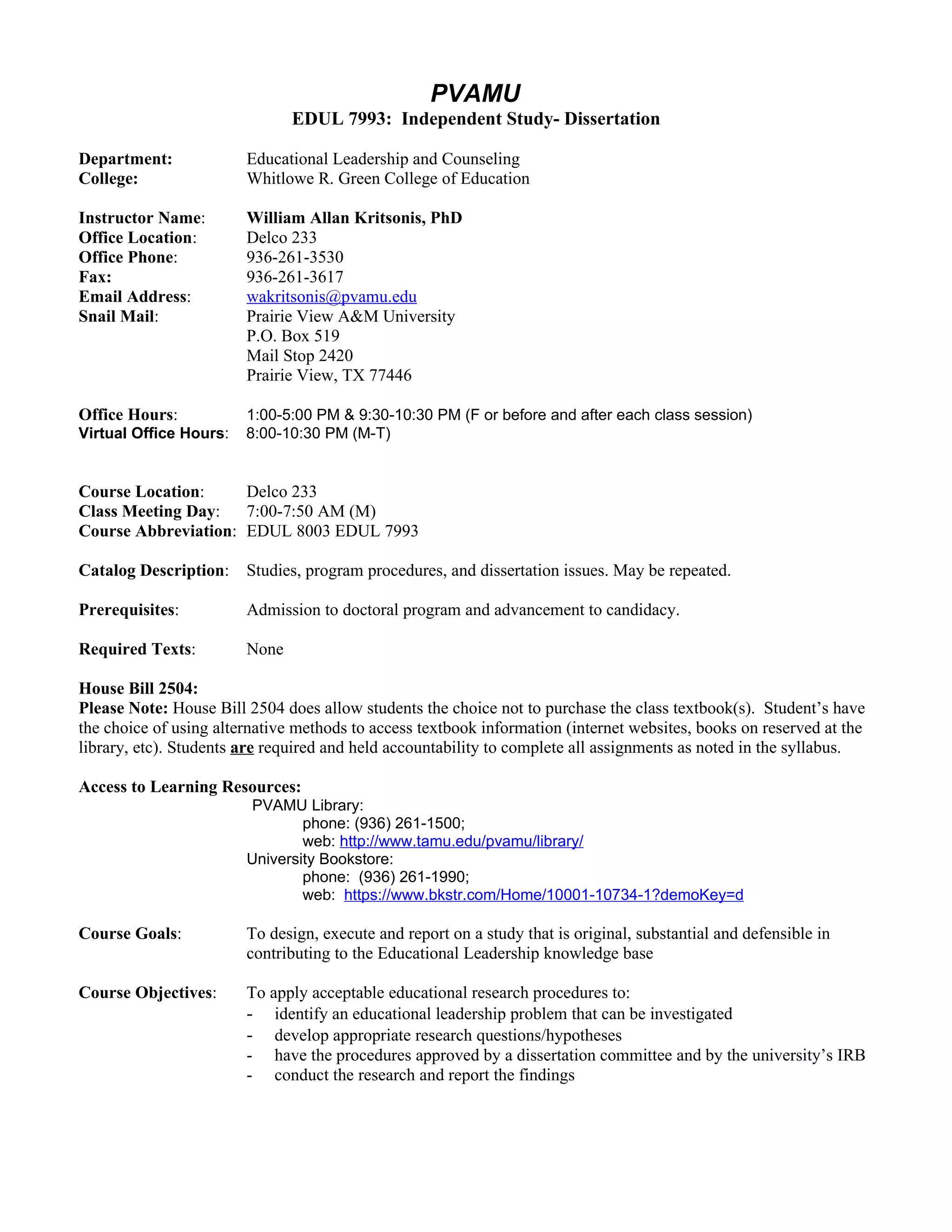
Course Goals/Accrediting Body Standards/Outcomes

         Course Goal                  ELCC Standard (2.2a &b)                     Course Objective
To design, execute and report     2.2a. Candidates demonstrate an         To apply acceptable educational
on a study that is original,      understanding of a variety of           research procedures to:
substantial and defensible in     instructional research                  - identify an educational
contributing to the Educational   methodologies and can analyze the       leadership problem that can be
Leadership knowledge base         comparable strengths and                investigated,    - develop
                                  weaknesses of each method.              appropriate research
                                                                          questions/hypotheses,
                                                                          - have the procedures approved
                                   2.2b. Candidates are able to use       by a dissertation committee and
                                  qualitative and quantitative data,      by the university's IRB, and
                                  appropriate research methods,           - conduct the research and report
                                  technology, and information             the findings.
                                  systems to develop a long-range
                                  plan for a district that assesses the
                                  district’s improvement and
                                  accountability systems.


                              E-FOLD-P (CONCEPTUAL FRAMEWORK)
                         Educator as Facilitator of Learning for Diverse Populations

5.0 To prepare beginning administrators as problem solvers, critical thinkers and decision makers.
6.0 To prepare beginning administrators as facilitators of teacher and student growth and development through
understanding of leadership dimensions.
7.0 To provide beginning administrators with an awareness of human diversity, a knowledge of the importance
and skills needed for effective community and parental involvement.
8.0 To prepare beginning administrators to be reflect and continual learners with knowledge and value of self
appraisal techniques and goal setting for a strong personal commitment.
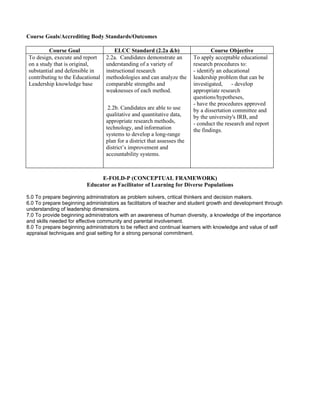
Quality Without Compromise
                                   Closing the Loop
                 The Six Question Model at Prairie View A&M University

                                                 Outcome


                                                  What
                             l ts                   Is
                          esu


                                                                            s
                                                 Desired?


                                                                         gie
                                                                 Ma pen?
                        R


                                                                     rate
                                                                Ho ke it
                                 Did t
                     of


                                                                      o
                                    a
                                 Wh


                                                                  wt

                                                                    p
                                  u
                      e


                                                                  St
                                                                 Ha
                                 ?
                                Yo
                   Us


                               Do

                                                  Continuous
                                                 Improvement
                                                    Circle
                                        Th ts?


                                                    (CIC)


                                                                          ?
                                                                         w


                                                                     sed
                                            l


                                                                       ll
                                                                     Ho
                                         su
                                      We e


                                                               As It be
                                                                    Wi
                                     W h re
                                        at


                                      Re


                                                                 ses

                                                                                  ans
                                 s
                             ult


                                                   When


                                                                                Me
                           es


                                                   Will it
                          R


                                                    Be
                                                 Assessed?

                                                    Cycle        Dana/Thomas-Smith/Closing the Loop Six Question Model/landscape


Course Requirements & Evaluation Methods

Course Evaluation Method:
This is a pass/fail course. Upon successful defense of the dissertation, students will be recommended for issuance
of a Ph.D. degree via the Graduate School. Because this course spans several semesters, students will be given an
“I” until the last semester when the dissertation is defended successfully.

True Outcomes
True Outcomes was a tool used by the University for Assessment Purposes. Currently, PVAMU is transitioning
from it to another assessment tool for students. The new assessment tool and artifacts for summer 2011 will be
announced during the course of the semester.

eCourses
PVAMU is moving to a new course management system (CMS) for online and web-assisted courses. Starting in
2008 Fall semester, WebCT will be replaced by eCourses-an upgraded version of WebCT 4.1 with improved
capabilities and better integration with the new Banner Student Information System

Course Procedures

Submission of Documents for Review
Please submit documents for review via email or hard copy to the respective members of the dissertation
committee unless advised otherwise.

Formatting Documents:
Microsoft Word is the standard word processing tool used at PVAMU. If you’re using other word processors, be
sure to use the “save as” tool and save the document in either the Microsoft Word, Rich-Text, or plain text format.
All dissertation documents must conform to APA standards and guidelines
Professional Organizations and Journals
American Association for School Administrators
National Association of Elementary School Principals
National Association of Secondary School Principals
Phi Delta Kappa
Texas Elementary Principals and Supervisors Association
Texas Association of Secondary School Principals
American Journal of Education
American School Board Journal
Education Administration Abstracts
Education Administration Quarterly
Education Week
Educational Leadership
NASSP Bulletin
National FORUM Journals (www.nationalforum.com)
Phi Delta Kappan
TASSP News Highlights
TEPSA Journal
Texas Study
Theory Into Practice
Today’s Education

References
American Association for School Administrators (http://www.aasa.org/aboutcontent.cfm?ItemNumber=215)
American Psychological Association (2009). Publication manual of the APA (6th ed.). Washington DC: Author
Educational Leadership Constituents Council (ELCC) Standards
(http://www.npbea.org/ELCCStandards%20_5-02.pdf)
Interstate School Leaders Licensure Consortium (ISLLC) Standards
(www.ccsso.org/projects/education_leadership_initiatives/ISLLC_standards/)
National Council for the Accreditation of Teacher Education (NCATE) (www.ncate.org/public/standards.asp)

University Rules and Procedures

Disability statement (See Student Handbook):
Students with disabilities, including learning disabilities, who wish to request accommodations in class should
register with the Services for Students with Disabilities (SSD) early in the semester so that appropriate
arrangements may be made. In accordance with federal laws, a student requesting special accommodations must
provide documentation of their disability to the SSD coordinator.

Academic misconduct (See Student Handbook):
You are expected to practice academic honesty in every aspect of this course and all other courses. Make sure you
are familiar with your Student Handbook, especially the section on academic misconduct. Students who engage in
academic misconduct are subject to university disciplinary procedures.

Forms of academic dishonesty:
     1. Cheating: deception in which a student misrepresents that he/she has mastered information on an
          academic exercise that he/she has not mastered; giving or receiving aid unauthorized by the instructor on
          assignments or examinations.

       2. Academic misconduct: tampering with grades or taking part in obtaining or distributing any part of a
          scheduled test.

       3. Fabrication: use of invented information or falsified research.
4. Plagiarism: unacknowledged quotation and/or paraphrase of someone else’s words, ideas, or data as
          one’s own in work submitted for credit. Failure to identify information or essays from the Internet and
          submitting them as one’s own work also constitutes plagiarism.

Nonacademic misconduct (See Student Handbook)
The university respects the rights of instructors to teach and students to learn. Maintenance of these rights requires
campus conditions that do not impede their exercise. Campus behavior that interferes with either (1) the instructor’s
ability to conduct the class, (2) the inability of other students to profit from the instructional program, or (3) campus
behavior that interferes with the rights of others will not be tolerated. An individual engaging in such disruptive
behavior may be subject to disciplinary action. Such incidents will be adjudicated by the Dean of Students under
nonacademic procedures.

Sexual misconduct (See Student Handbook):
Sexual harassment of students and employers at Prairie View A&M University is unacceptable and will not be
tolerated. Any member of the university community violating this policy will be subject to disciplinary action.

Attendance Policy:
Prairie View A&M University requires regular class attendance. Excessive absences will result in lowered grades.
Excessive absenteeism, whether excused or unexcused, may result in a student’s course grade being reduced or in
assignment of a grade of “F”. Absences are accumulated beginning with the first day of class.

Student Academic Appeals Process
Authority and responsibility for assigning grades to students rests with the faculty. However, in those instances
where students believe that miscommunication, errors, or unfairness of any kind may have adversely affected the
instructor's assessment of their academic performance, the student has a right to appeal by the procedure listed in
the Undergraduate Catalog and by doing so within thirty days of receiving the grade or experiencing any other
problematic academic event that prompted the complaint.

Two “C” Rule
Please Note: Continual matriculation at PVAMU requires that no more than two C’s shall be earned in a graduate
degree program. Any grade earned below a C means automatic dismissal from the graduate program.
NOTE: No grade of “C” or below will be accepted toward certification.

Technical Considerations for Online and Web-Assist Courses

Minimum Hardware and Software Requirements:
-Pentium with Windows XP or PowerMac with OS 9
-56K modem or network access
-Internet provider with SLIP or PPP
-8X or greater CD-ROM
-64MB RAM
-Hard drive with 40MB available space
-15” monitor, 800x600, color or 16 bit
-Sound card w/speakers
-Microphone and recording software
-Keyboard & mouse
-Netscape Communicator ver. 4.61 or Microsoft Internet Explorer ver. 5.0 /plug-ins
-Participants should have a basic proficiency of the following computer skills:
·Sending and receiving email
·A working knowledge of the Internet
·Proficiency in Microsoft Word
·Proficiency in the Acrobat PDF Reader
·Basic knowledge of Windows or Mac O.S.
Netiquette (online etiquette): Students are expected to participate in all discussions and virtual classroom chats
when directed to do so. Students are to be respectful and courteous to others in the discussions. Foul or abusive
language will not be tolerated. When referring to information from books, websites or articles, please use APA
standards to reference sources.

Technical Support: Students should call the Prairie View A&M University Helpdesk at 936-261-2525 for
technical issues with accessing your online course. The helpdesk is available 24 hours a day/7 days a week. For
other technical questions regarding your online course, call the Office of Distance Learning at 936-261-3290 or
936-261-32828

Communication Expectations and Standards:
All emails will receive a response from the instructor within 48 hours. You can send email anytime that is
convenient to you, but I check my email messages continuously during the day throughout the work-week (Monday
through Friday). I will respond to email messages during the work-week by the close of business (5:00 pm) on the
day following my receipt of them. Emails that I receive on Friday will be responded to by the close of business on
the following Monday.

                                     NOTICE OF EQUAL OPPORTUNITY

Prairie View A&M University does not discriminate on the basis of race, color, national origin, sex,
disability, or age in its programs and activities. The following person(s) has been designated to handle
inquiries regarding the non-discrimination policies:

Name: Renee R. Williams
Title: Equal Opportunity Compliance Officer/Title IX Coordinator
Institution: Prairie View A&M University
Office of Student Affairs & Institutional Relations
Address: P.O. Box 519: MS 1107
A.I. Thomas Building, St 013
Prairie View, Texas 77446
Telephone: 936-261-2123
Fax: 936-261-2138
Email: rrwilliams@pvamu.edu

Individuals requesting a disability accommodation should contact:
Name: Dr. Kay Norman
Title: Administrator for Diagnostic Testing and Disability Services
Institution: Prairie View A&M University
Email: kfnorman@pvamu.edu

Syllabus template edul 7993 independent study

  • 1.
    PVAMU EDUL 7993: Independent Study- Dissertation Department: Educational Leadership and Counseling College: Whitlowe R. Green College of Education Instructor Name: William Allan Kritsonis, PhD Office Location: Delco 233 Office Phone: 936-261-3530 Fax: 936-261-3617 Email Address: wakritsonis@pvamu.edu Snail Mail: Prairie View A&M University P.O. Box 519 Mail Stop 2420 Prairie View, TX 77446 Office Hours: 1:00-5:00 PM & 9:30-10:30 PM (F or before and after each class session) Virtual Office Hours: 8:00-10:30 PM (M-T) Course Location: Delco 233 Class Meeting Day: 7:00-7:50 AM (M) Course Abbreviation: EDUL 8003 EDUL 7993 Catalog Description: Studies, program procedures, and dissertation issues. May be repeated. Prerequisites: Admission to doctoral program and advancement to candidacy. Required Texts: None House Bill 2504: Please Note: House Bill 2504 does allow students the choice not to purchase the class textbook(s). Student’s have the choice of using alternative methods to access textbook information (internet websites, books on reserved at the library, etc). Students are required and held accountability to complete all assignments as noted in the syllabus. Access to Learning Resources: PVAMU Library: phone: (936) 261-1500; web: http://www.tamu.edu/pvamu/library/ University Bookstore: phone: (936) 261-1990; web: https://www.bkstr.com/Home/10001-10734-1?demoKey=d Course Goals: To design, execute and report on a study that is original, substantial and defensible in contributing to the Educational Leadership knowledge base Course Objectives: To apply acceptable educational research procedures to: - identify an educational leadership problem that can be investigated - develop appropriate research questions/hypotheses - have the procedures approved by a dissertation committee and by the university’s IRB - conduct the research and report the findings
  • 2.
    Course Goals/Accrediting BodyStandards/Outcomes Course Goal ELCC Standard (2.2a &b) Course Objective To design, execute and report 2.2a. Candidates demonstrate an To apply acceptable educational on a study that is original, understanding of a variety of research procedures to: substantial and defensible in instructional research - identify an educational contributing to the Educational methodologies and can analyze the leadership problem that can be Leadership knowledge base comparable strengths and investigated, - develop weaknesses of each method. appropriate research questions/hypotheses, - have the procedures approved 2.2b. Candidates are able to use by a dissertation committee and qualitative and quantitative data, by the university's IRB, and appropriate research methods, - conduct the research and report technology, and information the findings. systems to develop a long-range plan for a district that assesses the district’s improvement and accountability systems. E-FOLD-P (CONCEPTUAL FRAMEWORK) Educator as Facilitator of Learning for Diverse Populations 5.0 To prepare beginning administrators as problem solvers, critical thinkers and decision makers. 6.0 To prepare beginning administrators as facilitators of teacher and student growth and development through understanding of leadership dimensions. 7.0 To provide beginning administrators with an awareness of human diversity, a knowledge of the importance and skills needed for effective community and parental involvement. 8.0 To prepare beginning administrators to be reflect and continual learners with knowledge and value of self appraisal techniques and goal setting for a strong personal commitment.
  • 3.
    Quality Without Compromise Closing the Loop The Six Question Model at Prairie View A&M University Outcome What l ts Is esu s Desired? gie Ma pen? R rate Ho ke it Did t of o a Wh wt p u e St Ha ? Yo Us Do Continuous Improvement Circle Th ts? (CIC) ? w sed l ll Ho su We e As It be Wi W h re at Re ses ans s ult When Me es Will it R Be Assessed? Cycle Dana/Thomas-Smith/Closing the Loop Six Question Model/landscape Course Requirements & Evaluation Methods Course Evaluation Method: This is a pass/fail course. Upon successful defense of the dissertation, students will be recommended for issuance of a Ph.D. degree via the Graduate School. Because this course spans several semesters, students will be given an “I” until the last semester when the dissertation is defended successfully. True Outcomes True Outcomes was a tool used by the University for Assessment Purposes. Currently, PVAMU is transitioning from it to another assessment tool for students. The new assessment tool and artifacts for summer 2011 will be announced during the course of the semester. eCourses PVAMU is moving to a new course management system (CMS) for online and web-assisted courses. Starting in 2008 Fall semester, WebCT will be replaced by eCourses-an upgraded version of WebCT 4.1 with improved capabilities and better integration with the new Banner Student Information System Course Procedures Submission of Documents for Review Please submit documents for review via email or hard copy to the respective members of the dissertation committee unless advised otherwise. Formatting Documents: Microsoft Word is the standard word processing tool used at PVAMU. If you’re using other word processors, be sure to use the “save as” tool and save the document in either the Microsoft Word, Rich-Text, or plain text format. All dissertation documents must conform to APA standards and guidelines
  • 4.
    Professional Organizations andJournals American Association for School Administrators National Association of Elementary School Principals National Association of Secondary School Principals Phi Delta Kappa Texas Elementary Principals and Supervisors Association Texas Association of Secondary School Principals American Journal of Education American School Board Journal Education Administration Abstracts Education Administration Quarterly Education Week Educational Leadership NASSP Bulletin National FORUM Journals (www.nationalforum.com) Phi Delta Kappan TASSP News Highlights TEPSA Journal Texas Study Theory Into Practice Today’s Education References American Association for School Administrators (http://www.aasa.org/aboutcontent.cfm?ItemNumber=215) American Psychological Association (2009). Publication manual of the APA (6th ed.). Washington DC: Author Educational Leadership Constituents Council (ELCC) Standards (http://www.npbea.org/ELCCStandards%20_5-02.pdf) Interstate School Leaders Licensure Consortium (ISLLC) Standards (www.ccsso.org/projects/education_leadership_initiatives/ISLLC_standards/) National Council for the Accreditation of Teacher Education (NCATE) (www.ncate.org/public/standards.asp) University Rules and Procedures Disability statement (See Student Handbook): Students with disabilities, including learning disabilities, who wish to request accommodations in class should register with the Services for Students with Disabilities (SSD) early in the semester so that appropriate arrangements may be made. In accordance with federal laws, a student requesting special accommodations must provide documentation of their disability to the SSD coordinator. Academic misconduct (See Student Handbook): You are expected to practice academic honesty in every aspect of this course and all other courses. Make sure you are familiar with your Student Handbook, especially the section on academic misconduct. Students who engage in academic misconduct are subject to university disciplinary procedures. Forms of academic dishonesty: 1. Cheating: deception in which a student misrepresents that he/she has mastered information on an academic exercise that he/she has not mastered; giving or receiving aid unauthorized by the instructor on assignments or examinations. 2. Academic misconduct: tampering with grades or taking part in obtaining or distributing any part of a scheduled test. 3. Fabrication: use of invented information or falsified research.
  • 5.
    4. Plagiarism: unacknowledgedquotation and/or paraphrase of someone else’s words, ideas, or data as one’s own in work submitted for credit. Failure to identify information or essays from the Internet and submitting them as one’s own work also constitutes plagiarism. Nonacademic misconduct (See Student Handbook) The university respects the rights of instructors to teach and students to learn. Maintenance of these rights requires campus conditions that do not impede their exercise. Campus behavior that interferes with either (1) the instructor’s ability to conduct the class, (2) the inability of other students to profit from the instructional program, or (3) campus behavior that interferes with the rights of others will not be tolerated. An individual engaging in such disruptive behavior may be subject to disciplinary action. Such incidents will be adjudicated by the Dean of Students under nonacademic procedures. Sexual misconduct (See Student Handbook): Sexual harassment of students and employers at Prairie View A&M University is unacceptable and will not be tolerated. Any member of the university community violating this policy will be subject to disciplinary action. Attendance Policy: Prairie View A&M University requires regular class attendance. Excessive absences will result in lowered grades. Excessive absenteeism, whether excused or unexcused, may result in a student’s course grade being reduced or in assignment of a grade of “F”. Absences are accumulated beginning with the first day of class. Student Academic Appeals Process Authority and responsibility for assigning grades to students rests with the faculty. However, in those instances where students believe that miscommunication, errors, or unfairness of any kind may have adversely affected the instructor's assessment of their academic performance, the student has a right to appeal by the procedure listed in the Undergraduate Catalog and by doing so within thirty days of receiving the grade or experiencing any other problematic academic event that prompted the complaint. Two “C” Rule Please Note: Continual matriculation at PVAMU requires that no more than two C’s shall be earned in a graduate degree program. Any grade earned below a C means automatic dismissal from the graduate program. NOTE: No grade of “C” or below will be accepted toward certification. Technical Considerations for Online and Web-Assist Courses Minimum Hardware and Software Requirements: -Pentium with Windows XP or PowerMac with OS 9 -56K modem or network access -Internet provider with SLIP or PPP -8X or greater CD-ROM -64MB RAM -Hard drive with 40MB available space -15” monitor, 800x600, color or 16 bit -Sound card w/speakers -Microphone and recording software -Keyboard & mouse -Netscape Communicator ver. 4.61 or Microsoft Internet Explorer ver. 5.0 /plug-ins -Participants should have a basic proficiency of the following computer skills: ·Sending and receiving email ·A working knowledge of the Internet ·Proficiency in Microsoft Word ·Proficiency in the Acrobat PDF Reader ·Basic knowledge of Windows or Mac O.S.
  • 6.
    Netiquette (online etiquette):Students are expected to participate in all discussions and virtual classroom chats when directed to do so. Students are to be respectful and courteous to others in the discussions. Foul or abusive language will not be tolerated. When referring to information from books, websites or articles, please use APA standards to reference sources. Technical Support: Students should call the Prairie View A&M University Helpdesk at 936-261-2525 for technical issues with accessing your online course. The helpdesk is available 24 hours a day/7 days a week. For other technical questions regarding your online course, call the Office of Distance Learning at 936-261-3290 or 936-261-32828 Communication Expectations and Standards: All emails will receive a response from the instructor within 48 hours. You can send email anytime that is convenient to you, but I check my email messages continuously during the day throughout the work-week (Monday through Friday). I will respond to email messages during the work-week by the close of business (5:00 pm) on the day following my receipt of them. Emails that I receive on Friday will be responded to by the close of business on the following Monday. NOTICE OF EQUAL OPPORTUNITY Prairie View A&M University does not discriminate on the basis of race, color, national origin, sex, disability, or age in its programs and activities. The following person(s) has been designated to handle inquiries regarding the non-discrimination policies: Name: Renee R. Williams Title: Equal Opportunity Compliance Officer/Title IX Coordinator Institution: Prairie View A&M University Office of Student Affairs & Institutional Relations Address: P.O. Box 519: MS 1107 A.I. Thomas Building, St 013 Prairie View, Texas 77446 Telephone: 936-261-2123 Fax: 936-261-2138 Email: rrwilliams@pvamu.edu Individuals requesting a disability accommodation should contact: Name: Dr. Kay Norman Title: Administrator for Diagnostic Testing and Disability Services Institution: Prairie View A&M University Email: kfnorman@pvamu.edu