by Dalia Sabah
trainee as a bank clerk at HypoVereinsbank – Member of UniCredit,
2nd year
The Project and my motivation
The project „azubi europa“ is organised and coordinated by the company isw
(Gesellschaft für wissenschaftliche Beratung und Dienstleistung mbH) and funded by
the European Union (ESF) and the Federal State of Saxony-Anhalt.
One day Denis Diderot wrote „There are three principal means of acquiring
knowledge... observation of nature, reflection, and experimentation. Observation
collects facts; reflection combines them; experimentation verifies the result of that
combination.”
In my opinion and also that’s my main motivation is that I think the project connect
all the important elements to gain more knowledge about different countries but also
about myself and it’s gives the chance for new experiences in another place on earth.
And of course the indentation in the English language.
Contents - Internship calendary
 1. Poland – Kraków (01.06. – 06.06.2015)
 1.1. Day 1: trip from Germany to Poland
 1.2. Day 2: 1. workshop and visit „Techglass“
 1.3. Day 3: Vocational school Zespól Szkól Ekonomicznych nr. 1 in Kraków
 1.4. Day 4: 2. workshop and visit Kopalnia Soli „Wieliczka“
 1.5. Day 5: Auschwitz concentration camp
 1.6. Day 6: onward journey to Gdańsk
 2. Poland – Gdańsk (07.06. – 12.06.2015)
 2.1. Day 7: 3. workshop
 2.2. Day 8: 4. workshop and visit „Invest in Pomerania“
 2.3. Day 9: Vocational school Szkoly Ekonomiczno-Handlowe and visit the consulate general of Germany in
Danzig
 2.4. Day 10: Gdañsk University of Technology and the city rally in Gdansk
 2.5. Day 11: Westerplatte Education Path and final test
 2.6. Day 12: trip from Poland back to Germany
 3. acknowledgment
 4. Sources
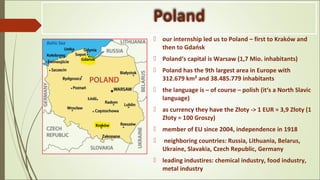
Poland
 our internship led us to Poland – first to Kraków and
then to Gdańsk
 Poland‘s capital is Warsaw (1,7 Mio. inhabitants)
 Poland has the 9th largest area in Europe with
312.679 km² and 38.485.779 inhabitants
 the language is – of course – polish (it‘s a North Slavic
language)
 as currency they have the Złoty -> 1 EUR ≈ 3,9 Złoty (1
Złoty = 100 Groszy)
 member of EU since 2004, independence in 1918
 neighboring countries: Russia, Lithuania, Belarus,
Ukraine, Slavakia, Czech Republic, Germany
 leading industires: chemical industry, food industry,
metal industry
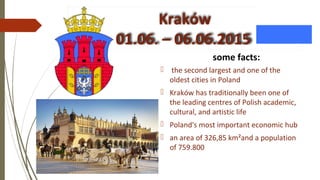
Kraków
01.06. – 06.06.2015
some facts:
 the second largest and one of the
oldest cities in Poland
 Kraków has traditionally been one of
the leading centres of Polish academic,
cultural, and artistic life
 Poland's most important economic hub
 an area of 326,85 km²and a population
of 759.800
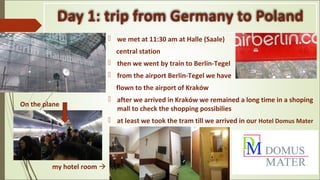
Day 1: trip from Germany to Poland
 we met at 11:30 am at Halle (Saale)
central station
 then we went by train to Berlin-Tegel
 from the airport Berlin-Tegel we have
flown to the airport of Kraków
 after we arrived in Kraków we remained a long time in a shoping
mall to check the shopping possibilies
 at least we took the tram till we arrived in our Hotel Domus Mater
my hotel room 
On the plane
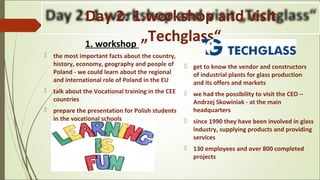
Day 2: 1.workshop and visit
„Techglass“1. workshop
 the most important facts about the country,
history, economy, geography and people of
Poland - we could learn about the regional
and international role of Poland in the EU
 talk about the Vocational training in the CEE
countries
 prepare the presentation for Polish students
in the vocational schools
.
 get to know the vendor and constructors
of industrial plants for glass production
and its offers and markets
 we had the possibility to visit the CEO –
Andrzej Skowiniak - at the main
headquarters
 since 1990 they have been involved in glass
industry, supplying products and providing
services
 130 employees and over 800 completed
projects
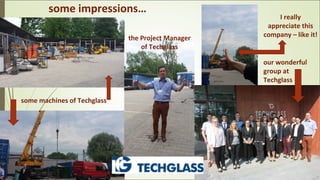
some impressions…
some machines of Techglass
the Project Manager
of Techglass
our wonderful
group at
Techglass
I really
appreciate this
company – like it!
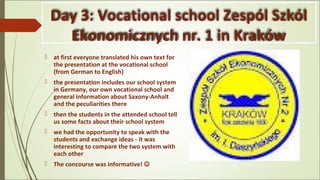
Day 3: Vocational school Zespól Szkól
Ekonomicznych nr. 1 in Kraków
 at first everyone translated his own text for
the presentation at the vocational school
(from German to English)
 the presentation includes our school system
in Germany, our own vocational school and
general information about Saxony-Anhalt
and the peculiarities there
 then the students in the attended school tell
us some facts about their school system
 we had the opportunity to speak with the
students and exchange ideas - it was
interesting to compare the two system with
each other
 The concourse was informative! 
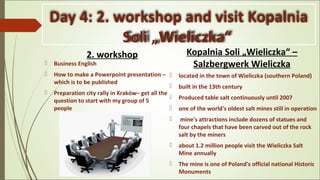
Day 4: 2. workshop and visit Kopalnia
Soli „Wieliczka“
2. workshop
 Business English
 How to make a Powerpoint presentation –
which is to be published
 Preparation city rally in Kraków– get all the
question to start with my group of 5
people
Kopalnia Soli „Wieliczka“ –
Salzbergwerk Wieliczka
 located in the town of Wieliczka (southern Poland)
 built in the 13th century
 Produced table salt continuously until 2007
 one of the world's oldest salt mines still in operation
 mine's attractions include dozens of statues and
four chapels that have been carved out of the rock
salt by the miners
 about 1.2 million people visit the Wieliczka Salt
Mine annually
 The mine is one of Poland's official national Historic
Monuments
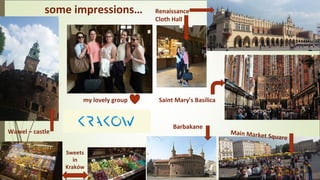
some impressions… Renaissance
Cloth Hall
my lovely group
Wawel – castle Main Market Square
Saint Mary's Basilica
Sweets
in
Kraków
Barbakane
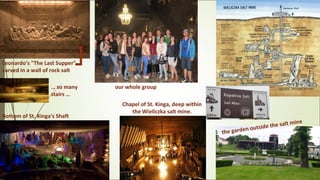
Leonardo's "The Last Supper"
carved in a wall of rock salt
our whole group… so many
stairs …
Bottom of St. Kinga's Shaft
the garden outside the salt mine
Chapel of St. Kinga, deep within
the Wieliczka salt mine.
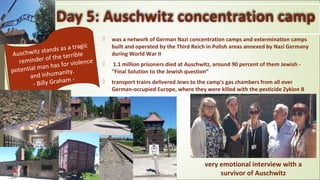
Day 5: Auschwitz concentration camp
 was a network of German Nazi concentration camps and extermination camps
built and operated by the Third Reich in Polish areas annexed by Nazi Germany
during World War II
 1.1 million prisoners died at Auschwitz, around 90 percent of them Jewish -
"Final Solution to the Jewish question“
 transport trains delivered Jews to the camp's gas chambers from all over
German-occupied Europe, where they were killed with the pesticide Zyklon B
Auschwitz stands as a tragic
reminder of the terrible
potential man has for violence
and inhumanity.
- Billy Graham -
very emotional interview with a
survivor of Auschwitz
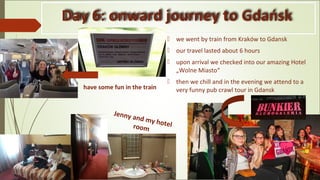
Day 6: onward journey to Gdańsk
 we went by train from Kraków to Gdansk
 our travel lasted about 6 hours
 upon arrival we checked into our amazing Hotel
„Wolne Miasto“
 then we chill and in the evening we attend to a
very funny pub crawl tour in Gdanskhave some fun in the train
Jenny and my hotelroom
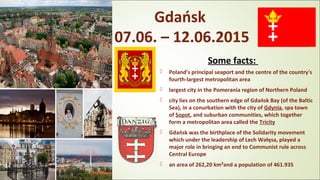
Gdańsk
07.06. – 12.06.2015
Some facts:
 Poland's principal seaport and the centre of the country's
fourth-largest metropolitan area
 largest city in the Pomerania region of Northern Poland
 city lies on the southern edge of Gdańsk Bay (of the Baltic
Sea), in a conurbation with the city of Gdynia, spa town
of Sopot, and suburban communities, which together
form a metropolitan area called the Tricity
 Gdańsk was the birthplace of the Solidarity movement
which under the leadership of Lech Wałęsa, played a
major role in bringing an end to Communist rule across
Central Europe
 an area of 262,20 km²and a population of 461.935
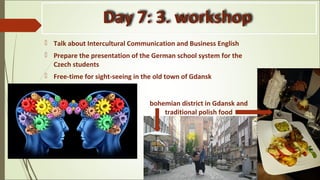
Day 7: 3. workshop
 Talk about Intercultural Communication and Business English
 Prepare the presentation of the German school system for the
Czech students
 Free-time for sight-seeing in the old town of Gdansk
bohemian district in Gdansk and
traditional polish food
Day 8: 4. workshop and visit „Invest in
Pomerania“
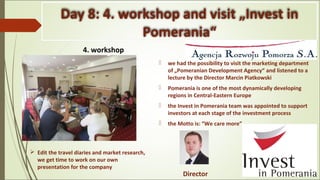
4. workshop .
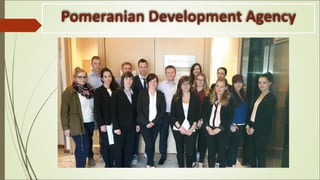
 we had the possibility to visit the marketing department
of „Pomeranian Development Agency“ and listened to a
lecture by the Director Marcin Piatkowski
 Pomerania is one of the most dynamically developing
regions in Central-Eastern Europe
 the Invest in Pomerania team was appointed to support
investors at each stage of the investment process
 the Motto is: “We care more”
Director
 Edit the travel diaries and market research,
we get time to work on our own
presentation for the company
Pomeranian Development Agency
Day 9: Vocational school Szkoly
Ekonomiczno-Handlowe and…
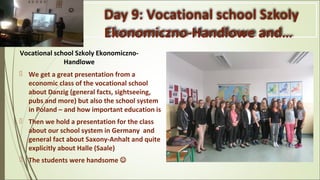
Vocational school Szkoly Ekonomiczno-
Handlowe
 We get a great presentation from a
economic class of the vocational school
about Danzig (general facts, sightseeing,
pubs and more) but also the school system
in Poland – and how important education is
 Then we hold a presentation for the class
about our school system in Germany and
general fact about Saxony-Anhalt and quite
explicitly about Halle (Saale)
 The students were handsome 
… visit the consulate general of
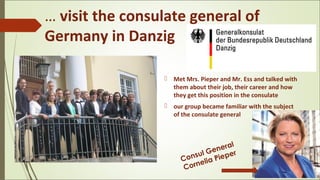
Germany in Danzig
 Met Mrs. Pieper and Mr. Ess and talked with
them about their job, their career and how
they get this position in the consulate
 our group became familiar with the subject
of the consulate general
Consul General
Cornelia Pieper
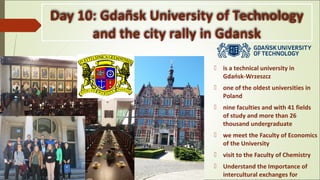
Day 10: Gdañsk University of Technology
and the city rally in Gdansk
 is a technical university in
Gdańsk-Wrzeszcz
 one of the oldest universities in
Poland
 nine faculties and with 41 fields
of study and more than 26
thousand undergraduate
 we meet the Faculty of Economics
of the University
 visit to the Faculty of Chemistry
 Understand the Importance of
intercultural exchanges for
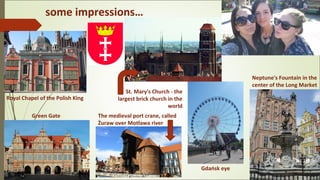
some impressions…
St. Mary's Church - the
largest brick church in the
world
Royal Chapel of the Polish King
Neptune's Fountain in the
center of the Long Market
Green Gate The medieval port crane, called
Żuraw over Motława river
Gdańsk eye
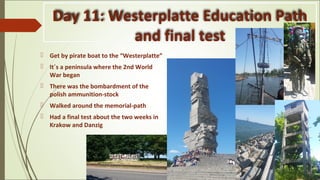
Day 11: Westerplatte Education Path
and final test
 Get by pirate boat to the “Westerplatte”
 It´s a peninsula where the 2nd World
War began
 There was the bombardment of the
polish ammunition-stock
 Walked around the memorial-path
 Had a final test about the two weeks in
Krakow and Danzig
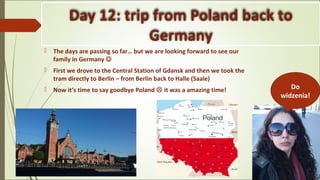
Day 12: trip from Poland back to
Germany
 The days are passing so far… but we are looking forward to see our
family in Germany 
 First we drove to the Central Station of Gdansk and then we took the
tram directly to Berlin – from Berlin back to Halle (Saale)
 Now it‘s time to say goodbye Poland  it was a amazing time! Do
widzenia!
3. acknowledgment
I am very grateful for the possibility to take part on the project „Azubi – Europa“.
The project was absolutely instructive and I would do it always again.
I‘d love to thank my great company „HypoVereinsbank – Member of UniCredit“ for
the permission to let me get through this venture.
But also I want to thank my vocational school which is always up to date about
projects like this.
And of course I want to thank especially Mrs. Kaufhold which has campaigned for my
participation and our trainer Mr. Dargatz which has always motivational phrases.
I learned so much about the MOE countries – but also so much about myself and I
had the opportunity to know such amazing people through the 2 weeks.
4. sources
 http://www.brainyquote.com/quotes/topics/topic_knowledge.html
 http://www.isw-bildung.de/azubi-europa/
 https://translate.google.de/?hl=de&tab=TT
 https://www.leo.org/ende/index_de.html
 https://en.wikipedia.org/wiki/Gdańsk
 https://en.wikipedia.org/wiki/Kraków
 DVD von Herrn Dargatz
 Eigene Notizen

Präsentation Dalia Sabah Juni 2015 PL

  • 1.
    by Dalia Sabah traineeas a bank clerk at HypoVereinsbank – Member of UniCredit, 2nd year
  • 2.
    The Project andmy motivation The project „azubi europa“ is organised and coordinated by the company isw (Gesellschaft für wissenschaftliche Beratung und Dienstleistung mbH) and funded by the European Union (ESF) and the Federal State of Saxony-Anhalt. One day Denis Diderot wrote „There are three principal means of acquiring knowledge... observation of nature, reflection, and experimentation. Observation collects facts; reflection combines them; experimentation verifies the result of that combination.” In my opinion and also that’s my main motivation is that I think the project connect all the important elements to gain more knowledge about different countries but also about myself and it’s gives the chance for new experiences in another place on earth. And of course the indentation in the English language.
  • 3.
    Contents - Internshipcalendary  1. Poland – Kraków (01.06. – 06.06.2015)  1.1. Day 1: trip from Germany to Poland  1.2. Day 2: 1. workshop and visit „Techglass“  1.3. Day 3: Vocational school Zespól Szkól Ekonomicznych nr. 1 in Kraków  1.4. Day 4: 2. workshop and visit Kopalnia Soli „Wieliczka“  1.5. Day 5: Auschwitz concentration camp  1.6. Day 6: onward journey to Gdańsk  2. Poland – Gdańsk (07.06. – 12.06.2015)  2.1. Day 7: 3. workshop  2.2. Day 8: 4. workshop and visit „Invest in Pomerania“  2.3. Day 9: Vocational school Szkoly Ekonomiczno-Handlowe and visit the consulate general of Germany in Danzig  2.4. Day 10: Gdañsk University of Technology and the city rally in Gdansk  2.5. Day 11: Westerplatte Education Path and final test  2.6. Day 12: trip from Poland back to Germany  3. acknowledgment  4. Sources
  • 4.
    Poland  our internshipled us to Poland – first to Kraków and then to Gdańsk  Poland‘s capital is Warsaw (1,7 Mio. inhabitants)  Poland has the 9th largest area in Europe with 312.679 km² and 38.485.779 inhabitants  the language is – of course – polish (it‘s a North Slavic language)  as currency they have the Złoty -> 1 EUR ≈ 3,9 Złoty (1 Złoty = 100 Groszy)  member of EU since 2004, independence in 1918  neighboring countries: Russia, Lithuania, Belarus, Ukraine, Slavakia, Czech Republic, Germany  leading industires: chemical industry, food industry, metal industry
  • 5.
    Kraków 01.06. – 06.06.2015 somefacts:  the second largest and one of the oldest cities in Poland  Kraków has traditionally been one of the leading centres of Polish academic, cultural, and artistic life  Poland's most important economic hub  an area of 326,85 km²and a population of 759.800
  • 6.
    Day 1: tripfrom Germany to Poland  we met at 11:30 am at Halle (Saale) central station  then we went by train to Berlin-Tegel  from the airport Berlin-Tegel we have flown to the airport of Kraków  after we arrived in Kraków we remained a long time in a shoping mall to check the shopping possibilies  at least we took the tram till we arrived in our Hotel Domus Mater my hotel room  On the plane
  • 7.
    Day 2: 1.workshopand visit „Techglass“1. workshop  the most important facts about the country, history, economy, geography and people of Poland - we could learn about the regional and international role of Poland in the EU  talk about the Vocational training in the CEE countries  prepare the presentation for Polish students in the vocational schools .  get to know the vendor and constructors of industrial plants for glass production and its offers and markets  we had the possibility to visit the CEO – Andrzej Skowiniak - at the main headquarters  since 1990 they have been involved in glass industry, supplying products and providing services  130 employees and over 800 completed projects
  • 8.
    some impressions… some machinesof Techglass the Project Manager of Techglass our wonderful group at Techglass I really appreciate this company – like it!
  • 9.
    Day 3: Vocationalschool Zespól Szkól Ekonomicznych nr. 1 in Kraków  at first everyone translated his own text for the presentation at the vocational school (from German to English)  the presentation includes our school system in Germany, our own vocational school and general information about Saxony-Anhalt and the peculiarities there  then the students in the attended school tell us some facts about their school system  we had the opportunity to speak with the students and exchange ideas - it was interesting to compare the two system with each other  The concourse was informative! 
  • 10.
    Day 4: 2.workshop and visit Kopalnia Soli „Wieliczka“ 2. workshop  Business English  How to make a Powerpoint presentation – which is to be published  Preparation city rally in Kraków– get all the question to start with my group of 5 people Kopalnia Soli „Wieliczka“ – Salzbergwerk Wieliczka  located in the town of Wieliczka (southern Poland)  built in the 13th century  Produced table salt continuously until 2007  one of the world's oldest salt mines still in operation  mine's attractions include dozens of statues and four chapels that have been carved out of the rock salt by the miners  about 1.2 million people visit the Wieliczka Salt Mine annually  The mine is one of Poland's official national Historic Monuments
  • 11.
    some impressions… Renaissance ClothHall my lovely group Wawel – castle Main Market Square Saint Mary's Basilica Sweets in Kraków Barbakane
  • 12.
    Leonardo's "The LastSupper" carved in a wall of rock salt our whole group… so many stairs … Bottom of St. Kinga's Shaft the garden outside the salt mine Chapel of St. Kinga, deep within the Wieliczka salt mine.
  • 13.
    Day 5: Auschwitzconcentration camp  was a network of German Nazi concentration camps and extermination camps built and operated by the Third Reich in Polish areas annexed by Nazi Germany during World War II  1.1 million prisoners died at Auschwitz, around 90 percent of them Jewish - "Final Solution to the Jewish question“  transport trains delivered Jews to the camp's gas chambers from all over German-occupied Europe, where they were killed with the pesticide Zyklon B Auschwitz stands as a tragic reminder of the terrible potential man has for violence and inhumanity. - Billy Graham - very emotional interview with a survivor of Auschwitz
  • 14.
    Day 6: onwardjourney to Gdańsk  we went by train from Kraków to Gdansk  our travel lasted about 6 hours  upon arrival we checked into our amazing Hotel „Wolne Miasto“  then we chill and in the evening we attend to a very funny pub crawl tour in Gdanskhave some fun in the train Jenny and my hotelroom
  • 15.
    Gdańsk 07.06. – 12.06.2015 Somefacts:  Poland's principal seaport and the centre of the country's fourth-largest metropolitan area  largest city in the Pomerania region of Northern Poland  city lies on the southern edge of Gdańsk Bay (of the Baltic Sea), in a conurbation with the city of Gdynia, spa town of Sopot, and suburban communities, which together form a metropolitan area called the Tricity  Gdańsk was the birthplace of the Solidarity movement which under the leadership of Lech Wałęsa, played a major role in bringing an end to Communist rule across Central Europe  an area of 262,20 km²and a population of 461.935
  • 16.
    Day 7: 3.workshop  Talk about Intercultural Communication and Business English  Prepare the presentation of the German school system for the Czech students  Free-time for sight-seeing in the old town of Gdansk bohemian district in Gdansk and traditional polish food
  • 17.
    Day 8: 4.workshop and visit „Invest in Pomerania“ 4. workshop .  we had the possibility to visit the marketing department of „Pomeranian Development Agency“ and listened to a lecture by the Director Marcin Piatkowski  Pomerania is one of the most dynamically developing regions in Central-Eastern Europe  the Invest in Pomerania team was appointed to support investors at each stage of the investment process  the Motto is: “We care more” Director  Edit the travel diaries and market research, we get time to work on our own presentation for the company
  • 18.
  • 19.
    Day 9: Vocationalschool Szkoly Ekonomiczno-Handlowe and… Vocational school Szkoly Ekonomiczno- Handlowe  We get a great presentation from a economic class of the vocational school about Danzig (general facts, sightseeing, pubs and more) but also the school system in Poland – and how important education is  Then we hold a presentation for the class about our school system in Germany and general fact about Saxony-Anhalt and quite explicitly about Halle (Saale)  The students were handsome 
  • 20.
    … visit theconsulate general of Germany in Danzig  Met Mrs. Pieper and Mr. Ess and talked with them about their job, their career and how they get this position in the consulate  our group became familiar with the subject of the consulate general Consul General Cornelia Pieper
  • 21.
    Day 10: GdañskUniversity of Technology and the city rally in Gdansk  is a technical university in Gdańsk-Wrzeszcz  one of the oldest universities in Poland  nine faculties and with 41 fields of study and more than 26 thousand undergraduate  we meet the Faculty of Economics of the University  visit to the Faculty of Chemistry  Understand the Importance of intercultural exchanges for
  • 22.
    some impressions… St. Mary'sChurch - the largest brick church in the world Royal Chapel of the Polish King Neptune's Fountain in the center of the Long Market Green Gate The medieval port crane, called Żuraw over Motława river Gdańsk eye
  • 23.
    Day 11: WesterplatteEducation Path and final test  Get by pirate boat to the “Westerplatte”  It´s a peninsula where the 2nd World War began  There was the bombardment of the polish ammunition-stock  Walked around the memorial-path  Had a final test about the two weeks in Krakow and Danzig
  • 24.
    Day 12: tripfrom Poland back to Germany  The days are passing so far… but we are looking forward to see our family in Germany   First we drove to the Central Station of Gdansk and then we took the tram directly to Berlin – from Berlin back to Halle (Saale)  Now it‘s time to say goodbye Poland  it was a amazing time! Do widzenia!
  • 25.
    3. acknowledgment I amvery grateful for the possibility to take part on the project „Azubi – Europa“. The project was absolutely instructive and I would do it always again. I‘d love to thank my great company „HypoVereinsbank – Member of UniCredit“ for the permission to let me get through this venture. But also I want to thank my vocational school which is always up to date about projects like this. And of course I want to thank especially Mrs. Kaufhold which has campaigned for my participation and our trainer Mr. Dargatz which has always motivational phrases. I learned so much about the MOE countries – but also so much about myself and I had the opportunity to know such amazing people through the 2 weeks.
  • 26.
    4. sources  http://www.brainyquote.com/quotes/topics/topic_knowledge.html http://www.isw-bildung.de/azubi-europa/  https://translate.google.de/?hl=de&tab=TT  https://www.leo.org/ende/index_de.html  https://en.wikipedia.org/wiki/Gdańsk  https://en.wikipedia.org/wiki/Kraków  DVD von Herrn Dargatz  Eigene Notizen