Original Research
Lumbar Intradiskal Platelet-Rich Plasma (PRP) Injections:
A Prospective, Double-Blind, Randomized Controlled Study
Q5 Yetsa A. Tuakli-Wosornu, MD, MPH, Alon Terry, MD, Kwadwo Boachie-Adjei, BS, CPH,
Julian R. Harrison, BS, Caitlin K. Gribbin, BA, Elizabeth E. LaSalle, BS,
Joseph T. Nguyen, MPH, Jennifer L. Solomon, MD, Gregory E. Lutz, MD
Abstract
Objective: To determine whether single injections of autologous platelet-rich plasma (PRP) into symptomatic degenerative
intervertebral disks will improve participant-reported pain and function.
Design: Prospective, double-blind, randomized controlled study.
Setting: Outpatient physiatric spine practice.
Participants: Adults with chronic (!6 months), moderate-to-severe lumbar diskogenic pain that was unresponsive to conservative
treatment.
Methods: Participants were randomized to receive intradiskal PRP or contrast agent after provocative diskography. Data on pain,
physical function, and participant satisfaction were collected at 1 week, 4 weeks, 8 weeks, 6 months, and 1 year. Participants in
the control group who did not improve at 8 weeks were offered the option to receive PRP and subsequently followed.
Main Outcome Measures: Functional Rating Index (FRI), Numeric Rating Scale (NRS) for pain, the pain and physical function
domains of the 36-item Short Form Health Survey, and the modi๏ฌed North American Spine Society (NASS) Outcome Questionnaire
were used.
Results: Forty-seven participants (29 in the treatment group, 18 in the control group) were analyzed by an independent observer
with a 92% follow-up rate. Over 8 weeks of follow-up, there were statistically signi๏ฌcant improvements in participants who
received intradiskal PRP with regards to pain (NRS Best Pain) (P ยผ .02), function (FRI) (P ยผ .03), and patient satisfaction (NASS
Outcome Questionnaire) (P ยผ .01) compared with controls. No adverse events of disk space infection, neurologic injury, or
progressive herniation were reported following the injection of PRP.
Conclusion: Participants who received intradiskal PRP showed signi๏ฌcant improvements in FRI, NRS Best Pain, and NASS patient
satisfaction scores over 8 weeks compared with controls. Those who received PRP maintained signi๏ฌcant improvements in FRI
scores through at least 1 year of follow-up. Although these results are promising, further studies are needed to de๏ฌne the subset
of participants most likely to respond to biologic intradiskal treatment and the ideal cellular characteristics of the intradiskal PRP
injectate.
Introduction
Low back pain (LBP) is a common, often confounding
problem for patients and physicians. In the United States,
at least 80% of adults experience at least 1 episode of LBP
during their lifetime [1]. LBP is the most common cause of
disability among Americans between 45 and 65 years of
age [2]. Furthermore, of all musculoskeletal conditions,
LBP imposes the greatest economic burden on the U.S.
health care system [3]. Although most cases of LBP are
self-limited, approximately 20% recur within 6 months of
the initial episode and a subset of patients experience
chronic symptoms thereafter. For individual patients
and the national health care system, LBP imposes high
physical and ๏ฌnancial costs [4,5].
Numerous anatomic structures can cause LBP [6-8].
The intervertebral disk (IVD) accounts for 40% or more
cases of chronic LBP [9]. Noninvasive imaging methods
used to identify spine pathology have limited ability
to determine the exact source of pain [10-13]. Dis-
kography, although controversial, remains a provocative
diagnostic test for pain generated by the IVD [14].
PM R XXX (2015) 1-10
www.pmrjournal.org
FLA 5.4.0 DTD ล  PMRJ1567_proof ล  14 September 2015 ล  4:33 pm ล  ce
1934-1482/$ - see front matter ยช 2015 by the American Academy of Physical Medicine and Rehabilitation
http://dx.doi.org/10.1016/j.pmrj.2015.08.010
1
2
3
4
5
6
7
8
9
10
11
12
13
14
15
16
17
18
19
20
21
22
23
24
25
26
27
28
29
30
31
32
33
34
35
36
37
38
39
40
41
42
43
44
45
46
47
48
49
50
51
52
53
54
55
56
57
58
59
60
61
62
63
64
65
66
67
68
69
70
71
72
73
74
75
76
77
78
79
80
81
82
83
84
85
86
87
88
89
90
91
92
93
94
95
96
97
98
99
100
101
102
103
104
105
106
107
108
109
110
111
112
113
114
115
116
117
118
119
120
121
122
123
124
125
126
127
128
129
130
131
132
133
134
135
136
137
138
139
140
141
142
143
144
145
146
147
148
149
150
151
152
153
154
155
156
157
158
159
160
The adult IVD is the largest avascular structure in the
human body. Small branches of the metaphyseal
arteries around the outer annulus comprise its limited
vasculature. IVDs therefore rely on passive diffusion
from adjacent endplate vessels for nutrition [15]. With
limited vascular supply and largely indirect access to
nutrition, the IVD has poor inherent healing potential.
The rationale behind intradiskal injection of platelet-
rich plasma (PRP) is to place a high concentration of
growth factors directly at the site of collagen injury or
degeneration, where they are habitually found in low
concentration. We hypothesize that circulating growth
factors (eg, platelet-derived growth factor, trans-
forming growth factor, insulin-like growth factor, and
vasoendothelial growth factor) and cytokines in PRP will
act as humoral mediators to induce the natural healing
cascade [16-18]. Preclinical, in vitro studies support this
hypothesis. Analysis of PRP-infused human IVD speci-
mens demonstrated cell proliferation and differentia-
tion, as well as up-regulated type II collagen and
proteoglycan synthesis via chondrogenesis [19]. In an
animal model, intradiskal PRP led to restoration of
normal cellular architecture and disk height in an
experimentally injured IVD [20,21].
Readily available and cost-effective compared with
surgical options, a prohealing therapy such as autolo-
gous PRP suits the pathoanatomic cascade that episodic
LBP represents. In comparison with surgical manage-
ment of the internally disrupted IVD, autologous PRP
could be a safer and more cost-effective therapy if
proven to be of bene๏ฌt.
A major advantage of PRP is its breadth of potential
clinical applications. Unlike an isolated growth factor,
PRP is a mixture of autologous growth factors, cells, and
๏ฌbrin readily accessible for use. The injection of ๏ฌbrin
itself may catalyze sealing of annular ๏ฌssures [22]. Po-
tential disadvantages of PRP include the relatively small
amount of growth factor delivered (nanogram scale) and
the variance of composition from subject to subject.
Among other considerations, subject cell count and the
speci๏ฌc harvesting system used in๏ฌ‚uence the ๏ฌnal con-
stituent factors of the PRP graft. Although PRP has
demonstrated promising results for a variety of muscu-
loskeletal conditions, small sample sizes and lack of
standardization of graft preparation have hampered
research efforts. This study sought to investigate
whether a single intradiskal injection of PRP, delivered
to the symptomatic IVD(s), would confer clinical bene๏ฌt
for individuals with chronic diskogenic LBP.
Materials and Methods
Study Design
This was a prospective, double-blind, randomized,
controlled study of participants with chronic lumbar
diskogenic pain treated with an intradiskal PRP
injection. The study was approved by the Hospital for
Special Surgery Institutional Review Board and the
Con๏ฌ‚ict of Interest Committee in Research (Institutional
Review Board #29-025). The study was funded by the
institutionโ€™s Physiatry Research & Education Fund. The
PRP preparation kits and centrifuge were donated by
Harvest Technologies Corporation (Plymouth, MA).
Primary Hypothesis
Single injections of autologous PRP into symptomatic
degenerative IVDs will improve participant-reported
pain and function.
Participant Recruitment
One hundred nine participants were assessed for
eligibility at a single academic outpatient spine practice
between May 2009 and November 2013 based on the
general inclusion and exclusion criteria set forward
(Table 1). Fifty-one participants were not enrolled in
the study (26 did not meet inclusion criteria and 25
declined to participate). A total of 58 participants met
the prediskography inclusion criteria and were ran-
domized for inclusion into the study. After diskography,
7 participants were excluded because of either the
presence of a Grade V annular ๏ฌssure or the lack of
concordant pain at time of injection with contrast.
Three participants failed to maintain inclusion/exclu-
sion criteria after undergoing the procedure, and 1 was
lost to follow-up, yielding a follow-up rate of 92%
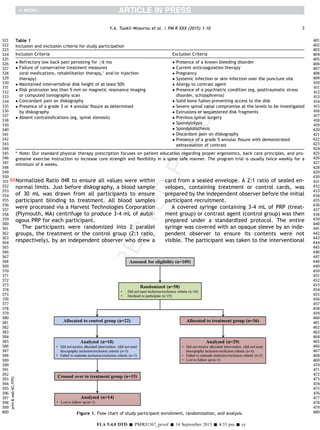
(Figure 1).
Study Protocol
Participants with a history of chronic axial LBP who
met inclusion and exclusion criteria were recruited.
Participants were evaluated by 2 interventional spine
and sports medicine physiatrists within the same prac-
tice and enrolled in the study if prediskography inclu-
sion criteria were met. General demographic
information, including age and gender, as well as
baseline outcome scores, were obtained from partici-
pant charts and questionnaires. Baseline information
was obtained from each participant before diskography
via the Functional Rating Index (FRI), Numeric Rating
Scale (NRS), and the 36-Item Short Form Health Survey
(SF-36) questionnaires. Each participant was then
required to complete repeat questionnaires that also
included a modi๏ฌed North American Spine Society
(NASS) Outcome Questionnaire at 1 week, 4 weeks, 8
weeks, 6 months, and 12 months or more postinjection.
At enrollment, typically 2 weeks before treatment,
participants provided informed consent, a baseline
assessment, and blood samples via venipuncture to
assess white blood cell count, erythrocyte sedimenta-
tion rate, prothrombin time, and International
2 Lumbar Intradiskal PRP Injections
FLA 5.4.0 DTD ล  PMRJ1567_proof ล  14 September 2015 ล  4:33 pm ล  ce
161
162
163
164
165
166
167
168
169
170
171
172
173
174
175
176
177
178
179
180
181
182
183
184
185
186
187
188
189
190
191
192
193
194
195
196
197
198
199
200
201
202
203
204
205
206
207
208
209
210
211
212
213
214
215
216
217
218
219
220
221
222
223
224
225
226
227
228
229
230
231
232
233
234
235
236
237
238
239
240
241
242
243
244
245
246
247
248
249
250
251
252
253
254
255
256
257
258
259
260
261
262
263
264
265
266
267
268
269
270
271
272
273
274
275
276
277
278
279
280
281
282
283
284
285
286
287
288
289
290
291
292
293
294
295
296
297
298
299
300
301
302
303
304
305
306
307
308
309
310
311
312
313
314
315
316
317
318
319
320
Normalized Ratio INRQ2 to ensure all values were within
normal limits. Just before diskography, a blood sample
of 30 mL was drawn from all participants to ensure
participant blinding to treatment. All blood samples
were processed via a Harvest Technologies Corporation
(Plymouth, MA) centrifuge to produce 3-4 mL of autol-
ogous PRP for each participant.
The participants were randomized into 2 parallel
groups, the treatment or the control group (2:1 ratio,
respectively), by an independent observer who drew a
card from a sealed envelope. A 2:1 ratio of sealed en-
velopes, containing treatment or control cards, was
prepared by the independent observer before the initial
participant recruitment.
A covered syringe containing 3-4 mL of PRP (treat-
ment group) or contrast agent (control group) was then
prepared under a standardized protocol. The entire
syringe was covered with an opaque sleeve by an inde-
pendent observer to ensure its contents were not
visible. The participant was taken to the interventional
Table 1
Inclusion and exclusion criteria for study participation
Inclusion Criteria Exclusion Criteria
 Refractory low back pain persisting for !6 mo
 Failure of conservative treatment measures
(oral medications, rehabilitation therapy,* and/or injection
therapy)
 Maintained intervertebral disk height of at least 50%
 Disk protrusion less than 5 mm on magnetic resonance imaging
or computed tomography scan
 Concordant pain on diskography
 Presence of a grade 3 or 4 annular ๏ฌssure as determined
by diskography
 Absent contraindications (eg, spinal stenosis)
 Presence of a known bleeding disorder
 Current anticoagulation therapy
 Pregnancy
 Systemic infection or skin infection over the puncture site
 Allergy to contrast agent
 Presence of a psychiatric condition (eg, posttraumatic stress
disorder, schizophrenia)
 Solid bone fusion preventing access to the disk
 Severe spinal canal compromise at the levels to be investigated
 Extrusions or sequestered disk fragments
 Previous spinal surgery
 Spondylolysis
 Spondylolisthesis
 Discordant pain on diskography
 Presence of a grade 5 annular ๏ฌssure with demonstrated
extravasation of contrast
* Note: Our standard physical therapy prescription focuses on patient education regarding proper ergonomics, back care principles, and pro-
gressive exercise instruction to increase core strength and ๏ฌ‚exibility in a spine safe manner. The program trial is usually twice weekly for a
minimum of 6 weeks.
printweb4C=FPOprintweb4C=FPO
Figure 1. Flow chart of study participant enrollment, randomization, and analysis.
3Y.A. Tuakli-Wosornu et al. / PM R XXX (2015) 1-10
FLA 5.4.0 DTD ล  PMRJ1567_proof ล  14 September 2015 ล  4:33 pm ล  ce
321
322
323
324
325
326
327
328
329
330
331
332
333
334
335
336
337
338
339
340
341
342
343
344
345
346
347
348
349
350
351
352
353
354
355
356
357
358
359
360
361
362
363
364
365
366
367
368
369
370
371
372
373
374
375
376
377
378
379
380
381
382
383
384
385
386
387
388
389
390
391
392
393
394
395
396
397
398
399
400
401
402
403
404
405
406
407
408
409
410
411
412
413
414
415
416
417
418
419
420
421
422
423
424
425
426
427
428
429
430
431
432
433
434
435
436
437
438
439
440
441
442
443
444
445
446
447
448
449
450
451
452
453
454
455
456
457
458
459
460
461
462
463
464
465
466
467
468
469
470
471
472
473
474
475
476
477
478
479
480
procedure suite and placed prone on the ๏ฌ‚uoroscopy
table. After a standardized sterile preparation, local
anesthesia was administered. With a standard double-
needle, extrapedicular technique, a 25-gauge spinal
needle was advanced through a 20-gauge introducer
needle into the mid-portion of the suspected disk levels,
as well as into a control level. Anteroposterior and
lateral ๏ฌ‚uoroscopic imaging con๏ฌrmed proper needle
position. A volume of 1-2 mL of contrast agent (Omni-
paque 180, Amersham Health, Princeton, NJ) was
injected while the participantโ€™s pain response and disk
architecture were recorded.
As soon as the participant endorsed concordant pain
reproduction and there was evidence of contrast ๏ฌlling an
annular ๏ฌssure, the covered syringe was attached to the
needle hub by an independent physiatrist to maintain
blinding. No extension tubing was used during the injec-
tion. Only disk levels that elicited concordant pain with
evidence of incomplete annular disruption (2 mL) were
then injected additionally with either 1-2 mL of PRP or
1-2 mL of contrast agent. Both the physician and partic-
ipant remained blinded. If more than one disk was
symptomatic with reproduction of concordant pain, the
PRP or contrast was divided into equal doses and injected
into each of the affected disks. All participants had a
peripheral intravenous access placed and received 1 g of
cefazolin (AncefQ3 ) 30 minutes before the procedure.
Postdiskography computed tomography scan images,
when obtained, were used by the treating physician to
visualize and categorize the architecture of the IVD
according to the Dallas Discogram Classi๏ฌcation [23].
This same information could later be used for surgical
decision-making if necessary. The treating physicians
remained blinded to the computed tomography scan
images during the initial 8-week follow-up period.
Follow-up questionnaires were then administered by
an independent observer at the designated time points.
After 12 months, a small subset of participants were
tracked annually for up to 2 years. All participants who
had no clinical improvement (ie, those who did not meet
or surpass the minimal clinically signi๏ฌcant outcome
measure improvements) at 8 weeks were unblinded. If
they were initially in the control group, they were
offered intradiskal PRP for their symptomatic disk(s).
Those in the PRP group who had no clinical improvement
were managed with other continued conservative
treatments, or went on to surgery.
Outcome Measures
Primary outcomes measures included postprocedure
improvements in pain, function, and participant satis-
faction. Secondary outcomes were untoward side
effects, including increased pain, bleeding, infection,
and neurologic de๏ฌcits. Four internationally validated
surveys were used as outcome measures: the FRI, the
NRS, the SF-36, and the modi๏ฌed NASS Outcome
Questionnaire. Only the physical functioning and pain
sections were scored on the SF-36 [24,25]. The FRI was
designed for participants with spinal disorders to mea-
sure participant perception of function and pain related
to performing dynamic movements and holding static
positions [26]. The minimum clinically important dif-
ference (MCID) of the FRI is a 9-point change [27]. The
NRS for pain is commonly presented as a 100-mm hori-
zontal line on which pain intensity is indicated by a
point between 0, ie, โ€œno pain at allโ€ and 10, ie, โ€œworst
pain imaginable.โ€ Participants were asked to tick an
integer representing current pain, pain at best, and pain
at worst [28]. The MCID of the NRS is a 2-point change
[29]. A change of 4.9 and 10 points constitute a MCID in
the SF-36 physical functioning and SF-36 pain scores,
respectively [28,30]. The modi๏ฌed NASS Outcome
Questionnaire measures participant satisfaction with
the procedure. The questionnaire used in this study is a
version of a questionnaire used in prior studies by other
authors [31,32].
A sample size of participants (48 treatment partici-
pants, 24 control participants) was estimated by power
analysis to achieve greater than 80% power to detect a
9-point change in FRI score with estimated standard
deviations of plus or minus 15 in a 2-way repeated
measures analysis of variance model with 5 time points.
Statistical Analysis
Overall summary statistics were calculated in terms
of means and standard deviations for continuous vari-
ables and frequencies, and percentages for discrete
variables. Baseline group differences for continuous
variables were evaluated using independent sample
t-tests, and c2
/Fisher exact tests were used for the
discrete variables. To assess the differences in partici-
pant reported outcome measures between PRP and
control groups over time and to adjust for missing data
at any given time point and the variation of the duration
of follow-up time, generalized linear mixed-effect
models were built. Multiple models were built to eval-
uate model ๏ฌt based on variance-covariance structures.
On the basis of the results from the ร€2 Log Likelihood,
the Akaike Information Criterion, and Schwarz Bayesian
Criterion, ๏ฌnal models with an unstructured variance-
covariance structure were reported [33]. Analysis of
the within-group changes over time for the PRP group
were assessed with a similar model. Bonferroni correc-
tions were applied to the analyses of inter- and
intragroup changes over time by multiplying the corre-
sponding P-values by factors of 3 and 5, respectively, to
account for multiple comparisons [34,35]. The effective
level of signi๏ฌcance was .05 for all reported P-values.
Differences in mean PRP group scores at discrete follow-
up time points compared with those at baseline were
assessed using paired t-tests. Measures of the associa-
tion between treatment group and participant-reported
4 Lumbar Intradiskal PRP Injections
FLA 5.4.0 DTD ล  PMRJ1567_proof ล  14 September 2015 ล  4:33 pm ล  ce
481
482
483
484
485
486
487
488
489
490
491
492
493
494
495
496
497
498
499
500
501
502
503
504
505
506
507
508
509
510
511
512
513
514
515
516
517
518
519
520
521
522
523
524
525
526
527
528
529
530
531
532
533
534
535
536
537
538
539
540
541
542
543
544
545
546
547
548
549
550
551
552
553
554
555
556
557
558
559
560
561
562
563
564
565
566
567
568
569
570
571
572
573
574
575
576
577
578
579
580
581
582
583
584
585
586
587
588
589
590
591
592
593
594
595
596
597
598
599
600
601
602
603
604
605
606
607
608
609
610
611
612
613
614
615
616
617
618
619
620
621
622
623
624
625
626
627
628
629
630
631
632
633
634
635
636
637
638
639
640
satisfaction were calculated using odds ratios with
observed level of signi๏ฌcance determined by Pearson
c2
test. Statistical signi๏ฌcance for measures of associ-
ation was set to .05. All analyses that estimated mar-
ginal means for levels of factors and factor interactions
were conducted using SPSS version 20.0 (IBM Corp.,
Armonk, NY).
Results
PRP Versus Control Evaluation
From 2009 to 2013, 109 participants were assessed for
lumbar back pain for potential eligibility by the senior
investigator (G.E.L.). Of those participants, 26 failed to
meet the full inclusion and exclusion criteria, and 25
declined to participate in the study. The ๏ฌnal number of
participants that were randomized was 58 participants
(53.2%). Of those 58 participants, 36 were randomized
to the treatment group (62.1%) and 22 were randomized
to the control group (37.9%). In the treatment group, 29
of the 36 participants were used for analysis (80.6%),
whereas 18 of the 22 control group participants were
used (81.2%).
Demographic characteristics in the 2 study groups are
reported in Table 2 Q4. Mean age between the 2 groups
were not signi๏ฌcantly different. The control group had a
mean age of 44 years and the treatment group had a
mean age of 41 years (P ยผ .36). There was a signi๏ฌcantly
greater proportion of female patients who were ran-
domized to the control group (84.2%) than there was in
the treatment group (51.7%) (P ยผ .03) (Table 2).
During the 8-week follow-up period in the compara-
tive component of the study, the PRP group demon-
strated signi๏ฌcant improvement in several outcome
measures. The interaction effect of the between group
comparisons over 8 weeks showed a signi๏ฌcant effect in
FRI score, indicating that the PRP group had signi๏ฌcantly
changed over 8 weeks compared with changes in the
control group (P ยผ .03) (Table 3). Participant-reported
NRS best pain score showed a signi๏ฌcant difference
over 8 weeks compared with the control group (P ยผ .02).
Group changes over 8 weeks were not found to be sig-
ni๏ฌcant in the self-reported current pain, worst pain,
SF-36 Pain, and SF-36 Function scores (P ยผ .16, P ยผ .09,
P ยผ .08, and P ยผ .44 respectively) (Table 3). Changes in
PRP and control groups over time are illustrated in
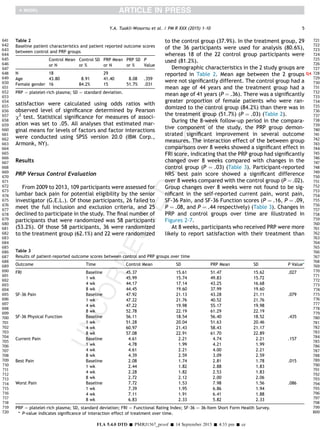
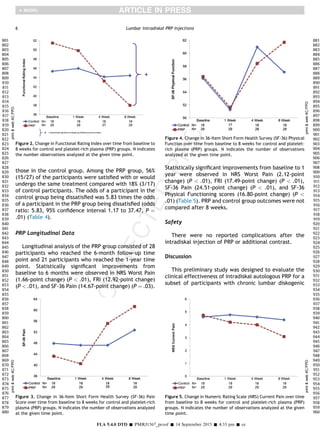
Figures 2-7.
At 8 weeks, participants who received PRP were more
likely to report satisfaction with their treatment than
Table 3
Results of patient-reported outcome scores between control and PRP groups over time
Outcome Time Control Mean SD PRP Mean SD P Value*
FRI Baseline 45.37 15.61 51.47 15.62 .027
1 wk 45.99 15.74 49.83 15.72
4 wk 44.17 17.14 43.25 16.68
8 wk 44.45 19.60 37.99 19.60
SF-36 Pain Baseline 47.92 21.13 43.28 21.11 .079
1 wk 47.22 21.76 40.52 21.76
4 wk 47.22 19.98 55.17 19.98
8 wk 52.78 22.19 61.29 22.19
SF-36 Physical Function Baseline 56.11 18.54 56.40 18.52 .435
1 wk 51.28 20.04 51.63 20.46
4 wk 60.97 21.43 58.43 21.17
8 wk 57.08 22.91 61.70 22.89
Current Pain Baseline 4.61 2.21 4.74 2.21 .157
1 wk 4.78 1.99 4.21 1.99
4 wk 4.61 2.21 4.00 2.21
8 wk 4.39 2.59 3.09 2.59
Best Pain Baseline 2.08 1.74 2.81 1.78 .015
1 wk 2.44 1.82 2.88 1.83
4 wk 2.28 1.82 2.53 1.83
8 wk 2.72 2.12 2.00 2.06
Worst Pain Baseline 7.72 1.53 7.98 1.56 .086
1 wk 7.39 1.95 6.86 1.94
4 wk 7.11 1.91 6.41 1.88
8 wk 6.83 2.33 5.82 2.33
PRP ยผ platelet-rich plasma; SD, standard deviation; FRI ยผ Functional Rating Index; SF-36 ยผ 36-Item Short Form Health Survey.
* P-value indicates signi๏ฌcance of interaction effect of treatment over time.
Table 2
Baseline patient characteristics and patient reported outcome scores
between control and PRP groups
Control Mean
or N
Control SD
or %
PRP Mean
or N
PRP SD
or %
P
Value
N 18 29
Age 43.80 8.91 41.40 8.08 .359
Female gender 16 84.2% 15 51.7% .031
PRP ยผ platelet-rich plasma; SD ยผ standard deviation.
5Y.A. Tuakli-Wosornu et al. / PM R XXX (2015) 1-10
FLA 5.4.0 DTD ล  PMRJ1567_proof ล  14 September 2015 ล  4:33 pm ล  ce
641
642
643
644
645
646
647
648
649
650
651
652
653
654
655
656
657
658
659
660
661
662
663
664
665
666
667
668
669
670
671
672
673
674
675
676
677
678
679
680
681
682
683
684
685
686
687
688
689
690
691
692
693
694
695
696
697
698
699
700
701
702
703
704
705
706
707
708
709
710
711
712
713
714
715
716
717
718
719
720
721
722
723
724
725
726
727
728
729
730
731
732
733
734
735
736
737
738
739
740
741
742
743
744
745
746
747
748
749
750
751
752
753
754
755
756
757
758
759
760
761
762
763
764
765
766
767
768
769
770
771
772
773
774
775
776
777
778
779
780
781
782
783
784
785
786
787
788
789
790
791
792
793
794
795
796
797
798
799
800
those in the control group. Among the PRP group, 56%
(15/27) of the participants were satis๏ฌed with or would
undergo the same treatment compared with 18% (3/17)
of control participants. The odds of a participant in the
control group being dissatis๏ฌed was 5.83 times the odds
of a participant in the PRP group being dissatis๏ฌed (odds
ratio: 5.83, 95% con๏ฌdence interval 1.17 to 37.47, P ยผ
.01) (Table 4).
PRP Longitudinal Data
Longitudinal analysis of the PRP group consisted of 28
participants who reached the 6-month follow-up time
point and 21 participants who reached the 1-year time
point. Statistically signi๏ฌcant improvements from
baseline to 6 months were observed in NRS Worst Pain
(1.66-point change) (P  .01), FRI (12.92-point change)
(P  .01), and SF-36 Pain (14.67-point change) (P ยผ .03).
Statistically signi๏ฌcant improvements from baseline to 1
year were observed in NRS Worst Pain (2.12-point
change) (P  .01), FRI (17.49-point change) (P  .01),
SF-36 Pain (24.51-point change) (P  .01), and SF-36
Physical Functioning scores (16.80-point change) (P 
.01) (Table 5). PRP and control group outcomes were not
compared after 8 weeks.
Safety
There were no reported complications after the
intradiskal injection of PRP or additional contrast.
Discussion
This preliminary study was designed to evaluate the
clinical effectiveness of intradiskal autologous PRP for a
subset of participants with chronic lumbar diskogenic
printweb4C=FPOprintweb4C=FPO
Figure 4. Change in 36-Item Short Form Health Survey (SF-36) Physical
Function over time from baseline to 8 weeks for control and platelet-
rich plasma (PRP) groups. N indicates the number of observations
analyzed at the given time point.
printweb4C=FPOprintweb4C=FPO
Figure 2. Change in Functional Rating Index over time from baseline to
8 weeks for control and platelet-rich plasma (PRP) groups. N indicates
the number observations analyzed at the given time point.
printweb4C=FPOprintweb4C=FPO
Figure 5. Change in Numeric Rating Scale (NRS) Current Pain over time
from baseline to 8 weeks for control and platelet-rich plasma (PRP)
groups. N indicates the number of observations analyzed at the given
time point.
printweb4C=FPOprintweb4C=FPO
Figure 3. Change in 36-Item Short Form Health Survey (SF-36) Pain
Score over time from baseline to 8 weeks for control and platelet-rich
plasma (PRP) groups. N indicates the number of observations analyzed
at the given time point.
6 Lumbar Intradiskal PRP Injections
FLA 5.4.0 DTD ล  PMRJ1567_proof ล  14 September 2015 ล  4:33 pm ล  ce
801
802
803
804
805
806
807
808
809
810
811
812
813
814
815
816
817
818
819
820
821
822
823
824
825
826
827
828
829
830
831
832
833
834
835
836
837
838
839
840
841
842
843
844
845
846
847
848
849
850
851
852
853
854
855
856
857
858
859
860
861
862
863
864
865
866
867
868
869
870
871
872
873
874
875
876
877
878
879
880
881
882
883
884
885
886
887
888
889
890
891
892
893
894
895
896
897
898
899
900
901
902
903
904
905
906
907
908
909
910
911
912
913
914
915
916
917
918
919
920
921
922
923
924
925
926
927
928
929
930
931
932
933
934
935
936
937
938
939
940
941
942
943
944
945
946
947
948
949
950
951
952
953
954
955
956
957
958
959
960
pain. To our knowledge, this is one of the ๏ฌrst clinical
studies investigating the ef๏ฌcacy of an intradiskal cell
therapy in a double-blind, randomized controlled study
design.
The strengths of this study were its double-blind,
randomized, controlled trial design, the rigorous
participant selection process, the high follow-up rate,
and long term data (ie, at least 1 year) in the majority of
participants. Although the number of participants was
relatively low, this study detected statistically signi๏ฌ-
cant improvements in NRS Best Pain, FRI, and NASS
satisfaction between the treatment and control groups
over 8 weeks. In addition, the bene๏ฌcial effects of PRP
were sustained for at least 1 year with respect to the FRI
Index. No participant in the treatment group experi-
enced complications, including progressive disk hernia-
tion, neurologic injury, or disk space infection.
Meticulous participant selection was critical for the
study. Inclusion and exclusion criteria were rigorous,
thus explaining the 4-year time period necessary to
enroll 51 eligible participants. Among the authors, it
was agreed that PRP is a targeted annular therapy. If the
disk protrusion was signi๏ฌcant (5 mm) and the end-
plates were degenerated, targeted annular therapy
would likely be of no clinical or functional bene๏ฌt.
Complete, Grade V annular ๏ฌssures also were excluded,
because then the injectate would likely ๏ฌ‚ow out of the
disk into the epidural space. This would allow little to
no opportunity for the PRP graft to effect an intradiskal
pro-healing change.
Interestingly, participants who elicited concordant
pain at 2 levels and were treated with PRP for both disks
showed superior improvements in all outcome measures
at 1 year compared with those participants who elicited
concordant pain at one level and subsequently received
treatment for the single disk. There were no signi๏ฌcant
differences in mean outcome measure scores at base-
line between these 2 subgroups.
The least amount of contrast necessary to elicit a
pain response was injected in the IVD with the intention
of leaving suf๏ฌcient space in the disk to accommodate
PRP volume. We did not use a pressure-controlled
manometry system because in the authorsโ€™ experi-
ence, these systems require greater volume of contrast
to elicit a pain response compared to manual adminis-
tration. In most participants, a pain response was eli-
cited with injection of less than 1 ml of contrast. In a
small group of participants, 2 mL of contrast was
required. In the authorsโ€™ experience, a disk that is not
completely disrupted will typically only hold 3-4 mL of
injectate. This limited the volume of PRP in most par-
ticipants to between 1 and 2 mL. Furthermore, for each
participant, treatment was limited to 1 injection at the
time of diskography to minimize the possibility of
adverse reaction from multiple disk punctures [36].
One limitation of the study was the limited follow-up
time of only 8 weeks for the control group. Having a
longer follow-up interval on the control participants (6
months, 1 year) would possibly enable detection of
greater differences between groups over time. Although
there were statistically signi๏ฌcant differences between
PRP and control groups over 8 weeks, these changes
were not detected in all outcome measures, and the
changes in NRS pain scores were modest at best. In
retrospect, there were some participants in the study
who had more disk degeneration and larger protrusions
than others, which likely increased some of the vari-
ability in witnessed responses. Finally, there was no
data collection on cell counts or biochemical analysis of
the PRP and there was no routine radiologic follow-up to
see if morphologic disk changes occurred with clinical
improvement. Future studies should include these data
to better learn about the effects of cell therapy on
lumbar disk disease.
printweb4C=FPOprintweb4C=FPO
Figure 6. Change in Numeric Rating Scale (NRS) Best pain over time
from baseline to 8 weeks for control and platelet-rich plasma (PRP)
groups. N indicates the number of observations analyzed at the given
time point.
printweb4C=FPOprintweb4C=FPO
Figure 7. Change in Numeric Rating Scale (NRS) Worst Pain over time
from baseline to 8 weeks for control and platelet-rich plasma (PRP)
groups. N indicates the number of observations analyzed at the given
time point.
7Y.A. Tuakli-Wosornu et al. / PM R XXX (2015) 1-10
FLA 5.4.0 DTD ล  PMRJ1567_proof ล  14 September 2015 ล  4:33 pm ล  ce
961
962
963
964
965
966
967
968
969
970
971
972
973
974
975
976
977
978
979
980
981
982
983
984
985
986
987
988
989
990
991
992
993
994
995
996
997
998
999
1000
1001
1002
1003
1004
1005
1006
1007
1008
1009
1010
1011
1012
1013
1014
1015
1016
1017
1018
1019
1020
1021
1022
1023
1024
1025
1026
1027
1028
1029
1030
1031
1032
1033
1034
1035
1036
1037
1038
1039
1040
1041
1042
1043
1044
1045
1046
1047
1048
1049
1050
1051
1052
1053
1054
1055
1056
1057
1058
1059
1060
1061
1062
1063
1064
1065
1066
1067
1068
1069
1070
1071
1072
1073
1074
1075
1076
1077
1078
1079
1080
1081
1082
1083
1084
1085
1086
1087
1088
1089
1090
1091
1092
1093
1094
1095
1096
1097
1098
1099
1100
1101
1102
1103
1104
1105
1106
1107
1108
1109
1110
1111
1112
1113
1114
1115
1116
1117
1118
1119
1120
A priori power analysis had indicated that a sample size
of 72 participants (48 treatment participants, 24 control
participants) was necessary to achieve greater than 80%
power to detect a 9-point change in FRI score with esti-
mated standard deviations of plus or minus 15 in a 2-way
repeated measures analysis of variance model with 5 time
Table 4
North American Spine Society (NASS) satisfaction at 8 weeks
Outcome Score
Control PRP
Odds Ratio
95% Con๏ฌdence
Interval
P-ValueN % N % Lower Upper
NASS satisfaction at 8 wk 1 or 2 3 17.6% 15 55.6% 5.83 1.17 37.47 .010
3 or 4 14 82.4% 12 44.4%
The NASS Patient Satisfaction Index:
1 ยผ The procedure met my expectations.
2 ยผ I improved less than I had hoped, but I would undergo the same procedure again for the same results.
3 ยผ The procedure helped, but I would not undergo the same procedure again for the same results.
4 ยผ I am the same or worse than before the procedure.
Table 5
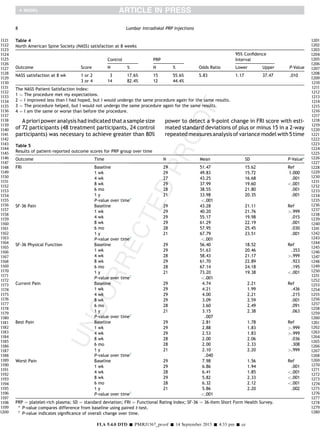
Results of patient-reported outcome scores for PRP group over time
Outcome Time N Mean SD P-Value*
FRI Baseline 29 51.47 15.62 Ref
1 wk 29 49.83 15.72 1.000
4 wk 27 43.25 16.68 .001
8 wk 29 37.99 19.60 .001
6 mo 28 38.55 21.80 .001
1 y 21 33.98 20.35 .001
P-value over timeโ€ 
.001
SF-36 Pain Baseline 29 43.28 21.11 Ref
1 wk 29 40.20 21.76 .999
4 wk 29 55.17 19.98 .015
8 wk 29 61.29 22.19 .001
6 mo 28 57.95 25.45 .030
1 y 21 67.79 23.51 .001
P-value over timeโ€ 
.001
SF-36 Physical Function Baseline 29 56.40 18.52 Ref
1 wk 29 51.63 20.46 .353
4 wk 28 58.43 21.17 .999
8 wk 29 61.70 22.89 .923
6 mo 28 67.14 24.18 .195
1 y 21 73.20 19.38 .001
P-value over timeโ€ 
.001
Current Pain Baseline 29 4.74 2.21 Ref
1 wk 29 4.21 1.99 .436
4 wk 29 4.00 2.21 .215
8 wk 29 3.09 2.59 .001
6 mo 28 3.60 2.49 .091
1 y 21 3.15 2.38 .063
P-value over timeโ€ 
.007
Best Pain Baseline 29 2.81 1.78 Ref
1 wk 29 2.88 1.83 .999
4 wk 29 2.53 1.83 .999
8 wk 28 2.00 2.06 .036
6 mo 28 2.00 2.33 .308
1 y 21 2.10 2.20 .999
P-value over timeโ€ 
.040
Worst Pain Baseline 29 7.98 1.56 Ref
1 wk 29 6.86 1.94 .001
4 wk 28 6.41 1.85 .001
8 wk 29 5.82 2.33 .001
6 mo 28 6.32 2.12 .001
1 y 21 5.86 2.20 .002
P-value over timeโ€ 
.001
PRP ยผ platelet-rich plasma; SD ยผ standard deviation; FRI ยผ Functional Rating Index; SF-36 ยผ 36-Item Short Form Health Survey.
* P-value compares difference from baseline using paired t-test.
โ€ 
P-value indicates signi๏ฌcance of overall change over time.
8 Lumbar Intradiskal PRP Injections
FLA 5.4.0 DTD ล  PMRJ1567_proof ล  14 September 2015 ล  4:33 pm ล  ce
1121
1122
1123
1124
1125
1126
1127
1128
1129
1130
1131
1132
1133
1134
1135
1136
1137
1138
1139
1140
1141
1142
1143
1144
1145
1146
1147
1148
1149
1150
1151
1152
1153
1154
1155
1156
1157
1158
1159
1160
1161
1162
1163
1164
1165
1166
1167
1168
1169
1170
1171
1172
1173
1174
1175
1176
1177
1178
1179
1180
1181
1182
1183
1184
1185
1186
1187
1188
1189
1190
1191
1192
1193
1194
1195
1196
1197
1198
1199
1200
1201
1202
1203
1204
1205
1206
1207
1208
1209
1210
1211
1212
1213
1214
1215
1216
1217
1218
1219
1220
1221
1222
1223
1224
1225
1226
1227
1228
1229
1230
1231
1232
1233
1234
1235
1236
1237
1238
1239
1240
1241
1242
1243
1244
1245
1246
1247
1248
1249
1250
1251
1252
1253
1254
1255
1256
1257
1258
1259
1260
1261
1262
1263
1264
1265
1266
1267
1268
1269
1270
1271
1272
1273
1274
1275
1276
1277
1278
1279
1280
points. However, stopping rules were applied because of
logistical concerns (ie, time and ๏ฌnancial constraints) and
an overwhelming number of control patients requesting
to be unblinded from the study protocol and requesting
the treatment speci๏ฌcally after the 8-week follow-up
period (n ยผ 15, 68.2%). As a result, the comparative
analysis was modi๏ฌed from 5 time points to 4. Given the
new parameters of the study, we were slightly under-
powered to detect the demonstrated difference in FRI
score at 8 weeks between the study groups. As an addi-
tional consequence, the variance-covariance matrix of
the original power analysis was not used for actual anal-
ysis of collected data. However, given the sample sizes
used for this study, we were adequately powered to
detect a 10-point difference between groups with a four
time point study design.
Conclusion
Participants who received intradiskal PRP experi-
enced signi๏ฌcantly greater improvements in FRI,
NRSeBest Pain, and NASS satisfaction scores compared
with those who received contrast agent alone over 8
weeks. Additionally, the signi๏ฌcant improvement in FRI
score was sustained for up to 1 year or more after PRP
injection. Under sterile conditions, intradiskal PRP
seems to have an excellent safety pro๏ฌle. There were
no reported complications after injection among
enrolled participants. Although these results are
encouraging, further studies are needed to determine
who the best candidates are for this treatment, what
the optimal PRP concentration and composition is,
whether multiple injections improve or worsen out-
comes, and how the cellular physiology responsible for
IVD regeneration can be considered to optimize the
therapeutic effect.
References
1. Andersson GB. Epidemiological features of chronic low-back pain.
Lancet 1999;354:581-585.
2. Frank JW, Brooker AS, DeMaio SE, et al. Disability resulting from
occupational low back pain. Part I: What do we know about
primary prevention? A review of the scienti๏ฌc evidence on pre-
vention before disability begins. Spine (Phila Pa 1976) 1996;21:
2908-2917.
3. Frymoyer JW, Cats-Baril WL. An overview of the incidences and
costs of low back pain. Orthop Clin North Am 1991;22:263-271.
4. Cassidy JD, Cote P, Carroll LJ, Kristman V. Incidence and course of
low back pain episodes in the general population. Spine (Phila Pa
1976) 2005;30:2817-2823.
5. Dunn KM, Hestbaek L, Cassidy JD. Low back pain across the life
course. Best Pract Res Clin. Rheumatol 2013;27:591-600.
6. Burdorf A, Sorock G. Positive and negative evidence of risk
factors for back disorders. Scand J Work Environ Health 1997;23:
243-256.
7. Garg A, Moore JS. Epidemiology of low-back pain in industry.
Occup Med 1992;7:593-608.
8. Deyo RA, Phillips WR. Low back pain. A primary care challenge.
Spine (Phila Pa 1976) 1996;21:2826-2832.
9. Schwarzer AC, Aprill CN, Derby R, Fortin J, Kine G, Bogduk N. The
prevalence and clinical features of internal disc disruption in pa-
tients with chronic low back pain. Spine (Phila Pa 1976) 1995;20:
1878-1883.
10. Rothman RH. A study of computer-assisted tomography. Spine
(Phila Pa 1976) 1984;9:548.
11. Jensen MC, Brant-Zawadzki MN, Obuchowski N, Modic MT,
Malkasian D, Ross JS. Magnetic resonance imaging of the lum-
bar spine in people without back pain. N Engl J Med 1994;331:
69-73.
12. Modic MT, Obuchowski NA, Ross JS, et al. Acute low back pain and
radiculopathy: MR imaging ๏ฌndings and their prognostic role and
effect on outcome. Radiology 2005;237:597-604.
13. Borenstein DG, Oโ€™Mara JW Jr, Boden SD, et al. The value of mag-
netic resonance imaging of the lumbar spine to predict low-back
pain in asymptomatic patients: A seven-year follow-up study. J
Bone Joint Surg Am 2001;83-A:1306-1311.
14. Walker J 3rd, El Abd O, Isaac Z, Muzin S. Discography in practice: A
clinical and historical review. Curr Rev Musculoskelet Med 2008;1:
69-83.
15. Bogduk N. Clinical Anatomy of the Lumbar Spine and Sacrum. 4th
ed. New York, NY: Elsevier; 2005, 147-148.
16. Mishra A, Woodall J Jr, Vieira A. Treatment of tendon and
muscle using platelet-rich plasma. Clin Sports Med 2009;28:
113-125.
17. Sampson S, Gerhardt M, Mandelbaum B. Platelet rich plasma in-
jection grafts for musculoskeletal injuries: A review. Curr Rev
Musculoskelet Med 2008;1:165-174.
18. Foster TE, Puskas BL, Mandelbaum BR, Gerhardt MB, Rodeo SA.
Platelet-rich plasma: From basic science to clinical applications.
Am J Sports Med 2009;37:2259-2272.
19. Chen WH, Lo WC, Lee JJ, et al. Tissue-engineered intervertebral
disc and chondrogenesis using human nucleus pulposus regulated
through TGF-beta1 in platelet-rich plasma. J Cell Physiol 2006;209:
744-754.
20. Gullung GB, Woodall JW, Tucci MA, James J, Black DA, McGuire RA.
Platelet-rich plasma effects on degenerative disc disease: Analysis
of histology and imaging in an animal model. Evid Based Spine Care
J 2011;2:13-18.
21. Obata S, Akeda K, Imanishi T, et al. Effect of autologous platelet-
rich plasma-releasate on intervertebral disc degeneration in the
rabbit anular puncture model: A preclinical study. Arthritis Res
Ther 2012;14:R241.
22. Allon AA, Aurouer N, Yoo BB, Liebenberg EC, Buser Z, Lotz JC.
Structured coculture of stem cells and disc cells prevent disc
degeneration in a rat model. Spine J 2010;10:1089-1097.
23. Sachs BL, Vanharanta H, Spivey MA, et al. Dallas discogram
description. A new classi๏ฌcation of CT/discography in low-back
disorders. Spine (Phila Pa 1976) 1987;12(3):287-294.
24. Jenkinson C, Coulter A, Wright L. Short form 36 (SF36) health
survey questionnaire: Normative data for adults of working age.
BMJ 1993;306:1437-1440.
25. Jenkinson C, Layte R, Coulter A, Wright L. Evidence for the
sensitivity of the SF-36 health status measure to inequalities in
health: Results from the oxford healthy lifestyles survey. J Epi-
demiol Community Health 1996;50:377-380.
26. Feise RJ, Michael Menke J. Functional rating index: A new valid
and reliable instrument to measure the magnitude of clinical
change in spinal conditions. Spine (Phila Pa 1976) 2001;26:78-86;
discussion 87.
27. Copay AG, Glassman SD, Subach BR, Berven S, Schuler TC,
Carreon LY. Minimally clinically important difference in lumbar
spine surgery patients: A choice of methods using the Oswestry
disability index, medical outcomes study questionnaire short form
36, and pain scales. Spine J 2008;8:968-974.
28. Krebs EE, Carey TS, Weinberger M. Accuracy of the pain numeric
rating scale as a screening test in primary care. J Gen Intern Med
2007;22:1453-1458.
9Y.A. Tuakli-Wosornu et al. / PM R XXX (2015) 1-10
FLA 5.4.0 DTD ล  PMRJ1567_proof ล  14 September 2015 ล  4:33 pm ล  ce
1281
1282
1283
1284
1285
1286
1287
1288
1289
1290
1291
1292
1293
1294
1295
1296
1297
1298
1299
1300
1301
1302
1303
1304
1305
1306
1307
1308
1309
1310
1311
1312
1313
1314
1315
1316
1317
1318
1319
1320
1321
1322
1323
1324
1325
1326
1327
1328
1329
1330
1331
1332
1333
1334
1335
1336
1337
1338
1339
1340
1341
1342
1343
1344
1345
1346
1347
1348
1349
1350
1351
1352
1353
1354
1355
1356
1357
1358
1359
1360
1361
1362
1363
1364
1365
1366
1367
1368
1369
1370
1371
1372
1373
1374
1375
1376
1377
1378
1379
1380
1381
1382
1383
1384
1385
1386
1387
1388
1389
1390
1391
1392
1393
1394
1395
1396
1397
1398
1399
1400
1401
1402
1403
1404
1405
1406
1407
1408
1409
1410
1411
1412
1413
1414
1415
1416
1417
1418
1419
1420
1421
1422
1423
1424
1425
1426
1427
1428
1429
1430
1431
1432
1433
1434
1435
1436
1437
1438
1439
1440
29. Childs JD, Piva SR, Fritz JM. Responsiveness of the numeric pain
rating scale in patients with low back pain. Spine (Phila Pa 1976)
2005;30:1331-1334.
30. Daltroy LH, Cats-Baril WL, Katz JN, Fossel AH, Liang MH. The North
American spine society lumbar spine outcome assessment instru-
ment: Reliability and validity tests. Spine (Phila Pa 1976) 1996;21:
741-749.
31. Schofferman J, Anderson D, Hines R, Smith G, White A. Childhood
psychological trauma correlates with unsuccessful lumbar spine
surgery. Spine (Phila Pa 1976) 1992;17(6 Suppl):S138-S144.
32. Slosar PJ, Reynolds JB, Schofferman J, Goldthwaite N, White AH,
Keaney D. Patient satisfaction after circumferential lumbar fusion.
Spine (Phila Pa 1976) 2000;25:722-726.
33. Littell RC, Pendergast J, Natarajan R. Tutorial in biostatistics:
Modelling covariance structure in the analysis of repeated mea-
sures data. Stat Med 2000;19:1819.
34. Bland JM, Altman DG. Multiple signi๏ฌcance tests: The Bonferroni
method. BMJ 1995;310:170.
35. Bhandari M, Whang W, Kuo JC, Devereaux PJ, Sprague S,
Tornetta P III. The risk of false-positive results in orthopaedic
surgical trials. Clin Orthop Relat Res 2003;413:63-69.
36. Carragee EJ, Don AS, Hurwitz EL, Cuellar JM, Carrino JA,
Herzog R. 2009 ISSLS prize winner: Does discography cause
accelerated progression of degeneration changes in the lumbar
disc: A ten-year matched cohort study. Spine (Phila Pa 1976)
2009;34:2338-2345.
Disclosure
Y.A.T.-W. Hospital for Special Surgery, Physiatry Department, New York, NY
Disclosures related to this publication: grant, Harvest Technologies unrestricted
research grant (money to institutionQ1 )
A.T. Hospital for Special Surgery, Physiatry Department, New York, NY
Disclosures related to this publication: grant, Harvest Technologies unrestricted
research grant (money to institution)
K.B.-A. Hospital for Special Surgery, Physiatry Department, New York, NY
Disclosures related to this publication: grant, Harvest Technologies unrestricted
research grant (money to institution)
J.R.H. Hospital for Special Surgery, Physiatry Department, New York, NY
Disclosure: nothing to disclose
C.K.G. Hospital for Special Surgery, Physiatry Department, New York, NY
Disclosures related to this publication: grant, Harvest Technologies unrestricted
research grant (money to institution)
E.E.L. Hospital for Special Surgery, Physiatry Department, New York, NY
Disclosures related to this publication: grant, Harvest Technologies unrestricted
research grant (money to institution)
J.T.N. Hospital for Special Surgery, Epidemiology and Biostatistics Department,
New York, NY
Disclosures related to this publication: grant, Harvest Technologies unrestricted
research grant (money to institution)
J.L.S. Hospital for Special Surgery, Physiatry Department, New York, NY
Disclosures related to this publication: grant, Harvest Technologies unrestricted
research grant (money to institution)
G.E.L. Hospital for Special Surgery, Physiatry Department, 429 E 75th St, 3rd
๏ฌ‚oor, New York, NY 10021. Address correspondence to: G.E.L.; e-mail: LutzG@
hss.edu
Disclosures related to this publication: grant, Harvest Technologies unrestricted
research grant (money to institution)
Disclosures outside this publication: consultancy, Biorestorative Therapies
medical advisor (money to author); stock/stock options, Biorestorative Thera-
pies (money to author)
This research was partially supported by a donation of study equipment from
Harvest Technologies. Mr. Nguyen was partially supported by Clinical Trans-
lational Science Center (CTSC) (UL1-RR024996).
An interim analysis of this study was presented at the October 2013 American
Academy of Physical Medicine and Rehabilitation conference.
Submitted for publication March 4, 2014; accepted August 13, 2015.
10 Lumbar Intradiskal PRP Injections
FLA 5.4.0 DTD ล  PMRJ1567_proof ล  14 September 2015 ล  4:33 pm ล  ce
1441
1442
1443
1444
1445
1446
1447
1448
1449
1450
1451
1452
1453
1454
1455
1456
1457
1458
1459
1460
1461
1462
1463
1464
1465
1466
1467
1468
1469
1470
1471
1472
1473
1474
1475
1476
1477
1478
1479
1480
1481
1482
1483
1484
1485
1486
1487
1488
1489
1490
1491
1492
1493
1494
1495
1496
1497
1498
1499
1500
1501
1502
1503
1504
1505
1506
1507
1508
1509
1510
1511
1512
1513
1514
1515
1516
1517
1518
1519
1520
1521
1522
1523
1524
1525
1526
1527
1528
1529
1530
1531
1532
1533
1534
1535
1536
1537
1538
1539
1540
1541
1542
1543
1544
1545
1546
1547
1548
1549
1550
1551
1552
1553
1554
1555
1556
1557
1558
1559
1560
1561
1562
1563
1564
1565
1566
1567
1568
1569
1570
1571
1572
1573
1574
1575
1576
1577
1578
1579
1580
1581
1582
1583
1584
1585
1586
1587
1588
1589
1590
1591
1592
1593
1594
1595
1596
1597
1598
1599
1600

Prp intradiskal 2015

  • 1.
    Original Research Lumbar IntradiskalPlatelet-Rich Plasma (PRP) Injections: A Prospective, Double-Blind, Randomized Controlled Study Q5 Yetsa A. Tuakli-Wosornu, MD, MPH, Alon Terry, MD, Kwadwo Boachie-Adjei, BS, CPH, Julian R. Harrison, BS, Caitlin K. Gribbin, BA, Elizabeth E. LaSalle, BS, Joseph T. Nguyen, MPH, Jennifer L. Solomon, MD, Gregory E. Lutz, MD Abstract Objective: To determine whether single injections of autologous platelet-rich plasma (PRP) into symptomatic degenerative intervertebral disks will improve participant-reported pain and function. Design: Prospective, double-blind, randomized controlled study. Setting: Outpatient physiatric spine practice. Participants: Adults with chronic (!6 months), moderate-to-severe lumbar diskogenic pain that was unresponsive to conservative treatment. Methods: Participants were randomized to receive intradiskal PRP or contrast agent after provocative diskography. Data on pain, physical function, and participant satisfaction were collected at 1 week, 4 weeks, 8 weeks, 6 months, and 1 year. Participants in the control group who did not improve at 8 weeks were offered the option to receive PRP and subsequently followed. Main Outcome Measures: Functional Rating Index (FRI), Numeric Rating Scale (NRS) for pain, the pain and physical function domains of the 36-item Short Form Health Survey, and the modi๏ฌed North American Spine Society (NASS) Outcome Questionnaire were used. Results: Forty-seven participants (29 in the treatment group, 18 in the control group) were analyzed by an independent observer with a 92% follow-up rate. Over 8 weeks of follow-up, there were statistically signi๏ฌcant improvements in participants who received intradiskal PRP with regards to pain (NRS Best Pain) (P ยผ .02), function (FRI) (P ยผ .03), and patient satisfaction (NASS Outcome Questionnaire) (P ยผ .01) compared with controls. No adverse events of disk space infection, neurologic injury, or progressive herniation were reported following the injection of PRP. Conclusion: Participants who received intradiskal PRP showed signi๏ฌcant improvements in FRI, NRS Best Pain, and NASS patient satisfaction scores over 8 weeks compared with controls. Those who received PRP maintained signi๏ฌcant improvements in FRI scores through at least 1 year of follow-up. Although these results are promising, further studies are needed to de๏ฌne the subset of participants most likely to respond to biologic intradiskal treatment and the ideal cellular characteristics of the intradiskal PRP injectate. Introduction Low back pain (LBP) is a common, often confounding problem for patients and physicians. In the United States, at least 80% of adults experience at least 1 episode of LBP during their lifetime [1]. LBP is the most common cause of disability among Americans between 45 and 65 years of age [2]. Furthermore, of all musculoskeletal conditions, LBP imposes the greatest economic burden on the U.S. health care system [3]. Although most cases of LBP are self-limited, approximately 20% recur within 6 months of the initial episode and a subset of patients experience chronic symptoms thereafter. For individual patients and the national health care system, LBP imposes high physical and ๏ฌnancial costs [4,5]. Numerous anatomic structures can cause LBP [6-8]. The intervertebral disk (IVD) accounts for 40% or more cases of chronic LBP [9]. Noninvasive imaging methods used to identify spine pathology have limited ability to determine the exact source of pain [10-13]. Dis- kography, although controversial, remains a provocative diagnostic test for pain generated by the IVD [14]. PM R XXX (2015) 1-10 www.pmrjournal.org FLA 5.4.0 DTD ล  PMRJ1567_proof ล  14 September 2015 ล  4:33 pm ล  ce 1934-1482/$ - see front matter ยช 2015 by the American Academy of Physical Medicine and Rehabilitation http://dx.doi.org/10.1016/j.pmrj.2015.08.010 1 2 3 4 5 6 7 8 9 10 11 12 13 14 15 16 17 18 19 20 21 22 23 24 25 26 27 28 29 30 31 32 33 34 35 36 37 38 39 40 41 42 43 44 45 46 47 48 49 50 51 52 53 54 55 56 57 58 59 60 61 62 63 64 65 66 67 68 69 70 71 72 73 74 75 76 77 78 79 80 81 82 83 84 85 86 87 88 89 90 91 92 93 94 95 96 97 98 99 100 101 102 103 104 105 106 107 108 109 110 111 112 113 114 115 116 117 118 119 120 121 122 123 124 125 126 127 128 129 130 131 132 133 134 135 136 137 138 139 140 141 142 143 144 145 146 147 148 149 150 151 152 153 154 155 156 157 158 159 160
  • 2.
    The adult IVDis the largest avascular structure in the human body. Small branches of the metaphyseal arteries around the outer annulus comprise its limited vasculature. IVDs therefore rely on passive diffusion from adjacent endplate vessels for nutrition [15]. With limited vascular supply and largely indirect access to nutrition, the IVD has poor inherent healing potential. The rationale behind intradiskal injection of platelet- rich plasma (PRP) is to place a high concentration of growth factors directly at the site of collagen injury or degeneration, where they are habitually found in low concentration. We hypothesize that circulating growth factors (eg, platelet-derived growth factor, trans- forming growth factor, insulin-like growth factor, and vasoendothelial growth factor) and cytokines in PRP will act as humoral mediators to induce the natural healing cascade [16-18]. Preclinical, in vitro studies support this hypothesis. Analysis of PRP-infused human IVD speci- mens demonstrated cell proliferation and differentia- tion, as well as up-regulated type II collagen and proteoglycan synthesis via chondrogenesis [19]. In an animal model, intradiskal PRP led to restoration of normal cellular architecture and disk height in an experimentally injured IVD [20,21]. Readily available and cost-effective compared with surgical options, a prohealing therapy such as autolo- gous PRP suits the pathoanatomic cascade that episodic LBP represents. In comparison with surgical manage- ment of the internally disrupted IVD, autologous PRP could be a safer and more cost-effective therapy if proven to be of bene๏ฌt. A major advantage of PRP is its breadth of potential clinical applications. Unlike an isolated growth factor, PRP is a mixture of autologous growth factors, cells, and ๏ฌbrin readily accessible for use. The injection of ๏ฌbrin itself may catalyze sealing of annular ๏ฌssures [22]. Po- tential disadvantages of PRP include the relatively small amount of growth factor delivered (nanogram scale) and the variance of composition from subject to subject. Among other considerations, subject cell count and the speci๏ฌc harvesting system used in๏ฌ‚uence the ๏ฌnal con- stituent factors of the PRP graft. Although PRP has demonstrated promising results for a variety of muscu- loskeletal conditions, small sample sizes and lack of standardization of graft preparation have hampered research efforts. This study sought to investigate whether a single intradiskal injection of PRP, delivered to the symptomatic IVD(s), would confer clinical bene๏ฌt for individuals with chronic diskogenic LBP. Materials and Methods Study Design This was a prospective, double-blind, randomized, controlled study of participants with chronic lumbar diskogenic pain treated with an intradiskal PRP injection. The study was approved by the Hospital for Special Surgery Institutional Review Board and the Con๏ฌ‚ict of Interest Committee in Research (Institutional Review Board #29-025). The study was funded by the institutionโ€™s Physiatry Research & Education Fund. The PRP preparation kits and centrifuge were donated by Harvest Technologies Corporation (Plymouth, MA). Primary Hypothesis Single injections of autologous PRP into symptomatic degenerative IVDs will improve participant-reported pain and function. Participant Recruitment One hundred nine participants were assessed for eligibility at a single academic outpatient spine practice between May 2009 and November 2013 based on the general inclusion and exclusion criteria set forward (Table 1). Fifty-one participants were not enrolled in the study (26 did not meet inclusion criteria and 25 declined to participate). A total of 58 participants met the prediskography inclusion criteria and were ran- domized for inclusion into the study. After diskography, 7 participants were excluded because of either the presence of a Grade V annular ๏ฌssure or the lack of concordant pain at time of injection with contrast. Three participants failed to maintain inclusion/exclu- sion criteria after undergoing the procedure, and 1 was lost to follow-up, yielding a follow-up rate of 92% (Figure 1). Study Protocol Participants with a history of chronic axial LBP who met inclusion and exclusion criteria were recruited. Participants were evaluated by 2 interventional spine and sports medicine physiatrists within the same prac- tice and enrolled in the study if prediskography inclu- sion criteria were met. General demographic information, including age and gender, as well as baseline outcome scores, were obtained from partici- pant charts and questionnaires. Baseline information was obtained from each participant before diskography via the Functional Rating Index (FRI), Numeric Rating Scale (NRS), and the 36-Item Short Form Health Survey (SF-36) questionnaires. Each participant was then required to complete repeat questionnaires that also included a modi๏ฌed North American Spine Society (NASS) Outcome Questionnaire at 1 week, 4 weeks, 8 weeks, 6 months, and 12 months or more postinjection. At enrollment, typically 2 weeks before treatment, participants provided informed consent, a baseline assessment, and blood samples via venipuncture to assess white blood cell count, erythrocyte sedimenta- tion rate, prothrombin time, and International 2 Lumbar Intradiskal PRP Injections FLA 5.4.0 DTD ล  PMRJ1567_proof ล  14 September 2015 ล  4:33 pm ล  ce 161 162 163 164 165 166 167 168 169 170 171 172 173 174 175 176 177 178 179 180 181 182 183 184 185 186 187 188 189 190 191 192 193 194 195 196 197 198 199 200 201 202 203 204 205 206 207 208 209 210 211 212 213 214 215 216 217 218 219 220 221 222 223 224 225 226 227 228 229 230 231 232 233 234 235 236 237 238 239 240 241 242 243 244 245 246 247 248 249 250 251 252 253 254 255 256 257 258 259 260 261 262 263 264 265 266 267 268 269 270 271 272 273 274 275 276 277 278 279 280 281 282 283 284 285 286 287 288 289 290 291 292 293 294 295 296 297 298 299 300 301 302 303 304 305 306 307 308 309 310 311 312 313 314 315 316 317 318 319 320
  • 3.
    Normalized Ratio INRQ2to ensure all values were within normal limits. Just before diskography, a blood sample of 30 mL was drawn from all participants to ensure participant blinding to treatment. All blood samples were processed via a Harvest Technologies Corporation (Plymouth, MA) centrifuge to produce 3-4 mL of autol- ogous PRP for each participant. The participants were randomized into 2 parallel groups, the treatment or the control group (2:1 ratio, respectively), by an independent observer who drew a card from a sealed envelope. A 2:1 ratio of sealed en- velopes, containing treatment or control cards, was prepared by the independent observer before the initial participant recruitment. A covered syringe containing 3-4 mL of PRP (treat- ment group) or contrast agent (control group) was then prepared under a standardized protocol. The entire syringe was covered with an opaque sleeve by an inde- pendent observer to ensure its contents were not visible. The participant was taken to the interventional Table 1 Inclusion and exclusion criteria for study participation Inclusion Criteria Exclusion Criteria Refractory low back pain persisting for !6 mo Failure of conservative treatment measures (oral medications, rehabilitation therapy,* and/or injection therapy) Maintained intervertebral disk height of at least 50% Disk protrusion less than 5 mm on magnetic resonance imaging or computed tomography scan Concordant pain on diskography Presence of a grade 3 or 4 annular ๏ฌssure as determined by diskography Absent contraindications (eg, spinal stenosis) Presence of a known bleeding disorder Current anticoagulation therapy Pregnancy Systemic infection or skin infection over the puncture site Allergy to contrast agent Presence of a psychiatric condition (eg, posttraumatic stress disorder, schizophrenia) Solid bone fusion preventing access to the disk Severe spinal canal compromise at the levels to be investigated Extrusions or sequestered disk fragments Previous spinal surgery Spondylolysis Spondylolisthesis Discordant pain on diskography Presence of a grade 5 annular ๏ฌssure with demonstrated extravasation of contrast * Note: Our standard physical therapy prescription focuses on patient education regarding proper ergonomics, back care principles, and pro- gressive exercise instruction to increase core strength and ๏ฌ‚exibility in a spine safe manner. The program trial is usually twice weekly for a minimum of 6 weeks. printweb4C=FPOprintweb4C=FPO Figure 1. Flow chart of study participant enrollment, randomization, and analysis. 3Y.A. Tuakli-Wosornu et al. / PM R XXX (2015) 1-10 FLA 5.4.0 DTD ล  PMRJ1567_proof ล  14 September 2015 ล  4:33 pm ล  ce 321 322 323 324 325 326 327 328 329 330 331 332 333 334 335 336 337 338 339 340 341 342 343 344 345 346 347 348 349 350 351 352 353 354 355 356 357 358 359 360 361 362 363 364 365 366 367 368 369 370 371 372 373 374 375 376 377 378 379 380 381 382 383 384 385 386 387 388 389 390 391 392 393 394 395 396 397 398 399 400 401 402 403 404 405 406 407 408 409 410 411 412 413 414 415 416 417 418 419 420 421 422 423 424 425 426 427 428 429 430 431 432 433 434 435 436 437 438 439 440 441 442 443 444 445 446 447 448 449 450 451 452 453 454 455 456 457 458 459 460 461 462 463 464 465 466 467 468 469 470 471 472 473 474 475 476 477 478 479 480
  • 4.
    procedure suite andplaced prone on the ๏ฌ‚uoroscopy table. After a standardized sterile preparation, local anesthesia was administered. With a standard double- needle, extrapedicular technique, a 25-gauge spinal needle was advanced through a 20-gauge introducer needle into the mid-portion of the suspected disk levels, as well as into a control level. Anteroposterior and lateral ๏ฌ‚uoroscopic imaging con๏ฌrmed proper needle position. A volume of 1-2 mL of contrast agent (Omni- paque 180, Amersham Health, Princeton, NJ) was injected while the participantโ€™s pain response and disk architecture were recorded. As soon as the participant endorsed concordant pain reproduction and there was evidence of contrast ๏ฌlling an annular ๏ฌssure, the covered syringe was attached to the needle hub by an independent physiatrist to maintain blinding. No extension tubing was used during the injec- tion. Only disk levels that elicited concordant pain with evidence of incomplete annular disruption (2 mL) were then injected additionally with either 1-2 mL of PRP or 1-2 mL of contrast agent. Both the physician and partic- ipant remained blinded. If more than one disk was symptomatic with reproduction of concordant pain, the PRP or contrast was divided into equal doses and injected into each of the affected disks. All participants had a peripheral intravenous access placed and received 1 g of cefazolin (AncefQ3 ) 30 minutes before the procedure. Postdiskography computed tomography scan images, when obtained, were used by the treating physician to visualize and categorize the architecture of the IVD according to the Dallas Discogram Classi๏ฌcation [23]. This same information could later be used for surgical decision-making if necessary. The treating physicians remained blinded to the computed tomography scan images during the initial 8-week follow-up period. Follow-up questionnaires were then administered by an independent observer at the designated time points. After 12 months, a small subset of participants were tracked annually for up to 2 years. All participants who had no clinical improvement (ie, those who did not meet or surpass the minimal clinically signi๏ฌcant outcome measure improvements) at 8 weeks were unblinded. If they were initially in the control group, they were offered intradiskal PRP for their symptomatic disk(s). Those in the PRP group who had no clinical improvement were managed with other continued conservative treatments, or went on to surgery. Outcome Measures Primary outcomes measures included postprocedure improvements in pain, function, and participant satis- faction. Secondary outcomes were untoward side effects, including increased pain, bleeding, infection, and neurologic de๏ฌcits. Four internationally validated surveys were used as outcome measures: the FRI, the NRS, the SF-36, and the modi๏ฌed NASS Outcome Questionnaire. Only the physical functioning and pain sections were scored on the SF-36 [24,25]. The FRI was designed for participants with spinal disorders to mea- sure participant perception of function and pain related to performing dynamic movements and holding static positions [26]. The minimum clinically important dif- ference (MCID) of the FRI is a 9-point change [27]. The NRS for pain is commonly presented as a 100-mm hori- zontal line on which pain intensity is indicated by a point between 0, ie, โ€œno pain at allโ€ and 10, ie, โ€œworst pain imaginable.โ€ Participants were asked to tick an integer representing current pain, pain at best, and pain at worst [28]. The MCID of the NRS is a 2-point change [29]. A change of 4.9 and 10 points constitute a MCID in the SF-36 physical functioning and SF-36 pain scores, respectively [28,30]. The modi๏ฌed NASS Outcome Questionnaire measures participant satisfaction with the procedure. The questionnaire used in this study is a version of a questionnaire used in prior studies by other authors [31,32]. A sample size of participants (48 treatment partici- pants, 24 control participants) was estimated by power analysis to achieve greater than 80% power to detect a 9-point change in FRI score with estimated standard deviations of plus or minus 15 in a 2-way repeated measures analysis of variance model with 5 time points. Statistical Analysis Overall summary statistics were calculated in terms of means and standard deviations for continuous vari- ables and frequencies, and percentages for discrete variables. Baseline group differences for continuous variables were evaluated using independent sample t-tests, and c2 /Fisher exact tests were used for the discrete variables. To assess the differences in partici- pant reported outcome measures between PRP and control groups over time and to adjust for missing data at any given time point and the variation of the duration of follow-up time, generalized linear mixed-effect models were built. Multiple models were built to eval- uate model ๏ฌt based on variance-covariance structures. On the basis of the results from the ร€2 Log Likelihood, the Akaike Information Criterion, and Schwarz Bayesian Criterion, ๏ฌnal models with an unstructured variance- covariance structure were reported [33]. Analysis of the within-group changes over time for the PRP group were assessed with a similar model. Bonferroni correc- tions were applied to the analyses of inter- and intragroup changes over time by multiplying the corre- sponding P-values by factors of 3 and 5, respectively, to account for multiple comparisons [34,35]. The effective level of signi๏ฌcance was .05 for all reported P-values. Differences in mean PRP group scores at discrete follow- up time points compared with those at baseline were assessed using paired t-tests. Measures of the associa- tion between treatment group and participant-reported 4 Lumbar Intradiskal PRP Injections FLA 5.4.0 DTD ล  PMRJ1567_proof ล  14 September 2015 ล  4:33 pm ล  ce 481 482 483 484 485 486 487 488 489 490 491 492 493 494 495 496 497 498 499 500 501 502 503 504 505 506 507 508 509 510 511 512 513 514 515 516 517 518 519 520 521 522 523 524 525 526 527 528 529 530 531 532 533 534 535 536 537 538 539 540 541 542 543 544 545 546 547 548 549 550 551 552 553 554 555 556 557 558 559 560 561 562 563 564 565 566 567 568 569 570 571 572 573 574 575 576 577 578 579 580 581 582 583 584 585 586 587 588 589 590 591 592 593 594 595 596 597 598 599 600 601 602 603 604 605 606 607 608 609 610 611 612 613 614 615 616 617 618 619 620 621 622 623 624 625 626 627 628 629 630 631 632 633 634 635 636 637 638 639 640
  • 5.
    satisfaction were calculatedusing odds ratios with observed level of signi๏ฌcance determined by Pearson c2 test. Statistical signi๏ฌcance for measures of associ- ation was set to .05. All analyses that estimated mar- ginal means for levels of factors and factor interactions were conducted using SPSS version 20.0 (IBM Corp., Armonk, NY). Results PRP Versus Control Evaluation From 2009 to 2013, 109 participants were assessed for lumbar back pain for potential eligibility by the senior investigator (G.E.L.). Of those participants, 26 failed to meet the full inclusion and exclusion criteria, and 25 declined to participate in the study. The ๏ฌnal number of participants that were randomized was 58 participants (53.2%). Of those 58 participants, 36 were randomized to the treatment group (62.1%) and 22 were randomized to the control group (37.9%). In the treatment group, 29 of the 36 participants were used for analysis (80.6%), whereas 18 of the 22 control group participants were used (81.2%). Demographic characteristics in the 2 study groups are reported in Table 2 Q4. Mean age between the 2 groups were not signi๏ฌcantly different. The control group had a mean age of 44 years and the treatment group had a mean age of 41 years (P ยผ .36). There was a signi๏ฌcantly greater proportion of female patients who were ran- domized to the control group (84.2%) than there was in the treatment group (51.7%) (P ยผ .03) (Table 2). During the 8-week follow-up period in the compara- tive component of the study, the PRP group demon- strated signi๏ฌcant improvement in several outcome measures. The interaction effect of the between group comparisons over 8 weeks showed a signi๏ฌcant effect in FRI score, indicating that the PRP group had signi๏ฌcantly changed over 8 weeks compared with changes in the control group (P ยผ .03) (Table 3). Participant-reported NRS best pain score showed a signi๏ฌcant difference over 8 weeks compared with the control group (P ยผ .02). Group changes over 8 weeks were not found to be sig- ni๏ฌcant in the self-reported current pain, worst pain, SF-36 Pain, and SF-36 Function scores (P ยผ .16, P ยผ .09, P ยผ .08, and P ยผ .44 respectively) (Table 3). Changes in PRP and control groups over time are illustrated in Figures 2-7. At 8 weeks, participants who received PRP were more likely to report satisfaction with their treatment than Table 3 Results of patient-reported outcome scores between control and PRP groups over time Outcome Time Control Mean SD PRP Mean SD P Value* FRI Baseline 45.37 15.61 51.47 15.62 .027 1 wk 45.99 15.74 49.83 15.72 4 wk 44.17 17.14 43.25 16.68 8 wk 44.45 19.60 37.99 19.60 SF-36 Pain Baseline 47.92 21.13 43.28 21.11 .079 1 wk 47.22 21.76 40.52 21.76 4 wk 47.22 19.98 55.17 19.98 8 wk 52.78 22.19 61.29 22.19 SF-36 Physical Function Baseline 56.11 18.54 56.40 18.52 .435 1 wk 51.28 20.04 51.63 20.46 4 wk 60.97 21.43 58.43 21.17 8 wk 57.08 22.91 61.70 22.89 Current Pain Baseline 4.61 2.21 4.74 2.21 .157 1 wk 4.78 1.99 4.21 1.99 4 wk 4.61 2.21 4.00 2.21 8 wk 4.39 2.59 3.09 2.59 Best Pain Baseline 2.08 1.74 2.81 1.78 .015 1 wk 2.44 1.82 2.88 1.83 4 wk 2.28 1.82 2.53 1.83 8 wk 2.72 2.12 2.00 2.06 Worst Pain Baseline 7.72 1.53 7.98 1.56 .086 1 wk 7.39 1.95 6.86 1.94 4 wk 7.11 1.91 6.41 1.88 8 wk 6.83 2.33 5.82 2.33 PRP ยผ platelet-rich plasma; SD, standard deviation; FRI ยผ Functional Rating Index; SF-36 ยผ 36-Item Short Form Health Survey. * P-value indicates signi๏ฌcance of interaction effect of treatment over time. Table 2 Baseline patient characteristics and patient reported outcome scores between control and PRP groups Control Mean or N Control SD or % PRP Mean or N PRP SD or % P Value N 18 29 Age 43.80 8.91 41.40 8.08 .359 Female gender 16 84.2% 15 51.7% .031 PRP ยผ platelet-rich plasma; SD ยผ standard deviation. 5Y.A. Tuakli-Wosornu et al. / PM R XXX (2015) 1-10 FLA 5.4.0 DTD ล  PMRJ1567_proof ล  14 September 2015 ล  4:33 pm ล  ce 641 642 643 644 645 646 647 648 649 650 651 652 653 654 655 656 657 658 659 660 661 662 663 664 665 666 667 668 669 670 671 672 673 674 675 676 677 678 679 680 681 682 683 684 685 686 687 688 689 690 691 692 693 694 695 696 697 698 699 700 701 702 703 704 705 706 707 708 709 710 711 712 713 714 715 716 717 718 719 720 721 722 723 724 725 726 727 728 729 730 731 732 733 734 735 736 737 738 739 740 741 742 743 744 745 746 747 748 749 750 751 752 753 754 755 756 757 758 759 760 761 762 763 764 765 766 767 768 769 770 771 772 773 774 775 776 777 778 779 780 781 782 783 784 785 786 787 788 789 790 791 792 793 794 795 796 797 798 799 800
  • 6.
    those in thecontrol group. Among the PRP group, 56% (15/27) of the participants were satis๏ฌed with or would undergo the same treatment compared with 18% (3/17) of control participants. The odds of a participant in the control group being dissatis๏ฌed was 5.83 times the odds of a participant in the PRP group being dissatis๏ฌed (odds ratio: 5.83, 95% con๏ฌdence interval 1.17 to 37.47, P ยผ .01) (Table 4). PRP Longitudinal Data Longitudinal analysis of the PRP group consisted of 28 participants who reached the 6-month follow-up time point and 21 participants who reached the 1-year time point. Statistically signi๏ฌcant improvements from baseline to 6 months were observed in NRS Worst Pain (1.66-point change) (P .01), FRI (12.92-point change) (P .01), and SF-36 Pain (14.67-point change) (P ยผ .03). Statistically signi๏ฌcant improvements from baseline to 1 year were observed in NRS Worst Pain (2.12-point change) (P .01), FRI (17.49-point change) (P .01), SF-36 Pain (24.51-point change) (P .01), and SF-36 Physical Functioning scores (16.80-point change) (P .01) (Table 5). PRP and control group outcomes were not compared after 8 weeks. Safety There were no reported complications after the intradiskal injection of PRP or additional contrast. Discussion This preliminary study was designed to evaluate the clinical effectiveness of intradiskal autologous PRP for a subset of participants with chronic lumbar diskogenic printweb4C=FPOprintweb4C=FPO Figure 4. Change in 36-Item Short Form Health Survey (SF-36) Physical Function over time from baseline to 8 weeks for control and platelet- rich plasma (PRP) groups. N indicates the number of observations analyzed at the given time point. printweb4C=FPOprintweb4C=FPO Figure 2. Change in Functional Rating Index over time from baseline to 8 weeks for control and platelet-rich plasma (PRP) groups. N indicates the number observations analyzed at the given time point. printweb4C=FPOprintweb4C=FPO Figure 5. Change in Numeric Rating Scale (NRS) Current Pain over time from baseline to 8 weeks for control and platelet-rich plasma (PRP) groups. N indicates the number of observations analyzed at the given time point. printweb4C=FPOprintweb4C=FPO Figure 3. Change in 36-Item Short Form Health Survey (SF-36) Pain Score over time from baseline to 8 weeks for control and platelet-rich plasma (PRP) groups. N indicates the number of observations analyzed at the given time point. 6 Lumbar Intradiskal PRP Injections FLA 5.4.0 DTD ล  PMRJ1567_proof ล  14 September 2015 ล  4:33 pm ล  ce 801 802 803 804 805 806 807 808 809 810 811 812 813 814 815 816 817 818 819 820 821 822 823 824 825 826 827 828 829 830 831 832 833 834 835 836 837 838 839 840 841 842 843 844 845 846 847 848 849 850 851 852 853 854 855 856 857 858 859 860 861 862 863 864 865 866 867 868 869 870 871 872 873 874 875 876 877 878 879 880 881 882 883 884 885 886 887 888 889 890 891 892 893 894 895 896 897 898 899 900 901 902 903 904 905 906 907 908 909 910 911 912 913 914 915 916 917 918 919 920 921 922 923 924 925 926 927 928 929 930 931 932 933 934 935 936 937 938 939 940 941 942 943 944 945 946 947 948 949 950 951 952 953 954 955 956 957 958 959 960
  • 7.
    pain. To ourknowledge, this is one of the ๏ฌrst clinical studies investigating the ef๏ฌcacy of an intradiskal cell therapy in a double-blind, randomized controlled study design. The strengths of this study were its double-blind, randomized, controlled trial design, the rigorous participant selection process, the high follow-up rate, and long term data (ie, at least 1 year) in the majority of participants. Although the number of participants was relatively low, this study detected statistically signi๏ฌ- cant improvements in NRS Best Pain, FRI, and NASS satisfaction between the treatment and control groups over 8 weeks. In addition, the bene๏ฌcial effects of PRP were sustained for at least 1 year with respect to the FRI Index. No participant in the treatment group experi- enced complications, including progressive disk hernia- tion, neurologic injury, or disk space infection. Meticulous participant selection was critical for the study. Inclusion and exclusion criteria were rigorous, thus explaining the 4-year time period necessary to enroll 51 eligible participants. Among the authors, it was agreed that PRP is a targeted annular therapy. If the disk protrusion was signi๏ฌcant (5 mm) and the end- plates were degenerated, targeted annular therapy would likely be of no clinical or functional bene๏ฌt. Complete, Grade V annular ๏ฌssures also were excluded, because then the injectate would likely ๏ฌ‚ow out of the disk into the epidural space. This would allow little to no opportunity for the PRP graft to effect an intradiskal pro-healing change. Interestingly, participants who elicited concordant pain at 2 levels and were treated with PRP for both disks showed superior improvements in all outcome measures at 1 year compared with those participants who elicited concordant pain at one level and subsequently received treatment for the single disk. There were no signi๏ฌcant differences in mean outcome measure scores at base- line between these 2 subgroups. The least amount of contrast necessary to elicit a pain response was injected in the IVD with the intention of leaving suf๏ฌcient space in the disk to accommodate PRP volume. We did not use a pressure-controlled manometry system because in the authorsโ€™ experi- ence, these systems require greater volume of contrast to elicit a pain response compared to manual adminis- tration. In most participants, a pain response was eli- cited with injection of less than 1 ml of contrast. In a small group of participants, 2 mL of contrast was required. In the authorsโ€™ experience, a disk that is not completely disrupted will typically only hold 3-4 mL of injectate. This limited the volume of PRP in most par- ticipants to between 1 and 2 mL. Furthermore, for each participant, treatment was limited to 1 injection at the time of diskography to minimize the possibility of adverse reaction from multiple disk punctures [36]. One limitation of the study was the limited follow-up time of only 8 weeks for the control group. Having a longer follow-up interval on the control participants (6 months, 1 year) would possibly enable detection of greater differences between groups over time. Although there were statistically signi๏ฌcant differences between PRP and control groups over 8 weeks, these changes were not detected in all outcome measures, and the changes in NRS pain scores were modest at best. In retrospect, there were some participants in the study who had more disk degeneration and larger protrusions than others, which likely increased some of the vari- ability in witnessed responses. Finally, there was no data collection on cell counts or biochemical analysis of the PRP and there was no routine radiologic follow-up to see if morphologic disk changes occurred with clinical improvement. Future studies should include these data to better learn about the effects of cell therapy on lumbar disk disease. printweb4C=FPOprintweb4C=FPO Figure 6. Change in Numeric Rating Scale (NRS) Best pain over time from baseline to 8 weeks for control and platelet-rich plasma (PRP) groups. N indicates the number of observations analyzed at the given time point. printweb4C=FPOprintweb4C=FPO Figure 7. Change in Numeric Rating Scale (NRS) Worst Pain over time from baseline to 8 weeks for control and platelet-rich plasma (PRP) groups. N indicates the number of observations analyzed at the given time point. 7Y.A. Tuakli-Wosornu et al. / PM R XXX (2015) 1-10 FLA 5.4.0 DTD ล  PMRJ1567_proof ล  14 September 2015 ล  4:33 pm ล  ce 961 962 963 964 965 966 967 968 969 970 971 972 973 974 975 976 977 978 979 980 981 982 983 984 985 986 987 988 989 990 991 992 993 994 995 996 997 998 999 1000 1001 1002 1003 1004 1005 1006 1007 1008 1009 1010 1011 1012 1013 1014 1015 1016 1017 1018 1019 1020 1021 1022 1023 1024 1025 1026 1027 1028 1029 1030 1031 1032 1033 1034 1035 1036 1037 1038 1039 1040 1041 1042 1043 1044 1045 1046 1047 1048 1049 1050 1051 1052 1053 1054 1055 1056 1057 1058 1059 1060 1061 1062 1063 1064 1065 1066 1067 1068 1069 1070 1071 1072 1073 1074 1075 1076 1077 1078 1079 1080 1081 1082 1083 1084 1085 1086 1087 1088 1089 1090 1091 1092 1093 1094 1095 1096 1097 1098 1099 1100 1101 1102 1103 1104 1105 1106 1107 1108 1109 1110 1111 1112 1113 1114 1115 1116 1117 1118 1119 1120
  • 8.
    A priori poweranalysis had indicated that a sample size of 72 participants (48 treatment participants, 24 control participants) was necessary to achieve greater than 80% power to detect a 9-point change in FRI score with esti- mated standard deviations of plus or minus 15 in a 2-way repeated measures analysis of variance model with 5 time Table 4 North American Spine Society (NASS) satisfaction at 8 weeks Outcome Score Control PRP Odds Ratio 95% Con๏ฌdence Interval P-ValueN % N % Lower Upper NASS satisfaction at 8 wk 1 or 2 3 17.6% 15 55.6% 5.83 1.17 37.47 .010 3 or 4 14 82.4% 12 44.4% The NASS Patient Satisfaction Index: 1 ยผ The procedure met my expectations. 2 ยผ I improved less than I had hoped, but I would undergo the same procedure again for the same results. 3 ยผ The procedure helped, but I would not undergo the same procedure again for the same results. 4 ยผ I am the same or worse than before the procedure. Table 5 Results of patient-reported outcome scores for PRP group over time Outcome Time N Mean SD P-Value* FRI Baseline 29 51.47 15.62 Ref 1 wk 29 49.83 15.72 1.000 4 wk 27 43.25 16.68 .001 8 wk 29 37.99 19.60 .001 6 mo 28 38.55 21.80 .001 1 y 21 33.98 20.35 .001 P-value over timeโ€  .001 SF-36 Pain Baseline 29 43.28 21.11 Ref 1 wk 29 40.20 21.76 .999 4 wk 29 55.17 19.98 .015 8 wk 29 61.29 22.19 .001 6 mo 28 57.95 25.45 .030 1 y 21 67.79 23.51 .001 P-value over timeโ€  .001 SF-36 Physical Function Baseline 29 56.40 18.52 Ref 1 wk 29 51.63 20.46 .353 4 wk 28 58.43 21.17 .999 8 wk 29 61.70 22.89 .923 6 mo 28 67.14 24.18 .195 1 y 21 73.20 19.38 .001 P-value over timeโ€  .001 Current Pain Baseline 29 4.74 2.21 Ref 1 wk 29 4.21 1.99 .436 4 wk 29 4.00 2.21 .215 8 wk 29 3.09 2.59 .001 6 mo 28 3.60 2.49 .091 1 y 21 3.15 2.38 .063 P-value over timeโ€  .007 Best Pain Baseline 29 2.81 1.78 Ref 1 wk 29 2.88 1.83 .999 4 wk 29 2.53 1.83 .999 8 wk 28 2.00 2.06 .036 6 mo 28 2.00 2.33 .308 1 y 21 2.10 2.20 .999 P-value over timeโ€  .040 Worst Pain Baseline 29 7.98 1.56 Ref 1 wk 29 6.86 1.94 .001 4 wk 28 6.41 1.85 .001 8 wk 29 5.82 2.33 .001 6 mo 28 6.32 2.12 .001 1 y 21 5.86 2.20 .002 P-value over timeโ€  .001 PRP ยผ platelet-rich plasma; SD ยผ standard deviation; FRI ยผ Functional Rating Index; SF-36 ยผ 36-Item Short Form Health Survey. * P-value compares difference from baseline using paired t-test. โ€  P-value indicates signi๏ฌcance of overall change over time. 8 Lumbar Intradiskal PRP Injections FLA 5.4.0 DTD ล  PMRJ1567_proof ล  14 September 2015 ล  4:33 pm ล  ce 1121 1122 1123 1124 1125 1126 1127 1128 1129 1130 1131 1132 1133 1134 1135 1136 1137 1138 1139 1140 1141 1142 1143 1144 1145 1146 1147 1148 1149 1150 1151 1152 1153 1154 1155 1156 1157 1158 1159 1160 1161 1162 1163 1164 1165 1166 1167 1168 1169 1170 1171 1172 1173 1174 1175 1176 1177 1178 1179 1180 1181 1182 1183 1184 1185 1186 1187 1188 1189 1190 1191 1192 1193 1194 1195 1196 1197 1198 1199 1200 1201 1202 1203 1204 1205 1206 1207 1208 1209 1210 1211 1212 1213 1214 1215 1216 1217 1218 1219 1220 1221 1222 1223 1224 1225 1226 1227 1228 1229 1230 1231 1232 1233 1234 1235 1236 1237 1238 1239 1240 1241 1242 1243 1244 1245 1246 1247 1248 1249 1250 1251 1252 1253 1254 1255 1256 1257 1258 1259 1260 1261 1262 1263 1264 1265 1266 1267 1268 1269 1270 1271 1272 1273 1274 1275 1276 1277 1278 1279 1280
  • 9.
    points. However, stoppingrules were applied because of logistical concerns (ie, time and ๏ฌnancial constraints) and an overwhelming number of control patients requesting to be unblinded from the study protocol and requesting the treatment speci๏ฌcally after the 8-week follow-up period (n ยผ 15, 68.2%). As a result, the comparative analysis was modi๏ฌed from 5 time points to 4. Given the new parameters of the study, we were slightly under- powered to detect the demonstrated difference in FRI score at 8 weeks between the study groups. As an addi- tional consequence, the variance-covariance matrix of the original power analysis was not used for actual anal- ysis of collected data. However, given the sample sizes used for this study, we were adequately powered to detect a 10-point difference between groups with a four time point study design. Conclusion Participants who received intradiskal PRP experi- enced signi๏ฌcantly greater improvements in FRI, NRSeBest Pain, and NASS satisfaction scores compared with those who received contrast agent alone over 8 weeks. Additionally, the signi๏ฌcant improvement in FRI score was sustained for up to 1 year or more after PRP injection. Under sterile conditions, intradiskal PRP seems to have an excellent safety pro๏ฌle. There were no reported complications after injection among enrolled participants. Although these results are encouraging, further studies are needed to determine who the best candidates are for this treatment, what the optimal PRP concentration and composition is, whether multiple injections improve or worsen out- comes, and how the cellular physiology responsible for IVD regeneration can be considered to optimize the therapeutic effect. References 1. Andersson GB. Epidemiological features of chronic low-back pain. Lancet 1999;354:581-585. 2. Frank JW, Brooker AS, DeMaio SE, et al. Disability resulting from occupational low back pain. Part I: What do we know about primary prevention? A review of the scienti๏ฌc evidence on pre- vention before disability begins. Spine (Phila Pa 1976) 1996;21: 2908-2917. 3. Frymoyer JW, Cats-Baril WL. An overview of the incidences and costs of low back pain. Orthop Clin North Am 1991;22:263-271. 4. Cassidy JD, Cote P, Carroll LJ, Kristman V. Incidence and course of low back pain episodes in the general population. Spine (Phila Pa 1976) 2005;30:2817-2823. 5. Dunn KM, Hestbaek L, Cassidy JD. Low back pain across the life course. Best Pract Res Clin. Rheumatol 2013;27:591-600. 6. Burdorf A, Sorock G. Positive and negative evidence of risk factors for back disorders. Scand J Work Environ Health 1997;23: 243-256. 7. Garg A, Moore JS. Epidemiology of low-back pain in industry. Occup Med 1992;7:593-608. 8. Deyo RA, Phillips WR. Low back pain. A primary care challenge. Spine (Phila Pa 1976) 1996;21:2826-2832. 9. Schwarzer AC, Aprill CN, Derby R, Fortin J, Kine G, Bogduk N. The prevalence and clinical features of internal disc disruption in pa- tients with chronic low back pain. Spine (Phila Pa 1976) 1995;20: 1878-1883. 10. Rothman RH. A study of computer-assisted tomography. Spine (Phila Pa 1976) 1984;9:548. 11. Jensen MC, Brant-Zawadzki MN, Obuchowski N, Modic MT, Malkasian D, Ross JS. Magnetic resonance imaging of the lum- bar spine in people without back pain. N Engl J Med 1994;331: 69-73. 12. Modic MT, Obuchowski NA, Ross JS, et al. Acute low back pain and radiculopathy: MR imaging ๏ฌndings and their prognostic role and effect on outcome. Radiology 2005;237:597-604. 13. Borenstein DG, Oโ€™Mara JW Jr, Boden SD, et al. The value of mag- netic resonance imaging of the lumbar spine to predict low-back pain in asymptomatic patients: A seven-year follow-up study. J Bone Joint Surg Am 2001;83-A:1306-1311. 14. Walker J 3rd, El Abd O, Isaac Z, Muzin S. Discography in practice: A clinical and historical review. Curr Rev Musculoskelet Med 2008;1: 69-83. 15. Bogduk N. Clinical Anatomy of the Lumbar Spine and Sacrum. 4th ed. New York, NY: Elsevier; 2005, 147-148. 16. Mishra A, Woodall J Jr, Vieira A. Treatment of tendon and muscle using platelet-rich plasma. Clin Sports Med 2009;28: 113-125. 17. Sampson S, Gerhardt M, Mandelbaum B. Platelet rich plasma in- jection grafts for musculoskeletal injuries: A review. Curr Rev Musculoskelet Med 2008;1:165-174. 18. Foster TE, Puskas BL, Mandelbaum BR, Gerhardt MB, Rodeo SA. Platelet-rich plasma: From basic science to clinical applications. Am J Sports Med 2009;37:2259-2272. 19. Chen WH, Lo WC, Lee JJ, et al. Tissue-engineered intervertebral disc and chondrogenesis using human nucleus pulposus regulated through TGF-beta1 in platelet-rich plasma. J Cell Physiol 2006;209: 744-754. 20. Gullung GB, Woodall JW, Tucci MA, James J, Black DA, McGuire RA. Platelet-rich plasma effects on degenerative disc disease: Analysis of histology and imaging in an animal model. Evid Based Spine Care J 2011;2:13-18. 21. Obata S, Akeda K, Imanishi T, et al. Effect of autologous platelet- rich plasma-releasate on intervertebral disc degeneration in the rabbit anular puncture model: A preclinical study. Arthritis Res Ther 2012;14:R241. 22. Allon AA, Aurouer N, Yoo BB, Liebenberg EC, Buser Z, Lotz JC. Structured coculture of stem cells and disc cells prevent disc degeneration in a rat model. Spine J 2010;10:1089-1097. 23. Sachs BL, Vanharanta H, Spivey MA, et al. Dallas discogram description. A new classi๏ฌcation of CT/discography in low-back disorders. Spine (Phila Pa 1976) 1987;12(3):287-294. 24. Jenkinson C, Coulter A, Wright L. Short form 36 (SF36) health survey questionnaire: Normative data for adults of working age. BMJ 1993;306:1437-1440. 25. Jenkinson C, Layte R, Coulter A, Wright L. Evidence for the sensitivity of the SF-36 health status measure to inequalities in health: Results from the oxford healthy lifestyles survey. J Epi- demiol Community Health 1996;50:377-380. 26. Feise RJ, Michael Menke J. Functional rating index: A new valid and reliable instrument to measure the magnitude of clinical change in spinal conditions. Spine (Phila Pa 1976) 2001;26:78-86; discussion 87. 27. Copay AG, Glassman SD, Subach BR, Berven S, Schuler TC, Carreon LY. Minimally clinically important difference in lumbar spine surgery patients: A choice of methods using the Oswestry disability index, medical outcomes study questionnaire short form 36, and pain scales. Spine J 2008;8:968-974. 28. Krebs EE, Carey TS, Weinberger M. Accuracy of the pain numeric rating scale as a screening test in primary care. J Gen Intern Med 2007;22:1453-1458. 9Y.A. Tuakli-Wosornu et al. / PM R XXX (2015) 1-10 FLA 5.4.0 DTD ล  PMRJ1567_proof ล  14 September 2015 ล  4:33 pm ล  ce 1281 1282 1283 1284 1285 1286 1287 1288 1289 1290 1291 1292 1293 1294 1295 1296 1297 1298 1299 1300 1301 1302 1303 1304 1305 1306 1307 1308 1309 1310 1311 1312 1313 1314 1315 1316 1317 1318 1319 1320 1321 1322 1323 1324 1325 1326 1327 1328 1329 1330 1331 1332 1333 1334 1335 1336 1337 1338 1339 1340 1341 1342 1343 1344 1345 1346 1347 1348 1349 1350 1351 1352 1353 1354 1355 1356 1357 1358 1359 1360 1361 1362 1363 1364 1365 1366 1367 1368 1369 1370 1371 1372 1373 1374 1375 1376 1377 1378 1379 1380 1381 1382 1383 1384 1385 1386 1387 1388 1389 1390 1391 1392 1393 1394 1395 1396 1397 1398 1399 1400 1401 1402 1403 1404 1405 1406 1407 1408 1409 1410 1411 1412 1413 1414 1415 1416 1417 1418 1419 1420 1421 1422 1423 1424 1425 1426 1427 1428 1429 1430 1431 1432 1433 1434 1435 1436 1437 1438 1439 1440
  • 10.
    29. Childs JD,Piva SR, Fritz JM. Responsiveness of the numeric pain rating scale in patients with low back pain. Spine (Phila Pa 1976) 2005;30:1331-1334. 30. Daltroy LH, Cats-Baril WL, Katz JN, Fossel AH, Liang MH. The North American spine society lumbar spine outcome assessment instru- ment: Reliability and validity tests. Spine (Phila Pa 1976) 1996;21: 741-749. 31. Schofferman J, Anderson D, Hines R, Smith G, White A. Childhood psychological trauma correlates with unsuccessful lumbar spine surgery. Spine (Phila Pa 1976) 1992;17(6 Suppl):S138-S144. 32. Slosar PJ, Reynolds JB, Schofferman J, Goldthwaite N, White AH, Keaney D. Patient satisfaction after circumferential lumbar fusion. Spine (Phila Pa 1976) 2000;25:722-726. 33. Littell RC, Pendergast J, Natarajan R. Tutorial in biostatistics: Modelling covariance structure in the analysis of repeated mea- sures data. Stat Med 2000;19:1819. 34. Bland JM, Altman DG. Multiple signi๏ฌcance tests: The Bonferroni method. BMJ 1995;310:170. 35. Bhandari M, Whang W, Kuo JC, Devereaux PJ, Sprague S, Tornetta P III. The risk of false-positive results in orthopaedic surgical trials. Clin Orthop Relat Res 2003;413:63-69. 36. Carragee EJ, Don AS, Hurwitz EL, Cuellar JM, Carrino JA, Herzog R. 2009 ISSLS prize winner: Does discography cause accelerated progression of degeneration changes in the lumbar disc: A ten-year matched cohort study. Spine (Phila Pa 1976) 2009;34:2338-2345. Disclosure Y.A.T.-W. Hospital for Special Surgery, Physiatry Department, New York, NY Disclosures related to this publication: grant, Harvest Technologies unrestricted research grant (money to institutionQ1 ) A.T. Hospital for Special Surgery, Physiatry Department, New York, NY Disclosures related to this publication: grant, Harvest Technologies unrestricted research grant (money to institution) K.B.-A. Hospital for Special Surgery, Physiatry Department, New York, NY Disclosures related to this publication: grant, Harvest Technologies unrestricted research grant (money to institution) J.R.H. Hospital for Special Surgery, Physiatry Department, New York, NY Disclosure: nothing to disclose C.K.G. Hospital for Special Surgery, Physiatry Department, New York, NY Disclosures related to this publication: grant, Harvest Technologies unrestricted research grant (money to institution) E.E.L. Hospital for Special Surgery, Physiatry Department, New York, NY Disclosures related to this publication: grant, Harvest Technologies unrestricted research grant (money to institution) J.T.N. Hospital for Special Surgery, Epidemiology and Biostatistics Department, New York, NY Disclosures related to this publication: grant, Harvest Technologies unrestricted research grant (money to institution) J.L.S. Hospital for Special Surgery, Physiatry Department, New York, NY Disclosures related to this publication: grant, Harvest Technologies unrestricted research grant (money to institution) G.E.L. Hospital for Special Surgery, Physiatry Department, 429 E 75th St, 3rd ๏ฌ‚oor, New York, NY 10021. Address correspondence to: G.E.L.; e-mail: LutzG@ hss.edu Disclosures related to this publication: grant, Harvest Technologies unrestricted research grant (money to institution) Disclosures outside this publication: consultancy, Biorestorative Therapies medical advisor (money to author); stock/stock options, Biorestorative Thera- pies (money to author) This research was partially supported by a donation of study equipment from Harvest Technologies. Mr. Nguyen was partially supported by Clinical Trans- lational Science Center (CTSC) (UL1-RR024996). An interim analysis of this study was presented at the October 2013 American Academy of Physical Medicine and Rehabilitation conference. Submitted for publication March 4, 2014; accepted August 13, 2015. 10 Lumbar Intradiskal PRP Injections FLA 5.4.0 DTD ล  PMRJ1567_proof ล  14 September 2015 ล  4:33 pm ล  ce 1441 1442 1443 1444 1445 1446 1447 1448 1449 1450 1451 1452 1453 1454 1455 1456 1457 1458 1459 1460 1461 1462 1463 1464 1465 1466 1467 1468 1469 1470 1471 1472 1473 1474 1475 1476 1477 1478 1479 1480 1481 1482 1483 1484 1485 1486 1487 1488 1489 1490 1491 1492 1493 1494 1495 1496 1497 1498 1499 1500 1501 1502 1503 1504 1505 1506 1507 1508 1509 1510 1511 1512 1513 1514 1515 1516 1517 1518 1519 1520 1521 1522 1523 1524 1525 1526 1527 1528 1529 1530 1531 1532 1533 1534 1535 1536 1537 1538 1539 1540 1541 1542 1543 1544 1545 1546 1547 1548 1549 1550 1551 1552 1553 1554 1555 1556 1557 1558 1559 1560 1561 1562 1563 1564 1565 1566 1567 1568 1569 1570 1571 1572 1573 1574 1575 1576 1577 1578 1579 1580 1581 1582 1583 1584 1585 1586 1587 1588 1589 1590 1591 1592 1593 1594 1595 1596 1597 1598 1599 1600