prepare for…..
Proxy Deep Dive
JUG Saxony Day 2015
1
@SvenRuppert
@SvenRuppert
has been coding java since 1996
Fellow / Senior Manager
reply Group
Germany - Munich
2
@SvenRuppert
has been coding java since 1996
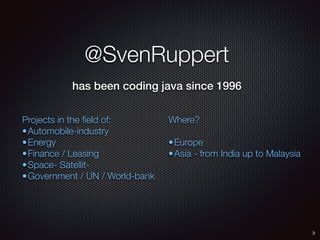
Projects in the field of:
•Automobile-industry
•Energy
•Finance / Leasing
•Space- Satellit-
•Government / UN / World-bank
Where?
•Europe
•Asia - from India up to Malaysia
3
Why a Proxy ?
4
@SvenRuppert
Proxies you can use them for :
generic parts inside your application
hiding technical stuff
decouple parts of your applications
Why a Proxy ?
5
@SvenRuppert
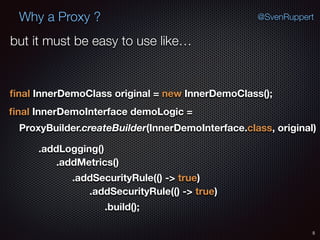
final InnerDemoClass original = new InnerDemoClass();
final InnerDemoInterface demoLogic =
ProxyBuilder.createBuilder(InnerDemoInterface.class, original)

.addLogging()
.addMetrics()
.addSecurityRule(() -> true)
.build();
but it must be easy to use like…
Why a Proxy ?
6
@SvenRuppert
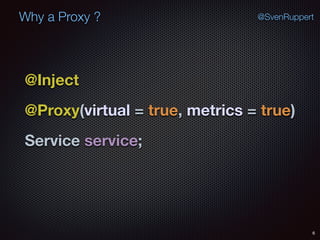
@Inject
@Proxy(virtual = true, metrics = true)
Service service;
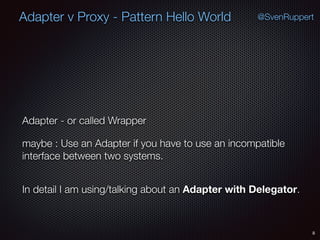
Adapter v Proxy - Pattern Hello World
7
@SvenRuppert
Difference between Proxy and Adapter
Adapter v Proxy - Pattern Hello World
Adapter - or called Wrapper
maybe : Use an Adapter if you have to use an incompatible
interface between two systems.
In detail I am using/talking about an Adapter with Delegator.
8
@SvenRuppert
Adapter v Proxy - Pattern Hello World
public class LegacyWorker {

public void writeTheStrings(String[] strArray){

Arrays.stream(strArray).forEach(System.out::println);

}

}
9
public interface WorkerAdapter {

public void workOnSomething(List<String> stringListe);

}
public class Adapter implements WorkerAdapter {

private LegacyWorker worker = new LegacyWorker();

@Override

public void workOnSomething(List<String> stringListe) {

final String[] strings = stringListe.toArray(new String[0]);

worker.writeTheStrings(strings);

}

}
@SvenRuppert
Adapter v Proxy - Pattern Hello World
public class Main {

public static void main(String[] args) {

final ArrayList<String> strings = new ArrayList<>();

Collections.addAll(strings, „A","B","C","D");


new Adapter().workOnSomething(strings);

}

}
10
• No need to know the LegacyWorker
• No inheritance between LegacyWorker and Adapter
• only a transformation of an interface
• same creation time for Delegator and Adapter
@SvenRuppert
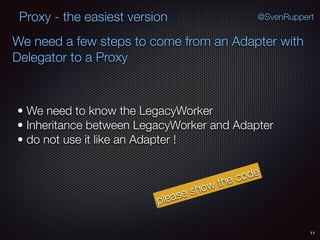
Proxy - the easiest version
11
• We need to know the LegacyWorker
• Inheritance between LegacyWorker and Adapter
• do not use it like an Adapter !
@SvenRuppert
We need a few steps to come from an Adapter with
Delegator to a Proxy
please show the code
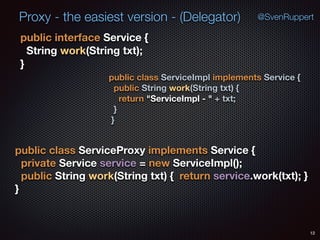
Proxy - the easiest version - (Delegator)
public interface Service {

String work(String txt);

}
12
@SvenRuppert
public class ServiceImpl implements Service {

public String work(String txt) {

return "ServiceImpl - " + txt;

}

}
public class ServiceProxy implements Service {

private Service service = new ServiceImpl();

public String work(String txt) { return service.work(txt); }

}
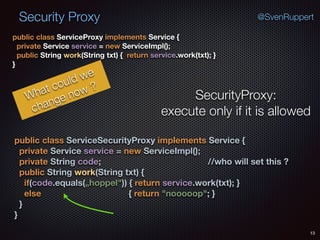
Security Proxy
13
@SvenRuppert
public class ServiceProxy implements Service {

private Service service = new ServiceImpl();

public String work(String txt) { return service.work(txt); }

}
What could we
change now ?
SecurityProxy:
execute only if it is allowed
public class ServiceSecurityProxy implements Service {

private Service service = new ServiceImpl();

private String code; //who will set this ?

public String work(String txt) {

if(code.equals(„hoppel")) { return service.work(txt); }

else { return "nooooop"; }

}

}
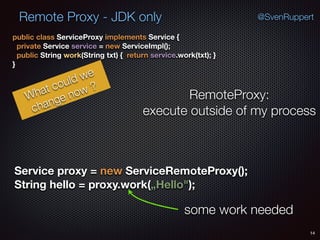
Remote Proxy - JDK only
14
@SvenRuppert
public class ServiceProxy implements Service {

private Service service = new ServiceImpl();

public String work(String txt) { return service.work(txt); }

}
What could we
change now ?
RemoteProxy:
execute outside of my process
Service proxy = new ServiceRemoteProxy();

String hello = proxy.work(„Hello");
some work needed
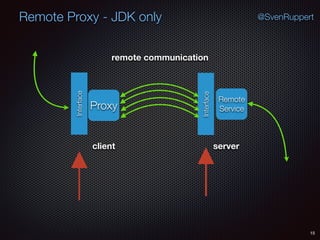
Remote Proxy - JDK only
15
@SvenRuppert
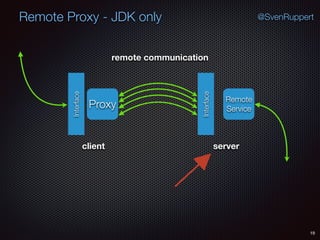
Proxy
Remote
Service
Interface
Interface
remote communication
client server
Remote Proxy - JDK only
16
@SvenRuppert
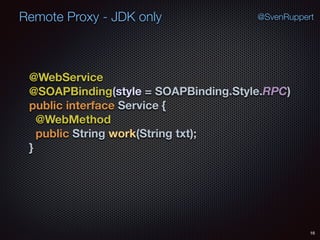
@WebService

@SOAPBinding(style = SOAPBinding.Style.RPC)

public interface Service {

@WebMethod

public String work(String txt);

}
Remote Proxy - JDK only
17
@SvenRuppert
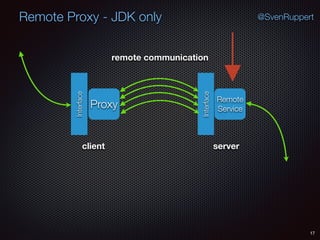
Proxy
Remote
Service
Interface
Interface
remote communication
client server
Remote Proxy - JDK only
18
@SvenRuppert
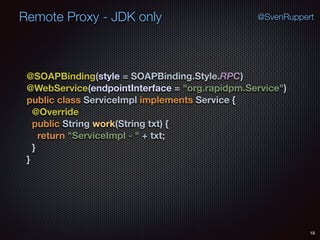
@SOAPBinding(style = SOAPBinding.Style.RPC)

@WebService(endpointInterface = "org.rapidpm.Service")

public class ServiceImpl implements Service {

@Override

public String work(String txt) {

return "ServiceImpl - " + txt;

}

}
Remote Proxy - JDK only
19
@SvenRuppert
Proxy
Remote
Service
Interface
Interface
remote communication
client server
Remote Proxy - JDK only
20
@SvenRuppert
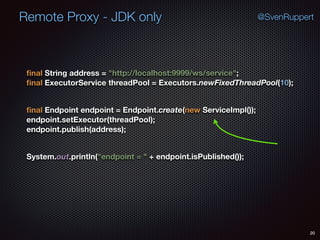
final String address = "http://localhost:9999/ws/service";

final ExecutorService threadPool = Executors.newFixedThreadPool(10);

final Endpoint endpoint = Endpoint.create(new ServiceImpl());

endpoint.setExecutor(threadPool);

endpoint.publish(address);

System.out.println("endpoint = " + endpoint.isPublished());
Remote Proxy - JDK only
21
@SvenRuppert
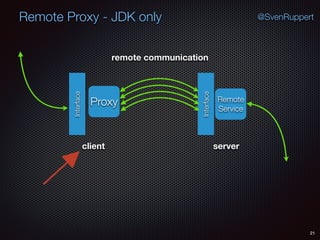
Proxy Remote
Service
Interface
Interface
remote communication
client server
Remote Proxy - JDK only
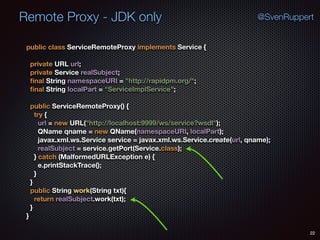
22
@SvenRuppert
public class ServiceRemoteProxy implements Service {


private URL url;

private Service realSubject;

final String namespaceURI = "http://rapidpm.org/";

final String localPart = "ServiceImplService";


public ServiceRemoteProxy() {

try {

url = new URL("http://localhost:9999/ws/service?wsdl");

QName qname = new QName(namespaceURI, localPart);

javax.xml.ws.Service service = javax.xml.ws.Service.create(url, qname);

realSubject = service.getPort(Service.class);

} catch (MalformedURLException e) {

e.printStackTrace();

}

}

public String work(String txt){

return realSubject.work(txt);

}

}
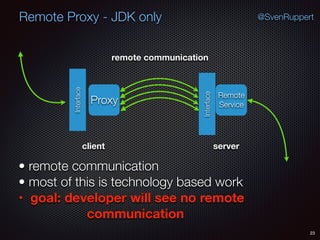
Remote Proxy - JDK only
23
@SvenRuppert
Proxy
Remote
Service
Interface
Interface
remote communication
client server
• remote communication
• most of this is technology based work
• goal: developer will see no remote
communication
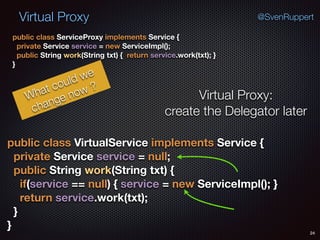
Virtual Proxy
24
@SvenRuppert
public class ServiceProxy implements Service {

private Service service = new ServiceImpl();

public String work(String txt) { return service.work(txt); }

}
What could we
change now ?
Virtual Proxy:
create the Delegator later
public class VirtualService implements Service {

private Service service = null;

public String work(String txt) {

if(service == null) { service = new ServiceImpl(); }

return service.work(txt);

}

}
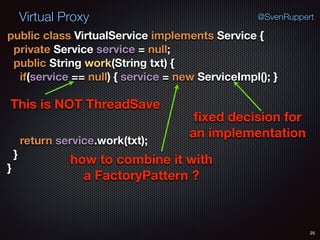
Virtual Proxy
25
@SvenRuppert
public class VirtualService implements Service {

private Service service = null;

public String work(String txt) {

if(service == null) { service = new ServiceImpl(); }


return service.work(txt);

}

}
This is NOT ThreadSave
fixed decision for
an implementation
how to combine it with
a FactoryPattern ?
Virtual Proxy
26
@SvenRuppert
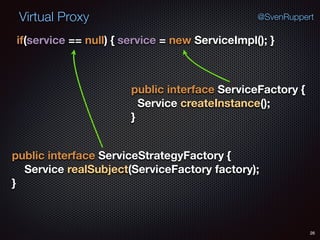
if(service == null) { service = new ServiceImpl(); }

public interface ServiceFactory {

Service createInstance();

}
public interface ServiceStrategyFactory {

Service realSubject(ServiceFactory factory);

}
Virtual Proxy - Not - ThreadSave
27
@SvenRuppert
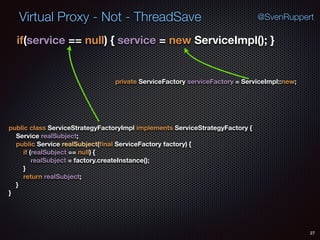
if(service == null) { service = new ServiceImpl(); }

public class ServiceStrategyFactoryImpl implements ServiceStrategyFactory {

Service realSubject;

public Service realSubject(final ServiceFactory factory) {

if (realSubject == null) {

realSubject = factory.createInstance();

}

return realSubject;

}

}
private ServiceFactory serviceFactory = ServiceImpl::new;
Virtual Proxy - Not - ThreadSave
28
@SvenRuppert
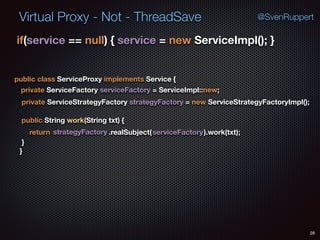
if(service == null) { service = new ServiceImpl(); }

public class ServiceProxy implements Service {
private ServiceFactory serviceFactory = ServiceImpl::new;
private ServiceStrategyFactory strategyFactory = new ServiceStrategyFactoryImpl();
public String work(String txt) {
return strategyFactory .realSubject(serviceFactory).work(txt);
}

}
Virtual Proxy - Synchronized
29
@SvenRuppert
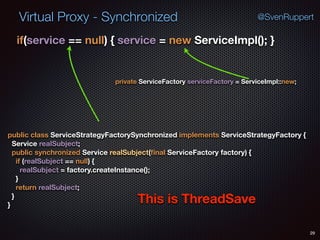
if(service == null) { service = new ServiceImpl(); }

public class ServiceStrategyFactorySynchronized implements ServiceStrategyFactory {

Service realSubject;

public synchronized Service realSubject(final ServiceFactory factory) {

if (realSubject == null) {

realSubject = factory.createInstance();

}

return realSubject;

}

}
private ServiceFactory serviceFactory = ServiceImpl::new;
This is ThreadSave
Combining Proxies
30
@SvenRuppert
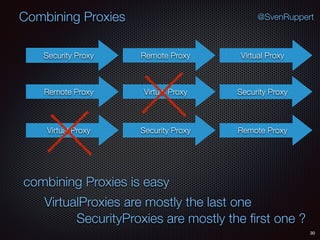
Security Proxy Virtual ProxyRemote Proxy
Security ProxyVirtual ProxyRemote Proxy
Security ProxyVirtual Proxy Remote Proxy
VirtualProxies are mostly the last one
combining Proxies is easy
SecurityProxies are mostly the first one ?
Combining Proxies - SecureVirtualProxy
31
@SvenRuppert
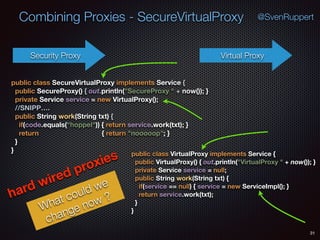
Security Proxy Virtual Proxy
public class VirtualProxy implements Service {

public VirtualProxy() { out.println("VirtualProxy " + now()); }

private Service service = null;

public String work(String txt) {

if(service == null) { service = new ServiceImpl(); }

return service.work(txt);

}

}
public class SecureVirtualProxy implements Service {

public SecureProxy() { out.println("SecureProxy " + now()); }

private Service service = new VirtualProxy();

//SNIPP….

public String work(String txt) {

if(code.equals("hoppel")) { return service.work(txt); }

return { return "nooooop"; }

}

}
hard wired proxies
What could we
change now ?
Combining Proxies - SecureVirtualProxy
32
@SvenRuppert
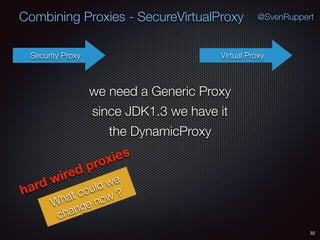
Security Proxy Virtual Proxy
hard wired proxies
What could we
change now ?
we need a Generic Proxy
since JDK1.3 we have it
the DynamicProxy
Dynamic Proxy - Hello World
33
@SvenRuppert
How to use it ?
java.lang.reflect.Proxy
we need an interface : here Service
we need an implementation : here ServiceImpl
Service proxyInstance = Service.class.cast( Proxy.newProxyInstance(

Service.class.getClassLoader(),

new Class<?>[]{Service.class},

new InvocationHandler() {

private final ServiceImpl service = new ServiceImpl();

@Override

public Object invoke(Object proxy, Method method, Object[] args) throws Throwable {

return method.invoke(service, args);

}

}

)

);
OK, step by step , please
Dynamic Proxy - Hello World
34
@SvenRuppert
Proxy.newProxyInstance (
Service.class.getClassLoader(),
new Class<?>[]{Service.class},
Service proxyInstance = Service.class.cast (
new InvocationHandler() {

private final ServiceImpl service = new ServiceImpl();

@Override

public Object invoke(Object proxy, Method m, Object[] args) throws Throwable {

return m.invoke(service, args);

}

}

)

);
how to make a VirtualProxy ?
Dynamic Virtual Proxy
35
@SvenRuppert
Proxy.newProxyInstance (
Service.class.getClassLoader(),
new Class<?>[]{Service.class},
Service proxyInstance = Service.class.cast (
new InvocationHandler() {

private final ServiceImpl service;

@Override

public Object invoke(Object proxy, Method m, Object[] args) throws Throwable {

if(service == null) { service = new ServiceImpl(); }
return m.invoke(service, args);

}

}

)

);
Dynamic Proxy - make it generic
36
@SvenRuppert
Proxy.newProxyInstance (
Service.class.getClassLoader(),
new Class<?>[]{Service.class},
Service proxyInstance = Service.class.cast (
new InvocationHandler() {

private final ServiceImpl service = new ServiceImpl();

@Override

public Object invoke(Object proxy, Method m, Object[] args) throws Throwable {

return m.invoke(service, args);

}

}

)

);
get it from outside
we will remove it
we will get it from outside
and finally we will call it ProxyGenerator
Dynamic Proxy - make it generic
37
@SvenRuppert
public class ProxyGenerator {

public static <P> P makeProxy(Class<P> subject, P realSubject) {

Object proxyInstance = Proxy.newProxyInstance(

subject.getClassLoader(),

new Class<?>[]{subject},

new InvocationHandler() {

@Override

public Object invoke(final Object proxy, final Method m, final Object[] args) throws Throwable {

return m.invoke(realSubject, args);

}

}

);

return subject.cast(proxyInstance);

}

}
Dynamic Proxy - make it generic
38
@SvenRuppert
public class ProxyGenerator {

public static <P> P makeProxy(Class<P> subject, P realSubject) {

Object proxyInstance = Proxy.newProxyInstance(

subject.getClassLoader(),

new Class<?>[]{subject},

(proxy, m, args) -> m.invoke(realSubject, args)

);

return subject.cast(proxyInstance);

}

}
Dynamic Proxy - make it generic
39
@SvenRuppert
with DynamicProxies
- we are writing less (more generic) code
- we can create Virtual-/Remote-/Security Proxies
but how to combine Proxies more generic ?
Dynamic Proxy - make it generic
40
@SvenRuppert
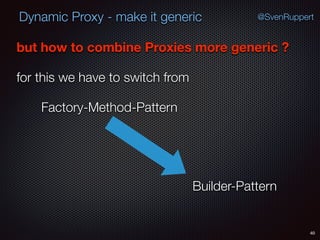
but how to combine Proxies more generic ?
for this we have to switch from
Factory-Method-Pattern
Builder-Pattern
DynamicProxyBuilder
41
@SvenRuppert
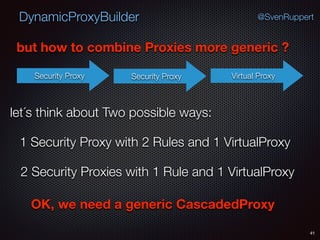
but how to combine Proxies more generic ?
Security Proxy Virtual ProxySecurity Proxy
let´s think about Two possible ways:
1 Security Proxy with 2 Rules and 1 VirtualProxy
2 Security Proxies with 1 Rule and 1 VirtualProxy
OK, we need a generic CascadedProxy
DynamicProxyBuilder
42
@SvenRuppert
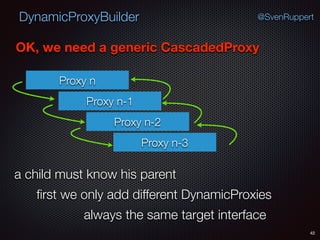
OK, we need a generic CascadedProxy
Proxy n
Proxy n-1
Proxy n-2
Proxy n-3
a child must know his parent
first we only add different DynamicProxies
always the same target interface
DynamicProxyBuilder
43
@SvenRuppert
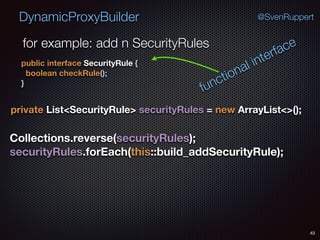
private List<SecurityRule> securityRules = new ArrayList<>();
for example: add n SecurityRules
public interface SecurityRule {

boolean checkRule();

}
functional interface
Collections.reverse(securityRules);

securityRules.forEach(this::build_addSecurityRule);
DynamicProxyBuilder
44
@SvenRuppert
private ProxyBuilder<I, T> build_addSecurityRule(SecurityRule rule) {

final ClassLoader classLoader = original.getClass().getClassLoader();

final Class<?>[] interfaces = {clazz};

final Object nextProxy = Proxy.newProxyInstance(

classLoader, interfaces,

new InvocationHandler() {

private T original = ProxyBuilder.this.original;

public Object invoke(Object proxy, Method method, Object[] args) throws Throwable {

final boolean checkRule = rule.checkRule();

if (checkRule) {

return method.invoke(original, args);

} else {

return null;

}

}

});

original = (T) clazz.cast(nextProxy);

return this;

}
how this will be used ?
last child
work on child
set child for next level
DynamicProxyBuilder
45
@SvenRuppert
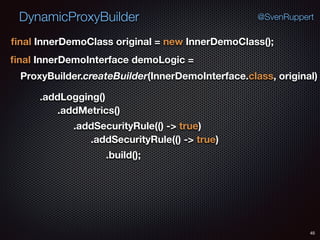
final InnerDemoClass original = new InnerDemoClass();
final InnerDemoInterface demoLogic =
ProxyBuilder.createBuilder(InnerDemoInterface.class, original)

.addLogging()
.addMetrics()
.addSecurityRule(() -> true)
.build();
DynamicObjectAdapter - orig Version
46
@SvenRuppert
the original Version of the DynamicObjectAdapter
was written by Dr. Heinz Kabutz
DynamicObjectAdapter - orig Version
47
@SvenRuppert
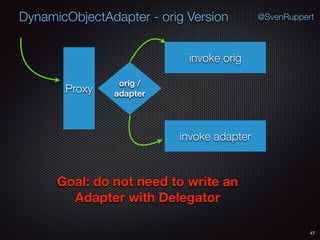
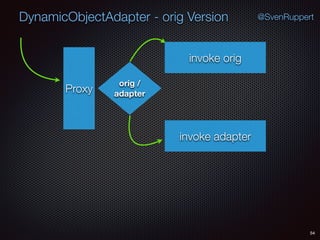
Proxy
orig /
adapter
invoke orig
invoke adapter
Goal: do not need to write an
Adapter with Delegator
DynamicObjectAdapter - orig Version
48
@SvenRuppert
core concept:
switching between method implementations
how to identify a method?
DynamicObjectAdapter - orig. Version
49
@SvenRuppert
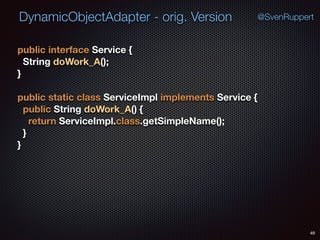
public interface Service {

String doWork_A();

}


public static class ServiceImpl implements Service {

public String doWork_A() {

return ServiceImpl.class.getSimpleName();

}

}
DynamicObjectAdapter - orig Version
50
@SvenRuppert
how to identify a method?
public class MethodIdentifier {

private final String name;

private final Class[] parameters;


public MethodIdentifier(Method m) {

name = m.getName();

parameters = m.getParameterTypes();

}

// we can save time by assuming that we only compare against

// other MethodIdentifier objects

public boolean equals(Object o) {

MethodIdentifier mid = (MethodIdentifier) o;

return name.equals(mid.name) &&

Arrays.equals(parameters, mid.parameters);

}

public int hashCode() { return name.hashCode(); }

}
DynamicObjectAdapter - orig. Version
51
@SvenRuppert
private static class DOAInvocationHandler<T extends I, I> implements InvocationHandler {
private Map<MethodIdentifier, Method> adaptedMethods = new HashMap<>();
private T original; private Object adapter;
private void addAdapter(Object adapter) {
this.adapter = adapter;
final Class<?> adapterClass = adapter.getClass();
Method[] methods = adapterClass.getDeclaredMethods();
for (Method m : methods) {
final MethodIdentifier key = new MethodIdentifier(m);
adaptedMethods.put(key, m);
}

}
public Object invoke(Object proxy, Method m, Object[] args) throws Throwable {
}

}
//SNIPP
DynamicObjectAdapter - orig. Version
52
@SvenRuppert
} catch (InvocationTargetException e) { throw e.getTargetException(); }

private static class DOAInvocationHandler<T extends I, I> implements InvocationHandler {
private Map<MethodIdentifier, Method> adaptedMethods = new HashMap<>();
private T original; private Object adapter;
private void addAdapter(Object adapter) {
}
public Object invoke(Object proxy, Method m, Object[] args) throws Throwable {
Method other = adaptedMethods.get(key);
try {

final MethodIdentifier key = new MethodIdentifier(m);
if (other != null) { return other.invoke(adapter, args); }
else { return m.invoke(original, args); }
}

}
//SNIPP
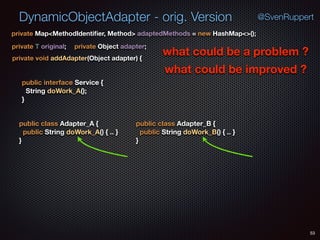
what could be a problem ?
what could be improved ?
DynamicObjectAdapter - orig. Version
53
@SvenRuppert
private Map<MethodIdentifier, Method> adaptedMethods = new HashMap<>();
private T original; private Object adapter;
private void addAdapter(Object adapter) {
what could be a problem ?
what could be improved ?
public interface Service {

String doWork_A();

}
public class Adapter_A {

public String doWork_A() { .. }

}
public class Adapter_B {

public String doWork_B() { .. }

}
DynamicObjectAdapter - orig Version
54
@SvenRuppert
Proxy
orig /
adapter
invoke orig
invoke adapter
DynamicObjectAdapter - ext. Version
55
@SvenRuppert
first extension !
DynamicObjectAdapter - ext. Version
56
@SvenRuppert
public interface Service {

String doWork_A(String txt);

String doWork_B(String txt);

}
public static class ServiceImpl implements Service {


public String doWork_A(String txt) {

return "doWorkd_A_Original";

}


public String doWork_B(String txt) {

return "doWorkd_B_Original";

}

}
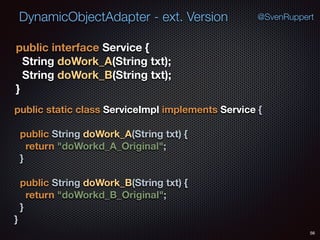
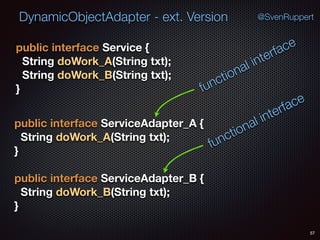
DynamicObjectAdapter - ext. Version
57
@SvenRuppert
public interface Service {

String doWork_A(String txt);

String doWork_B(String txt);

}
public interface ServiceAdapter_A {

String doWork_A(String txt);

}


public interface ServiceAdapter_B {

String doWork_B(String txt);

}
functional interface
DynamicObjectAdapter - ext. Version
58
@SvenRuppert
private Map<MethodIdentifier, Method> adaptedMethods = new HashMap<>();

private Map<MethodIdentifier, Object> adapters = new HashMap<>();


private T original;

private Class<T> target;
}

}
private void addAdapter(Object adapter) {
final Class<?> adapterClass = adapter.getClass();
Method[] methods = adapterClass.getDeclaredMethods();
for (Method m : methods) {
final MethodIdentifier key = new MethodIdentifier(m);
adaptedMethods.put(key, m);
adapters.put(key, adapter);
DynamicObjectAdapter - ext. Version
59
@SvenRuppert
private Map<MethodIdentifier, Method> adaptedMethods = new HashMap<>();

private Map<MethodIdentifier, Object> adapters = new HashMap<>();


private T original;

private Class<T> target;
} catch (InvocationTargetException e) {

throw e.getTargetException();

}

}
public Object invoke(Object proxy, Method method, Object[] args) throws Throwable {
try {

final MethodIdentifier key = new MethodIdentifier(method);

Method other = adaptedMethods.get(key);
if (other != null) {

return other.invoke(adapters.get(key), args);

} else {

return method.invoke(original, args);

}

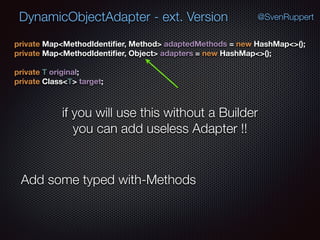
DynamicObjectAdapter - ext. Version @SvenRuppert
private Map<MethodIdentifier, Method> adaptedMethods = new HashMap<>();

private Map<MethodIdentifier, Object> adapters = new HashMap<>();


private T original;

private Class<T> target;
if you will use this without a Builder
you can add useless Adapter !!
Add some typed with-Methods
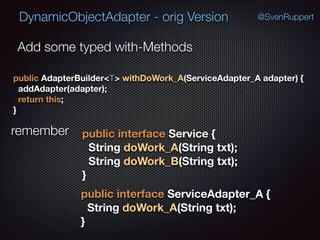
DynamicObjectAdapter - orig Version @SvenRuppert
Add some typed with-Methods
public AdapterBuilder<T> withDoWork_A(ServiceAdapter_A adapter) {

addAdapter(adapter);

return this;

}
remember public interface Service {

String doWork_A(String txt);

String doWork_B(String txt);

}
public interface ServiceAdapter_A {

String doWork_A(String txt);

}

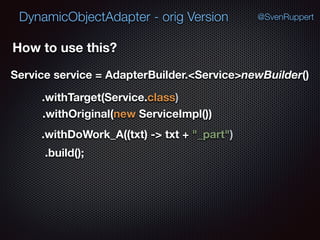
DynamicObjectAdapter - orig Version @SvenRuppert
.build();
How to use this?
Service service = AdapterBuilder.<Service>newBuilder()
.withTarget(Service.class)
.withOriginal(new ServiceImpl())
.withDoWork_A((txt) -> txt + "_part")
generated DynamicObjectAdapterBuilder @SvenRuppert
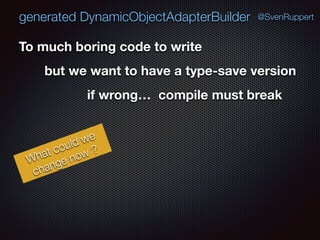
To much boring code to write
but we want to have a type-save version
What could we
change now ?
if wrong… compile must break
generated DynamicObjectAdapterBuilder @SvenRuppert
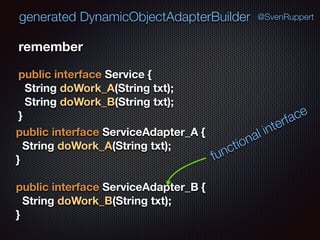
remember
public interface Service {

String doWork_A(String txt);

String doWork_B(String txt);

}
public interface ServiceAdapter_A {

String doWork_A(String txt);

}


public interface ServiceAdapter_B {

String doWork_B(String txt);

}
functional interface
generated DynamicObjectAdapterBuilder @SvenRuppert
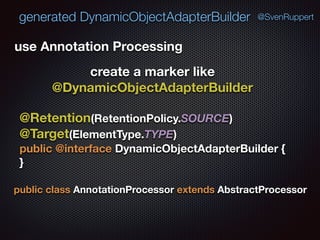
use Annotation Processing
create a marker like
@DynamicObjectAdapterBuilder
@Retention(RetentionPolicy.SOURCE)

@Target(ElementType.TYPE)

public @interface DynamicObjectAdapterBuilder {

}
public class AnnotationProcessor extends AbstractProcessor
generated DynamicObjectAdapterBuilder @SvenRuppert
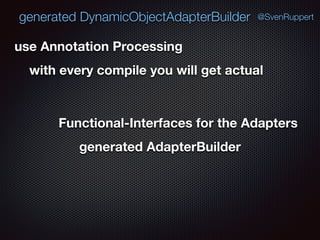
use Annotation Processing
with every compile you will get actual
Functional-Interfaces for the Adapters
generated AdapterBuilder
Summary
67
@SvenRuppert
we got type-save ProxyBuilder
..type-save generated DynamicObjectAdapter
..at runtime we could change the chain of Proxies
..could be used for
(Dynamic)
Dependency Injection Implementations
Summary
68
@SvenRuppert
If you are interested…
have a look at RapidPM on github
rapidpm-proxybuilder
rapidpm-dynamic-cdi
rapidpm-microservice
or contact me ;-) @SvenRuppert
Thank You !!!

Proxy Deep Dive JUG Saxony Day 2015-10-02

  • 1.
    prepare for….. Proxy DeepDive JUG Saxony Day 2015 1 @SvenRuppert
  • 2.
    @SvenRuppert has been codingjava since 1996 Fellow / Senior Manager reply Group Germany - Munich 2
  • 3.
    @SvenRuppert has been codingjava since 1996 Projects in the field of: •Automobile-industry •Energy •Finance / Leasing •Space- Satellit- •Government / UN / World-bank Where? •Europe •Asia - from India up to Malaysia 3
  • 4.
    Why a Proxy? 4 @SvenRuppert Proxies you can use them for : generic parts inside your application hiding technical stuff decouple parts of your applications
  • 5.
    Why a Proxy? 5 @SvenRuppert final InnerDemoClass original = new InnerDemoClass(); final InnerDemoInterface demoLogic = ProxyBuilder.createBuilder(InnerDemoInterface.class, original)
 .addLogging() .addMetrics() .addSecurityRule(() -> true) .addSecurityRule(() -> true) .build(); but it must be easy to use like…
  • 6.
    Why a Proxy? 6 @SvenRuppert @Inject @Proxy(virtual = true, metrics = true) Service service;
  • 7.
    Adapter v Proxy- Pattern Hello World 7 @SvenRuppert Difference between Proxy and Adapter
  • 8.
    Adapter v Proxy- Pattern Hello World Adapter - or called Wrapper maybe : Use an Adapter if you have to use an incompatible interface between two systems. In detail I am using/talking about an Adapter with Delegator. 8 @SvenRuppert
  • 9.
    Adapter v Proxy- Pattern Hello World public class LegacyWorker {
 public void writeTheStrings(String[] strArray){
 Arrays.stream(strArray).forEach(System.out::println);
 }
 } 9 public interface WorkerAdapter {
 public void workOnSomething(List<String> stringListe);
 } public class Adapter implements WorkerAdapter {
 private LegacyWorker worker = new LegacyWorker();
 @Override
 public void workOnSomething(List<String> stringListe) {
 final String[] strings = stringListe.toArray(new String[0]);
 worker.writeTheStrings(strings);
 }
 } @SvenRuppert
  • 10.
    Adapter v Proxy- Pattern Hello World public class Main {
 public static void main(String[] args) {
 final ArrayList<String> strings = new ArrayList<>();
 Collections.addAll(strings, „A","B","C","D"); 
 new Adapter().workOnSomething(strings);
 }
 } 10 • No need to know the LegacyWorker • No inheritance between LegacyWorker and Adapter • only a transformation of an interface • same creation time for Delegator and Adapter @SvenRuppert
  • 11.
    Proxy - theeasiest version 11 • We need to know the LegacyWorker • Inheritance between LegacyWorker and Adapter • do not use it like an Adapter ! @SvenRuppert We need a few steps to come from an Adapter with Delegator to a Proxy please show the code
  • 12.
    Proxy - theeasiest version - (Delegator) public interface Service {
 String work(String txt);
 } 12 @SvenRuppert public class ServiceImpl implements Service {
 public String work(String txt) {
 return "ServiceImpl - " + txt;
 }
 } public class ServiceProxy implements Service {
 private Service service = new ServiceImpl();
 public String work(String txt) { return service.work(txt); }
 }
  • 13.
    Security Proxy 13 @SvenRuppert public classServiceProxy implements Service {
 private Service service = new ServiceImpl();
 public String work(String txt) { return service.work(txt); }
 } What could we change now ? SecurityProxy: execute only if it is allowed public class ServiceSecurityProxy implements Service {
 private Service service = new ServiceImpl();
 private String code; //who will set this ?
 public String work(String txt) {
 if(code.equals(„hoppel")) { return service.work(txt); }
 else { return "nooooop"; }
 }
 }
  • 14.
    Remote Proxy -JDK only 14 @SvenRuppert public class ServiceProxy implements Service {
 private Service service = new ServiceImpl();
 public String work(String txt) { return service.work(txt); }
 } What could we change now ? RemoteProxy: execute outside of my process Service proxy = new ServiceRemoteProxy();
 String hello = proxy.work(„Hello"); some work needed
  • 15.
    Remote Proxy -JDK only 15 @SvenRuppert Proxy Remote Service Interface Interface remote communication client server
  • 16.
    Remote Proxy -JDK only 16 @SvenRuppert @WebService
 @SOAPBinding(style = SOAPBinding.Style.RPC)
 public interface Service {
 @WebMethod
 public String work(String txt);
 }
  • 17.
    Remote Proxy -JDK only 17 @SvenRuppert Proxy Remote Service Interface Interface remote communication client server
  • 18.
    Remote Proxy -JDK only 18 @SvenRuppert @SOAPBinding(style = SOAPBinding.Style.RPC)
 @WebService(endpointInterface = "org.rapidpm.Service")
 public class ServiceImpl implements Service {
 @Override
 public String work(String txt) {
 return "ServiceImpl - " + txt;
 }
 }
  • 19.
    Remote Proxy -JDK only 19 @SvenRuppert Proxy Remote Service Interface Interface remote communication client server
  • 20.
    Remote Proxy -JDK only 20 @SvenRuppert final String address = "http://localhost:9999/ws/service";
 final ExecutorService threadPool = Executors.newFixedThreadPool(10);
 final Endpoint endpoint = Endpoint.create(new ServiceImpl());
 endpoint.setExecutor(threadPool);
 endpoint.publish(address);
 System.out.println("endpoint = " + endpoint.isPublished());
  • 21.
    Remote Proxy -JDK only 21 @SvenRuppert Proxy Remote Service Interface Interface remote communication client server
  • 22.
    Remote Proxy -JDK only 22 @SvenRuppert public class ServiceRemoteProxy implements Service {
 
 private URL url;
 private Service realSubject;
 final String namespaceURI = "http://rapidpm.org/";
 final String localPart = "ServiceImplService";
 
 public ServiceRemoteProxy() {
 try {
 url = new URL("http://localhost:9999/ws/service?wsdl");
 QName qname = new QName(namespaceURI, localPart);
 javax.xml.ws.Service service = javax.xml.ws.Service.create(url, qname);
 realSubject = service.getPort(Service.class);
 } catch (MalformedURLException e) {
 e.printStackTrace();
 }
 }
 public String work(String txt){
 return realSubject.work(txt);
 }
 }
  • 23.
    Remote Proxy -JDK only 23 @SvenRuppert Proxy Remote Service Interface Interface remote communication client server • remote communication • most of this is technology based work • goal: developer will see no remote communication
  • 24.
    Virtual Proxy 24 @SvenRuppert public classServiceProxy implements Service {
 private Service service = new ServiceImpl();
 public String work(String txt) { return service.work(txt); }
 } What could we change now ? Virtual Proxy: create the Delegator later public class VirtualService implements Service {
 private Service service = null;
 public String work(String txt) {
 if(service == null) { service = new ServiceImpl(); }
 return service.work(txt);
 }
 }
  • 25.
    Virtual Proxy 25 @SvenRuppert public classVirtualService implements Service {
 private Service service = null;
 public String work(String txt) {
 if(service == null) { service = new ServiceImpl(); } 
 return service.work(txt);
 }
 } This is NOT ThreadSave fixed decision for an implementation how to combine it with a FactoryPattern ?
  • 26.
    Virtual Proxy 26 @SvenRuppert if(service ==null) { service = new ServiceImpl(); }
 public interface ServiceFactory {
 Service createInstance();
 } public interface ServiceStrategyFactory {
 Service realSubject(ServiceFactory factory);
 }
  • 27.
    Virtual Proxy -Not - ThreadSave 27 @SvenRuppert if(service == null) { service = new ServiceImpl(); }
 public class ServiceStrategyFactoryImpl implements ServiceStrategyFactory {
 Service realSubject;
 public Service realSubject(final ServiceFactory factory) {
 if (realSubject == null) {
 realSubject = factory.createInstance();
 }
 return realSubject;
 }
 } private ServiceFactory serviceFactory = ServiceImpl::new;
  • 28.
    Virtual Proxy -Not - ThreadSave 28 @SvenRuppert if(service == null) { service = new ServiceImpl(); }
 public class ServiceProxy implements Service { private ServiceFactory serviceFactory = ServiceImpl::new; private ServiceStrategyFactory strategyFactory = new ServiceStrategyFactoryImpl(); public String work(String txt) { return strategyFactory .realSubject(serviceFactory).work(txt); }
 }
  • 29.
    Virtual Proxy -Synchronized 29 @SvenRuppert if(service == null) { service = new ServiceImpl(); }
 public class ServiceStrategyFactorySynchronized implements ServiceStrategyFactory {
 Service realSubject;
 public synchronized Service realSubject(final ServiceFactory factory) {
 if (realSubject == null) {
 realSubject = factory.createInstance();
 }
 return realSubject;
 }
 } private ServiceFactory serviceFactory = ServiceImpl::new; This is ThreadSave
  • 30.
    Combining Proxies 30 @SvenRuppert Security ProxyVirtual ProxyRemote Proxy Security ProxyVirtual ProxyRemote Proxy Security ProxyVirtual Proxy Remote Proxy VirtualProxies are mostly the last one combining Proxies is easy SecurityProxies are mostly the first one ?
  • 31.
    Combining Proxies -SecureVirtualProxy 31 @SvenRuppert Security Proxy Virtual Proxy public class VirtualProxy implements Service {
 public VirtualProxy() { out.println("VirtualProxy " + now()); }
 private Service service = null;
 public String work(String txt) {
 if(service == null) { service = new ServiceImpl(); }
 return service.work(txt);
 }
 } public class SecureVirtualProxy implements Service {
 public SecureProxy() { out.println("SecureProxy " + now()); }
 private Service service = new VirtualProxy();
 //SNIPP….
 public String work(String txt) {
 if(code.equals("hoppel")) { return service.work(txt); }
 return { return "nooooop"; }
 }
 } hard wired proxies What could we change now ?
  • 32.
    Combining Proxies -SecureVirtualProxy 32 @SvenRuppert Security Proxy Virtual Proxy hard wired proxies What could we change now ? we need a Generic Proxy since JDK1.3 we have it the DynamicProxy
  • 33.
    Dynamic Proxy -Hello World 33 @SvenRuppert How to use it ? java.lang.reflect.Proxy we need an interface : here Service we need an implementation : here ServiceImpl Service proxyInstance = Service.class.cast( Proxy.newProxyInstance(
 Service.class.getClassLoader(),
 new Class<?>[]{Service.class},
 new InvocationHandler() {
 private final ServiceImpl service = new ServiceImpl();
 @Override
 public Object invoke(Object proxy, Method method, Object[] args) throws Throwable {
 return method.invoke(service, args);
 }
 }
 )
 ); OK, step by step , please
  • 34.
    Dynamic Proxy -Hello World 34 @SvenRuppert Proxy.newProxyInstance ( Service.class.getClassLoader(), new Class<?>[]{Service.class}, Service proxyInstance = Service.class.cast ( new InvocationHandler() {
 private final ServiceImpl service = new ServiceImpl();
 @Override
 public Object invoke(Object proxy, Method m, Object[] args) throws Throwable {
 return m.invoke(service, args);
 }
 }
 )
 ); how to make a VirtualProxy ?
  • 35.
    Dynamic Virtual Proxy 35 @SvenRuppert Proxy.newProxyInstance( Service.class.getClassLoader(), new Class<?>[]{Service.class}, Service proxyInstance = Service.class.cast ( new InvocationHandler() {
 private final ServiceImpl service;
 @Override
 public Object invoke(Object proxy, Method m, Object[] args) throws Throwable {
 if(service == null) { service = new ServiceImpl(); } return m.invoke(service, args);
 }
 }
 )
 );
  • 36.
    Dynamic Proxy -make it generic 36 @SvenRuppert Proxy.newProxyInstance ( Service.class.getClassLoader(), new Class<?>[]{Service.class}, Service proxyInstance = Service.class.cast ( new InvocationHandler() {
 private final ServiceImpl service = new ServiceImpl();
 @Override
 public Object invoke(Object proxy, Method m, Object[] args) throws Throwable {
 return m.invoke(service, args);
 }
 }
 )
 ); get it from outside we will remove it we will get it from outside and finally we will call it ProxyGenerator
  • 37.
    Dynamic Proxy -make it generic 37 @SvenRuppert public class ProxyGenerator {
 public static <P> P makeProxy(Class<P> subject, P realSubject) {
 Object proxyInstance = Proxy.newProxyInstance(
 subject.getClassLoader(),
 new Class<?>[]{subject},
 new InvocationHandler() {
 @Override
 public Object invoke(final Object proxy, final Method m, final Object[] args) throws Throwable {
 return m.invoke(realSubject, args);
 }
 }
 );
 return subject.cast(proxyInstance);
 }
 }
  • 38.
    Dynamic Proxy -make it generic 38 @SvenRuppert public class ProxyGenerator {
 public static <P> P makeProxy(Class<P> subject, P realSubject) {
 Object proxyInstance = Proxy.newProxyInstance(
 subject.getClassLoader(),
 new Class<?>[]{subject},
 (proxy, m, args) -> m.invoke(realSubject, args)
 );
 return subject.cast(proxyInstance);
 }
 }
  • 39.
    Dynamic Proxy -make it generic 39 @SvenRuppert with DynamicProxies - we are writing less (more generic) code - we can create Virtual-/Remote-/Security Proxies but how to combine Proxies more generic ?
  • 40.
    Dynamic Proxy -make it generic 40 @SvenRuppert but how to combine Proxies more generic ? for this we have to switch from Factory-Method-Pattern Builder-Pattern
  • 41.
    DynamicProxyBuilder 41 @SvenRuppert but how tocombine Proxies more generic ? Security Proxy Virtual ProxySecurity Proxy let´s think about Two possible ways: 1 Security Proxy with 2 Rules and 1 VirtualProxy 2 Security Proxies with 1 Rule and 1 VirtualProxy OK, we need a generic CascadedProxy
  • 42.
    DynamicProxyBuilder 42 @SvenRuppert OK, we needa generic CascadedProxy Proxy n Proxy n-1 Proxy n-2 Proxy n-3 a child must know his parent first we only add different DynamicProxies always the same target interface
  • 43.
    DynamicProxyBuilder 43 @SvenRuppert private List<SecurityRule> securityRules= new ArrayList<>(); for example: add n SecurityRules public interface SecurityRule {
 boolean checkRule();
 } functional interface Collections.reverse(securityRules);
 securityRules.forEach(this::build_addSecurityRule);
  • 44.
    DynamicProxyBuilder 44 @SvenRuppert private ProxyBuilder<I, T>build_addSecurityRule(SecurityRule rule) {
 final ClassLoader classLoader = original.getClass().getClassLoader();
 final Class<?>[] interfaces = {clazz};
 final Object nextProxy = Proxy.newProxyInstance(
 classLoader, interfaces,
 new InvocationHandler() {
 private T original = ProxyBuilder.this.original;
 public Object invoke(Object proxy, Method method, Object[] args) throws Throwable {
 final boolean checkRule = rule.checkRule();
 if (checkRule) {
 return method.invoke(original, args);
 } else {
 return null;
 }
 }
 });
 original = (T) clazz.cast(nextProxy);
 return this;
 } how this will be used ? last child work on child set child for next level
  • 45.
    DynamicProxyBuilder 45 @SvenRuppert final InnerDemoClass original= new InnerDemoClass(); final InnerDemoInterface demoLogic = ProxyBuilder.createBuilder(InnerDemoInterface.class, original)
 .addLogging() .addMetrics() .addSecurityRule(() -> true) .addSecurityRule(() -> true) .build();
  • 46.
    DynamicObjectAdapter - origVersion 46 @SvenRuppert the original Version of the DynamicObjectAdapter was written by Dr. Heinz Kabutz
  • 47.
    DynamicObjectAdapter - origVersion 47 @SvenRuppert Proxy orig / adapter invoke orig invoke adapter Goal: do not need to write an Adapter with Delegator
  • 48.
    DynamicObjectAdapter - origVersion 48 @SvenRuppert core concept: switching between method implementations how to identify a method?
  • 49.
    DynamicObjectAdapter - orig.Version 49 @SvenRuppert public interface Service {
 String doWork_A();
 }
 
 public static class ServiceImpl implements Service {
 public String doWork_A() {
 return ServiceImpl.class.getSimpleName();
 }
 }
  • 50.
    DynamicObjectAdapter - origVersion 50 @SvenRuppert how to identify a method? public class MethodIdentifier {
 private final String name;
 private final Class[] parameters;
 
 public MethodIdentifier(Method m) {
 name = m.getName();
 parameters = m.getParameterTypes();
 }
 // we can save time by assuming that we only compare against
 // other MethodIdentifier objects
 public boolean equals(Object o) {
 MethodIdentifier mid = (MethodIdentifier) o;
 return name.equals(mid.name) &&
 Arrays.equals(parameters, mid.parameters);
 }
 public int hashCode() { return name.hashCode(); }
 }
  • 51.
    DynamicObjectAdapter - orig.Version 51 @SvenRuppert private static class DOAInvocationHandler<T extends I, I> implements InvocationHandler { private Map<MethodIdentifier, Method> adaptedMethods = new HashMap<>(); private T original; private Object adapter; private void addAdapter(Object adapter) { this.adapter = adapter; final Class<?> adapterClass = adapter.getClass(); Method[] methods = adapterClass.getDeclaredMethods(); for (Method m : methods) { final MethodIdentifier key = new MethodIdentifier(m); adaptedMethods.put(key, m); }
 } public Object invoke(Object proxy, Method m, Object[] args) throws Throwable { }
 } //SNIPP
  • 52.
    DynamicObjectAdapter - orig.Version 52 @SvenRuppert } catch (InvocationTargetException e) { throw e.getTargetException(); }
 private static class DOAInvocationHandler<T extends I, I> implements InvocationHandler { private Map<MethodIdentifier, Method> adaptedMethods = new HashMap<>(); private T original; private Object adapter; private void addAdapter(Object adapter) { } public Object invoke(Object proxy, Method m, Object[] args) throws Throwable { Method other = adaptedMethods.get(key); try {
 final MethodIdentifier key = new MethodIdentifier(m); if (other != null) { return other.invoke(adapter, args); } else { return m.invoke(original, args); } }
 } //SNIPP what could be a problem ? what could be improved ?
  • 53.
    DynamicObjectAdapter - orig.Version 53 @SvenRuppert private Map<MethodIdentifier, Method> adaptedMethods = new HashMap<>(); private T original; private Object adapter; private void addAdapter(Object adapter) { what could be a problem ? what could be improved ? public interface Service {
 String doWork_A();
 } public class Adapter_A {
 public String doWork_A() { .. }
 } public class Adapter_B {
 public String doWork_B() { .. }
 }
  • 54.
    DynamicObjectAdapter - origVersion 54 @SvenRuppert Proxy orig / adapter invoke orig invoke adapter
  • 55.
    DynamicObjectAdapter - ext.Version 55 @SvenRuppert first extension !
  • 56.
    DynamicObjectAdapter - ext.Version 56 @SvenRuppert public interface Service {
 String doWork_A(String txt);
 String doWork_B(String txt);
 } public static class ServiceImpl implements Service {
 
 public String doWork_A(String txt) {
 return "doWorkd_A_Original";
 }
 
 public String doWork_B(String txt) {
 return "doWorkd_B_Original";
 }
 }
  • 57.
    DynamicObjectAdapter - ext.Version 57 @SvenRuppert public interface Service {
 String doWork_A(String txt);
 String doWork_B(String txt);
 } public interface ServiceAdapter_A {
 String doWork_A(String txt);
 }
 
 public interface ServiceAdapter_B {
 String doWork_B(String txt);
 } functional interface functional interface
  • 58.
    DynamicObjectAdapter - ext.Version 58 @SvenRuppert private Map<MethodIdentifier, Method> adaptedMethods = new HashMap<>();
 private Map<MethodIdentifier, Object> adapters = new HashMap<>();
 
 private T original;
 private Class<T> target; }
 } private void addAdapter(Object adapter) { final Class<?> adapterClass = adapter.getClass(); Method[] methods = adapterClass.getDeclaredMethods(); for (Method m : methods) { final MethodIdentifier key = new MethodIdentifier(m); adaptedMethods.put(key, m); adapters.put(key, adapter);
  • 59.
    DynamicObjectAdapter - ext.Version 59 @SvenRuppert private Map<MethodIdentifier, Method> adaptedMethods = new HashMap<>();
 private Map<MethodIdentifier, Object> adapters = new HashMap<>();
 
 private T original;
 private Class<T> target; } catch (InvocationTargetException e) {
 throw e.getTargetException();
 }
 } public Object invoke(Object proxy, Method method, Object[] args) throws Throwable { try {
 final MethodIdentifier key = new MethodIdentifier(method);
 Method other = adaptedMethods.get(key); if (other != null) {
 return other.invoke(adapters.get(key), args);
 } else {
 return method.invoke(original, args);
 }

  • 60.
    DynamicObjectAdapter - ext.Version @SvenRuppert private Map<MethodIdentifier, Method> adaptedMethods = new HashMap<>();
 private Map<MethodIdentifier, Object> adapters = new HashMap<>();
 
 private T original;
 private Class<T> target; if you will use this without a Builder you can add useless Adapter !! Add some typed with-Methods
  • 61.
    DynamicObjectAdapter - origVersion @SvenRuppert Add some typed with-Methods public AdapterBuilder<T> withDoWork_A(ServiceAdapter_A adapter) {
 addAdapter(adapter);
 return this;
 } remember public interface Service {
 String doWork_A(String txt);
 String doWork_B(String txt);
 } public interface ServiceAdapter_A {
 String doWork_A(String txt);
 }

  • 62.
    DynamicObjectAdapter - origVersion @SvenRuppert .build(); How to use this? Service service = AdapterBuilder.<Service>newBuilder() .withTarget(Service.class) .withOriginal(new ServiceImpl()) .withDoWork_A((txt) -> txt + "_part")
  • 63.
    generated DynamicObjectAdapterBuilder @SvenRuppert Tomuch boring code to write but we want to have a type-save version What could we change now ? if wrong… compile must break
  • 64.
    generated DynamicObjectAdapterBuilder @SvenRuppert remember publicinterface Service {
 String doWork_A(String txt);
 String doWork_B(String txt);
 } public interface ServiceAdapter_A {
 String doWork_A(String txt);
 }
 
 public interface ServiceAdapter_B {
 String doWork_B(String txt);
 } functional interface
  • 65.
    generated DynamicObjectAdapterBuilder @SvenRuppert useAnnotation Processing create a marker like @DynamicObjectAdapterBuilder @Retention(RetentionPolicy.SOURCE)
 @Target(ElementType.TYPE)
 public @interface DynamicObjectAdapterBuilder {
 } public class AnnotationProcessor extends AbstractProcessor
  • 66.
    generated DynamicObjectAdapterBuilder @SvenRuppert useAnnotation Processing with every compile you will get actual Functional-Interfaces for the Adapters generated AdapterBuilder
  • 67.
    Summary 67 @SvenRuppert we got type-saveProxyBuilder ..type-save generated DynamicObjectAdapter ..at runtime we could change the chain of Proxies ..could be used for (Dynamic) Dependency Injection Implementations
  • 68.
    Summary 68 @SvenRuppert If you areinterested… have a look at RapidPM on github rapidpm-proxybuilder rapidpm-dynamic-cdi rapidpm-microservice or contact me ;-) @SvenRuppert Thank You !!!