Completable Future
Srinivasan Raghavan
Senior Member of Technical Staff
Java Platform Group
Copyright © 2015, Oracle and/or its affiliates. All rights reserved. |
Program Agenda
java.util.Future Introduction
Cloud Services Design and the fight for Performance
CompletableFuture and power of parallelism
Building powerful libraries with Completable Future
1
2
3
4
4
Copyright © 2015, Oracle and/or its affiliates. All rights reserved. |
java.util.Future Introduction
• Before jdk1.5 , no java.util.concurrent.*, only threads ,synchronized primitives
• W ite o e , u a ywhe e ? – g eat su ess , But u it a illio ti es , wo k the sa e ? ig uestio
• In came java.util.concurrent.* with executor service and future tasks and many other concurrency constructs
• A java.util.Future is a construct which holds a result available at a later time
• Future is asynchronous , but its not non-blocking
5
Copyright © 2015, Oracle and/or its affiliates. All rights reserved. |
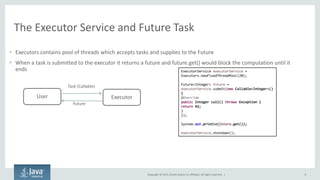
The Executor Service and Future Task
• Executors contains pool of threads which accepts tasks and supplies to the Future
• When a task is submitted to the executor it returns a future and future.get() would block the computation until it
ends
6
ExecutorService executorService =
Executors.newFixedThreadPool(20);
Future<Integer> future =
executorService.submit(new Callable<Integer>()
{
@Override
public Integer call() throws Exception {
return 42;
}
});
System.out.println(future.get());
executorService.shutdown();
User Executor
Task (Callable)
Future
Copyright © 2015, Oracle and/or its affiliates. All rights reserved. |
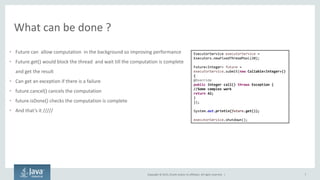
What can be done ?
• Future can allow computation in the background so improving performance
• Future.get() would block the thread and wait till the computation is complete
and get the result
• Can get an exception if there is a failure
• future.cancel() cancels the computation
• future.isDone() checks the computation is complete
• A d that’s it /////
7
ExecutorService executorService =
Executors.newFixedThreadPool(20);
Future<Integer> future =
executorService.submit(new Callable<Integer>()
{
@Override
public Integer call() throws Exception {
//Some complex work
return 42;
}
});
System.out.println(future.get());
executorService.shutdown();
Copyright © 2015, Oracle and/or its affiliates. All rights reserved. |
Distributed Cloud Services Design and the
fight for Performance
8
Copyright © 2015, Oracle and/or its affiliates. All rights reserved. |
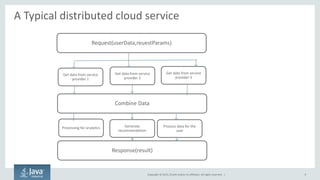
A Typical distributed cloud service
9
Get data from service
provider 1
Get data from service
provider 3
Get data from service
provider 2
Combine Data
Response(result)
Request(userData,reuestParams)
Processing for analytics Process data for the
user
Generate
recommendation
Copyright © 2015, Oracle and/or its affiliates. All rights reserved. |
Performance Bottlenecks and impacts
• Java.util.Future can help in parallelism
• But it cannot help with pipeline the tasks and managing the thread pool for you
• Future does not supports call backs and chaining of operations
• Building libraries with future can be complictaed
• Performing in a serial way can impact the latency big time
• It can destroy all benefits of having distributed services
• No amount of horizontal and vertical scaling can help
• Without dynamic services offerings business can be affected
10
Copyright © 2015, Oracle and/or its affiliates. All rights reserved. |
CompletableFuture and power of parallelism
11
Copyright © 2015, Oracle and/or its affiliates. All rights reserved. |
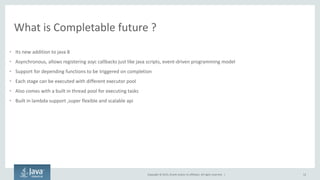
What is Completable future ?
• Its new addition to java 8
• Asynchronous, allows registering asyc callbacks just like java scripts, event-driven programming model
• Support for depending functions to be triggered on completion
• Each stage can be executed with different executor pool
• Also comes with a built in thread pool for executing tasks
• Built in lambda support ,super flexible and scalable api
12
Copyright © 2015, Oracle and/or its affiliates. All rights reserved. |
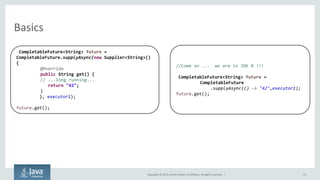
Basics
13
CompletableFuture<String> future =
CompletableFuture.supplyAsync(new Supplier<String>()
{
@Override
public String get() {
// ...long running...
return "42";
}
}, executor1);
future.get();
//Come on ... we are in JDK 8 !!!
CompletableFuture<String> future =
CompletableFuture
.supplyAsync(() -> "42",executor1);
future.get();
Copyright © 2015, Oracle and/or its affiliates. All rights reserved. |
Lambdas , Crash Recap
14
Copyright © 2015, Oracle and/or its affiliates. All rights reserved. |
Lambdas
• Function definition that is not bound to an identifier
15
/**
*
* This is a piece of code that illustrate how lambdas work in
Java 8
*
* Given an example
*
* f(x) = 2x+5;
*
* given x= 2 ; f(x) = 9 ;
*
* z(x)= f(g(x)) where g(x) =3x+5
*
* z(x) = 2(3x+5) +5 = 6x+15 12+15 = 27
* *
*/
public class LambdaUnderStanding2 {
@FunctionalInterface
static interface Funct {
int apply(int x);
default Funct compose(Funct before) {
return (x) -> apply(before.apply(x));
}
}
public static void main(String[] args) {
Funct annoymous = new Funct() {
@Override
public int apply(int x) {
return 2 * x + 5;;
}
};
Funct funct = (x) -> 2 * x + 5;
System.out.println(funct.apply(2));
Funct composed = funct.compose((x) -> 3 * x + 5);
System.out.println(composed.apply(2));
}
}
Copyright © 2015, Oracle and/or its affiliates. All rights reserved. |
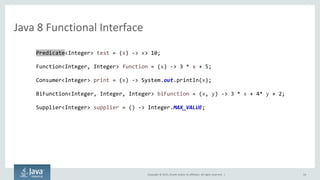
Java 8 Functional Interface
16
Predicate<Integer> test = (x) -> x> 10;
Function<Integer, Integer> function = (x) -> 3 * x + 5;
Consumer<Integer> print = (x) -> System.out.println(x);
BiFunction<Integer, Integer, Integer> biFunction = (x, y) -> 3 * x + 4* y + 2;
Supplier<Integer> supplier = () -> Integer.MAX_VALUE;
Copyright © 2015, Oracle and/or its affiliates. All rights reserved. |
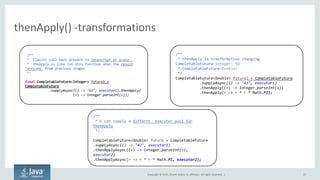
thenApply() -transformations
17
/**
* Classic call back present in javascript or scala .
* theApply is like run this function when the result
*arrives from previous stages
*/
final CompletableFuture<Integer> future1 =
CompletableFuture
.supplyAsync(() -> "42", executor1).thenApply(
(x) -> Integer.parseInt(x));
/**
* thenApply is trasformative changing
CompletableFuture<Integer> to
* CompletableFuture<Double>
*/
CompletableFuture<Double> future2 = CompletableFuture
.supplyAsync(() -> "42", executor1)
.thenApply((x) -> Integer.parseInt(x))
.thenApply(r -> r * r * Math.PI);
/**
* U can supply a differnt executor pool for
thenApply
*/
CompletableFuture<Double> future = CompletableFuture
.supplyAsync(() -> "42", executor1)
.thenApplyAsync((x) -> Integer.parseInt(x),
executor2)
.thenApplyAsync(r -> r * r * Math.PI, executor2);
Copyright © 2015, Oracle and/or its affiliates. All rights reserved. |
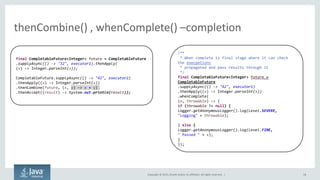
thenCombine() , whenComplete() –completion
18
final CompletableFuture<Integer> future = CompletableFuture
.supplyAsync(() -> "32", executor1).thenApply(
(x) -> Integer.parseInt(x));
CompletableFuture.supplyAsync(() -> "42", executor2)
.thenApply((x) -> Integer.parseInt(x))
.thenCombine(future, (x, y) -> x + y)
.thenAccept((result) -> System.out.println(result));
/**
* When complete is final stage where it can check
the execpetions
* propagated and pass results through it
*/
final CompletableFuture<Integer> future =
CompletableFuture
.supplyAsync(() -> "42", executor1)
.thenApply((x) -> Integer.parseInt(x))
.whenComplete(
(x, throwable) -> {
if (throwable != null) {
Logger.getAnonymousLogger().log(Level.SEVERE,
"Logging" + throwable);
} else {
Logger.getAnonymousLogger().log(Level.FINE,
" Passed " + x);
}
});
Copyright © 2015, Oracle and/or its affiliates. All rights reserved. |
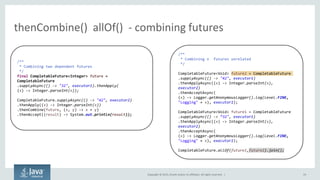
thenCombine() allOf() - combining futures
19
/**
* Combining two dependent futures
*/
final CompletableFuture<Integer> future =
CompletableFuture
.supplyAsync(() -> "32", executor1).thenApply(
(x) -> Integer.parseInt(x));
CompletableFuture.supplyAsync(() -> "42", executor2)
.thenApply((x) -> Integer.parseInt(x))
.thenCombine(future, (x, y) -> x + y)
.thenAccept((result) -> System.out.println(result));
/**
* Combining n futures unrelated
*/
CompletableFuture<Void> future2 = CompletableFuture
.supplyAsync(() -> "42", executor1)
.thenApplyAsync((x) -> Integer.parseInt(x),
executor2)
.thenAcceptAsync(
(x) -> Logger.getAnonymousLogger().log(Level.FINE,
"Logging" + x), executor2);
CompletableFuture<Void> future1 = CompletableFuture
.supplyAsync(() -> “ ", executor1)
.thenApplyAsync((x) -> Integer.parseInt(x),
executor2)
.thenAcceptAsync(
(x) -> Logger.getAnonymousLogger().log(Level.FINE,
"Logging" + x), executor2);
CompletableFuture.allOf(future1,future2).join();
Copyright © 2015, Oracle and/or its affiliates. All rights reserved. |
Building powerful libraries with Completable
Future
20
Copyright © 2015, Oracle and/or its affiliates. All rights reserved. |
Building powerful libraries with completable futures
• Building scalable service orchestrator
• Building dynamic http client framework
• Improve parallelism in existing services with are done serial
• Building libraries tuned for vertical scalability
21
Copyright © 2015, Oracle and/or its affiliates. All rights reserved. |
References
• https://docs.oracle.com/javase/tutorial/
• https://docs.oracle.com/javase/8/docs/api/java/util/concurrent/Completa
bleFuture.html
• http://cs.oswego.edu/mailman/listinfo/concurrency-interest
• https://github.com/srinivasanraghavan/functional
22
Copyright © 2015, Oracle and/or its affiliates. All rights reserved. |
Questions ?
23
Completable future

Completable future

  • 3.
    Completable Future Srinivasan Raghavan SeniorMember of Technical Staff Java Platform Group Copyright © 2015, Oracle and/or its affiliates. All rights reserved. |
  • 4.
    Copyright © 2015,Oracle and/or its affiliates. All rights reserved. | Program Agenda java.util.Future Introduction Cloud Services Design and the fight for Performance CompletableFuture and power of parallelism Building powerful libraries with Completable Future 1 2 3 4 4
  • 5.
    Copyright © 2015,Oracle and/or its affiliates. All rights reserved. | java.util.Future Introduction • Before jdk1.5 , no java.util.concurrent.*, only threads ,synchronized primitives • W ite o e , u a ywhe e ? – g eat su ess , But u it a illio ti es , wo k the sa e ? ig uestio • In came java.util.concurrent.* with executor service and future tasks and many other concurrency constructs • A java.util.Future is a construct which holds a result available at a later time • Future is asynchronous , but its not non-blocking 5
  • 6.
    Copyright © 2015,Oracle and/or its affiliates. All rights reserved. | The Executor Service and Future Task • Executors contains pool of threads which accepts tasks and supplies to the Future • When a task is submitted to the executor it returns a future and future.get() would block the computation until it ends 6 ExecutorService executorService = Executors.newFixedThreadPool(20); Future<Integer> future = executorService.submit(new Callable<Integer>() { @Override public Integer call() throws Exception { return 42; } }); System.out.println(future.get()); executorService.shutdown(); User Executor Task (Callable) Future
  • 7.
    Copyright © 2015,Oracle and/or its affiliates. All rights reserved. | What can be done ? • Future can allow computation in the background so improving performance • Future.get() would block the thread and wait till the computation is complete and get the result • Can get an exception if there is a failure • future.cancel() cancels the computation • future.isDone() checks the computation is complete • A d that’s it ///// 7 ExecutorService executorService = Executors.newFixedThreadPool(20); Future<Integer> future = executorService.submit(new Callable<Integer>() { @Override public Integer call() throws Exception { //Some complex work return 42; } }); System.out.println(future.get()); executorService.shutdown();
  • 8.
    Copyright © 2015,Oracle and/or its affiliates. All rights reserved. | Distributed Cloud Services Design and the fight for Performance 8
  • 9.
    Copyright © 2015,Oracle and/or its affiliates. All rights reserved. | A Typical distributed cloud service 9 Get data from service provider 1 Get data from service provider 3 Get data from service provider 2 Combine Data Response(result) Request(userData,reuestParams) Processing for analytics Process data for the user Generate recommendation
  • 10.
    Copyright © 2015,Oracle and/or its affiliates. All rights reserved. | Performance Bottlenecks and impacts • Java.util.Future can help in parallelism • But it cannot help with pipeline the tasks and managing the thread pool for you • Future does not supports call backs and chaining of operations • Building libraries with future can be complictaed • Performing in a serial way can impact the latency big time • It can destroy all benefits of having distributed services • No amount of horizontal and vertical scaling can help • Without dynamic services offerings business can be affected 10
  • 11.
    Copyright © 2015,Oracle and/or its affiliates. All rights reserved. | CompletableFuture and power of parallelism 11
  • 12.
    Copyright © 2015,Oracle and/or its affiliates. All rights reserved. | What is Completable future ? • Its new addition to java 8 • Asynchronous, allows registering asyc callbacks just like java scripts, event-driven programming model • Support for depending functions to be triggered on completion • Each stage can be executed with different executor pool • Also comes with a built in thread pool for executing tasks • Built in lambda support ,super flexible and scalable api 12
  • 13.
    Copyright © 2015,Oracle and/or its affiliates. All rights reserved. | Basics 13 CompletableFuture<String> future = CompletableFuture.supplyAsync(new Supplier<String>() { @Override public String get() { // ...long running... return "42"; } }, executor1); future.get(); //Come on ... we are in JDK 8 !!! CompletableFuture<String> future = CompletableFuture .supplyAsync(() -> "42",executor1); future.get();
  • 14.
    Copyright © 2015,Oracle and/or its affiliates. All rights reserved. | Lambdas , Crash Recap 14
  • 15.
    Copyright © 2015,Oracle and/or its affiliates. All rights reserved. | Lambdas • Function definition that is not bound to an identifier 15 /** * * This is a piece of code that illustrate how lambdas work in Java 8 * * Given an example * * f(x) = 2x+5; * * given x= 2 ; f(x) = 9 ; * * z(x)= f(g(x)) where g(x) =3x+5 * * z(x) = 2(3x+5) +5 = 6x+15 12+15 = 27 * * */ public class LambdaUnderStanding2 { @FunctionalInterface static interface Funct { int apply(int x); default Funct compose(Funct before) { return (x) -> apply(before.apply(x)); } } public static void main(String[] args) { Funct annoymous = new Funct() { @Override public int apply(int x) { return 2 * x + 5;; } }; Funct funct = (x) -> 2 * x + 5; System.out.println(funct.apply(2)); Funct composed = funct.compose((x) -> 3 * x + 5); System.out.println(composed.apply(2)); } }
  • 16.
    Copyright © 2015,Oracle and/or its affiliates. All rights reserved. | Java 8 Functional Interface 16 Predicate<Integer> test = (x) -> x> 10; Function<Integer, Integer> function = (x) -> 3 * x + 5; Consumer<Integer> print = (x) -> System.out.println(x); BiFunction<Integer, Integer, Integer> biFunction = (x, y) -> 3 * x + 4* y + 2; Supplier<Integer> supplier = () -> Integer.MAX_VALUE;
  • 17.
    Copyright © 2015,Oracle and/or its affiliates. All rights reserved. | thenApply() -transformations 17 /** * Classic call back present in javascript or scala . * theApply is like run this function when the result *arrives from previous stages */ final CompletableFuture<Integer> future1 = CompletableFuture .supplyAsync(() -> "42", executor1).thenApply( (x) -> Integer.parseInt(x)); /** * thenApply is trasformative changing CompletableFuture<Integer> to * CompletableFuture<Double> */ CompletableFuture<Double> future2 = CompletableFuture .supplyAsync(() -> "42", executor1) .thenApply((x) -> Integer.parseInt(x)) .thenApply(r -> r * r * Math.PI); /** * U can supply a differnt executor pool for thenApply */ CompletableFuture<Double> future = CompletableFuture .supplyAsync(() -> "42", executor1) .thenApplyAsync((x) -> Integer.parseInt(x), executor2) .thenApplyAsync(r -> r * r * Math.PI, executor2);
  • 18.
    Copyright © 2015,Oracle and/or its affiliates. All rights reserved. | thenCombine() , whenComplete() –completion 18 final CompletableFuture<Integer> future = CompletableFuture .supplyAsync(() -> "32", executor1).thenApply( (x) -> Integer.parseInt(x)); CompletableFuture.supplyAsync(() -> "42", executor2) .thenApply((x) -> Integer.parseInt(x)) .thenCombine(future, (x, y) -> x + y) .thenAccept((result) -> System.out.println(result)); /** * When complete is final stage where it can check the execpetions * propagated and pass results through it */ final CompletableFuture<Integer> future = CompletableFuture .supplyAsync(() -> "42", executor1) .thenApply((x) -> Integer.parseInt(x)) .whenComplete( (x, throwable) -> { if (throwable != null) { Logger.getAnonymousLogger().log(Level.SEVERE, "Logging" + throwable); } else { Logger.getAnonymousLogger().log(Level.FINE, " Passed " + x); } });
  • 19.
    Copyright © 2015,Oracle and/or its affiliates. All rights reserved. | thenCombine() allOf() - combining futures 19 /** * Combining two dependent futures */ final CompletableFuture<Integer> future = CompletableFuture .supplyAsync(() -> "32", executor1).thenApply( (x) -> Integer.parseInt(x)); CompletableFuture.supplyAsync(() -> "42", executor2) .thenApply((x) -> Integer.parseInt(x)) .thenCombine(future, (x, y) -> x + y) .thenAccept((result) -> System.out.println(result)); /** * Combining n futures unrelated */ CompletableFuture<Void> future2 = CompletableFuture .supplyAsync(() -> "42", executor1) .thenApplyAsync((x) -> Integer.parseInt(x), executor2) .thenAcceptAsync( (x) -> Logger.getAnonymousLogger().log(Level.FINE, "Logging" + x), executor2); CompletableFuture<Void> future1 = CompletableFuture .supplyAsync(() -> “ ", executor1) .thenApplyAsync((x) -> Integer.parseInt(x), executor2) .thenAcceptAsync( (x) -> Logger.getAnonymousLogger().log(Level.FINE, "Logging" + x), executor2); CompletableFuture.allOf(future1,future2).join();
  • 20.
    Copyright © 2015,Oracle and/or its affiliates. All rights reserved. | Building powerful libraries with Completable Future 20
  • 21.
    Copyright © 2015,Oracle and/or its affiliates. All rights reserved. | Building powerful libraries with completable futures • Building scalable service orchestrator • Building dynamic http client framework • Improve parallelism in existing services with are done serial • Building libraries tuned for vertical scalability 21
  • 22.
    Copyright © 2015,Oracle and/or its affiliates. All rights reserved. | References • https://docs.oracle.com/javase/tutorial/ • https://docs.oracle.com/javase/8/docs/api/java/util/concurrent/Completa bleFuture.html • http://cs.oswego.edu/mailman/listinfo/concurrency-interest • https://github.com/srinivasanraghavan/functional 22
  • 23.
    Copyright © 2015,Oracle and/or its affiliates. All rights reserved. | Questions ? 23