Development Approaches
Prototyping
Allan C. Tan, PMP, SCEA
About Me
Lean Startup
Lean Startup
• Eliminate Uncertainty
• Work Smarter, Not Harder
• Develop an MVP
• Validated Learning
Prototyping
• Early sample, model, or release of a product
built to test a concept or process or to act as a
thing to be replicated or learned from.
Goals of Prototyping
• Idea Validation
• Design Validated
• User Experience Improvements
Lo Fidelity Prototype
• Used for Validation
• Fast and Easy
• Idea / Design Validation
• Paper Prototype
• Powerpoint
• Balsamiq Mockups
Hi Fidelity Prototype
• Near production quality
• Design and UX Validation
• HTML
• InVision
• JustInMind
User Persona
• Create a reliable representations of your key
audience segments for reference.
• Help to focus decisions on the application
based on real world consideration
• Personas
– Demographics
– Technical Ability
– Motivation
Questions
Source: usability.gov
Questions
Source: usability.gov
Questions
Source: usability.gov
Sample Persona
Minimum Viable Product
• Features to see if something will work.
• Building a product that people will use and
pay for.
• Not to see if the product can be built in terms
of technical feasibility.
• Days worth of work, not weeks or months.
Traction
• A measurable set of customers or users that
serves to prove that your startup is "going
places."
Formula
50% Product + 50% Traction = Growth
0% Product + 100% Traction = Superficial
100% Product + 0% Traction = Expensive
Landing Page
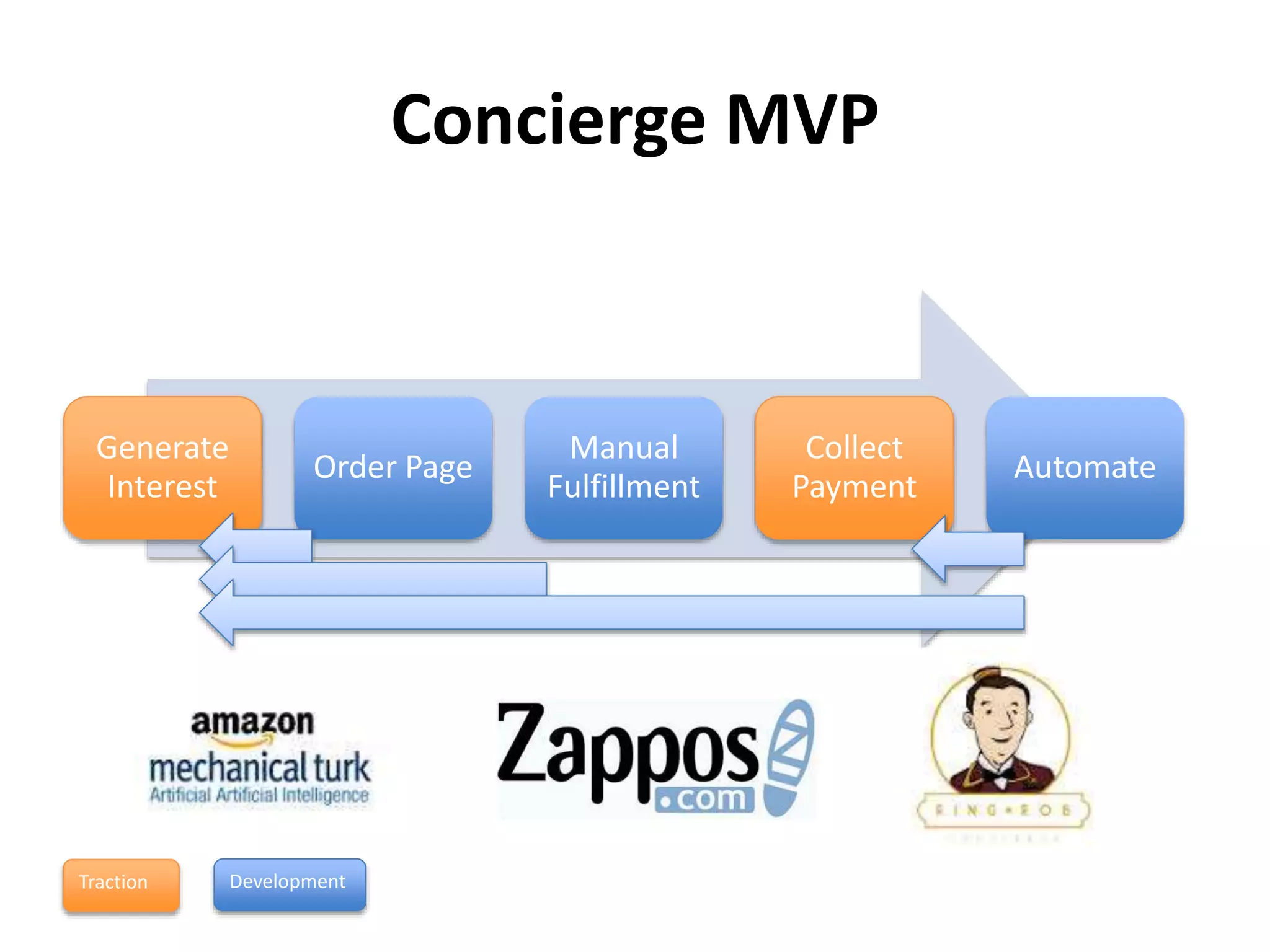
Concierge MVP
Generate
Interest
Order Page
Manual
Fulfillment
Collect
Payment
Automate
Traction Development
Optimize MVP
Build Landing
Pages
Ad
Campaigns
Registration /
Pre-order
A/B Tests
Build Feature
MVP
Traction Development
Prototype MVP
Look for
Advocates
Build Prototype
(Paper / Digital)
Pre-sell /
Fundraising
Build MVP
Traction Development
Reuse MVP
Generate
Interest
Build from
clone /
whitelabel
Sell
Analyze
/Customize
Traction Development
Approach by Market Type
• Existing Market
• New Market
• Cloned Market
• Niche Market
Existing Market
• Tested Idea
• Existing Market
• High Risk
• Tough Competition
Examples:
– POS, Inventory
– CRM, ERP
– Social Networking
– Notetaking
Existing Market
Goal: Displace the #1 or disrupt the market
Steps:
1. Identify Unfair Advantage
2. Look for advocates / partners
3. Create Prototype
4. Presell the solution, test the market
5. Build the dream team or outsource partner
6. Sell the solution
New Market
• Untested Idea
• New Market
• No/Low Competition
• High Risk
Examples:
• Not possible by definition 
New Market
Goal: Develop the new market
Steps:
1. Build landing page, vids, ads, etc.
2. Talk to domain experts
3. Test the market
4. Build the dream team or technical partner
5. Develop the MVP
6. Teach the market and gain traction
7. Maintain your leadership
Clone Market
• Tested Idea
• Localized Market
• Low Competition
• High Risk
Examples:
– eCommerce, Buy and Sell
– Crowdsourcing, Microtasking
Clone Market
Goal: Dominate the Local Market
Step:
1. Validate the local market
2. Check competition
3. Look for existing solution
– Clone scripts
– Commercial software
– Whitelabels
4. Customize
5. Sell
Niche Market
• Tested or Untested Idea
• Domain Expertise
• Low Risk
• Low Competition
Examples:
– Relocation Software
– Sports Betting
– Insurance Software
– Legal Research
Niche Market
Goal: Dominate the market
Step:
1. Leverage network and expertise
2. Build prototype
3. Presell
4. Build
5. Sell
Summary
Risk Compe-
tition
Concierge
MVP
Optimize
MVP
Prototype
MVP
Reuse
MVP
Existing Market Hi Hi ★ ★ ★★★★★ ★
New Market Hi Lo ★★ ★★★★★ ★★
Clone Market Med Lo ★★ ★ ★★★ ★★★★★
Niche Market Lo Lo ★★★ ★★★★ ★★★★★ ★★
MVP Tools
Resources
• http://media.balsamiq.com/ebooks/Balsamiq-
Interviews.pdf
• http://www.usefulusability.com/24-usability-
testing-tools/
Thank You
Allan C. Tan, SCEA, PMP
CEO/President
Email: allan@ideyatech.com
http://www.ideyatech.com/
allanctan
@allanctan ph.linkedin.com/in/allanctan/

Prototype