Proton Computed
Tomography
Nicole Hoffmann
Introduction
ļ‚— Radiation therapy
ā—¦ Common and effective
ļ‚— Photons damage everything
ā—¦ Detrimental to healthy tissue
ļ‚— Dose plot and irradiation damages
Overview
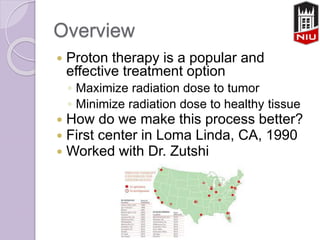
ļ‚— Proton therapy is a popular and
effective treatment option
ā—¦ Maximize radiation dose to tumor
ā—¦ Minimize radiation dose to healthy tissue
ļ‚— How do we make this process better?
ļ‚— First center in Loma Linda, CA, 1990
ļ‚— Worked with Dr. Zutshi
Background
ļ‚— Why would anyone use pCT?
ļ‚— X-ray CT uses photons, causing 3 to 5
percent range errors
ļ‚— More dangerous near vital organs
ļ‚— Potential pCT benefits
ā—¦ Fewer range errors by using same
particle
ā—¦ Planning and treatment with protons
Methods
ļ‚— Protons are charged
ļ‚— Multiple Coulomb Scattering
ļ‚— Calculations
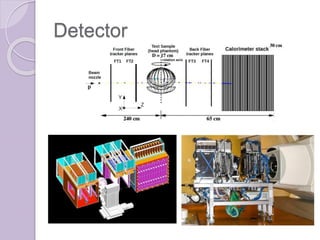
ā—¦ Trajectory (fiber tracker)
ā—¦ Residual energy (scintillator stack)
ā—¦ Estimation of path length and density
The detector was built as a collaboration between
Delhi, Fermilab, and NIU.
Fiber Tracker and Scintillator Stack
SiPMs
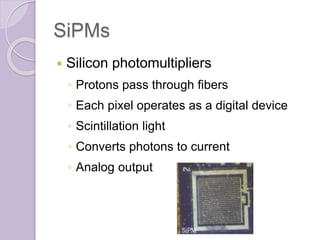
ļ‚— Silicon photomultipliers
ā—¦ Protons pass through fibers
ā—¦ Each pixel operates as a digital device
ā—¦ Scintillation light
ā—¦ Converts photons to current
ā—¦ Analog output
Single Photo Electron Spectrum
Detector
Methods
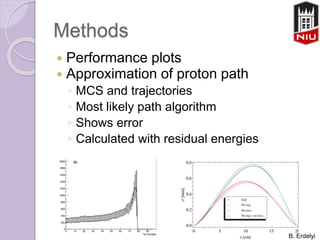
ļ‚— Performance plots
ļ‚— Approximation of proton path
ā—¦ MCS and trajectories
ā—¦ Most likely path algorithm
ā—¦ Shows error
ā—¦ Calculated with residual energies
B. Erdelyi
Results
ļ‚— Detector is finished
ļ‚— Undergoing testing to confirm pCT
benefits
ļ‚— Compare to X-Ray CT
ā—¦ Accuracy
ā—¦ Non-medical applications
ā—¦ Not affected by implants
ā—¦ Less radiation during scan
Conclusions
ļ‚— Significance
ā—¦ Changes cancer treatment
ā—¦ Less detrimental to patient health
ļ‚— Compared to X-Ray CT
ā—¦ Benefits are being investigated
Future Directions
ļ‚— Where do we go next?
ā—¦ Confirm positive benefits of pCT
ā—¦ Further improve the detector
ā—¦ Commercialize for clinical settings
Acknowledgments
ļ‚— Warrenville Proton Center
ļ‚— Department of Defense
ļ‚— Research Rookies
ļ‚— University of Delhi
ļ‚— Fermilab

Proton Computed Tomography.pptx

  • 1.
  • 2.
    Introduction ļ‚— Radiation therapy ā—¦Common and effective ļ‚— Photons damage everything ā—¦ Detrimental to healthy tissue ļ‚— Dose plot and irradiation damages
  • 3.
    Overview ļ‚— Proton therapyis a popular and effective treatment option ā—¦ Maximize radiation dose to tumor ā—¦ Minimize radiation dose to healthy tissue ļ‚— How do we make this process better? ļ‚— First center in Loma Linda, CA, 1990 ļ‚— Worked with Dr. Zutshi
  • 4.
    Background ļ‚— Why wouldanyone use pCT? ļ‚— X-ray CT uses photons, causing 3 to 5 percent range errors ļ‚— More dangerous near vital organs ļ‚— Potential pCT benefits ā—¦ Fewer range errors by using same particle ā—¦ Planning and treatment with protons
  • 5.
    Methods ļ‚— Protons arecharged ļ‚— Multiple Coulomb Scattering ļ‚— Calculations ā—¦ Trajectory (fiber tracker) ā—¦ Residual energy (scintillator stack) ā—¦ Estimation of path length and density The detector was built as a collaboration between Delhi, Fermilab, and NIU.
  • 6.
    Fiber Tracker andScintillator Stack
  • 7.
    SiPMs ļ‚— Silicon photomultipliers ā—¦Protons pass through fibers ā—¦ Each pixel operates as a digital device ā—¦ Scintillation light ā—¦ Converts photons to current ā—¦ Analog output
  • 8.
  • 9.
  • 10.
    Methods ļ‚— Performance plots ļ‚—Approximation of proton path ā—¦ MCS and trajectories ā—¦ Most likely path algorithm ā—¦ Shows error ā—¦ Calculated with residual energies B. Erdelyi
  • 11.
    Results ļ‚— Detector isfinished ļ‚— Undergoing testing to confirm pCT benefits ļ‚— Compare to X-Ray CT ā—¦ Accuracy ā—¦ Non-medical applications ā—¦ Not affected by implants ā—¦ Less radiation during scan
  • 12.
    Conclusions ļ‚— Significance ā—¦ Changescancer treatment ā—¦ Less detrimental to patient health ļ‚— Compared to X-Ray CT ā—¦ Benefits are being investigated
  • 13.
    Future Directions ļ‚— Wheredo we go next? ā—¦ Confirm positive benefits of pCT ā—¦ Further improve the detector ā—¦ Commercialize for clinical settings
  • 14.
    Acknowledgments ļ‚— Warrenville ProtonCenter ļ‚— Department of Defense ļ‚— Research Rookies ļ‚— University of Delhi ļ‚— Fermilab