Blinded Adaptations,  
Permutation Tests & T‐Tests
Michael Proschan (NIAID)Michael Proschan (NIAID)
IntroductionIntroduction
• Joint work with Ekkehard Glimm and MartinJoint work with Ekkehard Glimm and Martin 
Posch 2014, Stat. in Med. online 
• See also Posch & Proschan 2012, Stat. in Med. 
31 4146 415331, 4146‐4153
IntroductionIntroduction
• Clinical trials are pre‐meditated!Clinical trials are pre meditated!
• We pre‐specify everything
S i it / i f i it– Superiority/noninferiority
– Population (inclusion/exclusion criteria)
– Primary endpoint
– Secondary endpoints
– Analysis methods
– Sample size/power
IntroductionIntroduction
• Changes made after seeing data are rightlyChanges made after seeing data are rightly 
questioned: are investigators trying to get an 
unfair advantage?
– Changing primary endpoint because another 
endpoint has a bigger treatment effect
– Increasing sample size because the p‐value is close
– Changing primary analysis because “assumptions 
are violated”are violated
– Changing population because of promising 
subgroup resultssubgroup results
IntroductionIntroduction
• What’s the harm? 0 05 is arbitrary anywayWhat s the harm?  0.05 is arbitrary anyway
• Problem: if unlimited freedom to change 
anything the real error rate could be hugeanything, the real error rate could be huge
• Reminiscent of Bible code controversy
– Clairvoyant messages such as “Bin Laden” and 
“twin towers” by skipping letters in Old Testament
– Similar messages can be found by skipping letters 
in any large book (Brendan McKay)
IntroductionIntroduction
• But changes made before unblinding areBut changes made before unblinding are 
different
• Under strong null hypothesis that treatment• Under strong null hypothesis that treatment 
has NO effect, blinded data give no info about 
treatment effecttreatment effect
– Impossible to cheat even if it seems like cheating
E if bli d d d t h bi d l di t ib ti it• E.g., even if blinded data show bimodal distribution, it 
is not caused by treatment if strong null is true 
Permutation TestsPermutation Tests
• Permutation tests condition on all data otherPermutation tests condition on all data other 
than treatment labels
• Under strong null (D Z ) are independent• Under strong null, (D,Z ) are independent, 
where Z are ±1 treatment indicators & D are 
datadata 
– Observed data D would have been observed 
regardless of the treatment givenregardless of the treatment given
– It is as if we observed D FIRST, then made the 
treatment assignments Ztreatment assignments Z
Permutation TestsPermutation Tests
• Peaking at data changes nothing becausePeaking at data changes nothing because 
permutation tests already condition on D
• Conditional distribution of test statistic T(Z Y)• Conditional distribution of test statistic T(Z,Y) 
given D is that of T(Z,y) where y is fixed
Di ib i f Z d d d i i• Distribution of Z depends on randomization 
method 
– Simple
– Permuted block, etc.
Permutation TestsPermutation Tests
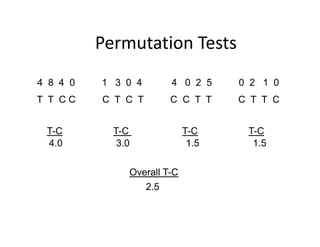
T T C C C T C T C C T T C T T C
4 8 4 0 1 3 0 4 4 0 2 5 0 2 1 0
T-C T-C T-C T-C
O ll T C
4.0 3.0 1.5 1.5
Overall T-C
2.5
Permutation TestsPermutation Tests
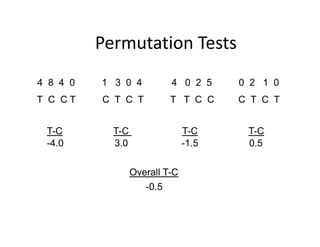
T C C T C T C T T T C C C T C T
4 8 4 0 1 3 0 4 4 0 2 5 0 2 1 0
T-C T-C T-C T-C
O ll T C
-4.0 3.0 -1.5 0.5
Overall T-C
-0.5
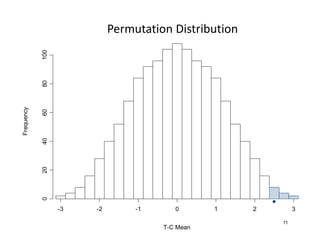
Rerandomization Distribution
Permutation Distribution
100
y
80
Frequency
06004002
11
T-C Mean
-3 -2 -1 0 1 2 3
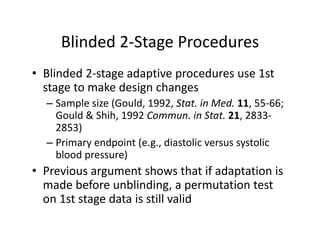
Blinded 2‐Stage ProceduresBlinded 2 Stage Procedures
• Blinded 2‐stage adaptive procedures use 1stBlinded 2 stage adaptive procedures use 1st  
stage to make design changes
– Sample size (Gould, 1992, Stat. in Med. 11, 55‐66; p ( , , , ;
Gould & Shih, 1992 Commun. in Stat. 21, 2833‐
2853) 
P i d i ( di li li– Primary endpoint (e.g., diastolic versus systolic 
blood pressure)
• Previous argument shows that if adaptation is• Previous argument shows that if adaptation is 
made before unblinding, a permutation test 
on 1st stage data is still validon 1st stage data is still valid
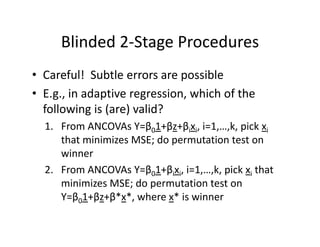
Blinded 2‐Stage ProceduresBlinded 2 Stage Procedures
• Careful! Subtle errors are possibleCareful!  Subtle errors are possible
• E.g., in adaptive regression, which of the 
following is (are) valid?following is (are) valid?
1. From ANCOVAs Y=β01+βz+βixi, i=1,…,k, pick xi
that minimizes MSE; do permutation test onthat minimizes MSE; do permutation test on 
winner
2 From ANCOVAs Y=β 1+β x i=1 k pick x that2. From ANCOVAs Y=β01+βixi, i=1,…,k, pick xi that 
minimizes MSE; do permutation test on 
Y=β01+βz+β*x*, where x* is winnerβ0 β β ,
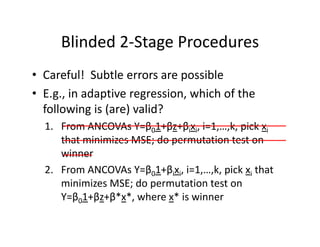
Blinded 2‐Stage ProceduresBlinded 2 Stage Procedures
• Careful! Subtle errors are possibleCareful!  Subtle errors are possible
• E.g., in adaptive regression, which of the 
following is (are) valid?following is (are) valid?
1. From ANCOVAs Y=β01+βz+βixi, i=1,…,k, pick xi
that minimizes MSE; do permutation test onthat minimizes MSE; do permutation test on 
winner
2 From ANCOVAs Y=β 1+β x i=1 k pick x that2. From ANCOVAs Y=β01+βixi, i=1,…,k, pick xi that 
minimizes MSE; do permutation test on 
Y=β01+βz+β*x*, where x* is winnerβ0 β β ,
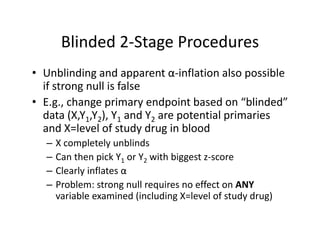
Blinded 2‐Stage ProceduresBlinded 2 Stage Procedures
• Unblinding and apparent α‐inflation also possible U b d g a d appa e t α at o a so poss b e
if strong null is false
• E.g., change primary endpoint based on “blinded” g g p y p
data (X,Y1,Y2), Y1 and Y2 are potential primaries 
and X=level of study drug in blood
– X completely unblinds
– Can then pick Y1 or Y2 with biggest z‐score
Clearly inflates α– Clearly inflates α
– Problem: strong null requires no effect on ANY
variable examined (including X=level of study drug)
Blinded 2‐Stage ProceduresBlinded 2 Stage Procedures
• Claim: the following procedure is validClaim: the following procedure is valid
– After viewing 1st stage data D1, choose test 
statistic T1(Y1 Z1) and second stage data to collectstatistic T1(Y1,Z1) and second stage data to collect
– After observing D2, choose T2(Y2,Z2) and method 
of combining T1 and T2, f(T1,T2)of combining T1 and T2, f(T1,T2)
– Conditional distribution of f(T1,T2) given (D1,D2) is 
its stratified permutation distributionp
– Stratified permutation test controls conditional, & 
therefore unconditional type I error rate 
Focus of Rest of TalkFocus of Rest of Talk
• Permutation tests are asymptoticallyPermutation tests are asymptotically 
equivalent to t‐tests
• Suggests that adaptive t tests might be valid if• Suggests that adaptive t‐tests might be valid if 
adaptive permutation tests are
W id i b• We consider connections between 
permutation and t‐tests, and validity of 
d i f d i iadaptive t‐tests from adaptive permutation 
tests 
One‐Sample CaseOne Sample Case
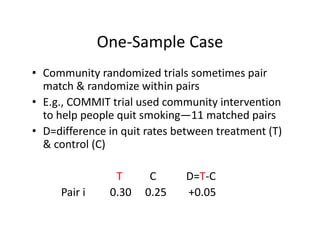
• Community randomized trials sometimes pair Co u ty a do ed t a s so et es pa
match & randomize within pairs
• E.g., COMMIT trial used community intervention g y
to help people quit smoking—11 matched pairs
• D=difference in quit rates between treatment (T) 
& control (C)
T C           D=T‐C
Pair i         0.30     0.25        +0.05
One‐Sample CaseOne Sample Case
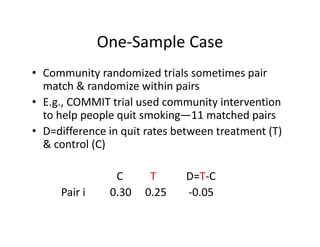
• Community randomized trials sometimes pair Co u ty a do ed t a s so et es pa
match & randomize within pairs
• E.g., COMMIT trial used community intervention g y
to help people quit smoking—11 matched pairs
• D=difference in quit rates between treatment (T) 
& control (C)
C T  D=T‐C
Pair i         0.30     0.25        ‐0.05
One‐Sample CaseOne Sample Case
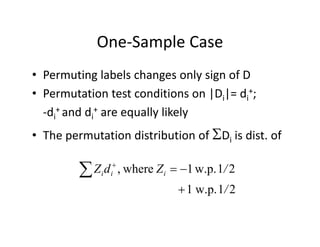
• Permuting labels changes only sign of DPermuting labels changes only sign of D
• Permutation test conditions on |Di|= di
+; 
d + d d + ll lik l‐di
+ and di
+ are equally likely
• The permutation distribution of Di is dist. ofThe permutation distribution of Di is dist. of
21w p1where /ZdZ  
21w.p.1
21w.p.1where,
/
/ZdZ iii


One‐Sample CaseOne Sample Case
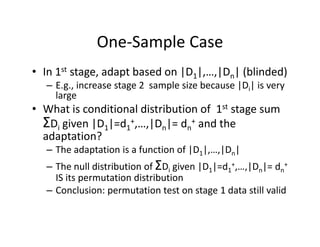
• In 1st stage, adapt based on |D1|,…,|Dn| (blinded)g , p | 1|, ,| n| ( )
– E.g., increase stage 2  sample size because |Di| is very 
large
• What is conditional distribution of 1st stage sum• What is conditional distribution of  1st stage sum 
ΣDi given |D1|=d1
+,…,|Dn|= dn
+ and the 
adaptation?adaptation?
– The adaptation is a function of |D1|,…,|Dn| 
– The null distribution of ΣDi given |D1|=d1
+,…,|Dn|= dn
+
i g | 1| 1 , ,| n| n
IS its permutation distribution
– Conclusion: permutation test on stage 1 data still valid
One‐Sample CaseOne Sample Case
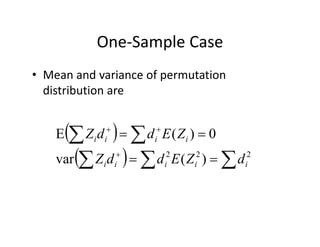
• Mean and variance of permutationMean and variance of permutation 
distribution are
    
0)(E iiii ZEddZ 
  

 222
)(var
)(
iiiii
iiii
dZEddZ
One‐Sample CaseOne Sample Case
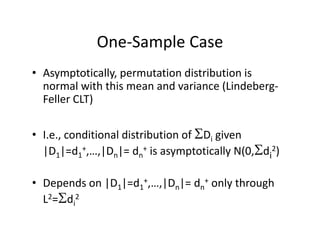
• Asymptotically, permutation distribution is sy ptot ca y, pe utat o d st but o s
normal with this mean and variance (Lindeberg‐
Feller CLT)
• I.e., conditional distribution of Di given , i g
|D1|=d1
+,…,|Dn|= dn
+ is asymptotically N(0,di
2)
• Depends on |D1|=d1
+,…,|Dn|= dn
+ only through 
L2=di
2L di
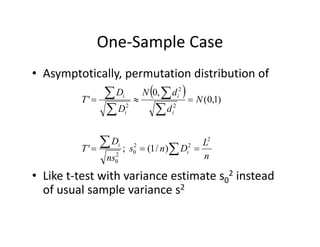
One‐Sample CaseOne Sample Case
• Asymptotically, permutation distribution ofAsymptotically, permutation distribution of 
  N
d
dN
D
D
T ii
2
2
2
)1,0(
,0
' 




LD
dD ii
2


n
L
Dns
ns
D
T i
i
2
22
02
0
)/1(;'  
• Like t‐test with variance estimate s0
2 instead 
of usual sample variance s2
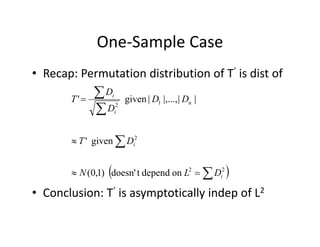
One‐Sample CaseOne Sample Case
• Recap: Permutation distribution of T’ is dist ofRecap: Permutation distribution of T is dist of 

 12
|||,...,|given' n
i
DD
D
D
T


2
i'
i
DT
D
 

22
2
d dtd ')10(
given' i
DLN
DT
• Conclusion: T’ is asymptotically indep of L2
  22
ondependtdoesn')1,0( iDLN
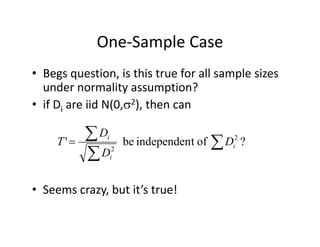
One‐Sample CaseOne Sample Case
• Begs question, is this true for all sample sizesBegs question, is this true for all sample sizes 
under normality assumption?
• if Di are iid N(0,2), then canif Di are iid N(0, ), then can
?fti d db' 2
 i
D
D
T ?oftindependenbe' 2
2 

 i
i
i
D
D
T
• Seems crazy, but it’s true!
One‐Sample CaseOne Sample Case
• One way to see that T’ is independent of Di
2One way to see that T is independent of Di
uses Basu’s theorem: 
• Recall S is sufficient for θ if F(y|s) does not 
d d θ i i l if { ( )} f ll θdepend on θ; it is complete if E{g(S)}=0 for all θ
implies g(S)≡0 with probability 1
• A is ancillary if its distribution does not depend• A is ancillary if its distribution does not depend 
on θ
• Basu, 1955, Sankhya 15, 377‐380:
If S is a complete, sufficient statistic and A 
is ancillary, then S and A are independent
One‐Sample CaseOne Sample Case
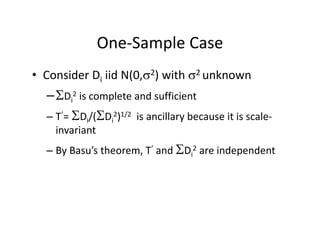
• Consider Di iid N(0 2) with 2 unknownConsider Di iid N(0, ) with  unknown
–Di
2 is complete and sufficient
– T’= Di/(Di
2)1/2 is ancillary because it is scale‐
invariant
– By Basu’s theorem, T’ and Di
2 are independent
One‐Sample CaseOne Sample Case
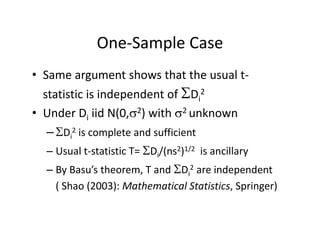
• Same argument shows that the usual t‐Same argument shows that the usual t
statistic is independent of Di
2
2 2• Under Di iid N(0,2) with 2 unknown
–Di
2 is complete and sufficient
– Usual t‐statistic T= Di/(ns2)1/2 is ancillary
– By Basu’s theorem T and D 2 are independent– By Basu s theorem, T and Di are independent 
( Shao (2003): Mathematical Statistics, Springer) 
One‐Sample CaseOne Sample Case
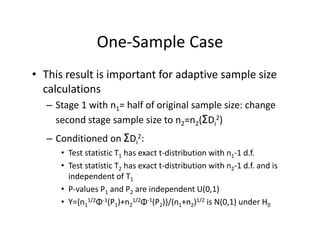
• This result is important for adaptive sample sizeThis result is important for adaptive sample size 
calculations
– Stage 1 with n1= half of original sample size: changeStage 1 with n1  half of original sample size: change 
second stage sample size to n2=n2(ΣDi
2)
– Conditioned on ΣD 2:– Conditioned on ΣDi : 
• Test statistic T1 has exact t‐distribution with n1‐1 d.f.
• Test statistic T2 has exact t‐distribution with n2‐1 d.f. and is 2 2
independent of T1
• P‐values P1 and P2 are independent U(0,1)
• Y={n 1/2Φ‐1(P )+n 1/2Φ‐1(P )}/(n +n )1/2 is N(0 1) under H• Y={n1
1/2Φ 1(P1)+n2
1/2Φ 1(P2)}/(n1+n2)1/2 is N(0,1) under H0
One‐Sample CaseOne Sample Case
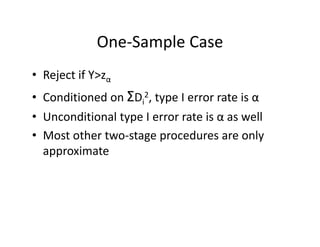
• Reject if Y>zReject if Y>zα
• Conditioned on ΣDi
2, type I error rate is α
• Unconditional type I error rate is α as well
• Most other two‐stage procedures are onlyMost other two stage procedures are only 
approximate
One‐Sample CaseOne Sample Case
• Could even make other adaptations like changing p g g
primary endpoint
• Look at ΣDi
2 for each endpoint and determine 
which one is primary  
 2– E.g., pick endpoint with smallest Di
2
• Slight generalization of our result shows that• Slight generalization of our result shows that 
conditional distribution of T given adaptation is 
still exact t 
One‐Sample CaseOne Sample Case
• Shows that conditional type I error rate givenShows that conditional type I error rate given 
adaptation is controlled at level α
• Unconditional type I error rate must also be• Unconditional type I error rate must also be 
controlled at level α
D i i l i i li• Derivation assumes multivariate normality 
with variance/covariance not depending on 
mean
Two‐Sample CaseTwo Sample Case
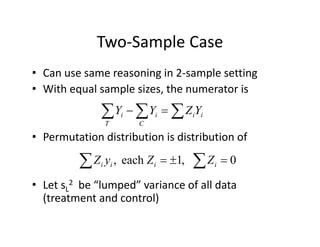
• Can use same reasoning in 2‐sample setting Ca use sa e easo g sa p e sett g
• With equal sample sizes, the numerator is
 YZYY
• Permutation distribution is distribution of
  ii
C
i
T
i YZYY
Permutation distribution is distribution of 
  0,1each, iiii ZZyZ
• Let sL
2 be “lumped” variance of all data 
(treatment and control)(treatment and control) 
Two‐Sample CaseTwo Sample Case
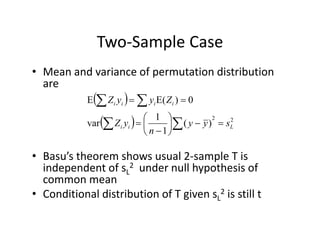
• Mean and variance of permutation distribution p
are
  0)(EE iiii ZyyZ  
  22
)(
1
1
var Lii syy
n
yZ 






 
• Basu’s theorem shows usual 2‐sample T is 
independent of sL
2 under null hypothesis ofindependent of sL under null hypothesis of 
common mean
• Conditional distribution of T given sL
2 is still t
Two‐Sample CaseTwo Sample Case
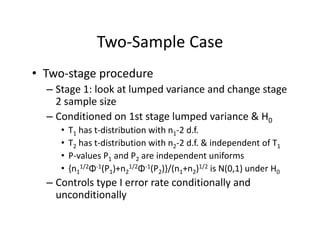
• Two‐stage procedureTwo stage procedure
– Stage 1: look at lumped variance and change stage 
2 sample size
– Conditioned on 1st stage lumped variance & H0
• T1 has t‐distribution with n1‐2 d.f.
• T2 has t‐distribution with n2‐2 d.f. & independent of T1
• P‐values P1 and P2 are independent uniforms
• {n1
1/2Φ‐1(P1)+n2
1/2Φ‐1(P2)}/(n1+n2)1/2 is N(0 1) under H0{n1 Φ (P1)+n2 Φ (P2)}/(n1+n2) is N(0,1) under H0
– Controls type I error rate conditionally and 
unconditionally
SummarySummary
• Permutation tests are often valid even inPermutation tests are often valid even in 
adaptive settings if blind is maintained
• There is a close connection between• There is a close connection between 
permutation tests and t‐tests
C d d lidi f d i f• Can deduce validity of adaptive t‐tests from 
validity of adaptive permutation tests

2014-10-22 EUGM | PROSCHAN | Blinded Adaptations Permutations Tests and T-Tests

  • 1.
  • 2.
    IntroductionIntroduction • Joint workwith Ekkehard Glimm and MartinJoint work with Ekkehard Glimm and Martin  Posch 2014, Stat. in Med. online  • See also Posch & Proschan 2012, Stat. in Med.  31 4146 415331, 4146‐4153
  • 3.
    IntroductionIntroduction • Clinical trialsare pre‐meditated!Clinical trials are pre meditated! • We pre‐specify everything S i it / i f i it– Superiority/noninferiority – Population (inclusion/exclusion criteria) – Primary endpoint – Secondary endpoints – Analysis methods – Sample size/power
  • 4.
    IntroductionIntroduction • Changes madeafter seeing data are rightlyChanges made after seeing data are rightly  questioned: are investigators trying to get an  unfair advantage? – Changing primary endpoint because another  endpoint has a bigger treatment effect – Increasing sample size because the p‐value is close – Changing primary analysis because “assumptions  are violated”are violated – Changing population because of promising  subgroup resultssubgroup results
  • 5.
    IntroductionIntroduction • What’s theharm? 0 05 is arbitrary anywayWhat s the harm?  0.05 is arbitrary anyway • Problem: if unlimited freedom to change  anything the real error rate could be hugeanything, the real error rate could be huge • Reminiscent of Bible code controversy – Clairvoyant messages such as “Bin Laden” and  “twin towers” by skipping letters in Old Testament – Similar messages can be found by skipping letters  in any large book (Brendan McKay)
  • 6.
    IntroductionIntroduction • But changesmade before unblinding areBut changes made before unblinding are  different • Under strong null hypothesis that treatment• Under strong null hypothesis that treatment  has NO effect, blinded data give no info about  treatment effecttreatment effect – Impossible to cheat even if it seems like cheating E if bli d d d t h bi d l di t ib ti it• E.g., even if blinded data show bimodal distribution, it  is not caused by treatment if strong null is true 
  • 7.
    Permutation TestsPermutation Tests • Permutationtests condition on all data otherPermutation tests condition on all data other  than treatment labels • Under strong null (D Z ) are independent• Under strong null, (D,Z ) are independent,  where Z are ±1 treatment indicators & D are  datadata  – Observed data D would have been observed  regardless of the treatment givenregardless of the treatment given – It is as if we observed D FIRST, then made the  treatment assignments Ztreatment assignments Z
  • 8.
    Permutation TestsPermutation Tests • Peakingat data changes nothing becausePeaking at data changes nothing because  permutation tests already condition on D • Conditional distribution of test statistic T(Z Y)• Conditional distribution of test statistic T(Z,Y)  given D is that of T(Z,y) where y is fixed Di ib i f Z d d d i i• Distribution of Z depends on randomization  method  – Simple – Permuted block, etc.
  • 9.
    Permutation TestsPermutation Tests T TC C C T C T C C T T C T T C 4 8 4 0 1 3 0 4 4 0 2 5 0 2 1 0 T-C T-C T-C T-C O ll T C 4.0 3.0 1.5 1.5 Overall T-C 2.5
  • 10.
    Permutation TestsPermutation Tests T CC T C T C T T T C C C T C T 4 8 4 0 1 3 0 4 4 0 2 5 0 2 1 0 T-C T-C T-C T-C O ll T C -4.0 3.0 -1.5 0.5 Overall T-C -0.5
  • 11.
  • 12.
    Blinded 2‐Stage ProceduresBlinded 2Stage Procedures • Blinded 2‐stage adaptive procedures use 1stBlinded 2 stage adaptive procedures use 1st   stage to make design changes – Sample size (Gould, 1992, Stat. in Med. 11, 55‐66; p ( , , , ; Gould & Shih, 1992 Commun. in Stat. 21, 2833‐ 2853)  P i d i ( di li li– Primary endpoint (e.g., diastolic versus systolic  blood pressure) • Previous argument shows that if adaptation is• Previous argument shows that if adaptation is  made before unblinding, a permutation test  on 1st stage data is still validon 1st stage data is still valid
  • 13.
    Blinded 2‐Stage ProceduresBlinded 2Stage Procedures • Careful! Subtle errors are possibleCareful!  Subtle errors are possible • E.g., in adaptive regression, which of the  following is (are) valid?following is (are) valid? 1. From ANCOVAs Y=β01+βz+βixi, i=1,…,k, pick xi that minimizes MSE; do permutation test onthat minimizes MSE; do permutation test on  winner 2 From ANCOVAs Y=β 1+β x i=1 k pick x that2. From ANCOVAs Y=β01+βixi, i=1,…,k, pick xi that  minimizes MSE; do permutation test on  Y=β01+βz+β*x*, where x* is winnerβ0 β β ,
  • 14.
    Blinded 2‐Stage ProceduresBlinded 2Stage Procedures • Careful! Subtle errors are possibleCareful!  Subtle errors are possible • E.g., in adaptive regression, which of the  following is (are) valid?following is (are) valid? 1. From ANCOVAs Y=β01+βz+βixi, i=1,…,k, pick xi that minimizes MSE; do permutation test onthat minimizes MSE; do permutation test on  winner 2 From ANCOVAs Y=β 1+β x i=1 k pick x that2. From ANCOVAs Y=β01+βixi, i=1,…,k, pick xi that  minimizes MSE; do permutation test on  Y=β01+βz+β*x*, where x* is winnerβ0 β β ,
  • 15.
    Blinded 2‐Stage ProceduresBlinded 2Stage Procedures • Unblinding and apparent α‐inflation also possible U b d g a d appa e t α at o a so poss b e if strong null is false • E.g., change primary endpoint based on “blinded” g g p y p data (X,Y1,Y2), Y1 and Y2 are potential primaries  and X=level of study drug in blood – X completely unblinds – Can then pick Y1 or Y2 with biggest z‐score Clearly inflates α– Clearly inflates α – Problem: strong null requires no effect on ANY variable examined (including X=level of study drug)
  • 16.
    Blinded 2‐Stage ProceduresBlinded 2Stage Procedures • Claim: the following procedure is validClaim: the following procedure is valid – After viewing 1st stage data D1, choose test  statistic T1(Y1 Z1) and second stage data to collectstatistic T1(Y1,Z1) and second stage data to collect – After observing D2, choose T2(Y2,Z2) and method  of combining T1 and T2, f(T1,T2)of combining T1 and T2, f(T1,T2) – Conditional distribution of f(T1,T2) given (D1,D2) is  its stratified permutation distributionp – Stratified permutation test controls conditional, &  therefore unconditional type I error rate 
  • 17.
    Focus of Restof TalkFocus of Rest of Talk • Permutation tests are asymptoticallyPermutation tests are asymptotically  equivalent to t‐tests • Suggests that adaptive t tests might be valid if• Suggests that adaptive t‐tests might be valid if  adaptive permutation tests are W id i b• We consider connections between  permutation and t‐tests, and validity of  d i f d i iadaptive t‐tests from adaptive permutation  tests 
  • 18.
    One‐Sample CaseOne Sample Case •Community randomized trials sometimes pair Co u ty a do ed t a s so et es pa match & randomize within pairs • E.g., COMMIT trial used community intervention g y to help people quit smoking—11 matched pairs • D=difference in quit rates between treatment (T)  & control (C) T C           D=T‐C Pair i         0.30     0.25        +0.05
  • 19.
    One‐Sample CaseOne Sample Case •Community randomized trials sometimes pair Co u ty a do ed t a s so et es pa match & randomize within pairs • E.g., COMMIT trial used community intervention g y to help people quit smoking—11 matched pairs • D=difference in quit rates between treatment (T)  & control (C) C T  D=T‐C Pair i         0.30     0.25        ‐0.05
  • 20.
    One‐Sample CaseOne Sample Case •Permuting labels changes only sign of DPermuting labels changes only sign of D • Permutation test conditions on |Di|= di +;  d + d d + ll lik l‐di + and di + are equally likely • The permutation distribution of Di is dist. ofThe permutation distribution of Di is dist. of 21w p1where /ZdZ   21w.p.1 21w.p.1where, / /ZdZ iii  
  • 21.
    One‐Sample CaseOne Sample Case •In 1st stage, adapt based on |D1|,…,|Dn| (blinded)g , p | 1|, ,| n| ( ) – E.g., increase stage 2  sample size because |Di| is very  large • What is conditional distribution of 1st stage sum• What is conditional distribution of  1st stage sum  ΣDi given |D1|=d1 +,…,|Dn|= dn + and the  adaptation?adaptation? – The adaptation is a function of |D1|,…,|Dn|  – The null distribution of ΣDi given |D1|=d1 +,…,|Dn|= dn + i g | 1| 1 , ,| n| n IS its permutation distribution – Conclusion: permutation test on stage 1 data still valid
  • 22.
    One‐Sample CaseOne Sample Case •Mean and variance of permutationMean and variance of permutation  distribution are      0)(E iiii ZEddZ       222 )(var )( iiiii iiii dZEddZ
  • 23.
    One‐Sample CaseOne Sample Case •Asymptotically, permutation distribution is sy ptot ca y, pe utat o d st but o s normal with this mean and variance (Lindeberg‐ Feller CLT) • I.e., conditional distribution of Di given , i g |D1|=d1 +,…,|Dn|= dn + is asymptotically N(0,di 2) • Depends on |D1|=d1 +,…,|Dn|= dn + only through  L2=di 2L di
  • 24.
    One‐Sample CaseOne Sample Case •Asymptotically, permutation distribution ofAsymptotically, permutation distribution of    N d dN D D T ii 2 2 2 )1,0( ,0 '      LD dD ii 2   n L Dns ns D T i i 2 22 02 0 )/1(;'   • Like t‐test with variance estimate s0 2 instead  of usual sample variance s2
  • 25.
    One‐Sample CaseOne Sample Case •Recap: Permutation distribution of T’ is dist ofRecap: Permutation distribution of T is dist of    12 |||,...,|given' n i DD D D T   2 i' i DT D    22 2 d dtd ')10( given' i DLN DT • Conclusion: T’ is asymptotically indep of L2   22 ondependtdoesn')1,0( iDLN
  • 26.
    One‐Sample CaseOne Sample Case •Begs question, is this true for all sample sizesBegs question, is this true for all sample sizes  under normality assumption? • if Di are iid N(0,2), then canif Di are iid N(0, ), then can ?fti d db' 2  i D D T ?oftindependenbe' 2 2    i i i D D T • Seems crazy, but it’s true!
  • 27.
    One‐Sample CaseOne Sample Case •One way to see that T’ is independent of Di 2One way to see that T is independent of Di uses Basu’s theorem:  • Recall S is sufficient for θ if F(y|s) does not  d d θ i i l if { ( )} f ll θdepend on θ; it is complete if E{g(S)}=0 for all θ implies g(S)≡0 with probability 1 • A is ancillary if its distribution does not depend• A is ancillary if its distribution does not depend  on θ • Basu, 1955, Sankhya 15, 377‐380: If S is a complete, sufficient statistic and A  is ancillary, then S and A are independent
  • 28.
    One‐Sample CaseOne Sample Case •Consider Di iid N(0 2) with 2 unknownConsider Di iid N(0, ) with  unknown –Di 2 is complete and sufficient – T’= Di/(Di 2)1/2 is ancillary because it is scale‐ invariant – By Basu’s theorem, T’ and Di 2 are independent
  • 29.
    One‐Sample CaseOne Sample Case •Same argument shows that the usual t‐Same argument shows that the usual t statistic is independent of Di 2 2 2• Under Di iid N(0,2) with 2 unknown –Di 2 is complete and sufficient – Usual t‐statistic T= Di/(ns2)1/2 is ancillary – By Basu’s theorem T and D 2 are independent– By Basu s theorem, T and Di are independent  ( Shao (2003): Mathematical Statistics, Springer) 
  • 30.
    One‐Sample CaseOne Sample Case •This result is important for adaptive sample sizeThis result is important for adaptive sample size  calculations – Stage 1 with n1= half of original sample size: changeStage 1 with n1  half of original sample size: change  second stage sample size to n2=n2(ΣDi 2) – Conditioned on ΣD 2:– Conditioned on ΣDi :  • Test statistic T1 has exact t‐distribution with n1‐1 d.f. • Test statistic T2 has exact t‐distribution with n2‐1 d.f. and is 2 2 independent of T1 • P‐values P1 and P2 are independent U(0,1) • Y={n 1/2Φ‐1(P )+n 1/2Φ‐1(P )}/(n +n )1/2 is N(0 1) under H• Y={n1 1/2Φ 1(P1)+n2 1/2Φ 1(P2)}/(n1+n2)1/2 is N(0,1) under H0
  • 31.
    One‐Sample CaseOne Sample Case •Reject if Y>zReject if Y>zα • Conditioned on ΣDi 2, type I error rate is α • Unconditional type I error rate is α as well • Most other two‐stage procedures are onlyMost other two stage procedures are only  approximate
  • 32.
    One‐Sample CaseOne Sample Case •Could even make other adaptations like changing p g g primary endpoint • Look at ΣDi 2 for each endpoint and determine  which one is primary    2– E.g., pick endpoint with smallest Di 2 • Slight generalization of our result shows that• Slight generalization of our result shows that  conditional distribution of T given adaptation is  still exact t 
  • 33.
    One‐Sample CaseOne Sample Case •Shows that conditional type I error rate givenShows that conditional type I error rate given  adaptation is controlled at level α • Unconditional type I error rate must also be• Unconditional type I error rate must also be  controlled at level α D i i l i i li• Derivation assumes multivariate normality  with variance/covariance not depending on  mean
  • 34.
    Two‐Sample CaseTwo Sample Case •Can use same reasoning in 2‐sample setting Ca use sa e easo g sa p e sett g • With equal sample sizes, the numerator is  YZYY • Permutation distribution is distribution of   ii C i T i YZYY Permutation distribution is distribution of    0,1each, iiii ZZyZ • Let sL 2 be “lumped” variance of all data  (treatment and control)(treatment and control) 
  • 35.
    Two‐Sample CaseTwo Sample Case •Mean and variance of permutation distribution p are   0)(EE iiii ZyyZ     22 )( 1 1 var Lii syy n yZ          • Basu’s theorem shows usual 2‐sample T is  independent of sL 2 under null hypothesis ofindependent of sL under null hypothesis of  common mean • Conditional distribution of T given sL 2 is still t
  • 36.
    Two‐Sample CaseTwo Sample Case •Two‐stage procedureTwo stage procedure – Stage 1: look at lumped variance and change stage  2 sample size – Conditioned on 1st stage lumped variance & H0 • T1 has t‐distribution with n1‐2 d.f. • T2 has t‐distribution with n2‐2 d.f. & independent of T1 • P‐values P1 and P2 are independent uniforms • {n1 1/2Φ‐1(P1)+n2 1/2Φ‐1(P2)}/(n1+n2)1/2 is N(0 1) under H0{n1 Φ (P1)+n2 Φ (P2)}/(n1+n2) is N(0,1) under H0 – Controls type I error rate conditionally and  unconditionally
  • 37.
    SummarySummary • Permutation testsare often valid even inPermutation tests are often valid even in  adaptive settings if blind is maintained • There is a close connection between• There is a close connection between  permutation tests and t‐tests C d d lidi f d i f• Can deduce validity of adaptive t‐tests from  validity of adaptive permutation tests