Ashley Hyde

Jessica Frogley

English 2010

10 December 2011

Proposal Paper

                      Proposal: Tax benefit for water conservation

       Utah is one of the five fastest growing states in the nation, and it shares a border with the

four other fastest growing states. From 1990 to 2000, Utah’s population increased by more than

510,000 people to over 2.2 million. In 2011 Utah reached 2.9 million people. The population

will more than double to nearly 5 million by 2050. Within the Wasatch Front, the population is

1.7 million in a 80 mile radius. That is 40 miles to Ogden which is North Salt Lake Valley. To

40 miles south from Salt Lake to Provo. As Utah’s population increases, so will the demand for

Utah’s limited water resources. (Utah.gov)

       If Utah’s residential and industrial water demands swell at the same rate as its population

growth, the state is headed for big trouble. To compound this mounting crisis, Utah is the second

driest state in the nation. Most of the state is classified as a “desert,” receiving less than 13

inches of annual precipitation. Since 1999, Utah suffered through a severe droughts. Utahans

also have the second highest water use rate in the nation. Utahans consume about 293 gallons

per person per day, over half of which is used to water lawns.

       Utah is in a progression to an unsustainable situation. Where the water resources are

being used up faster than replenishment can accrue(Cooper). Think of some environmentally

unfriendly choices people make everyday. Spraying off a sidewalk instead of using a broom,
washing their cars by hose multiple times a week. The biggest one seen is people water their

lawns during the wrong part of the day. When the water will evaporate faster than it gets to the

lawn. This occurs when people do not having an efficient watering system, so that it sprays the

sidewalk and not the lawn. This is seen by people everyday in residential areas.

         This proposal for a tax credit for people who take a social responsibility and transform

their lawns into a beautiful water wise Utah landscape. This tax benefit is an allowable

deduction on a tax return intended to reduce a taxpayer's burden while typically supporting

certain types of commercial activity (Merriam-Webster.com). This would be a incentive for

Utahans to transform their laws. A tax benefit allows some type of adjustment benefiting a

taxpayer's tax liability. The credit should cover the costs associated with installing a water wise

landscape or systems in the taxpayer’s residence located here in Utah.

         A water conservation system is a system or series of components or mechanisms that are

designed to provide for the collection of rainwater or residential graywater. Graywater is

wastewater generated from domestic activities such as laundry, dishwashing, and bathing.

Graywater reclamation is the process by which households make use of gray water's potential

instead of simply piping it into overburdened sewage systems with all the black water that

contains fecal matter and urine. A water wise conservation system includes a system that is

capable of storing rainwater or residential gray water for future use and reusing the collected

water for the same residential property.

       There will be some easy steps to start the water wise landscaping, but do not conceder

them disadvantages. The water wise tax credit for the people of Utah is not a difficult thing to

get started for their residential area. A project this big seems like it would not be an easy thing to
do, with the help of local professionals and specialist to help the project will pay off in many

ways. As well as getting the funds to pay for the entire cost up front. It is estimated that for each

1,000 square foot of landscape area converted from irrigated to non-irrigated the cost would be a

thousand dollars.

        The benefits of implementing a tax credit for Utahan's will help invoke people to get

involved in water conservation in a more serious manner. Tax benefits provide an advantage to

the taxpayer while typically benefiting another entity. It will make it easier for people to help

water conservation on a day to day basis with out doing anything after the instillation. This will

allow more people to help save their environment.

        Nothing can live without water, if Utahans can reduce per-capita consumption of water

25 percent by 2050, they will conserve the equivalent of over 500,000 acre-feet of water per

year. That is more water than can be held in Jordanelle Reservoir and Deer Creek Reservoir

combined, and more than any water project in Utah has developed.

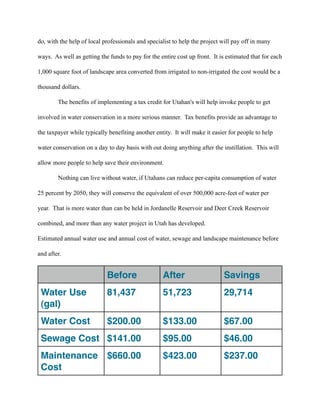
Estimated annual water use and annual cost of water, sewage and landscape maintenance before

and after.


                            Before                 After                     Savings
 Water Use                  81,437                 51,723                    29,714
 (gal)
 Water Cost                 $200.00                $133.00                   $67.00
 Sewage Cost $141.00                               $95.00                    $46.00
 Maintenance $660.00                               $423.00                   $237.00
 Cost
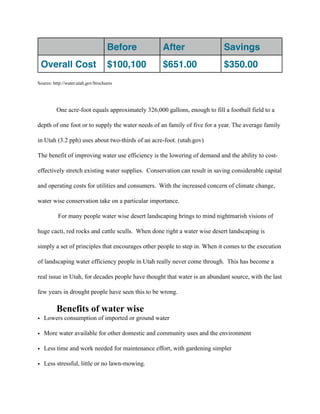
Before         After                    Savings
 Overall Cost                       $100,100       $651.00                  $350.00
Source: http://water.utah.gov/brochures


         One acre-foot equals approximately 326,000 gallons, enough to fill a football field to a

depth of one foot or to supply the water needs of an family of five for a year. The average family

in Utah (3.2 pph) uses about two-thirds of an acre-foot. (utah.gov)

The benefit of improving water use efficiency is the lowering of demand and the ability to cost-

effectively stretch existing water supplies. Conservation can result in saving considerable capital

and operating costs for utilities and consumers. With the increased concern of climate change,

water wise conservation take on a particular importance.

          For many people water wise desert landscaping brings to mind nightmarish visions of

huge cacti, red rocks and cattle sculls. When done right a water wise desert landscaping is

simply a set of principles that encourages other people to step in. When it comes to the execution

of landscaping water efficiency people in Utah really never come through. This has become a

real issue in Utah, for decades people have thought that water is an abundant source, with the last

few years in drought people have seen this to be wrong.


    Benefits of water wise
• Lowers consumption of imported or ground water

• More water available for other domestic and community uses and the environment

• Less time and work needed for maintenance effort, with gardening simpler

• Less stressful, little or no lawn-mowing.
Water wise plants in appropriate planting design, and soil grading and mulching, takes

full advantage of rainfall retention. When water restrictions are implemented, by municipality or

water costs, water wise plants will tend to survive and thrive, while more ornamental plants may

be unable to adapt.

       Increasing block rate structures most effectively communicate value and encourage

efficient use when compared to other types of rate structures. Through an increasing block rate

design, the unit price for water increases as the volume consumed increases, with prices being set

for each “block” of water use. People who use low or average volumes of water are charged a

modest unit price and rewarded for conservation; those using significantly higher volumes pay

higher unit prices. Utah communities use a wide variety of water rate structures, ranging from

efficiency-based designs to rate structures that promote little or no efficient water use.

Some have incorporated increasing block rate designs, but have set the block prices and volumes

in ways that do not effectively promote efficient water use. Although some Utah cities and towns

have made progress in developing and instituting efficiency-based rate structures, the results

from this analysis indicate that most still have much room for improvement.(Western Resource

Advocates)

       Many people feel like their day to day choices do not have a great affect of the water

circus that Utah is facing. Leave the hose on it is their bill anyway, what is a few house of

running the sprinklers giving the millions of people who water everyday. These are the thoughts

which turn up in the heads of real people when they make everyday choices. The moral case for

the claim that various people in Utah ought to take strong action on water conservation is fairly

easy to see.
What is much harder to spot is the moral demand for individual action, for making

conscious wise choices when it come to water conservation. One thing which gets in the way is

the thought that nothing an individual does can possibly matter that much so why bother

concerning water? People think that they are doing good and not being good when they take

certain steps to conserve water. They have a better Utah in mind but not a better character. They

little disaster is the possibility that they cannot really do any good at all.

        The little water wise actions people make can make no real difference at all, but people

still ought to undertake them. Society all together have a moral obligation which depends on the

demand of consistency in thoughts and actions of being water wise, on the reason they have for

thinking what they do about governments and what obligations they have, as well as the sort of

life people hope to lead. (Garvey)

Reasons for this conclusion can have a lot of relevant consequences in them

• Consequences having to do with the Earth

• Large scale social change

• Avoiding the suffering of human beings and every living thing on Earth.

Even though many of those consequences have nothing to do with a single persons sprinkler

system. The reasons can be bolstered by a persons consistent position in the rest of their

projects, the rest of their water wise choices. Society choosing to take action with water wise

and live in a certain water wise way, a consistent way with various judgements, principles, and

facts, will make a difference, nevertheless is the right thing to do.
Work Cite

1.Western Resources Advocates. “Water Rate Structures in Utah: How Utah Cities Compare

       Using This Important Water Use Efficiency Tool” January 2005. Web. 12 Oct 2011

2. Garvey, James. “Climate Change and Casual Inefficiency: Why Go Green When it Makes No

       Difference” EBSCOHOST. web. 12 Oct 2011

3. Week, Jennifer. “Water Shortages.” CQ Researcher, 18 June 2010: 529-52. 12 Oct 2011

4. "Tax." Merriam-Webster.com. Merriam-Webster, 2011. Web. 12 Oct 2011.

5. Stout, Linda. “Collective Visioning: How Groups Can Work Together for a Just and

       Sustainable Future.” 45.5. 2011. Masterfile Premier. EBSCO. Web. 12 Oct 2011

6. Cooper, Mary H. “Pollution and the Environment.” CQ Researcher. 17 July 1998. Web. 12

       October 2011

Proposal

  • 1.
    Ashley Hyde Jessica Frogley English2010 10 December 2011 Proposal Paper Proposal: Tax benefit for water conservation Utah is one of the five fastest growing states in the nation, and it shares a border with the four other fastest growing states. From 1990 to 2000, Utah’s population increased by more than 510,000 people to over 2.2 million. In 2011 Utah reached 2.9 million people. The population will more than double to nearly 5 million by 2050. Within the Wasatch Front, the population is 1.7 million in a 80 mile radius. That is 40 miles to Ogden which is North Salt Lake Valley. To 40 miles south from Salt Lake to Provo. As Utah’s population increases, so will the demand for Utah’s limited water resources. (Utah.gov) If Utah’s residential and industrial water demands swell at the same rate as its population growth, the state is headed for big trouble. To compound this mounting crisis, Utah is the second driest state in the nation. Most of the state is classified as a “desert,” receiving less than 13 inches of annual precipitation. Since 1999, Utah suffered through a severe droughts. Utahans also have the second highest water use rate in the nation. Utahans consume about 293 gallons per person per day, over half of which is used to water lawns. Utah is in a progression to an unsustainable situation. Where the water resources are being used up faster than replenishment can accrue(Cooper). Think of some environmentally unfriendly choices people make everyday. Spraying off a sidewalk instead of using a broom,
  • 2.
    washing their carsby hose multiple times a week. The biggest one seen is people water their lawns during the wrong part of the day. When the water will evaporate faster than it gets to the lawn. This occurs when people do not having an efficient watering system, so that it sprays the sidewalk and not the lawn. This is seen by people everyday in residential areas. This proposal for a tax credit for people who take a social responsibility and transform their lawns into a beautiful water wise Utah landscape. This tax benefit is an allowable deduction on a tax return intended to reduce a taxpayer's burden while typically supporting certain types of commercial activity (Merriam-Webster.com). This would be a incentive for Utahans to transform their laws. A tax benefit allows some type of adjustment benefiting a taxpayer's tax liability. The credit should cover the costs associated with installing a water wise landscape or systems in the taxpayer’s residence located here in Utah. A water conservation system is a system or series of components or mechanisms that are designed to provide for the collection of rainwater or residential graywater. Graywater is wastewater generated from domestic activities such as laundry, dishwashing, and bathing. Graywater reclamation is the process by which households make use of gray water's potential instead of simply piping it into overburdened sewage systems with all the black water that contains fecal matter and urine. A water wise conservation system includes a system that is capable of storing rainwater or residential gray water for future use and reusing the collected water for the same residential property. There will be some easy steps to start the water wise landscaping, but do not conceder them disadvantages. The water wise tax credit for the people of Utah is not a difficult thing to get started for their residential area. A project this big seems like it would not be an easy thing to
  • 3.
    do, with thehelp of local professionals and specialist to help the project will pay off in many ways. As well as getting the funds to pay for the entire cost up front. It is estimated that for each 1,000 square foot of landscape area converted from irrigated to non-irrigated the cost would be a thousand dollars. The benefits of implementing a tax credit for Utahan's will help invoke people to get involved in water conservation in a more serious manner. Tax benefits provide an advantage to the taxpayer while typically benefiting another entity. It will make it easier for people to help water conservation on a day to day basis with out doing anything after the instillation. This will allow more people to help save their environment. Nothing can live without water, if Utahans can reduce per-capita consumption of water 25 percent by 2050, they will conserve the equivalent of over 500,000 acre-feet of water per year. That is more water than can be held in Jordanelle Reservoir and Deer Creek Reservoir combined, and more than any water project in Utah has developed. Estimated annual water use and annual cost of water, sewage and landscape maintenance before and after. Before After Savings Water Use 81,437 51,723 29,714 (gal) Water Cost $200.00 $133.00 $67.00 Sewage Cost $141.00 $95.00 $46.00 Maintenance $660.00 $423.00 $237.00 Cost
  • 4.
    Before After Savings Overall Cost $100,100 $651.00 $350.00 Source: http://water.utah.gov/brochures One acre-foot equals approximately 326,000 gallons, enough to fill a football field to a depth of one foot or to supply the water needs of an family of five for a year. The average family in Utah (3.2 pph) uses about two-thirds of an acre-foot. (utah.gov) The benefit of improving water use efficiency is the lowering of demand and the ability to cost- effectively stretch existing water supplies. Conservation can result in saving considerable capital and operating costs for utilities and consumers. With the increased concern of climate change, water wise conservation take on a particular importance. For many people water wise desert landscaping brings to mind nightmarish visions of huge cacti, red rocks and cattle sculls. When done right a water wise desert landscaping is simply a set of principles that encourages other people to step in. When it comes to the execution of landscaping water efficiency people in Utah really never come through. This has become a real issue in Utah, for decades people have thought that water is an abundant source, with the last few years in drought people have seen this to be wrong. Benefits of water wise • Lowers consumption of imported or ground water • More water available for other domestic and community uses and the environment • Less time and work needed for maintenance effort, with gardening simpler • Less stressful, little or no lawn-mowing.
  • 5.
    Water wise plantsin appropriate planting design, and soil grading and mulching, takes full advantage of rainfall retention. When water restrictions are implemented, by municipality or water costs, water wise plants will tend to survive and thrive, while more ornamental plants may be unable to adapt. Increasing block rate structures most effectively communicate value and encourage efficient use when compared to other types of rate structures. Through an increasing block rate design, the unit price for water increases as the volume consumed increases, with prices being set for each “block” of water use. People who use low or average volumes of water are charged a modest unit price and rewarded for conservation; those using significantly higher volumes pay higher unit prices. Utah communities use a wide variety of water rate structures, ranging from efficiency-based designs to rate structures that promote little or no efficient water use. Some have incorporated increasing block rate designs, but have set the block prices and volumes in ways that do not effectively promote efficient water use. Although some Utah cities and towns have made progress in developing and instituting efficiency-based rate structures, the results from this analysis indicate that most still have much room for improvement.(Western Resource Advocates) Many people feel like their day to day choices do not have a great affect of the water circus that Utah is facing. Leave the hose on it is their bill anyway, what is a few house of running the sprinklers giving the millions of people who water everyday. These are the thoughts which turn up in the heads of real people when they make everyday choices. The moral case for the claim that various people in Utah ought to take strong action on water conservation is fairly easy to see.
  • 6.
    What is muchharder to spot is the moral demand for individual action, for making conscious wise choices when it come to water conservation. One thing which gets in the way is the thought that nothing an individual does can possibly matter that much so why bother concerning water? People think that they are doing good and not being good when they take certain steps to conserve water. They have a better Utah in mind but not a better character. They little disaster is the possibility that they cannot really do any good at all. The little water wise actions people make can make no real difference at all, but people still ought to undertake them. Society all together have a moral obligation which depends on the demand of consistency in thoughts and actions of being water wise, on the reason they have for thinking what they do about governments and what obligations they have, as well as the sort of life people hope to lead. (Garvey) Reasons for this conclusion can have a lot of relevant consequences in them • Consequences having to do with the Earth • Large scale social change • Avoiding the suffering of human beings and every living thing on Earth. Even though many of those consequences have nothing to do with a single persons sprinkler system. The reasons can be bolstered by a persons consistent position in the rest of their projects, the rest of their water wise choices. Society choosing to take action with water wise and live in a certain water wise way, a consistent way with various judgements, principles, and facts, will make a difference, nevertheless is the right thing to do.
  • 7.
    Work Cite 1.Western ResourcesAdvocates. “Water Rate Structures in Utah: How Utah Cities Compare Using This Important Water Use Efficiency Tool” January 2005. Web. 12 Oct 2011 2. Garvey, James. “Climate Change and Casual Inefficiency: Why Go Green When it Makes No Difference” EBSCOHOST. web. 12 Oct 2011 3. Week, Jennifer. “Water Shortages.” CQ Researcher, 18 June 2010: 529-52. 12 Oct 2011 4. "Tax." Merriam-Webster.com. Merriam-Webster, 2011. Web. 12 Oct 2011. 5. Stout, Linda. “Collective Visioning: How Groups Can Work Together for a Just and Sustainable Future.” 45.5. 2011. Masterfile Premier. EBSCO. Web. 12 Oct 2011 6. Cooper, Mary H. “Pollution and the Environment.” CQ Researcher. 17 July 1998. Web. 12 October 2011