Property-based testing 
Less is More 
Ho Tien Vu @hotienvu 
htvu@thoughtworks.com
Why we write tests 
• Programs are implemented based on 
specifications 
• Tests are used to verify against specification 
• Fail fast
Unit test 
• First line of defend 
• Test small modules in isolation 
• Fast, repeatable 
• Facilitates changes 
• Documentation
Unit test - Example 
• Testing sorted method on a List of Int 
• empty list => [] 
• already-sorted list => [1,2,3,4,5,6,] 
• reversed-sorted list => [6,5,4,3,2,1] 
• arbitrary list => [1,4,3,6,5,2]
Problems 
• Data is hard-coded 
• Are we missing out edge cases? 
- long list? 
- What about boundaries? (-21474836478 
2147483647) 
• Are we biased towards the 
implementation? 
• Spend considerable amount of time writing/ 
fixing tests
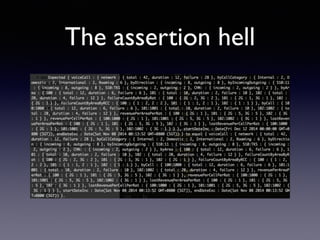
The assertion hell
“Testing shows the presence, not the 
absence of bugs” E.W. Dijkstra 
http://googleresearch.blogspot.sg/2006/06/extra-extra-read- 
all-about-it-nearly.html
Property-based test 
• Testable Specification + Random Testing 
• Focus on the specification 
• Let the testing library take care of 
generating test cases
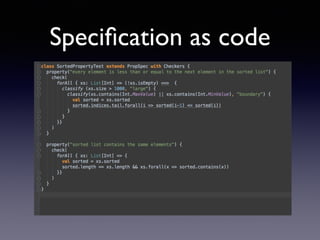
Specification as code
Properties of sorted 
• every element is less than or equal to the 
next element in the sorted list 
sorted[i] <= sorted[i+1] for i in 1..n-1
Properties of sorted 
• should retain all elements of original list 
sorted[i].size == original[i].size 
sorted.contains(x) for x in original
Random Testing 
• Random generator with emphasize on zero, 
extremities, +/- unity, special values, etc 
• Allow custom distribution
Generator 
• DSL for generating random test data 
- forAll, chooseFrom, oneOf, constant, etc 
• Allow custom-type 
• Composable - allow complex data 
structure e.g. Tree
Test auto-shrink 
• When encounter a failed test, the PBT 
library will try to minimize it 
• Reduce effort on debugging
Advantages of PBT 
• Let developer focus on specifications 
• Reduce testing effort 
• More coverage 
• Make testing FUN!
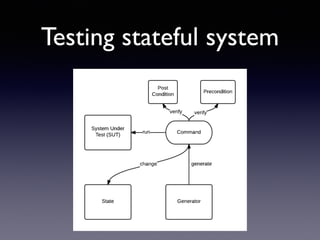
Testing stateful system 
• Stateful system is hard to test 
- testing 1 component O(n) 
- testing 2 components O(n^2)… 
• Often focus on how components behave 
instead of the system as a whole 
=> Need better abstraction
Testing stateful system 
with PBT 
• Abstraction in PBT 
- State: information about the system 
- Command: interface that changes system 
from one state to another 
- System Under Test(SUT) - the system we 
want to test
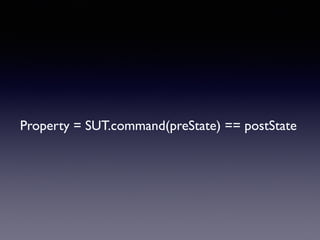
Property = SUT.command(preState) == postState
Testing stateful system
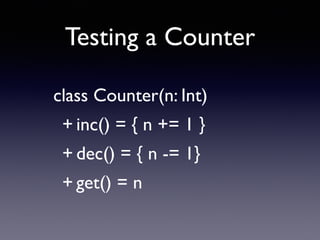
Testing a Counter 
class Counter(n: Int) 
+ inc() = { n += 1 } 
+ dec() = { n -= 1} 
+ get() = n
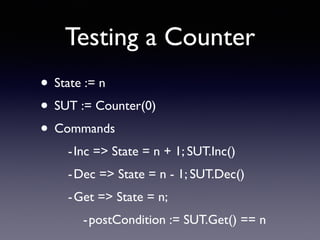
Testing a Counter 
• State := n 
• SUT := Counter(0) 
• Commands 
- Inc => State = n + 1; SUT.Inc() 
-Dec => State = n - 1; SUT.Dec() 
-Get => State = n; 
-postCondition := SUT.Get() == n
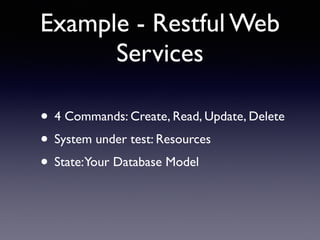
Example - Restful Web 
Services 
• 4 Commands: Create, Read, Update, Delete 
• System under test: Resources 
• State: Your Database Model
Example - Redis Client 
• Testing a Redis-client 
https://github.com/rickynils/scalacheck/tree/ 
master/examples/commands-redis
Example - LevelDb 
• https://code.google.com/p/leveldb/issues/ 
detail?id=44 
=> It is impossible for human to come up 
with a test case of 17 steps
Concurrency/ 
Distributed System 
• Have been used successfully in many 
projects 
- Riak 
- Akka 
• Often discover bugs that Unit tests couldn't
PBT library 
• Haskell - QuickCheck 
• JVM(Scala/Java/Clojure) 
- Scalacheck (Java/Scala) 
- test.check (Clojure) 
• Python - hypothesis 
• Erlang - QuickCheck 
• Javascript, C++, etc
PBT is not a silver 
bullet 
• Writing PBT can be really hard if 
- your program has side-effect 
- it’s not trivial to verify the output 
correctness (e.g. optimal function) 
- there are lots of duplication between 
specifications and implementations
Summary 
• PBT let developer focus on and express 
specification in a concise format 
• PBT reduces testing effort 
• PBT can be used to test stateful system 
• PBT works well with functional 
Programming Languages
Thank you! 
https://github.com/hotienvu/pbt-scalacheck 
@hotienvu 
htvu@thoughtworks.com

Property based testing - Less is more

  • 1.
    Property-based testing Lessis More Ho Tien Vu @hotienvu htvu@thoughtworks.com
  • 2.
    Why we writetests • Programs are implemented based on specifications • Tests are used to verify against specification • Fail fast
  • 3.
    Unit test •First line of defend • Test small modules in isolation • Fast, repeatable • Facilitates changes • Documentation
  • 4.
    Unit test -Example • Testing sorted method on a List of Int • empty list => [] • already-sorted list => [1,2,3,4,5,6,] • reversed-sorted list => [6,5,4,3,2,1] • arbitrary list => [1,4,3,6,5,2]
  • 5.
    Problems • Datais hard-coded • Are we missing out edge cases? - long list? - What about boundaries? (-21474836478 2147483647) • Are we biased towards the implementation? • Spend considerable amount of time writing/ fixing tests
  • 6.
  • 7.
    “Testing shows thepresence, not the absence of bugs” E.W. Dijkstra http://googleresearch.blogspot.sg/2006/06/extra-extra-read- all-about-it-nearly.html
  • 9.
    Property-based test •Testable Specification + Random Testing • Focus on the specification • Let the testing library take care of generating test cases
  • 10.
  • 11.
    Properties of sorted • every element is less than or equal to the next element in the sorted list sorted[i] <= sorted[i+1] for i in 1..n-1
  • 12.
    Properties of sorted • should retain all elements of original list sorted[i].size == original[i].size sorted.contains(x) for x in original
  • 13.
    Random Testing •Random generator with emphasize on zero, extremities, +/- unity, special values, etc • Allow custom distribution
  • 14.
    Generator • DSLfor generating random test data - forAll, chooseFrom, oneOf, constant, etc • Allow custom-type • Composable - allow complex data structure e.g. Tree
  • 15.
    Test auto-shrink •When encounter a failed test, the PBT library will try to minimize it • Reduce effort on debugging
  • 16.
    Advantages of PBT • Let developer focus on specifications • Reduce testing effort • More coverage • Make testing FUN!
  • 17.
    Testing stateful system • Stateful system is hard to test - testing 1 component O(n) - testing 2 components O(n^2)… • Often focus on how components behave instead of the system as a whole => Need better abstraction
  • 18.
    Testing stateful system with PBT • Abstraction in PBT - State: information about the system - Command: interface that changes system from one state to another - System Under Test(SUT) - the system we want to test
  • 19.
  • 20.
  • 21.
    Testing a Counter class Counter(n: Int) + inc() = { n += 1 } + dec() = { n -= 1} + get() = n
  • 22.
    Testing a Counter • State := n • SUT := Counter(0) • Commands - Inc => State = n + 1; SUT.Inc() -Dec => State = n - 1; SUT.Dec() -Get => State = n; -postCondition := SUT.Get() == n
  • 23.
    Example - RestfulWeb Services • 4 Commands: Create, Read, Update, Delete • System under test: Resources • State: Your Database Model
  • 24.
    Example - RedisClient • Testing a Redis-client https://github.com/rickynils/scalacheck/tree/ master/examples/commands-redis
  • 25.
    Example - LevelDb • https://code.google.com/p/leveldb/issues/ detail?id=44 => It is impossible for human to come up with a test case of 17 steps
  • 26.
    Concurrency/ Distributed System • Have been used successfully in many projects - Riak - Akka • Often discover bugs that Unit tests couldn't
  • 27.
    PBT library •Haskell - QuickCheck • JVM(Scala/Java/Clojure) - Scalacheck (Java/Scala) - test.check (Clojure) • Python - hypothesis • Erlang - QuickCheck • Javascript, C++, etc
  • 28.
    PBT is nota silver bullet • Writing PBT can be really hard if - your program has side-effect - it’s not trivial to verify the output correctness (e.g. optimal function) - there are lots of duplication between specifications and implementations
  • 29.
    Summary • PBTlet developer focus on and express specification in a concise format • PBT reduces testing effort • PBT can be used to test stateful system • PBT works well with functional Programming Languages
  • 30.