




![def test_sort_empty(xs):
assert quicksort([]) == []
def test_sorted(xs):
assert quicksort([1, 2, 3]) == [1, 2, 3]
def test_sort_unsorted(xs):
assert quicksort([5, 4]) == [4, 5]](https://image.slidesharecdn.com/untitled-170306085726/85/Better-Tests-Less-Code-Property-based-Testing-12-320.jpg)

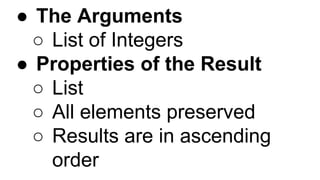

![@given(st.lists(st.integers()))
def test_sort(xs):
sorted_xs = quicksort(xs)
assert isinstance(sorted_xs, list)
assert Counter(xs) == Counter(sorted_xs)
assert all(
x <= y for x, y in
zip(sorted_xs, sorted_xs[1:])
)](https://image.slidesharecdn.com/untitled-170306085726/85/Better-Tests-Less-Code-Property-based-Testing-16-320.jpg)
![@given(st.lists(st.integers()))
def test_sort(xs):
sorted_xs = quicksort(xs)
assert isinstance(sorted_xs, list)
assert Counter(xs) == Counter(sorted_xs)
assert all(
x <= y for x, y in
zip(sorted_xs, sorted_xs[1:])
)](https://image.slidesharecdn.com/untitled-170306085726/85/Better-Tests-Less-Code-Property-based-Testing-17-320.jpg)
![@given(st.lists(st.integers()))
def test_sort(xs):
sorted_xs = quicksort(xs)
assert isinstance(sorted_xs, list)
assert Counter(xs) == Counter(sorted_xs)
assert all(
x <= y for x, y in
zip(sorted_xs, sorted_xs[1:])
)](https://image.slidesharecdn.com/untitled-170306085726/85/Better-Tests-Less-Code-Property-based-Testing-18-320.jpg)
![@given(st.lists(st.integers()))
def test_sort(xs):
sorted_xs = quicksort(xs)
assert isinstance(sorted_xs, list)
assert Counter(xs) == Counter(sorted_xs)
assert all(
x <= y for x, y in
zip(sorted_xs, sorted_xs[1:])
)](https://image.slidesharecdn.com/untitled-170306085726/85/Better-Tests-Less-Code-Property-based-Testing-19-320.jpg)
![@given(st.lists(st.integers()))
def test_sort(xs):
sorted_xs = quicksort(xs)
assert isinstance(sorted_xs, list)
assert Counter(xs) == Counter(sorted_xs)
assert all(
x <= y for x, y in
zip(sorted_xs, sorted_xs[1:])
)](https://image.slidesharecdn.com/untitled-170306085726/85/Better-Tests-Less-Code-Property-based-Testing-20-320.jpg)
![@given(st.lists(st.integers()))
def test_sort(xs):
sorted_xs = quicksort(xs)
assert isinstance(sorted_xs, list)
assert Counter(xs) == Counter(sorted_xs)
assert all(
x <= y for x, y in
zip(sorted_xs, sorted_xs[1:])
)](https://image.slidesharecdn.com/untitled-170306085726/85/Better-Tests-Less-Code-Property-based-Testing-21-320.jpg)
![@given(st.lists(st.integers()))
def test_sort(xs):
sorted_xs = quicksort(xs)
assert isinstance(sorted_xs, list)
assert Counter(xs) == Counter(sorted_xs)
assert all(
x <= y for x, y in
zip(sorted_xs, sorted_xs[1:])
)](https://image.slidesharecdn.com/untitled-170306085726/85/Better-Tests-Less-Code-Property-based-Testing-22-320.jpg)
![@given(st.lists(st.integers()))
test_sort([])
test_sort([0])
test_sort([93932932923, 82883982983838])
test_sort([9999,77,2,3,3,100,3,39,3993])](https://image.slidesharecdn.com/untitled-170306085726/85/Better-Tests-Less-Code-Property-based-Testing-23-320.jpg)


![[-3223, -99999999999, 32]](https://image.slidesharecdn.com/untitled-170306085726/85/Better-Tests-Less-Code-Property-based-Testing-26-320.jpg)
![[-3223, -99999999999, 32]
[-3223, -99999999999]](https://image.slidesharecdn.com/untitled-170306085726/85/Better-Tests-Less-Code-Property-based-Testing-27-320.jpg)
![[-3223, -99999999999, 32]
[-3223, -99999999999]
[1, 0]](https://image.slidesharecdn.com/untitled-170306085726/85/Better-Tests-Less-Code-Property-based-Testing-28-320.jpg)


![@given(lists(integers()))
def demonstrate(s):
print s
[]
[1,3,23,42]
[-1]](https://image.slidesharecdn.com/untitled-170306085726/85/Better-Tests-Less-Code-Property-based-Testing-32-320.jpg)
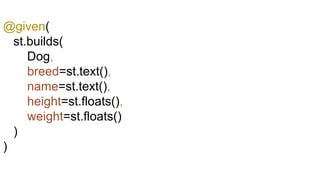
![@given(
dictionaries(
integers(), list(text())
)
)
def demonstrate(s):
print s
{323 : [“321312321”]}
{8382: [“”, “!1”, “asdas"}
{111: [“saodjad”]}](https://image.slidesharecdn.com/untitled-170306085726/85/Better-Tests-Less-Code-Property-based-Testing-33-320.jpg)

![@given(
sampled_from(
[‘A’, ‘B’, ‘C’]
)
)
def demonstrate(s):
print s
‘A’
‘A’
‘C’](https://image.slidesharecdn.com/untitled-170306085726/85/Better-Tests-Less-Code-Property-based-Testing-35-320.jpg)
![@given(
recursive(
booleans()
lists
)
)
def demonstrate(s):
print s
True
[True]
[True, [[False, True]]]](https://image.slidesharecdn.com/untitled-170306085726/85/Better-Tests-Less-Code-Property-based-Testing-36-320.jpg)









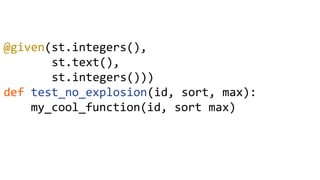
![@given(st.integers(),
st.text(),
st.integers()))
def test_no_explosion(id, sort, max):
response = requests.get(
BATPUTER_URL.format(id, sort, max)
)
assert response and response.json()
assert (response.status_code in
[200, 401, 400, 404])](https://image.slidesharecdn.com/untitled-170306085726/85/Better-Tests-Less-Code-Property-based-Testing-56-320.jpg)
![@given(st.integers(),
st.text(),
st.integers()))
def test_no_explosion(id, sort, max):
response = requests.get(
BATPUTER_URL.format(id, sort, max)
)
assert response and response.json()
assert (response.status_code in
[200, 401, 400, 404])](https://image.slidesharecdn.com/untitled-170306085726/85/Better-Tests-Less-Code-Property-based-Testing-57-320.jpg)
![@given(st.integers(),
st.text(),
st.integers()))
def test_no_explosion(id, sort, max):
response = requests.get(
BATPUTER_URL.format(id, sort, max)
)
assert response and response.json()
assert (response.status_code in
[200, 401, 400, 404])](https://image.slidesharecdn.com/untitled-170306085726/85/Better-Tests-Less-Code-Property-based-Testing-58-320.jpg)
![@given(st.integers(),
st.text(),
st.integers()))
def test_no_explosion(id, sort, max):
response = requests.get(
BATPUTER_URL.format(id, sort, max)
)
assert response and response.json()
assert (response.status_code in
[200, 401, 400, 404])](https://image.slidesharecdn.com/untitled-170306085726/85/Better-Tests-Less-Code-Property-based-Testing-59-320.jpg)


![def fromJson(json_str):
dct = json.loads(json_str)
return HistoricalEvent(
dct['id'],
dct['description'],
dateutil.parser.parse(
dct['event_time']
)
)](https://image.slidesharecdn.com/untitled-170306085726/85/Better-Tests-Less-Code-Property-based-Testing-67-320.jpg)

![@given(st.integers(), st.text(), datetimes(timezones=['UTC']))
def test_to_from_json(id, desc, date):
original_event = HistoricalEvent(id, desc, date)
encoded_event = json.dumps(event, cls=EventEncoder)
decoded_event = json.loads(
encoded_event,
object_hook=HistoricalEvent.fromJson
)
assert decoded_event == original_event](https://image.slidesharecdn.com/untitled-170306085726/85/Better-Tests-Less-Code-Property-based-Testing-69-320.jpg)
![@given(st.integers(), st.text(), datetimes(timezones=['UTC']))
def test_to_from_json(id, desc, date):
original_event = HistoricalEvent(id, desc, date)
encoded_event = json.dumps(event, cls=EventEncoder)
decoded_event = json.loads(
encoded_event,
object_hook=HistoricalEvent.fromJson
)
assert decoded_event == original_event](https://image.slidesharecdn.com/untitled-170306085726/85/Better-Tests-Less-Code-Property-based-Testing-70-320.jpg)
![@given(st.integers(), st.text(), datetimes(timezones=['UTC']))
def test_to_from_json(id, desc, date):
original_event = HistoricalEvent(id, desc, date)
encoded_event = json.dumps(event, cls=EventEncoder)
decoded_event = json.loads(
encoded_event,
object_hook=HistoricalEvent.fromJson
)
assert decoded_event == original_event](https://image.slidesharecdn.com/untitled-170306085726/85/Better-Tests-Less-Code-Property-based-Testing-71-320.jpg)
![@given(st.integers(), st.text(), datetimes(timezones=['UTC']))
def test_to_from_json(id, desc, date):
original_event = HistoricalEvent(id, desc, date)
encoded_event = json.dumps(event, cls=EventEncoder)
decoded_event = json.loads(
encoded_event,
object_hook=HistoricalEvent.fromJson
)
assert decoded_event == original_event](https://image.slidesharecdn.com/untitled-170306085726/85/Better-Tests-Less-Code-Property-based-Testing-72-320.jpg)
![@given(st.integers(), st.text(), datetimes(timezones=['UTC']))
def test_to_from_json(id, desc, date):
original_event = HistoricalEvent(id, desc, date)
encoded_event = json.dumps(event, cls=EventEncoder)
decoded_event = json.loads(
encoded_event,
object_hook=HistoricalEvent.fromJson
)
assert decoded_event == original_event](https://image.slidesharecdn.com/untitled-170306085726/85/Better-Tests-Less-Code-Property-based-Testing-73-320.jpg)











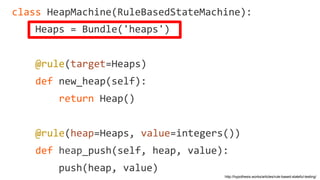


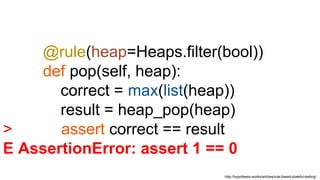



The document discusses property-based testing, emphasizing its significance and methodology in ensuring code correctness through automated test generation. It highlights the use of tools like Hypothesis for testing various functions, employing strategies such as defining arguments and expected results to validate the behavior of code under diverse conditions. The content is enriched with examples, patterns in testing, and references to additional resources for further learning.


