![Property-based testing vs. example-based testing
Example-based testing: assert that a property is true for some
values.
Are list appends associative?
Write some examples
def test_list_append_associative_example1():
x, y, z = [2], [3, 4, 5], [6, 7]
assert (x + y) + z == x + (y + z)
def test_list_append_associative_example2():
x, y, z = [2, 3], [], [6, 7]
assert (x + y) + z == x + (y + z)
# ...](https://image.slidesharecdn.com/handout-130626220659-phpapp02/85/5-minute-intro-to-property-based-testing-in-Python-with-hypothesis-2-320.jpg)
![Better: reduce boilerplate with parameters
pytest allows parameterization of arguments in tests.
Rewrite multiple examples as a single example
import pytest
@pytest.mark.parametrize (("x", "y", "z"), [
([2], [3, 4, 5], [6, 7]),
([2, 3], [], [6, 7])
])
def test_list_append_associative_parametrized(x, y, z):
assert (x + y) + z == x + (y + z)](https://image.slidesharecdn.com/handout-130626220659-phpapp02/85/5-minute-intro-to-property-based-testing-in-Python-with-hypothesis-3-320.jpg)
![Introduction to property-based hypothesis testing
from hypothesis.testdecorators import given
@given ([int], [int], [int])
def test_list_append_associative(x, y, z):
assert (x + y) + z == x + (y + z)
Passes!
hypothesis generates a “large” number of examples
Generation
Based on the type of the argument
Not exhaustive: failure to falsify does not mean true!
Default generators provided
You can write your own generators](https://image.slidesharecdn.com/handout-130626220659-phpapp02/85/5-minute-intro-to-property-based-testing-in-Python-with-hypothesis-4-320.jpg)
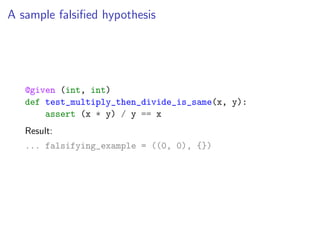

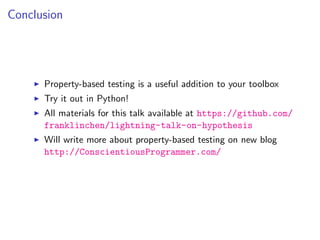

The document introduces property-based testing in Python using the Hypothesis library, contrasting it with example-based testing. It demonstrates how to utilize pytest for parameterized testing and illustrates property-based testing with several examples, including a falsifying case. The talk encourages exploring property-based testing as a valuable tool and provides resources for further learning.


![Property Based Testing [5] - Software Testing Techniques (CIS640)](https://cdn.slidesharecdn.com/ss_thumbnails/property-based-testing-170926175312-thumbnail.jpg?width=640&height=640&fit=bounds)


