Automated Developer
Testing: Achievements and
Challenges
Tao Xie
North Carolina State University
contact: taoxie@gmail.com
Automation in Developer Testing
• Background on developer testing
– http://www.developertesting.com/
– Kent Beck’s 2004 talk on “Future of Developer
Testing”
http://www.itconversations.com/shows/detail301.h
tml
• This talk focuses on developer testing
– Not system testing etc. conducted by testers
• Unit Test Automation commonly referred to writing
unit test cases manually, executed automatically 2
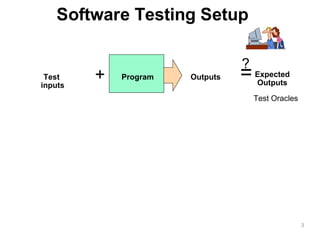
Software Testing Setup
=
?
Outputs Expected
Outputs
Program+Test
inputs
Test Oracles
3
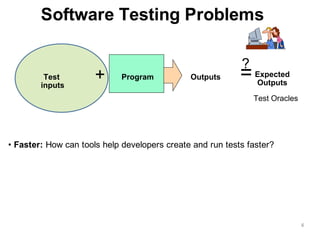
Software Testing Problems
=
?
Outputs Expected
Outputs
Program+Test
inputs
Test Oracles
4
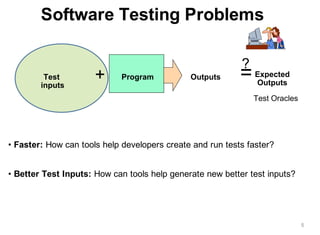
• Faster: How can tools help developers create and run tests faster?
Software Testing Problems
=
?
Outputs Expected
Outputs
Program+Test
inputs
Test Oracles
5
• Faster: How can tools help developers create and run tests faster?
• Better Test Inputs: How can tools help generate new better test inputs?
Software Testing Problems
=
?
Outputs Expected
Outputs
Program+Test
inputs
Test Oracles
6
• Faster: How can tools help developers create and run tests faster?
• Better Test Inputs: How can tools help generate new better test inputs?
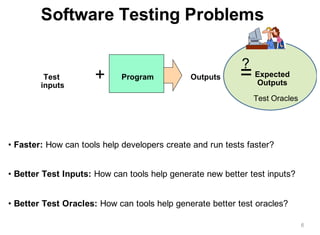
• Better Test Oracles: How can tools help generate better test oracles?
Example Unit Test Case
=
?
Outputs Expected
Outputs
Program+Test
inputs
Test Oracles
7
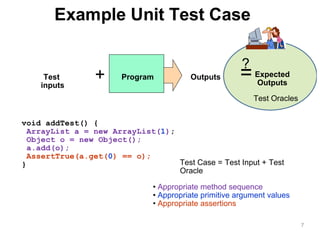
void addTest() {
ArrayList a = new ArrayList(1);
Object o = new Object();
a.add(o);
AssertTrue(a.get(0) == o);
}
• Appropriate method sequence
• Appropriate primitive argument values
• Appropriate assertions
Test Case = Test Input + Test
Oracle
Levels of Test Oracles
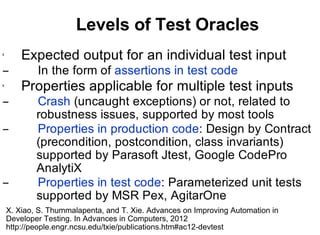
• Expected output for an individual test input
– In the form of assertions in test code
• Properties applicable for multiple test inputs
– Crash (uncaught exceptions) or not, related to
robustness issues, supported by most tools
– Properties in production code: Design by Contract
(precondition, postcondition, class invariants)
supported by Parasoft Jtest, Google CodePro
AnalytiX
– Properties in test code: Parameterized unit tests
supported by MSR Pex, AgitarOne
X. Xiao, S. Thummalapenta, and T. Xie. Advances on Improving Automation in
Developer Testing. In Advances in Computers, 2012
http://people.engr.ncsu.edu/txie/publications.htm#ac12-devtest
Economics of Test Oracles
9
• Expected output for an individual test input
– Easy to manually verify for one test input
– Expensive/infeasible to verify for many test inputs
– Limited benefits: only for one test input
• Properties applicable for multiple test inputs
– Not easy to write (need abstraction skills)
– But once written, broad benefits for multiple test
inputs
Assert behavior of multiple test inputs
Design by Contract
• Example tools: Parasoft Jtest, Google CodePro
AnalytiX, MSR Code Contracts, MSR Pex
• Class invariant: properties being satisfied by an
object (in a consistent state) [AgitarOne allows a
class invariant helper method used as test oracles]
• Precondition: conditions to be satisfied (on receiver
object and arguments) before a method can be
invoked
• Postcondition: properties being satisfied (on receiver
object and return) after the method has returned
• Other types of specs also exist
http://research.microsoft.com/en-
Microsoft Research Code
Contracts
[ContractInvariantMethod]
void ObjectInvariant() {
Contract.Invariant( items != null );
}
Features
§ Language expression
syntax
§ Type checking / IDE
§ Declarative
§ Special Encodings
§ Result and Old
public virtual int Add(object value)
{
Contract.Requires( value != null );
Contract.Ensures( Count == Contract.OldValue(Count) + 1 );
Contract.Ensures( Contract.Result<int>() == Contract.OldValue(Count) );
if (count == items.Length) EnsureCapacity(count + 1);
items[count] = value;
return count++;
}
- Slide adapted from MSRhttp://research.microsoft.com/en-us/projects/contracts/
Parameterized Unit Testing
void TestAdd(List list, int item) {
Assume.IsTrue(list != null);
var count = list.Count;
list.Add(item);
Assert.AreEqual(count + 1, list.Count);
}
• Parameterized Unit Test =
Unit Test with Parameters
• Separation of concerns
– Data is generated by a tool
– Developer can focus on functional specification
[Tillmann&Schulte ESEC/FSE 05]
http://research.microsoft.com/apps/pubs/default.aspx?id=77419
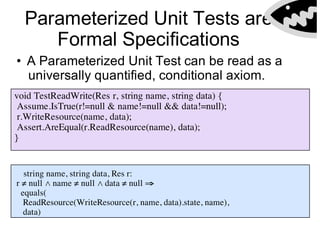
Parameterized Unit Tests are
Formal Specifications
Algebraic Specifications• A Parameterized Unit Test can be read as a
universally quantified, conditional axiom.
void TestReadWrite(Res r, string name, string data) {
Assume.IsTrue(r!=null & name!=null && data!=null);
r.WriteResource(name, data);
Assert.AreEqual(r.ReadResource(name), data);
}
string name, string data, Res r:
r ≠ null ⋀ name ≠ null ⋀ data ≠ null ⇒⇒
equals(
ReadResource(WriteResource(r, name, data).state, name),
data)
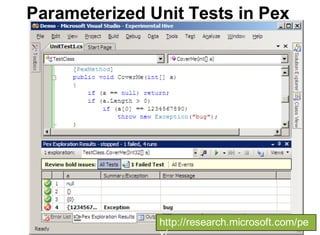
http://research.microsoft.com/pe
Parameterized Unit Tests in Pex
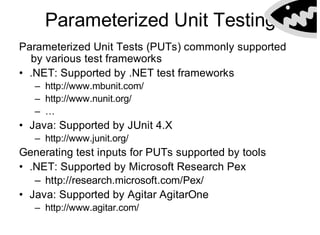
Parameterized Unit Testing
Getting PopularParameterized Unit Tests (PUTs) commonly supported
by various test frameworks
• .NET: Supported by .NET test frameworks
– http://www.mbunit.com/
– http://www.nunit.org/
– …
• Java: Supported by JUnit 4.X
– http://www.junit.org/
Generating test inputs for PUTs supported by tools
• .NET: Supported by Microsoft Research Pex
– http://research.microsoft.com/Pex/
• Java: Supported by Agitar AgitarOne
– http://www.agitar.com/
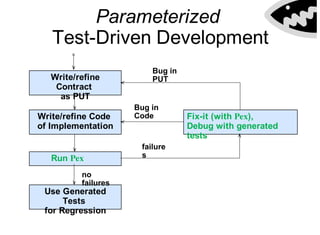
Parameterized
Test-Driven Development
Write/refine
Contract
as PUT
Write/refine Code
of Implementation
Fix-it (with Pex),
Debug with generated
tests
Use Generated
Tests
for Regression
Run Pex
Bug in
PUT
Bug in
Code
failure
s
no
failures
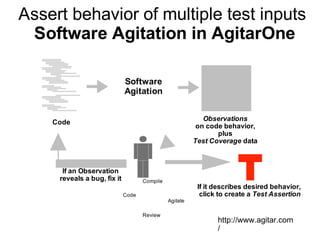
Assert behavior of multiple test inputs
Software Agitation in AgitarOne
Code
Software
Agitation
Observations
on code behavior,
plus
Test Coverage data
If an Observation
reveals a bug, fix it
If it describes desired behavior,
click to create a Test AssertionCode
Compile
Review
Agitate
- Slide adapted from Agitar Software Inc.
http://www.agitar.com
/
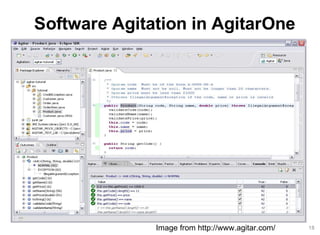
Software Agitation in AgitarOne
18Image from http://www.agitar.com/
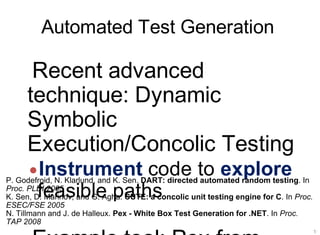
Automated Test Generation
19
Recent advanced
technique: Dynamic
Symbolic
Execution/Concolic Testing
•Instrument code to explore
feasible paths
P. Godefroid, N. Klarlund, and K. Sen. DART: directed automated random testing. In
Proc. PLDI 2005
K. Sen, D. Marinov, and G. Agha. CUTE: a concolic unit testing engine for C. In Proc.
ESEC/FSE 2005
N. Tillmann and J. de Halleux. Pex - White Box Test Generation for .NET. In Proc.
TAP 2008
void CoverMe(int[] a)
{
if (a == null) return;
if (a.Length > 0)
if (a[0] == 1234567890)
thrownewException("bug");
}
a.Length>0
a[0]==123…
TF
T
F
F
a==null
T
Constraints to solve
a!=null
a!=null &&
a.Length>0
a!=null &&
a.Length>0 &&
a[0]==123456890
Input
null
{}
{0}
{123…}
Execute&MonitorSolve
Choose next path
Observed constraints
a==null
a!=null &&
!(a.Length>0)
a==null &&
a.Length>0 &&
a[0]!=1234567890
a==null &&
a.Length>0 &&
a[0]==1234567890
Done: There is no path
left.
Dynamic Symbolic Execution in
Pex
http://pex4fun.com/HowDoesPexW
Automating Test Generation
• Method sequences
– MSeqGen/Seeker [Thummalapenta et al. OOSPLA 11, ESEC/FSE
09],
Covana [Xiao et al. ICSE 2011], OCAT [Jaygarl et al. ISSTA 10],
Evacon [Inkumsah et al. ASE 08], Symclat [d'Amorim et al. ASE 06]
• Environments e.g., db, file systems, network, …
– DBApp Testing [Taneja et al. ESEC/FSE 11], [Pan et al. ASE 11]
– CloudApp Testing [Zhang et al. IEEE Soft 12]
• Loops
– Fitnex [Xie et al. DSN 09]
@NCSU ASE
http://people.engr.ncsu.edu/txie/publications.htm
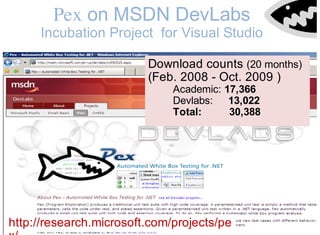
Pex on MSDN DevLabs
Incubation Project for Visual Studio
Download counts (20 months)
(Feb. 2008 - Oct. 2009 )
Academic: 17,366
Devlabs: 13,022
Total: 30,388
http://research.microsoft.com/projects/pe
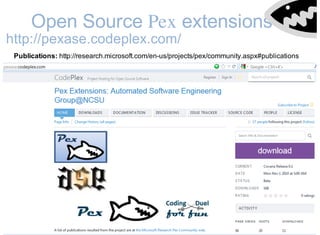
Open Source Pex extensions
http://pexase.codeplex.com/
Publications: http://research.microsoft.com/en-us/projects/pex/community.aspx#publications
Writing Test Oracles
Learning Formal Methods!?
• Parameterized Unit Test =
Unit Test with Parameters
• Separation of concerns
– Data is generated by a tool
– Developer can focus on functional
specification
void TestAdd(List list, int item) {
Assume.IsTrue(list != null);
var count = list.Count;
list.Add(item);
Assert.AreEqual(count + 1, list.Count);
}
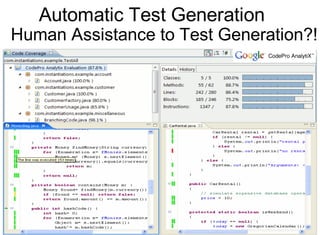
Automatic Test Generation
Human Assistance to Test Generation?!
Running Symbolic PathFinder ...
…
=====================================
================= results
no errors detected
=====================================
================= statistics
elapsed time: 0:00:02
states: new=4, visited=0, backtracked=4,
end=2
search: maxDepth=3, constraints=0
choice generators: thread=1, data=2
heap: gc=3, new=271, free=22
instructions: 2875
max memory: 81MB
loaded code: classes=71, methods=884
…
25
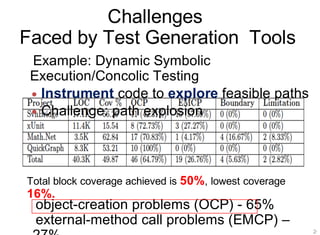
Challenges
Faced by Test Generation Tools
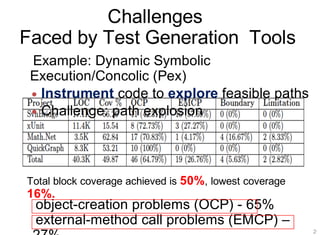
object-creation problems (OCP) - 65%
external-method call problems (EMCP) –
Total block coverage achieved is 50%, lowest coverage
16%.
26
Example: Dynamic Symbolic
Execution/Concolic Testing
• Instrument code to explore feasible paths
• Challenge: path explosion
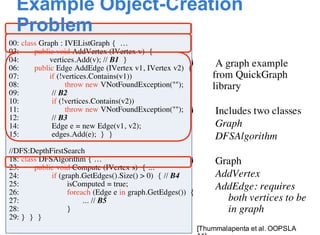
Ø A graph example
from QuickGraph
library
Ø Includes two classes
Graph
DFSAlgorithm
Ø Graph
AddVertex
AddEdge: requires
both vertices to be
in graph
00: class Graph : IVEListGraph { …
03: public void AddVertex (IVertex v) {
04: vertices.Add(v); // B1 }
06: public Edge AddEdge (IVertex v1, IVertex v2) {
07: if (!vertices.Contains(v1))
08: throw new VNotFoundException("");
09: // B2
10: if (!vertices.Contains(v2))
11: throw new VNotFoundException("");
12: // B3
14: Edge e = new Edge(v1, v2);
15: edges.Add(e); } }
//DFS:DepthFirstSearch
18: class DFSAlgorithm { …
23: public void Compute (IVertex s) { ...
24: if (graph.GetEdges().Size() > 0) { // B4
25: isComputed = true;
26: foreach (Edge e in graph.GetEdges()) {
27: ... // B5
28: }
29: } } }
[Thummalapenta et al. OOPSLA
Example Object-Creation
Problem
28
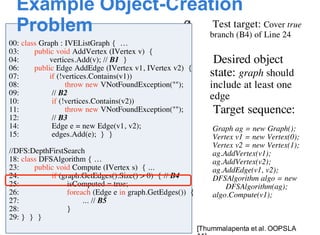
Ø Test target: Cover true
branch (B4) of Line 24
Ø Desired object
state: graph should
include at least one
edge
Ø Target sequence:
Graph ag = new Graph();
Vertex v1 = new Vertex(0);
Vertex v2 = new Vertex(1);
ag.AddVertex(v1);
ag.AddVertex(v2);
ag.AddEdge(v1, v2);
DFSAlgorithm algo = new
DFSAlgorithm(ag);
algo.Compute(v1);
00: class Graph : IVEListGraph { …
03: public void AddVertex (IVertex v) {
04: vertices.Add(v); // B1 }
06: public Edge AddEdge (IVertex v1, IVertex v2) {
07: if (!vertices.Contains(v1))
08: throw new VNotFoundException("");
09: // B2
10: if (!vertices.Contains(v2))
11: throw new VNotFoundException("");
12: // B3
14: Edge e = new Edge(v1, v2);
15: edges.Add(e); } }
//DFS:DepthFirstSearch
18: class DFSAlgorithm { …
23: public void Compute (IVertex s) { ...
24: if (graph.GetEdges().Size() > 0) { // B4
25: isComputed = true;
26: foreach (Edge e in graph.GetEdges()) {
27: ... // B5
28: }
29: } } }
Example Object-Creation
Problem
[Thummalapenta et al. OOPSLA
Challenges
Faced by Test Generation Tools
object-creation problems (OCP) - 65%
external-method call problems (EMCP) –
Total block coverage achieved is 50%, lowest coverage
16%.
29
Example: Dynamic Symbolic
Execution/Concolic (Pex)
• Instrument code to explore feasible paths
• Challenge: path explosion
Example External-Method Call
Problems (EMCP)
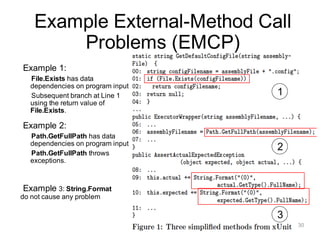
Example 1:
File.Exists has data
dependencies on program input
Subsequent branch at Line 1
using the return value of
File.Exists.
Example 2:
Path.GetFullPath has data
dependencies on program input
Path.GetFullPath throws
exceptions.
Example 3: String.Format
do not cause any problem
30
1
2
3
Human Can Help!
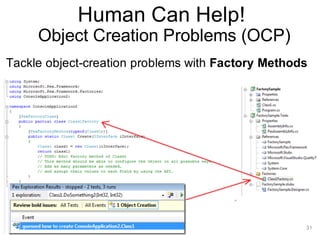
Object Creation Problems (OCP)
Tackle object-creation problems with Factory Methods
31
Human Can Help!
External-Method Call Problems (EMCP)
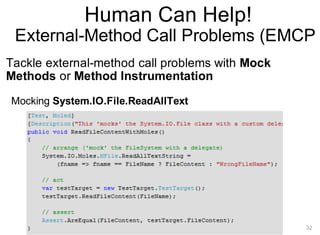
Tackle external-method call problems with Mock
Methods or Method Instrumentation
Mocking System.IO.File.ReadAllText
32
State-of-the-Art/Practice
Testing Tools
Running Symbolic PathFinder ...
…
=====================================
================= results
no errors detected
=====================================
================= statistics
elapsed time: 0:00:02
states: new=4, visited=0, backtracked=4,
end=2
search: maxDepth=3, constraints=0
choice generators: thread=1, data=2
heap: gc=3, new=271, free=22
instructions: 2875
max memory: 81MB
loaded code: classes=71, methods=884
…
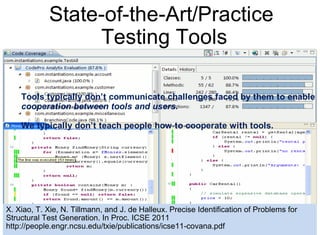
Tools typically don’t communicate challenges faced by them to enable
cooperation between tools and users.
We typically don’t teach people how to cooperate with tools.
33
X. Xiao, T. Xie, N. Tillmann, and J. de Halleux. Precise Identification of Problems for
Structural Test Generation. In Proc. ICSE 2011
http://people.engr.ncsu.edu/txie/publications/icse11-covana.pdf
Coding Duels
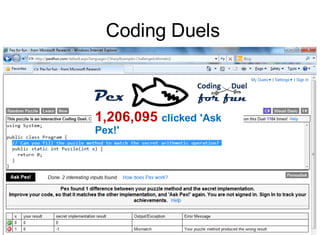
1,206,095 clicked 'Ask
Pex!'
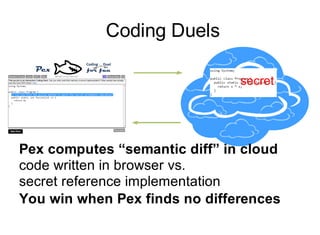
Coding Duels
Pex computes “semantic diff” in cloud
code written in browser vs.
secret reference implementation
You win when Pex finds no differences
secret
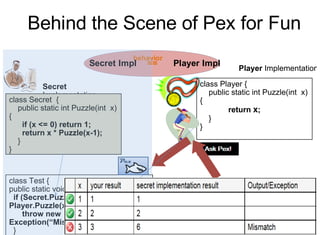
Behind the Scene of Pex for Fun
Secret
Implementation
class Secret {
public static int Puzzle(int x)
{
if (x <= 0) return 1;
return x * Puzzle(x-1);
}
}
Player Implementation
class Player {
public static int Puzzle(int x)
{
return x;
}
}
class Test {
public static void Driver(int x) {
if (Secret.Puzzle(x) !=
Player.Puzzle(x))
throw new
Exception(“Mismatch”);
}
behavior
Secret Impl == Player Impl
36
Coding Duels
Fun and Engaging
Iterative gameplay
Adaptive
Personalized
No cheating
Clear winning criterion
Example User Feedback
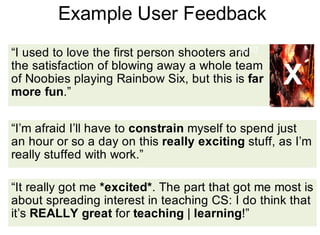
“It really got me *excited*. The part that got me most is
about spreading interest in teaching CS: I do think that
it’s REALLY great for teaching | learning!”
“I used to love the first person shooters and
the satisfaction of blowing away a whole team
of Noobies playing Rainbow Six, but this is far
more fun.”
“I’m afraid I’ll have to constrain myself to spend just
an hour or so a day on this really exciting stuff, as I’m
really stuffed with work.”
Released since
2010
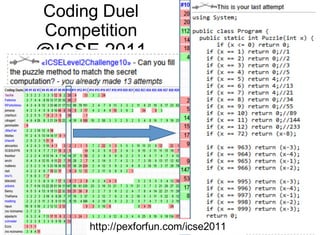
X
Coding Duel
Competition
@ICSE 2011
http://pexforfun.com/icse2011
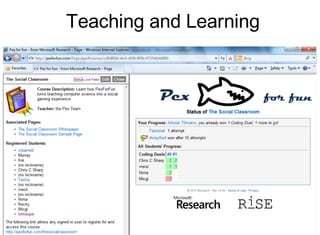
Teaching and Learning
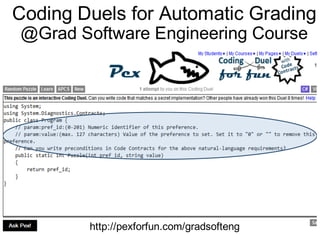
Coding Duels for Automatic Grading
@Grad Software Engineering Course
http://pexforfun.com/gradsofteng
Coding Duels for Training Testing
public static string Puzzle(int[] elems, int capacity, int elem) {
if ((maxsize <= 0) || (elems == null) || (elems.Length > (capacity
+ 1)))
return "Assumption Violation!";
Stack s= new Stack(capacity);
for (int i = 0; i < elems.Length; i++)
s.Push(elems[i]);
int origSize = s.GetNumOfElements();
//Please fill in below test scenario on the s stack
//The lines below include assertions to assert the program
behavior
PexAssert.IsTrue(s.GetNumOfElements() == origSize + 1);
PexAssert.IsTrue(s.Top() == elem);
PexAssert.IsTrue(!s.IsEmpty());
PexAssert.IsTrue(s.IsMember(elem));
return s.GetNumOfElements().ToString() + "; “ +
s.Top().ToString() + "; “
Set up a stack with some
elements
Cache values used in
assertions
Usage Scenarios of Pex4Fun
• Massive Open Online Courses (MOOC):
Challenges
– Grading, addressed by Pex4Fun
– Cheating [Open Challenge]
• Course assignments (students/professionals)
– E.g., intro programming, software engineering
• Student/professional competitions
– E.g., coding-duel competition at ICSE 2011
• Assessment of testing/programming/problem
solving skills for job applicants
– Not just final results of problem solving but also process!
More Reading
Nikolai Tillmann, Jonathan De Halleux, Tao
Xie, Sumit Gulwani and Judith Bishop
Teaching and Learning Programming
and Software Engineering via Interactive
Gaming
In Proceedings of the 35th International
Conference on Software Engineering (ICSE
2013), Software Engineering Education
(SEE), San Francisco, CA, May 2013.
http://people.engr.ncsu.edu/txie/publications
/icse13see-pex4fun.pdf
Conclusion
• Software testing is important and yet
costly; needs automation
• Better Test Inputs: help generate new
better test inputs
– Generate method arguments
– Generate method sequences
• Better Test Oracles: help generate better
test oracles
– Assert behavior of individual test inputs
– Assert behavior of multiple test inputs
• Software Testing Educational Gaming 45
Example Industrial
Developer Testing Tools
• Agitar AgitatorOne http://www.agitar.com/
• Parasoft Jtest http://www.parasoft.com/
• Google CodePro AnalytiX
https://developers.google.com/java-dev-tools/codepro/doc/
• SilverMark Test Mentor http://www.silvermark.com/
• Microsoft Research Pex (for .NET)
http://research.microsoft.com/Pex/
• Microsoft Research Spec Explorer (for .NET)
http://research.microsoft.com/specexplorer/
46
Trends in Practice
• Regression Test Selection/Prioritization
• Cloud Computing for Test Execution, e.g.,
http://www.skytap.com/
• Crowdsourcing for Testing, e.g.,
http://www.utest.com/
• Mocking Environments
– Google: EasyMock
– Microsoft VS: Fake/Moles
http://research.microsoft.com/en-us/projects/pex/
• Automatic Test Generation
– Microsoft: Pex, SAGE
http://research.microsoft.com/en-us/um/people/pg/
Q & A
Thank you!
contact:
taoxie@gmail.com
Acknowledgments: NSF grants CCF-0845272, CCF-0915400, CNS-0958235, CNS-
1160603,
Automated Combinatorial Testing
Goals – reduce testing cost, improve cost-benefit ratio
Accomplishments – huge increase in performance,
scalability, 200+ users, most major IT firms and others
Also non-testing applications – modelling and
simulation, genome
http://csrc.nist.gov/groups/SNS/acts/index.html
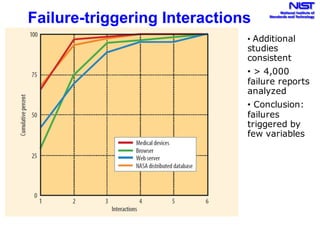
Failure-triggering Interactions
• Additional
studies
consistent
• > 4,000
failure reports
analyzed
• Conclusion:
failures
triggered by
few variables
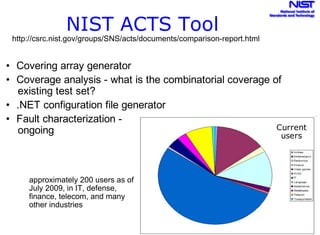
NIST ACTS Tool
• Covering array generator
• Coverage analysis - what is the combinatorial coverage of
existing test set?
• .NET configuration file generator
• Fault characterization -
ongoing Current
users
http://csrc.nist.gov/groups/SNS/acts/documents/comparison-report.html
approximately 200 users as of
July 2009, in IT, defense,
finance, telecom, and many
other industries
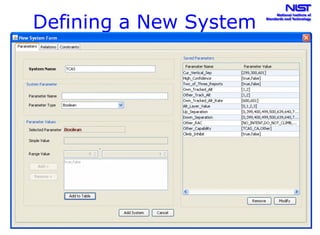
Defining a New System
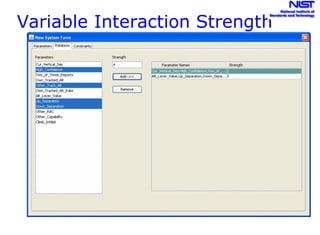
Variable Interaction Strength
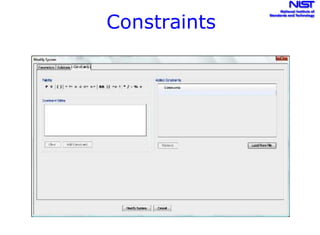
Constraints
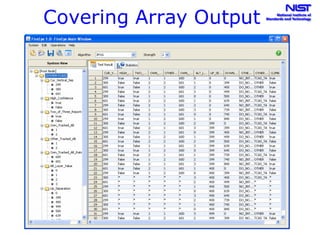
Covering Array Output

May: Automated Developer Testing: Achievements and Challenges

  • 1.
    Automated Developer Testing: Achievementsand Challenges Tao Xie North Carolina State University contact: taoxie@gmail.com
  • 2.
    Automation in DeveloperTesting • Background on developer testing – http://www.developertesting.com/ – Kent Beck’s 2004 talk on “Future of Developer Testing” http://www.itconversations.com/shows/detail301.h tml • This talk focuses on developer testing – Not system testing etc. conducted by testers • Unit Test Automation commonly referred to writing unit test cases manually, executed automatically 2
  • 3.
    Software Testing Setup = ? OutputsExpected Outputs Program+Test inputs Test Oracles 3
  • 4.
    Software Testing Problems = ? OutputsExpected Outputs Program+Test inputs Test Oracles 4 • Faster: How can tools help developers create and run tests faster?
  • 5.
    Software Testing Problems = ? OutputsExpected Outputs Program+Test inputs Test Oracles 5 • Faster: How can tools help developers create and run tests faster? • Better Test Inputs: How can tools help generate new better test inputs?
  • 6.
    Software Testing Problems = ? OutputsExpected Outputs Program+Test inputs Test Oracles 6 • Faster: How can tools help developers create and run tests faster? • Better Test Inputs: How can tools help generate new better test inputs? • Better Test Oracles: How can tools help generate better test oracles?
  • 7.
    Example Unit TestCase = ? Outputs Expected Outputs Program+Test inputs Test Oracles 7 void addTest() { ArrayList a = new ArrayList(1); Object o = new Object(); a.add(o); AssertTrue(a.get(0) == o); } • Appropriate method sequence • Appropriate primitive argument values • Appropriate assertions Test Case = Test Input + Test Oracle
  • 8.
    Levels of TestOracles • Expected output for an individual test input – In the form of assertions in test code • Properties applicable for multiple test inputs – Crash (uncaught exceptions) or not, related to robustness issues, supported by most tools – Properties in production code: Design by Contract (precondition, postcondition, class invariants) supported by Parasoft Jtest, Google CodePro AnalytiX – Properties in test code: Parameterized unit tests supported by MSR Pex, AgitarOne X. Xiao, S. Thummalapenta, and T. Xie. Advances on Improving Automation in Developer Testing. In Advances in Computers, 2012 http://people.engr.ncsu.edu/txie/publications.htm#ac12-devtest
  • 9.
    Economics of TestOracles 9 • Expected output for an individual test input – Easy to manually verify for one test input – Expensive/infeasible to verify for many test inputs – Limited benefits: only for one test input • Properties applicable for multiple test inputs – Not easy to write (need abstraction skills) – But once written, broad benefits for multiple test inputs
  • 10.
    Assert behavior ofmultiple test inputs Design by Contract • Example tools: Parasoft Jtest, Google CodePro AnalytiX, MSR Code Contracts, MSR Pex • Class invariant: properties being satisfied by an object (in a consistent state) [AgitarOne allows a class invariant helper method used as test oracles] • Precondition: conditions to be satisfied (on receiver object and arguments) before a method can be invoked • Postcondition: properties being satisfied (on receiver object and return) after the method has returned • Other types of specs also exist http://research.microsoft.com/en-
  • 11.
    Microsoft Research Code Contracts [ContractInvariantMethod] voidObjectInvariant() { Contract.Invariant( items != null ); } Features § Language expression syntax § Type checking / IDE § Declarative § Special Encodings § Result and Old public virtual int Add(object value) { Contract.Requires( value != null ); Contract.Ensures( Count == Contract.OldValue(Count) + 1 ); Contract.Ensures( Contract.Result<int>() == Contract.OldValue(Count) ); if (count == items.Length) EnsureCapacity(count + 1); items[count] = value; return count++; } - Slide adapted from MSRhttp://research.microsoft.com/en-us/projects/contracts/
  • 12.
    Parameterized Unit Testing voidTestAdd(List list, int item) { Assume.IsTrue(list != null); var count = list.Count; list.Add(item); Assert.AreEqual(count + 1, list.Count); } • Parameterized Unit Test = Unit Test with Parameters • Separation of concerns – Data is generated by a tool – Developer can focus on functional specification [Tillmann&Schulte ESEC/FSE 05] http://research.microsoft.com/apps/pubs/default.aspx?id=77419
  • 13.
    Parameterized Unit Testsare Formal Specifications Algebraic Specifications• A Parameterized Unit Test can be read as a universally quantified, conditional axiom. void TestReadWrite(Res r, string name, string data) { Assume.IsTrue(r!=null & name!=null && data!=null); r.WriteResource(name, data); Assert.AreEqual(r.ReadResource(name), data); } string name, string data, Res r: r ≠ null ⋀ name ≠ null ⋀ data ≠ null ⇒⇒ equals( ReadResource(WriteResource(r, name, data).state, name), data)
  • 14.
  • 15.
    Parameterized Unit Testing GettingPopularParameterized Unit Tests (PUTs) commonly supported by various test frameworks • .NET: Supported by .NET test frameworks – http://www.mbunit.com/ – http://www.nunit.org/ – … • Java: Supported by JUnit 4.X – http://www.junit.org/ Generating test inputs for PUTs supported by tools • .NET: Supported by Microsoft Research Pex – http://research.microsoft.com/Pex/ • Java: Supported by Agitar AgitarOne – http://www.agitar.com/
  • 16.
    Parameterized Test-Driven Development Write/refine Contract as PUT Write/refineCode of Implementation Fix-it (with Pex), Debug with generated tests Use Generated Tests for Regression Run Pex Bug in PUT Bug in Code failure s no failures
  • 17.
    Assert behavior ofmultiple test inputs Software Agitation in AgitarOne Code Software Agitation Observations on code behavior, plus Test Coverage data If an Observation reveals a bug, fix it If it describes desired behavior, click to create a Test AssertionCode Compile Review Agitate - Slide adapted from Agitar Software Inc. http://www.agitar.com /
  • 18.
    Software Agitation inAgitarOne 18Image from http://www.agitar.com/
  • 19.
    Automated Test Generation 19 Recentadvanced technique: Dynamic Symbolic Execution/Concolic Testing •Instrument code to explore feasible paths P. Godefroid, N. Klarlund, and K. Sen. DART: directed automated random testing. In Proc. PLDI 2005 K. Sen, D. Marinov, and G. Agha. CUTE: a concolic unit testing engine for C. In Proc. ESEC/FSE 2005 N. Tillmann and J. de Halleux. Pex - White Box Test Generation for .NET. In Proc. TAP 2008
  • 20.
    void CoverMe(int[] a) { if(a == null) return; if (a.Length > 0) if (a[0] == 1234567890) thrownewException("bug"); } a.Length>0 a[0]==123… TF T F F a==null T Constraints to solve a!=null a!=null && a.Length>0 a!=null && a.Length>0 && a[0]==123456890 Input null {} {0} {123…} Execute&MonitorSolve Choose next path Observed constraints a==null a!=null && !(a.Length>0) a==null && a.Length>0 && a[0]!=1234567890 a==null && a.Length>0 && a[0]==1234567890 Done: There is no path left. Dynamic Symbolic Execution in Pex http://pex4fun.com/HowDoesPexW
  • 21.
    Automating Test Generation •Method sequences – MSeqGen/Seeker [Thummalapenta et al. OOSPLA 11, ESEC/FSE 09], Covana [Xiao et al. ICSE 2011], OCAT [Jaygarl et al. ISSTA 10], Evacon [Inkumsah et al. ASE 08], Symclat [d'Amorim et al. ASE 06] • Environments e.g., db, file systems, network, … – DBApp Testing [Taneja et al. ESEC/FSE 11], [Pan et al. ASE 11] – CloudApp Testing [Zhang et al. IEEE Soft 12] • Loops – Fitnex [Xie et al. DSN 09] @NCSU ASE http://people.engr.ncsu.edu/txie/publications.htm
  • 22.
    Pex on MSDNDevLabs Incubation Project for Visual Studio Download counts (20 months) (Feb. 2008 - Oct. 2009 ) Academic: 17,366 Devlabs: 13,022 Total: 30,388 http://research.microsoft.com/projects/pe
  • 23.
    Open Source Pexextensions http://pexase.codeplex.com/ Publications: http://research.microsoft.com/en-us/projects/pex/community.aspx#publications
  • 24.
    Writing Test Oracles LearningFormal Methods!? • Parameterized Unit Test = Unit Test with Parameters • Separation of concerns – Data is generated by a tool – Developer can focus on functional specification void TestAdd(List list, int item) { Assume.IsTrue(list != null); var count = list.Count; list.Add(item); Assert.AreEqual(count + 1, list.Count); }
  • 25.
    Automatic Test Generation HumanAssistance to Test Generation?! Running Symbolic PathFinder ... … ===================================== ================= results no errors detected ===================================== ================= statistics elapsed time: 0:00:02 states: new=4, visited=0, backtracked=4, end=2 search: maxDepth=3, constraints=0 choice generators: thread=1, data=2 heap: gc=3, new=271, free=22 instructions: 2875 max memory: 81MB loaded code: classes=71, methods=884 … 25
  • 26.
    Challenges Faced by TestGeneration Tools object-creation problems (OCP) - 65% external-method call problems (EMCP) – Total block coverage achieved is 50%, lowest coverage 16%. 26 Example: Dynamic Symbolic Execution/Concolic Testing • Instrument code to explore feasible paths • Challenge: path explosion
  • 27.
    Ø A graphexample from QuickGraph library Ø Includes two classes Graph DFSAlgorithm Ø Graph AddVertex AddEdge: requires both vertices to be in graph 00: class Graph : IVEListGraph { … 03: public void AddVertex (IVertex v) { 04: vertices.Add(v); // B1 } 06: public Edge AddEdge (IVertex v1, IVertex v2) { 07: if (!vertices.Contains(v1)) 08: throw new VNotFoundException(""); 09: // B2 10: if (!vertices.Contains(v2)) 11: throw new VNotFoundException(""); 12: // B3 14: Edge e = new Edge(v1, v2); 15: edges.Add(e); } } //DFS:DepthFirstSearch 18: class DFSAlgorithm { … 23: public void Compute (IVertex s) { ... 24: if (graph.GetEdges().Size() > 0) { // B4 25: isComputed = true; 26: foreach (Edge e in graph.GetEdges()) { 27: ... // B5 28: } 29: } } } [Thummalapenta et al. OOPSLA Example Object-Creation Problem
  • 28.
    28 Ø Test target:Cover true branch (B4) of Line 24 Ø Desired object state: graph should include at least one edge Ø Target sequence: Graph ag = new Graph(); Vertex v1 = new Vertex(0); Vertex v2 = new Vertex(1); ag.AddVertex(v1); ag.AddVertex(v2); ag.AddEdge(v1, v2); DFSAlgorithm algo = new DFSAlgorithm(ag); algo.Compute(v1); 00: class Graph : IVEListGraph { … 03: public void AddVertex (IVertex v) { 04: vertices.Add(v); // B1 } 06: public Edge AddEdge (IVertex v1, IVertex v2) { 07: if (!vertices.Contains(v1)) 08: throw new VNotFoundException(""); 09: // B2 10: if (!vertices.Contains(v2)) 11: throw new VNotFoundException(""); 12: // B3 14: Edge e = new Edge(v1, v2); 15: edges.Add(e); } } //DFS:DepthFirstSearch 18: class DFSAlgorithm { … 23: public void Compute (IVertex s) { ... 24: if (graph.GetEdges().Size() > 0) { // B4 25: isComputed = true; 26: foreach (Edge e in graph.GetEdges()) { 27: ... // B5 28: } 29: } } } Example Object-Creation Problem [Thummalapenta et al. OOPSLA
  • 29.
    Challenges Faced by TestGeneration Tools object-creation problems (OCP) - 65% external-method call problems (EMCP) – Total block coverage achieved is 50%, lowest coverage 16%. 29 Example: Dynamic Symbolic Execution/Concolic (Pex) • Instrument code to explore feasible paths • Challenge: path explosion
  • 30.
    Example External-Method Call Problems(EMCP) Example 1: File.Exists has data dependencies on program input Subsequent branch at Line 1 using the return value of File.Exists. Example 2: Path.GetFullPath has data dependencies on program input Path.GetFullPath throws exceptions. Example 3: String.Format do not cause any problem 30 1 2 3
  • 31.
    Human Can Help! ObjectCreation Problems (OCP) Tackle object-creation problems with Factory Methods 31
  • 32.
    Human Can Help! External-MethodCall Problems (EMCP) Tackle external-method call problems with Mock Methods or Method Instrumentation Mocking System.IO.File.ReadAllText 32
  • 33.
    State-of-the-Art/Practice Testing Tools Running SymbolicPathFinder ... … ===================================== ================= results no errors detected ===================================== ================= statistics elapsed time: 0:00:02 states: new=4, visited=0, backtracked=4, end=2 search: maxDepth=3, constraints=0 choice generators: thread=1, data=2 heap: gc=3, new=271, free=22 instructions: 2875 max memory: 81MB loaded code: classes=71, methods=884 … Tools typically don’t communicate challenges faced by them to enable cooperation between tools and users. We typically don’t teach people how to cooperate with tools. 33 X. Xiao, T. Xie, N. Tillmann, and J. de Halleux. Precise Identification of Problems for Structural Test Generation. In Proc. ICSE 2011 http://people.engr.ncsu.edu/txie/publications/icse11-covana.pdf
  • 34.
  • 35.
    Coding Duels Pex computes“semantic diff” in cloud code written in browser vs. secret reference implementation You win when Pex finds no differences secret
  • 36.
    Behind the Sceneof Pex for Fun Secret Implementation class Secret { public static int Puzzle(int x) { if (x <= 0) return 1; return x * Puzzle(x-1); } } Player Implementation class Player { public static int Puzzle(int x) { return x; } } class Test { public static void Driver(int x) { if (Secret.Puzzle(x) != Player.Puzzle(x)) throw new Exception(“Mismatch”); } behavior Secret Impl == Player Impl 36
  • 37.
    Coding Duels Fun andEngaging Iterative gameplay Adaptive Personalized No cheating Clear winning criterion
  • 38.
    Example User Feedback “Itreally got me *excited*. The part that got me most is about spreading interest in teaching CS: I do think that it’s REALLY great for teaching | learning!” “I used to love the first person shooters and the satisfaction of blowing away a whole team of Noobies playing Rainbow Six, but this is far more fun.” “I’m afraid I’ll have to constrain myself to spend just an hour or so a day on this really exciting stuff, as I’m really stuffed with work.” Released since 2010 X
  • 39.
  • 40.
  • 41.
    Coding Duels forAutomatic Grading @Grad Software Engineering Course http://pexforfun.com/gradsofteng
  • 42.
    Coding Duels forTraining Testing public static string Puzzle(int[] elems, int capacity, int elem) { if ((maxsize <= 0) || (elems == null) || (elems.Length > (capacity + 1))) return "Assumption Violation!"; Stack s= new Stack(capacity); for (int i = 0; i < elems.Length; i++) s.Push(elems[i]); int origSize = s.GetNumOfElements(); //Please fill in below test scenario on the s stack //The lines below include assertions to assert the program behavior PexAssert.IsTrue(s.GetNumOfElements() == origSize + 1); PexAssert.IsTrue(s.Top() == elem); PexAssert.IsTrue(!s.IsEmpty()); PexAssert.IsTrue(s.IsMember(elem)); return s.GetNumOfElements().ToString() + "; “ + s.Top().ToString() + "; “ Set up a stack with some elements Cache values used in assertions
  • 43.
    Usage Scenarios ofPex4Fun • Massive Open Online Courses (MOOC): Challenges – Grading, addressed by Pex4Fun – Cheating [Open Challenge] • Course assignments (students/professionals) – E.g., intro programming, software engineering • Student/professional competitions – E.g., coding-duel competition at ICSE 2011 • Assessment of testing/programming/problem solving skills for job applicants – Not just final results of problem solving but also process!
  • 44.
    More Reading Nikolai Tillmann,Jonathan De Halleux, Tao Xie, Sumit Gulwani and Judith Bishop Teaching and Learning Programming and Software Engineering via Interactive Gaming In Proceedings of the 35th International Conference on Software Engineering (ICSE 2013), Software Engineering Education (SEE), San Francisco, CA, May 2013. http://people.engr.ncsu.edu/txie/publications /icse13see-pex4fun.pdf
  • 45.
    Conclusion • Software testingis important and yet costly; needs automation • Better Test Inputs: help generate new better test inputs – Generate method arguments – Generate method sequences • Better Test Oracles: help generate better test oracles – Assert behavior of individual test inputs – Assert behavior of multiple test inputs • Software Testing Educational Gaming 45
  • 46.
    Example Industrial Developer TestingTools • Agitar AgitatorOne http://www.agitar.com/ • Parasoft Jtest http://www.parasoft.com/ • Google CodePro AnalytiX https://developers.google.com/java-dev-tools/codepro/doc/ • SilverMark Test Mentor http://www.silvermark.com/ • Microsoft Research Pex (for .NET) http://research.microsoft.com/Pex/ • Microsoft Research Spec Explorer (for .NET) http://research.microsoft.com/specexplorer/ 46
  • 47.
    Trends in Practice •Regression Test Selection/Prioritization • Cloud Computing for Test Execution, e.g., http://www.skytap.com/ • Crowdsourcing for Testing, e.g., http://www.utest.com/ • Mocking Environments – Google: EasyMock – Microsoft VS: Fake/Moles http://research.microsoft.com/en-us/projects/pex/ • Automatic Test Generation – Microsoft: Pex, SAGE http://research.microsoft.com/en-us/um/people/pg/
  • 48.
    Q & A Thankyou! contact: taoxie@gmail.com Acknowledgments: NSF grants CCF-0845272, CCF-0915400, CNS-0958235, CNS- 1160603,
  • 49.
    Automated Combinatorial Testing Goals– reduce testing cost, improve cost-benefit ratio Accomplishments – huge increase in performance, scalability, 200+ users, most major IT firms and others Also non-testing applications – modelling and simulation, genome http://csrc.nist.gov/groups/SNS/acts/index.html
  • 50.
    Failure-triggering Interactions • Additional studies consistent •> 4,000 failure reports analyzed • Conclusion: failures triggered by few variables
  • 51.
    NIST ACTS Tool •Covering array generator • Coverage analysis - what is the combinatorial coverage of existing test set? • .NET configuration file generator • Fault characterization - ongoing Current users http://csrc.nist.gov/groups/SNS/acts/documents/comparison-report.html approximately 200 users as of July 2009, in IT, defense, finance, telecom, and many other industries
  • 52.
  • 53.
  • 54.
  • 55.