What is Cell?
Prokaryotic and
Eukaryotic Cells
Structure and
function
Prokaryotic cells are single-celled organisms that
represent the earliest forms of life on Earth.
Including Bacteria and Archaea.
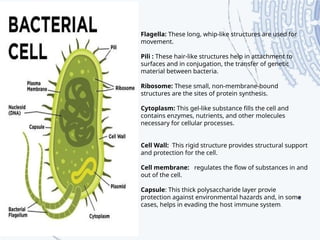
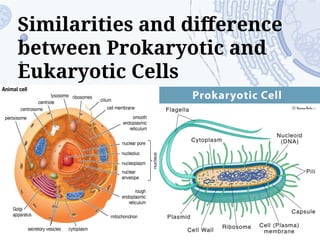
Flagella: These long, whip-like structures are used for
movement.
Pili : These hair-like structures help in attachment to
surfaces and in conjugation, the transfer of genetic
material between bacteria.
Ribosome: These small, non-membrane-bound
structures are the sites of protein synthesis.
Cytoplasm: This gel-like substance fills the cell and
contains enzymes, nutrients, and other molecules
necessary for cellular processes.
Cell Wall: This rigid structure provides structural support
and protection for the cell.
Cell membrane: regulates the flow of substances in and
out of the cell.
Capsule: This thick polysaccharide layer provie
protection against environmental hazards and, in some
cases, helps in evading the host immune system.
Eukaryotic cells are the fundamental
units of life for all multicellular
organisms, including plants, animals,
fungi, and protists
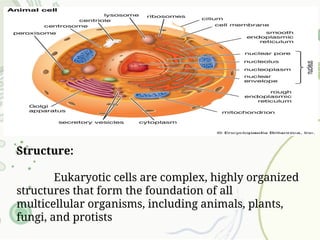
Structure:
Eukaryotic cells are complex, highly organized
structures that form the foundation of all
multicellular organisms, including animals, plants,
fungi, and protists
:
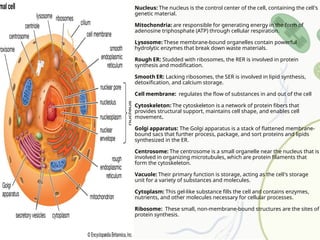
Nucleus , '
The nucleus is the control center of the cell containing the cell s
.
genetic material
:
Mitochondria are responsible for generating energy in the form of
( ) .
adenosine triphosphate ATP through cellular respiration
:
Lysosome -
These membrane bound organelles contain powerful
.
hydrolytic enzymes that break down waste materials
:
Rough ER ,
Studded with ribosomes the RER is involved in protein
.
synthesis and modification
:
Smooth ER , ,
Lacking ribosomes the SER is involved in lipid synthesis
, .
detoxification and calcium storage
:
Cell membrane regulates the flow of substances in and out of the cell
:
Cytoskeleton The cytoskeleton is a network of protein fibers that
, ,
provides structural support maintains cell shape and enables cell
movement.
:
Golgi apparatus -
The Golgi apparatus is a stack of flattened membrane
, ,
bound sacs that further process package and sort proteins and lipids
.
synthesized in the ER
:
Centrosome The centrosome is a small organelle near the nucleus that is
,
involved in organizing microtubules which are protein filaments that
.
form the cytoskeleton
:
Vacuole , '
Their primary function is storage acting as the cell s storage
.
unit for a variety of substances and molecules
:
Cytoplasm - ,
This gel like substance fills the cell and contains enzymes
, .
nutrients and other molecules necessary for cellular processes
:
Ribosome , - -
These small non membrane bound structures are the sites of
.
protein synthesis
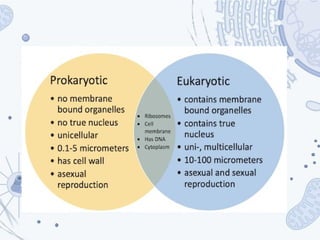
Similarities and difference
between Prokaryotic and
Eukaryotic Cells
Thank you for
listening
😊😊😊

Prokaryotic-and-Eukaryotic-Cells-PPT.pptx

  • 2.
  • 3.
  • 4.
    Prokaryotic cells aresingle-celled organisms that represent the earliest forms of life on Earth. Including Bacteria and Archaea.
  • 6.
    Flagella: These long,whip-like structures are used for movement. Pili : These hair-like structures help in attachment to surfaces and in conjugation, the transfer of genetic material between bacteria. Ribosome: These small, non-membrane-bound structures are the sites of protein synthesis. Cytoplasm: This gel-like substance fills the cell and contains enzymes, nutrients, and other molecules necessary for cellular processes. Cell Wall: This rigid structure provides structural support and protection for the cell. Cell membrane: regulates the flow of substances in and out of the cell. Capsule: This thick polysaccharide layer provie protection against environmental hazards and, in some cases, helps in evading the host immune system.
  • 7.
    Eukaryotic cells arethe fundamental units of life for all multicellular organisms, including plants, animals, fungi, and protists
  • 8.
    Structure: Eukaryotic cells arecomplex, highly organized structures that form the foundation of all multicellular organisms, including animals, plants, fungi, and protists
  • 9.
    : Nucleus , ' Thenucleus is the control center of the cell containing the cell s . genetic material : Mitochondria are responsible for generating energy in the form of ( ) . adenosine triphosphate ATP through cellular respiration : Lysosome - These membrane bound organelles contain powerful . hydrolytic enzymes that break down waste materials : Rough ER , Studded with ribosomes the RER is involved in protein . synthesis and modification : Smooth ER , , Lacking ribosomes the SER is involved in lipid synthesis , . detoxification and calcium storage : Cell membrane regulates the flow of substances in and out of the cell : Cytoskeleton The cytoskeleton is a network of protein fibers that , , provides structural support maintains cell shape and enables cell movement. : Golgi apparatus - The Golgi apparatus is a stack of flattened membrane , , bound sacs that further process package and sort proteins and lipids . synthesized in the ER : Centrosome The centrosome is a small organelle near the nucleus that is , involved in organizing microtubules which are protein filaments that . form the cytoskeleton : Vacuole , ' Their primary function is storage acting as the cell s storage . unit for a variety of substances and molecules : Cytoplasm - , This gel like substance fills the cell and contains enzymes , . nutrients and other molecules necessary for cellular processes : Ribosome , - - These small non membrane bound structures are the sites of . protein synthesis
  • 11.
    Similarities and difference betweenProkaryotic and Eukaryotic Cells
  • 13.