Projects Summary
Introduction
This is a summary of the work I performed as part of my graduate assistantship.Like my weekly summaries I will
have project names in bold and names of people underlined for convenience and ease of scanning.In the report I
will first describe each of the seven projects.Then I will give an overview of the work performed for the graduate
assistantship assignment.
Project Name Contact
I Research Navigator Margaret Henderson
II SQLite Flash-Course Margaret Henderson
III Instrumentation Database Paul Fawcett
IV VIVO Back-End Jon DeShazo
V DMPTool Margaret Henderson
VI Bioinformatic Resources Karen Gau
VII Research Data Survey Margaret Henderson
Project descriptions
Project I is the Research Navigator which is a collection of websites,each focusing on an area of research with the
goal of providing quick and convenient access to resources available to researchers at VCU. Each site contains
organized lists of links to resources with descriptions.These sites consolidate and improve access to disparate
resources both within and outside of the university for researchers at VCU. The websites were constructed using the
LibGuides format. To be included in the list a resource has to meet certain criteria. For example for inclusion a
resource must be free to use or VCU must have a subscription so it is free to students and faculty. Each resource
contains reliable, up-to date information and is representative of the best of what is available for its type. The
resource is concise and easy to use rather than being exhaustive.
http://guides.library.vcu.edu/research-navigator
Project II, Databases for Beginners: SQLite is a one hourcourse designed to teach basic database concepts,
Standardized Query Language, and the use of the SQLite software. The course not only introduces database
concepts,it leaves them with practical skills that they can use. SQLite is the most widely used database systemand
is more efficient than MySQL for databases under140 terabytes. Terms, concepts,and techniques necessary for
database use and design were covered. During the lecture the students created their own SQLite database and
practiced the techniques necessary fordatabase creation and implementation. A physical representation of a sample
database was also constructed to help illustrate concepts and for use as a teaching aid. The students were also
provided with detailed notes covering the topics discussed in more detail than was possible in a one-hourclass. In
addition they were given resources for further study including books,tutorials (both video and written), as well as
my contact information should they have any questions orneed any help.
http://events.vcu.edu/detailEvent.asp?ID=61921
Project III, the Instrumentation Database involves the creation of a database of all major research instrumentation
at VCU. The database will be a resource of significant utility to the VCU research community and is driven by
inquiries from the state Joint Commission on Technology and Science (JCOTS) and an anticipated mandate from the
State Council of Higher Education for Virginia (SCHEV). This database will contain more detailed and more
accurate information than the fixed asset lists. Originally this was to be composed of equipment at VCU’s medical
campus but has since expanded to include all major scientific equipment at the Monroe Park campus and affiliated
facilities. The information included in this database will need to be secure due to potentially sensitive information.
For example, some of the equipment has the potential for dual-use and thus that information should not be available
to those without special authorization.
To collect this information a REDCap survey instrument has been created. The chairs of all the departments, cores,
and associated facilities have been contacted and each has or will choose an individual to fill out the surveys for
each piece of equipment that meets our criteria for inclusion. It will include instruments or systems that are unique,
of a special nature, and/orare composed of an assemblage of parts. In most cases equipment exceeding $100,000
will also be included.
Project IV, VIVO Back-End involves improving an existing resource through modifications to its back-end to help
with the latest version of the front-end. VIVO is a resource which facilitates networking among researchers.
Project V, DMPTool, uses software to provide consultation to assist researchers to better plan for and address the
need for proper data management. Project VI, Bioinformatics Resources involved advising Karen Gau on class
covering resources for bioinformaticians and bioinformatics researchers.It also involved the setup and organization
of those classes which detail and explain the use of those resources. Project VII, Research Data Survey was a
proposed survey to collect and present student and faculty attitudes on the management and sharing of research data.
The aim is to identify potential service areas for data management support and opportunities for institutional
collaboration.
In addition to these projects I also helped with side-projects and performed other duties.I assisted with the graphics
for the posterpresentation Cataloging University Research Resources to Create DMPTool Templates and a
LibGuide Research Portal which covered some of the projects I worked on. I helped set up, and provided
assistance for the Data Management Bootcamp. I tested,cleaned up, and made changes to websites such as
PubMed Alternatives.There were also several seminars that I was asked to attend so that I could take notes and
report on their content such as After You Click Submit, and Enhancing the Transparency and Reproducibility in
Science.
http://www.library.vcu.edu/about/news/2014/data-management-bootcamp-kicks-off-a-big-year-for-big-data-.html
http://escholarship.umassmed.edu/escience_symposium/2015/posters/11/
Outline of Work Performed
The first project that I worked on was the Research Navigator. My first step was to get a clear idea of what the goals
of the project were, its purpose,and who would access it. I took detailed notes compiled from meetings, things I
learned from researching similar projects, as well as what I learned while working on the project. If there are any
questions about the project, I kept my hand-written notes.
While I was clarifying expectations for and ironing out the details of what the finished product would look like, I
performed research to collect the resources to list and also to get an idea of the amount of resources available to
researchers at VCU. I used Excel and Google Sheets to keep track of the information. This was useful not only to
store the data but also to organize it and to determine which types of data were most important to collect.
Throughout the project the Excel file was expanded, updated,and re-organized. This allowed the final product to be
well organized and within the desired scope.
Once I had a good idea of goals & scope of the project, as well as the amount, type, and categories of resources,I
created prototype pages using the LibGuides format. Before starting the job LibGuides had been mentioned as
something that might be useful to know and so I read up on it before starting the graduate assistantship.When I was
granted access to create pages,I experimented with the format so I knew both how to use it and what could be done
with it. There were several non-standard things that were needed for the websites. We met with and were assisted by
Erin White. I also researched solutions on the forums for LibGuides.
When the prototype was approved, I began constructing the pages using the organized data from the Excel file.
Since there was a considerable amount of resources discovered I was asked to write criteria for inclusion so that
those resources could be pared down to only those most relevant and those that were the most useful. I also
compiled a list of categories for the pages such as Genetics or Mathematics. When both the criteria for inclusion and
the list of categories were approved I built the first drafts of the pages.These drafts were shown to a variety of
people to get their input. The final versions incorporated the changes that I made based on the suggestions from that
input. After they were completed I performed periodic checks to make sure the links were correct, and that the
resources listed were still relevant. I also showed the pages to members of my lab, classmates, and professors to get
further input. This input allowed me to make improvements to and to update the pages based on their suggestions
throughout the graduate assistantship.
In January of 2015 it was suggested that I teach a class covering basic database concepts and SQL. Initially I was
going to teach the use of MySQL, however after consultations with VCU Technology Services it was decided that
MySQL would require considerable man-hours on their part to set up on the classroom computers. While
researching different ways to implement SQL and reading database tutorials I discovered SQLite as an alternative.
SQLite is an executable file that does not require installation or configuration. It is often used as a teaching tool but
is also incredibly useful. For small to moderate implementation it is actually quicker and more efficient than
MySQL. It is also the most widely deployed database systemin the world despite not being as well known.
Once it had been established that I would be using SQLite I spent time learning how to use its command-line
interface. I had used MySQL in a previous class and was familiar with database concepts. However, there were
differences between the two systems and additional practice was useful to reacquaint myself with the subject as well
as to learn SQLite. When that was done I created a lesson plan for the class as well as slides. The slides were built
using Google Slides so that they would be accessible to both IBM and Mac users.In addition to the SQLite class I
also constructed a follow-up advanced course teaching MySQL in case there was sufficient interest to warrant the
time it would take Technology Services to set it up on the classroom computers. As with the otherprojects I also
took extensive notes from meetings, research I performed, and things I learned during the creation of the class. If
there are any questions I kept my notes for this project as well.
Before teaching the class I practiced teaching both at home, at work, and with classmates to get input. I made
changes to the format, order, and scope of the class based on the suggestions Ireceived. I constructed a physical
representation of the sample database I used in class to help illustrate concepts such as foreign keys, joins, and
primary keys. In addition I provided the class with extensive notes covering the topic in more detail than the 1 hou r
time limit for the class would allow. The students were also provided with links to other resources for further study
including books,tutorials, as well as my contact information should they have any questions orneed assistance.
In May I met with Paul Fawcett to discuss the creation of a database of major research instrumentation at VCU.
Initially this was intended to include equipment at the medical campus but has since expanded to incorporate
equipment on the Monroe Park campus as well as at laboratories and installations affiliated with VCU. The first step
was to discuss the scope and goals of the project as well as to iron out the details of what the finished product would
look like. Next I constructed a REDCap survey to collect the information. It had been mentioned that it would be
helpful to know something about REDCap in the interview so I read up on it before I started the job and when given
access to an account,practiced it so I would be proficient with its use.
I was provided with a list of all the departments at VCU as well as the chairs and their contact information. This was
used as the basis of an Excel file to keep track of who had been contacted as well as notes for the project. A copy of
the latest version of this file is attached for reference. With Paul we composed an email requesting the head of each
department to identify an individual that we could work with to collect the information for our database.When
sending the letters I realized that much of the contact information for the department chairs was either missing or
incorrect so I performed research to update the contact information. In addition I added research cores, affiliated
laboratories, and departments that weren’t included in the initial list.
When the heads of all departments, cores,and affiliated facilities had been contacted,the next step was to contact
the individuals that had been chosen to help us collect the instrumentation information. In some cases there was
some debate as to who was responsible for which departments. I followed up with contacts and chairs to clarify this.
In some cases I had to contact each of the PIs for a department directly and/or had to follow-up with individuals who
were on vacation or out of the office. In some cases I toured the facility to become familiar with what was there.
This project is on-going and Paul has allowed me to continue to work on it until its completion. Currently we have
collected 95 surveys and have collected information on all instrumentation that meets our criteria for 27
departments. When all the information has been collected the next step will be to construct the database as well as
the front-end.
In March I met with Margaret and Jon DeShazo to discuss updating the back-end for VIVO to improve the resource.
In order to access the back-end it was required that I use a virtual private network (VPN) with duo security
authentication.I did not have administrative access to my office computer so in order to work on the project I had to
get the VPN set up though Technology Services. There were also difficulties with the setup for the test server which
was corrected with the help of Michael Tran.
While I was working with Technology Services to be granted access to the back-end I read up on the documentation
for VIVO. I discovered much of the documentation was out of date so I did research online and through forums to
determine how I would work with the database for VIVO. In June I met with Jon DeShazo and he verified that the
steps specified in the documentation did not work. There were two strategies I proposed which could be used in
order to perform the data ingestion. The first involved a web-interface and the other involved using SSH-Shell. The
web interface would be easier to use yet more complicated to fix if there were any problems while the command-line
shell interface would take longer for me to do but it would be easier to troubleshoot. I presented the strengths and
weaknesses of both techniques and it was determined that the web interface would be the best option. It was
suggested that Icontinue to research how to solve the problem using the web interface and wait for the next time I
could meet with Jon DeShazo.
At the beginning of the assignment it was proposed that I would help Margaret with consolations with primary
investigators of labs at VCU on research data management planning using the Data Management Planning Tool. As
with previous topics, the DMPTool had been mentioned in the job interview as something it would be useful to
know so I read the documentation and familiarized myself with it before I started the job. When I was granted access
to the software I created several sample DMPTool data management plans and practiced using the tool. Despite
approaching the PI of my lab as well as otherPIs in several departments, there was less interest in the program than
anticipated. As before, I kept my notes on the project and am familiar with the DMPTool so I can answer questions.
In June and July I was approached by Karen Gau for advice on classes that she and Julie Arendt were creating to
cover resources for Bioinformatics. I reviewed her slides and offered advice on both what resources might be of
most use to Bioinformatics students and researchers,as well as the structure and format for the class. Also in July
Margaret said that she would be interested in doing a survey of interest in research data management. I set up a
REDCap survey for the project and read up on similar initiatives at other universities.
There were several other things that I helped with during my graduate assistantship.I helped edit and update
websites, staffed the Data Management Boot Camp, and helped with a posterpresentation covering the projects that
I worked on. During the Data Management Boot Camp I helped set up the seminar. I also covered one of the two
rooms for the event. For the posterI provided input and took screenshots fromthe Excel database I used to build the
Research Navigator pages,samples from the VIVO page, as well as samples from the Research Navigator pages.
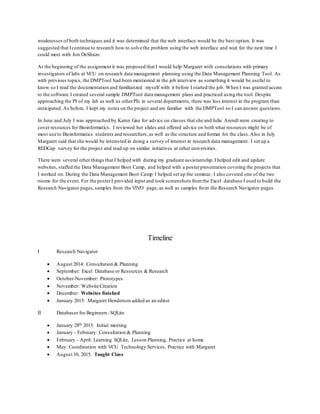
Timeline
I Research Navigator
 August 2014: Consultation & Planning
 September: Excel Database or Resources & Research
 October-November: Prototypes
 November: Website Creation
 December: Websites finished
 January 2015: Margaret Henderson added as an editor
II Databases for Beginners: SQLite
 January 28th 2015: Initial meeting
 January - February: Consultation & Planning
 February - April: Learning SQLite, Lesson Planning, Practice at home
 May: Coordination with VCU Technology Services, Practice with Margaret
 August 10, 2015: Taught Class
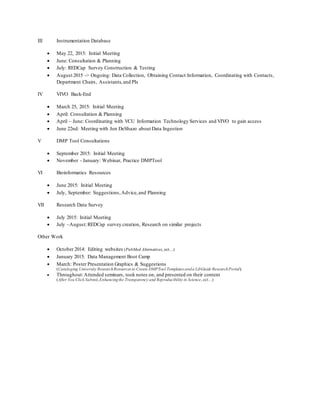
III Instrumentation Database
 May 22, 2015: Initial Meeting
 June: Consultation & Planning
 July: REDCap Survey Construction & Testing
 August 2015 -> Ongoing: Data Collection, Obtaining Contact Information, Coordinating with Contacts,
Department Chairs, Assistants,and PIs
IV VIVO Back-End
 March 25, 2015: Initial Meeting
 April: Consultation & Planning
 April – June: Coordinating with VCU Information Technology Services and VIVO to gain access
 June 22nd: Meeting with Jon DeShazo about Data Ingestion
V DMP Tool Consultations
 September 2015: Initial Meeting
 November - January: Webinar, Practice DMPTool
VI Bioinformatics Resources
 June 2015: Initial Meeting
 July, September: Suggestions,Advice,and Planning
VII Research Data Survey
 July 2015: Initial Meeting
 July –August:REDCap survey creation, Research on similar projects
Other Work
 October 2014: Editing websites (PubMed Alternatives, ect…)
 January 2015: Data Management Boot Camp
 March: Poster Presentation Graphics & Suggestions
(Cataloging University ResearchResources to Create DMPTool Templates anda LibGuide ResearchPortal)
 Throughout:Attended seminars, took notes on, and presented on their content
(After You Click Submit,Enhancingthe Transparency and Reproducibility in Science, ect…)

Projects Summary

  • 1.
    Projects Summary Introduction This isa summary of the work I performed as part of my graduate assistantship.Like my weekly summaries I will have project names in bold and names of people underlined for convenience and ease of scanning.In the report I will first describe each of the seven projects.Then I will give an overview of the work performed for the graduate assistantship assignment. Project Name Contact I Research Navigator Margaret Henderson II SQLite Flash-Course Margaret Henderson III Instrumentation Database Paul Fawcett IV VIVO Back-End Jon DeShazo V DMPTool Margaret Henderson VI Bioinformatic Resources Karen Gau VII Research Data Survey Margaret Henderson Project descriptions Project I is the Research Navigator which is a collection of websites,each focusing on an area of research with the goal of providing quick and convenient access to resources available to researchers at VCU. Each site contains organized lists of links to resources with descriptions.These sites consolidate and improve access to disparate resources both within and outside of the university for researchers at VCU. The websites were constructed using the LibGuides format. To be included in the list a resource has to meet certain criteria. For example for inclusion a resource must be free to use or VCU must have a subscription so it is free to students and faculty. Each resource contains reliable, up-to date information and is representative of the best of what is available for its type. The resource is concise and easy to use rather than being exhaustive. http://guides.library.vcu.edu/research-navigator Project II, Databases for Beginners: SQLite is a one hourcourse designed to teach basic database concepts, Standardized Query Language, and the use of the SQLite software. The course not only introduces database concepts,it leaves them with practical skills that they can use. SQLite is the most widely used database systemand is more efficient than MySQL for databases under140 terabytes. Terms, concepts,and techniques necessary for database use and design were covered. During the lecture the students created their own SQLite database and practiced the techniques necessary fordatabase creation and implementation. A physical representation of a sample database was also constructed to help illustrate concepts and for use as a teaching aid. The students were also provided with detailed notes covering the topics discussed in more detail than was possible in a one-hourclass. In addition they were given resources for further study including books,tutorials (both video and written), as well as my contact information should they have any questions orneed any help. http://events.vcu.edu/detailEvent.asp?ID=61921
  • 2.
    Project III, theInstrumentation Database involves the creation of a database of all major research instrumentation at VCU. The database will be a resource of significant utility to the VCU research community and is driven by inquiries from the state Joint Commission on Technology and Science (JCOTS) and an anticipated mandate from the State Council of Higher Education for Virginia (SCHEV). This database will contain more detailed and more accurate information than the fixed asset lists. Originally this was to be composed of equipment at VCU’s medical campus but has since expanded to include all major scientific equipment at the Monroe Park campus and affiliated facilities. The information included in this database will need to be secure due to potentially sensitive information. For example, some of the equipment has the potential for dual-use and thus that information should not be available to those without special authorization. To collect this information a REDCap survey instrument has been created. The chairs of all the departments, cores, and associated facilities have been contacted and each has or will choose an individual to fill out the surveys for each piece of equipment that meets our criteria for inclusion. It will include instruments or systems that are unique, of a special nature, and/orare composed of an assemblage of parts. In most cases equipment exceeding $100,000 will also be included. Project IV, VIVO Back-End involves improving an existing resource through modifications to its back-end to help with the latest version of the front-end. VIVO is a resource which facilitates networking among researchers. Project V, DMPTool, uses software to provide consultation to assist researchers to better plan for and address the need for proper data management. Project VI, Bioinformatics Resources involved advising Karen Gau on class covering resources for bioinformaticians and bioinformatics researchers.It also involved the setup and organization of those classes which detail and explain the use of those resources. Project VII, Research Data Survey was a proposed survey to collect and present student and faculty attitudes on the management and sharing of research data. The aim is to identify potential service areas for data management support and opportunities for institutional collaboration. In addition to these projects I also helped with side-projects and performed other duties.I assisted with the graphics for the posterpresentation Cataloging University Research Resources to Create DMPTool Templates and a LibGuide Research Portal which covered some of the projects I worked on. I helped set up, and provided assistance for the Data Management Bootcamp. I tested,cleaned up, and made changes to websites such as PubMed Alternatives.There were also several seminars that I was asked to attend so that I could take notes and report on their content such as After You Click Submit, and Enhancing the Transparency and Reproducibility in Science. http://www.library.vcu.edu/about/news/2014/data-management-bootcamp-kicks-off-a-big-year-for-big-data-.html http://escholarship.umassmed.edu/escience_symposium/2015/posters/11/
  • 3.
    Outline of WorkPerformed The first project that I worked on was the Research Navigator. My first step was to get a clear idea of what the goals of the project were, its purpose,and who would access it. I took detailed notes compiled from meetings, things I learned from researching similar projects, as well as what I learned while working on the project. If there are any questions about the project, I kept my hand-written notes. While I was clarifying expectations for and ironing out the details of what the finished product would look like, I performed research to collect the resources to list and also to get an idea of the amount of resources available to researchers at VCU. I used Excel and Google Sheets to keep track of the information. This was useful not only to store the data but also to organize it and to determine which types of data were most important to collect. Throughout the project the Excel file was expanded, updated,and re-organized. This allowed the final product to be well organized and within the desired scope. Once I had a good idea of goals & scope of the project, as well as the amount, type, and categories of resources,I created prototype pages using the LibGuides format. Before starting the job LibGuides had been mentioned as something that might be useful to know and so I read up on it before starting the graduate assistantship.When I was granted access to create pages,I experimented with the format so I knew both how to use it and what could be done with it. There were several non-standard things that were needed for the websites. We met with and were assisted by Erin White. I also researched solutions on the forums for LibGuides. When the prototype was approved, I began constructing the pages using the organized data from the Excel file. Since there was a considerable amount of resources discovered I was asked to write criteria for inclusion so that those resources could be pared down to only those most relevant and those that were the most useful. I also compiled a list of categories for the pages such as Genetics or Mathematics. When both the criteria for inclusion and the list of categories were approved I built the first drafts of the pages.These drafts were shown to a variety of people to get their input. The final versions incorporated the changes that I made based on the suggestions from that input. After they were completed I performed periodic checks to make sure the links were correct, and that the resources listed were still relevant. I also showed the pages to members of my lab, classmates, and professors to get further input. This input allowed me to make improvements to and to update the pages based on their suggestions throughout the graduate assistantship. In January of 2015 it was suggested that I teach a class covering basic database concepts and SQL. Initially I was going to teach the use of MySQL, however after consultations with VCU Technology Services it was decided that MySQL would require considerable man-hours on their part to set up on the classroom computers. While researching different ways to implement SQL and reading database tutorials I discovered SQLite as an alternative. SQLite is an executable file that does not require installation or configuration. It is often used as a teaching tool but is also incredibly useful. For small to moderate implementation it is actually quicker and more efficient than MySQL. It is also the most widely deployed database systemin the world despite not being as well known. Once it had been established that I would be using SQLite I spent time learning how to use its command-line interface. I had used MySQL in a previous class and was familiar with database concepts. However, there were differences between the two systems and additional practice was useful to reacquaint myself with the subject as well as to learn SQLite. When that was done I created a lesson plan for the class as well as slides. The slides were built using Google Slides so that they would be accessible to both IBM and Mac users.In addition to the SQLite class I also constructed a follow-up advanced course teaching MySQL in case there was sufficient interest to warrant the time it would take Technology Services to set it up on the classroom computers. As with the otherprojects I also
  • 4.
    took extensive notesfrom meetings, research I performed, and things I learned during the creation of the class. If there are any questions I kept my notes for this project as well. Before teaching the class I practiced teaching both at home, at work, and with classmates to get input. I made changes to the format, order, and scope of the class based on the suggestions Ireceived. I constructed a physical representation of the sample database I used in class to help illustrate concepts such as foreign keys, joins, and primary keys. In addition I provided the class with extensive notes covering the topic in more detail than the 1 hou r time limit for the class would allow. The students were also provided with links to other resources for further study including books,tutorials, as well as my contact information should they have any questions orneed assistance. In May I met with Paul Fawcett to discuss the creation of a database of major research instrumentation at VCU. Initially this was intended to include equipment at the medical campus but has since expanded to incorporate equipment on the Monroe Park campus as well as at laboratories and installations affiliated with VCU. The first step was to discuss the scope and goals of the project as well as to iron out the details of what the finished product would look like. Next I constructed a REDCap survey to collect the information. It had been mentioned that it would be helpful to know something about REDCap in the interview so I read up on it before I started the job and when given access to an account,practiced it so I would be proficient with its use. I was provided with a list of all the departments at VCU as well as the chairs and their contact information. This was used as the basis of an Excel file to keep track of who had been contacted as well as notes for the project. A copy of the latest version of this file is attached for reference. With Paul we composed an email requesting the head of each department to identify an individual that we could work with to collect the information for our database.When sending the letters I realized that much of the contact information for the department chairs was either missing or incorrect so I performed research to update the contact information. In addition I added research cores, affiliated laboratories, and departments that weren’t included in the initial list. When the heads of all departments, cores,and affiliated facilities had been contacted,the next step was to contact the individuals that had been chosen to help us collect the instrumentation information. In some cases there was some debate as to who was responsible for which departments. I followed up with contacts and chairs to clarify this. In some cases I had to contact each of the PIs for a department directly and/or had to follow-up with individuals who were on vacation or out of the office. In some cases I toured the facility to become familiar with what was there. This project is on-going and Paul has allowed me to continue to work on it until its completion. Currently we have collected 95 surveys and have collected information on all instrumentation that meets our criteria for 27 departments. When all the information has been collected the next step will be to construct the database as well as the front-end. In March I met with Margaret and Jon DeShazo to discuss updating the back-end for VIVO to improve the resource. In order to access the back-end it was required that I use a virtual private network (VPN) with duo security authentication.I did not have administrative access to my office computer so in order to work on the project I had to get the VPN set up though Technology Services. There were also difficulties with the setup for the test server which was corrected with the help of Michael Tran. While I was working with Technology Services to be granted access to the back-end I read up on the documentation for VIVO. I discovered much of the documentation was out of date so I did research online and through forums to determine how I would work with the database for VIVO. In June I met with Jon DeShazo and he verified that the steps specified in the documentation did not work. There were two strategies I proposed which could be used in order to perform the data ingestion. The first involved a web-interface and the other involved using SSH-Shell. The web interface would be easier to use yet more complicated to fix if there were any problems while the command-line shell interface would take longer for me to do but it would be easier to troubleshoot. I presented the strengths and
  • 5.
    weaknesses of bothtechniques and it was determined that the web interface would be the best option. It was suggested that Icontinue to research how to solve the problem using the web interface and wait for the next time I could meet with Jon DeShazo. At the beginning of the assignment it was proposed that I would help Margaret with consolations with primary investigators of labs at VCU on research data management planning using the Data Management Planning Tool. As with previous topics, the DMPTool had been mentioned in the job interview as something it would be useful to know so I read the documentation and familiarized myself with it before I started the job. When I was granted access to the software I created several sample DMPTool data management plans and practiced using the tool. Despite approaching the PI of my lab as well as otherPIs in several departments, there was less interest in the program than anticipated. As before, I kept my notes on the project and am familiar with the DMPTool so I can answer questions. In June and July I was approached by Karen Gau for advice on classes that she and Julie Arendt were creating to cover resources for Bioinformatics. I reviewed her slides and offered advice on both what resources might be of most use to Bioinformatics students and researchers,as well as the structure and format for the class. Also in July Margaret said that she would be interested in doing a survey of interest in research data management. I set up a REDCap survey for the project and read up on similar initiatives at other universities. There were several other things that I helped with during my graduate assistantship.I helped edit and update websites, staffed the Data Management Boot Camp, and helped with a posterpresentation covering the projects that I worked on. During the Data Management Boot Camp I helped set up the seminar. I also covered one of the two rooms for the event. For the posterI provided input and took screenshots fromthe Excel database I used to build the Research Navigator pages,samples from the VIVO page, as well as samples from the Research Navigator pages. Timeline I Research Navigator  August 2014: Consultation & Planning  September: Excel Database or Resources & Research  October-November: Prototypes  November: Website Creation  December: Websites finished  January 2015: Margaret Henderson added as an editor II Databases for Beginners: SQLite  January 28th 2015: Initial meeting  January - February: Consultation & Planning  February - April: Learning SQLite, Lesson Planning, Practice at home  May: Coordination with VCU Technology Services, Practice with Margaret  August 10, 2015: Taught Class
  • 6.
    III Instrumentation Database May 22, 2015: Initial Meeting  June: Consultation & Planning  July: REDCap Survey Construction & Testing  August 2015 -> Ongoing: Data Collection, Obtaining Contact Information, Coordinating with Contacts, Department Chairs, Assistants,and PIs IV VIVO Back-End  March 25, 2015: Initial Meeting  April: Consultation & Planning  April – June: Coordinating with VCU Information Technology Services and VIVO to gain access  June 22nd: Meeting with Jon DeShazo about Data Ingestion V DMP Tool Consultations  September 2015: Initial Meeting  November - January: Webinar, Practice DMPTool VI Bioinformatics Resources  June 2015: Initial Meeting  July, September: Suggestions,Advice,and Planning VII Research Data Survey  July 2015: Initial Meeting  July –August:REDCap survey creation, Research on similar projects Other Work  October 2014: Editing websites (PubMed Alternatives, ect…)  January 2015: Data Management Boot Camp  March: Poster Presentation Graphics & Suggestions (Cataloging University ResearchResources to Create DMPTool Templates anda LibGuide ResearchPortal)  Throughout:Attended seminars, took notes on, and presented on their content (After You Click Submit,Enhancingthe Transparency and Reproducibility in Science, ect…)