
PM World Today – June 2011 (Vol. XIII, Issue VI)


                PM WORLD TODAY – FEATURED PAPER – JUNE 2011

       Project Selection in Large Engineering Construction
                             Programs

                                                   By Bob Prieto

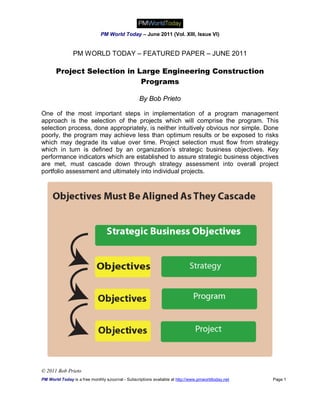
One of the most important steps in implementation of a program management
approach is the selection of the projects which will comprise the program. This
selection process, done appropriately, is neither intuitively obvious nor simple. Done
poorly, the program may achieve less than optimum results or be exposed to risks
which may degrade its value over time. Project selection must flow from strategy
which in turn is defined by an organization’s strategic business objectives. Key
performance indicators which are established to assure strategic business objectives
are met, must cascade down through strategy assessment into overall project
portfolio assessment and ultimately into individual projects.


© 2011 Bob Prieto
PM World Today is a free monthly eJournal - Subscriptions available at http://www.pmworldtoday.net   Page 1
PM World Today – June 2011 (Vol. XIII, Issue VI)


The selection of the portfolio of projects that will comprise the program must:

             optimize multiple strategic business objectives
             address sequencing required for optimization
             address interdependencies between projects
             reflect real world resource constraints
             enhance program (and organizational) flexibility and resiliency

Programs which experience weak project selection may have failed to:

        maintain focus on strategic business objectives allowing biases to enter the
         process
        establish a sufficiently strong methodology for project portfolio evaluation,
         often only considering one primary strategic business objective without
         attention to other such objectives
        appropriately cascade metrics down to the assessment of project portfolio
         performance
        inadequately reflect uncertainty and risks in portfolio evaluation

Weak project selection will result in lower value capture and, to the extent to which
project selection appears to be driven by non-objective factors, undermine
organizational honesty and openness.

Projects selection must be monitored as well as project performance under program
management. This is an area which requires increased focus in the engineering and
construction industry. Changes in market conditions, resource constraints, risk levels
or execution performance may drive a re-evaluation of the portfolio which shows that
redeployment of resources is in the best interest of achieving the programs strategic
business objectives even when sunk costs and commitments are fully considered.

Termination of a previously selected project may be a simpler matter if it is
performing below expectations (schedule delays, cost overruns) but when driven by a
reduction in the benefits that will accrue or value derived it is a much harder matter.
Who wants to be the program manager who terminates a strong performing project
(ahead of schedule, under budget)?

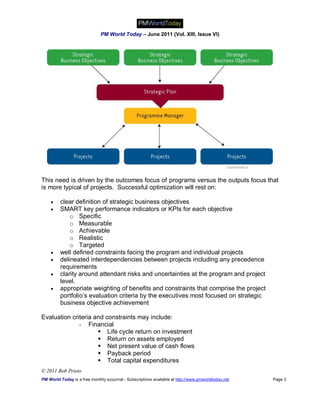
Optimize Multiple Strategic Business Objectives

A key attribute of project selection in major engineering and construction programs is
the need to simultaneously optimize multiple strategic business objectives.


© 2011 Bob Prieto
PM World Today is a free monthly eJournal - Subscriptions available at http://www.pmworldtoday.net   Page 2
PM World Today – June 2011 (Vol. XIII, Issue VI)


This need is driven by the outcomes focus of programs versus the outputs focus that
is more typical of projects. Successful optimization will rest on:

        clear definition of strategic business objectives
        SMART key performance indicators or KPIs for each objective
             o Specific
             o Measurable
             o Achievable
             o Realistic
             o Targeted
        well defined constraints facing the program and individual projects
        delineated interdependencies between projects including any precedence
         requirements
        clarity around attendant risks and uncertainties at the program and project
         level.
        appropriate weighting of benefits and constraints that comprise the project
         portfolio’s evaluation criteria by the executives most focused on strategic
         business objective achievement

Evaluation criteria and constraints may include:
              - Financial
                      Life cycle return on investment
                      Return on assets employed
                      Net present value of cash flows
                      Payback period
                      Total capital expenditures
© 2011 Bob Prieto
PM World Today is a free monthly eJournal - Subscriptions available at http://www.pmworldtoday.net   Page 3
PM World Today – June 2011 (Vol. XIII, Issue VI)


                            Product/project gross margins
                   -    Market
                            Market share
                            Market growth and duration
                            Period of profitable production
                            Product flexibility
                            Customer impacts
                   -    Strategic
                            Flexibility
                            Resiliency
                            Contribution to overall portfolio performance
                            Enablement of SBO achievement
                            Enablement of other portfolio projects
                            Critical resource utilization
                   -    Sustainability or Triple Bottom Line focused criteria
                            Economic
                            Social
                                   Community impacts
                                   Capacity building
                                   New industry/business creation
                                   Stakeholder support
                                   Workforce impacts
                            Environmental, Health & Safety
                                   Airborne emissions
                                   Water consumption
                                   Discharge water quality
                                   Environmental degradation
                                   Worker health and safety
                                   Public health and safety
                   -    Risk
                            Economic or market uncertainties
                            Other event risks
                            Financing uncertainties
                            Cost uncertainties
                            Schedule uncertainties
                            Labor risks
                            Stakeholder risks
                            Sovereign and legislative risks
                            Political risks
                            Technology risks
                            Intellectual property risks
                            Business model risks
                            Project execution risks
© 2011 Bob Prieto
PM World Today is a free monthly eJournal - Subscriptions available at http://www.pmworldtoday.net   Page 4
PM World Today – June 2011 (Vol. XIII, Issue VI)


Weak project evaluation methodologies that seek to reduce all benefits to a singular
cost related value, such as NPV, must be avoided in recognition that:

        Uncertainty in estimates is compounded
        Structured multi-variate risk analysis would produce a better assessment of
         risk
        Benefits of later phase projects are not fully appreciated
        Changes in risk profile over time are not recognized

Avoiding Bias in Project Selection

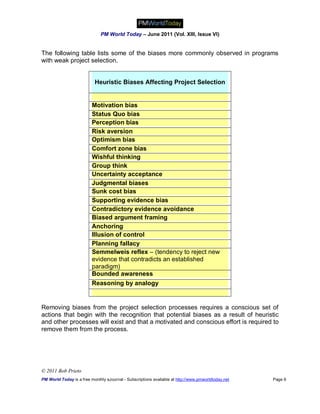
Objective assessment rests on well defined objectives, constraints and evaluation
metrics that can be mapped to well defined evaluation criteria.


                                                      Constraints


       Strategic
       Business
    Objectives (SBO)

                                                                                                     Optimal
                                                      Evaluation
                                                                                                      Project
                                                       Criteria
                                                                                                     Portfolio


        Evaluation
         Metrics


                                     Avoiding Bias in Project Selection


It is essential that the owner’s team and program manager understand potential
sources of selection bias and carefully review objectives, metrics, constraints and
evaluation criteria to ensure such biases have been minimized and ideally eliminated.
The use of unconscious shortcuts to make complex decisions has been well
documented but may lead to systematic errors in the project portfolio selection
process.


© 2011 Bob Prieto
PM World Today is a free monthly eJournal - Subscriptions available at http://www.pmworldtoday.net               Page 5
PM World Today – June 2011 (Vol. XIII, Issue VI)


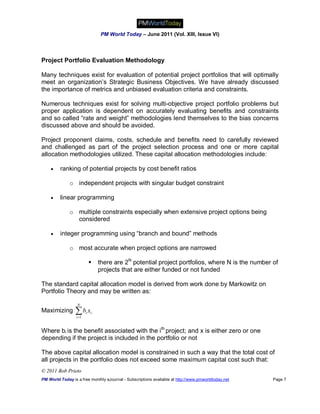
The following table lists some of the biases more commonly observed in programs
with weak project selection.


                           Heuristic Biases Affecting Project Selection


                          Motivation bias
                          Status Quo bias
                          Perception bias
                          Risk aversion
                          Optimism bias
                          Comfort zone bias
                          Wishful thinking
                          Group think
                          Uncertainty acceptance
                          Judgmental biases
                          Sunk cost bias
                          Supporting evidence bias
                          Contradictory evidence avoidance
                          Biased argument framing
                          Anchoring
                          Illusion of control
                          Planning fallacy
                          Semmelweis reflex – (tendency to reject new
                          evidence that contradicts an established
                          paradigm)
                          Bounded awareness
                          Reasoning by analogy


Removing biases from the project selection processes requires a conscious set of
actions that begin with the recognition that potential biases as a result of heuristic
and other processes will exist and that a motivated and conscious effort is required to
remove them from the process.


© 2011 Bob Prieto
PM World Today is a free monthly eJournal - Subscriptions available at http://www.pmworldtoday.net   Page 6
PM World Today – June 2011 (Vol. XIII, Issue VI)


Project Portfolio Evaluation Methodology

Many techniques exist for evaluation of potential project portfolios that will optimally
meet an organization’s Strategic Business Objectives. We have already discussed
the importance of metrics and unbiased evaluation criteria and constraints.

Numerous techniques exist for solving multi-objective project portfolio problems but
proper application is dependent on accurately evaluating benefits and constraints
and so called “rate and weight” methodologies lend themselves to the bias concerns
discussed above and should be avoided.

Project proponent claims, costs, schedule and benefits need to carefully reviewed
and challenged as part of the project selection process and one or more capital
allocation methodologies utilized. These capital allocation methodologies include:

        ranking of potential projects by cost benefit ratios

              o independent projects with singular budget constraint

        linear programming

              o multiple constraints especially when extensive project options being
                considered

        integer programming using “branch and bound” methods

              o most accurate when project options are narrowed

                                there are 2N potential project portfolios, where N is the number of
                                 projects that are either funded or not funded

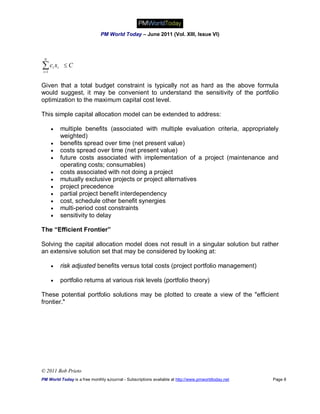
The standard capital allocation model is derived from work done by Markowitz on
Portfolio Theory and may be written as:

                  N
Maximizing       b x
                  i 1
                         i   i


Where bi is the benefit associated with the ith project; and x is either zero or one
depending if the project is included in the portfolio or not

The above capital allocation model is constrained in such a way that the total cost of
all projects in the portfolio does not exceed some maximum capital cost such that:
© 2011 Bob Prieto
PM World Today is a free monthly eJournal - Subscriptions available at http://www.pmworldtoday.net   Page 7
PM World Today – June 2011 (Vol. XIII, Issue VI)


 N

c x
i 1
       i   i    C


Given that a total budget constraint is typically not as hard as the above formula
would suggest, it may be convenient to understand the sensitivity of the portfolio
optimization to the maximum capital cost level.

This simple capital allocation model can be extended to address:

              multiple benefits (associated with multiple evaluation criteria, appropriately
               weighted)
              benefits spread over time (net present value)
              costs spread over time (net present value)
              future costs associated with implementation of a project (maintenance and
               operating costs; consumables)
              costs associated with not doing a project
              mutually exclusive projects or project alternatives
              project precedence
              partial project benefit interdependency
              cost, schedule other benefit synergies
              multi-period cost constraints
              sensitivity to delay

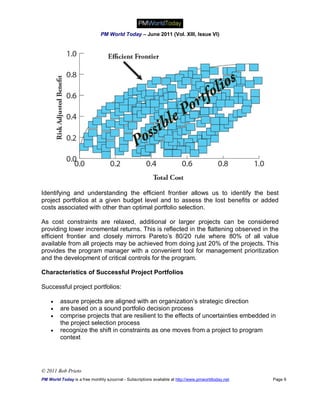
The “Efficient Frontier”

Solving the capital allocation model does not result in a singular solution but rather
an extensive solution set that may be considered by looking at:

              risk adjusted benefits versus total costs (project portfolio management)

              portfolio returns at various risk levels (portfolio theory)

These potential portfolio solutions may be plotted to create a view of the "efficient
frontier."


© 2011 Bob Prieto
PM World Today is a free monthly eJournal - Subscriptions available at http://www.pmworldtoday.net   Page 8
PM World Today – June 2011 (Vol. XIII, Issue VI)


Identifying and understanding the efficient frontier allows us to identify the best
project portfolios at a given budget level and to assess the lost benefits or added
costs associated with other than optimal portfolio selection.

As cost constraints are relaxed, additional or larger projects can be considered
providing lower incremental returns. This is reflected in the flattening observed in the
efficient frontier and closely mirrors Pareto’s 80/20 rule where 80% of all value
available from all projects may be achieved from doing just 20% of the projects. This
provides the program manager with a convenient tool for management prioritization
and the development of critical controls for the program.

Characteristics of Successful Project Portfolios

Successful project portfolios:

        assure projects are aligned with an organization’s strategic direction
        are based on a sound portfolio decision process
        comprise projects that are resilient to the effects of uncertainties embedded in
         the project selection process
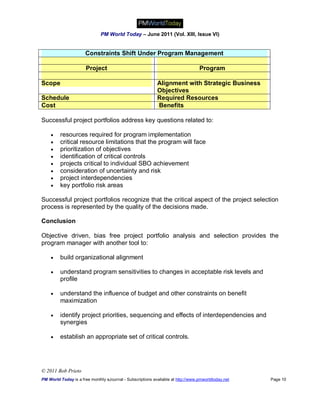
        recognize the shift in constraints as one moves from a project to program
         context


© 2011 Bob Prieto
PM World Today is a free monthly eJournal - Subscriptions available at http://www.pmworldtoday.net   Page 9
PM World Today – June 2011 (Vol. XIII, Issue VI)


                      Constraints Shift Under Program Management

                       Project                                                    Program

Scope                                                       Alignment with Strategic Business
                                                            Objectives
Schedule                                                    Required Resources
Cost                                                        Benefits

Successful project portfolios address key questions related to:

        resources required for program implementation
        critical resource limitations that the program will face
        prioritization of objectives
        identification of critical controls
        projects critical to individual SBO achievement
        consideration of uncertainty and risk
        project interdependencies
        key portfolio risk areas

Successful project portfolios recognize that the critical aspect of the project selection
process is represented by the quality of the decisions made.

Conclusion

Objective driven, bias free project portfolio analysis and selection provides the
program manager with another tool to:

        build organizational alignment

        understand program sensitivities to changes in acceptable risk levels and
         profile

        understand the influence of budget and other constraints on benefit
         maximization

        identify project priorities, sequencing and effects of interdependencies and
         synergies

        establish an appropriate set of critical controls.


© 2011 Bob Prieto
PM World Today is a free monthly eJournal - Subscriptions available at http://www.pmworldtoday.net   Page 10
PM World Today – June 2011 (Vol. XIII, Issue VI)


References:

    1. Markowitz, H.M. (March 1952). "Portfolio Selection". The Journal of Finance 7
         (1): 77–91. doi:10.2307/2975974. http://jstor.org/stable/2975974.

    2. Strategic Program Management; published by the Construction Management
         Association of America (CMAA); ISBN 978-0-9815612-1-9; July 24, 2008

    3. Topics in Strategic Program Management; ISBN 978-0-557-52887-5; July
         2010


© 2011 Bob Prieto
PM World Today is a free monthly eJournal - Subscriptions available at http://www.pmworldtoday.net   Page 11
PM World Today – June 2011 (Vol. XIII, Issue VI)


About the Author


                               Bob Prieto

                               Author


                        Bob Prieto is a Senior Vice President of Fluor Corporation,
                        one of America’s largest engineering, construction and project
management firms, where he is responsible for strategy in support of the firm’s
Industrial & Infrastructure Group and its key clients. He focuses on the development,
delivery and oversight of large, complex projects worldwide. Prior to joining Fluor,
Bob served as chairman of Parsons Brinckerhoff Inc. He served as a member of the
executive committee of the National Center for Asia-Pacific Economic Cooperation, a
member of the Industry Leaders’ Council of the American Society of Civil Engineers
(ASCE), and co-founder of the Disaster Resource Network. He currently serves on a
number of committees looking at issues related to infrastructure delivery and
resiliency and disaster response and rebuilding. Until 2006 he served as one of three
U.S. presidential appointees to the Asia Pacific Economic Cooperation (APEC)
Business Advisory Council (ABAC) and previously served as chairman of the
Engineering and Construction Governors of The World Economic Forum and co-chair
of the infrastructure task force formed after September 11th by the New York City
Chamber of Commerce. He recently completed ten year tenure as a member of the
board of trustees of Polytechnic University of New York culminating in its merger with
New York University. Bob is the author of “Strategic Program Management”
published by the Construction Management Association of America (CMAA) and
more recently a companion work entitled “Topics in Strategic Program Management”.


© 2011 Bob Prieto
PM World Today is a free monthly eJournal - Subscriptions available at http://www.pmworldtoday.net   Page 12

Project Selection in Large Engineering and Construction Programs

  • 1.
    PM World Today– June 2011 (Vol. XIII, Issue VI) PM WORLD TODAY – FEATURED PAPER – JUNE 2011 Project Selection in Large Engineering Construction Programs By Bob Prieto One of the most important steps in implementation of a program management approach is the selection of the projects which will comprise the program. This selection process, done appropriately, is neither intuitively obvious nor simple. Done poorly, the program may achieve less than optimum results or be exposed to risks which may degrade its value over time. Project selection must flow from strategy which in turn is defined by an organization’s strategic business objectives. Key performance indicators which are established to assure strategic business objectives are met, must cascade down through strategy assessment into overall project portfolio assessment and ultimately into individual projects. © 2011 Bob Prieto PM World Today is a free monthly eJournal - Subscriptions available at http://www.pmworldtoday.net Page 1
  • 2.
    PM World Today– June 2011 (Vol. XIII, Issue VI) The selection of the portfolio of projects that will comprise the program must:  optimize multiple strategic business objectives  address sequencing required for optimization  address interdependencies between projects  reflect real world resource constraints  enhance program (and organizational) flexibility and resiliency Programs which experience weak project selection may have failed to:  maintain focus on strategic business objectives allowing biases to enter the process  establish a sufficiently strong methodology for project portfolio evaluation, often only considering one primary strategic business objective without attention to other such objectives  appropriately cascade metrics down to the assessment of project portfolio performance  inadequately reflect uncertainty and risks in portfolio evaluation Weak project selection will result in lower value capture and, to the extent to which project selection appears to be driven by non-objective factors, undermine organizational honesty and openness. Projects selection must be monitored as well as project performance under program management. This is an area which requires increased focus in the engineering and construction industry. Changes in market conditions, resource constraints, risk levels or execution performance may drive a re-evaluation of the portfolio which shows that redeployment of resources is in the best interest of achieving the programs strategic business objectives even when sunk costs and commitments are fully considered. Termination of a previously selected project may be a simpler matter if it is performing below expectations (schedule delays, cost overruns) but when driven by a reduction in the benefits that will accrue or value derived it is a much harder matter. Who wants to be the program manager who terminates a strong performing project (ahead of schedule, under budget)? Optimize Multiple Strategic Business Objectives A key attribute of project selection in major engineering and construction programs is the need to simultaneously optimize multiple strategic business objectives. © 2011 Bob Prieto PM World Today is a free monthly eJournal - Subscriptions available at http://www.pmworldtoday.net Page 2
  • 3.
    PM World Today– June 2011 (Vol. XIII, Issue VI) This need is driven by the outcomes focus of programs versus the outputs focus that is more typical of projects. Successful optimization will rest on:  clear definition of strategic business objectives  SMART key performance indicators or KPIs for each objective o Specific o Measurable o Achievable o Realistic o Targeted  well defined constraints facing the program and individual projects  delineated interdependencies between projects including any precedence requirements  clarity around attendant risks and uncertainties at the program and project level.  appropriate weighting of benefits and constraints that comprise the project portfolio’s evaluation criteria by the executives most focused on strategic business objective achievement Evaluation criteria and constraints may include: - Financial  Life cycle return on investment  Return on assets employed  Net present value of cash flows  Payback period  Total capital expenditures © 2011 Bob Prieto PM World Today is a free monthly eJournal - Subscriptions available at http://www.pmworldtoday.net Page 3
  • 4.
    PM World Today– June 2011 (Vol. XIII, Issue VI)  Product/project gross margins - Market  Market share  Market growth and duration  Period of profitable production  Product flexibility  Customer impacts - Strategic  Flexibility  Resiliency  Contribution to overall portfolio performance  Enablement of SBO achievement  Enablement of other portfolio projects  Critical resource utilization - Sustainability or Triple Bottom Line focused criteria  Economic  Social  Community impacts  Capacity building  New industry/business creation  Stakeholder support  Workforce impacts  Environmental, Health & Safety  Airborne emissions  Water consumption  Discharge water quality  Environmental degradation  Worker health and safety  Public health and safety - Risk  Economic or market uncertainties  Other event risks  Financing uncertainties  Cost uncertainties  Schedule uncertainties  Labor risks  Stakeholder risks  Sovereign and legislative risks  Political risks  Technology risks  Intellectual property risks  Business model risks  Project execution risks © 2011 Bob Prieto PM World Today is a free monthly eJournal - Subscriptions available at http://www.pmworldtoday.net Page 4
  • 5.
    PM World Today– June 2011 (Vol. XIII, Issue VI) Weak project evaluation methodologies that seek to reduce all benefits to a singular cost related value, such as NPV, must be avoided in recognition that:  Uncertainty in estimates is compounded  Structured multi-variate risk analysis would produce a better assessment of risk  Benefits of later phase projects are not fully appreciated  Changes in risk profile over time are not recognized Avoiding Bias in Project Selection Objective assessment rests on well defined objectives, constraints and evaluation metrics that can be mapped to well defined evaluation criteria. Constraints Strategic Business Objectives (SBO) Optimal Evaluation Project Criteria Portfolio Evaluation Metrics Avoiding Bias in Project Selection It is essential that the owner’s team and program manager understand potential sources of selection bias and carefully review objectives, metrics, constraints and evaluation criteria to ensure such biases have been minimized and ideally eliminated. The use of unconscious shortcuts to make complex decisions has been well documented but may lead to systematic errors in the project portfolio selection process. © 2011 Bob Prieto PM World Today is a free monthly eJournal - Subscriptions available at http://www.pmworldtoday.net Page 5
  • 6.
    PM World Today– June 2011 (Vol. XIII, Issue VI) The following table lists some of the biases more commonly observed in programs with weak project selection. Heuristic Biases Affecting Project Selection Motivation bias Status Quo bias Perception bias Risk aversion Optimism bias Comfort zone bias Wishful thinking Group think Uncertainty acceptance Judgmental biases Sunk cost bias Supporting evidence bias Contradictory evidence avoidance Biased argument framing Anchoring Illusion of control Planning fallacy Semmelweis reflex – (tendency to reject new evidence that contradicts an established paradigm) Bounded awareness Reasoning by analogy Removing biases from the project selection processes requires a conscious set of actions that begin with the recognition that potential biases as a result of heuristic and other processes will exist and that a motivated and conscious effort is required to remove them from the process. © 2011 Bob Prieto PM World Today is a free monthly eJournal - Subscriptions available at http://www.pmworldtoday.net Page 6
  • 7.
    PM World Today– June 2011 (Vol. XIII, Issue VI) Project Portfolio Evaluation Methodology Many techniques exist for evaluation of potential project portfolios that will optimally meet an organization’s Strategic Business Objectives. We have already discussed the importance of metrics and unbiased evaluation criteria and constraints. Numerous techniques exist for solving multi-objective project portfolio problems but proper application is dependent on accurately evaluating benefits and constraints and so called “rate and weight” methodologies lend themselves to the bias concerns discussed above and should be avoided. Project proponent claims, costs, schedule and benefits need to carefully reviewed and challenged as part of the project selection process and one or more capital allocation methodologies utilized. These capital allocation methodologies include:  ranking of potential projects by cost benefit ratios o independent projects with singular budget constraint  linear programming o multiple constraints especially when extensive project options being considered  integer programming using “branch and bound” methods o most accurate when project options are narrowed  there are 2N potential project portfolios, where N is the number of projects that are either funded or not funded The standard capital allocation model is derived from work done by Markowitz on Portfolio Theory and may be written as: N Maximizing b x i 1 i i Where bi is the benefit associated with the ith project; and x is either zero or one depending if the project is included in the portfolio or not The above capital allocation model is constrained in such a way that the total cost of all projects in the portfolio does not exceed some maximum capital cost such that: © 2011 Bob Prieto PM World Today is a free monthly eJournal - Subscriptions available at http://www.pmworldtoday.net Page 7
  • 8.
    PM World Today– June 2011 (Vol. XIII, Issue VI) N c x i 1 i i C Given that a total budget constraint is typically not as hard as the above formula would suggest, it may be convenient to understand the sensitivity of the portfolio optimization to the maximum capital cost level. This simple capital allocation model can be extended to address:  multiple benefits (associated with multiple evaluation criteria, appropriately weighted)  benefits spread over time (net present value)  costs spread over time (net present value)  future costs associated with implementation of a project (maintenance and operating costs; consumables)  costs associated with not doing a project  mutually exclusive projects or project alternatives  project precedence  partial project benefit interdependency  cost, schedule other benefit synergies  multi-period cost constraints  sensitivity to delay The “Efficient Frontier” Solving the capital allocation model does not result in a singular solution but rather an extensive solution set that may be considered by looking at:  risk adjusted benefits versus total costs (project portfolio management)  portfolio returns at various risk levels (portfolio theory) These potential portfolio solutions may be plotted to create a view of the "efficient frontier." © 2011 Bob Prieto PM World Today is a free monthly eJournal - Subscriptions available at http://www.pmworldtoday.net Page 8
  • 9.
    PM World Today– June 2011 (Vol. XIII, Issue VI) Identifying and understanding the efficient frontier allows us to identify the best project portfolios at a given budget level and to assess the lost benefits or added costs associated with other than optimal portfolio selection. As cost constraints are relaxed, additional or larger projects can be considered providing lower incremental returns. This is reflected in the flattening observed in the efficient frontier and closely mirrors Pareto’s 80/20 rule where 80% of all value available from all projects may be achieved from doing just 20% of the projects. This provides the program manager with a convenient tool for management prioritization and the development of critical controls for the program. Characteristics of Successful Project Portfolios Successful project portfolios:  assure projects are aligned with an organization’s strategic direction  are based on a sound portfolio decision process  comprise projects that are resilient to the effects of uncertainties embedded in the project selection process  recognize the shift in constraints as one moves from a project to program context © 2011 Bob Prieto PM World Today is a free monthly eJournal - Subscriptions available at http://www.pmworldtoday.net Page 9
  • 10.
    PM World Today– June 2011 (Vol. XIII, Issue VI) Constraints Shift Under Program Management Project Program Scope Alignment with Strategic Business Objectives Schedule Required Resources Cost Benefits Successful project portfolios address key questions related to:  resources required for program implementation  critical resource limitations that the program will face  prioritization of objectives  identification of critical controls  projects critical to individual SBO achievement  consideration of uncertainty and risk  project interdependencies  key portfolio risk areas Successful project portfolios recognize that the critical aspect of the project selection process is represented by the quality of the decisions made. Conclusion Objective driven, bias free project portfolio analysis and selection provides the program manager with another tool to:  build organizational alignment  understand program sensitivities to changes in acceptable risk levels and profile  understand the influence of budget and other constraints on benefit maximization  identify project priorities, sequencing and effects of interdependencies and synergies  establish an appropriate set of critical controls. © 2011 Bob Prieto PM World Today is a free monthly eJournal - Subscriptions available at http://www.pmworldtoday.net Page 10
  • 11.
    PM World Today– June 2011 (Vol. XIII, Issue VI) References: 1. Markowitz, H.M. (March 1952). "Portfolio Selection". The Journal of Finance 7 (1): 77–91. doi:10.2307/2975974. http://jstor.org/stable/2975974. 2. Strategic Program Management; published by the Construction Management Association of America (CMAA); ISBN 978-0-9815612-1-9; July 24, 2008 3. Topics in Strategic Program Management; ISBN 978-0-557-52887-5; July 2010 © 2011 Bob Prieto PM World Today is a free monthly eJournal - Subscriptions available at http://www.pmworldtoday.net Page 11
  • 12.
    PM World Today– June 2011 (Vol. XIII, Issue VI) About the Author Bob Prieto Author Bob Prieto is a Senior Vice President of Fluor Corporation, one of America’s largest engineering, construction and project management firms, where he is responsible for strategy in support of the firm’s Industrial & Infrastructure Group and its key clients. He focuses on the development, delivery and oversight of large, complex projects worldwide. Prior to joining Fluor, Bob served as chairman of Parsons Brinckerhoff Inc. He served as a member of the executive committee of the National Center for Asia-Pacific Economic Cooperation, a member of the Industry Leaders’ Council of the American Society of Civil Engineers (ASCE), and co-founder of the Disaster Resource Network. He currently serves on a number of committees looking at issues related to infrastructure delivery and resiliency and disaster response and rebuilding. Until 2006 he served as one of three U.S. presidential appointees to the Asia Pacific Economic Cooperation (APEC) Business Advisory Council (ABAC) and previously served as chairman of the Engineering and Construction Governors of The World Economic Forum and co-chair of the infrastructure task force formed after September 11th by the New York City Chamber of Commerce. He recently completed ten year tenure as a member of the board of trustees of Polytechnic University of New York culminating in its merger with New York University. Bob is the author of “Strategic Program Management” published by the Construction Management Association of America (CMAA) and more recently a companion work entitled “Topics in Strategic Program Management”. © 2011 Bob Prieto PM World Today is a free monthly eJournal - Subscriptions available at http://www.pmworldtoday.net Page 12