Towards A Geospatial Web-Based
Community Information System
As An Efficient Approach for Social
Service Delivery Information in Lower
Local Government
Project Proposal Presentation
by
Justus Bernard Muhwezi
Reg. No.: 2012/HD18/252U
Contents of the presentation
● Introduction
● Literature review
● Related Work
● Methodology
● Conclusion
introduction | literaturereview | relatedwork | methodology | conclusion
Introduction of the study
● Introduction
● Background of the study
● Objectives
○ General objectives
○ Specific objectives
● Scope
● Statement of the problem
● Significance
● Theoretical framework
literaturereview | relatedwork | methodology | conclusion
introduction| background | generalobjectives | specificobjectives | scope | problemstatement | significance | theoreticalframework|theoreticalillustration
Introduction
● project (hereafter called study)
● explore the use of available Information
Communication Technology (ICT) platforms/
environments/software/hardware applicable in
the lower local governments setting
● develop a geospatial web-based Community
Information System (geospatialCIS) to facilitate
efficient provision of community information
products and services in a user-friendly and
timely manner
introduction|literaturereview | relatedwork | methodology | conclusion
background | generalobjectives | specificobjectives | scope | problemstatement | significance | theoreticalframework|theoreticalillustration
Background of the study
● International Monetary Fund (2003)
recommendations to Ugandan Govt
● Poverty Eradication Action Plan (2005) findings
and action plans
● Rural Development Strategy (2005) targeting
rural areas
● National Development Plan (2010) priority areas
of implementation
introduction|literaturereview | relatedwork | methodology | conclusion
introduction| generalobjectives | specificobjectives | scope | problemstatement | significance | theoreticalframework|theoreticalillustration
Statement of the problem
● the current functionality of CIS infrastructure is
not efficient in production of community
information products and services
● long process of delivering information is not
timely and user-friendly
● the return-on-investment in information has not
been harnessed in favor of rural community
planning and decision making, since CIS was
initiated in 2005
introduction|literaturereview | relatedwork | methodology | conclusion
introduction| background | generalobjectives | specificobjectives | scope | significance | theoreticalframework|theoreticalillustration
General objective
● General objective of the study
○ to develop a geospatialCIS that will integrate
geospatial, web-based and database
technologies into CIS realization for improved
information update and production,
visualization, presentation, sharing,
communication, management and utilization.
introduction|literaturereview | relatedwork | methodology | conclusion
introduction| background | specificobjectives | scope | problemstatement | significance | theoreticalframework|theoreticalillustration
Specific objectives
● Specific objectives include:
○ to construct a CIS spatial database (back-end
application)
○ to develop a user-friendly multimedia website
(front-end application)
○ to integrate geospatial technologies as a service
linked to the back-end CIS spatial DBMS and
front-end website application
introduction|literaturereview | relatedwork | methodology | conclusion
introduction| background | generalobjectives | scope | problemstatement | significance | theoreticalframework|theoreticalillustration
Scope
● limited to the geospatialCIS design comprising of
geospatial web-based and database technologies,
adequately enabled with capability for data
management, visualization, user collaborative
tools, information production and sharing based
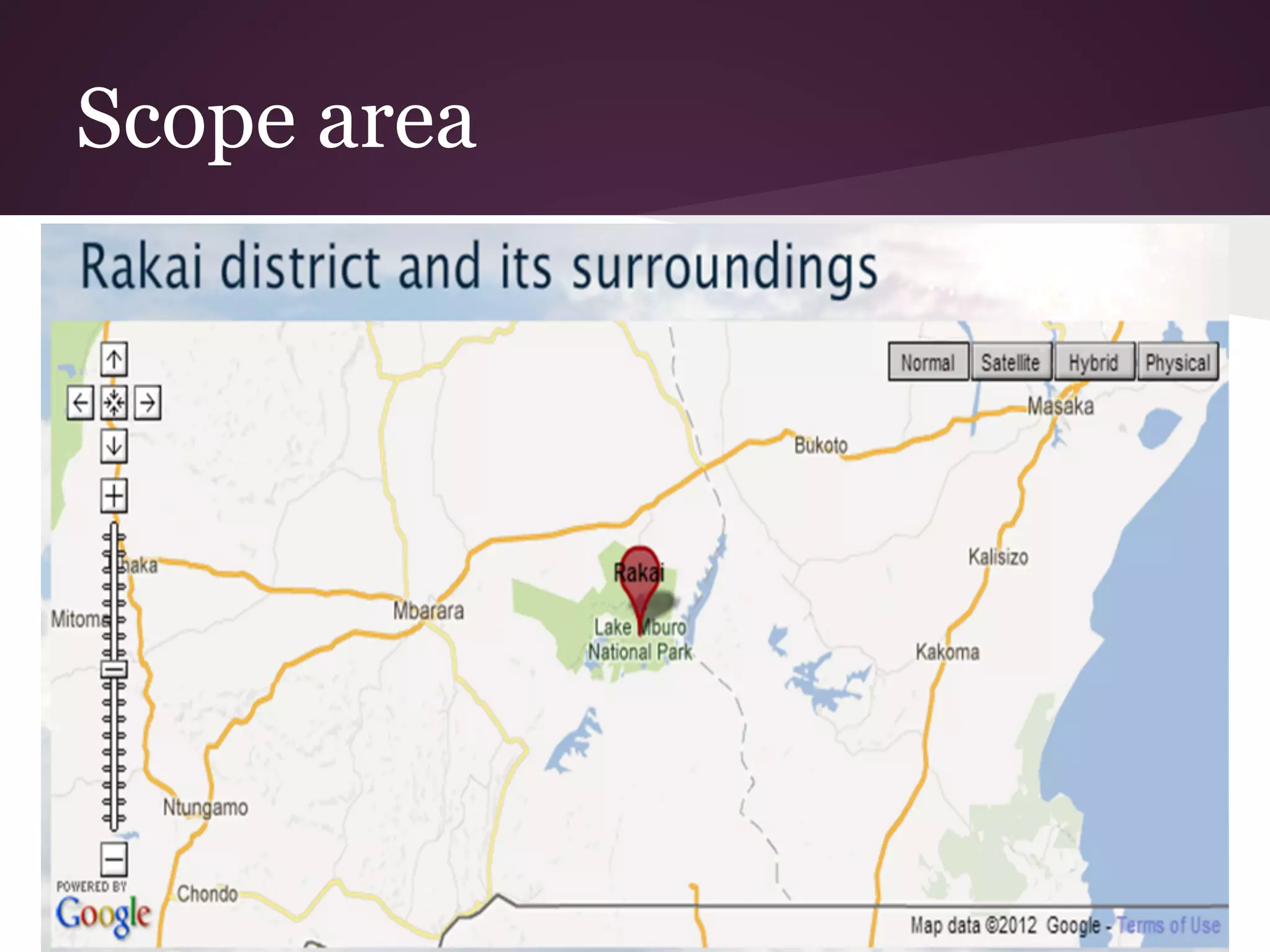
on one selected CIS implementing district site of
Rakai
introduction|literaturereview | relatedwork | methodology | conclusion
introduction| background | generalobjectives | specificobjectives | problemstatement | significance | theoreticalframework|theoreticalillustration
Scope area
Significance
● to contribute towards improvement of efficiency
and increase in effectiveness of the CIS
establishment and development
● enhanced CIS will facilitate regular and
sustainable monitoring of government, non-
government organizations (NGOs) and other
poverty eradication initiatives among
communities for timely appropriate evidence-
based policy formulation and decision making
introduction|literaturereview | relatedwork | methodology | conclusion
introduction| background | generalobjectives | specificobjectives | scope | problemstatement | theoreticalframework|theoreticalillustration
Theoretical framework
● Key concepts: web site, geospatial, CIS, database,
GIS, ICTs, programming languages, scripting,
maps, web hosting, blogs, multimedia,
● system development life cycle (SDLC) method for
prototype system development
● three tier architecture model as the preferred
model for prototype design
introduction|literaturereview | relatedwork | methodology | conclusion
introduction| background | generalobjectives | specificobjectives | scope | problemstatement | significance |theoreticalillustration
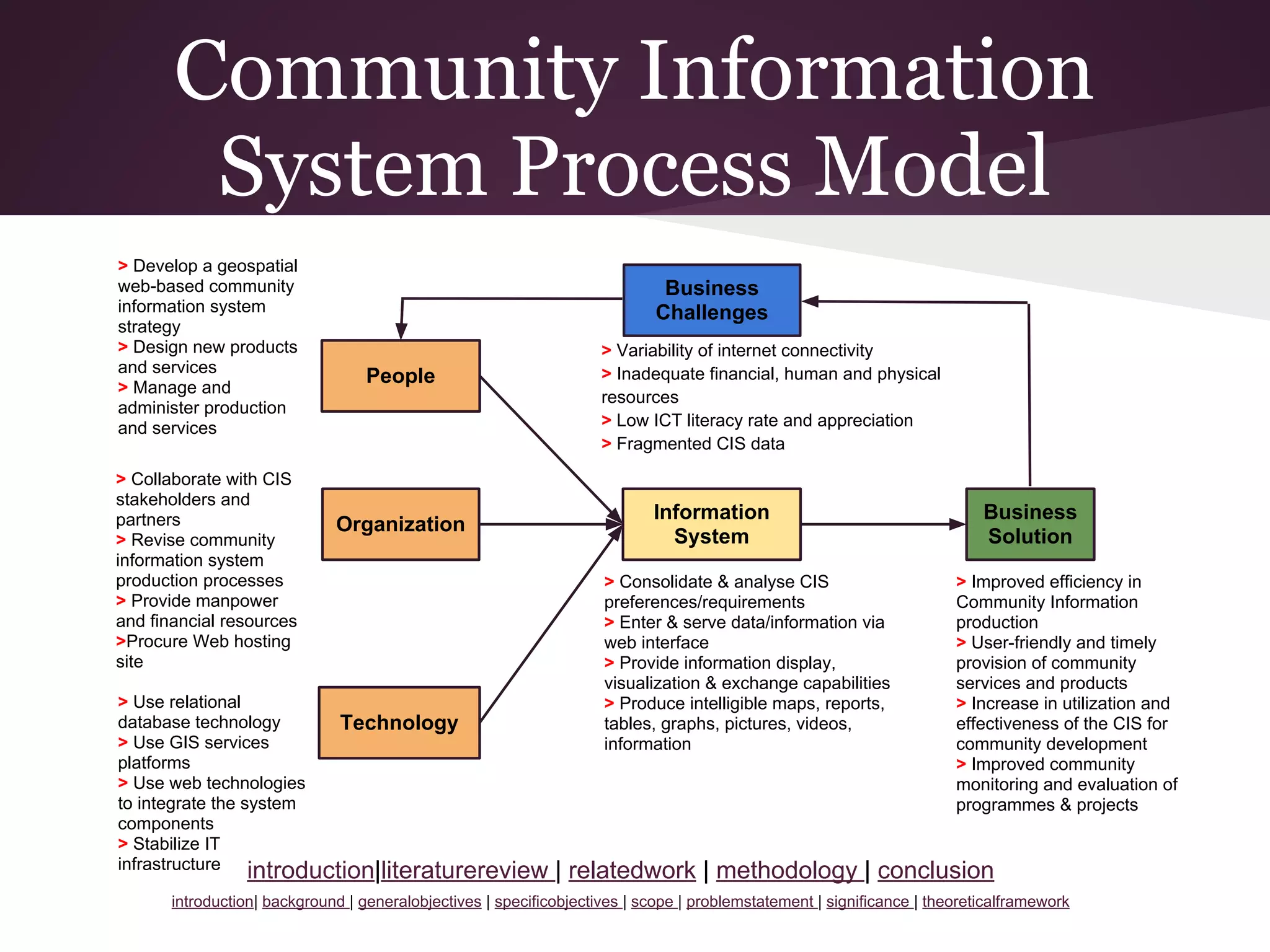
Community Information
System Process Model
People
Information
System
Business
Solution
Business
Challenges
Organization
Technology
> Develop a geospatial
web-based community
information system
strategy
> Design new products
and services
> Manage and
administer production
and services
> Consolidate & analyse CIS
preferences/requirements
> Enter & serve data/information via
web interface
> Provide information display,
visualization & exchange capabilities
> Produce intelligible maps, reports,
tables, graphs, pictures, videos,
information
> Improved efficiency in
Community Information
production
> User-friendly and timely
provision of community
services and products
> Increase in utilization and
effectiveness of the CIS for
community development
> Improved community
monitoring and evaluation of
programmes & projects
> Variability of internet connectivity
> Inadequate financial, human and physical
resources
> Low ICT literacy rate and appreciation
> Fragmented CIS data
> Collaborate with CIS
stakeholders and
partners
> Revise community
information system
production processes
> Provide manpower
and financial resources
>Procure Web hosting
site
> Use relational
database technology
> Use GIS services
platforms
> Use web technologies
to integrate the system
components
> Stabilize IT
infrastructure introduction|literaturereview | relatedwork | methodology | conclusion
introduction| background | generalobjectives | specificobjectives | scope | problemstatement | significance | theoreticalframework
Contents of the presentation
Introduction
● Literature review
● Related Work
● Methodology
introduction | literaturereview | relatedwork | methodology | conclusion
Literature review
● Introduction
● Database technologies
● Web technologies
● Geospatial technologies
● Research assumptions
● Study questions
introduction | relatedwork | methodology | conclusion
introduction | databasetechnologies | webtechnologies | geospatialtechnologies | researchassumptions | studyquestions
Introduction
● the right of access to information to all citizens
(Uganda Constitution 1995)
● A big percentage of population are rural
subsistence farmers who find it hard to access
information (UBOS Census report 2002)
● G2C, G2B & G2G connectivity programme through
National Backbone Infrastructure (ICT 2006)
● ICTs are a tool for poverty alleviation in
developing nations (Ssewanyana 2007)
introduction | literaturereview | relatedwork | methodology | conclusion
databasetechnologies | webtechnologies | geospatialtechnologies | researchassumptions | studyquestions
Database technologies
● many secure database management systems both
under open source and off-shelf software
applications
● desired DB includes that which would enable the
integration and configuration less cumbersome to
end user and light enough to do the work
● deployable by low-cost website hosting
● allowing multi-user capability,and capable of
inputting and outputting information in user
friendly manner
introduction | literaturereview | relatedwork | methodology | conclusion
introduction | webtechnologies | geospatialtechnologies | researchassumptions | studyquestions
Web technologies
● various programming language environs that are
deployable and recommended in modern dynamic
websites including PHP5, HTML5, .NET, ASP.
NET, JavaScript, AJAX, etc
● there a variety of internet service providers that
connect to the different rural areas in the country
● the different browsers accessible produce varying
results when it come to geo-info, latest being
based on Web 2.X series
introduction | literaturereview | relatedwork | methodology | conclusion
introduction | databasetechnologies | geospatialtechnologies | researchassumptions | studyquestions
Geospatial technologies
● limiting factor to the utilization of geospatial
applications is due to the initial high cost of
purchase of software and set-up requirements of
speed and memory for dedicated hardware
● alternative open-source software should be tested
for accessibility and functionality and ease of
manipulation and analysis
● installation and adaptability to local lower
government computer environments
introduction | literaturereview | relatedwork | methodology | conclusion
introduction | databasetechnologies | webtechnologies | researchassumptions | studyquestions
Research assumptions
● Availability of timely data collection from local
government rural communities
● Available and accessible internet connectivity at
the selected sites of the study
● Adequate financial, human and physical
resources for the study
● Information services and products will serve the
purpose of the local government community rural
development and rural initiative projects.
introduction | literaturereview | relatedwork | methodology | conclusion
introduction | databasetechnologies | webtechnologies | geospatialtechnologies | studyquestions
Study questions
● Can the present CIS be enhanced to capture data in
a user-friendly, accurate and timely manner?
● Can the existing web technologies be adopted in CI
production to support development planning and
at the various levels of local government?
● Can appropriate geospatial tools be integrated into
the current CIS infrastructure to generate
intelligible and evidence-based products and
services for rural community development?
● introduction | literaturereview | relatedwork | methodology | conclusion
introduction | databasetechnologies | webtechnologies | geospatialtechnologies | researchassumptions
Contents of the presentation
Introduction
Literature review
● Related Work
● Methodology
introduction | literaturereview | relatedwork | methodology | conclusion
Related work
● Canadian Geospatial Data Infrastructure
GeoSearch, an enabling technology for the users
to freely search for, identify, visualize and obtain
basic geographic and demographic data for areas
in Canada (UN Report 2009)
● WB report 2010, Uganda has not embraced fully
current trends in ICTs especially open source
geospatial web-based technologies
introduction | literaturereview | methodology | conclusion
Contents of the presentation
Introduction
Literature review
Related Work
● Methodology
introduction | literaturereview | relatedwork | methodology | conclusion
Methodology
● Introduction
● Requirements' specification
○ Primary data
○ Secondary data
● System analysis and design
● Implementation
● Testing
● Packaging
● Documentation
introduction | literaturereview | relatedwork | conclusion
introduction | requirementspecs | systemanalysis | implementation | testing | packaging | documentation
Introduction
● Case study methodology true essence, exploration
and research method that investigates
contemporary real-life phenomenon through
detailed contextual analysis of a limited number
of events or conditions, and their relationships
introduction | literaturereview | relatedwork | methodology | conclusion
requirementspecs | systemanalysis | systemdesign | implementation | testing | packaging | documentation
Requirements' specifications
● System Development Life Cycle technique to
be used
● different data gathering techniques shall be
used depending on the situation and the
respondents targeted including
questionnaires, interviews, secondary
data/information, district reports/plans,
current information systems at the district
introduction | literaturereview | relatedwork | methodology | conclusion
introduction | systemanalysis | systemdesign | implementation | testing | packaging | documentation
System analysis and design
● The analysis will be based on the user and system
requirements generated from the collected data
● features of the geospatialCIS prototype will be
specified to achieve all the required system
functionality in order to fulfill the objectives
● conceptual model consisting of the database, the
user interface and the communications part
● the three components will designed separately
but with proper interfaces to ensure proper
system integration and communication
introduction | literaturereview | relatedwork | methodology | conclusion
introduction | requirementspecs | systemdesign | implementation | testing | packaging | documentation
Implementation
● transforming of the developed designs into
functional system which will include development
of the database component, the algorithms, user
interfaces and geosystem integration through the
website communication component
● best practices as derived from the literature to be
further reviewed shall be used in web design,
database design and geospatial technology
integration
introduction | literaturereview | relatedwork | methodology | conclusion
introduction | requirementspecs | systemanalysis | testing | packaging | documentation
Testing
● developed prototype will be tested to satisfy the
system specification and meet the user needs
● test plan will be developed and run on a given set
of test data
● Unit testing will be carried out on all the different
components of the system individually as they
were developed and then system testing as whole
● Any discovered undesirable behavior will be
debugged and tested on web hosting servers and
different browsers and window platforms
introduction | literaturereview | relatedwork | methodology | conclusion
introduction | requirementspecs | systemanalysis | implementation | packaging | documentation
Packaging
● the installable pieces of the packages used and
their instructions shall be put together and
compiled for downloading and installation at the
user/clients machine.
● the server components shall be configured for the
levels of use to the guest users, authorized user
and administrator user roles, privileges and rights
introduction | literaturereview | relatedwork | methodology | conclusion
introduction | requirementspecs | systemanalysis | implementation | testing | documentation
Documentation
● The entire project documentation shall be written
according to the set guidelines for project
proposal report writing in partial fulfillment of the
award of Master of Science in Information
Systems, included shall be the code for the parts
of the different components for improvement and
evaluation, together with an enclosed installable
CD attached on the inside of the back page.
introduction | literaturereview | relatedwork | methodology | conclusion
introduction | requirementspecs | systemanalysis| implementation | testing | packaging
Contents of the presentation
Introduction
Literature review
Related Work
Methodology
● Conclusion
introduction | literaturereview | relatedwork | methodology | conclusion
Conclusion
● realization of a geospatial web-based community
information system will contribute towards CIS
aims and objectives
● increased availability of user-friendly information
to all major actors at lower local government rural
community socio-economic transformation and
development shall promote citizen access to
government geospatial data through use of free
and available ICTs.
introduction | literaturereview | relatedwork | methodology
Thank you

Project proposal geospatialweb'asedcis

  • 1.
    Towards A GeospatialWeb-Based Community Information System As An Efficient Approach for Social Service Delivery Information in Lower Local Government Project Proposal Presentation by Justus Bernard Muhwezi Reg. No.: 2012/HD18/252U
  • 2.
    Contents of thepresentation ● Introduction ● Literature review ● Related Work ● Methodology ● Conclusion introduction | literaturereview | relatedwork | methodology | conclusion
  • 3.
    Introduction of thestudy ● Introduction ● Background of the study ● Objectives ○ General objectives ○ Specific objectives ● Scope ● Statement of the problem ● Significance ● Theoretical framework literaturereview | relatedwork | methodology | conclusion introduction| background | generalobjectives | specificobjectives | scope | problemstatement | significance | theoreticalframework|theoreticalillustration
  • 4.
    Introduction ● project (hereaftercalled study) ● explore the use of available Information Communication Technology (ICT) platforms/ environments/software/hardware applicable in the lower local governments setting ● develop a geospatial web-based Community Information System (geospatialCIS) to facilitate efficient provision of community information products and services in a user-friendly and timely manner introduction|literaturereview | relatedwork | methodology | conclusion background | generalobjectives | specificobjectives | scope | problemstatement | significance | theoreticalframework|theoreticalillustration
  • 5.
    Background of thestudy ● International Monetary Fund (2003) recommendations to Ugandan Govt ● Poverty Eradication Action Plan (2005) findings and action plans ● Rural Development Strategy (2005) targeting rural areas ● National Development Plan (2010) priority areas of implementation introduction|literaturereview | relatedwork | methodology | conclusion introduction| generalobjectives | specificobjectives | scope | problemstatement | significance | theoreticalframework|theoreticalillustration
  • 6.
    Statement of theproblem ● the current functionality of CIS infrastructure is not efficient in production of community information products and services ● long process of delivering information is not timely and user-friendly ● the return-on-investment in information has not been harnessed in favor of rural community planning and decision making, since CIS was initiated in 2005 introduction|literaturereview | relatedwork | methodology | conclusion introduction| background | generalobjectives | specificobjectives | scope | significance | theoreticalframework|theoreticalillustration
  • 7.
    General objective ● Generalobjective of the study ○ to develop a geospatialCIS that will integrate geospatial, web-based and database technologies into CIS realization for improved information update and production, visualization, presentation, sharing, communication, management and utilization. introduction|literaturereview | relatedwork | methodology | conclusion introduction| background | specificobjectives | scope | problemstatement | significance | theoreticalframework|theoreticalillustration

  • 8.
    Specific objectives ● Specificobjectives include: ○ to construct a CIS spatial database (back-end application) ○ to develop a user-friendly multimedia website (front-end application) ○ to integrate geospatial technologies as a service linked to the back-end CIS spatial DBMS and front-end website application introduction|literaturereview | relatedwork | methodology | conclusion introduction| background | generalobjectives | scope | problemstatement | significance | theoreticalframework|theoreticalillustration
  • 9.
    Scope ● limited tothe geospatialCIS design comprising of geospatial web-based and database technologies, adequately enabled with capability for data management, visualization, user collaborative tools, information production and sharing based on one selected CIS implementing district site of Rakai introduction|literaturereview | relatedwork | methodology | conclusion introduction| background | generalobjectives | specificobjectives | problemstatement | significance | theoreticalframework|theoreticalillustration
  • 10.
  • 11.
    Significance ● to contributetowards improvement of efficiency and increase in effectiveness of the CIS establishment and development ● enhanced CIS will facilitate regular and sustainable monitoring of government, non- government organizations (NGOs) and other poverty eradication initiatives among communities for timely appropriate evidence- based policy formulation and decision making introduction|literaturereview | relatedwork | methodology | conclusion introduction| background | generalobjectives | specificobjectives | scope | problemstatement | theoreticalframework|theoreticalillustration
  • 12.
    Theoretical framework ● Keyconcepts: web site, geospatial, CIS, database, GIS, ICTs, programming languages, scripting, maps, web hosting, blogs, multimedia, ● system development life cycle (SDLC) method for prototype system development ● three tier architecture model as the preferred model for prototype design introduction|literaturereview | relatedwork | methodology | conclusion introduction| background | generalobjectives | specificobjectives | scope | problemstatement | significance |theoreticalillustration
  • 13.
    Community Information System ProcessModel People Information System Business Solution Business Challenges Organization Technology > Develop a geospatial web-based community information system strategy > Design new products and services > Manage and administer production and services > Consolidate & analyse CIS preferences/requirements > Enter & serve data/information via web interface > Provide information display, visualization & exchange capabilities > Produce intelligible maps, reports, tables, graphs, pictures, videos, information > Improved efficiency in Community Information production > User-friendly and timely provision of community services and products > Increase in utilization and effectiveness of the CIS for community development > Improved community monitoring and evaluation of programmes & projects > Variability of internet connectivity > Inadequate financial, human and physical resources > Low ICT literacy rate and appreciation > Fragmented CIS data > Collaborate with CIS stakeholders and partners > Revise community information system production processes > Provide manpower and financial resources >Procure Web hosting site > Use relational database technology > Use GIS services platforms > Use web technologies to integrate the system components > Stabilize IT infrastructure introduction|literaturereview | relatedwork | methodology | conclusion introduction| background | generalobjectives | specificobjectives | scope | problemstatement | significance | theoreticalframework
  • 14.
    Contents of thepresentation Introduction ● Literature review ● Related Work ● Methodology introduction | literaturereview | relatedwork | methodology | conclusion
  • 15.
    Literature review ● Introduction ●Database technologies ● Web technologies ● Geospatial technologies ● Research assumptions ● Study questions introduction | relatedwork | methodology | conclusion introduction | databasetechnologies | webtechnologies | geospatialtechnologies | researchassumptions | studyquestions
  • 16.
    Introduction ● the rightof access to information to all citizens (Uganda Constitution 1995) ● A big percentage of population are rural subsistence farmers who find it hard to access information (UBOS Census report 2002) ● G2C, G2B & G2G connectivity programme through National Backbone Infrastructure (ICT 2006) ● ICTs are a tool for poverty alleviation in developing nations (Ssewanyana 2007) introduction | literaturereview | relatedwork | methodology | conclusion databasetechnologies | webtechnologies | geospatialtechnologies | researchassumptions | studyquestions
  • 17.
    Database technologies ● manysecure database management systems both under open source and off-shelf software applications ● desired DB includes that which would enable the integration and configuration less cumbersome to end user and light enough to do the work ● deployable by low-cost website hosting ● allowing multi-user capability,and capable of inputting and outputting information in user friendly manner introduction | literaturereview | relatedwork | methodology | conclusion introduction | webtechnologies | geospatialtechnologies | researchassumptions | studyquestions
  • 18.
    Web technologies ● variousprogramming language environs that are deployable and recommended in modern dynamic websites including PHP5, HTML5, .NET, ASP. NET, JavaScript, AJAX, etc ● there a variety of internet service providers that connect to the different rural areas in the country ● the different browsers accessible produce varying results when it come to geo-info, latest being based on Web 2.X series introduction | literaturereview | relatedwork | methodology | conclusion introduction | databasetechnologies | geospatialtechnologies | researchassumptions | studyquestions
  • 19.
    Geospatial technologies ● limitingfactor to the utilization of geospatial applications is due to the initial high cost of purchase of software and set-up requirements of speed and memory for dedicated hardware ● alternative open-source software should be tested for accessibility and functionality and ease of manipulation and analysis ● installation and adaptability to local lower government computer environments introduction | literaturereview | relatedwork | methodology | conclusion introduction | databasetechnologies | webtechnologies | researchassumptions | studyquestions
  • 20.
    Research assumptions ● Availabilityof timely data collection from local government rural communities ● Available and accessible internet connectivity at the selected sites of the study ● Adequate financial, human and physical resources for the study ● Information services and products will serve the purpose of the local government community rural development and rural initiative projects. introduction | literaturereview | relatedwork | methodology | conclusion introduction | databasetechnologies | webtechnologies | geospatialtechnologies | studyquestions
  • 21.
    Study questions ● Canthe present CIS be enhanced to capture data in a user-friendly, accurate and timely manner? ● Can the existing web technologies be adopted in CI production to support development planning and at the various levels of local government? ● Can appropriate geospatial tools be integrated into the current CIS infrastructure to generate intelligible and evidence-based products and services for rural community development? ● introduction | literaturereview | relatedwork | methodology | conclusion introduction | databasetechnologies | webtechnologies | geospatialtechnologies | researchassumptions
  • 22.
    Contents of thepresentation Introduction Literature review ● Related Work ● Methodology introduction | literaturereview | relatedwork | methodology | conclusion
  • 23.
    Related work ● CanadianGeospatial Data Infrastructure GeoSearch, an enabling technology for the users to freely search for, identify, visualize and obtain basic geographic and demographic data for areas in Canada (UN Report 2009) ● WB report 2010, Uganda has not embraced fully current trends in ICTs especially open source geospatial web-based technologies introduction | literaturereview | methodology | conclusion
  • 24.
    Contents of thepresentation Introduction Literature review Related Work ● Methodology introduction | literaturereview | relatedwork | methodology | conclusion
  • 25.
    Methodology ● Introduction ● Requirements'specification ○ Primary data ○ Secondary data ● System analysis and design ● Implementation ● Testing ● Packaging ● Documentation introduction | literaturereview | relatedwork | conclusion introduction | requirementspecs | systemanalysis | implementation | testing | packaging | documentation
  • 26.
    Introduction ● Case studymethodology true essence, exploration and research method that investigates contemporary real-life phenomenon through detailed contextual analysis of a limited number of events or conditions, and their relationships introduction | literaturereview | relatedwork | methodology | conclusion requirementspecs | systemanalysis | systemdesign | implementation | testing | packaging | documentation
  • 27.
    Requirements' specifications ● SystemDevelopment Life Cycle technique to be used ● different data gathering techniques shall be used depending on the situation and the respondents targeted including questionnaires, interviews, secondary data/information, district reports/plans, current information systems at the district introduction | literaturereview | relatedwork | methodology | conclusion introduction | systemanalysis | systemdesign | implementation | testing | packaging | documentation
  • 28.
    System analysis anddesign ● The analysis will be based on the user and system requirements generated from the collected data ● features of the geospatialCIS prototype will be specified to achieve all the required system functionality in order to fulfill the objectives ● conceptual model consisting of the database, the user interface and the communications part ● the three components will designed separately but with proper interfaces to ensure proper system integration and communication introduction | literaturereview | relatedwork | methodology | conclusion introduction | requirementspecs | systemdesign | implementation | testing | packaging | documentation
  • 29.
    Implementation ● transforming ofthe developed designs into functional system which will include development of the database component, the algorithms, user interfaces and geosystem integration through the website communication component ● best practices as derived from the literature to be further reviewed shall be used in web design, database design and geospatial technology integration introduction | literaturereview | relatedwork | methodology | conclusion introduction | requirementspecs | systemanalysis | testing | packaging | documentation
  • 30.
    Testing ● developed prototypewill be tested to satisfy the system specification and meet the user needs ● test plan will be developed and run on a given set of test data ● Unit testing will be carried out on all the different components of the system individually as they were developed and then system testing as whole ● Any discovered undesirable behavior will be debugged and tested on web hosting servers and different browsers and window platforms introduction | literaturereview | relatedwork | methodology | conclusion introduction | requirementspecs | systemanalysis | implementation | packaging | documentation
  • 31.
    Packaging ● the installablepieces of the packages used and their instructions shall be put together and compiled for downloading and installation at the user/clients machine. ● the server components shall be configured for the levels of use to the guest users, authorized user and administrator user roles, privileges and rights introduction | literaturereview | relatedwork | methodology | conclusion introduction | requirementspecs | systemanalysis | implementation | testing | documentation
  • 32.
    Documentation ● The entireproject documentation shall be written according to the set guidelines for project proposal report writing in partial fulfillment of the award of Master of Science in Information Systems, included shall be the code for the parts of the different components for improvement and evaluation, together with an enclosed installable CD attached on the inside of the back page. introduction | literaturereview | relatedwork | methodology | conclusion introduction | requirementspecs | systemanalysis| implementation | testing | packaging
  • 33.
    Contents of thepresentation Introduction Literature review Related Work Methodology ● Conclusion introduction | literaturereview | relatedwork | methodology | conclusion
  • 34.
    Conclusion ● realization ofa geospatial web-based community information system will contribute towards CIS aims and objectives ● increased availability of user-friendly information to all major actors at lower local government rural community socio-economic transformation and development shall promote citizen access to government geospatial data through use of free and available ICTs. introduction | literaturereview | relatedwork | methodology
  • 35.