WORKING CAPITAL MANAGEMENTOF PULLMAC CRANES INDIA PVTLTD,
GHAZIABAD, UP, INDIA
1
A
RESEARCH PROJECT REPORT
On
PULL MAC CRANES INDIA PVT. LTD.
Submitted to:
SIKKIM MANIPAL UNIVERCITY
Master of Business Administration
WORKING CAPITAL MANAGEMENTOF PULLMAC CRANES INDIA PVTLTD,
GHAZIABAD, UP, INDIA
2
INDEX TABLE
SL.NO CONTENTS PAGE NO.
1
PART – I
 EXECUTIVE SUMMARY
2 TO 6
2
PART – II
 INTRODUCTION TO THE STUDY
 INDUSTRY PROFILE
7 TO 14
3
PART - III
 INTRODUCTION OF COMPANY
15 TO 35
4
PART - IV
 RESEARCH METHDOLOGY
 OBJECTIVES OF THE STUDY
36 TO 39
6
PART - V
 WORKING CAPITAL MANAGEMENT
40 TO 66
7
PART - VI
 DATA ANALYSISAND INTERPRETATION
67 TO 85
8
PART – VII
 FINDINGS
 SUGGESTIONS &
 CONCLUSIONS.
86 TO 89
9
ANNEXURE
 FINANCIALSTATEMENT.
 BIBILOGROPHY.
90 TO 92
WORKING CAPITAL MANAGEMENTOF PULLMAC CRANES INDIA PVTLTD,
GHAZIABAD, UP, INDIA
3
EXECUTIVE SUMMARY
 INDUSTRYPROFILE.
 COMPANY PROFILE.
 NEED FOR THE STUDY.
 OBJECTIVES OF THE STUDY.
 SCOPE OF THE STUDY.
 LIMITATIONS OF THE STUDY.
 METHODOLOGY.
 FINDINGS.
 SUGGESTIONS.
 CONCLUSION.
PART - I
WORKING CAPITAL MANAGEMENTOF PULLMAC CRANES INDIA PVTLTD,
GHAZIABAD, UP, INDIA
4
EXECUTIVE SUMMARY
Title of the study:
“The study of working capital management”
As a part of curriculum, every student studying MBA has to undertake a project on a particular subject
assigned to him/her. Accordingly I have been assigned the project work on the study of working capital
management in PULLMAC CRANES INDIA PRIVATE LIMITED.
Decisions relating to working capital (Current assets-Current liabilities) and short term financing are known
as working capital management. It involves the relationship between a firm’s short-term assets and its short
term liabilities.
The goal of working capital management is to ensure that the firm is able to continue its operation and that it
has sufficient cash flow to satisfy both maturing short term debt and upcoming operational expenses.
Working capital is used in PULLMAC CRANES INDIA PRIVATE LIMITED., for the following purpose:-
Raw material, work in progress, finished goods, inventories, sundry debtors, and day to day cash
requirements. The PULLMAC CRANES INDIA PRIVATE LIMITED.., keep certain funds which is automatically
available to finance the current assets requirements.
The various information regarding “Working Capital Management” such as classification, determinants,
sources have been discussed relating to PULLMAC CRANES INDIA PRIVATE LIMITED.,
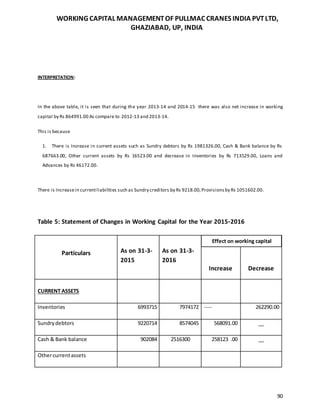
Ratio Analysis has been Carried out using Financial Information for last five accounting years i.e. from 2011
to 2016 Ratios like Working capital Turnover Ratio, Quick Ratio, Current Ratio, Inventory Turnover Ratio,
Debtor Turnover Ratio, Creditors turnover rario have also been analyzed. A Statement of Changes in
Working Capital has also been analyzed.
At PULLMAC CRANES INDIA PRIVATE LIMITED., the working capital management has shown increase in the
period of study. This shows working capital is managed effectively and all the other departments are working
in perfect co-ordination to ensure the progress of PULLMAC CRANES INDIA PRIVATE LIMITED., but I have
given some Suggestions & Conclusions on the basis of my Project Study.
WORKING CAPITAL MANAGEMENTOF PULLMAC CRANES INDIA PVTLTD,
GHAZIABAD, UP, INDIA
5
COMPANY PROFILE
Calcutta PULLMAC CRANES INDIA PRIVATE LIMITED was registered at Registrar of Companies Ghaziabad on 07
January, 1959 and is categorised as Company Limited by Shares and an Indian Non-Government Company.
PULLMAC CRANES INDIA PRIVATE LIMITED's Corporate Identification Number (CIN) is 15312WB1959PTC024089
and Registeration Number is 024089.
PULLMAC CRANES INDIA PRIVATE LIMITED is involved in Manufacturing – Crane Machine Assembling and
manufacturing Activity and currently company is in Active Status.
NEED FOR THE STUDY
 The study has been conducted for gaining practical knowledge about Working Capital Management &
activities PULLMAC CRANES INDIA PRIVATE LIMITED
 The study is undertaken as a part of the MBA curriculum from 01 June 2016 to
31st July 2016 in the form of summer in plant training for the fulfillment of the requirement of MBA
degree.
OBJECTIVES OF THE STUDY
 To study the sources and uses of the working capital.
 To study the liquidity position through various working capital related ratios.
 To study the working capital components such as receivables accounts,
Cash management, Inventory management.
 To make suggestions based on the finding of the study.
SCOPE OF THE STUDY
The scope of the study is identified after and during the study is conducted. The main scope of the study
was to put into practical the theoretical aspect of the study into real life work experience. The study of
working capital is based on tools like Ratio Analysis, Statement of changes in working capital. Further the study
is based on last5 years Annual Reports of Pullmac Cranes India PrivateLimited.
LIMITATIONS OF THE STUDY
 The study duration (summer in plant) is short.
 The analysis islimited to justfive years of data study (from year 2011 to year 2016) for financial analysis.
WORKING CAPITAL MANAGEMENTOF PULLMAC CRANES INDIA PVTLTD,
GHAZIABAD, UP, INDIA
6
 Limited interaction with the concerned heads due to their busy schedule.
 The findings of the study are based on the information retrieved by the selected unit.
METHDOLOGY
In preparingof this project the information collected from the followingsources.
Primary data:
The Primary data has been collected from Personal Interaction with CMA RAMJEEVAN GIRI, MR. DEEPAK TYAGI
and other staff members.
Secondary data:
The major source of data for this project was collected through annual reports, profit and loss account of 5 year’s
period from 2011-2016 & some more information collected from internet and text sources.
SAMPLING DESIGN
Samplingunit : Financial Statements.
SamplingSize : LastFive years financial statements.
Tools Used: MS-Excel has been used for calculations.
FINDINGS:
 Working capital of the Pullmac Cranes India Private Limited.. was increasing and showing positive working
capital per year.
 The Pullmac Cranes India Private Limited. has higher current and quick ratios are i.e., 2.87 and 2.30
respectively.So the company’s liquidity position isgood.It shows that it is ableto meet its current obligations.
SUGGESTIONS
 Working capital of the company has increasing every year. Profit also increasing every year this is good sign for
the company. It has to maintain itfurther, to run the business longterm.
WORKING CAPITAL MANAGEMENTOF PULLMAC CRANES INDIA PVTLTD,
GHAZIABAD, UP, INDIA
7
The Current and quick ratios are almost up to the standard requirement. So the Working capital management. Pull
Mac Cranes India PrivateLimited. is satisfactory and ithas to maintain itfurther.
CONCLUSION:
The study on working capital management conducted in Pullmac Cranes India PrivateLimited. to analyze
the financial position of the company. The company’s financial position is analyzed by usingthe tool of annual
reports from 20010-11 to 2015-16.
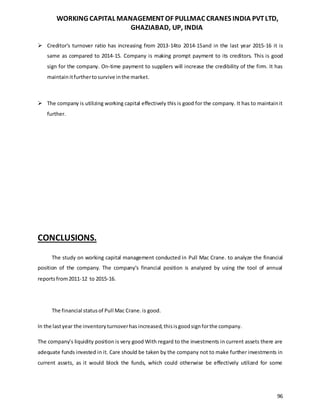
The financial status of Pullmac Cranes India Private Limited. is good. In the last year the inventory turnover has
increased,this is good sign for the company.
On the whole, the company is movingforward with excellent management.
WORKING CAPITAL MANAGEMENTOF PULLMAC CRANES INDIA PVTLTD,
GHAZIABAD, UP, INDIA
8
 INTRODUCTION TO THE STUDY
 INDUSTRY PROFILE
PART - II
WORKING CAPITAL MANAGEMENTOF PULLMAC CRANES INDIA PVTLTD,
GHAZIABAD, UP, INDIA
9
INTRODUCTION TO THE STUDY
BACKGROUND OF STUDY
"Cash is the lifeblood of business" is an often repeated maxim amongst financial managers. Working
capital management refers to the management of current or short-term assets and short-term liabilities.
Components of short-term assets include inventories,loans and advances, debtors,investments and cash and bank
balances. Short-term liabilities include creditors, trade advances, borrowings and provisions. The major emphasis
is, however, on short-term assets, since short-term liabilities arise in the context of short-term assets. It is
important that companies minimizerisk by prudent working capital management.
STATEMENT OF THE PROBLEM
This project deals with the study about “Working Capital Management” in Pullmac Cranes India Private
Limited
IMPORTANCE OF THE STUDY
There are numerous aspects of working capital management that makes it an important topic for the study.
The management of assets in any organization is an essential part of overall management. The enterprise, at the
time of formation attaches great importance to fixed assets management, as a part of investment decision-making.
However, in the overall day-to-day financial management, after the initial investment, the management gives
more importance to managing working capital. If we look at any financial statement it will be evident that the
investment in fixed assets remains more or less static but the working capital is constantly changing. A healthy
working capital position is the sine-qua-non of a successful business. This is reflected in adequate inventories,
lowest level of debtors, minimum utilization of bank facilities for working capital, etc. thus the study of working
capital management occupies an important placein financial management.
WORKING CAPITAL MANAGEMENTOF PULLMAC CRANES INDIA PVTLTD,
GHAZIABAD, UP, INDIA
10
INDUSTRIAL PROFILE
HISTORY
The manufacturing industry is one of the oldest domestic industries in India, contributing significantly
to both the industrial and economic growth of the country sinceit achieved independence
History of Industry in India dates back to the history of mankind. India’s handicrafts manufactured in village huts
and houses all over the country were prized in foreign countries.
Industrial Development in the Planning Era:
Immediately after independence, need to take solid steps for improvingindustrial scenewas badly felt.It was
realised thatindustrialisation was the only vehiclewhich could lead the shattered economy of the country on the
path of progress and prosperity.Consequently, industry attracted special attention of plans and planners
The First Five Year Plan (1951-56):
This plan became operational only four years after Independence. The main thrust of the plan was on agriculture
because the country was facingshortageof food-grains atthat time. Therefore, the emphasis was on increasing
capacity of existingindustries rather than startingnew ones. Cotton textile, sugar,vanaspati,cement, paper,
chemical and engineering industries showed some progress.
The Second Five Year Plan (1956-61):
This plan laid emphasison the development of basic and heavy industries and defined the key-role which the
public sector was to play in the economic development of the country. A comprehensive Industrial Policy
Resolution was announced on 20th April 1956.
The Third Five Year Plan (1961-66):
This plan laid stresson the expansion of basic industrieslikesteel,chemicals,fuel,power and machinebuilding.
The basic philosophy behind this plan was to lay foundation for a ‘self-generating’ economy. The Hindustan
MachineTools Limited had only one factory in the Second Plan and this number rose to five in the Third Plan.
The Fourth Five-Year Plan (1969-74):
Indian Economy started recoveringfrom recession atthe beginningof the Fourth Five Year Plan.But the growth
rate showed wide yearly fluctuations frompeak of 7.3 per cent in 1969-70 to zero growth in 1973-74 as againstthe
stipulated annual growth rate of 8-10 per cent.
WORKING CAPITAL MANAGEMENTOF PULLMAC CRANES INDIA PVTLTD,
GHAZIABAD, UP, INDIA
11
The Fifth Five Year Plan (1974-79):
The main emphasis of this plan was on rapid growth of core sector industries and increasethe production of
export oriented articles and articles of mass consumption.The average annual rateof growth was 8.21 per cent.
The public sector had assumed much importance.
The Sixth Five Year Plan (1980-85):
This plan marked a watershed in the development process which was initiated three decades ago with the
commencement of the firstplan.Although considerablegrowth was achieved duringthe firstfiveplans,much
thought could not be given to quality,costcompetitiveness or needs of modernisation.Thus high cost, low quality
production structure had emerged.
Seventh Five Year Plan (1985-1990):
This plan registered an annual growth rate of 8.5 per cent as againstthe target of 8.7 per cent. The plan aimed at
developing a ‘high tech’ and electronics industrial servicebase.Industrial dispersal,self employment, improving
the exploitation of the local resources,proper trainingwere the main planks of the plan.
Ninth Five Year Plan (1997-2002):
Industrial growth improved marginally to 6.6 per cent in 1997-98 but fell to 4.1 per cent in 1998-99.This decline
was probably caused by poor performance in miningand manufacturingsectors.The overall industrial outputgrew
by 6.7 per cent in 1999-2000,which again fell to 4.9 per cent in 2000-01 mainly dueto fall in manufacturingsector.
The Tenth Five Year Plan is still continuing.This plan targets a Gross Domestic Product(GDP) growth rate of eight
per cent and the growth target for industrial sector has been set at ten per cent. Presently, Indian Industry,
especially themanufacturingsector, is recordinga consistently high growth rate which shows robustness of Indian
Industry,particularly automobile/auto components and pharmaceutical sub-sectors.
For sustainingpaceof growth and investment, several initiativeshavebeen launched for modernising,technology
upgradation,reducingtransaction costs,increased exportthrust, so as to enhance its global competitiveness and
achievebalanced regional development.
Further, in order to give export thrust, Department of Commerce has launched major initiativessuch as
Assistances to States for InfrastructureDevelopment for Exports (ASIDE). Market Access Initiatives(MAI),Special
Economic Zones (SEZs) Policy,Modernisation of Director General of Foreign Trade (DGFT), etc.
For a balanced industrial development, industrial policy packages havebeen announced for special category states
of Uttaranchal,Himachal Pradesh,Jammu and Kashmir and North Eaststates. Social scarcity issues havebeen
addressed through insurancecover for workers in handloom,agro and rural industrial and processed marine
product sector.
Textile industry is a major employment intensive sector for which special schemes/packages were introduced.
Technology Upgrading Funds Scheme (TUFS) is one such scheme which is expected to improve the access for
decentralized powerloom sector. Textile Canter InfrastructureDevelopment Scheme (TCIDS) will take careof
infrastructuredevelopment aspect of textile industry.
Manufacturingsector has a shareof 79.36 per cent in the Index of Industrial Production (IIP).Duringtheyear 2002 -
03, the IIP grew at the rate of 5.8 per cent as compared to 2.1 per cent in 2001- 02. Manufacturingsector
WORKING CAPITAL MANAGEMENTOF PULLMAC CRANES INDIA PVTLTD,
GHAZIABAD, UP, INDIA
12
registered a growth rate of 6.0 per cent as against2.8 per cent during2001- 02.As per the use-based classification,
production of basic foods,capital goods,intermediate goods and consumer goods exhibited higher increaseduring
2002-03 as compared to 2001-02.
MANUFACTURING INDUSTRY STRUCTURE
 Highlyfragmentedandwidelydispersed.
 WesternIndiaaccountsfor 45-50% of total IndianManufacturing Industry.
FOREIGN TRADE
India exports approximately 7500 commodities to about 190 countries,and imports around 6000 commodities
from 140 countries.[9] Indiaexported US$318.2 billion and imported $462.9 billion worth of commodities in 2014.
Summary tableof recent India Foreign Trade
Year Export Import Trade Deficit
1999 36.3 50.2 -13.9
2000 43.1 60.8 -17.7
2001 42.5 54.5 -12.0
2002 44.5 53.8 -9.3
2003 48.3 61.6 -13.3
2004 57.24 74.15 -16.91
WORKING CAPITAL MANAGEMENTOF PULLMAC CRANES INDIA PVTLTD,
GHAZIABAD, UP, INDIA
13
2005 69.18 89.33 -20.15
2006 76.23 113.1 -36.87
2007 112.0 187.9 -75.9
2008 176.4 305.5 -129.1
2009 168.2 274.3 -106.1
2010 201.1 327.0 -125.9
2011 299.4 461.4 -162.0
2012 298.4 500.4 -202.0
2013 313.2 467.5 -154.3
2014 318.2 462.9 -144.7
2015[14] 310.3 447.9 -137.6
The top 10 commodity exports in 2014 were as follows:
Rank Commodity HS Code Value (US$ billion) Share (%)
WORKING CAPITAL MANAGEMENTOF PULLMAC CRANES INDIA PVTLTD,
GHAZIABAD, UP, INDIA
14
1 Refined Petroleum 27 61.2 19.2
2 Gems, precious metals, coins 71 41.2 13
3 Vehicles 87 14.5 4.6
4 Machines, engines, pumps 85 13.6 4.3
5 Organic chemicals 29 12.1 3.8
6 Pharmaceuticals 30 11.7 3.7
7 Cereals 10 10.1 3.2
8 Iron and steel 72 9.1 2.9
9 Clothing (not knit or crotchet) 58 9.1 2.9
10 Electronics 85 9.1 2.8
The top 10 commodity imports in 2014 were as follows:
Rank Commodity HS Code Value (US$ billion) Share (%)
1 Oil 27 177.5 38.3
2 Gems, precious metals, coins 71 60 13
WORKING CAPITAL MANAGEMENTOF PULLMAC CRANES INDIA PVTLTD,
GHAZIABAD, UP, INDIA
15
3 Electronics 85 32 6.9
4 Machines, engines, pumps 85 31.2 6.7
5 Organic chemicals 29 18.3 4
6 Plastics 39 11.8 2.6
7 Iron and steel 72 11.4 2.5
8 Animal/vegetable fats and oils 15 10.7 2.3
9 Ores, slag and ash 26 7.4 1.6
10 Medical and technical equipment 90 7.1 1.5
LISTS OF CRANES MANUFACTURE
LOADMATE
DEMAG
Electro Mech
Anupam Industries Limited
UNICON CRANES
Mukand Ltd
CRANEX LIMITED
REVA INDUSTRIES LTD
DC Hoist and Instruments Pvt. Ltd
K2 Cranes
WORKING CAPITAL MANAGEMENTOF PULLMAC CRANES INDIA PVTLTD,
GHAZIABAD, UP, INDIA
16
TYPES OF IRON
PigIron and its properties:
1. PigIron is a basic rawmaterial for all irons and produced fromblastfurnace.
2. It contains Carbon Percentage equal to 3-4%
3. PigIron from ore contains three basic forms of Iron
4. Castiron (Made from Cupola furnace)
5. Wrought Iron (Made from Pudding furnace)
6. Steel (Made from Bessemer converter)
WORKING CAPITAL MANAGEMENTOF PULLMAC CRANES INDIA PVTLTD,
GHAZIABAD, UP, INDIA
17
WroughtIron andits properties:
1. Wrought Iron is a mechanical mixtureof pure iron and silicateslag
2. Its Carbon Percentage is 0.02%to 0.03%
3. Wrought Iron is never cast
4. Wrought Iron is havinghigh ductile,corrosion resistant,fatigueresistant
5. It is havingTensilestrength: 3380-3500 kg per squarecentimeter and 2530-2670 kg per square
centimeter in transversedirection
6. Wrought Iron's melting point: 1510 degree C, Weight – 7680 kg per meter cube.
7. Wrought Iron's Poisson'sratio:0.3
MalleableCastIron and itsproperties:
1. MalleableCastIron is obtained fromhard &brittle white iron.,through a controlled heat
treatment conversion process.
2. MalleableCastIron is havingCarbon %: 2 to 3 %
3. MalleableCastIron havingmaterial properties likeHigh yield strength, ease of machinability,
corrosion resistanceand high youngmodulus
4. It is havingLow coefficientof thermal expansion and high wear resistance& dampingvibration.
5. ShrinkageAllowancefor this Iron is 1.5 mm / 100mm
6. MalleableCastIron is used to make Crank-shaft,rail road,universal jointetc.
Nodularcast iron(Ductile cast iron) andits properties:
1. Nodular castIron contains Carbon %: 3.2 % & 4.2 %
2. Nodular castIron is havingdampingcapacity intermediate between castiron & steel.
3. This iron is also havinghigh wear resistance
4. Application:Pump compressor,valve,i.c engines, pipe, paper industry,earth moving machinery.
5. Grey cast iron and its properties:
WORKING CAPITAL MANAGEMENTOF PULLMAC CRANES INDIA PVTLTD,
GHAZIABAD, UP, INDIA
18
Greycast iron can also be produced from pig iron.
1. Grey CastIron is an alloy of Carbon & silicon with iron.
2. Carbon percentage of Grey Cast Iron:2.5 to 3.8 %
3. Grey castiron is havingSelf damping,good antifriction properties and also havinglowestmelting
point. This is the reason why grey castiron is mostly used in machiningbed to reduce and absorb the
vibration dueto self dampingproperties.
4. Applications of Grey CastIron : Machine tool structure, manhole covers , piston rings,rollingmill.
Water pipes.
Whitecast iron andits properties:
1. Carbon Percentage of White CastIron : 1.8 % to 3.6 %
2. White castIron is not machinable
3. Shrinkageallowancefor this type of CastIron is 1 mm/ 100 mm.
WORKING CAPITAL MANAGEMENTOF PULLMAC CRANES INDIA PVTLTD,
GHAZIABAD, UP, INDIA
19
 INTRODUCTION OF COMPANY
 COMPANYPROFILE.
 VISIONAND MISSION.
 BOARD OF DIRECORS.
 OBJECTIVES OF PULL MAC CRANE.PVT.LTD.
 PRODUCT PROFILE OF PULL MAC
CRANE.PVT.LTD.
 EXPANSIONAND DIVERSIFICATION.
 SWOT ANALYSISOF PULL MAC CRANE.PVT.LTD
 ORGANIZATIONSTRUCTURE.
 DEPARTMENTAL STUDIES.
PART - III
WORKING CAPITAL MANAGEMENTOF PULLMAC CRANES INDIA PVTLTD,
GHAZIABAD, UP, INDIA
20
INTRODUCTION OF THE COMPANY
HISTORY OF THE COMPANY
Pullmac Cranes India Private Limited is a small-scale industry. The company purchased and constructed
building in the year 1993. It started production in the year 1995. It is a private company situated in the Industrial
estate, Ghaziabad, UP On the outskirts of Ghaziabad city which is enjoying all the required facilities like water,
power, transport,labors and good environment and materials.
The company is achieving its sales target with some ups and downs. The company has been receiving good
response from customers and expected to achieve better sales in coming years .The Company has its nature of
business.
The company has not accepted any deposits from public as per the provisions of section 58A of the
company Act, 1956.
PROFILEOF PULLMAC CRANES INDIA PRIVATELIMITED
WORKING CAPITAL MANAGEMENTOF PULLMAC CRANES INDIA PVTLTD,
GHAZIABAD, UP, INDIA
21
CAPITAL STRUCTURE OF PULLMAC CRANES INDIA PRIVATE LIMITED
SHARE CAPITAL:-
1. Authorized capital Rs 1000000
100000 equity shares of Rs. 10 each.
Subscribed/ paid-up sharecapital Rs. 1000000
100000equity shares of Rs .10 each.
Name of the company PULLMAC CRANES INDIA PRIVATE LIMITED
Year of establishment 1993.
Chairman
SHAKEEL AHMED SIDDIQUE
JAVED SIDDIQUE
IMRAN SIDDIQUE
Type of company Private Limited.
Area of operation
PULLMAC CRANES INDIA PRIVATE LIMITED.
B-65, HIG DUPLEX, SANJAY NAGAR, SECTOR-23 GHAZIABAD
UP 201001 IN
Nature of Business Manufacturing, Cranes Machine
Export places
Dandeli, Harihar, Goa, Hyderbad, Hubli, Dharwad,
Banglore, Nagpur, Belgaum.
No. of departments 6 [Six] Departments.
Number of employees 232
Number of working days 6 days in a week.
Production capacity 4 Cranes per month
Storage Capacity 50 cranes
WORKING CAPITAL MANAGEMENTOF PULLMAC CRANES INDIA PVTLTD,
GHAZIABAD, UP, INDIA
22
BORROWED FUND:-
The Company has taken long term loans from Corporation Bank Ghaziabad It has also taken unsecured loans from
its joint associate with PULL MAK MACHINE PVT LTD The company has also received government subsidy of 25%
on capital investments.
TABLE SHOWING THE LONG TERM LOANS TAKEN BY PULLMAC CRANES INDIA PRIVATE LIMITED
INVESTMENT IN FIXED ASSETS IS SOWN BELOW
SL.NO Fixed Assets Total Investment (Rs.)
1 Land and Building 30,00,000.00
2 Machinery 12,00,000.00
3 Adjacent Building 15,00,000.00
Year
Loan
Secured Loan Unsecured Loan
2011 -2012 2019216.00 569734.00
2012 – 2013 3651599.00 115000.00
2013 – 2014 3742360.00 2664000.00
2014 – 2015 2238845.00 2651471.00
2015 - 2016 2574672.00 3049192.00
WORKING CAPITAL MANAGEMENTOF PULLMAC CRANES INDIA PVTLTD,
GHAZIABAD, UP, INDIA
23
VISION AND MISSION OF PULLMAC CREANS PVT. LTD.
“VISION”
“To fulfill thegrowing demand of Alum and increasingtheproduction”
“MISSION”
1. To provideemployment.
2. Quality product,
3. Maximum satisfaction to customers.
4. To ensure enterprise growth.
5. To create clean and healthy environment.
6. To develop the establishingthe organization in the city.
COMPANY OWNERSHIP
 SHARE HOLDERS
 SHAKEEL AHMED SIDDIQUE
 JAVED SIDDIQUE
 IMRAN SIDDIQUE
 SALMAN HUSAIN
 GULAM ALI
 BOARD OF DIRECTORS
 SHAKEEL AHMED SIDDIQUE
 JAVED SIDDIQUE
 IMRAN SIDDIQUE
WORKING CAPITAL MANAGEMENTOF PULLMAC CRANES INDIA PVTLTD,
GHAZIABAD, UP, INDIA
24
 MANAGING DIRECTOR
 JAVED SIDDIQUE
 STAFF
NAMES DESIGNATION
Mr. CMA RJ GIRI. Nadkarni FinanceManager
Mr.V.R. Deshpande AdministrativeManager
Mr. Rajendra.Mahalkar Production Manager
Mr. Neil PurchaseManager
Mr. Patil Laboratory In-charge
Note: Marketing Department is handled by MD.
OBJECTIVES OF PULLMAC CRANES INDIA PRIVATE LIMITED
 To expand their market into other states.
 To modernize the organization by usingthe hi-tech machines in the production process.
 To increasethe productivity.
 To produce chemical into different area.
 To know the customer attitude towards alumChemical.
PRODUCT PROFILE:-
A crane is a type of machine, generally equipped with a hoist rope, wire ropes or chains, and sheaves, that can be
used both to lift and lower materials and to move them horizontally. It is mainly used for lifting heavy things and
transporting them to other places. It uses one or more simple machines to create mechanical advantage and thus
move loads beyond the normal capability of a human. Cranes are commonly employed in the transportindustry for
the loading and unloading of freight, in the construction industry for the movement of materials and in the
manufacturingindustry for the assemblingof heavy equipment.
WORKING CAPITAL MANAGEMENTOF PULLMAC CRANES INDIA PVTLTD,
GHAZIABAD, UP, INDIA
25
Cranes existin an enormous variety of forms – each tailored to a specific use.Sizes range from the smallestjib
cranes,used insideworkshops,to the tallesttower cranes,used for constructinghigh buildings.Mini -cranes are
also used for constructinghigh buildings,in order to facilitateconstructions by reachingtightspaces.Finally,we
can find larger floatingcranes,generally used to build oil rigs and salvagesunken ships.
Some liftingmachines do not strictly fitthe above definition of a crane, but are generally known as cranes,such as
stacker cranes and loader cranes.
MAJOR PRODUCTS OF THE COMPANY
 Vehicle Mounted Crane.
 Tower Crane.
 Rough Terrain Crane.
 Crawler Crane.
 All Terrain Crane.
 Railroad Crane.
 Telescopic Handler Crane
Vehicle Mounted Crane
 Tower Crane.
WORKING CAPITAL MANAGEMENTOF PULLMAC CRANES INDIA PVTLTD,
GHAZIABAD, UP, INDIA
26
Rough Terrain Crane.
Crawler Crane.
All Terrain Crane.
WORKING CAPITAL MANAGEMENTOF PULLMAC CRANES INDIA PVTLTD,
GHAZIABAD, UP, INDIA
27
EXPANSION AND DIVERSIFICATION
 Expansion of the company is under progress. The company is planning to produce Heavy
Machine evaporation of cranes related parts . Estimated investment in expansion process is Rs 27 cror.
The funds required for expansion is borrowed from bank through term loans. Expansion of the company is
likely to give 100 – 120 employment opportunities.
INFRASTRUCTURE FACILITIES PROVIDED BY PULL MACK CRANE PVT LTD:
WELFARE FACILITIES:
The workers in Pullmac Craneand Minerals aregiven some facilities for their.Betterment and comfort.
1. WASHING RESTING FACILITIES:
Facility for washing, storing, drying materials, resting first aid facilities have been provided inside the
factory for the benefits of workers on duty.
Telescopic Handler Crane.
Harbor Cranes.
WORKING CAPITAL MANAGEMENTOF PULLMAC CRANES INDIA PVTLTD,
GHAZIABAD, UP, INDIA
28
2. DRINKING WATER:
The company has made provision of clean, drinking water providing to the workers during the working
hours.There aredrinkingtaps and coolers placed in every department.
3 SHELTER AND LUNCHROOM:
After the workinghours to take rest rooms have been made by the company and to have food in
lunchtime.
4. CANTEEN:
Canteen is also provided to the workers. It runs on “no profit and no loss basis”.
5. PARKING FACILITIES:
As the raw materials arebrought in Lorries,there is a proper facility to park them and unload them.
SWOT ANALYSIS OF PULL MACE CRANE PVT LTD.
 STRENTHS
1. Availability of manpower.
2. High quality product.
3. Low pricehigh quality.
4. Availability of rawmaterials.
 WEAKNESS
1. Heavy transportcharges.
2. Major consumption in paper industries butlimited iron industries in india.
 OPPORTUNITIES
1. Technological up gradation.
2. Foreign market expansion.
3. Onlineorderingprocess.
4. Product expansion.
5. Market expansion.
 THREATS
1. Entry of competitors.
2. Product substitution.
WORKING CAPITAL MANAGEMENTOF PULLMAC CRANES INDIA PVTLTD,
GHAZIABAD, UP, INDIA
29
ORGANISATIONSTRUCTURE
DEPARTMENTAL STUDIES OF PULL MAC CRANE PVT LTD.
 PURCHASE DEPARTMENT.
 LABORATORY DEPARTMENT.
 ADMINISTRATION DEPARTMENT.
 PRODUCTION DEPARTMENT.
 FINANCE DEPARTMENT.
 MARKETING DEPARTMENT.
Manager
Manager
MANAGING DIRECTOR
Manager
PURCHASE DEPT LABORATORYDEPT
PRODUCTION
DEPT
ADMINISTRATION
DEPT
MARKETING DEPT
Laboratory
In-charge
Manager
FINANCE DEPT
WORKING CAPITAL MANAGEMENTOF PULLMAC CRANES INDIA PVTLTD,
GHAZIABAD, UP, INDIA
30
TABLE SHOWING SUPPLIERS RAW MATERIALS.
SL.NO SUPPLIERS LOCATION
1
Sponge Iron Manufacturers Association
NEW DELHI
2
Bhatia Steel Tubes
NEW DELHI
3 TATA STEEL INDIA
4 SALE INDIAL LIMITED BOKARO
5
PETROPOL INDIA LIMITED
INDOR
6 BALAJI INDUSTRIES KOLHAPUR
7
Ion Exchange (India) Ltd
DELHI
WORKING CAPITAL MANAGEMENTOF PULLMAC CRANES INDIA PVTLTD,
GHAZIABAD, UP, INDIA
31
 DESIGN DEPARTMENT
Design management is a business disciplinethatuses project management, design, strategy, and supply
chain techniques to control acreativeprocess,supporta cultureof creativity,and build a structureand
organization for design.The objective of design management is to develop and maintain an efficientbusiness
environment in which an organization can achieveits strategic and [[mission statement|mission goalsthrough
design. Design management is a comprehensive activity atall levels of business (operational to strategic),from the
discovery phaseto the execution phase."Simply put, design management is the business sideof design.Design
management encompasses the ongoing processes,business decisions,and strategies thatenableinnovation and
create effectively-designed products,services,communications,environments, and brands that enhance our
quality of lifeand provide organizational success."[1] Thedisciplineof design management overlaps with marketing
management, operations management, and strategic management
 PRODUCTION AND ASSEMBLING DEPARTMENT
The Production department is one of the important department in the company. It is the department that
produces the product on which the company is established.Special careis taken in this department on production.
Listof critical rawmaterials presently in the production of Alum.
PRODUCTS PRODUCED:
The company is engaged in the production of three types of Cranes
a. Vehicle Mounted Crane.
b. Tower Crane.
c. Rough Terrain Crane.
WORKING CAPITAL MANAGEMENTOF PULLMAC CRANES INDIA PVTLTD,
GHAZIABAD, UP, INDIA
32
 ADMINISTRATION DEPARTMENT:
Administration Department takes care of the whole activities happening in and around the company. The
personal manager heads the department and personal managers is responsible for the man power in the whole
factory. Personal Manager is concerned with the most efficient use of people to achieve organizati on and
individual goals.Itis theway of managing people at work so that they give the best to the organization.
Administration department also takes care of the planning, organizing, directing, controlling, procuring
and developing and integrating of the company and human resources to the end. It also looks after the financial
matters of the company.
FUNCTIONS:
 Maintenance of files,records etc.,
 Collectingand presenting the data in the form of useful information from the records.
 Maintenance of time management in the company.
 Insuringsmooth runningof the office files by interactingwith external agendas as required.
 Good relation between the employer and employee.
 Maintainingthefinancial matters of the company.
 Good relations with supplier and customers.
 Maintenance of salary,wages records.
 Keeping all therecords of all the departments.
 FINANCE DEPARTMENT:
Finance is an essential component of the business to maintain its operations effectively. This dept. is
concerned with day-to-day activities like purchases, sales salary etc. and proper management and maintenance of
accounts of concerned year.
SincePullmac CranePvt. Ltd is the small scaleindustry itmaintainsvery good accountingsystem,
The whole financial matter is mainly dealtby the separatedept called financedept.
The Major sources of financeare,
1. Shares ( Equity Shares)
2. Loan from corporation banks.
FUNCTIONS:
WORKING CAPITAL MANAGEMENTOF PULLMAC CRANES INDIA PVTLTD,
GHAZIABAD, UP, INDIA
33
 Recording day to day transactions in a systematic manner.
 Maintainingproper accounts of purchases and sales.
 Maintainingprofit& loss A/c and Preparingthe Balancesheet of PULL MAC CRANE systematically.
 Payingthe interest on loans at righttime.
 Maintain & payingthe tax’s & insurance.
 Make useof availablefinanceresources properly.
 Maintain liquidity of assets properly to earn the maximum profit.
 MARKETING DEPARTMENT:
Marketing Department is also a one of the important department in the company. This department is
important because it gives a clear picture of how much to produce? Which will also help in the investment to he
made and to purchasedepartment to purchaserawmaterials.
The marketing department has a procedure, by which it is done i.e., fit receives the order from the buyers and
forwards the order to the production department and as per the order production department produces the
required production and it makes the packingof materials and sends itto the buyers as per the order.
Marketing department also take care of the time given to it by the buyer to produce the product. If there is any
default in the order such as product not as per order or not at time or minimum product supplied the party will
send back the sample to the organization and the organization gives certain percentage of discount for the default
but no replacement is made
THE SOME OF THE IMPORTANT CUSTOMERS OF THE CALCUTTA UDYOG PVT LTD., ARE:-
TABLE SHOWING CUSROMERS
SL.NO CUSTOMERS LOCATION
1 WEST COAST PAPER MILLS LIMITED DANDELI
2 GRASIM INDUSTRIES LTD HARIHAR
WORKING CAPITAL MANAGEMENTOF PULLMAC CRANES INDIA PVTLTD,
GHAZIABAD, UP, INDIA
34
3 ZUARI INDUSTRIES LTD GOA
4 BALKRISHNA HARIKRISHNA KARWA HYDERBAD
5 KARAVEERA BADHRA TRADERS HUBLI
6 KIT LAB DHARWAD
7 MAHENDRA CHEMICALS BANGLORE
8 NUCLEAR POWER CORPORATION KAIGA
9 SAMAR CHEMICALS BANGLORE
10 SHREYAS PAPER MILLS DANDELI
11 VICCO LABORATORIES NAGPUR
12 SHRI LAXMI INDUSTRIES BELGAUM
WORKING CAPITAL MANAGEMENTOF PULLMAC CRANES INDIA PVTLTD,
GHAZIABAD, UP, INDIA
35
 RESEARCH METHDOLOGY.
 SCOPE OF THE STUDY.
 OBJECTIVES OF THE STUDY.
 METHDOLOGY.
PART - IV
WORKING CAPITAL MANAGEMENTOF PULLMAC CRANES INDIA PVTLTD,
GHAZIABAD, UP, INDIA
36
SCOPE OF THE STUDY
The scope of the study is identified after and during the study is conducted. The main scope of the study was to
put into practical the theoretical aspect of the study into real life work experience. The study of working capital is
based on tools like Ratio Analysis, Statement of changes in working capital. Further the study is based on last 5
years Annual Reports of Pull Mac Cranes pvt ltd.
OBJECTIVES OF THE STUDY
 To study the sources and uses of the workingcapital.
 To study the liquidity position through various workingcapital related ratios.
 To study the working capital components such as receivables accounts,
Cash management, Inventory management.
 To make suggestions based on the findingof the study.
RESEARCH METHDOLOGY
INTRODUCTION:
Research methodology is a way to systematically solvetheresearch problem. It May be understood as a scienceof
studyingnow research is done systematically.In thatvarious steps,those aregenerally adopted by a researcher in
studyinghis problemalongwith the logic behind them.
“The procedures by which researcher go about their work of describing, explaining and predicting phenomenon
are called methodology”.
TYPE OF RESEARCH:
This project “A Study on Working Capital Management of Pull Mac Crane Pvt Ltd. is considered as an analytical
research.
WORKING CAPITAL MANAGEMENTOF PULLMAC CRANES INDIA PVTLTD,
GHAZIABAD, UP, INDIA
37
Analytical Research is defined as the research in which,researcher has to usefacts or information already
available,and analyzethese to make a critical evaluation of the facts,figures,data or material.
SOURCE OF RESEARCH DATA:
There are mainly two through which the data required for the research is collected.
PRIMARY DATA:
The primary data is that data which is collected fresh or firsthand,and for firsttime which is original in nature.
In this study the Primary data has been collected from Personal Interaction with Finance manager i.e., Mr. CMA R.J
GIRI. and other staff members.
SECONDARY DATA:
The secondary data are those which have already collected and stored. Secondary data easily get those secondary
data from records,annual reports of the company etc. Itwill savethe time, money and efforts to collectthe data.
The major source of data for this project was collected through annual reports, profit and loss account of 5 year
period from 2011-2016 & some more information collected from internet and text sources.
SAMPLING DESIGN
Samplingunit : Financial Statements.
SamplingSize : Lastfive years financial statements.
Tool Used for calculations:- MS-Excel.
TOOLS USED FOR ANALYSIS OF DATA
The data were analyzed usingthe followingfinancial tools.They are
 Ratio analysis.
 Statement of changes in working capital.
WORKING CAPITAL MANAGEMENTOF PULLMAC CRANES INDIA PVTLTD,
GHAZIABAD, UP, INDIA
38
LIMITATIONS OF THE STUDY
 The study duration (summer in plant) is short.
 The analysis islimited to justfive years of data study (from year 20011 to year 2016) for financial analysis.
 Limited interaction with the concerned heads due to their busy schedule.
 The findings of the study are based on the information retrieved by the selected unit.
WORKING CAPITAL MANAGEMENTOF PULLMAC CRANES INDIA PVTLTD,
GHAZIABAD, UP, INDIA
39
 WORKING CAPITAL MANAGEMENT.
 INTRODUCTION.
 MEANIG OF CAPITAL.
 MEANING OF WORKING CAPITAL.
 NEED OF WORKING CAPITAL.
 CLASSIFICATION OF WORKING CAPITAL.
 ESTIMATION OF “WC” REQIUREMENTS
 OPERATING CYCLE OF WORKING CAPITAL.
 FINANCING OF WORKING CAPITAL.
 DETERMINANTS OF “WC” REQUIREMENTS.
 COMPONENTS OF “W C M”.
PART - V
WORKING CAPITAL MANAGEMENTOF PULLMAC CRANES INDIA PVTLTD,
GHAZIABAD, UP, INDIA
40
Introduction:
Capital is the keynote of economic development. In this modern age, the level of economic development
is determined by the proportion of capital available.
Meaning of Capital:
In the ordinary sense of the word Capital means initial investment invested by businessman or owner at the time
of commencing the business. Capital (economics), a factor of production that is not wanted for itself but for its
ability to help in producingother goods.
Definition:
Capital is a factor of production with a specific, changeable value attached to it that could, potentially, provide its
owner with more wealth. It is an abstract economic concept, and, as such, has many different definitions and
classifications, but the unifying feature of capital is that it has a certain value, so it in itself is a type of wealth, and
it has the potential of generating more wealth.
Features of Capital:
Capital has thefollowingfeatures.
1. Capital is a man made.
2. Capital is a perishable.
3. Capital is a human control possible.
4. Capital is a mobile.
5. Capital is a human sacrifice.
6. Capital is a scarce.
7. Capital is a passivefactor.
INTRODUCTION OF WORKING CAPITAL:
Workingcapital isthelifeblood and nerve centre of a business.Justas circulation of blood is essential in the
human body for maintaininglife,workingcapital is very essential to maintain thesmooth runningof a business.No
business can run successfully withoutan adequate amount of working capital.
WORKING CAPITAL MANAGEMENTOF PULLMAC CRANES INDIA PVTLTD,
GHAZIABAD, UP, INDIA
41
There is operative aspects of working capital i.e. current assets which is known as funds also employed to the
business process from the gross working capital Current asset comprises cash receivables, inventories, marketable
securities held as short term investment and other items nearer to cash or equivalent to cash. Working capital
comes into business operation when actual operation takes place generally the requirement of quantum of
working capital is determined by the level of production which depends upon the management attitude towards
risk and the factors which influence the amount of cash, inventories, receivables and other current assets required
to supportgiven volume of production.
Working capital management as usually concerned with administration of the current assets as well as current
liabilities. The area includes the requirement of funds from various resources and to utilize them in all result
oriented manner. It can be stated without exaggeration that effective working capital management is the short
requirement of longterm success.
The importance of working capital management is indisputable; Business liability relies on its ability to effective
management of receivables, inventory, and payables. By minimizing the amount of funds tied up in current assets.
Firms are able to reduce financing costs or increase the funds available for expansion. Many managerial efforts are
put into bringingnon-optimal level of current assets and liabilities back towards their optimal levels.
MEANING OF WORKING CAPITAL
Workingcapital means the funds (i.e.; capital) availableand used for day to day operations (i.e.; working) of an
enterprise. It consists broadly of that portion of assets of a business which areused in or related to its current
operations.It refers to funds which areused duringan accountingperiod to generate a current income of a type
which is consistentwith major purpose of a firm existence.
In Accounting:
DEFINITIONS:
Many scholars’gives many definitions regardingterm workingcapital someof these are given below.
WORKING CAPITAL MANAGEMENTOF PULLMAC CRANES INDIA PVTLTD,
GHAZIABAD, UP, INDIA
42
Accordingto Weston & Brigham
“Working capital refers to a firm’s investment in short-term assets cash, short term securities,
accounts receivables and inventories.
Mead Mallott & Field
“Working capital means currentassets”.
Bonnerille
“Any acquisition of funds which increases the current assets increases working capital for they are one
and the same”.
Positive working capital means that the company is able to pay off its short-term liabilities companies that have a
lot of workingcapital will bemore successful sincethey can expand and improve their operations.
Negative working capital means that a company currently is unable to meet its short-term liabilities with its
current assets.. Companies with negative workingcapital may lack the funds necessary for growth
OBJECTIVES OF WORKING CAPITAL MANAGEMENT
Effective management of working capital ismeans of accomplishingthe firm’s goal of adequate liquidity.Itis
concerned with the administration of currentassets and current liabilities.Ithas the main followingobjectives-
1. To maximizeprofitof the firm.
2. To help in timely payment of bills.
3. To maintain sufficientcurrentassets.
4. To ensure adequate liquidity of the firms.
5. It protects the solvency of the firm.
WORKING CAPITAL MANAGEMENTOF PULLMAC CRANES INDIA PVTLTD,
GHAZIABAD, UP, INDIA
43
6. To dischargecurrentliabilities.
7. To increasethe valueof the firm.
8. To minimizethe risk of business.
THE NEED FOR THE WORKING CAPITAL
The need for working capital arises due to the time gap between production and realization of cash from sales.
Working capital is must for every business for purchasing raw-materials, semi finished goods, stores & spares etc
and the followingpurposes.
1. To purchase raw materials, spare parts and other component.
A manufacturing firm needs raw-materials and other components parts for the purpose of converting
them in to final products, for this purpose it requires working capital. Trading concern requires less working
capital.
2. To meet over head expenses.
Working capital is required to meet recurring over head expenses such as cost
of fuel, power, office expenses and other manufacturingexpenses.
3. To hold finished and spare parts etc.
Stock represents current asset. A firm that can afford to maintain stock of required finished goods,
work in progress & spares in required quantities can operate successfully. So for that adequate quantity of
working capital isrequired.
4. To pay selling & distribution expenses.
Working capital is required to pay selling & distribution expenses. It includes cost of packing,
commission etc.
5. Workingcapital isrequired for repairs & maintenance both machinery as well as factory buildings.
6. Workingcapital is required to pay wages, salaries and other charges.
7. It is helpful in maintain uncertaintiesinvolved in businessfield.
WORKING CAPITAL MANAGEMENTOF PULLMAC CRANES INDIA PVTLTD,
GHAZIABAD, UP, INDIA
44
WORKING CAPITAL MANAGEMENT
Working Capital Management refers to management of current assets and current Liabilities. The major thrust of
course is on the management of current assets .This Ii understandable because current liabilities arise in the
context of current assets. Working Capital Management is a significant fact of financial management. Its
Importance stems from two reasons:-
 Investment in current assets represents a substantial portion of total investment.
 Investment in current assets and the level of current liabilities have to be geared quickly to change in sales. To
be sure, fixed asset investment and long term financing are responsive to variation in sales. However, this
relationship isnotas closeand directas itis in the caseof working capital components.
CLASSIFICATION OF WORKING CAPITAL
WORKING CAPITAL
On The Basis of Concepts On The Basis of Time
Gross Working
Capital
NetWorking
Capital
Permanent/Fixed
WorkingCapital
Temporary/
Fluctuating
WorkingCapital
Initial Working
Capital
RegularWorking
Capital
Seasonal Working
Capital
Special Working
Capital
WORKING CAPITAL MANAGEMENTOF PULLMAC CRANES INDIA PVTLTD,
GHAZIABAD, UP, INDIA
45
I. On The Basis of Concepts
1) Gross Working Capital
Gross working capital is the amount of funds invested in various components of current assets. Current assets
are those assets which are easily / immediately converted into cash within a short period of time say, an
accounting year. Current assets includes Cash in hand and cash at bank, Inventories, Bills receivables, Sundry
debtors, short term loans and advances.
This concept has the followingadvantages:-
i. Financial managers areprofoundly concerned with the current assets.
ii. Gross workingcapital provides thecorrect amount of working capital atthe right time.
iii. It enables a firm to realizethe greatest return on its investment.
iv. It helps in the fixation of various areas of financial responsibility.
v. It enables a firm to plan and control funds and to maximize the return on investment.
For these advantages,gross workingcapital has becomea more acceptableconcept in financial management.
1) Net Working Capital
This is the difference between current assets and current liabilities. Current liabilities are those that are
expected to mature within an accountingyear and includecreditors,billspayableand outstandingexpenses.
Working Capital Management is no doubt significant for all firms, but its significance is enhanced in cases of small
firms. A small firm has more investment in current assets than fixed assets and therefore current assets should be
efficiently managed.
The working capital needs increase as the firm grows. As sales grow, the firm needs to invest more in debtors and
inventories.The financemanager should be aware of such needs and financethem quickly.
II. On The Basis of Concepts
1) Permanent / Fixed Working Capital
Permanent or fixed working capital is minimum amount which is required to ensure effective utilization of
fixed facilities and for maintaining the circulation of current assets. Every firm has to maintain a minimum level of
raw material, work- in-process, finished goods and cash balance. This minimum level of current assts is called
permanent or fixed working capital as this part of working is permanently blocked in current assets. As the
business growthe requirements of workingcapital also increases dueto increasein currentassets.
WORKING CAPITAL MANAGEMENTOF PULLMAC CRANES INDIA PVTLTD,
GHAZIABAD, UP, INDIA
46
a) Initial working capital
At its inception and during the formative period of its operations a company must have enough cash fund
to meet its obligations.The need for initial workingcapital isfor every company to consolidateits position.
b) Regular working capital
Regular working capital refers to the minimum amount of liquid capital required to keep up the circulation
of the capital from the cash inventories to accounts receivable and from account receivables to back again
cash. It consists of adequate cash balance on hand and at bank, adequate stock of raw materials and
finished goods and amount of receivables.
2) Temporary / Fluctuating Working Capital
Temporary / Fluctuating working capital is the working capital needed to meet seasonal as well as unforeseen
requirements. It may be divided into two types.
a) Seasonal Working Capital
There are many lines of business where the volume of operations are different and hence the amount of
working capital vary with the seasons. The capital required to meet the seasonal needs of the enterprise is known
as seasonal Workingcapital.
Special Working Capital
The Capital required to meet any special operations such as experiments with new products or new techniques of
production and making interior advertisingcampaign etc, arealso known as special Working Capital.
IMPORTANCE OF WORKING CAPITAL
1. Solvency of the business: Adequate working capital helps in maintaining the solvency of the business by
providinguninterrupted of production.
2. Goodwill : Sufficient amount of working capital enables a firm to make prompt payments and makes and
maintain the goodwill.
3. Easy loans: Adequate working capital leads to high solvency and credit standing can arrange loans from
banks and other on easy and favorable terms.
4. Cash discounts: Adequate working capital also enables a concern to avail cash discounts on the
purchases and hence reduces cost.
WORKING CAPITAL MANAGEMENTOF PULLMAC CRANES INDIA PVTLTD,
GHAZIABAD, UP, INDIA
47
5. Regular Supply of Raw Material: Sufficient working capital ensures regular supply of raw material and
continuous production.
6. Regular payment of salaries, wages and other day to day commitments: It leads to the satisfaction of the
employees and raises the morale of its employees, increases their efficiency, reduces wastage and costs
and enhances production and profits.
7. Exploitation of favorable market conditions: If a firm is having adequate working capital then it can
exploit the favorable market conditions such as purchasing its requirements in bulk when the prices are
lower and holdings its inventories for higher prices.
8. Ability to Face Crises: A concern can face the situation duringthe depression.
9. Quick and regular return on investments: Sufficient working capital enables a concern to pay quick and
regular of dividends to its investors and gains confidence of the investors and can raise more funds in
future.
10. High morale: Adequate working capital brings an environment of securities, confidence, high morale
which results in overall efficiency in a business.
ADEQUACY OF WORKING CAPITAL:
Working capital should be adequate so as to protect a business from the adverse effects of shrinkage in
the values of current assets. It ensures to a greater extent the maintenance of a company’s credit standing and
provides for such emergencies as strikes, floods, fire etc. It permits the carrying of inventories at a level that
would enable a business to serve satisfactorily the needs of its customers. It enables a company to operate its
business moreefficiently because there is no delay in obtainingmaterials etc;becauseof creditdifficulties.
INADEQUATE OF WORKING CAPITAL:
When working capital is inadequate, a company faces many problems. It stagnates the growth and it
becomes difficult for the firm to undertake profitable projects for non-availability of working capital funds.
Difficulty in implementing operating plans and achieving the firm’s profit targets. Operating inefficiencies creep in
when it becomes difficult even to meet day-to-day commitments. Fixed assets are not utilized efficiently thus the
firm’s profitability would deteriorate. Paucity of working capital funds renders the firm unable to avail attractive
WORKING CAPITAL MANAGEMENTOF PULLMAC CRANES INDIA PVTLTD,
GHAZIABAD, UP, INDIA
48
credit opportunities. The firm loses its reputation when it is not in a position to honor it short-term obligations
thereby leadingto tight creditterms.
DANGERS OF EXCESSIVE WORKING CAPITAL:
Too much working capital isas dangerous astoo littleof it. Excessiveworkingcapital raisesproblems.
1. It results in unnecessary accumulation of inventories. Thus chances of inventory mishandling, waste, theft
and losses increase.
2. Indication of defective credit policy and slack collection period. Consequently, it results in higher
incidenceof bad debts, adversely affectingprofits,
3. Makes the management complacent which degenerates in to managerial inefficiency.
4. The tendencies of accumulating inventories to make a speculative profit, which tends to liberalize the
dividend policy, make it difficult for the concern to cope in the future when it is not able to make
speculativeprofits.
ESTIMATION OF WORKING CAPITAL REQIUREMENTS
Managing the working capital is a matter of balance. The firms must have sufficient funds on hand to meet
its immediate needs. The Pull Mac Crane Pvt. Limited is manufacturingoriented organization.
The followingaspects haveto be taken into consideration whileestimatingthe working capital requirements.
They are:
1. Total costs incurred on material,wages and overheads.
2. The length of time for which raw material are to remain in stores before they are issued for
production.
3. The length of the production cycle or work-in-process, i.e., the time taken for conversion of raw
material into finished goods.
4. The length of sales cycleduringwhich finished goods to be kept waitingfor sales.
5. The average period of creditallowed to customers.
6. The amount of cash required payingday-today expenses of the business.
WORKING CAPITAL MANAGEMENTOF PULLMAC CRANES INDIA PVTLTD,
GHAZIABAD, UP, INDIA
49
7. The average amount of cash required to make advancepayments.
8. The average credit period expected to be allowed by suppliers.
9. Time lagin the payment of wages and other expenses.
OPERATING CYCLE OF WORKING CAPITAL:
The working capital cyclereserves to the length of time between the firmpayingcash for materials etc., this
working capital also known as operatingcycle. Workingcapital cycleor operatingcycleindicates the length or time
between companies payingfor materials entering into stock and receivingthe cash from sales of finished goods.
The operating cycle(Working Capital) consistsof the followingevents. Which continues throughout the lifeof
business?
RAW
MATERIALS
WORK-IN-PROGRESSFINISHED STOCK
DEBTORS
CASH
WORKING CAPITAL MANAGEMENTOF PULLMAC CRANES INDIA PVTLTD,
GHAZIABAD, UP, INDIA
50
 Conversion of cash into rawmaterials.
 Conversion of raw materials into work in progress.
 Conversion of work in progress into finished stock.
 Conversion of finished stock into accounts receivables(Debtors)through saleand
 Conversion of accountreceivables into cash.
FINANCING OF WORKING CAPITAL
 Introduction:
 After determining the level of workingcapital,a firmhas to decide how it is to be financed.
 In that Pull Mac Crane , it was financing the working capital from the following four common sources.
They are,
1. SHARES:
The Pull Mac Crane has issued the equity shares for raising the funds. The Equity shares do not have any fixed
commitment charges and the dividend on these shares is to be paid subject to the availability of sufficient funds.
These funds have been injected from the company’s own personal resources and fromthe members.
2. TRADE CREDIT:
The trade credit refer to the credit extended by the suppliers of goods in the normal course of business. The
firm has a good relationship with the trade creditors. So that suppliers s end the goods to the firm for the payment
to be received in future as per the agreement or sales invoice. In this way, the firm generates the short-term
finances from the trade creditors. It is an easy and convenient method to finance and it is informal and
spontaneous sourceof financefor the firm.
3. BANK CREDIT:
Commercial banks play an important role in financing the trade & industry Bank provides short-term,
medium term & longterm financeto an industrialistor a business man.
WORKING CAPITAL MANAGEMENTOF PULLMAC CRANES INDIA PVTLTD,
GHAZIABAD, UP, INDIA
51
1. Loans: The Pull Mac Crane (PVT) LTD., has taken loan from the commercial bank for working capital
requirement for a certain period at certain interest rate.
2. Cash Credit / Overdrafts: Under cash credit/overdraft from/arrangement of bank finance, the bank
specifies a determined borrowings/credit limit. The borrower can draw/borrow up to the stipulated
credit/overdraft limit. Within the specified limit/ line of credit, any number of drawals/drawings are possible
to the extent of his requirement periodically. This form of financing of working capital is highly attractive to
the borrowers because, firstly, it is flexible in that although borrowed funds are repayable on demand, banks
usually do not recall cash advances/roll them over and, secondly, the borrower has the freedom to draw the
amount actually outstanding. However, cash credit/overdraft is inconvenient to the banks and hampers credit
planning.
4. CUSTOMER ADVANCES:
The Pull Mac Crane(pvt) Limited follow the practice of collecting advance money from the customers as soon
as orders are placed and before the actual delivery of the goods. Such an advance received from the customers
constitutes one of the short-term sources of finance.
Certain % of the price of the goods to be sold to the customers is collected in the of an advance. Seller can utilize
the advancemoney so collected for meeting these urgent financial obligations.
DETERMINANTS OF WORKING CAPITAL REQUIREMENTS
In order to determine the amount of working capital needed by the firm a number of factors have to be considered
by financemanager. These factors areexplained below.
1. Nature of Business:
The Nature of the business effects the working capital requirements to a great extent. For
instance public utilities like railways, electric companies, etc. need very little working capital because they
need not hold large inventories and their operations are mostly on cash basis, but in case of
manufacturing firms and trading firms, the requirement of working capital is sufficiently large as they
have to investsubstantially in inventories and accounts receivables .
WORKING CAPITAL MANAGEMENTOF PULLMAC CRANES INDIA PVTLTD,
GHAZIABAD, UP, INDIA
52
Pull Mac Crane is a production firm, there for working capital required is more in period of production as
compared to other period.
2. Production Policies:
The production policies also determine the Working capital requirement. Through the production
schedulei.e. the plan for production,production process etc.
The Pull Mac Cranehas small production process.
3. Credit Policy:
The credit policy relatingto sales and affects the working capital.
The credit policy influencethe requirement of working capital in two ways:
1. Through creditterms granted by the firm to its customers/buyers.
2. Credit terms availableto the firm from its creditors.
The credit terms granted to customers have a bearingon the Magnitude of Workingcapital by determining the
level of book debts. The creditsales results ishigher book debts (re available) higher book debt means more
Workingcapital.
On the other hand, if liberal credit terms are available from the suppliers of goods [Trade creditors], the need for
working capital is less. The working capital requirements of business are, thus, affected by the terms of purchase
and sale,and the role given to creditby a company in its dealings with Creditors and Debtors.
In pull mace crane company raw materials are purchased with a credit or cash and finished goods are sold on cash
basis and also creditbasis.
Changes in Technology:
Technology used in manufacturing process is mainly determined need of working capital. Modernize
technology needs lowworking capital,where as old and traditional technology needs greater working capital.
WORKING CAPITAL MANAGEMENTOF PULLMAC CRANES INDIA PVTLTD,
GHAZIABAD, UP, INDIA
53
5. Size of the Business Unit:
The size of the business unit is also important factor in influencing the working capital needs of a firm.
Large ScaleIndustries requires hugeamount of workingcapital compared to Small scaleIndustries.
Growth and Expansion:
The growth in volume and growth in working capital go hand in hand, however, the change may not be
proportionateand the increased need for working capital isfeltrightfrom the initial stages of growth.
7. Dividend Policy:
Another appropriation of profits which has a bearing on working capital is dividend payment. Payment of
dividend utilizes cash while retaining profits acts as a source as working capital Thus working capital gets affected
by dividend policies.
The PULL MAC CRANE follows liberal dividend policy will require more working capital than company that follows a
strictdividend policy.
8. Supply Conditions:
If supply of raw material and spares is timely and adequate, the firm can get by with a comparatively low
inventory level. If supply is scarce and unpredictable or available during particular seasons, the firm will have to
obtain raw material when it is available. It is essential to keep larger stocks increasing working capital
requirements.
Market Conditions:
The level of competition existing in the market also influences working capital requirement. When
competition is high, the company should have enough inventories of finished goods to meet a certain level of
demand. Otherwise, customers are highly likely to switch over to competitor’s products. It thus has greater
working capital needs. When competition is low, but demand for the product is high, the firm can afford to have a
WORKING CAPITAL MANAGEMENTOF PULLMAC CRANES INDIA PVTLTD,
GHAZIABAD, UP, INDIA
54
smaller inventory and would consequently require lesser working capital. But this factor has not applied in these
technological and competitivedays.
Business Cycle:
The working capital requirements are also determined by the nature of the business cycle. Business
fluctuations lead to cyclical and seasonal changes which, in turn, cause a shift in the working capital position,
particularly for temporary workingcapital the variationsin thebusiness conditionsmay be in two directions:
1. Upward phasewhen boom condition prevail,
2. Downswing phasewhen economic activity is marked by a decline.
11. Profit Level:
Profit level also affects the working capital requirements as a concern higher profit margin results in
higher generation of internal funds and more contributingto working capital.
ESTIMATION OF CURRENT ASSETS
1. Raw Material Inventory:
The Investment in Raw Material can be computed with the help of the followingformula:-
Budgeted Costof Raw Average Inventory
Production x Material(s) x HoldingPeriod
( In units) per unit (months/days)
12 months/ 52 weeks /365days
2. Work-in-progress (W/P) Inventory:
The relevant cost of determine work in process inventory are the proportionate share of cost of raw
material and conversion costs ( labors and Manufacturing over Head cost excluding depreciation) In case, full until
WORKING CAPITAL MANAGEMENTOF PULLMAC CRANES INDIA PVTLTD,
GHAZIABAD, UP, INDIA
55
of raw material is required in the beginning the unit cost of work is process would be higher, i.e., cost of full unit +
50% of conversion cost compared to the raw material requirement. Throughout the production Cycle, working
process is normally equivalentto 50% of total costof production.Symbolically,
Budgeted Estimated work- Average Time Span
Production x in-progress cost x of work-in-progress
( In units ) per unit inventory (months/days)
12 months / 52 weeks / 365days
3. Finished Goods Inventory:
Workingcapital required to financethe finished goods inventory is given by factors summed up as follows:-
Budgeted Cost of Goods Produced Finished Goods
Production x per unit (excluding x HoldingPeriod
( in units ) depreciation) (months/days)
12 months / 52 weeks / 365days
4. Debtors:
The working capital tied up in debtor should be estimated in relation to total cost price ( excluding
depreciation ) symbolically,
Budgeted Costof Salesper Average Debt
Production x unitexcluding x CollectionPeriod
( Inunits) depreciation (months/days)
12 months/ 52 weeks /365days
WORKING CAPITAL MANAGEMENTOF PULLMAC CRANES INDIA PVTLTD,
GHAZIABAD, UP, INDIA
56
5. Cash and Bank Balances:
Apart from Working Capital needs for Financing Inventories and Debtors, Firms also find it useful
to have such minimum cash Balances with them. It is difficult to lay down the exact procedure of
determining such an amount. This would primarily be based on the motives of holding cash balances of
the business firm, attitude of management towards risk, the access to the borrowing sources in times of
needandpast experience.
ESTIMATION OF CURRENT LIABILITIES
The Working Capital needs of business firms are lower to the extent that such needs are met through the
Current Liabilities(other than Bank Credit) arising in the ordinary course of business. The Important Current
Liabilities in this contextareTrade-Creditors, Wages and Overheads:-
1. Trade Creditors:
The Funding of Working Capital from Trade Creditors can be computed with the help of the following
formula:-
BudgetedYearly RawMaterial CreditPeriod
Production x Cost x Allowedbycreditors
( Inunits) per unit (months/days)
12 months/ 52 weeks /365days
Note:- Proportional adjustmentshouldbe made tocash purchasesof Raw Materials.
2. Direct Wages:
The Funding of Working Capital from Direct Wages can be computed with the help of the
followingformula:-
WORKING CAPITAL MANAGEMENTOF PULLMAC CRANES INDIA PVTLTD,
GHAZIABAD, UP, INDIA
57
BudgetedYearly DirectLabor Average Time-lagin
Production x Cost x Paymentof wages
( Inunits) per unit (months/days)
12 months/ 52 weeks /365dayss
Note:- The average Credit Period for the payment of wages approximates to half-a-month in the case of
monthly wage payment. The first days monthly wages are paid on the 30th of
the month, extending credit
for 29 days, the second day’s wages are, again , paid on the 30th
day, extending credit for 28 days, and so
on.Average creditperiodapproximatestohalf-a-month.
3. Overheads(otherthan Depreciationand Amortization):
The Funding of Working Capital from Overheads can be computed with the help of the following
formula:-
BudgetedYearly Overhead Average Time-lagin
Production x Cost x Paymentof overheads
( In units) per unit (months/days)
12 months/ 52 weeks /365days
Note:- The amount of Overheads may be separately calculated for different types of Overheads. In the
case of SellingOverheads,the relevant itemwouldbe salesvolume insteadof ProductionVolume.
WORKING CAPITAL MANAGEMENTOF PULLMAC CRANES INDIA PVTLTD,
GHAZIABAD, UP, INDIA
58
FORMAT FOR DETERMINATION OF WORKING CAPITAL:
SL.NO PARTICULARS AMOUNT
1
2
ESTIMATION OF CURRENT ASSETS
1) Minimum desired cash and Bank balances. xxx
2) Inventories
Raw material xxx
Work-in-progress xxx
Finished stock xxx
3) Debtors xxx
Total Current Assets
ESTIMATION OF CURRENT LIABILITIES
1) Creditors xxx
2) Wages xxx
3) Overheads xxx
Total current liabilities
NET WORKING CAPITAL
(Total Current assets – Total Current liabilities)
Add : Margin for contingency net
Working capital requirement
XXX
XXX
XXX
XX
WORKING CAPITAL MANAGEMENTOF PULLMAC CRANES INDIA PVTLTD,
GHAZIABAD, UP, INDIA
59
XXXX
COMPONENTS OF WORKING CAPITAL
The components of working capital are:
 CASH MANAGEMENT
 RECEIVABLES MANAGEMENT
 INVENTORY MANAGEMENT
 CASH MANAGEMENT:
Cash is the important current assetfor the operation of the business.Cash is the
Basic input needed to keep the business running in the continuous basis, it is also the ultimate output expected to
be realized by sellingor productmanufactured by the firm.
The firm should keep sufficient cash neither more nor less. Cash shortage will disrupt the firm’s manufacturing
operations while excessive cash will simply remain ideal without contributing anything towards the firm’s
profitability. Thus a major function of the financial manager is to maintain a sound cash position. Cash is the
money, which a firm can disburse immediately without any restriction. The term cash includes coins, currency and
cheques held by the firm and balances in its bank account.
NEED FOR HOLDING CASH
The need for holdingCash arises froma variety of reasons which are,
1. Transaction Motive:
A company is always entering into transactions with other entities. While some of these transactions
may not result in an immediate inflow/outflow of cash (E.g. Credit purchases and Sales), other transactions
WORKING CAPITAL MANAGEMENTOF PULLMAC CRANES INDIA PVTLTD,
GHAZIABAD, UP, INDIA
60
cause immediate inflows and outflows. So firms keep a certain amount of cash so as to deal with routine
transactions whereimmediate cash payment is required.
2. Precautionary Motive:
Contingencies have a habit of cropping up when least expected. A sudden fire may break out, accidents
may happen, employees may go on a strike, creditors may present bills earlier than expected or the debtors may
make payments earlier than warranted. The company has to be prepared to meet these contingencies to
minimizethe losses.For this purposecompanies generally maintain someamount in the form of Cash.
3. Speculative Motive:
Firms also maintain cash balances in order to take advantage of opportunities that do not take place in
the course of routine business activities. For example, there may be a sudden decrease in the price of Raw
Materials which is not expected to last long or the firm may want to invest in securities of other companies when
the priceis justright.These transactions arepurely of speculativenaturefor which the firms need cash.
OBJECTIVES OF CASH MANAGEMENT
Primary object of the cash management is to maintain a proper balance between liquidity and profitability. In
order to protect the solvency of the firm and also to maximize the profitability. Following are some of the
objectives of cash management.
1. To meet day to day cash requirements.
2. To providefor unexpected payments.
3. To maximizeprofits on availableinvestment opportunities.
4. To protect the solvency of the firmand build up image.
5. To minimizeoperational costof cash management.
6. To ensure effective utilization of availablecash resources.
CASH BUDGETING
Cash budgeting is an important tool for controlling the cash. It is prepared for future period to know the
estimated amount of cash that may be required. Cash budget is a statement of estimated cash inflows
WORKING CAPITAL MANAGEMENTOF PULLMAC CRANES INDIA PVTLTD,
GHAZIABAD, UP, INDIA
61
and outflows relating to a future period. It gives information about the amount of cash expected to be
received and the amount of cash expected to be paid out by a firm for a given period.
Cash budgeting indicates probably cash receipts and cash payments for an under consideration. It is a
statement of budgeted cash receipts and cash payment resulting in either positive or negative cash or for
a week or for a year and so on.
 RECEIVABLES MANAGEMENT:
Receivables or debtors are the one of the most importantparts of the current
Assets which is created if the company sells the finished goods to the customer but not receive the cash for the
same immediately. Trade credit arises when a company sales its products or services on credit and does not
receive cash immediately. It is an essential marketing tool, acting as a bridge for the moment of goods through
production and distribution stages to customers.
The receivables include three characteristics
1) It involveelement of risk which should becarefully analysis.
2) It is based on economic value. To the buyer, the economic value in goods or services passes
immediately at the time of sale,whileseller expects an equivalentvalueto be received later on.
3) It implies futurity. The cash payment for goods or serves received by the buyer will be made by him in a future
period.
A company gives trade credit to protect its sales from the competitors and to attract the potential customers to
buy its products at favorable terms. Trade credit creates receivables or book debts that the company is accepted to
collect in the near future. The customers from who receivables have to be collected are called as “Trade Debtors”
receivables constitutea substantial position of currentassets.
Granting credit and crediting debtors, amounts to the blocking of the company’s funds. The interval between the
date of sale and the date of payment has to be financed out of working capital as substantial amounts are tied up
in trade debtors. It needs careful analysisand proper management.
WORKING CAPITAL MANAGEMENTOF PULLMAC CRANES INDIA PVTLTD,
GHAZIABAD, UP, INDIA
62
In PULL MAC CRANE ltd., they are sellingthegoods on cash basisand also on creditbasis.
 INVENTORY MANAGEMENT:
Inventories are goods held for eventual sale by a firm. Inventories are thus one of the major
elements, which help the firm in obtaining the desired level of sales. Inventories includes raw materials,
semi finished goods,finished products.
In company there should be an optimum level of investment for any asset, whether it is plant, cash or inventories.
Again inadequate disrupts production and causes losses in sales. Efficient management of inventory should
ultimately result in wealth maximization of owner’s wealth. It implies that while the management should try to
pursue financial objective of turning inventory as quickly as possible, it should at the same time ensure sufficient
inventories to satisfy production and sales demand.
The main objectives of inventory management are operational and financial.
The operational mean that means that the materials and spares should be available in sufficient quantity so that
work is not disrupted for want of inventory. The financial objective means that investments in inventories should
not remain ideal and minimum workingcapital should belocked in it.
The following are the objectives of inventory management:-
 To ensure continuous supply of materials,spares and finished goods.
 To avoid both over and under stockingof inventory.
 To maintain investments in inventories at the optimum level as required by the operational and saleactivities.
 To keep material cost under control so that they contribute in reducing cost of production and overall
purchases.
 To minimizelosses through deterioration,pilferage,wastages and damages.
 To design proper organization for inventory control so that management. Clear cut account ability should be
fixed atvarious levels of the organization.
WORKING CAPITAL MANAGEMENTOF PULLMAC CRANES INDIA PVTLTD,
GHAZIABAD, UP, INDIA
63
 To ensure perpetual inventory control so that materials shown in stock ledgers should be actually lying in the
stores.
 To ensure rightquality of goods at reasonableprices.
BENEFITS OF HOLDING INVENORIES:
Holding of large and adequate inventories is very beneficial to every firm. The benefits or
advantages of holdinginventories area as follows.
1. Reducing orders cost.
2. Continuous production.
3. To avoid loss.
4. Availingquantity discount.
5. It enables the firmto avoid scarcity of goods meant for either production o sale.
COST OF HOLDING INVENTORIES:
Holding of inventory exposes the firm to a number of risks and costs. Risks of holding inventories can
be put as follows.
1. Material cost
2. Order cost
3. Storage cost
4. Insurance
5. Obsolescence
6. Spoilage
In the PULL MAC CRANE, each of the above mentioned costs have to be controlled through efficient inventory
management technique. That is:
Economic Order Quantity (EOQ):
This refers to the optimal ordering quantity that will incur the minimum total cost (order cost and carrying cost)
for an item of inventory. With the increase in the order size, the ordering cost decreases but the carrying cost
increases and the optimal order, quantity is determined where these two costs are equal. The company is always
tried to keep an eye on the level of safety stock and the lead-time associated with the orders made.
WORKING CAPITAL MANAGEMENTOF PULLMAC CRANES INDIA PVTLTD,
GHAZIABAD, UP, INDIA
64
E.O.Q = √ 2AO
Here, A= Annual consumption. O= Orderingcost per order. C= Carryingcostper unit.
C
WORKING CAPITAL MANAGEMENTOF PULLMAC CRANES INDIA PVTLTD,
GHAZIABAD, UP, INDIA
65
 DATA ANANLYSIS AND INTERPRETATION.
PART - VI
WORKING CAPITAL MANAGEMENTOF PULLMAC CRANES INDIA PVTLTD,
GHAZIABAD, UP, INDIA
66
A] NET WORKING CAPITAL
An analysisof the net workingcapital will bevery help full for knowing the operational efficiency of the
company. The followingtableprovides the data relatingto the net working capital of PULL MAC CRANE.
NET WORKING CAPITAL = CURRENT ASSETS-CURRENT LIABILITIS
Years Current Asset Current Liabilities NWC
2011-12 4563099.00 2041543.00 2521556.00
2012-13 9599646.00 3887765.00 5711881.00
2013-14 9077617.00 2829079.00 6248538.00
2014-15 11003428.00 3889899.00 7113529.00
2015-16 11946666.00 4165659.00 7781007.00
WORKING CAPITAL MANAGEMENTOF PULLMAC CRANES INDIA PVTLTD,
GHAZIABAD, UP, INDIA
67
INTERPRETATION:-
The above chart shows that during the year 2011-12 the company has 2521556.00 N.W.C. In the year 2012-13
huge increase in the N.W.C is 5711881.00 and in the year 2013-14 the company has 6248538.00 N.W.C in the year
2014-15 the company has 7113529.00 N.W.C the N.W.C of the company is increasing compared to the previous
years, in the year 2015-16 the company has 7781007.00 N.W.C this means the company in a positive position &
N.W.C has improved vary fast as compared to the previous years which show liquidity Position of the Pull Mac
Cranes Pvt Ltd has always more& sufficientworkingcapital availableto pay off its current liabilities.
B] RATIO ANALYSIS
INTRODUCTION:
Ratio Analysis is a powerful tool of financial analysis. Alexander Hall first presented it in 1991 in Federal
Reserve Bulletin. Ratio Analysis is a process of comparison of one figure against other, which makes a ratio and the
appraisal of the ratios of the ratios to make proper analysis about the strengths and weakness of the firm’s
operations. The term ratio refers to the numerical or quantitative relationship between two accounting figures.
Ratio analysis of financial statements stands for the process of determining and presenting the relationship of
items and group of items in the statements.
Note: I have used the ratio analysis in this project in order to substantiate the managing of working capital. For
this,I used some of the ratios to get the required output.
Various working capital ratios used by me are as follows:
1. LIQUIDITY RATIOS:
Liquidity refers to the ability of a firm to meet its current obligations as and when these become
due. The short-term obligations aremet by realizingamounts from current, floatingor circulatingassets.
Following arethe ratios which can help to assess the ability of a firm to meet its currentliabilities.
1. Current ratio
2. Acid Test Ratio / Quick Ratio / Liquidity Ratio
WORKING CAPITAL MANAGEMENTOF PULLMAC CRANES INDIA PVTLTD,
GHAZIABAD, UP, INDIA
68
3. Absolute liquid ratio
2. TURNOVER/ACTIVITY RATIOS:
These are the ratios which indicatethe speed with which assets areconverted or turned over into sales.
1. Inventory Turnover Ratio.
2. Debtors/ Accounts receivables Turnover Ratio.
3. Creditors/Accounts Payables Turnover Ratio.
4. WorkingCapital Turnover Ratio.
1. CURRENT RATIO:-
It is a ratio, which express the relationship between the total current Assets and current liabilities.It measures
the firm’s ability to meet its current liabilities. It indicates the availability of current assets in rupees for every one
rupee of current liabilities. A ratio of greater than one means that the firm has more current assets than current
liabilities claims againstthem. A standard ratio between them is 2:1.
Current Ratio: Current Assets
Current Liabilities
Year Current Assets Current Liabilities Current Ratio
2011-12 4563099.00 2041543.00 2.23
2012-13 9599646.00 3887765.00 2.47
2013-14 9077617.00 2829079.00 3.21
2014-15 11003428.00 3889899.00 2.83
2015-16 11946666.00 4165659.00 2.87
WORKING CAPITAL MANAGEMENTOF PULLMAC CRANES INDIA PVTLTD,
GHAZIABAD, UP, INDIA
69
INTERPRETATION:-
It is seen from the above chart that during the year 2011-12 the current ratio was 2.23,
during the year 2012-13 it was 2.47 and in the year 2013-14 it was 3.21. This shows the current
ratio increases every year but in the year 2014-15 the current ratio was dropped to 2.83 due to
increase in current liabilities. In the year 2015-16 the current ratio has increases 2.87. The current
ratio is above the standard ratio i.e., 2:1. Hence it can be said that there is enough current assets
inPull Mac Crane Pvt.Ltd to meetitscurrent liabilities.
2. ACID TEST RATIO / QUICK RATIO / LIQUIDITY RATIO:-
This ratio establishes a relationship between quick/liquid assets and current liabilities. It
measures the firms’ capacity to pay off current obligations immediately. An asset is liquid if it can be
converted in to cash immediately without a loss of value; Inventories are considered to be less liquid.
Because inventories normally require some time for realizing into cash. This ratio is also known as
acid-test ratio. The standardquickratiois 1:1. Isconsideredsatisfactory.
Quick Ratio = Quick Assets(current assets - Inventory)
Current Liabilities
WORKING CAPITAL MANAGEMENTOF PULLMAC CRANES INDIA PVTLTD,
GHAZIABAD, UP, INDIA
70
Year CurrentAssets Inventories QuickAssets CurrentLiabilities QuickRatio
2011-12 4563099.00 1532455.00 3030644.00 2041543.00 1.48
2012-13 9599646.00 2161071.00 7438575.00 3887765.00 1.91
2013-14 9077617.00 3336430.00 5741187.00 2829079.00 2.03
2014-15 11003428.00 2622901.00 8380527.00 3889899.00 2.15
2015-16 11946666.00 2360611.00 9586055.00 4165659.00 2.30
INTERPRETATION:-
WORKING CAPITAL MANAGEMENTOF PULLMAC CRANES INDIA PVTLTD,
GHAZIABAD, UP, INDIA
71
During the year 2011-12 the quick ratio was 1.48, in the year 2012-13 it increases to 1.91 This shows the
company maintains satisfactory quick ratio, in the year 2013-14 the quick ratio increases to 2.03, in the year 2014-
15 it increases 2.15, in the year 2015-16 it increases 2.30, due to increase in quick assets. The quick ratio is above
the standard ratio i.e., 1:1. Hence it shows that the liquidity position of the company is adequate.
3. ABSOLUTE LIQUID RATIO:-
Absolute liquid ratio may be defined as the relationship between Absolute liquid assets and current
liabilities.Absoluteliquid assets includecash in hand and cash atbank.
The standard ratio is 0.5:1.
Absolute Liquidity Ratio = Cash & Bank Balance
Current Liabilities
Years Cash & Bank Balance Current Liabilities Absolute Liquidity Ratio
2011-12 493742.00 2041543.00 0.24
2012-13 1205660.00 3887765.00 0.31
2013-14 1033152.00 2829079.00 0.36
2014-15 1720815.00 3889899.00 0.44
2015-16 1978938.00 4165659.00 0.47
WORKING CAPITAL MANAGEMENTOF PULLMAC CRANES INDIA PVTLTD,
GHAZIABAD, UP, INDIA
72
INTERPRETATION:
Duringthe year 2011-12 the Absolute liquidity ratio was 0.24,duringthe year 2012-13 itwas 0.31 and in
the year 2013-14 itwas 0.36, in the year 2014-15 itwas 0.44 This shows the Absolute liquidity ratio increases every
year but it is belowthe standard ratio.In the year 2015-16 the Absolute liquidity ratio has increases0.47.
Hence it shows that the liquidity position of the company is satisfactory.
1. INVENTORY TURNOVER RATIO:-
Inventory turnover ratio is the ratio, which indicates the number of times the stock is turned over i.e., sold
during the year. This measures the efficiency of the sales and stock levels of a company. A high ratio means high
sales, fast stock turnover and a low stock level. A low stock turnover ratio means the business is slowing down or
with a high stock level.
Inventory Turnover Ratio = Net Sales
Closing Inventory
Year Net Sales Closing inventory Inventory Turnover ratio
2011-12 19542081.00 1532455.00 12.75 Times
2012-13 31321229.00 2161071.00 14.49 Times
2013-14 27894285.00 3336430.00 8.36 Times
2014-15 38496046.00 2622901.00 14.68 Times
WORKING CAPITAL MANAGEMENTOF PULLMAC CRANES INDIA PVTLTD,
GHAZIABAD, UP, INDIA
73
INTERPRETATION:
It is seen from the above chart that Duringthe year 2011-12 the Inventory t/o ratio is 12.75 times, in the
year 2012-13 itincreased to 14.49 times, But in the year 2013-14 itdecreased to 8.36 times . There was a
subsequent increasein the year 2014-15 and 2015-16 to 14.68 times and 17.94 times respectively.
This shows the company has more sales.
2. INVENTORY HOLDING PERIOD :-
This period measures the average time taken for clearing the stocks. It indicates that how many days’
inventories take to convert from rawmaterial to finished goods.
Inventory Holding Period = Days in a year
2015-16 42345651.00 2360611.00 17.94 Times
WORKING CAPITAL MANAGEMENTOF PULLMAC CRANES INDIA PVTLTD,
GHAZIABAD, UP, INDIA
74
Inventory turnover ratio
INTERPRETATION:
Year Days ina Year InventoryTurnoverRatio InventoryHoldingPeriod
2011-12 365 12.75 Times 28.63 Days
2012-13 365 14.49 Times 25.19 Days
2013-14 365 8.36 Times 43.66 Days
2014-15 365 14.68 Times 24.86 Days
2015-16 365 17.94 Times 20.34 Days
WORKING CAPITAL MANAGEMENTOF PULLMAC CRANES INDIA PVTLTD,
GHAZIABAD, UP, INDIA
75
Inventory holdingperiod fluctuatingover the years.It was 28.63 days in the year 2011-12. Itdecreased to
25.19 days in the year 2012-13,it increased to 43.66 days in the year 2013-14,there was a subsequent decreasein
the year 2014-15 and 2015-16 to 24.86 days and 20.34 days respectively.
This shows the company is minimizingtheseinventory-holdingdays thereby to increasethe sales.
3. DEBTORS / ACCOUNTS RECEIVABLES TURNOVER RATIO:-
Debtor’s turnover ratio indicates the speed of debt collection of the firm. This ratio computes the number of
times debtors (receivables) has been turned over duringthe particular period.
Debtors Turnover Ratio = Net Sales
Average Debtors
Note: in PULL MAC CRANE, we have taken the total net sales instead of the credit sales, because the credit sales
information has not availablefor the calculation of DTR.
Year NetSales Average Debtors Debtors Turnover Ratio
2011-12 19542081.00 2201381.00 8.88 Times
2012-13 31321229.00 4958527.00 6.32 Times
2013-14 27894285.00 1805948.00 15.44 Times
2014-15 38496046.00 3787274.00 10.16 Times
2015-16 42345651.00 4355365.00 9.72 Times
WORKING CAPITAL MANAGEMENTOF PULLMAC CRANES INDIA PVTLTD,
GHAZIABAD, UP, INDIA
76
INTERPRETATION:
It is clear that debtor turnover ratio fluctuating over the years. It was 8.88 times in the year 2011-12. It
decreased to 6.32 times in the year 2012-13, It again increased to 15.44 times in the year 2013-14 but it decreased
to 10.16 times and 9.72 Times in the year 2014-15 and 2015-16 respectively. This shows the company is not
collectingdebt rapidly.
4. DEBTORS COLLECTION PERIOD :-
Debtors collection period measures the quality of debtors since it measures the rapidity or the slowness
with which money is collected from them a shorter collection period implies prompt payment by debtors. It
reduces the chances of bad debts. A longer collection period implies too liberal and inefficient credit collection
performance.
Average Collection Period = Days in a Year
Debtors Turnover Ratio
WORKING CAPITAL MANAGEMENTOF PULLMAC CRANES INDIA PVTLTD,
GHAZIABAD, UP, INDIA
77
INTERPRETATION:
Debt collection period changingover the years.It was 41.10 days in the year 2011-12.It increased to
57.75 days in the year 2012-13,but in the year 2013-14 it decreased to 23.64 days. There was a subsequent
increasein the year 2014-15 and 2015-16 to 35.92 days and 37.55 days respectively.
This shows the inefficientcreditcollection performanceof the company.
Year Days ina Year DebtorsTurnoverRatio DebtorsCollectionPeriod
2011-12 365 8.88 Times 41.10 Days
2012-13 365 6.32 Times 57.75 Days
2013-14 365 15.44 Times 23.64 Days
2014-15 365 10.16 Times 35.92 Days
2015-16 365 9.72 Times 37.55 Days
WORKING CAPITAL MANAGEMENTOF PULLMAC CRANES INDIA PVTLTD,
GHAZIABAD, UP, INDIA
78
5. CREDITORS/ACCOUNTS PAYABLES TURNOVER RATIO:-
Creditor’s turnover ratio is the ratio, which indicates the number of times the debts are paid in the year. This
ratio is calculated as follows.
Creditors Turnover Ratio = Net Purchases
Average Creditors
Note: In the PULL MAC CRANE, we have taken the total Purchases instead of the credit purchases, because the
creditpurchases information has notavailablefor the calculationsof CTR.
Year NetPurchases Average Creditors Creditors Turnover Ratio
2011-12 11691090.00 1673515.00 6.98 Times
2012-13 17778675.00 3492127.00 5.09 Times
2013-14 18896828.00 2649781.00 7.13 Times
2014-15 23605773.00 2658999.00 8.88 Times
2015-16 27146639.00 3057849.00 8.88 Times
WORKING CAPITAL MANAGEMENTOF PULLMAC CRANES INDIA PVTLTD,
GHAZIABAD, UP, INDIA
79
INTERPRETATION:
It is clear that creditor turnover ratio changing over the years. It was 6.98 times in the year 2011-12. It
decreased to 5.09 times in the year 2012-13, there was a subsequent increase in the year 2013-14 and 2014-15 to
7.13 times and 8.88 times respectively. In the year 2015-16 it is same as compared to 2014-15. It shows that
company has makingprompt payment to the creditors.
6. CREDITORS PAYMENT PERIOD:-
The Creditors Payment Period represents the average number of days taken by the firm to pay the creditors
and other bills payables.
Average Payment Period = Days in a Year
Creditors Turnover Ratio
WORKING CAPITAL MANAGEMENTOF PULLMAC CRANES INDIA PVTLTD,
GHAZIABAD, UP, INDIA
80
INTERPRETATION:
Average payment period changingover the years.It was 52.29 days in the year 2011-12.Itincreased to
71.71 days in the year 2012-13,But in the year 2013-14 and 2014-15 itdecreased to 51.19 days and 41.10 days
respectively.In the year 2015-16 itis sameas compared to 2014-15.It indicates thatthe company has taken the
steps to prompt payment to the creditors.
7. WORKING CAPITAL TURNOVER RATIO:-
Year Days ina Year CreditorsTurnoverRatio Average PaymentPeriod
2011-12 365 6.98 Times 52.29 Days
2012-13 365 5.09 Times 71.71 Days
2013-14 365 7.13 Times 51.19 Days
2014-15 365 8.88 Times 41.10 Days
2015-16 365 8.88 Times 41.10 Days
WORKING CAPITAL MANAGEMENTOF PULLMAC CRANES INDIA PVTLTD,
GHAZIABAD, UP, INDIA
81
This ratio indicates the number of times the working capital is turned over in the course of the year. This ra tio
measures the efficiency with which the working capital is used by the firm. A higher ratio indicates efficient
utilization of working capital and a low ratio indicates otherwise. But a very high working capital turnover is not a
good situation for any firm.
Working Capital Turnover Ratio = Net Sales
Net Working Capital
Year Net Sales Net Working Capital WCTR
2011-12 19542081.00 2521556.00 7.75 Times
2012-13 31321229.00 5711881.00 5.48 Times
2013-14 27894285.00 6248538.00 4.46 Times
2014-15 38496046.00 7113529.00 5.41 Times
2015-16 42345651.00 7781007.00 5.44 Times
WORKING CAPITAL MANAGEMENTOF PULLMAC CRANES INDIA PVTLTD,
GHAZIABAD, UP, INDIA
82
INTERPRETATION:
The working capital t/o ratio is fluctuating year to year that was high in the year 2011-12, 7.75 times; there
was a subsequent decrease in the year 2012-13 and 2013-14 to 5.48 times and 4.46 times. But it increases in the
year 2014-15 and 2015-16 to 5.41 and 5.44 times respectively. This shows the company is utilizing working capital
effectively.
FUND FLOW STATEMENTS
Principles of workingcapital for calculation purpose
CURRENT ASSETS
If the current assets increaseas a resultof this,working capital also increases.
If the current assets decreases as a resultof this working capital decreases.
CURRENT LIABILITIES
If the current liabilities increases as a resultof this workingcapital decreases.
WORKING CAPITAL MANAGEMENTOF PULLMAC CRANES INDIA PVTLTD,
GHAZIABAD, UP, INDIA
83
If the current liabilities decreases asa resultof this workingcapital Increase.
Statement of Changes in Working Capital:
The purpose of preparing this statement is for finding out the increase or decrease in working capital and to make
a comparison between two financial years.
Table 1: Statement of Changes in Working Capital for the Year 2011-2012
Particulars As on 31-3-
2011
As on 31-3-
2012
Increase Decrease
CURRENT ASSETS
Inventories 2001305.00 1532455.00 __ 468850.00
Sundrydebtors 1438810.00 2201381.00 762571.00 __
Cash & Bank balance 503667.00 493742.00 __ 9925.00
Othercurrentassets 134364.00 148822.00 14458.00 __
Loans andAdvances 193081.00 186699.00 __ 6382.00
(A)Total Current Assets 4271227.00 4563099.00
CURRENT LIABILITIES
Sundrycreditors 1606195.00 1673515.00 __ 67320.00
Effect on working capital
WORKING CAPITAL MANAGEMENTOF PULLMAC CRANES INDIA PVTLTD,
GHAZIABAD, UP, INDIA
84
Provisions 511561.00 368028.00 143533.00 __
(B)Total Current Liabilities 2117756.00 2041543.00
(A)-(B) NetWorkingCapital 2153471.00 2521556.00
Increase in WorkingCapital 368085.00* __ __ 368085.00*
TOTAL 2521556.00 2521556.00 920562.00 930487.00
INTERPRETATION:
In the above table, it is seen that during the year 2010-2011 and 2011-12 there was a net increase in working
capital of Rs 368085.00.Itindicates an adequate workingcapital in Pull Mac Cranepvtltd.,
This is becauseof
1. Increase current assets such as Sundry debtors by Rs 762571.00, other current assets by Rs 14458.00. And
decrease in Inventories by Rs 468850.00, Cash & Bank balance by Rs 9925.00, Loans and Advances by Rs
6382.00.
2. Increase in current liabilities such as in Sundry creditors by Rs 67320.00 and decrease in Provisions by Rs
143533.00.
WORKING CAPITAL MANAGEMENTOF PULLMAC CRANES INDIA PVTLTD,
GHAZIABAD, UP, INDIA
85
Table 2: Statement of Changes in Working Capital for the Year 2012-2013
Particulars As on 31-3-
2012
As on 31-3-
2013
Increase Decrease
CURRENT ASSETS
Inventories 1532455.00 2161071.00 628616.00 __
Sundrydebtors 2201381.00 4958527.00 2757146.00 __
Cash & Bank balance 493742.00 1205660.00 711918.00 __
Othercurrentassets 148822.00 78260.00 __ 70562.00
Loans andAdvances 186699.00 1196128.00 1009429.00 __
(A)Total Current Assets 4563099.00 9599646.00
CURRENT LIABILITIES
Sundrycreditors 1673515.00 3492127.00 __ 1818612.00
Provisions 368028.00 395638.00 __ 27610.00
(B)Total Current Liabilities 2041543.00 3887765.00
(A)-(B) NetWorkingCapital 2521556.00 5711881.00
Effect on working capital
WORKING CAPITAL MANAGEMENTOF PULLMAC CRANES INDIA PVTLTD,
GHAZIABAD, UP, INDIA
86
Increase in WorkingCapital 3190325.00* __ __ 3190325.00*
TOTAL 5711881.00 5711881.00 5107109.00 5107109.00
INTERPRETATION:
In the above table, it is seen that during the year 2011-12 and 2012-13 there was huge net increase in working
capital by Rs 3190325.00 As Compare to 2004-05 and 2011-12. This is because
1. There is Increase in current assets such as Inventories by Rs 628616.00, Sundry debtors by Rs 2757146.00,
Cash & Bank balance by Rs 711918.00, Loans and Advances by Rs 1009429.00. And decrease in other current
assets by Rs 70562.00.
2. There is Increasein currentliabilities such as Sundry creditors by Rs 1818612.00,Provi sions by Rs 27610.00.
WORKING CAPITAL MANAGEMENTOF PULLMAC CRANES INDIA PVTLTD,
GHAZIABAD, UP, INDIA
87
Table 3: Statement of Changes in Working Capital for the Year 2013-14
Particulars As on 31-3-
2013
As on 31-3-
2014
Increase Decrease
CURRENT ASSETS
Inventories 2161071.00 3336430.00 1175359.00 __
Sundrydebtors 4958527.00 1805948.00 __ 3152579.00
Cash & Bank balance 1205660.00 1033152.00 __ 172508.00
Othercurrentassets 78260.00 189683.00 111423.00 __
Loans andAdvances 1196128.00 2712404.00 1516276.00 __
(A)Total Current Assets 9599646.00 9077617.00
CURRENT LIABILITIES
Sundrycreditors 3492127.00 2649781.00 842346.00 __
Provisions 395638.00 179298.00 216340.00 __
(B)Total Current Liabilities 3887765.00 2829079.00
(A)-(B) NetWorkingCapital 5711881.00 6248538.00
Effect on working capital
WORKING CAPITAL MANAGEMENTOF PULLMAC CRANES INDIA PVTLTD,
GHAZIABAD, UP, INDIA
88
Increase in WorkingCapital 536657.00*
__ __
536657.00*
TOTAL 6248538.00 6248538.00 3861744.00 3861744.00
INTERPRETATION:
In the above table, it is seen that during the year 2012-13 and 2013-14 there was also net increase in working
capital by Rs 536657.00.As compare to 2011-12 and 2012-13.
This is because
1. There is Increase in current assets such as Inventories by Rs 1175359.00, other current assets by Rs
111423.00, Loans and Advances by Rs 1516276.00 and decrease in Sundry debtors by Rs 3152579.00, Cash &
Bank balanceby Rs 113618.00.
2. There is Decrease in current liabilities such as Sundry creditors by Rs 842346.00, Provisions by Rs
216340.00.
Table 4: Statement of Changes in Working Capital for the Year 2014-2015
Particulars As on 31-3-
2014
As on 31-3-
2015
Increase Decrease
Effect on working capital
WORKING CAPITAL MANAGEMENTOF PULLMAC CRANES INDIA PVTLTD,
GHAZIABAD, UP, INDIA
89
CURRENT ASSETS
Inventories 3336430.00 2622901.00 __ 713529.00
Sundrydebtors 1805948.00 3787274.00 1981326.00 __
Cash & Bank balance 1033152.00 1720815.00 687663.00 __
Othercurrentassets 189683.00 206206.00 16523.00 __
Loans andAdvances 2712404.00 2666232.00 __ 46172.00
(A)Total Current Assets 9077617.00 11003428.00
CURRENT LIABILITIES
Sundrycreditors 2649781.00 2658999.00 __ 9218.00
Provisions 179298.00 1230900.00 __ 1051602.00
(B)Total Current Liabilities 2829079.00 3889899.00
(A)-(B) NetWorkingCapital 6248538.00 7113529.00
Increase in WorkingCapital 864991.00*
__ __
864991.00*
TOTAL 7113529.00 7113529.00 2667512.00 2667512.00
WORKING CAPITAL MANAGEMENTOF PULLMAC CRANES INDIA PVTLTD,
GHAZIABAD, UP, INDIA
90
INTERPRETATION:
In the above table, it is seen that during the year 2013-14 and 2014-15 there was also net increase in working
capital by Rs 864991.00 As compare to 2012-13 and 2013-14.
This is because
1. There is Increase in current assets such as Sundry debtors by Rs 1981326.00, Cash & Bank balance by Rs
687663.00, Other current assets by Rs 16523.00 and decrease in Inventories by Rs 713529.00, Loans and
Advances by Rs 46172.00.
There is Increasein currentliabilities such as Sundry creditors by Rs 9218.00,Provisionsby Rs 1051602.00.
Table 5: Statement of Changes in Working Capital for the Year 2015-2016
Particulars As on 31-3-
2015
As on 31-3-
2016
Increase Decrease
CURRENT ASSETS
Inventories 6993715 7974172 ---- 262290.00
Sundrydebtors 9220714 8574045 568091.00 __
Cash & Bank balance 902084 2516300 258123 .00 __
Othercurrentassets
Effect on working capital
WORKING CAPITAL MANAGEMENTOF PULLMAC CRANES INDIA PVTLTD,
GHAZIABAD, UP, INDIA
91
Loans andAdvances 887502 953898 399935.00 __
(A)Total Current Assets 11003428.00 11946666.00
CURRENT LIABILITIES
Sundrycreditors 2658999.00 3057849.00 __ 398850.00
Provisions 1230900.00 1107810.00 123090.00 __
(B)Total Current Liabilities 3889899.00 4165659.00
(A)-(B) NetWorkingCapital 7113529.00 7781007.00
Increase in WorkingCapital 667478.00* __ __ 667478.00*
TOTAL 8270981.00 8270981.00 1349239.00 1349239.00
INTERPRETATION:
In the above table, it is seen that during the year 2014-15 and 2015-16 there was also net increase in working
capital by Rs 1157452.00 As compare to 2013-14 and 2014-15.
This is because
WORKING CAPITAL MANAGEMENTOF PULLMAC CRANES INDIA PVTLTD,
GHAZIABAD, UP, INDIA
92
1. There is Increase in current assets such as Sundry debtors by Rs 568091.00, Cash & Bank balance by Rs
258123.00 Loans and Advances by Rs 399935.00 and decrease in Inventories by Rs 262290.00, other current
assets by Rs 20621.00.
2. There is Increasein current liabilities such as Sundry creditors by Rs 398850.00 and decrease in Provisions by
Rs123090.00.
WORKING CAPITAL MANAGEMENTOF PULLMAC CRANES INDIA PVTLTD,
GHAZIABAD, UP, INDIA
93
 FINDINGS.
 SUGGESTIONS &
 CONCLUSIONS.
PART - VII
WORKING CAPITAL MANAGEMENTOF PULLMAC CRANES INDIA PVTLTD,
GHAZIABAD, UP, INDIA
94
FINDINGS.
 Working capital of the Pull Mac Crane. was increasing and showing positive working capital
per year.
 The Pull Mac Crane has higher current and quick ratios are i.e., 2.87 and 2.30 respectively.
 Inventory turnover ratio is very low in the year 2014-15. In the year 2014-15 it has increased
by 6.32 times as compared to 2013-14 and in the last year 2015-16 it has again increased by 3.26
times as compared to 2015-16.
 Debtor’s turnover ratio is very high in the year 2013-14. In the year 2014-15 it has decreased by 5.28
times as compared to 2013-14 and in the last year 2015-16 it has again decreased by 0.44 times as
comparedto 2014-15.
 Creditor’s turnover ratio has increased in the years of 2013-14 and 2014-15. It is same in the last
year2015-16 as comparedto 2014-15.
 Working capital turnover ratio is very low in the year 2013-14. In the year 2014-15 it has increased
by 0.95 timesascomparedto 2013-14and in the lastyear 2013-14 it hasagain increasedby0.03 times.
WORKING CAPITAL MANAGEMENTOF PULLMAC CRANES INDIA PVTLTD,
GHAZIABAD, UP, INDIA
95
SUGGESTIONS.
 Working capital of the company has increasing every year. Profit also increasing every year this is
goodsignfor the company.It has to maintainitfurther,torun the business longterm.
 The Current and quick ratios are almost up to the standard requirement. So the Working capital
management. Pull MacCrane.issatisfactoryandit has to maintainitfurther.
 The company has sufficient working capital and has betterliquidity position. Byefficient utilizing this
short-termcapital,thenitshouldincrease the turnover.
 The company should take precautionary measures for investing and collecting funds from
receivablesandtoreduce the bad debts.
 The company has sufficient working capital and has betterliquidity position. Byefficient utilizing this
short-termcapital,thenitshouldincrease the turnover.
WORKING CAPITAL MANAGEMENTOF PULLMAC CRANES INDIA PVTLTD,
GHAZIABAD, UP, INDIA
96
 Creditor’s turnover ratio has increasing from 2013-14to 2014-15and in the last year 2015-16 it is
same as compared to 2014-15. Company is making prompt payment to its creditors. This is good
sign for the company. On-time payment to suppliers will increase the credibility of the firm. It has
maintainitfurthertosurvive inthe market.
 The company is utilizing working capital effectively this is good for the company. It has to maintainit
further.
CONCLUSIONS.
The study on working capital management conducted in Pull Mac Crane. to analyze the financial
position of the company. The company’s financial position is analyzed by using the tool of annual
reportsfrom2011-12 to 2015-16.
The financial statusof Pull Mac Crane.is good.
In the lastyear the inventoryturnoverhas increased,thisisgoodsignforthe company.
The company’s liquidity position is very good With regard to the investments in current assets there are
adequate funds invested in it. Care should be taken by the company not to make further investments in
current assets, as it would block the funds, which could otherwise be effectively utilized for some
WORKING CAPITAL MANAGEMENTOF PULLMAC CRANES INDIA PVTLTD,
GHAZIABAD, UP, INDIA
97
productive purpose. Onthe whole,the companyismovingforwardwithexcellentmanagement.
 FINANCIAL STATEMENT.
 BIBILOGROPHY.
FINANCIAL STATEMENT 2015-16
PROVISIONAL BALANCE SHEET AS AT 31st
MARCH, 2016
LIABILITY AMOUNT ASSETS AMOUNT
WORKING CAPITAL MANAGEMENTOF PULLMAC CRANES INDIA PVTLTD,
GHAZIABAD, UP, INDIA
98
SOURCES OF FUNDS FIXED ASSETS
Share capital 1000000.00 Gross block 10913360.00
Reserves and surplus 9827210.00 Less: Depreciation 5135959.00
LOAN FUNDS Net Block 5777401.00
Secured Loans 2574672.00 Capital WIP 3693764.00
Unsecured Loans 3049192.00 CURRENT ASSETS
Deferred tax liability 801098.00 Inventories 2360611.00
CURRENT LIABILITIES Sundry debtors 4355365.00
Sundry creditors 3057849.00 Cash & bank balance 1978938.00
Provisions 1107810.00 Other current assets 185585.00
Loans and Advances 3066167.00
TOTAL 21417831.00 21417831.00
WORKING CAPITAL MANAGEMENTOF PULLMAC CRANES INDIA PVTLTD,
GHAZIABAD, UP, INDIA
99
BIBLIOGRAPHY
TEXT BOOKS
 M.Y.Khan/ P.K Jain, Financial ManagementText, Problem’sCases,5TH
Edition,Tata McGraw –
Hill PublishingCompanyLimited,New Delhi,2007.
 Prasanna Chandra, Financial ManagementTheory and Practice, 5TH
Edition,
Tata McGraw –Hill PublishingCompanyLimited,NewDelhi,2001.
 Annual Report of Pull Mac Crane Private Limited.
WEB SITE VISITED
www.google.com
www.wikipedia.org
www.transtutors.com

Project mba

  • 1.
    WORKING CAPITAL MANAGEMENTOFPULLMAC CRANES INDIA PVTLTD, GHAZIABAD, UP, INDIA 1 A RESEARCH PROJECT REPORT On PULL MAC CRANES INDIA PVT. LTD. Submitted to: SIKKIM MANIPAL UNIVERCITY Master of Business Administration
  • 2.
    WORKING CAPITAL MANAGEMENTOFPULLMAC CRANES INDIA PVTLTD, GHAZIABAD, UP, INDIA 2 INDEX TABLE SL.NO CONTENTS PAGE NO. 1 PART – I  EXECUTIVE SUMMARY 2 TO 6 2 PART – II  INTRODUCTION TO THE STUDY  INDUSTRY PROFILE 7 TO 14 3 PART - III  INTRODUCTION OF COMPANY 15 TO 35 4 PART - IV  RESEARCH METHDOLOGY  OBJECTIVES OF THE STUDY 36 TO 39 6 PART - V  WORKING CAPITAL MANAGEMENT 40 TO 66 7 PART - VI  DATA ANALYSISAND INTERPRETATION 67 TO 85 8 PART – VII  FINDINGS  SUGGESTIONS &  CONCLUSIONS. 86 TO 89 9 ANNEXURE  FINANCIALSTATEMENT.  BIBILOGROPHY. 90 TO 92
  • 3.
    WORKING CAPITAL MANAGEMENTOFPULLMAC CRANES INDIA PVTLTD, GHAZIABAD, UP, INDIA 3 EXECUTIVE SUMMARY  INDUSTRYPROFILE.  COMPANY PROFILE.  NEED FOR THE STUDY.  OBJECTIVES OF THE STUDY.  SCOPE OF THE STUDY.  LIMITATIONS OF THE STUDY.  METHODOLOGY.  FINDINGS.  SUGGESTIONS.  CONCLUSION. PART - I
  • 4.
    WORKING CAPITAL MANAGEMENTOFPULLMAC CRANES INDIA PVTLTD, GHAZIABAD, UP, INDIA 4 EXECUTIVE SUMMARY Title of the study: “The study of working capital management” As a part of curriculum, every student studying MBA has to undertake a project on a particular subject assigned to him/her. Accordingly I have been assigned the project work on the study of working capital management in PULLMAC CRANES INDIA PRIVATE LIMITED. Decisions relating to working capital (Current assets-Current liabilities) and short term financing are known as working capital management. It involves the relationship between a firm’s short-term assets and its short term liabilities. The goal of working capital management is to ensure that the firm is able to continue its operation and that it has sufficient cash flow to satisfy both maturing short term debt and upcoming operational expenses. Working capital is used in PULLMAC CRANES INDIA PRIVATE LIMITED., for the following purpose:- Raw material, work in progress, finished goods, inventories, sundry debtors, and day to day cash requirements. The PULLMAC CRANES INDIA PRIVATE LIMITED.., keep certain funds which is automatically available to finance the current assets requirements. The various information regarding “Working Capital Management” such as classification, determinants, sources have been discussed relating to PULLMAC CRANES INDIA PRIVATE LIMITED., Ratio Analysis has been Carried out using Financial Information for last five accounting years i.e. from 2011 to 2016 Ratios like Working capital Turnover Ratio, Quick Ratio, Current Ratio, Inventory Turnover Ratio, Debtor Turnover Ratio, Creditors turnover rario have also been analyzed. A Statement of Changes in Working Capital has also been analyzed. At PULLMAC CRANES INDIA PRIVATE LIMITED., the working capital management has shown increase in the period of study. This shows working capital is managed effectively and all the other departments are working in perfect co-ordination to ensure the progress of PULLMAC CRANES INDIA PRIVATE LIMITED., but I have given some Suggestions & Conclusions on the basis of my Project Study.
  • 5.
    WORKING CAPITAL MANAGEMENTOFPULLMAC CRANES INDIA PVTLTD, GHAZIABAD, UP, INDIA 5 COMPANY PROFILE Calcutta PULLMAC CRANES INDIA PRIVATE LIMITED was registered at Registrar of Companies Ghaziabad on 07 January, 1959 and is categorised as Company Limited by Shares and an Indian Non-Government Company. PULLMAC CRANES INDIA PRIVATE LIMITED's Corporate Identification Number (CIN) is 15312WB1959PTC024089 and Registeration Number is 024089. PULLMAC CRANES INDIA PRIVATE LIMITED is involved in Manufacturing – Crane Machine Assembling and manufacturing Activity and currently company is in Active Status. NEED FOR THE STUDY  The study has been conducted for gaining practical knowledge about Working Capital Management & activities PULLMAC CRANES INDIA PRIVATE LIMITED  The study is undertaken as a part of the MBA curriculum from 01 June 2016 to 31st July 2016 in the form of summer in plant training for the fulfillment of the requirement of MBA degree. OBJECTIVES OF THE STUDY  To study the sources and uses of the working capital.  To study the liquidity position through various working capital related ratios.  To study the working capital components such as receivables accounts, Cash management, Inventory management.  To make suggestions based on the finding of the study. SCOPE OF THE STUDY The scope of the study is identified after and during the study is conducted. The main scope of the study was to put into practical the theoretical aspect of the study into real life work experience. The study of working capital is based on tools like Ratio Analysis, Statement of changes in working capital. Further the study is based on last5 years Annual Reports of Pullmac Cranes India PrivateLimited. LIMITATIONS OF THE STUDY  The study duration (summer in plant) is short.  The analysis islimited to justfive years of data study (from year 2011 to year 2016) for financial analysis.
  • 6.
    WORKING CAPITAL MANAGEMENTOFPULLMAC CRANES INDIA PVTLTD, GHAZIABAD, UP, INDIA 6  Limited interaction with the concerned heads due to their busy schedule.  The findings of the study are based on the information retrieved by the selected unit. METHDOLOGY In preparingof this project the information collected from the followingsources. Primary data: The Primary data has been collected from Personal Interaction with CMA RAMJEEVAN GIRI, MR. DEEPAK TYAGI and other staff members. Secondary data: The major source of data for this project was collected through annual reports, profit and loss account of 5 year’s period from 2011-2016 & some more information collected from internet and text sources. SAMPLING DESIGN Samplingunit : Financial Statements. SamplingSize : LastFive years financial statements. Tools Used: MS-Excel has been used for calculations. FINDINGS:  Working capital of the Pullmac Cranes India Private Limited.. was increasing and showing positive working capital per year.  The Pullmac Cranes India Private Limited. has higher current and quick ratios are i.e., 2.87 and 2.30 respectively.So the company’s liquidity position isgood.It shows that it is ableto meet its current obligations. SUGGESTIONS  Working capital of the company has increasing every year. Profit also increasing every year this is good sign for the company. It has to maintain itfurther, to run the business longterm.
  • 7.
    WORKING CAPITAL MANAGEMENTOFPULLMAC CRANES INDIA PVTLTD, GHAZIABAD, UP, INDIA 7 The Current and quick ratios are almost up to the standard requirement. So the Working capital management. Pull Mac Cranes India PrivateLimited. is satisfactory and ithas to maintain itfurther. CONCLUSION: The study on working capital management conducted in Pullmac Cranes India PrivateLimited. to analyze the financial position of the company. The company’s financial position is analyzed by usingthe tool of annual reports from 20010-11 to 2015-16. The financial status of Pullmac Cranes India Private Limited. is good. In the last year the inventory turnover has increased,this is good sign for the company. On the whole, the company is movingforward with excellent management.
  • 8.
    WORKING CAPITAL MANAGEMENTOFPULLMAC CRANES INDIA PVTLTD, GHAZIABAD, UP, INDIA 8  INTRODUCTION TO THE STUDY  INDUSTRY PROFILE PART - II
  • 9.
    WORKING CAPITAL MANAGEMENTOFPULLMAC CRANES INDIA PVTLTD, GHAZIABAD, UP, INDIA 9 INTRODUCTION TO THE STUDY BACKGROUND OF STUDY "Cash is the lifeblood of business" is an often repeated maxim amongst financial managers. Working capital management refers to the management of current or short-term assets and short-term liabilities. Components of short-term assets include inventories,loans and advances, debtors,investments and cash and bank balances. Short-term liabilities include creditors, trade advances, borrowings and provisions. The major emphasis is, however, on short-term assets, since short-term liabilities arise in the context of short-term assets. It is important that companies minimizerisk by prudent working capital management. STATEMENT OF THE PROBLEM This project deals with the study about “Working Capital Management” in Pullmac Cranes India Private Limited IMPORTANCE OF THE STUDY There are numerous aspects of working capital management that makes it an important topic for the study. The management of assets in any organization is an essential part of overall management. The enterprise, at the time of formation attaches great importance to fixed assets management, as a part of investment decision-making. However, in the overall day-to-day financial management, after the initial investment, the management gives more importance to managing working capital. If we look at any financial statement it will be evident that the investment in fixed assets remains more or less static but the working capital is constantly changing. A healthy working capital position is the sine-qua-non of a successful business. This is reflected in adequate inventories, lowest level of debtors, minimum utilization of bank facilities for working capital, etc. thus the study of working capital management occupies an important placein financial management.
  • 10.
    WORKING CAPITAL MANAGEMENTOFPULLMAC CRANES INDIA PVTLTD, GHAZIABAD, UP, INDIA 10 INDUSTRIAL PROFILE HISTORY The manufacturing industry is one of the oldest domestic industries in India, contributing significantly to both the industrial and economic growth of the country sinceit achieved independence History of Industry in India dates back to the history of mankind. India’s handicrafts manufactured in village huts and houses all over the country were prized in foreign countries. Industrial Development in the Planning Era: Immediately after independence, need to take solid steps for improvingindustrial scenewas badly felt.It was realised thatindustrialisation was the only vehiclewhich could lead the shattered economy of the country on the path of progress and prosperity.Consequently, industry attracted special attention of plans and planners The First Five Year Plan (1951-56): This plan became operational only four years after Independence. The main thrust of the plan was on agriculture because the country was facingshortageof food-grains atthat time. Therefore, the emphasis was on increasing capacity of existingindustries rather than startingnew ones. Cotton textile, sugar,vanaspati,cement, paper, chemical and engineering industries showed some progress. The Second Five Year Plan (1956-61): This plan laid emphasison the development of basic and heavy industries and defined the key-role which the public sector was to play in the economic development of the country. A comprehensive Industrial Policy Resolution was announced on 20th April 1956. The Third Five Year Plan (1961-66): This plan laid stresson the expansion of basic industrieslikesteel,chemicals,fuel,power and machinebuilding. The basic philosophy behind this plan was to lay foundation for a ‘self-generating’ economy. The Hindustan MachineTools Limited had only one factory in the Second Plan and this number rose to five in the Third Plan. The Fourth Five-Year Plan (1969-74): Indian Economy started recoveringfrom recession atthe beginningof the Fourth Five Year Plan.But the growth rate showed wide yearly fluctuations frompeak of 7.3 per cent in 1969-70 to zero growth in 1973-74 as againstthe stipulated annual growth rate of 8-10 per cent.
  • 11.
    WORKING CAPITAL MANAGEMENTOFPULLMAC CRANES INDIA PVTLTD, GHAZIABAD, UP, INDIA 11 The Fifth Five Year Plan (1974-79): The main emphasis of this plan was on rapid growth of core sector industries and increasethe production of export oriented articles and articles of mass consumption.The average annual rateof growth was 8.21 per cent. The public sector had assumed much importance. The Sixth Five Year Plan (1980-85): This plan marked a watershed in the development process which was initiated three decades ago with the commencement of the firstplan.Although considerablegrowth was achieved duringthe firstfiveplans,much thought could not be given to quality,costcompetitiveness or needs of modernisation.Thus high cost, low quality production structure had emerged. Seventh Five Year Plan (1985-1990): This plan registered an annual growth rate of 8.5 per cent as againstthe target of 8.7 per cent. The plan aimed at developing a ‘high tech’ and electronics industrial servicebase.Industrial dispersal,self employment, improving the exploitation of the local resources,proper trainingwere the main planks of the plan. Ninth Five Year Plan (1997-2002): Industrial growth improved marginally to 6.6 per cent in 1997-98 but fell to 4.1 per cent in 1998-99.This decline was probably caused by poor performance in miningand manufacturingsectors.The overall industrial outputgrew by 6.7 per cent in 1999-2000,which again fell to 4.9 per cent in 2000-01 mainly dueto fall in manufacturingsector. The Tenth Five Year Plan is still continuing.This plan targets a Gross Domestic Product(GDP) growth rate of eight per cent and the growth target for industrial sector has been set at ten per cent. Presently, Indian Industry, especially themanufacturingsector, is recordinga consistently high growth rate which shows robustness of Indian Industry,particularly automobile/auto components and pharmaceutical sub-sectors. For sustainingpaceof growth and investment, several initiativeshavebeen launched for modernising,technology upgradation,reducingtransaction costs,increased exportthrust, so as to enhance its global competitiveness and achievebalanced regional development. Further, in order to give export thrust, Department of Commerce has launched major initiativessuch as Assistances to States for InfrastructureDevelopment for Exports (ASIDE). Market Access Initiatives(MAI),Special Economic Zones (SEZs) Policy,Modernisation of Director General of Foreign Trade (DGFT), etc. For a balanced industrial development, industrial policy packages havebeen announced for special category states of Uttaranchal,Himachal Pradesh,Jammu and Kashmir and North Eaststates. Social scarcity issues havebeen addressed through insurancecover for workers in handloom,agro and rural industrial and processed marine product sector. Textile industry is a major employment intensive sector for which special schemes/packages were introduced. Technology Upgrading Funds Scheme (TUFS) is one such scheme which is expected to improve the access for decentralized powerloom sector. Textile Canter InfrastructureDevelopment Scheme (TCIDS) will take careof infrastructuredevelopment aspect of textile industry. Manufacturingsector has a shareof 79.36 per cent in the Index of Industrial Production (IIP).Duringtheyear 2002 - 03, the IIP grew at the rate of 5.8 per cent as compared to 2.1 per cent in 2001- 02. Manufacturingsector
  • 12.
    WORKING CAPITAL MANAGEMENTOFPULLMAC CRANES INDIA PVTLTD, GHAZIABAD, UP, INDIA 12 registered a growth rate of 6.0 per cent as against2.8 per cent during2001- 02.As per the use-based classification, production of basic foods,capital goods,intermediate goods and consumer goods exhibited higher increaseduring 2002-03 as compared to 2001-02. MANUFACTURING INDUSTRY STRUCTURE  Highlyfragmentedandwidelydispersed.  WesternIndiaaccountsfor 45-50% of total IndianManufacturing Industry. FOREIGN TRADE India exports approximately 7500 commodities to about 190 countries,and imports around 6000 commodities from 140 countries.[9] Indiaexported US$318.2 billion and imported $462.9 billion worth of commodities in 2014. Summary tableof recent India Foreign Trade Year Export Import Trade Deficit 1999 36.3 50.2 -13.9 2000 43.1 60.8 -17.7 2001 42.5 54.5 -12.0 2002 44.5 53.8 -9.3 2003 48.3 61.6 -13.3 2004 57.24 74.15 -16.91
  • 13.
    WORKING CAPITAL MANAGEMENTOFPULLMAC CRANES INDIA PVTLTD, GHAZIABAD, UP, INDIA 13 2005 69.18 89.33 -20.15 2006 76.23 113.1 -36.87 2007 112.0 187.9 -75.9 2008 176.4 305.5 -129.1 2009 168.2 274.3 -106.1 2010 201.1 327.0 -125.9 2011 299.4 461.4 -162.0 2012 298.4 500.4 -202.0 2013 313.2 467.5 -154.3 2014 318.2 462.9 -144.7 2015[14] 310.3 447.9 -137.6 The top 10 commodity exports in 2014 were as follows: Rank Commodity HS Code Value (US$ billion) Share (%)
  • 14.
    WORKING CAPITAL MANAGEMENTOFPULLMAC CRANES INDIA PVTLTD, GHAZIABAD, UP, INDIA 14 1 Refined Petroleum 27 61.2 19.2 2 Gems, precious metals, coins 71 41.2 13 3 Vehicles 87 14.5 4.6 4 Machines, engines, pumps 85 13.6 4.3 5 Organic chemicals 29 12.1 3.8 6 Pharmaceuticals 30 11.7 3.7 7 Cereals 10 10.1 3.2 8 Iron and steel 72 9.1 2.9 9 Clothing (not knit or crotchet) 58 9.1 2.9 10 Electronics 85 9.1 2.8 The top 10 commodity imports in 2014 were as follows: Rank Commodity HS Code Value (US$ billion) Share (%) 1 Oil 27 177.5 38.3 2 Gems, precious metals, coins 71 60 13
  • 15.
    WORKING CAPITAL MANAGEMENTOFPULLMAC CRANES INDIA PVTLTD, GHAZIABAD, UP, INDIA 15 3 Electronics 85 32 6.9 4 Machines, engines, pumps 85 31.2 6.7 5 Organic chemicals 29 18.3 4 6 Plastics 39 11.8 2.6 7 Iron and steel 72 11.4 2.5 8 Animal/vegetable fats and oils 15 10.7 2.3 9 Ores, slag and ash 26 7.4 1.6 10 Medical and technical equipment 90 7.1 1.5 LISTS OF CRANES MANUFACTURE LOADMATE DEMAG Electro Mech Anupam Industries Limited UNICON CRANES Mukand Ltd CRANEX LIMITED REVA INDUSTRIES LTD DC Hoist and Instruments Pvt. Ltd K2 Cranes
  • 16.
    WORKING CAPITAL MANAGEMENTOFPULLMAC CRANES INDIA PVTLTD, GHAZIABAD, UP, INDIA 16 TYPES OF IRON PigIron and its properties: 1. PigIron is a basic rawmaterial for all irons and produced fromblastfurnace. 2. It contains Carbon Percentage equal to 3-4% 3. PigIron from ore contains three basic forms of Iron 4. Castiron (Made from Cupola furnace) 5. Wrought Iron (Made from Pudding furnace) 6. Steel (Made from Bessemer converter)
  • 17.
    WORKING CAPITAL MANAGEMENTOFPULLMAC CRANES INDIA PVTLTD, GHAZIABAD, UP, INDIA 17 WroughtIron andits properties: 1. Wrought Iron is a mechanical mixtureof pure iron and silicateslag 2. Its Carbon Percentage is 0.02%to 0.03% 3. Wrought Iron is never cast 4. Wrought Iron is havinghigh ductile,corrosion resistant,fatigueresistant 5. It is havingTensilestrength: 3380-3500 kg per squarecentimeter and 2530-2670 kg per square centimeter in transversedirection 6. Wrought Iron's melting point: 1510 degree C, Weight – 7680 kg per meter cube. 7. Wrought Iron's Poisson'sratio:0.3 MalleableCastIron and itsproperties: 1. MalleableCastIron is obtained fromhard &brittle white iron.,through a controlled heat treatment conversion process. 2. MalleableCastIron is havingCarbon %: 2 to 3 % 3. MalleableCastIron havingmaterial properties likeHigh yield strength, ease of machinability, corrosion resistanceand high youngmodulus 4. It is havingLow coefficientof thermal expansion and high wear resistance& dampingvibration. 5. ShrinkageAllowancefor this Iron is 1.5 mm / 100mm 6. MalleableCastIron is used to make Crank-shaft,rail road,universal jointetc. Nodularcast iron(Ductile cast iron) andits properties: 1. Nodular castIron contains Carbon %: 3.2 % & 4.2 % 2. Nodular castIron is havingdampingcapacity intermediate between castiron & steel. 3. This iron is also havinghigh wear resistance 4. Application:Pump compressor,valve,i.c engines, pipe, paper industry,earth moving machinery. 5. Grey cast iron and its properties:
  • 18.
    WORKING CAPITAL MANAGEMENTOFPULLMAC CRANES INDIA PVTLTD, GHAZIABAD, UP, INDIA 18 Greycast iron can also be produced from pig iron. 1. Grey CastIron is an alloy of Carbon & silicon with iron. 2. Carbon percentage of Grey Cast Iron:2.5 to 3.8 % 3. Grey castiron is havingSelf damping,good antifriction properties and also havinglowestmelting point. This is the reason why grey castiron is mostly used in machiningbed to reduce and absorb the vibration dueto self dampingproperties. 4. Applications of Grey CastIron : Machine tool structure, manhole covers , piston rings,rollingmill. Water pipes. Whitecast iron andits properties: 1. Carbon Percentage of White CastIron : 1.8 % to 3.6 % 2. White castIron is not machinable 3. Shrinkageallowancefor this type of CastIron is 1 mm/ 100 mm.
  • 19.
    WORKING CAPITAL MANAGEMENTOFPULLMAC CRANES INDIA PVTLTD, GHAZIABAD, UP, INDIA 19  INTRODUCTION OF COMPANY  COMPANYPROFILE.  VISIONAND MISSION.  BOARD OF DIRECORS.  OBJECTIVES OF PULL MAC CRANE.PVT.LTD.  PRODUCT PROFILE OF PULL MAC CRANE.PVT.LTD.  EXPANSIONAND DIVERSIFICATION.  SWOT ANALYSISOF PULL MAC CRANE.PVT.LTD  ORGANIZATIONSTRUCTURE.  DEPARTMENTAL STUDIES. PART - III
  • 20.
    WORKING CAPITAL MANAGEMENTOFPULLMAC CRANES INDIA PVTLTD, GHAZIABAD, UP, INDIA 20 INTRODUCTION OF THE COMPANY HISTORY OF THE COMPANY Pullmac Cranes India Private Limited is a small-scale industry. The company purchased and constructed building in the year 1993. It started production in the year 1995. It is a private company situated in the Industrial estate, Ghaziabad, UP On the outskirts of Ghaziabad city which is enjoying all the required facilities like water, power, transport,labors and good environment and materials. The company is achieving its sales target with some ups and downs. The company has been receiving good response from customers and expected to achieve better sales in coming years .The Company has its nature of business. The company has not accepted any deposits from public as per the provisions of section 58A of the company Act, 1956. PROFILEOF PULLMAC CRANES INDIA PRIVATELIMITED
  • 21.
    WORKING CAPITAL MANAGEMENTOFPULLMAC CRANES INDIA PVTLTD, GHAZIABAD, UP, INDIA 21 CAPITAL STRUCTURE OF PULLMAC CRANES INDIA PRIVATE LIMITED SHARE CAPITAL:- 1. Authorized capital Rs 1000000 100000 equity shares of Rs. 10 each. Subscribed/ paid-up sharecapital Rs. 1000000 100000equity shares of Rs .10 each. Name of the company PULLMAC CRANES INDIA PRIVATE LIMITED Year of establishment 1993. Chairman SHAKEEL AHMED SIDDIQUE JAVED SIDDIQUE IMRAN SIDDIQUE Type of company Private Limited. Area of operation PULLMAC CRANES INDIA PRIVATE LIMITED. B-65, HIG DUPLEX, SANJAY NAGAR, SECTOR-23 GHAZIABAD UP 201001 IN Nature of Business Manufacturing, Cranes Machine Export places Dandeli, Harihar, Goa, Hyderbad, Hubli, Dharwad, Banglore, Nagpur, Belgaum. No. of departments 6 [Six] Departments. Number of employees 232 Number of working days 6 days in a week. Production capacity 4 Cranes per month Storage Capacity 50 cranes
  • 22.
    WORKING CAPITAL MANAGEMENTOFPULLMAC CRANES INDIA PVTLTD, GHAZIABAD, UP, INDIA 22 BORROWED FUND:- The Company has taken long term loans from Corporation Bank Ghaziabad It has also taken unsecured loans from its joint associate with PULL MAK MACHINE PVT LTD The company has also received government subsidy of 25% on capital investments. TABLE SHOWING THE LONG TERM LOANS TAKEN BY PULLMAC CRANES INDIA PRIVATE LIMITED INVESTMENT IN FIXED ASSETS IS SOWN BELOW SL.NO Fixed Assets Total Investment (Rs.) 1 Land and Building 30,00,000.00 2 Machinery 12,00,000.00 3 Adjacent Building 15,00,000.00 Year Loan Secured Loan Unsecured Loan 2011 -2012 2019216.00 569734.00 2012 – 2013 3651599.00 115000.00 2013 – 2014 3742360.00 2664000.00 2014 – 2015 2238845.00 2651471.00 2015 - 2016 2574672.00 3049192.00
  • 23.
    WORKING CAPITAL MANAGEMENTOFPULLMAC CRANES INDIA PVTLTD, GHAZIABAD, UP, INDIA 23 VISION AND MISSION OF PULLMAC CREANS PVT. LTD. “VISION” “To fulfill thegrowing demand of Alum and increasingtheproduction” “MISSION” 1. To provideemployment. 2. Quality product, 3. Maximum satisfaction to customers. 4. To ensure enterprise growth. 5. To create clean and healthy environment. 6. To develop the establishingthe organization in the city. COMPANY OWNERSHIP  SHARE HOLDERS  SHAKEEL AHMED SIDDIQUE  JAVED SIDDIQUE  IMRAN SIDDIQUE  SALMAN HUSAIN  GULAM ALI  BOARD OF DIRECTORS  SHAKEEL AHMED SIDDIQUE  JAVED SIDDIQUE  IMRAN SIDDIQUE
  • 24.
    WORKING CAPITAL MANAGEMENTOFPULLMAC CRANES INDIA PVTLTD, GHAZIABAD, UP, INDIA 24  MANAGING DIRECTOR  JAVED SIDDIQUE  STAFF NAMES DESIGNATION Mr. CMA RJ GIRI. Nadkarni FinanceManager Mr.V.R. Deshpande AdministrativeManager Mr. Rajendra.Mahalkar Production Manager Mr. Neil PurchaseManager Mr. Patil Laboratory In-charge Note: Marketing Department is handled by MD. OBJECTIVES OF PULLMAC CRANES INDIA PRIVATE LIMITED  To expand their market into other states.  To modernize the organization by usingthe hi-tech machines in the production process.  To increasethe productivity.  To produce chemical into different area.  To know the customer attitude towards alumChemical. PRODUCT PROFILE:- A crane is a type of machine, generally equipped with a hoist rope, wire ropes or chains, and sheaves, that can be used both to lift and lower materials and to move them horizontally. It is mainly used for lifting heavy things and transporting them to other places. It uses one or more simple machines to create mechanical advantage and thus move loads beyond the normal capability of a human. Cranes are commonly employed in the transportindustry for the loading and unloading of freight, in the construction industry for the movement of materials and in the manufacturingindustry for the assemblingof heavy equipment.
  • 25.
    WORKING CAPITAL MANAGEMENTOFPULLMAC CRANES INDIA PVTLTD, GHAZIABAD, UP, INDIA 25 Cranes existin an enormous variety of forms – each tailored to a specific use.Sizes range from the smallestjib cranes,used insideworkshops,to the tallesttower cranes,used for constructinghigh buildings.Mini -cranes are also used for constructinghigh buildings,in order to facilitateconstructions by reachingtightspaces.Finally,we can find larger floatingcranes,generally used to build oil rigs and salvagesunken ships. Some liftingmachines do not strictly fitthe above definition of a crane, but are generally known as cranes,such as stacker cranes and loader cranes. MAJOR PRODUCTS OF THE COMPANY  Vehicle Mounted Crane.  Tower Crane.  Rough Terrain Crane.  Crawler Crane.  All Terrain Crane.  Railroad Crane.  Telescopic Handler Crane Vehicle Mounted Crane  Tower Crane.
  • 26.
    WORKING CAPITAL MANAGEMENTOFPULLMAC CRANES INDIA PVTLTD, GHAZIABAD, UP, INDIA 26 Rough Terrain Crane. Crawler Crane. All Terrain Crane.
  • 27.
    WORKING CAPITAL MANAGEMENTOFPULLMAC CRANES INDIA PVTLTD, GHAZIABAD, UP, INDIA 27 EXPANSION AND DIVERSIFICATION  Expansion of the company is under progress. The company is planning to produce Heavy Machine evaporation of cranes related parts . Estimated investment in expansion process is Rs 27 cror. The funds required for expansion is borrowed from bank through term loans. Expansion of the company is likely to give 100 – 120 employment opportunities. INFRASTRUCTURE FACILITIES PROVIDED BY PULL MACK CRANE PVT LTD: WELFARE FACILITIES: The workers in Pullmac Craneand Minerals aregiven some facilities for their.Betterment and comfort. 1. WASHING RESTING FACILITIES: Facility for washing, storing, drying materials, resting first aid facilities have been provided inside the factory for the benefits of workers on duty. Telescopic Handler Crane. Harbor Cranes.
  • 28.
    WORKING CAPITAL MANAGEMENTOFPULLMAC CRANES INDIA PVTLTD, GHAZIABAD, UP, INDIA 28 2. DRINKING WATER: The company has made provision of clean, drinking water providing to the workers during the working hours.There aredrinkingtaps and coolers placed in every department. 3 SHELTER AND LUNCHROOM: After the workinghours to take rest rooms have been made by the company and to have food in lunchtime. 4. CANTEEN: Canteen is also provided to the workers. It runs on “no profit and no loss basis”. 5. PARKING FACILITIES: As the raw materials arebrought in Lorries,there is a proper facility to park them and unload them. SWOT ANALYSIS OF PULL MACE CRANE PVT LTD.  STRENTHS 1. Availability of manpower. 2. High quality product. 3. Low pricehigh quality. 4. Availability of rawmaterials.  WEAKNESS 1. Heavy transportcharges. 2. Major consumption in paper industries butlimited iron industries in india.  OPPORTUNITIES 1. Technological up gradation. 2. Foreign market expansion. 3. Onlineorderingprocess. 4. Product expansion. 5. Market expansion.  THREATS 1. Entry of competitors. 2. Product substitution.
  • 29.
    WORKING CAPITAL MANAGEMENTOFPULLMAC CRANES INDIA PVTLTD, GHAZIABAD, UP, INDIA 29 ORGANISATIONSTRUCTURE DEPARTMENTAL STUDIES OF PULL MAC CRANE PVT LTD.  PURCHASE DEPARTMENT.  LABORATORY DEPARTMENT.  ADMINISTRATION DEPARTMENT.  PRODUCTION DEPARTMENT.  FINANCE DEPARTMENT.  MARKETING DEPARTMENT. Manager Manager MANAGING DIRECTOR Manager PURCHASE DEPT LABORATORYDEPT PRODUCTION DEPT ADMINISTRATION DEPT MARKETING DEPT Laboratory In-charge Manager FINANCE DEPT
  • 30.
    WORKING CAPITAL MANAGEMENTOFPULLMAC CRANES INDIA PVTLTD, GHAZIABAD, UP, INDIA 30 TABLE SHOWING SUPPLIERS RAW MATERIALS. SL.NO SUPPLIERS LOCATION 1 Sponge Iron Manufacturers Association NEW DELHI 2 Bhatia Steel Tubes NEW DELHI 3 TATA STEEL INDIA 4 SALE INDIAL LIMITED BOKARO 5 PETROPOL INDIA LIMITED INDOR 6 BALAJI INDUSTRIES KOLHAPUR 7 Ion Exchange (India) Ltd DELHI
  • 31.
    WORKING CAPITAL MANAGEMENTOFPULLMAC CRANES INDIA PVTLTD, GHAZIABAD, UP, INDIA 31  DESIGN DEPARTMENT Design management is a business disciplinethatuses project management, design, strategy, and supply chain techniques to control acreativeprocess,supporta cultureof creativity,and build a structureand organization for design.The objective of design management is to develop and maintain an efficientbusiness environment in which an organization can achieveits strategic and [[mission statement|mission goalsthrough design. Design management is a comprehensive activity atall levels of business (operational to strategic),from the discovery phaseto the execution phase."Simply put, design management is the business sideof design.Design management encompasses the ongoing processes,business decisions,and strategies thatenableinnovation and create effectively-designed products,services,communications,environments, and brands that enhance our quality of lifeand provide organizational success."[1] Thedisciplineof design management overlaps with marketing management, operations management, and strategic management  PRODUCTION AND ASSEMBLING DEPARTMENT The Production department is one of the important department in the company. It is the department that produces the product on which the company is established.Special careis taken in this department on production. Listof critical rawmaterials presently in the production of Alum. PRODUCTS PRODUCED: The company is engaged in the production of three types of Cranes a. Vehicle Mounted Crane. b. Tower Crane. c. Rough Terrain Crane.
  • 32.
    WORKING CAPITAL MANAGEMENTOFPULLMAC CRANES INDIA PVTLTD, GHAZIABAD, UP, INDIA 32  ADMINISTRATION DEPARTMENT: Administration Department takes care of the whole activities happening in and around the company. The personal manager heads the department and personal managers is responsible for the man power in the whole factory. Personal Manager is concerned with the most efficient use of people to achieve organizati on and individual goals.Itis theway of managing people at work so that they give the best to the organization. Administration department also takes care of the planning, organizing, directing, controlling, procuring and developing and integrating of the company and human resources to the end. It also looks after the financial matters of the company. FUNCTIONS:  Maintenance of files,records etc.,  Collectingand presenting the data in the form of useful information from the records.  Maintenance of time management in the company.  Insuringsmooth runningof the office files by interactingwith external agendas as required.  Good relation between the employer and employee.  Maintainingthefinancial matters of the company.  Good relations with supplier and customers.  Maintenance of salary,wages records.  Keeping all therecords of all the departments.  FINANCE DEPARTMENT: Finance is an essential component of the business to maintain its operations effectively. This dept. is concerned with day-to-day activities like purchases, sales salary etc. and proper management and maintenance of accounts of concerned year. SincePullmac CranePvt. Ltd is the small scaleindustry itmaintainsvery good accountingsystem, The whole financial matter is mainly dealtby the separatedept called financedept. The Major sources of financeare, 1. Shares ( Equity Shares) 2. Loan from corporation banks. FUNCTIONS:
  • 33.
    WORKING CAPITAL MANAGEMENTOFPULLMAC CRANES INDIA PVTLTD, GHAZIABAD, UP, INDIA 33  Recording day to day transactions in a systematic manner.  Maintainingproper accounts of purchases and sales.  Maintainingprofit& loss A/c and Preparingthe Balancesheet of PULL MAC CRANE systematically.  Payingthe interest on loans at righttime.  Maintain & payingthe tax’s & insurance.  Make useof availablefinanceresources properly.  Maintain liquidity of assets properly to earn the maximum profit.  MARKETING DEPARTMENT: Marketing Department is also a one of the important department in the company. This department is important because it gives a clear picture of how much to produce? Which will also help in the investment to he made and to purchasedepartment to purchaserawmaterials. The marketing department has a procedure, by which it is done i.e., fit receives the order from the buyers and forwards the order to the production department and as per the order production department produces the required production and it makes the packingof materials and sends itto the buyers as per the order. Marketing department also take care of the time given to it by the buyer to produce the product. If there is any default in the order such as product not as per order or not at time or minimum product supplied the party will send back the sample to the organization and the organization gives certain percentage of discount for the default but no replacement is made THE SOME OF THE IMPORTANT CUSTOMERS OF THE CALCUTTA UDYOG PVT LTD., ARE:- TABLE SHOWING CUSROMERS SL.NO CUSTOMERS LOCATION 1 WEST COAST PAPER MILLS LIMITED DANDELI 2 GRASIM INDUSTRIES LTD HARIHAR
  • 34.
    WORKING CAPITAL MANAGEMENTOFPULLMAC CRANES INDIA PVTLTD, GHAZIABAD, UP, INDIA 34 3 ZUARI INDUSTRIES LTD GOA 4 BALKRISHNA HARIKRISHNA KARWA HYDERBAD 5 KARAVEERA BADHRA TRADERS HUBLI 6 KIT LAB DHARWAD 7 MAHENDRA CHEMICALS BANGLORE 8 NUCLEAR POWER CORPORATION KAIGA 9 SAMAR CHEMICALS BANGLORE 10 SHREYAS PAPER MILLS DANDELI 11 VICCO LABORATORIES NAGPUR 12 SHRI LAXMI INDUSTRIES BELGAUM
  • 35.
    WORKING CAPITAL MANAGEMENTOFPULLMAC CRANES INDIA PVTLTD, GHAZIABAD, UP, INDIA 35  RESEARCH METHDOLOGY.  SCOPE OF THE STUDY.  OBJECTIVES OF THE STUDY.  METHDOLOGY. PART - IV
  • 36.
    WORKING CAPITAL MANAGEMENTOFPULLMAC CRANES INDIA PVTLTD, GHAZIABAD, UP, INDIA 36 SCOPE OF THE STUDY The scope of the study is identified after and during the study is conducted. The main scope of the study was to put into practical the theoretical aspect of the study into real life work experience. The study of working capital is based on tools like Ratio Analysis, Statement of changes in working capital. Further the study is based on last 5 years Annual Reports of Pull Mac Cranes pvt ltd. OBJECTIVES OF THE STUDY  To study the sources and uses of the workingcapital.  To study the liquidity position through various workingcapital related ratios.  To study the working capital components such as receivables accounts, Cash management, Inventory management.  To make suggestions based on the findingof the study. RESEARCH METHDOLOGY INTRODUCTION: Research methodology is a way to systematically solvetheresearch problem. It May be understood as a scienceof studyingnow research is done systematically.In thatvarious steps,those aregenerally adopted by a researcher in studyinghis problemalongwith the logic behind them. “The procedures by which researcher go about their work of describing, explaining and predicting phenomenon are called methodology”. TYPE OF RESEARCH: This project “A Study on Working Capital Management of Pull Mac Crane Pvt Ltd. is considered as an analytical research.
  • 37.
    WORKING CAPITAL MANAGEMENTOFPULLMAC CRANES INDIA PVTLTD, GHAZIABAD, UP, INDIA 37 Analytical Research is defined as the research in which,researcher has to usefacts or information already available,and analyzethese to make a critical evaluation of the facts,figures,data or material. SOURCE OF RESEARCH DATA: There are mainly two through which the data required for the research is collected. PRIMARY DATA: The primary data is that data which is collected fresh or firsthand,and for firsttime which is original in nature. In this study the Primary data has been collected from Personal Interaction with Finance manager i.e., Mr. CMA R.J GIRI. and other staff members. SECONDARY DATA: The secondary data are those which have already collected and stored. Secondary data easily get those secondary data from records,annual reports of the company etc. Itwill savethe time, money and efforts to collectthe data. The major source of data for this project was collected through annual reports, profit and loss account of 5 year period from 2011-2016 & some more information collected from internet and text sources. SAMPLING DESIGN Samplingunit : Financial Statements. SamplingSize : Lastfive years financial statements. Tool Used for calculations:- MS-Excel. TOOLS USED FOR ANALYSIS OF DATA The data were analyzed usingthe followingfinancial tools.They are  Ratio analysis.  Statement of changes in working capital.
  • 38.
    WORKING CAPITAL MANAGEMENTOFPULLMAC CRANES INDIA PVTLTD, GHAZIABAD, UP, INDIA 38 LIMITATIONS OF THE STUDY  The study duration (summer in plant) is short.  The analysis islimited to justfive years of data study (from year 20011 to year 2016) for financial analysis.  Limited interaction with the concerned heads due to their busy schedule.  The findings of the study are based on the information retrieved by the selected unit.
  • 39.
    WORKING CAPITAL MANAGEMENTOFPULLMAC CRANES INDIA PVTLTD, GHAZIABAD, UP, INDIA 39  WORKING CAPITAL MANAGEMENT.  INTRODUCTION.  MEANIG OF CAPITAL.  MEANING OF WORKING CAPITAL.  NEED OF WORKING CAPITAL.  CLASSIFICATION OF WORKING CAPITAL.  ESTIMATION OF “WC” REQIUREMENTS  OPERATING CYCLE OF WORKING CAPITAL.  FINANCING OF WORKING CAPITAL.  DETERMINANTS OF “WC” REQUIREMENTS.  COMPONENTS OF “W C M”. PART - V
  • 40.
    WORKING CAPITAL MANAGEMENTOFPULLMAC CRANES INDIA PVTLTD, GHAZIABAD, UP, INDIA 40 Introduction: Capital is the keynote of economic development. In this modern age, the level of economic development is determined by the proportion of capital available. Meaning of Capital: In the ordinary sense of the word Capital means initial investment invested by businessman or owner at the time of commencing the business. Capital (economics), a factor of production that is not wanted for itself but for its ability to help in producingother goods. Definition: Capital is a factor of production with a specific, changeable value attached to it that could, potentially, provide its owner with more wealth. It is an abstract economic concept, and, as such, has many different definitions and classifications, but the unifying feature of capital is that it has a certain value, so it in itself is a type of wealth, and it has the potential of generating more wealth. Features of Capital: Capital has thefollowingfeatures. 1. Capital is a man made. 2. Capital is a perishable. 3. Capital is a human control possible. 4. Capital is a mobile. 5. Capital is a human sacrifice. 6. Capital is a scarce. 7. Capital is a passivefactor. INTRODUCTION OF WORKING CAPITAL: Workingcapital isthelifeblood and nerve centre of a business.Justas circulation of blood is essential in the human body for maintaininglife,workingcapital is very essential to maintain thesmooth runningof a business.No business can run successfully withoutan adequate amount of working capital.
  • 41.
    WORKING CAPITAL MANAGEMENTOFPULLMAC CRANES INDIA PVTLTD, GHAZIABAD, UP, INDIA 41 There is operative aspects of working capital i.e. current assets which is known as funds also employed to the business process from the gross working capital Current asset comprises cash receivables, inventories, marketable securities held as short term investment and other items nearer to cash or equivalent to cash. Working capital comes into business operation when actual operation takes place generally the requirement of quantum of working capital is determined by the level of production which depends upon the management attitude towards risk and the factors which influence the amount of cash, inventories, receivables and other current assets required to supportgiven volume of production. Working capital management as usually concerned with administration of the current assets as well as current liabilities. The area includes the requirement of funds from various resources and to utilize them in all result oriented manner. It can be stated without exaggeration that effective working capital management is the short requirement of longterm success. The importance of working capital management is indisputable; Business liability relies on its ability to effective management of receivables, inventory, and payables. By minimizing the amount of funds tied up in current assets. Firms are able to reduce financing costs or increase the funds available for expansion. Many managerial efforts are put into bringingnon-optimal level of current assets and liabilities back towards their optimal levels. MEANING OF WORKING CAPITAL Workingcapital means the funds (i.e.; capital) availableand used for day to day operations (i.e.; working) of an enterprise. It consists broadly of that portion of assets of a business which areused in or related to its current operations.It refers to funds which areused duringan accountingperiod to generate a current income of a type which is consistentwith major purpose of a firm existence. In Accounting: DEFINITIONS: Many scholars’gives many definitions regardingterm workingcapital someof these are given below.
  • 42.
    WORKING CAPITAL MANAGEMENTOFPULLMAC CRANES INDIA PVTLTD, GHAZIABAD, UP, INDIA 42 Accordingto Weston & Brigham “Working capital refers to a firm’s investment in short-term assets cash, short term securities, accounts receivables and inventories. Mead Mallott & Field “Working capital means currentassets”. Bonnerille “Any acquisition of funds which increases the current assets increases working capital for they are one and the same”. Positive working capital means that the company is able to pay off its short-term liabilities companies that have a lot of workingcapital will bemore successful sincethey can expand and improve their operations. Negative working capital means that a company currently is unable to meet its short-term liabilities with its current assets.. Companies with negative workingcapital may lack the funds necessary for growth OBJECTIVES OF WORKING CAPITAL MANAGEMENT Effective management of working capital ismeans of accomplishingthe firm’s goal of adequate liquidity.Itis concerned with the administration of currentassets and current liabilities.Ithas the main followingobjectives- 1. To maximizeprofitof the firm. 2. To help in timely payment of bills. 3. To maintain sufficientcurrentassets. 4. To ensure adequate liquidity of the firms. 5. It protects the solvency of the firm.
  • 43.
    WORKING CAPITAL MANAGEMENTOFPULLMAC CRANES INDIA PVTLTD, GHAZIABAD, UP, INDIA 43 6. To dischargecurrentliabilities. 7. To increasethe valueof the firm. 8. To minimizethe risk of business. THE NEED FOR THE WORKING CAPITAL The need for working capital arises due to the time gap between production and realization of cash from sales. Working capital is must for every business for purchasing raw-materials, semi finished goods, stores & spares etc and the followingpurposes. 1. To purchase raw materials, spare parts and other component. A manufacturing firm needs raw-materials and other components parts for the purpose of converting them in to final products, for this purpose it requires working capital. Trading concern requires less working capital. 2. To meet over head expenses. Working capital is required to meet recurring over head expenses such as cost of fuel, power, office expenses and other manufacturingexpenses. 3. To hold finished and spare parts etc. Stock represents current asset. A firm that can afford to maintain stock of required finished goods, work in progress & spares in required quantities can operate successfully. So for that adequate quantity of working capital isrequired. 4. To pay selling & distribution expenses. Working capital is required to pay selling & distribution expenses. It includes cost of packing, commission etc. 5. Workingcapital isrequired for repairs & maintenance both machinery as well as factory buildings. 6. Workingcapital is required to pay wages, salaries and other charges. 7. It is helpful in maintain uncertaintiesinvolved in businessfield.
  • 44.
    WORKING CAPITAL MANAGEMENTOFPULLMAC CRANES INDIA PVTLTD, GHAZIABAD, UP, INDIA 44 WORKING CAPITAL MANAGEMENT Working Capital Management refers to management of current assets and current Liabilities. The major thrust of course is on the management of current assets .This Ii understandable because current liabilities arise in the context of current assets. Working Capital Management is a significant fact of financial management. Its Importance stems from two reasons:-  Investment in current assets represents a substantial portion of total investment.  Investment in current assets and the level of current liabilities have to be geared quickly to change in sales. To be sure, fixed asset investment and long term financing are responsive to variation in sales. However, this relationship isnotas closeand directas itis in the caseof working capital components. CLASSIFICATION OF WORKING CAPITAL WORKING CAPITAL On The Basis of Concepts On The Basis of Time Gross Working Capital NetWorking Capital Permanent/Fixed WorkingCapital Temporary/ Fluctuating WorkingCapital Initial Working Capital RegularWorking Capital Seasonal Working Capital Special Working Capital
  • 45.
    WORKING CAPITAL MANAGEMENTOFPULLMAC CRANES INDIA PVTLTD, GHAZIABAD, UP, INDIA 45 I. On The Basis of Concepts 1) Gross Working Capital Gross working capital is the amount of funds invested in various components of current assets. Current assets are those assets which are easily / immediately converted into cash within a short period of time say, an accounting year. Current assets includes Cash in hand and cash at bank, Inventories, Bills receivables, Sundry debtors, short term loans and advances. This concept has the followingadvantages:- i. Financial managers areprofoundly concerned with the current assets. ii. Gross workingcapital provides thecorrect amount of working capital atthe right time. iii. It enables a firm to realizethe greatest return on its investment. iv. It helps in the fixation of various areas of financial responsibility. v. It enables a firm to plan and control funds and to maximize the return on investment. For these advantages,gross workingcapital has becomea more acceptableconcept in financial management. 1) Net Working Capital This is the difference between current assets and current liabilities. Current liabilities are those that are expected to mature within an accountingyear and includecreditors,billspayableand outstandingexpenses. Working Capital Management is no doubt significant for all firms, but its significance is enhanced in cases of small firms. A small firm has more investment in current assets than fixed assets and therefore current assets should be efficiently managed. The working capital needs increase as the firm grows. As sales grow, the firm needs to invest more in debtors and inventories.The financemanager should be aware of such needs and financethem quickly. II. On The Basis of Concepts 1) Permanent / Fixed Working Capital Permanent or fixed working capital is minimum amount which is required to ensure effective utilization of fixed facilities and for maintaining the circulation of current assets. Every firm has to maintain a minimum level of raw material, work- in-process, finished goods and cash balance. This minimum level of current assts is called permanent or fixed working capital as this part of working is permanently blocked in current assets. As the business growthe requirements of workingcapital also increases dueto increasein currentassets.
  • 46.
    WORKING CAPITAL MANAGEMENTOFPULLMAC CRANES INDIA PVTLTD, GHAZIABAD, UP, INDIA 46 a) Initial working capital At its inception and during the formative period of its operations a company must have enough cash fund to meet its obligations.The need for initial workingcapital isfor every company to consolidateits position. b) Regular working capital Regular working capital refers to the minimum amount of liquid capital required to keep up the circulation of the capital from the cash inventories to accounts receivable and from account receivables to back again cash. It consists of adequate cash balance on hand and at bank, adequate stock of raw materials and finished goods and amount of receivables. 2) Temporary / Fluctuating Working Capital Temporary / Fluctuating working capital is the working capital needed to meet seasonal as well as unforeseen requirements. It may be divided into two types. a) Seasonal Working Capital There are many lines of business where the volume of operations are different and hence the amount of working capital vary with the seasons. The capital required to meet the seasonal needs of the enterprise is known as seasonal Workingcapital. Special Working Capital The Capital required to meet any special operations such as experiments with new products or new techniques of production and making interior advertisingcampaign etc, arealso known as special Working Capital. IMPORTANCE OF WORKING CAPITAL 1. Solvency of the business: Adequate working capital helps in maintaining the solvency of the business by providinguninterrupted of production. 2. Goodwill : Sufficient amount of working capital enables a firm to make prompt payments and makes and maintain the goodwill. 3. Easy loans: Adequate working capital leads to high solvency and credit standing can arrange loans from banks and other on easy and favorable terms. 4. Cash discounts: Adequate working capital also enables a concern to avail cash discounts on the purchases and hence reduces cost.
  • 47.
    WORKING CAPITAL MANAGEMENTOFPULLMAC CRANES INDIA PVTLTD, GHAZIABAD, UP, INDIA 47 5. Regular Supply of Raw Material: Sufficient working capital ensures regular supply of raw material and continuous production. 6. Regular payment of salaries, wages and other day to day commitments: It leads to the satisfaction of the employees and raises the morale of its employees, increases their efficiency, reduces wastage and costs and enhances production and profits. 7. Exploitation of favorable market conditions: If a firm is having adequate working capital then it can exploit the favorable market conditions such as purchasing its requirements in bulk when the prices are lower and holdings its inventories for higher prices. 8. Ability to Face Crises: A concern can face the situation duringthe depression. 9. Quick and regular return on investments: Sufficient working capital enables a concern to pay quick and regular of dividends to its investors and gains confidence of the investors and can raise more funds in future. 10. High morale: Adequate working capital brings an environment of securities, confidence, high morale which results in overall efficiency in a business. ADEQUACY OF WORKING CAPITAL: Working capital should be adequate so as to protect a business from the adverse effects of shrinkage in the values of current assets. It ensures to a greater extent the maintenance of a company’s credit standing and provides for such emergencies as strikes, floods, fire etc. It permits the carrying of inventories at a level that would enable a business to serve satisfactorily the needs of its customers. It enables a company to operate its business moreefficiently because there is no delay in obtainingmaterials etc;becauseof creditdifficulties. INADEQUATE OF WORKING CAPITAL: When working capital is inadequate, a company faces many problems. It stagnates the growth and it becomes difficult for the firm to undertake profitable projects for non-availability of working capital funds. Difficulty in implementing operating plans and achieving the firm’s profit targets. Operating inefficiencies creep in when it becomes difficult even to meet day-to-day commitments. Fixed assets are not utilized efficiently thus the firm’s profitability would deteriorate. Paucity of working capital funds renders the firm unable to avail attractive
  • 48.
    WORKING CAPITAL MANAGEMENTOFPULLMAC CRANES INDIA PVTLTD, GHAZIABAD, UP, INDIA 48 credit opportunities. The firm loses its reputation when it is not in a position to honor it short-term obligations thereby leadingto tight creditterms. DANGERS OF EXCESSIVE WORKING CAPITAL: Too much working capital isas dangerous astoo littleof it. Excessiveworkingcapital raisesproblems. 1. It results in unnecessary accumulation of inventories. Thus chances of inventory mishandling, waste, theft and losses increase. 2. Indication of defective credit policy and slack collection period. Consequently, it results in higher incidenceof bad debts, adversely affectingprofits, 3. Makes the management complacent which degenerates in to managerial inefficiency. 4. The tendencies of accumulating inventories to make a speculative profit, which tends to liberalize the dividend policy, make it difficult for the concern to cope in the future when it is not able to make speculativeprofits. ESTIMATION OF WORKING CAPITAL REQIUREMENTS Managing the working capital is a matter of balance. The firms must have sufficient funds on hand to meet its immediate needs. The Pull Mac Crane Pvt. Limited is manufacturingoriented organization. The followingaspects haveto be taken into consideration whileestimatingthe working capital requirements. They are: 1. Total costs incurred on material,wages and overheads. 2. The length of time for which raw material are to remain in stores before they are issued for production. 3. The length of the production cycle or work-in-process, i.e., the time taken for conversion of raw material into finished goods. 4. The length of sales cycleduringwhich finished goods to be kept waitingfor sales. 5. The average period of creditallowed to customers. 6. The amount of cash required payingday-today expenses of the business.
  • 49.
    WORKING CAPITAL MANAGEMENTOFPULLMAC CRANES INDIA PVTLTD, GHAZIABAD, UP, INDIA 49 7. The average amount of cash required to make advancepayments. 8. The average credit period expected to be allowed by suppliers. 9. Time lagin the payment of wages and other expenses. OPERATING CYCLE OF WORKING CAPITAL: The working capital cyclereserves to the length of time between the firmpayingcash for materials etc., this working capital also known as operatingcycle. Workingcapital cycleor operatingcycleindicates the length or time between companies payingfor materials entering into stock and receivingthe cash from sales of finished goods. The operating cycle(Working Capital) consistsof the followingevents. Which continues throughout the lifeof business? RAW MATERIALS WORK-IN-PROGRESSFINISHED STOCK DEBTORS CASH
  • 50.
    WORKING CAPITAL MANAGEMENTOFPULLMAC CRANES INDIA PVTLTD, GHAZIABAD, UP, INDIA 50  Conversion of cash into rawmaterials.  Conversion of raw materials into work in progress.  Conversion of work in progress into finished stock.  Conversion of finished stock into accounts receivables(Debtors)through saleand  Conversion of accountreceivables into cash. FINANCING OF WORKING CAPITAL  Introduction:  After determining the level of workingcapital,a firmhas to decide how it is to be financed.  In that Pull Mac Crane , it was financing the working capital from the following four common sources. They are, 1. SHARES: The Pull Mac Crane has issued the equity shares for raising the funds. The Equity shares do not have any fixed commitment charges and the dividend on these shares is to be paid subject to the availability of sufficient funds. These funds have been injected from the company’s own personal resources and fromthe members. 2. TRADE CREDIT: The trade credit refer to the credit extended by the suppliers of goods in the normal course of business. The firm has a good relationship with the trade creditors. So that suppliers s end the goods to the firm for the payment to be received in future as per the agreement or sales invoice. In this way, the firm generates the short-term finances from the trade creditors. It is an easy and convenient method to finance and it is informal and spontaneous sourceof financefor the firm. 3. BANK CREDIT: Commercial banks play an important role in financing the trade & industry Bank provides short-term, medium term & longterm financeto an industrialistor a business man.
  • 51.
    WORKING CAPITAL MANAGEMENTOFPULLMAC CRANES INDIA PVTLTD, GHAZIABAD, UP, INDIA 51 1. Loans: The Pull Mac Crane (PVT) LTD., has taken loan from the commercial bank for working capital requirement for a certain period at certain interest rate. 2. Cash Credit / Overdrafts: Under cash credit/overdraft from/arrangement of bank finance, the bank specifies a determined borrowings/credit limit. The borrower can draw/borrow up to the stipulated credit/overdraft limit. Within the specified limit/ line of credit, any number of drawals/drawings are possible to the extent of his requirement periodically. This form of financing of working capital is highly attractive to the borrowers because, firstly, it is flexible in that although borrowed funds are repayable on demand, banks usually do not recall cash advances/roll them over and, secondly, the borrower has the freedom to draw the amount actually outstanding. However, cash credit/overdraft is inconvenient to the banks and hampers credit planning. 4. CUSTOMER ADVANCES: The Pull Mac Crane(pvt) Limited follow the practice of collecting advance money from the customers as soon as orders are placed and before the actual delivery of the goods. Such an advance received from the customers constitutes one of the short-term sources of finance. Certain % of the price of the goods to be sold to the customers is collected in the of an advance. Seller can utilize the advancemoney so collected for meeting these urgent financial obligations. DETERMINANTS OF WORKING CAPITAL REQUIREMENTS In order to determine the amount of working capital needed by the firm a number of factors have to be considered by financemanager. These factors areexplained below. 1. Nature of Business: The Nature of the business effects the working capital requirements to a great extent. For instance public utilities like railways, electric companies, etc. need very little working capital because they need not hold large inventories and their operations are mostly on cash basis, but in case of manufacturing firms and trading firms, the requirement of working capital is sufficiently large as they have to investsubstantially in inventories and accounts receivables .
  • 52.
    WORKING CAPITAL MANAGEMENTOFPULLMAC CRANES INDIA PVTLTD, GHAZIABAD, UP, INDIA 52 Pull Mac Crane is a production firm, there for working capital required is more in period of production as compared to other period. 2. Production Policies: The production policies also determine the Working capital requirement. Through the production schedulei.e. the plan for production,production process etc. The Pull Mac Cranehas small production process. 3. Credit Policy: The credit policy relatingto sales and affects the working capital. The credit policy influencethe requirement of working capital in two ways: 1. Through creditterms granted by the firm to its customers/buyers. 2. Credit terms availableto the firm from its creditors. The credit terms granted to customers have a bearingon the Magnitude of Workingcapital by determining the level of book debts. The creditsales results ishigher book debts (re available) higher book debt means more Workingcapital. On the other hand, if liberal credit terms are available from the suppliers of goods [Trade creditors], the need for working capital is less. The working capital requirements of business are, thus, affected by the terms of purchase and sale,and the role given to creditby a company in its dealings with Creditors and Debtors. In pull mace crane company raw materials are purchased with a credit or cash and finished goods are sold on cash basis and also creditbasis. Changes in Technology: Technology used in manufacturing process is mainly determined need of working capital. Modernize technology needs lowworking capital,where as old and traditional technology needs greater working capital.
  • 53.
    WORKING CAPITAL MANAGEMENTOFPULLMAC CRANES INDIA PVTLTD, GHAZIABAD, UP, INDIA 53 5. Size of the Business Unit: The size of the business unit is also important factor in influencing the working capital needs of a firm. Large ScaleIndustries requires hugeamount of workingcapital compared to Small scaleIndustries. Growth and Expansion: The growth in volume and growth in working capital go hand in hand, however, the change may not be proportionateand the increased need for working capital isfeltrightfrom the initial stages of growth. 7. Dividend Policy: Another appropriation of profits which has a bearing on working capital is dividend payment. Payment of dividend utilizes cash while retaining profits acts as a source as working capital Thus working capital gets affected by dividend policies. The PULL MAC CRANE follows liberal dividend policy will require more working capital than company that follows a strictdividend policy. 8. Supply Conditions: If supply of raw material and spares is timely and adequate, the firm can get by with a comparatively low inventory level. If supply is scarce and unpredictable or available during particular seasons, the firm will have to obtain raw material when it is available. It is essential to keep larger stocks increasing working capital requirements. Market Conditions: The level of competition existing in the market also influences working capital requirement. When competition is high, the company should have enough inventories of finished goods to meet a certain level of demand. Otherwise, customers are highly likely to switch over to competitor’s products. It thus has greater working capital needs. When competition is low, but demand for the product is high, the firm can afford to have a
  • 54.
    WORKING CAPITAL MANAGEMENTOFPULLMAC CRANES INDIA PVTLTD, GHAZIABAD, UP, INDIA 54 smaller inventory and would consequently require lesser working capital. But this factor has not applied in these technological and competitivedays. Business Cycle: The working capital requirements are also determined by the nature of the business cycle. Business fluctuations lead to cyclical and seasonal changes which, in turn, cause a shift in the working capital position, particularly for temporary workingcapital the variationsin thebusiness conditionsmay be in two directions: 1. Upward phasewhen boom condition prevail, 2. Downswing phasewhen economic activity is marked by a decline. 11. Profit Level: Profit level also affects the working capital requirements as a concern higher profit margin results in higher generation of internal funds and more contributingto working capital. ESTIMATION OF CURRENT ASSETS 1. Raw Material Inventory: The Investment in Raw Material can be computed with the help of the followingformula:- Budgeted Costof Raw Average Inventory Production x Material(s) x HoldingPeriod ( In units) per unit (months/days) 12 months/ 52 weeks /365days 2. Work-in-progress (W/P) Inventory: The relevant cost of determine work in process inventory are the proportionate share of cost of raw material and conversion costs ( labors and Manufacturing over Head cost excluding depreciation) In case, full until
  • 55.
    WORKING CAPITAL MANAGEMENTOFPULLMAC CRANES INDIA PVTLTD, GHAZIABAD, UP, INDIA 55 of raw material is required in the beginning the unit cost of work is process would be higher, i.e., cost of full unit + 50% of conversion cost compared to the raw material requirement. Throughout the production Cycle, working process is normally equivalentto 50% of total costof production.Symbolically, Budgeted Estimated work- Average Time Span Production x in-progress cost x of work-in-progress ( In units ) per unit inventory (months/days) 12 months / 52 weeks / 365days 3. Finished Goods Inventory: Workingcapital required to financethe finished goods inventory is given by factors summed up as follows:- Budgeted Cost of Goods Produced Finished Goods Production x per unit (excluding x HoldingPeriod ( in units ) depreciation) (months/days) 12 months / 52 weeks / 365days 4. Debtors: The working capital tied up in debtor should be estimated in relation to total cost price ( excluding depreciation ) symbolically, Budgeted Costof Salesper Average Debt Production x unitexcluding x CollectionPeriod ( Inunits) depreciation (months/days) 12 months/ 52 weeks /365days
  • 56.
    WORKING CAPITAL MANAGEMENTOFPULLMAC CRANES INDIA PVTLTD, GHAZIABAD, UP, INDIA 56 5. Cash and Bank Balances: Apart from Working Capital needs for Financing Inventories and Debtors, Firms also find it useful to have such minimum cash Balances with them. It is difficult to lay down the exact procedure of determining such an amount. This would primarily be based on the motives of holding cash balances of the business firm, attitude of management towards risk, the access to the borrowing sources in times of needandpast experience. ESTIMATION OF CURRENT LIABILITIES The Working Capital needs of business firms are lower to the extent that such needs are met through the Current Liabilities(other than Bank Credit) arising in the ordinary course of business. The Important Current Liabilities in this contextareTrade-Creditors, Wages and Overheads:- 1. Trade Creditors: The Funding of Working Capital from Trade Creditors can be computed with the help of the following formula:- BudgetedYearly RawMaterial CreditPeriod Production x Cost x Allowedbycreditors ( Inunits) per unit (months/days) 12 months/ 52 weeks /365days Note:- Proportional adjustmentshouldbe made tocash purchasesof Raw Materials. 2. Direct Wages: The Funding of Working Capital from Direct Wages can be computed with the help of the followingformula:-
  • 57.
    WORKING CAPITAL MANAGEMENTOFPULLMAC CRANES INDIA PVTLTD, GHAZIABAD, UP, INDIA 57 BudgetedYearly DirectLabor Average Time-lagin Production x Cost x Paymentof wages ( Inunits) per unit (months/days) 12 months/ 52 weeks /365dayss Note:- The average Credit Period for the payment of wages approximates to half-a-month in the case of monthly wage payment. The first days monthly wages are paid on the 30th of the month, extending credit for 29 days, the second day’s wages are, again , paid on the 30th day, extending credit for 28 days, and so on.Average creditperiodapproximatestohalf-a-month. 3. Overheads(otherthan Depreciationand Amortization): The Funding of Working Capital from Overheads can be computed with the help of the following formula:- BudgetedYearly Overhead Average Time-lagin Production x Cost x Paymentof overheads ( In units) per unit (months/days) 12 months/ 52 weeks /365days Note:- The amount of Overheads may be separately calculated for different types of Overheads. In the case of SellingOverheads,the relevant itemwouldbe salesvolume insteadof ProductionVolume.
  • 58.
    WORKING CAPITAL MANAGEMENTOFPULLMAC CRANES INDIA PVTLTD, GHAZIABAD, UP, INDIA 58 FORMAT FOR DETERMINATION OF WORKING CAPITAL: SL.NO PARTICULARS AMOUNT 1 2 ESTIMATION OF CURRENT ASSETS 1) Minimum desired cash and Bank balances. xxx 2) Inventories Raw material xxx Work-in-progress xxx Finished stock xxx 3) Debtors xxx Total Current Assets ESTIMATION OF CURRENT LIABILITIES 1) Creditors xxx 2) Wages xxx 3) Overheads xxx Total current liabilities NET WORKING CAPITAL (Total Current assets – Total Current liabilities) Add : Margin for contingency net Working capital requirement XXX XXX XXX XX
  • 59.
    WORKING CAPITAL MANAGEMENTOFPULLMAC CRANES INDIA PVTLTD, GHAZIABAD, UP, INDIA 59 XXXX COMPONENTS OF WORKING CAPITAL The components of working capital are:  CASH MANAGEMENT  RECEIVABLES MANAGEMENT  INVENTORY MANAGEMENT  CASH MANAGEMENT: Cash is the important current assetfor the operation of the business.Cash is the Basic input needed to keep the business running in the continuous basis, it is also the ultimate output expected to be realized by sellingor productmanufactured by the firm. The firm should keep sufficient cash neither more nor less. Cash shortage will disrupt the firm’s manufacturing operations while excessive cash will simply remain ideal without contributing anything towards the firm’s profitability. Thus a major function of the financial manager is to maintain a sound cash position. Cash is the money, which a firm can disburse immediately without any restriction. The term cash includes coins, currency and cheques held by the firm and balances in its bank account. NEED FOR HOLDING CASH The need for holdingCash arises froma variety of reasons which are, 1. Transaction Motive: A company is always entering into transactions with other entities. While some of these transactions may not result in an immediate inflow/outflow of cash (E.g. Credit purchases and Sales), other transactions
  • 60.
    WORKING CAPITAL MANAGEMENTOFPULLMAC CRANES INDIA PVTLTD, GHAZIABAD, UP, INDIA 60 cause immediate inflows and outflows. So firms keep a certain amount of cash so as to deal with routine transactions whereimmediate cash payment is required. 2. Precautionary Motive: Contingencies have a habit of cropping up when least expected. A sudden fire may break out, accidents may happen, employees may go on a strike, creditors may present bills earlier than expected or the debtors may make payments earlier than warranted. The company has to be prepared to meet these contingencies to minimizethe losses.For this purposecompanies generally maintain someamount in the form of Cash. 3. Speculative Motive: Firms also maintain cash balances in order to take advantage of opportunities that do not take place in the course of routine business activities. For example, there may be a sudden decrease in the price of Raw Materials which is not expected to last long or the firm may want to invest in securities of other companies when the priceis justright.These transactions arepurely of speculativenaturefor which the firms need cash. OBJECTIVES OF CASH MANAGEMENT Primary object of the cash management is to maintain a proper balance between liquidity and profitability. In order to protect the solvency of the firm and also to maximize the profitability. Following are some of the objectives of cash management. 1. To meet day to day cash requirements. 2. To providefor unexpected payments. 3. To maximizeprofits on availableinvestment opportunities. 4. To protect the solvency of the firmand build up image. 5. To minimizeoperational costof cash management. 6. To ensure effective utilization of availablecash resources. CASH BUDGETING Cash budgeting is an important tool for controlling the cash. It is prepared for future period to know the estimated amount of cash that may be required. Cash budget is a statement of estimated cash inflows
  • 61.
    WORKING CAPITAL MANAGEMENTOFPULLMAC CRANES INDIA PVTLTD, GHAZIABAD, UP, INDIA 61 and outflows relating to a future period. It gives information about the amount of cash expected to be received and the amount of cash expected to be paid out by a firm for a given period. Cash budgeting indicates probably cash receipts and cash payments for an under consideration. It is a statement of budgeted cash receipts and cash payment resulting in either positive or negative cash or for a week or for a year and so on.  RECEIVABLES MANAGEMENT: Receivables or debtors are the one of the most importantparts of the current Assets which is created if the company sells the finished goods to the customer but not receive the cash for the same immediately. Trade credit arises when a company sales its products or services on credit and does not receive cash immediately. It is an essential marketing tool, acting as a bridge for the moment of goods through production and distribution stages to customers. The receivables include three characteristics 1) It involveelement of risk which should becarefully analysis. 2) It is based on economic value. To the buyer, the economic value in goods or services passes immediately at the time of sale,whileseller expects an equivalentvalueto be received later on. 3) It implies futurity. The cash payment for goods or serves received by the buyer will be made by him in a future period. A company gives trade credit to protect its sales from the competitors and to attract the potential customers to buy its products at favorable terms. Trade credit creates receivables or book debts that the company is accepted to collect in the near future. The customers from who receivables have to be collected are called as “Trade Debtors” receivables constitutea substantial position of currentassets. Granting credit and crediting debtors, amounts to the blocking of the company’s funds. The interval between the date of sale and the date of payment has to be financed out of working capital as substantial amounts are tied up in trade debtors. It needs careful analysisand proper management.
  • 62.
    WORKING CAPITAL MANAGEMENTOFPULLMAC CRANES INDIA PVTLTD, GHAZIABAD, UP, INDIA 62 In PULL MAC CRANE ltd., they are sellingthegoods on cash basisand also on creditbasis.  INVENTORY MANAGEMENT: Inventories are goods held for eventual sale by a firm. Inventories are thus one of the major elements, which help the firm in obtaining the desired level of sales. Inventories includes raw materials, semi finished goods,finished products. In company there should be an optimum level of investment for any asset, whether it is plant, cash or inventories. Again inadequate disrupts production and causes losses in sales. Efficient management of inventory should ultimately result in wealth maximization of owner’s wealth. It implies that while the management should try to pursue financial objective of turning inventory as quickly as possible, it should at the same time ensure sufficient inventories to satisfy production and sales demand. The main objectives of inventory management are operational and financial. The operational mean that means that the materials and spares should be available in sufficient quantity so that work is not disrupted for want of inventory. The financial objective means that investments in inventories should not remain ideal and minimum workingcapital should belocked in it. The following are the objectives of inventory management:-  To ensure continuous supply of materials,spares and finished goods.  To avoid both over and under stockingof inventory.  To maintain investments in inventories at the optimum level as required by the operational and saleactivities.  To keep material cost under control so that they contribute in reducing cost of production and overall purchases.  To minimizelosses through deterioration,pilferage,wastages and damages.  To design proper organization for inventory control so that management. Clear cut account ability should be fixed atvarious levels of the organization.
  • 63.
    WORKING CAPITAL MANAGEMENTOFPULLMAC CRANES INDIA PVTLTD, GHAZIABAD, UP, INDIA 63  To ensure perpetual inventory control so that materials shown in stock ledgers should be actually lying in the stores.  To ensure rightquality of goods at reasonableprices. BENEFITS OF HOLDING INVENORIES: Holding of large and adequate inventories is very beneficial to every firm. The benefits or advantages of holdinginventories area as follows. 1. Reducing orders cost. 2. Continuous production. 3. To avoid loss. 4. Availingquantity discount. 5. It enables the firmto avoid scarcity of goods meant for either production o sale. COST OF HOLDING INVENTORIES: Holding of inventory exposes the firm to a number of risks and costs. Risks of holding inventories can be put as follows. 1. Material cost 2. Order cost 3. Storage cost 4. Insurance 5. Obsolescence 6. Spoilage In the PULL MAC CRANE, each of the above mentioned costs have to be controlled through efficient inventory management technique. That is: Economic Order Quantity (EOQ): This refers to the optimal ordering quantity that will incur the minimum total cost (order cost and carrying cost) for an item of inventory. With the increase in the order size, the ordering cost decreases but the carrying cost increases and the optimal order, quantity is determined where these two costs are equal. The company is always tried to keep an eye on the level of safety stock and the lead-time associated with the orders made.
  • 64.
    WORKING CAPITAL MANAGEMENTOFPULLMAC CRANES INDIA PVTLTD, GHAZIABAD, UP, INDIA 64 E.O.Q = √ 2AO Here, A= Annual consumption. O= Orderingcost per order. C= Carryingcostper unit. C
  • 65.
    WORKING CAPITAL MANAGEMENTOFPULLMAC CRANES INDIA PVTLTD, GHAZIABAD, UP, INDIA 65  DATA ANANLYSIS AND INTERPRETATION. PART - VI
  • 66.
    WORKING CAPITAL MANAGEMENTOFPULLMAC CRANES INDIA PVTLTD, GHAZIABAD, UP, INDIA 66 A] NET WORKING CAPITAL An analysisof the net workingcapital will bevery help full for knowing the operational efficiency of the company. The followingtableprovides the data relatingto the net working capital of PULL MAC CRANE. NET WORKING CAPITAL = CURRENT ASSETS-CURRENT LIABILITIS Years Current Asset Current Liabilities NWC 2011-12 4563099.00 2041543.00 2521556.00 2012-13 9599646.00 3887765.00 5711881.00 2013-14 9077617.00 2829079.00 6248538.00 2014-15 11003428.00 3889899.00 7113529.00 2015-16 11946666.00 4165659.00 7781007.00
  • 67.
    WORKING CAPITAL MANAGEMENTOFPULLMAC CRANES INDIA PVTLTD, GHAZIABAD, UP, INDIA 67 INTERPRETATION:- The above chart shows that during the year 2011-12 the company has 2521556.00 N.W.C. In the year 2012-13 huge increase in the N.W.C is 5711881.00 and in the year 2013-14 the company has 6248538.00 N.W.C in the year 2014-15 the company has 7113529.00 N.W.C the N.W.C of the company is increasing compared to the previous years, in the year 2015-16 the company has 7781007.00 N.W.C this means the company in a positive position & N.W.C has improved vary fast as compared to the previous years which show liquidity Position of the Pull Mac Cranes Pvt Ltd has always more& sufficientworkingcapital availableto pay off its current liabilities. B] RATIO ANALYSIS INTRODUCTION: Ratio Analysis is a powerful tool of financial analysis. Alexander Hall first presented it in 1991 in Federal Reserve Bulletin. Ratio Analysis is a process of comparison of one figure against other, which makes a ratio and the appraisal of the ratios of the ratios to make proper analysis about the strengths and weakness of the firm’s operations. The term ratio refers to the numerical or quantitative relationship between two accounting figures. Ratio analysis of financial statements stands for the process of determining and presenting the relationship of items and group of items in the statements. Note: I have used the ratio analysis in this project in order to substantiate the managing of working capital. For this,I used some of the ratios to get the required output. Various working capital ratios used by me are as follows: 1. LIQUIDITY RATIOS: Liquidity refers to the ability of a firm to meet its current obligations as and when these become due. The short-term obligations aremet by realizingamounts from current, floatingor circulatingassets. Following arethe ratios which can help to assess the ability of a firm to meet its currentliabilities. 1. Current ratio 2. Acid Test Ratio / Quick Ratio / Liquidity Ratio
  • 68.
    WORKING CAPITAL MANAGEMENTOFPULLMAC CRANES INDIA PVTLTD, GHAZIABAD, UP, INDIA 68 3. Absolute liquid ratio 2. TURNOVER/ACTIVITY RATIOS: These are the ratios which indicatethe speed with which assets areconverted or turned over into sales. 1. Inventory Turnover Ratio. 2. Debtors/ Accounts receivables Turnover Ratio. 3. Creditors/Accounts Payables Turnover Ratio. 4. WorkingCapital Turnover Ratio. 1. CURRENT RATIO:- It is a ratio, which express the relationship between the total current Assets and current liabilities.It measures the firm’s ability to meet its current liabilities. It indicates the availability of current assets in rupees for every one rupee of current liabilities. A ratio of greater than one means that the firm has more current assets than current liabilities claims againstthem. A standard ratio between them is 2:1. Current Ratio: Current Assets Current Liabilities Year Current Assets Current Liabilities Current Ratio 2011-12 4563099.00 2041543.00 2.23 2012-13 9599646.00 3887765.00 2.47 2013-14 9077617.00 2829079.00 3.21 2014-15 11003428.00 3889899.00 2.83 2015-16 11946666.00 4165659.00 2.87
  • 69.
    WORKING CAPITAL MANAGEMENTOFPULLMAC CRANES INDIA PVTLTD, GHAZIABAD, UP, INDIA 69 INTERPRETATION:- It is seen from the above chart that during the year 2011-12 the current ratio was 2.23, during the year 2012-13 it was 2.47 and in the year 2013-14 it was 3.21. This shows the current ratio increases every year but in the year 2014-15 the current ratio was dropped to 2.83 due to increase in current liabilities. In the year 2015-16 the current ratio has increases 2.87. The current ratio is above the standard ratio i.e., 2:1. Hence it can be said that there is enough current assets inPull Mac Crane Pvt.Ltd to meetitscurrent liabilities. 2. ACID TEST RATIO / QUICK RATIO / LIQUIDITY RATIO:- This ratio establishes a relationship between quick/liquid assets and current liabilities. It measures the firms’ capacity to pay off current obligations immediately. An asset is liquid if it can be converted in to cash immediately without a loss of value; Inventories are considered to be less liquid. Because inventories normally require some time for realizing into cash. This ratio is also known as acid-test ratio. The standardquickratiois 1:1. Isconsideredsatisfactory. Quick Ratio = Quick Assets(current assets - Inventory) Current Liabilities
  • 70.
    WORKING CAPITAL MANAGEMENTOFPULLMAC CRANES INDIA PVTLTD, GHAZIABAD, UP, INDIA 70 Year CurrentAssets Inventories QuickAssets CurrentLiabilities QuickRatio 2011-12 4563099.00 1532455.00 3030644.00 2041543.00 1.48 2012-13 9599646.00 2161071.00 7438575.00 3887765.00 1.91 2013-14 9077617.00 3336430.00 5741187.00 2829079.00 2.03 2014-15 11003428.00 2622901.00 8380527.00 3889899.00 2.15 2015-16 11946666.00 2360611.00 9586055.00 4165659.00 2.30 INTERPRETATION:-
  • 71.
    WORKING CAPITAL MANAGEMENTOFPULLMAC CRANES INDIA PVTLTD, GHAZIABAD, UP, INDIA 71 During the year 2011-12 the quick ratio was 1.48, in the year 2012-13 it increases to 1.91 This shows the company maintains satisfactory quick ratio, in the year 2013-14 the quick ratio increases to 2.03, in the year 2014- 15 it increases 2.15, in the year 2015-16 it increases 2.30, due to increase in quick assets. The quick ratio is above the standard ratio i.e., 1:1. Hence it shows that the liquidity position of the company is adequate. 3. ABSOLUTE LIQUID RATIO:- Absolute liquid ratio may be defined as the relationship between Absolute liquid assets and current liabilities.Absoluteliquid assets includecash in hand and cash atbank. The standard ratio is 0.5:1. Absolute Liquidity Ratio = Cash & Bank Balance Current Liabilities Years Cash & Bank Balance Current Liabilities Absolute Liquidity Ratio 2011-12 493742.00 2041543.00 0.24 2012-13 1205660.00 3887765.00 0.31 2013-14 1033152.00 2829079.00 0.36 2014-15 1720815.00 3889899.00 0.44 2015-16 1978938.00 4165659.00 0.47
  • 72.
    WORKING CAPITAL MANAGEMENTOFPULLMAC CRANES INDIA PVTLTD, GHAZIABAD, UP, INDIA 72 INTERPRETATION: Duringthe year 2011-12 the Absolute liquidity ratio was 0.24,duringthe year 2012-13 itwas 0.31 and in the year 2013-14 itwas 0.36, in the year 2014-15 itwas 0.44 This shows the Absolute liquidity ratio increases every year but it is belowthe standard ratio.In the year 2015-16 the Absolute liquidity ratio has increases0.47. Hence it shows that the liquidity position of the company is satisfactory. 1. INVENTORY TURNOVER RATIO:- Inventory turnover ratio is the ratio, which indicates the number of times the stock is turned over i.e., sold during the year. This measures the efficiency of the sales and stock levels of a company. A high ratio means high sales, fast stock turnover and a low stock level. A low stock turnover ratio means the business is slowing down or with a high stock level. Inventory Turnover Ratio = Net Sales Closing Inventory Year Net Sales Closing inventory Inventory Turnover ratio 2011-12 19542081.00 1532455.00 12.75 Times 2012-13 31321229.00 2161071.00 14.49 Times 2013-14 27894285.00 3336430.00 8.36 Times 2014-15 38496046.00 2622901.00 14.68 Times
  • 73.
    WORKING CAPITAL MANAGEMENTOFPULLMAC CRANES INDIA PVTLTD, GHAZIABAD, UP, INDIA 73 INTERPRETATION: It is seen from the above chart that Duringthe year 2011-12 the Inventory t/o ratio is 12.75 times, in the year 2012-13 itincreased to 14.49 times, But in the year 2013-14 itdecreased to 8.36 times . There was a subsequent increasein the year 2014-15 and 2015-16 to 14.68 times and 17.94 times respectively. This shows the company has more sales. 2. INVENTORY HOLDING PERIOD :- This period measures the average time taken for clearing the stocks. It indicates that how many days’ inventories take to convert from rawmaterial to finished goods. Inventory Holding Period = Days in a year 2015-16 42345651.00 2360611.00 17.94 Times
  • 74.
    WORKING CAPITAL MANAGEMENTOFPULLMAC CRANES INDIA PVTLTD, GHAZIABAD, UP, INDIA 74 Inventory turnover ratio INTERPRETATION: Year Days ina Year InventoryTurnoverRatio InventoryHoldingPeriod 2011-12 365 12.75 Times 28.63 Days 2012-13 365 14.49 Times 25.19 Days 2013-14 365 8.36 Times 43.66 Days 2014-15 365 14.68 Times 24.86 Days 2015-16 365 17.94 Times 20.34 Days
  • 75.
    WORKING CAPITAL MANAGEMENTOFPULLMAC CRANES INDIA PVTLTD, GHAZIABAD, UP, INDIA 75 Inventory holdingperiod fluctuatingover the years.It was 28.63 days in the year 2011-12. Itdecreased to 25.19 days in the year 2012-13,it increased to 43.66 days in the year 2013-14,there was a subsequent decreasein the year 2014-15 and 2015-16 to 24.86 days and 20.34 days respectively. This shows the company is minimizingtheseinventory-holdingdays thereby to increasethe sales. 3. DEBTORS / ACCOUNTS RECEIVABLES TURNOVER RATIO:- Debtor’s turnover ratio indicates the speed of debt collection of the firm. This ratio computes the number of times debtors (receivables) has been turned over duringthe particular period. Debtors Turnover Ratio = Net Sales Average Debtors Note: in PULL MAC CRANE, we have taken the total net sales instead of the credit sales, because the credit sales information has not availablefor the calculation of DTR. Year NetSales Average Debtors Debtors Turnover Ratio 2011-12 19542081.00 2201381.00 8.88 Times 2012-13 31321229.00 4958527.00 6.32 Times 2013-14 27894285.00 1805948.00 15.44 Times 2014-15 38496046.00 3787274.00 10.16 Times 2015-16 42345651.00 4355365.00 9.72 Times
  • 76.
    WORKING CAPITAL MANAGEMENTOFPULLMAC CRANES INDIA PVTLTD, GHAZIABAD, UP, INDIA 76 INTERPRETATION: It is clear that debtor turnover ratio fluctuating over the years. It was 8.88 times in the year 2011-12. It decreased to 6.32 times in the year 2012-13, It again increased to 15.44 times in the year 2013-14 but it decreased to 10.16 times and 9.72 Times in the year 2014-15 and 2015-16 respectively. This shows the company is not collectingdebt rapidly. 4. DEBTORS COLLECTION PERIOD :- Debtors collection period measures the quality of debtors since it measures the rapidity or the slowness with which money is collected from them a shorter collection period implies prompt payment by debtors. It reduces the chances of bad debts. A longer collection period implies too liberal and inefficient credit collection performance. Average Collection Period = Days in a Year Debtors Turnover Ratio
  • 77.
    WORKING CAPITAL MANAGEMENTOFPULLMAC CRANES INDIA PVTLTD, GHAZIABAD, UP, INDIA 77 INTERPRETATION: Debt collection period changingover the years.It was 41.10 days in the year 2011-12.It increased to 57.75 days in the year 2012-13,but in the year 2013-14 it decreased to 23.64 days. There was a subsequent increasein the year 2014-15 and 2015-16 to 35.92 days and 37.55 days respectively. This shows the inefficientcreditcollection performanceof the company. Year Days ina Year DebtorsTurnoverRatio DebtorsCollectionPeriod 2011-12 365 8.88 Times 41.10 Days 2012-13 365 6.32 Times 57.75 Days 2013-14 365 15.44 Times 23.64 Days 2014-15 365 10.16 Times 35.92 Days 2015-16 365 9.72 Times 37.55 Days
  • 78.
    WORKING CAPITAL MANAGEMENTOFPULLMAC CRANES INDIA PVTLTD, GHAZIABAD, UP, INDIA 78 5. CREDITORS/ACCOUNTS PAYABLES TURNOVER RATIO:- Creditor’s turnover ratio is the ratio, which indicates the number of times the debts are paid in the year. This ratio is calculated as follows. Creditors Turnover Ratio = Net Purchases Average Creditors Note: In the PULL MAC CRANE, we have taken the total Purchases instead of the credit purchases, because the creditpurchases information has notavailablefor the calculationsof CTR. Year NetPurchases Average Creditors Creditors Turnover Ratio 2011-12 11691090.00 1673515.00 6.98 Times 2012-13 17778675.00 3492127.00 5.09 Times 2013-14 18896828.00 2649781.00 7.13 Times 2014-15 23605773.00 2658999.00 8.88 Times 2015-16 27146639.00 3057849.00 8.88 Times
  • 79.
    WORKING CAPITAL MANAGEMENTOFPULLMAC CRANES INDIA PVTLTD, GHAZIABAD, UP, INDIA 79 INTERPRETATION: It is clear that creditor turnover ratio changing over the years. It was 6.98 times in the year 2011-12. It decreased to 5.09 times in the year 2012-13, there was a subsequent increase in the year 2013-14 and 2014-15 to 7.13 times and 8.88 times respectively. In the year 2015-16 it is same as compared to 2014-15. It shows that company has makingprompt payment to the creditors. 6. CREDITORS PAYMENT PERIOD:- The Creditors Payment Period represents the average number of days taken by the firm to pay the creditors and other bills payables. Average Payment Period = Days in a Year Creditors Turnover Ratio
  • 80.
    WORKING CAPITAL MANAGEMENTOFPULLMAC CRANES INDIA PVTLTD, GHAZIABAD, UP, INDIA 80 INTERPRETATION: Average payment period changingover the years.It was 52.29 days in the year 2011-12.Itincreased to 71.71 days in the year 2012-13,But in the year 2013-14 and 2014-15 itdecreased to 51.19 days and 41.10 days respectively.In the year 2015-16 itis sameas compared to 2014-15.It indicates thatthe company has taken the steps to prompt payment to the creditors. 7. WORKING CAPITAL TURNOVER RATIO:- Year Days ina Year CreditorsTurnoverRatio Average PaymentPeriod 2011-12 365 6.98 Times 52.29 Days 2012-13 365 5.09 Times 71.71 Days 2013-14 365 7.13 Times 51.19 Days 2014-15 365 8.88 Times 41.10 Days 2015-16 365 8.88 Times 41.10 Days
  • 81.
    WORKING CAPITAL MANAGEMENTOFPULLMAC CRANES INDIA PVTLTD, GHAZIABAD, UP, INDIA 81 This ratio indicates the number of times the working capital is turned over in the course of the year. This ra tio measures the efficiency with which the working capital is used by the firm. A higher ratio indicates efficient utilization of working capital and a low ratio indicates otherwise. But a very high working capital turnover is not a good situation for any firm. Working Capital Turnover Ratio = Net Sales Net Working Capital Year Net Sales Net Working Capital WCTR 2011-12 19542081.00 2521556.00 7.75 Times 2012-13 31321229.00 5711881.00 5.48 Times 2013-14 27894285.00 6248538.00 4.46 Times 2014-15 38496046.00 7113529.00 5.41 Times 2015-16 42345651.00 7781007.00 5.44 Times
  • 82.
    WORKING CAPITAL MANAGEMENTOFPULLMAC CRANES INDIA PVTLTD, GHAZIABAD, UP, INDIA 82 INTERPRETATION: The working capital t/o ratio is fluctuating year to year that was high in the year 2011-12, 7.75 times; there was a subsequent decrease in the year 2012-13 and 2013-14 to 5.48 times and 4.46 times. But it increases in the year 2014-15 and 2015-16 to 5.41 and 5.44 times respectively. This shows the company is utilizing working capital effectively. FUND FLOW STATEMENTS Principles of workingcapital for calculation purpose CURRENT ASSETS If the current assets increaseas a resultof this,working capital also increases. If the current assets decreases as a resultof this working capital decreases. CURRENT LIABILITIES If the current liabilities increases as a resultof this workingcapital decreases.
  • 83.
    WORKING CAPITAL MANAGEMENTOFPULLMAC CRANES INDIA PVTLTD, GHAZIABAD, UP, INDIA 83 If the current liabilities decreases asa resultof this workingcapital Increase. Statement of Changes in Working Capital: The purpose of preparing this statement is for finding out the increase or decrease in working capital and to make a comparison between two financial years. Table 1: Statement of Changes in Working Capital for the Year 2011-2012 Particulars As on 31-3- 2011 As on 31-3- 2012 Increase Decrease CURRENT ASSETS Inventories 2001305.00 1532455.00 __ 468850.00 Sundrydebtors 1438810.00 2201381.00 762571.00 __ Cash & Bank balance 503667.00 493742.00 __ 9925.00 Othercurrentassets 134364.00 148822.00 14458.00 __ Loans andAdvances 193081.00 186699.00 __ 6382.00 (A)Total Current Assets 4271227.00 4563099.00 CURRENT LIABILITIES Sundrycreditors 1606195.00 1673515.00 __ 67320.00 Effect on working capital
  • 84.
    WORKING CAPITAL MANAGEMENTOFPULLMAC CRANES INDIA PVTLTD, GHAZIABAD, UP, INDIA 84 Provisions 511561.00 368028.00 143533.00 __ (B)Total Current Liabilities 2117756.00 2041543.00 (A)-(B) NetWorkingCapital 2153471.00 2521556.00 Increase in WorkingCapital 368085.00* __ __ 368085.00* TOTAL 2521556.00 2521556.00 920562.00 930487.00 INTERPRETATION: In the above table, it is seen that during the year 2010-2011 and 2011-12 there was a net increase in working capital of Rs 368085.00.Itindicates an adequate workingcapital in Pull Mac Cranepvtltd., This is becauseof 1. Increase current assets such as Sundry debtors by Rs 762571.00, other current assets by Rs 14458.00. And decrease in Inventories by Rs 468850.00, Cash & Bank balance by Rs 9925.00, Loans and Advances by Rs 6382.00. 2. Increase in current liabilities such as in Sundry creditors by Rs 67320.00 and decrease in Provisions by Rs 143533.00.
  • 85.
    WORKING CAPITAL MANAGEMENTOFPULLMAC CRANES INDIA PVTLTD, GHAZIABAD, UP, INDIA 85 Table 2: Statement of Changes in Working Capital for the Year 2012-2013 Particulars As on 31-3- 2012 As on 31-3- 2013 Increase Decrease CURRENT ASSETS Inventories 1532455.00 2161071.00 628616.00 __ Sundrydebtors 2201381.00 4958527.00 2757146.00 __ Cash & Bank balance 493742.00 1205660.00 711918.00 __ Othercurrentassets 148822.00 78260.00 __ 70562.00 Loans andAdvances 186699.00 1196128.00 1009429.00 __ (A)Total Current Assets 4563099.00 9599646.00 CURRENT LIABILITIES Sundrycreditors 1673515.00 3492127.00 __ 1818612.00 Provisions 368028.00 395638.00 __ 27610.00 (B)Total Current Liabilities 2041543.00 3887765.00 (A)-(B) NetWorkingCapital 2521556.00 5711881.00 Effect on working capital
  • 86.
    WORKING CAPITAL MANAGEMENTOFPULLMAC CRANES INDIA PVTLTD, GHAZIABAD, UP, INDIA 86 Increase in WorkingCapital 3190325.00* __ __ 3190325.00* TOTAL 5711881.00 5711881.00 5107109.00 5107109.00 INTERPRETATION: In the above table, it is seen that during the year 2011-12 and 2012-13 there was huge net increase in working capital by Rs 3190325.00 As Compare to 2004-05 and 2011-12. This is because 1. There is Increase in current assets such as Inventories by Rs 628616.00, Sundry debtors by Rs 2757146.00, Cash & Bank balance by Rs 711918.00, Loans and Advances by Rs 1009429.00. And decrease in other current assets by Rs 70562.00. 2. There is Increasein currentliabilities such as Sundry creditors by Rs 1818612.00,Provi sions by Rs 27610.00.
  • 87.
    WORKING CAPITAL MANAGEMENTOFPULLMAC CRANES INDIA PVTLTD, GHAZIABAD, UP, INDIA 87 Table 3: Statement of Changes in Working Capital for the Year 2013-14 Particulars As on 31-3- 2013 As on 31-3- 2014 Increase Decrease CURRENT ASSETS Inventories 2161071.00 3336430.00 1175359.00 __ Sundrydebtors 4958527.00 1805948.00 __ 3152579.00 Cash & Bank balance 1205660.00 1033152.00 __ 172508.00 Othercurrentassets 78260.00 189683.00 111423.00 __ Loans andAdvances 1196128.00 2712404.00 1516276.00 __ (A)Total Current Assets 9599646.00 9077617.00 CURRENT LIABILITIES Sundrycreditors 3492127.00 2649781.00 842346.00 __ Provisions 395638.00 179298.00 216340.00 __ (B)Total Current Liabilities 3887765.00 2829079.00 (A)-(B) NetWorkingCapital 5711881.00 6248538.00 Effect on working capital
  • 88.
    WORKING CAPITAL MANAGEMENTOFPULLMAC CRANES INDIA PVTLTD, GHAZIABAD, UP, INDIA 88 Increase in WorkingCapital 536657.00* __ __ 536657.00* TOTAL 6248538.00 6248538.00 3861744.00 3861744.00 INTERPRETATION: In the above table, it is seen that during the year 2012-13 and 2013-14 there was also net increase in working capital by Rs 536657.00.As compare to 2011-12 and 2012-13. This is because 1. There is Increase in current assets such as Inventories by Rs 1175359.00, other current assets by Rs 111423.00, Loans and Advances by Rs 1516276.00 and decrease in Sundry debtors by Rs 3152579.00, Cash & Bank balanceby Rs 113618.00. 2. There is Decrease in current liabilities such as Sundry creditors by Rs 842346.00, Provisions by Rs 216340.00. Table 4: Statement of Changes in Working Capital for the Year 2014-2015 Particulars As on 31-3- 2014 As on 31-3- 2015 Increase Decrease Effect on working capital
  • 89.
    WORKING CAPITAL MANAGEMENTOFPULLMAC CRANES INDIA PVTLTD, GHAZIABAD, UP, INDIA 89 CURRENT ASSETS Inventories 3336430.00 2622901.00 __ 713529.00 Sundrydebtors 1805948.00 3787274.00 1981326.00 __ Cash & Bank balance 1033152.00 1720815.00 687663.00 __ Othercurrentassets 189683.00 206206.00 16523.00 __ Loans andAdvances 2712404.00 2666232.00 __ 46172.00 (A)Total Current Assets 9077617.00 11003428.00 CURRENT LIABILITIES Sundrycreditors 2649781.00 2658999.00 __ 9218.00 Provisions 179298.00 1230900.00 __ 1051602.00 (B)Total Current Liabilities 2829079.00 3889899.00 (A)-(B) NetWorkingCapital 6248538.00 7113529.00 Increase in WorkingCapital 864991.00* __ __ 864991.00* TOTAL 7113529.00 7113529.00 2667512.00 2667512.00
  • 90.
    WORKING CAPITAL MANAGEMENTOFPULLMAC CRANES INDIA PVTLTD, GHAZIABAD, UP, INDIA 90 INTERPRETATION: In the above table, it is seen that during the year 2013-14 and 2014-15 there was also net increase in working capital by Rs 864991.00 As compare to 2012-13 and 2013-14. This is because 1. There is Increase in current assets such as Sundry debtors by Rs 1981326.00, Cash & Bank balance by Rs 687663.00, Other current assets by Rs 16523.00 and decrease in Inventories by Rs 713529.00, Loans and Advances by Rs 46172.00. There is Increasein currentliabilities such as Sundry creditors by Rs 9218.00,Provisionsby Rs 1051602.00. Table 5: Statement of Changes in Working Capital for the Year 2015-2016 Particulars As on 31-3- 2015 As on 31-3- 2016 Increase Decrease CURRENT ASSETS Inventories 6993715 7974172 ---- 262290.00 Sundrydebtors 9220714 8574045 568091.00 __ Cash & Bank balance 902084 2516300 258123 .00 __ Othercurrentassets Effect on working capital
  • 91.
    WORKING CAPITAL MANAGEMENTOFPULLMAC CRANES INDIA PVTLTD, GHAZIABAD, UP, INDIA 91 Loans andAdvances 887502 953898 399935.00 __ (A)Total Current Assets 11003428.00 11946666.00 CURRENT LIABILITIES Sundrycreditors 2658999.00 3057849.00 __ 398850.00 Provisions 1230900.00 1107810.00 123090.00 __ (B)Total Current Liabilities 3889899.00 4165659.00 (A)-(B) NetWorkingCapital 7113529.00 7781007.00 Increase in WorkingCapital 667478.00* __ __ 667478.00* TOTAL 8270981.00 8270981.00 1349239.00 1349239.00 INTERPRETATION: In the above table, it is seen that during the year 2014-15 and 2015-16 there was also net increase in working capital by Rs 1157452.00 As compare to 2013-14 and 2014-15. This is because
  • 92.
    WORKING CAPITAL MANAGEMENTOFPULLMAC CRANES INDIA PVTLTD, GHAZIABAD, UP, INDIA 92 1. There is Increase in current assets such as Sundry debtors by Rs 568091.00, Cash & Bank balance by Rs 258123.00 Loans and Advances by Rs 399935.00 and decrease in Inventories by Rs 262290.00, other current assets by Rs 20621.00. 2. There is Increasein current liabilities such as Sundry creditors by Rs 398850.00 and decrease in Provisions by Rs123090.00.
  • 93.
    WORKING CAPITAL MANAGEMENTOFPULLMAC CRANES INDIA PVTLTD, GHAZIABAD, UP, INDIA 93  FINDINGS.  SUGGESTIONS &  CONCLUSIONS. PART - VII
  • 94.
    WORKING CAPITAL MANAGEMENTOFPULLMAC CRANES INDIA PVTLTD, GHAZIABAD, UP, INDIA 94 FINDINGS.  Working capital of the Pull Mac Crane. was increasing and showing positive working capital per year.  The Pull Mac Crane has higher current and quick ratios are i.e., 2.87 and 2.30 respectively.  Inventory turnover ratio is very low in the year 2014-15. In the year 2014-15 it has increased by 6.32 times as compared to 2013-14 and in the last year 2015-16 it has again increased by 3.26 times as compared to 2015-16.  Debtor’s turnover ratio is very high in the year 2013-14. In the year 2014-15 it has decreased by 5.28 times as compared to 2013-14 and in the last year 2015-16 it has again decreased by 0.44 times as comparedto 2014-15.  Creditor’s turnover ratio has increased in the years of 2013-14 and 2014-15. It is same in the last year2015-16 as comparedto 2014-15.  Working capital turnover ratio is very low in the year 2013-14. In the year 2014-15 it has increased by 0.95 timesascomparedto 2013-14and in the lastyear 2013-14 it hasagain increasedby0.03 times.
  • 95.
    WORKING CAPITAL MANAGEMENTOFPULLMAC CRANES INDIA PVTLTD, GHAZIABAD, UP, INDIA 95 SUGGESTIONS.  Working capital of the company has increasing every year. Profit also increasing every year this is goodsignfor the company.It has to maintainitfurther,torun the business longterm.  The Current and quick ratios are almost up to the standard requirement. So the Working capital management. Pull MacCrane.issatisfactoryandit has to maintainitfurther.  The company has sufficient working capital and has betterliquidity position. Byefficient utilizing this short-termcapital,thenitshouldincrease the turnover.  The company should take precautionary measures for investing and collecting funds from receivablesandtoreduce the bad debts.  The company has sufficient working capital and has betterliquidity position. Byefficient utilizing this short-termcapital,thenitshouldincrease the turnover.
  • 96.
    WORKING CAPITAL MANAGEMENTOFPULLMAC CRANES INDIA PVTLTD, GHAZIABAD, UP, INDIA 96  Creditor’s turnover ratio has increasing from 2013-14to 2014-15and in the last year 2015-16 it is same as compared to 2014-15. Company is making prompt payment to its creditors. This is good sign for the company. On-time payment to suppliers will increase the credibility of the firm. It has maintainitfurthertosurvive inthe market.  The company is utilizing working capital effectively this is good for the company. It has to maintainit further. CONCLUSIONS. The study on working capital management conducted in Pull Mac Crane. to analyze the financial position of the company. The company’s financial position is analyzed by using the tool of annual reportsfrom2011-12 to 2015-16. The financial statusof Pull Mac Crane.is good. In the lastyear the inventoryturnoverhas increased,thisisgoodsignforthe company. The company’s liquidity position is very good With regard to the investments in current assets there are adequate funds invested in it. Care should be taken by the company not to make further investments in current assets, as it would block the funds, which could otherwise be effectively utilized for some
  • 97.
    WORKING CAPITAL MANAGEMENTOFPULLMAC CRANES INDIA PVTLTD, GHAZIABAD, UP, INDIA 97 productive purpose. Onthe whole,the companyismovingforwardwithexcellentmanagement.  FINANCIAL STATEMENT.  BIBILOGROPHY. FINANCIAL STATEMENT 2015-16 PROVISIONAL BALANCE SHEET AS AT 31st MARCH, 2016 LIABILITY AMOUNT ASSETS AMOUNT
  • 98.
    WORKING CAPITAL MANAGEMENTOFPULLMAC CRANES INDIA PVTLTD, GHAZIABAD, UP, INDIA 98 SOURCES OF FUNDS FIXED ASSETS Share capital 1000000.00 Gross block 10913360.00 Reserves and surplus 9827210.00 Less: Depreciation 5135959.00 LOAN FUNDS Net Block 5777401.00 Secured Loans 2574672.00 Capital WIP 3693764.00 Unsecured Loans 3049192.00 CURRENT ASSETS Deferred tax liability 801098.00 Inventories 2360611.00 CURRENT LIABILITIES Sundry debtors 4355365.00 Sundry creditors 3057849.00 Cash & bank balance 1978938.00 Provisions 1107810.00 Other current assets 185585.00 Loans and Advances 3066167.00 TOTAL 21417831.00 21417831.00
  • 99.
    WORKING CAPITAL MANAGEMENTOFPULLMAC CRANES INDIA PVTLTD, GHAZIABAD, UP, INDIA 99 BIBLIOGRAPHY TEXT BOOKS  M.Y.Khan/ P.K Jain, Financial ManagementText, Problem’sCases,5TH Edition,Tata McGraw – Hill PublishingCompanyLimited,New Delhi,2007.  Prasanna Chandra, Financial ManagementTheory and Practice, 5TH Edition, Tata McGraw –Hill PublishingCompanyLimited,NewDelhi,2001.  Annual Report of Pull Mac Crane Private Limited. WEB SITE VISITED www.google.com www.wikipedia.org www.transtutors.com