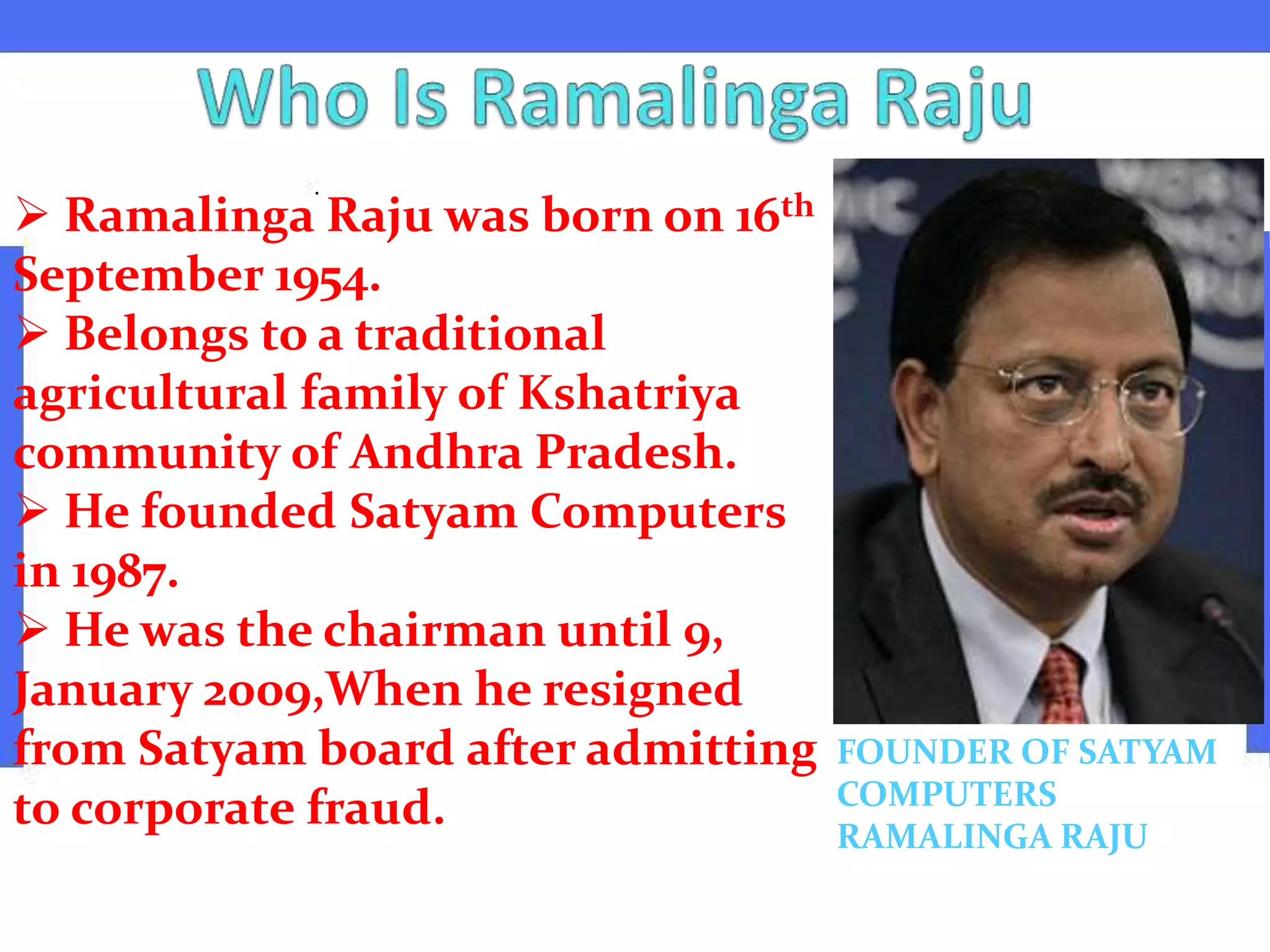
 Ramalinga Raju was born on 16th
September 1954.
 Belongs to a traditional
agricultural family of Kshatriya
community of Andhra Pradesh.
 He founded Satyam Computers
in 1987.
 He was the chairman until 9,
January 2009,When he resigned
from Satyam board after admitting
to corporate fraud.
FOUNDER OF SATYAM
COMPUTERS
RAMALINGA RAJU
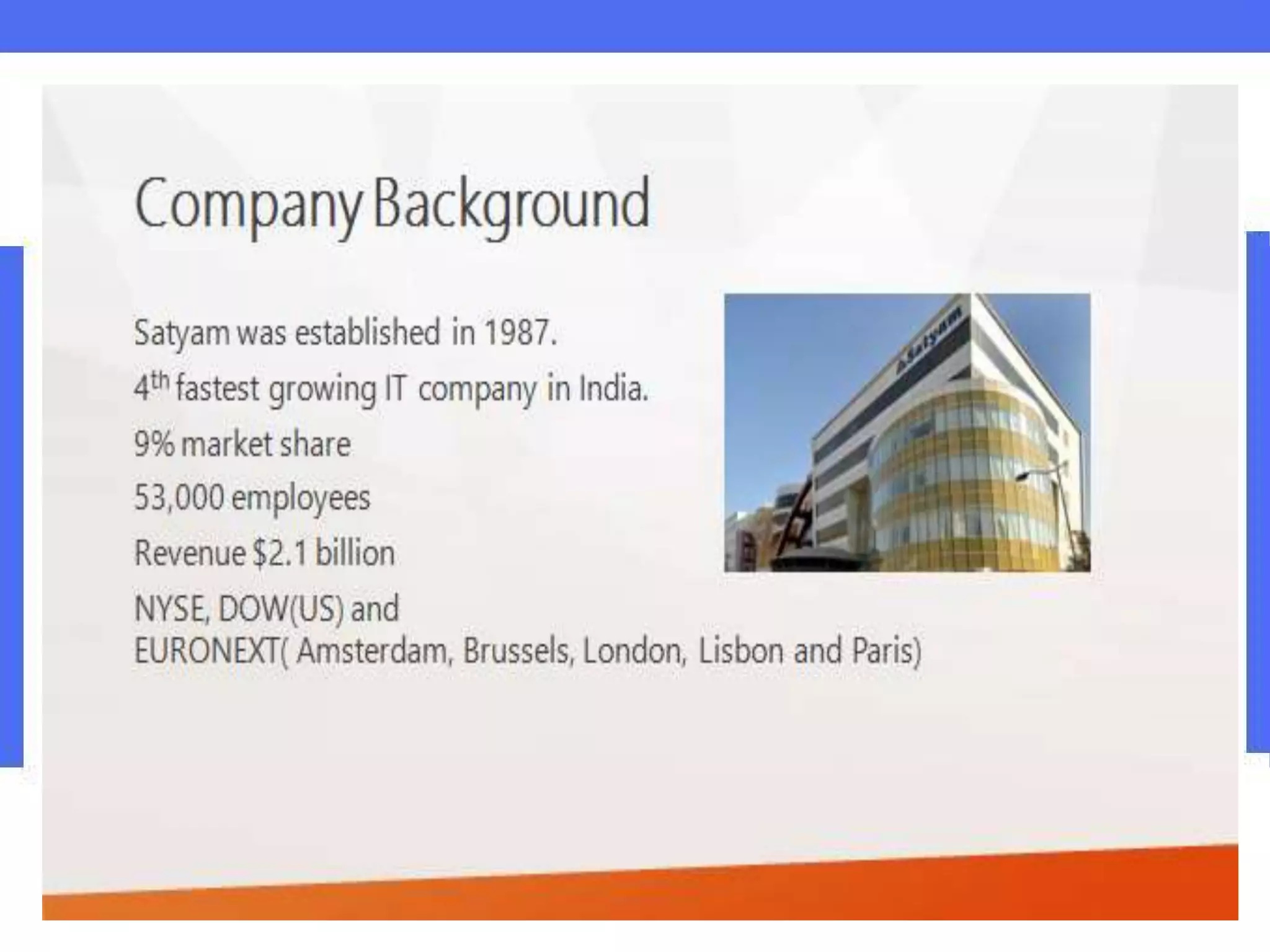
 Satyam Company Services Ltd. was incorporated on
June 24, 1987
Promoters holding of the shares in 1992 was 18.78%
Main business of the company was IT related fields and
it came into prominence after Y2K problem
In 1991, it was in a rented house having 10 Engineers.
Company was listed in Bombay Stock Exchange in 1992
company bags its first fortune 500 client John Deere &
Co
Revenue crossed $2 Billion -2008
Listing in NASDAQ, USA- 1999
Listed on New York Stock Exchange- 2001
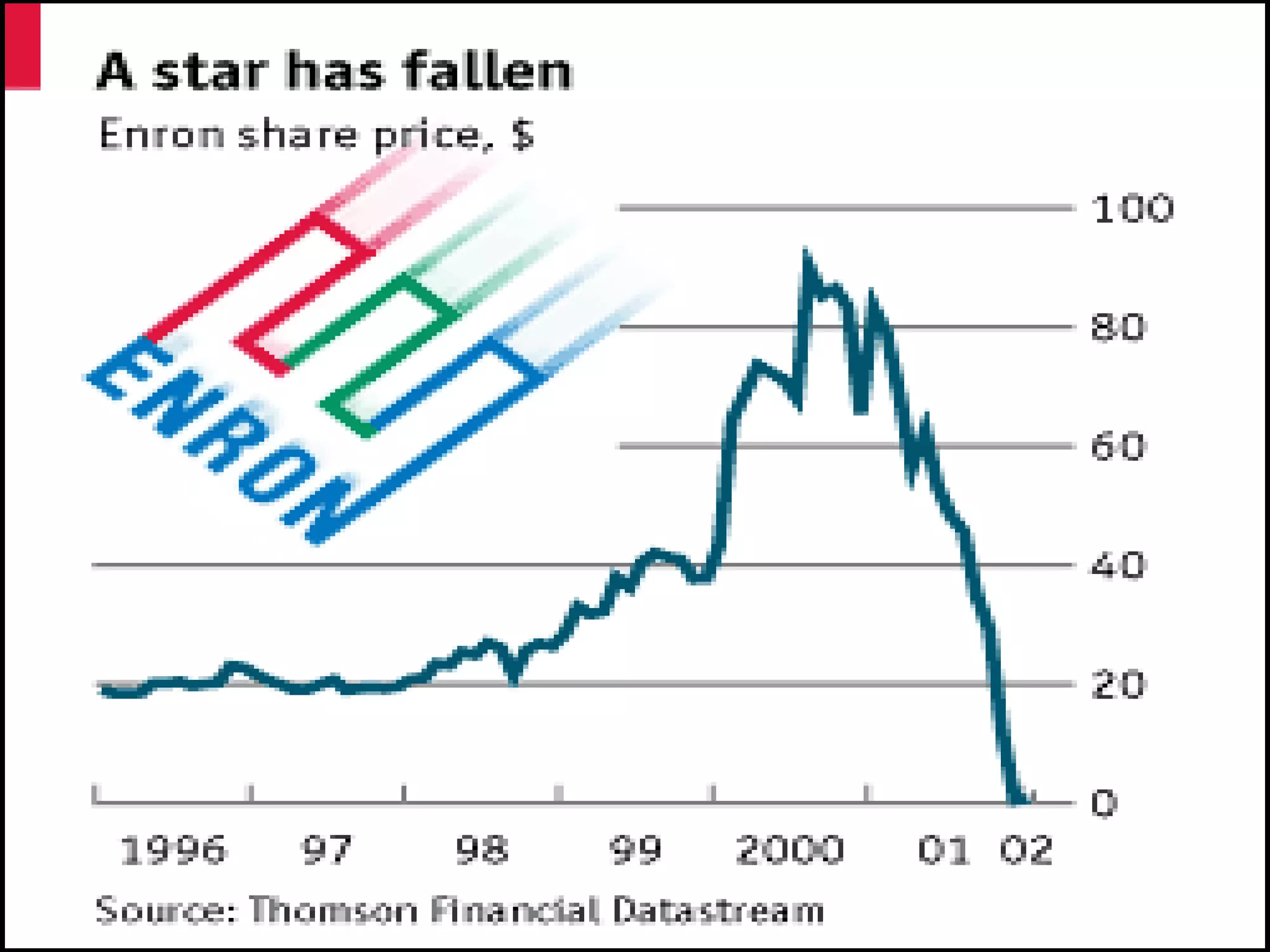
 Enron is known as the one of the largest fraud scandals in the
United States history.
Enron corporation was an American energy, commodities, and
services company based in Houston , Texas.
 Enron formed in 1985 by Kenneth Lay.
During 1985, it bought the smaller and less diversified Houston
natural gas company.
 The company initially named itself “HNG/inter North Inc.,
however was later renamed to “Enron”.
As a result of the investigations, the company was forced to
file for bankruptcy in December 2001. In May 2006, Enron’s
former chief executive, Jeffrey Skilling was sentenced to 24
years in jail while the ex-chairman Kenneth Lay died of
heart-attack in July 2006.
• Employed approximately 20,000 staff.
• One of the world’s major electricity ,natural gas ,pulp and
paper company.
• Revenue as nearly $101 billions.
• Named Enron “America’s Most Innovative Company” for
the six consecutive years by Fortune.
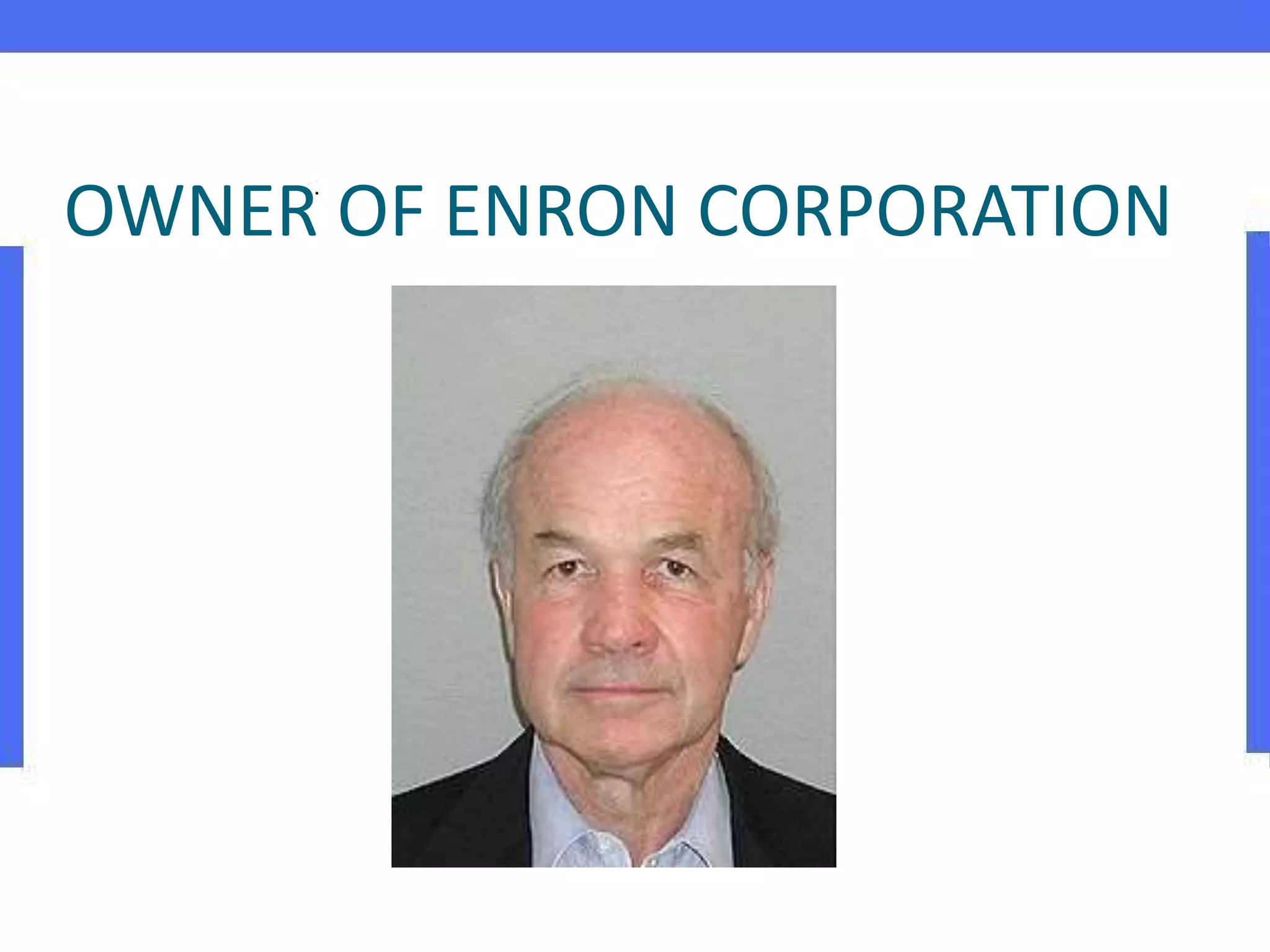
KENNETH LAY
OWNER OF ENRON CORPORATION
Timeline
Enron was formed on July1985 by Kenneth Lay after
merging Houston Natural Gas and Omaha based InterNorth.
On 2000, Enron reaches No. 7 on the Fortune 500 list.
On August 14, 2001, Jeffrey Skilling resigns as CEO, and
Kenneth Lay becomes CEO again (He had been CEO from
1985-2000).
On August 15, 2001 - Sherron Watkins sends a memo to
Kenneth Lay about accounting issues.
On October 31, 2001 - The SEC opens a formal investigation
into Enron's transactions.
Contd.
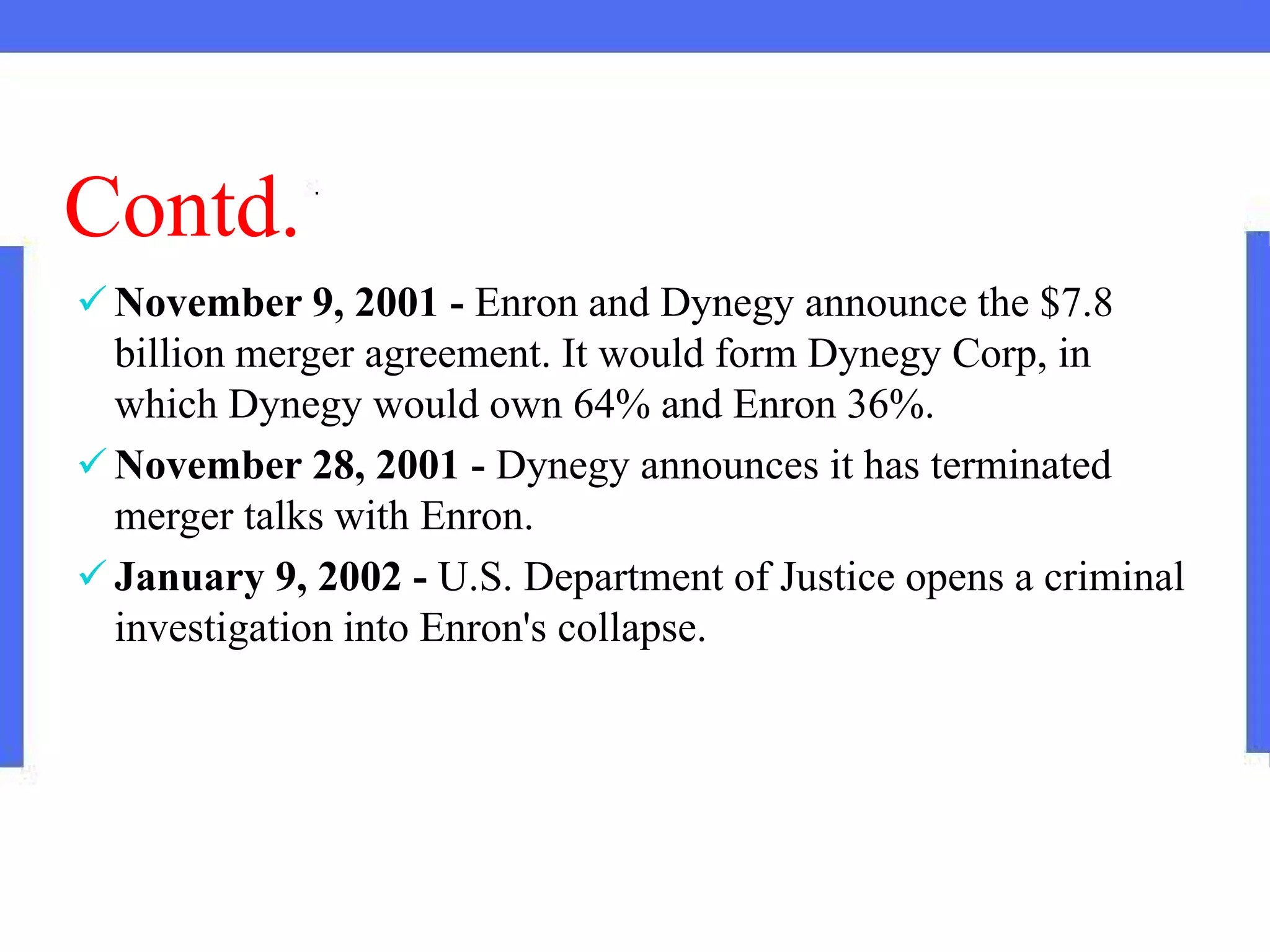
 November 9, 2001 - Enron and Dynegy announce the $7.8
billion merger agreement. It would form Dynegy Corp, in
which Dynegy would own 64% and Enron 36%.
 November 28, 2001 - Dynegy announces it has terminated
merger talks with Enron.
 January 9, 2002 - U.S. Department of Justice opens a criminal
investigation into Enron's collapse.
Contd.
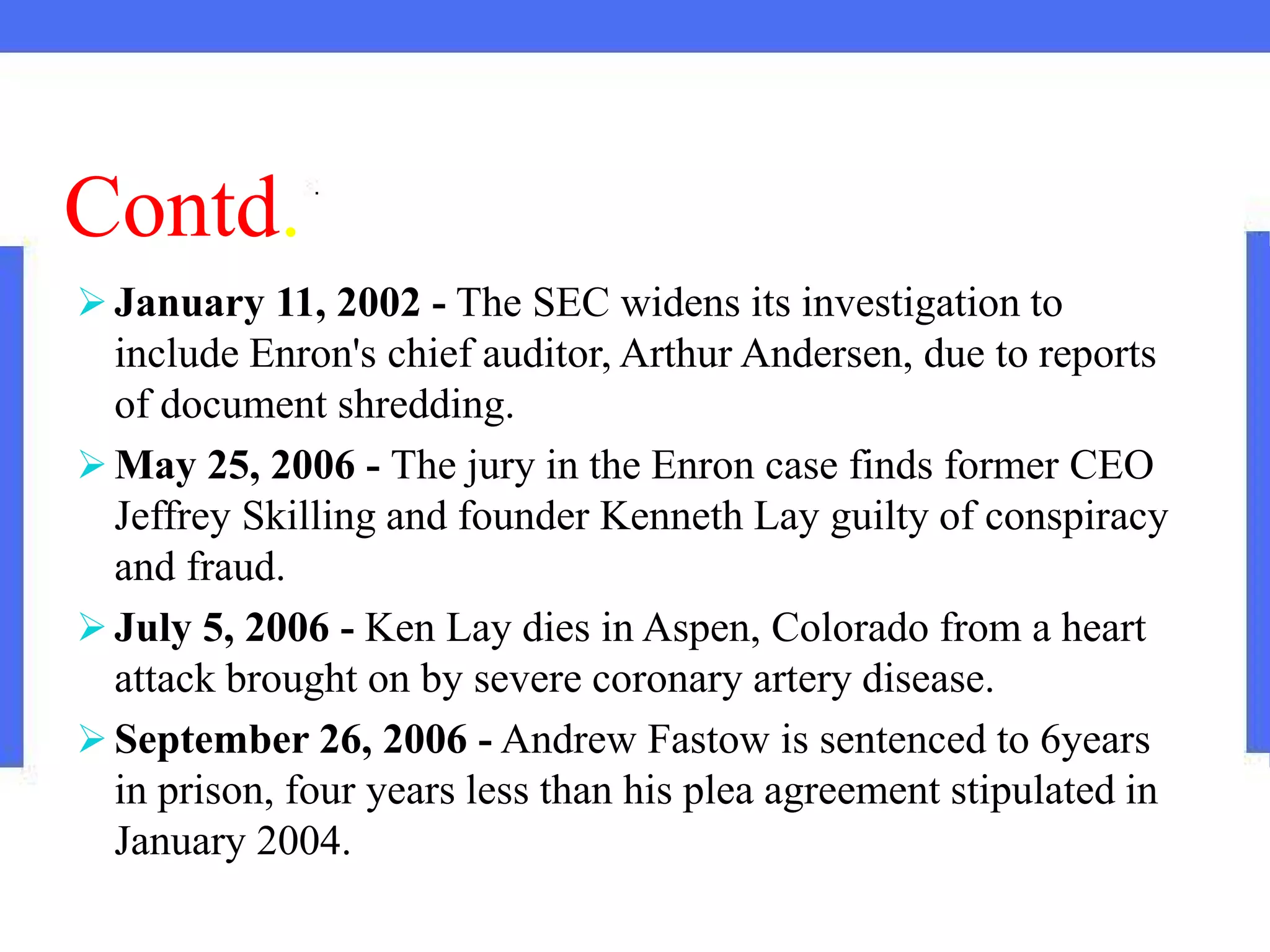
 January 11, 2002 - The SEC widens its investigation to
include Enron's chief auditor, Arthur Andersen, due to reports
of document shredding.
 May 25, 2006 - The jury in the Enron case finds former CEO
Jeffrey Skilling and founder Kenneth Lay guilty of conspiracy
and fraud.
 July 5, 2006 - Ken Lay dies in Aspen, Colorado from a heart
attack brought on by severe coronary artery disease.
 September 26, 2006 - Andrew Fastow is sentenced to 6years
in prison, four years less than his plea agreement stipulated in
January 2004.
Contd.
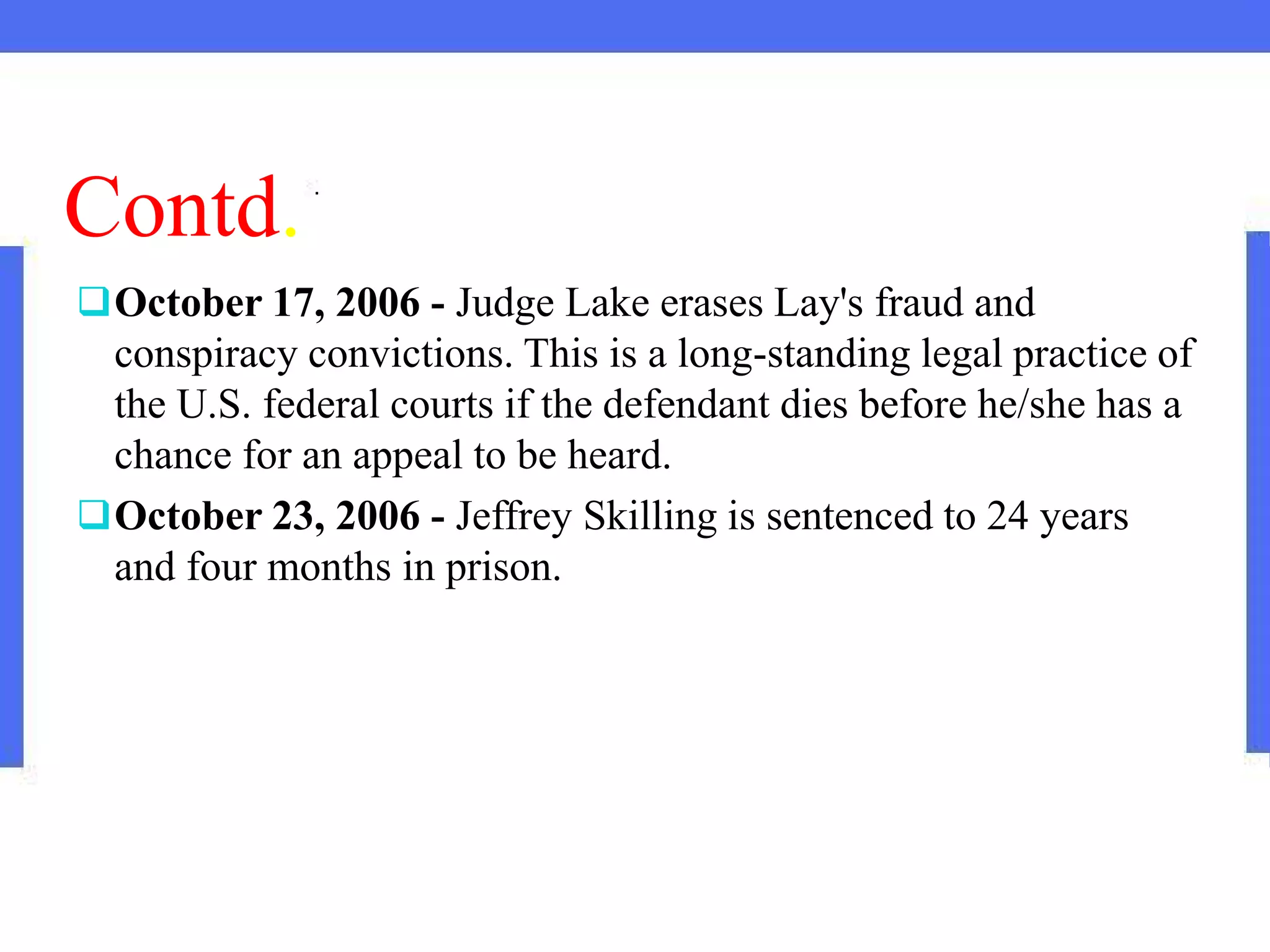
October 17, 2006 - Judge Lake erases Lay's fraud and
conspiracy convictions. This is a long-standing legal practice of
the U.S. federal courts if the defendant dies before he/she has a
chance for an appeal to be heard.
October 23, 2006 - Jeffrey Skilling is sentenced to 24 years
and four months in prison.
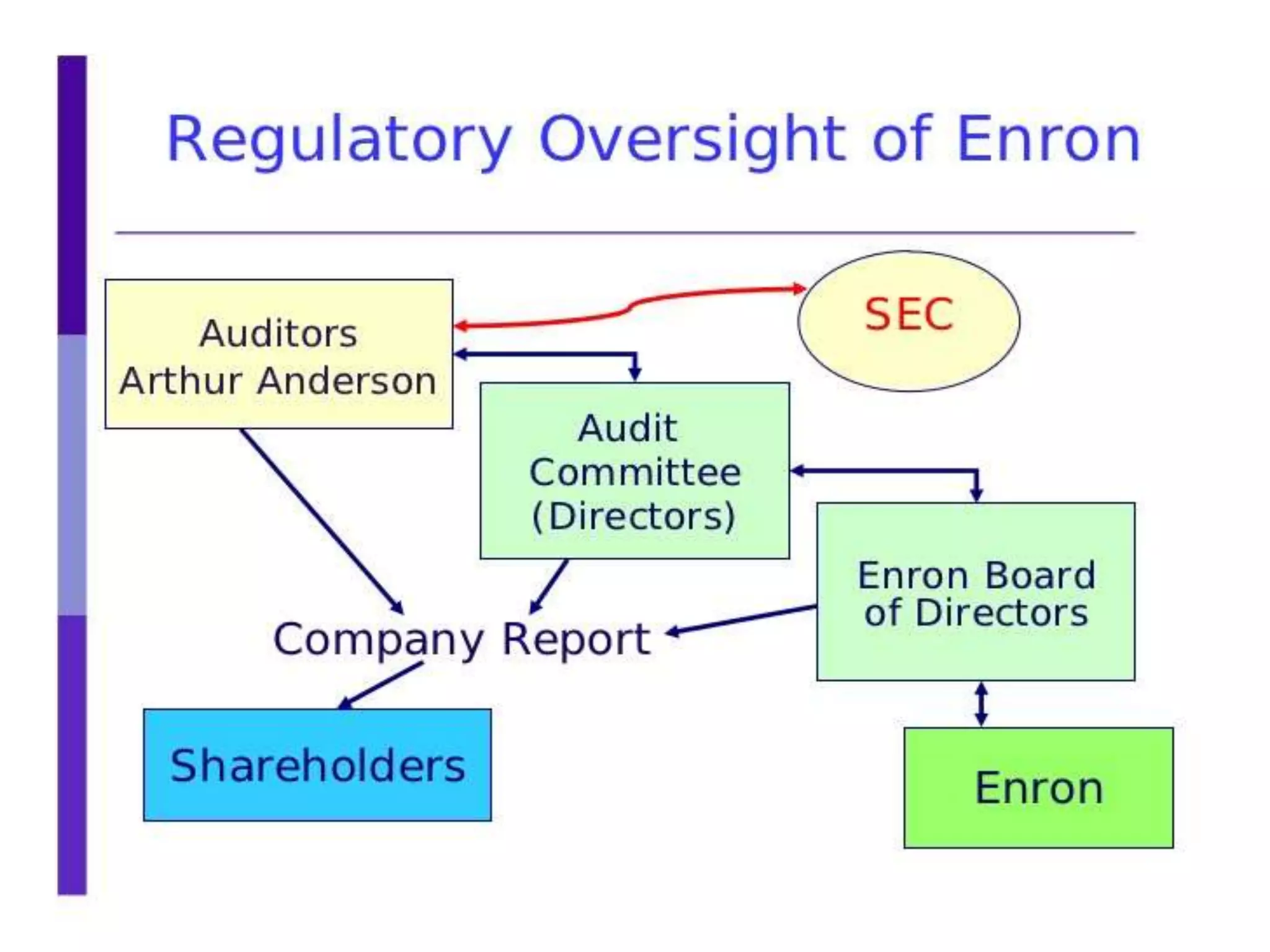
AUDITOR OF COMPANY ARTHUR
ANDERSON
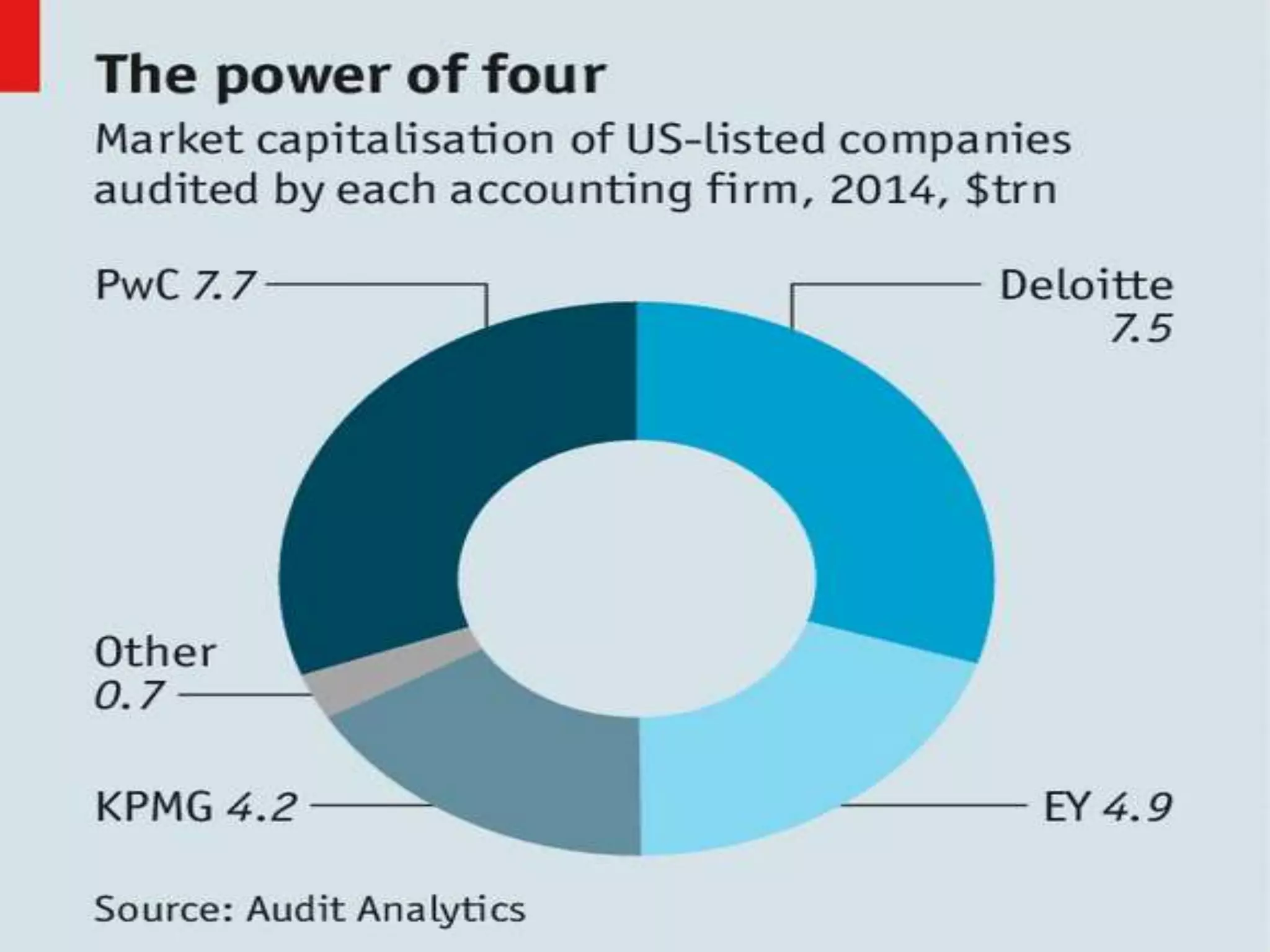
AUDITING FIRM’S RESPONSIBILITY
Regarding auditing good governance
requires high quality standards for
preparation and disclosure, and
independence for the external auditor.
Enron’s external auditor was Arthur
Anderson, which also provided firm
with extensive internal auditing and
consulting services.
Reasons for the Failure of Enron
o Economic Risk
As Enron expanded beyond the natural gas pipeline
business, it also reached beyond the US borders.
Enron International, a wholly-owned subsidiary of
Enron, was created to construct and manage energy
assets outside the United States, particularly in
markets where energy was being deregulated. This
exposed the company to economic risk.
Contd.
Political Risk
International diversification, particularly in developing
economies such as India and China, exposed Enron to
political risks. For example, the Dabhol power project in
India represented the single largest foreign direct
investment project until that time in India, and it attracted
considerable political opposition and controversy. Given
its limited business experience in developing economies,
Enron did not have expertise in managing the political risk
of expropriation of its assets after the construction of the
plant.
THE RISE OF SATYAM
DISASTER
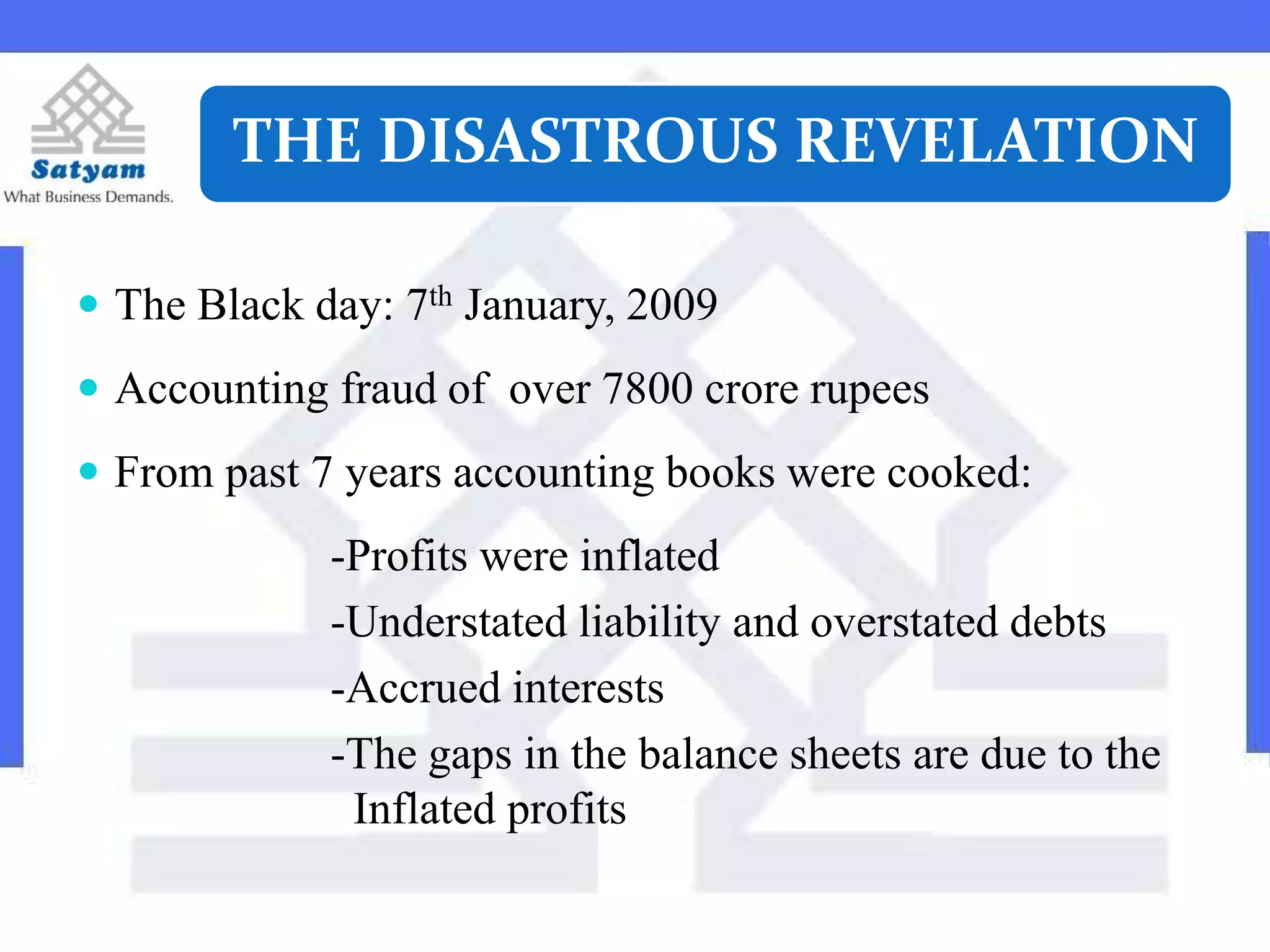
THE DISASTROUS REVELATION
 The Black day: 7th January, 2009
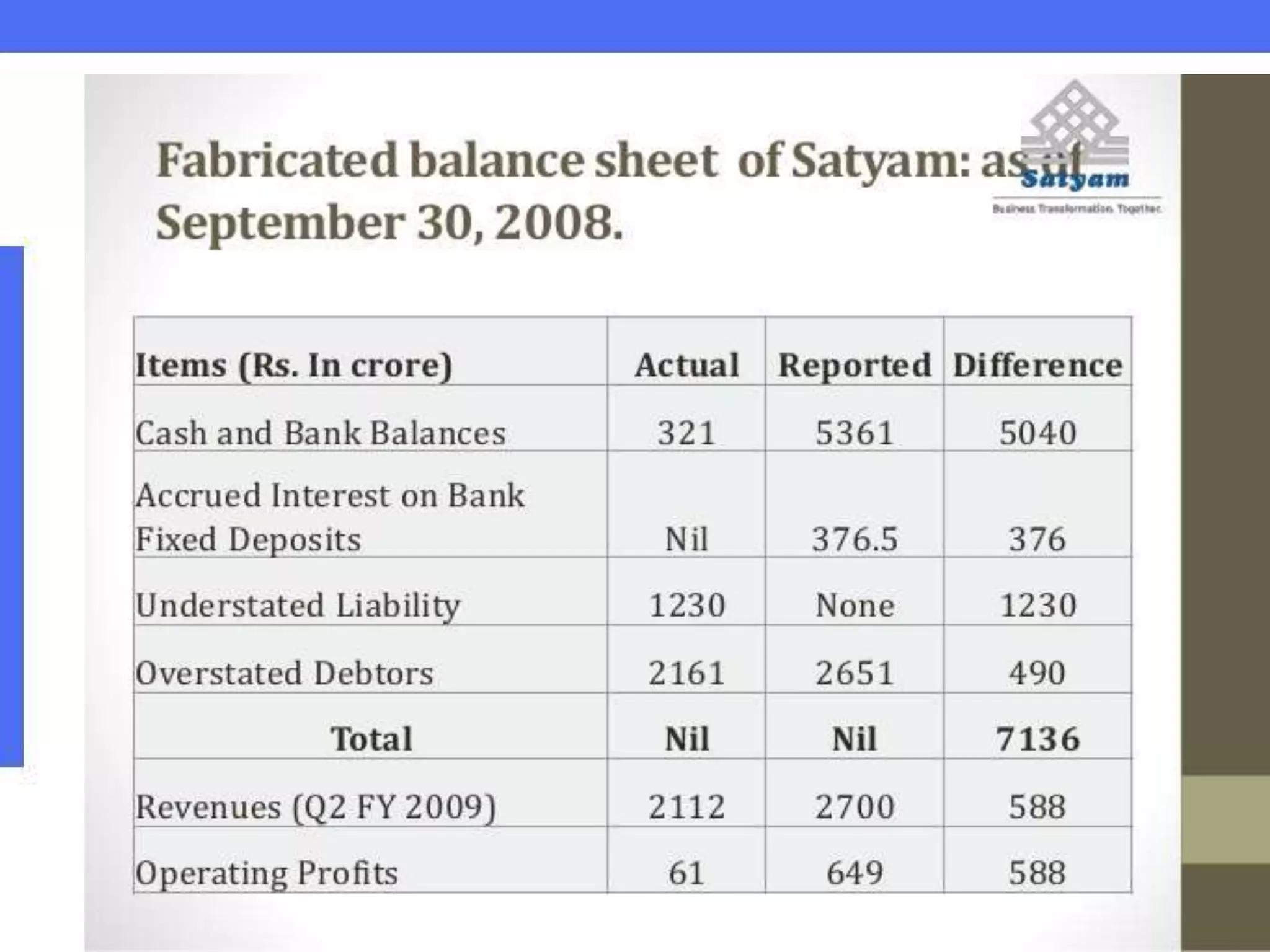
 Accounting fraud of over 7800 crore rupees
 From past 7 years accounting books were cooked:
-Profits were inflated
-Understated liability and overstated debts
-Accrued interests
-The gaps in the balance sheets are due to the
Inflated profits
CONFESSION LETTER
 Raju wrote in the confession letter
“Every attempt to fill the gap failed".
It was like riding a tiger, not knowing how to get off without
being eaten”.
CONFESSION LETTER
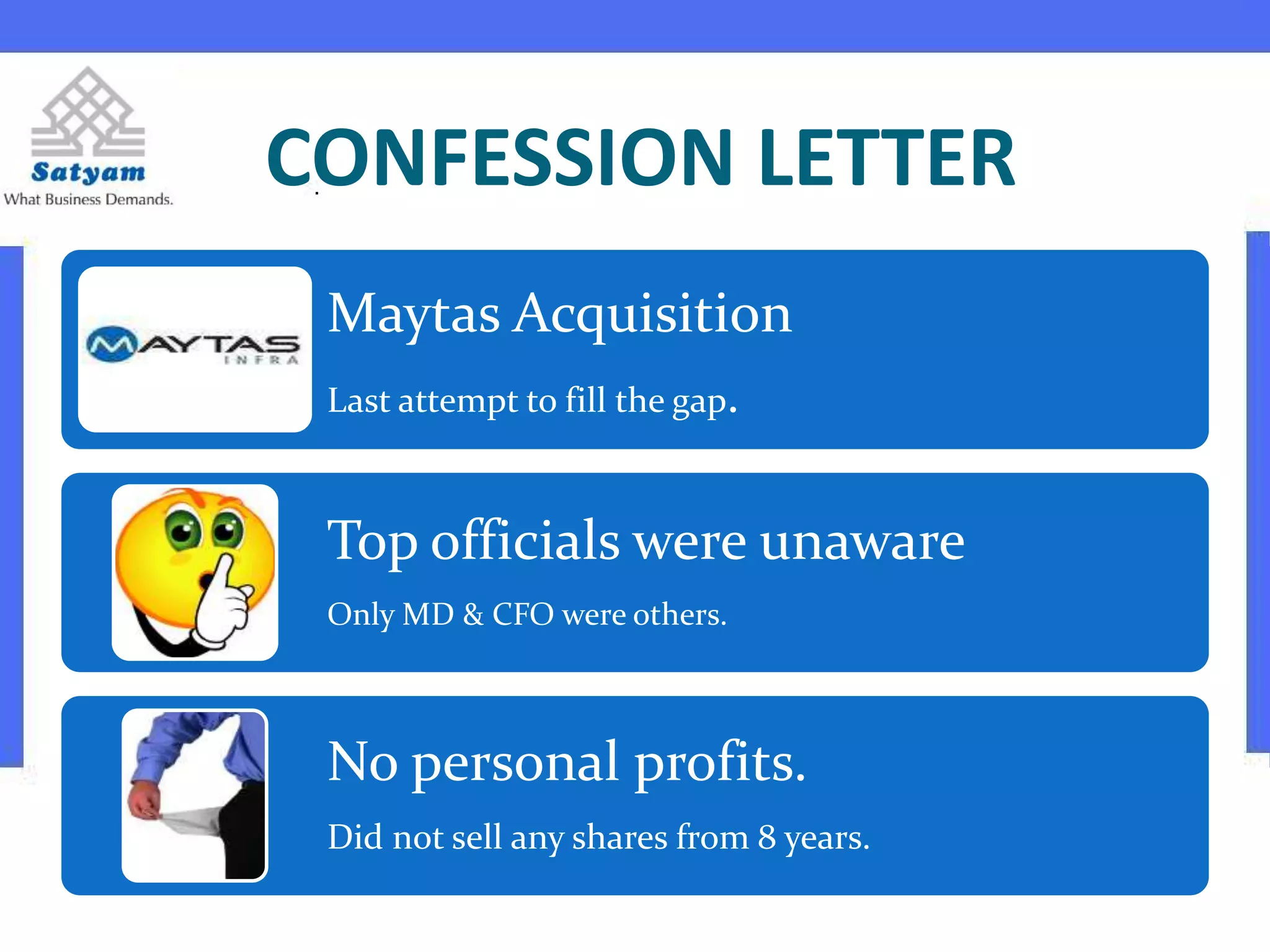
Maytas Acquisition
Last attempt to fill the gap.
Top officials were unaware
Only MD & CFO were others.
No personal profits.
Did not sell any shares from 8 years.
MINUTES AFTER REVELATION
• 11464 Crore
Companies
worth
• BSE sensex fell by 749.05 i.e. 7.25% .
• NSE fell by 192.40 points i.e. 6.18%.
Stock Market
• Biggest single day fall for a stock in
stock market
• 175 Rs/-(Jan 6th)
Satyam
shares
1607 Crore
77%
All time low of Rs 11.50 on 9th jan and closed at 23.75 Rs/-.
Compared to highest of 524.90 Rs/- on may 29,2008
HOW DID IT START???
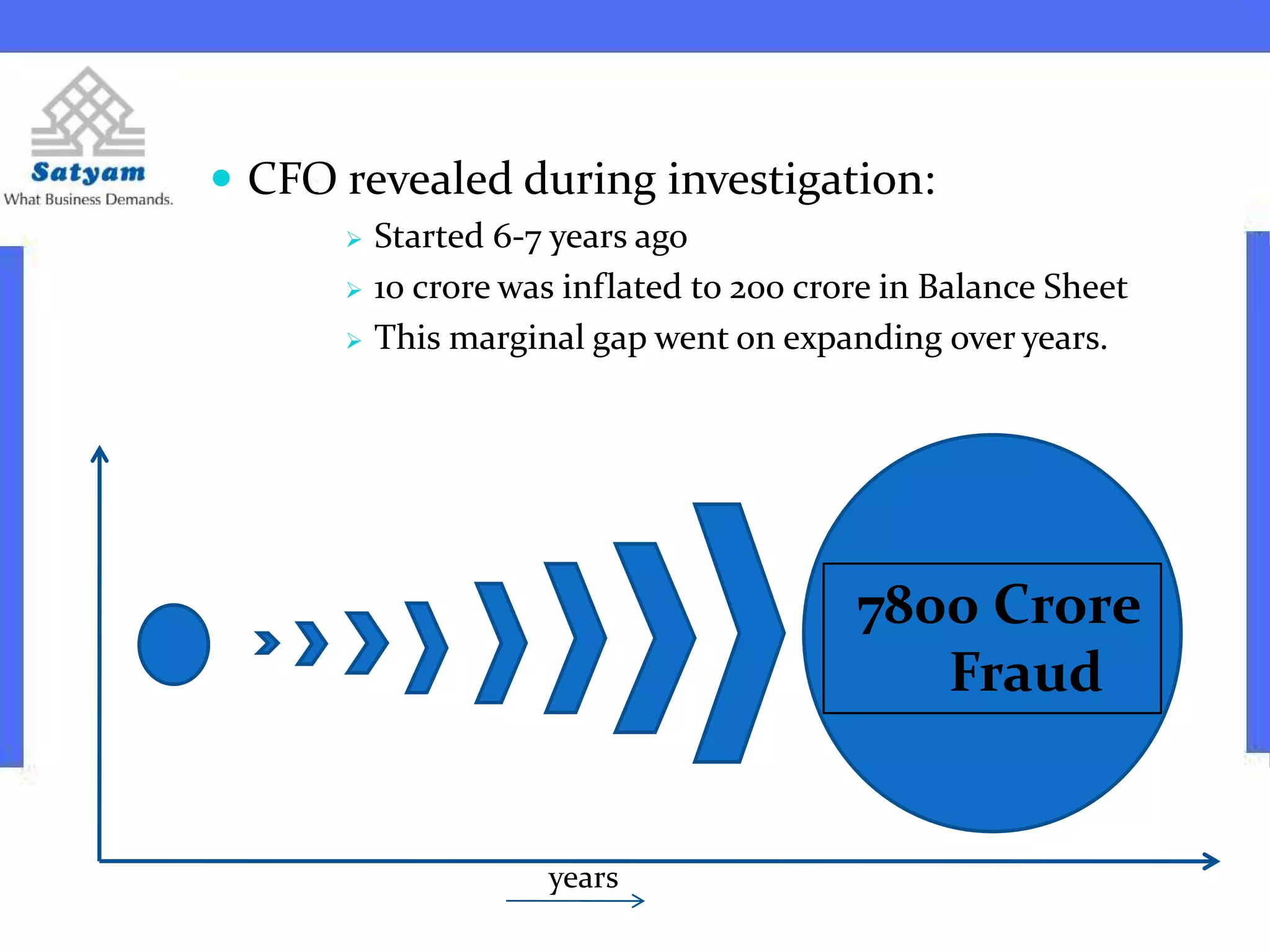
 CFO revealed during investigation:
 Started 6-7 years ago
 10 crore was inflated to 200 crore in Balance Sheet
 This marginal gap went on expanding over years.
7800 Crore
Fraud
years
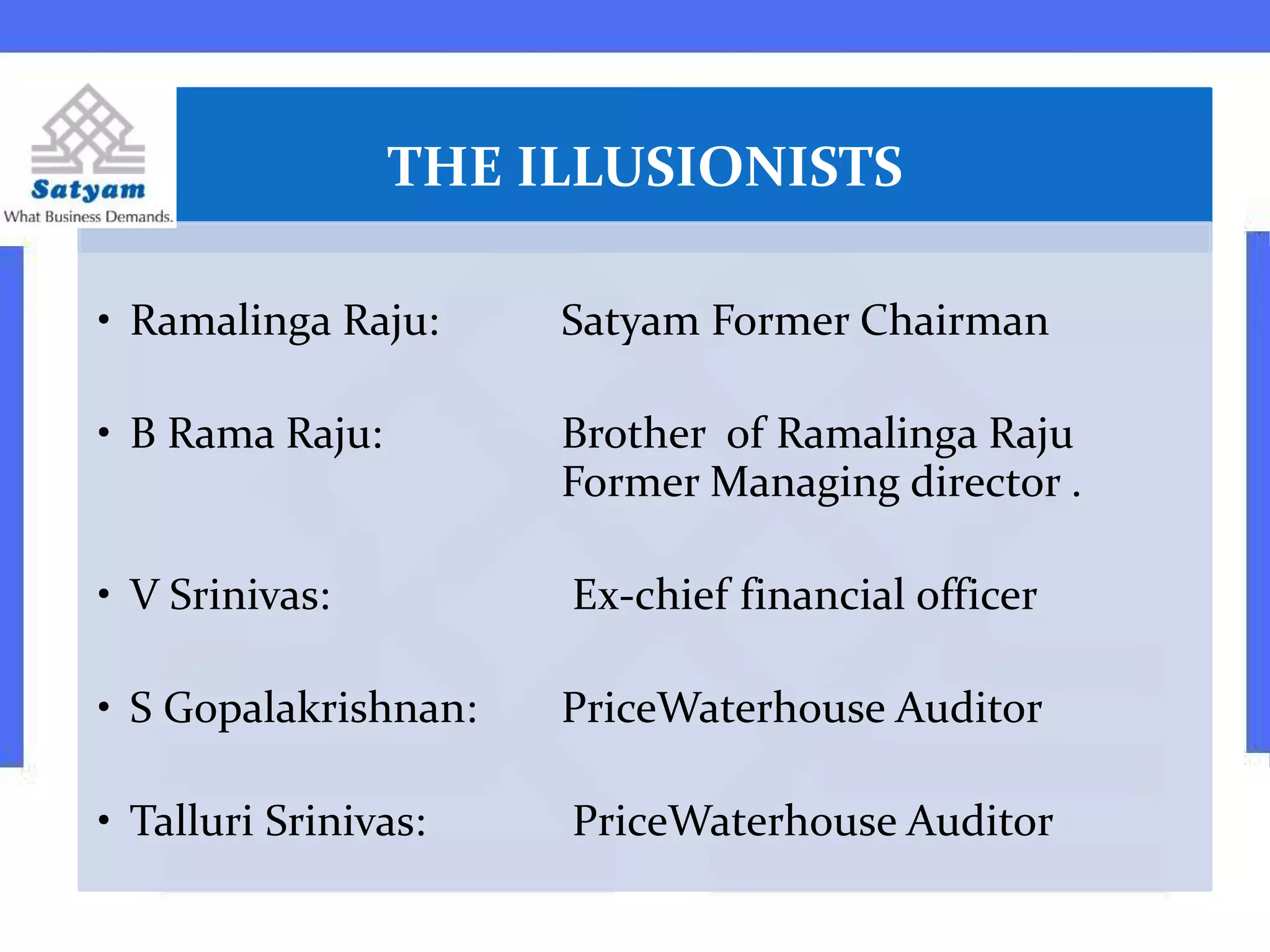
THE ILLUSIONISTS
• Ramalinga Raju: Satyam Former Chairman
• B Rama Raju: Brother of Ramalinga Raju
Former Managing director .
• V Srinivas: Ex-chief financial officer
• S Gopalakrishnan: PriceWaterhouse Auditor
• Talluri Srinivas: PriceWaterhouse Auditor
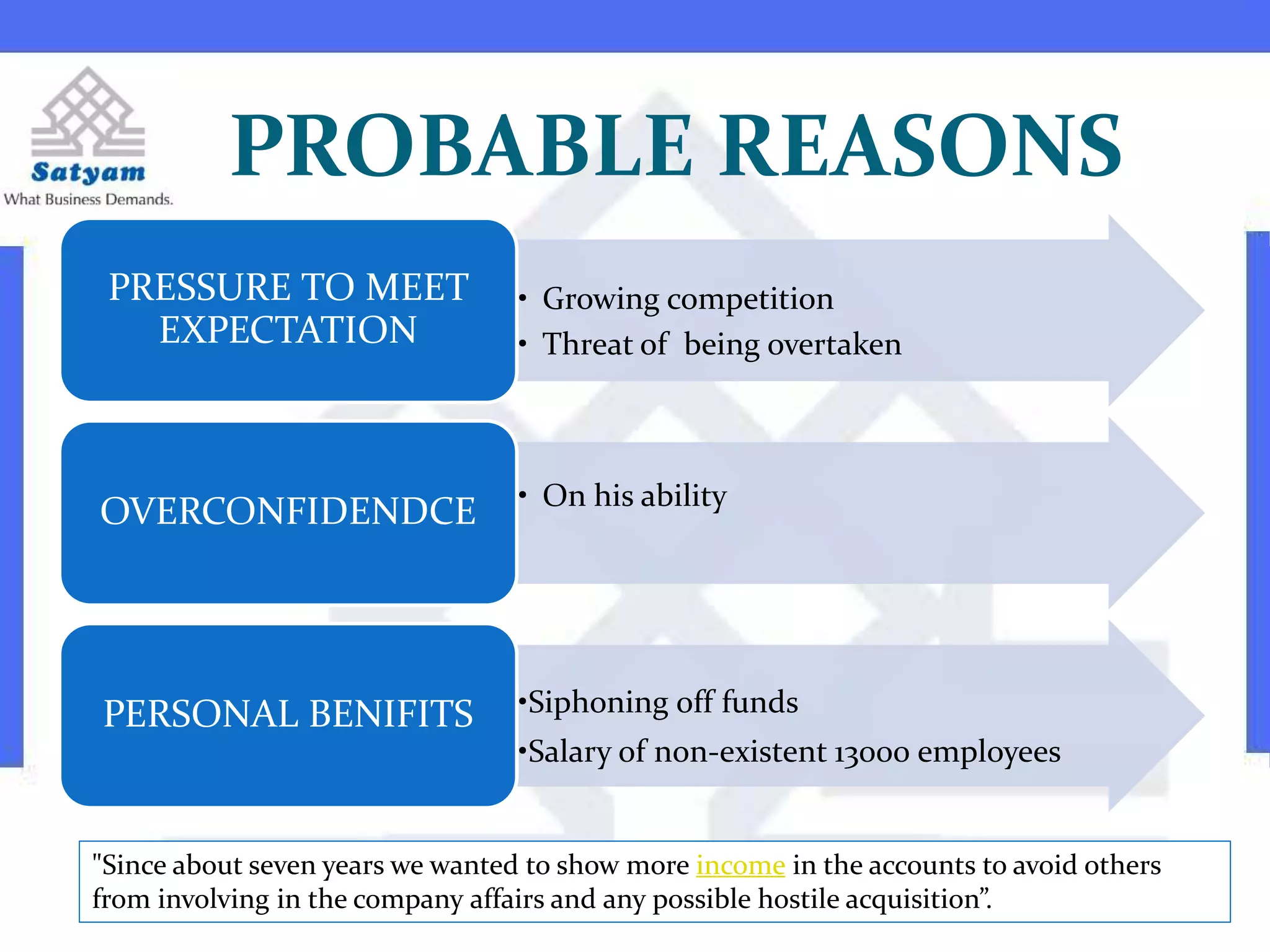
PROBABLE REASONS
• Growing competition
• Threat of being overtaken
PRESSURE TO MEET
EXPECTATION
• On his ability
OVERCONFIDENDCE
•Siphoning off funds
•Salary of non-existent 13000 employees
PERSONAL BENIFITS
"Since about seven years we wanted to show more income in the accounts to avoid others
from involving in the company affairs and any possible hostile acquisition”.
THE GAME PLAN
 The software firm’s unreal and fictitious fixed deposits
were managed with an understanding between
the management and audit section .
•Ignorence of Firm’s
Auditors.
•Control over CFO.
•Offered to resign
twice.
•Bank deposits were
directly handled by
the chairman and
Managing director.
THE LAST ATTEMPT
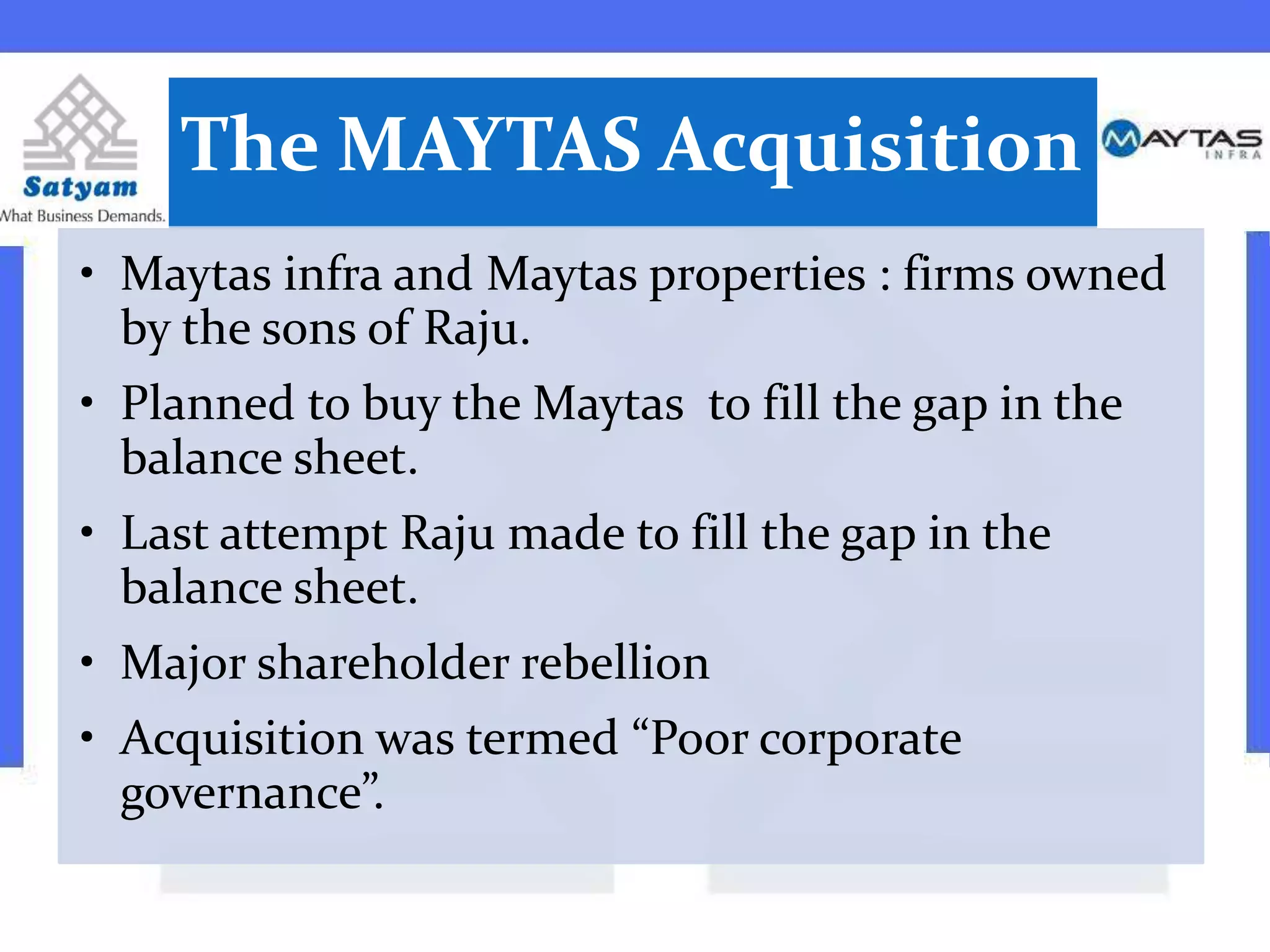
The MAYTAS Acquisition
• Maytas infra and Maytas properties : firms owned
by the sons of Raju.
• Planned to buy the Maytas to fill the gap in the
balance sheet.
• Last attempt Raju made to fill the gap in the
balance sheet.
• Major shareholder rebellion
• Acquisition was termed “Poor corporate
governance”.
WHY DID RAJU CONFESS?
 .”
Raju was probably convinced that the gap in the balance
sheet reached unmanageable proportions and could not be
filled anyhow in future.
A person who used a pseudonym, claimed himself to be a
former senior executive in Satyam involved with its contract
with the World Bank, acted as the whistleblower whose email
to a Satyam board member triggered a chain of events that
culminated in erstwhile chairman Mr Raju’s decision to confess
to the financial crime.
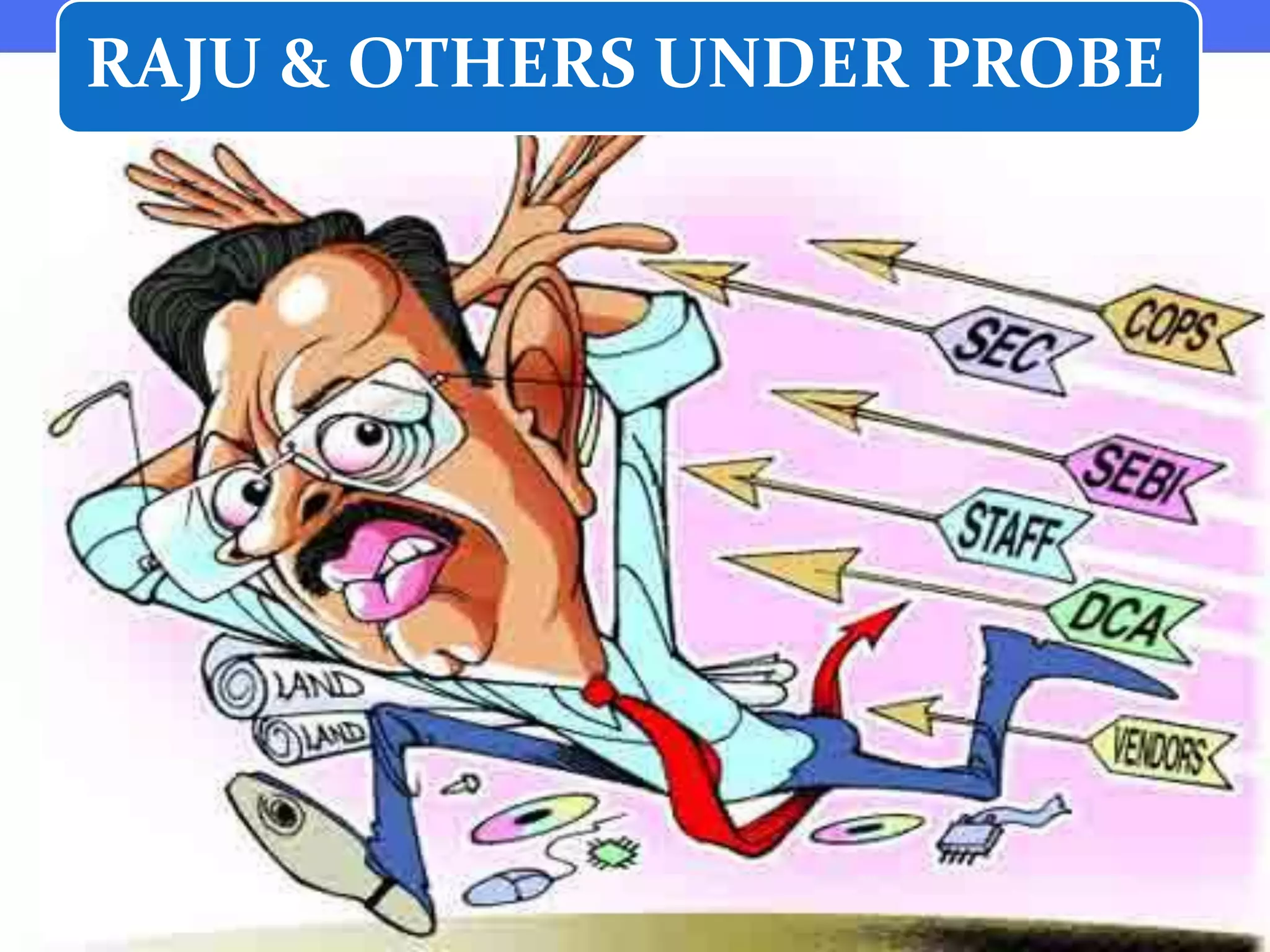
RAJU & OTHERS UNDER PROBE
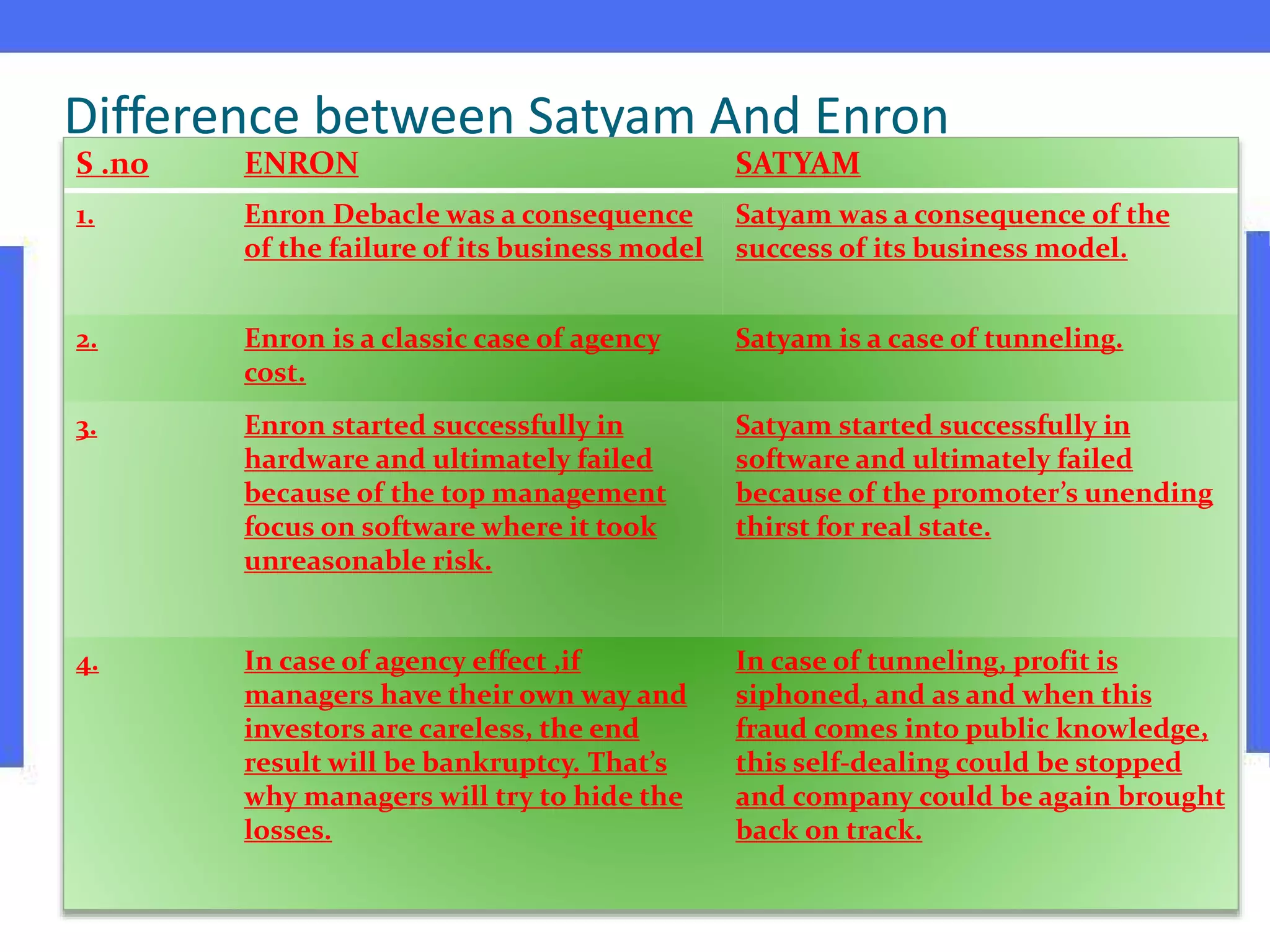
Difference between Satyam And Enron
S .no ENRON SATYAM
1. Enron Debacle was a consequence
of the failure of its business model
Satyam was a consequence of the
success of its business model.

2. Enron is a classic case of agency
cost.
Satyam is a case of tunneling.
3. Enron started successfully in
hardware and ultimately failed
because of the top management
focus on software where it took
unreasonable risk.
Satyam started successfully in
software and ultimately failed
because of the promoter’s unending
thirst for real state.
4. In case of agency effect ,if
managers have their own way and
investors are careless, the end
result will be bankruptcy. That’s
why managers will try to hide the
losses.
In case of tunneling, profit is
siphoned, and as and when this
fraud comes into public knowledge,
this self-dealing could be stopped
and company could be again brought
back on track.
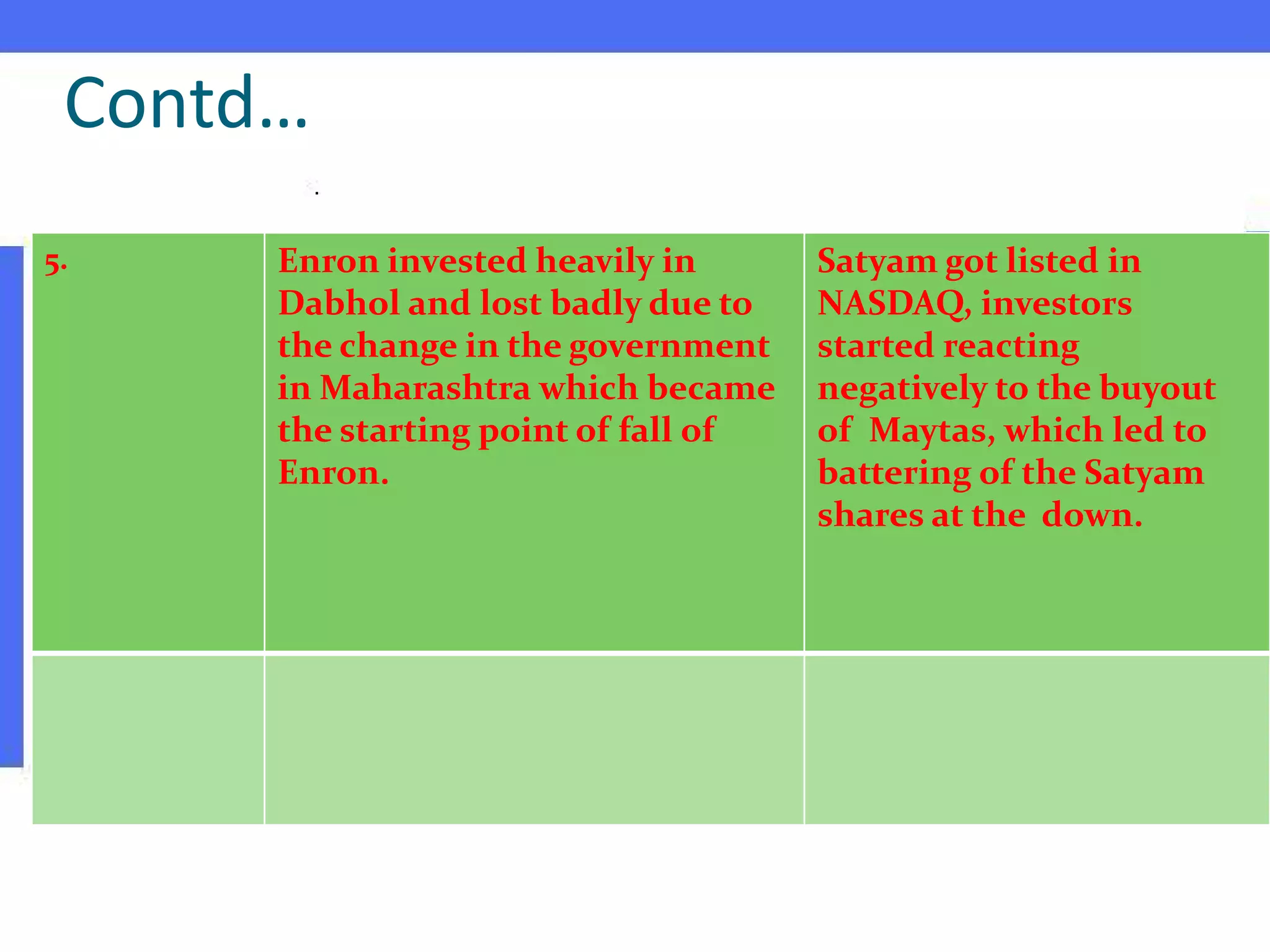
Contd…
5. Enron invested heavily in
Dabhol and lost badly due to
the change in the government
in Maharashtra which became
the starting point of fall of
Enron.
Satyam got listed in
NASDAQ, investors
started reacting
negatively to the buyout
of Maytas, which led to
battering of the Satyam
shares at the down.
Recommendations
We need to take some precautious activities, so that
we can eliminate these types of situations. Some of
the activities are:
 Bann of granting of government permissions on
illegal practices which provides the companies a
window through which they can generate black
money.
We should focus upon CSR (Corporate Social
Responsibility) due to involvement of society to
the business and these types of activities affects it.
Contd.
Auditors should perform their work ethically.
Manipulations, over profit, hiding loss etc are the
examples of unethical practices.
Whole part of profit should avoid for investment. So
that if we suffer from any losses, we have the money
with ourselves for recovery.
 Risk management should be effective. Taking risk is
good but unnecessary taking risks should be avoided.
So proper risk measure tool should be used.
 Enron should have public in stockholder reports.
 Many would have saved all their money.
 Enron scandal should be a lesson for future
businesses involving ethical dilemmas.
 The scandal made the authorities realize the
importance of ethics and the importance
INTERNAL CONTROL in business enterprises. It
also helped understand the real meaning of
Shareholder’s wealth maximization.
SATYAM AND ENRON CASE

SATYAM AND ENRON CASE

  • 2.
     Ramalinga Rajuwas born on 16th September 1954.  Belongs to a traditional agricultural family of Kshatriya community of Andhra Pradesh.  He founded Satyam Computers in 1987.  He was the chairman until 9, January 2009,When he resigned from Satyam board after admitting to corporate fraud. FOUNDER OF SATYAM COMPUTERS RAMALINGA RAJU
  • 3.
     Satyam CompanyServices Ltd. was incorporated on June 24, 1987 Promoters holding of the shares in 1992 was 18.78% Main business of the company was IT related fields and it came into prominence after Y2K problem In 1991, it was in a rented house having 10 Engineers. Company was listed in Bombay Stock Exchange in 1992 company bags its first fortune 500 client John Deere & Co Revenue crossed $2 Billion -2008 Listing in NASDAQ, USA- 1999 Listed on New York Stock Exchange- 2001
  • 4.
     Enron isknown as the one of the largest fraud scandals in the United States history. Enron corporation was an American energy, commodities, and services company based in Houston , Texas.  Enron formed in 1985 by Kenneth Lay. During 1985, it bought the smaller and less diversified Houston natural gas company.  The company initially named itself “HNG/inter North Inc., however was later renamed to “Enron”.
  • 5.
    As a resultof the investigations, the company was forced to file for bankruptcy in December 2001. In May 2006, Enron’s former chief executive, Jeffrey Skilling was sentenced to 24 years in jail while the ex-chairman Kenneth Lay died of heart-attack in July 2006. • Employed approximately 20,000 staff. • One of the world’s major electricity ,natural gas ,pulp and paper company. • Revenue as nearly $101 billions. • Named Enron “America’s Most Innovative Company” for the six consecutive years by Fortune.
  • 6.
  • 7.
    OWNER OF ENRONCORPORATION
  • 8.
    Timeline Enron was formedon July1985 by Kenneth Lay after merging Houston Natural Gas and Omaha based InterNorth. On 2000, Enron reaches No. 7 on the Fortune 500 list. On August 14, 2001, Jeffrey Skilling resigns as CEO, and Kenneth Lay becomes CEO again (He had been CEO from 1985-2000). On August 15, 2001 - Sherron Watkins sends a memo to Kenneth Lay about accounting issues. On October 31, 2001 - The SEC opens a formal investigation into Enron's transactions.
  • 9.
    Contd.  November 9,2001 - Enron and Dynegy announce the $7.8 billion merger agreement. It would form Dynegy Corp, in which Dynegy would own 64% and Enron 36%.  November 28, 2001 - Dynegy announces it has terminated merger talks with Enron.  January 9, 2002 - U.S. Department of Justice opens a criminal investigation into Enron's collapse.
  • 10.
    Contd.  January 11,2002 - The SEC widens its investigation to include Enron's chief auditor, Arthur Andersen, due to reports of document shredding.  May 25, 2006 - The jury in the Enron case finds former CEO Jeffrey Skilling and founder Kenneth Lay guilty of conspiracy and fraud.  July 5, 2006 - Ken Lay dies in Aspen, Colorado from a heart attack brought on by severe coronary artery disease.  September 26, 2006 - Andrew Fastow is sentenced to 6years in prison, four years less than his plea agreement stipulated in January 2004.
  • 11.
    Contd. October 17, 2006- Judge Lake erases Lay's fraud and conspiracy convictions. This is a long-standing legal practice of the U.S. federal courts if the defendant dies before he/she has a chance for an appeal to be heard. October 23, 2006 - Jeffrey Skilling is sentenced to 24 years and four months in prison.
  • 13.
    AUDITOR OF COMPANYARTHUR ANDERSON
  • 16.
    AUDITING FIRM’S RESPONSIBILITY Regardingauditing good governance requires high quality standards for preparation and disclosure, and independence for the external auditor. Enron’s external auditor was Arthur Anderson, which also provided firm with extensive internal auditing and consulting services.
  • 18.
    Reasons for theFailure of Enron o Economic Risk As Enron expanded beyond the natural gas pipeline business, it also reached beyond the US borders. Enron International, a wholly-owned subsidiary of Enron, was created to construct and manage energy assets outside the United States, particularly in markets where energy was being deregulated. This exposed the company to economic risk.
  • 19.
    Contd. Political Risk International diversification,particularly in developing economies such as India and China, exposed Enron to political risks. For example, the Dabhol power project in India represented the single largest foreign direct investment project until that time in India, and it attracted considerable political opposition and controversy. Given its limited business experience in developing economies, Enron did not have expertise in managing the political risk of expropriation of its assets after the construction of the plant.
  • 21.
  • 23.
  • 24.
    THE DISASTROUS REVELATION The Black day: 7th January, 2009  Accounting fraud of over 7800 crore rupees  From past 7 years accounting books were cooked: -Profits were inflated -Understated liability and overstated debts -Accrued interests -The gaps in the balance sheets are due to the Inflated profits
  • 26.
    CONFESSION LETTER  Rajuwrote in the confession letter “Every attempt to fill the gap failed". It was like riding a tiger, not knowing how to get off without being eaten”.
  • 27.
    CONFESSION LETTER Maytas Acquisition Lastattempt to fill the gap. Top officials were unaware Only MD & CFO were others. No personal profits. Did not sell any shares from 8 years.
  • 28.
  • 29.
    • 11464 Crore Companies worth •BSE sensex fell by 749.05 i.e. 7.25% . • NSE fell by 192.40 points i.e. 6.18%. Stock Market • Biggest single day fall for a stock in stock market • 175 Rs/-(Jan 6th) Satyam shares 1607 Crore 77% All time low of Rs 11.50 on 9th jan and closed at 23.75 Rs/-. Compared to highest of 524.90 Rs/- on may 29,2008
  • 30.
    HOW DID ITSTART???
  • 31.
     CFO revealedduring investigation:  Started 6-7 years ago  10 crore was inflated to 200 crore in Balance Sheet  This marginal gap went on expanding over years. 7800 Crore Fraud years
  • 32.
    THE ILLUSIONISTS • RamalingaRaju: Satyam Former Chairman • B Rama Raju: Brother of Ramalinga Raju Former Managing director . • V Srinivas: Ex-chief financial officer • S Gopalakrishnan: PriceWaterhouse Auditor • Talluri Srinivas: PriceWaterhouse Auditor
  • 33.
    PROBABLE REASONS • Growingcompetition • Threat of being overtaken PRESSURE TO MEET EXPECTATION • On his ability OVERCONFIDENDCE •Siphoning off funds •Salary of non-existent 13000 employees PERSONAL BENIFITS "Since about seven years we wanted to show more income in the accounts to avoid others from involving in the company affairs and any possible hostile acquisition”.
  • 34.
  • 35.
     The softwarefirm’s unreal and fictitious fixed deposits were managed with an understanding between the management and audit section . •Ignorence of Firm’s Auditors. •Control over CFO. •Offered to resign twice. •Bank deposits were directly handled by the chairman and Managing director.
  • 36.
  • 37.
    The MAYTAS Acquisition •Maytas infra and Maytas properties : firms owned by the sons of Raju. • Planned to buy the Maytas to fill the gap in the balance sheet. • Last attempt Raju made to fill the gap in the balance sheet. • Major shareholder rebellion • Acquisition was termed “Poor corporate governance”.
  • 38.
    WHY DID RAJUCONFESS?
  • 39.
     .” Raju wasprobably convinced that the gap in the balance sheet reached unmanageable proportions and could not be filled anyhow in future. A person who used a pseudonym, claimed himself to be a former senior executive in Satyam involved with its contract with the World Bank, acted as the whistleblower whose email to a Satyam board member triggered a chain of events that culminated in erstwhile chairman Mr Raju’s decision to confess to the financial crime.
  • 40.
    RAJU & OTHERSUNDER PROBE
  • 41.
    Difference between SatyamAnd Enron S .no ENRON SATYAM 1. Enron Debacle was a consequence of the failure of its business model Satyam was a consequence of the success of its business model. 2. Enron is a classic case of agency cost. Satyam is a case of tunneling. 3. Enron started successfully in hardware and ultimately failed because of the top management focus on software where it took unreasonable risk. Satyam started successfully in software and ultimately failed because of the promoter’s unending thirst for real state. 4. In case of agency effect ,if managers have their own way and investors are careless, the end result will be bankruptcy. That’s why managers will try to hide the losses. In case of tunneling, profit is siphoned, and as and when this fraud comes into public knowledge, this self-dealing could be stopped and company could be again brought back on track.
  • 42.
    Contd… 5. Enron investedheavily in Dabhol and lost badly due to the change in the government in Maharashtra which became the starting point of fall of Enron. Satyam got listed in NASDAQ, investors started reacting negatively to the buyout of Maytas, which led to battering of the Satyam shares at the down.
  • 43.
    Recommendations We need totake some precautious activities, so that we can eliminate these types of situations. Some of the activities are:  Bann of granting of government permissions on illegal practices which provides the companies a window through which they can generate black money. We should focus upon CSR (Corporate Social Responsibility) due to involvement of society to the business and these types of activities affects it.
  • 44.
    Contd. Auditors should performtheir work ethically. Manipulations, over profit, hiding loss etc are the examples of unethical practices. Whole part of profit should avoid for investment. So that if we suffer from any losses, we have the money with ourselves for recovery.  Risk management should be effective. Taking risk is good but unnecessary taking risks should be avoided. So proper risk measure tool should be used.
  • 45.
     Enron shouldhave public in stockholder reports.  Many would have saved all their money.  Enron scandal should be a lesson for future businesses involving ethical dilemmas.  The scandal made the authorities realize the importance of ethics and the importance INTERNAL CONTROL in business enterprises. It also helped understand the real meaning of Shareholder’s wealth maximization.