Yann-Gaël Guéhéneuc
(/jan/, he/il)
Work licensed under Creative Commons
BY-NC-SA 4.0 International
Project Manifold
(Forwarding
and Delegation)
yann-gael.gueheneuc@concordia.ca
Version 0.2
2024/10/09
2/55
Fragile Base Class Problem
 Joshua Bloch ;
Effective Java ;
Prentice Hall, 2nd
edition (May 28, 2008)
3/55
FORWARDING
4/55
Requirements – Need
 Implement a Set
that counts the number of added elements,
which is different from the current number of
elements,
e.g., for performance tuning
5/55
Requirements – Client Code
public class Main {
public static void main(final String[] args) {
final CountingHashSet<String> s = new CountingHashSet<String>();
s.addAll(Arrays.asList("Rick Deckard", "Roy Batty", "Pris Stratton",
"Zhora Salome", "Leon Kowalski", "Rachael"));
s.remove("Leon Kowalski");
s.remove("Zhora Salome");
s.remove("Pris Stratton");
s.remove("Roy Batty");
s.add("Tyrell");
System.out.print("Was expected 7, got ");
System.out.println(s.getAddCount());
}
}
6/55
Requirements – Client Code
7? 13?
public class Main {
public static void main(final String[] args) {
final CountingHashSet<String> s = new CountingHashSet<String>();
s.addAll(Arrays.asList("Rick Deckard", "Roy Batty", "Pris Stratton",
"Zhora Salome", "Leon Kowalski", "Rachael"));
s.remove("Leon Kowalski");
s.remove("Zhora Salome");
s.remove("Pris Stratton");
s.remove("Roy Batty");
s.add("Tyrell");
System.out.print("Was expected 7, got ");
System.out.println(s.getAddCount());
}
}
7/55
Given – Set Interface
public interface Set extends Collection {
int size();
boolean isEmpty();
boolean contains(Object o);
Iterator iterator();
Object[] toArray();
Object[] toArray(Object a[]);
boolean add(Object o);
boolean remove(Object o);
boolean containsAll(Collection c);
boolean addAll(Collection c);
boolean retainAll(Collection c);
boolean removeAll(Collection c);
void clear();
boolean equals(Object o);
int hashCode();
}
8/55
Given – HashSet Implementation
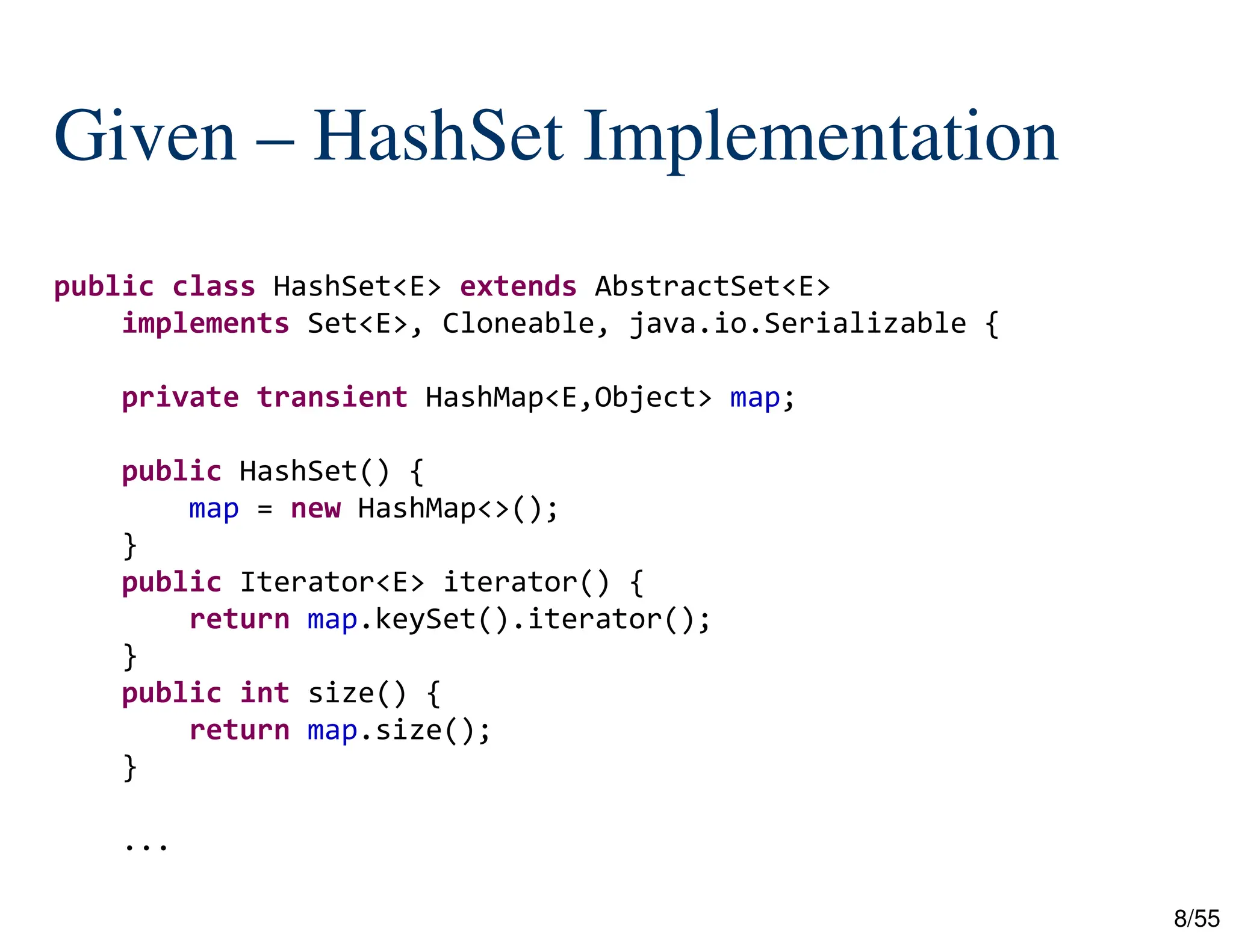
public class HashSet<E> extends AbstractSet<E>
implements Set<E>, Cloneable, java.io.Serializable {
private transient HashMap<E,Object> map;
public HashSet() {
map = new HashMap<>();
}
public Iterator<E> iterator() {
return map.keySet().iterator();
}
public int size() {
return map.size();
}
...
9/55
Solution
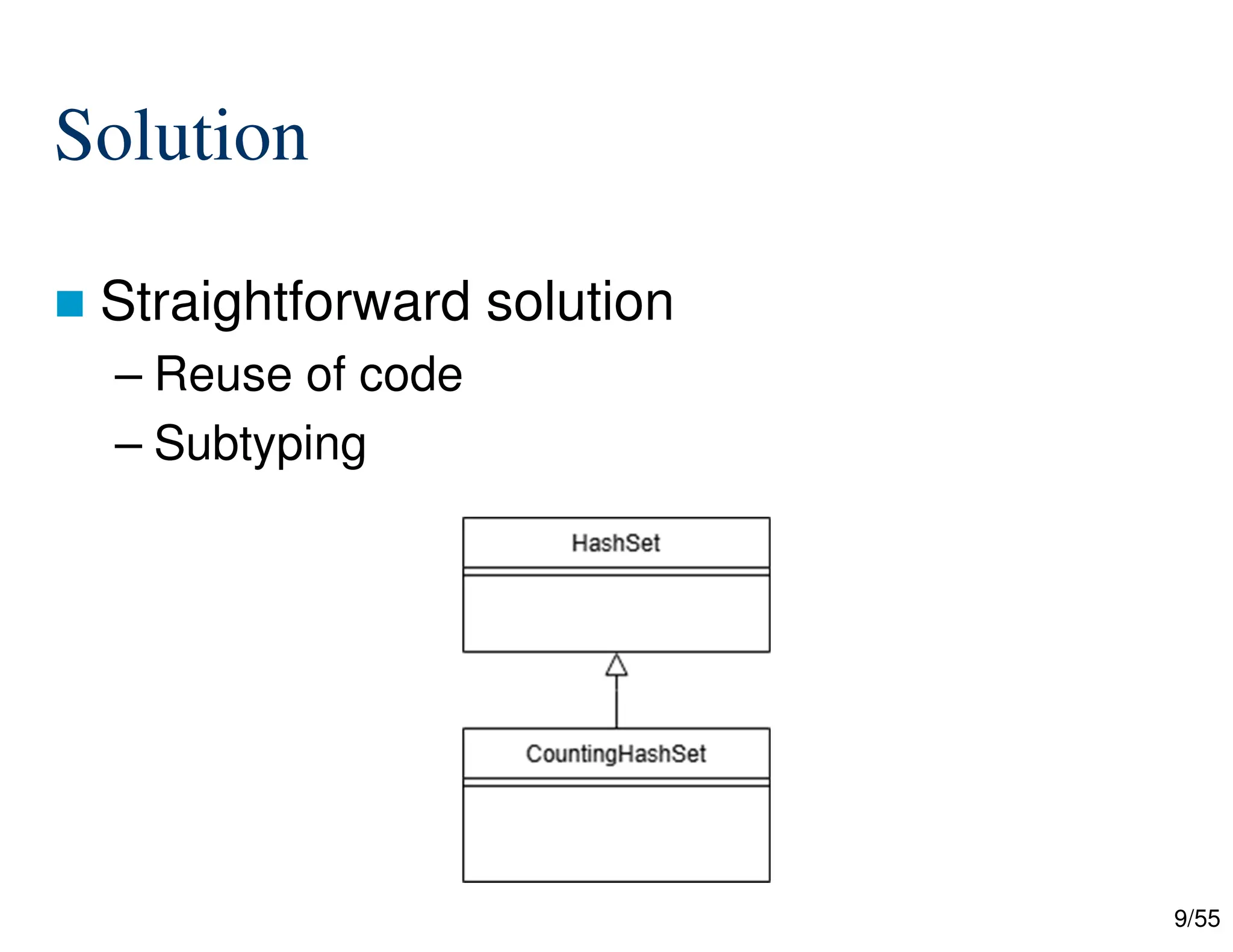
 Straightforward solution
– Reuse of code
– Subtyping
10/55
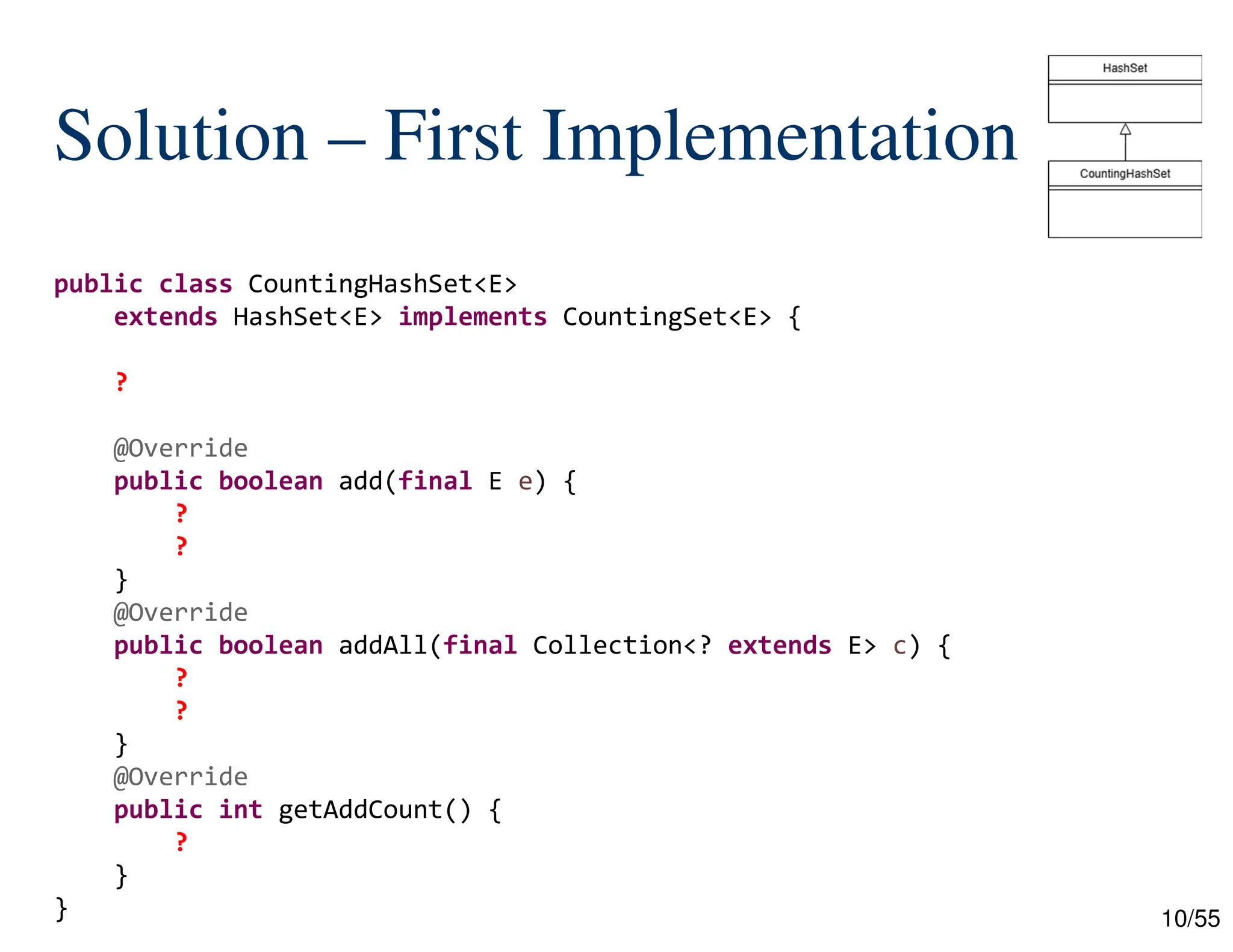
Solution – First Implementation
public class CountingHashSet<E>
extends HashSet<E> implements CountingSet<E> {
?
@Override
public boolean add(final E e) {
?
?
}
@Override
public boolean addAll(final Collection<? extends E> c) {
?
?
}
@Override
public int getAddCount() {
?
}
}
11/55
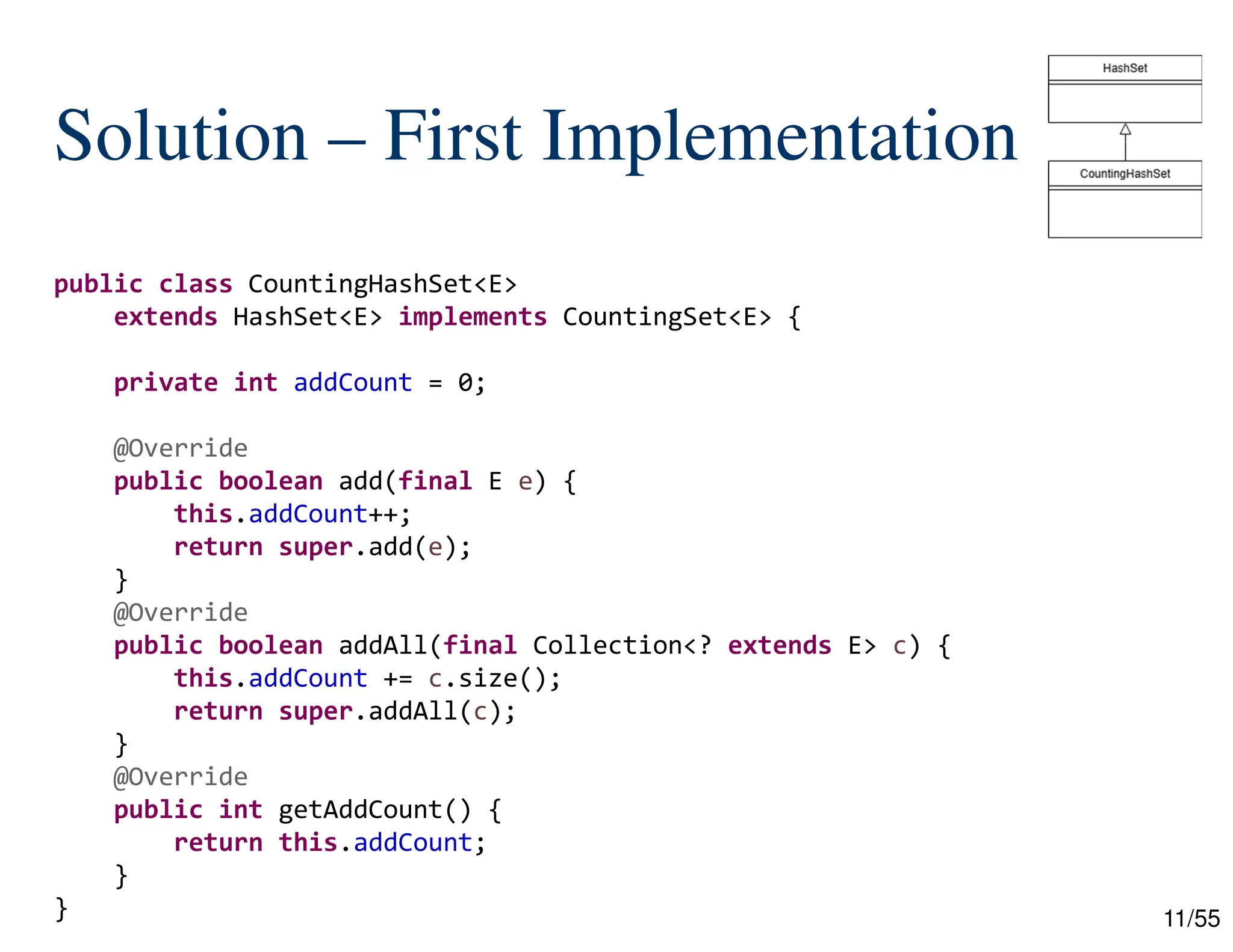
Solution – First Implementation
public class CountingHashSet<E>
extends HashSet<E> implements CountingSet<E> {
private int addCount = 0;
@Override
public boolean add(final E e) {
this.addCount++;
return super.add(e);
}
@Override
public boolean addAll(final Collection<? extends E> c) {
this.addCount += c.size();
return super.addAll(c);
}
@Override
public int getAddCount() {
return this.addCount;
}
}
12/55
Solution – First Implementation
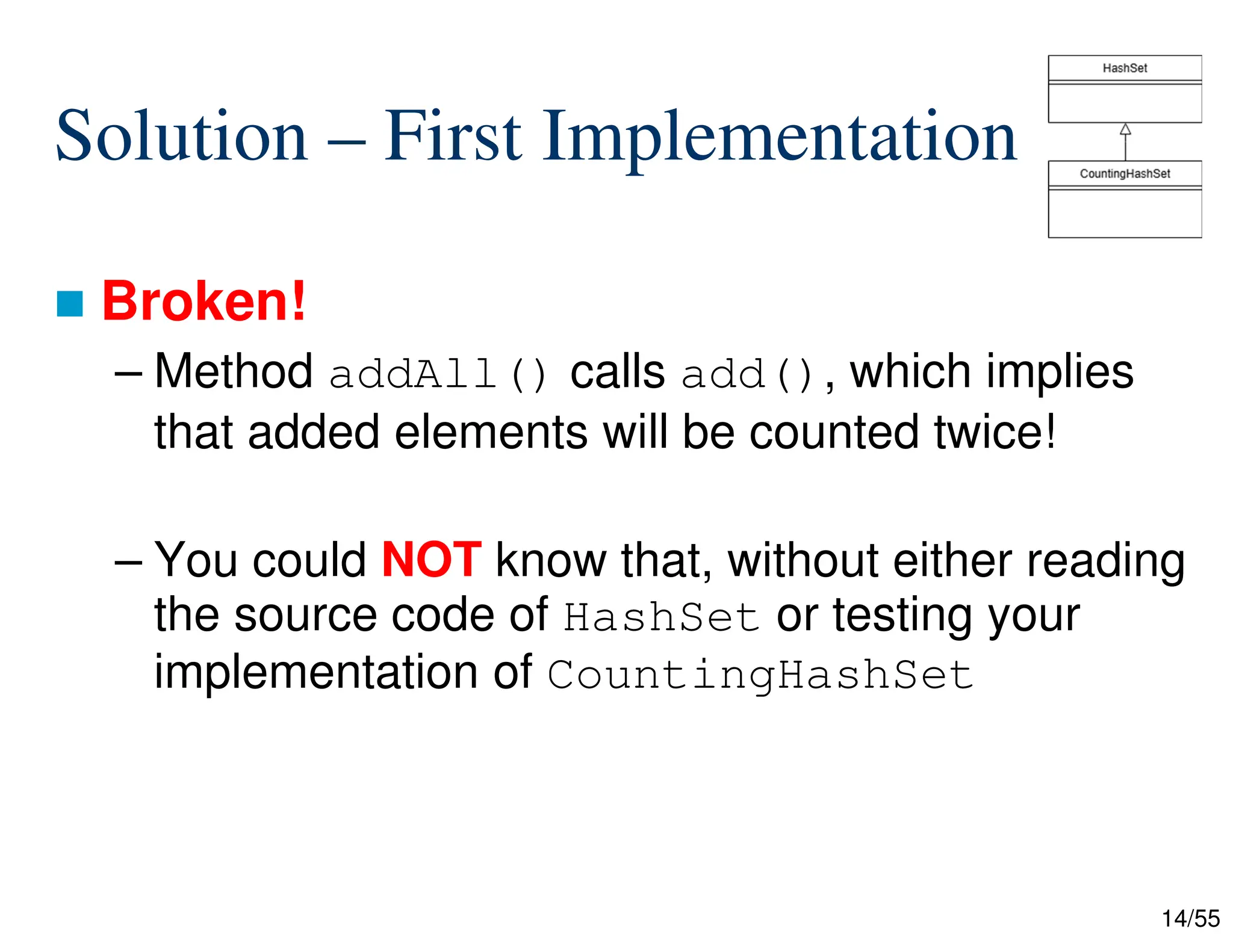
 Broken!
13/55
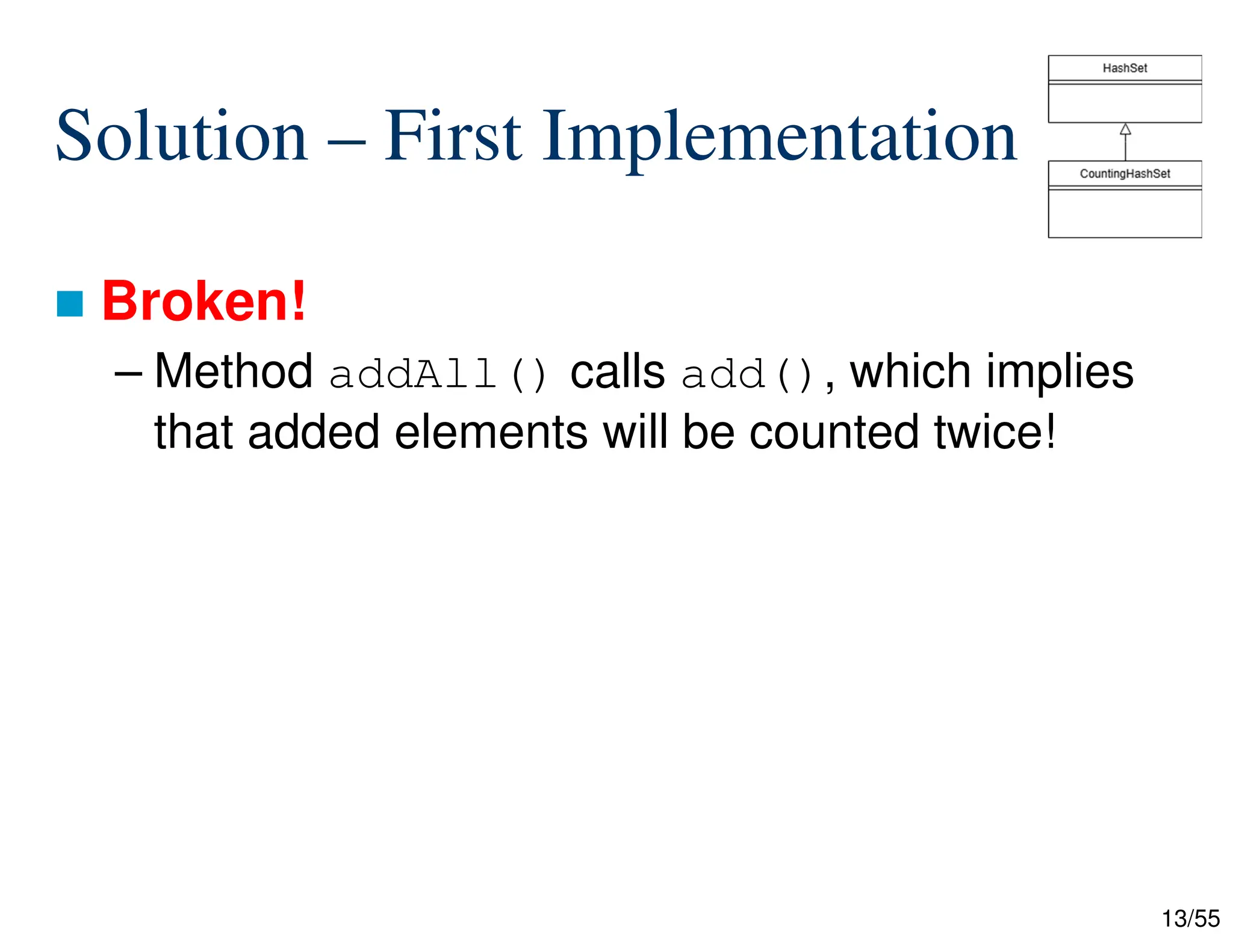
Solution – First Implementation
 Broken!
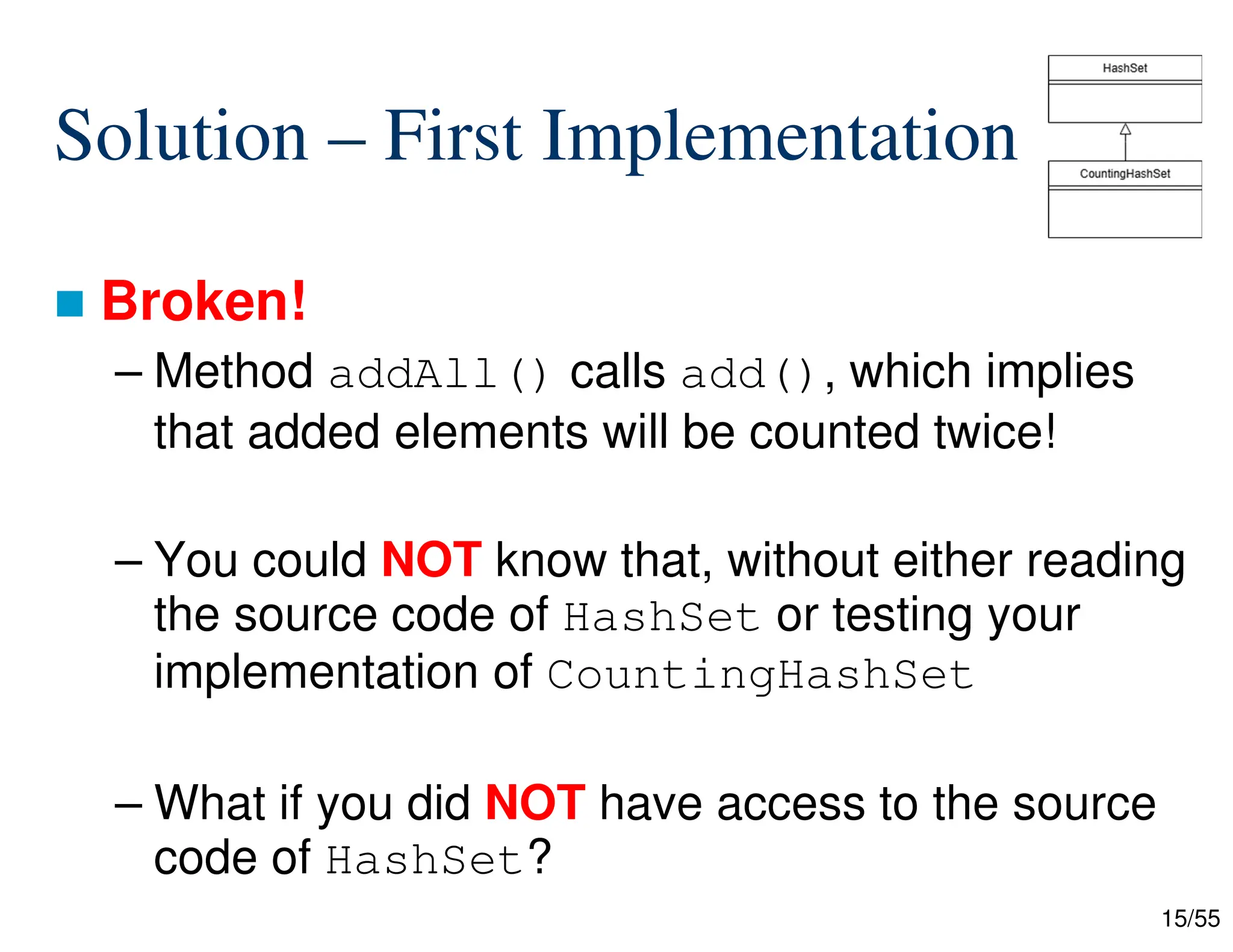
– Method addAll() calls add(), which implies
that added elements will be counted twice!
14/55
Solution – First Implementation
 Broken!
– Method addAll() calls add(), which implies
that added elements will be counted twice!
– You could NOT know that, without either reading
the source code of HashSet or testing your
implementation of CountingHashSet
15/55
Solution – First Implementation
 Broken!
– Method addAll() calls add(), which implies
that added elements will be counted twice!
– You could NOT know that, without either reading
the source code of HashSet or testing your
implementation of CountingHashSet
– What if you did NOT have access to the source
code of HashSet?
16/55
Fragile Base Class Problem
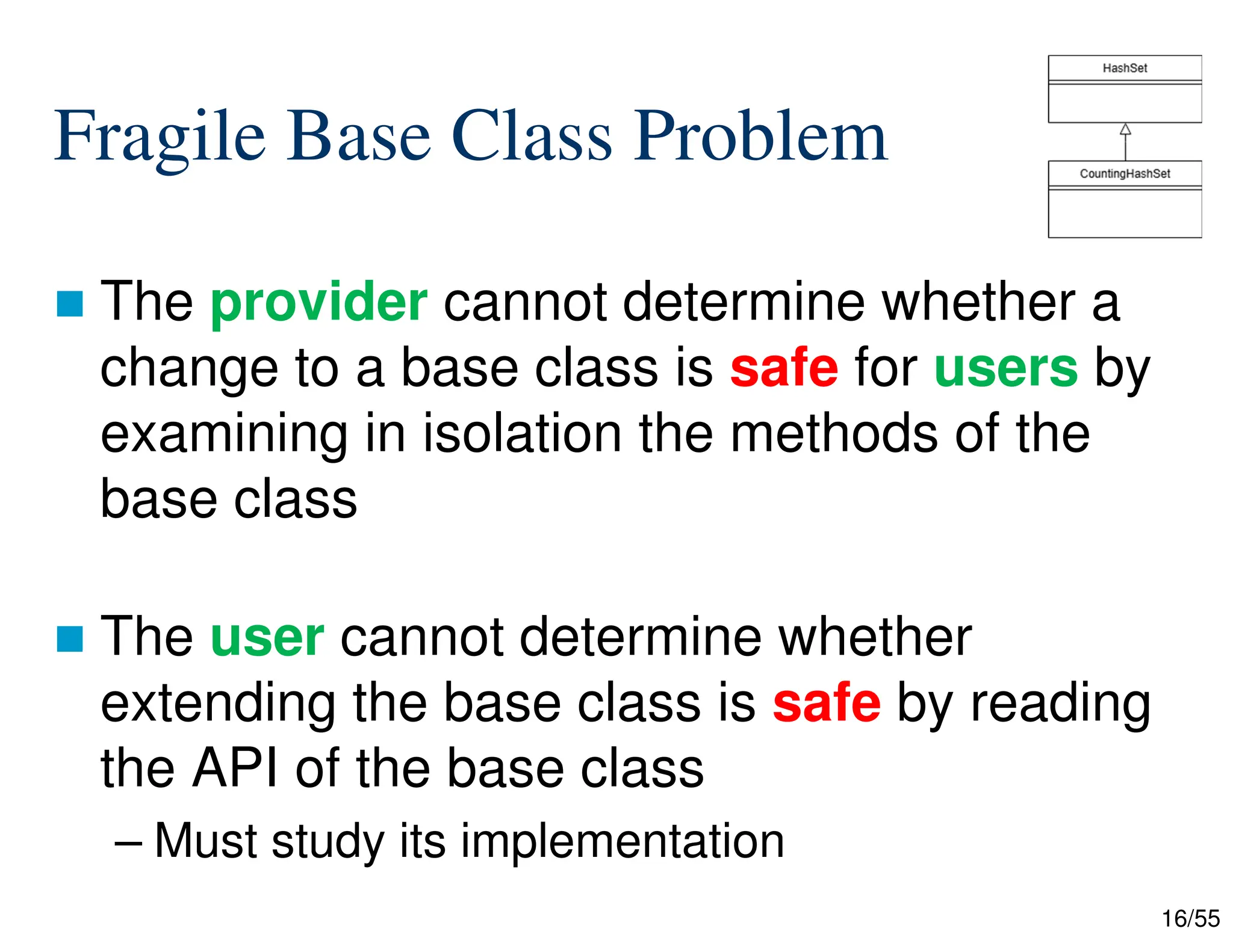
 The provider cannot determine whether a
change to a base class is safe for users by
examining in isolation the methods of the
base class
 The user cannot determine whether
extending the base class is safe by reading
the API of the base class
– Must study its implementation
17/55
Solution – Second Implementation


Problem: fragile base class problem
Solution: favour composition over inheritance
18/55
Solution – Second Implementation
 Favour composition over inheritance
– Allow changing implementation
– Allow safe inheritance

Problem: fragile base class problem
Solution: favour composition over inheritance
19/55
Solution – Second Implementation
 Favour composition over inheritance
– Allow changing implementation
– Allow safe inheritance
 Add one level of indirection
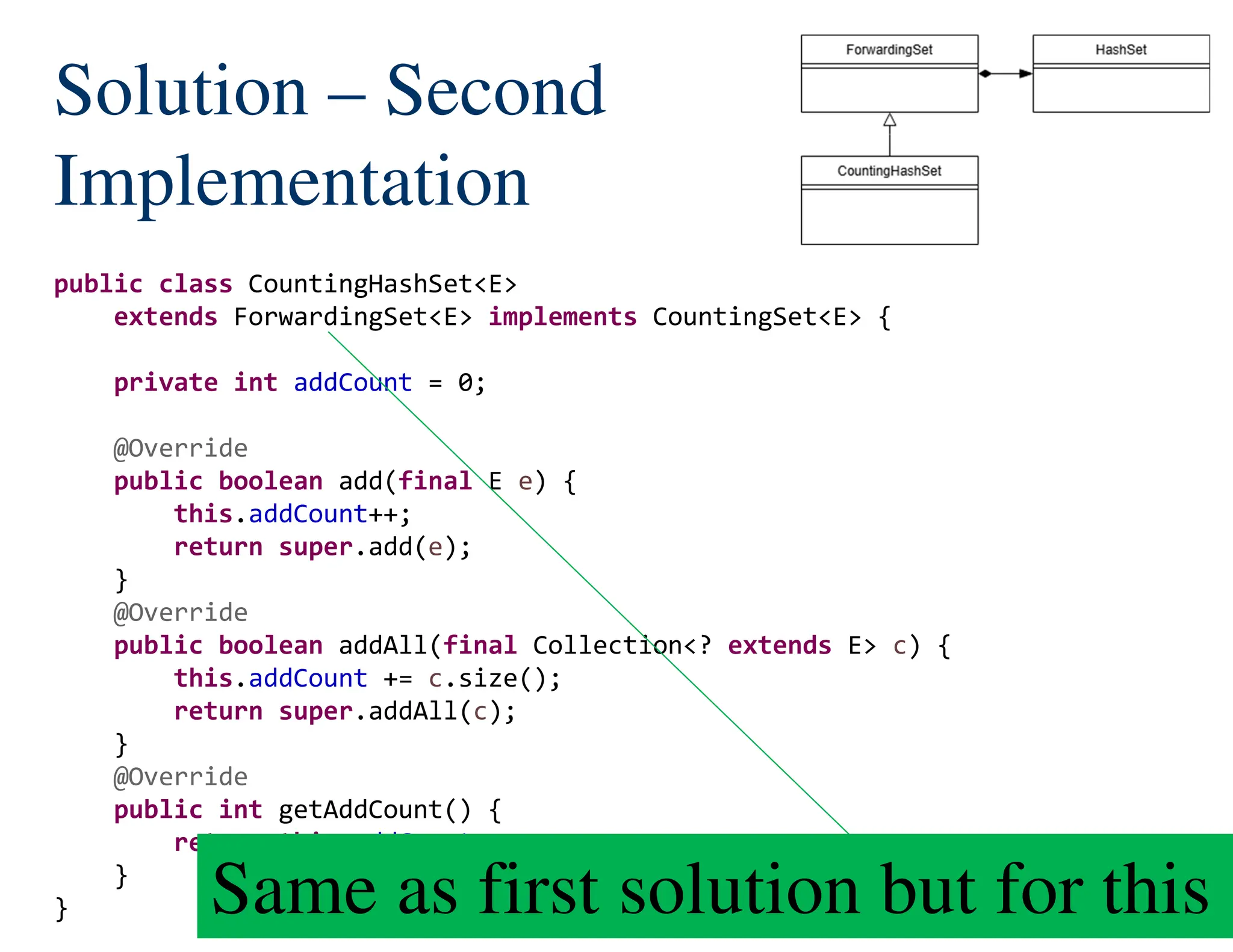
– A ForwardingSet delegates to HashSet
– Composite delegates to component
– CountingHashSet extends ForwardingSet
Problem: fragile base class problem
Solution: favour composition over inheritance
20/55
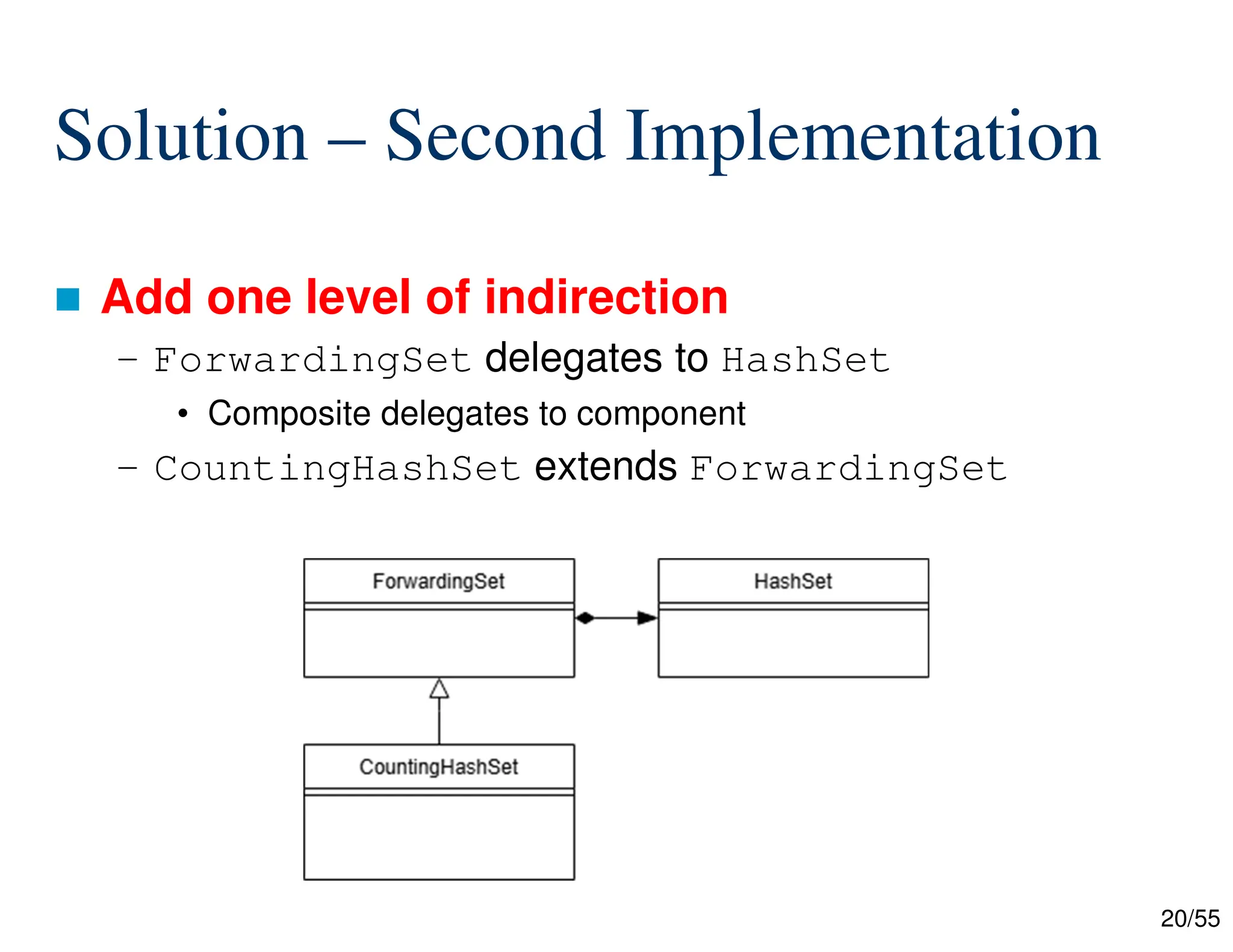
 Add one level of indirection
– ForwardingSet delegates to HashSet
• Composite delegates to component
– CountingHashSet extends ForwardingSet
Solution – Second Implementation
21/55
Solution – Second
Implementation
public class ForwardingSet<E> implements Set<E> {
private final Set<E> s = new HashSet<E>();
public void clear() { s.clear(); }
public boolean contains(final Object o) { return s.contains(o); }
public boolean isEmpty() { return s.isEmpty(); }
public int size() { return s.size(); }
public Iterator<E> iterator() { return s.iterator(); }
public boolean add(final E e) { return s.add(e); }
public boolean remove(final Object o) { return s.remove(o); }
public boolean containsAll(final Collection<?> c) { return s.containsAll(c); }
public boolean addAll(final Collection<? extends E> c) { return s.addAll(c); }
public boolean removeAll(final Collection<?> c) { return s.removeAll(c); }
public boolean retainAll(final Collection<?> c) { return s.retainAll(c); }
public Object[] toArray() { return s.toArray(); }
public <T> T[] toArray(final T[] a) { return s.toArray(a); }
public boolean equals(final Object o) { return s.equals(o); }
public int hashCode() { return s.hashCode(); }
public String toString() { return s.toString(); }
}
22/55
Solution – Second
Implementation
Typical delegations
public class ForwardingSet<E> implements Set<E> {
private final Set<E> s = new HashSet<E>();
public void clear() { s.clear(); }
public boolean contains(final Object o) { return s.contains(o); }
public boolean isEmpty() { return s.isEmpty(); }
public int size() { return s.size(); }
public Iterator<E> iterator() { return s.iterator(); }
public boolean add(final E e) { return s.add(e); }
public boolean remove(final Object o) { return s.remove(o); }
public boolean containsAll(final Collection<?> c) { return s.containsAll(c); }
public boolean addAll(final Collection<? extends E> c) { return s.addAll(c); }
public boolean removeAll(final Collection<?> c) { return s.removeAll(c); }
public boolean retainAll(final Collection<?> c) { return s.retainAll(c); }
public Object[] toArray() { return s.toArray(); }
public <T> T[] toArray(final T[] a) { return s.toArray(a); }
public boolean equals(final Object o) { return s.equals(o); }
public int hashCode() { return s.hashCode(); }
public String toString() { return s.toString(); }
}
23/55
Solution – Second
Implementation
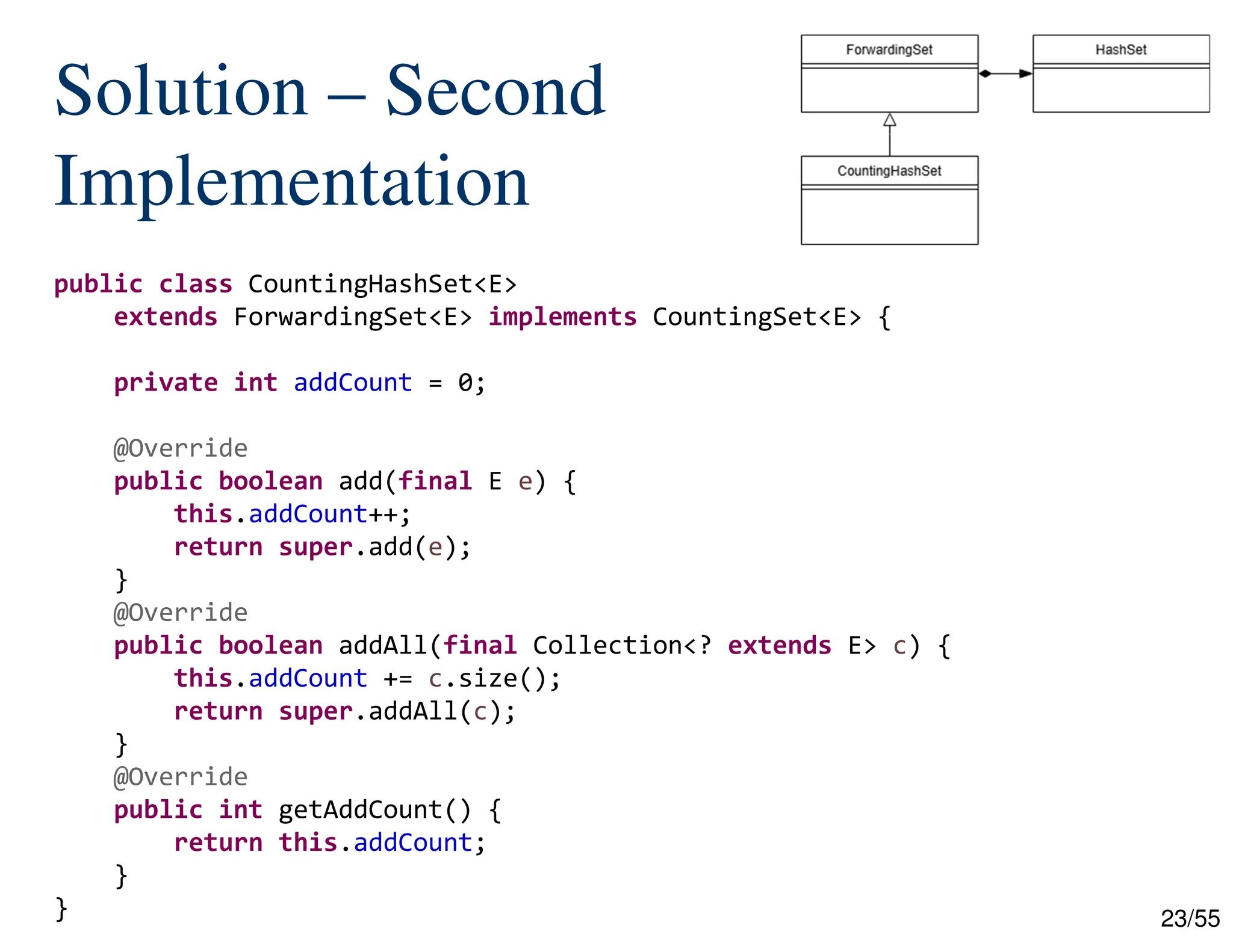
public class CountingHashSet<E>
extends ForwardingSet<E> implements CountingSet<E> {
private int addCount = 0;
@Override
public boolean add(final E e) {
this.addCount++;
return super.add(e);
}
@Override
public boolean addAll(final Collection<? extends E> c) {
this.addCount += c.size();
return super.addAll(c);
}
@Override
public int getAddCount() {
return this.addCount;
}
}
24/55
Solution – Second
Implementation
public class CountingHashSet<E>
extends ForwardingSet<E> implements CountingSet<E> {
private int addCount = 0;
@Override
public boolean add(final E e) {
this.addCount++;
return super.add(e);
}
@Override
public boolean addAll(final Collection<? extends E> c) {
this.addCount += c.size();
return super.addAll(c);
}
@Override
public int getAddCount() {
return this.addCount;
}
} Same as first solution but for this
25/55
Solution – Second
Implementation
 Forwarding involves two distinct objects
– Not one object and its superclass
 this refers alternatively
– To the instance of CountingHashSet
– To the (unrelated) instance of HashSet
26/55
Solution – Third
Implementation
 Project Manifold
– “Manifold is a Java compiler plugin, its features
include Metaprogramming, Properties,
Extension Methods, Operator Overloading,
Templates, a Preprocessor, and more.”
– https://github.com/manifold-systems
27/55
Solution – Third
Implementation
 Manifold Delegation
– “The manifold-delegation project is a compiler
plugin that provides language support for call
forwarding and true delegation. These features
are an experimental effort toward interface
composition as a practical alternative to
implementation inheritance.”
– https://github.com/manifold-systems/manifold/
tree/master/manifold-deps-parent/manifold-
delegation
28/55
Solution – Third
Implementation
 Manifold Delegation
– “The manifold-delegation project is a compiler
plugin that provides language support for call
forwarding and true delegation. These features
are an experimental effort toward interface
composition as a practical alternative to
implementation inheritance.”
– https://github.com/manifold-systems/manifold/
tree/master/manifold-deps-parent/manifold-
delegation
29/55
Solution – Third
Implementation
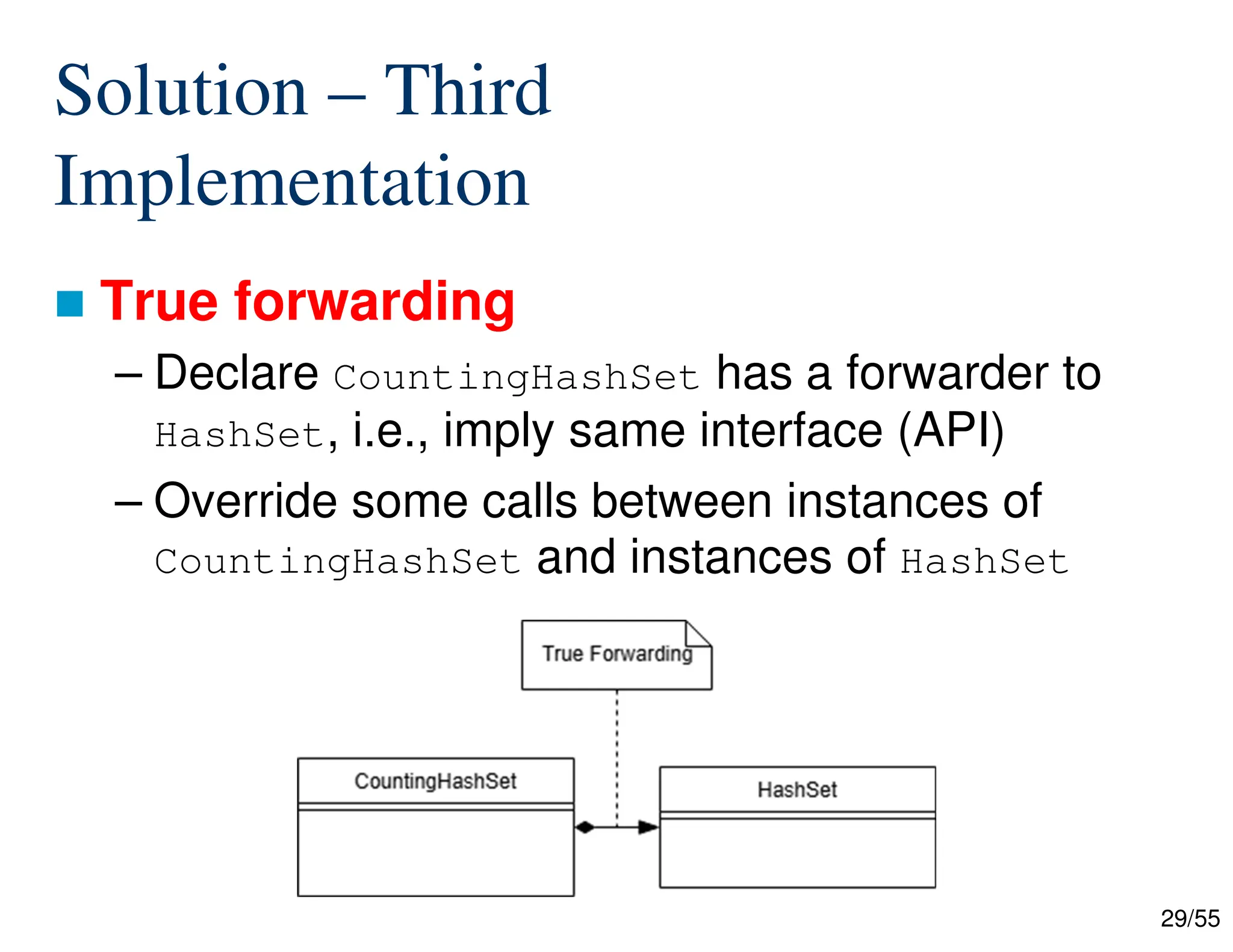
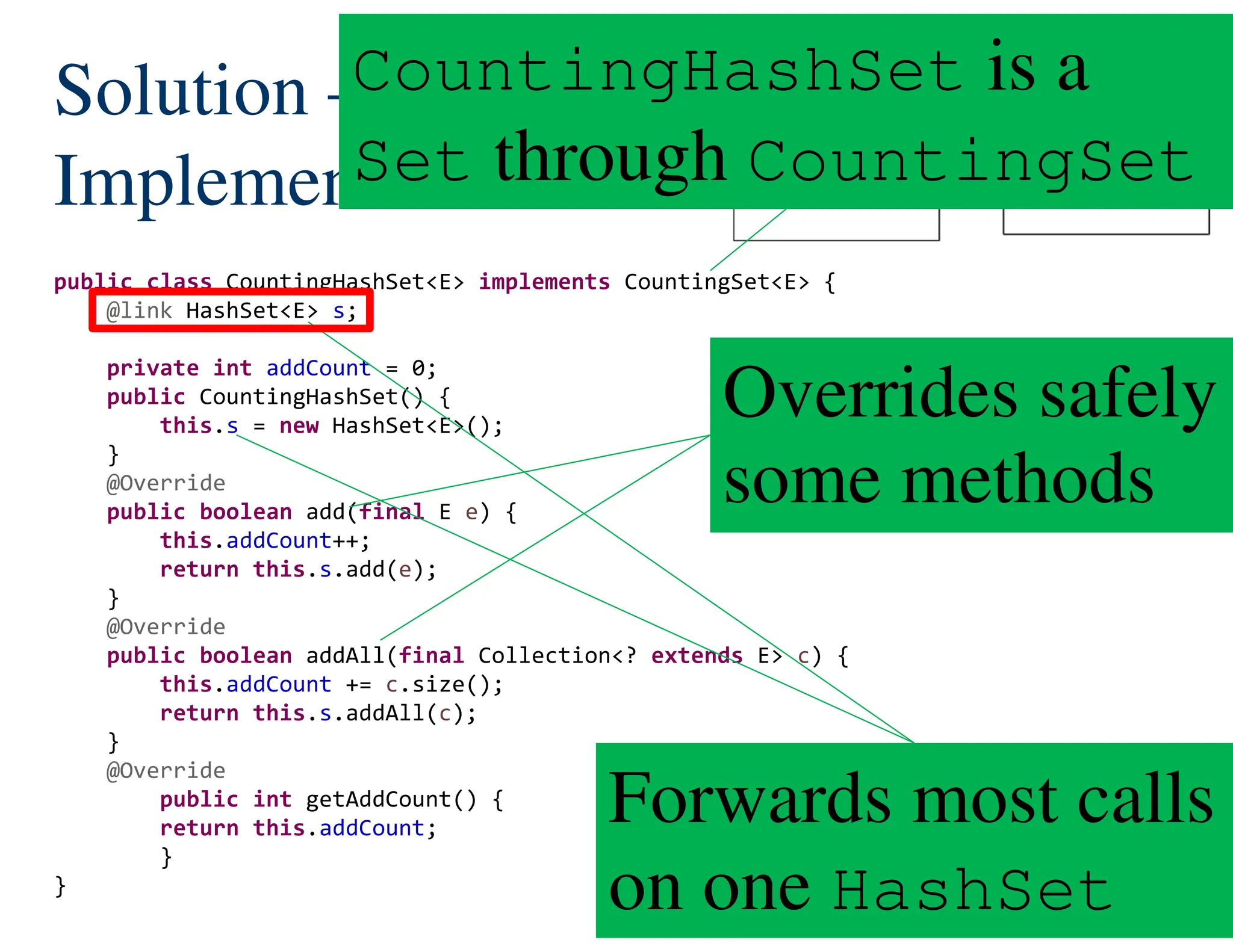
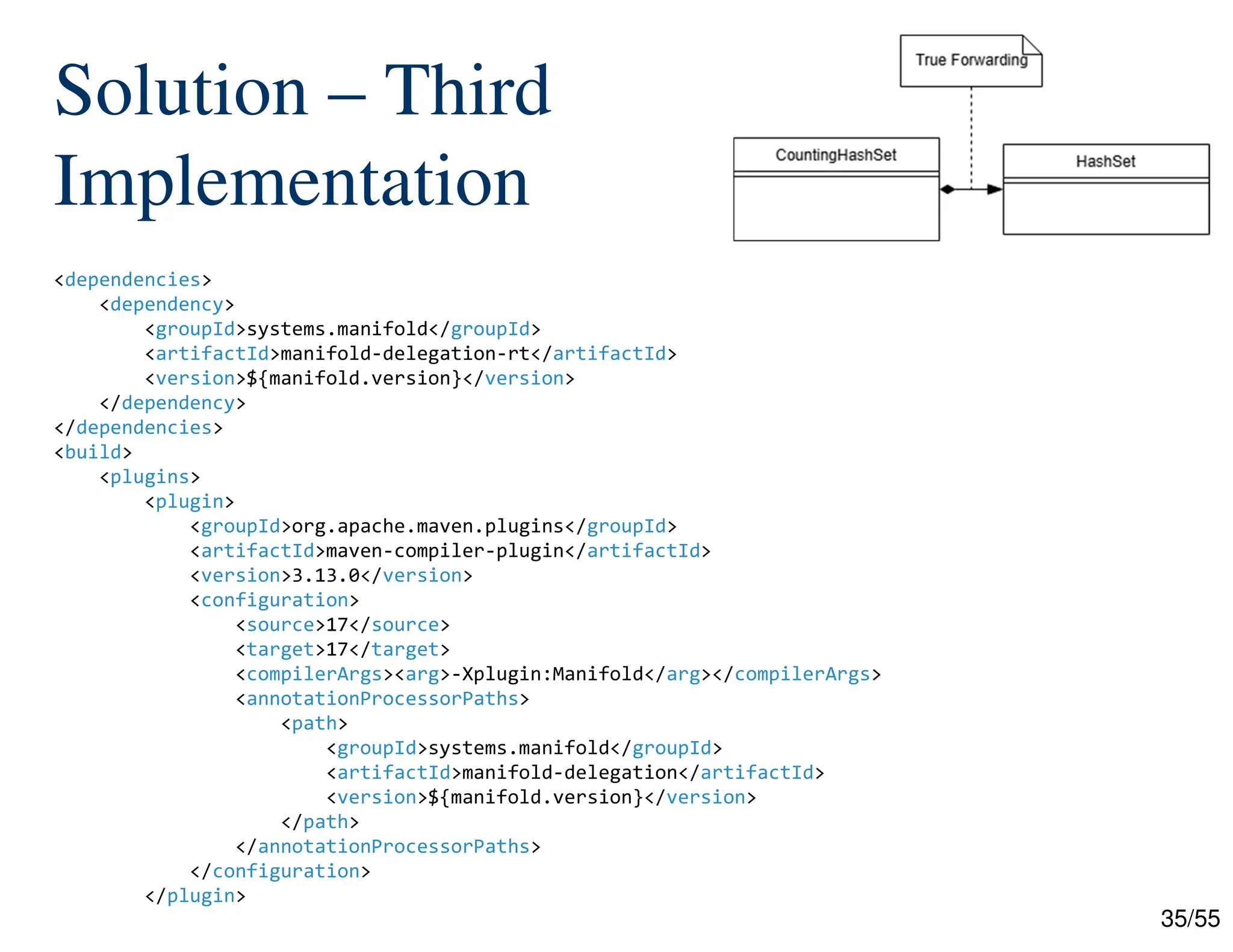
 True forwarding
– Declare CountingHashSet has a forwarder to
HashSet, i.e., imply same interface (API)
– Override some calls between instances of
CountingHashSet and instances of HashSet
30/55
Solution – Third
Implementation
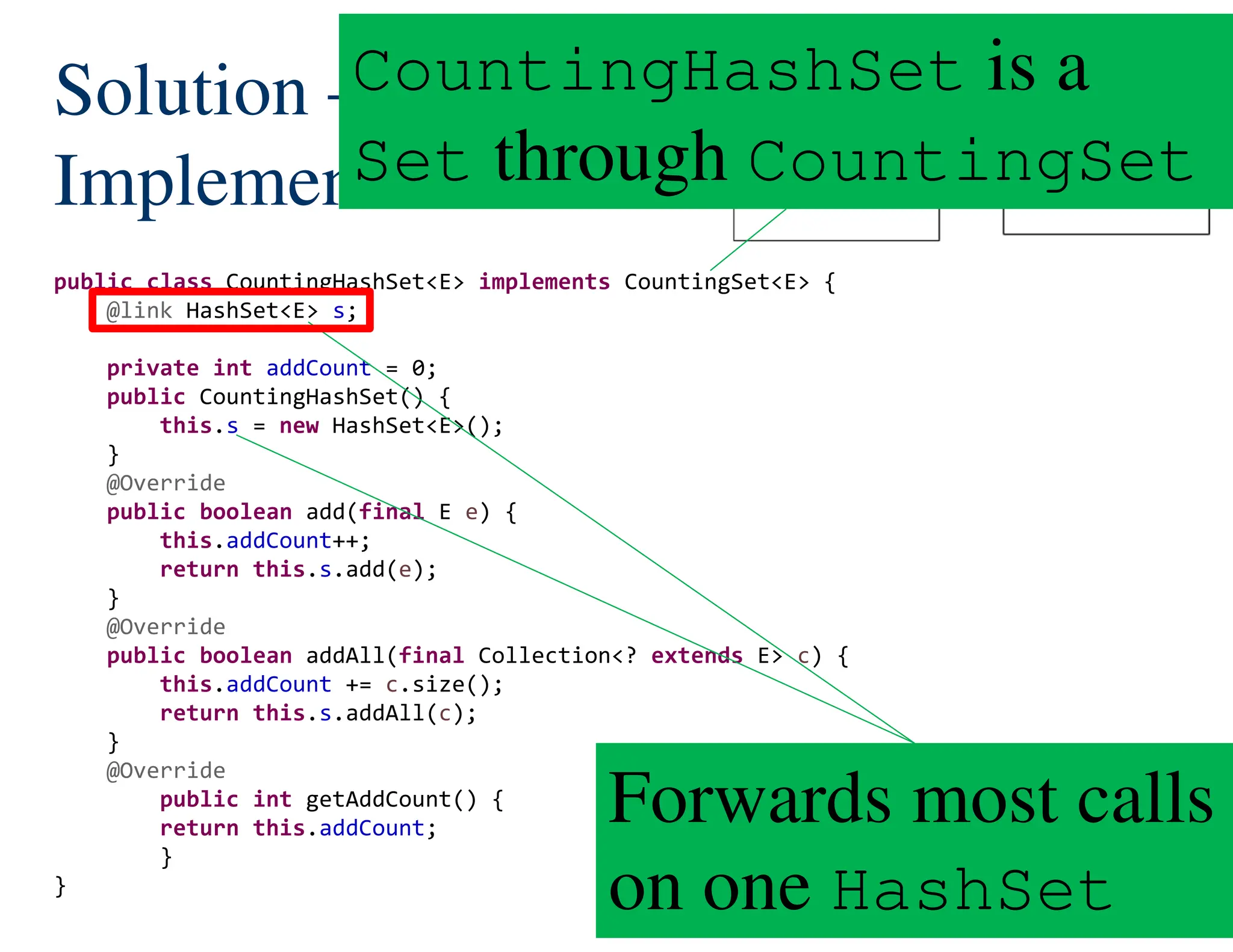
public class CountingHashSet<E> implements CountingSet<E> {
@link HashSet<E> s;
private int addCount = 0;
public CountingHashSet() {
this.s = new HashSet<E>();
}
@Override
public boolean add(final E e) {
this.addCount++;
return this.s.add(e);
}
@Override
public boolean addAll(final Collection<? extends E> c) {
this.addCount += c.size();
return this.s.addAll(c);
}
@Override
public int getAddCount() {
return this.addCount;
}
}
31/55
Solution – Third
Implementation
public class CountingHashSet<E> implements CountingSet<E> {
@link HashSet<E> s;
private int addCount = 0;
public CountingHashSet() {
this.s = new HashSet<E>();
}
@Override
public boolean add(final E e) {
this.addCount++;
return this.s.add(e);
}
@Override
public boolean addAll(final Collection<? extends E> c) {
this.addCount += c.size();
return this.s.addAll(c);
}
@Override
public int getAddCount() {
return this.addCount;
}
}
CountingHashSet is a
Set through CountingSet
32/55
Solution – Third
Implementation
public class CountingHashSet<E> implements CountingSet<E> {
@link HashSet<E> s;
private int addCount = 0;
public CountingHashSet() {
this.s = new HashSet<E>();
}
@Override
public boolean add(final E e) {
this.addCount++;
return this.s.add(e);
}
@Override
public boolean addAll(final Collection<? extends E> c) {
this.addCount += c.size();
return this.s.addAll(c);
}
@Override
public int getAddCount() {
return this.addCount;
}
}
CountingHashSet is a
Set through CountingSet
Forwards most calls
on one HashSet
33/55
Solution – Third
Implementation
public class CountingHashSet<E> implements CountingSet<E> {
@link HashSet<E> s;
private int addCount = 0;
public CountingHashSet() {
this.s = new HashSet<E>();
}
@Override
public boolean add(final E e) {
this.addCount++;
return this.s.add(e);
}
@Override
public boolean addAll(final Collection<? extends E> c) {
this.addCount += c.size();
return this.s.addAll(c);
}
@Override
public int getAddCount() {
return this.addCount;
}
}
CountingHashSet is a
Set through CountingSet
Forwards most calls
on one HashSet
Overrides safely
some methods
34/55
Solution – Third
Implementation
public class CountingHashSet<E> implements CountingSet<E> {
@link HashSet<E> s;
private int addCount = 0;
public CountingHashSet() {
this.s = new HashSet<E>();
}
@Override
public boolean add(final E e) {
this.addCount++;
return this.s.add(e);
}
@Override
public boolean addAll(final Collection<? extends E> c) {
this.addCount += c.size();
return this.s.addAll(c);
}
@Override
public int getAddCount() {
return this.addCount;
}
}
35/55
Solution – Third
Implementation
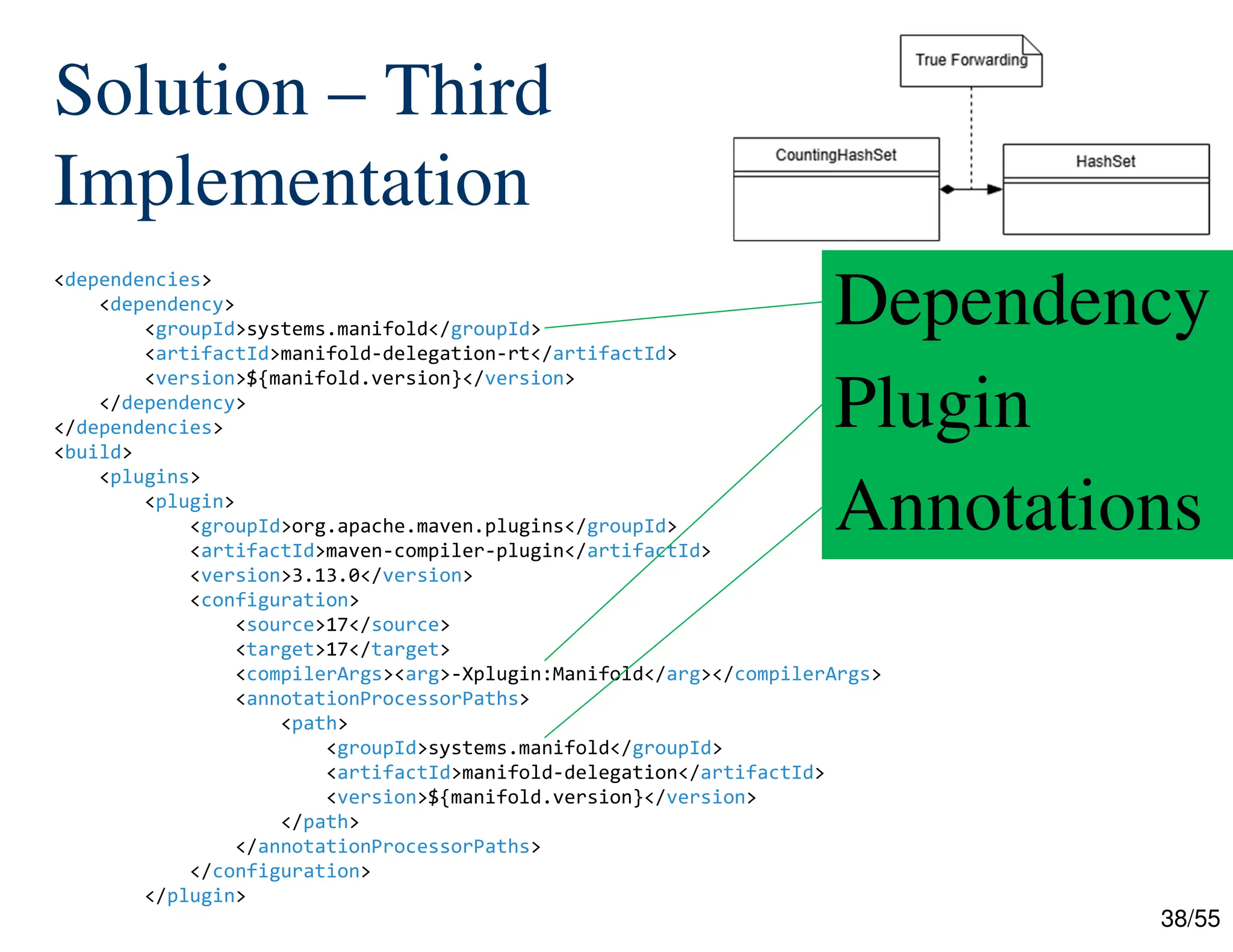
<dependencies>
<dependency>
<groupId>systems.manifold</groupId>
<artifactId>manifold-delegation-rt</artifactId>
<version>${manifold.version}</version>
</dependency>
</dependencies>
<build>
<plugins>
<plugin>
<groupId>org.apache.maven.plugins</groupId>
<artifactId>maven-compiler-plugin</artifactId>
<version>3.13.0</version>
<configuration>
<source>17</source>
<target>17</target>
<compilerArgs><arg>-Xplugin:Manifold</arg></compilerArgs>
<annotationProcessorPaths>
<path>
<groupId>systems.manifold</groupId>
<artifactId>manifold-delegation</artifactId>
<version>${manifold.version}</version>
</path>
</annotationProcessorPaths>
</configuration>
</plugin>
36/55
Solution – Third
Implementation
<dependencies>
<dependency>
<groupId>systems.manifold</groupId>
<artifactId>manifold-delegation-rt</artifactId>
<version>${manifold.version}</version>
</dependency>
</dependencies>
<build>
<plugins>
<plugin>
<groupId>org.apache.maven.plugins</groupId>
<artifactId>maven-compiler-plugin</artifactId>
<version>3.13.0</version>
<configuration>
<source>17</source>
<target>17</target>
<compilerArgs><arg>-Xplugin:Manifold</arg></compilerArgs>
<annotationProcessorPaths>
<path>
<groupId>systems.manifold</groupId>
<artifactId>manifold-delegation</artifactId>
<version>${manifold.version}</version>
</path>
</annotationProcessorPaths>
</configuration>
</plugin>
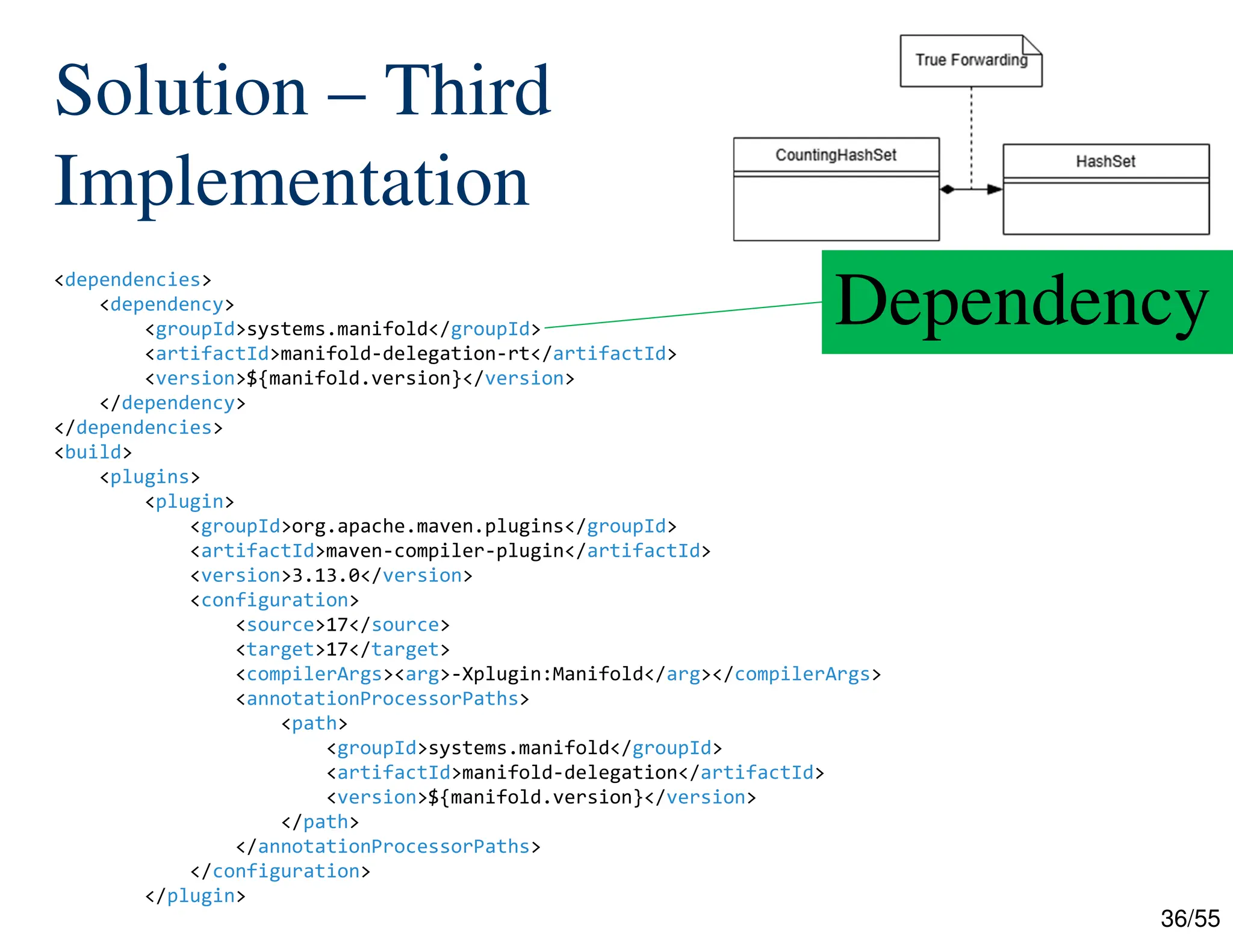
Dependency
37/55
Solution – Third
Implementation
<dependencies>
<dependency>
<groupId>systems.manifold</groupId>
<artifactId>manifold-delegation-rt</artifactId>
<version>${manifold.version}</version>
</dependency>
</dependencies>
<build>
<plugins>
<plugin>
<groupId>org.apache.maven.plugins</groupId>
<artifactId>maven-compiler-plugin</artifactId>
<version>3.13.0</version>
<configuration>
<source>17</source>
<target>17</target>
<compilerArgs><arg>-Xplugin:Manifold</arg></compilerArgs>
<annotationProcessorPaths>
<path>
<groupId>systems.manifold</groupId>
<artifactId>manifold-delegation</artifactId>
<version>${manifold.version}</version>
</path>
</annotationProcessorPaths>
</configuration>
</plugin>
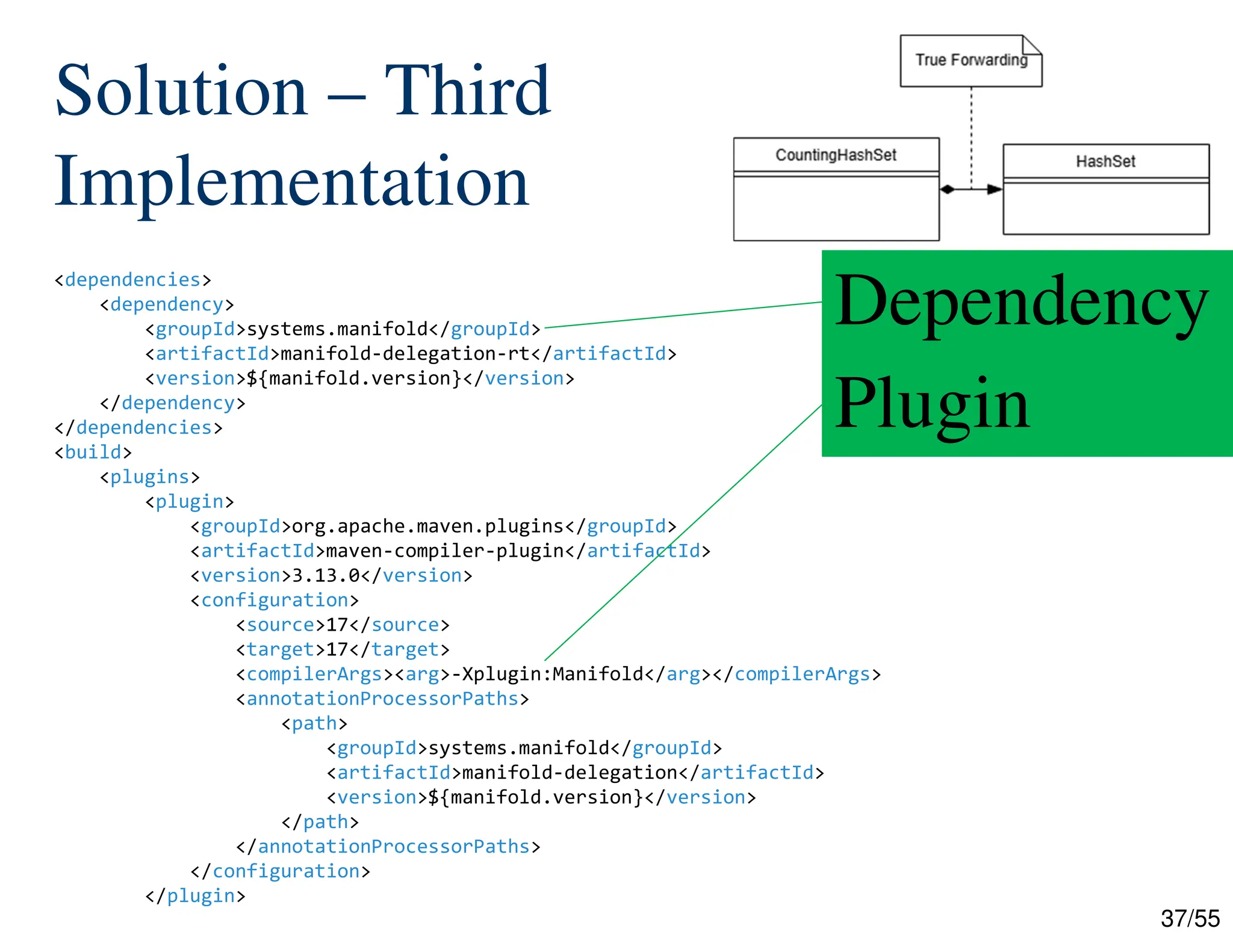
Dependency
Plugin
38/55
Solution – Third
Implementation
<dependencies>
<dependency>
<groupId>systems.manifold</groupId>
<artifactId>manifold-delegation-rt</artifactId>
<version>${manifold.version}</version>
</dependency>
</dependencies>
<build>
<plugins>
<plugin>
<groupId>org.apache.maven.plugins</groupId>
<artifactId>maven-compiler-plugin</artifactId>
<version>3.13.0</version>
<configuration>
<source>17</source>
<target>17</target>
<compilerArgs><arg>-Xplugin:Manifold</arg></compilerArgs>
<annotationProcessorPaths>
<path>
<groupId>systems.manifold</groupId>
<artifactId>manifold-delegation</artifactId>
<version>${manifold.version}</version>
</path>
</annotationProcessorPaths>
</configuration>
</plugin>
Dependency
Plugin
Annotations
39/55
SUBCLASSING
40/55
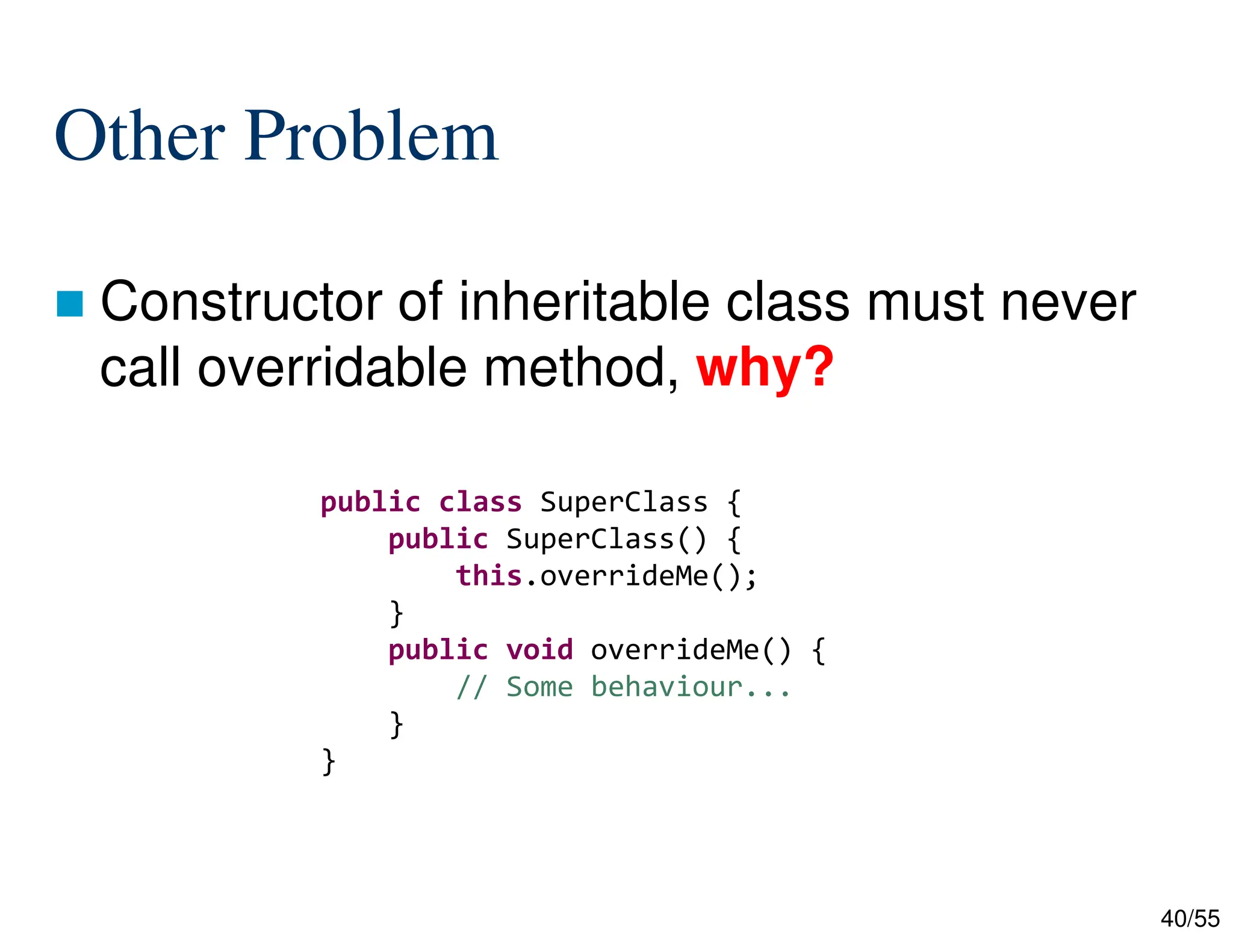
Other Problem
 Constructor of inheritable class must never
call overridable method, why?
public class SuperClass {
public SuperClass() {
this.overrideMe();
}
public void overrideMe() {
// Some behaviour...
}
}
41/55
Other Problem
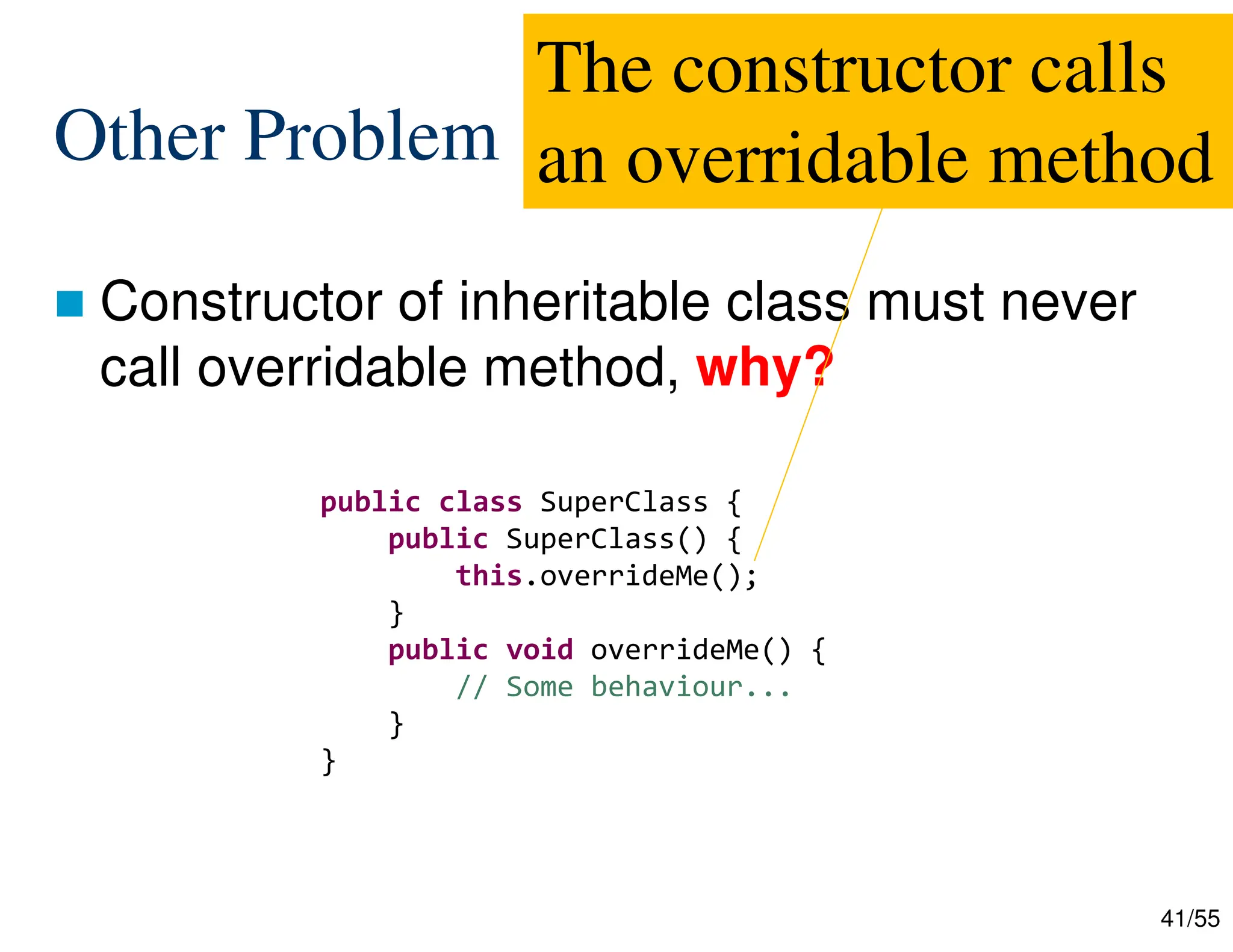
 Constructor of inheritable class must never
call overridable method, why?
public class SuperClass {
public SuperClass() {
this.overrideMe();
}
public void overrideMe() {
// Some behaviour...
}
}
The constructor calls
an overridable method
42/55
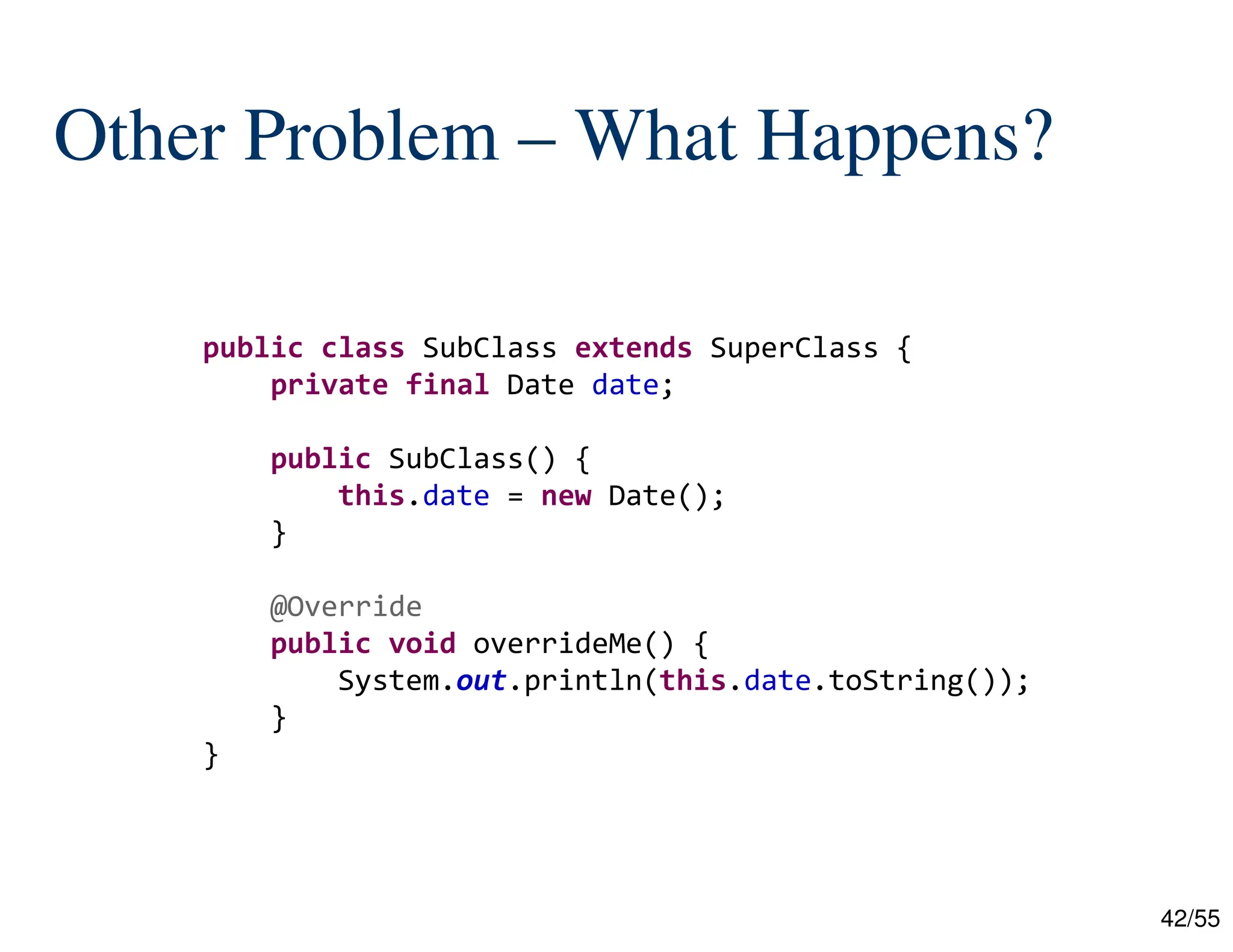
Other Problem – What Happens?
public class SubClass extends SuperClass {
private final Date date;
public SubClass() {
this.date = new Date();
}
@Override
public void overrideMe() {
System.out.println(this.date.toString());
}
}
43/55
Other Problem – What Happens?
NullPointerException
public class SubClass extends SuperClass {
private final Date date;
public SubClass() {
this.date = new Date();
}
@Override
public void overrideMe() {
System.out.println(this.date.toString());
}
}
44/55
Other Problem – Second
Implementation
 Constructor of inheritable class must never
call overridable method!
public class SafeSuperClass {
public SafeSuperClass() {
this.cannotOverrideMe();
}
public final void cannotOverrideMe() {
// Some behaviour...
}
}
45/55
FORWARDING AND
DELEGATION
46/55
Forwarding and
Delegation
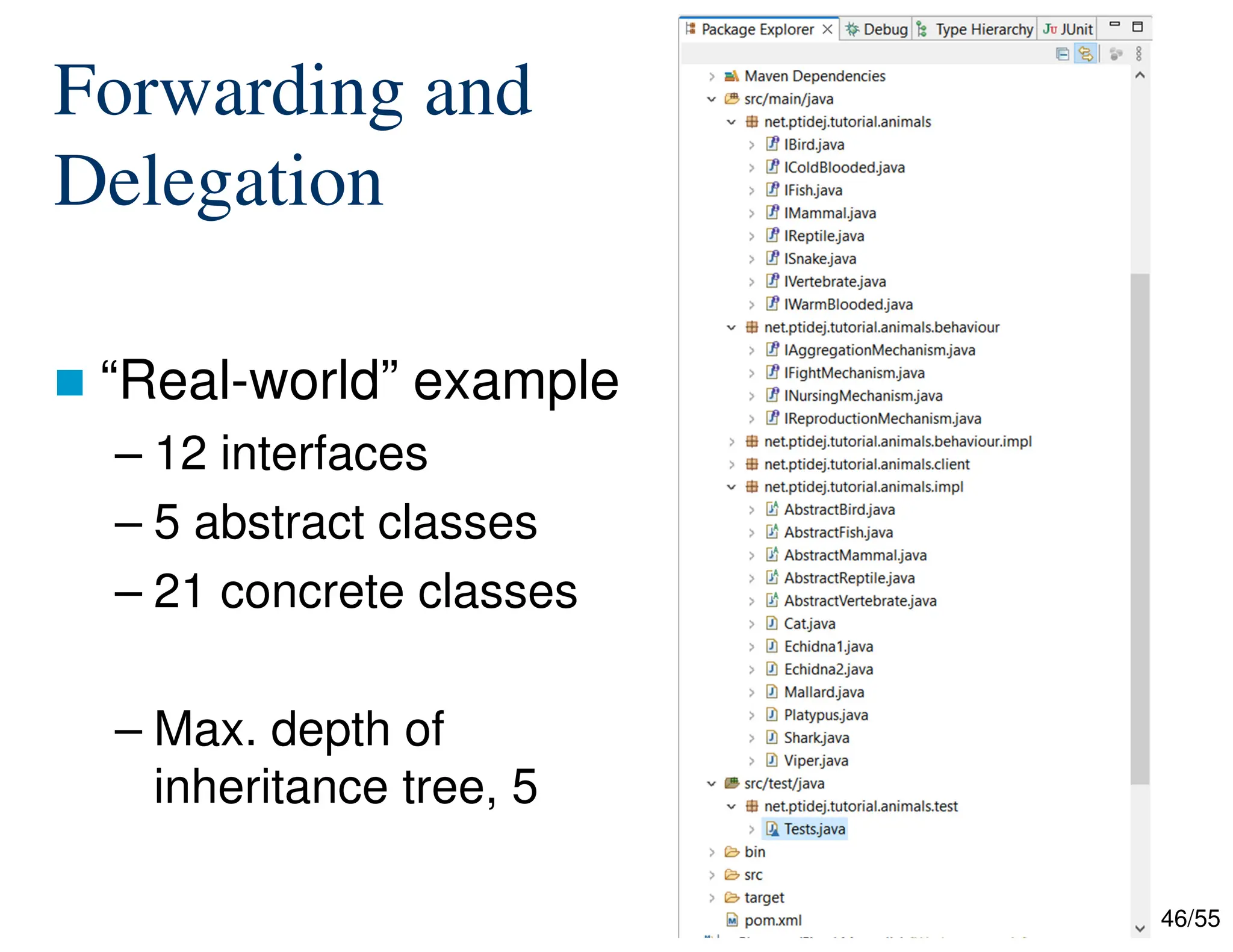
 “Real-world” example
– 12 interfaces
– 5 abstract classes
– 21 concrete classes
– Max. depth of
inheritance tree, 5
47/55
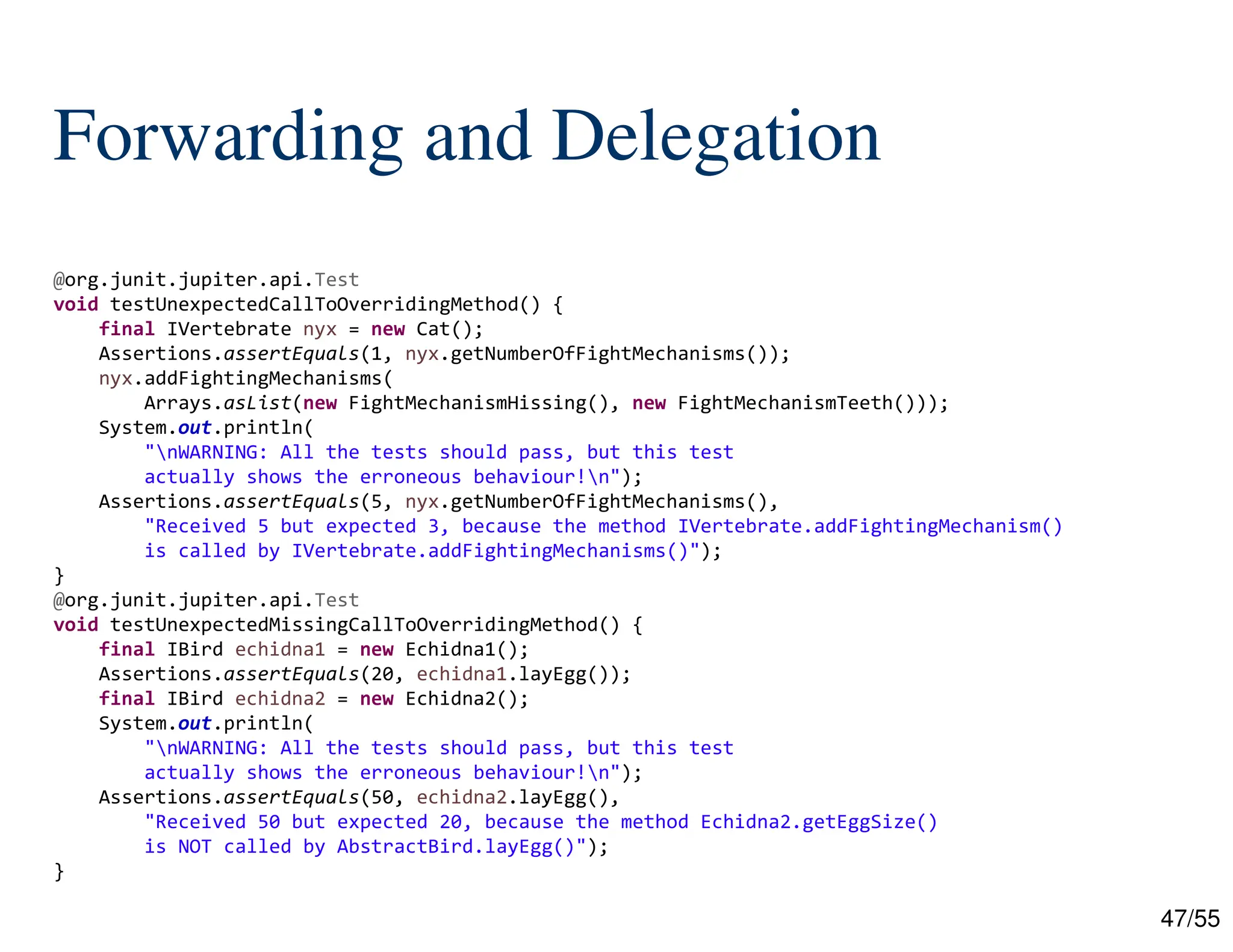
Forwarding and Delegation
@org.junit.jupiter.api.Test
void testUnexpectedCallToOverridingMethod() {
final IVertebrate nyx = new Cat();
Assertions.assertEquals(1, nyx.getNumberOfFightMechanisms());
nyx.addFightingMechanisms(
Arrays.asList(new FightMechanismHissing(), new FightMechanismTeeth()));
System.out.println(
"nWARNING: All the tests should pass, but this test
actually shows the erroneous behaviour!n");
Assertions.assertEquals(5, nyx.getNumberOfFightMechanisms(),
"Received 5 but expected 3, because the method IVertebrate.addFightingMechanism()
is called by IVertebrate.addFightingMechanisms()");
}
@org.junit.jupiter.api.Test
void testUnexpectedMissingCallToOverridingMethod() {
final IBird echidna1 = new Echidna1();
Assertions.assertEquals(20, echidna1.layEgg());
final IBird echidna2 = new Echidna2();
System.out.println(
"nWARNING: All the tests should pass, but this test
actually shows the erroneous behaviour!n");
Assertions.assertEquals(50, echidna2.layEgg(),
"Received 50 but expected 20, because the method Echidna2.getEggSize()
is NOT called by AbstractBird.layEgg()");
}
48/55
Forwarding and Delegation
@org.junit.jupiter.api.Test
void testUnexpectedCallToOverridingMethod() {
final IVertebrate nyx = new Cat();
Assertions.assertEquals(1, nyx.getNumberOfFightMechanisms());
nyx.addFightingMechanisms(
Arrays.asList(new FightMechanismHissing(), new FightMechanismTeeth()));
System.out.println(
"nWARNING: All the tests should pass, but this test
actually shows the erroneous behaviour!n");
Assertions.assertEquals(5, nyx.getNumberOfFightMechanisms(),
"Received 5 but expected 3, because the method IVertebrate.addFightingMechanism()
is called by IVertebrate.addFightingMechanisms()");
}
@org.junit.jupiter.api.Test
void testUnexpectedMissingCallToOverridingMethod() {
final IBird echidna1 = new Echidna1();
Assertions.assertEquals(20, echidna1.layEgg());
final IBird echidna2 = new Echidna2();
System.out.println(
"nWARNING: All the tests should pass, but this test
actually shows the erroneous behaviour!n");
Assertions.assertEquals(50, echidna2.layEgg(),
"Received 50 but expected 20, because the method Echidna2.getEggSize()
is NOT called by AbstractBird.layEgg()");
}
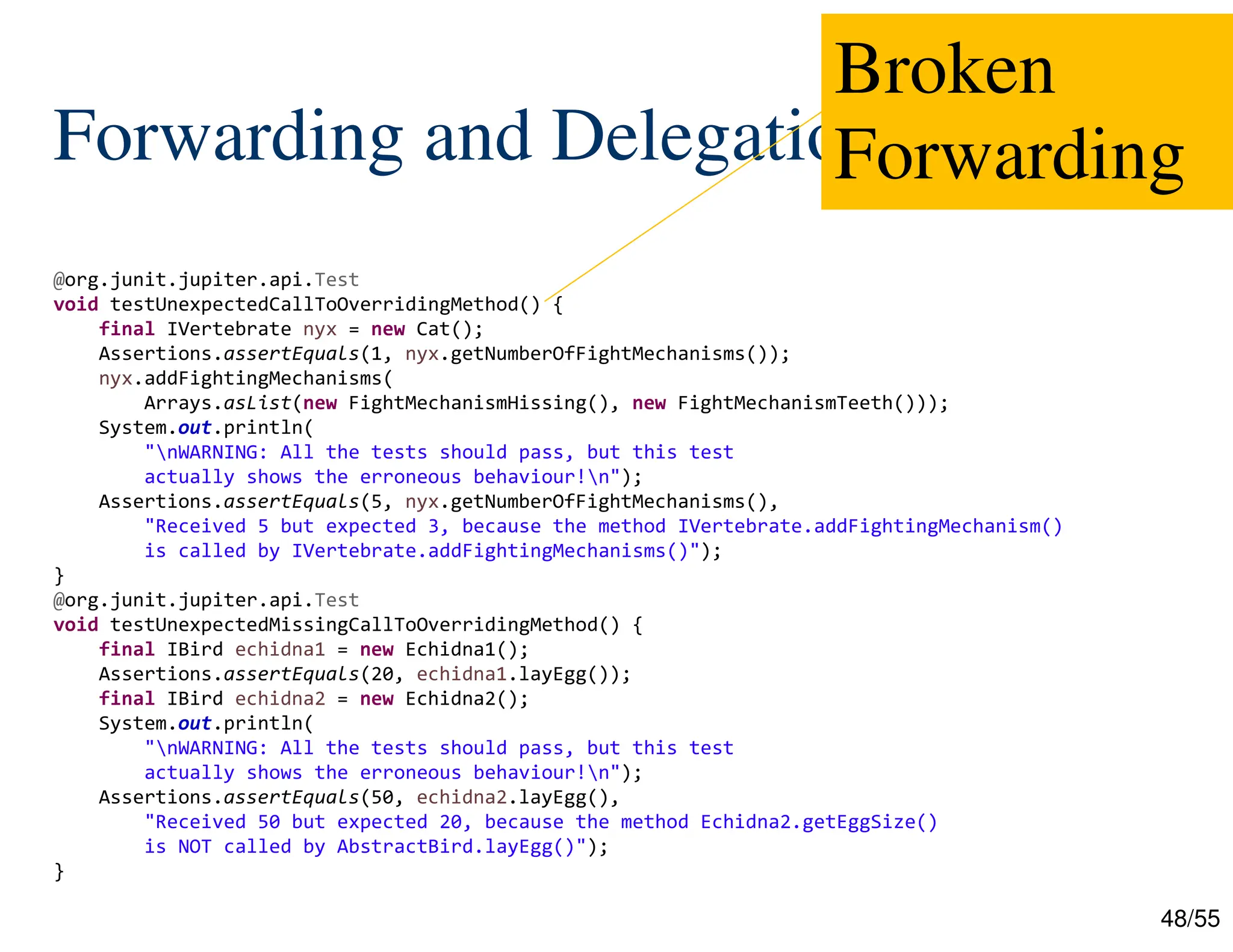
Broken
Forwarding
49/55
Forwarding and Delegation
@org.junit.jupiter.api.Test
void testUnexpectedCallToOverridingMethod() {
final IVertebrate nyx = new Cat();
Assertions.assertEquals(1, nyx.getNumberOfFightMechanisms());
nyx.addFightingMechanisms(
Arrays.asList(new FightMechanismHissing(), new FightMechanismTeeth()));
System.out.println(
"nWARNING: All the tests should pass, but this test
actually shows the erroneous behaviour!n");
Assertions.assertEquals(5, nyx.getNumberOfFightMechanisms(),
"Received 5 but expected 3, because the method IVertebrate.addFightingMechanism()
is called by IVertebrate.addFightingMechanisms()");
}
@org.junit.jupiter.api.Test
void testUnexpectedMissingCallToOverridingMethod() {
final IBird echidna1 = new Echidna1();
Assertions.assertEquals(20, echidna1.layEgg());
final IBird echidna2 = new Echidna2();
System.out.println(
"nWARNING: All the tests should pass, but this test
actually shows the erroneous behaviour!n");
Assertions.assertEquals(50, echidna2.layEgg(),
"Received 50 but expected 20, because the method Echidna2.getEggSize()
is NOT called by AbstractBird.layEgg()");
}
Broken
Forwarding
Broken
Delegation
50/55
Forwarding and
Delegation
 As of 24/10/01, project Manifold comes with
some constraints on declared types
– Class AbstractBird must implement IBird
– Must use AbstractBird instead of Mallard
public class Echidna2 extends
AbstractMammal implements IBird, IMammal {
// For Manifold: must be "AbstractBird
// birdTraits", not "Mallard birdTraits"
@link
AbstractBird birdTraits = new Mallard();
51/55
CONCLUSION
52/55
Conclusion
 Polymorphism is a fundamental concept
of object-oriented programming, but it is
not without problem
 Adding one level of indirection solves the
problem
– Encapsulation
– Delegation
 Information hiding
53/55
Conclusion
 Encapsulation and delegation
 Typing and reflection
Can be used to prevent problem and make
programs more flexible!
Do not require unnecessary, boring, and
error-prone boilerplate code ( Manifold)
54/55
Food For Thoughts
 HashSet does not allow duplicate keys so it
could be that super.addAll(c) add less
elements because of some duplicated keys
and, therefore, that this.addCount()
reports more than the really added elements
 If we wanted this.addCount() to be also
equal to size...
55/55
Resources
 https://github.com/ptidejteam/tutorials-
ProjectManifold
 yann-gael.gueheneuc@concordia.ca

Project Manifold (Forwarding and Delegation)