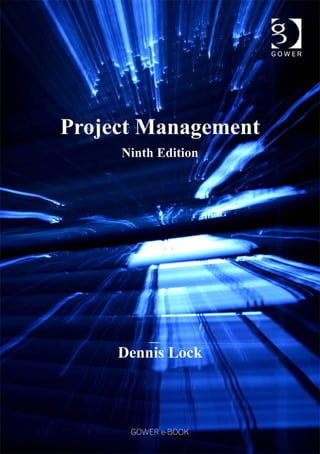
Project Management Ninth Edition Dennis Lock - PDF
Download (2025)
https://ebookultra.com/download/project-management-ninth-edition-
dennis-lock/
Visit ebookultra.com today to download the complete set of
ebooks or textbooks
Here are some recommended products for you. Click the link to
download, or explore more at ebookultra.com
Project Management 9th Edition Dennis Lock
https://ebookultra.com/download/project-management-9th-edition-dennis-
lock-2/
Project Management 9th Edition Dennis Lock
https://ebookultra.com/download/project-management-9th-edition-dennis-
lock/
The Essentials of Project Management 2 Sub Edition Dennis
Lock
https://ebookultra.com/download/the-essentials-of-project-
management-2-sub-edition-dennis-lock/
Project Management Toolkit The Basics for Project Success
Project Management Toolkit 2nd Edition Trish Melton
https://ebookultra.com/download/project-management-toolkit-the-basics-
for-project-success-project-management-toolkit-2nd-edition-trish-
melton/
A Standard for Enterprise Project Management ESI
International Project Management Series Michael S.
Zambruski
https://ebookultra.com/download/a-standard-for-enterprise-project-
management-esi-international-project-management-series-michael-s-
zambruski/
Construction Project Management Peter Fewings
https://ebookultra.com/download/construction-project-management-peter-
fewings/
A Guide to the Project Management Body of Knowledge PMBOK
5th Edition Project Management Institute
https://ebookultra.com/download/a-guide-to-the-project-management-
body-of-knowledge-pmbok-5th-edition-project-management-institute/
Project Management 4th Edition Stephen Hartley
https://ebookultra.com/download/project-management-4th-edition-
stephen-hartley/
A Guide to the Project Management Body of Knowledge Pmbok
r Guide Seventh Edition Project Management Institute
https://ebookultra.com/download/a-guide-to-the-project-management-
body-of-knowledge-pmbok-r-guide-seventh-edition-project-management-
institute/
Project Management Ninth Edition Dennis Lock Digital
Instant Download
Author(s): Dennis Lock
ISBN(s): 9780566087721, 0566087723
Edition: 9
File Details: PDF, 3.43 MB
Year: 2007
Language: english
Project Management
Project and Programme Management
Resources for Students
Gower have teamed up with a major provider of project management training, ESI International,
to bring you a range of project and programme resources to support your learning.
Visit www.projectmanagement9.com and:
Download white papers on topics as diverse as the project communication, project leadership,
risk management and project troubleshooting.
View professional project webinars from some of the leading presenters on project management
covering topics such as: risk management, troubled project recovery, portfolio management,
business requirements, earned value management, performance-based service contracting.
Learn about the qualifications and development available from the PMI, Project Management
Institute, the world’s largest non-profit professional association in project management.
Link to further resources, professional bodies, news sites and more.
These resources are designed to help you develop your learning on project management and
start you on the road to professional qualifications or further development, once you have finished
your degree or your current qualification.
Visit
www.projectmanagement9.com
•
•
•
•
Project
Management
Ninth Edition
DENNIS LOCK
© Dennis Lock 2007
All rights reserved. No part of this publication may be reproduced, stored in a retrieval system or
transmitted in any form or by any means, electronic, mechanical, photocopying, recording or
otherwise without the prior permission of the publisher.
Published by
Gower Publishing Limited
Gower House
Croft Road
Aldershot
Hampshire GU11 3HR
England
Gower Publishing Company
Suite 420
101 Cherry Street
Burlington,
VT 05401-4405
USA
Dennis Lock has asserted his moral right under the Copyright, Designs and Patents Act, 1988, to be
identified as the author of this work.
British Library Cataloguing in Publication Data
Lock, Dennis
Project management. – 9th ed.
1. Project management
I. Title
658.4'04
ISBN-13: 978-0-566-08772-1 (pbk)
978-0-566-08769-1 (hardback)
Library of Congress Cataloging-in-Publication Data
Lock, Dennis.
Project management / by Dennis Lock. -- 9th ed.
p.cm.
Includes bibiliographical references and index.
ISBN 978-0-566-08769-1 (hardback) -- ISBN 978-0-566-08772-1 (pbk) 1. Project
management. I. Title.
T56.8.L6 2007
658.4'04--dc22
2006037664
Printed and bound in Great Britain by MPG Books Ltd. Bodmin, Cornwall
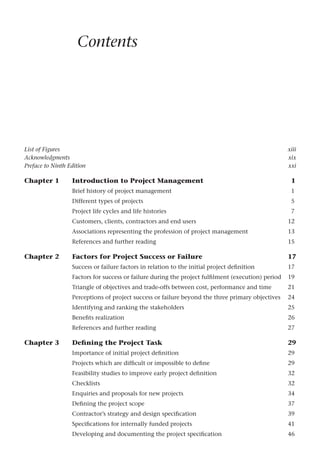
List of Figures xiii
Acknowledgments xix
Preface to Ninth Edition xxi
Chapter 1 Introduction to Project Management 1
Brief history of project management 1
Different types of projects 5
Project life cycles and life histories 7
Customers, clients, contractors and end users 12
Associations representing the profession of project management 13
References and further reading 15
Chapter 2 Factors for Project Success or Failure 17
Success or failure factors in relation to the initial project definition 17
Factors for success or failure during the project fulfilment (execution) period 19
Triangle of objectives and trade-offs between cost, performance and time 21
Perceptions of project success or failure beyond the three primary objectives 24
Identifying and ranking the stakeholders 25
Benefits realization 26
References and further reading 27
Chapter 3 Defining the Project Task 29
Importance of initial project definition 29
Projects which are difficult or impossible to define 29
Feasibility studies to improve early project definition 32
Checklists 32
Enquiries and proposals for new projects 34
Defining the project scope 37
Contractor’s strategy and design specification 39
Specifications for internally funded projects 41
Developing and documenting the project specification 46
Contents
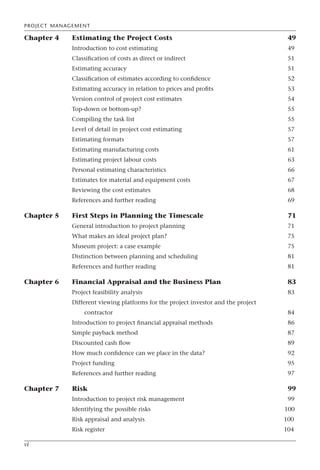
PROJECT MANAGEMENT
vi
Chapter 4 Estimating the Project Costs 49
Introduction to cost estimating 49
Classification of costs as direct or indirect 51
Estimating accuracy 51
Classification of estimates according to confidence 52
Estimating accuracy in relation to prices and profits 53
Version control of project cost estimates 54
Top-down or bottom-up? 55
Compiling the task list 55
Level of detail in project cost estimating 57
Estimating formats 57
Estimating manufacturing costs 61
Estimating project labour costs 63
Personal estimating characteristics 66
Estimates for material and equipment costs 67
Reviewing the cost estimates 68
References and further reading 69
Chapter 5 First Steps in Planning the Timescale 71
General introduction to project planning 71
What makes an ideal project plan? 75
Museum project: a case example 75
Distinction between planning and scheduling 81
References and further reading 81
Chapter 6 Financial Appraisal and the Business Plan 83
Project feasibility analysis 83
Different viewing platforms for the project investor and the project
contractor 84
Introduction to project financial appraisal methods 86
Simple payback method 87
Discounted cash flow 89
How much confidence can we place in the data? 92
Project funding 95
References and further reading 97
Chapter 7 Risk 99
Introduction to project risk management 99
Identifying the possible risks 100
Risk appraisal and analysis 100
Risk register 104
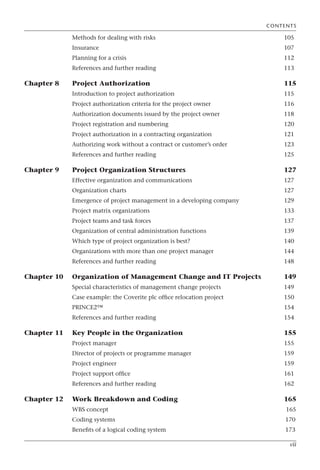
vii
Methods for dealing with risks 105
Insurance 107
Planning for a crisis 112
References and further reading 113
Chapter 8 Project Authorization 115
Introduction to project authorization 115
Project authorization criteria for the project owner 116
Authorization documents issued by the project owner 118
Project registration and numbering 120
Project authorization in a contracting organization 121
Authorizing work without a contract or customer’s order 123
References and further reading 125
Chapter 9 Project Organization Structures 127
Effective organization and communications 127
Organization charts 127
Emergence of project management in a developing company 129
Project matrix organizations 133
Project teams and task forces 137
Organization of central administration functions 139
Which type of project organization is best? 140
Organizations with more than one project manager 144
References and further reading 148
Chapter 10 Organization of Management Change and IT Projects 149
Special characteristics of management change projects 149
Case example: the Coverite plc office relocation project 150
PRINCE2™ 154
References and further reading 154
Chapter 11 Key People in the Organization 155
Project manager 155
Director of projects or programme manager 159
Project engineer 159
Project support office 161
References and further reading 162
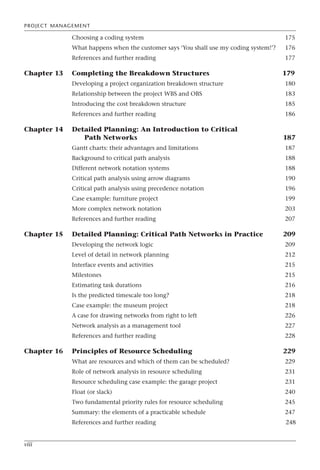
Chapter 12 Work Breakdown and Coding 165
WBS concept 165
Coding systems 170
Benefits of a logical coding system 173
CONTENTS
PROJECT MANAGEMENT
viii
Choosing a coding system 175
What happens when the customer says ‘You shall use my coding system!’? 176
References and further reading 177
Chapter 13 Completing the Breakdown Structures 179
Developing a project organization breakdown structure 180
Relationship between the project WBS and OBS 183
Introducing the cost breakdown structure 185
References and further reading 186
Chapter 14 Detailed Planning: An Introduction to Critical
Path Networks 187
Gantt charts: their advantages and limitations 187
Background to critical path analysis 188
Different network notation systems 188
Critical path analysis using arrow diagrams 190
Critical path analysis using precedence notation 196
Case example: furniture project 199
More complex network notation 203
References and further reading 207
Chapter 15 Detailed Planning: Critical Path Networks in Practice 209
Developing the network logic 209
Level of detail in network planning 212
Interface events and activities 215
Milestones 215
Estimating task durations 216
Is the predicted timescale too long? 218
Case example: the museum project 218
A case for drawing networks from right to left 226
Network analysis as a management tool 227
References and further reading 228
Chapter 16 Principles of Resource Scheduling 229
What are resources and which of them can be scheduled? 229
Role of network analysis in resource scheduling 231
Resource scheduling case example: the garage project 231
Float (or slack) 240
Two fundamental priority rules for resource scheduling 245
Summary: the elements of a practicable schedule 247
References and further reading 248
ix
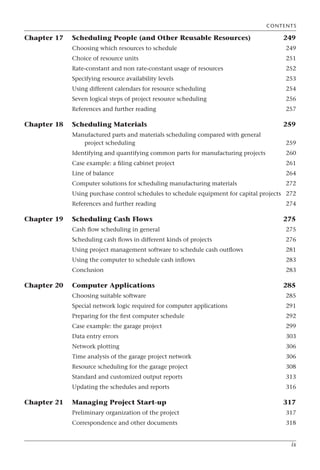
Chapter 17 Scheduling People (and Other Reusable Resources) 249
Choosing which resources to schedule 249
Choice of resource units 251
Rate-constant and non rate-constant usage of resources 252
Specifying resource availability levels 253
Using different calendars for resource scheduling 254
Seven logical steps of project resource scheduling 256
References and further reading 257
Chapter 18 Scheduling Materials 259
Manufactured parts and materials scheduling compared with general
project scheduling 259
Identifying and quantifying common parts for manufacturing projects 260
Case example: a filing cabinet project 261
Line of balance 264
Computer solutions for scheduling manufacturing materials 272
Using purchase control schedules to schedule equipment for capital projects 272
References and further reading 274
Chapter 19 Scheduling Cash Flows 275
Cash flow scheduling in general 275
Scheduling cash flows in different kinds of projects 276
Using project management software to schedule cash outflows 281
Using the computer to schedule cash inflows 283
Conclusion 283
Chapter 20 Computer Applications 285
Choosing suitable software 285
Special network logic required for computer applications 291
Preparing for the first computer schedule 292
Case example: the garage project 299
Data entry errors 303
Network plotting 306
Time analysis of the garage project network 306
Resource scheduling for the garage project 308
Standard and customized output reports 313
Updating the schedules and reports 316
Chapter 21 Managing Project Start-up 317
Preliminary organization of the project 317
Correspondence and other documents 318
CONTENTS
PROJECT MANAGEMENT
x
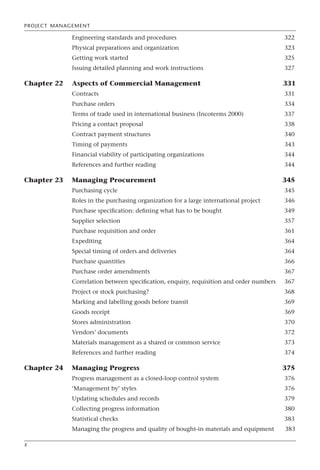
Engineering standards and procedures 322
Physical preparations and organization 323
Getting work started 325
Issuing detailed planning and work instructions 327
Chapter 22 Aspects of Commercial Management 331
Contracts 331
Purchase orders 334
Terms of trade used in international business (Incoterms 2000) 337
Pricing a contact proposal 338
Contract payment structures 340
Timing of payments 343
Financial viability of participating organizations 344
References and further reading 344
Chapter 23 Managing Procurement 345
Purchasing cycle 345
Roles in the purchasing organization for a large international project 346
Purchase specification: defining what has to be bought 349
Supplier selection 357
Purchase requisition and order 361
Expediting 364
Special timing of orders and deliveries 364
Purchase quantities 366
Purchase order amendments 367
Correlation between specification, enquiry, requisition and order numbers 367
Project or stock purchasing? 368
Marking and labelling goods before transit 369
Goods receipt 369
Stores administration 370
Vendors’ documents 372
Materials management as a shared or common service 373
References and further reading 374
Chapter 24 Managing Progress 375
Progress management as a closed-loop control system 376
‘Management by’ styles 376
Updating schedules and records 379
Collecting progress information 380
Statistical checks 383
Managing the progress and quality of bought-in materials and equipment 383
xi
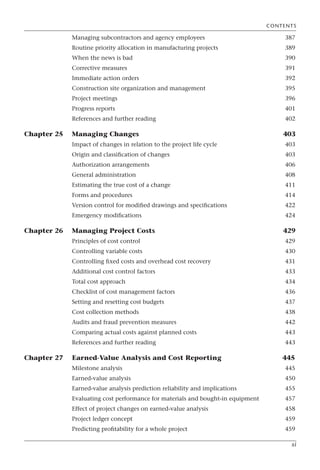
Managing subcontractors and agency employees 387
Routine priority allocation in manufacturing projects 389
When the news is bad 390
Corrective measures 391
Immediate action orders 392
Construction site organization and management 395
Project meetings 396
Progress reports 401
References and further reading 402
Chapter 25 Managing Changes 403
Impact of changes in relation to the project life cycle 403
Origin and classification of changes 403
Authorization arrangements 406
General administration 408
Estimating the true cost of a change 411
Forms and procedures 414
Version control for modified drawings and specifications 422
Emergency modifications 424
Chapter 26 Managing Project Costs 429
Principles of cost control 429
Controlling variable costs 430
Controlling fixed costs and overhead cost recovery 431
Additional cost control factors 433
Total cost approach 434
Checklist of cost management factors 436
Setting and resetting cost budgets 437
Cost collection methods 438
Audits and fraud prevention measures 442
Comparing actual costs against planned costs 443
References and further reading 443
Chapter 27 Earned-Value Analysis and Cost Reporting 445
Milestone analysis 445
Earned-value analysis 450
Earned-value analysis prediction reliability and implications 455
Evaluating cost performance for materials and bought-in equipment 457
Effect of project changes on earned-value analysis 458
Project ledger concept 459
Predicting profitability for a whole project 459
CONTENTS
PROJECT MANAGEMENT
xii
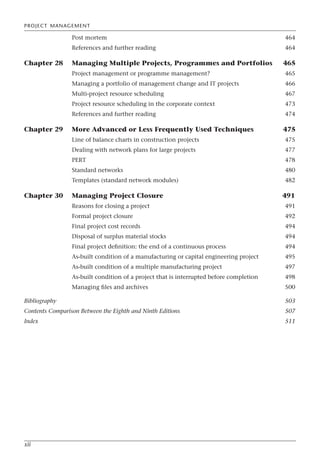
Post mortem 464
References and further reading 464
Chapter 28 Managing Multiple Projects, Programmes and Portfolios 465
Project management or programme management? 465
Managing a portfolio of management change and IT projects 466
Multi-project resource scheduling 467
Project resource scheduling in the corporate context 473
References and further reading 474
Chapter 29 More Advanced or Less Frequently Used Techniques 475
Line of balance charts in construction projects 475
Dealing with network plans for large projects 477
PERT 478
Standard networks 480
Templates (standard network modules) 482
Chapter 30 Managing Project Closure 491
Reasons for closing a project 491
Formal project closure 492
Final project cost records 494
Disposal of surplus material stocks 494
Final project definition: the end of a continuous process 494
As-built condition of a manufacturing or capital engineering project 495
As-built condition of a multiple manufacturing project 497
As-built condition of a project that is interrupted before completion 498
Managing files and archives 500
Bibliography 503
Contents Comparison Between the Eighth and Ninth Editions 507
Index 511
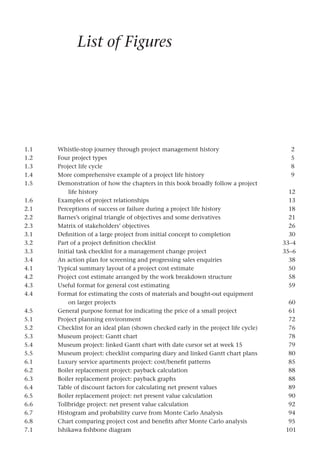
1.1 Whistle-stop journey through project management history 2
1.2 Four project types 5
1.3 Project life cycle 8
1.4 More comprehensive example of a project life history 9
1.5 Demonstration of how the chapters in this book broadly follow a project
life history 12
1.6 Examples of project relationships 13
2.1 Perceptions of success or failure during a project life history 18
2.2 Barnes’s original triangle of objectives and some derivatives 21
2.3 Matrix of stakeholders’ objectives 26
3.1 Definition of a large project from initial concept to completion 30
3.2 Part of a project definition checklist 33–4
3.3 Initial task checklist for a management change project 35–6
3.4 An action plan for screening and progressing sales enquiries 38
4.1 Typical summary layout of a project cost estimate 50
4.2 Project cost estimate arranged by the work breakdown structure 58
4.3 Useful format for general cost estimating 59
4.4 Format for estimating the costs of materials and bought-out equipment
on larger projects 60
4.5 General purpose format for indicating the price of a small project 61
5.1 Project planning environment 72
5.2 Checklist for an ideal plan (shown checked early in the project life cycle) 76
5.3 Museum project: Gantt chart 78
5.4 Museum project: linked Gantt chart with date cursor set at week 15 79
5.5 Museum project: checklist comparing diary and linked Gantt chart plans 80
6.1 Luxury service apartments project: cost/benefit patterns 85
6.2 Boiler replacement project: payback calculation 88
6.3 Boiler replacement project: payback graphs 88
6.4 Table of discount factors for calculating net present values 89
6.5 Boiler replacement project: net present value calculation 90
6.6 Tollbridge project: net present value calculation 92
6.7 Histogram and probability curve from Monte Carlo Analysis 94
6.8 Chart comparing project cost and benefits after Monte Carlo analysis 95
7.1 Ishikawa fishbone diagram 101
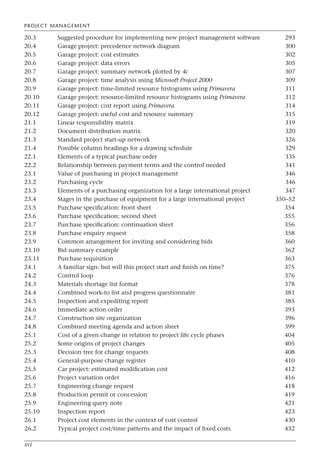
List of Figures
PROJECT MANAGEMENT
xiv
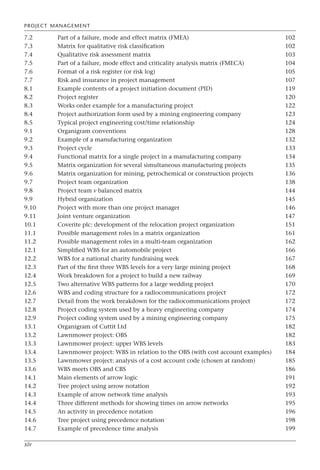
7.2 Part of a failure, mode and effect matrix (FMEA) 102
7.3 Matrix for qualitative risk classification 102
7.4 Qualitative risk assessment matrix 103
7.5 Part of a failure, mode effect and criticality analysis matrix (FMECA) 104
7.6 Format of a risk register (or risk log) 105
7.7 Risk and insurance in project management 107
8.1 Example contents of a project initiation document (PID) 119
8.2 Project register 120
8.3 Works order example for a manufacturing project 122
8.4 Project authorization form used by a mining engineering company 123
8.5 Typical project engineering cost/time relationship 124
9.1 Organigram conventions 128
9.2 Example of a manufacturing organization 132
9.3 Project cycle 133
9.4 Functional matrix for a single project in a manufacturing company 134
9.5 Matrix organization for several simultaneous manufacturing projects 135
9.6 Matrix organization for mining, petrochemical or construction projects 136
9.7 Project team organization 138
9.8 Project team v balanced matrix 144
9.9 Hybrid organization 145
9.10 Project with more than one project manager 146
9.11 Joint venture organization 147
10.1 Coverite plc: development of the relocation project organization 151
11.1 Possible management roles in a matrix organization 161
11.2 Possible management roles in a multi-team organization 162
12.1 Simplified WBS for an automobile project 166
12.2 WBS for a national charity fundraising week 167
12.3 Part of the first three WBS levels for a very large mining project 168
12.4 Work breakdown for a project to build a new railway 169
12.5 Two alternative WBS patterns for a large wedding project 170
12.6 WBS and coding structure for a radiocommunications project 172
12.7 Detail from the work breakdown for the radiocommunications project 172
12.8 Project coding system used by a heavy engineering company 174
12.9 Project coding system used by a mining engineering company 175
13.1 Organigram of Cuttit Ltd 182
13.2 Lawnmower project: OBS 182
13.3 Lawnmower project: upper WBS levels 183
13.4 Lawnmower project: WBS in relation to the OBS (with cost account examples) 184
13.5 Lawnmower project: analysis of a cost account code (chosen at random) 185
13.6 WBS meets OBS and CBS 186
14.1 Main elements of arrow logic 191
14.2 Tree project using arrow notation 192
14.3 Example of arrow network time analysis 193
14.4 Three different methods for showing times on arrow networks 195
14.5 An activity in precedence notation 196
14.6 Tree project using precedence notation 198
14.7 Example of precedence time analysis 199
xv
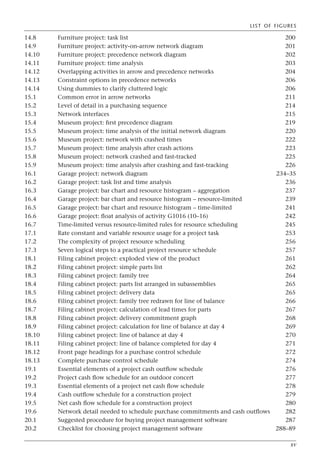
14.8 Furniture project: task list 200
14.9 Furniture project: activity-on-arrow network diagram 201
14.10 Furniture project: precedence network diagram 202
14.11 Furniture project: time analysis 203
14.12 Overlapping activities in arrow and precedence networks 204
14.13 Constraint options in precedence networks 206
14.14 Using dummies to clarify cluttered logic 206
15.1 Common error in arrow networks 211
15.2 Level of detail in a purchasing sequence 214
15.3 Network interfaces 215
15.4 Museum project: first precedence diagram 219
15.5 Museum project: time analysis of the initial network diagram 220
15.6 Museum project: network with crashed times 222
15.7 Museum project: time analysis after crash actions 223
15.8 Museum project: network crashed and fast-tracked 225
15.9 Museum project: time analysis after crashing and fast-tracking 226
16.1 Garage project: network diagram 234–35
16.2 Garage project: task list and time analysis 236
16.3 Garage project: bar chart and resource histogram – aggregation 237
16.4 Garage project: bar chart and resource histogram – resource-limited 239
16.5 Garage project: bar chart and resource histogram – time-limited 241
16.6 Garage project: float analysis of activity G1016 (10–16) 242
16.7 Time-limited versus resource-limited rules for resource scheduling 245
17.1 Rate constant and variable resource usage for a project task 253
17.2 The complexity of project resource scheduling 256
17.3 Seven logical steps to a practical project resource schedule 257
18.1 Filing cabinet project: exploded view of the product 261
18.2 Filing cabinet project: simple parts list 262
18.3 Filing cabinet project: family tree 264
18.4 Filing cabinet project: parts list arranged in subassemblies 265
18.5 Filing cabinet project: delivery data 265
18.6 Filing cabinet project: family tree redrawn for line of balance 266
18.7 Filing cabinet project: calculation of lead times for parts 267
18.8 Filing cabinet project: delivery commitment graph 268
18.9 Filing cabinet project: calculation for line of balance at day 4 269
18.10 Filing cabinet project: line of balance at day 4 270
18.11 Filing cabinet project: line of balance completed for day 4 271
18.12 Front page headings for a purchase control schedule 272
18.13 Complete purchase control schedule 274
19.1 Essential elements of a project cash outflow schedule 276
19.2 Project cash flow schedule for an outdoor concert 277
19.3 Essential elements of a project net cash flow schedule 278
19.4 Cash outflow schedule for a construction project 279
19.5 Net cash flow schedule for a construction project 280
19.6 Network detail needed to schedule purchase commitments and cash outflows 282
20.1 Suggested procedure for buying project management software 287
20.2 Checklist for choosing project management software 288–89
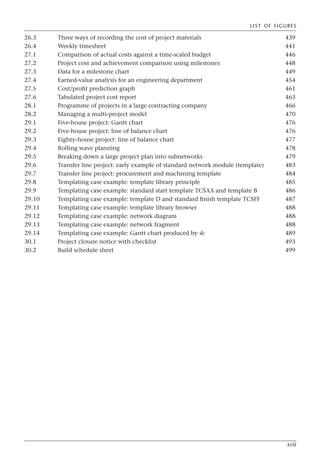
LIST OF FIGURES
PROJECT MANAGEMENT
xvi
20.3 Suggested procedure for implementing new project management software 293
20.4 Garage project: precedence network diagram 300
20.5 Garage project: cost estimates 302
20.6 Garage project: data errors 305
20.7 Garage project: summary network plotted by 4c 307
20.8 Garage project: time analysis using Microsoft Project 2000 309
20.9 Garage project: time-limited resource histograms using Primavera 311
20.10 Garage project: resource-limited resource histograms using Primavera 312
20.11 Garage project: cost report using Primavera 314
20.12 Garage project: useful cost and resource summary 315
21.1 Linear responsibility matrix 319
21.2 Document distribution matrix 320
21.3 Standard project start-up network 326
21.4 Possible column headings for a drawing schedule 329
22.1 Elements of a typical purchase order 335
22.2 Relationship between payment terms and the control needed 341
23.1 Value of purchasing in project management 346
23.2 Purchasing cycle 346
23.3 Elements of a purchasing organization for a large international project 347
23.4 Stages in the purchase of equipment for a large international project 350–52
23.5 Purchase specification: front sheet 354
23.6 Purchase specification: second sheet 355
23.7 Purchase specification: continuation sheet 356
23.8 Purchase enquiry request 358
23.9 Common arrangement for inviting and considering bids 360
23.10 Bid summary example 362
23.11 Purchase requisition 363
24.1 A familiar sign: but will this project start and finish on time? 375
24.2 Control loop 376
24.3 Materials shortage list format 378
24.4 Combined work-to list and progress questionnaire 381
24.5 Inspection and expediting report 385
24.6 Immediate action order 393
24.7 Construction site organization 396
24.8 Combined meeting agenda and action sheet 399
25.1 Cost of a given change in relation to project life cycle phases 404
25.2 Some origins of project changes 405
25.3 Decision tree for change requests 408
25.4 General-purpose change register 410
25.5 Car project: estimated modification cost 412
25.6 Project variation order 416
25.7 Engineering change request 418
25.8 Production permit or concession 419
25.9 Engineering query note 421
25.10 Inspection report 423
26.1 Project cost elements in the context of cost control 430
26.2 Typical project cost/time patterns and the impact of fixed costs 432
xvii
26.3 Three ways of recording the cost of project materials 439
26.4 Weekly timesheet 441
27.1 Comparison of actual costs against a time-scaled budget 446
27.2 Project cost and achievement comparison using milestones 448
27.3 Data for a milestone chart 449
27.4 Earned-value analysis for an engineering department 454
27.5 Cost/profit prediction graph 461
27.6 Tabulated project cost report 463
28.1 Programme of projects in a large contracting company 466
28.2 Managing a multi-project model 470
29.1 Five-house project: Gantt chart 476
29.2 Five-house project: line of balance chart 476
29.3 Eighty-house project: line of balance chart 477
29.4 Rolling wave planning 478
29.5 Breaking down a large project plan into subnetworks 479
29.6 Transfer line project: early example of standard network module (template) 483
29.7 Transfer line project: procurement and machining template 484
29.8 Templating case example: template library principle 485
29.9 Templating case example: standard start template TCSAA and template B 486
29.10 Templating case example: template D and standard finish template TCSFF 487
29.11 Templating case example: template library browser 488
29.12 Templating case example: network diagram 488
29.13 Templating case example: network fragment 488
29.14 Templating case example: Gantt chart produced by 4c 489
30.1 Project closure notice with checklist 493
30.2 Build schedule sheet 499
LIST OF FIGURES
This page intentionally left blank
Acknowledgements
4c Systems Limited
Dr Martin Barnes
Professor Sally Brailsford
Association for Project Management
Alan Fowler
Primavera
Robert Pow
Welcom Software
Artemis Views is a registered trademark. Deltek Open Plan™ is a registered trademark of Deltek.
Primavera Project Planner is a registered trademark. PRINCE2 is a trademark of the Office of Government
Commerce. Windows and PowerPoint are trademarks of Microsoft Corporation. 4c is a trademark of
4c Systems Limited.
I
am grateful to the following people and organizations who have helped in different but valuable
ways in the preparation of this edition and its immediate predecessor:
Other documents randomly have
different content
features heavy. His forehead, however, was high, and his face,
despite the prominent nose and large eyes, was of a delicate
gentleness; a man of strength, and mind. The other was tall and
slender, well proportioned and broad of shoulder. His features were
finely cut and his blond hair was thick and well groomed. He carried
himself rigidly erect and with an air of suppressed feeling. His firm
chin he held high and his eyes stared straight ahead, apparently at
something far beyond. He was speaking softly to the woman, one
muscular arm around her waist. The woman—she was more a girl—
was almost as tall as the man. Her hips were narrow and her
shoulders wide, but the fullness of her breast and her rhythmic,
animal grace proclaimed her richly feminine. There was a clear
beauty in her brown hair, the swift symmetry of her patrician nose,
the ripe lips and in the sparkling blue of her eyes. All wore identical
clothing, a loose suit of thin cloth; sandles upon their feet.
They passed Rod without a glance. But as they passed the woman
spoke.
"It has been worth it—" Rod heard her say and they marched in the
building and down the corridor.
The Capeks followed them and Rod turned to watch their departure.
But as they were half-way down the deserted hall, one machine
made a restraining movement and they halted. A door opened and
they passed from view into a side room.
Rod stared at the vacant hall for a long moment, felt a strange sense
of unease. Where were they going? Why were they led out, the
others left behind? What had the woman meant by "It has been—"
Suddenly his mind snapped with a hazard supposition. The brainless
corpse he had seen! The Capeks bred brains! They used them as
needed; so had said 83....
He dashed down the hall. There was no plan in his mind but action.
He paused before the door, then pushed in.
It was a wide chamber with no windows. The door was the only exit.
Lighted by the same ceiling glow as all these rooms seemed to be,
this light was more intense. Everything was spotless. And stark in
the glare was a raised platform upon which rested five oblong
tables. Upon the tables lay the men and the woman.
Three Capeks stood near, two others—by their numbers those he
had followed—stood by in the center of the room.
The humans were strapped to the tables, a Capek stood over each
of them. Rod noticed the walls were lined with shelves of glittering
instruments. There was a stronger light over the platform.
It was an operating room! His premonitions had been correct—these
people were to be de-brained, at once.
One Capek raised a thin lancet and his eye bent over the form of the
dark-haired man. The others were arranging implements along the
sides of the tables.
Rod had not been noticed. Unresisted admission seemed customary
at any place here.
The voice of the blond man spoke softly but it was clearly audible in
the quiet room.
"Good-bye, Vee," he said.
"Stop!" cried Rod. He shot to the platform, knocked the lancet from
the hand of the nearest machine.
The Capeks turned in obvious astonishment.
"What is the meaning of this!" demanded one. Then his voice
changed to incredulity. "You have no number—"
The next step was unconsidered. He had been finally found out. And
he could not let these people die. It did not matter what happened
to him.
He reached out, snapped the suspension switch upon the shell of
the Capek who had spoken. The machine drooped instantly.
Another clutched his arm and Rod whirled upon him. His strength
was as yet untested and he wondered how powerful he really was.
He snapped his arm from the grasp, flicked down and caught the
machine by its carriage. Easily lifting the wriggling Capek over his
head, he flung the thing through the air. It crashed into the far wall
with an explosion of shattered machinery.
Another rushed at him, arms rearing. Rod caught one of the metal
bars and tore it from its socket. With his other hand he grasped the
neck cable of a near Capek, pulled out its single eye. He was rapidly
learning to fight with his new powers and he tore into the rest with a
clash of steel against steel.
The machine with the severed neck was flailing the air blindly. Rod
grabbed another and hurled it into the eyeless one. The last machine
raised a broken leg-bar and swung it at Rod's eye. He dodged and
the metal struck his right arm, splintered it. The tendrils dangled,
useless. Rod caught the Capek with his other, whipped it into the
wall.
Broken parts littered the floor, reddish fluid seeping from crushed
shells. He turned to see the one-armed machine fleeing from the
room, out the door before he could pursue. He would warn the
others. And he had but one arm now....
Rod turned to the men and the woman upon the slabs. Their eyes
were wide. He felt a choking sorrow as he looked at them, helpless
there, and he thought of the others outside in the compound,
equally as helpless and doomed to a fate such as he had saved
these. But had he saved them? The room would be filled with
avenging Capeks in a moment.
Hurriedly, he loosened the straps which bound them.
"We must go quickly; he will bring others!" he said.
They sat up, still staring.
"What are you?" asked the blond one.
"I am Rod Carver. I come from that age of freedom which your
ancestors cherished." He saw them look to his machine body and
back to his eye, unbelieving. He struck his shell with a tendril. "One
of them did this to me—put my brain here. I escaped before the idea
was given."
They said nothing and the girl moved to the light-haired man, put an
arm upon his shoulder. The stocky one stared at Rod with poignant
eyes; his arms hung limply with the quiet reserve of strength.
"I understand there are but a hundred of them. I shall release all of
you. We can do something!" cried Rod.
"How did you get here?" asked the tall one.
"There is no time—can't you see! I will explain later. We must leave
now!"
"What have we to lose, Ralph?" said the dark-haired one, turning to
his companion. He looked back to Rod, jumped down to the
platform. "I don't know why or what you are, but I saw what you
just did." He motioned to the woman and the man. "This is Vee, and
Ralph. I am Daro. We will go with you to whatever comes."
"Shall I release the others?" asked Rod.
"You can't. They're enclosed by electrically charged wire," put in the
one named Ralph.
There was a sudden whirr of machinery in the corridor outside, the
chatter of many voices.
"They come!" cried Daro.
Rod rushed to the door.
"Keep behind me!" he commanded.
He pulled the door open. One end of the hall was packed with
machines coming from the compound. The Capek that had escaped
must have gone there for help. The opening to the street was
deserted except for those passing.
"This way!" Rod yelled and dashed for the street. The others
followed with the mob of Capeks speeding swiftly after them.
For a moment the scene was as he had first observed it, quiet with
moving machines in the afternoon sun. Then, as they burst out of
the building, there was an abrupt cessation of activity. All stopped,
craned their black neck cords and stared.
"Come on!" Rod yelled to his human allies and sped up the street,
not knowing where.
But the surprise of the Capeks was brief. As the swarm poured from
the building, all in the streets joined them in mad pursuit.
Rod turned down a deserted side street, then up another. For the
time being, they were lost from view.
Finally, seeing the humans wearily fall behind, he halted.
"How do we leave the city?" he asked.
"We cannnot leave Detroy. We would surely die outside," panted
Ralph. "The Capeks destroyed all life and vegetation when they
conquered our ancestors; it is a blistering desert everywhere."
Suddenly a horde of machines rolled out of an alley in front of them,
cutting off their retreat. Red looked about frantically. There was an
open door in a building across the way. He motioned toward it. They
ran over. When they were inside, he slammed the door.
He saw to the locks as the mob halted outside, shouting. It was a
small, bare chamber, opening into another room at the rear. He
looked in; there was no other exit. Except that there were no
cabinets, the room was similar to the quarters of 83, where he had
first been.
In this brief respite, he found them staring at him again.
"How did you get here?" asked Daro.
And briefly, his words loud above the noise outside, he told them
what he knew of his coming and the subsequent happenings.
They listened with sparkling eyes, unmindful of their present
insecurity.
"Why, it's like nothing that ever happened," cried the girl when he
had finished. And Rod's mind was kindled with a single purpose. He
had no idea what he could do—perhaps it was too late now—but he
was willing to give his life in an attempt to set these people free. His
life was nothing, meaningless to him as he was....
"But I guess we're trapped," he said. "With one of my arms gone,
we could never get through that crowd outside."
Something was ramming against the door. It shook under the blows
and Rod rolled over, putting his weight against it. Ralph had found a
thick, metal bar in the room. The massive Daro had procured a
hatchet of sorts. The girl stood against the wall, keeping out of the
way.
The pounding upon the door grew stronger. Finally, with a crash it
burst in, flinging Rod across the room. Two Capeks scrambled from
the floor where they had fallen.
Daro swung his hatchet into a shell and as it spurted red, Ralph did
away with the other one. Rod leaped up.
Machines were streaming into the room. Rod pulled the eye from the
nearest, snatched at another and flung him at the mob in the door.
He was fast learning how to steer his powerful body. He thought
"speed," and darted into the machines with all the force of his
weight. A wave fell, piled at the doorway, barrels smashed. But they
were immediately pushed aside as others came.
Rod rolled into the helpless fight but, with his single arm, was of
little aid. Ralph and Daro swung right and left. But it was a losing
battle from the beginning—those fallen were immediately replaced.
Finally Daro dropped his hatchet and, at the risk of his life, knelt
over a fallen Capek. He unscrewed the right arm, then fought his
way to Rod's side. Rod saw his intention and held off the machines
with his left as Daro removed his shattered limb, fitted the new arm
in the socket. He had almost finished when a tendril caught him by a
leg. He was swung high into the air, snapped like a whip. The Capek
bashed his somber head against the shell of another machine. Daro
died instantly.
Rod's brain, the only human element he possessed, melted with hot
compassion at the courageous sacrifice, then flamed to blind fury.
Like a thing possessed, he screwed the arm home and wheeled into
the fray, pounding gigantic blows with balled tendrils. In a moment
beneath his onslaught there was not a machine standing in the
room.
He looked to the door, saw two Capeks jammed there, unable to
move. The narrow entrance was blocked. Behind them a horde of
machines pressed vainly. Then they drew back, gathered in little
groups, shouting and waving their arms. Rod snapped the switches
of those stuck in the doorway.
"R4, the ruler, has not arrived yet," said Ralph. "Without him, their
brains can conceive of no concerted action."
"And when he comes?" asked Rod.
The tall man mutely pointed to the broken body of Daro upon the
floor.
"When he comes, R4 will doubtless call for his flame guns and
dispense with the matter at once," Ralph said with resignation. "It
was by those weapons that civilization was overthrown—rays of
invisible heat that withered all it touched. However, since the
beginning of their indubitable security here, they retain only a few of
these guns which they must connect to the main power transmitter.
I saw it happen once when I was a boy, during a brief rebellion."
Suddenly Rod remembered the power building which he had seen on
the way to the compound. The rays were operated by the same
power that ran the city. He remembered 83 saying he was
impervious to heat. If he could reach the power plant, destroy it,
then the Capeks would be weaponless. And with the greater
strength that 83 had bestowed—he had two arms now and he had
learned much—they might have a chance against the machines.
There were but a hundred of them. How many had been accounted
for already? But how could he leave with them swarming at the only
exit? And they would get the humans if he left. He whispered to
Ralph of his scheme. It might be that he could do something in
time....
"If you got through," Ralph said, "I think I could hold the door. It will
take time for them to unjam the machines there. It's our only
chance. Go!"
Then Rod thought of the rear chamber. It might be suicide, but he
must try.
"Do what you can until I return," he said. "You can always
surrender; they would probably not harm you if you gave up."
"We prefer to die here," said Ralph. Vee came to his side. She held
the hatchet Daro had dropped.
Rod rolled into the other room. He went to the wall, tapped it,
inspected it closely. It was of metal but did not sound very thick. He
backed up, arms and neck cord behind him out of the way. He
hurled himself against the wall.
It smashed before him and he careened into the street behind the
building. There was no machine in sight.
Rod darted down the pavement, turned into the next street. Far in
the distance, he could see the crowd before the building he had left.
He shot across the thoroughfare and into the next, glided swiftly to
the power plant.
He paused at the door, heard again the drone of massive dynamos.
There came a cry from within and several Capeks rushed out, the
afternoon sunlight glittering upon their number plates. Rod hurled
one heavily to the pavement, eluded the others and darted into the
building.
It was a monstrous room, walls studded with glowing tubes,
machinery covering the floor. The Capeks—there were six of them—
came at him again but he dodged. He began smashing every tube in
sight. He sped along the wall, one arm rigidly outstretched, breaking
tubes as he passed. Holding the Capeks off with his other hand, he
encircled the room, shattered every tube. But the light of the ceiling
continued to glow. The power was unimpaired.
Finally he was forced to turn upon his tormentors. Two fell at the
first blow of his metal fist. One fled across the room and pushed a
large lever on the wall, as Rod killed the others. A narrow door
opened at the end of the room and Capeks, a steady stream of
them, began rolling out. The one who had opened the door shouted
a command as Rod smashed him.
The machines drew near, then rushed in a body. Rod retreated,
wheeled about the room, a mad thing of metal, breaking everything
in his path. Where was the main mechanism? His efforts had been
useless, the light upon the ceiling still glowed, the whine of power
continued. The controlling unit must be elsewhere.
Suddenly he found himself in a corner, surrounded, others still
entering the door. They were a wall of steel before him.
The first wave approached and he fought them off. But slowly, by
their strength of numbers, he was forced to the floor, his wheels
knocked from under him, tendrils covering his arms.
They lifted him, marched to the center of the room. He was caught,
He had failed! Mankind would continue in their power, they would be
bred like sheep forever; mere brains to these mind-vampires. He had
been their only hope....
The Capeks were apparently waiting for orders, holding him there in
the middle of the room. He was held tightly by a dozen of them; the
others returned to the compartment and the door closed. Rod tried
commanding them to release him, to no avail. They remained silent
and seemingly with little interest but to hold him there. They were
probably mere workers, he thought, with practically no independent
impulses.
Glancing helplessly about the room, Rod noticed a glowing metal
disk near his ring of captors. It was but a few feet from him,
gleaming with a dull, reddish light; a glass tube encased in wire
mesh. He had overlooked it before. Looking about, he saw it to be
the only unshattered instrument in the room. It might be the main
tube!
Rod grew limp in their tendrils for a moment. Then suddenly he
lunged backward, away from the tube with all his strength. It had
the desired effect. The Capeks tugged at him. He went limp again.
At the sudden cessation of his pull, the machines fell backward and
he was forced forward upon their sprawled bodies.
Swiftly he enlongated his neck. He raised it high, lashed down at the
tube with his eye. Rod saw the mesh cave in and the glass shatter.
Then his eye burst and all was black. He was jerked to his feet
again, and despite the rattle of his captors' machinery, he felt a
strange silence. The dynamos had halted. The power was off!
Then the tendrils of the Capeks fell away from his arms. He heard
the clatter of cylinders falling to the floor. He could see nothing. But
something in his inner consciousness told him to flee; some deep
intuition older than thought, born of a time when the desert beyond
the city was lush vegetation and furry animals roamed its dawn
trails, an ancient wisdom cried of danger in the darkness.
He remembered he had been facing the door. Arms outstretched, he
moved forward, hit the wall, groped about and finally found the
opening.
He moved outside into the street. He remembered which way to go,
but blind he could never find the building in which he had left the
humans. He could be of little assistance now if he did. And he had
lost so much time.
Rod rolled slowly, his mind devoid of a solution. He would be an easy
prey to the first Capek that chanced upon him. The wheels of his
carriage hit something. Before he could stop, he fell over the
obstacle, crashed to the pavement.
He lay there prepared for anything and expecting immediate death.
But there was no sound. Carefully, he felt about him, discovered the
thing over which he had fallen. By its shape, he made out the form
of a dead Capek—the one he had killed on the way in.
Whispering a prayer to whatever god still lingered in this
unsanctioned age, he felt for the neck cable, would have made burnt
offerings when he found the dead eye unbroken. He detached it
and, removing his own, set it there—could see again.
He glanced to the power plant. It was now a mass of twisted,
steaming metal. The whole building had melted silently to the
ground and in the rising waves of heat, he could see the glowing
shells of cremated Capeks, those that had captured him. Looking to
his own cylinder, Rod saw it was blistered with heat, one arm was
badly bent. The destruction of the dynamos had released
tremendous stored energy, had consumed the whole building as it
dissipated into the air.
As Rod hurried up the street, his mind was filled with a three-fold
thankfulness; to a sixth sense that even his soulless reincarnation
could not disavow, to the Capek 83 who, with whatever motive, had
given him a body with such resistance, and to a merciful guiding
spirit that sent in his path the accident of regained sight.
Swiftly he shot up the street. The sun was low in the west and the
alleys were darkening. But he made no attempt at concealment now.
The Capeks were nothing to the fate he had survived. Thanks again
to 83, he would have a fair chance against them unless greatly
outnumbered.
As Rod neared the squat building where he had left Ralph and the
woman, he saw no movement. Before the door was a great heap of
machinery, the street was filled with scattered parts. The street was
deserted. The Capeks were gone. All was silent.
On each side of the door, which was still jammed with suspended
machines, were smooth holes. Rod peered in. The unmoving body of
Ralph, his clothing in tatters, lay upon the floor amid a mass of
broken metal. His face was bloody. The girl was not there.
Rod entered, placed his tendrils beneath the body, raised it. As he
did so, the man moaned, slowly opened his eyes. He stared at Rod
blankly. Then he recoiled and his eyes filled with fright.
Rod held him gently but firmly.
"It is I, Rod Carver! What happened? Where is Vee?"
Ralph sighed with relief, tried to sit up.
"R4 came soon after you left," he whispered hoarsely. "They entered
with the flame gun. I fought but they beat me down, without using
the weapon. R4 came in. I struggled up, hit him with the hatchet. I
killed him." He laughed hysterically. "A Capek hit me and they
thought I was dead." Suddenly he started and writhed, attempting
to rise. A leg was broken. "Vee!" he cried. "They took Vee! They
went to the tower to create another ruler immediately—to use her
brain!"
Rod swung the man to the flat top of his shell, leapt out into the
street. The tower, rising miles above the city, was close by. He rolled
there with all the speed of his wheels, was at the door almost
instantly.
The edifice was octagonal of shape and windowless except high in
its corniced loft; a single door at it's base. Rod entered the great
door. The chamber within, vaulted with distorted curves and planes,
decorated with unknown instruments, was vacant. The room was
lighted. The tower must have a small separate power unit....
Faintly, he heard sounds from above, noticed a winding slide that
spiraled to the upper floors. He rolled upon the little incline and shot
upward, dizzily around and around, following the increasing sounds
coming down the shaft. He reached the top floor, halted at the
landing.
The sounds were voices, chanting, an insane metallic chatter. Rod
rolled silently down a wide, smooth corridor. The voices came from
behind a massive door at the end of the hall.
Ralph still upon his shell, Rod flung the door open. The chant died
away. It was an immense chamber, dark windows upon the far wall,
lights hanging from the high ceiling. Around the walls stood the
Capeks, all eyes upon him. In the center of the room, Rod saw a
long dais, shimmering of a yellow metal, and upon it, swathed in
white cloth, was the bound body of Vee. Beside here were two
Capeks, the numbers 2 and 3 upon their shells. Holding a platter of
glistening instruments, one stood at the side. With a lancet poised in
his hand, the other stood over the girl.
"Stop!" cried Rod.
He dropped Ralph to the floor, advanced. The Capeks remained
motionless, staring. Number 2 watched his approach, hand in the air
over Vee's head.
Rod thought, "speed. Great speed!" In a flash, he was there, caught
the arm with the knife, jerked it from its socket.
The machines made quick recovery from their surprise. There
remained perhaps sixty of them after the day of destruction; they
swept toward him in a murderous wave. Madly, they rushed upon
him from all sides and he was knocked from his carriage, covered by
falling cylinders. He fought with a deadly power but was at last lifted
bodily from the floor. His arms were strapped to his sides. He was
rolled into a corner. The ceremony continued without another glance
at him.
Across the room, Ralph was bound in a like manner, head sagging
upon his chest. They had lost! It was all over now....
A Capek again stood over the body of Vee, the lancet in his hand.
The machines were lined against the walls as before.
"A ruler is born!" shouted the Capek flourishing the knife. "From this
despised clay arises a super-being—R-five!" He leveled the lancet at
the side of Vee's head, to plunge it into the scalp; to uncover the
brain.
Rod struggled at his bonds with all his mechanical strength. He could
not move. His wheels were also locked, strapped to the wall. He
must stand here and watch her die—a deathless death—to be
reincarnated as the foul brain of a cruel thing of metal. There was
nothing he could do!
Rod watched the unwavering knife move close. Horror fused his
mind.
Suddenly the knife paused. There was a clamoring of many voices in
the hall outside—human voices! The machines' eyes all turned to the
door. Rod looked, saw men and women pouring into the room.
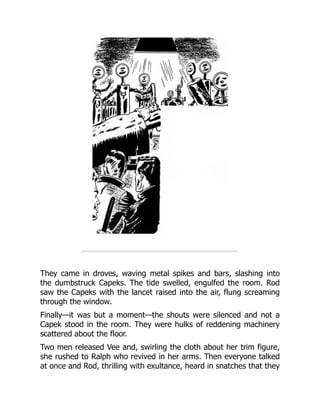
They came in droves, waving metal spikes and bars, slashing into
the dumbstruck Capeks. The tide swelled, engulfed the room. Rod
saw the Capeks with the lancet raised into the air, flung screaming
through the window.
Finally—it was but a moment—the shouts were silenced and not a
Capek stood in the room. They were hulks of reddening machinery
scattered about the floor.
Two men released Vee and, swirling the cloth about her trim figure,
she rushed to Ralph who revived in her arms. Then everyone talked
at once and Rod, thrilling with exultance, heard in snatches that they
had climbed the fences when they discovered the electrical charge
was cut off—when the power plant was destroyed. They had left the
stock yards and come here.
Vee supporting him, Ralph came and cut Rod's bonds. His
besmeared face was a radiation of complete happiness and he gave
not a glance to his injured leg.
"We owe it all to you," he said softly, then turned to the staring
crowd. "Here is our true saviour! He shall be our ruler forever!"
"Yes?" disputed a vibrant voice at the door. All heads turned.
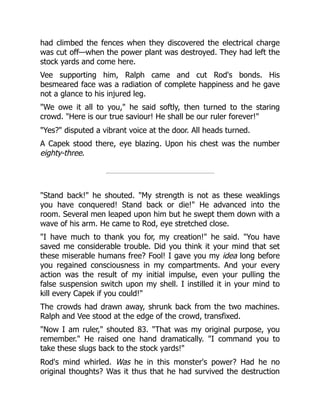
A Capek stood there, eye blazing. Upon his chest was the number
eighty-three.
"Stand back!" he shouted. "My strength is not as these weaklings
you have conquered! Stand back or die!" He advanced into the
room. Several men leaped upon him but he swept them down with a
wave of his arm. He came to Rod, eye stretched close.
"I have much to thank you for, my creation!" he said. "You have
saved me considerable trouble. Did you think it your mind that set
these miserable humans free? Fool! I gave you my idea long before
you regained consciousness in my compartments. And your every
action was the result of my initial impulse, even your pulling the
false suspension switch upon my shell. I instilled it in your mind to
kill every Capek if you could!"
The crowds had drawn away, shrunk back from the two machines.
Ralph and Vee stood at the edge of the crowd, transfixed.
"Now I am ruler," shouted 83. "That was my original purpose, you
remember." He raised one hand dramatically. "I command you to
take these slugs back to the stock yards!"
Rod's mind whirled. Was he in this monster's power? Had he no
original thoughts? Was it thus that he had survived the destruction
of the power plant? Something within him told him to obey; but the
hatred of the machine, the Capek before him, was greater than the
urge to obedience. He might be at his bidding but 83 had overlooked
one thing....
"Whether it is your idea or mine, I do not know," said Rod, "but I
shall kill you—for you, too, are a Capek!" He rolled slowly forward.
"Stop!" 83 faltered. "See this body, mind. It is as strong as yours. I
made both. What I created, I can destroy!"
Rod said nothing. He shot out an arm and grasped the long neck.
With a snap of the cable, 83 tore loose from his tendrils. He was
more powerful than the others had been.
Arms flailing, seeking a death-hold upon the darting machine, Rod
caught a wheel of 83's carriage, up-ended him. But the thing was on
its wheels instantly, upon him again. Rod found a grip upon one
black arm, hurled him against the floor. The crash which would have
ruined another Capek affected 83 not at all. He charged again. Rod
was taken by the neck, flung against the wall. A roller was broken.
Rod careened about the room, sparring for an opening. Twice men
interfered, to be instantly killed by a stroke of 83's hand.
Catching a firm hold upon the other's arms at the upper joint, close
to the shell, they remained deadlocked for a moment, staring into
each other's eye.
Rod twisted with all his might. Then 83's arms snapped—and so did
his.
Both dismembered, they paused.
And 83 whirled, fleeing from the room.
Rod was after him instantly, passed him at the landing, blocked his
escape downward. Turning, 83 dashed up the slide to the roof. Rod
followed. The Capek, dashing madly about the level, was finally
trapped in a corner of the light railing.
Rod gazed at him in the dimming light, advanced slowly. A great
sadness filled his mind as he came on, the city of Detroy lying silent
in the shadows far below; a great sadness and a great joy. Sadness
for himself, trapped forever in this half-tomb of metal; joy at the
restoration of the human race. They, the people below, would
eternally worship him for their salvation. But he could never be one
of them, never again thrill to the little things which are essentially
human. He would ever be a lonely brain, encased in cold, impassive
steel. He could see the sunset and the soft dusk over the city, hear
the whispers of night; but never could he feel them....
He looked to the cringing shape of 83 and, had he been capable,
would have smiled, as he thought, "Speed!"
He rushed at 83, thundering into the scheming Capek. The railing
snapped and they went over the edge, and down into the depth
below.
*** END OF THE PROJECT GUTENBERG EBOOK REVOLT ON THE
EARTH-STAR ***
Updated editions will replace the previous one—the old editions will
be renamed.
Creating the works from print editions not protected by U.S.
copyright law means that no one owns a United States copyright in
these works, so the Foundation (and you!) can copy and distribute it
in the United States without permission and without paying
copyright royalties. Special rules, set forth in the General Terms of
Use part of this license, apply to copying and distributing Project
Gutenberg™ electronic works to protect the PROJECT GUTENBERG™
concept and trademark. Project Gutenberg is a registered trademark,
and may not be used if you charge for an eBook, except by following
the terms of the trademark license, including paying royalties for use
of the Project Gutenberg trademark. If you do not charge anything
for copies of this eBook, complying with the trademark license is
very easy. You may use this eBook for nearly any purpose such as
creation of derivative works, reports, performances and research.
Project Gutenberg eBooks may be modified and printed and given
away—you may do practically ANYTHING in the United States with
eBooks not protected by U.S. copyright law. Redistribution is subject
to the trademark license, especially commercial redistribution.
START: FULL LICENSE
THE FULL PROJECT GUTENBERG LICENSE
PLEASE READ THIS BEFORE YOU DISTRIBUTE OR USE THIS WORK
To protect the Project Gutenberg™ mission of promoting the free
distribution of electronic works, by using or distributing this work (or
any other work associated in any way with the phrase “Project
Gutenberg”), you agree to comply with all the terms of the Full
Project Gutenberg™ License available with this file or online at
www.gutenberg.org/license.
Section 1. General Terms of Use and
Redistributing Project Gutenberg™
electronic works
1.A. By reading or using any part of this Project Gutenberg™
electronic work, you indicate that you have read, understand, agree
to and accept all the terms of this license and intellectual property
(trademark/copyright) agreement. If you do not agree to abide by all
the terms of this agreement, you must cease using and return or
destroy all copies of Project Gutenberg™ electronic works in your
possession. If you paid a fee for obtaining a copy of or access to a
Project Gutenberg™ electronic work and you do not agree to be
bound by the terms of this agreement, you may obtain a refund
from the person or entity to whom you paid the fee as set forth in
paragraph 1.E.8.
1.B. “Project Gutenberg” is a registered trademark. It may only be
used on or associated in any way with an electronic work by people
who agree to be bound by the terms of this agreement. There are a
few things that you can do with most Project Gutenberg™ electronic
works even without complying with the full terms of this agreement.
See paragraph 1.C below. There are a lot of things you can do with
Project Gutenberg™ electronic works if you follow the terms of this
agreement and help preserve free future access to Project
Gutenberg™ electronic works. See paragraph 1.E below.
1.C. The Project Gutenberg Literary Archive Foundation (“the
Foundation” or PGLAF), owns a compilation copyright in the
collection of Project Gutenberg™ electronic works. Nearly all the
individual works in the collection are in the public domain in the
United States. If an individual work is unprotected by copyright law
in the United States and you are located in the United States, we do
not claim a right to prevent you from copying, distributing,
performing, displaying or creating derivative works based on the
work as long as all references to Project Gutenberg are removed. Of
course, we hope that you will support the Project Gutenberg™
mission of promoting free access to electronic works by freely
sharing Project Gutenberg™ works in compliance with the terms of
this agreement for keeping the Project Gutenberg™ name associated
with the work. You can easily comply with the terms of this
agreement by keeping this work in the same format with its attached
full Project Gutenberg™ License when you share it without charge
with others.
1.D. The copyright laws of the place where you are located also
govern what you can do with this work. Copyright laws in most
countries are in a constant state of change. If you are outside the
United States, check the laws of your country in addition to the
terms of this agreement before downloading, copying, displaying,
performing, distributing or creating derivative works based on this
work or any other Project Gutenberg™ work. The Foundation makes
no representations concerning the copyright status of any work in
any country other than the United States.
1.E. Unless you have removed all references to Project Gutenberg:
1.E.1. The following sentence, with active links to, or other
immediate access to, the full Project Gutenberg™ License must
appear prominently whenever any copy of a Project Gutenberg™
work (any work on which the phrase “Project Gutenberg” appears,
or with which the phrase “Project Gutenberg” is associated) is
accessed, displayed, performed, viewed, copied or distributed:
This eBook is for the use of anyone anywhere in the United
States and most other parts of the world at no cost and with
almost no restrictions whatsoever. You may copy it, give it away
or re-use it under the terms of the Project Gutenberg License
included with this eBook or online at www.gutenberg.org. If you
are not located in the United States, you will have to check the
laws of the country where you are located before using this
eBook.
1.E.2. If an individual Project Gutenberg™ electronic work is derived
from texts not protected by U.S. copyright law (does not contain a
notice indicating that it is posted with permission of the copyright
holder), the work can be copied and distributed to anyone in the
United States without paying any fees or charges. If you are
redistributing or providing access to a work with the phrase “Project
Gutenberg” associated with or appearing on the work, you must
comply either with the requirements of paragraphs 1.E.1 through
1.E.7 or obtain permission for the use of the work and the Project
Gutenberg™ trademark as set forth in paragraphs 1.E.8 or 1.E.9.
1.E.3. If an individual Project Gutenberg™ electronic work is posted
with the permission of the copyright holder, your use and distribution
must comply with both paragraphs 1.E.1 through 1.E.7 and any
additional terms imposed by the copyright holder. Additional terms
will be linked to the Project Gutenberg™ License for all works posted
with the permission of the copyright holder found at the beginning
of this work.
1.E.4. Do not unlink or detach or remove the full Project
Gutenberg™ License terms from this work, or any files containing a
part of this work or any other work associated with Project
Gutenberg™.
1.E.5. Do not copy, display, perform, distribute or redistribute this
electronic work, or any part of this electronic work, without
prominently displaying the sentence set forth in paragraph 1.E.1
with active links or immediate access to the full terms of the Project
Gutenberg™ License.
1.E.6. You may convert to and distribute this work in any binary,
compressed, marked up, nonproprietary or proprietary form,
including any word processing or hypertext form. However, if you
provide access to or distribute copies of a Project Gutenberg™ work
in a format other than “Plain Vanilla ASCII” or other format used in
the official version posted on the official Project Gutenberg™ website
(www.gutenberg.org), you must, at no additional cost, fee or
expense to the user, provide a copy, a means of exporting a copy, or
a means of obtaining a copy upon request, of the work in its original
“Plain Vanilla ASCII” or other form. Any alternate format must
include the full Project Gutenberg™ License as specified in
paragraph 1.E.1.
1.E.7. Do not charge a fee for access to, viewing, displaying,
performing, copying or distributing any Project Gutenberg™ works
unless you comply with paragraph 1.E.8 or 1.E.9.
1.E.8. You may charge a reasonable fee for copies of or providing
access to or distributing Project Gutenberg™ electronic works
provided that:
• You pay a royalty fee of 20% of the gross profits you derive
from the use of Project Gutenberg™ works calculated using the
method you already use to calculate your applicable taxes. The
fee is owed to the owner of the Project Gutenberg™ trademark,
but he has agreed to donate royalties under this paragraph to
the Project Gutenberg Literary Archive Foundation. Royalty
payments must be paid within 60 days following each date on
which you prepare (or are legally required to prepare) your
periodic tax returns. Royalty payments should be clearly marked
as such and sent to the Project Gutenberg Literary Archive
Foundation at the address specified in Section 4, “Information
about donations to the Project Gutenberg Literary Archive
Foundation.”
• You provide a full refund of any money paid by a user who
notifies you in writing (or by e-mail) within 30 days of receipt
that s/he does not agree to the terms of the full Project
Gutenberg™ License. You must require such a user to return or
destroy all copies of the works possessed in a physical medium
and discontinue all use of and all access to other copies of
Project Gutenberg™ works.
• You provide, in accordance with paragraph 1.F.3, a full refund of
any money paid for a work or a replacement copy, if a defect in
the electronic work is discovered and reported to you within 90
days of receipt of the work.
• You comply with all other terms of this agreement for free
distribution of Project Gutenberg™ works.
1.E.9. If you wish to charge a fee or distribute a Project Gutenberg™
electronic work or group of works on different terms than are set
forth in this agreement, you must obtain permission in writing from
the Project Gutenberg Literary Archive Foundation, the manager of
the Project Gutenberg™ trademark. Contact the Foundation as set
forth in Section 3 below.
1.F.
1.F.1. Project Gutenberg volunteers and employees expend
considerable effort to identify, do copyright research on, transcribe
and proofread works not protected by U.S. copyright law in creating
the Project Gutenberg™ collection. Despite these efforts, Project
Gutenberg™ electronic works, and the medium on which they may
be stored, may contain “Defects,” such as, but not limited to,
incomplete, inaccurate or corrupt data, transcription errors, a
copyright or other intellectual property infringement, a defective or
damaged disk or other medium, a computer virus, or computer
codes that damage or cannot be read by your equipment.
1.F.2. LIMITED WARRANTY, DISCLAIMER OF DAMAGES - Except for
the “Right of Replacement or Refund” described in paragraph 1.F.3,
the Project Gutenberg Literary Archive Foundation, the owner of the
Project Gutenberg™ trademark, and any other party distributing a
Project Gutenberg™ electronic work under this agreement, disclaim
all liability to you for damages, costs and expenses, including legal
fees. YOU AGREE THAT YOU HAVE NO REMEDIES FOR
NEGLIGENCE, STRICT LIABILITY, BREACH OF WARRANTY OR
BREACH OF CONTRACT EXCEPT THOSE PROVIDED IN PARAGRAPH
1.F.3. YOU AGREE THAT THE FOUNDATION, THE TRADEMARK
OWNER, AND ANY DISTRIBUTOR UNDER THIS AGREEMENT WILL
NOT BE LIABLE TO YOU FOR ACTUAL, DIRECT, INDIRECT,
CONSEQUENTIAL, PUNITIVE OR INCIDENTAL DAMAGES EVEN IF
YOU GIVE NOTICE OF THE POSSIBILITY OF SUCH DAMAGE.
1.F.3. LIMITED RIGHT OF REPLACEMENT OR REFUND - If you
discover a defect in this electronic work within 90 days of receiving
it, you can receive a refund of the money (if any) you paid for it by
sending a written explanation to the person you received the work
from. If you received the work on a physical medium, you must
return the medium with your written explanation. The person or
entity that provided you with the defective work may elect to provide
a replacement copy in lieu of a refund. If you received the work
electronically, the person or entity providing it to you may choose to
give you a second opportunity to receive the work electronically in
lieu of a refund. If the second copy is also defective, you may
demand a refund in writing without further opportunities to fix the
problem.
1.F.4. Except for the limited right of replacement or refund set forth
in paragraph 1.F.3, this work is provided to you ‘AS-IS’, WITH NO
OTHER WARRANTIES OF ANY KIND, EXPRESS OR IMPLIED,
INCLUDING BUT NOT LIMITED TO WARRANTIES OF
MERCHANTABILITY OR FITNESS FOR ANY PURPOSE.
1.F.5. Some states do not allow disclaimers of certain implied
warranties or the exclusion or limitation of certain types of damages.
If any disclaimer or limitation set forth in this agreement violates the
law of the state applicable to this agreement, the agreement shall be
interpreted to make the maximum disclaimer or limitation permitted
by the applicable state law. The invalidity or unenforceability of any
provision of this agreement shall not void the remaining provisions.
1.F.6. INDEMNITY - You agree to indemnify and hold the Foundation,
the trademark owner, any agent or employee of the Foundation,
anyone providing copies of Project Gutenberg™ electronic works in
accordance with this agreement, and any volunteers associated with
the production, promotion and distribution of Project Gutenberg™
electronic works, harmless from all liability, costs and expenses,
including legal fees, that arise directly or indirectly from any of the
following which you do or cause to occur: (a) distribution of this or
any Project Gutenberg™ work, (b) alteration, modification, or
additions or deletions to any Project Gutenberg™ work, and (c) any
Defect you cause.
Section 2. Information about the Mission
of Project Gutenberg™
Project Gutenberg™ is synonymous with the free distribution of
electronic works in formats readable by the widest variety of
computers including obsolete, old, middle-aged and new computers.
It exists because of the efforts of hundreds of volunteers and
donations from people in all walks of life.
Volunteers and financial support to provide volunteers with the
assistance they need are critical to reaching Project Gutenberg™’s
goals and ensuring that the Project Gutenberg™ collection will
remain freely available for generations to come. In 2001, the Project
Gutenberg Literary Archive Foundation was created to provide a
secure and permanent future for Project Gutenberg™ and future
generations. To learn more about the Project Gutenberg Literary
Archive Foundation and how your efforts and donations can help,
see Sections 3 and 4 and the Foundation information page at
www.gutenberg.org.
Section 3. Information about the Project
Gutenberg Literary Archive Foundation
The Project Gutenberg Literary Archive Foundation is a non-profit
501(c)(3) educational corporation organized under the laws of the
state of Mississippi and granted tax exempt status by the Internal
Revenue Service. The Foundation’s EIN or federal tax identification
number is 64-6221541. Contributions to the Project Gutenberg
Literary Archive Foundation are tax deductible to the full extent
permitted by U.S. federal laws and your state’s laws.
The Foundation’s business office is located at 809 North 1500 West,
Salt Lake City, UT 84116, (801) 596-1887. Email contact links and up
to date contact information can be found at the Foundation’s website
and official page at www.gutenberg.org/contact
Section 4. Information about Donations to
the Project Gutenberg Literary Archive
Foundation
Project Gutenberg™ depends upon and cannot survive without
widespread public support and donations to carry out its mission of
increasing the number of public domain and licensed works that can
be freely distributed in machine-readable form accessible by the
widest array of equipment including outdated equipment. Many
small donations ($1 to $5,000) are particularly important to
maintaining tax exempt status with the IRS.
The Foundation is committed to complying with the laws regulating
charities and charitable donations in all 50 states of the United
States. Compliance requirements are not uniform and it takes a
considerable effort, much paperwork and many fees to meet and
keep up with these requirements. We do not solicit donations in
locations where we have not received written confirmation of
compliance. To SEND DONATIONS or determine the status of
compliance for any particular state visit www.gutenberg.org/donate.
While we cannot and do not solicit contributions from states where
we have not met the solicitation requirements, we know of no
prohibition against accepting unsolicited donations from donors in
such states who approach us with offers to donate.
International donations are gratefully accepted, but we cannot make
any statements concerning tax treatment of donations received from
outside the United States. U.S. laws alone swamp our small staff.
Please check the Project Gutenberg web pages for current donation
methods and addresses. Donations are accepted in a number of
other ways including checks, online payments and credit card
donations. To donate, please visit: www.gutenberg.org/donate.
Section 5. General Information About
Project Gutenberg™ electronic works
Professor Michael S. Hart was the originator of the Project
Gutenberg™ concept of a library of electronic works that could be
freely shared with anyone. For forty years, he produced and
distributed Project Gutenberg™ eBooks with only a loose network of
volunteer support.
Project Gutenberg™ eBooks are often created from several printed
editions, all of which are confirmed as not protected by copyright in
the U.S. unless a copyright notice is included. Thus, we do not
necessarily keep eBooks in compliance with any particular paper
edition.
Most people start at our website which has the main PG search
facility: www.gutenberg.org.
This website includes information about Project Gutenberg™,
including how to make donations to the Project Gutenberg Literary
Archive Foundation, how to help produce our new eBooks, and how
to subscribe to our email newsletter to hear about new eBooks.
Welcome to our website – the ideal destination for book lovers and
knowledge seekers. With a mission to inspire endlessly, we offer a
vast collection of books, ranging from classic literary works to
specialized publications, self-development books, and children's
literature. Each book is a new journey of discovery, expanding
knowledge and enriching the soul of the reade
Our website is not just a platform for buying books, but a bridge
connecting readers to the timeless values of culture and wisdom. With
an elegant, user-friendly interface and an intelligent search system,
we are committed to providing a quick and convenient shopping
experience. Additionally, our special promotions and home delivery
services ensure that you save time and fully enjoy the joy of reading.
Let us accompany you on the journey of exploring knowledge and
personal growth!
ebookultra.com

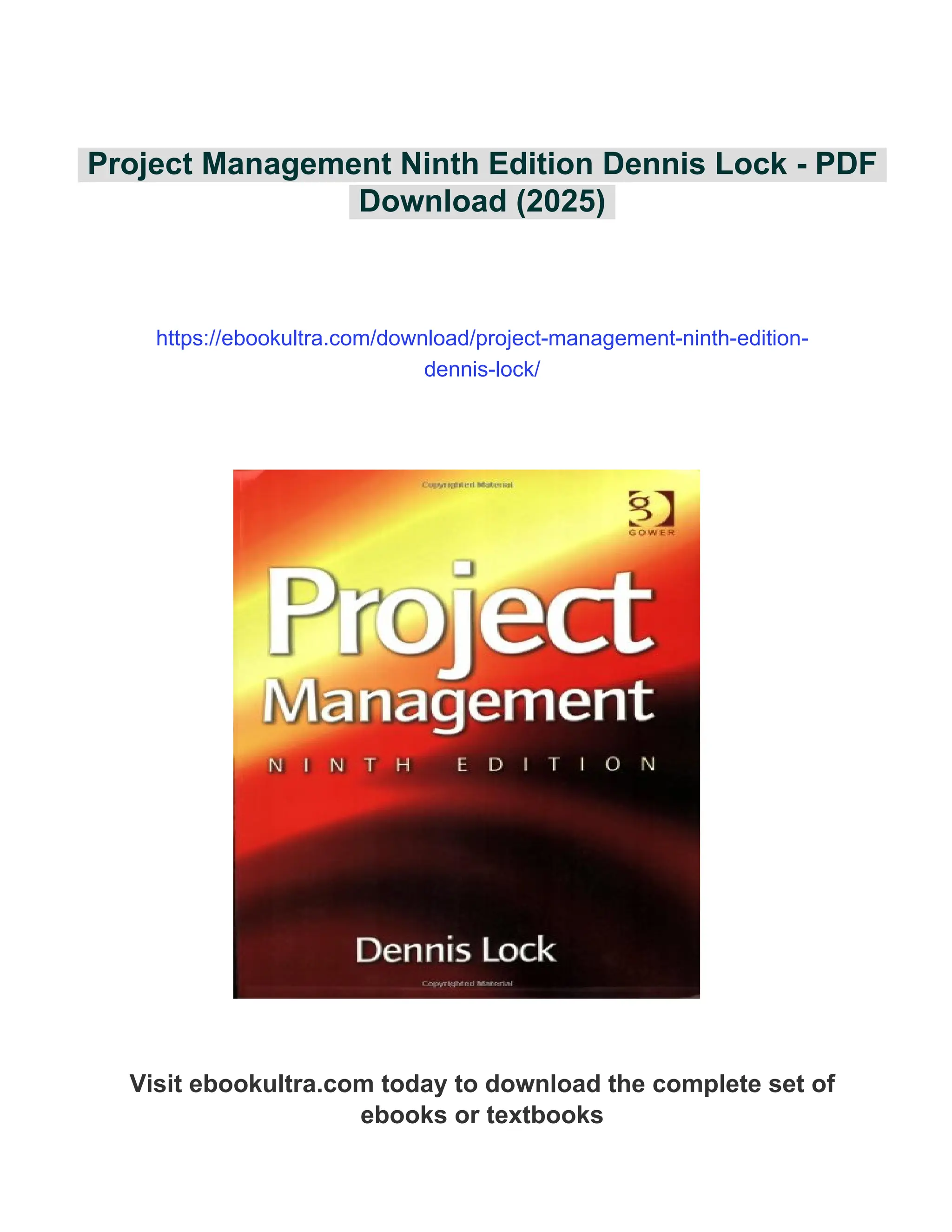
Project Management Ninth Edition Dennis Lock

  • 1.
    Project Management NinthEdition Dennis Lock - PDF Download (2025) https://ebookultra.com/download/project-management-ninth-edition- dennis-lock/ Visit ebookultra.com today to download the complete set of ebooks or textbooks

  • 2.
    Here are somerecommended products for you. Click the link to download, or explore more at ebookultra.com Project Management 9th Edition Dennis Lock https://ebookultra.com/download/project-management-9th-edition-dennis- lock-2/ Project Management 9th Edition Dennis Lock https://ebookultra.com/download/project-management-9th-edition-dennis- lock/ The Essentials of Project Management 2 Sub Edition Dennis Lock https://ebookultra.com/download/the-essentials-of-project- management-2-sub-edition-dennis-lock/ Project Management Toolkit The Basics for Project Success Project Management Toolkit 2nd Edition Trish Melton https://ebookultra.com/download/project-management-toolkit-the-basics- for-project-success-project-management-toolkit-2nd-edition-trish- melton/
  • 3.
    A Standard forEnterprise Project Management ESI International Project Management Series Michael S. Zambruski https://ebookultra.com/download/a-standard-for-enterprise-project- management-esi-international-project-management-series-michael-s- zambruski/ Construction Project Management Peter Fewings https://ebookultra.com/download/construction-project-management-peter- fewings/ A Guide to the Project Management Body of Knowledge PMBOK 5th Edition Project Management Institute https://ebookultra.com/download/a-guide-to-the-project-management- body-of-knowledge-pmbok-5th-edition-project-management-institute/ Project Management 4th Edition Stephen Hartley https://ebookultra.com/download/project-management-4th-edition- stephen-hartley/ A Guide to the Project Management Body of Knowledge Pmbok r Guide Seventh Edition Project Management Institute https://ebookultra.com/download/a-guide-to-the-project-management- body-of-knowledge-pmbok-r-guide-seventh-edition-project-management- institute/
  • 5.
    Project Management NinthEdition Dennis Lock Digital Instant Download Author(s): Dennis Lock ISBN(s): 9780566087721, 0566087723 Edition: 9 File Details: PDF, 3.43 MB Year: 2007 Language: english
  • 7.
  • 8.
    Project and ProgrammeManagement Resources for Students Gower have teamed up with a major provider of project management training, ESI International, to bring you a range of project and programme resources to support your learning. Visit www.projectmanagement9.com and: Download white papers on topics as diverse as the project communication, project leadership, risk management and project troubleshooting. View professional project webinars from some of the leading presenters on project management covering topics such as: risk management, troubled project recovery, portfolio management, business requirements, earned value management, performance-based service contracting. Learn about the qualifications and development available from the PMI, Project Management Institute, the world’s largest non-profit professional association in project management. Link to further resources, professional bodies, news sites and more. These resources are designed to help you develop your learning on project management and start you on the road to professional qualifications or further development, once you have finished your degree or your current qualification. Visit www.projectmanagement9.com • • • •
  • 9.
  • 10.
    © Dennis Lock2007 All rights reserved. No part of this publication may be reproduced, stored in a retrieval system or transmitted in any form or by any means, electronic, mechanical, photocopying, recording or otherwise without the prior permission of the publisher. Published by Gower Publishing Limited Gower House Croft Road Aldershot Hampshire GU11 3HR England Gower Publishing Company Suite 420 101 Cherry Street Burlington, VT 05401-4405 USA Dennis Lock has asserted his moral right under the Copyright, Designs and Patents Act, 1988, to be identified as the author of this work. British Library Cataloguing in Publication Data Lock, Dennis Project management. – 9th ed. 1. Project management I. Title 658.4'04 ISBN-13: 978-0-566-08772-1 (pbk) 978-0-566-08769-1 (hardback) Library of Congress Cataloging-in-Publication Data Lock, Dennis. Project management / by Dennis Lock. -- 9th ed. p.cm. Includes bibiliographical references and index. ISBN 978-0-566-08769-1 (hardback) -- ISBN 978-0-566-08772-1 (pbk) 1. Project management. I. Title. T56.8.L6 2007 658.4'04--dc22 2006037664 Printed and bound in Great Britain by MPG Books Ltd. Bodmin, Cornwall
  • 11.
    List of Figuresxiii Acknowledgments xix Preface to Ninth Edition xxi Chapter 1 Introduction to Project Management 1 Brief history of project management 1 Different types of projects 5 Project life cycles and life histories 7 Customers, clients, contractors and end users 12 Associations representing the profession of project management 13 References and further reading 15 Chapter 2 Factors for Project Success or Failure 17 Success or failure factors in relation to the initial project definition 17 Factors for success or failure during the project fulfilment (execution) period 19 Triangle of objectives and trade-offs between cost, performance and time 21 Perceptions of project success or failure beyond the three primary objectives 24 Identifying and ranking the stakeholders 25 Benefits realization 26 References and further reading 27 Chapter 3 Defining the Project Task 29 Importance of initial project definition 29 Projects which are difficult or impossible to define 29 Feasibility studies to improve early project definition 32 Checklists 32 Enquiries and proposals for new projects 34 Defining the project scope 37 Contractor’s strategy and design specification 39 Specifications for internally funded projects 41 Developing and documenting the project specification 46 Contents
  • 12.
    PROJECT MANAGEMENT vi Chapter 4Estimating the Project Costs 49 Introduction to cost estimating 49 Classification of costs as direct or indirect 51 Estimating accuracy 51 Classification of estimates according to confidence 52 Estimating accuracy in relation to prices and profits 53 Version control of project cost estimates 54 Top-down or bottom-up? 55 Compiling the task list 55 Level of detail in project cost estimating 57 Estimating formats 57 Estimating manufacturing costs 61 Estimating project labour costs 63 Personal estimating characteristics 66 Estimates for material and equipment costs 67 Reviewing the cost estimates 68 References and further reading 69 Chapter 5 First Steps in Planning the Timescale 71 General introduction to project planning 71 What makes an ideal project plan? 75 Museum project: a case example 75 Distinction between planning and scheduling 81 References and further reading 81 Chapter 6 Financial Appraisal and the Business Plan 83 Project feasibility analysis 83 Different viewing platforms for the project investor and the project contractor 84 Introduction to project financial appraisal methods 86 Simple payback method 87 Discounted cash flow 89 How much confidence can we place in the data? 92 Project funding 95 References and further reading 97 Chapter 7 Risk 99 Introduction to project risk management 99 Identifying the possible risks 100 Risk appraisal and analysis 100 Risk register 104
  • 13.
    vii Methods for dealingwith risks 105 Insurance 107 Planning for a crisis 112 References and further reading 113 Chapter 8 Project Authorization 115 Introduction to project authorization 115 Project authorization criteria for the project owner 116 Authorization documents issued by the project owner 118 Project registration and numbering 120 Project authorization in a contracting organization 121 Authorizing work without a contract or customer’s order 123 References and further reading 125 Chapter 9 Project Organization Structures 127 Effective organization and communications 127 Organization charts 127 Emergence of project management in a developing company 129 Project matrix organizations 133 Project teams and task forces 137 Organization of central administration functions 139 Which type of project organization is best? 140 Organizations with more than one project manager 144 References and further reading 148 Chapter 10 Organization of Management Change and IT Projects 149 Special characteristics of management change projects 149 Case example: the Coverite plc office relocation project 150 PRINCE2™ 154 References and further reading 154 Chapter 11 Key People in the Organization 155 Project manager 155 Director of projects or programme manager 159 Project engineer 159 Project support office 161 References and further reading 162 Chapter 12 Work Breakdown and Coding 165 WBS concept 165 Coding systems 170 Benefits of a logical coding system 173 CONTENTS
  • 14.
    PROJECT MANAGEMENT viii Choosing acoding system 175 What happens when the customer says ‘You shall use my coding system!’? 176 References and further reading 177 Chapter 13 Completing the Breakdown Structures 179 Developing a project organization breakdown structure 180 Relationship between the project WBS and OBS 183 Introducing the cost breakdown structure 185 References and further reading 186 Chapter 14 Detailed Planning: An Introduction to Critical Path Networks 187 Gantt charts: their advantages and limitations 187 Background to critical path analysis 188 Different network notation systems 188 Critical path analysis using arrow diagrams 190 Critical path analysis using precedence notation 196 Case example: furniture project 199 More complex network notation 203 References and further reading 207 Chapter 15 Detailed Planning: Critical Path Networks in Practice 209 Developing the network logic 209 Level of detail in network planning 212 Interface events and activities 215 Milestones 215 Estimating task durations 216 Is the predicted timescale too long? 218 Case example: the museum project 218 A case for drawing networks from right to left 226 Network analysis as a management tool 227 References and further reading 228 Chapter 16 Principles of Resource Scheduling 229 What are resources and which of them can be scheduled? 229 Role of network analysis in resource scheduling 231 Resource scheduling case example: the garage project 231 Float (or slack) 240 Two fundamental priority rules for resource scheduling 245 Summary: the elements of a practicable schedule 247 References and further reading 248
  • 15.
    ix Chapter 17 SchedulingPeople (and Other Reusable Resources) 249 Choosing which resources to schedule 249 Choice of resource units 251 Rate-constant and non rate-constant usage of resources 252 Specifying resource availability levels 253 Using different calendars for resource scheduling 254 Seven logical steps of project resource scheduling 256 References and further reading 257 Chapter 18 Scheduling Materials 259 Manufactured parts and materials scheduling compared with general project scheduling 259 Identifying and quantifying common parts for manufacturing projects 260 Case example: a filing cabinet project 261 Line of balance 264 Computer solutions for scheduling manufacturing materials 272 Using purchase control schedules to schedule equipment for capital projects 272 References and further reading 274 Chapter 19 Scheduling Cash Flows 275 Cash flow scheduling in general 275 Scheduling cash flows in different kinds of projects 276 Using project management software to schedule cash outflows 281 Using the computer to schedule cash inflows 283 Conclusion 283 Chapter 20 Computer Applications 285 Choosing suitable software 285 Special network logic required for computer applications 291 Preparing for the first computer schedule 292 Case example: the garage project 299 Data entry errors 303 Network plotting 306 Time analysis of the garage project network 306 Resource scheduling for the garage project 308 Standard and customized output reports 313 Updating the schedules and reports 316 Chapter 21 Managing Project Start-up 317 Preliminary organization of the project 317 Correspondence and other documents 318 CONTENTS
  • 16.
    PROJECT MANAGEMENT x Engineering standardsand procedures 322 Physical preparations and organization 323 Getting work started 325 Issuing detailed planning and work instructions 327 Chapter 22 Aspects of Commercial Management 331 Contracts 331 Purchase orders 334 Terms of trade used in international business (Incoterms 2000) 337 Pricing a contact proposal 338 Contract payment structures 340 Timing of payments 343 Financial viability of participating organizations 344 References and further reading 344 Chapter 23 Managing Procurement 345 Purchasing cycle 345 Roles in the purchasing organization for a large international project 346 Purchase specification: defining what has to be bought 349 Supplier selection 357 Purchase requisition and order 361 Expediting 364 Special timing of orders and deliveries 364 Purchase quantities 366 Purchase order amendments 367 Correlation between specification, enquiry, requisition and order numbers 367 Project or stock purchasing? 368 Marking and labelling goods before transit 369 Goods receipt 369 Stores administration 370 Vendors’ documents 372 Materials management as a shared or common service 373 References and further reading 374 Chapter 24 Managing Progress 375 Progress management as a closed-loop control system 376 ‘Management by’ styles 376 Updating schedules and records 379 Collecting progress information 380 Statistical checks 383 Managing the progress and quality of bought-in materials and equipment 383
  • 17.
    xi Managing subcontractors andagency employees 387 Routine priority allocation in manufacturing projects 389 When the news is bad 390 Corrective measures 391 Immediate action orders 392 Construction site organization and management 395 Project meetings 396 Progress reports 401 References and further reading 402 Chapter 25 Managing Changes 403 Impact of changes in relation to the project life cycle 403 Origin and classification of changes 403 Authorization arrangements 406 General administration 408 Estimating the true cost of a change 411 Forms and procedures 414 Version control for modified drawings and specifications 422 Emergency modifications 424 Chapter 26 Managing Project Costs 429 Principles of cost control 429 Controlling variable costs 430 Controlling fixed costs and overhead cost recovery 431 Additional cost control factors 433 Total cost approach 434 Checklist of cost management factors 436 Setting and resetting cost budgets 437 Cost collection methods 438 Audits and fraud prevention measures 442 Comparing actual costs against planned costs 443 References and further reading 443 Chapter 27 Earned-Value Analysis and Cost Reporting 445 Milestone analysis 445 Earned-value analysis 450 Earned-value analysis prediction reliability and implications 455 Evaluating cost performance for materials and bought-in equipment 457 Effect of project changes on earned-value analysis 458 Project ledger concept 459 Predicting profitability for a whole project 459 CONTENTS
  • 18.
    PROJECT MANAGEMENT xii Post mortem464 References and further reading 464 Chapter 28 Managing Multiple Projects, Programmes and Portfolios 465 Project management or programme management? 465 Managing a portfolio of management change and IT projects 466 Multi-project resource scheduling 467 Project resource scheduling in the corporate context 473 References and further reading 474 Chapter 29 More Advanced or Less Frequently Used Techniques 475 Line of balance charts in construction projects 475 Dealing with network plans for large projects 477 PERT 478 Standard networks 480 Templates (standard network modules) 482 Chapter 30 Managing Project Closure 491 Reasons for closing a project 491 Formal project closure 492 Final project cost records 494 Disposal of surplus material stocks 494 Final project definition: the end of a continuous process 494 As-built condition of a manufacturing or capital engineering project 495 As-built condition of a multiple manufacturing project 497 As-built condition of a project that is interrupted before completion 498 Managing files and archives 500 Bibliography 503 Contents Comparison Between the Eighth and Ninth Editions 507 Index 511
  • 19.
    1.1 Whistle-stop journeythrough project management history 2 1.2 Four project types 5 1.3 Project life cycle 8 1.4 More comprehensive example of a project life history 9 1.5 Demonstration of how the chapters in this book broadly follow a project life history 12 1.6 Examples of project relationships 13 2.1 Perceptions of success or failure during a project life history 18 2.2 Barnes’s original triangle of objectives and some derivatives 21 2.3 Matrix of stakeholders’ objectives 26 3.1 Definition of a large project from initial concept to completion 30 3.2 Part of a project definition checklist 33–4 3.3 Initial task checklist for a management change project 35–6 3.4 An action plan for screening and progressing sales enquiries 38 4.1 Typical summary layout of a project cost estimate 50 4.2 Project cost estimate arranged by the work breakdown structure 58 4.3 Useful format for general cost estimating 59 4.4 Format for estimating the costs of materials and bought-out equipment on larger projects 60 4.5 General purpose format for indicating the price of a small project 61 5.1 Project planning environment 72 5.2 Checklist for an ideal plan (shown checked early in the project life cycle) 76 5.3 Museum project: Gantt chart 78 5.4 Museum project: linked Gantt chart with date cursor set at week 15 79 5.5 Museum project: checklist comparing diary and linked Gantt chart plans 80 6.1 Luxury service apartments project: cost/benefit patterns 85 6.2 Boiler replacement project: payback calculation 88 6.3 Boiler replacement project: payback graphs 88 6.4 Table of discount factors for calculating net present values 89 6.5 Boiler replacement project: net present value calculation 90 6.6 Tollbridge project: net present value calculation 92 6.7 Histogram and probability curve from Monte Carlo Analysis 94 6.8 Chart comparing project cost and benefits after Monte Carlo analysis 95 7.1 Ishikawa fishbone diagram 101 List of Figures
  • 20.
    PROJECT MANAGEMENT xiv 7.2 Partof a failure, mode and effect matrix (FMEA) 102 7.3 Matrix for qualitative risk classification 102 7.4 Qualitative risk assessment matrix 103 7.5 Part of a failure, mode effect and criticality analysis matrix (FMECA) 104 7.6 Format of a risk register (or risk log) 105 7.7 Risk and insurance in project management 107 8.1 Example contents of a project initiation document (PID) 119 8.2 Project register 120 8.3 Works order example for a manufacturing project 122 8.4 Project authorization form used by a mining engineering company 123 8.5 Typical project engineering cost/time relationship 124 9.1 Organigram conventions 128 9.2 Example of a manufacturing organization 132 9.3 Project cycle 133 9.4 Functional matrix for a single project in a manufacturing company 134 9.5 Matrix organization for several simultaneous manufacturing projects 135 9.6 Matrix organization for mining, petrochemical or construction projects 136 9.7 Project team organization 138 9.8 Project team v balanced matrix 144 9.9 Hybrid organization 145 9.10 Project with more than one project manager 146 9.11 Joint venture organization 147 10.1 Coverite plc: development of the relocation project organization 151 11.1 Possible management roles in a matrix organization 161 11.2 Possible management roles in a multi-team organization 162 12.1 Simplified WBS for an automobile project 166 12.2 WBS for a national charity fundraising week 167 12.3 Part of the first three WBS levels for a very large mining project 168 12.4 Work breakdown for a project to build a new railway 169 12.5 Two alternative WBS patterns for a large wedding project 170 12.6 WBS and coding structure for a radiocommunications project 172 12.7 Detail from the work breakdown for the radiocommunications project 172 12.8 Project coding system used by a heavy engineering company 174 12.9 Project coding system used by a mining engineering company 175 13.1 Organigram of Cuttit Ltd 182 13.2 Lawnmower project: OBS 182 13.3 Lawnmower project: upper WBS levels 183 13.4 Lawnmower project: WBS in relation to the OBS (with cost account examples) 184 13.5 Lawnmower project: analysis of a cost account code (chosen at random) 185 13.6 WBS meets OBS and CBS 186 14.1 Main elements of arrow logic 191 14.2 Tree project using arrow notation 192 14.3 Example of arrow network time analysis 193 14.4 Three different methods for showing times on arrow networks 195 14.5 An activity in precedence notation 196 14.6 Tree project using precedence notation 198 14.7 Example of precedence time analysis 199
  • 21.
    xv 14.8 Furniture project:task list 200 14.9 Furniture project: activity-on-arrow network diagram 201 14.10 Furniture project: precedence network diagram 202 14.11 Furniture project: time analysis 203 14.12 Overlapping activities in arrow and precedence networks 204 14.13 Constraint options in precedence networks 206 14.14 Using dummies to clarify cluttered logic 206 15.1 Common error in arrow networks 211 15.2 Level of detail in a purchasing sequence 214 15.3 Network interfaces 215 15.4 Museum project: first precedence diagram 219 15.5 Museum project: time analysis of the initial network diagram 220 15.6 Museum project: network with crashed times 222 15.7 Museum project: time analysis after crash actions 223 15.8 Museum project: network crashed and fast-tracked 225 15.9 Museum project: time analysis after crashing and fast-tracking 226 16.1 Garage project: network diagram 234–35 16.2 Garage project: task list and time analysis 236 16.3 Garage project: bar chart and resource histogram – aggregation 237 16.4 Garage project: bar chart and resource histogram – resource-limited 239 16.5 Garage project: bar chart and resource histogram – time-limited 241 16.6 Garage project: float analysis of activity G1016 (10–16) 242 16.7 Time-limited versus resource-limited rules for resource scheduling 245 17.1 Rate constant and variable resource usage for a project task 253 17.2 The complexity of project resource scheduling 256 17.3 Seven logical steps to a practical project resource schedule 257 18.1 Filing cabinet project: exploded view of the product 261 18.2 Filing cabinet project: simple parts list 262 18.3 Filing cabinet project: family tree 264 18.4 Filing cabinet project: parts list arranged in subassemblies 265 18.5 Filing cabinet project: delivery data 265 18.6 Filing cabinet project: family tree redrawn for line of balance 266 18.7 Filing cabinet project: calculation of lead times for parts 267 18.8 Filing cabinet project: delivery commitment graph 268 18.9 Filing cabinet project: calculation for line of balance at day 4 269 18.10 Filing cabinet project: line of balance at day 4 270 18.11 Filing cabinet project: line of balance completed for day 4 271 18.12 Front page headings for a purchase control schedule 272 18.13 Complete purchase control schedule 274 19.1 Essential elements of a project cash outflow schedule 276 19.2 Project cash flow schedule for an outdoor concert 277 19.3 Essential elements of a project net cash flow schedule 278 19.4 Cash outflow schedule for a construction project 279 19.5 Net cash flow schedule for a construction project 280 19.6 Network detail needed to schedule purchase commitments and cash outflows 282 20.1 Suggested procedure for buying project management software 287 20.2 Checklist for choosing project management software 288–89 LIST OF FIGURES
  • 22.
    PROJECT MANAGEMENT xvi 20.3 Suggestedprocedure for implementing new project management software 293 20.4 Garage project: precedence network diagram 300 20.5 Garage project: cost estimates 302 20.6 Garage project: data errors 305 20.7 Garage project: summary network plotted by 4c 307 20.8 Garage project: time analysis using Microsoft Project 2000 309 20.9 Garage project: time-limited resource histograms using Primavera 311 20.10 Garage project: resource-limited resource histograms using Primavera 312 20.11 Garage project: cost report using Primavera 314 20.12 Garage project: useful cost and resource summary 315 21.1 Linear responsibility matrix 319 21.2 Document distribution matrix 320 21.3 Standard project start-up network 326 21.4 Possible column headings for a drawing schedule 329 22.1 Elements of a typical purchase order 335 22.2 Relationship between payment terms and the control needed 341 23.1 Value of purchasing in project management 346 23.2 Purchasing cycle 346 23.3 Elements of a purchasing organization for a large international project 347 23.4 Stages in the purchase of equipment for a large international project 350–52 23.5 Purchase specification: front sheet 354 23.6 Purchase specification: second sheet 355 23.7 Purchase specification: continuation sheet 356 23.8 Purchase enquiry request 358 23.9 Common arrangement for inviting and considering bids 360 23.10 Bid summary example 362 23.11 Purchase requisition 363 24.1 A familiar sign: but will this project start and finish on time? 375 24.2 Control loop 376 24.3 Materials shortage list format 378 24.4 Combined work-to list and progress questionnaire 381 24.5 Inspection and expediting report 385 24.6 Immediate action order 393 24.7 Construction site organization 396 24.8 Combined meeting agenda and action sheet 399 25.1 Cost of a given change in relation to project life cycle phases 404 25.2 Some origins of project changes 405 25.3 Decision tree for change requests 408 25.4 General-purpose change register 410 25.5 Car project: estimated modification cost 412 25.6 Project variation order 416 25.7 Engineering change request 418 25.8 Production permit or concession 419 25.9 Engineering query note 421 25.10 Inspection report 423 26.1 Project cost elements in the context of cost control 430 26.2 Typical project cost/time patterns and the impact of fixed costs 432
  • 23.
    xvii 26.3 Three waysof recording the cost of project materials 439 26.4 Weekly timesheet 441 27.1 Comparison of actual costs against a time-scaled budget 446 27.2 Project cost and achievement comparison using milestones 448 27.3 Data for a milestone chart 449 27.4 Earned-value analysis for an engineering department 454 27.5 Cost/profit prediction graph 461 27.6 Tabulated project cost report 463 28.1 Programme of projects in a large contracting company 466 28.2 Managing a multi-project model 470 29.1 Five-house project: Gantt chart 476 29.2 Five-house project: line of balance chart 476 29.3 Eighty-house project: line of balance chart 477 29.4 Rolling wave planning 478 29.5 Breaking down a large project plan into subnetworks 479 29.6 Transfer line project: early example of standard network module (template) 483 29.7 Transfer line project: procurement and machining template 484 29.8 Templating case example: template library principle 485 29.9 Templating case example: standard start template TCSAA and template B 486 29.10 Templating case example: template D and standard finish template TCSFF 487 29.11 Templating case example: template library browser 488 29.12 Templating case example: network diagram 488 29.13 Templating case example: network fragment 488 29.14 Templating case example: Gantt chart produced by 4c 489 30.1 Project closure notice with checklist 493 30.2 Build schedule sheet 499 LIST OF FIGURES
  • 24.
  • 25.
    Acknowledgements 4c Systems Limited DrMartin Barnes Professor Sally Brailsford Association for Project Management Alan Fowler Primavera Robert Pow Welcom Software Artemis Views is a registered trademark. Deltek Open Plan™ is a registered trademark of Deltek. Primavera Project Planner is a registered trademark. PRINCE2 is a trademark of the Office of Government Commerce. Windows and PowerPoint are trademarks of Microsoft Corporation. 4c is a trademark of 4c Systems Limited. I am grateful to the following people and organizations who have helped in different but valuable ways in the preparation of this edition and its immediate predecessor:
  • 26.
    Other documents randomlyhave different content
  • 27.
    features heavy. Hisforehead, however, was high, and his face, despite the prominent nose and large eyes, was of a delicate gentleness; a man of strength, and mind. The other was tall and slender, well proportioned and broad of shoulder. His features were finely cut and his blond hair was thick and well groomed. He carried himself rigidly erect and with an air of suppressed feeling. His firm chin he held high and his eyes stared straight ahead, apparently at something far beyond. He was speaking softly to the woman, one muscular arm around her waist. The woman—she was more a girl— was almost as tall as the man. Her hips were narrow and her shoulders wide, but the fullness of her breast and her rhythmic, animal grace proclaimed her richly feminine. There was a clear beauty in her brown hair, the swift symmetry of her patrician nose, the ripe lips and in the sparkling blue of her eyes. All wore identical clothing, a loose suit of thin cloth; sandles upon their feet. They passed Rod without a glance. But as they passed the woman spoke. "It has been worth it—" Rod heard her say and they marched in the building and down the corridor. The Capeks followed them and Rod turned to watch their departure. But as they were half-way down the deserted hall, one machine made a restraining movement and they halted. A door opened and they passed from view into a side room. Rod stared at the vacant hall for a long moment, felt a strange sense of unease. Where were they going? Why were they led out, the others left behind? What had the woman meant by "It has been—" Suddenly his mind snapped with a hazard supposition. The brainless corpse he had seen! The Capeks bred brains! They used them as needed; so had said 83.... He dashed down the hall. There was no plan in his mind but action. He paused before the door, then pushed in. It was a wide chamber with no windows. The door was the only exit. Lighted by the same ceiling glow as all these rooms seemed to be,
  • 28.
    this light wasmore intense. Everything was spotless. And stark in the glare was a raised platform upon which rested five oblong tables. Upon the tables lay the men and the woman. Three Capeks stood near, two others—by their numbers those he had followed—stood by in the center of the room. The humans were strapped to the tables, a Capek stood over each of them. Rod noticed the walls were lined with shelves of glittering instruments. There was a stronger light over the platform. It was an operating room! His premonitions had been correct—these people were to be de-brained, at once. One Capek raised a thin lancet and his eye bent over the form of the dark-haired man. The others were arranging implements along the sides of the tables. Rod had not been noticed. Unresisted admission seemed customary at any place here. The voice of the blond man spoke softly but it was clearly audible in the quiet room. "Good-bye, Vee," he said. "Stop!" cried Rod. He shot to the platform, knocked the lancet from the hand of the nearest machine. The Capeks turned in obvious astonishment. "What is the meaning of this!" demanded one. Then his voice changed to incredulity. "You have no number—" The next step was unconsidered. He had been finally found out. And he could not let these people die. It did not matter what happened to him. He reached out, snapped the suspension switch upon the shell of the Capek who had spoken. The machine drooped instantly. Another clutched his arm and Rod whirled upon him. His strength was as yet untested and he wondered how powerful he really was.
  • 29.
    He snapped hisarm from the grasp, flicked down and caught the machine by its carriage. Easily lifting the wriggling Capek over his head, he flung the thing through the air. It crashed into the far wall with an explosion of shattered machinery. Another rushed at him, arms rearing. Rod caught one of the metal bars and tore it from its socket. With his other hand he grasped the neck cable of a near Capek, pulled out its single eye. He was rapidly learning to fight with his new powers and he tore into the rest with a clash of steel against steel. The machine with the severed neck was flailing the air blindly. Rod grabbed another and hurled it into the eyeless one. The last machine raised a broken leg-bar and swung it at Rod's eye. He dodged and the metal struck his right arm, splintered it. The tendrils dangled, useless. Rod caught the Capek with his other, whipped it into the wall. Broken parts littered the floor, reddish fluid seeping from crushed shells. He turned to see the one-armed machine fleeing from the room, out the door before he could pursue. He would warn the others. And he had but one arm now.... Rod turned to the men and the woman upon the slabs. Their eyes were wide. He felt a choking sorrow as he looked at them, helpless there, and he thought of the others outside in the compound, equally as helpless and doomed to a fate such as he had saved these. But had he saved them? The room would be filled with avenging Capeks in a moment. Hurriedly, he loosened the straps which bound them. "We must go quickly; he will bring others!" he said. They sat up, still staring. "What are you?" asked the blond one.
  • 30.
    "I am RodCarver. I come from that age of freedom which your ancestors cherished." He saw them look to his machine body and back to his eye, unbelieving. He struck his shell with a tendril. "One of them did this to me—put my brain here. I escaped before the idea was given." They said nothing and the girl moved to the light-haired man, put an arm upon his shoulder. The stocky one stared at Rod with poignant eyes; his arms hung limply with the quiet reserve of strength. "I understand there are but a hundred of them. I shall release all of you. We can do something!" cried Rod. "How did you get here?" asked the tall one. "There is no time—can't you see! I will explain later. We must leave now!" "What have we to lose, Ralph?" said the dark-haired one, turning to his companion. He looked back to Rod, jumped down to the platform. "I don't know why or what you are, but I saw what you just did." He motioned to the woman and the man. "This is Vee, and Ralph. I am Daro. We will go with you to whatever comes." "Shall I release the others?" asked Rod. "You can't. They're enclosed by electrically charged wire," put in the one named Ralph. There was a sudden whirr of machinery in the corridor outside, the chatter of many voices. "They come!" cried Daro. Rod rushed to the door. "Keep behind me!" he commanded. He pulled the door open. One end of the hall was packed with machines coming from the compound. The Capek that had escaped must have gone there for help. The opening to the street was deserted except for those passing.
  • 31.
    "This way!" Rodyelled and dashed for the street. The others followed with the mob of Capeks speeding swiftly after them. For a moment the scene was as he had first observed it, quiet with moving machines in the afternoon sun. Then, as they burst out of the building, there was an abrupt cessation of activity. All stopped, craned their black neck cords and stared. "Come on!" Rod yelled to his human allies and sped up the street, not knowing where. But the surprise of the Capeks was brief. As the swarm poured from the building, all in the streets joined them in mad pursuit. Rod turned down a deserted side street, then up another. For the time being, they were lost from view. Finally, seeing the humans wearily fall behind, he halted. "How do we leave the city?" he asked. "We cannnot leave Detroy. We would surely die outside," panted Ralph. "The Capeks destroyed all life and vegetation when they conquered our ancestors; it is a blistering desert everywhere." Suddenly a horde of machines rolled out of an alley in front of them, cutting off their retreat. Red looked about frantically. There was an open door in a building across the way. He motioned toward it. They ran over. When they were inside, he slammed the door. He saw to the locks as the mob halted outside, shouting. It was a small, bare chamber, opening into another room at the rear. He looked in; there was no other exit. Except that there were no cabinets, the room was similar to the quarters of 83, where he had first been. In this brief respite, he found them staring at him again. "How did you get here?" asked Daro.
  • 32.
    And briefly, hiswords loud above the noise outside, he told them what he knew of his coming and the subsequent happenings. They listened with sparkling eyes, unmindful of their present insecurity. "Why, it's like nothing that ever happened," cried the girl when he had finished. And Rod's mind was kindled with a single purpose. He had no idea what he could do—perhaps it was too late now—but he was willing to give his life in an attempt to set these people free. His life was nothing, meaningless to him as he was.... "But I guess we're trapped," he said. "With one of my arms gone, we could never get through that crowd outside." Something was ramming against the door. It shook under the blows and Rod rolled over, putting his weight against it. Ralph had found a thick, metal bar in the room. The massive Daro had procured a hatchet of sorts. The girl stood against the wall, keeping out of the way. The pounding upon the door grew stronger. Finally, with a crash it burst in, flinging Rod across the room. Two Capeks scrambled from the floor where they had fallen. Daro swung his hatchet into a shell and as it spurted red, Ralph did away with the other one. Rod leaped up. Machines were streaming into the room. Rod pulled the eye from the nearest, snatched at another and flung him at the mob in the door. He was fast learning how to steer his powerful body. He thought "speed," and darted into the machines with all the force of his weight. A wave fell, piled at the doorway, barrels smashed. But they were immediately pushed aside as others came. Rod rolled into the helpless fight but, with his single arm, was of little aid. Ralph and Daro swung right and left. But it was a losing battle from the beginning—those fallen were immediately replaced. Finally Daro dropped his hatchet and, at the risk of his life, knelt over a fallen Capek. He unscrewed the right arm, then fought his
  • 33.
    way to Rod'sside. Rod saw his intention and held off the machines with his left as Daro removed his shattered limb, fitted the new arm in the socket. He had almost finished when a tendril caught him by a leg. He was swung high into the air, snapped like a whip. The Capek bashed his somber head against the shell of another machine. Daro died instantly. Rod's brain, the only human element he possessed, melted with hot compassion at the courageous sacrifice, then flamed to blind fury. Like a thing possessed, he screwed the arm home and wheeled into the fray, pounding gigantic blows with balled tendrils. In a moment beneath his onslaught there was not a machine standing in the room. He looked to the door, saw two Capeks jammed there, unable to move. The narrow entrance was blocked. Behind them a horde of machines pressed vainly. Then they drew back, gathered in little groups, shouting and waving their arms. Rod snapped the switches of those stuck in the doorway. "R4, the ruler, has not arrived yet," said Ralph. "Without him, their brains can conceive of no concerted action." "And when he comes?" asked Rod. The tall man mutely pointed to the broken body of Daro upon the floor. "When he comes, R4 will doubtless call for his flame guns and dispense with the matter at once," Ralph said with resignation. "It was by those weapons that civilization was overthrown—rays of invisible heat that withered all it touched. However, since the beginning of their indubitable security here, they retain only a few of these guns which they must connect to the main power transmitter. I saw it happen once when I was a boy, during a brief rebellion."
  • 34.
    Suddenly Rod rememberedthe power building which he had seen on the way to the compound. The rays were operated by the same power that ran the city. He remembered 83 saying he was impervious to heat. If he could reach the power plant, destroy it, then the Capeks would be weaponless. And with the greater strength that 83 had bestowed—he had two arms now and he had learned much—they might have a chance against the machines. There were but a hundred of them. How many had been accounted for already? But how could he leave with them swarming at the only exit? And they would get the humans if he left. He whispered to Ralph of his scheme. It might be that he could do something in time.... "If you got through," Ralph said, "I think I could hold the door. It will take time for them to unjam the machines there. It's our only chance. Go!" Then Rod thought of the rear chamber. It might be suicide, but he must try. "Do what you can until I return," he said. "You can always surrender; they would probably not harm you if you gave up." "We prefer to die here," said Ralph. Vee came to his side. She held the hatchet Daro had dropped. Rod rolled into the other room. He went to the wall, tapped it, inspected it closely. It was of metal but did not sound very thick. He backed up, arms and neck cord behind him out of the way. He hurled himself against the wall. It smashed before him and he careened into the street behind the building. There was no machine in sight. Rod darted down the pavement, turned into the next street. Far in the distance, he could see the crowd before the building he had left. He shot across the thoroughfare and into the next, glided swiftly to the power plant. He paused at the door, heard again the drone of massive dynamos.
  • 35.
    There came acry from within and several Capeks rushed out, the afternoon sunlight glittering upon their number plates. Rod hurled one heavily to the pavement, eluded the others and darted into the building. It was a monstrous room, walls studded with glowing tubes, machinery covering the floor. The Capeks—there were six of them— came at him again but he dodged. He began smashing every tube in sight. He sped along the wall, one arm rigidly outstretched, breaking tubes as he passed. Holding the Capeks off with his other hand, he encircled the room, shattered every tube. But the light of the ceiling continued to glow. The power was unimpaired. Finally he was forced to turn upon his tormentors. Two fell at the first blow of his metal fist. One fled across the room and pushed a large lever on the wall, as Rod killed the others. A narrow door opened at the end of the room and Capeks, a steady stream of them, began rolling out. The one who had opened the door shouted a command as Rod smashed him. The machines drew near, then rushed in a body. Rod retreated, wheeled about the room, a mad thing of metal, breaking everything in his path. Where was the main mechanism? His efforts had been useless, the light upon the ceiling still glowed, the whine of power continued. The controlling unit must be elsewhere. Suddenly he found himself in a corner, surrounded, others still entering the door. They were a wall of steel before him. The first wave approached and he fought them off. But slowly, by their strength of numbers, he was forced to the floor, his wheels knocked from under him, tendrils covering his arms. They lifted him, marched to the center of the room. He was caught, He had failed! Mankind would continue in their power, they would be
  • 36.
    bred like sheepforever; mere brains to these mind-vampires. He had been their only hope.... The Capeks were apparently waiting for orders, holding him there in the middle of the room. He was held tightly by a dozen of them; the others returned to the compartment and the door closed. Rod tried commanding them to release him, to no avail. They remained silent and seemingly with little interest but to hold him there. They were probably mere workers, he thought, with practically no independent impulses. Glancing helplessly about the room, Rod noticed a glowing metal disk near his ring of captors. It was but a few feet from him, gleaming with a dull, reddish light; a glass tube encased in wire mesh. He had overlooked it before. Looking about, he saw it to be the only unshattered instrument in the room. It might be the main tube! Rod grew limp in their tendrils for a moment. Then suddenly he lunged backward, away from the tube with all his strength. It had the desired effect. The Capeks tugged at him. He went limp again. At the sudden cessation of his pull, the machines fell backward and he was forced forward upon their sprawled bodies. Swiftly he enlongated his neck. He raised it high, lashed down at the tube with his eye. Rod saw the mesh cave in and the glass shatter. Then his eye burst and all was black. He was jerked to his feet again, and despite the rattle of his captors' machinery, he felt a strange silence. The dynamos had halted. The power was off! Then the tendrils of the Capeks fell away from his arms. He heard the clatter of cylinders falling to the floor. He could see nothing. But something in his inner consciousness told him to flee; some deep intuition older than thought, born of a time when the desert beyond the city was lush vegetation and furry animals roamed its dawn trails, an ancient wisdom cried of danger in the darkness. He remembered he had been facing the door. Arms outstretched, he moved forward, hit the wall, groped about and finally found the
  • 37.
    opening. He moved outsideinto the street. He remembered which way to go, but blind he could never find the building in which he had left the humans. He could be of little assistance now if he did. And he had lost so much time. Rod rolled slowly, his mind devoid of a solution. He would be an easy prey to the first Capek that chanced upon him. The wheels of his carriage hit something. Before he could stop, he fell over the obstacle, crashed to the pavement. He lay there prepared for anything and expecting immediate death. But there was no sound. Carefully, he felt about him, discovered the thing over which he had fallen. By its shape, he made out the form of a dead Capek—the one he had killed on the way in. Whispering a prayer to whatever god still lingered in this unsanctioned age, he felt for the neck cable, would have made burnt offerings when he found the dead eye unbroken. He detached it and, removing his own, set it there—could see again. He glanced to the power plant. It was now a mass of twisted, steaming metal. The whole building had melted silently to the ground and in the rising waves of heat, he could see the glowing shells of cremated Capeks, those that had captured him. Looking to his own cylinder, Rod saw it was blistered with heat, one arm was badly bent. The destruction of the dynamos had released tremendous stored energy, had consumed the whole building as it dissipated into the air. As Rod hurried up the street, his mind was filled with a three-fold thankfulness; to a sixth sense that even his soulless reincarnation could not disavow, to the Capek 83 who, with whatever motive, had given him a body with such resistance, and to a merciful guiding spirit that sent in his path the accident of regained sight. Swiftly he shot up the street. The sun was low in the west and the alleys were darkening. But he made no attempt at concealment now. The Capeks were nothing to the fate he had survived. Thanks again
  • 38.
    to 83, hewould have a fair chance against them unless greatly outnumbered. As Rod neared the squat building where he had left Ralph and the woman, he saw no movement. Before the door was a great heap of machinery, the street was filled with scattered parts. The street was deserted. The Capeks were gone. All was silent. On each side of the door, which was still jammed with suspended machines, were smooth holes. Rod peered in. The unmoving body of Ralph, his clothing in tatters, lay upon the floor amid a mass of broken metal. His face was bloody. The girl was not there. Rod entered, placed his tendrils beneath the body, raised it. As he did so, the man moaned, slowly opened his eyes. He stared at Rod blankly. Then he recoiled and his eyes filled with fright. Rod held him gently but firmly. "It is I, Rod Carver! What happened? Where is Vee?" Ralph sighed with relief, tried to sit up. "R4 came soon after you left," he whispered hoarsely. "They entered with the flame gun. I fought but they beat me down, without using the weapon. R4 came in. I struggled up, hit him with the hatchet. I killed him." He laughed hysterically. "A Capek hit me and they thought I was dead." Suddenly he started and writhed, attempting to rise. A leg was broken. "Vee!" he cried. "They took Vee! They went to the tower to create another ruler immediately—to use her brain!" Rod swung the man to the flat top of his shell, leapt out into the street. The tower, rising miles above the city, was close by. He rolled there with all the speed of his wheels, was at the door almost instantly.
  • 39.
    The edifice wasoctagonal of shape and windowless except high in its corniced loft; a single door at it's base. Rod entered the great door. The chamber within, vaulted with distorted curves and planes, decorated with unknown instruments, was vacant. The room was lighted. The tower must have a small separate power unit.... Faintly, he heard sounds from above, noticed a winding slide that spiraled to the upper floors. He rolled upon the little incline and shot upward, dizzily around and around, following the increasing sounds coming down the shaft. He reached the top floor, halted at the landing. The sounds were voices, chanting, an insane metallic chatter. Rod rolled silently down a wide, smooth corridor. The voices came from behind a massive door at the end of the hall. Ralph still upon his shell, Rod flung the door open. The chant died away. It was an immense chamber, dark windows upon the far wall, lights hanging from the high ceiling. Around the walls stood the Capeks, all eyes upon him. In the center of the room, Rod saw a long dais, shimmering of a yellow metal, and upon it, swathed in white cloth, was the bound body of Vee. Beside here were two Capeks, the numbers 2 and 3 upon their shells. Holding a platter of glistening instruments, one stood at the side. With a lancet poised in his hand, the other stood over the girl. "Stop!" cried Rod. He dropped Ralph to the floor, advanced. The Capeks remained motionless, staring. Number 2 watched his approach, hand in the air over Vee's head. Rod thought, "speed. Great speed!" In a flash, he was there, caught the arm with the knife, jerked it from its socket. The machines made quick recovery from their surprise. There remained perhaps sixty of them after the day of destruction; they swept toward him in a murderous wave. Madly, they rushed upon him from all sides and he was knocked from his carriage, covered by falling cylinders. He fought with a deadly power but was at last lifted
  • 40.
    bodily from thefloor. His arms were strapped to his sides. He was rolled into a corner. The ceremony continued without another glance at him. Across the room, Ralph was bound in a like manner, head sagging upon his chest. They had lost! It was all over now.... A Capek again stood over the body of Vee, the lancet in his hand. The machines were lined against the walls as before. "A ruler is born!" shouted the Capek flourishing the knife. "From this despised clay arises a super-being—R-five!" He leveled the lancet at the side of Vee's head, to plunge it into the scalp; to uncover the brain. Rod struggled at his bonds with all his mechanical strength. He could not move. His wheels were also locked, strapped to the wall. He must stand here and watch her die—a deathless death—to be reincarnated as the foul brain of a cruel thing of metal. There was nothing he could do! Rod watched the unwavering knife move close. Horror fused his mind. Suddenly the knife paused. There was a clamoring of many voices in the hall outside—human voices! The machines' eyes all turned to the door. Rod looked, saw men and women pouring into the room.
  • 41.
    They came indroves, waving metal spikes and bars, slashing into the dumbstruck Capeks. The tide swelled, engulfed the room. Rod saw the Capeks with the lancet raised into the air, flung screaming through the window. Finally—it was but a moment—the shouts were silenced and not a Capek stood in the room. They were hulks of reddening machinery scattered about the floor. Two men released Vee and, swirling the cloth about her trim figure, she rushed to Ralph who revived in her arms. Then everyone talked at once and Rod, thrilling with exultance, heard in snatches that they
  • 42.
    had climbed thefences when they discovered the electrical charge was cut off—when the power plant was destroyed. They had left the stock yards and come here. Vee supporting him, Ralph came and cut Rod's bonds. His besmeared face was a radiation of complete happiness and he gave not a glance to his injured leg. "We owe it all to you," he said softly, then turned to the staring crowd. "Here is our true saviour! He shall be our ruler forever!" "Yes?" disputed a vibrant voice at the door. All heads turned. A Capek stood there, eye blazing. Upon his chest was the number eighty-three. "Stand back!" he shouted. "My strength is not as these weaklings you have conquered! Stand back or die!" He advanced into the room. Several men leaped upon him but he swept them down with a wave of his arm. He came to Rod, eye stretched close. "I have much to thank you for, my creation!" he said. "You have saved me considerable trouble. Did you think it your mind that set these miserable humans free? Fool! I gave you my idea long before you regained consciousness in my compartments. And your every action was the result of my initial impulse, even your pulling the false suspension switch upon my shell. I instilled it in your mind to kill every Capek if you could!" The crowds had drawn away, shrunk back from the two machines. Ralph and Vee stood at the edge of the crowd, transfixed. "Now I am ruler," shouted 83. "That was my original purpose, you remember." He raised one hand dramatically. "I command you to take these slugs back to the stock yards!" Rod's mind whirled. Was he in this monster's power? Had he no original thoughts? Was it thus that he had survived the destruction
  • 43.
    of the powerplant? Something within him told him to obey; but the hatred of the machine, the Capek before him, was greater than the urge to obedience. He might be at his bidding but 83 had overlooked one thing.... "Whether it is your idea or mine, I do not know," said Rod, "but I shall kill you—for you, too, are a Capek!" He rolled slowly forward. "Stop!" 83 faltered. "See this body, mind. It is as strong as yours. I made both. What I created, I can destroy!" Rod said nothing. He shot out an arm and grasped the long neck. With a snap of the cable, 83 tore loose from his tendrils. He was more powerful than the others had been. Arms flailing, seeking a death-hold upon the darting machine, Rod caught a wheel of 83's carriage, up-ended him. But the thing was on its wheels instantly, upon him again. Rod found a grip upon one black arm, hurled him against the floor. The crash which would have ruined another Capek affected 83 not at all. He charged again. Rod was taken by the neck, flung against the wall. A roller was broken. Rod careened about the room, sparring for an opening. Twice men interfered, to be instantly killed by a stroke of 83's hand. Catching a firm hold upon the other's arms at the upper joint, close to the shell, they remained deadlocked for a moment, staring into each other's eye. Rod twisted with all his might. Then 83's arms snapped—and so did his. Both dismembered, they paused. And 83 whirled, fleeing from the room. Rod was after him instantly, passed him at the landing, blocked his escape downward. Turning, 83 dashed up the slide to the roof. Rod
  • 44.
    followed. The Capek,dashing madly about the level, was finally trapped in a corner of the light railing. Rod gazed at him in the dimming light, advanced slowly. A great sadness filled his mind as he came on, the city of Detroy lying silent in the shadows far below; a great sadness and a great joy. Sadness for himself, trapped forever in this half-tomb of metal; joy at the restoration of the human race. They, the people below, would eternally worship him for their salvation. But he could never be one of them, never again thrill to the little things which are essentially human. He would ever be a lonely brain, encased in cold, impassive steel. He could see the sunset and the soft dusk over the city, hear the whispers of night; but never could he feel them.... He looked to the cringing shape of 83 and, had he been capable, would have smiled, as he thought, "Speed!" He rushed at 83, thundering into the scheming Capek. The railing snapped and they went over the edge, and down into the depth below.
  • 45.
    *** END OFTHE PROJECT GUTENBERG EBOOK REVOLT ON THE EARTH-STAR *** Updated editions will replace the previous one—the old editions will be renamed. Creating the works from print editions not protected by U.S. copyright law means that no one owns a United States copyright in these works, so the Foundation (and you!) can copy and distribute it in the United States without permission and without paying copyright royalties. Special rules, set forth in the General Terms of Use part of this license, apply to copying and distributing Project Gutenberg™ electronic works to protect the PROJECT GUTENBERG™ concept and trademark. Project Gutenberg is a registered trademark, and may not be used if you charge for an eBook, except by following the terms of the trademark license, including paying royalties for use of the Project Gutenberg trademark. If you do not charge anything for copies of this eBook, complying with the trademark license is very easy. You may use this eBook for nearly any purpose such as creation of derivative works, reports, performances and research. Project Gutenberg eBooks may be modified and printed and given away—you may do practically ANYTHING in the United States with eBooks not protected by U.S. copyright law. Redistribution is subject to the trademark license, especially commercial redistribution. START: FULL LICENSE
  • 46.
    THE FULL PROJECTGUTENBERG LICENSE
  • 47.
    PLEASE READ THISBEFORE YOU DISTRIBUTE OR USE THIS WORK To protect the Project Gutenberg™ mission of promoting the free distribution of electronic works, by using or distributing this work (or any other work associated in any way with the phrase “Project Gutenberg”), you agree to comply with all the terms of the Full Project Gutenberg™ License available with this file or online at www.gutenberg.org/license. Section 1. General Terms of Use and Redistributing Project Gutenberg™ electronic works 1.A. By reading or using any part of this Project Gutenberg™ electronic work, you indicate that you have read, understand, agree to and accept all the terms of this license and intellectual property (trademark/copyright) agreement. If you do not agree to abide by all the terms of this agreement, you must cease using and return or destroy all copies of Project Gutenberg™ electronic works in your possession. If you paid a fee for obtaining a copy of or access to a Project Gutenberg™ electronic work and you do not agree to be bound by the terms of this agreement, you may obtain a refund from the person or entity to whom you paid the fee as set forth in paragraph 1.E.8. 1.B. “Project Gutenberg” is a registered trademark. It may only be used on or associated in any way with an electronic work by people who agree to be bound by the terms of this agreement. There are a few things that you can do with most Project Gutenberg™ electronic works even without complying with the full terms of this agreement. See paragraph 1.C below. There are a lot of things you can do with Project Gutenberg™ electronic works if you follow the terms of this agreement and help preserve free future access to Project Gutenberg™ electronic works. See paragraph 1.E below.
  • 48.
    1.C. The ProjectGutenberg Literary Archive Foundation (“the Foundation” or PGLAF), owns a compilation copyright in the collection of Project Gutenberg™ electronic works. Nearly all the individual works in the collection are in the public domain in the United States. If an individual work is unprotected by copyright law in the United States and you are located in the United States, we do not claim a right to prevent you from copying, distributing, performing, displaying or creating derivative works based on the work as long as all references to Project Gutenberg are removed. Of course, we hope that you will support the Project Gutenberg™ mission of promoting free access to electronic works by freely sharing Project Gutenberg™ works in compliance with the terms of this agreement for keeping the Project Gutenberg™ name associated with the work. You can easily comply with the terms of this agreement by keeping this work in the same format with its attached full Project Gutenberg™ License when you share it without charge with others. 1.D. The copyright laws of the place where you are located also govern what you can do with this work. Copyright laws in most countries are in a constant state of change. If you are outside the United States, check the laws of your country in addition to the terms of this agreement before downloading, copying, displaying, performing, distributing or creating derivative works based on this work or any other Project Gutenberg™ work. The Foundation makes no representations concerning the copyright status of any work in any country other than the United States. 1.E. Unless you have removed all references to Project Gutenberg: 1.E.1. The following sentence, with active links to, or other immediate access to, the full Project Gutenberg™ License must appear prominently whenever any copy of a Project Gutenberg™ work (any work on which the phrase “Project Gutenberg” appears, or with which the phrase “Project Gutenberg” is associated) is accessed, displayed, performed, viewed, copied or distributed:
  • 49.
    This eBook isfor the use of anyone anywhere in the United States and most other parts of the world at no cost and with almost no restrictions whatsoever. You may copy it, give it away or re-use it under the terms of the Project Gutenberg License included with this eBook or online at www.gutenberg.org. If you are not located in the United States, you will have to check the laws of the country where you are located before using this eBook. 1.E.2. If an individual Project Gutenberg™ electronic work is derived from texts not protected by U.S. copyright law (does not contain a notice indicating that it is posted with permission of the copyright holder), the work can be copied and distributed to anyone in the United States without paying any fees or charges. If you are redistributing or providing access to a work with the phrase “Project Gutenberg” associated with or appearing on the work, you must comply either with the requirements of paragraphs 1.E.1 through 1.E.7 or obtain permission for the use of the work and the Project Gutenberg™ trademark as set forth in paragraphs 1.E.8 or 1.E.9. 1.E.3. If an individual Project Gutenberg™ electronic work is posted with the permission of the copyright holder, your use and distribution must comply with both paragraphs 1.E.1 through 1.E.7 and any additional terms imposed by the copyright holder. Additional terms will be linked to the Project Gutenberg™ License for all works posted with the permission of the copyright holder found at the beginning of this work. 1.E.4. Do not unlink or detach or remove the full Project Gutenberg™ License terms from this work, or any files containing a part of this work or any other work associated with Project Gutenberg™. 1.E.5. Do not copy, display, perform, distribute or redistribute this electronic work, or any part of this electronic work, without prominently displaying the sentence set forth in paragraph 1.E.1
  • 50.
    with active linksor immediate access to the full terms of the Project Gutenberg™ License. 1.E.6. You may convert to and distribute this work in any binary, compressed, marked up, nonproprietary or proprietary form, including any word processing or hypertext form. However, if you provide access to or distribute copies of a Project Gutenberg™ work in a format other than “Plain Vanilla ASCII” or other format used in the official version posted on the official Project Gutenberg™ website (www.gutenberg.org), you must, at no additional cost, fee or expense to the user, provide a copy, a means of exporting a copy, or a means of obtaining a copy upon request, of the work in its original “Plain Vanilla ASCII” or other form. Any alternate format must include the full Project Gutenberg™ License as specified in paragraph 1.E.1. 1.E.7. Do not charge a fee for access to, viewing, displaying, performing, copying or distributing any Project Gutenberg™ works unless you comply with paragraph 1.E.8 or 1.E.9. 1.E.8. You may charge a reasonable fee for copies of or providing access to or distributing Project Gutenberg™ electronic works provided that: • You pay a royalty fee of 20% of the gross profits you derive from the use of Project Gutenberg™ works calculated using the method you already use to calculate your applicable taxes. The fee is owed to the owner of the Project Gutenberg™ trademark, but he has agreed to donate royalties under this paragraph to the Project Gutenberg Literary Archive Foundation. Royalty payments must be paid within 60 days following each date on which you prepare (or are legally required to prepare) your periodic tax returns. Royalty payments should be clearly marked as such and sent to the Project Gutenberg Literary Archive Foundation at the address specified in Section 4, “Information
  • 51.
    about donations tothe Project Gutenberg Literary Archive Foundation.” • You provide a full refund of any money paid by a user who notifies you in writing (or by e-mail) within 30 days of receipt that s/he does not agree to the terms of the full Project Gutenberg™ License. You must require such a user to return or destroy all copies of the works possessed in a physical medium and discontinue all use of and all access to other copies of Project Gutenberg™ works. • You provide, in accordance with paragraph 1.F.3, a full refund of any money paid for a work or a replacement copy, if a defect in the electronic work is discovered and reported to you within 90 days of receipt of the work. • You comply with all other terms of this agreement for free distribution of Project Gutenberg™ works. 1.E.9. If you wish to charge a fee or distribute a Project Gutenberg™ electronic work or group of works on different terms than are set forth in this agreement, you must obtain permission in writing from the Project Gutenberg Literary Archive Foundation, the manager of the Project Gutenberg™ trademark. Contact the Foundation as set forth in Section 3 below. 1.F. 1.F.1. Project Gutenberg volunteers and employees expend considerable effort to identify, do copyright research on, transcribe and proofread works not protected by U.S. copyright law in creating the Project Gutenberg™ collection. Despite these efforts, Project Gutenberg™ electronic works, and the medium on which they may be stored, may contain “Defects,” such as, but not limited to, incomplete, inaccurate or corrupt data, transcription errors, a copyright or other intellectual property infringement, a defective or
  • 52.
    damaged disk orother medium, a computer virus, or computer codes that damage or cannot be read by your equipment. 1.F.2. LIMITED WARRANTY, DISCLAIMER OF DAMAGES - Except for the “Right of Replacement or Refund” described in paragraph 1.F.3, the Project Gutenberg Literary Archive Foundation, the owner of the Project Gutenberg™ trademark, and any other party distributing a Project Gutenberg™ electronic work under this agreement, disclaim all liability to you for damages, costs and expenses, including legal fees. YOU AGREE THAT YOU HAVE NO REMEDIES FOR NEGLIGENCE, STRICT LIABILITY, BREACH OF WARRANTY OR BREACH OF CONTRACT EXCEPT THOSE PROVIDED IN PARAGRAPH 1.F.3. YOU AGREE THAT THE FOUNDATION, THE TRADEMARK OWNER, AND ANY DISTRIBUTOR UNDER THIS AGREEMENT WILL NOT BE LIABLE TO YOU FOR ACTUAL, DIRECT, INDIRECT, CONSEQUENTIAL, PUNITIVE OR INCIDENTAL DAMAGES EVEN IF YOU GIVE NOTICE OF THE POSSIBILITY OF SUCH DAMAGE. 1.F.3. LIMITED RIGHT OF REPLACEMENT OR REFUND - If you discover a defect in this electronic work within 90 days of receiving it, you can receive a refund of the money (if any) you paid for it by sending a written explanation to the person you received the work from. If you received the work on a physical medium, you must return the medium with your written explanation. The person or entity that provided you with the defective work may elect to provide a replacement copy in lieu of a refund. If you received the work electronically, the person or entity providing it to you may choose to give you a second opportunity to receive the work electronically in lieu of a refund. If the second copy is also defective, you may demand a refund in writing without further opportunities to fix the problem. 1.F.4. Except for the limited right of replacement or refund set forth in paragraph 1.F.3, this work is provided to you ‘AS-IS’, WITH NO OTHER WARRANTIES OF ANY KIND, EXPRESS OR IMPLIED,
  • 53.
    INCLUDING BUT NOTLIMITED TO WARRANTIES OF MERCHANTABILITY OR FITNESS FOR ANY PURPOSE. 1.F.5. Some states do not allow disclaimers of certain implied warranties or the exclusion or limitation of certain types of damages. If any disclaimer or limitation set forth in this agreement violates the law of the state applicable to this agreement, the agreement shall be interpreted to make the maximum disclaimer or limitation permitted by the applicable state law. The invalidity or unenforceability of any provision of this agreement shall not void the remaining provisions. 1.F.6. INDEMNITY - You agree to indemnify and hold the Foundation, the trademark owner, any agent or employee of the Foundation, anyone providing copies of Project Gutenberg™ electronic works in accordance with this agreement, and any volunteers associated with the production, promotion and distribution of Project Gutenberg™ electronic works, harmless from all liability, costs and expenses, including legal fees, that arise directly or indirectly from any of the following which you do or cause to occur: (a) distribution of this or any Project Gutenberg™ work, (b) alteration, modification, or additions or deletions to any Project Gutenberg™ work, and (c) any Defect you cause. Section 2. Information about the Mission of Project Gutenberg™ Project Gutenberg™ is synonymous with the free distribution of electronic works in formats readable by the widest variety of computers including obsolete, old, middle-aged and new computers. It exists because of the efforts of hundreds of volunteers and donations from people in all walks of life. Volunteers and financial support to provide volunteers with the assistance they need are critical to reaching Project Gutenberg™’s goals and ensuring that the Project Gutenberg™ collection will
  • 54.
    remain freely availablefor generations to come. In 2001, the Project Gutenberg Literary Archive Foundation was created to provide a secure and permanent future for Project Gutenberg™ and future generations. To learn more about the Project Gutenberg Literary Archive Foundation and how your efforts and donations can help, see Sections 3 and 4 and the Foundation information page at www.gutenberg.org. Section 3. Information about the Project Gutenberg Literary Archive Foundation The Project Gutenberg Literary Archive Foundation is a non-profit 501(c)(3) educational corporation organized under the laws of the state of Mississippi and granted tax exempt status by the Internal Revenue Service. The Foundation’s EIN or federal tax identification number is 64-6221541. Contributions to the Project Gutenberg Literary Archive Foundation are tax deductible to the full extent permitted by U.S. federal laws and your state’s laws. The Foundation’s business office is located at 809 North 1500 West, Salt Lake City, UT 84116, (801) 596-1887. Email contact links and up to date contact information can be found at the Foundation’s website and official page at www.gutenberg.org/contact Section 4. Information about Donations to the Project Gutenberg Literary Archive Foundation Project Gutenberg™ depends upon and cannot survive without widespread public support and donations to carry out its mission of increasing the number of public domain and licensed works that can be freely distributed in machine-readable form accessible by the widest array of equipment including outdated equipment. Many
  • 55.
    small donations ($1to $5,000) are particularly important to maintaining tax exempt status with the IRS. The Foundation is committed to complying with the laws regulating charities and charitable donations in all 50 states of the United States. Compliance requirements are not uniform and it takes a considerable effort, much paperwork and many fees to meet and keep up with these requirements. We do not solicit donations in locations where we have not received written confirmation of compliance. To SEND DONATIONS or determine the status of compliance for any particular state visit www.gutenberg.org/donate. While we cannot and do not solicit contributions from states where we have not met the solicitation requirements, we know of no prohibition against accepting unsolicited donations from donors in such states who approach us with offers to donate. International donations are gratefully accepted, but we cannot make any statements concerning tax treatment of donations received from outside the United States. U.S. laws alone swamp our small staff. Please check the Project Gutenberg web pages for current donation methods and addresses. Donations are accepted in a number of other ways including checks, online payments and credit card donations. To donate, please visit: www.gutenberg.org/donate. Section 5. General Information About Project Gutenberg™ electronic works Professor Michael S. Hart was the originator of the Project Gutenberg™ concept of a library of electronic works that could be freely shared with anyone. For forty years, he produced and distributed Project Gutenberg™ eBooks with only a loose network of volunteer support.
  • 56.
    Project Gutenberg™ eBooksare often created from several printed editions, all of which are confirmed as not protected by copyright in the U.S. unless a copyright notice is included. Thus, we do not necessarily keep eBooks in compliance with any particular paper edition. Most people start at our website which has the main PG search facility: www.gutenberg.org. This website includes information about Project Gutenberg™, including how to make donations to the Project Gutenberg Literary Archive Foundation, how to help produce our new eBooks, and how to subscribe to our email newsletter to hear about new eBooks.
  • 57.
    Welcome to ourwebsite – the ideal destination for book lovers and knowledge seekers. With a mission to inspire endlessly, we offer a vast collection of books, ranging from classic literary works to specialized publications, self-development books, and children's literature. Each book is a new journey of discovery, expanding knowledge and enriching the soul of the reade Our website is not just a platform for buying books, but a bridge connecting readers to the timeless values of culture and wisdom. With an elegant, user-friendly interface and an intelligent search system, we are committed to providing a quick and convenient shopping experience. Additionally, our special promotions and home delivery services ensure that you save time and fully enjoy the joy of reading. Let us accompany you on the journey of exploring knowledge and personal growth! ebookultra.com