Project Management Ninth Edition 9th Edition Dennis Lock
1.
Project Management NinthEdition 9th Edition
Dennis Lock download
https://ebookbell.com/product/project-management-ninth-
edition-9th-edition-dennis-lock-2322604
Explore and download more ebooks at ebookbell.com
2.
Here are somerecommended products that we believe you will be
interested in. You can click the link to download.
Project Management Strategic And Operational Planning Jitesh J Thakkar
https://ebookbell.com/product/project-management-strategic-and-
operational-planning-jitesh-j-thakkar-45333452
Project Management 20 Leveraging Tools Distributed Collaboration And
Metrics For Project Success 1st Edition Harold Kerzner
https://ebookbell.com/product/project-management-20-leveraging-tools-
distributed-collaboration-and-metrics-for-project-success-1st-edition-
harold-kerzner-46088708
Project Management Next Generation The Pillars For Organizational
Excellence 1st Edition Harold Kerzner
https://ebookbell.com/product/project-management-next-generation-the-
pillars-for-organizational-excellence-1st-edition-harold-
kerzner-46136200
Project Management In Electronic Discovery Michael I Quartararo
https://ebookbell.com/product/project-management-in-electronic-
discovery-michael-i-quartararo-46226844
3.
Project Management ToolboxTools And Techniques For The Practicing
Project Manager 2nd Edition Russ J Martinelli
https://ebookbell.com/product/project-management-toolbox-tools-and-
techniques-for-the-practicing-project-manager-2nd-edition-russ-j-
martinelli-46413350
Project Management Metrics Kpis And Dashboards A Guide To Measuring
And Monitoring Project Performance 4th Edition 4th Harold Kerzner
https://ebookbell.com/product/project-management-metrics-kpis-and-
dashboards-a-guide-to-measuring-and-monitoring-project-
performance-4th-edition-4th-harold-kerzner-46503822
Project Management For Practice A Guide And Toolbox For Successful
Projects Daud Alam
https://ebookbell.com/product/project-management-for-practice-a-guide-
and-toolbox-for-successful-projects-daud-alam-46631694
Project Management For Scholarly Researchers Systems Innovation And
Technologies Adedeji B Badiru
https://ebookbell.com/product/project-management-for-scholarly-
researchers-systems-innovation-and-technologies-adedeji-b-
badiru-46704302
Project Management 3rd Edition Keith Posner Mike Applegarth
https://ebookbell.com/product/project-management-3rd-edition-keith-
posner-mike-applegarth-46856622
Project and ProgrammeManagement
Resources for Students
Gower have teamed up with a major provider of project management training, ESI International,
to bring you a range of project and programme resources to support your learning.
Visit www.projectmanagement9.com and:
Download white papers on topics as diverse as the project communication, project leadership,
risk management and project troubleshooting.
View professional project webinars from some of the leading presenters on project management
covering topics such as: risk management, troubled project recovery, portfolio management,
business requirements, earned value management, performance-based service contracting.
Learn about the qualifications and development available from the PMI, Project Management
Institute, the world’s largest non-profit professional association in project management.
Link to further resources, professional bodies, news sites and more.
These resources are designed to help you develop your learning on project management and
start you on the road to professional qualifications or further development, once you have finished
your degree or your current qualification.
Visit
www.projectmanagement9.com
•
•
•
•
List of Figuresxiii
Acknowledgments xix
Preface to Ninth Edition xxi
Chapter 1 Introduction to Project Management 1
Brief history of project management 1
Different types of projects 5
Project life cycles and life histories 7
Customers, clients, contractors and end users 12
Associations representing the profession of project management 13
References and further reading 15
Chapter 2 Factors for Project Success or Failure 17
Success or failure factors in relation to the initial project definition 17
Factors for success or failure during the project fulfilment (execution) period 19
Triangle of objectives and trade-offs between cost, performance and time 21
Perceptions of project success or failure beyond the three primary objectives 24
Identifying and ranking the stakeholders 25
Benefits realization 26
References and further reading 27
Chapter 3 Defining the Project Task 29
Importance of initial project definition 29
Projects which are difficult or impossible to define 29
Feasibility studies to improve early project definition 32
Checklists 32
Enquiries and proposals for new projects 34
Defining the project scope 37
Contractor’s strategy and design specification 39
Specifications for internally funded projects 41
Developing and documenting the project specification 46
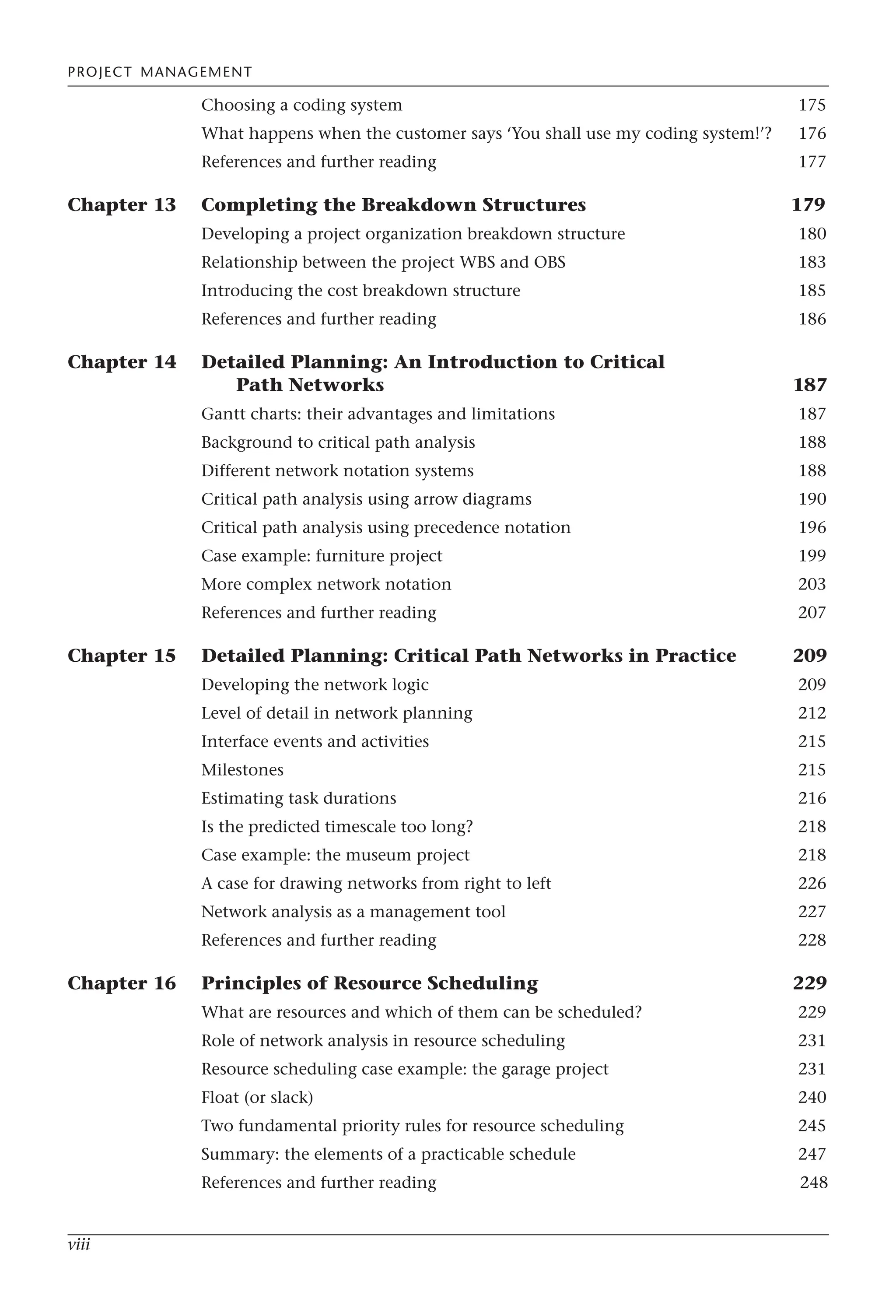
Contents
11.
PROJECT MANAGEMENT
vi
Chapter 4Estimating the Project Costs 49
Introduction to cost estimating 49
Classification of costs as direct or indirect 51
Estimating accuracy 51
Classification of estimates according to confidence 52
Estimating accuracy in relation to prices and profits 53
Version control of project cost estimates 54
Top-down or bottom-up? 55
Compiling the task list 55
Level of detail in project cost estimating 57
Estimating formats 57
Estimating manufacturing costs 61
Estimating project labour costs 63
Personal estimating characteristics 66
Estimates for material and equipment costs 67
Reviewing the cost estimates 68
References and further reading 69
Chapter 5 First Steps in Planning the Timescale 71
General introduction to project planning 71
What makes an ideal project plan? 75
Museum project: a case example 75
Distinction between planning and scheduling 81
References and further reading 81
Chapter 6 Financial Appraisal and the Business Plan 83
Project feasibility analysis 83
Different viewing platforms for the project investor and the project
contractor 84
Introduction to project financial appraisal methods 86
Simple payback method 87
Discounted cash flow 89
How much confidence can we place in the data? 92
Project funding 95
References and further reading 97
Chapter 7 Risk 99
Introduction to project risk management 99
Identifying the possible risks 100
Risk appraisal and analysis 100
Risk register 104
12.
vii
Methods for dealingwith risks 105
Insurance 107
Planning for a crisis 112
References and further reading 113
Chapter 8 Project Authorization 115
Introduction to project authorization 115
Project authorization criteria for the project owner 116
Authorization documents issued by the project owner 118
Project registration and numbering 120
Project authorization in a contracting organization 121
Authorizing work without a contract or customer’s order 123
References and further reading 125
Chapter 9 Project Organization Structures 127
Effective organization and communications 127
Organization charts 127
Emergence of project management in a developing company 129
Project matrix organizations 133
Project teams and task forces 137
Organization of central administration functions 139
Which type of project organization is best? 140
Organizations with more than one project manager 144
References and further reading 148
Chapter 10 Organization of Management Change and IT Projects 149
Special characteristics of management change projects 149
Case example: the Coverite plc office relocation project 150
PRINCE2™ 154
References and further reading 154
Chapter 11 Key People in the Organization 155
Project manager 155
Director of projects or programme manager 159
Project engineer 159
Project support office 161
References and further reading 162
Chapter 12 Work Breakdown and Coding 165
WBS concept 165
Coding systems 170
Benefits of a logical coding system 173
CONTENTS
13.
PROJECT MANAGEMENT
viii
Choosing acoding system 175
What happens when the customer says ‘You shall use my coding system!’? 176
References and further reading 177
Chapter 13 Completing the Breakdown Structures 179
Developing a project organization breakdown structure 180
Relationship between the project WBS and OBS 183
Introducing the cost breakdown structure 185
References and further reading 186
Chapter 14 Detailed Planning: An Introduction to Critical
Path Networks 187
Gantt charts: their advantages and limitations 187
Background to critical path analysis 188
Different network notation systems 188
Critical path analysis using arrow diagrams 190
Critical path analysis using precedence notation 196
Case example: furniture project 199
More complex network notation 203
References and further reading 207
Chapter 15 Detailed Planning: Critical Path Networks in Practice 209
Developing the network logic 209
Level of detail in network planning 212
Interface events and activities 215
Milestones 215
Estimating task durations 216
Is the predicted timescale too long? 218
Case example: the museum project 218
A case for drawing networks from right to left 226
Network analysis as a management tool 227
References and further reading 228
Chapter 16 Principles of Resource Scheduling 229
What are resources and which of them can be scheduled? 229
Role of network analysis in resource scheduling 231
Resource scheduling case example: the garage project 231
Float (or slack) 240
Two fundamental priority rules for resource scheduling 245
Summary: the elements of a practicable schedule 247
References and further reading 248
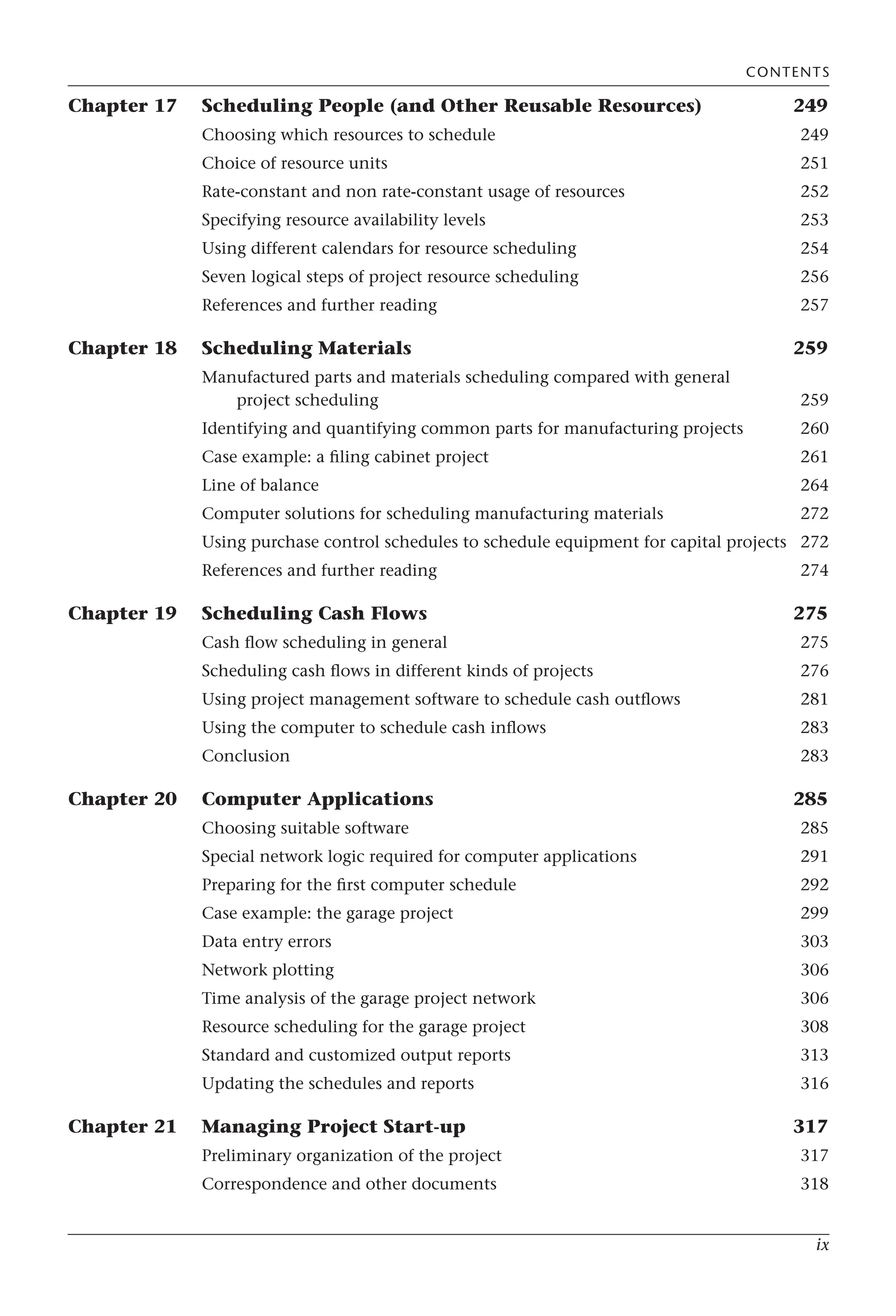
14.
ix
Chapter 17 SchedulingPeople (and Other Reusable Resources) 249
Choosing which resources to schedule 249
Choice of resource units 251
Rate-constant and non rate-constant usage of resources 252
Specifying resource availability levels 253
Using different calendars for resource scheduling 254
Seven logical steps of project resource scheduling 256
References and further reading 257
Chapter 18 Scheduling Materials 259
Manufactured parts and materials scheduling compared with general
project scheduling 259
Identifying and quantifying common parts for manufacturing projects 260
Case example: a filing cabinet project 261
Line of balance 264
Computer solutions for scheduling manufacturing materials 272
Using purchase control schedules to schedule equipment for capital projects 272
References and further reading 274
Chapter 19 Scheduling Cash Flows 275
Cash flow scheduling in general 275
Scheduling cash flows in different kinds of projects 276
Using project management software to schedule cash outflows 281
Using the computer to schedule cash inflows 283
Conclusion 283
Chapter 20 Computer Applications 285
Choosing suitable software 285
Special network logic required for computer applications 291
Preparing for the first computer schedule 292
Case example: the garage project 299
Data entry errors 303
Network plotting 306
Time analysis of the garage project network 306
Resource scheduling for the garage project 308
Standard and customized output reports 313
Updating the schedules and reports 316
Chapter 21 Managing Project Start-up 317
Preliminary organization of the project 317
Correspondence and other documents 318
CONTENTS
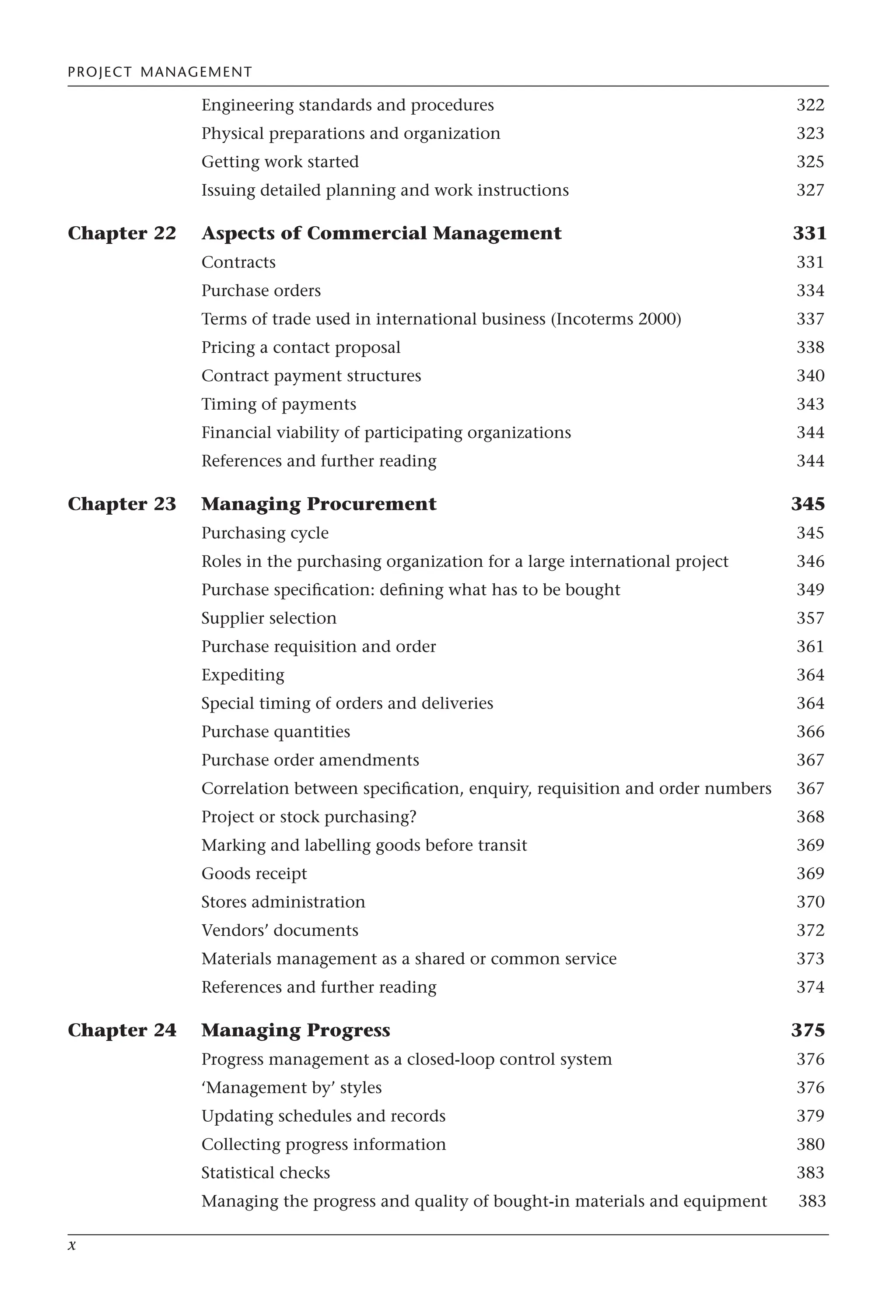
15.
PROJECT MANAGEMENT
x
Engineering standardsand procedures 322
Physical preparations and organization 323
Getting work started 325
Issuing detailed planning and work instructions 327
Chapter 22 Aspects of Commercial Management 331
Contracts 331
Purchase orders 334
Terms of trade used in international business (Incoterms 2000) 337
Pricing a contact proposal 338
Contract payment structures 340
Timing of payments 343
Financial viability of participating organizations 344
References and further reading 344
Chapter 23 Managing Procurement 345
Purchasing cycle 345
Roles in the purchasing organization for a large international project 346
Purchase specification: defining what has to be bought 349
Supplier selection 357
Purchase requisition and order 361
Expediting 364
Special timing of orders and deliveries 364
Purchase quantities 366
Purchase order amendments 367
Correlation between specification, enquiry, requisition and order numbers 367
Project or stock purchasing? 368
Marking and labelling goods before transit 369
Goods receipt 369
Stores administration 370
Vendors’ documents 372
Materials management as a shared or common service 373
References and further reading 374
Chapter 24 Managing Progress 375
Progress management as a closed-loop control system 376
‘Management by’ styles 376
Updating schedules and records 379
Collecting progress information 380
Statistical checks 383
Managing the progress and quality of bought-in materials and equipment 383
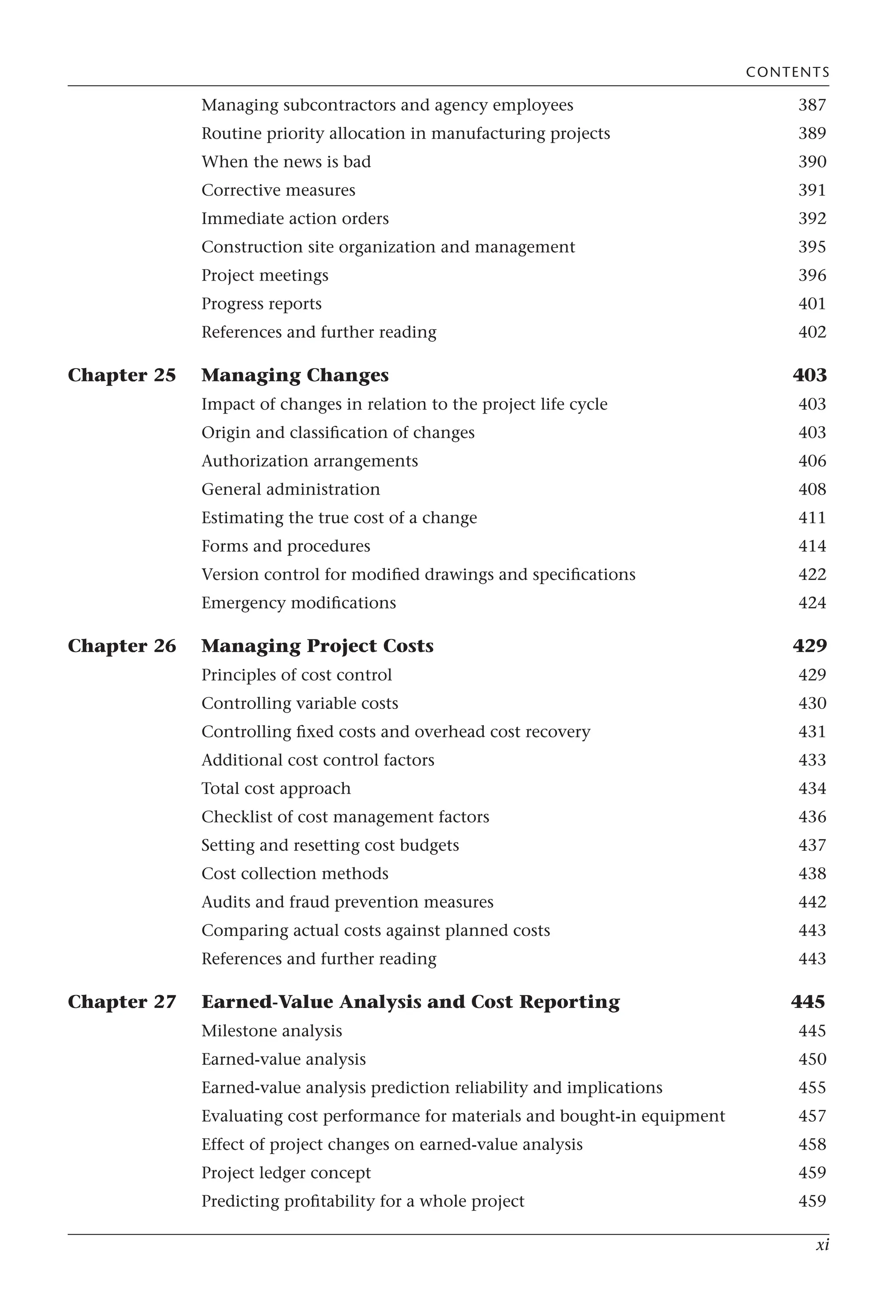
16.
xi
Managing subcontractors andagency employees 387
Routine priority allocation in manufacturing projects 389
When the news is bad 390
Corrective measures 391
Immediate action orders 392
Construction site organization and management 395
Project meetings 396
Progress reports 401
References and further reading 402
Chapter 25 Managing Changes 403
Impact of changes in relation to the project life cycle 403
Origin and classification of changes 403
Authorization arrangements 406
General administration 408
Estimating the true cost of a change 411
Forms and procedures 414
Version control for modified drawings and specifications 422
Emergency modifications 424
Chapter 26 Managing Project Costs 429
Principles of cost control 429
Controlling variable costs 430
Controlling fixed costs and overhead cost recovery 431
Additional cost control factors 433
Total cost approach 434
Checklist of cost management factors 436
Setting and resetting cost budgets 437
Cost collection methods 438
Audits and fraud prevention measures 442
Comparing actual costs against planned costs 443
References and further reading 443
Chapter 27 Earned-Value Analysis and Cost Reporting 445
Milestone analysis 445
Earned-value analysis 450
Earned-value analysis prediction reliability and implications 455
Evaluating cost performance for materials and bought-in equipment 457
Effect of project changes on earned-value analysis 458
Project ledger concept 459
Predicting profitability for a whole project 459
CONTENTS
17.
PROJECT MANAGEMENT
xii
Post mortem464
References and further reading 464
Chapter 28 Managing Multiple Projects, Programmes and Portfolios 465
Project management or programme management? 465
Managing a portfolio of management change and IT projects 466
Multi-project resource scheduling 467
Project resource scheduling in the corporate context 473
References and further reading 474
Chapter 29 More Advanced or Less Frequently Used Techniques 475
Line of balance charts in construction projects 475
Dealing with network plans for large projects 477
PERT 478
Standard networks 480
Templates (standard network modules) 482
Chapter 30 Managing Project Closure 491
Reasons for closing a project 491
Formal project closure 492
Final project cost records 494
Disposal of surplus material stocks 494
Final project definition: the end of a continuous process 494
As-built condition of a manufacturing or capital engineering project 495
As-built condition of a multiple manufacturing project 497
As-built condition of a project that is interrupted before completion 498
Managing files and archives 500
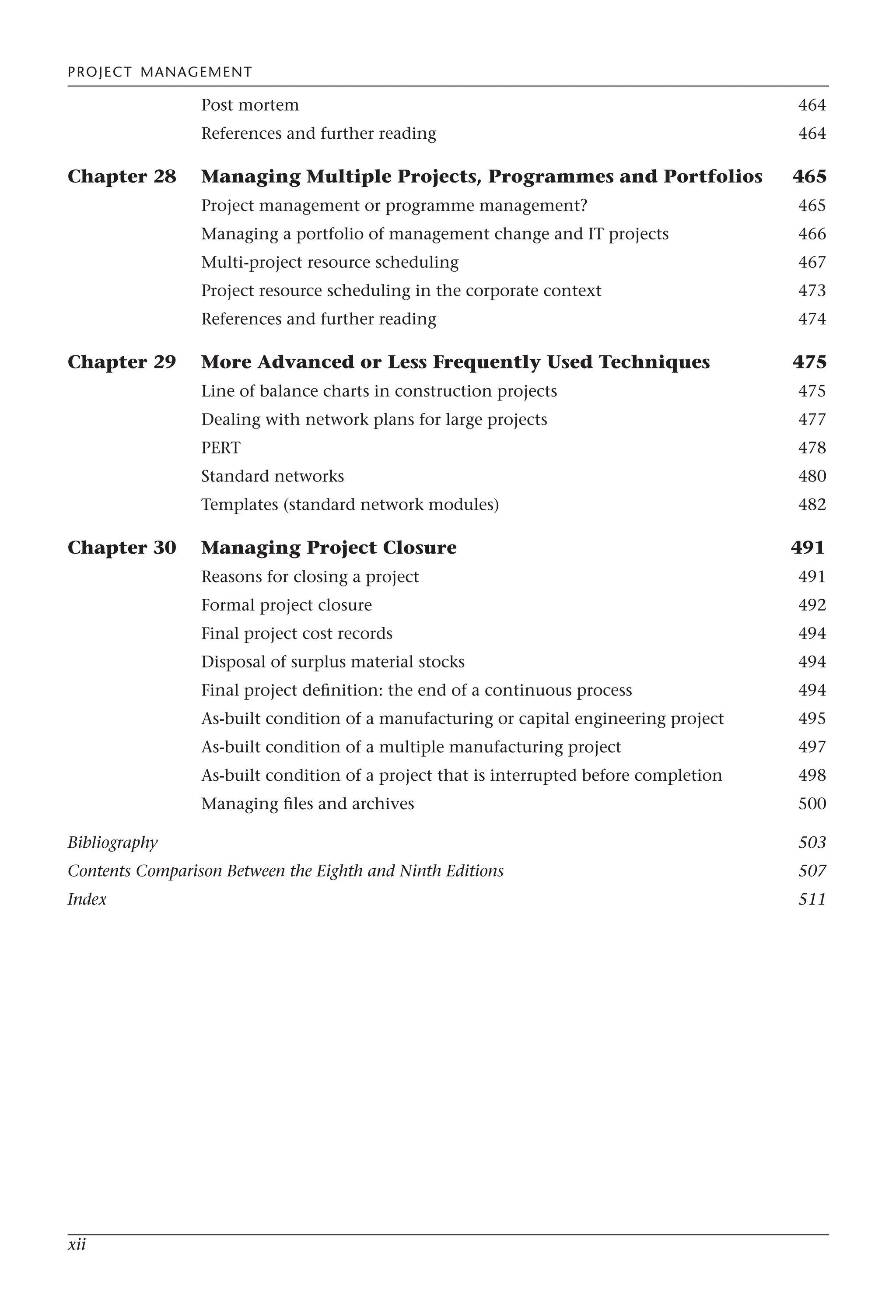
Bibliography 503
Contents Comparison Between the Eighth and Ninth Editions 507
Index 511
18.
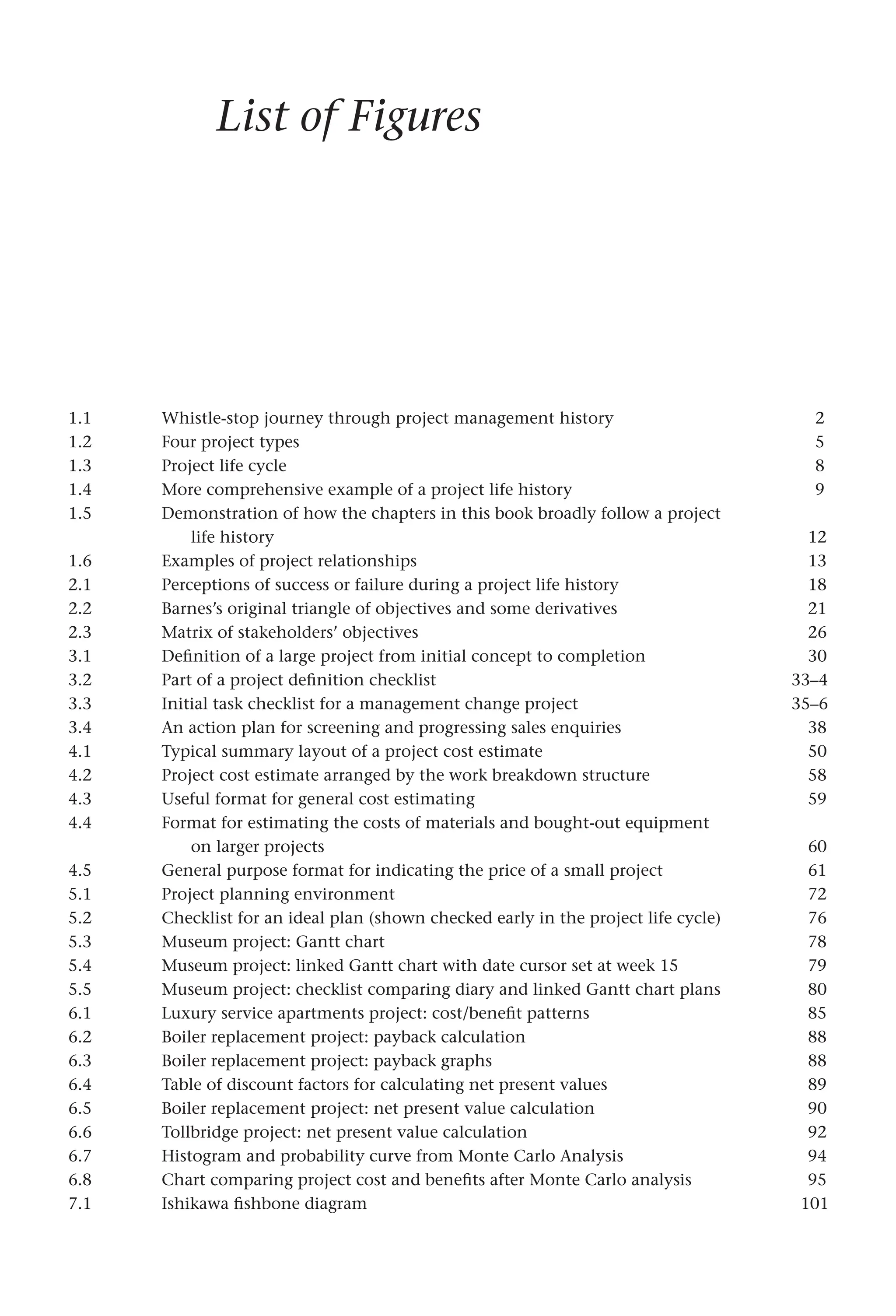
1.1 Whistle-stop journeythrough project management history 2
1.2 Four project types 5
1.3 Project life cycle 8
1.4 More comprehensive example of a project life history 9
1.5 Demonstration of how the chapters in this book broadly follow a project
life history 12
1.6 Examples of project relationships 13
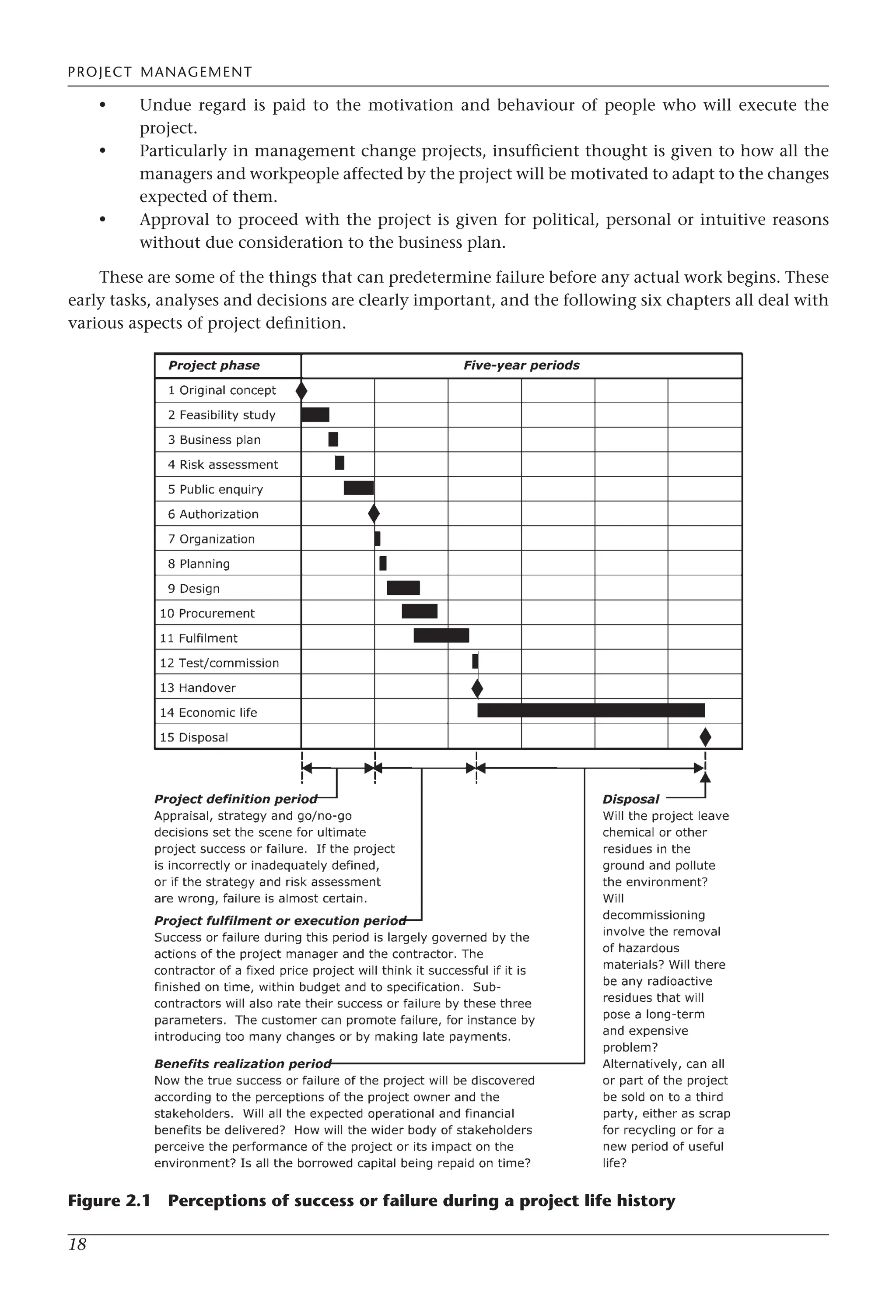
2.1 Perceptions of success or failure during a project life history 18
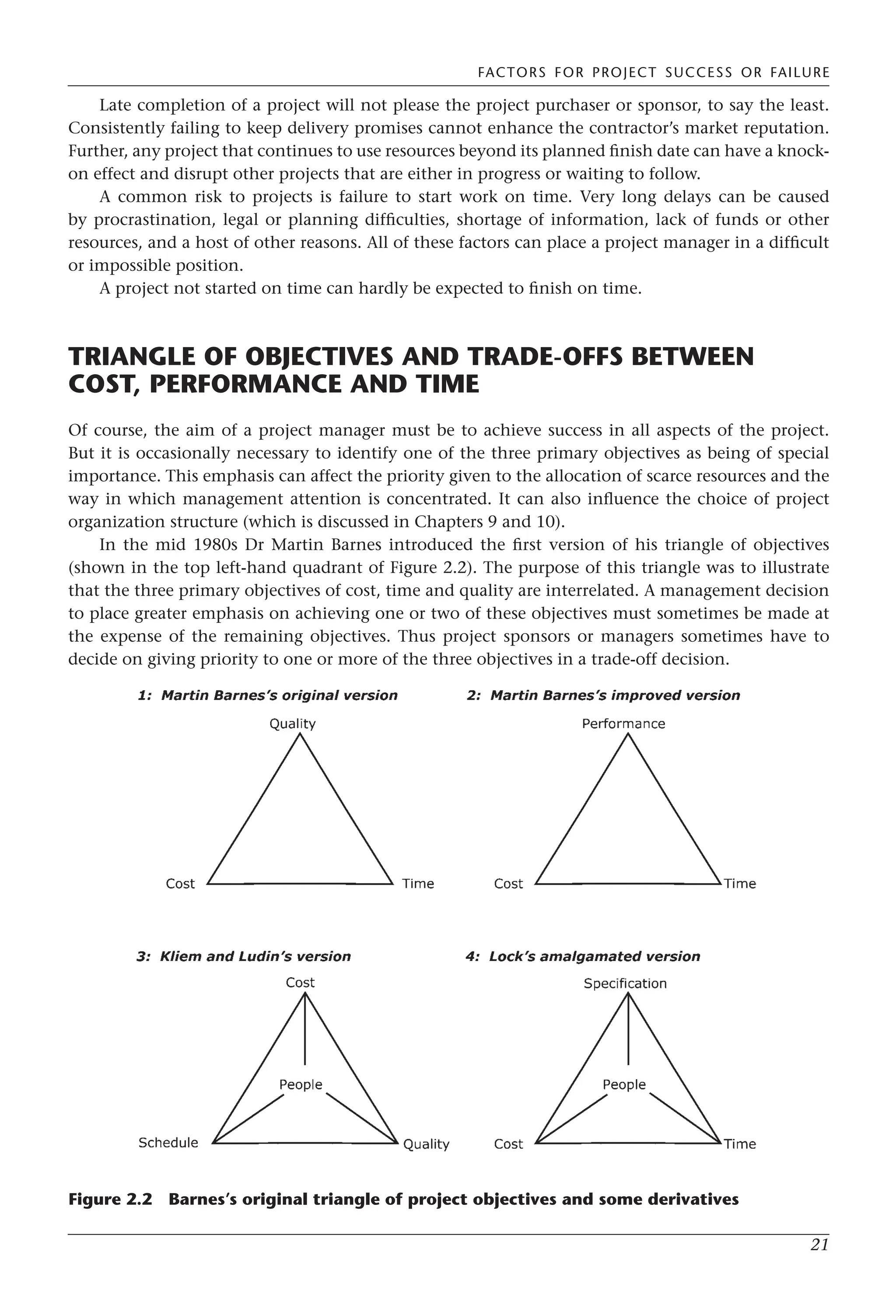
2.2 Barnes’s original triangle of objectives and some derivatives 21
2.3 Matrix of stakeholders’ objectives 26
3.1 Definition of a large project from initial concept to completion 30
3.2 Part of a project definition checklist 33–4
3.3 Initial task checklist for a management change project 35–6
3.4 An action plan for screening and progressing sales enquiries 38
4.1 Typical summary layout of a project cost estimate 50
4.2 Project cost estimate arranged by the work breakdown structure 58
4.3 Useful format for general cost estimating 59
4.4 Format for estimating the costs of materials and bought-out equipment
on larger projects 60
4.5 General purpose format for indicating the price of a small project 61
5.1 Project planning environment 72
5.2 Checklist for an ideal plan (shown checked early in the project life cycle) 76
5.3 Museum project: Gantt chart 78
5.4 Museum project: linked Gantt chart with date cursor set at week 15 79
5.5 Museum project: checklist comparing diary and linked Gantt chart plans 80
6.1 Luxury service apartments project: cost/benefit patterns 85
6.2 Boiler replacement project: payback calculation 88
6.3 Boiler replacement project: payback graphs 88
6.4 Table of discount factors for calculating net present values 89
6.5 Boiler replacement project: net present value calculation 90
6.6 Tollbridge project: net present value calculation 92
6.7 Histogram and probability curve from Monte Carlo Analysis 94
6.8 Chart comparing project cost and benefits after Monte Carlo analysis 95
7.1 Ishikawa fishbone diagram 101
List of Figures
19.
PROJECT MANAGEMENT
xiv
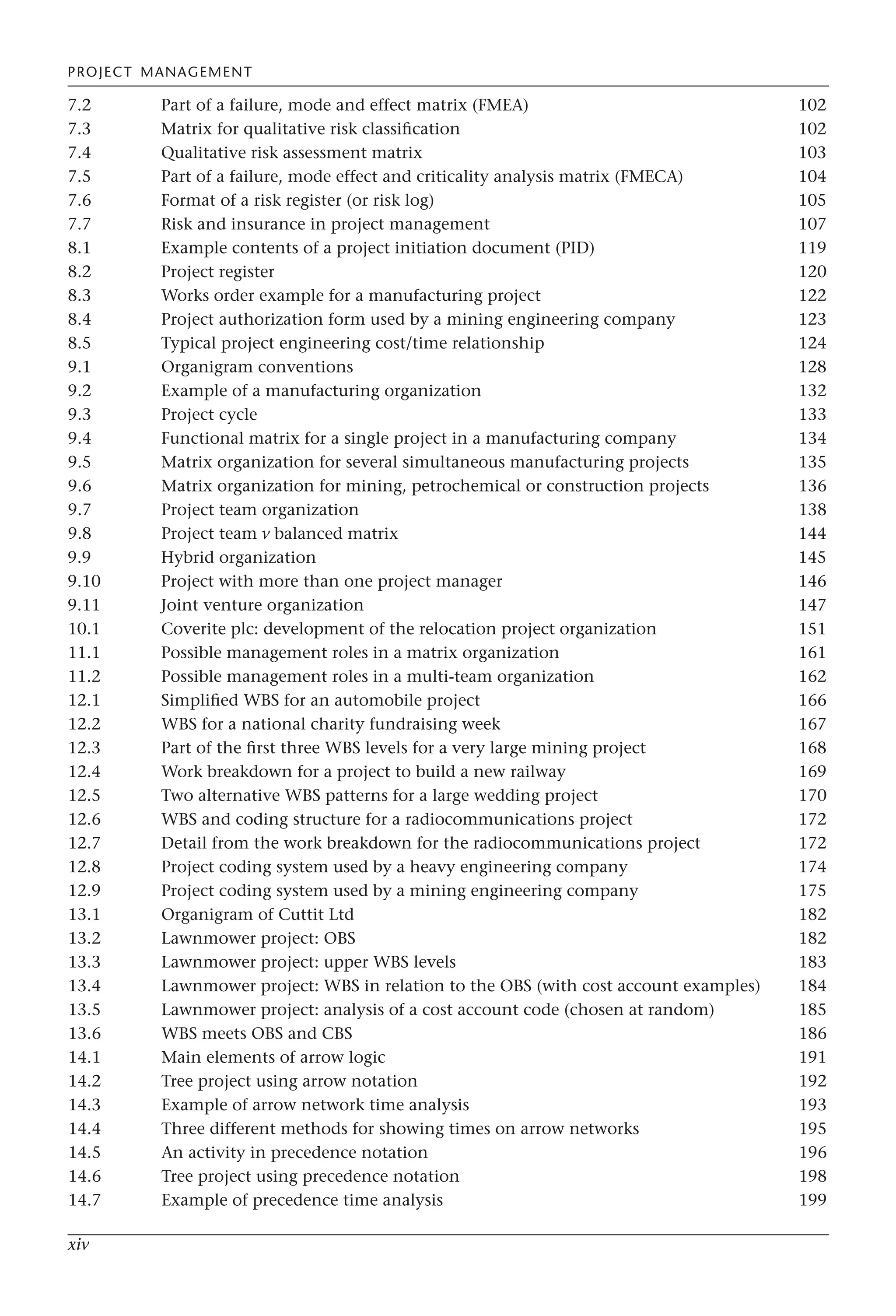
7.2 Partof a failure, mode and effect matrix (FMEA) 102
7.3 Matrix for qualitative risk classification 102
7.4 Qualitative risk assessment matrix 103
7.5 Part of a failure, mode effect and criticality analysis matrix (FMECA) 104
7.6 Format of a risk register (or risk log) 105
7.7 Risk and insurance in project management 107
8.1 Example contents of a project initiation document (PID) 119
8.2 Project register 120
8.3 Works order example for a manufacturing project 122
8.4 Project authorization form used by a mining engineering company 123
8.5 Typical project engineering cost/time relationship 124
9.1 Organigram conventions 128
9.2 Example of a manufacturing organization 132
9.3 Project cycle 133
9.4 Functional matrix for a single project in a manufacturing company 134
9.5 Matrix organization for several simultaneous manufacturing projects 135
9.6 Matrix organization for mining, petrochemical or construction projects 136
9.7 Project team organization 138
9.8 Project team v balanced matrix 144
9.9 Hybrid organization 145
9.10 Project with more than one project manager 146
9.11 Joint venture organization 147
10.1 Coverite plc: development of the relocation project organization 151
11.1 Possible management roles in a matrix organization 161
11.2 Possible management roles in a multi-team organization 162
12.1 Simplified WBS for an automobile project 166
12.2 WBS for a national charity fundraising week 167
12.3 Part of the first three WBS levels for a very large mining project 168
12.4 Work breakdown for a project to build a new railway 169
12.5 Two alternative WBS patterns for a large wedding project 170
12.6 WBS and coding structure for a radiocommunications project 172
12.7 Detail from the work breakdown for the radiocommunications project 172
12.8 Project coding system used by a heavy engineering company 174
12.9 Project coding system used by a mining engineering company 175
13.1 Organigram of Cuttit Ltd 182
13.2 Lawnmower project: OBS 182
13.3 Lawnmower project: upper WBS levels 183
13.4 Lawnmower project: WBS in relation to the OBS (with cost account examples) 184
13.5 Lawnmower project: analysis of a cost account code (chosen at random) 185
13.6 WBS meets OBS and CBS 186
14.1 Main elements of arrow logic 191
14.2 Tree project using arrow notation 192
14.3 Example of arrow network time analysis 193
14.4 Three different methods for showing times on arrow networks 195
14.5 An activity in precedence notation 196
14.6 Tree project using precedence notation 198
14.7 Example of precedence time analysis 199
20.
xv
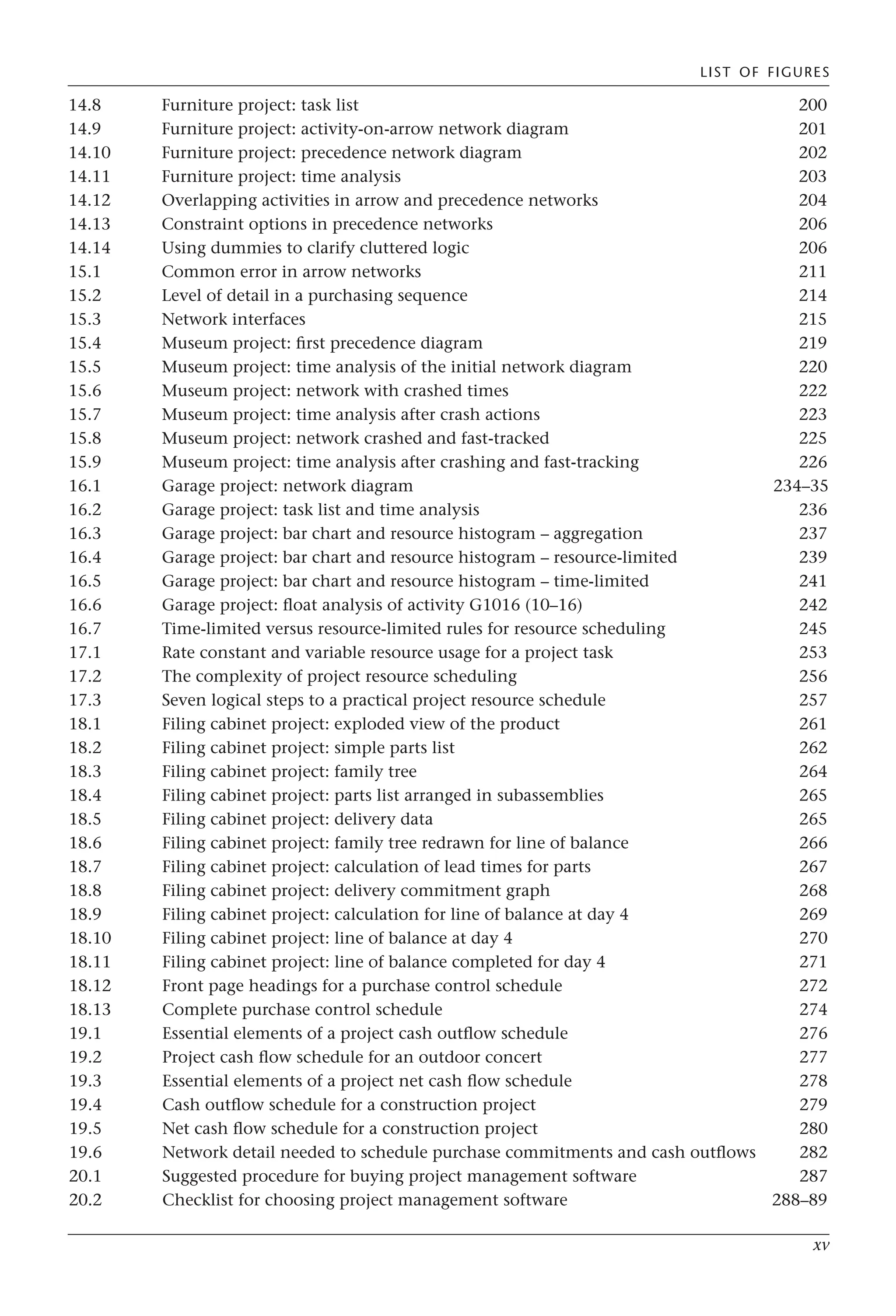
14.8 Furniture project:task list 200
14.9 Furniture project: activity-on-arrow network diagram 201
14.10 Furniture project: precedence network diagram 202
14.11 Furniture project: time analysis 203
14.12 Overlapping activities in arrow and precedence networks 204
14.13 Constraint options in precedence networks 206
14.14 Using dummies to clarify cluttered logic 206
15.1 Common error in arrow networks 211
15.2 Level of detail in a purchasing sequence 214
15.3 Network interfaces 215
15.4 Museum project: first precedence diagram 219
15.5 Museum project: time analysis of the initial network diagram 220
15.6 Museum project: network with crashed times 222
15.7 Museum project: time analysis after crash actions 223
15.8 Museum project: network crashed and fast-tracked 225
15.9 Museum project: time analysis after crashing and fast-tracking 226
16.1 Garage project: network diagram 234–35
16.2 Garage project: task list and time analysis 236
16.3 Garage project: bar chart and resource histogram – aggregation 237
16.4 Garage project: bar chart and resource histogram – resource-limited 239
16.5 Garage project: bar chart and resource histogram – time-limited 241
16.6 Garage project: float analysis of activity G1016 (10–16) 242
16.7 Time-limited versus resource-limited rules for resource scheduling 245
17.1 Rate constant and variable resource usage for a project task 253
17.2 The complexity of project resource scheduling 256
17.3 Seven logical steps to a practical project resource schedule 257
18.1 Filing cabinet project: exploded view of the product 261
18.2 Filing cabinet project: simple parts list 262
18.3 Filing cabinet project: family tree 264
18.4 Filing cabinet project: parts list arranged in subassemblies 265
18.5 Filing cabinet project: delivery data 265
18.6 Filing cabinet project: family tree redrawn for line of balance 266
18.7 Filing cabinet project: calculation of lead times for parts 267
18.8 Filing cabinet project: delivery commitment graph 268
18.9 Filing cabinet project: calculation for line of balance at day 4 269
18.10 Filing cabinet project: line of balance at day 4 270
18.11 Filing cabinet project: line of balance completed for day 4 271
18.12 Front page headings for a purchase control schedule 272
18.13 Complete purchase control schedule 274
19.1 Essential elements of a project cash outflow schedule 276
19.2 Project cash flow schedule for an outdoor concert 277
19.3 Essential elements of a project net cash flow schedule 278
19.4 Cash outflow schedule for a construction project 279
19.5 Net cash flow schedule for a construction project 280
19.6 Network detail needed to schedule purchase commitments and cash outflows 282
20.1 Suggested procedure for buying project management software 287
20.2 Checklist for choosing project management software 288–89
LIST OF FIGURES
21.
PROJECT MANAGEMENT
xvi
20.3 Suggestedprocedure for implementing new project management software 293
20.4 Garage project: precedence network diagram 300
20.5 Garage project: cost estimates 302
20.6 Garage project: data errors 305
20.7 Garage project: summary network plotted by 4c 307
20.8 Garage project: time analysis using Microsoft Project 2000 309
20.9 Garage project: time-limited resource histograms using Primavera 311
20.10 Garage project: resource-limited resource histograms using Primavera 312
20.11 Garage project: cost report using Primavera 314
20.12 Garage project: useful cost and resource summary 315
21.1 Linear responsibility matrix 319
21.2 Document distribution matrix 320
21.3 Standard project start-up network 326
21.4 Possible column headings for a drawing schedule 329
22.1 Elements of a typical purchase order 335
22.2 Relationship between payment terms and the control needed 341
23.1 Value of purchasing in project management 346
23.2 Purchasing cycle 346
23.3 Elements of a purchasing organization for a large international project 347
23.4 Stages in the purchase of equipment for a large international project 350–52
23.5 Purchase specification: front sheet 354
23.6 Purchase specification: second sheet 355
23.7 Purchase specification: continuation sheet 356
23.8 Purchase enquiry request 358
23.9 Common arrangement for inviting and considering bids 360
23.10 Bid summary example 362
23.11 Purchase requisition 363
24.1 A familiar sign: but will this project start and finish on time? 375
24.2 Control loop 376
24.3 Materials shortage list format 378
24.4 Combined work-to list and progress questionnaire 381
24.5 Inspection and expediting report 385
24.6 Immediate action order 393
24.7 Construction site organization 396
24.8 Combined meeting agenda and action sheet 399
25.1 Cost of a given change in relation to project life cycle phases 404
25.2 Some origins of project changes 405
25.3 Decision tree for change requests 408
25.4 General-purpose change register 410
25.5 Car project: estimated modification cost 412
25.6 Project variation order 416
25.7 Engineering change request 418
25.8 Production permit or concession 419
25.9 Engineering query note 421
25.10 Inspection report 423
26.1 Project cost elements in the context of cost control 430
26.2 Typical project cost/time patterns and the impact of fixed costs 432
22.
xvii
26.3 Three waysof recording the cost of project materials 439
26.4 Weekly timesheet 441
27.1 Comparison of actual costs against a time-scaled budget 446
27.2 Project cost and achievement comparison using milestones 448
27.3 Data for a milestone chart 449
27.4 Earned-value analysis for an engineering department 454
27.5 Cost/profit prediction graph 461
27.6 Tabulated project cost report 463
28.1 Programme of projects in a large contracting company 466
28.2 Managing a multi-project model 470
29.1 Five-house project: Gantt chart 476
29.2 Five-house project: line of balance chart 476
29.3 Eighty-house project: line of balance chart 477
29.4 Rolling wave planning 478
29.5 Breaking down a large project plan into subnetworks 479
29.6 Transfer line project: early example of standard network module (template) 483
29.7 Transfer line project: procurement and machining template 484
29.8 Templating case example: template library principle 485
29.9 Templating case example: standard start template TCSAA and template B 486
29.10 Templating case example: template D and standard finish template TCSFF 487
29.11 Templating case example: template library browser 488
29.12 Templating case example: network diagram 488
29.13 Templating case example: network fragment 488
29.14 Templating case example: Gantt chart produced by 4c 489
30.1 Project closure notice with checklist 493
30.2 Build schedule sheet 499
LIST OF FIGURES
Acknowledgements
4c Systems Limited
DrMartin Barnes
Professor Sally Brailsford
Association for Project Management
Alan Fowler
Primavera
Robert Pow
Welcom Software
Artemis Views is a registered trademark. Deltek Open Plan™ is a registered trademark of Deltek.
Primavera Project Planner is a registered trademark. PRINCE2 is a trademark of the Office of Government
Commerce. Windows and PowerPoint are trademarks of Microsoft Corporation. 4c is a trademark of
4c Systems Limited.
I
am grateful to the following people and organizations who have helped in different but valuable
ways in the preparation of this edition and its immediate predecessor:
Preface to NinthEdition
T
he changes for each new edition of Project Management are fuelled largely by my continued
learning and experience. This knowledge originated from my experiences as a manager working
in a number of quite different industries, augmented by a number of successful and fulfilling
consultancy assignments. I have enjoyed the schadenfreude frisson of learning from the mistakes of
others, and equally from the humiliating embarrassments of my own errors. A rich source in more
recent years has come from the challenge of teaching well over 1000 post-graduate management
students from all parts of the world, an experience that (apart from one unpleasant encounter with
a cohort of ten surly English MBA aspirants) has proved wholly and mutually challenging and very
rewarding.
Somewhere embedded in all this learning experience is the advice that I receive from time
to time from reviewers, almost all of whom have been encouraging and supportive. A few have
even been so kind as to offer free advice. One kind reviewer of the eighth edition suggested that
my chapter sequence should be changed to observe more strictly the life cycle pattern of a typical
project. This book has always vaguely been modelled on the start-to-finish progress path of a project,
but I am very grateful to that reviewer for his good advice. As a direct result I have taken this book
apart and rebuilt it so that it now sticks far more faithfully to the project life cycle phases from initial
project idea to final closure. This closer adherence to the project life cycle has allowed the chapters
to follow in a continuous, almost seamless flow and for that reason it was no longer necessary to
divide the book into the separate parts used in earlier editions.
Every new edition seems to grow in size. That has never been my direct intention, but it still
happens every time. I perform my own brand of liposuction to remove surplus fat, and I excise
material that no longer enjoys being flavour of the month. This time, for instance, I have saved
considerable space by consolidating the two former cost estimating chapters into one, by merging
three computing chapters into one, and by condensing the three previous purchasing chapters into
one. Nothing of any substance has been lost through these consolidations which, together, should
have reduced the number of chapters from the former 25 to 20. Yet the book has instead grown to 30
chapters, and the number of illustrations has increased from 164 to very nearly 200. These statistics
indicate the extensive scope of this revision.
Work breakdown structure and coding is now given more prominence as a separate chapter and
the new chapters subjects include:
factors for project success or failure;
first steps in planning the timescale;
financial appraisal and the business plan;
organization of business change and IT projects;
key people in the organization;
•
•
•
•
•
27.
PROJECT MANAGEMENT
xxii
combining thework-, organization- and cost-breakdown structures;
scheduling cash flows;
advanced or less frequently used project management methods.
All the former case studies have been reviewed and augmented. Some of these are fairly detailed,
whilst others are simply vignettes drawn from my past experiences. To be consistent these are now
all referred to as case examples.
The general balance of the book has changed slightly to include more on management change
and IT projects, against which there is now slightly less emphasis on manufacturing projects and
production operations.
I feel moved to mention one old favourite that is missing from this new edition. I have used
the gantry project as a case example in all previous editions of this book and in countless lectures
to illustrate critical path network logic and time analysis. I realized some time ago that building a
stand-alone gantry on a remote hillside was a particularly useless endeavour, and I am astonished
that no one has ever questioned the motives or provenance of that futile project. Now it’s dead and
buried (probably on the same remote hillside) and will soon be forgotten. I doubt whether it will
find any mourners, but it left a gap that needed a replacement and for that I have introduced a more
realistic refurbishment project for a museum and art gallery.
As ever, I always have the reader in my mind’s eye as I write, and I have particular sympathy
with the many students attending our universities whose first language is not English. Thus I try
to avoid unnecessary jargon or management-speak. I attempt to write in English that is readily
understandable, and which does not require the reader to have a dictionary constantly on hand.
Every diagram has been reviewed or is new for this edition, and I have taken great care taken to
ensure that each supports the text and is legible and accurate.
Most chapters end with a ‘References and further reading’ section. The few do that not deal with
subjects that are very poorly represented in the literature. There is, once again, a general bibliography
and that has been updated as far as possible.
I want to acknowledge the assistance of Robert Pow who, once again, has reviewed and corrected
the insurance section in Chapter 7. I am very grateful to Alan Fowler who, as well as being managing
director of Isochron Ltd, is a person of tremendous ability, imagination and forward thinking. My
synergistic collaboration with him on another Gower book taught me a great deal in a very short
time about huge management change and IT projects, and I have drawn on that experience for this
ninth edition. I have almost come to take for granted the expert and highly professional team at
Gower, every member of which has been magnificent and supportive throughout.
Dennis Lock
•
•
•
28.
1 Introduction toProject
Management
P
roject management has evolved to plan, coordinate and control the complex and diverse
activities of modern industrial, commercial and management change and IT projects. All
projects share one common characteristic – the projection of ideas and activities into new
endeavours. The ever-present element of risk and uncertainty means that the events and tasks
leading to completion can never be foretold with absolute accuracy. Examples abound of projects
that have exceeded their costs by enormous amounts, finishing late or even being abandoned before
completion. Such failures are far too common, seen in all kinds of projects in industry, commerce
and (especially, it seems) the public sector.
The purpose of project management is to foresee or predict as many of the dangers and problems
as possible and to plan, organize and control activities so that projects are completed successfully
in spite of all the risks. This process should start well before any resource is committed, and must
continue until all work is finished. The primary aim of the project manager is for the result to satisfy
the project sponsor or purchaser and all the other principal stakeholders, within the promised
timescale and without using more money and other resources than those that were originally set
aside or budgeted.
BRIEF HISTORY OF PROJECT MANAGEMENT
Clearly, man-made projects are not new: monuments surviving from the earliest civilizations testify
to the incredible achievements of our forebears and still evoke our wonder and admiration. Modern
projects, for all their technological sophistication, are not necessarily greater in scale than some
of those early mammoth works. But economic pressures of the industrialized world, competition
between rival companies, and greater regard for the value, well-being and hence the employment
costs of working people have all contributed to the development of new project management ideas
and techniques. Figure 1.1 is a cursory, rather light-hearted romp through the history of project
management. It makes generalizations and the dates are approximate, but the story is interesting
and an appropriate introduction to the fascinating subject of project management. Those with the
time available to study an authoritative and comprehensive account of project management history
should read Morris (1994).
Projects from prehistory to Victorian times (before 1900)
Projects from ancient times have left impressive legacies on our architectural and industrial culture.
We wonder how some of those early masters managed without the technology that is readily and
cheaply available today. However, with the exception of a few notable philanthropic employers,
29.
PROJECT MANAGEMENT
2
concern forthe welfare and safety of workers was generally lacking and many early project workers
actually lost their lives through injuries, disease and sheer physical exhaustion. People were often
regarded as a cheap and expendable resource.
Formal management organization structures have existed from early times, but these flourished
in military, church and civil administrations rather than in industry. Industrial organization came
much later. I have an organization chart showing a Chinese bridge-building team that is reputed to
date back to the Ming dynasty (1368–1644) but that was an army team.
Projects before 1900 were generally managed by the creative architects and engineers themselves.
Many of us are familiar with stories of the giants who flourished in the latter part of this historical
period; people such as Sir Christopher Wren (1632–1723), Thomas Telford (1757–1834) and
Isambard Kingdom Brunel (1806–59). You can read about Brunel in Vaughan (1991). There was no
separately recognized profession of project management. Commonsense, determination, hard work
(sometimes at the expense of neglecting personal health) usually got the job done. The time had
not yet come for the industrial engineers and behavioural scientists who would eventually study
working practices, organization theory and people at work.
Before 1900
Wonderful projects
People cheap, even expendable
Urgency not driven by the rat-race
Management organization structures
seen in the church and the military
No management scientists
No project management profession
•
•
•
•
•
•
1900 – 1949
Emergence of management
science
People begin to study work and
people at work
Henry Gantt introduces his famous
planning charts
Early development of critical path
networks
•
•
•
•
1950 – 1969
US defense projects exploit critical
path network analysis
Mainframe computers can run
project management software in
batch mode
Project management becomes a
recognized profession
More concern for people at work
•
•
•
•
1970 – 1979
Project management has two
meanings:
- industrial project management
- IT project management
Creation of professional associations
More project management software
Legislation for health and safety
Anti-discrimination laws introduced
•
•
•
•
•
1980 – 1989
Desktop computers can run powerful
project management software
Better graphics, with colour
Managers less dependent on IT
experts
Computers cannot now run arrow
networks and precedence becomes
the norm
•
•
•
•
1990 – 2000+
PCs and notebooks can run all
applications
More interest in project risk
IT and industrial project
management no longer considered
so differently
Project management is a respected
profession, with flourishing
associations
•
•
•
•
• Wider acceptance of
project management as
a profession
• Worldwide
communication by
satellite and the
Internet
Figure 1.1 Whistle-stop journey through project management history
30.
INTRODUCTION
3
1900 to 1949
Rapidindustrialization and the demands of munitions production in World War 1 saw the emergence
of management scientists and industrial engineers such as Elton Mayo and Frederick Winslow Taylor,
who studied people and productivity in factories (Kanigel, 1997). Henry Ford made production-line
manufacture famous with his Model T automobile and, especially important for project managers,
Henry Gantt (1861-1919), who worked for Taylor, developed his now-famous charts which are still
popular and used universally today.
It is not generally appreciated that early examples of critical path networks were developed
before 1950, although their value was not widely appreciated at the time. Without the existence
of computers, they were inflexible to change, tedious to translate into working schedules and
thus impracticable and difficult to use. Gantt’s bar charts were generally preferred, often set up on
proprietary charts that allowed rescheduling using movable magnetic or plug-in strips or cards.
Everything from the allocation of work to people and machines to holiday schedules was controlled
by charts, usually prominently displayed on office walls.
1950 to 1969
The emergence of mainframe digital computers made the processing and updating of critical path
networks faster and easier. The American defence industry and Du Pont were among the organizations
quick to exploit this powerful planning and scheduling tool in the 1950s. The manufacturing and
construction industries soon came to recognize the benefits of these new methods.
Computers were large, extremely expensive, and required their own dedicated air-conditioned
clean rooms. Their capital and operating costs were beyond the budgets of all but the biggest
organizations, so that many planners in smaller companies bought their computing time from
bureaux, where project schedules were processed in batch mode. These bureau facilities were
provided both by computer manufacturers and by large companies whose computers had free time.
It was at this time that I cut my project management teeth, and I have fond memories of being
able to plan and control projects and programmes of multiple projects very successfully, although
processing time was measured in days rather than in today’s nanoseconds.
Project management became a recognized job description, if not yet a respected profession.
Companies were showing more concern for the welfare of people at work, although discrimination
because of race, sex and age was still too common. The year 1968 saw publication of the first edition
of this book, at a time when most other publications dealt with planning and scheduling as separate
techniques rather than treating project management holistically as a management discipline.
1970 to 1979
This period saw rapid growth in information technology, or ‘IT’ (as it soon became known). Industrial
project management continued as before, but with more project management software available and
wider recognition of the role. However, the spread of IT brought another, different kind of project
manager on the scene. These were the IT project managers: people who had no project planning or
scheduling experience and no interest or desire to learn those methods. They possessed instead the
technical and mental skills needed to lead teams developing IT projects. These IT project managers
were usually senior systems analysts, and one of their characteristics was their scarcity. High demand
for their services led them to make frequent career jumps, moving rapidly up a generous salary scale.
Development of the professional project management associations grew during this period,
which also saw the development of legislation to protect workers’ health and safety. Other new laws
were intended to discourage unfair discrimination of people because of their race, religious beliefs
or sex.
31.
PROJECT MANAGEMENT
4
Although projectmanagement software became more widely available, processing continued
to be carried out on big expensive mainframe computers in batch mode. Graphics were primitive
compared with modern equipment. Data input was still accomplished by copying data from network
diagrams on to coding sheets from which cards had to be punched and verified, sometimes needing
two cards for every network activity. After sorting, these punched cards had to be taken to trained
computer operators, who worked in clean air-conditioned rooms where entry was usually forbidden
to project managers. The first process results always seemed to produce a large pile of print-out
listing a crop of errors that needed considerable detective work before the faults could be identified,
and then corrected by punching several new cards before the computer could produce its practical
working schedules.
All the output reports in those early computing days came as text from line printers, so that
graphics such as bar charts were crudely formed from patterns of alphanumeric characters. Yet
the process was stimulating, exciting and fun. We had our mishaps, for example when over 2000
pre-sorted punched cards were accidentally scattered over the floor of the London taxicab that
was transporting them to the computer bureau. But we got our schedules calculated, managed our
projects and enjoyed ourselves in the process.
1980 to 1989
During this decade project managers became far less dependent upon IT experts. They now had their
own desktop computers that could run most project management software. Graphics were greatly
improved, with smaller printers available locally in the office that could produce complex charts in
many colours. However, productivity did not match this growth in technology as quickly as one
might have expected because managers became more interested in the technology itself than in
the work that it was intended to manage. People were frequently seen grouped round each other’s
screens asking questions such as ‘What happens if you do this?’ and ‘Have you tried that?’ or ‘Why
has it crashed and lost all my data?’ In other words, managers had to learn to become ‘computer
literate’ and be far less dependent on IT experts.
Software that could run activity-on-arrow networks became obsolete. All planners have since
had to use activity-on-node (precedence) networks in their computers and adapt to the relatively
small areas of network visible on the small screen. However, processing times were cut dramatically,
so that schedules could be up and running much faster for new projects. Schedules could now be
updated almost immediately from the planner’s own keyboard to cope with progress information
and project changes.
1990 to the present day
Practically all software suppliers recognized the need to make their products compatible with
Microsoft Windows. Microsoft themselves introduced Microsoft Project into their Office suite of
programs. One or two operating and plotting faults in very early versions of Microsoft Project were
eliminated in later versions, and the program is now by far the most widely used, especially among
students who appreciate its user-friendly features (www.microsoft.com/office/project). However,
many professionals continue to use programs at the high end of the software market, preferring
their greater power, versatility and adaptability for particular project applications.
Project risk is taken seriously and people pay more attention to predicting risk events so that
contingencies and risk mitigation strategies can be planned.
Of immense importance is the power of communication made possible by satellites and the
Internet, effectively shrinking the world and making it possible to transmit drawings, reports and
other documents almost instantaneously to almost anywhere.
32.
INTRODUCTION
5
Project management isno longer considered as two separate branches (one for industrial projects
and another for IT projects). There is wider and welcome acceptance that managing company
changes as projects can bring faster and better results.
Many good books dealing comprehensively with all aspects of project management (except
purchasing) are now available in most languages, and there is no shortage of training courses.
Well-regarded professional qualifications awarded by universities, management schools and the
professional organizations can be gained by those who follow the appropriate training and can
demonstrate competence. With this wealth of knowledge and experience we might ask why so many
modern projects fail so dramatically. Eurotunnel, for example, operates at the time of writing with
an unmanageable debt burden exceeding £6.5 billion. The new Wembley Stadium project finished
late and cost twice its original budget. Government IT projects are not exempt from spectacular
failure. We hear of projects that suffer ‘soaring costs’, yet the UK annual cost inflation is at the very
low rate of around 2 per cent.
In spite of the failures, we should be proud of the many successful modern projects, in aviation,
aerospace, construction, medicine and all other branches of human industry. Apart from the threat
of hostilities and terrorism, it seems certain that climate change and the exhaustion of natural
fossil fuel resources will provide the biggest challenges in the future. We shall need effective project
managers to deal with these challenges if humankind is to survive.
DIFFERENT TYPES OF PROJECTS
The principal identifying characteristic of a project is its novelty. It is a step into the unknown,
fraught with risk and uncertainty. No two projects are ever exactly alike: even a repeated project will
differ from its predecessor in one or more commercial, administrative or physical aspects. However,
I have found it possible and convenient to classify projects as four different general types. These are
shown in Figure 1.2.
Figure 1.2 Four project types
33.
PROJECT MANAGEMENT
6
Type 1projects: civil engineering, construction, petrochemical, mining
and quarrying
Projects in this category are those which spring most readily to mind whenever industrial projects are
mentioned. One common feature is that the actual work (the fulfilment phase) must be conducted
on a site that is exposed to the elements, and usually remote from the contractor’s head office. As
such they are often open to the public gaze.
These projects incur special risks and problems of organization. They may require massive capital
investment, and they deserve (but do not always get) rigorous management of progress, finance and
quality. Operations are often hazardous so that health and safety aspects demand special attention,
particularly in heavy work such as construction, tunnelling and mining.
For very large industrial projects the funding and resources needed can be too great for one
contractor to risk or even find. The organization and communications are therefore likely to be
complicated by the participation of many different specialists and contractors, possibly with the
main players acting together through a consortium or joint venture company established specifically
for the project.
Type 2 projects: manufacturing
Manufacturing projects result in the production of a piece of mechanical or electronic equipment, a
machine, ship, aircraft, land vehicle, or some other product or item of specially designed hardware.
The finished product might be purpose-built for a single customer but internal research and
development projects for products to be sold in all market sectors also fall into this manufacturing
category.
Manufacturing projects are usually conducted in a laboratory, factory or other home-based
environment, where the company should easily be able to exercise on-the-spot management and
provide an optimum environment in which to do and manage the work. Of course, these ideal
conditions do not always apply. Some manufacturing projects involve work away from the home
base, for example in installing and commissioning a machine or equipment on a customer’s premises,
customer training and post-project service and maintenance.
More difficult is the case of a complex product that is developed and manufactured by a
consortium of companies, sometimes with members based in different countries. A common example
is aircraft production, where the engines might be developed and manufactured in one country,
the wings in another and the final assembly taking place in a third country. Such international
manufacturing projects are prone to higher risk and difficulties in control and coordination arising
through organizational complexity, national rivalries, contracts, long-distance communications,
multiple languages and conflicting technical standards.
Type 3 projects: IT projects and projects associated with management
change
This class of project proves the point that every company, whatever its size, can expect to need
project management expertise at least once in its lifetime. These are the projects that arise when
companies relocate their headquarters, develop and introduce a new computer system, launch a
marketing campaign, prepare for a trade exhibition, produce a feasibility or other study report,
restructure the organization, mount a stage show, or generally engage in any operation that involves
the management and coordination of activities to produce an end result that is not identifiable
principally as an item of hardware or construction.
34.
INTRODUCTION
7
Not all projectsare conducted commercially or for profit. Most not-for-profit organizations,
including national and local government departments, professional associations, charities and
disaster relief agencies conduct projects that fall into this category of management projects.
Although management projects do not usually result in a visible, tangible creation such as a
piece of hardware, much often depends on their successful outcome and they can require enormous
investment. There are several well-known cases where, for instance, failure to implement a new
computer system correctly has caused serious operational breakdown, exposing the managers
responsible to public discredit. Effective project management is at least as important for these
projects as it is for the largest construction or manufacturing project.
Type 3 projects may be associated with or even depend upon Type 1 or Type 2 projects. For
example, if a company decides to relocate to a new, purpose-built office, the overall relocation
project is itself a Type 3 management project but its success will depend also on the Type 1 project
needed to construct the new building. Thus projects of different types may be associated with each
other in a company’s project programme or project portfolio.
Type 4 projects: projects for pure scientific research
Pure scientific research projects (not to be confused with research and development projects) are
truly a special case. They occasionally result in dramatically profitable discoveries. On the other
hand, they can consume vast amounts of money over many years, yet yield no practical or economic
result. Research projects carry the highest risk because they attempt to extend the boundaries of
current human knowledge. The project objectives are usually difficult or impossible to define and
there may be no awareness of the possible outcome. Therefore, pure research projects are not usually
amenable to the project management methods that can be applied to industrial, manufacturing or
management projects.
Some form of control over pure research projects must, however, be attempted. Money and
other resources cannot be spent without any form of monitoring or restraint. Budgets have to be set
in line with available funding.
A sensible method for controlling a pure scientific research project is to conduct regular
management reviews and reassessments of the potential value of the project. At each of these reviews,
a decision can be taken to stop the project (known colloquially as pulling the plug) or release new
funding to allow it to continue at least until the next review. Although this can be unsettling for the
scientists involved, the project sponsor is not expected to pour money for ever into a vast hole. This
procedure, where continued project funding is dependent upon the outcome of regular reviews, is
known as stage-gate control.
Although the research activities might themselves lie outside the scope of familiar project
management methods, the provision of accommodation, communications, equipment and research
materials might well constitute Type 1, 2 or 3 capital investment projects to which proper project
management can and must be applied.
PROJECT LIFE CYCLES AND LIFE HISTORIES
Some projects come into being gradually, and others fade out slowly, so that their precise beginning
and end dates can be difficult to recognize. However, most projects have not only actual beginning
and end dates but also one or more significant dates between these can be identified as key events
or ‘milestones’.
The period between the beginning and end of a project is usually referred to as the project life
cycle. It is convenient and necessary here to introduce three key players in the project life cycle:
35.
PROJECT MANAGEMENT
8
The customer(in some projects known as the client) is the person or organization that
wants to buy the project and put the end product to use in its own business or sell (or lease)
it on to a third party.
The contractor is the organization principally responsible to the customer for carrying out
the project work.
The project manager is a person employed by the contractor (or occasionally by the customer)
to plan and manage all the project activities so that the project is finished on time, within
budget and within its specification.
These definitions do not apply strictly to all projects, but they are adequate for the purposes of
this introductory chapter. In a Type 3 management project, the customer and the contractor might
reside within the same company, so that the company’s executives (who represent the customer in
this case) instruct a departmental manager (the contractor) to carry out a project for the company’s
own use. However, such complexities can be disregarded for the moment: organization patterns and
roles will be discussed more exhaustively in Chapters 9, 10 and 11.
Life cycle of small projects
Consider, first, the typical life cycle of small projects: projects that have relatively short duration,
do not involve large amounts of capital expenditure and are relatively straightforward to manage.
Most authorities and writers, when they talk about the life cycle of a project, refer to the period that
begins with the authorization of work on the project (or signing of a customer-contractor contract)
up to the handover of the desired product to the customer. This can be a view that is too simplistic,
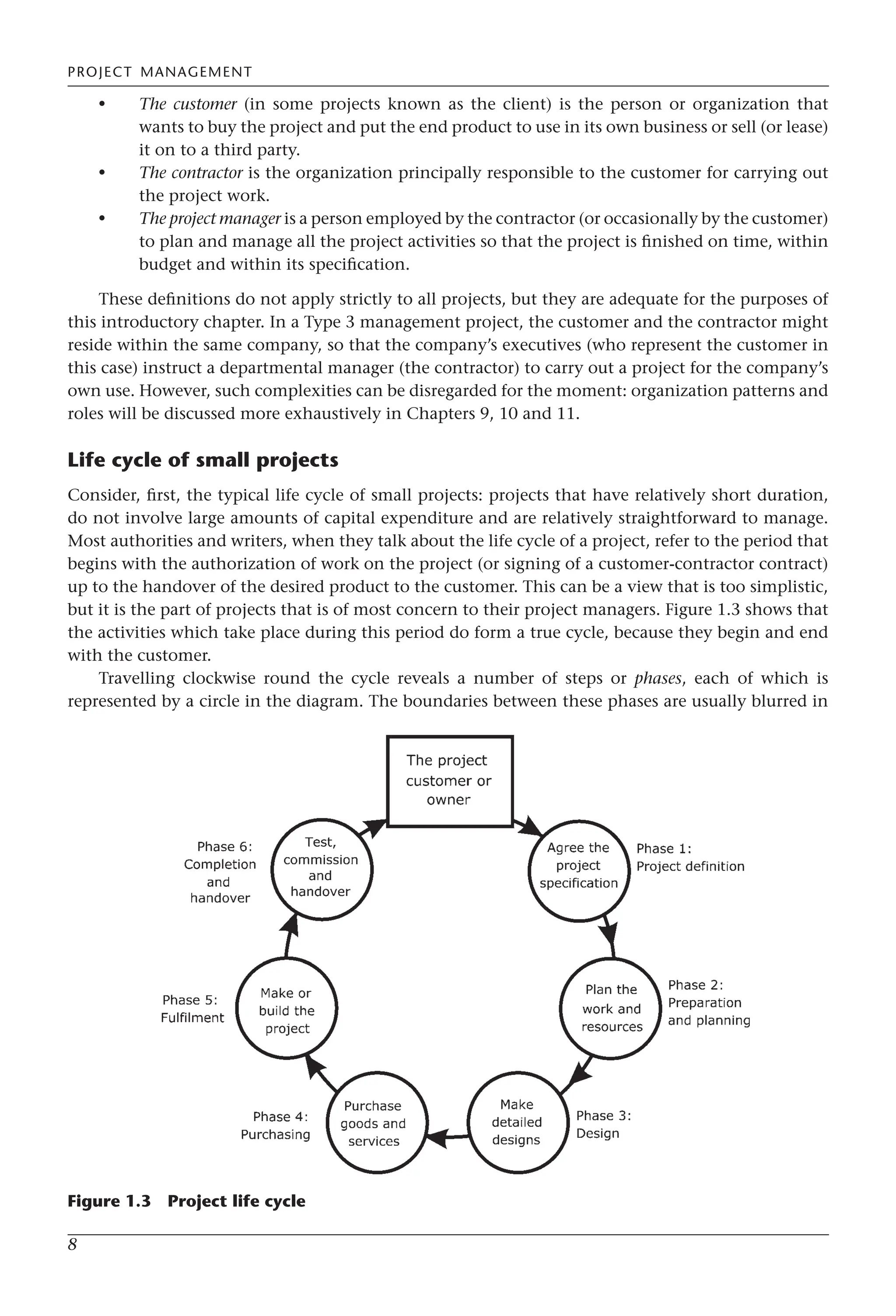
but it is the part of projects that is of most concern to their project managers. Figure 1.3 shows that
the activities which take place during this period do form a true cycle, because they begin and end
with the customer.
Travelling clockwise round the cycle reveals a number of steps or phases, each of which is
represented by a circle in the diagram. The boundaries between these phases are usually blurred in
•
•
•
Figure 1.3 Project life cycle
36.
INTRODUCTION
9
practice, because thephases tend to overlap. For example, some project purchasing and fulfilment
work can usually start before well before design is complete.
This view of a project life cycle is, in very many cases, too simplistic because it ignores everything
that happens before the start of actual work, and also takes no account of what happens to the
project after its delivery to the customer. For a more complete picture, we really have to consider
not only the project life cycle as seen by the project manager, but also the entire life history of the
project from its conception to death and disposal.
More comprehensive view of the project life cycle or history
The simple life cycle shown in Figure 1.3 holds good for small, relatively simple projects but for most
capital projects many more phases can usually be identified. For example, the six phases of Figure
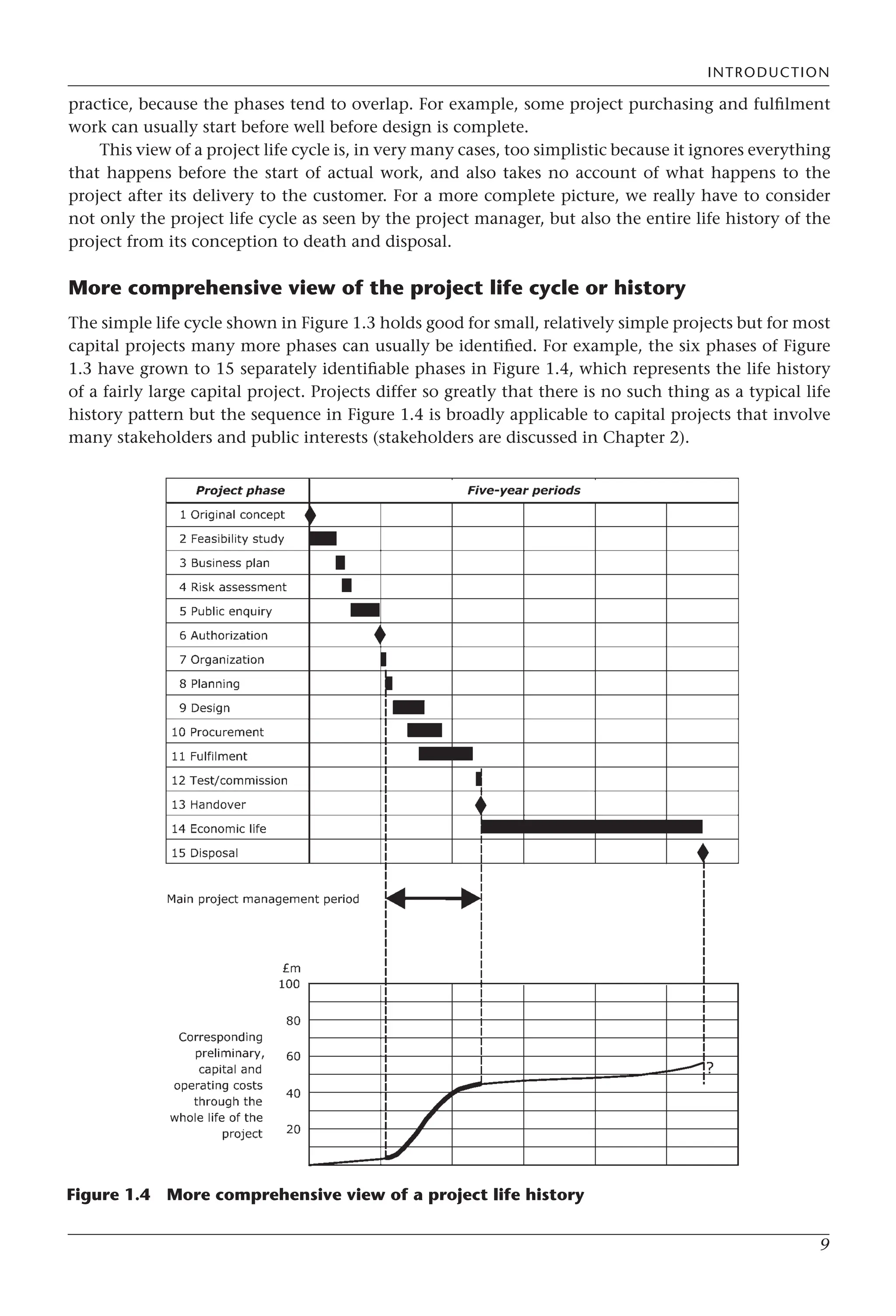
1.3 have grown to 15 separately identifiable phases in Figure 1.4, which represents the life history
of a fairly large capital project. Projects differ so greatly that there is no such thing as a typical life
history pattern but the sequence in Figure 1.4 is broadly applicable to capital projects that involve
many stakeholders and public interests (stakeholders are discussed in Chapter 2).
Figure 1.4 More comprehensive view of a project life history
37.
PROJECT MANAGEMENT
10
Explanation ofthe life history phases
The upper portion of Figure 1.4 is a Gantt chart setting out the phases of a large capital project
against the total life history timescale (for more on Gantt charts see Chapter 14). In this case, the
total period spanned by the project is about 27.5 years, but remember that this is only an example:
actual cases might be anything from one or two years to several decades.
All projects begin as a concept, a gleam in the eye of their progenitor. An entrepreneur or
organization recognizes the need for a project and forms an initial idea that justifies further
investigation. Phases 1 to 4 comprise this formative period, which should end in proposals and a
business plan that describes the project, sets out the financial requirements, the intended benefits
and the principal milestones. Taken together, these early phases form the initial project definition.
Projects in the public eye, or which have significant potential environmental or social impact,
might have to be subjected to one or more public enquiries and prolonged planning applications
(Phase 5), which can seriously delay or even prevent the start of the actual project.
Once everyone has agreed the project definition, all permissions have been granted, and the
funds are available, the project can be authorized (Phase 6). Authorization should really be almost
an instantaneous event or milestone rather that a time-consuming phase, but some organizations
are very cautious about this process and can drag their feet for several months before agreeing to
release the funds and other resources required for the project to start.
When the project has been authorized, the organization has to be put in place. This is Phase 7
in our example and, together with Phase 8, constitutes the project start-up period. Phase 7 includes
the appointment of the project manager and the setting aside or provision of office space and other
accommodation. Only then can real work on the project start, which is signalled by the project
manager arranging for detailed planning and mobilization of the workforce (Phase 8).
Phases 9, 10 and 11 cover the overlapping periods of design, procurement and manufacture or
construction (or, for Type 3 projects, management change). The project is finished when it is handed
over to the customer to be put into operational use (Phase 13) but this cannot usually be done before
the contractor has carried out commissioning and tests or trials (Phase 12) to ensure that the project
will be fit for its intended purpose.
Many project management publications limit their account of the project life cycle or life history
to Phases 6 through 13. The reason for this is that these are the phases that most directly involve
the control of the project manager, who might not actually come on to the scene until Phase 6 or 7.
They constitute the most active or fulfilment period of the project life history and can be compared
loosely with the life cycle in Figure 1.3.
Another glance at Figure 1.4 shows that our version of the project life history not only begins
much earlier than some published versions, but also does not finish until very much later, when the
outcome of the original project has come to the end of its useful economic life and is scrapped or
otherwise disposed of.
Expenditure in relation to the project life history
The graph in the lower portion of Figure 1.4 sets out a pattern of expenditure that might be expected
throughout the life history of a project. It is drawn on the same timescale as the Gantt chart above
and indicates general patterns of expenditure rather than actual monetary levels (since total costs
obviously vary enormously between different projects).
Some expenditure must be made by the project owner or sponsor during the formative, definition
phases. In our example I have shown this expenditure to be at a modest level but some projects
require considerable investigation before they can actually start. A feasibility study costing many
millions of pounds might have to be commissioned to explore the risks, benefits and best strategy
38.
INTRODUCTION
11
for the proposedproject. Public enquiries and wrangling over the specification can delay the project
start and soak up yet more money. The new Wembley Stadium project, for example, underwent a
prolonged definition period that consumed some of the time and money that had originally been set
aside for the actual construction. Some large projects might even be preceded by pilot projects that
themselves demand substantial investment.
The portion of the expenditure curve drawn with a bold line corresponds to the project fulfilment
period when the project manager is actively involved. Almost all the money spent during this time
should be built into the real project, to add value as well as cost. This is one area of the life history
where we can be reasonably confident that the pattern will be similar from one project to the next.
Expenditure usually builds up very slowly as people are gradually assigned to work on the project,
with only a relatively few staff involved in the early stages to carry out initial design and planning.
Later, as working drawings or specifications begin to emerge from the designers or technologists,
money has to be committed in buying materials and equipment so that the main workforce can be
engaged to use these purchases to fulfil the project. Nearer the end of the fulfilment phase (Phase 11
in our example) most purchasing costs are over, and people begin to leave the workforce, so that the
rate of expenditure falls. This expenditure pattern (although not the vertical scale) can be claimed
as typical of most projects and is commonly known as the S-curve. It is the time when the project
manager has most direct influence over control of the project’s capital costs.
Phase 14 marks the end of expenditure on the project’s capital cost and the project moves
into a completely different mode. This is the useful operating life of the project, when all the
expenditure involved is incurred by the project customer (the project owner) in operating,
maintenance, repairs and consumable materials. This is the period, for example, during which
a building can be occupied, an IT system remains accurate and efficient, a special machine
continues to perform its designed task, a mine or quarry produces minerals on an economic scale
or a drug continues to be dispensed to patients before a new, improved drug is developed by the
pharmaceutical industry.
When the project nears the end of its economic life, either the owner has no further use for it
or the costs of operating, maintenance and repair begin to rise to uneconomic proportions. So the
time comes to dispose of the project. In the case of a building this might be centuries after it was
originally built, with ownership having been transferred many times as different occupants come
and go. On the other hand, a modern high technology project might be rendered obsolete after
only a few years of successful operation. In some cases the redundant project can be sold on to a
third party for scrap, yielding a small cash inflow. At the other extreme, disposal costs for a nuclear
power generating station can rival or even exceed the original capital costs, owing to difficulties in
handling and storing materials that are dangerously radioactive. For that reason, I have shown a
question mark at the end of the project life history costs, because the disposal costs (or cash returns)
are so very different from one project to the next.
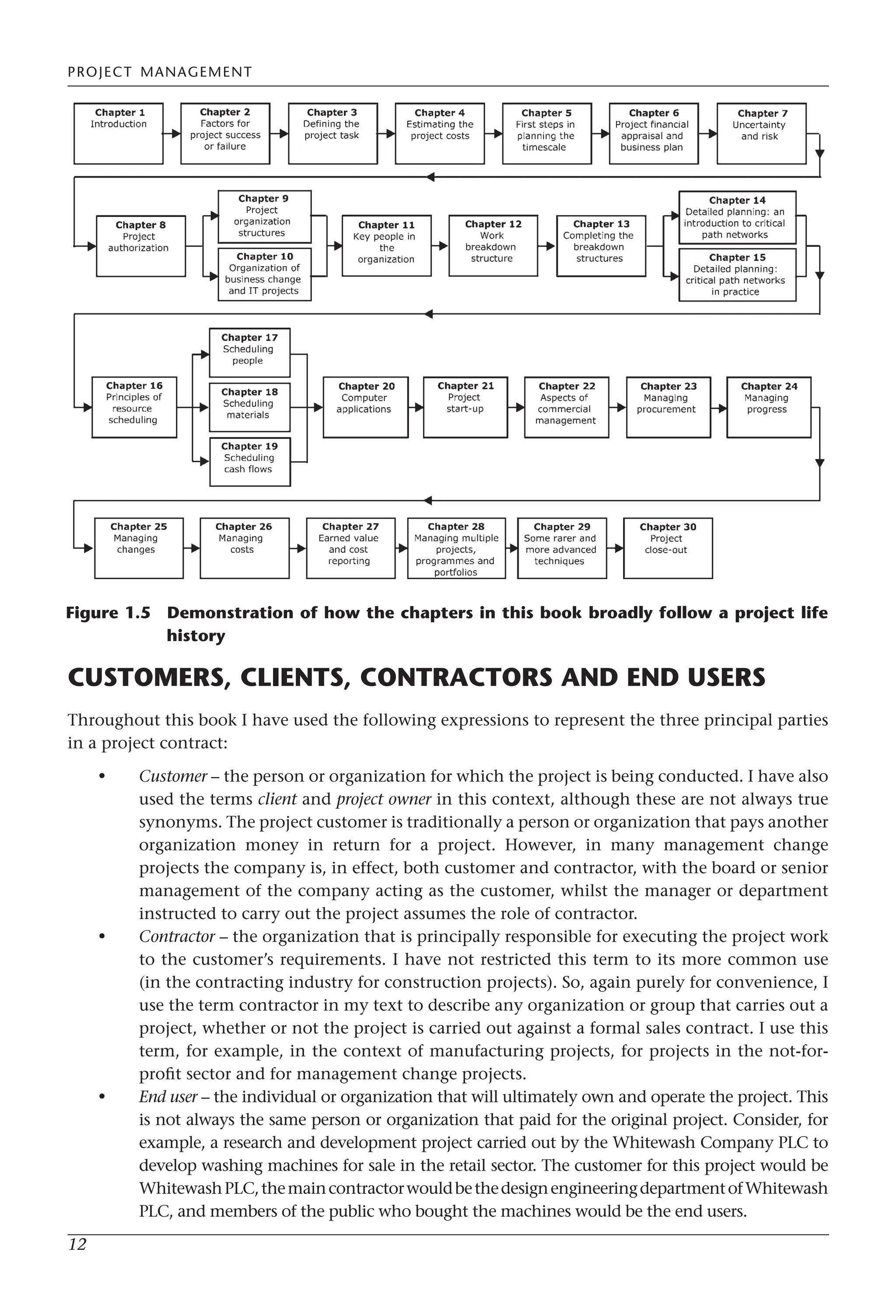
Chapters of this book in relation to the project life history
Figure 1.5 sets out the life history of a large project again, but this time it is presented as a flow
chart instead of the Gantt chart seen in Figure 1.4. A flow chart such as this is an elementary
form of the activity-on-node network planning method described in Chapter 15. In practice the
sequence can be slightly more complicated because some tasks have to be repeated at different
stages in the life of the project as more detailed information becomes available. For example, cost
estimating (Chapter 4) requires a simple version of the coded work breakdown structures that must
be developed later in the project (described in Chapters 12 and 13). However, Figure 1.5 shows that
the chapters in this book have been arranged as far as possible in line with the life history phases
of a large project.
39.
PROJECT MANAGEMENT
12
CUSTOMERS, CLIENTS,CONTRACTORS AND END USERS
Throughout this book I have used the following expressions to represent the three principal parties
in a project contract:
Customer – the person or organization for which the project is being conducted. I have also
used the terms client and project owner in this context, although these are not always true
synonyms. The project customer is traditionally a person or organization that pays another
organization money in return for a project. However, in many management change
projects the company is, in effect, both customer and contractor, with the board or senior
management of the company acting as the customer, whilst the manager or department
instructed to carry out the project assumes the role of contractor.
Contractor – the organization that is principally responsible for executing the project work
to the customer’s requirements. I have not restricted this term to its more common use
(in the contracting industry for construction projects). So, again purely for convenience, I
use the term contractor in my text to describe any organization or group that carries out a
project, whether or not the project is carried out against a formal sales contract. I use this
term, for example, in the context of manufacturing projects, for projects in the not-for-
profit sector and for management change projects.
End user – the individual or organization that will ultimately own and operate the project. This
is not always the same person or organization that paid for the original project. Consider, for
example, a research and development project carried out by the Whitewash Company PLC to
develop washing machines for sale in the retail sector. The customer for this project would be
WhitewashPLC,themaincontractorwouldbethedesignengineeringdepartmentofWhitewash
PLC, and members of the public who bought the machines would be the end users.
•
•
•
Figure 1.5 Demonstration of how the chapters in this book broadly follow a project life
history
40.
INTRODUCTION
13
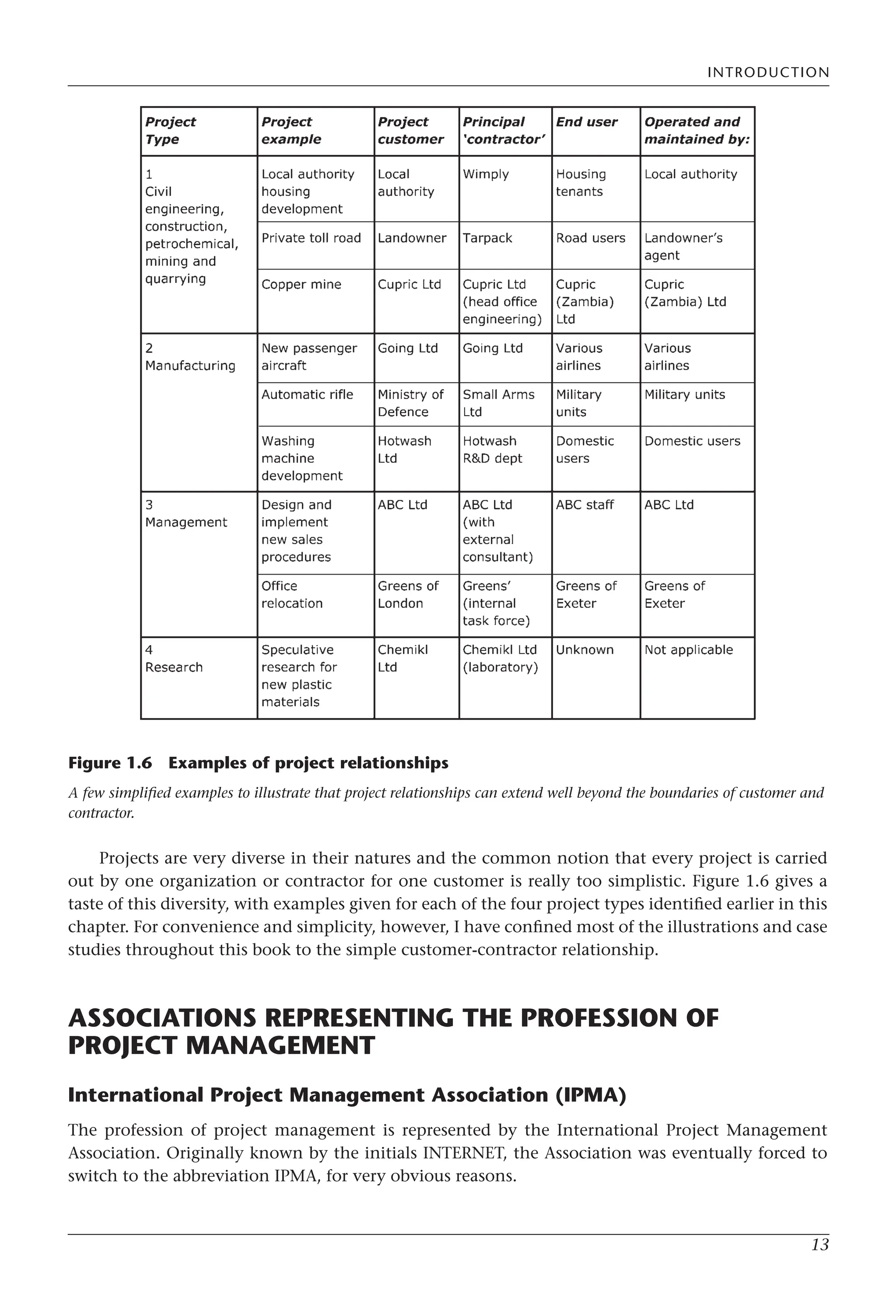
Projects are verydiverse in their natures and the common notion that every project is carried
out by one organization or contractor for one customer is really too simplistic. Figure 1.6 gives a
taste of this diversity, with examples given for each of the four project types identified earlier in this
chapter. For convenience and simplicity, however, I have confined most of the illustrations and case
studies throughout this book to the simple customer-contractor relationship.
ASSOCIATIONS REPRESENTING THE PROFESSION OF
PROJECT MANAGEMENT
International Project Management Association (IPMA)
The profession of project management is represented by the International Project Management
Association. Originally known by the initials INTERNET, the Association was eventually forced to
switch to the abbreviation IPMA, for very obvious reasons.
Figure 1.6 Examples of project relationships
A few simplified examples to illustrate that project relationships can extend well beyond the boundaries of customer and
contractor.
41.
PROJECT MANAGEMENT
14
Association forProject Management (APM)
The corporate member of the IPMA in the UK is the Association for Project Management (APM) and
further information is available from their secretariat at:
Association for Project Management
150 West Wycombe Road
High Wycombe
Buckinghamshire, HP12 3AE
Telephone: 0845 458 1944; Email: info@apm.org.uk; Website: www.apm.org.uk
APM arranges seminars and meetings through a network of local branches and, ten times year,
publishes the journal Project. It also produces other publications, foremost among which is its APM
Body of Knowledge. Personal or corporate membership of APM is an excellent way for project managers
and all others involved in project management to meet and to maintain current awareness of all
aspects of project management.
Membership starts at student level and rises through various grades to full member (MAPM) and
fellow (FAPM). APM’s basic professional qualification, which depends on suitable experience and
written examinations, is APMP. This qualification recognizes an individual’s baseline knowledge
and experience in project management. It is regarded by APM as the benchmark qualification in the
project management profession and is the first step towards certification.
APM has a well-established certification procedure for project managers, who must already be full
members. To quote from APM’s own literature, ‘the certificated project manager is at the pinnacle of
the profession, possessing extensive knowledge and having carried responsibility for the delivery of
at least one significant project’. As evidence of competence, certification has obvious advantages for
the project manager, and will increasingly be demanded as mandatory by some project purchasers.
Certification provides employers with a useful measure when recruiting or assessing staff and the
company that can claim to employ certificated project managers will benefit from an enhanced
professional image. Certification has relevance also for project clients. It helps them to assess a
project manager’s competence by providing clear proof that the individual concerned has gained
peer recognition of their ability to manage projects.
Project Management Institute (PMI)
Founded in the US in 1969, PMI is the world’s leading not-for-profit organization for individuals
around the globe who work in, or are interested in, project management. PMI develops recognized
standards, not least of which is the widely respected project management body of knowledge guide,
commonly known by its abbreviated title the PMBOK Guide.
PMI publications include the monthly professional magazine PM Network, the monthly newsletter
PMI Today and the quarterly Project Management Journal. In addition to its many research and
education activities, PMI is dedicated to developing and maintaining a rigorous, examination-based
professional certification program to advance the project management profession and recognize
the achievements of individual professionals. PMI claims that its Project Management Professional
(PMP) certification is the world’s most recognized professional credential for project management
practitioners and others in the profession. For more information, contact PMI at:
PMI Headquarters
Four Campus Boulevard
Newtown Square
PA 19073-3299, USA
Telephone: +610-356-4600; Email: pmihq@pmi.org; Website: www.pmi.org
42.
INTRODUCTION
15
REFERENCES AND FURTHERREADING
APM (2006), APM Body of Knowledge, 5th Edition (High Wycombe: Association for Project
Management) (also available on CD-ROM).
Barnes, M. (2002), A Long Term View of Project Management – Its Past and its Likely Future, Keynote
speech to the IPMA 16th World Congress on Project Management, Berlin.
Kanigel, R. (1997), The One Best Way: Frederick Winslow Taylor and the Enigma of Efficiency (London:
Little, Brown and Company).
Morris, P. (1994), The Management of Projects (London, Thomas Telford).
PMI (2004), A Guide to the Project Management Body of Knowledge, 3rd Edition (Newtown Square, PA:
Project Management Institute).
Vaughan, A. (1991), Isambard Kingdom Brunel: Engineering Knight-Errant (Cambridge: Cambridge
University Press).
2 Factors forProject Success or
Failure
T
he manager of a typical project would consider the task well done if the project finished on
time, according to its specified performance and within its budgeted cost. These three objectives
(time, performance and cost) are traditionally the basic parameters for measuring project
success or failure and they will be discussed later in this chapter. However, although important, they
relate principally to the execution or fulfilment stage of a project, which is the period of most direct
interest to the project manager and the principal contractor. Other people (not least the customer)
might have quite different views about the ultimate success or failure of a project. A project that
is delivered on time, within budget and in line with its specification might provide the contractor
with a good profit, beneficial publicity and a warm glow of satisfaction. However, a customer who
subsequently discovers that the project fails to live up to its initial promise and does not deliver its
expected return on investment will perceive the result as a failure. Other stakeholders might have
their own, quite different, parameters for measuring success.
The upper portion of Figure 2.1 repeats the Gantt chart view of a project life history first
seen in Figure 1.4. However, the project life is now compared not with rates of expenditure, but
with some of the factors that determine actual or perceived success or failure as the project life
history unfolds.
SUCCESS OR FAILURE FACTORS IN RELATION TO THE
INITIAL PROJECT DEFINITION
Initial project definition leads to the business case on which the decision to authorize or disallow
the project start will principally depend. This initial definition takes during Phases 1 to 6 in the
Gantt chart of Figure 2.1. This is clearly too early for anyone to measure the success or failure of
the project but it is the time in the project’s life history when the foundations for success or failure
are laid.
Any of the following shortcomings during this early period can condemn a project to almost
certain failure:
The project scope (the extent of work required) is not clearly stated and understood.
The technical requirements are vague.
Estimates of cost, timescale or benefits are too optimistic.
Risk assessment is incomplete or flawed.
The intended project strategy is inappropriate.
Insufficient regard is paid to cash flows and the provision of funds.
The interests and concerns of stakeholders are not taken into account.
•
•
•
•
•
•
•
45.
PROJECT MANAGEMENT
18
Undue regardis paid to the motivation and behaviour of people who will execute the
project.
Particularly in management change projects, insufficient thought is given to how all the
managers and workpeople affected by the project will be motivated to adapt to the changes
expected of them.
Approval to proceed with the project is given for political, personal or intuitive reasons
without due consideration to the business plan.
These are some of the things that can predetermine failure before any actual work begins. These
early tasks, analyses and decisions are clearly important, and the following six chapters all deal with
various aspects of project definition.
•
•
•
Figure 2.1 Perceptions of success or failure during a project life history
46.
FACTORS FOR PROJECTSUCCESS OR FAILURE
19
FACTORS FOR SUCCESS OR FAILURE DURING THE PROJECT
FULFILMENT (EXECUTION) PERIOD
When authorization has been given for the project to start, it is the contractor (or the main
contractor, if there are several subcontractors) and the project manager who take over most of the
responsibility for success or failure. Remember that the term ‘contractor’ is used here to mean not
only a company that manages or undertakes a project for an external customer, but it also applies
equally to an internal manager or team responsible for a management change, IT or similar in-house
project. Similarly, the term ‘customer’ can mean not only an external client or customer, but also the
executive management of a company carrying out its own internal project.
The success of the contractor and the project manager will usually be judged according to how
well they achieve the three primary objectives of cost, performance and time. Many things need
to be in place and many actions taken during the project execution period to help ensure success.
Among other things, these include:
good project definition and a sound business case
appropriate choice of project strategy
strong support for the project and its manager from higher management
availability of sufficient funds and other resources
firm control of changes to the authorized project
technical competence
a sound quality culture throughout the organization
a suitable organization structure
appropriate regard for the health and safety of everyone connected with the project
good project communications
well-motivated staff
quick and fair resolution of conflict.
These issues are all important for good project management.
The primary objectives of cost, performance and time are clear benchmarks against which to
judge success or failure when (or soon after) a project is finished and handed over to the customer.
The project manager needs to understand what each of these objectives implies and how the three
can interrelate with each other.
Cost objective
Every project should be controlled against detailed cost budgets to ensure that the expenditure
authorized in its contract or charter is not exceeded. Failure to complete work within the authorized
budget will reduce profits and the return on the capital invested, with risk of a more serious (even
terminal) financial outcome in extreme cases.
Most projects are undertaken with the expectation of benefits, either on completion or later in
their life history. However, there are many projects where there is no initial profit motive. Here are
some examples:
pure scientific research programmes;
fieldwork and other projects carried out by charitable organizations (with the exception of
fundraising projects);
local or national government projects that are paid for from public funds;
other work carried out by organizations in the not-for-profit sector.
•
•
•
•
•
•
•
•
•
•
•
•
•
•
•
•
47.
PROJECT MANAGEMENT
20
However, evenwith no profit motive, strict attention to cost budgets and financial management
is usually vital. A project might have to be abandoned altogether if funds run out before completion,
in which case the money and effort already invested become forfeit and must be written off. In
extreme circumstances over-expenditure could cause the end of the organization responsible.
Performance (or quality) objective
Quality has often been used as an alternative (but less satisfactory) name for the performance project
objective. General understanding of project or product quality conjures up several things in our
imagination. Perceived quality characteristics will depend on the nature of the project or product,
but here are a few general examples:
performance at least equal to the specification;
reliability and freedom from malfunction;
long useful and economic life;
safe: posing no unintentional threat of harm to living creatures (the adjective ‘unintentional’
is used here to accommodate, for example, projects carried out by arms manufacturers,
pesticide companies and mouse trap manufacturers);
low operating and maintenance costs;
comfort and a pleasant impact on the human senses (sight, smell, taste, touch, hearing);
environmentally friendly.
A copper refinery that was intended and designed to process 200 000 tonnes of cathode copper
per annum must be able to do so, and it must produce that copper at the specified level of purity.
The plant must function reliably, efficiently and safely. There will be trouble for all concerned if the
plant causes environmental pollution.
Development projects for consumer goods must produce articles that satisfy the market
requirements and conform to relevant legislation. The design concept and manufacture have to
result in a product that is safe, reliable and appealing to the customer.
If a project is undertaken to reorganize a company, relocate its headquarters and install new IT
systems, the IT must perform as expected, and the accommodation and all other conditions must be
conducive to staff satisfaction and productivity.
At one time quality in manufacturing and other industrial projects was seen primarily as the
responsibility of a quality control department. Great reliance was placed on inspection and testing
to discover faults (called non-conformances in quality management jargon), and then arranging for
these faults to be rectified. In more recent years organizations, in all market sectors, have embraced
the concept of total quality management (TQM). In TQM a ‘quality culture’ is created throughout
the organization, with quality built in to all design and work processes, and with responsibility
for quality shared by all the staff and workforce from top management downwards. Quality
considerations extend well beyond industrial projects and are regarded as equally important in the
service industries and other businesses. The ISO 9000 series of standards is widely accepted as the
base from which to design, implement and operate an effective quality management system, with
the ultimate objective of creating a quality culture throughout the organization. The International
Organization for Standards (ISO) publishes the ISO 9000 series and a full range of other international
standards (www.iso.org).
Time objective
Actual progress has to match or beat planned progress. All significant stages of the project must take
place no later than their specified dates, to result in total completion on or before the planned finish
date.
•
•
•
•
•
•
•
48.
FACTORS FOR PROJECTSUCCESS OR FAILURE
21
Late completion of a project will not please the project purchaser or sponsor, to say the least.
Consistently failing to keep delivery promises cannot enhance the contractor’s market reputation.
Further, any project that continues to use resources beyond its planned finish date can have a knock-
on effect and disrupt other projects that are either in progress or waiting to follow.
A common risk to projects is failure to start work on time. Very long delays can be caused
by procrastination, legal or planning difficulties, shortage of information, lack of funds or other
resources, and a host of other reasons. All of these factors can place a project manager in a difficult
or impossible position.
A project not started on time can hardly be expected to finish on time.
TRIANGLE OF OBJECTIVES AND TRADE-OFFS BETWEEN
COST, PERFORMANCE AND TIME
Of course, the aim of a project manager must be to achieve success in all aspects of the project.
But it is occasionally necessary to identify one of the three primary objectives as being of special
importance. This emphasis can affect the priority given to the allocation of scarce resources and the
way in which management attention is concentrated. It can also influence the choice of project
organization structure (which is discussed in Chapters 9 and 10).
In the mid 1980s Dr Martin Barnes introduced the first version of his triangle of objectives
(shown in the top left-hand quadrant of Figure 2.2). The purpose of this triangle was to illustrate
that the three primary objectives of cost, time and quality are interrelated. A management decision
to place greater emphasis on achieving one or two of these objectives must sometimes be made at
the expense of the remaining objectives. Thus project sponsors or managers sometimes have to
decide on giving priority to one or more of the three objectives in a trade-off decision.
Figure 2.2 Barnes’s original triangle of project objectives and some derivatives
49.
PROJECT MANAGEMENT
22
Shortly afterhis triangle’s initial introduction Dr Barnes changed ‘quality’ to ‘performance’
because, in his own words:
‘Quality’ implied little more than compliance with spec., but ‘performance’ I intended to mean ‘the
project, on completion, does what it is supposed to do’. (quoted from private correspondence)
Thus the triangle, shown in the top right-hand quadrant of Figure 2.2, is the more widely known
version of the Barnes triangle.
Whenever someone has a good, clearly stated original idea, be certain that others will come
along later to complicate the concept needlessly. There are many such examples in the techniques
and practice of project management. Thus the Barnes triangle has even been converted to a complex
three-dimensional vector diagram in one book. However, two derivatives of the Barnes triangle are
worthy of mention, not least because one of them is my own.
The good management, organization and motivation of all who contribute to a project cannot
be taken for granted and this must be acknowledged from the start. With this in mind, Kliem and
Ludin (1992) set out a modified triangle of objectives with people shown at its centre. The Kliem and
Ludin triangle is shown in the bottom left-hand quadrant of Figure 2.2.
Like Dr Barnes, I was not content with the word ‘quality’ and searched for an alternative. For
reasons explained in the following section, I prefer to use ‘level of specification’ instead of ‘quality’.
The triangle in the bottom right-hand quadrant of Figure 2.2 combines my preference with those of
Barnes, Kliem and Ludin.
The outcome of a trade-off decision can be indicated by placing a spot or blob within the
triangle boundaries. For example, if cost is the greatest consideration, the blob will be placed in the
cost corner. If all the objectives are regarded as equal (balanced), the blob will be put in the middle
of the triangle.
A project for a charitable organization with very limited funds would have to be controlled very
much with budgets in mind, so that costs must be the project manager’s chief concern. Industries
such as aerospace and nuclear power generation have to place high emphasis on safety and reliability,
so performance becomes their most important objective. A project to set up and stock a stand at a
trade exhibition, for which the date has been announced and the venue booked, is so dependent on
meeting the time objective that it might be necessary to accept overspent budgets if that is the only
way to avoid missing the date.
Quality/cost relationship
It is a mistake to believe that there can be a simple and acceptable trade-off between quality and cost.
Those who promote total quality management argue, quite rightly, that quality can be achieved
without extra cost (see, for example, Crosby, 1979). However, there is an even more fundamental
reason why quality is not an objective that can be downgraded or compromised. This becomes clear
if we accept Juran’s definition of quality as a service or product that is ‘fit for the purpose for which
it was intended’ (Juran and Godfrey, 1999). No contractor or project manager should contemplate
a result that is not ‘fit for purpose’. Therefore quality is not negotiable. Downgrading quality is not
an option. That is why ‘performance’ or ‘level of specification’ are more appropriate names for this
objective because, in many cases, they are negotiable.
Suppose that the initial estimates for a new building are too high and that construction costs
must be reduced. One option might be to build on relatively simple foundations instead of using
deep sunk piles, which could save thousands of pounds. But if the ground conditions demand piling
for the building to be safe, that cost-saving option is ruled out on the grounds of reliability and
safety. It would compromise quality and is not a true option. The building would not be fit for its
intended purpose.
50.
FACTORS FOR PROJECTSUCCESS OR FAILURE
23
Now suppose that the same developer reviews the specification for interior finishes and finds
that marble-finished floors could be replaced with carpeted floors at a substantial cost saving. The
floors would still be serviceable, safe, reliable and fit for purpose. Carpeting would, therefore, be
an option that would not compromise quality. Quality has not been changed, but the level of
specification has.
The developer might also review the performance specifications for services such as lighting
and air conditioning. It is possible that the performance parameters could be downgraded slightly
for a significant saving in capital and operating costs. Again, this should not affect the safety and
reliability of the building and, provided that lighting and ventilation are adequate and within
legislative requirements, would not render the building unfit for its intended purpose.
Time/cost relationship
Remember that TIME IS MONEY!
(Benjamin Franklin, in Advice to a Young Tradesman, 1748).
There is usually a direct and very important relationship between time and money. If the planned
timescale is exceeded, the original cost estimates are almost certain to be overspent. A project costs
money during every day of its existence, working or non-working, weekday or weekend, from day
one of the programme right through until the last payment has exchanged hands. These costs arise
for a variety of reasons, some of which will now be explained.
Effect of project delays on direct costs
The variable or direct project costs of materials and workforce man-hours are time-related in several
ways. Cost inflation is one factor, so that a job started and finished later than planned can be
expected to cost more because of intervening materials price rises and increases in wages, salaries
and other costs.
There are other, less easily quantifiable, causes where late working implies inefficient working,
perhapsthroughlosttimeorwaitingtime(oftentheresultofmaterialsshortages,missinginformation,
or poor planning, communications and organization). If any project task takes longer to perform
than its planned duration, it is probable that the budgeted man-hours will also be exceeded. This is
true not only for a single task, but also for the project as a whole.
Effect of project delays on indirect (overhead) costs
The fixed or overhead costs of management, administration, accommodation, services and general
facilities will be incurred day by day, every day, regardless of work done, until the project is finished.
If the project runs late, these costs will have to be borne for a longer period than planned. They will
then exceed their budget.
Effect of project delays on the costs of financing
Another important time-related cost is financing. Where the contractor has an overdraft at the bank
or relies on other loan financing, interest has to be paid on the loan. Even if the contractor can
finance the project from internal funds, there is still a notional cost of financing, equivalent to the
interest or dividends that the same funds could have earned had the contractor invested the money
elsewhere (such as in a bank deposit account). If a project runs late, the financing period is extended,
and the total amount of interest or notional interest payable must increase correspondingly.
51.
PROJECT MANAGEMENT
24
Much ofthe finance raised for a large project is likely to be invested in work in progress as the
project proceeds through the execution stage of its life history. This work in progress includes not
only the tangible results of a project such as construction or manufacture, but also the intangible
elements such as planning and engineering or design. In many projects the contractor can only
charge the customer for work that can be demonstrated as finished. For example, in construction
and manufacturing projects the amount of work completed usually has to be inspected and certified
by an independent quality surveyor or engineer before it can be charged out to the customer. The
customer will not pay without the receipt of certified invoices. Certified invoices are often linked to
planned events or milestones. If the planned amount of work has not been done, or if a milestone
has not been reached, a certified invoice cannot be issued. The contractor’s revenue is then delayed,
which means that the contractor must continue to finance the mounting costs of the project.
The contractor could suffer severe cash flow problems as a result, even leading to bankruptcy in the
worst case.
Cost penalties
Late completion can invoke the ignominy of contract cost penalties. Some contracts contain a penalty
clause which provides the customer with the sanction of a cost penalty against the contractor for
each day or week by which the contractor fails to meet the contracted delivery obligation.
Total cost effect of project delays
All these time/cost considerations mean that delays on a large project can easily cause additional
costs amounting to thousands of pounds per day. It is clear, therefore, that if work can be carefully
monitored and managed so that it proceeds without disruption against a sensible, achievable plan,
much of the battle to control costs will already have been won.
PERCEPTIONS OF PROJECT SUCCESS OR FAILURE BEYOND
THE THREE PRIMARY OBJECTIVES
Most project managers are expected to complete their projects so that they satisfy the three primary
objectives of time, performance and cost. These are usually the most important factors that drive
the project contractor and they should align with the foremost expectations of the project owner.
Most project management procedures (and this book) are directed towards achieving these goals,
which could be summarized as delighting the customer while creating a commercial success for
the contractor. In this context the contracting organization and the customer are both primary
stakeholders in the project.
It must be recognized, however, that many projects have to satisfy more than two primary
stakeholders. For example, a bank that has provided loan finance for a project will have a keen
interest in whether the project succeeds or fails.
There will always be people and organizations who, while not being principal stakeholders,
nonetheless have an interest in how the outcome of a project might affect them. Subcontractors
and suppliers are an obvious example. Staff working on a project have a stake in the outcome
because project success or failure can (apart from contributing to job satisfaction) have profound
implications for their future employment and careers.
Perceptions of success or failure will differ between the various stakeholders. The residents of
houses lying in the path of a proposed new motorway would take a very different view from that of
the potential motorway users. A project to build a transport system that runs out of cash and ruins its
52.
FACTORS FOR PROJECTSUCCESS OR FAILURE
25
main contractor would be an undoubted failure from the point of view of the shareholders, project
staff and unpaid creditors. But road users would not regard that project as a failure if a replacement
contractor and fresh cash injections allowed the new road to be opened as planned.
Some environmental groups might be dismayed by new project proposals. Many project
managers have learned to their cost that work can be seriously delayed by determined protesters,
who may be able to publicize a good case, attract a great deal of public support and even trespass on
the owner’s site or premises.
It is clear, then, that the true measure of project success or failure depends on how the project
outcome is perceived by all the stakeholders. Hartman (2000) declares that a ‘project is successful
if all the stakeholders are happy’. Although that ideal may not always be achievable, it is best
project management practice to try to identify all the stakeholders and satisfy their aspirations as far
as possible.
IDENTIFYING AND RANKING THE STAKEHOLDERS
The range and nature of stakeholders will vary very greatly from one project to another but the
principle of stakeholder identification can be illustrated by an example. Suppose that a project has
been proposed to redevelop a derelict urban area. This ambitious project will provide a shopping
mall, offices, cinema and live entertainments, other leisure facilities, new connecting roads and
so on. The primary stakeholders for this project will certainly include the main project contractor
and the project owner. The banks or other organizations financing the project will also have a
considerable primary interest in the project’s success or failure.
Not least of the stakeholders are all those who hold shares or have otherwise invested in
participating companies that, by accepting an element of risk, stand to make a profit or loss as a
result of the project.
Subcontractors, suppliers, staff, artisans and labourers can all be considered stakeholders too,
although perhaps these could be placed in the second rank. Intended occupiers of the shops, offices
and other premises also have a large stake in the project.
There are others who will be dependent on the secondary stakeholders. These are the wholesale
suppliers of merchandise to be sold in the new shops, service staff such as car park attendants, shop
and office workers, companies expecting to provide security, cleaning and maintenance services,
and so on.
Public transport organizations must consider how the development will affect passenger
numbers: some of their existing services might need to be changed to suit the new travel patterns
(and take advantage of the new business generated).
Then there are the various regulatory authorities, such as the local building inspectors, planning
office and many other official organizations. These are all stakeholders whose decisions and actions
can affect the project.
People living near the proposed development will benefit from the new shopping and leisure
facilities but might resent the inconvenience of construction works and the prospect of increased
traffic and noise when the new premises start to function. Parents might be concerned that their
schoolchildren will have to cross streets that are busier and more hazardous. Motorists and other
road users will be interested in how the new road layouts will affect their journeys. The new
entertainments facilities will provide wider opportunities for live artistes.
This discussion could be carried on at length to identify still more stakeholders. Some will have
the power to influence the project, while others will be able only to voice opinions. All stakeholders
might be ranked (primary, secondary, tertiary and so on) according to the power that they can wield
and the impact that the project will have on them.
53.
PROJECT MANAGEMENT
26
Consideration ofthe stakeholders’ interests
Once all the stakeholders have been identified, the means of communicating and dealing with them
will have to be considered. Regulations and local byelaws will determine how local government and
other official bodies must be consulted. There might have to be meetings with some stakeholders’
groups or associations. Publicity can include, for example, announcements in the local press
and advance public display of architects’ plans and models. Consultation is always better than
confrontation.
When the preliminary investigation of stakeholders’ interests is finished, the triangle of
objectives could, in theory at least, be supplemented by a more complex matrix of stakeholders’
perceptions. Figure 2.3 above shows a theoretical format.
BENEFITS REALIZATION
In most industrial and manufacturing projects the project owner should start to realize the expected
benefits immediately or shortly after the project is successfully finished and handed over (Phase
13 in Figure 2.1). A chemical plant, once successfully commissioned, will be capable of producing
saleable product. A new office building might require attention to the occupier’s snagging list during
the first few weeks of occupation but should nonetheless provide a pleasant working environment
that can immediately improve staff satisfaction (and thus productivity). However, business change
and IT projects can be quite different because their most significant benefits tend to be realized later
in the project life history, during the first months (or even years) of the period shown as Phase 14
in Figure 2.1.
Consider, for example, a large-scale project that is intended to replace and standardize the
customer service and invoicing systems of all the companies in an international group. The execution
Figure 2.3 Matrix of stakeholders’ objectives
This extends the concept of the triangle of objectives and allows the perceived priorities of all project stakeholders to be
considered.
54.
FACTORS FOR PROJECTSUCCESS OR FAILURE
27
phase of the project is finished when the IT designers have developed, documented and tested
the software. If the IT was contracted out, the IT specialist contractor might have had a successful
project outcome, with all three primary objectives of cost, performance and time satisfied at the time
of handover to the user company.
However, the proof of the pudding is in the eating. There is much more to the success of a
management change project than the technical excellence and performance of the IT. It is only
when the new system is up, running and accepted by the managers and staff of all the companies in
the group that the project owner can begin to regard the project as a success. That implementation
process can be long and difficult.
There may be a requirement for one or more special mobile implementation teams to be set
up. A team will visit each of the different companies, and stay with that company until the staff
are trained to use the new system, the initial problems are solved and benefits begin to become
apparent.
Introducing new systems and procedures can be very difficult in any organization where the staff
resist change, have understandable concerns about possible redundancies, come from a rich mix of
different cultures, or resent having to cope with all the initial teething problems that significant
changes create. Such difficulties are made worse by the spread of rumours (true or false) through the
unofficial communication grapevine.
In recent years all these difficulties have led to new ways of assessing and managing the benefits
realization of management change and IT projects. It is now recognized that the benefits realization
process should start during early project definition by establishing benchmarks that can be put in
place in the business plan. These benchmarks have some similarity with the milestones set in the
project execution plans of all projects, but for management change and IT projects there are two
important differences:
The most important benchmarks often occur some time after initial handover and
commissioning of the project from the contractor to the customer (remembering yet once
again that the contractor and owner can be in the same company).
Each benchmark must be directly associated with a cash inflow, cost saving or other real
benefit that can be tracked to a favourable entry in the company’s accounts or management
reports.
Benefits realization is appreciated among the more enlightened management fraternity as the
most important driver in managing a management change or IT project, so that the intended long-
term benefits are kept in the minds of the project manager and the other project stakeholders.
There are management consultant companies that specialize in helping organizations to achieve
their project implementation benefits, and some have proprietary methods and software programs
for the purpose. An Internet search for ‘benefits realization’ is a good pathway to these companies
and their methods. One specialist company is Isochron Limited, and that organization uses the
terms ‘recognition events’ and ‘value flashpoints’ to identify milestones and financial benchmarks
respectively. Isochron’s methods are explained in Fowler and Lock (2006).
Although triggered by difficulties peculiar to management change and IT projects, there is no
reason why some of these new and specialized benefits realization management processes should
not be applied or adapted for use in industrial and management projects.
REFERENCES AND FURTHER READING
Bradley, G. (2006), Benefit Realisation Management: A Practical Guide to Achieving Benefits Through
Change (Aldershot: Gower).
•
•
varalta. Varhaiset kävelijätriensivät pysähtymättä ohi, tuskin
katsahtivatkaan siihen. Neuve-Saint-Augustininkadulla, johon
ajoneuvot pysähtyivät, ei vielä yhdeksän aikana ollut kuin kahdet
vaunut. Kaupunginosan asukkaat, pikkukauppiaat varsinkin,
ryhmittyivät oville ja katukäytävien kulmiin ihmetellen viirien ja
töyhtöjen paljoutta katsellen nenä pystyssä ja tehden katkeria
huomautuksia. Varsinkin heitä suututtivat Michodièrenkadulla,
lähettämön edessä odottavat tavaravaunut, loistaviksi maalatut,
punaiset ja keltaiset kuviot vihreällä pohjalla, joiden kiiltävän uudet
pinnat hohtivat auringonpaisteessa kullalta ja purppuralta. Tällaisia
vaunuja Mouret'lla oli neljät, ja kaikki oli maalattu uudelleen
tilaisuutta varten, kyljissä oli liikkeen nimi suurin kirjaimin ja keskellä
kattoa korkea kilpi, jossa kerrottiin talvinäyttelyn avaamisesta.
Vastapäätä olevan puotinsa ovelta Baudu katseli vihasta kalpeana,
miten vaunut sullottiin edellisestä illasta jääneitä tavaralähetyksiä
täyteen ja miten ne sitten lähtivät liikkeelle komeiden hevosten
vetäminä. Aina bulevardille asti hän seurasi katseellaan näitä
päivänpaisteessa säihkyviä, vieriviä ilmoitustauluja, jotka lähtivät
Pariisin kaikille kulmille julistamaan Naisten Aarreaitan vihattua
nimeä.
Vähitellen ajurinvaunuja alkoi tulla ja pysähtyä riviin. Joka kerta
kun uusi ostaja saapui, ovikäytävässä seisovat, tavaratalon livreehen
puetut palveluspojat — takki ja housut vihreät, liivit puna- ja
keltaraitaiset — riensivät kadulle. Isä Jouve, virastaan eronnut
kapteeni, pitkä takki yllä, kaulassa valkea solmuke ja rinnassa
arvokkaana kilpenä loistava mitali, kunniamerkki pitkästä ja
nuhteettomasta palveluksesta, otti asiakkaan vastaan vakavan
kohteliaasti ja kumartui selittämään eri osastoja. Sitten tulija
päästettiin eteishalliin, joka oli sisustettu itämaiseksi saliksi.
57.
Jo heti sisäänastuessa oli siis ihailemisen aihetta, jonka vaikutus
ei mennyt hukkaan kenenkään kohdalla. Mouret oli itse keksinyt
tämän yllätyksen. Hän oli tuottanut sangen edullisilla ehdoilla
itämailta suuren valikoiman mattoja, sekä vanhan- että
uudenmallisia, joita tähän asti oli ollut myytävinä ainoastaan
harvinaisuuksien kauppiailla sangen korkeaan hintaan. Näille hän
toivoi suurta menekkiä, ja hän möi ne melkein ostohinnasta, sillä
hänelle niiden pääasiallinen tarkoitus oli tavaratalon koristaminen ja
taiteenihailijoiden houkutteleminen. Tämä itämainen sali näkyi
Gaillonin aukion keskipalkoille asti. Se oli kokonaan matoista ja
verhoista rakennettu, ja Mouret oli itse johtanut niiden ripustamista
paikoilleen. Kattoa verhosivat smyrnalaiset matot, joiden
monimutkaiset mallit kasvoivat esiin punaiselta pohjalta. Seinät olivat
oviverhojen peitossa. Oli vihreä-, kelta- ja punaraitaisia syyrialaisia ja
karamanilaisia verhoja, vähempiarvoisia Diarbekirin mattoja,
karkeapintaisia kuin paimenpuvut, kaitoja Ispahanin, Teheranin ja
Kermanin mattoja, leveämpiä kukikkaita mattoja Sumakasta ja
Madrasista täynnä oudonmuotoisia pioneja ja palmuja,
mielikuvituksen lumotuista puutarhoista poimittuja. Maassa oli
lattiamattoja, pehmeitä kuin turkikset, keskellä agralainen matto,
erinomaisen hieno malliltaan, keskus oli valkea ja leveät reunat
vaaleansinipohjaisia mielikuvituksellisin sinipunervin koukeroin. Joka
paikassa oli ihmeellisiä kudonnaisia: Mekan samettimaisen häiveisiä
mattoja, rukousmattoja Daghestanista vertauskuvallisine kuvioineen,
Kurdistanin kukkakirjaisia mattoja ja vihdoin eräässä nurkassa
halpahintaisten mattojen pino, Gheurdesin, Coulan ja Kircheerin
mattoja viidestätoista frangista alkaen. Tähän muhkeaan passan
telttaan, jossa huonekaluina oli kamelintyynyistä rakennettuja
nojatuoleja ja sohvia, toiset ruudullisia, toiset maalaisruusuilla
kirjailtuja, tuntuivat itämaat levittäneen kaiken komeutensa, Turkki,
58.
Arabia, Persia, Intiaolivat siellä edustettuina. Palatsit oli tyhjennetty,
moskeijat ja basaarit riistetty aarteista puhtaiksi. Tummennut kulta
vallitsi vanhojen mattojen kuluneissa muodoissa, joiden vaalenneissa
vivahduksissa oli rauenneen hiilloksen himmeää hehkua ja vanhojen
mestarien paahtunutta väriä. Tämä barbaarinen taide huokui
itämaiden näkyjä vahvan tuoksun ohella, jonka vanhat villakankaat
olivat tuoneet muassaan auringon ja syöpäläisten maista.
Kun Denise, joka juuri sinä päivänä astui palvelukseen, tuli tähän
saliin, hän pysähtyi hämmästyneenä ovelle ihmetellen eteishallin
outoa asua ja uskaltamatta mennä edemmäksi haaremin tapaan
sisustettuun huoneeseen. Erään palveluspojan täytyi lähteä
näyttämään hänelle tietä ullakolle ja luovuttaa hänet siellä
makuuhuoneiden hoitajan ja siivoojan rouva Cabinin käsiin; tämä
osoitti hänelle asunnoksi huoneen n:o 7, johon hänen
matkakirstunsa jo oli tuotu. Huone oli ahdas kammio, viettävän,
ikkunan puhkaiseman katon alla, ja sen kalustona oli pieni vuode,
pähkinäpuinen kaappi, pukeutumispöytä ja kaksi tuolia. Ullakolla oli
pitkänä jonona kaksikymmentä yhtäläistä pientä kammiota, joista
johti ovi pitkään, keltaiseksi maalattuun luostarimaiseen käytävään.
Talon kolmestakymmenestäviidestä tytöstä nukkui näissä ne
kaksikymmentä, joilla ei ollut Pariisissa sukulaisia; muut asuivat
kaupungilla, muutamat keksittyjen tätien tai serkkujen luona. Heti
huoneeseen tultuaan Denise riisui köyhän, harjaamisesta kuluneen
mustan pukunsa paikattuine hihoineen, ainoan, minkä hän oli
Valognes'ista tuonut mukanaan, ja puki ylleen osastonsa mustan
silkkipuvun, joka oli korjattu häntä varten ja odotti vuoteella. Puku
oli vieläkin liian väljä ja kohosi olkapäistä. Mutta Denise oli niin
hätääntynyt, ettei joutanut ajattelemaan sellaisia pikkuasioita. Hän ei
ollut koskaan ennen käyttänyt silkkipukua. Kun hän laskeutui
59.
portaita mennäkseen osastolleenja näki hameen välkkyilevän, hän
ujosteli juhlallista pukuaan ja häpesi kankaan kahinaa.
Tullessaan osastolle hän kuuli että siellä riideltiin. Clara vakuutti
kimeällä äänellä:
— Aivan varmaan, rouva, minä saavuin ennen häntä.
— Se ei ole totta, väitti Marguerite vastaan. — Hän tyrkkäsi minua
ovella, mutta minä olin jo toisella jalallani astunut saliin.
Oli kysymys palvelusvuoroista. Myyjättäret kirjoittivat sitä mukaa
kun saapuivat nimensä kivitaululle, ja näin syntynyt luettelo määräsi
jokaiselle oman vuoronsa palvella asiakkaita. Heti kun joku oli
suorittanut asiakkaansa asiat, hän riensi uudestaan merkitsemään
nimensä viimeiseksi luetteloon. Näistä vuoroista tytöt nyt riitelivät, ja
Aurélie rouva päätti lopulta, että Marguerite oli oikeassa.
— Aina minulle tehdään vääryyttä, Clara mutisi vihoissaan.
Mutta Denisen astuessa sisään riitakumppanit leppyivät heti. He
katsoivat toisiinsa ja naurahtivat. Voi raukan pukua. Ujoudesta
jäykkänä Denisekin meni kirjoittamaan nimensä luetteloon kaikkein
viimeiseksi. Aurélie rouva katseli häntä levottomana eikä voinut olla
sanomatta:
— Mutta, ystäväni, teitähän sopisi kaksi tuohon pukuun. Se on
välttämättä pienennettävä… Ja sitten, ettehän te osaa pukeutua!
Tulkaa tänne, korjaan vähän asuanne.
Hän vei Denisen kahden vaatteita täyteen sullotun kaapin välissä
olevan suuren peilin eteen. Huone, jonka kaikki seinät olivat tällaisia
peilejä ja kaappeja täynnä, muistutti punapohjaisine kukikkaine
60.
plyyssiverhoineen ja veistettyinetammipaneeleineen hotellin salia. Ja
yhä enemmän ravintolamaisuus johtui mieleen, kun näki
silkkipukuiset ja hymyhuuliset myyjättäret, jotka asiakkaiden mieliksi
alinomaa häärivät uskaltamatta istuutua ostajien käytettäviksi
varatuille tuoleille, vaikka niitä oli koko tusina. Jokaisen tytön
rinnassa oli napinreikään pistettynä lyijykynä, terä ylöspäin, ja
taskussa puoleksi näkyvissä tarkistusvihko, joka muodosti valkean
täplän mustalle kankaalle. Jotkut koettivat sormuksilla, rintaneuloilla,
kaulaketjuilla ja muilla koristeilla elävöittää pukunsa
yksitoikkoisuutta, mutta varsinkin he kilpailivat hiuslaitteiden
komeudesta kähertäen ja järjestäen hiuksensa mitä
monimutkaisemmin, palmikoille, kiharoille ja koukeroille.
— Vetäkää toki vyö kireämmäksi edestä, sanoi Aurélie rouva. Noin,
ette edes näytä enää kyttyräselkäiseltä… Entä hiuksenne! No, jo te
osaatte hapsenne pörröttää! Ja kaunis tukka teillä olisi, jos
tahtoisitte.
Denisessä ei tosin muuta kaunista ollutkaan kuin paksu,
tuhkanvaalea tukka, joka irralla ollessaan valui nilkkoihin asti ja
jonka saaminen kampaukselle oli hyvin vaivalloista niin että hänen
täytyi tyytyä nostamaan se paksupiikkisellä sarvikammalla solmuksi
niskaan. Clara, jota hiukset suututtivat, oli nauravinaan niille, kun ne
muka eivät taipumattoman vallattomina pysyneet kunnollisessa
solmussakaan, ja hän viittasi luokseen erään valkovaateosaston
myyjättären, jolla oli leveät, mutta miellyttävät kasvot. Nämä kaksi
naapuriosastoa olivat alituisessa riidassa keskenään, mutta joskus
myyjättäret suvaitsivat yhdessä pilkata muita.
— Neiti Cugnot, katsokaa tuota harjaa, nauroi Clara, jota
Marguerite tyrkkäsi kyynärpäällään ollen hänkin nauravinaan
61.
menehtyäkseen.
Mutta valkovaateosaston myyjätärei ollut naurutuulella. Hän oli jo
jonkin aikaa katsellut Deniseä, ja hänelle oli johtunut mieleen, mitä
hän itse oli saanut kestää palveluksensa ensi kuukausina.
— Niin, eihän sitä kaikilla sellaista harjaa ole, vastasi hän.
Ja hän palasi osastoonsa toisten vaietessa nolostuneina. Denise,
joka oli kuullut, katsoi kiitollisena hänen jälkeensä ja otti Aurélie
rouvan kädestä vastaan omalla nimellään merkityn tarkistusvihkon.
— No niin, sanoi Aurélie rouva, — huomenna saatte pukeutua
sievemmin… Ja nyt koettakaa tottua talon tapoihin ja odottakaa
vuoroanne. Meillä on kova työpäivä edessä, ja teillä on tilaisuus
näyttää mihin kelpaatte.
Mutta osasto oli yhä tyhjä, näin aikaisin ei yleisö vielä ollut
liikkeellä. Myyjättäret eivät vaivanneet liikaa itseään, vaan liikkuivat
veltosti ja välinpitämättömästi säästääkseen voimiaan iltapäivää
varten. Denise, jota vaivasi ajatus, että muut pitivät häntä silmällä
nähdäkseen kuinka hän alussa suorittaisi tehtäviä, rupesi
teroittamaan kynäänsä jotakin tehdäkseen, ja pisti sen sitten
niinkuin muutkin rintaansa napinreikään. Hän koetti rohkaista
mieltään. Täytyihän hänen taistella päästäkseen alkuun. Edellisenä
iltana hänelle oli sanottu, että hänet otettiin ylimääräisenä ilman
kiinteätä palkkaa; hänen täytyi siis tyytyä vain myyntiprosentteihin.
Hän toivoi kumminkin ansaitsevansa edes tuhatkaksisataa vuodessa,
sillä hän tiesi, että hyvät myyjättäret ansaitsivat aina
kahteentuhanteenkin, jos vähänkin vaivasivat itseään. Hän oli tehnyt
menoarvionsa ja luuli voivansa sadalla frangilla kuukaudessa maksaa
Pépén ylläpidon ja lisäksi suorittaa Jeanin menot, sillä eihän
62.
tämäkään ansainnut vielämitään. Itse hän ei tarvinnut muuta kuin
vähän vaatteita. Mutta ansaitakseen niin paljon hänen täytyi olla luja
ja ahkera eikä olla muiden äreydestä ja kiusanteosta millänsäkään.
Hänen tuli rohkeasti pitää puoliaan, ja jos muu ei auttanut, ryöstää
väkisin osansa. Koettaessaan näin karaistua kestämään taistelua hän
näki osaston ohi kulkevan pitkän nuoren miehen, joka tervehti häntä
hymyillen. Tunnettuaan Delochen, joka oli edellisenä päivänä otettu
pitsiosaston myyjäksi, Denise vastasi hänen tervehdykseensä
onnellisena ystävyydenosoituksesta, joka tuli hänen osakseen, ja
näki siinä hyvän enteen.
Puoli kymmenen aikana ruokakello soi, ja ensimmäiseen vuoroon
kuuluvat menivät aamiaiselle. Sitten uusi soitto kutsui toisen vuoron
syömään. Ostajia vain ei näkynyt. Rouva Frédéric, joka
katkeroituneena leskenä koetti hakea lievennystä ennustamalla
muille onnettomuuksia, väitti jurosti, että päivä oli hukassa, ettei
tarvinnut enää odottaa kissaakaan ja että oli parasta sulkea kaapit ja
lähteä tiehensä. Marguerite, joka oli sangen ahne, tuli tästä
ennustuksesta nyrpeälle mielelle, ja hänen litteät kasvonsa
synkkenivät, mutta hevoskaula Clara, joka ei välittänyt muusta,
kunhan pääsi kedoille laukkaamaan, ajatteli jo huvimatkaa
Verrières'iin, jos liike romahtaisi. Aurélie rouva käveli osastollaan
vakavan näköisenä ja sanaakaan sanomatta, kenraalina, jonka on
vastattava niin voitosta kuin tappiostakin.
Yhtätoista käydessä alkoi tulla ostajia. Denisen myyntivuoro
lähestyi, eräs rouva tuli sisään.
— Pulloposki maalta, tiedättehän, kuiskasi Marguerite.
Saapunut oli noin neljänkymmenenviiden ikäinen
tukevanpuoleinen nainen, joka kaukaisesta maaseutukaupungistaan
63.
tuli aika-ajoin käymäänPariisissa. Kotona hän pitkinä kuukausina
pani rahoja säästöön, ja kun hän tuli Pariisiin, hän tuli suoraa päätä
Naisten Aarreaittaan, missä kulutti kaikki säästönsä. Harvoin hän
kirjeitse tilasi mitään, sillä hän tahtoi itse nähdä, omaksi ilokseen
kosketella tavaroita, ja hän osti Naisten Aarreaitasta koko vuoden
tarpeensa, yksin silmäneulatkin, joista häneltä muka kotikaupungissa
kiskottiin hävyttömät hinnat. Koko tavaratalo tunsi hänet ja tiesi, että
hän oli rouva Boutarel, kotoisin Albista, mutta sen enempää hänen
oloistaan ja elämästään ei tiedetty, eikä välitettykään tietää.
— Toivon, että voitte hyvin, rouva Boutarel, sanoi Aurélie rouva
tullen kohteliaasti häntä vastaan. — Mitä haluatte? Teitä palvellaan
heti paikalla.
Sitten kääntyen neitien puoleen hän sanoi:
— Pian joku tänne.
Denise lähestyi, mutta Clara heittäytyi väliin. Viimeksimainittu oli
yleensä laiska myymään eikä suuresti välittänyt rahoista, koska hän
ansaitsi niitä enemmän ja vaivatta liikkeen ulkopuolella. Mutta nyt
hän innostui, kun huomasi voivansa tehdä kiusaa vastatulleelle.
— Anteeksi, nyt on minun vuoroni, Denise vastusteli.
Aurélie rouva pysähdytti hänet ankaralla katseella, ja kuiskasi:
— Tässä ei ole nyt vuoroista kysymys, minun käskyjäni täällä
totellaan. Odottakaa kunnes opitte kuinka tunnettuja asiakkaita on
palveltava.
Denise vetäytyi pois tieltä. Tuntien silmiensä kostuvan hän käänsi
selkänsä salatakseen herkkyytensä ja oli katsovinaan ikkunasta
64.
kadulle. Joko hänetnyt estettiin myymästäkin? Kaikkiko he yksissä
tuumin aikoivat riistää häneltä ansiot? Tulevaisuus alkoi pelottaa
häntä, ja hänestä tuntui mahdottomalta kestää tässä itsekkyyden
taistelussa. Sydän täynnä katkeruutta hän painoi otsansa kylmää
lasia vastaan, ja katsellen vastapäätä olevaa Vanhaa Elbeufia hän
ajatteli, että hänen kenties sittenkin olisi pitänyt pyytää setää
ottamaan hänet luokseen; ehkä setä oli jo muuttanutkin mieltä.
Olihan hän näyttänyt niin liikuttuneelta eilisiltana. Nyt hänen täytyi
olla yksin tässä laajassa talossa, johon hän oli eksynyt kaikkien
loukattavaksi ja vihattavaksi. Pépé ja Jean, jotka olivat aina tottuneet
turvautumaan häneen, olivat vieraiden luona; tuntui aivan siltä, kuin
häneltä olisi revitty sydän rinnasta. Vaivoin pidätettyjen kyynelten
läpi näytti koko katu hänestä värisevän sakeassa usvassa. Hänen
takaansa kuului yhtämittaista puhetta.
— Tämähän nousee niskaan, kuului rouva Boutarel sanovan.
— Rouva on väärässä, Clara vakuutti, — se istuu erinomaisen
hyvin olkapäistä… Tai kenties rouva mieluummin tahtoo pienen
turkin.
Mutta samassa Denise tunsi käsivarttaan kosketettavan ja
säpsähti.
Rouva Aurélie puhutteli häntä ankarasti:
— Taas seisotte mitään tekemättä, katsotte vain huviksenne
kadulle. Se ei käy ollenkaan.
— Hyvä rouva, eihän minun anneta palvella asiakkaita.
— Teille on muuta työtä. Alusta teidän on alettava. Pankaa
vaatteet takaisin paikoilleen.
65.
Osastolla käyneitä vähälukuisiaostajia varten oli kaapit pengottu
jo sekaisin. Pitkillä tammipöydillä salin oikealla ja vasemmalla
puolella oli suuria vaatekasoja, turkkeja, viittoja, vaippoja,
kaikenkokoisia ja kaikenmallisia. Vastaamatta Denise rupesi
lajittelemaan niitä, käänsi ne siististi kokoon ja pani takaisin
kaappeihin. Tämä oli vasta-alkavien työtä. Hän ei väittänyt enää
vastaan, sillä hän ymmärsi, että täällä vaadittiin ehdotonta
tottelevaisuutta ja että hänen oli odotettava, kunnes johtajatar sallisi
hänen myydä, niinkuin ensiksi oli tuntunut aikovankin. Hän järjesteli
yhä vaatteita, kun Mouret saapui. Denise hätkähti hänet
nähdessään. Puna kohosi hänen kasvoilleen, ja hänet valtasi
uudestaan outo pelko, kun hän luuli, että Mouret puhuisi hänelle.
Mutta tämä ei edes nähnytkään häntä. Tuskin lienee muistanutkaan
tyttöä, jota hän hetkeksi viehättyen oli puoltanut.
— Rouva Aurélie, hän sanoi käskevästi.
Hän oli hiukan kalpea, mutta katse oli kirkas ja päättäväinen.
Kiertäessään osastoja hän oli huomannut ne tyhjiksi, ja äkkiä hänen
mieleensä oli johtunut, että onni voisi pettää lujauskoisenkin
palvelijansa. Eihän kello tosin vielä ollut paljoa, tuskin yhtätoista, ja
hän tiesi kokemuksesta, ettei varsinaista ostajakuntaa voinut odottaa
ennenkuin iltapäivällä. Mutta eräistä merkeistä päättäen oli syytä
levottomuuteen. Ennen oli näyttelyissä ollut liikettä jo aamusta
alkaen, mutta tällä kertaa tavaratalossa ei näkynyt naapuriston
rouviakaan, joiden oli tapana pistäytyä paljain päin ikäänkuin
tervehtimään. Niinkuin kaikkien suurten sotajoukonjohtajien on laita,
hänkin masentumattomasta toimintatarmostaan huolimatta joutui
jonkinlaisen taikauskoisen heikkouden valtaan. Asiat eivät sujuneet.
Hän oli hukassa. Eikä hän tiennyt minkä tähden. Hän luuli lukevansa
tappionsa ohikulkevien asiakkaidenkin kasvoista.
66.
Samassa rouva Boutarelkin,joka tavallisesti aina osti, meni pois
sanoen:
— Ei teillä ole mitään, mikä miellyttäisi minua… En ainakaan vielä
voi päättää, täytyy miettiä.
Mouret näki hänen lähtevän, ja kun Aurélie rouva kutsua
noudattaen riensi saapuville, Mouret vei hänet syrjään kysyäkseen
häneltä jotakin. He vaihtoivat muutaman kiireisen sanan. Aurélie
rouva oli masentuneen näköinen ja teki liikkeen ikäänkuin
sanoakseen, ettei kauppa ottanut vilkastuakseen. Hetkeksi he jäivät
vastakkain seisomaan neuvottomina, sellaisen epäilyksen vallassa,
jota kenraalit eivät tahdo miehistölle paljastaa. Sitten Mouret sanoi
ääneen tavallisella rohkeudellaan:
— Ottakaa työhuoneesta ompelutyttö tänne, jos tarvitsette väkeä.
Aina hänestäkin kai on vähän apua.
Epätoivoisena hän jatkoi kierrostaan. Aamusta alkaen hän oli
koettanut välttää Bourdonclea, jonka levottomat huomautukset
suututtivat häntä. Mutta astuessaan ulos valkovaateosastolta, jossa
kaupanteko oli vieläkin huonompaa, hän sattui suoraan tätä
onnettomuudenennustajaa vastaan eikä voinut päästä pakoon.
Voimatta kestää Bourdonclen valituksia hän lähetti tämän muitta
mutkitta tiehensä kiukkuisin sanoin, joilta hän ei säästänyt
korkeitakaan virkailijoitaan, kun oli pahalla päällä.
— Jättäkää minut rauhaan, hän ärjäisi. — Kaikki on kunnossa. Jos
suutun, niin ajan kaikki pelkurit niin pitkälle kuin tietä piisaa.
Mouret asettui yksin seisomaan välikerroshalliin kaidepuihin
nojaten. Sieltä hän saattoi katseellaan hallita koko tavaratalon, niin
67.
hyvin välikerroksen osastot,jotka olivat hänen ympärillään, kuin
alakerrankin osastot, jotka levisivät hänen alapuolellaan. Yläkerran
tyhjyys tuntui hänestä kammottavalta. Pitsiosastolla eräs vanha
rouva tyhjennytti kaikki laatikot ostamatta mitään, ja
valkotavaraosastolla kolme tytönheilakkaa käänteli ja katseli
loppumattomiin yhdeksänkymmenen centimen kauluksia. Alhaalla
ostajakunta tuntui jo vähän lisääntyvän; hän havaitsi sen kirkkaista
valonvälähdyksistä ovien auetessa. Mutta ostajajono osastoilla oli
katkonainen ja liikkui hitaasti. Lyhyttavaraosastolla ja
trikootavaraosastolla liikkui aamupukuisia naisia, mutta
kangasosastoilla ei ollut ketään. Sisäänkäytävässä liikkeen
livreepukuiset palveluspojat odotellessaan ostajia laiskottelivat
väläytellen messinkisiä kiiltonappejaan. Aika-ajoin
järjestyksenvalvoja kulki ohi juhlallisen täsmällisenä valkeine
solmioineen. Mouret'n sydäntä kouristi varsinkin hänen katsellessaan
keskushallin: kuolonkolkkoa rauhaa. Valo lankesi katon hiotun lasin
himmeäksi siivilöimänä ja täytti huoneen oudolla, ilmassa väräjävällä
kirkkaudella, jonka kappelimaisen viileässä äänettömyydessä
silkkipakat uinuivat. Myyjien askeleiden kaiku, muutamat kuiskaten
lausutut sanat, lattiaa laahaavan hameen kahina yksistään
hämmensivät hallin painostavaa hiljaisuutta. Ulkoa kuului kyllä
vaunujen räminää, äkkiä pysähtyvien hevosien kavionkopsetta,
vaununovien kiinnilyömistä, näyteikkunoiden takana tunkeilevien
kadullakulkijoiden rähinää, sanalla sanoen, lähenevän väkijoukon
kuhinaa. Mutta nähdessään kassanhoitajien vetelehtivän joutilaina
luukkujensa takana, pakettipöytien sinisine käärepapereineen ja
lankakerineen olevan tyhjinä Mouret tunsi väkisinkin joutuvansa
pelon valtaan. Hänen suuri koneensa tuntui herkeävän
liikkumattomaksi ja jähmettyvän.
68.
— Kuulkaahan, Favier,Hutin kuiskasi. — Näettekö isännän tuolla
ylhäällä. Siinä mies, joka ei näytä olevan juhlatuulella.
— Kehno talo kerrassaan, Favier vastasi. — Eihän koko päivänä
synny myyntiä ollenkaan!
Asiakkaita väijyessään ystävät toisiinsa katsomatta tuontuostakin
purkivat vihaansa kuiskaten toisilleen. Osaston muut myyjät
pinosivat paris-bonheur -pakkoja Robineaun johdolla, kun taas
Bouthemont juhlallisessa neuvottelussa erään nuoren, laihan naisen
kanssa puhui puoliääneen, arvokkaan näköisenä kuten ainakin, kun
oli tärkeästä tilauksesta kysymys. Silkkikankaat heidän ympärillään
olivat sirotekoisilla hyllypöydillä vaaleankeltaisiin papereihin
käärittyinä, ladottuina päällekkäin niinkuin tavattoman isokokoiset
korukansikirjat. Pöydillä oli suurina kasoina kaikenlaiset läikesilkit,
satiinit, puolisilkit ja sametit, kirjavat niinkuin viikatteen kaatamat ja
haravan kokoamat kukat niityllä. Kaikista osastoista tämä oli komein,
tavaratalon upea juhlasali, missä kaupan olevat tavarat näyttivät
olevan vain kallisarvoisia koristeita.
— Minun täytyy ansaita sata frangia pyhään mennessä, sanoi
Hutin. — Jos en saa keskimäärin kahtatoista frangia päivässä, olen
pahassa pulassa. Luotin juuri tähän näyttelyyn.
— Peijakas! Vai sata frangia, eipä vähän, sanoi Favier. — Minä olen
tyytyväinen kun pääsen viiteen- tai kuuteenkymmeneen… Vai niin
kalliita henttuja sinä itsellesi kustannat?
— Eikö mitä, ystäväni! Tyhmyyden minä tein. Satuin lyömään
vetoa ja hävisin… Ja nyt minun täytyy kestitä viisi henkeä, kaksi
miestä ja kolme naista… Tuhat tulimmaista! Tulkoonpa vain ostaja
69.
niin tyrkkään hänelleheti kaksikymmentä metriä paris-bonheuria. Ei
hän vähemmällä pääse käsistäni.
He keskustelivat vielä vähän aikaa, kertoivat mitä olivat tehneet
edellisenä iltana ja mitä aikoivat tehdä viikonloppuna. Favier oli
innostunut kilpa-ajoihin ja löi vetoa hevosista. Hutin oli etevä soutaja
ja seurusteli kahvilakonserttien laulajattarien kanssa. Mutta kumpikin
he olivat alituisessa rahanpuutteessa, ajattelivat aina vain rahaa ja
tappelivat rahasta pitkin viikkoa maanantaista lauantaihin.
Sunnuntaina he sitten söivät kaikki ansionsa. Armoa tuntematta
myyjät varastivat toisiltaan ostajia, se oli heidän urheiluaan
tavaratalossa. Nyt esimerkiksi Bouthemont, se veijari, oli vienyt
heiltä rouva Sauveurin hankkijan, tuon laihan naisen, jonka kanssa
hän juuri keskusteli. Mainio saalis, kaksi tai kolme tusinaa
kangaspakkoja, sillä tunnettu ompelija ei tyytynyt vähään. Ja
vastikään Robineaukin oli siepannut Favier'lta asiakkaan.
— Robineau! Hänestä meidän on kaikin mokomin päästävä erille,
sanoi Hutin, joka käytti vähimmätkin tilaisuudet yllyttääkseen
osaston sitä miestä vastaan, jonka paikalle hän halusi. — Eihän
johtajien ja alajohtajien pitäisi saada myydä… Kunniani kautta, kun
minä pääsen alajohtajaksi, niin saatte nähdä kuinka siivosti teitä
kohtelen.
Parhaansa mukaan tuo pieni, pullea ja liehakoiva normandialainen
koetti taivuttaa kasvojaan toverillisen suopeiksi. Favier ei voinut olla
vilkaisematta häneen, mutta vastasi, yksitotiset kasvot aina yhtä
äreinä:
— Niin, niin, kyllä tiedän… En ainakaan minä pane vastaan. Sitten
nähdessään erään naisen lähestyvän hän lisäsi hiljaa:
70.
— Huomio! Tuoon teitä varten.
Tulija oli rokonarpinen nainen, jolla oli keltainen hattu ja punainen
puku. Hutin näki hänet heti asiakkaaksi, joka ei osta. Hän kumartui
kiireesti myyntipöydän taakse muka sitoakseen kengännauhojaan, ja
kuiskasi piilostaan:
— Ei, lempo vieköön! Pitäkööt muut hänestä huolta… Minä en
pilaa vuoroani.
Mutta Robineau huusi:
— Kenen vuoro? Herra Hutininko? Missä herra Hutin on?
Kun tämä itsepintaisesti pysyi piilossaan, seuraava myyjä sai pitää
huolta rokonarpisesta naisesta. Tämä ei todellakaan tahtonut muuta
kuin näytetilkkuja hintalappuineen, mutta pidätti sittenkin myyjää
ainakin kymmenen minuuttia rasittaen häntä kysymyksillään.
Alajohtaja oli sattunut näkemään, kun Hutin nousi pöydän takaa, ja
uuden ostajan saapuessa hän tuli ankaran näköisenä väliin, kun
Hutin riensi tulijaa vastaan.
— Teidän vuoronne on ohi, hän sanoi. — Kun kutsuin, ette
suvainnut nousta tuolta.
— En minä kuullut…
— Älkää väitelkö!… Kirjoittakaa nimenne viimeiseksi luetteloon…
Teidän vuoronne, herra Favier.
Favier, joka salaa oli asiasta hyvillään, katsoi ystäväänsä ikäänkuin
pyytääkseen anteeksi, mutta Hutin oli huulet valkeina kääntänyt
päänsä pois. Asia oli hänelle sitä kiusallisempi, kun hän tunsi hyvin
71.
vastatulleen, viehättävän, nuoren,vaalean naisen, joka kävi usein
silkkiosastolla ja jota myyjät keskenään sanoivat "kaunottareksi", kun
eivät tienneet hänen nimeään. Hän osti paljon, käski tuoda ostokset
vaunuihin ja katosi sitten tietymättömiin. Hän oli pitkä ja
sirorakenteinen, sangen aistikkaasti pukeutunut ja käyttäytyi niinkuin
ainakin rikas ja hienosukuinen nainen.
— Entä hempukkanne? kysyi Hutin Favier'lta, kun tämä palasi
kassalta, jonne oli saattanut kaunottaren.
— Ei hänestä taida olla minun hempukakseni eikä teidänkään,
liiaksi näyttää hienolta, Favier vastasi. — Hän on varmaan jonkun
raha- tai virkapohatan vaimo tai jotain sen tyylistä.
— Mitä vielä! sanoi Hutin. — Hienoiltahan ne näyttävät kaikki,
olivatpa sitten mitä hyvänsä.
Favier katseli tarkistusvihkoaan.
— Yhdentekevää! hän sanoi. — Hyvän kaupan minä tein.
Kaksisataayhdeksänkymmentäkolme frangia. Siitä jää minulle lähes
kolme frangia.
Hutin puri huultaan ja purki vihansa tarkistusvihkoon. Oli sekin
koko laitos, kun ei taskuunkaan sopinut. Vaikka toverit ulkonaisesti
olivat mitä parhaimmat ystävät, he kävivät salaa kovaa sotaa
keskenään. Favier oli aina väistyvinään Hutinin etevyyttä, mutta tiesi
kyllä korvata vahinkonsa, kun toinen käänsi selkänsä. Hutinia
kiusasivat nuo kolme frangia, jotka olisivat kuuluneet hänelle ja jotka
häntä paljon taitamattomampi myyjä oli vienyt. Päivä alkoi tosiaan
hyvin. Jos se jatkui näin, niin hänellä ei ollut millä maksaa
soodavettäkään vierailleen. Taistelun näin alettua hän ryhtyi
72.
kävelemään edestakaisin niinkuinnälkäinen susi väijyen saalista ja
kadehtien yksin osastonjohtajaakin, joka saattoi ovelle rouva
Sauveurin laihan hankkijattaren toistaen:
— Aivan oikein, asia on siis päätetty. Sanokaa hänelle, että teen
voitavani taivuttaakseni herra Mouret'n myöntävään vastaukseen.
Mouret oli jo aikoja sitten poistunut välikerroksen hallista. Hän oli
äkkiä ilmestynyt alakertaan vieville pääportaille, josta hän myös
saattoi nähdä mitä talossa tapahtui. Veri oli jälleen kohonnut hänen
kasvoilleen, ja hänen luottamuksensa oli palannut ja yhä lujentunut
hänen nähdessään tavarataloon vähitellen tulvivat joukot. Se oli
odotettu rynnäkkö, iltapäivän kaivattu tungos, jonka tuloa hän
peloissaan oli hetken epäillyt. Kaikki virkailijat olivat paikoillaan, sillä
viimeinen kellonsoitto oli jo kolmannellekin pöydälle ilmoittanut
aterian päättyneen. Huono-onnisen aamupäivän huono tulos, jonka
arvatenkin oli aiheuttanut yhdeksän aikaan purkautunut rankkasade,
oli vielä korjattavissa, sillä nyt taivaan laki jälleen kohosi häikäisevän
kirkkaana voitonriemua ennustaen. Välikerroksen osastot
vilkastuivat. Mouret'n täytyi väistyä syrjään antaakseen tietä naisille,
jotka pieninä ryhminä kulkivat hänen ohitsensa kokoontuakseen
valkotavarain tai valmiiden vaatteiden osastoille. Takanaan pitsi- ja
huiviosastolla hän kuuli mainittavan suuria summia. Mutta hallit
varsinkin elvyttivät hänen toivoaan. Lyhyttavaraosastolla oli
tungosta, villakangasosastot olivat tulvillaan ja ostajajono tiivistyi
kaiken aikaa. Asiakkaat olivat melkein kaikki hattupäisiä, siellä täällä
vain joku myöhästynyt huivipäinen palvelijatar. Keskushallissa,
kattovalaistuksen selkeässä kirkkaudessa naiset olivat riisuneet
käsineensä sivelläkseen paris-bonheur -pakkoja ja puhellen
puoliääneen. Mouret oli nyt tietoinen kadulta kantautuvista sekavista
äänistäkin: ne ennustivat lukemattoman joukon lähestymistä. Hän
73.
tunsi jalkojensa allakoneen kuumenevan ja pärskyvän luoden
liikuntoa ja elämää mahtavan tavaratalon joka soppeen alkaen
kassasta, johon kulta helisten kasaantui, ja pöydistä, missä apulaiset
yhtä mittaa käärivät ostoksia paperiin, aina kellarikerroksen
syvänteisiin saakka, lähettämöön, joka tulvi täyteen tavarapaketteja
ja jonka kuumeinen toiminta tärisytti koko taloa. Keskellä
väentungosta isä Jouve asteli vakavana varkaita tarkkaillen.
— Kas, sinäkö siinä! Mouret sanoi äkkiä huomatessaan Paul de
Vallagnosc'in, jonka palveluspoika saattoi hänen luokseen. — Et
ollenkaan häiritse… Sitä paitsi sinun vain tarvitsee seurata minua, jos
tahdot nähdä kaiken, sillä tänään minun on oltava koko päivä
pahimmassa kahakassa.
Mouret ei osannut vieläkään täysin rauhoittua. Ihmisiä kyllä tuli
koko ajan, mutta tulisiko myynnistä kuitenkaan niin suurenmoista,
kuin hän oli toivonut? Hän ei ilmaissut pelkoaan, laski vain leikkiä
ystävänsä kanssa ja vei hänet nauraen mukanaan.
— Taitaa olla hiukan paranemaan päin, Hutin sanoi Favier'lle. —
Minulta vain asiat eivät onnistu. On totta tosiaankin kovan onnen
päivä. Taas meni vuoro hukkaan, sillä tuo houkkio ei ostanut mitään.
Hän osoitti leuallaan naista, joka parhaillaan poistui heittäen
kyllästyneitä katseita kankaisiin. Tuhannen frangin palkalla ei
kovinkaan kauan selvinnyt, jos ei saanut myydä. Tavallisesti Hutinin
myyntiprosentti nousi seitsemään tai kahdeksaan frangiin, niin että
hän kaikkiaan, kiinteä palkka mukaan laskettuna, ansaitsi
keskimäärin kymmenen frangia päivässä. Favier pääsi korkeintaan
kahdeksaan. Nyt tuo tolvana vei häneltä parhaat palat. Hän sai taas
pukukankaan myydyksi, vaikka oli jäykkä ja kylmä kuin jääpuikko
74.
eikä saanut koskaankenenkään suuta vetäytymään nauruun. Pistipä
todella vihaksi.
— Yömyssyt ja rullapäät rahaa tekevät, kuiskasi Favier tarkoittaen
lyhyttavara- ja trikootavaraosaston myyjiä.
Mutta Hutin, joka tarkasteli tavaratalon elämää, sanoi äkkiä:
— Tunnetteko rouva Desforges'in, johtajan ystävättären?… Hän on
käsineosastolla, tuo tumma kaunotar, jolle Mignot koettaa käsineitä.
Hän vaikeni. Sitten hän jatkoi aivan hiljaa kuin osoittaen sanansa
Mignot'lle, jota ei herennyt katselemasta:
— Kas niin, poikaseni, hiero sinä hänen sormiaan, niin pääset
pitkälle. Et sinä ensi kertaa voimiasi koettele. Onhan sitä ennenkin
nähty.
Mignot, käsineosaston myyjä, ja Hutin olivat kauniina miehinä
tunnettuja naistenlumoojia ja kilpailivat etusijasta. Eivät he tosin
kumpikaan voineet kerskata mistään todellisesta valloituksesta;
Mignot'n maine perustui vanhaan juttuun, että erään
poliisikomisarion vaimo oli häneen rakastunut, Hutin taas oli
voittanut erään nyörinpunojattaren suosion tämän väsyttyä
kaupunginosansa pahamaineisten hotellien tarjoamiin huvituksiin.
Mutta kilpakumppanit valehtelivat parhaansa mukaan ylläpitääkseen
mainettaan viitaten alinomaa kaikenlaisiin salaperäisiin seikkailuihin,
lemmenkohtauksiin kreivittärien ja muiden kanssa.
— Ottaisitte te hänet, Favier sanoi veitikkamaisen viattomasti.
— Tosiaankin! Hutin huudahti. — Jos hän tulee tänne, niin kiedon
hänet pauloihini, minun on välttämättä hankittava viisi frangia.
75.
Käsineosastolla kokonainen jononaisia istui nikkelikulmaisen,
vihreällä sametilla verhotun myyntipöydän edessä, ja myyjät
pinosivat heidän eteensä kapeita, ruusunpunaisia rasioita, joita
ottivat laatikoista. Mignot varsinkin kumarteli, sievät nukenkasvot
hymyssä ja soinnutteli somasti pariisilaista sorakieltään. Hän oli
myynyt rouva Desforges'ille jo kaksitoista paria bonheur-nimisiä
kiiltonahkahansikkaita, liikkeen erikoistavaraa. Sitten rouva
Desforges oli halunnut kolme paria pesunahkahansikkaita. Ja nyt hän
antoi koetella Saksin hansikkaita, peläten ettei niissä ollut tarkat
numerot.
— Ne sopivat erinomaisesti, toisteli Mignot. — Kuusi ja kolme
neljännestä olisi liian suuri numero noin hentoon käteen.
Puoleksi maaten pöydällä hän ojensi kätensä ottaen asiakkaan
sormet toinen toisensa perästä liuvuttaen niihin hyväilevän hitaasti
hansikkaat ja katsoen tätä silmiin ikäänkuin toivoen erottavansa
niissä nautinnon raukean ilmeen. Mutta rouva Desforges, kyynärpää
samettiin nojattuna ja käsi koholla, luovutti hänelle sormensa ilman
vähintäkään liikutusta, yhtä tyynenä kuin luovuttaessaan jalkansa
kamarineidilleen kengän napittamista varten. Myyjä ei hänestä ollut
mies; katsomattakaan Mignot'iin rouva Desforges käytti häntä
palvelukseensa välittämättä hänen kosketuksestaan enempää kuin
palvelijansakaan kosketuksesta.
— Olenko liian kovaotteinen, rouva?
Rouva Desforges kielsi pään liikkeellä. Saksin hansikkaiden haju,
metsäeläimen ikäänkuin sokeroitu myskinhaju, kohosi tavallisesti
hänen päähänsä, ja hän tunnusti nauraen, että tuo arveluttava haju
hurmasi oudolla tavalla häntä. Mutta tämän arkisen myyntipöydän
edessä hän ei kiinnittänyt siihen vähintäkään huomiota; siitä ei
76.
kohonnut mitään aistillisestihivelevää lämpöä, joka olisi saattanut
hänet hetkeksikään katsomaan edessään olevaa miestä toisin silmin
kuin ketä muuta myyjää tahansa.
— Haluatteko muuta, rouva?
— En, kiitos… Olkaa hyvä ja viekää nämä kassaan n:o 10, rouva
Desforges'ia varten.
Talossa tunnettuna asiakkaana hän antoi nimensä kassaan ja käski
viedä sinne kaikki ostokset huolimatta myyjää seuraansa. Rouva
Desforges'in mentyä Mignot iski silmää naapurilleen uskotellakseen,
että jotakin erinomaista oli tekeillä:
— Mitä sanot! Tuollaiselle hienokäpälälle voisi koettaa käsineitä
kaiken ikänsä.
Mutta rouva Desforges jatkoi ostoksiaan. Hän kääntyi vasemmalle
ja pysähtyi ostamaan pyyheliinoja. Sitten hän teki pitkän kierroksen
ja tuli villakangasosastolle hallin perälle. Sieltä hän aikoi ostaa
pukukankaan keittäjättärelleen, jolle hän tahtoi lahjoittaa jotakin
osoittaakseen tyytyväisyyttään. Mutta osasto oli niin täpötäynnä, että
tuskin pääsi kulkemaan. Pikkuporvariston rouvat tungeskelivat siellä,
koskettelivat kankaita ja suorittivat arvionsa. Hänen täytyi istuutua
hetkeksi odottamaan. Hyllyillä oli päällekkäin ladottuna paksuja
kangaspakkoja, joita myyjät ottivat yksitellen alas jännittäen
voimiaan. He eivät tienneet lopuksi kuinka selvitä pöytiä täyttävistä
kankaista, joita valui sekaisin lattiaan asti. Siinä oli lainehtiva meri
syvänvärisiä ja himmeästi kiiltäviä villakankaita, raudanharmaita,
kellertävän harmaita, sinertävän harmaita, siellä täällä
skotlanninruutuinen villakangas tai flanellin punainen verivirta.
Valkeat hintalaput muistuttivat harvaan pudonneita lumihiutaleita
77.
talvisen mustalla tantereella.Pakkapinon takaa Liénard puhui piloja
pitkän ompelijatytön kanssa, joka oli juossut paljain päin emäntänsä
lähettämänä hankkimaan lisää kangasta. Liénard vihasi näitä suuria
myyntipäiviä, jolloin sai tehdä työtä katketakseen, ja koetti päästä
niin vähällä kuin suinkin, sillä hänen ei tarvinnut tehdä työtä
elääkseen, hänen isänsä maksoi hänelle runsaan avustuksen. Sen
tähden hän vaivasi itseään juuri sen verran, että pysyi paikassa.
— Kuulkaahan, Fanny neiti, hän sanoi, — aina teillä on kiire…
Oliko toissapäivänä ostamanne kangas hyvä? Teidän kauttanne
rikastun varmaan, ostatte niin paljon.
Ompelijatyttö juoksi nauraen tiehensä, Liénard huomasi edessään
rouva
Desforges'in eikä voinut olla kysymättä häneltä:
— Mitä haluatte, rouva?
Rouva tahtoi pukukankaan, halpaa mutta lujaa ja kestävää
kangasta. Säästääkseen käsivarsiaan Liénard koetti tyrkyttää hänelle
tiskillä olevia, auki käärittyjä kankaita. Siinä oli kasmireja, seviotteja,
merinoita, ja vakuuttamalla hän vakuutti, ettei sen parempia ollut
olemassakaan; niitä ei saanut koskaan kulumaan loppuun. Mutta
rouva Desforges huomasi hyllyllä erään sinertävän kankaan, jota hän
tahtoi katsoa lähempää. Liénard'in täytyi siis suostua ottamaan alas
mainittu pakka, joka ei kuitenkaan asiakasta miellyttänyt. Kangas oli
liian karkeaa. Täytyi ottaa esille useampia lajeja asiakkaan
uteliaisuuden tyydyttämiseksi, vaikka tälle itse asiassa oli aivan
yhdentekevää, mitä otti. Nuoren miehen oli pakko tyhjentää
korkeimmatkin hyllyt. Hänen selkänsä oli katketa ja kädet vapisivat.
Koko myyntipöytä katosi sileäpintaisten, karkeakarvaisten,
silkkinukkaisten kankaiden alle. Rouva Desforges halusi nähdä kaiken
78.
ja kosketella kaikkiakankaita, paksuja ja ohuita, tiheitä ja harvoja,
aikomattakaan ostaa. Saatuaan vihdoinkin tarpeekseen hän sanoi:
— Oh, hyvä Jumala, se ensimmäinen taisi sittenkin olla paras. Se
olisi keittäjättärelleni… Niin, juuri tuo pienipilkkuinen kahden frangin
kangas.
Kun Liénard kalpeana tukahdutetusta vihasta oli mitannut halutun
metrimäärän, hän sanoi:
— Olkaa hyvä ja viekää se kassaan n:o 10, rouva Desforges'in
laskuun.
Kun hän nousi lähteäkseen, hän huomasi vieressään rouva Martyn
tyttärensä Valentinen seurassa. Valentine oli neljätoistavuotias, laiha
ja reipas tyttö, joka vähääkään ujostelematta heitti tavaroihin naisen
haluavia katseita.
— Tekö täällä, hyvä rouva?
— Kyllä vaan ja mikä tungos!
— No sanokaapa muuta! Aivanhan täällä tukehtuu. Tavaton
menestys…
Oletteko nähnyt itämaisen salin?
— Kerrassaan suurenmoinen!
Keskellä tungosta, erilaista tavaraa tavoittelevan joukon jaloissa he
kiittelivät ihmetellen mattonäyttelyn komeuksia. Sitten rouva Marty
kertoi tarvitsevansa päällysvaatekangasta. Mutta hän ei tiennyt
oikein minkälaista ja oli pyytänyt nähdäkseen villaista
kappakangasta.
79.
— Älä, äiti,Valentine kuiskasi, — se on liian jokapäiväistä.
— Tulkaa silkkiosastolle, sanoi rouva Desforges. — Mennään
katsomaan sitä kuuluisaa paris-bonheuria.
Rouva Marty epäröi hetkisen. Hän pelkäsi kallista hintaa, sillä hän
oli vannonut miehelleen olevansa järkevä. Jo tunnin ajan hän oli
ostellut yhtä mittaa ja häntä seurasi jo kokonainen tavarakuorma.
Mutta lopulta hän sanoi myyjälle, joka näytteli hänelle
kappakankaita:
— En taida sittenkään välittää noista. Menen silkkiosastolle. Nuo
kankaat eivät miellytä minua.
Kauppa-apulainen seurasi heitä kuormineen. Nyt oli silkkiosastokin
tulvillaan. Varsinkin väkeä oli sisänäyttelyn edessä, jonka Hutin oli
järjestänyt ja Mouret viimeistellyt painaen siihen mestarin leimansa.
Hallin perällä lasikattoa kannattavan patsaan ympärillä kuohui
kankaita mahtavana koskena, joka katosta asti vyörytti laineitaan
lattiaan. Kirkasväriset satiinit ja sulavan heleät silkit vetivät aluksi
huomion puoleensa. Sitten silmä takertui lähdeveden läpikuultaviin
helmiäisvivahduksiin, kristallimaisen kirkkaaseen niilinvihreään,
taivaanväriseen, ruusunpunaiseen ja tonavansiniseen. Hienona
kuohuna vaahtoilivat ylimpänä kepeät harsokudokset, alempana
mahtavina aaltoina herttuatarsilkit ja ihmesatiinit, maassa ikäänkuin
altaassa raskaat kankaat, kuviolliset damastit, kulta- ja
hopeakirjosilkit uinuivat keskellä syvää samettiuomaa, mistä mustat,
valkeat ja kirjavat sametit taustanaan silkkiä ja satiinia väräjävine
valonheijastuksineen levenivät liikkumattomaksi lammeksi kuvastaen
pintaansa taivasta ja maata. Kalpeina himosta naiset kumartuivat
katsomaan huimaavaa putousta, joka uhkasi temmata heidät
mukanaan valtaviin pyörteihinsä ja jonka häikäisevä kirkkaus
80.
vastustamattomasti houkutteli luokseentuhotakseen ja
hukuttaakseen.
— Täälläkö sinäkin olet! rouva Desforges sanoi nähdessään
myyntipöydän edessä istuvan rouva Bourdelais'n.
— Kas, päivää, vastasi tämä ojentaen kätensä tervehtiäkseen. —
Täytyihän minunkin pistäytyä katsomaan.
— No niin, miltä tuntuu? Ihmeellistä, eikö ole? Unennäköä
todellakin.
Ja oletko itämaista salia nähnyt!
— Olen. Tavattoman kaunis!
Mutta huolimatta yleisestä ihastuksesta, joka näkyi käyneen
päivän tunnussanaksi ja jota hän itsekään ei voinut vastustaa, rouva
Bourdelais ei menettänyt käytännöllisen emännän kylmäverisyyttä.
Hän tutki huolellisesti paris-bonheur -pakkaa, sillä hän oli tullut
ostamaan yksinomaan tätä harvinaisen halpaa kangasta, jos se
hänestä olisi sen arvoista kuin kehuttiin. Se oli, ja hän käski mitata
kaksikymmentäviisi metriä, josta hän toivoi saavansa puvun itselleen
ja takin pikku tyttärelleen.
— Mitä, joko aiot lähteä? rouva Desforges kysyi. — Etkö tule
kanssamme kiertämään tavarataloa?
— En, kiitos, minulla ei ole aikaa. Lapset odottavat kotona. En
uskaltanut ottaa heitä matkaan, kun pelkäsin tungosta.
Hän kiirehti pois seuraten myyjää, joka vei silkkikankaan kassaan
n:o 10. Siellä nuori Albert, pää pyörällä, koki selvitä laskuista, joita
ojennettiin joka taholta hänelle. Kun myyjä merkittyään ostoksen
81.
tarkistuskirjaansa tuli kopinluo, hän luetteli kassanhoitajalle laskun,
jonka tämä kirjoitti muistikirjaansa. Numerot verrattiin ja lasku
merkittiin vielä kerran tarkistuskirjan irtirevittävään lehteen, joka
jätettiin kassaan ja pistettiin messinkikoukkuun kuittaamisleimasimen
viereen.
— Sataneljäkymmentäviisi frangia, Albert sanoi. Rouva Bourdelais
maksoi ja mainitsi osoitteensa, sillä hän oli tullut jalkaisin eikä
viitsinyt kantaa itse ostoksia kotiin. Kassan takana Joseph pani
kankaan pakettiin ja lähetti sen pienellä hissillä lähettämöön, jonne
kaikki tavarat tuntuivat pyrkivän sihisten mennessään kuin
sulkuluukusta virtaava vesi.
Mutta tungos silkkiosastolla oli niin suuri, että rouva Desforges'in
ja rouva Martyn oli alussa aivan mahdoton päästä myyjien puheille.
He jäivät seisomaan keskelle naistungosta, jossa kankaita katseltiin
ja käänneltiin tuntikausia ennenkuin päästiin mihinkään päätökseen.
Paris-bonheur herätti varsinkin yleistä huomiota ja sai aikaan
innostuksen, joka kulkutaudin tapaan leviten tempaa kaikki
mukaansa ja taivuttaa joukot noudattamaan muodin oikkua. Myyjillä
oli täysi työ kankaan mittaamisessa. Kirjavien hattujen lomitse
välähtivät silkin kalpeat leimaukset kankaan pingottuessa pitkin
messinkivarsissa riippuvia tammisia metripuikkoja. Oudosti kähisten
sakset kävivät kankaiden kimppuun väsymättä ja vaativat
lakkaamatta uusia pakkoja pilkottaviksi ja heitettäviksi
kyltymättömille joukoille.
— Se ei ole todellakaan heikkoa hintaansa nähden, sanoi rouva
Desforges, jonka onnistui vihdoinkin päästä lähemmäksi ja joka
tarkasteli pöydän reunalla olevaa pakkaa.
82.
Mutta rouva Martynja hänen tyttärensä kasvot ilmaisivat
pettymystä. Lehdissä oli puhuttu niin paljon tästä kankaasta, että he
olivat odottaneet parempaa, jotakin lujempaa ja kiiltävämpää.
Samassa Bouthemont tuntien rouva Desforges'in ja tahtoen
miellyttää tätä kaunista rouvaa, jota sanottiin kaikkivaltiaaksi
johtajan suhteen, lähestyi heitä hiukan hiomattoman kohteliaana.
Kuinka, eikö rouvia vielä palveltu! Sehän oli anteeksiantamatonta.
Syyksi kai oli laskettava, että täällä oltiin sellaisessa myllyssä, ettei
enää tiennyt mihin kääntyä. Ja raivaten itselleen tietä liehuvien
hameiden välitse hän riensi hakemaan tuoleja nauraen isoäänistä
nauruaan, jonka karkeaa naistenihailua ilmaiseva sointu ei tuntunut
loukkaavan Henrietteä.
— Katsokaapa, Favier kuiskasi Hutinille mennessään hakemaan
hyllyltä samettirasiaa, — tuossa Bouthemont vie teiltä saaliinne.
Hutin oli unohtanut rouva Desforges'in tuskastuessaan vanhaan
rouvaan, joka pidätettyään häntä neljännestunnin osti lopuksi metrin
mustaa satiinia kureliiviksi. Kiireisenä aikana ei luetteloa seurattu,
vaan myytiin miten sattui. Hutinin piti juuri vastata rouva
Boutarelille, joka oltuaan Aarreaitassa kolme tuntia aamupäivällä oli
nyt palannut viettämään iltapäivänsäkin loppuun, kun Favier'n sanat
saivat hänet säpsähtämään. Joko johtajan lemmittykin oli nyt
pääsemäisillään hänen käsistään, vaikka hän oli vannonut
kiristävänsä häneltä viisi frangia. Silloin hänen mittansa todellakin
olisi täysi, sillä hän ei ollut vielä ansainnut kolmea frangia enempää.
Bouthemont huusi kovalla äänellä:
— Kuulkaahan herrat, tulkaa tänne joku.
83.
Hutin käännytti rouvaBoutarelin Robineauhin puoleen, jolla ei sillä
hetkellä ollut mitään tekemistä.
— Olkaa hyvä, rouva, ja kääntykää alajohtajan puoleen. Hän tietää
paremmin tästä kuin minä.
Sitten hän riensi paikalle ja otti rouva Martyn tavarat villaosaston
myyjältä, joka oli seurannut naisia. Mutta sinä päivänä hän oli niin
hermostunut, että hänen hieno vainunsa petti. Tavallisesti hän heti
naisen nähdessään arvasi, olisiko hänessä ostajaa vai eikö, ja
paljonko hän ostaisi. Ja päästyään siitä selville hän osasi hallita
ostajaa taivuttaen hänet noudattamaan omaa makuaan, väittäen
tietävänsä paremmin mikä oli paras ratkaisu kussakin pulmassa.
— Minkälaista silkkiä haluatte, rouva, kyseli hän mitä
kohteliaimmin.
Rouva Desforges ennätti tuskin avata suutaan, kun hän jo jatkoi:
— Tiedän. Näen heti mitä tarvitsette.
Kun paris-bonheur -pakka oli avattu ahtaalle nurkalle, missä oli
kokonainen läjä muitakin kankaita, rouva Marty tyttärineen tuli.
Hutin, joka oli levoton, ymmärsi, että näitä oli palveltava
ensimmäiseksi. Naiset puhelivat hiljaa keskenään. Rouva Desforges
neuvoi ystäväänsä:
— Eihän tietysti viiden frangin kuudenkymmenen silkki ole
viidentoista eikä edes kymmenenkään frangin kankaan arvoista.
— Se rypistyy helposti, jatkoi rouva Marty. — Pelkään, ettei siitä
ole päällysvaatteiksi. Siinä ei ole tarpeeksi ryhtiä.
84.
Tämän huomautuksen johdostamyyjän täytyi sekaantua
puheeseen. Hän ilmaisi mielipiteensä erehtymättömän miehen
liioitellulla kohteliaisuudella.
— Mutta, hyvä rouva, notkeus juuri on tämän silkin parhaimpia
ominaisuuksia. Se ei rypisty ollenkaan… Se on juuri mitä tarvitsette.
Hänen varmuutensa oli niin valtava, etteivät naiset uskaltaneet
väittää vastaan. Rouva Marty otti kankaan uudestaan tutkittavaksi,
kun hän tunsi jonkun koskevan olkapäähänsä. Se oli rouva Guibal,
joka jo tunnin ajan oli käyskennellyt huvikseen tavaratalossa suoden
silmilleen rikkauksien tyydykettä ostamatta nuppineulaakaan.
Vieläkin kerran sulut laukesivat ja sanoja tulvi ehtimiseen.
— Tekö täällä?
— Olen kyllä. Vaivoin olen näin pitkälle päässyt.
— Niin todellakin. Tavaton tungos. Ihmiset ovat koko ajan yhdessä
paikassa eivätkä liiku… Entä itämainen sali?
— Hurmaava kerrassaan!
— Hyvä Jumala, mikä menestys! Jääkäähän tänne, niin menemme
kohta yhdessä ylös.
— Ei kiitos, minä tulen juuri sieltä.
Hutin odotti salaten kärsimättömyytensä yhtämittaiseen
hymyynsä. Naiset eivät todellakaan kursailleet ketään. Varastivat
ujostelematta häneltä hänen rahansa. Vihdoinkin rouva Guibal
poistui jatkaakseen hidasta kävelyään ja kiersi ihastuneen näköisenä
silkkinäyttelyä.
85.
— Teidän sijassanneostaisin päällysvaatteen valmiina, rouva
Desforges sanoi kiinnittäen huomionsa takaisin kankaaseen. —
Huokeammaksi se tulisi.
— Totta on, että koristeineen ja ompelupalkkoineen … kuiskasi
rouva
Marty. — Ja sitten on tilaisuus valita.
He nousivat kaikki. Rouva Desforges kääntyi Hutiniin:
— Tehkää hyvin ja saattakaa meidät valmiiden vaatteiden
osastolle.
Hutin hämmästyi, sillä tällaiseen hän ei ollut tottunut. Vai ei
todellakaan tuo tumma kaunotar ostanut mitään. Hänen vainunsa oli
siis pettänyt. Hän kääntyi rouva Martysta taivuttaakseen Henrietteä
vaikutusvoimansa alle.
— Ja te, rouva, te ette siis halua mitään, satiinia? samettia?…
Olisi tilaisuus tehdä oivallisia kauppoja.
— Kiitos, toinen kerta, tämä vastasi tyynesti katsomatta häneen
sen enempää kuin äsken Mignot'honkaan.
Hutinin täytyi ottaa rouva Martyn tavarat ja lähteä saattamaan
naisia valmiiden vaatteiden osastolle. Lähtiessään hän näki
harmikseen, että Robineau par'aikaa möi rouva Boutarelille
melkoisen määrän silkkiä. Hänellä ei totta tosiaan ollutkaan enää
vainua, tuskin hän sai kahtakymmentä centimeäkään kokoon.
Tappiolle joutuneen, tyhjäksi ryöstetyn miehen raivo kuohui hänen
nuhteettoman kohteliaan käytöksensä alla.
86.
— Ensimmäiseen kerrokseen,hyvät rouvat, hän sanoi yhä
naurussa suin.
Ei ollut helppoa päästä porraskäytävään. Käytävässä liikkui taaja,
tuhatpäinen joukko vyöryen eteenpäin kuin virtaava joki, joka halliin
jouduttuaan tulvi yli reunojensa. Yhtämittaisessa taistelun tohinassa
myyjät riuhtoivat voitonhuumauksessaan mielensä mukaan tätä
naiskansaa heitellen sitä edestakaisin tulisessa kiireessä. Oli jouduttu
siihen iltapäivän hetkeen, jolloin tulistunut kone tempasi kaikki
mukaansa huumaavaan lentoon puristaen verille raastetuilta
uhreiltaan viimeisenkin rovon. Hutin ei päässyt askeltakaan
eteenpäin. Henriette tukehtumaisillaan kuumuudesta katsoi ylöspäin
ja huomasi ylimmällä portaalla Mouret'n, joka palasi tuon tuosta
tähän samaan paikkaan ihailemaan suunnatonta voittoaan. Henriette
hymyili ystävälleen toivoen saavansa häneltä apua. Mutta Mouret ei
edes huomannut häntä joukosta, jatkoi vain kasvot riemusta
säteilevinä selityksiään Vallagnoscille. Kadun hälinä ei päässyt enää
tavaratalon seinien sisällä kuohuvasta melskeestä voitolle; korva ei
erottanut enää pyörien räminää, kavion kapsetta, vaununovien
pauketta. Tämä lainehtiva ihmismeri toi mieleen Pariisin
hämmästyttävän suuruuden, joka kykeni saamaan tällaisia
ostajajoukkoja liikkeelle. Kuumassa ilmassa tuntui kankaiden
tuoksuja. Askelten kaiku, myyntipöytiä piirittävien ihmisten tuhat
kertaa toistamat samat lauseet, messinkilevyjä vastaan kilahtelevien
rahojen helinä, kassojen ympärillä tungeskelevien kukkaroiden
napse, kellariholvien ammottaviin kuiluihin vierivien tavarahissien
jyrinä, kaikki yhtyi sekavaksi, yhä voimistuvaksi meluksi. Ja hienon
tomuharson samentamina esineiden ääriviivat kävivät epäselviksi,
osastot ikäänkuin sulivat yhteen. Lyhyttavaraosasto näytti olevan
vedenpaisumuksen vallassa, valkotavaraosastossa ikkunasta iskevä
kirkas auringonsäde kultasi kankaiden lumikinoksia. Kaukana
87.
Welcome to ourwebsite – the perfect destination for book lovers and
knowledge seekers. We believe that every book holds a new world,
offering opportunities for learning, discovery, and personal growth.
That’s why we are dedicated to bringing you a diverse collection of
books, ranging from classic literature and specialized publications to
self-development guides and children's books.
More than just a book-buying platform, we strive to be a bridge
connecting you with timeless cultural and intellectual values. With an
elegant, user-friendly interface and a smart search system, you can
quickly find the books that best suit your interests. Additionally,
our special promotions and home delivery services help you save time
and fully enjoy the joy of reading.
Join us on a journey of knowledge exploration, passion nurturing, and
personal growth every day!
ebookbell.com