h
PROJECT HAYSTACK
10 Years of Bringing Data Semantics to the Built
Environment
2
Making Data from Diverse Systems
Easy to Work With
The Challenge
3
• Data produced by devices and equipment has poor descriptive
information to define what the data means
• Names can’t do the job
• Manual, labor intensive processes are required to add
semantic definitions to data before analysis, presentation and
other value creation can begin
• This barrier adds cost and slows the process of generating
value from data
• The Haystack community has been addressing this problem
by developing a standardized approach to “semantic
modeling” of equipment systems since 2011
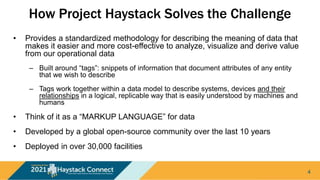
How Project Haystack Solves the Challenge
4
• Provides a standardized methodology for describing the meaning of data that
makes it easier and more cost-effective to analyze, visualize and derive value
from our operational data
– Built around “tags”: snippets of information that document attributes of any entity
that we wish to describe
– Tags work together within a data model to describe systems, devices and their
relationships in a logical, replicable way that is easily understood by machines and
humans
• Think of it as a “MARKUP LANGUAGE” for data
• Developed by a global open-source community over the last 10 years
• Deployed in over 30,000 facilities
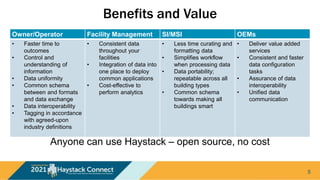
Benefits and Value
5
Owner/Operator Facility Management SI/MSI OEMs
• Faster time to
outcomes
• Control and
understanding of
information
• Data uniformity
• Common schema
between and formats
and data exchange
• Data interoperability
• Tagging in accordance
with agreed-upon
industry definitions
• Consistent data
throughout your
facilities
• Integration of data into
one place to deploy
common applications
• Cost-effective to
perform analytics
• Less time curating and
formatting data
• Simplifies workflow
when processing data
• Data portability;
repeatable across all
building types
• Common schema
towards making all
buildings smart
• Deliver value added
services
• Consistent and faster
data configuration
tasks
• Assurance of data
interoperability
• Unified data
communication
Anyone can use Haystack – open source, no cost
Enabling a Future Where a Push of a Button
Can Turn Device Data into True Intelligence
6
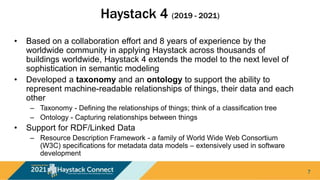
Haystack 4 (2019 - 2021)
7
• Based on a collaboration effort and 8 years of experience by the
worldwide community in applying Haystack across thousands of
buildings worldwide, Haystack 4 extends the model to the next level of
sophistication in semantic modeling
• Developed a taxonomy and an ontology to support the ability to
represent machine-readable relationships of things, their data and each
other
– Taxonomy - Defining the relationships of things; think of a classification tree
– Ontology - Capturing relationships between things
• Support for RDF/Linked Data
– Resource Description Framework - a family of World Wide Web Consortium
(W3C) specifications for metadata data models – extensively used in software
development
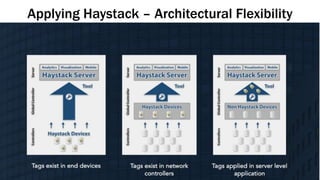
Applying Haystack – Architectural Flexibility
8
The Event
9
Haystack Connect
May 4-6, 2021
A global virtual conference
FREE for all attendees!
www.HaystackConnect.org
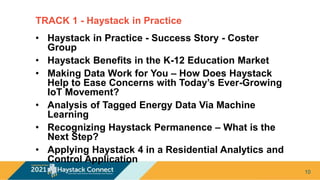
10
• Haystack in Practice - Success Story - Coster
Group
• Haystack Benefits in the K-12 Education Market
• Making Data Work for You – How Does Haystack
Help to Ease Concerns with Today’s Ever-Growing
IoT Movement?
• Analysis of Tagged Energy Data Via Machine
Learning
• Recognizing Haystack Permanence – What is the
Next Step?
• Applying Haystack 4 in a Residential Analytics and
Control Application
TRACK 1 - Haystack in Practice
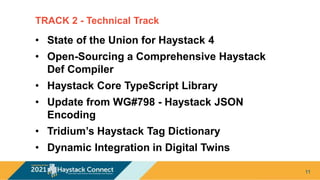
11
• State of the Union for Haystack 4
• Open-Sourcing a Comprehensive Haystack
Def Compiler
• Haystack Core TypeScript Library
• Update from WG#798 - Haystack JSON
Encoding
• Tridium’s Haystack Tag Dictionary
• Dynamic Integration in Digital Twins
TRACK 2 - Technical Track

Project Haystack - 10 Years of Bringing Data Semantics to the Built Environment!

  • 1.
    h PROJECT HAYSTACK 10 Yearsof Bringing Data Semantics to the Built Environment
  • 2.
    2 Making Data fromDiverse Systems Easy to Work With
  • 3.
    The Challenge 3 • Dataproduced by devices and equipment has poor descriptive information to define what the data means • Names can’t do the job • Manual, labor intensive processes are required to add semantic definitions to data before analysis, presentation and other value creation can begin • This barrier adds cost and slows the process of generating value from data • The Haystack community has been addressing this problem by developing a standardized approach to “semantic modeling” of equipment systems since 2011
  • 4.
    How Project HaystackSolves the Challenge 4 • Provides a standardized methodology for describing the meaning of data that makes it easier and more cost-effective to analyze, visualize and derive value from our operational data – Built around “tags”: snippets of information that document attributes of any entity that we wish to describe – Tags work together within a data model to describe systems, devices and their relationships in a logical, replicable way that is easily understood by machines and humans • Think of it as a “MARKUP LANGUAGE” for data • Developed by a global open-source community over the last 10 years • Deployed in over 30,000 facilities
  • 5.
    Benefits and Value 5 Owner/OperatorFacility Management SI/MSI OEMs • Faster time to outcomes • Control and understanding of information • Data uniformity • Common schema between and formats and data exchange • Data interoperability • Tagging in accordance with agreed-upon industry definitions • Consistent data throughout your facilities • Integration of data into one place to deploy common applications • Cost-effective to perform analytics • Less time curating and formatting data • Simplifies workflow when processing data • Data portability; repeatable across all building types • Common schema towards making all buildings smart • Deliver value added services • Consistent and faster data configuration tasks • Assurance of data interoperability • Unified data communication Anyone can use Haystack – open source, no cost
  • 6.
    Enabling a FutureWhere a Push of a Button Can Turn Device Data into True Intelligence 6
  • 7.
    Haystack 4 (2019- 2021) 7 • Based on a collaboration effort and 8 years of experience by the worldwide community in applying Haystack across thousands of buildings worldwide, Haystack 4 extends the model to the next level of sophistication in semantic modeling • Developed a taxonomy and an ontology to support the ability to represent machine-readable relationships of things, their data and each other – Taxonomy - Defining the relationships of things; think of a classification tree – Ontology - Capturing relationships between things • Support for RDF/Linked Data – Resource Description Framework - a family of World Wide Web Consortium (W3C) specifications for metadata data models – extensively used in software development
  • 8.
    Applying Haystack –Architectural Flexibility 8
  • 9.
    The Event 9 Haystack Connect May4-6, 2021 A global virtual conference FREE for all attendees! www.HaystackConnect.org
  • 10.
    10 • Haystack inPractice - Success Story - Coster Group • Haystack Benefits in the K-12 Education Market • Making Data Work for You – How Does Haystack Help to Ease Concerns with Today’s Ever-Growing IoT Movement? • Analysis of Tagged Energy Data Via Machine Learning • Recognizing Haystack Permanence – What is the Next Step? • Applying Haystack 4 in a Residential Analytics and Control Application TRACK 1 - Haystack in Practice
  • 11.
    11 • State ofthe Union for Haystack 4 • Open-Sourcing a Comprehensive Haystack Def Compiler • Haystack Core TypeScript Library • Update from WG#798 - Haystack JSON Encoding • Tridium’s Haystack Tag Dictionary • Dynamic Integration in Digital Twins TRACK 2 - Technical Track